What's Missing From This Message: Kathy Klotz-Guest's Application to TEDxSpokane
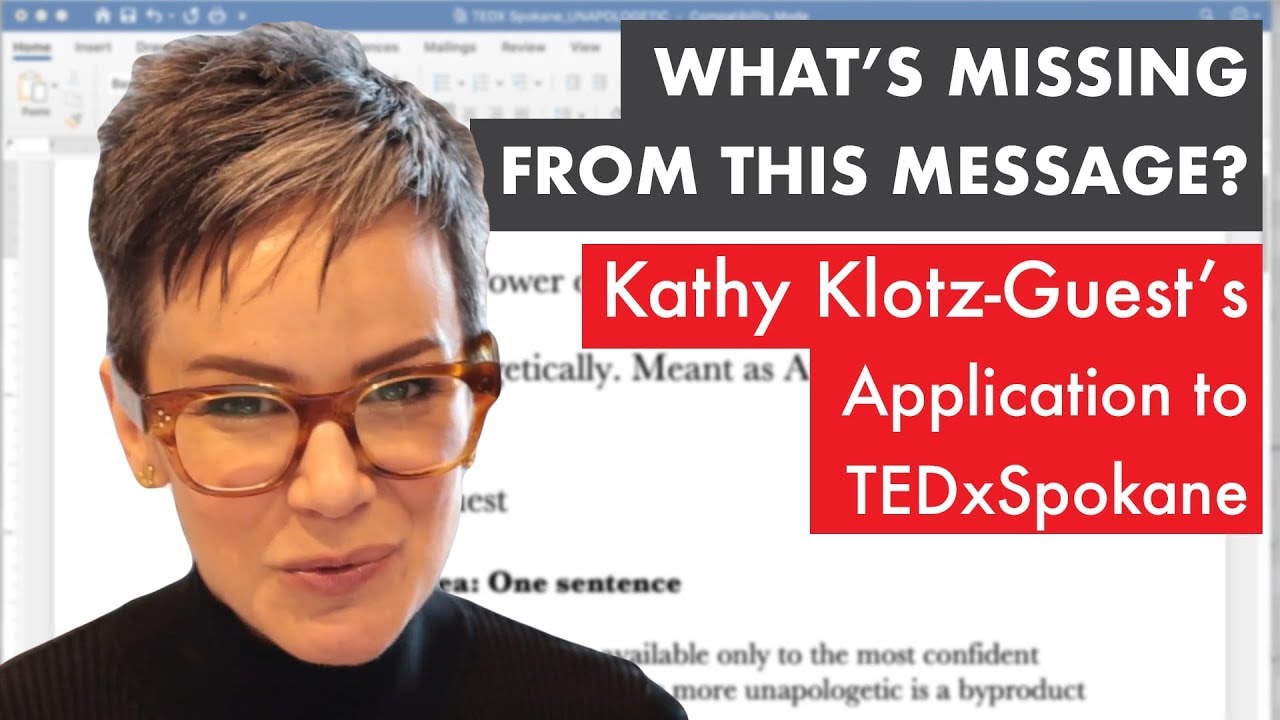
Tamsen Webster critiques Kathy Klotz-Guest's TEDxSpokane application, examining her title, core idea, and pitch. Webster points out where the narrative needs tightening, where specificity is missing, and how to make the talk feel more actionable and distinct.
Chapters
A lot of people want to speak at a TEDx so that they can get their big idea and their big message out into the world. Now, these TEDxs have applications, and those applications are an opportunity to make sure that there is nothing missing from your message because those applications are usually really, really short. This week on What's Missing from This Message, we're gonna look at Cathy Kluck's guest's application to TEDx Spokane, and we're gonna find exactly what will make her application even stronger— a strong narrative through even those very short answers that she has to give. Let's take a look at Cathy's TEDxSpokane application. She's calling it The Power of Being Unapologetic. That's a good, strong TEDx-y title. TEDx loves these, uh, really strong descriptive titles that have a little bit of mystery to them. The Power of is a, is a pretty standard structure for them, like The Power of Introverts, for instance. And she's got here The Power of Being Unapologetic. So I read that as the power of being not sorry about things. Uh, and in fact, that may be a— that might even be a smoother title, The Power of Being Not Sorry, because it, it It's a little bit more unexpected. It's a little bit more unfamiliar and yet simpler words than unapologetic. So a thing to consider. She's really talking about here, I think, about being, as she says, meant as authentically. So living without filters or living without being afraid to completely own and be proud of who you are. That's what I'm reading from this. I also know Kathy quite well. So I'm guessing. With the application itself, most TEDx applications have a series of questions like this, and a lot of times they're expecting you to answer these questions succinctly, concisely, clearly, interestingly. I mean, there's a whole bunch of stuff that they're looking to have happen in a very small amount of space. And typically they are, in fact, limiting your words or character count. So some of the things that I as an organizer always looked for was, did I get an answer to the question I was looking for? Did it make sense if I didn't know anything about the idea? Were there use of language that most people would understand? Was there something that was unfamiliar, unexpected, or obviously new about what we're talking about here? And importantly, though I don't know how many TEDx organizers would say this out loud, I'm actually reading to see how much you understand about what I am looking for as the organizer on behalf of the TEDx audience that I serve. So with all of that in mind, let's take a look at what Cathy's looking at. The first thing we're looking at here right up on top is the fact that she's got— they're asking for this one big small idea, one sentence. This is very, very common in TEDx applications where they want to see your big idea in one crisp, clean sentence. I will tell you that most TEDx ideas die right here because most people can't do it in one sentence or can't do it in one sentence that meets all the criteria that I just talked about. So, let's talk about what Kathy has here. So, she has as her one sentence that, "Being unapologetic isn't a power available only to the most confident among us. Rather, the confidence to be more unapologetic is a byproduct of small choices to show up and be seen." So, nice and clear. I, as an organizer, I might argue that the semicolon is the fusing together of two sentences that would normally otherwise be 2 sentences. So, um, there's probably some work she can do here to get this into 1 sentence. Um, but let's look at it through the lens of something that I want by a means I didn't expect, which is kind of my magic formula for a 1-sentence explanation for an idea. Um, so the, the first thing is that I don't see a result in this description, meaning I don't see something that I as an audience member or as an organizer am actively looking for right now. I don't know what she means off the top of the application about being unapologetic. Like I said, I know Kathy, so I'm reading into this, but I think somebody who is reading this for the first time would look at that and go, well, maybe I don't want to be unapologetic. Maybe I believe in being polite, right? So there's a danger here in the fact that it's not immediately clear what it is that she is offering, what, what question this particular talk answers. So if it's— I think there's some elements here because I think many people do want to show up as themselves, be seen and be appreciated as themselves. And so that might be a thing to move forward to say, to really focus on as the outcome of the talk. The other thing that's here is, okay, so if that's what I'm going to get from listening to this talk is a way to show up and be seen without having to be afraid or apologize for it, then I want to see something that I haven't heard before when it comes to what the part— what Cathy's approach is to doing that. Right now, that's reading as small choices, and I think those small choices are important, but remember that many TEDx organizers see things like this over and over and over again, and so we have to give a just a little bit more information about what those small choices are. So, I think there's real power in the fact that she's talking about being unapologetic. Given the fact that Kathy has a comedy background, there's a potential to play with this sorry-not-sorry kind of idea. And I wonder if the real idea of this is that the best way to show up and be seen is to be not sorry about anything that we show. About ourselves. So you see what I'm saying there, that what we're trying to do is get, get a, get an outcome that people won't recognize and want, and give some kind of twist on how you're going to get there. So I think the elements are here. I think we just need to surface them a little bit more strongly. Next question that they're asking her— oh, one other thing I wanted to say about this, that this description right now doesn't answer the, the promise of a title that says The Power of Being Unapologetic, or the The Power of Being Not Sorry. Um, the— this is— it sounds like it's more of, um, how to gain the confidence, not a talk about where the power of being not sorry or being unapologetic comes from. So I would encourage Kathy to make sure that those two match up, that we want to make sure that the title matches what the idea is. That's not a huge deal. That's not— as far as I'm concerned as a TEDx organizer, that's not a deal killer. But that's just a thing to look out for is to make sure that your title matches what the, what the idea is. Okay, let's move on to why am I passionate about it. So this is where the organizers are trying to figure out what your connection is. I will also tell you that subtly they're trying to suss out whether or not that you are trying to use this for your own personal gain. Um, and depending on how they ask that, it either is or is not, uh, a more obvious thing that they're trying to find out about here. Most of the time, I think TEDx organizers really do know, want to know why you're passionate about it. And more often than not, they're looking for that personal connection to the topic, that this is a— this is an idea that you can't not talk about, uh, rather than just one that you think you should talk about. So to that end, it's a really powerful opportunity for you to tell a story about yourself if you're given the characters and if you're given the words. I mean, keep it to be a short story. Um, so this is my example here with, with Kathy is that she's got that element. She took— it took her years to choose herself even while being scared in order to show up more unapologetically. Little choices over time transformed her confidence, her relationships, and her ability to be more fully seen. For me, I want that for us all. This is one of those opportunities we've talked about before where even though it's about you and the next question is about the audience, it's— I would suggest she flip this a little bit and say many people experience this state, like where they feel like they can't be seen, they feel like they're going to be punished for who they really are, who they really want to be. Um, and the, the— by flipping that and starting with that, then you're really speaking more to the organizer and the audience. And then coming out from that and say, well, that was me, or that was an experience I had as well. This is another place where I would love, if she's got the word count or the character count, to be a little bit more specific. So What were those little choices over time? What were those things? Tell me how you're getting there, because between this and the first answer with these small choices, I don't really have a sense of what these small choices are. Now, the danger of that is what we're left is what I often refer to as what could be perceived as a fear and baby steps talk, where the big barrier to getting what you want is that you're afraid of it and that the answer is that you take little baby steps. To solve it. That's a very common theme in ideas and talks, and I know that that's not what Kathy's talking about here. So I want to make sure that she's adding those kinds of specifics that make sure that it doesn't get read that way. So, um, I think the passion piece is important, and I think I like where she's going with it. Just a little bit more specificity, both about her personal example to that— be vulnerable, be not sorry, be unapologetic— like, show me that you're doing exactly what this talk is about, um, both about your connection to it and about what those small choices are. Next question that Spokane asks is why others should care. This is, we all want to be fully ourselves. Many of us make painful choices daily about how much of ourselves we show and to whom. That makes us less free, less happy, more invisible to others who might be our people. So I know that I said before that we want a little bit of this in the previous answer, as counterintuitive as that is, and that means that forces a little bit more thinking about a deeper deeper application about why others should care. I love what Kathy's saying here. I think she's got a great, great perspective on it, and that this is a source of pain for a lot of people, and Kathy really wants to address that pain through this potential TEDx talks— through this potential talk, excuse me. So the one thing in here that I think would make that stronger is that I don't know what our people means. So, without any context, other places in this answer, and again, I know she's constrained by space, it comes off as this new note that I don't know what it means. And those little things are the little things that will get an organizer who's reading a ton of these to go, "Well, I don't really understand, so I'm not gonna read it," or, "We're not gonna move this forward." And when I know there's an idea as powerful as Kathy's is here, I would hate to see that happen. So here's what I would suggest. Move some of this, we wanna be fully ourselves piece up to why she cares, because that's the surface first thing that most people would care about. And then when she's answering this question, why others should care, I think this is a point to develop that our people point a little bit more. It also allows her to continue a narrative through the first, through the first couple of answers through this one. And that's important. Remember that the organizers are reading it as a narrative document. So the more that you can tie these answers together, the stronger this application is going to be. All right, next question: what the audience will take away. People who show up unapologetically aren't necessarily born not giving a mm about what others think. Instead, many of us gained unapologetic confidence over time in the smaller, vulnerable decisions to let part of ourselves be seen. It's possible for us all. So Couple things here. One is that this is still assuming that people want to be not sorry, and, and then, and that's because that's how it's written, show up unapologetically. And I think that there's just, that's one of those places we're flipping some of the language there and anchoring it more on that commonly accepted goal right now of showing up, being seen for who we are and appreciated for that, is important. I think that if the big point of this talk is that it's possible, I'm not sure that that is, that's as strong as this could be. I think we wanna be able to practice that. So if there's an opportunity for Cathy to be able to say that she's gonna do something in the talk that shows people that it's possible for them, that would make this even stronger. Just because just hearing that it's possible doesn't always make people realize it's possible for them. And, and a real focus for TEDx Talks is— and TEDx organizers— is making sure that the audience feels like they can do something for themselves. That's much more likely to have that idea spread, as we talk about. The other thing that I want to point out about that point right now is that as written, as this is— that it's possible, that, that we want to do this, and really it's just small steps that get in the way. It makes me wonder if, if there are other talks already out there in the TED or TEDx universe on not being sorry, or unapologetic, you know, not being unapologetic, or being authentic, or those kinds of things. This is a piece of advice I would give to anybody wanting to apply to a TEDx. Is do the research to find out what else is out there already so that you can position your idea sharply against what's already there. Because remember, this idea is hugely important to you, and it is the thing that you have been focused on if you're thinking about doing one of these talks. But these organizers see hundreds of ideas, not just the ones coming in for their own organization and their own event, but also for across all the things that they're looking at, all these other TEDx ideas, all these other things that they're reading, all the things they're reading all the time to curate. That's why it's so important when you've got a great strong idea like Kathy has, is to make sure that you're doing the work to get the specifics in there that allow the strength of that to really, really shine. Let's take a look at the fourth question. This is a new one to me. I haven't seen this on a TEDx application before, a long-term community outcome. She writes here that so much pain and unhappiness are caused by reducing ourselves to fit in. That renders our true selves invisible. Imagine the ripples of transformation at work, in our communities, and in the world if we showed up more unapologetically to be seen and to see others. So I think where she's going with this is that there are, there are effects beyond just our personal experiences and our personal world when these barriers exist between us, when these barriers of constantly being, questioning whether or not one should apologize for who one is. And Kathy, I know, based on what I know about her, knows that there's huge power in owning that and in having that bravery and having that willingness to come forward and be yourself and the effects that that can have. I think that there's opportunity here to make this even stronger by focusing on that second ripple more, meaning it's less about just, hey, what if we get seen, but that there's important things that happen in our community and in our society when people self-censor, when there isn't somebody out there being unapologetic that gives us a standard bearer, as by the way Kathy absolutely is, that there's— that, that we lose something as a whole, not just individually, but as a society, when we don't get to hear all voices simply because they want to make sure that nobody gets offended. Which, by the way, being offensive might be a fun, fun twist on this as well. So I don't know. But, um, so the bio here, this is a— this is— I love Kathy, she's fantastic. Um, and the bio I think is a good standard piece. We've talked a lot about bios before, so I'm not going to focus too much on this one, but let's make sure, well, when we're reading it, that it, it speaks to the things that she's talked about so far. So she's leading off with the fact that she's a former Silicon marketing— a Silicon Valley marketing executive and a trained improviser. She combines business and comedy backgrounds to help people unleash more of their creative superpowers. So this is one of those places where, uh, she hasn't talked about creativity elsewhere in the, in the application. And so I would unleash more of their— put something in there that really speaks to the idea she's talking about here. Um, her clients include Cisco Systems, Amazon, and Kaiser Permanente. Um, I think that that's— I think that that kind of credit— credibility and credentials— important, works really well. Uh, she's a founder of Keeping It Human. Uh, she's— I love these additional credentials that she's put in. Uh, Uh, she's— she— her book has been a must-read for chief marketing officers. Again, this is reading a bit more like, uh, the bio that would be suitable if, if, if Kathy was speaking at a marketing conference. And so I'm wondering if there are other things that she can pull from her background in this paragraph, or other ways to position what she's talking about here so it more directly focuses on the, her credibility to speak about that particular topic that she's, that she submitted. Uh, her credentials are incredibly impressive— her MA and MBA from Stanford and Berkeley, um, where she studied for comedy. And, uh, so she's got this. And then that last little bit of, of personality where she's thrilled her 11-year-old still thinks that she's funny, um, and performs. So this is one of those things where I know it's hard, super hard with these applications when there's, there's so little space. But this— we— because there's so little space, that's, that's why when you're writing it, anyone's writing this, we need to make sure that as much as you can, you are tying that narrative through every single short answer. That is the best way to keep your application strong, and in this case, make sure that the strength of your idea, which is already so great here, really, really shines through. My thanks to Kathy for submitting her TEDx application, for getting some women here on what's missing from this message. If you have a short-form piece of content that you want to see what's missing from it, email me at redthreadme@tamsenwebster.com. If you're enjoying this, don't forget to subscribe.










