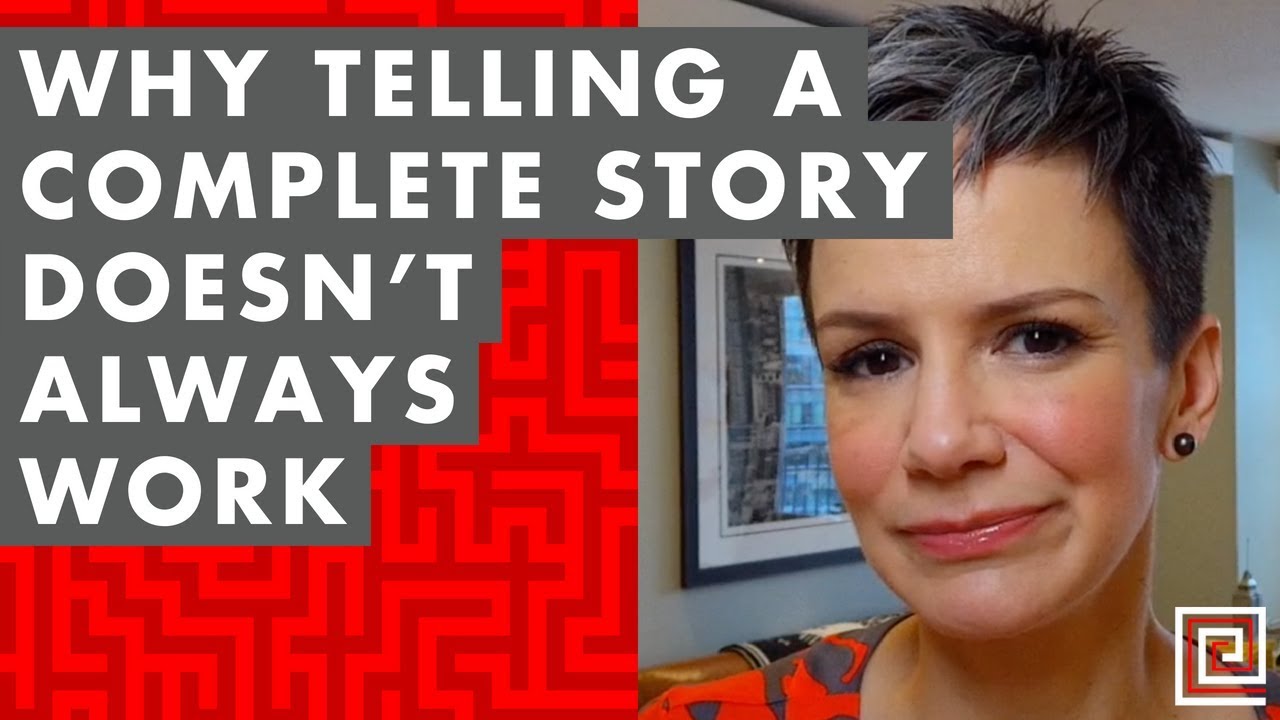
Tamsen Webster explains why fully resolved stories can backfire in marketing: listeners can't see themselves in a completed narrative. She recommends using in medias res and pairing case studies with open-ended stories that invite the audience to imagine what happens next.
Chapters
We've been told a lot that in order to drive action, in order to make our messages more compelling, we need to tell more stories. But there was a lesson I learned back in the days that I worked for nonprofits about the kind of stories we can tell. And the mistake that most of us make? We tell a story that's already over. I'm Tamsen Webster of TamsenWebster.com, and that's what we're talking about this week on Find the Red Thread. See, this trend towards storytelling in business isn't new. It's been around at least as long as I've been involved in marketing communications, and that's about 20 years now. See, it's one of those few places where the nonprofit world, I think, actually led the rest of the industry because nonprofits have been talking about stories for a very long time. Specifically because stories turned out to be a very good way to get donors and potential donors to understand the impact of a gift. Or when I worked at a performing arts college, it was a great way to see potential students see the impact of an education at that particular college. So these stories were really important. But there was something I noticed about which stories were more effective than others. And pretty counterintuitively, it was the stories that were already complete that just weren't quite as effective. Why not? Because in order for someone to act on a story, they have to see themselves in it. And a lot of times when we tell a complete story, The story feels done over and not relevant to the person who's hearing or reading it. But thankfully, there is a literary technique that we can use. Have you ever heard the term in medias res? It means in the middle of things. And a lot of stories, a lot of classic literature starts this way. You start right in the middle of the story, not once upon a time, but you start right with somebody already on a train and something happening. And I want you to think about this in terms of how to flip your stories around a little bit because you wanna make sure that the people that you're talking to, the customers that you're reaching out to, the audiences that are listening to you, that they really see themselves in the story, not just as a participant and a casual observer, but as someone who can make a difference, as someone who can do it too. So does that mean discard the stories of things that are complete? Of course not. They're very helpful to make a conceptual idea concrete. That's one of the reasons they're so effective. And stories are also the way that we encode information, and that's why the Red Thread is essentially based on it. But look for opportunities to say, "And this is what you could do too," and point out to people what the next steps could look like. So for instance, if you are trying to raise money for your business or for your organization, Show them what has happened, where other donors have gotten a certain initiative, but then make it clear that there are other steps still to be taken and what those things look like. If you're not raising money, that's fine. If you're trying to get someone to take an action on the message, then you can say, "Well, this is what some people did, but this is what other options could be. These are the other things that you could do too." That allows them to see what the potential action and effects could be. But it also allows them to have the choice to figure out what's gonna make the most sense for them. So stay with the stories, but think about combining completed stories, which are also known as case studies, by the way, with stories that have an open end, a stories that your audience, your customer, your prospects can find themselves in and figure out how to choose their own adventure to complete. I'm Tamsen Webster of TamsenWebster.com. If you enjoyed this episode, please share it and consider subscribing to my newsletter. I'd love to have you on my list. I send out these videos every 2 weeks, as well as a collection of some of the research for the swipe file that I keep, a collection of news, interesting stories, new studies, all sorts of ideas for things that you can use in your own messages and presentations. Thanks so much for watching and listening. I'll see you next time.