"Building Artists Through Music & Mentorship" Pavlina Dokovska on Pedagogy, Leadership, and...
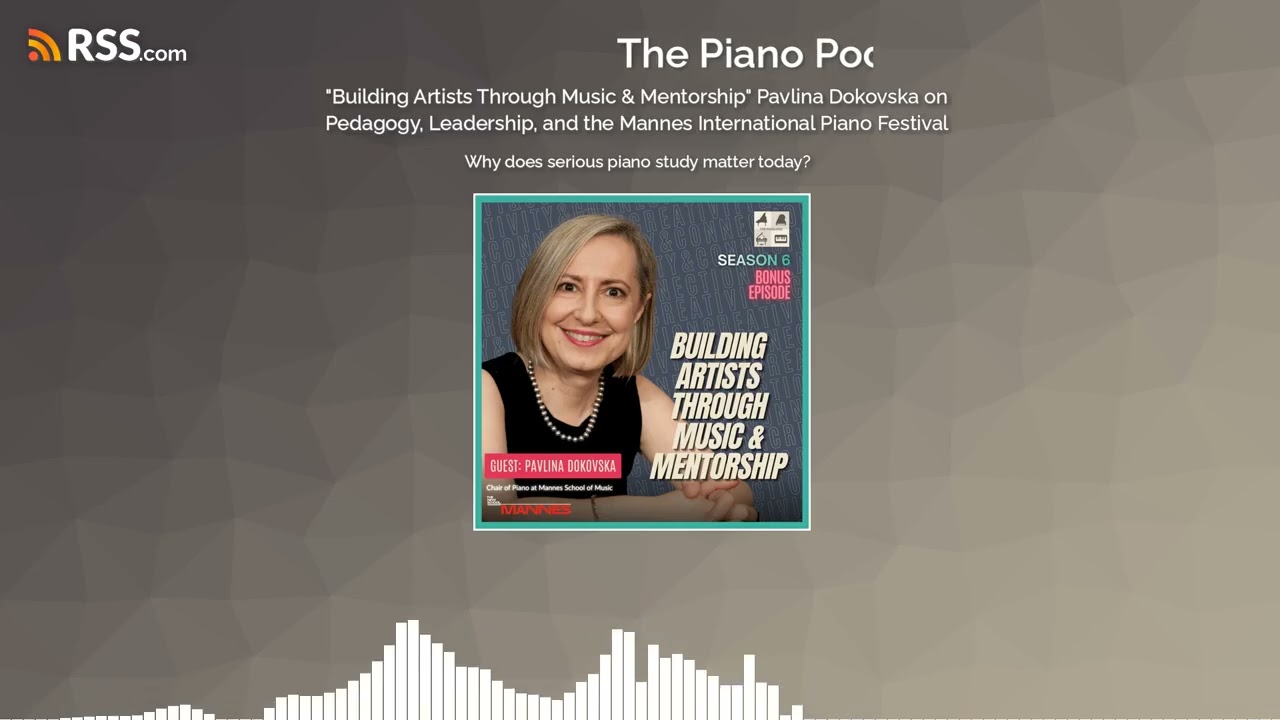
This content was created by The Piano Pod with Yukimi Song. This content was uploaded by The Piano Pod with Yukimi Song. This is a YouTube episode titled "Building Artists Through Music & Mentorship" (The Piano Pod) posted March 25, 2026. It is an interview-style podcast episode in English featuring Pavlina Dokovska (international concert pianist and chair of the piano department at Mannes School of Music) with contributions from Mannes graduate student Jiwon Yang and the show host(s) of The Piano Pod. The conversation focuses on pedagogy, the value of sustained piano study, community and mentorship, details about the Mannes School of Music and its piano department, and the Mannes International Piano Festival (two-week July session, ages 16+, scholarship support, faculty and application information). The episode includes practical festival logistics, student experiences, and calls-to-action directing listeners to links in the show notes.
Chapters
Hello everyone and welcome back to The Piano Pod.
Today's episode is a special bonus conversation created in collaboration with Mannes School of Music at The New School. Do you remember last October? The Piano Pod partnered with Mannes Prep for its very first live edition. It brought together members of the Mannes community and beyond, and the energy in the room was remarkable. The audience leaned in, asked thoughtful questions during the Q&A, and stayed long after the event ended to continue the conversation. That experience, rooted in live performance, dialogue, and genuine exchange, clearly resonated on both sides. The momentum opened the door to today's episode, one centered on artistry, pedagogy, and the long arc of piano study through the lens of an artist who has shaped generations of musicians. This season, we are exploring Creativity and Connection, highlighting artists and institutions who are building community while reimagining the future of classical music. Today we explore what it truly means to build artists through music and mentorship. I am thrilled to welcome Pavlina Dokovska, internationally active concert pianist and chair of the piano department at Mannes School of Music. For decades, she has shaped generations of young artists through through a philosophy grounded in rigor, humanity, and a deeply family-centered approach to teaching. Her perspective, rooted in performance, pedagogy, and institutional leadership, offers a rare and valuable lens on serious piano study today. In our conversation, we discuss why sustained piano study matters now, how artists are formed through mentorship and community, and how these ideas intersect with the Menace International Piano Festival, an initiative that extends the department's spirit into an intensive summer gathering in the heart of downtown Manhattan, one of the world's great cultural centers. We are also joined by Jiwon Young, a current graduate student at Mannes and recent first prize winner of the Concerto Competition. Through her perspective, we glimpse what it is like to study and grow as an artist within this vibrant musical community and how mentorship translates into artistic confidence on stage. If you are watching this episode, be sure to like the video. It truly helps this show grow and reach more listeners. If you're listening on audio, please subscribe and leave a review. Your engagement sustains this growing community of artists and thinkers who are reimagining what classical music can be today. Here is The Piano Pod with Pavlina Dakovska.
Please enjoy the show. You are listening to The Piano Pod, where we talk to the brightest minds in the industry about how they are bringing the piano into the future and thriving in a complex, ever-evolving world. Pavlina, welcome to The Piano Pod. It's such a pleasure to have you today. Thank you so much for being here.
Thank you for having me. It's a great pleasure for me too.
No, thank you. And so before we dive in, I want to briefly return to that moment last fall. You know, collaborating with Mannes Prep at Stiefel Hall gave me a window into the Mannes community at the New School, how deeply people are connected and how state-of-the-art the facilities are and how uniquely situated it is in downtown Manhattan, connecting the East, West Villages, and the historic Greenwich Village neighborhood. It's so wonderful. And what struck me most was seeing, you young musicians, some as young as 5 or 6, in the prep and sharing the same building and musical environment with college-level, postgraduate-level students from Mannes, all learning and making music under one roof. And today I'm speaking with you in your role as chair of the piano department at Mannes School of Music. You've been teaching there for how many years?
30. Oh, wow! And I have been chairing the piano department since 1998. And since 1999, I started the now very well-known Mannes Sounds Festival, which takes the young talent of Mannes and later on of the College of Performing Arts, School of Drama, School of Jazz, all over the city of New York at some of the most prestigious concert venues, including Weill Hall, Carnegie Hall, many cultural centers, consulates, Steinway Hall, museums. So, Manus is all over.
So, what has kept you committed to this particular musical community for so long?
I feel very, very passionate about Manus. When I was invited to give a masterclass for the first time as a performing artist, you know, performing artists are invited to give masterclasses. And I was asked for a first masterclass to give in 1996, and then again in '97, two classes in a row. And then I was asked to be hired. And ever since I went into Mannes and I met colleagues, I met students, I felt the whole atmosphere. It's a very special world. It's a very family-like school. Students, parents, not only parents because we had in the college, we have international students, but faculty, patrons, we all are feeling like we are a family. That's a— this is one word that always comes to mind when I say Manus.
Wow, beautifully said. So with your expansive career as a concert pianist and decades of experience as a pedagogue and chair of the piano department, I'm curious to hear your perspective. Why does serious piano study matter in our current musical and cultural moment?
I would like to share with you a great quote by the writer E.T.A. Hoffmann, who inspired many composers including Schumann, Brahms, etc. He said, "Music is the most romantic of all arts because its subject is the infinite. Music discloses to man an unknown realm in which he leaves behind all definite feelings to surrender himself to inexpressible longing. So this sentence, this quote from Hoffman always lives with me. I always share it because in one sentence he describes the magic of music. Music indeed takes us to a very extraordinary place of the mind, of the emotions, We are, as performers, as students, as listeners, as audience, we're making the same intellectual and emotional journey as the composers did, and we're living the life of geniuses, you know, to go through the emotional and intellectual journey of Beethoven, Mozart, Schubert, Chopin, Prokofiev, Schoenberg, and now contemporary composers. This is an extraordinary privilege, and it makes our own life richer because we are involved with their rich world. And when we speak about the importance of young people to study music, This is one very strong and important point. Their life becomes richer, their values become different, their knowledge is, is very, very— becomes very broad.
Why?
Because you cannot be performing the music of, let's say, Chopin or the music of Prokofiev unless you understand the world they lived in unless you understand the history, the culture, the arts of that period. So anyone who studies music and studies it in the right way becomes a very well-rounded person. And because of that, also becomes a better person. I strongly believe that music is extremely important in the— by— when we educate the young people. It also trains concentration, discipline, the ability to express yourself, the ability to connect to audience, and not only audience, it makes you a freer person because it teaches communication. And these skills can serve you very well regardless what your profession later on will be. Music and arts have to be part of the education. The same way, you know, math, it's not a matter of choice. Students have to study math. They have to study English. They have to study other languages. They have to study music. They have to study arts, humanities. It's actually a beautiful world word which we say about humanities, that it's part of studying humanities, music. This brings out our humanity. There is a reason why it's called humanity.
Yes, absolutely. Wow, that's a really powerful statement. Thank you so much. So, you know, I think my audience should get to know you better, and I've been listening to your album Music of Tribute Debussy, "O Morning," and it's a, you know, homage to Debussy. And then I heard several different composers, pieces by composers as well, and then your performance was just so incredible.
But so how your musical journey began and the path that led you to an international performing career, I would like to know.
You grew up in Bulgaria, right?
Yeah, I grew up in Bulgaria. I had extraordinary teachers. My first teachers, I will be always very, very grateful. Lydia Kutova was the one who really put me on a path of professional career because I started performing at the age of 11, my first performance with orchestra. Then I studied in the conservatory with, uh, Julia Konstantin Ganev, who were very privileged to study with Henrik Neuhaus, one of the greatest teachers of all times in Moscow. I also spent several summers with the great performer and teacher Yvonne Lefebvre, and I worked with her on French music. I won the Debussy competition there, and then I came on a Fulbright scholarship to the United States. Studied with Beveridge Webster at the Juilliard School where I got my master's degree. Um, in the meantime, I also won a competition in Senegal, and, um, while I was actually already at Juilliard, I had a management. I was performing already in Europe, and, um, then I started performing in the United States through another manager. So I would spend 6 months in Europe touring, 6 months in the United States touring, in Asia, Mexico, etc. So I was very fortunate to experience that, and I was very lucky also to collaborate with extraordinary musicians, instrumentalists, great singers from whom I learned a lot. One of them was Nikolai Gjelov, one of the greatest bassists in the world. Mirella Freri. I have worked with Nathaniel Rosen, the great cellist, recorded with him. Robert McDuffie, the great violinist. So this is briefly what my life as a performer was. And Being fortunate to study with great teachers, I knew that I have a calling for that. I felt I had calling for that because I, I really connected and learned from them not only about music and playing the piano, but also how to communicate your knowledge. To people. And as a performer, I was many times invited to give master classes. So for me, this was a calling. And when I started working at Manus, it became one of my missions. And I'm very happy and I'm very grateful that I had this opportunity to start sharing my knowledge in a very big, consistent, profound way with the future generation of pianists. And we have real stars who follow the path of graduates of Mannes, like Murray Piraeus, you know, Richard Good, So we have extraordinary musicians who came from Mannes and alums of Mannes, and they are performing, whether it's Natasha Paremsky, whether it's Ri Tetsov, whether it's Daria Rabotkina, Angelina Gadelya, Vladimir Rumyantsev. The list is very long, and I actually today I just got a text message from my former student, Rui Tetzlaff, who has a wonderful career and at the same time doing his doctoral degree at Peabody with Richard Good. He just texted me with a program for his performance, from his performance in Florida. It is a very big, big concert series. And he said, and guess what, Natasha Paremsky also performed there. And so I saw the list of these two students of mine, former students, and I was so, so proud to see them performing actually on the same series. So Manus is all over.
Wow. So with the decades of teaching there and you've seen it all, you know, you've experienced it all, I'm sure. So from that point of view, what does it mean to train pianists, young pianists, as complete artists in this modern world?
It is an interesting question because on one hand, we as teachers need to follow the tradition of great teaching of the past. Because these teachers were truly phenomenal. When we go back, back all the way, Clara Schumann, Leschetitsky, the list is very long. At the same time, we live in very different times. We live in stressful times, and it is very important to provide all the support the students need in order to continue pursuing music, not to be discouraged, not to be distracted by the many distractions in the world today. And to really approach every single student for his or her uniqueness. Teaching piano is about connecting to individual students. You don't teach the same piece the same way to, to every student. Otherwise, you make recordings about how to teach a piece. Every student has their own knowledge, broad or limited, imagination, and you have to reach out to them depending on it. And while communicating the necessary knowledge about the composer, you go to the student depending on their needs, also pianistic. Some, some students have not only different hands but different level of pianistic technical abilities. So you have to address that. And therefore, teaching is a something which is requires tremendous sense of responsibility, tremendous understanding about giving, and, and real love for the student. You have to love your student, because if you don't connect with love there is always a barrier. The students feel where they're welcome, where they're embraced with appreciation. I always say to my students, the purpose is to— I mean, perfection is not possible. We just try to do the best we can at the given moment. And there is no place for frustration or anger with yourself. You just love music, give what music is needed, and appreciate every little progress you're making. Whether at 3 o'clock you, you were able to master, uh, 4 measures of something, you have to be happy. So music making is about being very happy within the process of making music. If you don't have that state of mind, you cannot enter the world of these great composers, because music was born out of love, passion, and sense of liberation. You're feeling liberated when you put down on the piece of paper the music. Therefore, we as performers have to experience that passion, that sense of liberation, the happiness that we can make music.
Well, thank you.
Well, that's powerful. Now, so you've been telling me this, the word, this community, quite a bit today. So what role does community play in supporting artistic growth and long-term development?
Community is very important. Family is very important. Your friends are very important. The audience that you, you try to also, you cultivate your own audience is what today also The artists have to develop ability to promote themselves, to attract audiences. This is something that also at Mannes is being taught, entrepreneurship.
Yeah, that's wonderful.
You have to be able to market who you are because We live with the technology in the world that makes it possible. Before, the artist was counting only on a manager, what the manager was able, the impresario was able to do to get you performances. Now, the young people have the ability to promote themselves and they should.
Let's talk about Madness, right? So can you give us a brief overview of the School of Music at The New School, so Mannes, and the role that piano department plays within it?
Well, as we know, the piano is an instrument that everyone, whether you play violin or cello or winds or singer, you need to know to play somehow piano. And also, the piano department is involved in supporting the other instrumentalists and the singers. So, um, we have chamber music, we have classes which teach our students how to work with singers, how to work with instrumentalists. The piano department is very, very strong, and I'm very proud that Mannes, as of 2024, became the only conservatory in New York to meet the criteria for an All-Steinway School. So we have extraordinary— pianos, and the students have the opportunity to play on great instruments. The piano department is— because of, because of the prominence of the piano department and the success that Mannesounds Festival has had during the 27 years, I— this led to my idea to start The Mannes Piano International Piano Festival, which we started in 2024, the year when we became an all-Steinway school. So, um, this is another important contribution that the Mannes Piano Department is giving to the world, to the world of music, because it's an international piano festival. We bring in students from all over the world. We have international faculty. In addition to the Mannes faculty. So the month of July is a wonderful month which spotlights the great accomplishments of the piano department.
Wonderful.
So the Mannes International Piano Festival that you mentioned, so let's talk more about that. So it takes place exactly at where you are? At Mannes School of Music.
Also, and also at— we, we, we are part of the New School. We collaborate, as I mentioned, with the Mannes Sounds Festival. We collaborate, collaborate with the School of Jazz, School of Drama, with Parsons School of Design. I have created fantastic events with Parsons also, including partnership. So now we have an event which also includes some students from Lang. It's Leo Tolstoy and Music on February 24th. So, um, the campus of The New School is wonderful, and we use some of the great facilities, the great halls of The New School, because we are part of it.
Wow, that's wonderful. So how long is the festival for, especially for this year? When is the start date?
Festival, since, since we started in 2024, is, uh, 2 weeks. Um, students this year would arrive on the 12th of July and through July 26th. And, um, this is a very intense period when they have private lessons, when they have daily performance workshops, There are lectures, there are presentations, there are showcases where all pianists play at the end of each week. We have a wonderful competition which gives cash prizes for a second, third prize, and honorary mentions, and we have a great concert series featuring the new generation of outstanding pianists.
Wonderful.
And so what are the age groups for this festival?
We, we welcome anybody from the age of 16 on, and exceptions are being made for exceptionally talented students under the age of 16. Of course, they have to be accompanied by parents. There is a process, you know, they have to apply, they have to send their recordings. We listen to these recordings, we make decisions. We also are very generous about scholarships. For the last 2 years, we have given about $30,000 in scholarships.
So, uh, wonderful.
This is— everyone who has been part of this, this festival has left very happy.
Great. Now, can you introduce us some of the core faculty members or maybe guest artists for this year's?
Of our international piano faculty, Hyunjun Chung, one of the leading pedagogues and performers of Korea, South Korea. Yun Sun, a professor in Shanghai who happens to be also an alumna of Mannes. Wonderful pianist and great teacher, very well known in China and not only. We have Ronan O'Horah from the United Kingdom and Graham Scott from the United Kingdom, both prominent pianists and, and teachers. So as far as Manus Faculty, we have great stars who are joining the faculty. Enshine, legendary Enshine, um, Eterian Giaparizze, um, Vladimir Valyarevich, um, Irina Morozova, Simona Dinnerstein. We have about Thomas Sauer, Jerome Rose, I mean, the list is like 15 people. Uh, Gustav Oppenshäuser, each and every one of our faculty are recognized worldwide.
Amazing.
So what do you hope participants carry forward beyond the festival, both artistically and then personally, you know, by participating this festival?
We hope that they learn, uh, a lot, that they enjoy their stay in New York City. I must say that this festival is the only large-scale piano festival in New York City, and so when you come and you study piano, you also have the ability to go to the Metropolitan Museum, to the Frick Museum, to the Museum of Modern Art. There are so many museums, there are so many things happening in New York City. I also would like to mention another very important aspect that we're very proud of. We, we are providing for the students unlimited number of hours for practicing. So many festivals internationally and U.S. festivals, you know, they give you 3 hours to practice because facilities are limited. Our students can practice.
Really?
Yeah.
Yes.
So, so we won't limit the number of hours. Of course, at night they have to sleep. Right.
That's right. Wonderful. So now we'd like to hear from Jiwon Yang, a past Mannes International Piano Festival participant and a current Mannes graduate student. And before we hear from her, her perspective, Pavlina, could you tell us a bit about Jiwon? What qualities stood out to you as a developing artist?
Jiwon is absolutely an exceptional pianist. And she auditioned only at METS. She did. She, she felt that this is the place she wants to be. She studies with me and with Richard Good, and she won the third prize in Van Cliburn Junior. She has, she has a large list of competitions, and the last one was the third prize at the ARD Munich International Piano Competition, which is one of the biggest ones in, in the piano world. So she's a very accomplished pianist, and she's also a great collaborator. She She plays a lot of chamber music. She is a wonderful person and she felt really in love, she fell really in love with Mannes. So when she finished her undergraduate study and it was time to apply for graduate studies and I asked her, where are you going to apply? She said, I I don't want to go anywhere else. I'm going to stay at Mannes. And now she, she's going to be auditioning also for Professional Studies Diploma. So she'll be 8 years at Mannes, nurtured by a wonderful atmosphere, her colleagues, great teachers. She takes collaborative piano classes. She with Professor Stanescu, she— Professor Novacek, she studies chamber music, she studies with many people, Brandon Meyers. She is spreading her wings, and I'm very, very happy with what she has accomplished and the kind of person she has become.
Now we're joined by Jiwon Yang, a graduate student at Mannes School of Music and a participant in last year's Mannes International Piano Festival. And before we begin, welcome, Jiwon.
Thank you. Thank you for having me.
Thank you. And I want to start with a huge congratulations. You just won first prize in the George and Elizabeth Gregory Concerto Competition at Mannes last night.
Yeah. Wow.
So, so it was a final round last night?
Yes. So we had the 3 different rounds for this whole year. It started In the fall semester of 2025, we started the prescreening round with the videos and then to the semifinal round, which happened like last November. Then 5 finalists got to play last night with a second piano accompanist. We have 3 pianists, 1 percussionist, and 1 violinist. So it was a very huge night. It was—
Wow. Really, I'm very, very happy for you and what a great achievement. So as a first prize winner, what will you receive?
So, well, I got an opportunity to perform with our school orchestra soon.
The date will be released soon.
And also the cash prize.
How much?
It was a $4,000 cash prize. Oh, my goodness. And also the very, like, I would say, personal growth. By playing in front of the audience. I mean, it's a very, like, a big privilege to play in front of the audience the whole concerto. As I played Tchaikovsky's First Piano Concerto, it was actually like the length of 40 minutes, so it was actually huge. So it itself was already a great experience for myself. And also my pianist who accompanied me was, uh, well, himself, I would identify him as orchestra. He was amazing playing with me. With him, I was very confident on playing.
So, oh, wonderful. Congratulations once again. So for our viewers and listeners who are just discovering you, you know, could you briefly introduce yourself? Where you are originally from? What you are focusing on in your graduate studies? And then what has shaped you artistically?
So, well, basically first I'm based in South Korea, Seoul. I just moved to New York City and it's my first time living in the States abroad alone. It's been 6 years already, so I kind of feel like this is my second home. And as I'm a student at MADIS for 6 years already, because right now I'm pursuing my last semester, final semester as a master's degree student. But I was a graduate of undergraduate here as well.
So my most focus is obviously a solo pianist. I really perform everywhere. Since I was like a young girl, I was traveling a lot for international competitions and also performances. By that, I try to expand expand my perspectives and my growth as a musician, which one of my goal at last, it's to be able to, well, travel everywhere to perform, share my music with people around the world. So that's what I am working currently now.
Okay, I'm just curious, what has kept you at Manus from your undergraduate till now, what kept you for a long time?
So it might sound very obvious, but really one of the only— even the only reason is my professors. I currently study with Richard Good and Pavlina Dukovska. They are wonderful people. I, I'm always honored to be their students.
And it was the major reason I also came to MADNESS. But not only the professors, but like the community here at MADNESS are really amazing. Like, as I'm staying here for almost 6 years, it's actually 1/4 of my whole life.
And all the communities, all the other professors, all the other community— I mean, all the faculty members, my friends friends, peers, they're all really amazing, I would say.
I kind of imagine like if this is gonna be the same if I was in other place. That it really means a lot to me here at Mannes.
It's a wonderful, really tight community there. So today you're here with us because you participated in the Mannes International Piano Festival, I believe last year, And now in its upcoming summer would be the third year. And so I'm just curious what attracted you to apply last summer and then what specifically drew you in?
Yeah, so first of all, I actually attended both first and second year of Venice Summer Festival. So when I first heard that this is going to happen, I was very excited, not because it's gonna happen in our school, but I believed my professor Pavlina Dukovska, who's actually in charge of everything, she's the chair of everything.
And not only that, but because even during the school years she has been in charge of an event called Manas Sounds Festival, which happens every year. She curates all the performances, not only in our school but everywhere around New York City. So students have an opportunity to perform in many, um, big, uh, big venues including Carnegie Hall and, um, Steinway Hall in New York City. So when I first heard about this news that this new festival is gonna open up, I had no doubt that this is gonna be a really great privilege to to all the pianists in the world to be able to achieve a great opportunity. So as I expected, the first year, even it was the first year, the festival was very successful. Um, it includes lessons, private lessons with all the faculty members from Mannes, but not only, but also from international a pianist, a great well-known pianist from international, and we have a master class going on. And also what, where it— what really stood out to me is that all the students get to get their own practice room for a whole time they participate. For me, I quite feel that this is very rare thing because As I've been traveling a lot to all the other competitions and festivals, getting their own practice room for as much as they can, it's quite rare.
So you always have to fight for it, right?
Yes.
I, I thought it was a very great thing to not be limited to the space for using, and also we provided the housing.. And also the last, the second week, which is the last week, we hold a competition itself to fight over the cash prize also. And I also participated in the first year competition, which I won the second prize. So all these things, and also we have a weekly showcase that students get to play whatever they want to play. All the other things. And also one of the main attractive thing is that it's New York City, Manhattan. So I mean, I believe people in this world always kind of wish or dream about traveling to New York City once in their life, I assume.
So all these things come and it's truly attractive, I would say.
Was there any particular moment that may be musical or even personal that stayed with you from the past festival experiences?
Well, yes, of course, faculty members. It was my great privilege to be able to work with all the international faculties. It's a very nice thing that we got to share our passion to the faculty members, and we learn a lot from them.
And also friends, like, we had a very big portion of applicants since the first year, so we have 2 weeks. Some people get to choose to join either only one week, they can choose both weeks. The way you get to meet people from these festivals, I think it's very, um, very meaningful. I still be in touch with a lot of friends I've met, and they come around from everywhere, like from Asia, from Europe, and other states, and you get to know them because we get to know all the pianists. It's our community, and like, we know we have something inside to share in common. So I think it's a very great chance to meet people and also the staff members. I, I still remember from the, the very first year, um, without them it wasn't really possible, I would say. The, the staff members were really nice, they were very supportive, um, they were everywhere that we needed them, and I think because of them the festival was even able to be more successful and fluent. So I will be coming back for this summer festival as well, as I will be opening the concert Oh, and I—
oh, as I'm saying this, I kind of forgot to mention about it. In our festival also, we have very important guest artists to come and perform their solo recitals. We always had like about 5 great pianists, including Ye Kwon Sunoo, who was the very first one to open the concert on our first festival.
And yeah, we get to watch and share also their music and to see their passion over the music as well. So I'm also honored to be able to perform as a guest artist this year. I'm looking forward.
Wow, that's incredible. What an incredible opportunity. So How did this festival shape you as a developing artist in your practice, maybe in your practice habits or performance mindset or sense of artistic community? What do you think?
I think the most thing I learned and I noticed after having this festival was in a very short time period, I was able to build my confidence over my own music. Like sometimes, like, as we're still in a learning process, you might be not sure enough with your own thing, like you might be stuck on something.
But by meeting all the other faculty members and like getting to talk with them and from like learning from them, it really helped me to go forward as a musician and also kind of expand and build my perspective on music, like how to, like, consume in a different way of interpretations and things. And also by performing. I mean, as a pianist, and not only pianist but as a stage artist, I think it's very crucial to have an experience to be able to perform on stage in order to build your ability as a stage artist. And I think Manus Summer Festival is one of the things that will really help you to grow as a musician, especially on stage.
Wonderful. So this would be the last question. So if a young pianist is listening to this episode and wondering, you know, whether they should go to Summer Festival anywhere, or whether they should apply, what would you tell them?
If you're hesitating, or if you're wondering whether I should apply, just go and apply. It won't be a regret. And well, I myself haven't been to like thousands of festivals in this world, but I can still guarantee that Mana Summer Festival is one of the best experience I think you could get. So why not? Why don't you apply?
Wonderful. So for those who are listening right now or watching, all the links are in the show notes or description, so be sure to check them out. Jiwon, thank you so much once again for sharing your experience with us, and congratulations once again.
Thank you so much, and thank you for having me.
Can you quickly share a bit about the current application process for students joining from around the world? I believe it's international, so you are, you know, accepting students globally. So including key dates, for example, deadlines and so on.
Well, there is an early application. I believe it's March, sometime in March. Then it's end of April, May. Students can reach out to us through email. They can also reach out to me directly if they have questions. We are a very friendly team. We, we would answer any questions the applicants may have.
So to learn more about the Mannes International Piano Festival, please visit the Manus website. You can find a link on screen right now, or you can find a QR code also appearing on the screen. For those listening to this episode, the link is available in the show notes. Pavlina, thank you so much for participating today. What a wonderful conversation. But before I let you go, what gives you hope about the next generation of pianists?
I see how passionate the new generation of pianists is. And I see the passion of the students, and I also believe that something as great as music cannot disappear because people feel once they're in touch with music, they feel the necessity to have music in their lives one way or another. So I'm very hopeful. We have to be hopeful.
Yes, absolutely. Well, thank you, Pavlina. What a great way to end our conversation for sharing your time and insight in artistry. It's been a really wonderful conversation, and I hope that you come back to The Piano Pod with Yukimi Song and then we can talk more about piano.
Yeah, great pleasure.
Thank you. So thank you to our listeners as well. If you enjoyed this episode, please like it and leave a comment. Your engagement truly helps the show grow and keeps this work going. We'll see you in the next episode. Thank you once again, Pavlina.
Thank you.
Bye-bye.
More from The


Spirit, Body, and Soul: Pianist & Composer David Berry on Virtuosity, Creativity, and...



Season 6 Episode 20 | "Spirit, Body, and Soul" feat. David Berry, Concert Pianist & Composer


Beyond Borders: From Argentina to Poland to Texas—Oscar Macchioni reflects on a life in music

Sound Liberation: Joe Williams on Black Artistry, Legacy & Belonging in Concert Music


