E10 🙌 : The Piano Pod Happy Hour🥳 🍻🍷
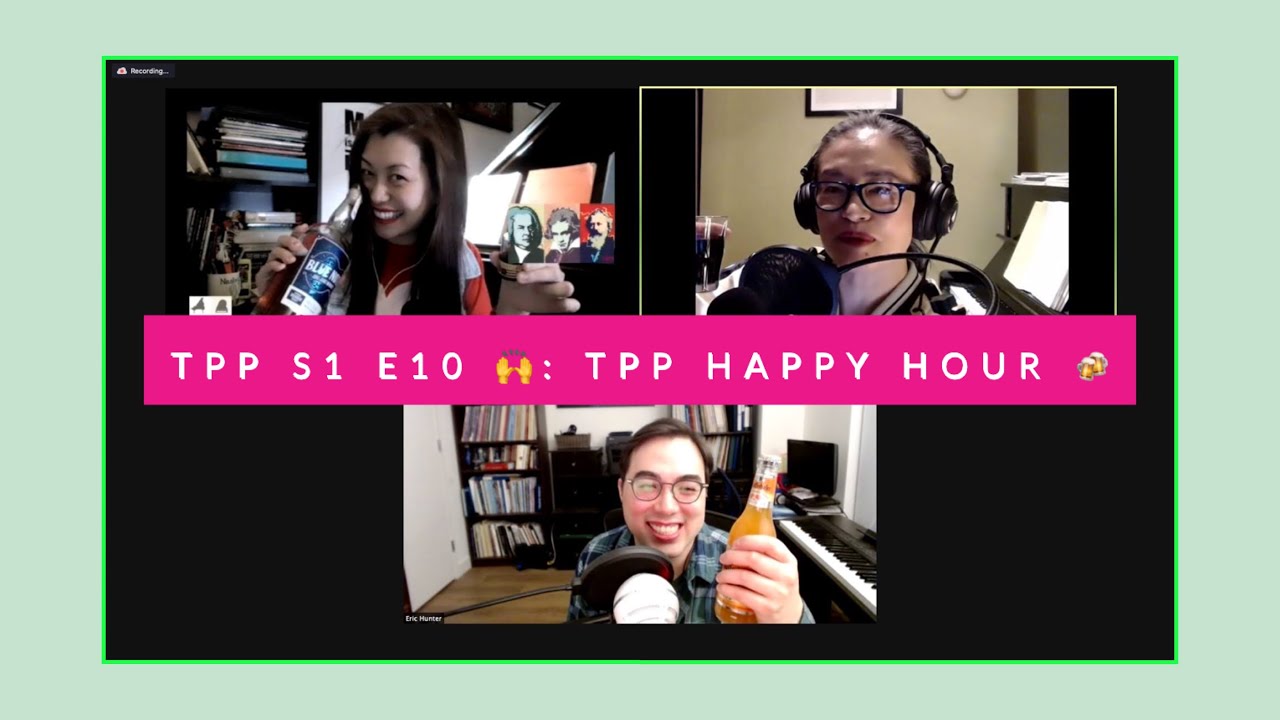
This content was created by The Piano Pod with Yukimi Song. This content was uploaded by The Piano Pod with Yukimi Song. This is a YouTube video titled "E10 🙌 : The Piano Pod Happy Hour🥳 🍻🍷" (created 2021-03-24). It’s a bonus/happy-hour episode of The Piano Pod in which hosts Yukimi Song, Eric Hunter and Clara Zhang have an informal group conversation reflecting on the podcast’s early episodes (1–5), recounting guests and highlights — e.g., Dr. Skidmore (Conquer Anxiety), Vera Luz Anselmo, Mike Grande, Chantal Balestri, Paola Marchettini, and Ray Mack — and discussing production lessons (editing, Zoom/speaker view issues, pre-interviews, hosting energy), the pandemic’s effect on teaching/tech, livestreaming and consistency on platforms. Metadata: YouTube format, thumbnail available, March 24, 2021.
Chapters
Hi everybody, welcome back to The Piano Pod with Yukimi Song.
I'm Clara Zhang, and I am Eric Hunter.
Hi, how are you guys doing?
Hi, oh, hi! Moiketes!
Here we are.
So let me explain tonight. Today, this episode is a special episode, bonus episode, to celebrate our 10th episode of— oh my gosh, we made it till 10!
Yay!
So what we're doing— what are we doing today, Eric?
Oh, so, uh, we are having happy hour.
Hey, all right, that's right. This is called The Piano Pod with Yukimi Song happy hour episode, right? I'm gonna— and basically, that's right, we're basically reviewing the past, from the introductory episode to episode number 5. We're going to just talk about them and laugh about them, our success and failures.
Plenty of failures in the early episodes on our part, for sure.
Even recently. But we learn from the failures. So I'm excited about this episode and Well, basically we are good friends, right?
Totally.
Yeah.
Even before we started this podcasting, we were really close friends. We got to know each other. And then just, you know, this past summer we just decided to do this.
Well, pandemic hit. We had to— we're so used to being productive, right? So we had to do something.
Exactly.
Good for the world, really. And good for our souls too.
Yeah, I mean, I'll say it's been really great for me. I mean, the— this podcast has become— it almost feels like my full-time job. I mean, it isn't, and we do a lot of other things, all three of us, but we're just really dedicated to it, and we put a lot of time into it. We— it feels like really satisfying. We get to talk to amazing people, become better friends, learn so much. Um, and, uh, and once again, we have to thank Yukimi because it was her brainchild.
Exactly. Totally.
Honestly, I— somebody told me when I was studying at NYU back in 2007, 2008, this professor, and he said, you should do podcasting. I was like, all right, what is podcasting? At that time I was like clueless. And he said, it's basically a radio show but it's a little bit more casual approach. And I was like, okay, because he knew that I had a communications background in terms of my degree. So I was like, well, but you know, I just moved to New York City. I had basically, I had no one. So I have to, you know, start my own life before I can launch anything. So that idea was, there, but it was just gone at that moment, at that time. Then obviously the pandemic happens and I was trying to do a video vlog or hoping to do a podcast for my own piano studio and featuring my student. However, the thing is it was great. It went very well. But after episode 2, 3, it's like, who is going to be on my show? Because these are all my students and I have only— you know what I mean? And then some students are only 9, 10. What are they going to talk about? How was your day? Good. How was your piano practice? Good. So then I was like, oh, but I wish I could do this podcast. I wish I could continue. Then one day it hit me, hmm, you know, we usually meet once a month. Well, this is Eric's idea, The Piano Pod with Yukimi Song, the open forum where we talk about piano, you know, and so many topics related to piano. I was like, why, how can we, why don't we bring this into a different platform instead of just meeting together? As a group in New York City, but we can, you know, do this globally, globally eventually.
So yeah, yeah, and we have been. Yeah, I'm going to talk about this more, but we've had some great global outreach with this podcast, which I'm very proud of. And it's, it's really amazing the people that you can reach through the power of the internet, right? Um, yeah, but, but yeah, I just, uh You know, Open Forum was really nice and we were having it in person and I've tried to continue it virtually and we've had some very good conversations, but you know, like the previous summer we had a barbecue here.
Oh my goodness, that was fun.
We had like wine on the rooftop and that was really fun. And so yeah, it definitely left a hole when we couldn't get together anymore, but this podcast has turned into a whole new thing, you know, it's taken on a life of its own.
I know, and actually I am This is more than what I expected. What I am learning or gaining from this whole experience is such a passion project. And yeah. Oh my gosh. Every episode is like a masterclass. Oh, totally.
I mean, in a way, I almost feel like we're more connected now. Than ever before, right? I mean, I always came to the forum when Eric used to have it for breakfast at his house. You know, he cooked us great breakfast and we talk about piano, all related. Yukimi is always there. And I remember the very first time I couldn't make it. I was like, well, I would just call in, you know? And then after that, we started to have more calling ins and the pandemic hit and everything was just online. And, uh, You know, I mean, really, like, Yukimi started this and this is just amazing. You know, we get to be so close and kind of motivate each other. And, you know, some days are good, some days are not great, but yet we have each other.
That's, that's right.
You know, we're not alone in it.
Yeah, I should, I should mention to our audience that you guys don't know because we only put out content once or twice a month. But the three of us are talking all day long about The Piano Pod because there's so much to do, right? Editing episodes, finding new guests, setting up interviews, um, social media takes up a ton of time, which is mostly Clara and Yukimi, I have to say. And, uh, newsletter, newsletters, yes, Spotify playlist, right?
Um, And even finding guests sometimes takes— starting the very first episode, we had to read a whole book, a psychology book. I was like, on vacation.
Yes.
Yeah. Fortunately, that was during the summer, although it was well worth the read.
It was good.
It was a good book.
I loved it.
Yeah. It was just funny. But honestly, he's the one— well, so because of the podcast vlog I was doing and he saw the link, our first guest, Dr. John Stevens.
Yeah.
And he's the one, he says, I want to be on the show. But I told him, well, this show vlog I am doing for my piano studio, it's called Conversations with a Piano Student, is for piano students. So not for— right, cheers. So not for professionals. So then that actually gave me idea of, hmm, let me talk to Eric and Clara. They are really close friends and I trust them. And actually I've known Clara for a long time.
Oh my God.
I know.
I remember I came to your house for Christmas one time, one year. It was like the most miserable year in my life. I didn't know too many people yet here. We all just moved here. You're like, and I'm not that social person, but 'Can you just— would you like to come to my house?' I was like, 'She's so nice, okay.' We were all a bunch of lonely people that Christmas together. We came to New York with a simple dream to be a musician, you know, and I think we should be so proud of ourselves, you know.
That's right.
By the way, guys, what are you drinking tonight?
Okay, I'm drinking red wine. Blend. It's a blend of Merlot and something else. I ordered a case from this company.
So yeah, well, it's a COVID style. We're inside and we can't be—
well, what about you?
I am going to pour a little out. I started last time I had our happy hour. It's a Blue Note. I figured it has music on it. Bourbon. I don't normally drink something this heavy, but for our show we have to.
Eric, what about yours?
We're gonna have a good time. So I have to admit, I'm not really a beer drinker, but I have here a Schöfferhofer. Sorry, my German.
Oh yeah, yeah, yeah, I like that one.
But I mean, this is basically juice. It's grapefruit beer, you know, right? But it goes down really easy. I like it a lot.
Hey, great. Anyway, so before we get too drunk, so let's get going.
Yeah, yeah. So what I want to talk about is what went wrong with the first episode.
Do we start from what went wrong?
Yeah, why not admit to our mistakes?
Because Dr. Skidmore was a great guest with amazing material, and we had a pre-meeting where we had multiple pre-meetings, right? I don't think we had so many pre-meetings with subsequent guests and, uh, read the book. So excited. I mean, guys, anyone who's listening, seriously, if you haven't checked out his stuff yet, you really have to. It is absolutely—
his book is Conquer Anxiety.
Yeah. And, uh, and it was our first interview. We actually even recorded it before we did the intro to The Piano Pod with Yukimi Song with Yukimi Song. This is who we are. And boy, do we mess up a lot.
Okay, what's the big number one mess? What's the number one problem?
Okay, so first of all, just to like cut ourselves a little bit of slack, it turns out it's actually very difficult to do an interview show online because we don't want to be talking over each other because it's Zoom, you know? It's not like we're together in person with a single camera where that kind of thing works itself out. We were worried about like messing up the audio feed by having people— by having crosstalk. It turns out it's not that much of a problem. But because of that, that made us very shy about jumping in and talking over anybody. And then we kind of—
well, yeah.
It's a very serious topic, right, to begin with.
Yeah. But we let Dr. Skidmore talk for 20 minutes straight, which is like, yeah, that was hard on him, first of all.
Yes, exactly.
I think he just felt like he had to keep going., and we kind of just didn't know how to get in there. I mean, we were not experienced interviewers at the time, and I think all three of us were just kind of like, "What do we do?" I also want to say we're just, you know, we're respectful, right?
It's like when I talk to my therapist, you know, I don't even want to jump in sometimes, right? Like when you listen to a lecture, you don't want to just interfere, right?
I mean, well, yeah, that's the thing is like he did— that's the other thing is he didn't stop long enough for us to like kind of catch our breath and like get in there again because we were inexperienced with that.
Exactly.
So he just kept going and going until finally we were like, oh my God.
Yeah.
And then another funny thing is, some reason all the shots, all that—
oh God, yes. Oh no.
Oh, you know, speaker view on Zoom is, uh, sensitive to the sound, right? So Basically, whoever is talking is on a speaker view, but some reason the microphone of Eric, or maybe the squeaky sound of your chair.
Yeah. Yeah.
Catching a microphone was catching a squeaky sound. So every single second of the speaker view was on Eric.
That was before we did recording both speaker view and gallery view, right? So we only had one recording and it was of my face half the time not saying anything. So that was pretty embarrassing.
It was hard. It was very— that was one of the hardest episodes.
Yeah, that was the first episode that Yukimi ever edited because Yukimi does all the video editing, which is a huge job, and she had the biggest job. It was like this, yeah, with this first episode, which is a disaster visually.
Yeah, and it was like hot summer day, you know, everybody's out partying. Yukimi is like spending 10 hours a day at home editing, you know.
Oh yeah, totally. Yeah, so for anybody who's just listened to it and has not, you know, uh, checked out our YouTube channel, if you want to see me looking totally incompetent, there you go.
Well, also Go ahead, Clara.
Because, you know, just coming to the point that we didn't really know how to chime in. I remember so vividly at that episode, I keep on seeing that green box, you know, keep on going to Eric, but I didn't have the courage, let's say, to even just like speak up because I was just so worried we're recording, you know, I didn't want to mess up. But had I just said something, like, everything could have been fixed, you know. So it's just talking about experience, right?
Yeah, you know, live and learn, right?
Exactly. Yeah, we can always—
and I also What makes me laugh is the introductory video.
Oh yeah, so that was our next taping, right?
I'm like so nervous, right? So, and then reading every word on that script that we created, so I was like, yeah, hi, my name is Yukimi, nice to meet you. That's the way I was speaking.
You know, I just watched it right before this because I wanted to go back. It wasn't Really? Yeah, it wasn't so bad, but it is true that we've tried to really like figure out a better balance between how to script things and how to be, you know, more spur of the moment because scripted stuff generally doesn't turn out well. But of course we want to make sure we hit the most important points with every guest, so we have our notes at least. That's something we're getting better at.
Right.
But you know what jumped out to me when I watched it was that you were tiny.
Oh, I was really far away.
That was before we kind of adjusted where we were sitting.
Exactly.
And half of my head was like off the camera. I remember showing to my mother and she was like, where is your forehead?
Oh yeah, that's funny.
Well, we're learning, you know. Yes, step at a time, right?
Exactly. We're getting better.
That's right.
So that was the first episode.
So that was the, well, that was the intro. Yeah. And then episode 2 was Vera Anselmo.
That's right.
Who, which I knew personally because Vera was my boss for 3 years when I first moved to New York. And, you know, we kept a good relationship and I think Eric brought, you know, Vera out in the beginning. And I mean, she's kind of well-known piano business owner and she owns a lot of so we brought her in and it was a great episode except there's so many ideas and we had, you know, we wanted to make it casual but it just ends up being story after story after story. And I think it also became kind of difficult for Yukimi Song to edit later on because there was, we didn't really have a defined, like now we kind of have, you know, for those audience that are, have been following us for a while, now we kind of have a sort of a setup, right? We have a past, present, future, and we have, you know, how we come in. But in the beginning, we were just— especially after the first episode, we were like, oh, let's try to be a little more casual. And I remember I had to stop the interview in the middle, which I think eventually did help a little bit. And we were like, okay, let's all take a chill pill for a second, and then we restarted. And I remember that was, you know, that was the first time we were kind of even brave enough to do something. What was your experience, guys, with the second episode?
Honestly, that's the episode I realized, hmm, maybe we shouldn't have had that really long, meaningful pre-interview meeting. Because the pre-interview meeting was just so amazing. I mean, interview was great. Yeah, don't get me wrong, but it was great. So I think that's the time, maybe we can have— but we kept going on with this long pre-interview meeting for a while anyway. But I think that's the time that I realized maybe— yeah, but I think Vera Luz Anselmo is an experienced interviewee.
That's true.
She was so great. She was amazing.
Great speaker. Yeah, and, um, I love her toughness in terms of building the business and managing even during the COVID Sure, but she had such a great attitude. I know, I know. Oh, I love her strengths, but she has this such a warm, warm quality, like almost like a mother, like, yeah, motherly quality. I really love that. And she says something amazing, amazing thing, you know, toward the end of the interview about COVID And it was good timing too.
I thought the way she spoke about COVID and like, you know, so many musicians are suffering through this, but the way she talked about it, she had so much grace, you know. And it was just really beautiful, just take it in stride. You know, see it as a time to reflect. I mean, okay, I understand there are people who can't pay their bills and people who can't eat. It's like my brother is on— he's an unemployed musician. He's literally on unemployment. It's stressful.
That's a lot of musicians these days.
Yeah, but, but I think her point was, you know, there's only so much we can control, right? Try to get something out of this that's gonna, you know, uh, so you're gonna be better off. When things go back to normal, whatever the new normal may be.
Yeah.
So I mean, really, it was a perfect candidate for our second episode. You know, it was even inspiring for us, right? Like, we just started this project. And then, I mean, also Vera, you know, again, I know her, so all these years she often works with young musicians who just came out of school. You know, she took a call from me, or she took an email from me, and she just called back like, next morning and gave me a job. And I remember, you know, like, so you're so inexperienced when you first moved to New York, and she was like, okay, let's do it, you know, you can fail. And so that was really good. And yeah, I was glad.
Well, I'm sure she picked up on your good energy. You know, there's no way she just does that with anybody, you know.
Sure. Yeah, yeah, of course.
Yeah, so nice to be— guys always encouraging.
So let's talk about Mike Grande, episode number 3. What do you think about that?
Cheers to that.
Yes.
Cheers to that. Yes. Finally, we started. That was like the first step for me to discover what we want to do and who we are. Like, really the first step. Okay, we wanted to do podcast about piano and beyond for sure, but there are so many other podcasts out there about piano. But I think Mike Grande's episode really opened up to our own niche or branding, but we are not quite sure yet. But that was like the first step. What do you think, guys?
Yeah, I felt it was the first time we got our stride as— or hit our stride as interviewers. And it's interesting because Mike is just— he works all day long on Rock Out Loud Live. I mean, he's just— you can just see his online activity. He's all over the place. So we actually— we didn't do— okay, we didn't do a pre-interview. We did the demonstration of the software with him, right? But this is the first time we didn't do a pre-interview. So we're kind of less prepared than usual, and that actually helped. Because he's like a very experienced public speaker and really engaging. And, and it was, it was really easy. And of course, we had figured out a few things by that point, right? We were getting better. But yeah, that was the first time we were actually all able to kind of crosstalk.
Exactly.
You know, that was—
but he made it easier for us, you know.
He did. Yeah, yeah, yeah.
I, I literally like got energy off of him.
Yeah.
Yeah.
And it was like early in the morning too.
Yep. Yep.
Came in there looking like he had just gotten out of the gym, like full of energy and just— Oh my God. Yeah. I needed that boost that day.
Yeah. I remember I was upstairs at my friend's house, so I was recording outside and I was so worried about my mic and everything on my phone. My phone turns out working better than my computer that day. But I just remember that was the first time we felt okay to laugh even during the interview. And that really helped, really lightened us up.
Oh, totally. Laughter is so important.
Exactly.
Yeah. And also that episode. Okay, so for those who are listening and watching, we're talking about episode number 3, Mike Grande, Rock Out Live, which is the software for basically music teaching, right?
Yeah. Lessons and concerts now, you know, concerts too. Yeah.
Really? Okay. Great. So then he said, I didn't make this for, you know, for this pandemic. I was planning on this for 3, last 3 to 5 years. Right. So I was thinking, oh, wait a minute. You know, people actually think about what's ahead of— most of us do, but in terms of this, bringing this music lesson into homes by digital, and then people are actually thinking that way before that. Actually, this pandemic brought us the future a little quicker and sooner than we expected. That's what it is.
Yeah, that's a very good point.
Yeah, the future came a little soon, too soon, you know what I mean? But it was supposed to be happening like within a year or two, then boom. So there we go, that's, that's the lesson I learned.
And even outside of music, you know, the whole working from home revolution, that got a real, uh, kind of kick in the pants because a lot of people do not want to go back to work in the office now. And still remains to be seen how that's going to work itself out.
Right.
See, you know, after the vaccine is, you know, taken by most people. I mean, but I was even thinking this week, you know, that I even was talking to some of my students about this. If you really think about it, online teaching can be very productive and effective too. And a lot of times it's more fun, you know. Whatever I have here, I can show to my student right away. We have two pianos, especially with Mike's, you know, his technology even reduces all these delays. Even Zoom these days are quite good, you know, and you reduce the travel times, you reduce all the hassles and time. You know, after all, what we have is time, right? Like, we live on this earth for, you know, whatever time we have, and that's it. So I agree.
Yes. I hope that things will go back to normal, but at the same time, I hope this kind of way of communications and piano lessons and beyond also still remain after COVID.
Right. If not completely, at least partially or most part. It's just New York kids, especially we live in the city, they're so busy. And I think a lot of my students, I see some more improvement, you know, learning more pieces because when they don't have to spend so many hours on the road every day and they can concentrate more, reading, reading books.
The amount of focus has changed.
Right?
Yeah.
They're all prepared. They're ready to go on time.
I love it.
Yeah, I'll share that I recently started teaching an old friend of mine, like 20 years gone, dating myself, but going back to undergrad, who used to live here. And then, yeah, I know that's painful, but, um, but yeah, he moved out to LA recently, so he's 3 hours behind even. But, um, but we started lessons a couple months ago and it's just been amazing. I mean, first of all, he's an excellent student. He's really good and making a lot of progress, but also because we've known each other for so long. We never had lessons before, but, um, you know, this is just something that probably wouldn't have happened otherwise, right? And it's proven to be incredibly fulfilling.
So that was actually the pivot point for me, um, the episode 3.
Well, I will say it felt like that for me too. And then with episode 4, Chantal Balestri, this was my first time being host. And I felt like I backslid quite a bit because—
Why?
Because I started, I introduced the episode and then I was like, oh my God, I don't know how to start this conversation. This is like, because like, you know, we're all friends with Chantal. And, you know, we knew she was going to be great and we're just used to like talking like friends. And then all of a sudden, I'm like, oh wait, no, I got to introduce her to people that don't know who she is and never heard from her before. Like, wait, what do I do? What do I do? And it's like we had some questions and stuff prepared, but I had not put enough time into thinking about how do you start that, you know? And how do you get your listeners involved right from the beginning? It's like you don't want to just like read a history book of their life, right? And so yeah, I got nervous and it was not my finest hour. Sorry, Chantal, but of course Chantal did amazingly anyway.
Yes, she's such a pro.
Right, right. But I felt, well, intro is a different ball game, but I think in terms of questions, I think we were really strateg— we have strategies. Doesn't she? We had some to ask. I really like the, the way we ask questions. And there were some tough questions, you know what I mean?
Oh yeah, for sure. Especially—
oh yeah, definitely.
I think—
yeah. And I felt like— I think that might have been the first episode where I realized, oh, we need to be telling a story, right? That's, that's— and, um, and it's, it's, uh, you know, in subsequent episodes it hasn't always been linear, you know. It's— it doesn't always work out best just to go from the beginning to the end with no diversion. Like, it can jump around and stuff, but I think you want to come away with a portrait of a person, journey they've been on. It's like, you know, there needs to be a narrative for it to be a satisfying interview. And that was the first time I started experimenting with that.
But actually, Eric, I have been enjoying you being the main host for the last 2 episodes. You have more energy, and also Yeah, right? Yeah, yeah, for sure.
Okay, so that's, uh, well, you know, we'll skip ahead a little bit because we were just gonna do up through episode 5 tonight. Um, but, uh, but yeah, so episode 6 was Paola Marchettini, who again is another great friend of ours, and we had a wonderful pre-interview that was just full of good stuff and so much fun. And Then it's very close.
It's a couple days before our main interview, right?
And then we did the main interview, which was pretty late at night, and he was tired and I was tired. And then I watched it back later, and Yukimi and Clara were great, but I was like, oh my God, no, no, no, no, no. Like, I need more energy. Like, holy— like, this is— so that, yeah, Eric fail again. But ever since then, Tonight, for example, frankly, coming in here tonight again, it's Saturday night, been with my family all day. I was pretty beat, but this is helping, right?
Yeah, yeah, yeah, exactly. Hey, whatever it takes.
But yeah, you're on camera. You got to like energy to the max or it shows and it's not good.
No, but it's fine. But last 2 episodes or so, the way you were starting the episode was just very creative.
I love that. Exactly. Yeah, right? Yeah, I love that.
Yeah, I've been putting more thought into that lately.
Yeah.
And that's great. I think as a team, we are going to improve. We're going to just evolve. We're not going to stay the same. This is kind of a live thing.
Exactly.
Yeah.
Evolving is so good. Go ahead.
No, I was just going to say also back to Chantelle's episode. Funny, I actually know Chantal through Paulo, and you know, and but the Chantal was the very first episode that she was overseas. She actually was in Italy. So we also had that too as a gesture.
That's a good point. Yeah.
And she just finished teaching and you know, we were like here, totally different time zone, totally different atmosphere, really, you know, and with the pandemic and everything, I think, you know, there's just a lot to be to adjust, you know, and sometimes like this Paulo's episode, again, back to that, he is a very dear friend of mine, like such a good friend that I was worried to be too casual on camera. So I tried to be like really formal and that didn't work too well either, you know. So it's like all kinds of things could play out.
So, well, since we're talking about Paulo, I will say that that was the episode that we decided, you know what, Enough with the pre-interviews, we're giving away too much good stuff off camera. And so now we try to keep it to half an hour or less just to work out logistics and get comfortable and save all the best stuff for the interview itself. So everybody should see an uptick in the quality of our interviews from that, hopefully.
Yeah, yes, we're learning. So I want to focus a little bit more on Chantal herself. Recently, she was posting something on Facebook. So it's been a year since the pandemic happened and a lot of people's life have changed for— I don't want to say for good, but big time. Yeah. Especially for those who are artists who come to the United States, visa, all that things. And they had to decide the last minute very, very short, you know, the time was given, like really this much of time, short time to decide black or white kind of a decision, right?
Right.
So for sure, that's such a life.
Yeah, right, exactly. But I just wanted to really tell Chantal, if you're listening, that no matter where you are, you're gonna be great. And even this, the worst situation may happen, But you can turn that into something great. I believe in you. And I myself had tough situations, but I just wanted to always say, you know what, what can I get out of this? Really, this worst situation, because I don't want to lose. You know, being a loser means you don't learn anything. Then might as well, you know, the worst moment in your life. I want to be the winner. What do you do? Learn. So I believe that quality in Chantal more than I do. I'm not as strong, but I think you can make it through. And one of these days the gates will open, then people can go in and out of the countries, and you know, Chantal can come back to the United States and do all the performances of her dreams. So I really have this positive— I'm sending this positive energy from New York to her.
Yes, me too.
You know, also, that being— I actually just remembered while we're on camera, that's not true, that I— how I met Chantelle. I actually met her in Miami. I keep on forgetting this. And that's how strong she is. You know, she's— Chantelle is quite young. We won't tell her age, but you know, she has her festivals. And then, you know, even during the lockdown, down with this pandemic, she was able to keep it going, you know. And so long ago, one year, a few years ago, I just went to Miami for, you know, just to chill out. And then I got bored and I went to a festival and she was actually performing. Uh, we— I went to a master class and she was there. And I think I couldn't go to her concert. And then later on we met again in New York. And, you know, and really she hasn't been here that long, but yet— and she's been to so many different countries. And it's just this time, and she just decided to go back and, you know, at that moment. And all the things that she's still teaching her students here, you know, all these things, you know, for any young people, it's like almost hard to imagine, but yet she's doing it, you know. And that's like, people say New Yorkers, and I mean, she is now a New Yorker. I think New York trains us, right, to be stronger and stronger no matter what situation we're in.
Absolutely. Yep, well said.
All right, so Ray Mack, yes, episode number 5. Oh my goodness, thank you Clara for introducing him to us. Wow, little student, what an energy that guy has. What an individual. Yeah, what Oh my goodness. By the way, I don't know if you guys saw Facebook yesterday.
There was a post. Oh, yeah, we're in the hospital. And a couple hours ago he was like, we have a baby. The second baby.
Yes, she just had a second child. Congratulations. Congratulations, Ray. Everybody send Ray your congratulations.
That's right. Yes.
Ray Mack is a sensational YouTube star, and we wanted to feature him because we can learn a lot from him. Yes. So, uh, what did we learn from him?
Oh, so much.
Yeah, tell me, Eric.
Uh, where to start? First of all, it was just a ton of fun to interview Ray, and I will say that we had a long pre-interview with him and then an even long— even longer actual interview with him. Because it was live. It was live.
It was live.
It was, yes, it was our first livestream. So first and only so far livestream episode. We thought about livestreaming this one, but then we were like, eh, we're gonna be drinking, you know, maybe we'll say some things that we won't like later. But, um, um, yeah, and we just, uh, we were just having a ton of fun. Um, but there are a couple things that stood out to me. Because he doesn't have the mentality of— I'll say me and some other classical pianists who are a little bit nervous about, let's call it publishing, because that's really what it is, which is just putting yourself out there for other people to consume your content. He taught me a really good lesson about that, and I kind of always knew it in a way, but like consistency of output if you're trying to be known is so important, especially in this age when anybody can put up anything anytime, right? Before he was a YouTube sensation, when he had a viral hit or two, basically, he committed to making a video every single week.
That's right.
Right? That is a big commitment. I still couldn't do that, you know, and then he did it for how many years? Like But that was like back in 2006 or something, maybe 2005, right? Every single week, not just one video, sometimes two or three even. And, um, you know, like, uh, I've been in the music industry a while. I've met a lot of people, uh, you know, some who became famous, some who switched careers, and that type of commitment is very rare to find. That's, that's really what it takes. If you can do that, you will go far. So that was the biggest thing that I learned from Ray.
Well, I mean, I would say this, you know, Ray has been a good, good friend. Hao shi shen. I still call him that. He to this day still calls me teacher even though he's like a year younger than me, you know. It's just a very— he is Malaysian, uh, he lives in Malaysia with his family now, but he studied here in Massachusetts for a few years for his undergraduate, and that's where we met, and he was doing his undergraduate while I was doing my master's. And I— everybody knew he played the piano because he played pop songs, and he was not shy. He, you know, he attracted a lot of girls. You know, all the Asian girls were like, oh my God, he's playing again! And here I am, I was the pianist, right? But I sometimes refused to perform because I was like all about that perfectionist, you know. I'm not getting a concert, I'm not gonna And he really was just really, really sunshine, you know. He was just always there, and he came to my class. It was like, "Teacher," you know. I was like, "You don't have to really call me teacher." He was like, "No, no, no, you're my teacher, right?" You're— he was like, "Can you take me in your class because I failed my sight reading, uh, exam? You know, I want to be music minor or something, but I can't read music, and I can play anything by ear, but I can't read music." So he came in to study with all the music minors where I was teaching, and he was just not only so talented, so humble, you know, so willing to learn about everything. And we've been friends all these years, but I remember the very— one of the first episodes of one of the first videos that he was visiting me, you know, we had house parties and he was like sitting on my bed practicing on my keyboard, and now he's like "Teacher, I'm gonna record this. I'm gonna put up this thing called YouTube." I'm like, "What is that?" You know, at that time it was still like MySpace world, I think, you know. And he was very high in tech as well. And, you know, really, I wouldn't say like a thick face, you know, like as Asians sometimes we feel like, "Oh my God, you know, I'm shy, like I don't want to do this." But he was like, "You know, I'm just gonna leave it here and anyone wants to watch it." And then, you know, it's To this day, it's still not his main profession. He was a trader, he was in technology, he worked for Microsoft for a while, he sold mansions for a while. Who knows? He does a lot of multi-network marketing even. But I think in the end, he has a good heart, and he also has a lot of so-called haters on the internet. But sometimes they all become— he's like, biggest fans, right? Because he's inspiring them to be better people. And that's what we, I think, need the most in this world. What did you think of that episode, Yukimi?
That was just pure fun. Yeah, right? Yeah. Just he took the microphone and he took it away. Like, he did the show.
Right.
So we were just like listening and just a little bit of navigation that we needed, but rest of it was just his thing. He made it very easy.
Yeah.
And the live show was so fun. We've never done it before. And we used the Restream, the software Restream, to stream on YouTube and Facebook at the same time. It was just really fun. Really, he taught me how to enjoy. I mean, that episode taught me how to enjoy music more, how not to be judgmental. And just, can we just enjoy the sound? Can we just enjoy the day? You know what I mean? Right. Yeah. Why do we just stuck in this little tiny room and practice hours and hours and really be so hard on yourself? And sometimes you get so depressed because the result is not what we want to, but music is beautiful. The day is beautiful. Can we just enjoy?
And I would Say also to enjoy the connection with other people through it. It's very clear for Ray that is such a huge part of it.
Yep, exactly.
And one of the amazing things about him is he does all the things you need to do to find success on the internet, networking with other people, but— and it's like, how do I put it, like it seems strategic because he does all the right things, but it just comes naturally to him because that's who he is. It's the same way he has this amazing attitude with the haters, right? He converts them into fans, but that's because he has this natural ability to see the good in people and wish them well, see through their pain, right? Yeah.
Yeah, exactly. I mean, he's a real person person, right? Like he's really, you know, in real life too, you know, when you meet him, Monday, hopefully. But it feels like we already know him so well just through these interviews, right? They're all becoming great friends. By the way, there's one thing I just want to chime in. Since we were talking about the live streaming, I want to ask our listeners, you know, if anyone listening— I have had some people, uh, Kelly, Lauren Kelly in Vancouver. I haven't even told you guys the great news. She was suggesting maybe we will, uh, do our live streaming a little later sometimes, you know, even when we publish because some teachers are still teaching, you know. And then she— I was like, well, we always have it, but she was like, it's more fun, you know, when I watch with you guys. So two things I was thinking: should we do more live streaming? But first of all, anyone wants to join us, you know, to watch us, you know, if we were doing more live. Two, should we move the, uh, if we were going to premiere it, is it better if we do it later, you know, of the night or day, right?
You know, is she on the West Coast, right? Because she's in Vancouver. Yeah, yeah, right. So normally we live stream at 8, which is 5 for them.
That's right, that's right, right, right.
So, well, anyway, guys, I guess it really depends on who's listening because, you know, we can track our analytics on Simplecast. And I will tell you right now, actually, where did I put the stats? I had them here somewhere. Oh yeah. So for anybody who's interested, um, 60% of our audience is in the US. That's by far the vast majority. And then, um, the next highest would be Germany, followed by Brazil, Mexico, Japan, um, uh, UK, Canada, Spain, Peru, and Thailand. So we're really all over the world, right? So if you guys want us to livestream in your time zone, you got to Speak up. Okay. Send us a message. Comment on our Instagram or Facebook. Yeah. Twitter.
YouTube. Right.
We'll take requests, but there just have to be enough of you. All right.
Exactly.
So my last question for you, both of you, is in terms of all these guests. So what's the common quality that— what's the quality that all these guests share? There was a reason that we chose these people, right?
Yeah.
Um, so what, what do you think is this common quality that they share? You think?
I would say, first of all, very positive attitude.
For sure.
You know, without exception, um, these 5, 6 guests and our subsequent guests have all been such positive people. They're such a delight to talk to.
Right, right.
Well, what about you?
Clara? Yeah, I want to think, you know, I want to say, sure, you know, most of us musicians, we all have this work ethic, but it's being able to have fun as well as working crazy, crazy hard, you know. And I think all of our guests really, like, they all, they're all obviously very, you know, successful and very out there, and yet they all seem to have this lighthearted personality, and they really know how to have fun.
Yeah, absolutely. You're right. Absolutely. They don't take too serious about things.
Exactly. They need to learn to not take everything personally.
And they're willing to take chances, like taking a chance on us in our first season of this podcast. You know, that's right.
I was gonna say the same thing. They, they take chances, and they also, they seem to invest in themselves. I think that's very important. They're not just sit down and get used to their normal stuff. Right. They are edgy people. They are antsy, always like, hmm, what can, what else can I do?
Absolutely.
They literally invest time and effort in something else. And that's really, I learned a lot. Yeah. I'm learning a lot.
Yeah.
All right. So kids, kids. Is it time?
It is time, yes!
Oh my gosh, time for The Piano Pod rapid-fire questions. Are we ready?
We're ready. Who's going first?
Okay, I am, I am going first.
I'm scared.
All right, this is really fun. Are you ready? Okay, what is your guilty pleasure?
Oh, guilty pleasure.
Eric, go!
Okay, uh, the first thing that jumps to mind is the TV show Trailer Park Boys.
I have no idea what it is.
That's from my time in Canada. Yeah, so, uh, well, it's kind of an old show now, but it's a mockumentary, which, you know, like, like The Office, but, um, about a trio of drunk degenerates living in a trailer park. In Nova Scotia, and Canadians know it very well. And especially when I'm down or something, that show always makes me feel better. So that's it. That's my guilty pleasure.
All right, what about you, Clara?
Well, for me, I think for those listeners out there, if you ever see our crazy Instagram posts, that's all come from like mostly from the Crazy Clara. When I'm down or something, I go on to like whatever app, you know, right now I'm using Meitu, this Chinese app, and I use all these filters and make these like pictures, you know, into like really crazy little characters. It's almost like an imaginary world that we live in with all the filters. And that really somehow, it takes time, but it kind of calms me down, you know, because—
Oh really? Calms you down? Okay, good.
Hey guys, wait, wait, wait, hang on. Before we go, are you gonna— are we gonna answer our own rapid-fire questions? I think you should answer too. Yeah, yeah, everybody wants to know what you're doing.
Oh my God, okay, it's easy. Oh yeah, okay, that is my guilty pleasure.
That can't be the answer for me because I don't feel guilty.
I do sometimes. Yeah, you're right, but sometimes I feel guilty, so hey, that's my guilty pleasure.
Fair enough.
Good answer.
Hey folks, remember it's a rapid, so no long answers. All right, okay, who's next?
Oh, we're passing around. Okay, go, Claire.
Favorite restaurant in New York City? Oh my God. Oh, Kimmy, go first.
Oh geez, um, honestly, I haven't been to restaurants in a long time, but there is one Japanese place right underneath where Eric lives. Oh, the market. Yeah, it's called— I think it's Nhi, but that's one— it's not restaurant, but that's one of my favorite places. Okay.
Yeah, so that's the first place we have to go after the lockdown.
Right.
All right, Eric.
Um, so unfortunately my favorite restaurant closed, or maybe, maybe they, um, they've reinvented themselves because it's becoming a different restaurant, so I don't know if it's the same. Owner or not, but before the pandemic, my favorite restaurant was right up the street and it's called Char Sue, C-U-E, Char Sue. And it was this amazing fusion restaurant that was super inventive and everything was really delicious and quite reasonably priced and amazing drinks. And my wife and I would go there for dates. Oh, sorry, this is rapid fire.
That's great.
That's great.
No, I know why it's so hard. For our guests, you know. I think before pandemic it was, uh, well, maybe it's still there, uh, um, uh, Wolfgang, you know, when I used to still eat a lot.
Okay, okay, okay, so great.
Go ahead, Eric.
Eric, your turn.
Okay, uh, what is your most embarrassing performing experience?
Ah, okay, I'll go first.
Uh, when I was 14, that was the first time I forgot my music on stage. But now I learned it's no big deal.
That's right. Okay, very good, very good.
All right, that was when I was getting my master's and was a big stage, really literally thousands of people watching. I started octave lower. I was nervous. So hey.
Oh, you started an octave lower? That's not so bad, that's not so bad. Okay, I got a good one for you guys. Yeah, um, there wasn't— it wasn't a big concert, but it was an audition. And I had recently gotten contact lenses again, which I gave up on soon after. I can't wear contact lenses. My eyes are too weird. Um, and so I was like, I was, they were not sitting well in my eyes and I was blinking. My eyes are watering the whole time. And then it started doing weird things with the light in the room, which was pretty dark to begin with. And I was playing Stravinsky's, and it was a very difficult piece. And then like, because of the contacts in my eyes, something happened with the light and the shadows. I thought something was going to fall on me. I like, I was playing and I look up like this and then, and then I suddenly realized that there was nothing there and like went back like nothing happened. But it was, I don't know if that's my most embarrassing, but it was pretty weird.
If our students are listening, listen to all of us. We have all had our stuff happening. It's okay.
Yes, all right, next question. Who was your celebrity crush when you were a teenager?
Uh, something crush as a teenager—
Leonardo, uh, Cappuccio, DiCaprio.
Okay, all right. What about you, Eric? Uh, probably all the babes on Baywatch.
Yeah, okay, me, me, this is very famous. Yukimi Song loves drinking wine, loves Michael Jackson.
Oh yeah, interesting. Yeah, yeah, yeah.
All right, next question.
Uh, let me ask then because it's, uh, kind of related. All-time favorite classical album and all-time favorite non-classical album.
Okay. All-time favorite classical album is, you know, there's this 20th Century Pianist series albums. Do you know? It's, it has— oh yeah, yeah, yeah, yeah, yeah, yeah, yeah, right, exactly. Nelson Freire, he's a Brazilian pianist, and oh, his Schumann Fantasy in C major, wow, out of this world.
That's my favorite. I haven't heard that one.
Yeah, it sounds incredible.
Okay, check out our spring playlist.
Yeah, and then we're gonna have to put all this stuff. No classical is very hard to choose, but right now I am listening to Depeche Mode. I don't know the title of the album, but I love the Behind the Wheel. So it's one of those albums with the name Behind the Wheel. Anyway, I'm old. So Clara, what's yours?
Well, I was thinking I can't choose, so I have two favorites of classical. I have The later one of the Goldberg Recreation by Glenn Gould. People used to call him Clara Gould. I was addicted to Glenn Gould. Yeah, that's still, you know, if I don't feel good, I go to that one. And also the All Chopin album by Rubinstein. That also was my first album that I was able to buy.
Do you mean the complete collection?
Complete collection.
Okay.
And the non-classical, I love Johnny Cash. I don't know why.
Okay, great. Yeah, what about you, Eric?
Eric? I don't know, you know, I'm actually sitting here looking at MP3s on my hard drive because even though I thought about it earlier when I thought of this question, I don't know how I could just pick one classical album, especially because because when I was— like, a lot of the albums that were most influential on me when I was younger, I don't like anymore. I outgrew those pianists. But I feel like, let's just say, when I was a kid, the Tchaikovsky symphonies were very influential on me when I was in about 4th and 5th grade. And it's probably the Philadelphia Orchestra that, um, with Ormandy, I think that was I was listening to LPs back then. That's how long ago. So it was my parents' LPs. And for non-classical, it would probably be Led Zeppelin IV and/or Dream Theater Systematic Chaos.
I don't know Dream Theater. I don't even know what that is.
They are classically trained, for what it's worth.
All right, check out our playlist. I'm sure it's all going to be there.
Oh, yeah. All right, so Clara, what's your question?
Alright, serious question, but in short words, warm-up routine on piano.
I start out with Chopin étude playing very slowly. Right now I am reviewing Opus 25, No. 11.
Randy is just doing it this week after the recital. Well, that's a very hard one.
Oh yeah. What about you, Eric?
Um, so I don't really have a warm-up routine. I don't— I certainly don't ever try to warm up technically, but I would say kind of my warm-up is whatever I feel like doing that's going to get me to eventually practice, right? So whatever kind of suits my mood. Sometimes I manage to get to work right away, but more often I just need to play something that's going to pull me in, and eventually some part of it is Sorry guys, this is rapid fire, I know. But part of it is sometimes you have to slow your mind down from everything else that was going on in the day to get into that space where you can work. Working at the piano, it's like we talked with, I think it was Frederick Chu, you know, right? Like it's a different kind of work than like being on your computer answering emails and Facebooking and things like that.
It is physical, but it's also just so—
Yes.
Well, for me, I mean, I really, I also don't have exactly a routine, which don't tell my teacher. I'm sure Dr. G is watching, but I start with bath mostly. I try to start with some bath, and, but if my finger really need to pick me up and I go to some Chopin, and if it really doesn't work, I go to good old Henon.
Oh, wow.
Okay.
Yeah.
So. All right, keep on going. Who's next?
All right, so let's make this a last round.
Yes.
Okay, sounds good. So I have a very last question for you. What is your dream piece to play?
Hmm, Goldberg Variation for me to play.
What is it?
Okay, Goldberg.
Goldberg.
Yeah.
Okay.
Um, You know, I never finished the Rachmaninoff Second Concerto. I think it's got to be that, to finish that and have a chance to play it with orchestra. Yeah, either that or Gaspard de la Nuit, which I also never— I performed only the first movement so far. Probably one of those two.
We are still young. We still have time.
So I would say— I would say Prokofiev Sonata, all of them.
Oh, all of them, okay.
And then Rachmaninoff Piano Concerto No.
3.
Who do you guys feel you owe the most to among important people in your life?
My mother. Mm, my grandparents.
Okay, well, for me it would be hard to pick between my parents, my wife, and all the teachers that have left a profound influence on me because I've really had a lot of really amazing teachers. It's been a huge blessing.
Great. All right, so Clara, very, very last question.
Apple cake or chocolate?
Apple cake or chocolate?
What kind of cake?
Doesn't matter, choose.
I choose chocolate cake.
All right, why do you choose? Because I chose.
I choose apple, not because I try to look like I'm a healthy person. I am healthy. I'm trying to be healthy, but because I, I don't, I don't go for sweet stuff. I don't eat sweet stuff. So apple. Yeah, Clara.
Good. Chocolate. Chocolate makes me happy, but because I chose chocolate, because I chose chocolate. All right, question. All right, we did it.
Yeah.
All right, so this concludes this episode of The Piano Pod with Yukimi Song with Yukimi Song. We want to thank you, to our audience, for tuning in. Want to remind you that we have an exciting guest lineup for the next few episodes, such as Selena Vistoresi from Notable and Jim Riddle, jazz pianist, which those two episodes will be published in April. And Madeline Brewster, who is the founder of The Art of Practicing Institute, which will be released in May.
That's right. If you enjoyed today's episode, please rate and review on whatever podcasting platform you use. If you're watching it from YouTube, please hit the thumbs up button right here and be sure to subscribe to our channel.
Oh, I love it.
You can also find us on Facebook, Twitter, Instagram, and LinkedIn. The links are in the description below.
Well, Clara, I think that bourbon's starting to hit, huh? Um, as always, we welcome your feedback for us. In the comments, DMs, email at thepianopodnyc@gmail.com.
Hope to see you for the next episode of That Piano Pod. Bye everyone!
Bye everybody!
More from The


Spirit, Body, and Soul: Pianist & Composer David Berry on Virtuosity, Creativity, and...



Season 6 Episode 20 | "Spirit, Body, and Soul" feat. David Berry, Concert Pianist & Composer


Beyond Borders: From Argentina to Poland to Texas—Oscar Macchioni reflects on a life in music

Sound Liberation: Joe Williams on Black Artistry, Legacy & Belonging in Concert Music


