Extra from Season 6 — Mada & Hugh Piano Duo on Creativity & Connection
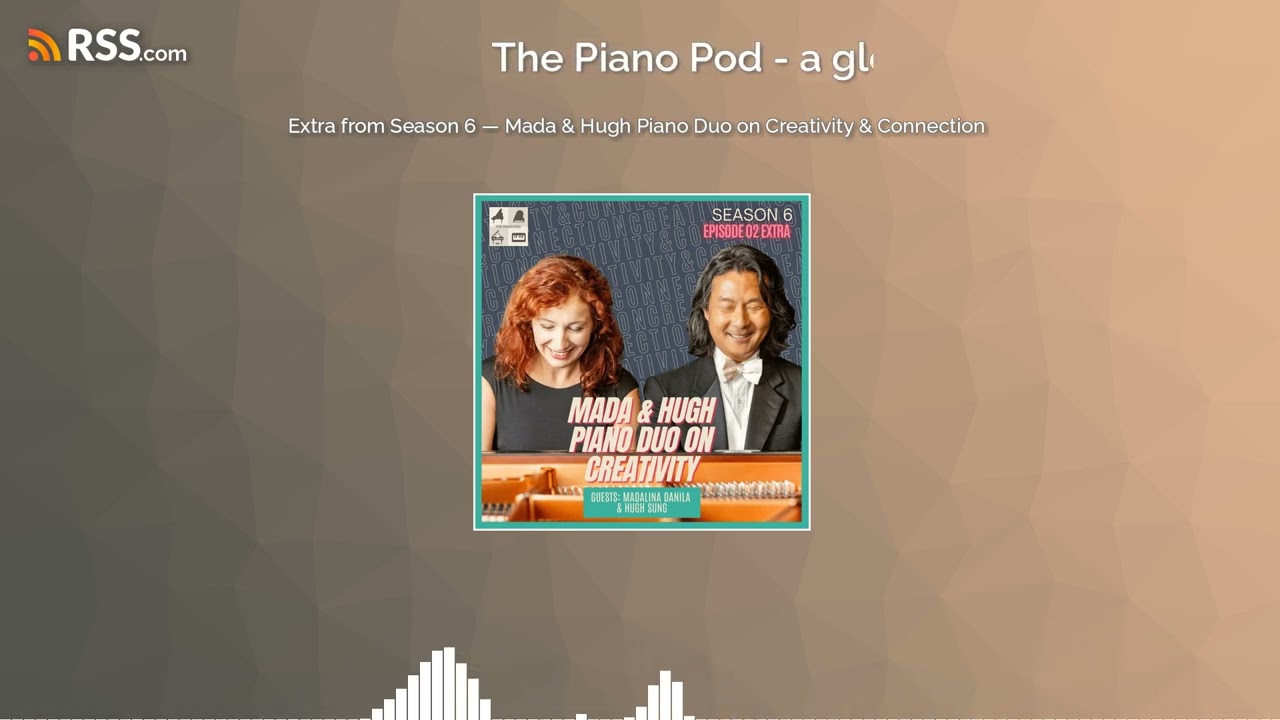
This content was created by The Piano Pod with Yukimi Song. This content was uploaded by The Piano Pod with Yukimi Song. This is a YouTube bonus episode excerpt titled "Extra from Season 6 — Mada & Hugh Piano Duo on Creativity & Connection" (created 2026-01-11). It's a multi-speaker interview/bonus segment from The Piano Pod with Yukimi Song featuring the Mada & Hugh piano duo (MADA and HUGH) and the host (The Piano Pod with Yukimi Song). The participants discuss creativity and play (journaling, art journaling), the emotional and social benefits of making music, adult beginner piano students, lifelong learning in music, and concerns/opportunities around AI and technology for artistic expression. The clip is presented as a holiday bonus and invites viewers to watch the full Season 6, Episode 2 conversation.
Chapters
Music is the universal language. Well, if it's a universal language, we have a syntax problem because most of the people just don't understand what we do. I would say our mission as a duo is to bridge worlds and to make the world we connect to more beautiful.
We, we come from very different cultures, and the fact that we come together as a four-hand piano duo sharing one piano and we have to make things work and making music to share with people, I think, sends out the message that music truly connects people regardless of their background or cultures.
I think the piano in particular is one of those unique instruments that has truly been able to bridge so many cultural barriers. This remarkable machine, 300 years of development, pieces of physics and art and engineering, has come to be so beloved by so many different cultures and peoples around the world, and that It's truly a piece of art that helps us to find a common voice.
Happy holidays, friends! Here's a little gift from me and The Piano Pod. This bonus segment comes from Season 6, Episode 2 with the award-winning Mada and Hugh piano duo. Our conversation went longer than expected, and while this part didn't make it into the final episode, I knew I wanted to share it with you. It's just too good to keep it to myself. In this excerpt, Mara and Hugh open up about creativity in its purest form, how hobbies and play can recharge us, and how music connects us beyond perfection, and how we can reclaim our humanity in a world increasingly shaped by technology and AI. It's an honest, thoughtful exchange that I think is the perfect reminder for this season of reflection. So pour yourself a warm drink, take a pause, and enjoy this special bonus episode. And in case you missed the whole episode that aired in September, be sure to catch up. You really don't want to miss the juicy behind the scenes of how this incredible piano duo comes to life. Here's the bonus episode with Mara and Hugh Piano Duo. Please enjoy the show.
Journaling, writing.
Yeah, I was going to talk about that. I've taken up recently, I mean, I think it's like 2 years or something, but I don't even recall exactly the moment that it began. It just, I had always been curious about, you know, painting and about the visuals. My mom is a painter and an architect. So I I think I got that from her, but I never professionally pursued that. I chose music, right? But sometimes as a hobby, I do like to doodle and sketch and play with colors and textures. And I have found to do this in a creative way, in the form of journaling and scrapbooking. And You know, there are so many people that enjoy doing that. It's, it's, it's, it's a lot of people that are part of this community of art journaling that, you know, share their experiences online. And it's also a very recommended form of therapy. And this is, this is my safe space where I, I go once in a while, sometimes maybe too much, and I stay there for too long. But it's, it is a form of healing and it is a form of charging batteries. And it's also a very helpful way, not just to be creative without any purpose, you know, because as professionals, yes, we want to be creative, we feel the need, right? It's an intricate need, first of all. But we kind of have to be creative because also this is our job. This is what we have chosen. To do, right? We have to, we've transformed it into a job. Yeah. But by pursuing hobbies, it doesn't matter for how long. It's just, I feel liberated from that pressure of being good at and getting validation from people, you know, because I think that this is what stops a lot of folks pursuing their creative dreams, especially classical music, right?
Oh, don't get me started.
Especially that.
If I may jump in, again, just kind of putting on my retail hat, one of the things, because I'm working at Cunningham Piano, I see so many people coming in and we're there to help them bring home a piano. And I can't tell you how many times I see people coming in, they feel ashamed to come to the piano, like, oh, I haven't played in years, or I'm not very good at this. I'm like, And it's sad to see people judging themselves on an instrument where our greatest joy is you wanna learn, you have to start. So it's wonderful, you know? And make mistakes, try it. But just, I want people to experience the joy of playing music, not to punish themselves because they can't play such and such a lick quite right. Or, you know, they haven't taken lessons in years or they quit when they were kids. You know, the, the, the judgment that many people come to art with, it's, is unnecessary to some degree, right?
Yeah.
And I'm talking about the general public. And I think we, we need more playground art where people are invited to be messy artists, play the piano, hit wrong notes, enjoy the process, and, and, and find a different way to iterate from that rather than expecting to be perfectly Have everything before you.
Of course, depends on what level do you want to be at, right? So again, this is a very delicate territory. But yes, what Hugh is emphasizing is we need, especially in this era of technology, we need to allow ourselves to be creative outside of technology and outside of AI, which is great. I mean, you operate with AI quite a lot. But we were reading just the other day, we're reading some, a little bit concerning news about how AI started creating realistic movies and songs. And it's so hard to tell the difference, you know? And the question is, which I think every single person should ask themselves, like, well, then what's going to happen with our unique creativity, right? Our unique voice. This is the authentic form of creativity, not AI. So what's going to happen? How are we going to be able to tell the difference in the future? And is it going to be even worth it, worth expressing, worth looking for? Yeah.
Yeah.
So—
Well, I think there's a tremendous— maybe it sounds really weird. I see this huge opportunity, actually, Um, because I also see as AI— and I think AI is phenomenal as a tool, as, as a creative partner, so many— in an efficiency booster. You know, there are things that I can do now with AI I couldn't even dream of doing, which is, I think, is wonderful. Having said that, um, when it comes really to the creativity in the performing arts and things like that, one of the things I— believe it or not, I was— I, I don't think I ever showed you, but I was actually experimenting with taking some of our videos and then trying to work them through AI and getting, you know, getting a different background, seeing if AI could put us to make us look a little bit more stylized. It failed miserably, miserably. Well, here's the— yeah, here's the thing. Now I'm going to say something that might sound counterintuitive. AI is trained on the most popular media models. There's a reason why Disney is suing a lot of the AI video generators because most people want to make their characters look like Iron Man or Superman or Bugs Bunny, you know, the known trademark characters, you know, or the scenes. They're all the specific kind of sci-fi action. The creativity is, you know, everybody's copying the creativity of giants that have pioneered some of those things. To be truly original, to be truly human, You know, and playing the— being someone who plays the piano for a living, it's just not that economically viable. There's not a lot—
it has never been economically viable.
Never been. And it's not just— it's just not a field that AI is going to have interest in sort of analyzing to the degree that it's really genuinely good. You know, the AI videos that I generate were so laughably bad because they don't have any models to generate from, because it's just not that much out there. So we have this quiet little space in, in the piano world where, because we're not this global, you know, media empire and what we do, we are this beautiful little corner of genuine human art, you know, with, with still— and it still amazes me that we have industries that create beautiful instruments that we get to play on, that they still make and manufacture, you know, to really high degrees of skill and craftsmanship. We have this unique little oasis, this crazy little eye in the storm of technology where people want the opportunity to experience what it means to be genuinely human. Come play the piano, an acoustic piano. And then this— I know this sounds strange because But this is what I said, I don't see AI generating piano players. It just doesn't happen. No, really, it doesn't really happen. AI can generate talking avatars. AI can generate sci-fi, you know, gunfights. AI doesn't generate pianists playing beautiful repertoire, you know, or unique compositions, you know, contemporary compositions. AI is not going to start to generate George Crumb. That's not—
no, a lot of people have been influenced and inspired by George Crumb, obviously.
But there's a sameness to the AI content that I see being generated. There's a sameness, a similarliness, right? The creativity is starting to shrink in terms of certain kinds of output. And this humble discipline of being disconnected and touching wood and metal and molding sound physically with your own hands and ears. There's a meditative quality in what we do and what we share. And when the audience has the patience to sit through a 3, 5, 10, 20-minute song from beginning to end and, and learn what that sonic adventure actually is, guess what? You have just reclaimed a huge bit of the human experience, the genuine human experience, where our senses and our touch and our creativity is directly connecting us, the listener, ourselves, through real physical airwaves. There's something— there's, there's a beautiful technological oasis that I think we create as classical pianists.
Yeah, surprisingly, I think it's happening too, because I'm getting a lot of inquiries about piano lessons. They're all adults, beginner students. And then most of them, they live in around here, Brooklyn, Williamsburg. So young Gen Z, but they work in tech company.
So that's why they're looking for the disconnect, of course. Yes.
But you see, so it's nothing quite like with your own hands and create something, whether that is just pressing the key down to create the sound, but it's nothing quite like it seems like. So they, they come, but they don't realize how difficult piano can be.
So it's like, well, yeah, here's, that's another aspect. That's another aspect. And, and we've, we've been noticing in kids, I mean, we, we have both, both taught at some point. You know, there's, especially with kids, it's so hard to tell them to prepare them for something that takes a lot of work for pretty much a lifetime. Okay. Because it's, you know, it's not the same as, you know, you go to law school, you go to medical school, you have this amount of years, I know, 4, 5, 6 years, and then you can start a job. No, for us is yes, you get your diploma with master's, which is 2 or bachelor's, that's 4. But it doesn't mean that your learning process is over after you graduate. And then it means that next day, that's it. That's that's done with school. No, I don't think so. I don't think, I mean, at least if we talk in the context of being an artist and continue to produce in terms of quality, not quantity. So again, big difference here.
Let's see, there's something beautiful about being involved with an art that is on the one hand, extremely easy to start. Anybody can put their fingers down, it sounds great. Yeah. And then having an entire lifetime to always realize there's something more that I can improve, there's something more that I can grow or, or learn, or another artist or another composition or another— literally, there's no end to the world that you can explore. There's something, I think, that is very— that can be exciting. In other words, you're never going to plateau, you know, at some point, you know. I, uh, yeah, that's just my, my, my thinking, you know, in terms of, you know, if, if music can be presented in such a way where it's not so much— it's presented a way where it's an opportunity to say, here's a world, easy to start, but you will never run out of things to learn. Grow, explore, enjoy?
Well, it has to do also with the will of the individual, right? Of course there is. I mean, the potential is there. The, the, the everything, the world is, is in front of you. Do you want to take this trip? Do you want, are you willing to make this effort? It's up to you. No one is going to push you, right? Of course you can present to a kid, you can present to an adult. You can say, well, this is, this is going to offer you a lifetime of exploring and learning and, and, and, um, reward, but it's also, it requires a lot of effort and frustration quite often from you. Are you willing to pay the price or not? I think the choice is, uh, is the individual's. Yeah.
But you, you have both chose that path, right? Like, I only have $500 in the pocket, but I'm going to do it. That sort of thing, you know what I mean? Like, and reinventing yourself and reclaiming your space. And I think it's really beautiful.
There was a period of time when I was very heavily involved with AirTurn. My whole mind and concentration was on building the small tech company for 3 years. It's a 24-hour day, nonstop job, really. When you are an entrepreneur at that level, you cannot think of anything else, right? And my— everything I was doing is just poured into trying to make AirTurn survive and successful. So for 3 years, I didn't play the piano, okay? I just didn't have time. Completely devoted myself to AirTurn. Well, my time at AirTurn, I decided to leave, sell my shares, and, you know, the company's still going on, but, you know, I, I left I got a payout, you know, and it helped me give me some time to think about what to do next. Curiously, as soon as I quit, Curtis had given me a call and asked, could you help us out, you know, just to do some accompanying, you know, and just, you know, help us out a few hours a week or whatever, because, you know, we have an overflow of some students that just— we can't find a pianist for. I hadn't played for 3 years. I'm like, am I going to remember how to do this? I remember coming and sitting in that, uh, you know, the first lesson, you know, and I think it was Mozart, you know, or I don't remember playing. Like, okay, I'll put my hands in the keys. It was like no time had passed. The music was just— everything just came. And I, I almost had tears in my eyes. I'm like, why did I stop? I remember once thinking that I was so sick and tired of music because I was just non-stop playing everyday concerts 4 or 5 times a week and just rehearsals all day long. But now coming back to it, I realized I can't let this go. This is— this was foolish of me to almost— to have almost lost the music that was— that's me. And I almost— I remember coming back from that, you know, couple lessons that had tears in my eyes. I'm like I never want to lose that love again, you know. And ever since that moment, it's like any opportunity— I don't care, even if it's, you know, just a simple opportunity to play with some kid, I don't care. It's music. I get to play it. I get to do something beautiful. And this wonderful opportunity I have to, to do something unique and creative, it's, it's like— I remember I was at a certain company and was meeting with one of the co-founders, and this gentleman's very impressive. You know, he's— if I mention his name to some people, they would be like, ah, you got to work with him? Anyway, he was of that level. And I, you know, being new to entrepreneurship and, and, and business, and it was like peppering him with questions about how do you do this, how did you get started, how do you make money, blah blah blah, and all this. I remember him looking at me like, you know, you can learn business. Anybody can learn business, but not anybody can play the way you play. I would give it all up if I could do what you do. I hope you realize what you really have. It's not the money, it's not the business. You have music. You can play. And to see from this giant of a man actually yearning to do what I do. I, at the time, I dismissed it, you know. Many years after that, I realized I think he was right, you know. What we do as musicians, that's precious, very, very precious, and something that I want to share with other people and even, even other students to help them at least understand the joy of making music. It's not, it's not about being successful, but it's about having the joy of knowing that I can sit down and music is in me. And music is— even if I just sit and listen, music is something I can deeply, deeply enjoy.
And not just that, but also, um, it's scientifically proved that music, uh, shapes the character and personality of people.
Is that why I'm so crazy? Is that why I'm so crazy?
In terms of empathy, social connection, it helps a lot, especially people that play together. Like we explained this to the kids that were part of Forehand Duets. There were kids and teenagers up to 16, 17 years old, right? And I mean, they were going through clearly this, the most delicate period of their lifetime. And it was a time when they should learn right now. They should figure out or start figuring out their role in society, their role, you know, what's going on with them in this world, right? So I think music can have a very impactful role in people's life. Yeah, it really shapes— like, I remember that when I started performing chamber music, Seriously. And that was probably after 17, 18, because before it was just in high school, just before, you know, people would ask me like, do you want to play? Like, yeah, I need the accompanist. I need to say, okay, fine. But then professionally in terms of, you know, heavier works and in a more professional way, I realized, boy, this person is difficult to work with. Well, I'm difficult to work with. Or like, It was this awareness on relationships between people. And that's also transferable outside the practice room or outside the concert hall, right? In interpersonal relationships. Yeah. So, and I think music has quietly but strongly major role if approach, if incorporated in people's lives.
I hope you enjoyed this extra holiday episode with the incredible Matta and Hugh piano duo. Their honesty and creativity are such an inspiration, a reminder of how art can ground us, recharge us, and connect us in meaningful ways. If you enjoyed this bonus episode, please don't forget to hit the thumbs up, subscribe to The Piano Pod on YouTube, and share it with a friend who loves music. And if you missed the full episode with Matta and Hugh that aired back in September, be sure to watch or listen. It's packed with stories, behind-the-scenes insights, and unforgettable performances. Thank you so much for joining me for this holiday bonus. Wishing you a joyful season of music, reflection, and connection, and I'll see you in 2026.
More from The


Spirit, Body, and Soul: Pianist & Composer David Berry on Virtuosity, Creativity, and...



Season 6 Episode 20 | "Spirit, Body, and Soul" feat. David Berry, Concert Pianist & Composer


Beyond Borders: From Argentina to Poland to Texas—Oscar Macchioni reflects on a life in music

Sound Liberation: Joe Williams on Black Artistry, Legacy & Belonging in Concert Music


