Music As Witness feat. Concert Pianist, Anna Shelest
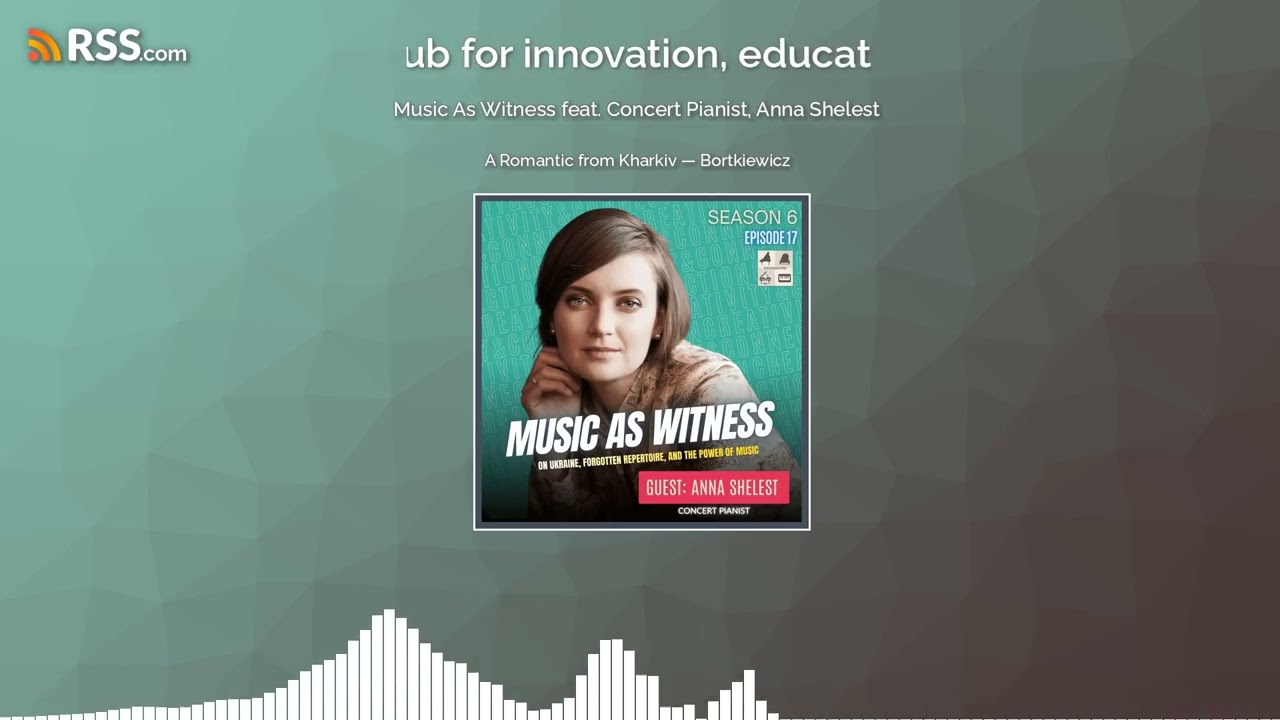
This content was created by The Piano Pod with Yukimi Song. This content was uploaded by The Piano Pod with Yukimi Song. This is a YouTube-hosted podcast episode titled "Music As Witness feat. Concert Pianist, Anna Shelest" (Season 6, Episode 17) from The Piano Pod with Yukimi Song, published May 8, 2026. The excerpt is an interview-style conversation led by host Yukimi Song (The Piano Pod with Yukimi Song) with guest pianist Anna Shelest. They discuss Shelest’s career, her Dona Voce projects, championing lesser-known Ukrainian composers (notably Sergey/Bartkiewicz/Bortkiewicz and works like A Thousand and One Nights and the Piano Concerto No.1), her album Romantic from Kharkiv, her Kharkiv upbringing and the Horowitz teaching legacy, Juilliard training, and recent performances/recordings. The episode includes sponsor messages for the Alexander and Buono Foundation and brief additional speaker interjections. Metadata: YouTube content, Episode recorded/published 2026-05-08, title as above.
Chapters
This episode of The Piano Pod with Yukimi Song with Yukimi Song with Yukimi Song is proudly sponsored by the Alexander M. Buono Foundation, an organization dedicated to supporting classical musicians through performance opportunities, recordings, and artistic development. Welcome back to The Piano Pod with Yukimi Song with Yukimi Song with Yukimi Song. This season we are exploring creativity and connection. Highlighting artists who are reimagining what musical purpose can look like in today's world. As we move toward the final stretch of Season 6, we are excited to share that after today's episode, only 3 more conversations remain before we close this remarkable season. I also want to take a moment to thank you for your support. This season has been a real season of growth for The Piano Pod with major highlights, such as presenting our live event at Stiefel Hall in collaboration with MANES, which marked an important step forward for the platform. We are grateful to all of you who continue to listen, watch, share, and believe in what we are building. And there is much more to come. Season 7 begins in September 2026 with a new theme, Culture and Courage. I'll share more soon about why I chose that theme, but in the meantime, start thinking about who would make a great guest for the new season. If someone comes to mind, please fill out the guest recommendation form. You can find the link in the show notes. Now back to today's episode. This conversation is proudly sponsored by the Alexander and Buono Foundation, an organization dedicated to supporting classical musicians through concerts, recordings, and artistic development. Earlier this season, the foundation reached out to the show, and today we are pleased to bring you this special collaboration featuring one of their distinguished artists, pianist Anna Scheelest. Known for championing extraordinary repertoire rarely heard by audiences, Anna's work spans major orchestral collaborations, recording projects that revive the work of forgotten composers, and initiatives that expand the voices represented in the classical canon. She has drawn international attention for her collaboration with conductor Niemjarvi, including recordings of Anton Brüggenstein's piano concerto in bringing renewed life to music once celebrated but rarely performed today. Another important thread in Anna's artistic work is her ongoing project, Dona Voce, which highlights music by women composers across several centuries through recordings, performances, and educational work. Born in Kharkiv, Ukraine, and later continuing her studies at the Juilliard School in New York, Anna has built an international career rooted in discovery, curiosity, and artistic conviction. This is Season 6, Episode 17 of The Piano Pod with pianist Anna Schellest. Please enjoy the show. You are listening to The Piano Pod, where we talk to the brightest minds in the industry about how they are bringing the piano into the future and thriving in a complex ever-evolving world. Anna, welcome to The Piano Pod with Yukimi Song with Yukimi Song with Yukimi Song. And thank you so much for being here today.
Thank you so much. I'm very happy to be with you.
Thank you. And truly a pleasure. And where are you joining us from today?
Well, I'm joining from my apartment in New York City, and it's quiet right now, so I hope it's going to stay like this. We're not going to have too many sirens. That's like a typical soundtrack of of New York City.
Do you live in Manhattan?
Yes, I live in Washington Heights. I lived there since I was a student when I came to New York. I think it's one of those very popular, popular neighborhoods for musicians. It was certainly for students. So we've been here almost 18 years. Really love our neighborhood. So I feel very much at home here.
Oh, great. I used to live in Washington Heights as well.
Oh, okay.
Yeah, 168 and I don't know.
Okay. I'm at 170, between 77 and 178.
Oh, right. So it's a very, very lively neighborhood.
Yes. And lots of musicians. Sometimes when it's nice weather, people open their windows. You hear people practicing. It's a little bit like being a student again, you know? Really? Yeah. Yeah. Yeah.
Yeah.
You hear rehearsals and lots of jazz musicians, I think, live in our neighborhood. So I, it's interesting. It has that vibe of creative people around you.
There are a lot of musicians on the west side. Yeah, that's for sure. Yeah. So I've been following your work for some time, especially your album A Romantic from Kharkiv and your efforts to bring composers like Sergei Borkiewicz back into the conversation. So I have really been looking forward to our interview session today. So I also know your husband Dmitry through the piano world and his work with a piano company in New York, and because of that connection, I also have been listening to your duo recording, Ukrainian Rhapsody, as a cellist piano duo. It is always such a joy to hear your forehand playing, and we will definitely talk more about that later in the episode. So, but to begin, I'd like to start with this question. Your career spans a wide range of artistic directions: performing traditional repertoire, championing lesser-known composers, building projects like Donna Boche, and collaborating with living composers. At the center of all you do, what is the, you know, driving artistic force, meaning mission or passion, that connects everything you do?
Well, I think essentially it's really my love for the piano and my curiosity about it. I think there is something maybe from childhood that stays with you when you think about how we get interested in things. You know, it's a certain spark that I think you can relate to people of other professions as well, right? Like they hear something, they see something. It could be, I don't know, engineering, math, For me it was piano. So I think this is really at the heart of it. And then it kind of takes you on this journey of, I think my, like many musicians, when you are in this profession for several decades, you're kind of surprised at how different stages of your lives are. And piano kind of takes you, like it was certainly for me, it took me to many interesting places. It kind of defined the circle of people, of my friends, Also, my husband is a pianist, so it very much affected my personal life. So I think it's just this initial curiosity, and I was fortunate that my parents supported me, and then it gave my life great meaning. And I'm just still— I want to always stay surprised by the music that I'm finding. So it's never getting to be old and boring and like, you know what to expect. So I think this is something that I'm grateful for, how the piano enriched my life.
Wonderful. You're known for championing repertoire that audiences do not often hear, you know. So what first drew you toward exploring repertoire beyond the traditional uh, canon?
You know, this also was a very organic, uh, journey because you notice that you're curious about different things. I had very traditional education. I played a lot of very traditional repertoire. I did piano competitions. So you really get to know kind of the canon. Um, but I think what attracted me first, uh, to things that maybe I've never heard this piece before, or maybe there is not a recording of this piece before. I think at first it was kind of sense of freedom and that you could sort of make your own interpretation because as you know, there are lots of rules in our profession. And tradition is certainly, it's a very valuable thing, but sometimes it could put limits on your creativity.. And I think I felt maybe intuitively that, you know, playing something, maybe it will be piece by like very famous composer, but not so well known. It just made me see a different side of even kind of my approach to interpretation. So this is kind of how it started. And then, you know, as you get more mature, you become more confident and just choosing things that, you really want to play, if you're really drawn to the program, you know that, you know, I can make it work and I hopefully will convince the audience that this is a worthy piece of music. And then of course, as an artist, I think we all react to the world around us about— you react to conversations in society, different political movements, Ukrainian war certainly, had a deep effect on me. My work with women composers, I think also is a conversation about women in society, their roles, you know, what historically the struggles they had. I think it, all of these things, they affect you. And then I feel you choose repertoires that sort of reflect your state of mind and what you care about. So I think it's been kind of organic process of reacting to the world around you and finding your way. And I think through music we can really contribute something constructive because music usually it's so beautiful. It's so— there is this attempt by composers to create a harmonic world. So I think we can as artists really be very constructive when we contribute to any type of narrative.
Last year you released the album Romantic from Kharkiv, and the album is devoted to the music of Sergei Bokkevich. I'm sorry if I'm mispronouncing. I was just corrected, and then I'm trying to—
No, it's great. And as we were talking just before we started to record, I do think that with composers, just when you become globally known, each accent brings kind of a different dimension to your name. So I think it's just fine. I say it's Sergey Bartkevich, but everybody has said it was a little bit different, um, maybe accent or stressing different letters. Yeah.
And then the— but album was incredible. I just discovered so many unknown pieces by him too. But, you know, to be honest, my favorite piece by him is the Piano Concerto No. 1.
Well, I'm so thrilled to hear your reaction to the concerto. I think it's just such a fantastic romantic concerto. So my initial idea for this album was, of course, kind of my reaction to the Russian war in Ukraine. I think for me, playing Ukrainian music in general. This is something that I try to include in all of my programs now. It's a way that I feel like I can stay in solidarity with Ukrainians by playing music from Ukraine. And I've known that kind of it's something that makes me feel kind of eases my heart, but I was so surprised how when I even like post a piece by Ukrainian music or, you know, make like a, you know, like social media post about it, oftentimes people from Ukraine would say, oh, this is so beautiful, thank you for— like, it's something that means a lot, I think, to Ukrainians when people in other parts of the world present their culture. So this was, I think, kind of my initial first step in this process. And then just discovering music that I think as music itself has tremendous value and I think can enrich the piano repertoire. But for me, Bortkiewicz, the first connection was of course that he comes from the same city as I do, from Kharkiv. We were born a little over 100 years apart. And his house was actually in the center of Kharkiv, near what now is Opera Theatre. I walked that street like so many times, but I did not know about him and his music until very recently. So even though I grew up in Ukraine, I went to school there, his music was not kind of part of my upbringing. And because of his life, because he essentially became a refugee after the Russian Revolution, he had a lot of obstacles in just— so living at the time for his music to become more well-known in Ukraine, we did not know about just this fantastic composer. But this first piano concerto was a work that was actually so well received when it was first composed, but I think the timing of it was just very unfortunate. He published his first concerto in 1913, just a year before First World War. Up to that point, his career was going quite well. In fact, most of his work was published, and you can actually find a lot of it in public domain in sources like IMSLP. So if you're curious about his work, it's very easy to find. So when I downloaded all this music and I was going through all these pieces, I was just overwhelmed with, first of all, there's a lot of very difficult music, you know, things that will take you a long time to play. And there are etudes that are quite demanding. And of course, each composer with him, again, being, I think he was tremendously talented pianist, they bringing something new to the piano, to your skill as a pianist when you're playing their music. So my initial idea was to do a recording of his solo music. And the very first work I learned was "A Thousand and One Nights" because I thought that that cycle has so many, first of all, beautiful movements. It's a 10-movement piece. You could play portions of it. It's just very easy type of work to program.
Creme.
So that was the first work that I played, and I was thinking about just doing solo pieces. And then, um, Nemy Yarvi, with whom I worked for a few years already, he was asking me about what is the Ukrainian concertos, because he's somebody who championed esoteric repertoire all his life. So this is when I was, oh my God, there is this first Viola Concerto, it's so fantastic. And, you know, working on it with him, just having his kind of power as interpreter on this record was just absolutely a dream come true. And the recording of First Piano Concerto, it's a live recording from Estonia, from Tallinn, with Estonia National Symphony Orchestra, and that was also very special. Concert. We combined Ukrainian and Estonian concertos on the program. So Bartkevich was one, and I played Arthur Lemba Concerto No. 2. Estonia has been amazing friend to Ukraine through these last 4 years. They actually start each of their concert with Ukrainian national anthem because they really understand the struggles and the threat Ukraine is facing. So they're really so supportive. Like, you really— I'm so grateful to this country for being such a loyal friend. Oh, so this was a very special performance for that reason as well. It kind of had several levels of meaning. To me. So have this on record. I mean, I certainly, like, when I heard it, I, you know, it takes me back into that kind of a concert environment and excitement. So it's one of those, this really projects where many things came together, my interest, my passion, a lot of my kind of heartache and just heartbreak about what's happening. But we were able to work around this and actually create something beautiful. And this is also something that I think indicative of Bartkiewicz's life. He had tremendously difficult life. He found himself kind of in the midst of all of the tragedies in Europe. And when you read about this, you think, oh gosh, how can person you know, survives this and creates something beautiful and harmonious. But when you listen to his music, there is really none of that. I think he stayed a true romantic at heart. For him, I feel strongly that music was a way to escape the world, to create— this was the only place of harmony and some kind of order and beauty that he had. And it comes to me with just— it's very strong aspect of his music that I think when people hear it, this is what they react to. So music is fantastic. It's beautiful. It's lyrical. There is a lot of very fun virtuosic moments, but I think that very deep feeling of loss and dealing with just tragedies he had to deal with in his life. This gives it certain depth that I think you, you really connect to.
Layers upon layers of feelings that he expresses was just so incredible. And as you mentioned, that, uh, A Thousand and One Nights, uh, 10, I guess, movements, uh, that are also included into this album. And plus two other solo pieces, Lamentations and Consolations. That's one. And then also Nocturne from Three Pieces, right? Yeah.
Yes, yes. Um, yeah, so my idea was to show his range because I just recently learned about him. I kind of thought many people might— this might be the first record of Ljuberković, and how do you introduce him in a way that really shows his range as an orchestrator, as a master of large form, but also in miniatures. And just emotions and colors that he draws from The Piano Pod, I think, are very unique and really very worthy to play and to listen to.
Wow, I really thoroughly enjoyed it. I wish I knew more of his pieces before, but I think from now on, I want to listen to his piano music more.
Another thing I would add is that he also has a few cycles of music for children that are really wonderful. One is based on Andersen fairy tales. So he really masters this medium of like program music and especially when it's done for children because, you know, you can only move, you know, there are certain limits. It's really brilliant cycle. And then another one of like this young adventurer. So those are wonderful teaching pieces as well to introduce if you're looking for something a little bit, you know.
Wow, definitely.
And they're all available on Yes, I'm a Soupy is— yes, it has most of his things. It just— there is a lot to choose from.
Then beyond Borkiewicz, are there any particular Ukrainian composers whose music you feel audiences should know more about?
Certainly. You know, one thing I would say just about Ukrainian culture in general, because we're talking about it in 2026. The Russian war in Ukraine is ongoing, and most people learn about Ukraine or think about Ukraine in context of kind of that reality today. So sometimes there is this perspective that Ukrainian culture, Ukrainian music, it's, it's like a derivative from the Russian culture. Something that linked so closely that, you know, it's impossible to separate them. And I always like to, if I have a chance to speak about it, to offer a different perspective, a little bit more kind of Ukrainian-centric, and stress how old Ukraine actually is. Especially if you travel to Ukraine, you, you really feel it. For example, in Kyiv, The Sophia Cathedral, it's over 1,000 years old. You can go inside and see it's actually like mosaics. They are that old. On our last trip to Ukraine, we visited friends in the city of Izium, and they— we went for a hike, and they have these kind of little mountains, hills, where there are these statues, they're called Zbaba, and these are statues of stone women. They're about 1,200 years old. These were statues that kind of nomadic tribes who lived in that area at the time, they, they were most likely for like some kind of worship. They use these figures, and this was not in some kind of museum. This was basically basically you go on a hike and you see these ancient things. Ukraine is also a place of some of the oldest human settlements in Europe that archaeologists did discover. So with it, it's these types of things that affect the music as well, because you feel something very old and ancient. And the main A way you can actually trace those things is through song, like with, you know, many cultures, right? The songs, songs of the people. And again, where those songs come from, there is a lot of influence from like pagan times. And then when Christianity came to Ukraine, how those two things blended together. Ukraine has very unique traditions around Christmas time, for example, when you have these special songs. They called Kolyadka, Shidrivka, where it was a kind of fusion of the birth of Christ, but also, you know, the New Year, the things that are associated with kind of renewal of nature. And, you know, looking forward to kind of the new work starting on the harvest. So all of these things are very much, I think, create certain depth in Ukrainian music. Then a little bit later on, there is a tradition of kabzars, and these were traveling musicians who through song, they kept kind of Ukrainian history alive and tell these stories. So when composers went and kind of mined material for their works, so one important composer for Ukraine is Mykola Lysenko. So he was the first one in, uh, in Ukrainian musical history in the 19th century when, um, there was this movement in, in Europe of kind of national music when composers used, uh, materials from, from their land, from their people. He was the first one to sort of codify, um, like Ukrainian folklore became part, kind of DNA of his musical language. So he is a very interesting composer to go and look at and see how this very real— he was a scholar, like scholar, he studied these songs, how he used them in his piano writing. I actually have his suite on Ukrainian themes, Opus 2, on my record Ukrainian Rhapsody. And this is something that I really found so— it was so original how he used the dance suite that, you know, we most associate with Bach, but he used Ukrainian themes to create all of these European dances, kind of the fusion of the two. So his piano music has a lot of it. So if you want to kind of get this very genuine Ukrainian language in music, I would start there. So Bartkiewicz, of course, been my great love for the last 2 years. Another composer that I just recently discovered, we just played his piece for piano, for hands, is Theodora Kymenka, also from Kharkiv. Really such an interesting composer. I'm just beginning to discover his music, so I'm sharing this, but this year has been 150 since his birth, so lots of Ukrainian musicians are doing programs of his music. But when we're talking about modernist era, I would say Barys Liatoshynsky. He was a composer who created kind of the modern language, and I would look at his preludes just to get a sense exactly what he did, because it's really, it's modern, it's original, but there is still this idea of a narrative, I think, that, and song that kind of shines through even though it's done in the modern language, but it's very original. And just very strong, strongly made musical language that he created.
And now a brief message from our sponsor, the Alexander and Bruno Foundation.
The Alexander and Bruno Foundation is a nonprofit corporation with a mission to identify the world's most promising classical musicians and help them launch and sustain careers. Co-founders Barry Alexander and Cosmo Buono draw on more than a half century of combined experience in performance, marketing, publicity, and development guidance to help the artists they support. Believing that truly great careers are built with consistent effort applied over time, we have been responsible for helping to launch the careers of more than 500 competition winners through Carnegie Hall debuts, with 8 Piano Laureates being named Young Steinway Artists, a distinction held by fewer than 140 pianists worldwide. Among the artists we are proud to support is the remarkable pianist Anna Scheleste. Following her competition win, Anna made debuts at Carnegie Hall, Alice Tully Hall, and the Kennedy Center. The Kennedy Center, all within a single year, and signed a recording contract with Sorel Classics, creating a discography that now includes her 3 Donna Voce recordings made up exclusively of works by women composers. On October 18th at Carnegie Hall, Alexander and Buono will present Anna and her husband Dmitry Shellest as the Shellest Piano Duo in a program with the Brandywine Valley Symphony Strings that will feature works by two living composers, Philip Glass and Ole Bezvorodko, and the American premiere of Bezvorodko's Piano Concerto for Piano Four Hands and String Orchestra. We invite you to learn more about the Foundation's work and the extraordinary artists we support at alexanderbuono.org and to follow us on LinkedIn, Facebook, X, and Instagram.
I would love to go back a little bit. Um, you grew up obviously in, you know, Kharkiv, Ukraine, a city with a remarkable pianistic legacy connected to the Horowitz family, right, tradition. So particularly through the teaching legacy of Vladimir Horowitz's sister, Regina Horowitz. So I think she was teaching there, no? Karkiv.
Yes, so I think this is such an incredible story, uh, because Regina Horowitz really created the legacy, uh, in our city. But this legacy, it's sort of known to everyone from Karkiv, but I wish more people know about her and her contribution and just her life, um, because Of course, Vladimir Horowitz is one of the most important artists of the 20th century. He and Regina were born in Kyiv. They were educated there, and then Horowitz and her, they had a wonderful career until Horowitz went— he went first to kind of study and concert abroad, but then he did not return to Soviet Union. Union. And the fact that he did not return, uh, for him it meant a great career and very prosperous and life of the legend. But for his family, his family was really punished for this fact. And this is not to kind of guilt him in any way, but this was just a reality for, for actually many families. If one of, of you left and didn't come back, the family was punished. His father was actually arrested and was— he died in, in Gulag. But with Regina, what happened to her, her artistic life was really hindered by that. She wasn't allowed to ever leave Soviet Union, and there were just lots of obstacles in her way to have professionally life free and, and as successful as it could have been. But nonetheless, her talent, it's not something that could have been hidden. So for most of her life, she taught in Kharkiv, in Kharkiv Conservatory, in Kharkiv Special Music School that I later attended. And she told generations of pianists from Kharkiv. And kind of the aura of Horowitz, this was something I was always aware of as a child, that like Regina Horowitz, Vladimir Horowitz— what made it so special also at the time that Horowitz recordings in Soviet Union, it was very difficult to get them, almost impossible. And he went through kind of great length to make sure she gets his recordings, and these were real treasures for Regina to share with her students. So by the time, of course, I was in school, it was available, you know, we could be free to listen to them. But when she was teaching in the '60s, '70s, this was just a very unique resource to have, to have a pianist of such originality and, you know, absolutely unique approach to the instrument. Regina actually resembles Vladimir very much in the pictures. She actually looks like his female version. And also I was told by my teachers that her posture at the piano, like, is a very similar way that Horowitz sat. It was very much how, so it seemed like they had like this talent, this incredible relationship to the piano, something that they shared. But of course, the main thing I think that she imparted to her students was like the ear for color, for that singing tone, and this incredible imagination that I think also gave opportunity to people, for people to be a little bit more original. Because, uh, education in Soviet Union, music education, it was certainly very structured, but I think there were maybe certain limitations on how things should be done, you know. Like, Bukharovs was somebody who broke all the rules, uh, and I think this was such a tremendous thing to have like this freedom in his recordings to take. And one of my teachers in Kharkiv, Sergei Polusmak, he was her student, but many teachers in our school were her former students. So Horowitz and his legacy, he was the first pianist I really understood that what it meant to be a concert pianist, to be not just person playing the piano. So this was very important, kind of those early influences. But I know for anyone who is from Kharkiv, when you start talking to them, it's inevitable there will be some kind of connection to Regina if they have connection to The Piano Pod with—
Wow. So What was it like growing up there, like, you know, in that musical environment and be, you know, sort of having to have the lineage and in training?
Well, you know, when you were a kid, I don't think you think about things like that, you know, like lineage. It's something that you're just aware because when adults talking to you about things that you think, oh, this sounds important. It sounds like could be important. I think just with age, like when you actually try to understand deeply, like what it meant for her, you know, like to, to live at the time, you know, to have the kind of things happening through the family that did, you have a different appreciation of it. But I don't come from a musical family. My parents weren't musicians. So music was always something that was kind of this magical world, you know, it was certainly like for my mom was like that she wanted me to be in the arts because it's just something that's so beautiful and so, which it is, but I think perhaps sometimes if you grow up in musical environment, just like with my children, I think to them, it's just something that is very regular and just everyday occurrence. But for me it wasn't. So I think just music to me as a child, it kind of had this aura of something very otherworldly about it.
Any memorable teachers or mentors you had while in Kharkiv?
Yes. So I had pretty conventional education. I also, I'm not always sure if I should tell the story, but maybe since we have a little bit more time, I actually failed my first piano lesson. Like I had the, but maybe it's a little bit indicative of, it was a very strict education. So I was 5 years old and my mom, She wanted me to take piano lessons, so she found out who would be like very respected. So this was a teacher who had a good reputation. And we were preparing to come to the first piano lesson. And one of the things that was requested is that we bring a grading book. So I don't think I would have to bring any book, music books yet, but I had to bring a grading book. So this is something that really stuck in my memory. So I remember the piano and the keys like black and white. I haven't played piano yet. And the first thing that happened that the piano lid was closed. So she, the teacher closed the piano lid and I was like, what's going on? And the first exercise we had to do was to, I remember it was called the rainbow. You move your hand from left to right. So apparently I was terrible at this, so she failed me. So at the end of the lesson, she gave me one. So at the time we had like five number system, 1, 2, 3, 4, 5, 5. And I remember I did not think much of it because I don't think I understood. But my mom was so upset. And when we came home, We lived with my grandparents and my grandpa, they were also excited, said, oh, your first piano lesson. And I was telling him, Grandma, guess what grade I gotten? And of course he thought, oh, you got the excellent, 5+. So I was like, no, this is not what happened. So he actually couldn't guess that I got 1. And he, I remember shock on his face. And, but I'm telling you the story because I actually often Often we have conversations with people who play piano— I'm not playing piano anymore— or love music, and they would say something like, oh, you know, I had piano lessons as a kid, but my teacher said I had no talent, or like, I had my ears, I had no hearing. And I like to share the story saying that, you know, don't— this might not be true because I failed my lesson and look, you know, I'm, I'm still playing the piano. But I think this sort of attitude, it was quite common because it was about children following rules. And there were rules in place and they certainly gave some results. But I think this is something that perhaps intuitively I was always not rebelling, but I wasn't a rebel by any means. I was very obedient student, but some things that I questioned a lot of times in my childhood. Do you think, oh, why is it this way? I, you know, and you do it because you sort of want to do well. But this is something that I think can have a negative effect as well on your life. But, you know, I don't want to just share something, you know, not so Rosie, I certainly had wonderful experiences as a child. I went to special music school in, in Kharkiv, which is like a boarding school for students where music and academics, they were in the same place. And essentially all your friends were studying music seriously. So it would be your friends study piano or they played in orchestra. So music was built into the routine of the day. We had times during the day where it was designated for practicing piano. And then you take, you know, academic, and then in the middle of the day you have music theory, and then you go to math. So it was a really wonderful system to kind of make music a very organic part of learning and give kids comprehensive education. But I don't think that at the time I, you know, I would play some— something not traditional repertoire. It was like very much about learning the tropes and just staying in this lane of things that have been tried and work.
So Yeah, well, but thank you for sharing your first lesson sort of anecdote. That's actually— I hear a lot of stories like that, but later on became this concert pianist like you. And you ended up going to Juilliard, which is like the most prestigious music schools in the United States. So, you know, coming to the United States, well, what's it like, you know, from transitioning from Ukraine and came to Juilliard?
Well, I first— when we came to United States, when my family immigrated, we did not come to New York. We came to Kentucky. So I had—
wow.
Yes, I had, which was a really big culture shock because there are very few immigrants, especially at the time. So it was kind of a learning through like shock because you, you had to assimilate, you had to learn like the language, the culture. So this was a very kind of important experience for me. I think in a way you get to know like real United States because I live in New York now, and I think New York, it's its own place. It's like unlike any other place, but living kind of in a more suburban place, and I went to school, Northern Kentucky University, which is, you know, like midsize. It's a university, not just a conservatory. So it gave me opportunity just to to experience life among— because before that I was always around musicians and like my school was small, like music was sort of the common thread that connected us. And this was something else. It was, you're in a new country, you have— yes, I was in the kind of in the music department, but it's a huge school and there's so many people that really music is not something that will connect you. Um, so it was really, uh, very difficult, I think, at first, but I learned a lot. And at the school where I was, uh, we had a lot of opportunity, um, to perform. Uh, it was the school I received my bachelor's. Uh, it's called Northern Kentucky University. And, um, that was a place was actually, I had a lot of opportunity to to perform and where I started to be a little bit more kind of adventurous with the repertoire. And then of course, coming to New York, that was just wonderful experience. I worked with Jerome Lowenthal. I received my master's degree at Juilliard. It was only 2 years, but I think his way of working with students is so different from anything else I experienced in my life. And it's really about sharing his wisdom and his absolutely— his horizons in music and how he can find parallels and connections to different composers, different pieces from literature. Just showing you and sharing with you very broad way you can think about music. And you sort of, the way I now think about it, you take it in and then you try to see how you can use your instinct as a musician, like work with these ideas to come up with something. Of your own. And I remember in his studio, uh, everybody played so differently. Like, was one particular thing about his students is that I don't think like you can tell that this is his students. There's not like something that like we all were doing. He was really encouraging that, um, exploration of what makes your approach to the instrument unique. And he would give suggestions. To you, but it was sort of, in a way, consider this way, what will happen if you do it this way. And just for me, it was kind of loosening some of the frames, like I said, I had around my creativity and approach to interpretation. And it was incredibly important. And I just admire him endlessly, and it was just a very inspiring time.
So I'm gonna now talk about your Dona Boche project. So I was listening to the Dona Boche Volume Number 3. So you've been producing the album for like over the last few years. So tell us about this project.
So, uh, Donna Wojcicki, I'm really, uh, so happy that it kind of already has 3 volumes because when I was first thinking about it, it really came together as idea for a program. Uh, so I thought it would be interesting to do a program of women composers. So at the time I really knew nothing about the subject. I just thought, okay, that's interesting. Let's see what I'll find. And, um, one of the first things I did, I went to the Library of Performing Arts in New York, um, at the Lincoln Center. Uh, and I actually, I think I just Googled like women composers, what are the names? And then I went and I saw what they have. So I, I, I took a few scores. My first trip, there were lots of music by Cécile Cheminade. So I never heard of her, but there were a few volumes. And when I was flipping through it, I was like, oh, looks very, looks interesting. How come I never heard about this composer? So it really started just like a, I thought it was interesting idea. Let's see where it leads me. And I was just so shocked that there's so much music and I don't know it. I think speaking about it today, because I think things have really been changing, it sounds a little bit strange, but again, thinking back to my education, I never played like a serious work by women composers. And like even when you imagine the school, where I was as a kid, we had in the main concert hall portraits of composers, right? So it was all men composers. So I didn't even associate like that women, like I knew that there are women composers today and they're writing music, but sort of what happened in the past, it was like complete blind spot. You know, you just, you don't think about it, you don't know it's there. It's just completely unknown. So I was actually very shocked that like, I'm a pianist, I played piano for all these years, how come like I know nothing about this? So this is really what sparked my interest. And one conscious choice I made, maybe because of my own kind of, I had not high expectations, honestly, for the music. I thought it would not be very difficult. Like that was like, you know, if we don't know it, why, you know, how hard could it be? And when I started looking and I saw there's so much virtuosic piano music written for women, my first album, Dona Voca, that's kind of a very conscious decision I made. Like the first sonata on that album is a Vinnie Mendelssohn, and it has really very strong, very dramatic opening because this is something that for myself, I was almost like angry, like why I did not know about this stuff. So I wanted to have like big impact, but kind of stressing that element in eventually in this journey of mine is important to me because I think the— when this music presents a challenge for me pianistically, it's very interesting. But I think another thing that you're dealing with when you're presenting works by women composers, especially if it's in a more traditional environments, there are sort of, again, like low expectations and like people don't expect much from it. So it's always fun when you play and then they're like, wow, it's really so great. Like this music is wonderful. So the way I kind of went about it, I played the first Don't Watch Your Programs and I recorded the first record, but in the process I found so much music that I thought, you know, I definitely want to make another one. But in the meantime, YouTube was my way of sort of collecting the pieces that I thought were interesting. This is how the second volume of Dona Voci came about. I learned Fanny Mendelssohn does Jaar during pandemic. So this is this work that when I came across her music, right away I thought this is tremendous piece. It's like almost 100 pages long. It's a cycle. What it— there's so much you needed to invest so much time in that. So during pandemic, I took each month I would learn a movement and I would record it. So this was a way for me to keep, you know, remember the time it was really so— we never knew we would replay again. So it was a good way to like motivate and set goals, at least for like making a video. And then when I completed that war cycle and I was just so overwhelmed with it's such an Incredible piece. So maybe I'll, since I began talking about it, just to give you just a little bit more of a historical context. So Fanny Mendelssohn, she wrote a lot of work for piano. I think her cycle Das Jahr, which has 13 movements, uh, 12 movements that depict the year, and 13th movement is like a postlude. Uh, to me it's her, uh, strongest piece. Um, I, I, I think I played through most of her things that are, uh, available. I know new things being discovered all the time, but, uh, to me this is her masterpiece for the piano because it's so ahead of its time. It's, um, has just all the elements of the great, uh, romantic cycle, and it has programmatic element. It has so many novel things in, in kind of in technique. It's the range, emotional range is incredible in this music. But also just thinking about how she's sort of presented in music history. Like it was like a little bit like a footnote. Yes, the sister of, uh, Felix Mendelssohn, talented sister. And this is kind of completely goes against this narrative because, uh, this is the biggest work that came from Mendelssohn household. It's certainly bigger than anything that he wrote. And the relationship between Fanny and Felix is also very interesting because they were very close. They very close bond as siblings, also as musicians. They shared a lot of ideas musically, but the mystery about Das Jahr is that we do not know if Felix knew anything about this piece, because in none of the letters it's not mentioned. Because he would also— he would mention it in letters to her or somebody else that he heard a piece, he loved, like he would always compliment her, or often compliment her on her work. So I think it's almost like she wrote this incredible work for the future because she didn't even want to share it with her brother. Her husband, William Hansel, later contributed little paintings, these vignettes for each movement. So Das Jahr, it's really a collection of, um, it's a representation of things that were so important to, to her and her husband. It was art, poetry, and music. So, oh, this is a cycle that I think should stand along all the great romantic cycles. I played it several times in concert. It's just tremendous experience for the pianist. It's challenging. It's incredibly rewarding. But it really pushes, pushes your limits. So for me, when you're confronted with work like this, and then you read somewhere that, oh, she was kind of talented sister, you know, it makes you a little bit like, no, this is not, you know, that's who she was. And yes, certainly she had a lot of limitations placed on her by just living in at the times that she did. And she was very intelligent woman. I think she knew where she could maybe push a little bit, but she was not like a rebel who would just go against the norm. But still, in her music, she created something that I think it's almost like would be considered inappropriate for a woman to try to step kind of into that realm to create something kind of of that statue. So one thing that I also think about just how to present this music, and for me sometimes just finding— there are so many women composers, but if you able to find like this one work to tell people about, for me from the piano solo repertoire, this is one of those really highlights. That I think we, like anyone who's interested in repertoire of women composers, could point to and say, okay, this is very special, this is very unique. It's just as deserving as any other piece from the considered great piano work.
Yeah, they are amazing piano pieces. But you know what made it more amazing or incredible was your playing, I think, made it.
Well, thank you.
Special.
Well, I think, you know, one thing that I also found so interesting working with the repertoire of women composers, you sort of have to think a lot about creating a unique approach to each composer because this is sort of something you're learning when you think about like a piano education, you learn you play Bach this way, you play Mozart this way. There are certain things about each composer. And the older you get, the more experience you have. I think it's almost like you have like the sound profile, you know, like for each of the composers and you build it by absorbing a lot of tradition as well. Now with women composers, there's no tradition, right? Like we don't have any great recordings of Horowitz. Or Michelangelo playing this work. So you really have to think hard about how do you extract the most meaning from the score? Like what, what makes her special? And it's certainly something that evolves with you. I understand that it takes time and the more I play the music, that type of approach is going to be more refined and clear. But this is one of the most interesting interesting thing about— I remember playing that first recital of Dona Voce and just trying to think, okay, how am I approaching like Fanny Mendelssohn, Clara Schumann, Lili Boulanger? Like, yes, it's different eras, but you cannot just— it's something has to be unique about that particular composer. So it pushes you to reevaluate a lot of things and just come up with things that maybe you've never tried before. But then when you do, and especially if you find like a good idea that works, it makes you really happy when these things happen.
But yeah, I think what made that music alive was your playing and interpretation. So congratulations.
Thank you so much.
So that came out also last year, no? That volume?
Yes. So Das Jahr was in volume 2, and volume 3, that was really incredible. Just many events had to happen because it was my dream to do a work of Concertos in Dona Voce chapters, and, um, Nimi Jarvi, he wanted to jump into kind of that idea as well. He is someone who has tremendous repertoire, and very— it's very unusual that there is work that he hasn't conducted. So when I told him, you know, these are really great pieces, it's a Clara Schumann Piano Concerto and Cecil Schumann Concertstück, he really was— he agreed that, yes, I haven't done these works before, let's do them. And to have now, like, in the third volume, it's much more collaborative project because we have piano and orchestra for Clara Schumann and Cécile Chaminade, and I'm playing some of the solo works, and then I'm playing piano for hands music with Dmitry. So I One must think it's kind of symbolic of hopefully the Onomochi Project is covering more ground and more people are aware of it. But this is kind of our, so far, the grand version of what I envision this program to be.
Then is there Volume 4 coming, maybe?
Yes, absolutely. I'm working. I have a few ideas. I'm not ready to Actually, I have an idea, but it will probably be some time, but I'm kind of lining— I don't want to give it away yet because it's still in the process. But one of the ways that I also found a great resource as a pianist working today is YouTube, because a lot of repertoires that we— I first try, like I learn it, I will play it in concerts and and you record it and you put it on YouTube. And this is sort of like my lab, you know, where you try things. And then one thing that I think is important before you do recording, like to play the piece sometimes, like leave it and then come back to it. So it has a little bit of time to kind of brew and process. Improve. Yes, it's a process. This has been kind of a great fun way of sharing some music, which I think eventually will find its way onto CD. But there's just— it's not as much pressure as kind of releasing a whole record. You could just do piece at a time and see how this puzzle comes together eventually for the record.
Well, keep us posted. Well, we'll be listening into Volume 4 for sure.
Thank you.
So you've been, you know, you mentioned of Neymar Jarvi, the legendary conductor, many times. You've collaborated with him for a number of occasions, and it's this album, Dona Voce Volume 3. Also, you performed with him Anton Rubinstein concert recordings as well, as well as others. So tell us about the experience with a collaboration with this legendary conductor.
So, uh, Niemeyer, working with him, uh, it's really became one of the most consequential musical experiences for me, because when you have a chance to, um, play with somebody kind of of that caliber of musicianship and also experience, and charisma, you— it really again pushes your boundaries and in what's possible. So our first collaboration was on the project of piano concertos by Anton Rubinstein, who is a very interesting figure because we know a lot about his pianism because it was sort of legendary. There are all these witnesses who would say that this is like the best pianist they ever heard. He had just something so unique and magnetic about his playing. He was like the second Liszt. So this is something you know, is that yes, he was this legend, but we don't know so much about him as a composer. And one of the interesting things for me was to— yes, we know all these legendary stories about him, But when you get to play his music, then you really understand his approach to the piano and kind of his romantic spirit and his really respect for the romantic tradition. And he was really like, consequentially, romantic artist. And he just wrote so much music. He was just so in love with just process of being a musician. This is all that matters to him. And it's again playing his concertos, just I learned a lot, just kind of like as a practical things as a pianist about different facet of the romantic approach to the piano. And then of course working with Maestro Jarvi, One thing that he possesses, like this magical talent that makes you hear— it doesn't matter what he conducts, it could be very familiar piece, it could be something new, new work, or something a little bit obscure. You just completely engrossed in, in the drama of the music. He kind of takes you on this journey, and you also have this feeling that this interpretation is inevitable, like this is how this piece should go. There's such a conviction in interpretation, but at the same time it feels completely natural, that it's not that it's forced or there's some kind of agenda behind it. This is just music, just unfolds so beautifully and naturally. And I think, you know, I'm trying to analyze why, like what are the things that make it possible. And of course you can explain it with just, okay, it's just a talent that, you know, it cannot be explained. But I think that there are other things that contribute to that. One thing is that the way he makes musicians feel. You remember, like the very first time we played, I felt like very intimidated, just, you know, knowing that he conducted Gillos and like 'Now I'm playing, like, whoa, it's just ridiculous.' But he doesn't really have that kind of authoritative way. It's very collaborative, and he tries to put musicians at the most comfortable place with kind words or kind glance. And when you're doing something well, like, I know even observing kind of how he interacts with the orchestra, he just like, he encourages you like, oh, this is like the phrase, it's things are just, it's things are blooming and like, let's all enjoy it. So there is such a beautiful aura and just atmosphere he creates that musicians, we all want to give our best because this is where most magical things are happening. And one thing that really changed for me. If I were to pinpoint my approach to concerto, to the piano concerto, because again, the idea that piano is such an integral— it's part of the orchestra. Yes, you have your solo role, but one of kind of interesting observation I made about kind of my own process is that, you know, when you're playing like any piano concerto, you're practicing your part. Of course, you spend most time by yourself and you will have all these moments in a piece. And you usually have quite a few, like several, that you really love this particular passage or like a particular chord progression that you think, oh, it's so beautiful. Like, I just want everybody to hear it. And then you get to rehearsal and then it's like, wow, this is actually not the important part because then there is a solo, like French horn has a solo and you just doing accompaniment. Like, uh, it made me aware, uh, that, uh, sometimes as pianists, uh, you, we, we, we think a little bit just, just about, you know, our part, but as a conductor, and because we, we worked on many projects together, and I also was able sometimes to send him kind of my just piano parts, and he would give me some notes. And I think it was always this structural things that you understand that what is your role in the piano concerto. Yes, absolutely. There are moments when you are the soloist, you're playing the theme, but then there are moments where actually you are providing the color, you're doing, you know, you're doing something that is important, but it's not the primary role. And one thing that I think affected my thinking before working with him is how piano recordings are, because when you listen to piano concertos on the recording, it's not the same as it is in the hall because the piano is always like, we mic the piano and we sort of have this expectations of how things sound, but it's not really— if you— I really started paying attention to it. It's completely different. Like even if any standard concerto, when you're listening to it in the concert hall, it's very different experience. So I really started thinking more kind of symphonically and like try to think like, how does conductor think about piano concerto? And then when it opens up your— this approach to you, I think it also affected how I approach piano, solo piano works, because this idea of building, like thinking of a larger structure and planning it, it became much more concrete to me. It's the importance of it. And I think it's just through my work with Maestro Jarvi. So it's definitely been such a gift to me. So I'm very happy and proud of that work, but also very grateful. Oh yeah.
And then also the extensive amount of piano concerti you have under your belt. That's quite amazing. Yeah. So congratulations with all the amazing work that you've done.
Thank you.
So I'd like to also talk about another collaboration, very important collaboration, which is the cellist piano duo. So your husband and you are this amazing four-hand. Do you guys also do two pianos or mainly four?
We do. So we have the cellist piano duo, which is me and my husband Dmitry. Most of our repertoire is piano four hands for very practical reason is that we have one piano at home and most concert halls have one piano. So yes, we have, you know, pieces. And if there is an opportunity to do piano program, we would absolutely take it. But it's just something that we found that works for us. And we kind of worked in that direction.
So let's talk about Dmitry. So he is also from Ukraine, correct?
Yes. So I met Dmitry in 5th grade. So we were in the same school in Ukraine. How cute. So, because that's what everybody say when they— but it's You know, just for us, it's just, that's how kind of how things happened. So we were in the same class. We were, we were in the same grade, different classes. We had like Class A, Class B. He was in A, I was in B, but we were in the same grade. At different points of time, we shared piano teachers. We had the same piano teachers. And then he also came to Northern Kentucky University. This is how we reconnected.
Really? Over all places? Oh my goodness.
So this is kind of how we reconnected in United States. So then we were already older and then things, our relationship took a different, different turn. But yes, music again, like what I said at the beginning, like piano kind of determined so much of my life. And again, we, for both of us, we met each other through piano. So it meant more than just a profession, you know, it kind of trickled into your personal life in a very significant way. So we started playing together, I think once we, got married. At first it was actually just a question from our friends and just audience said, oh, you're married? Do you guys play together? Do you like— and then we thought, I guess maybe we should start it. It was just something again that happened, not like just this one particular one. We gradually started experimenting and We found that it's a really fun activity to do together. And also it opens up a different type of repertoire for you and different way to approach the instrument because from all of the ensembles, this is the only one where you share instrument with another person.
That's right.
You know, so it, you know, it makes for in a way when you like always by yourself and then it's like, who's that other person? Why is he covering my keys that I want to push on? So it was just something we maybe like we could say stumbled into, but we've been playing for, I guess, over 15 years together. And I think the thing about the piano duo, the most interesting work happens and the most important work happens is when you're playing together. Like you really— it's a type of ensemble that your part on its own is really so incomplete, right? It doesn't make sense. So you really rely on the other person to make, you know, that whole experience. And one thing that's been also wonderful. I think being a pianist sometimes can be kind of a lonely experience. You know, when you travel for concerts, it's like just you. So to travel and play concerts together, it's really wonderful because you have this other person that, you know, you love, that you get to make music together.
You know, so far you've played many Ukrainian composers, pieces for Bohème, so like a Ukrainian Rhapsody, the album, and then the title is coming from one of the tracks as well. So, but I understand that there's an upcoming Carnegie Hall concert with Bohème.
Yes, so I am just— you're the first person we are sharing this with. Oh, really?
Yes.
So In October, October 18, 2026, at Weill Concert Hall, we will have a very special program which is presented by Alessandro Buona Foundation. They're presenting myself, Dmitry, Brandywine Valley Symphony Orchestra in a program of Ukrainian and American music, which is also going to be part of Ukraine Ukrainian Cultural Festival in New York as it's taking place in October. So this is very special program that sort of has many of these elements that became very important to me artistically. Music that is probably could be new to many listeners, but I think it's so worthy. It speaks to our time. I think it addresses things that are happening in the world today, and hopefully it helps us to process and make sense of what's happening and also have a moment of kind of remembrance. So the program is built about, around the idea of Ukrainian and American composers. So in the first half, we're going to have established modern composers, Valentin Silvestrov and Philip Glass. Uh, to be— they happen to be actually born in the same year.
Oh really?
Oh yeah, 1937. And these are, uh, Composers who really created their own original language, which I think is so remarkable. It's a remarkable achievement, and this is why they speak so deeply and to the audiences, and we can connect with them. One thing about, I think, contemporary music, which which is very special, and I think a lot when I perform music by living composers, is that it's really music about us, you know, because when you're learning pieces from centuries ago, yes, of course you can connect and they're beautiful things, we all appreciate them, but there is something about the aesthetic of the time when composers are working that you feel closer to, and maybe some things that are missing from our lives, a composer can kind of substitute in their music. And when you listen to it, you feel like this is what you need. This is what makes you at peace. And with Silvestrov, it's just tremendous beauty and lyricism of his work. And in Philip Glass, it's this idea of music that grounds you. Somehow giving you center in our world that's kind of spinning around us. So this is going to be the first half. And in the second half, we will have Adagio for Strings by Barber. And it's a piece of great comfort.
Yes.
It's just that comforts the listener, comforts the player. And the reason we are opening second half with that is that The second work that will close the program will be a new piece, a new concerto by Ukrainian composer Oleksiy Barodko for string orchestra and piano for hands. It's very unique combination. I don't think there is another piece in the repertoire for this particular group of musicians. And, uh, this piece, uh, to me it's like a musical monument to very tragic event, uh, that is still unfolding. And that is, um, it's the piece dedicated to Azovstal defenders of the city of Mariupol. That's a city that at the beginning of the war was besieged by the Russian army, and today it is occupied. So it For Ukrainians, it's a place of great pain and tragedy. Last year there was a movie that won an Oscar. It was called 20 Days in Mariupol. So this music, it's about that city. It's about that event that is unresolved. You know, it's, it's tragedy that keeps unfolding. So I think to create a musical score that speaks to that event is incredibly powerful. And for us to give the American premiere of this work— this work was premiered in Kyiv this fall in 2025, and we have this very historic opportunity. Uh, it's a kind of awesome responsibility to do something like this, um, to present this work, uh, to American audience. So, uh, this is something that, um, I think was a lot of, um, just, uh, anticipation and trepidation because, uh, I think it, it's certainly extremely beautiful program to me, and I'm just grateful that other musicians and organizations responded in this way to program this music in this way.
Wonderful, because four-hand duet concerto, that's so unique, and I— yes, I would love that, and I'm coming. So wow. And then, but also I've been looking for actually four-hand duet by Philip Glass, and only thing I knew was from the movie, but it's not really the written score. So how do you—
So I have to specify in the first half, so I'm playing a solo with the chamber orchestra. So it's going to be Silvestrov Messenger for piano and string orchestra, and then Philip Glass Concerto No. 1 for piano and string orchestra. Orchestra. So it's very unusual program where it has a lot of piano and in kind of different configurations and different styles. But the piece for piano, for hands, also has very new ways of approaching the piano and making these effects that of course remind you, make you think of very violent, very— the sounds of what is war sounding like. And there is going to be just a lot of new sounds that I think you're going to hear at this program. So it's something that really will be occupying my kind of my whole mind and and heart when I will prepare for this program.
Oh yeah, this is wonderful. So are the tickets available now, or—
I think that they should be available soon.
Okay, uh, this is something, uh, I think maybe during the summer, usually like 3 months ahead or something like that, concept like this, no? Yeah, yeah.
But you know, I'm one of those things that it's so wonderful to have presenters because you don't have to worry about these things. And I know Alexander von der Foundation, they are the mastermind behind the organizational part of it. So I'm just trusting that they know exactly what to do and how to get this word out about this concept. And then in fact, they are sponsoring, well, this episode, and we're very grateful for—
I just want to go back to to the conversation of Ukraine and, you know, we both are immigrants and we always carry that part of ourselves. So the heritage, but what do you think, like, you know, you're in America now for many, many years, decades, and, but you come back to your roots.
Yes. I think this is something that becomes very important to you with time. I certainly didn't think about it maybe in my 20s. But then I think as you find your place in the world, also I have children, like you think about how you find yourself and certainly thinking about your roots, where you come from, it becomes increasingly important. So for me, The connection to Ukraine was, you know, certainly through— at first out of curiosity. I wanted— about 10 years ago I started researching more Ukrainian composers, but today I find really a great significance in performing works by living composers and have connections with composers who write and who live in Ukraine today and who write in Ukraine today because they are sort of witnessing history in sound. And some composers I really connect so strongly with. One of the composers that I absolutely fell in love with, with her music, her name is Victoria Polyva. And she's composer from Kyiv. And to me, her music, it just has such a tremendous depth and strength. And there is one work, it's called How Much Longer, that she wrote at the beginning of the Russian invasion that I play as an encore. It's a piece that's a little bit over 2 minutes 'How Much Longer,' when I saw the score for it, I played through it. It didn't really have a date on the sheet music, but when I played through this, I just was so shocked because it was music that expressed the feeling, that question that I was asking and I'm still asking every day, like, how much longer is this going to go on? Continue. And I asked her, I had the opportunity to meet her in New York 2 years ago, when did you write this? And she said, oh, it was spring of 2022. And this is just one of those instances when you really see kind of the magic of what writing music is, you know, that she wrote this short piece that it would take me hours or like hundreds of of pages to maybe describe, but it's all in this very concentrated form. So this has been a work that I place on core very, very often, and immediately people understand what it's about. You don't need to— you don't need any words to really go to the heart and communicate something that is very personal. It's very painful, but it's good share it because it sort of makes— I think when humans share these things, it makes it easier to deal with. So this is something that with Ukrainian culture, to me, I try to do as much as possible. And another wonderful thing that it's so easy to connect today, you know, like there's so many talented young Ukrainian composers who you can just send them a message on Facebook or Instagram. You can ask for the score. You can ask, like, if you already have the score, you can have conversations and have like deeper understanding of what the piece is. So there's been tremendously important work and I just found great satisfaction Action in it.
Classical music has endured for centuries, but its relevance is something every generation has to reclaim for itself. And we saw this debate resurface recently when a prominent actor, someone who actually grew up in the New York City art scene, suggested that no one cares about forms like opera and ballet anymore. But, well, I have a lot to say about that comment, but rather focusing on negativity, but I would like to, you know, focus on a vital question. So how do we bridge the gap for a modern audience, right? So in your view, what is the key to maintaining the, you know, vitality of classical music so that it doesn't just survive but truly thrives in this modern world?
Yes, of course, this is question we all thinking about it because of course it's a great fear. Like if you start thinking about it too much, like what if there is no music in the future? But seriously, I don't think that we in any danger of being irrelevant. I just think that classical music, it has its place. I think realistically we cannot have the same role we had like a pianist in 19th century, where this was the most popular way, one of the most popular way to make music. But I think there are some things in the process of making music which will become, in my opinion, more valuable as technology invades our life more and more, because I think what makes classical music sometimes seem unapproachable, I think, to people is that it can be seen as complex, which I think it's true, but it also requires a lot of time. You know, it requires time just not even learning it, just listening to it, just taking time To listen to a piece of music which is longer than like your typical popular song, it's something of kind of a luxury today when world is so— information is so abundant and we just being bombarded with all these different contrasting stories and memes. So I think people increasingly are searching for something that can ground them. And I think the experience of making music, it's almost— I think will soon have this meditative value. Like, even I— conversations about mental health, right, with young people, because they're so reliant on screens. Music was one of the few things where you have to be completely present for a long time. And also, once you get into the process, it's so incredibly complicated. It's interesting, uh, to memorize a piece of music. You cannot be thinking about anything else. You have to be so, um, in the moment, and all the distractions have to leave your headspace. So I think there are some qualities that we take for granted as classical musicians because we understand this is what necessary for us to do. But perhaps if we can communicate them more effectively and also show general audiences that there are so many elements of playing an instrument listening to music, doing something that maybe out from the outside could seem kind of— it doesn't make any sense how, like, people sitting in the hall listening to pianist for 2 hours, right? You know, it's like absurd, like absurd, like why would you do this? But once you have that, you take the time it gives you sort of experience that you cannot find in our technologically sophisticated world. So yes, it cannot be immediately popular or it will never be like the trendiest thing. But with time, everybody, I think, is looking for things to ground them, to give them sort of peace of mind and just let you breathe. And just be in a different world than ours. So I actually, I'm quite optimistic about this. And when people make comments about, you know, with this famous actor, I think that I won't be surprised that like if in 10, 15 years he becomes like a fan who will love like Müller symphonies, and he, he will go and hear Ring Cycle, maybe make a movie about it. Perhaps it's not the time of his life where it's valuable to him. But you can, we can all speak from experience, things that you liked when you were 10 and 20, they're very different. So it's a journey. But I do think that we have many tools at our disposal to kind of bring more people in and just sees it, shows that this is something that worthy to pursue and gives you lots of emotions and enriches your life in a real way.
So, uh, the Carnegie Hall concert this October, October 18th, 2026, Wild Recital Hall at Carnegie. And besides that, what other projects or, uh, performances coming up? For you?
Well, we're working on a repertoire the next year. It's also going to be a big year for Beethoven, so we're working on the repertoire of piano for hands, movements of symphonies, and how Beethoven affected, you know, every— everyone, right, living after him. So this is a wonderful project. We're starting lining up pieces for that. Also, our recording with Nemi Yarvi of Poulenc piano concertos for two pianos is going to be— it's going to be our next release. So we are working on that. And again, the search for the interesting repertoire, it never ends. So this is, you know, I've always tons of scores on my piano. And there is never a year that's the same as the one before because there is always like new music that's waiting for you to be uncovered, discovered, or just reinterpret even if there are things that you played a long time ago.
I'm in awe of your dedication and curiosity creativity and passion. So, well, thank you for really sharing your story. Now, where can our audience follow your work and stay connected? Through your website at annashellist.com?
Yes, there is my website, uh, then our social media, uh, platforms, as well as YouTube. The name is Shellist and The Piano Pod with Yukimi Song. This is the way we, uh, I try to connect my work as a soloist with our work as a duo. So our YouTube channel has over 100 episodes of different repertoire, and there's some videos kind of like a presentation format about composers, about just some works, and all of the streaming platforms, you know, Spotify or iTunes. You could find all of the recordings there and take a listen.
So before I let you go, we have one more thing— The Piano Pod rapid-fire questions. Now, we take this segment very seriously. You shared, you know, your stories and expertise today, but these questions, they may reveal who you truly are. So let's do this. Now, I want you to answer each question with shortest response as possible. No explanation is necessary. Okay? Question number 1, what is your comfort food?
Chocolate.
How do you like your coffee in the morning?
Just with milk, no sugar.
Cats or dogs?
Dogs.
Do you have dogs?
Do you have a dog? No, don't have either.
Okay.
But if I did, I would choose a dog.
Okay. Sunrise or sunset?
Sunset.
Summer or winter?
Summer.
Now, level 2. What skill have you always wanted to learn but haven't had a chance to?
Math.
Math?
Yes. I'm not good at math.
What is your word or words to live by?
Be true to yourself.
Favorite venue you have ever performed in?
I think it was— I want to take longer time because to explain it, it was the first time I played at a huge venue because I do not know actually what it was. It was in Paris. I was in this competition. I was one of the prize winners and I know this venue is associated with UNESCO. Something to do with United Nations. And it was a huge concert hall. I think it was the most— it was a shocking experience because I came out and it was, it looked like a stadium. And I've never had this experience before because you have rehearsal, like you kind of know what to expect. But I was about 11 and I don't even know the name of the concert hall, but I think it was the most overwhelming I felt ever because I just did not expect and I did not anticipate that myself as a child I could be in a space like that. So it's just immediately I thought of this when you ask me this question.
It must be very, very big and special. Yeah, I need to look, look, look it up. All right, and next question: What is the most important quality you look for in other people? Honesty. Name a composer you wish more people knew about.
Sergei Bartkevich.
Good one. Yes, of course. Name one piece in your current playlist. Doesn't have to be classical music.
It's a piece by a modern Ukrainian composer. It's Maxim Shaligin.
It's called "To All the Resurrected." Now, if you go back and give your younger self one piece of advice, what would it be?
Don't take adults too seriously. Good.
Last one, fill in the blank: music is blank.
Music is— music is— it's so many things. Music is to me It's a way to live.
Ah, good. Anna, thank you so much for joining us today and sharing your artistry and journey with us. And it has been a real pleasure having you on the show. So to listeners, I encourage you to explore Anna's recordings and projects. You can learn more on her website, and we will include links in the show notes. Special thanks to Alexander and Buono Foundation for making this episode possible. Please visit alexanderbuono.org to learn more. And to everyone listening, thank you for spending some time with us. And if you enjoyed this episode, please like and comment and tag us @thepianopod. Thank you for listening, and we will see you next time on The Piano Pod. Thank you, Anna.
Thank you, Yukimi Song. This was a wonderful conversation. I will. Thank you so much. Thank you.
More from The


Spirit, Body, and Soul: Pianist & Composer David Berry on Virtuosity, Creativity, and...



Season 6 Episode 20 | "Spirit, Body, and Soul" feat. David Berry, Concert Pianist & Composer


Beyond Borders: From Argentina to Poland to Texas—Oscar Macchioni reflects on a life in music

Sound Liberation: Joe Williams on Black Artistry, Legacy & Belonging in Concert Music


