Part 1 of Season 4 Episode 6: George Marriner Maull -- Conductor/Director at The Discovery Orchestra
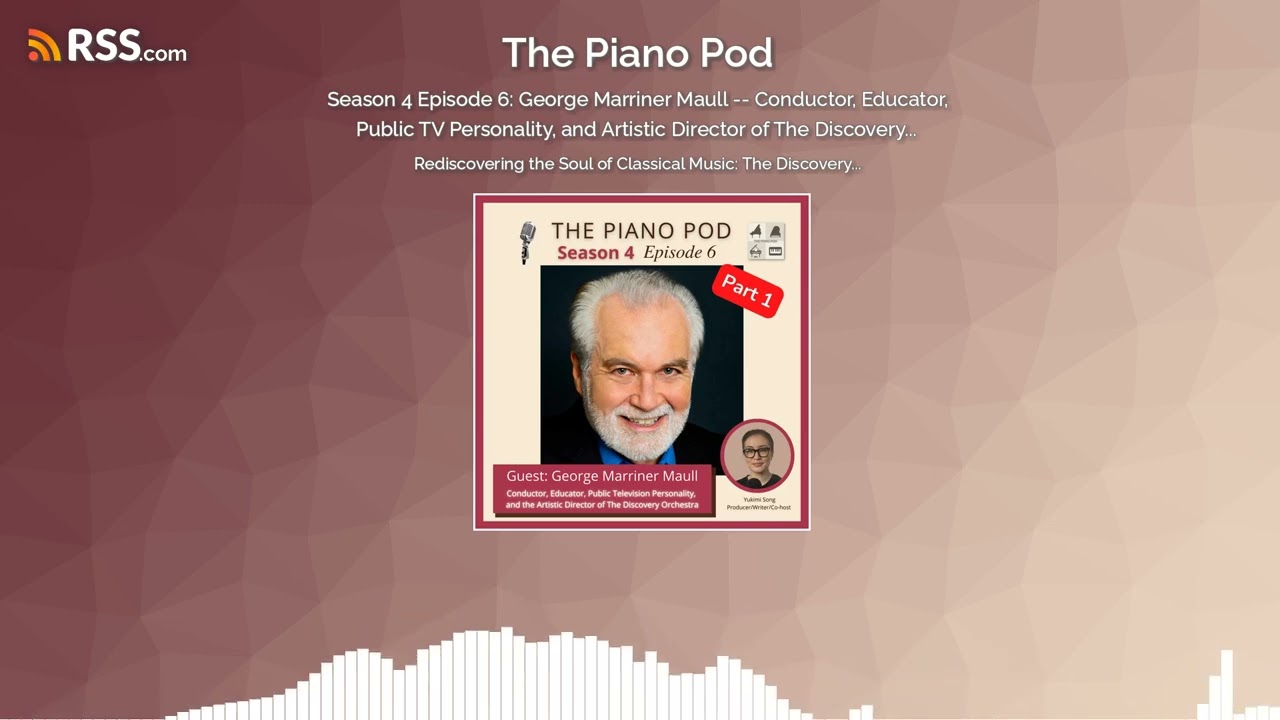
This content was created by The Piano Pod with Yukimi Song. This content was uploaded by The Piano Pod with Yukimi Song. This is a YouTube podcast episode (Part 1 of Season 4, Episode 6) of The Piano Pod with Yukimi Song (posted 2023-11-19) featuring host Yukimi Song interviewing Maestro George Marriner Maull, conductor and Artistic Director of The Discovery Orchestra. The excerpt is a multi-speaker interview/conversation in English that covers the history and mission of the Discovery Orchestra, their teaching methods for listening to classical music, outreach and education programs, media productions (TV, radio, podcast), audience engagement strategies, and related anecdotes and awards. The clip also contains short illustrative musical commentary and promotional bits for The Piano Pod.
Chapters
Layers of different patterns are used to create the texture, another one of the elements of music we can focus on when we listen. This particular kind of texture was favored by a number of composers at the end of the 19th and early 20th century. One of them, French composer Claude Debussy, was also a great influence on Stravinsky. Listen to some of the layers Debussy used to create texture in his tone poem "The Sea," "La Mer." This passage is from the second movement called "Play of the Waves." Here's the primary pattern played by violins and violas. Now listen to the rising a scale-like pattern played by cellos and harps. Here's a pattern Debussy gives to— well, you tell me which instruments play this pattern. —And that pattern was played by— woodwinds. Yeah, woodwinds. The bassoons, the clarinets, oboes, flute, and piccolo. Here's one more pattern Debussy gives to the French horns and to one additional a solo brass instrument. See if you can identify which one. So what's the additional instrument? Trumpet. The trumpet, yes. Very unmistakable. Now, using these 4 patterns, layered one on top of each other like lasagna. And by manipulating the dynamics, the use of loudness and softness, Debussy builds an enormous climax and then backs away from it. Allow your listening to absorb all four patterns as we now play them together for you. At the Discovery Orchestra, we don't bring concepts like sequence to your attention so that you might impress your friends at parties or concerts. We bring concepts like sequence to your attention so that you will notice and enjoy them as you listen to music in real time.
Welcome back to another episode of The Piano Pod.
Here, tradition meets innovation. We bridge the timeless beauty of the piano with the dynamic pulse of today's world. I am your host, Yukimi Song. During the summer, I was searching for some incredible talents in our industry to interview for this season, and after posting about it on social media, and it received warm feedback from our fans and listeners. We were able to create quite an incredible guest lineup for this season thanks to you who took the time to fill out the nomination form. Well, one of our faithful listeners, Mr. Rick Collar, who is the executive director at the Discovery Orchestra, also took his time to fill out the guest nomination form for the show, and he nominated today's guest. Massive shout out to Mr. Collar. Thank you. Hope you're tuning in today. By the way, the link to the guest nomination form is in the description, so if you would like to recommend someone or nominate yourself for the future episode of The Piano Pod with Yukimi Song with Yukimi Song, we welcome your recommendation. Now, without any further ado, let me introduce today's guest, Maestro George Marinermahl. He is a distinguished educator, public television personality, conductor, and violist whose love for classical music has profoundly impacted millions of listeners nationwide. Serving as the Artistic Director of the Discovery Orchestra and being a 3-time Emmy-nominated public television personality, Maestro Ma has guided countless individuals toward becoming more discerning listeners, enriching their classical music experiences. Whether commanding the podium or engaging audiences in lecture settings, Maestro Ma's contagious enthusiasm for classical music knows no bounds. For over a decade, Maestro Meng has graced the stage as the host of the New Jersey Performing Arts Center's Classical Overtures, enlightening audiences before performances by world-renowned ensembles and artists. His radio program, Inside Music, now in its 4th season on WWFM, The Classical Network, continues to captivate listeners biweekly. As a distinguished conductor, Maestro Moll served as the music director and conductor of various orchestras, including the Philharmonic Orchestra of New Jersey, Louisville Ballet, and the New Jersey Youth Symphony. He has graced prestigious stages like Carnegie Hall and Lincoln Center and conducted performances in multiple countries, leaving an enduring musical legacy. Additionally, Maestro Moll is a gifted violist, having performed with esteemed orchestras such as American Symphony Orchestra, Aspen Festival Orchestra, and Brooklyn Philharmonic. His journey began in Philadelphia, where he received choral training and piano education. Later, he honed his viola skills under the guidance of Irving Segal of the Philadelphia Orchestra and pursued advanced studies at the University of Louisville and the Juilliard School. So I can't wait to invite Mr. Maul to the show and delve deep into his incredible journey, exploring the mission and vision of the Discovery Orchestra, the art audience engagement, and the transformative power of classical music. Before starting this special episode with Maestro Ma, I want to welcome all our first-timers to The Piano Pod with Yukimi Song. I'm a classical pianist and educator from New York City. Whether you're diving deep into the piano career, working professionally in the classical music scene, or simply have a passion for piano tunes, this podcast is your backstage pass to the fascinating piano world. I also want to welcome back and thank you to amazing TPP fans and faithful listeners for tuning in today. Please rate and review the show on your favorite podcast platform because every rating review will help people find the show. So dear TPP fans and listeners, get ready for an enlightening conversation with Maestro Ma that will inspire and captivate music enthusiasts and learners alike. Please enjoy the show. You are listening to The Piano Pod with Yukimi Song, where we talk to the brightest minds in the industry about how they are Bringing The Piano Pod into the 21st century.
Hello, Maestro George Marion Amahl. Thanks for being on my show this morning.
What an honor. Yukimi, thank you so much for inviting me to be with you today.
I have been researching in depth about your work through the Discovery Orchestra. I've known this orchestra for quite some time, and then actually, as I was developing this idea of podcasting, I watched your show I watched your small video clips a lot because I really love the way you engage with your audience, and then I had to learn from a good example, which was you. So then also you sent me the link of this video. There were several, but one in particular, Discover Saint-Saëns' Organ Symphony, where you talk about sequence and timbre and forms and compositional styles and so many things to the audience. And actually, your video brought me to tears because really, really, because you made me fall in love in music all over again. And, you know, I wish I had a teacher like you. I wish I was in the audience when I was a kid, you know, to experience that. What a powerful thing, powerful video. And so today I really want this, how I feel about watching the video, the sensation I felt, I really can't wait to share this feeling with my audience through our conversation. Anyway, let's talk about the Discovery Orchestra. So I visited the Discovery Orchestra's website, discoveryorchestra.org, many times lately, especially lately, to do some research for this episode. And then in the front page of the website, it says, we teach the listening skills that help you really connect with classical music. Wow, that is powerful. Simple yet powerful. What is the Discovery Orchestra? What is the mission and vision of the Discovery Orchestra?
Well, of course, the Discovery Orchestra is a 501 not-for-profit musical education organization, and we incorporated it in the state of New Jersey. Our offices are in Summit, New Jersey, in sort of central New Jersey, sort of a direct line from the Lincoln Tunnel if you go west on Interstate 78. And the mission, of course, is that very sentence, helping people to really connect with classical music through teaching them how to listen. And it's, it's important.
It's important to learn how to listen. Mm-hmm. Wonderful. And, you know, in a society filled with electronically reproduced music, how does this Discovery Orchestra help people truly engage with classical music?
Right. Well, as we know, there is a 24/7, rather incessant presence of electronically reproduced music. It goes everywhere you go: supermarket, doctor's office, on the hold on the telephone. There's always music being played in the background in our lives, and it's actually trained generations of people to merely hear music as sort of a sonic wallpaper that accompanies everything they do. And, uh, the list of, of things you could be doing while you hear music only is endless. But as a consequence, people have actually learned to ignore music rather than to be completely and fully present with it. I, I'd like to ask friends sometimes, the next time you're in a restaurant with friends, uh, after a few bites, do we mention, how did you like that last piece of music that was played on the sound system in the restaurant? And there will always be someone at the table who says, is there music playing? That's how desensitized people have become. So the first thing that the Discovery Orchestra does to help people engage is to initiate a circumstance that provokes an individual to have an aha around whether they are actually listening or not, because people don't realize that they are not actually listening but only just hearing music while they do or think about other things. And you can even see it in the concert hall when we're on stage. Out of our peripheral vision, we see people texting friends in Ohio and We see people reading the program notes, and of course that's defeating the purpose of being there because every sound must be taken in by the person in order to understand it. So all of these distractions, I mean, there's always someone in the audience who seems to be scanning the people around them for perhaps an attractive person to hook up with at intermission or something. It's, it's amazing what people do in the concert hall. So How we accomplish this aha, I will speak about in detail a little later, but having cajoled audience members into making a decision to give music their totally undivided attention, then we ask them to fill in gaps in information that we provide them. That is, we ask them questions which can only be answered by giving the next short excerpt of music we play their undivided attention. So we kind of force them to listen. And in this process, we help them notice various aspects about the elements of music, the rhythms, melodies, textures, harmonies, the dynamics, the timbres, and the form as used by the composer in whatever is the featured musical selection on that concert.
You know, that's a lot of planning to do. And And also a lot of work. I mean, put together an orchestra and play music itself is already a lot of task anyway. And as I was watching— this is true. Yeah. And as I was watching your show and your orchestra knew exactly which excerpt to play according to whatever you tell them to do.
There, Yukimi, there is a secret behind that, and that has to do with all the work that we do ahead of time. Obviously, I select the excerpts of music to be played. And then we— I make master copies for each part of the orchestra, the first violin part, second violin part. And there are these books that we assemble, these binders for the orchestra, so that there is only one thing to play on each page. And they just turn to the next excerpt, one after another. They know that the next thing they're going to play is after the next thing I say. And that's why they're so on top of it.
But of course, they have to agree to do Yeah, but you know, the whole experience, even just by watching at home on YouTube, was just so powerful. And then I was like, wow, this is well choreographed. And that it is nonstop. And then how audience, your audience was captivated by the presentation.
When you think about the teachers in our lives, and I'm thinking mostly here of the people in school, that we studied with when, when we were in either high school or whatever, um, are my favorite teachers. And I think many people's favorite teacher are the ones who combine a knowledge of their subject with a slightly entertaining personality, perhaps even humorous at times. And, and they also have a little flair for the dramatic. They're sort of actors and actresses, and those teachers really get the class involved. So that's kind of the model I try to use as I prepare the scripts for these programs.
I want to know more about your life a little bit later in the episode because it seems like you have more than just one skill. Like, being a conductor itself is a big task and big, you know, training, long years of training. But then you seem to have different skills, like, you know, even you're very comfortable in front of the camera, on the microphone. That takes a lot guts and also practice too. So we'll talk more about that later. Absolutely. Yeah. So could you share a bit about the history of the Discovery Orchestra? What was missing in the industry that made you decide to start the Discovery Orchestra? Because to me, there was something missing in my field, like teaching music, that I decided to start a podcast, just sort of like a fill in the blank. Yes.
Well, the Discovery Orchestra was originally founded in 1987 as the Philharmonic Orchestra of New Jersey. Uh, a good friend of mine, Brian Dalu, and I founded that orchestra as a professional freelance symphony orchestra that performed standard orchestral repertoire primarily in venues that are in Somerset County, West Central New Jersey. The roster of the musicians was and still is composed of members of the musicians union Local 802 in New York City, and it functioned like other freelance orchestras that are in New York, uh, some of which I used to play in as a member of the viola section. Orchestras such as the American Symphony, which performs at Carnegie Hall. The Philharmonic Orchestra of New Jersey expanded its geographic reach at one point by starting to perform in Richardson Auditorium at Princeton University and at the New Jersey Performing Arts Center in Newark when that facility opened. In 1997. The Philharmonic Orchestra performed in this capacity from 1987 for 18 years until 2006. And as far as what was missing in our industry goes, some of our patrons early on when we first founded the orchestra began to call the office or write to the office. People weren't using computers so much at that point, and they would ask if we knew of a course in music appreciation that would help them understand classical music better. It was really interesting. We'd have empty nesters who said, our children have now moved out of the house. They're gone. They're pursuing their own lives. We want to look for something to do. And we think that music appreciation would be it. Or one of the funnier calls we got from someone was a gentleman who said, my wife has been dragging me to symphony concerts for 25 years. I'm bored to tears when I'm there. Is there anything you can do to help me? So since I had been fascinated really since I was 9 years old with why some individuals seem to give music their undivided attention and others didn't. I told our staff that I would present a course in music listening for adult students. And it was originally, I think, 8 sessions on like first Monday, on Mondays in the month or for 2 months. And they lasted 90 minutes. And I enjoyed giving those courses a lot. I think 12 people took the first one and then it just began to grow and grow. Until the Art Center was having me do these things before 500 people at a time in the smaller concert hall there. But in any event, these courses became very popular. And at a meeting of the board of trustees of the orchestra in 1995, I was asked if I could present a concert with the orchestra that would teach people how to listen as I did in my course. And so during the 1996-97 season, we presented our first Discovery Concert in Princeton. Now, several years later, at a 1999 long-range planning session, the board members were asked to write their personal list of the top 5 things they'd like to see happen at the Philharmonic Orchestra of New Jersey, and these suggestions were then written on large pieces of paper, uh, stuck to the walls, and the trustees were then asked to rank each of the ideas that were on these pieces of paper. And the, the idea that received the most first place votes was, could we make a public television show with a Discovery concert as the material? And so in 2002, Bach to the Future, uh, our first show was videotaped totally on spec. We had no idea if any public television stations would choose to broadcast it, but we, we made it at the Performing Arts Center in Newark., and our producer, Elise van Stolk, sent the show to American Public Television, and they in turn decided to distribute it nationally. The first broadcast, I remember, was by the Philadelphia Public Television station, WHYY, on New Year's afternoon in 2003. It was an ideal time slot because it was 1 hour before the annual televised concert by the Vienna Philharmonic on New Year's Day. So a lot of people got to see our show, and this, this program subsequently received an Emmy nomination and was broadcast from coast to coast and in Canada for the next 3 years and seen, according to the Nielsen ratings, by about a million people. So in the wake, in the wake of the success, the board meeting conversations began to hover around this question: what is the most important thing that the Discover— excuse me, that the Philharmonic Orchestra of New Jersey provides? What unique What offering do we present that other professional orchestras do not? And the answer was, what is missing in our industry, as you asked me? And it was that nobody else was trying to teach the audience thoroughly how to listen to this music. And of course, um, that was a gap that needed to be filled. Now, there were audible gasps in the boardroom at a later meeting when it was suggested by one of the trustees that we consider presenting only Discovery concerts each season. No more regular symphonic concerts. I mean, it scared the board, but the momentum continued. And what followed was an in-depth strategic review that resulted in the 2006 renaming and rebranding of the Philharmonic Orchestra of New Jersey as the Discovery Orchestra.
Wow. That is just quite a journey.
It was.
And then where does this, the name Discovery comes from? That's, that's a cute story.
I belong to my local Episcopal church, St. Luke's in Gladstone, and have since I moved out from the city. One of the members of the parish is now a good friend of mine. His name is Richard Somerset Ward, hyphenated last name, from Britain. He went to Cambridge University and His last job was head of art and music at the BBC. So he had made dozens of television shows, many, many, I don't know how many, with famous singers like Pavarotti and you just, you name it. He did films with them essentially for the BBC. So he was very interested in what had happened to the Philharmonic Orchestra of New Jersey. And so, um, he, at the church picnic one year in June, he said to me, "Well, you know, George, I think you ought to name it the Discovery Orchestra because you give discovery concerts." I said, "Bingo, you've got it." So we have Richard Somerset Ward to thank for our name.
It's a really great name, catchy and inviting as well. That's exactly what we need, right, in our industry. As you've said several times, your orchestra focuses on teaching listening skills. And I'm an educator, classical pianist, and I teach piano lessons. And as a teacher, my job is not just about teaching how to play the piano. My job is much bigger than that. I feel like, and especially, yes, especially I'm doing this piano teaching on my own as a, you know, solopreneur. This is my piano studio. So I feel like I have so much more to offer. I have to offer more, much more than just what's on the score. Does that make sense?
So yeah, so I think teaching listening skills is part of my job as well.
Which I'm trying to do. And then, you know, in the end, I want my students to attend Carnegie Hall.
You know, I live in New York City.
You know, I have this luxury. My students have this luxury to go to any of this world-class concert anytime they want, every night. However, do they go? Not so much. They're busy, but also sometimes it's a little bit intimidating to get there.
Right. And also they're not being informed about how to listen, what to look for in music. Right. Yeah. So I think music education, teaching as a teacher, that is part of teaching as well. So having said that, what are the 21st century general audience's needs? What do they want in the classical music setting concerts, do you think?
Well, Well, I think that our biggest task is to help people discover how moving this music is. I mean, why would I want to go to a concert if I thought I would be bored? Many years ago, when I was still living in Manhattan, one of the board members of the New Jersey Youth Symphony— actually, he was the president of the board of the New Jersey Youth Symphony, which I was conducting at that time. He had tickets to Carnegie Hall. His corporation had a box at Carnegie Hall, and he couldn't go. And so he said, would you and Marcia like to have these tickets? I said, absolutely sure. Well, we went and found that there were lots of strangers in the box. Apparently a lot of the executives were unable to go that night, so there were a bunch of people who had never been to a concert before, including a young couple who seemed to be maybe in their 20s And, you know, they were turning to us and said, do you know what's going to happen here? I said, oh, I do. Now, the program was going— this was the Vienna Philharmonic, one of the great orchestras of the world. And of course, Marcia and I were excited out of our minds to be there because we had never heard the Vienna Philharmonic live before. And so this young couple wanted to know what was going to happen. I said, well, just stay tuned and we'll find out. Now, Sadly, the first piece on the program was Anton Webern's Five Pieces for Orchestra, which, while it used all 95 or 100 people on stage, was a rather typical 12-tone composition, incredibly dissonant and unbelievably disjointed. And so when that piece was over, the couple turned to us and said, Is this what it's like? And I said, not, not always. And I said, they were thinking of leaving and they were, they were going to leave, exit the hall. And I said, stay until after intermission when they play Mahler's First Symphony. I said, then we'll find out what this is about. And so they did. And of course they were knocked out by listening to Mahler's First Symphony. They never heard such a thing in their life. So I thought, this tells me something about what educators need to have in mind. In other words, you probably shouldn't use a 12-tone piece of music necessarily to start beginners on their listening journey.
Yeah, we might turn them off, you know.
So even if it's our favorite piece of 12-tone music or whatever. So I think that audiences need to be educated. Now, we know the sad thing is that that in public schools and even in private schools, although it varies greatly from many— from school district to school district and from school to school, but kids are not being taught how to listen to music. The primary emphasize— emphasis of music education in school is performance. You know, that's— they're teaching the choir to sing their concert. They're teaching the other kids to sing their Broadway show. They're teaching the orchestra to play their concert and the band to to get ready for the marching events with the football team or whatever. And so those teachers, even if they've wanted to teach music listening, many times I think they feel like they don't have time. In other words, there's just so much pressure to have that concert for the grandparents ready, you know, at a private school. I remember when I taught at a private school, we always had an annual concert for the young children for their grandparents. This, this was the big thing, you know. So, um, because I was already interested in teaching music listening, when I took the job at the private school, I told the headmaster, I will teach a course in music listening to the older kids, to the high school-aged kids. And so we had a course in music listening there. But normally you don't find this, and I feel like, you know, people are always saying the audiences are aging drastically, but you look out at the concert hall, sea of gray hair out and, um, I don't see it getting better unless we make a concerted effort to teach people how to listen. Because once you've been moved to tears by a piece of music, you will never be the same, and you will want to repeat that experience whenever you can, either with recordings or with live performances. And so we've got to get people to have that peak experience listening to music somehow.
Right. Yeah. Yeah. And everybody remembers that moment that you fell in love with music, right? That sensation, whether that is through video or through the record set you had or CD, whatever, or live concerts. So can you elaborate on the specific techniques or methods you use to enhance people's listening experience with classical music?
Sure.
Well, first of all, due to the format of our programs, we greatly restrict the repertoire. In other words, I don't try to teach people everything that's important in The Rite of Spring in a 1-hour concert, not even everything that's important in the Dvořák New World Symphony in a 1-hour concert. I select a single single 5 to 10 minute movement from the standard orchestral repertoire. And that's what we're going to stick to in this discovery concert format. And we play the movement straight through, usually, or almost all the way through. In— if it's 10 minutes, we might only play part of it at the beginning, but with no explanation, we usually play that 5 minute movement straight through. The next item on the agenda is to create the aha around the act of listening. So we will ask the audience to answer a question by listening to the next music. For example, I might explain that in the next music, all 3 trombones will play a very loud chord, and I ask the audience members to raise their hands when they notice that happens. We then proceed to play the wrong music on purpose, an excerpt in which the trombones do not play at all. And this always causes some consternation and confusion, even some laughter to erupt in the audience. And then I chastise them and I say, I didn't see any hands go up. And then in desperation, someone will say, well, the trombones never played. And I confess my crime. And then I launch into a brief explanation about the difference between listening to music and just hearing it as a background. And we end it with something like, "Now that we all know the difference between listening and hearing, we must make a conscious decision to give music our undivided attention." And then we proceed to play the right music containing the trombone chord, and of course all the hands go up at the right moment accompanied by big grins and smiles of recognition and satisfaction. So then, continually referencing a printed listening guide that we've provided the audience which has numbered musical events, such as at number 2, the trombones play their chord. At number 7, how many steps are there in the ascending sequence at number 7? Or at number 15, the dynamic level, the volume changes, the music gets— and then there's a blank— could louder, softer, whatever. So these gaps in information give the audience members listening problems to solve. I think that people learn best when they solve problems. In other words, I just tell them, it gets softer there, here come the trombones. If I tell them all that, they don't remember it. But if they have to figure out themselves what it is, so we'll play at number 15 and ask them to fill in the blank. Let's say the music becomes subito piano, suddenly soft at that moment. So they write in their answers and then we verify the answers and we work our way through the listening guide for about about 45 to 50 minutes. Finally, we ask them to follow their listening guides as we play the entire movement again straight through. Sometimes we have the numbers projected on the wall behind the orchestra so that they can keep their place in the listening guide in case they get confused, but we never fail to receive verbal comments or written survey responses that say, "The second time through, 'Oh, was so much more enjoyable. It sounded like a completely different piece of music.' Right. That's exactly what we were hoping to accomplish. So that's the methodology in a nutshell.
Wow, that's incredible. And then I actually got to experience that through that, uh, Samson organ symphony that I watched.
Yeah, totally.
Even I'm a trained classical pianist, but then the way you explain and present it just gave me a total different perspective on the piece.
Do you want to hear a funny anecdote in this way? Please. Frequently, when my orchestra members are walking off stage after a discovery concert— and these are graduates of the Juilliard School, the Manhattan School, the Curtis Institute, Oberlin College, you know, New England Conservatory, whatever— someone will be walking off stage and say, you know, I never heard that spot. In this piece, they'll tell their colleague. And I'm thinking to myself, what have you been doing all this time? But it's fine. I'm glad that we can even have professional musicians discover something they hadn't noticed in a piece of music.
Yeah, you are literally bridging the gap between the audience and the professional musicians. And that's so important because the way these general audiences would look at us classical musicians are like really cold, stoned, non-expressive facial expression, you know, playing music.
But when I was a child, when I was a child, those few television shows that featured a symphony orchestra, except for Mr. Bernstein shows, okay, Mr. Bernstein shows were very, very different. But if they, if they made a film of the Philadelphia Orchestra playing or any other professional orchestra in the United States, what you saw was a group of men, mostly, almost no women, mostly white people sitting, looking very dour as they played their music, you know. And, you know, I was thinking, anybody look at this, think, what on earth is the point of this? They look like they wish they were somewhere else.
Yeah.
So your point is well taken.
Yeah, absolutely. I mean, I don't want the musicians to make funny faces to play the music. That's right. Yeah. And then, you know, we're not really talking about dumbing down or watering things down. Not at all. No, right? Yes. Yes.
I mean, you know, I, I don't bring puppets out on stage. I once have brought dancers out on stage when we did a discovery concert on Strauss's Blue Danube Waltz. And so The second time through, we actually had professional dancers dance the Viennese waltz while we were doing it in front of the orchestra. But that's the only time I've had something else going on besides just listening to the music, because that, of course, is the most important skill to develop. I mean, most people in the world only think there is song, things with words. I mean, if you asked a teenager— when I was in high school, would you sit and listen to a 5-minute piece of music that has no words. They would look at you like, well, what's the point? It's gotta have words, man. You know, some rock and roll song or popular song. That's what they want to listen to. So the very idea of giving your attention to music that is wordless, strictly abstract, this requires an adjustment of the mind. And of course, we can only enjoy that if we're actually really present with the music and notice what's happening.
It's the art of listening. Right. We hardly talk about that. We, even among our colleagues in the industry, we talk about art of playing, art of technique, but we never talk about listening. Yeah.
Well, as we know, when we train, we are taught as performers to listen in a different way. Am I in tune? Am I in rhythmic sync with everybody else? You know, I'm at the proper dynamic level for my section in the orchestra. That kind of listening while we perform, our brain gets very used to monitoring what we're doing as we play. But the idea of listening just for the sheer pleasure of the experience, this is not something we talk about that much.
Right. Yeah, yeah, absolutely. So how do you attract these audience or drive them to come to the concerts? That's another challenge, right? Yeah, it's a huge challenge.
That is a huge challenge and it remains so. I mean, obviously when we were still giving live performances that were not recorded, you know, we did what everybody else does. It wasn't beyond me to go around neighborhoods putting up posters in supermarkets. Literally anything you do, we tried to get local news media. Newspapers were still being used. Of course, now it's the, it's the internet, but then you tried to get a writer to do a feature. On the concert that was coming up. In fact, I never cared if we were reviewed at the concert. I wanted someone to write a feature saying, if you go to this concert, you will be amazed at what you discover or learned or whatever, just to whet people's appetite in that fashion. Interesting story about music criticism. When I lived in Louisville, I was in my first marriage, and my wife's brother-in-law was a very fine amateur guitarist. His idol, country music guitarist Chet Atkins. And so he was always at home after he got home from work trying to imitate Chet Atkins' style of playing. So anyway, I asked him one afternoon, have you ever been to a concert by the Louisville Orchestra, which I was a member of at that time? And he said, no. He said, have you ever read in the paper what they say about those concerts? And the reviews often were very negative. And, and that's when it hit me, boy, professional classical music do not need music reviewers. They need someone to hype the concert in the media before it happens so that people like my brother-in-law would want to go. So of course, I took him to a concert after he said that to me. I said, you're going to go to our next concert. And he came out transformed. He said, How can all those people play together like that at the same time? I mean, someone who was an amateur musician, he could well appreciate the discipline involved in what we were doing. Anyway, it's just— hello.
Yes, it's a— I know it's a lot. It's a lot of things. Yes. But I think we can be very creative in that part, right? As classical musicians. Yes. Yes, now talking about creative, and you have been doing a lot, and not just these concert series, but also, you know, as you mentioned, one concert sometimes being featured in as a TV program, and then also those TV shows came like award nominated, right? And, or even receiving awards, right? We received Telly Awards. Yeah, yes, that's incredible. So for example, not only Back to the Future, but also Discover Beethoven's Fifth you did, and then also Discover Vivaldi's Four Seasons, that's Emmy nominated and also Telly Awards, several of them. And then Saint-Saëns, as I mentioned, Organ Symphony is also Telly Award recipient. And then Discover the Firebird, which is the—
Yes. Mm-hmm.
Telly Awards as well. So how do these programs contribute to your mission of transforming listening experiences are you reaching out to a much wider audience?
Right. When you think about the first discovery concert, which we gave at Princeton University in Alexander Hall, there were probably 600 people. This was in 1996. The Alexander Hall holds maybe 900 people, and I think we had about 600 at that first discovery concert. As I mentioned earlier, when that same concert on the third movement of the Fourth Brandenburg Concerto was turned into our first production for American Public Television, it was viewed over its 3-year run by about a million people, which is more than a 275% increase in the individuals reached. We can't achieve that when we just play a concert one time in one hall, not recorded, that's it. And the board began to feel like that was an unwise expenditure of resources. I mean, if you think you're a donor, would you rather reach 600 people, or if we were at NJPAC, 1,500 people in Prudential Hall, or would you rather have your gift help 1 million people learn about this? So you can see that it's a good mechanism for attracting donors as well by creating a televised production.
But you are such a pioneer that way. You know, these days, you know, we are using social media to promote and then, you know, different media, YouTube video clips and so forth. But you've been doing this for a long time. And then not only that, you have the radio show as well. And then recently you started the podcast. So you're my fellow podcaster too. And then I really enjoyed listening to— what's the title? Is it Notes Under the Piano?
Notes from Under the Piano.
From Under the Piano. Yes.
That was the brainchild of one of our board members. He said, you know, we have all these YouTube listening lessons up online. YouTube fans like to know something more about the person creating these YouTubes. Create some biographical stories about yourself. So that was how Notes from Under the Piano came into existence.
Yeah, it's really entertaining. And then each episode is very short, bite-sized. It's really fun to listen to. I already listened to several of them this morning. So, yeah, of course, you know, Discovery Orchestra You also provide outreach programs and also educational resources for teachers and students. So can you tell us a little bit about those?
There are a number of organizations that we have joined forces with in urban settings such as Jersey City, Newark, Paterson, New Jersey, and also some senior citizen groups in the suburbs. And what happens is that that these organizations, in some cases, the, the people that founded the organization knew about us. Or, for instance, the organist at my church teaches at the Newark Boys Chorus School. Okay, he's one of the faculty members. So of course we had that connection. And actually, our former executive director, Virginia Johnston, was on the board of the Newark Boys Chorus School. And so you know, it became early on a suggestion, go to the school and work with the students there. And then, uh, as far as Patterson goes, it's been in— been running for quite a while now, but there's a thing called the Patterson Music Project, which is an El Sistema-based organization, and they sort of function now under the aegis of the New Jersey Youth Symphony and of the Wharton Arts organization. It's a— Wharton Arts is rather large community music and arts school out here in the 'burbs, but they have this huge support going for the Patterson Music Project. And it started out again with just a few dozen kids, and there are hundreds of students involved in that program in Patterson now. So again, the idea was take music listening lessons to them. So we still do this. Uh, another group that we work with is Keys to Success. And the keys being referred to are piano keys. And this is an incredible organization in Newark.
Yes, actually, I interviewed Jihoon Kerska. Jihoon? Jihoon, yes. Yes, she is incredible. Anyways, sorry.
Yes, she's again just an incredible force for good. And so she knew us and we began inviting their students to come to our discovery concerts when we were still doing more of them live, and, um, we feel that we have to move and make ourselves available to people who might not otherwise find us, wherever they might be. And so now we actually send a string quartet out to these situations, as well as even still doing, leftover from COVID some Zoom sessions with these groups, as well as with senior citizens.
So How does this Discovery Orchestra work? So you have a concert series like throughout the year?
Well, not really at this point. It's very interesting. Before COVID I'm thinking this was like in 2018, we had a, one of our 3-year strategic planning sessions starting. We used to do 5-year plans, but we realized that the world was changing too quickly. So we switched to 3-year plans. So we had started a 3-year plan in 2018. And the essence of that plan was, because everyone seems to be living on screens at this point, at the end of this 3-year plan, by the end of it, gradually stop giving, give fewer and fewer live performances until at the end of the 3-year plan, we would only be making electronic product for either television, the radio, or the internet. And that was, again, a scary thing to do. But of course, the irony was that when COVID broke out, it was as though our board had some sort of clairvoyant moment. And because when we got there and no one could be performing live at that point, we were already set up, you know, to do our thing online and in other media electronically. So at this point, the only live things are our outreach programs. For the kids and the senior citizens, and the smaller events that we do. We still do an occasional, what we call intimate afternoon, in which some performance takes place either by a solo pianist or a string quartet or a clarinet quartet or whatever, and we make a discovery concert out of it. But it is also a social occasion in which people have a little wine and cheese beforehand and, you know, and get to talk to the performers and talk to me. And, you know, it's a less structured event, but it does include a little discovery portion in which they play music, we take it apart, they play the music again. Hey there, TPP family.
The Piano Pod with Yukimi Song is now into our fourth season, and it's all thanks to you. Since 2020, you've been with my journey with the TPP, exploring addressing this burning question: How do we make classical music resonate with today's audience in fresh and captivating ways? 4 years in, and the journey has been nothing short of magical. The Piano Pod with Yukimi Song isn't just a podcast; it's a movement, a space where pianists, composers, and educators brainstorm, debate, and reimagine classical music's place in our fast-paced world. We're together on a to ensure classical music doesn't just survive but thrives in our modern age. But here's the thing: to keep bringing you these insightful biweekly episodes, I need your help. Every bit of support goes into the podcast's essentials, from hosting to high-quality recording tech, and the countless hours behind the scenes. So, do you want to be part of this journey? Click the PayPal link in the show or head to thepianopod.com to donate. And as a token of appreciation, I will personally mail you The Piano Pod's snazzy logo sticker. So hit the subscribe button, spread the word, and let's continue our mission and journey as classical musicians.
Now let's continue with the show. And then not only the videos, you ventured into apps now, and it's called AHA Classical, and I follow you on Instagram, Aha Classical. And then also I just downloaded the app on my phone, Aha Classical app. Yes, yes, I haven't tried it yet, but I watched the introductory video. I think you are on the video and in the very studio where you are and explaining about how to use this app. So tell us about this app. What is it and who is this for? What's the purpose?
Well, as I may have mentioned earlier, my wife is a pianist and a piano teacher. And so for years, her students have been coming to our home here in Bedminster. And I used to sort of get a kick out of watching siblings arrive at their lessons. There was always the question of who went first, you know? Yes. And the other would sit, the other would sit on our couch waiting for the lesson. And of course, I had seen this in my childhood. My mother was a pianist and a piano teacher. And I remember her students would come to— she had more than a few sibling groups that would come for the lessons. Of course, in those days, there was nothing to do but either work on your homework for school or read something. But back in 2015, '16 or so, I remember that Marcia was giving a lesson to one of her sibling people, and the brother was sitting on the couch totally engrossed in his handheld electronic device, as so many children are these days. Right. Okay. And I thought to myself, it's like a light went off, and I thought, I wonder if some game could be created that would teach children, or adults for that matter, how to listen to music. Yet another way to get to them. And so at that time, our education committee of the Discovery Orchestra formed a subcommittee called the Game App Committee, and we met many times and discussed ideas. We downloaded all sorts of musical games that were already on the web, and then we even had consultations with a professor at Temple University in Philadelphia who specialized in creating things like game apps. And at the conclusion of all that, he said, you know, I think it's going to be too expensive. To try to develop a game app. And besides which, you know, you should really create this on your website, not a separate thing to be sold to people. Forget any commercial value in this. You won't get it. It just won't happen. But if you want to use your website, so anyway, we abandoned the idea until last year. And last year, one of the organizations that we partner with, this is Social Impact Studios in Philadelphia. They were really excited about this idea of a game and they said, we will partner with you. We will do the technical end. They're the technical geeks and the gurus of internet technology and what have you. And they said, we will help you create this game. You supply the content. You've got all this content already online. Let's chop it up and turn it into a game app. So that's how it came to be. And we just released it this past week. Really? Wow.
Wonderful. Congratulations. And so it's a game. So they, how do you call it? Like it says quest. So one quests another and they pass and then they go to another one.
And they can go on to the next quest. And if you get the right answers, you earn notes instead of stars or lingots. Coins. Yeah. A coin, you know, you, you get notes if you get the right answer. So, you know, we're anxiously awaiting some initial feedback from people to see how it's going down. Uh, you know, we can obviously modify it, adjust it, change it as we need to.
And then how many pieces are in the app at the moment?
There are just two quests. Okay. And I think there are probably just two pieces of music. One in each quest that gets explored in more detail than the other things we ask of them. But we are going to come out with a third quest sometime this month. And I don't, I'm not sure yet what they're picking as the piece.
And they're like orchestral pieces.
Yes, they are orchestral pieces.
Exactly. I think, you know, every era you go through, or time period you go through in life, it's just the way you reach out to the audience changes, right? Correct.
And you have to stay up with what's happening. Which you're doing. Well, I must say, none of us work in a vacuum, and I have such an incredible staff of people that I work with. Ginny Johnston left being executive director, but stayed on as chief finance officer of the corporation. Rick has a tremendous background in music. He studied at Juilliard Pre-College as a teenager. Is a wonderful pianist. And then he got his master's degree in business and worked for music publishers, creating textbooks for use in classrooms, in public schools and what have you. So he was already in his life very much on the page of the kinds of things we do. So because my wife played classes for his mother, who's a cellist and a cello teacher, uh, we got to meet Rick. So when we found out who Rick was, we then asked him to serve on the Education Committee, which he did. And then when Ginny left, he just happened to be looking for a new job at that point. So it was a tremendous bonne chance. We just moved Rick right into the Executive Director's seat. And then other people who work with us include Christine, essentially our person who takes care of all planning and facility use., and she came from a business background in New York City. Wonderful, wonderful person. And then Michael, who is another one of our staff members, he was one of my concertmasters in the New Jersey Youth Symphony and is now himself also a conductor. Uh, and, but he was looking for part-time work. He's just finishing his doctor's degree in conducting at Rutgers. So I'm surrounded by very talented, hardworking people. I mean, there are only the 5 of us, but we do a lot. And then the board members and the volunteers help to make all that we do possible. I mean, again, I don't do this by myself. I do it with the help of my friends, as the Beatles song says.
But you know, that speaks volumes about you. Like, they believe in your vision and they really truly see your hard work and dedication, devotion.
And that's a wrap for the first part of this special episode on The Piano Pod with guest Maestro George Marinormal. If you have been enjoying our episodes, please rate and review us on your favorite podcast platform. You can also watch this episode on The Piano Pod's YouTube channel. Please find us on social media to get the latest piano news via Facebook, Twitter, Instagram, and LinkedIn. So hit that subscribe button, spread the word, and don't forget to follow The Piano Pod on social media. All the links are in the description. Tune in next Tuesday, November 21st at 8 PM for the rest of the interview with George Marin Armand.
More from The


Spirit, Body, and Soul: Pianist & Composer David Berry on Virtuosity, Creativity, and...



Season 6 Episode 20 | "Spirit, Body, and Soul" feat. David Berry, Concert Pianist & Composer


Beyond Borders: From Argentina to Poland to Texas—Oscar Macchioni reflects on a life in music

Sound Liberation: Joe Williams on Black Artistry, Legacy & Belonging in Concert Music


