S2 E5 Dr. Alexandria Le--Yamaha Artist, Educator, and Arts Advocate
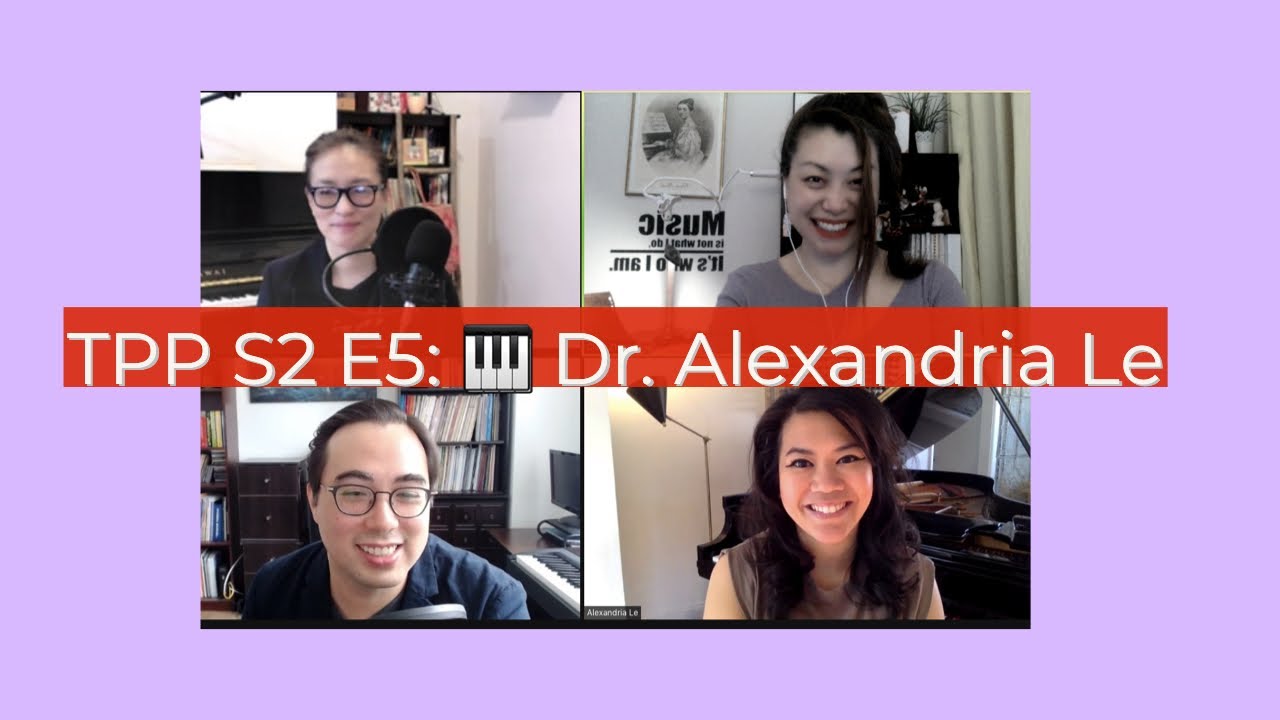
This content was created by The Piano Pod with Yukimi Song. This content was uploaded by The Piano Pod with Yukimi Song. This is a YouTube podcast episode titled "S2 E5 Dr. Alexandria Le--Yamaha Artist, Educator, and Arts Advocate" (uploaded 2021-11-03). It's an interview-style conversation on The Piano Pod with Yukimi Song featuring guest Dr. Alexandria Lee (concert pianist, educator, Yamaha artist and arts advocate) with hosts Yukimi Song, Eric Hunter and Clara Chang. The discussion covers Dr. Lee's performance career and awards, her community-focused fellowships (Pro Musicis, Ensemble Connect), outreach concerts in settings like Rikers Island and addiction recovery programs, the founding and activities of her nonprofit Notes with a Purpose (including a Wine & Music festival and shelter outreach), her teaching philosophy and approaches for children and adults, and multiple audience impact stories.
Chapters
Welcome back to The Piano Pod with Yukimi Song.
I am Eric Hunter. I'm Clara Chang.
I'm Clara Chang.
I'm Yukimi Song.
Today our guest is Dr. Alexandria Lee, concert pianist, educator, and arts advocate. A winner of over 20 first prize music awards, her performance career has seen her play everywhere from Carnegie Hall and the Salle Cortot to the jails of Rikers Island. After establishing her career for over 15 years in New York, she returned to her hometown of Las Vegas in order to form the nonprofit organization Notes with a Purpose. Since its inception several years ago, it has already engaged thousands of children and adults in the Las Vegas area through outreach concerts and special events. Dr. Lee is a Yamaha artist. She is also someone I am very privileged to call my good friend. Welcome to the show, Alex.
Thank you. Thank you so much for joining us.
Now, of course, you and I have a lot of history, but I know for people who are tuning in for the first time, I'm sure the question on their minds is, why Las Vegas? Yeah, right? That doesn't seem like the first place that comes to mind when we think about classical music.
Definitely not. Uh, it was not really a matter of choice. I was born and raised here. My My parents moved, um, moved here just a few years before I was born, and, um, and they're still here. So yeah, after living in New York for over 15 years and a little stint in Canada, I just started focusing back on Las Vegas. It was something that I always— it was a place I always wanted to return to.
Yeah. Now you were in New York for a long time and you were doing quite well. I remember going to your concerts. Yeah. So, so what was it that drew you back to Vegas, aside from your family, of course?
So the truthful answer is I was starting to feel a little burnt out in New York City. I had a really wonderful but stressful job, and I believe I saw more of the subway. Just, you know, I'm solar powered. I don't know if you can tell. It's just sunny here and I'm solar powered.. And, um, you know, I'm used to driving cars and, you know, I just needed space. So, you know, after my fellowship was done, um, I, I, you know, I was seeking kind of the West Coast, you know, just to kind of breathe a little bit and just, um, I mean, I was definitely busy when I came back, but, um, I basically wanted to load my groceries, you know, in the back of the car versus hauling everything from, you know, Trader Joe's on Sunday.
I still do.
Yeah, yeah. No, like, I have so much respect for people who are still like buffing it out.
Yeah, my biceps are really tight.
That's all workout. Yeah, exactly.
I'm getting lazy out here, ladies.
Yeah.
Uh, well, I can definitely relate because I had a similar flight myself to the West Coast. After our not-so-sunny days in Rochester. Um, uh, but let's talk a little bit about that time in New York because I feel like that was a formative time for you, right? Especially once you got Pro Musicis. So, uh, yeah, and then later Ensemble Connect. Can you talk a little bit about those?
Yeah, so, um, I was like a long-hauler graduate student I, I did eventually finish my doctorate, but I just kept getting distracted by really fun projects. And also the thing that kept pulling me away from just sitting in the practice room and just finishing out my degree was an interest in being really out in the community and really wanting to connect with people in the community, and this meant beyond just music students and musicians. And so I start— I don't even think you know the story, Eric. I had a colleague, Gwen Perlmusichus, and she invited me to the Winter's Recital. And so I went to her concert at Weill Hall, and I was like, well, this is great. What is this organization? And I read the mission statement and it was really such a heartful, just soulful, beautiful organization that gives back to the community. They essentially pick the first prize winner to play their premiere debuts in New York and Boston and a whole bunch of other places. But then they'll send you into really hard to reach places like prisons or hospitals or assisted living facilities. And that just really resonated with me. I was like, this is, you know, I had such respect for my colleague. I mean, she was playing at such a high level. I was like, geez, you know, so this is like a serious competition of sorts, but it also had a social awareness aspect to it. You know, this, mindfulness. And the award was only every 2 years or so. And then I got invited to the next winner's concert, and I was like, okay, I just need to like apply to this thing, you know, it's time for me to throw my hat in. And I was supposed to finish out my doctorate at that time. And I ended up winning. And that was such a momentous time because it just really connected all the dots for me. You know, I wanted my music to mean something. I wanted to bring it to people who couldn't normally get to concerts. And so they presented me, for instance, at the Phoenix House, which is a drug and alcohol addiction recovery program. And there are a few places around New York City. And, you know, so they hauled in a Yamaha grand into their, this multipurpose room. And it was sitting there for a few days. So the, you know, kind of like the energy started picking up. People were like, what is about to happen? And, you know, it was my first concert, solo concert with such a big audience that really, it was a new experience for me. Where, you know, the men had to be sitting on one side and the women on the other. And they were all going through a very transformative time of their lives. So yeah, and then following that, just a few months later, I learned about Ensemble Connect. At that time it was called Ensemble ACJW. Glad for the name change. So Ensemble Connect is a fellowship run by New York City Sorry, it's run by Juilliard and Carnegie Hall, and they have a partnership with the New York City Department of Education. So it's a teaching artist program, essentially. It's a fellowship that teaches young musicians how to present, you know, music and art to any kind of audience and to do it very conscientiously. And, um, and, you know, with that, I, I, I miraculously, you know, got that position and it just followed the heels of Prometheus. It was, it was an awesome year. I have to say, I was like, wow, the universe does not want me to finish my doctorate right now.
So, um, you had bigger fish to fry.
Yeah.
Yeah. And thankfully Stony Brook, um, where I got my master's and my doctorate, there were just I mean, they were so supportive. They were like, well, this is what we want our musicians to do anyway. She's just doing it kind of early. Or, you know, I did end up rewriting— because of me, they rewrote the graduate student handbook. They're like, you need to finish within a certain amount of time.
Okay.
So it was just a really important time in my life. As you said, Eric, it was, it was really time for, for me to find that support, you know, to find kind of the, the, the currents, you know, that were taking me towards what I wanted to do. I, you know, even starting out in Rochester, you know, going to Eastman, there was a music therapy course that they offered. And, you know, I kind of dipped my toe in that because I was like, I just want to help people with music, you know, in some way, you know, and And so this was just a great— teaching artist work is really kind of up my alley, I think, because it allows me to still really— challenges me to keep my chops up, present new ideas and works to different communities, and just meet a whole lot of different people.
The way you're even speaking, you're so passionate. Such an impact that these two organizations gave you while you live in New York. And how fortunate is that, that to be able to find that at such a young age? Because musicians, we all struggle. Why am I practicing hours and hours of this piece? And it's so hard to find a meaning of it all, and we all struggle. But in a way, you found what your really true desire of why am I practicing? Because I want to really give, give back to the, uh, the community. And then it's so wonderful that you found that, you know, um, outlet. Yeah.
I felt very lucky. It's also kind of, I'm sure you're noticing the trend that that conversation is happening in our, in our world, in our music world, that it's like, why, why are we practicing? You know, when I was just entering Eastman, and this was a while back, like, you know, so it was 2001, 2002. You don't have to do that. Just kidding. I meant 2010. The stats were that there were 10,000 pianists graduating with degrees a year. And I was like, okay, what are we doing with this, right? Do— it's important for people to connect with music and have, you know, have music be a part of their lives. But I'm like, that's a lot of competition. Like, that's a lot of— what, what are we doing besides, you know, playing for ourselves? So that stat really just stuck with me, you know, throughout the years. And the funny story, actually, speaking of being in a conservatory environment, um, in studio class, one studio class, the question was raised, whose dream is it to play in Carnegie Hall? And there were 3 hands that didn't raise, you know, in a group of 20, and mine wasn't one of them. And we were also clumped together, which says a lot. But yeah, they asked why, you know, why, why don't you want to, you know, play Carnegie Hall? I'm like, listen, I do want to play Carnegie Hall. Not saying that, you know, I'll turn away. And I did. That was the greatest irony. I mentioned this in my interview too. When Carnegie Hall— I was sitting like with the Carnegie Hall administration. They're like— I said, I have a story for you. I actually, you know, you were not my dream, but actually the thing is, um, The reason being was I said, I don't wanna just be playing for people who are looking at the concert roster or the season going, oh, I wanna hear her, I wanna hear how she plays Opus 110 Beethoven Sonata. Like, let me compare her to, it's like they already know what it sounds like. What about the people who can't afford to get to Carnegie Hall, who feel intimidated, who can't, access that, right? And, um, and so it's just amazing how, you know, years later they— Carnegie Hall created Ensemble Connect to smash that, uh, that conception. They said, we're going to create an ensemble of 20 people to learn how to go out into the community. And, and, you know, it's not about bringing people to Carnegie Hall, it's about enriching the place around us. And so that's when I had the experience of preparing a concert, an interactive performance, it's what we call them, to go to Rikers Island.
I want to hear more about Rikers Island. And also, you just mentioned the word interactive, so I think that's the key. It's not about us presenting this you're really humongous amount of repertoire, and then hahaha, I'm at Carnegie Hall, but there is this interaction between you and the audience. And then, you know, I really feel the— really this energy from you, like, where how much you are also— you're such a giving person, but how much also you're receiving from the audience. And I really want to know more about it. I want to, if you could share some of the stories. It seems like you really had an amazing time as a performer and giving this wonderful gift of music to the audience that where normally we don't reach out to. So if you could share with us a few examples, maybe at the prison or at the hospitals.
Sure, absolutely. The most— one of the most important aspects that I was aware of even before getting into the ensemble, but was really driven home, was you've got to know who your audience is. You have to understand why they're there and what is the takeaway at the end. What do you want to leave them with? What's— so there was always something called an entry point. I mean, it starts to It starts to sound academic, you know, but it was very structured. It was a very structured teaching artist training program. I mean, we had the foremost teaching artists teaching the ensemble how to deliver our message. So we had Eric Booth, for instance, he's kind of like the grandfather of teaching artistry. So, When going into Rikers Island, uh, we— I had an interesting, uh, we were always put in interesting ensembles. So before Rikers Island, uh, the first ensemble formation I was given, I was playing with a violinist, a French horn player, and a cellist. It was like a very odd combination, and they did this purposefully. They're like, you know what, we're not going to give you ensembles where, you know, you can just pull out, you know, Trout Quintet or something and then just, you know, play together. We had to do a little bit of arrangement of music, you know, find music that really then meant a lot for us to be able to bring out. I mean, like, we even snuck in Adele as the opening with, you know, with the bassoonist, for instance, you know, for our school outreach programs. But for the Rikers, visit, I was actually in a Mozart piano quintet arranged formation, and our theme was how does Mozart create drama in music? What makes music dramatic? And so our interactive components really, you know, with being in a jail setting, you can't have people come up and, you know, try to, you know, do things, but we did ask questions and got amazing answers. You know, you actually have knowledgeable audiences all over the place. And so that experience of bringing something informative but not preachy, you know, we— you never want to sound like you're preaching to the audience at all. And it was something that we're all still learning too, you know. So it's a young group, and what's great is that, you know, after the 2 years of really intensive work, there's more of a natural approach to it. You know, it's really kind of how you merge it with your own personality. So it was challenging for me at times because I was like, oh my gosh, I have to figure out this tight 50-minute script that could be suddenly chopped, you know, off by 5 minutes if suddenly the school bell is about to ring or there's an emergency or, you know, but making a really tight show, being very mindful about every single word we were saying, because we did not want to slip up and say something that wasn't PC, that, you know, would— that would be terrible for students to hear. And all of that was really nitpicked over. And so once you're out of the 2 years, you're like, wow, okay, I should be able to talk to an audience now, right? And understand the flow of the performance because You know, it's not that it always has to be high energy. No, it's— we can get really, really deep and introspective with the music and have everyone follow along with us. So it's such a powerful thing. You know, we are in such a powerful position as musicians. You know, we should have everyone in the palm of our hands and take them on a journey with us. You know, and so I always feel like this incredible weight and responsibility, you know, anytime I perform. But the interactive perform— nature is incredibly important because it's not talking to, it's not playing to, it's like, let me invite you in into what I'm experiencing, you know, and this is what I'm listening for. Very simple things, it's very cool.
Alex, can you give some examples of comments or interactions you've had with audience members following these kinds of performances?
Oh yeah.
What stands out in your mind?
This happens a lot when when they're living in a, in a place that's not— that doesn't feel very safe, you know, if you're in a shelter or if you're in a jail, you know, when you're performing the music for them, it creates a safe environment for them. And this, this wasn't said to me, uh, it was said to another one of my colleagues with another group, but it was at Rikers Island, and they said This was the first time I've been able to close my eyes and feel safe and feel comforted. And I know that happens when I'm in my performances too. It just didn't come out that strongly. I've gotten, for another drug addiction recovery program, it's like, you mentioned you were gonna play Bach. And I was like, oh God, this is gonna be, ugh. And then, whoa, he's like, I— wow, like, that was incredible, you know. And that particular concert, what I did was, um, it was a solo concert for a drug and addiction— it was an addiction recovery program. And my final piece was the Bach Busoni Chaconne. And for those that may not be familiar with it, um, it's taking the same theme, the same the same motive over 64 variations. So you hear the 64 times, and by the end, you know, it's transformed. And that's what I wanted to show the audience is that, you know, you can still be who you are. You can have a lot of things happen to you during this time. You know, these developments, you have big, big milestones in your life. You know, in the Bach, there's like a couple of— there's like 4 moments where you really hear that theme very powerfully. And at the end, it's So empowered and triumphant. And I wanted to leave people in the audience going, yeah, I can get through this 15-month program. Right. Like, and it's not all going to be rosy, but there are also sublime moments or moments where I'm gonna really know myself. And so that was, yeah, you, you have people who normally never even think about listening to classical music. And they'll come to you. And that's happened with— through my, my nonprofit, um, where, uh, a recovery program client, uh, came up to me and, um, I was presenting Jessica Meyer, who is an amazing teaching artist and violist and composer, um, in New York City. I brought her all the way out here to Las Vegas. I presented her in front of the addiction recovery clients And she did a really cool looping pedal, um, her own solo show. And it was an hour and she told her stories of what inspired her. And it was a mandatory concert. And so the next week I went back into the, um, the rescue mission. That's what it's called, the Las Vegas Rescue Mission. And I was playing piano just during dinner time, just kind of like scoping out what it would be like, you know, to play, to bring people in. And this— I suddenly see this guy just staring at me, just like he was eating his food and just staring. And I'm just playing and he's sitting right, you know, kind of right in front of me. And I'm like, okay, this is getting a little bit unsettling because he doesn't look like the most approachable, friendly guy. I was like, oh my God, you know, I'm like, let me just play through my piece, let it out, you know. Afterwards, he comes up to me and he's like 6'4". He's not, he's not a small person at all. He comes up and he's like, hi, uh, I want to speak to you. I was like, oh gosh, hi. You know, um, he goes, I was really pissed off. Beep. Sorry, you can beep that out. I was like, but I was like, I was really pissed off that I had to go to that like Viola show last week. Um, because it's, I work graveyard. So when they came knocking on my door to get up, that's like being woken up at 3 in the morning to go to a show. And so he's like, I was not happy with that, but oh my God, that was the best thing ever. And, um, I, I got up now today to tell you that, and also that I started listening to classical music, and I now listen to it every night as a part of my recovery. And so that floored me. And, and Jeff— that's his name— um, he continued listening to classical music. He graduated from the program, um, and the most beautiful part is he He ended up becoming head of security for the mission. So he would introduce my high school students, well, Notes with a Purpose, saying, I mean, he would shut the room up. He's like, y'all need to listen to these, like, this is an amazing group. Like, he was sort of, he understood, he felt the effects of, you know, what can happen if you open up yourself and, you know, find yourself on this path with experiencing music. And Jessica is such a wonderful musician, so, you know, we really have her to thank. But, you know, that was the kind of experience I wanted to curate, you know, from my own playing and also, you know, what I do, what I've been doing since that fellowship.
Yeah, well, you just gave me chills. Yeah, what a powerful experience. Um, can you tell us, um, how Notes with a Purpose got started? When did you first get the idea to form your own organization?
Yeah, um, so it has a little bit of a backstory. Before it was Notes with a Purpose, it was actually the Las Vegas Wine and Music Festival. So, um, yeah, yeah, it is. Um, so I've had this idea for about 10 years in my head of pairing wine to classical music. And it happened because I was drinking a glass of Chardonnay. It was completely unintentional, but I was allowed to bring in a glass of Chardonnay into this chamber music concert. And they start playing the Dvořák American String Quartet. And it was one of those moments where I could, I'm listening to the Dvořák, it starts playing, I'm tasting grassiness grass, like this kind of like grassy flavor. I wasn't even a wine drinker. I was like, I hated wine actually. I mean, I just didn't have any experience with it, but I could taste grass and paired with the opening dun dun dun, I was just like, oh, oh. And I literally looked around me. I was like, does anyone, is anyone else experiencing this? Right? Not everyone bought wine to take it. And I, and I literally went, holy beep, like, why isn't anyone doing this? I was in the middle of Washington State. It was wine country. I was like, okay, I don't even drink alcohol that much. And I think this is an awesome idea. So I just kind of, you know, shoved that to the back of my head. And then I don't know, 8, 8 years later, 7 years later, um, I kind of run this idea by a sommelier, a wine expert, and they didn't laugh at it. I was like, great. And I started to think of ways to go back to do something in Las Vegas. So I wasn't even planning on moving back to Las Vegas. I just wanted to kind of put feelers out and orchestrate something. And after the first, After the first year of Ensemble Connect, or during the first year, I was starting to become really motivated because one of our questions was that— one of our exercises we had to revisit time and time again was, what is your mission and vision statement? No, what is yours? Not someone else's, but look inside yourself. And mine always pointed back to Las Vegas. It was like, I just wanna connect back to Las Vegas, have, you know, this kind of high-quality experience that I get here in New York City and kind of transport that back to Las Vegas somehow and do it in a cool way, in a Vegas way. I'm a foodie, I love food. So, you know, bring the food in. So it ended up being a 3-day chamber music festival. I had 18 out-of-town musicians and 6 locals, including myself, even though I wasn't really a local, but it was amazing. Like I had Carol Wincence, Frank Morelli, Alan Kay, Phil Setzer from Emerson String Quartet. It was kind of like my dream. I like, when they came walking down the hall for their first rehearsal, I was like, like, I did it. You know, it was, it was one of those like, Ah, and actually I have a SoundCloud from that festival. If there's one track that you should listen to, it's the Appalachian Spring, because it's Carol Wincents on flute, Frank Morelli on bassoon, Alan Kay on clarinet, and it's the dream team. Yeah, when Carol's telling the audience about her interactions with Aaron Copland, you're like, Okay. Okay. You know, and it was done Orpheus style, no conductor. And it just was so tight. It was, it was one of those moments. Like it was worth it. Like this year of, you know, administrative pain, you know, um, is so worth it. And it was really fun pairing wines to it. I had food brought in too. So after that was done, I collapsed for a month. I just like, said I can't move or do anything else, but I wanted to do more. You know, I said, okay, you know, this is not it. There are other ways to be involved with Vegas. Again, I didn't want to perpetuate that thing that, oh, only ticketed people can come to my wine and music concert, you know. No. So I was like, well, let's start a nonprofit. And so that's when Notes with a Purpose came in. You know, I wanted to kind of combine music notes potentially wine notes, you know, but make it more about music affecting people in a general sense. None of my branding ever says it's a classical music chamber music festival. You know, it's just music. It's music. So I've done different things with Notes with a Purpose. It's— so that was 2000— 16 when I really like launched it off. And I was running two programs. One was, um, uh, we called at the time Wednesdays Live at the Mission and was rebranded to, uh, Mission Music Live. And that was bringing, um, myself and high school students into the Las Vegas Rescue Mission, which is a homeless shelter, a food pantry, and it houses the addiction recovery program. So I was bringing in high school kids to perform during the mealtimes where there were up to 400 meals served in 1 hour. And I made the kids talk into the microphone to introduce themselves and play. I mean, it wasn't all quiet. People are eating, but some people who really wanted the music would sit closer to the piano. There were also violinists, guitar players. So the goal of that was to start planting seeds for young musicians to see how they can give, use their music, you know, that music is not just for, you know, being juried on, you know, it's not all about being judged, but about listen, like your music can affect someone. And also to burst their perspective and their bubble wide open. Like, look at all these people who are hungry, right? Like, you're lucky, you know, we're lucky. I always feel so damn lucky, right? So it's like, it's like I wanted to influence humility, you know, in young musicians. But so that was Notes with a Purpose and the Wine and Music stuff. Suddenly became our gala type of event. I would host it twice a year. I did things like Mimosas and Mozart, a brunch concert. I did Reclassified, which was merging EDM with classical music. And so those were ticketed events, but we would always also try to raise money. During those, and that would go directly into our outreach programs. This really stood out when I played at the dinner service at the Mission. A man came up to me and said, "I had never seen a pianist play in front of me before. I've never heard a live piano performance." Like, whoa. I mean, talk about taking for granted what we do, right? It's like, no, my mom stuck this in front of me at the age of 2 and a half, so can't say the same thing, right? It's like, it's so— and one, another person said, you know, I have a request. And I was like, oh my God, he's going to say something like Free Bird or something like that, you know? But he shyly said, you know, I watch this on YouTube all the time. And I was like, oh, please don't say, I don't know, like Liszt's Transcendental Etude, or I don't know. I was like, don't do it. But he was like, it's Fantasy Impromptu. And I was like, oh, I was like, yeah. I was like, I can totally play it. And so I dragged— well, I didn't have to drag him. I was like, come on over to the piano. And it was like, and the dinner service was done. And so people were packing up. So it was like a private— it was so meaningful. Like, I almost started choking up because I could hear him just like, can you imagine just listening to something only available to you through the computer? You know, and someone's actually able to play Chopin in front of you. And like, we were both kind of choked up, you know, at the end, and he was kind of shy about it. And so he's like, okay, thank you, you know. And later, I, I don't know, months later, I played it again, but for the whole dinner service. And he tagged Notes with a Purpose on Facebook saying she played it for me again, you know, and I was like, I know who that is. I, I know who that is, you know. And it's just like, you know, people, we are— we get so stuck in— gosh, like, we gotta make sure we appease, you know, all of like the voices in our head from our conservatory days, right? Or, you know, our mentors. It's like, oh, or he also knows— you're like Okay, Chopin, I know, kind of have a standard, right? Like, we have a standard we're trying to reach, and that is the difficult— it's a complex conversation we all have with ourselves. It's like, you know, it's not going to be enough for me just to play, you know, be really sloppy and someone's like, oh, bravo, you know, brava, you know. I don't want that, you know. I want to really get the true essence of the piece, really deliver it sincerely and with integrity, you know, and form that connection with the audience at the same time. And it's hard to do. It's hard to administrate. It's hard to, you know, we all do it, all these multiple hats we're trying to wear and also try to practice enough, you know, to make sure we're doing a good job.
Of course.
Yeah.
And then, Alec, thank you so much. And I want to come back to this question. Now, I know you are also teaching a lot now. We talked a little bit in the beginning and you said you were also teaching on Zoom. Basically, to me, I'm very curious now after all this experience you have had, which is quite unusual actually for artists. Not everybody really gets to have all this experience. How do you— I assume you also teach children. Like, how would you approach, like, what would you tell them? How does that go?
Um, I really enjoy putting things into context immediately for the kids. It's like, why— what's up with dynamics, right? Like, why should you play soft? Um, I even experienced this myself when I went to one particular teacher and he's like, do this hairpin crescendo in this Clementi sonatina. Like, that was like— that Clementi-Sanettino was the bane of my existence. I was like, this is so boring, you know? Like, to me at that time, you know, I was just coming back to piano and I'm like, okay, why the crescendo? What's the big deal about it? So, you know, that stuck with me. So whenever I'm speaking to my kids, it's like that crescendo, it's like, it's about excitement, right? Like, where are you going to? Putting that context was incredibly important for me then and now. So my kids have an understanding of what the music is trying to say. And there are so many different kind of teaching techniques to do that, but sometimes it's just a very simple, you know, what's the mood? What do you think the mood is? Okay, I've been teaching little kids kind of recently, so, you know, have to kind of have that, bring that energy. But, um, that's essentially what I do. I also teach, um, some adult students as well. And, um, the adult students actually really like understanding the tools to manipulate the piano. So there— one is a lawyer, he doesn't— but he attends all the Philharmonic concerts, he goes to all my concerts, and for him to realize, oh, that's the artist brush you use. Oh, that's how you do it. That's how you make something pop, right? Like, that's what voicing towards the top can do. And then it's really fun. It's like, oh, you know, like, you know, so I'll push him aside. It's like, let me teach, you know, and I'll demonstrate, you know, like, what voicing can really do, especially when he's just heard a concerto performance, you know, kind of recently. It's like, well, this is how you What happens when you don't voice the opening of the Tchaikovsky Piano Concerto, right? It's just like slamming thick chords. All right, voice that top. And it's like you have that silver lining. And so giving context to what the adults are listening to too, it informs them so their next experience they can really appreciate more of the kind of tactical stuff that we're all doing on the piano. Um, because no, you know, they're, And they enjoy trying to work on it too. So it's— and not all my students are going to be, you know, piano professional pianists, and that's not my, that's not my goal. My goal is to have them enjoy music, love music, and feel prepared to, if they ever want to sit down with sheet music, that they're not overwhelmed, you know. And also know enough harmony or, you know, theory just to understand like most of what you're listening to, you know, nowadays. Like, you can figure this out, you know, yourself.
Yeah, so I think it's great that you're giving them context, right? Because otherwise these days, especially, people are— students are having a hard time connecting to music from 200 years ago. Totally, right? And then especially we are abundant with all sorts of music around, and with the press of a button you can listen to music of any choices of, of your favorites, right? So can you tell us what are some challenges you encounter, some great things too, obviously, but when you are teaching, trying to relate to students?
I think the, um, The greatest challenge for me sometimes is under— is just reminding myself, you know, meet where the student's at. You know, it's, you can see the potential of a student and it can be frustrating at times when you're like, oh, if only you just put in like the time that you need, you can be freaking amazing. You know? And so I dropped, I had to drop that really quick. I was like, you know, the challenge today for any kind of teacher is time management for, for kids. I don't— did we have to go through that? Like, it just seems like homework is like overwhelming, you know. Um, you have to now have like 30 hours in a day to— for, you know, a kid needs to have 30 hours in a day just to like get all the things that they need done. So my challenge is, um, it's just, it's just really saying to myself, it's okay that they're not practicing the hour and a half that you want them to practice, you know, make sure that they're getting what, something meaningful out of, out of the lesson, you know, and I definitely am giving them the specific amazing tools I got, you know, I had a very serious upbringing. So, you know, does this kid need to know how to play the B-flat major scale, you know, you know, in doubles, triplets, and, you know, quadruplets in a certain time? You know, that's not the point. It's teaching him discipline, right? And managing expectations is— that's the fundamental answer. It's managing expectations from the parent. For me, You know, I had to— I have a mom who really is like, put her in a competition. It's like, well, there's gonna— you have to give a certain amount of time if you're gonna do this. And, um, I feel lucky that I have enough of a presence and sort of an active concert career because it's like, I know what I'm talking about. You know, it gives, it gives a little bit of, uh, Um, a little backing. Yeah, yeah. Let me just say, after I played Totentanz this past weekend and my kids came to it, they're like— they went to the— the mom's like, see, you're lucky to be with her. I'm like, oh, thank you. You know, it's like really nice to have those moments. And I think it's important for teachers to do, actually. And you all are fantastic pianists, but I think every music teacher should give an opportunity for, um, for students to hear them. I love, Eric, how you would play on your student recitals. You'd give them something to, to aspire to, you know. It's like, okay, this is, this is why I'm practicing, you know. It's, it's not fair to give the kids scales when you can't play scales, you know. Um, yeah, it's like, uh-oh.
Sorry, for anybody who's just listening, I just did a big oops. I suck at scales.
Yeah, that's, yeah, that was a big part of my upbringing. So continuing that tradition.
Tradition you've kept. I mean, everything you've told us, it's really been very moving because there's a lot of artists out there who are content to just kind of follow the playbook, not to take anything away from them, you know, but it's clear with you that from the beginning you were different because you really wanted to connect. One thing we didn't mention is when you're playing in a homeless shelter and somebody is standing right next to your piano, right? That is an experience you can't have in a concert hall. Where does that come from? You know, what suited you for this life from the earliest ages? Right. Because that was always a part of you.
Yeah. It is a matter of understanding who's standing in the same room as you or sitting in the same room. Um, I, I'm a good listener, so I, I have a lot of, um, empathy and sympathy. Um, so I think that's a very important component to to what I do, like what makes a good teaching artist. It's not about me, you know, um, and also, um, getting to the reason why we're all there, you know. I'm not gonna force Beethoven on anyone, you know, who is not ready to listen to it. I mean, there's a way to prepare things, um, yeah. My mom used to put me in front of a lot of different audiences. I was— I owe my mom so much. Of course, we all do owe our parents a lot. But, you know, my mom would take me to this annual, like, New Year's Eve party run by really wonderful people in this town. But there are— I was, gosh, the youngest person there was like 60 years old. And they were also on the other side of the political party, you know. And so I learned very early on that we can all get along, you know. I learned how to get along with people very early on, like I was 9 or 10, you know, and, um, and listening to their stories. And, you know, when it was time for me to play, it, it just was about connecting with people in the room who were far older than me and looked very different from me. But that was like an early experience of mine that was very important. It was just trying to be on the same level with the audience. We are not some angelic, like, amazing deity that comes, plants ourselves in front of the concert stage, even though it's really sweet when people are like, "Oh, you're so amazing." I'm like, "Okay, chill out. It's okay." You know, like, We're all human. And so I think when you can relate to the audience, it's very important. Yeah, and just making sure that you're kind, you know, you're— I am no better than— it's just being on the same playing field as everyone else. You know, I actually told my mom, so, you know, I have an Asian mom and she was very— very supportive, but also, you know, she's pushing me. She's— she has great dreams for her daughter. And so when I first moved back to Vegas after the festival was epic, so she was like, whoa, cool. But then like the place I was playing the most was a homeless shelter. And my mom's like, what the heck is happening? You know, it's like she didn't understand necessarily what I was—
Mr. Carnegie Hall.
Yeah, yeah. It's like, what happened to my daughter? You know, it was just like— and, um, And I was able to give her a teaching, have a teaching moment with my mom, which is really cool because I said to her, you know, Mom, I'm supremely lucky to have you as my mom. Like I was born to a mom who didn't use drugs or drink. Had you been doing that and abusing that, I would be, I would have that addiction, right? I have a mom who worked really hard and gave me all the amazing things that she gave me, but you know, that person there didn't have that, that chance. And so I'm just sharing that. And so what that did was it, it lowered her fear level with, you know, just like a random homeless person.
She—
I'm like, Mom, they're not going to come and like take your purse away or something. Like, they're just as, you know, frightened of everything else as you are. They're in a very vulnerable position. And so I only got to learn that from, you know, just experiencing life around different populations. That's really important too, is understanding. I could so have easily surrounded myself with just classical musicians. I, I'm very— I've been very introspective and retrospective these days, you know, reflective these days. It's like, oh, what if I went this way to this conservatory? Or what if I did that? Because who doesn't have a little bit of envy? Like, look, like I could so do what she's been doing, uh, only if I practice 6 more hours a day.
We all have that. We all have—
we all have that. And so I was like, no, this is— this is the path that we're all— it's the path that we're supposed to be on. It is okay to not be okay. It is okay to also, you know, to be where we're at, you know. And it's just looking forward what's our next step?
So thanks, Alex. Um, many thoughts about that, but unfortunately we have to move on. So one last question before rapid fire, um, and that's what do you see, uh, are some of the challenges for the current generation of young musicians coming up, and what's your advice for them?
Oh, that is a great question. Um, I don't see as many challenges as I see opportunities.
Wow.
Um, because there are so many things that are available to musicians now. Like, you can edit your whole own music video. How freaking cool is that? Like, I was like, why don't— I mean, Anderson .Rowe, epic. Like, I was like, why doesn't every artist have their own amazing music video like that, right? But what's so— what inspires me from the younger generation and what's probably like what, you know, older musicians or people kind of poopoo about, it's like, oh, what's this TikTok thing? I'm like, I see so much creativity, you know, the kind of editing that's done, the kind of fast-pacedness. I mean, yeah, it's a little ADD-ish, you know what I mean? But, you know, you think that it's only catered to those people, but I enjoy it. I enjoy seeing really creative ways that young people are bringing, you know, to what they do, you know, suddenly everything is interesting. It's like eating a bowl of cereal can suddenly be interesting if you cut and edit the right way, right? It's like, how did this happen? There are challenges, of course. Like, if you're growing up in a typical conservatory, like, type training, yeah. I was just telling my boyfriend who's not a musician how fortunate it feels to play with an orchestra. Like, oh my God. Like, no, I'm not like Yuja who gets to like, you know, tour, right? You know, none of us, you know, it's like, it's just Yuja who gets to, and Long Long who have like, they're hogging all the gigs. No, but you know, that opportunity to play like a real standard piece of repertoire, right? With an orchestra. Like, what, uh, what an honor and a privilege. So if someone is being groomed only to do that, they're in trouble because that doesn't happen often. I mean, like, you— oh, you know, and I'm certainly not the best pianist in, like, you know, this state, but I got chosen to play it, right? It's like, so then that's like about your connections and all that all these other things. So the challenge is just making sure if you are killing it with your technique and your playing, just look outside the box, you know, and vice versa, you know. Like, if you're not practicing your scales, practice your scales so, you know, you don't have to worry about them when you have to play it. And everything's kind of scales, just play your scales, you know. So, um, did you hear that, Eric? Yeah, Eric, I was looking right at you. Got homework, Eric.
Yeah, okay, right after this I'm heading down to The Piano Pod with scales.
It's how I cram so well, actually.
Yeah, I have no doubt.
I have like the— like, thank God my teacher was like, practice this, this, this, this, you know. If you practice like the combination of scales, arpeggios, octaves, broken octaves, You know, the only thing I really didn't practice was double thirds. I freaking hate them, but you know, luckily we don't encounter them too often. Yeah. Boo to double thirds. So practice them if you're young, start practicing them now. Um, but yeah, no, it's, it's so learning music for me, especially because I contextualize things immediately. It's like, I don't play them, play slow drills from the get-go. It's like, what does this sound like? How do I want to phrase this? Boom, you know, and then I plug in all the pieces. Yeah.
All right.
Not to make you feel bad, Eric, like big takeaway, practice scales.
I will. I will. I promise. Uh, no, it's very funny because all my students are playing a lot of scales right now. So if any of them ever hear this, they're just gonna laugh their way to the bank. Um, okay. So we gotta wrap up. Uh, sorry to, to, uh, have to end our time already, but it's on to rapid fire. So, uh, short answers only, please. First thing that comes to mind. Are you ready?
Yes.
Number 1, what is your favorite comfort food?
Um, oh, it is either fried chicken or I just had mac and cheese. That was very comforting.
Okay. Both good choices. Uh, I think I know the answer to this one, but cats or dogs?
Dogs.
Uh, what are your words to live by?
Oh, oh, this is not a rapid fire. Oh my gosh. I'm on the spot now. Um, be kind.
There you go.
Uh, and what is the most important quality you look for in people?
Um, sincerity.
Excellent. And what is your least favorite quality in people that you try to avoid?
Hmm, uh, greed. Greed.
Yeah, I mean, you can have more than one.
Oh, I have a whole list.
I was just kidding.
I'm just kidding. Put it in the notes. Okay, my turn. Name 3 people who inspired you, living or dead.
Um, definitely my mom, whether I wanted it to or not. It's good. Um, Miss, Miss G, Erna Golovian, was my primary music piano teacher based out of California. And I have, but I have so many mentors, like I That's part of what does it right now. And my boyfriend's doing a good job. He's wonderful. So shout out to Eric.
Which historic figure or composer do you want to learn or take lessons from if he or she were alive?
I'm almost afraid to say this because I know someone whose grandmother studied with Clara Schumann, and she was right here.
Right here.
She is strict, man. Like, I read a letter from her and it literally said, uh, I was really disappointed in the way you played in the lesson last week, you know? And I was like, oh, burn. But Clara seems like an amazing— yeah, person.
She is. That's why I changed my name to hers.
Oh yeah.
Which is always behind me. Which historic figure or composer do you want to hang out with at the bar if he or she were alive?
Um, probably Brahms, a younger Brahms.
So you get the lesson from Clara and then you go hang out with Brahms.
Yeah, totally. I mean, he wasn't taken, right? So you just like, just move on over.
All right, my turn. Name one piece in your current playlist.
It's been the Christian Zimmermann recording of Totentanz, uh, but oh, you guys should check this out. Um, there's a newly signed Yamaha artist, Blackbok, B-L-K-B-O-K. He fuses, um, hip-hop with classical.
Wow.
And he's on Instagram as that. And so I just met him and I've been I'm totally stalking his stuff. And it's so fun. So fun.
Wow, great. Yeah, I have to check it out. Check him out. So next question, name a book title you're currently reading.
Um, what did I— it's, it's all very depressing. Like one is on trauma. I don't remember the full name of it. It's a really wonderful book. I'll send it to you if you guys post it. It's really well regarded.
Great.
So you get only one song or piece to listen to for the rest of your life. What is it?
I have the same answer as your other guest. I'd rather listen to nothing.
Because— Yes, it's hard to pick. I know.
Yeah, I mean, I would say that the Ravel slow movement of his G major concerto. Quite nice.
Beautiful.
Yeah, but I don't know if I want to listen to that on loop for the rest of my life.
Yeah.
Okay, so here's the last question. Fill in the blank: music is blank.
For everyone.
Wonderful, wonderful answer. Thank you.
Yeah, great answer.
All right.
So that concludes this episode of The Piano Pod with Yukimi Song.
Thanks for coming.
Oh, thank you, Alex, for joining us today and sharing your insights and expertise. Thank you to our audience for tuning in. You can find more information on all of Dr. Lee's musical activities at alexandrialee.com and more about her nonprofit organization at noteswithapurpose.org.
If you enjoyed today's episode, please rate and review on whatever podcasting platform you use. If you're watching us on YouTube, remember to hit the thumbs up button and be sure to subscribe to our channel. You can also find us on Facebook, Twitter, Instagram, and LinkedIn. The links are in the description below.
If you have feedback for us, please leave it in the comments or DM us via social media, or you can You can also email us at thepianopodnyc@gmail.com.
That's all for now. We will see you for the next episode of The Piano Pod. Bye everybody!
Bye everyone!
Thank you so much!
Thank you! Thank you!
Bye!
Thank you so much!
More from The


Spirit, Body, and Soul: Pianist & Composer David Berry on Virtuosity, Creativity, and...



Season 6 Episode 20 | "Spirit, Body, and Soul" feat. David Berry, Concert Pianist & Composer


Beyond Borders: From Argentina to Poland to Texas—Oscar Macchioni reflects on a life in music

Sound Liberation: Joe Williams on Black Artistry, Legacy & Belonging in Concert Music


