S2 E9: David A Jones--Creator of Piano/Theory Course "Rhythm Warriors Piano Zone"
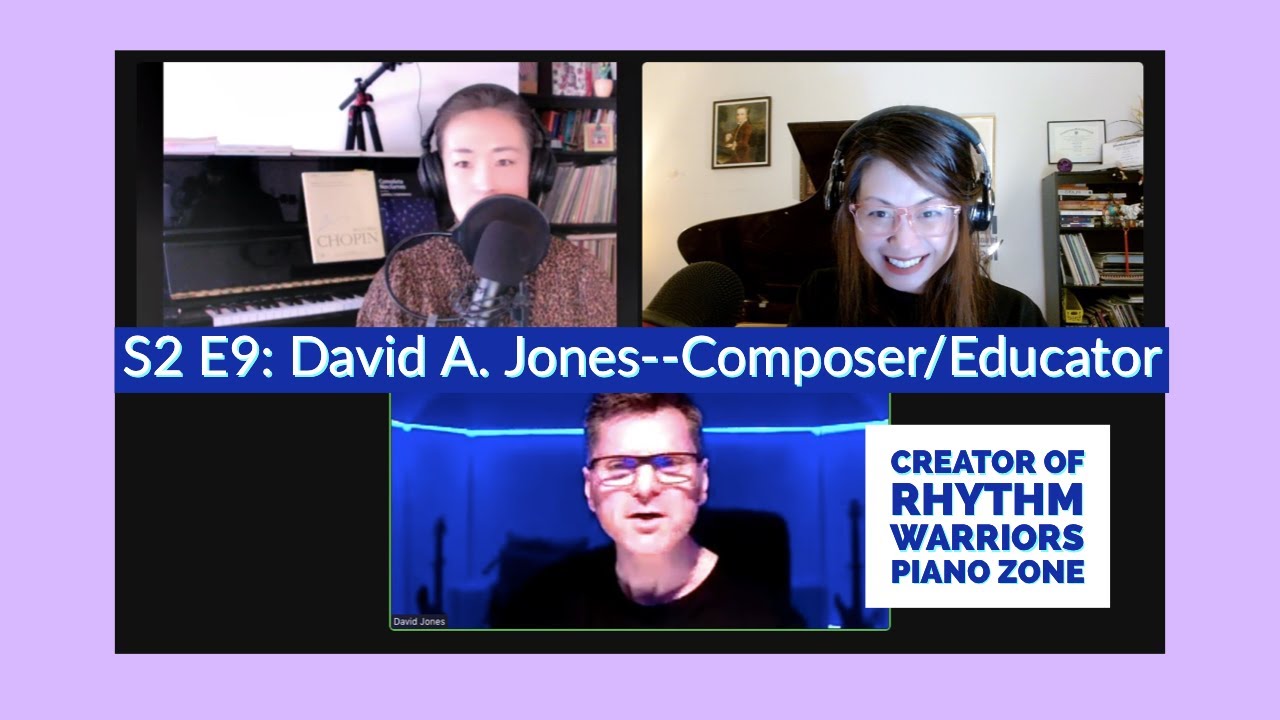
This content was created by The Piano Pod with Yukimi Song. This content was uploaded by The Piano Pod with Yukimi Song. This is a YouTube podcast episode (title: "S2 E9: David A Jones--Creator of Piano/Theory Course 'Rhythm Warriors Piano Zone'"; published 2022-02-09) — an interview-style episode of The Piano Pod with Yukimi Song. Hosts Yukimi Song and co-host Clara Zhang speak with guest David A. Jones (UK-based composer, course creator and director of Presto Music School) about his new piano/theory course Rhythm Warriors Piano Zone. The conversation covers the course format (ebook with animated coaching tied to an edutainment cartoon), recognition by the London College of Music examinations, target audience (young children, piano teachers and music schools), teaching philosophy (fun, accessibility, group tuition), curriculum design (theory, modes, chord-based learning), teacher training and business-building for studios, and plans for wider release and distribution.
Chapters
Welcome to The Piano Pod with Yukimi Song.
Hi everyone, I'm Clara Zhang.
For anyone listening or watching our show for the first time, so happy to have you. Clara and I are both classical pianists and piano teachers from New York City. This podcast is for anyone who plays the piano for fun, loves listening to the piano music, or for someone who is currently pursuing a career in piano or works in the industry professionally, or who is just simply curious about the world of piano music.
In each episode, we interview a guest speaker who has been breaking exciting new ground in the music industry. Before getting started, we want to thank our listeners for tuning in. Please rate our show or review on Apple Podcasts because every rating review will help people find our show.
For this episode, we invited Mr. David Jones from the UK. David is a piano theory course creator. The name of the course is called Piano Zone, recently published and recognized by the London College of Music examinations.
Yeah, I'm really excited about this episode. In the description of this piano course, David said the course comes with fully animated coaching for children to practice at home. Wow! This is so new and sounds so exciting.
I know, right? And it turns out David also is a film composer and TV composer-producer, as well as a director of a music school in the UK.
Wow, that's really amazing. I'm really curious to know how all his background helped create his piano music theory courses.
Yeah, well, there's only one way to find out. Let's get the show started, shall we?
Yep, let's do it. You're listening to The Piano Pod with Yukimi Song, where we talk to the brightest minds in the industry about how they are bringing the piano into the 21st century.
We're very excited to introduce our guest of episode number 8, Mr. David Jones, piano theory course creator as recognized by the London College of Music Examinations film composer for movies such as Out of Time, co-creator, composer, songwriter, music producer of the new musical animated edutainment TV series Rhythm Warriors. Mr. Jones recently released a new piano music theory course for young students called Rhythm Warriors Piano Zone, presented at a 3-day online event called the Ultimate Music Business Summit, which took place a few weeks ago. The Summit is an annual online event for music entrepreneurs to gain cutting-edge ideas and information. Mr. Jones is also the director of a London-based music production company, Presta Music Production, and Presta Music School, the largest independent music school in the UK. David, we're so happy to have you today, and thank you for joining us from England.
Yeah, thanks for having me. Thanks for having me. Great to see you.
Wonderful to see you. And so how is England? How is, um, you know, a COVID situation? Any latest news?
To be honest, I— well, first of all, I spend, um, about 120 hours a week in here, and it looks like I'm in space. I'm safe.
I don't get out much.
Yes, it's like you're in space. I love it.
Uh, yeah, I mean, it's It's bad in so much that, I mean, there's all kinds of dreadful, dreadful stories out there, but all we can do is do our best, look after each other, stay safe, and take what precautions we can.
Exactly. But I'm glad you're well. And so, David, you are, I consider, a true 21st century musician. I mean, you know, we musicians wear so many different hats. And— but not as many as you do. And you're not only a musician, composer, but producer of a show, course creator, educator, director of music school, etc. So we're very curious about your life and career, and we would love for you to share some stories and secrets of success so that the young musicians will be so inspired and motivated by you to practice more and pursue a career in this challenging yet most wonderful and fulfilling music industry. So David, first and foremost, you just launched a new piano course, Rhythm Warrior Piano Zone, and congratulations. And we would like to start from there. As Clara mentioned at the beginning of this episode, you described to us this piano course as it is recognized by London College Music Examinations, and it comes with fully animated coaching practice for young children to work on at home. You also described to us that this course will help piano teachers to retain their young students as they are so observed with their lessons and practice. So David, what is Piano Zone?
So the first release of Piano Zone will be an ebook which you can do either on your laptop or your tablet, even your phone, granted a bit smaller on your phone, but you could do it. Wow. And the neat thing, I mean, and it is a hard— it will be a hard book as well. But the very first release is the ebook version. As you say, it's recognized by London College of Music examinations. I don't work for LCM, by the way, and I should, should make that clear from the perspective of we're not on commission by them. There's no, there's no financial, you know, benefit one way or the other. This arrangement has purely come about because, um, I have created courses for London College of Music in the past. I've written lots of exam material for them at all grades I make all piano pieces. Piano is my first love, piano is my passion, and the educating specifically of little ones because of the benefits that it brings to little ones, because I love that, possibly because I've got the same sense of humor as 4-year-olds, maybe that's why I'm here. Maybe that's why I enjoy teaching piano.
That's certainly helpful, right?
What Piano Zone does is it's based on our new cartoon series which is produced by ourselves and Emo Front in association with Sparky Animation Studios. Clever guys that they are. And what the cartoon series does is teach children in an engaging way. It's an edutainment series, it educates and entertains. But what Piano Zone: The Course does is focus specifically on piano using core ideas from the show— teamwork, a sense of community, always about doing your best You know, if you always do your best at all times, what can anybody else ask for if we do our best? And so these wholesome messages are very gently spread through this as you learn real music remotely. You could do the course without a teacher, it would be physically possible. What's so much nicer though is to work on it in a class environment because we use the course in our music school And what is lovely is the fact that the whole thing has the vibrant color, it's the vibrant graphics from the show, so all the characters feature in the book itself, but then when you come to a key point you can click play and then the characters will chat you through in an engaging way, rather than just say, "This is C, you know, play C," they laugh and joke and play and they're basically teaching each other and it's this teamwork between between yourself, the child at home, it's your teamwork with the characters from the show that produces the music as a whole. It's taken us a while to develop, to say the least. I first came up with the idea for the show when my youngest son was 14 months old, and he's going to be 16 this year.
Oh my god! Wow!
It's been a long journey, but the development's been fantastic. What started off as a little idea has been taken by Imo Front and Sparky just to another level. What excites me most is not what it is, it's what it does. It's what it brings benefit-wise to music teachers around the world, piano teachers around the world, and their students. Because as you guys were saying before, there's an inherent benefit. There is a beautiful, beautiful inherent benefit to teacher and student whereby if you start a student at 4, or granted younger, but this course is designed from 4, if you start a student at 4, then as I'm sure you guys, you guys will know this, you guys are expert absolutely in this, from the ages of 4 to 6, this is when a child's perception of music and beat is at one of its most formative stages. There's good cases to say that rhythm comes earlier, absolutely, but specifically the quantitative element of pitch— how does a child actually process their understanding of pitch? And our course uses so many key factors that we've developed over the years, that we've researched over the years. We've taught over 15,000 students at Presto Music School since we started, and so we have a little bit of experience in this, um, and particularly in that age group as well. And seeing so many different children of so many different learning styles and all their abilities and all their personalities and their characteristics and seeing which systems work best for them, and this all comes together in the course. And I am delighted to say that last Wednesday, after 15, 16 years work on this thing, we ran the book, the animated part of the book, in class for the first time. And it, it worked 100% exactly how we— I mean, obviously we've been tech— we, you know, we've been testing, measuring, testing, measuring, testing, measuring. But the finished version It just, it just worked wonderfully, and the point was that the children sat and took all the information that they'd learnt in their lesson. Remember, it's a two-way thing. There's the lesson part, your teacher's teaching and using the course, and then what the animation does is the animation helps to support the work that goes on in class, and this wonderful two-way thing is the fact that If a teacher is going to spend— if a teacher will spend $50, for example, on an advert, their cost per acquisition, if they're running ads to gain students, and of course they only retain them for a month, then they're going to be losing money. They're going to go out of business. And our core focus at Presto has been and always will be fun, quality of service, value to the customers in everything that we do. But we have a business mind on it as well. We actually run a music school Business Builder Program, and this helps teachers around the world to grow their student numbers. As I say, we've used it to teach 15,000 students. Wow. If you, if you take a student on at the age of 16, we're not saying for a second you shouldn't do that, not, not at all. But of course, if you took them on at 4, those same students, then the long-term value that you can bring to a student is immense, especially when you start them so young. From a personal point of view, they got so much more out of it But from a value perspective, because it's win-win, the student is getting so much, the teacher should be gaining so much, both financially, from a professional perspective, from an emotional perspective.
Yeah.
And so from the age of 4, what happens is this course helps to retain the student. Why will a student keep coming? Because they love their lessons and they're making awesome progress. Why is this happening? Because the teacher is delivering the best lessons possible, because they're wonderful teachers bringing their own personality, they're bringing their own character. Their own teaching style, because you can use this course however you wish, use any course however you wish. But the student is also being encouraged to teach by two nutty characters in the cartoon, and the children want to progress, and it's a beautiful upward spiral.
Yeah, well, thank you so much, David. That was amazing. So I was watching some cartoons from your website, and it was so much fun. I love the cartoon, you know, as you say that Though as piano teachers, we kind of have this luck that we can be children for the rest of our lives, right? And then, you know, so I just want to be clear to our beautiful listeners in the US and for those tuning in from other countries beside the UK, can you explain what's LCME?
Yeah, sure. So the London College of Music is the largest music education establishment in the UK. And in particular, so they do both, um, all manner of music. It's a school in London, but they also have an examination department as well. It's a separate department. And London College of Music examinations are only one of four in the UK that are actually government body recognized. So if you want to study anywhere in the UK and gain globally recognized, uh, results, globally recognized examinations, uh, there's only one of four that you can use. But in particular, the only one, the only one of those that's actually recognized by a university, as in a figurehead university, the only one is London College of Music. So it really is the, the, I think if not the, a top-flight music education establishment and separate exam department.
And that's different from ABRSM, right? We have—
yes, so ABRSM is another board. ABRSM, they're a fantastic body. We actually use ABRSM as well. There's 4 exam boards, 4 main ones that are recognized by the government, and we use 3 of them. Because we use them for when it's specific, it fits the needs of the individual. So we never— our philosophy has always been that we teach with the students, we never teach at the students. We assess them, we assess their learning styles, and we have a very strong assessment-led learning system. So everything we do is in partnership with them. And our education system knits together in turn with the exam board as well. So for example, if they have a particular set of specific requirements that ABARSM would suit them better, for whatever reason that may be, or Rock School is the other exam board, if that suits them best, we'll do that. But I would say that perhaps 85 to 90% of our exams are actually done through LCM.
Thank you so much for explaining. That really clears up because, you know, in the United States where more familiar with ABRSM. Uh, I think, uh, they have this, you know, exam systems and everything. Yeah, internationally.
Asia too.
In Asia too.
Okay, guys, can I, can I just say something that as well, that's really interesting from the perspective of, um, perception, in that my— all my exams when I was, when I was growing up, when I was, when I was little, um, and I was doing all my grades they were all ABRSM. So I was, I was indoctrinated into ABRSM, which is fine, it was just, it's the only thing I knew, right? So I did all my grades with ABRSM, and the only reason that I started to, um, enjoy more the LCM material and their exam syllabus was purely around what did I want for my students, what kind of educational direction did I want to go in, and I just found LCM for the more sort of— I'm not going to say pop and rock, I'm not going to say that because that makes it sound like LCM is purely pop and rock and that is not the case, right? Because you can do your— in the same way that ABRSM is classical piano, LCM has a classical piano syllabus as well. There's just some really neat creative educational ideas that are going on with LCM and I really enjoy that. I have a very sort of inclusive philosophy with life, very positive philosophy.
You know, I want to really talk more on that because I think music education, especially in the United States— I don't know about the UK— but we're really slowly changing, or rather quickly, because the genre is not just limited to classical music. And then, you know, as I feel like I'm the front runner or front person of this music education because I teach young children and then I get to know firsthand the market, right? What they want, what they need in terms of music. And, you know, as much as they love this traditional approach to things, but also, you know, what they listen to is not really traditional. They listen to so many different music. So to relate to that as a music teacher, as a piano teacher, we kind of have to go above beyond what's been taught traditionally, right? Yeah. So we, we, I have so many questions with that because, you know, I want to compare what, you know, the US versus UK. I don't think we have that much difference in that, you know. So yeah, but let me just, I want to ask more questions with the Rhythm Warriors because I saw the clip of it. The music is fantastic.
Thank you.
And then the character is just— they are adorable. And you know, I have a niece and nephew. My nephew is 5 and my niece is about to be 2, and they watch, you know, edutainment. I did not know that there's a word exists, edutainment, like that. But they watch shows like this on, you know, Amazon or whatever, and they learn about words to— some of them are music related, and then my niece just learns nursery songs quickly from cartoons. And so I think it's exciting. And so first, is Rhythm Warriors available right now for anyone to watch, or not?
Not at the moment, only because this has been a wonderfully exciting long road And the book is the very first release. So whereas normally the cartoon potentially might come out first, we had all this in place. This has been something— this is a long and well-researched development of the cartoon itself, but also the book. So the book just happens to be coming first, but as I say, the actual book itself is animated as well. So when the book is released, you'll be able to do that. But, but all your viewers can register to be first to gain access to have a look at it in the first instance, um, if it's appropriate to do so, for you to be able to share the link. We can— I can supply that to you, and then people can click on that and then learn more about it as the whole thing comes out. Because we've included as well a training program as well. So so that teachers can— yes, by all means, you could just use the course. There's nothing in there that a piano teacher would not recognize. Of course you would, it's music.
Right, right, right.
Of course it is.
And it's open to teachers internationally or just in the UK?
Yeah, yeah, yeah, absolutely.
Oh, okay.
Absolutely, yeah. So any teacher around the world can use it. In fact, interestingly, our teaching system, we only train people outside the Warrington area. We won't have anybody in the Warrington area because the training is so powerful we'd actually set up competition for our own school. So sorry, Warrington guys, but they could use— they could use the coursebooks, they just wouldn't have access to the Business Builder training, uh, because when people take it up, they, they instantly have tons more students, tons more students, you know. I mean, One of our teachers has got 220 students a week. Another of our teachers—
Private students?
Just short— 200, over 220 a week. Another teacher has just short of 200. The next one down has about 175. These are all teachers who have gone through our program because we do things slightly differently. It's very traditional very, very traditional in what we are imparting. So I'm a classical pianist at heart, and so my love initially came about through playing Bach and Mozart. That's what— that's where I started. Um, I mean, granted, I like— but as an 8-year-old, I didn't connect with Mozart straight away. But as an 8— as perhaps a 7-year-old, I started to really enjoy pop music and so on. And then when I started piano lessons at 8, yes, Bach and Mozart were the two composers that I really latched on to first, I would say. And what we then did, very, very long story short, because I had a terrible time at school, I hated school, I had a few great teachers— thank you, Mrs. Miller— I had a few great teachers. Yeah, my music teacher at school, she was awesome. And my main piano teacher, Ray— thank you, Ray— my main piano teacher when I was going through my school— got wonderful, brilliant, brilliant, brilliant teachers. And there was a particular situation at college, so nothing to do with Mrs. Miller, nothing to do with Ray. I had a really bad experience at college with— and I'm going to be very polite and diplomatic here, but but certain situations at school just did not fit my learning style. And with my hand on my heart, I hate to say this, but I felt like a failure. I was made to feel like my learning style didn't count because I was really good at working things out by ear. My aural skills were pretty good. I won't say they were awesome, I'll just say that they were pretty good. And it just meant that when I saw— the minute that my Sight reading was terrible. My sight reading was really poor. I could read music, but my sight reading wasn't great. But the moment that I realized something— the moment I realized the unique thing in music— yeah, I'm sure you guys know what it is, but I'm gonna chat about it anyway. But there's something unique about music that means it's the easiest subject for anybody in the world to learn. Um, and the moment I realized that I found reading music so much easier because I could then see the patterns and shapes that I could hear. And the moment that fell into place, my progress started to zip up a bit. And the second my teacher spotted that, they basically said, 'Well, I was cheating. That's not how it works. You've got to read the music.' 'Well, but I understand it this way.' 'Yeah, we can't do that.' So I was made to feel like a failure and a fraud. And I nearly gave it— I nearly gave up music completely. I've said this many times, you know, if I can make— if I can make the success from where I started from, then anybody can. So the message to any student who might be struggling on piano at this stage is, you know, if you're stuck on something, then find somebody who will unlock music for you in your learning style. Somebody who's— as you guys are here sharing the joy of music, you guys are like the epitome, the absolute forefront of positivity and helping students to understand, you know, music. You think, you think about how music actually connects with people. People like listening to it, that's normally the first thing that people come to, or they like to play it. Some people genuinely like to write it down, they actually enjoy the process of the visual side. So if you think about the 3 main learning styles that we have as well, We can either be aural learners, kinesthetic learners, or visual learners. So we're either listening to it, we're hearing it, or we're playing it. So the ways in which music exists are the 3 ways that we could potentially learn it. The minute they all lock together and you can find a student's least path of resistance to get them to excel, it unlocks music for them, and away they go. So when I say anybody can find music is the easiest thing if you've not found your easy access to music yet, it doesn't mean that you won't.
That's right. So we, we all have to— I'm sorry to interrupt for a second.
All I was going to say is, in my opinion.
Okay, got it. I see, I see. Well, I mean, it's, uh, it's very inspiring to hear different perspective of how you start this course, right? Your own journey. So I'm also very, very curious because I also sometimes think about my studio as a little unique, you know. So I really started with philosophy. So I'm curious, what is your core philosophy of your course?
Fun. Fun. Fun. Yeah, fun. Fun. Accessible. The fun first. If fun fun comes first, then the minute you can show us— and we'll talk here specifically about the younger students— if we can have fun in the first 5 minutes, then the child is thinking, what's next? Or if we can have fun in the first 30 seconds, the child is thinking, wow, oh wow, it's cool, what's next? And what's next? You know, what's— I'm reminded of Nightmare Before Christmas. That bit before Christmas, you know, what's this, what's this? They want to know what the next thing is. And again, you have this wonderful upward spiral of positivity. So fun first, but right in that very first lesson, because I still enjoy teaching, so I still start my own classes and I enjoy teaching.
Do you teach 200 students as well?
No, no.
You don't have the time now.
I used to, but I've really brought my student numbers down now just so that we have the time to, as much as anything, mentor the other teachers as well. We do ensure that the teachers have all the support that they could possibly require, and I've got to make space for it somehow.
So, and these are group classes, I assume they are not individual classes, right?
And I'm glad you've asked.
Yes.
And we do it to purposefully focus on the benefits of group tuition. What's been lovely over the years is conversations with parents or other educators where they say, 'You do one-to-one lessons, don't you?' As if to say that that is the pinnacle, the best version. And it really depends on the students. And I know, I know that one-to-one lessons are best for certain individuals because that is what they want, it's what they need, it's a direct that they're going in, they've got something in mind, and there are teachers that can deliver that.
Well, also later on, right? In the very beginning—
Oh yeah, oh absolutely, yeah, yeah, without a shadow of a doubt, yeah, yeah, certainly, because there are the needs of the individual, in my opinion, become more precise as you go further. So for argument's sake, by the time you— once you've gone past Grade 8 and the students and the diploma and so on and so forth, and there's always going to be scenarios where particular students are really niching down and really focusing on the pinnacle of performance and expression and so on and so forth, all the things that come with play. So without a shadow of a doubt, yeah, later on once we're our group sessions are purposefully designed to make the most and maximize the benefits of group tuition because you're playing as a band, you're playing with your friends, you know. Um, you think about how many— you think about how many children play music to a really high level, and in my school, when I was in high school, um, I was and still am the only person that worked to a particular level within music. So, um, and there was 1,500 students, that's 1 in 1,500. And, and we did a measurement just before lockdown, we did a calculation. So, so I was 1 out of 1,500. Just before lockdown, we did a calculation, we were achieving the same model with 1 in every 13 students in our area. So that means, I mean, so it meant that the, the capability of exposure and reach and the benefits of music and confidence that that brings in children was much greater now. So I feel, I feel as though that's a success in the fact that we've got students who are getting distinctions in their exams, you know, they're playing piano to Grade 8 by the time they're 15 16, you know, to be getting distinction at that age, to that level, it's great.
And you're saying, yeah, the age group starts at 4 years old and then goes on all the way to 16 or college?
No, we teach all the way through. We've got students who are retired, so we teach all ages straight through.
Yeah.
Okay, so we, as in this course or you're at your school?
Well, my school, of which I'm the director of, we use our piano course because we wrote it. So in fact, the course came first. I'm just looking around actually to see if I had a copy of it to hand, but I don't. But there you go. So we wrote the course before we opened the school. We were commissioned to create it by London College of Music. We basically, we've been approached by a particular organization, I don't think I can maybe say the names, but I don't know if I can or I can't, so I won't. But just in case, so we've been approached by a particular body to create a course because our course was ticking boxes. I never understood this, the fact that piano had been taught to me in one particular way, which I thoroughly enjoyed for a good chunk, especially with my lessons with Ray. Thanks, Ray. And then when I started teaching, I had the opportunity to teach keyboard as well. So there was a lot more music theory involved in that because you were playing chords right from the beginning.
Yes.
Now I had good experience of chords, but the idea of putting the theory of chord knowledge right into lesson 1— this is a chord of C in the key of C. And so, for example, you think of an Alberti bass, you think of broken chords in the left hand, it's a chord of C. It's a chord of C. If somebody had shown me I first started Bach's Prelude in C when I was 10, thoroughly enjoyed it, and I got about 3 bars into it. I hadn't started my lessons with Ray at this point, I hasten to add. So I started Bach's Prelude about the age of 10, there or thereabouts, got 3 bars in, and it was just sight reading to me. It was— because it's a load of notes, let's call a spade a spade. It's a bunch of notes. But the minute that you realize, especially from my learning style perspective, the minute that you realize that the whole thing is connected and we simply have a chord of C moving and so on and so forth, and you can now start to track through the harmony in there as well, and you now get a greater appreciation of the background theory to the piece, then music really is beginning to unlock, um, What do you think was really missing from other music method books as you were creating this, your courses, let's say, maybe traditional versus yours is more contemporary approach and classical versus many different genres?
Because, you know, right now I am studying a little bit more about other method books and just comparing, and just popping out the fact that they are integrating more jazz music, pop, rock music into method books. So what do you think of that?
I would always give full credit to any course creator, author at all, because anybody who puts their life work or anybody who puts their true passion together and, and, and collates it in a manner whereby they say this is music for me This is how I put music forward. I give full credit to anybody who attains and achieves that. So I would not be disparaging to any course or book at all. Having said that, and there's no book, by the way, but no, but what I would say is that if I didn't think there was something missing, then we wouldn't have created our course. So I think that's fair to say as well. Our perspective in how we created the course, comes from us, it's our experience. I would say that the first thing that I wanted to ensure was that it was intuitive. How can you make sure that at every point you have full comprehension of the student? I'll give you a perfect example. So our theory course, again recognized by London College of Music as a, you know, it's a great online theory course and it will guarantee you pass at Grade 5 theory first time. That's how confident we are. If you If you fail— they don't— but if you failed your Grade 5 theory as a result of this course, we'd pay for you to do it again. That's how passionate we are about making sure you pass that Grade 5. I love that. Yeah, no messing about. Yeah, let's have it. Let's have it.
You'll send some students over though.
We'll take a student from zero to Grade 5 in under 6 months, and we'll guarantee that first-time pass. One of the things that we're currently just working on at the moment is just a re— a slightly re-pitching of how modes work. And when you look at how modes are taught, in my humble opinion, I always feel as though the student's perspective isn't necessarily taken into account, especially that student's perspective whereby they don't know what you're going to show them. Everything is easy when you already know the answer. So from an educator's perspective, I'm, I'm going to show you these things, and I know it's easy because I understand it, but that's not fair. And again, in my humble opinion, that's not fair on the student. So our interpretation of how we teach modes starts from the viewpoint that you already know this, you already know a major scale, you've been doing that since when, and you already know a pure or a natural minor. We use the word pure a lot in the UK for a natural minor. There's two modes. A mode is just a different, is it just a different starting point for your scale? And then slowly but surely we say, well, why, why would we use the notes C and E and G in my melody on a chord of C? Well, they're the notes from the chord. What other notes can I use? You can use passing notes. All right, okay, so I'm going to base my melody on C, E, G and put passing notes in between. And so all the pieces that you've been playing since you were little, or whenever you started, have been doing this. You've got a chord of C in your left hand, and your melody is based on broken chords effectively with passing notes, and maybe a little bit of chromaticism too. But what happens is, the moment that you move to D minor, you now center that melody around broken chord of D minor with some passing notes, but it doesn't keep returning to C. Its home point is the notes of D minor. It could, it could return to C because you're the composer and you can make your melody or do whatever you want, but where does it feel like it wants to return? So it wants to return to D, so basically you play from D to D all the white notes in the key of C. That's a mode, it's just a different home point. So we always teach from the perspective of here's one thing to know, let's know that, let's learn it, let's hear what it sounds like, let's practice clapping it, let's be very practical with it, let's look at it in the notation. And when once we've established that, then we'll, then we'll build in a manner to which every student hopefully will access it in their learning style.
I'm so eager to know when can we see this, just even the glimpse of your course, and then the, you know, everything.
I, I The Presto courseware, and all as in the old, so the Presto courseware is from the age of 7.
Okay.
That's available, we can pop the link in the chat or the link to within the podcast, and we can put the link in that so that people can find that. You can contact us directly through prestomusicschool.co.uk But I think the best way is probably through our Music School Business Builder because that helps teachers to, yes, get access to the courseware, but also any training materials in there as well. Because we don't want to just train the teachers to the philosophies and the principles behind the book. We want to help them grow as well. So our Business Builder course helps them to grow their student numbers as well, but do it in a way which is appropriate for them. We're not, we're not mercenary. We're not, um, we're not focused on the money. We're focused on the quality and the fun and the value. And then by doing a good thing, people can grow their music profession, but they're sharing the benefits of music with more people. Well, that's a win-win. What's, what's wrong with that? That's good. That's not—
Absolutely, absolutely. So, and also, when can we see this Rhythm Warriors Piano Zone. I am—
yeah, sure. If you go to, if you go to rhythmwarriors.com, then you can actually— anybody can see the, the teaser trailer that we prepared for that. You can find Rhythm Warriors on Facebook. Hey, look at that, they're an alien band and they've got their own Facebook page. So you can, you can do that. But, um, realistically, uh, oh, oh, definitely this year, definitely this year. Uh, but as, as I was perhaps alluding to just before we started the podcast today, uh, there is a very exciting opportunity which has presented itself to us, and so we've just slightly paused whilst we just finalize that opportunity because it will enable more children and more teachers around the world to gain more support, which is nice. So if we've got the opportunity to help more teachers use the system, if we've got the opportunity to help more children benefit from the system— I don't get me wrong, if there's a course that— I, I'm not disparaging to any other course. Some teachers will have their own course for 4-year-olds and it works really well for them, and that's That's wonderful. And that's ticking the box that our course was designed to do. We're just trying to do a good thing. Yes, there's a business behind it, of course there is, but we are genuinely trying to do a good thing. So what the new opportunity is, is something that will help even more so. So that's why there's a slight pause and that's why I can't give you a date, but this year.
Okay. Okay.
It's okay.
Yeah, yeah. Hey, just keep us posted. Post it. Um, yeah, we're very interested.
Who is your target audience, uh, more specifically? And, uh, I'm curious. Tell us.
We, we actually do a free training session on this, so I encourage everybody to, uh, register for this. In fact, it's an hour long. It's quite— this training session is quite in-depth. Um, yeah, yeah, it's, it's a, it's an hour, it's an hour-long training session. It's completely free. And what it does is it helps teachers to ascertain their ideal target student, because you were asking there, Clara, about, you know, who is our ideal student. And one of the pitfalls that we see why piano students— sorry, piano teachers— don't necessarily grow is because they will quite often say, I'm a piano teacher, I teach piano, who wants piano lessons? So in some ways they focus on something that they do as opposed to the target audience, because we focus on our dream student first, which is exactly what you're asking there. Our dream student initially, in the first instance, we started teaching primary school children, anybody who, yes of course, had an interest in music, But interestingly, what we tried to do was show how easy music can be. That was our first point of call. How can we make music accessible? So what we wanted to do was attract, or at least present music in a way that was accessible so that children could identify themselves in an advert, in a presentation, in whatever the case may be, however we were connecting with them. Whether it be social media, whether it be in the press, whatever it is, and they would say, that's me, that, that, look, that child is doing what I want to do, and look how easy it is, because we show them how they could do it. This is you, this is where you want to be, this is how we get you there. And as soon as the child, at their own level, at their own level of comprehension, as soon as they can spot that link, right, then the parent wants them to do it, the guardian wants them to do it, the child wants to do it. And then it's a win-win.
Well, I assume you are marketing this to the teachers as well as to the students, right? So I'm curious, how do you market yourself? What's your strategy?
Yeah, sure. So everything is different. Every marketing strategy is different depending on who the end client, end user, end teacher is. So the marketing for the teachers is different to the marketing to the— because we We train music schools as well. So when music schools want to boost their numbers, we will— our strategy for helping them is different because everything is results-driven. Um, we only ever work by application. So for example, when we're helping teachers, we want to have a conversation with them because we're a friendly bunch, you know. We encourage everybody to jump on a call with us and, and let's find out if we're a good fit, because if we are a good fit then we would want to work with them. And be honest, they would want to work with us, because if we're a good fit, it's a win-win, right? I wish, I wish that when I was first starting, I wish I knew what I knew now. I wish that we had—
I wish—
don't we all?
Yeah.
I wish that we had all our systems in place, because our systems are so comprehensive now. It's literally I mean, it's very human, but it's, uh, do this, do this, do this. It's an action plan. We're never stuck for what to work on next. We always know exactly what we're working on, but we can show teachers what that system is, or at least help them with their existing system. But we need to know where they are at in that system, um, because we, we turned our— we turned our mess into our message. We turned all our failings— my failings, my situation— and I, I trained and I researched. And, and I'll be honest, I, I still suffer from imposter syndrome. Absolutely. I am very familiar with imposter syndrome, 100%.
Well, we're classical musicians, right?
Yes. Yeah, absolutely.
And I do, and it's because you think, yeah, but shouldn't I be doing it properly? I'll give you a perfect example. I admire you guys more than I can put into— I mean, I've been very chatty today, but I admire you guys more than I can put into words because in so many ways I see you guys at the pinnacle of, you know, where are we heading? Where— but the question is going to be where Where do we as individuals want to be heading? So in so many ways, you guys are doing the thing that I had a vision of what my idea, my dream goal would be. You, you have a skill set that I, I recognize. I thought, right, uh, that's, that's gonna be really hard work for me because I, I can recognize I've got got different strengths here. My strengths and my passions are going to be more in helping 4 and 5 and 6-year-olds get inspired into music, and how, how can I grow that, if that makes sense. So my, my natural direction of where my career went ended up being helping more teachers to scale their business, to grow and grow and grow. And, and when we say you know, how do we market that? When we speak to a teacher— I'm just very, very brief on this subject— when we speak to a teacher, we make sure it's a good fit, because if it is, then that win-win is a no-brainer, right? And how do we connect with them? It tends to be word of mouth. That's a big, that's a big part of it, because The amount of business that is generated through social media, purely through word of mouth, tends to keep us more busy than, than anything. So we've never run an ad. In fact, Music School Business Builder is only being available from January for the first time ever. We've been using it for the last— well, since 2003. We've been building it since 2003, and we've only made it public for the first time this literally this month. So we've never had to market that.
So David, do you think the COVID effect or help shape the business, you know, eventually? Do you think COVID was a part of this creation coming into fruition? You know, what do you think?
Yeah, I mean, it's a sad state of affairs in so much that it has impacted so many so much. And I have very, very close, very dear friends friends who have had a loss as a result of COVID and that is, uh, very deep and very moving, and it impacts us, of course. Um, what I would say is that we adapt. Humans, uh, and we're naturally adaptive and resilient bunch. Um, you know, the sun keeps coming up, we keep moving forward. And so I don't want to make light of how bad some people have had COVID, and there's no but and there's no however to that. That is just like a statement in its own right, so my thoughts and my best wishes go to everybody who has suffered in that capacity. When COVID hit, we had to shut our school and potentially that was the end of our business. We used, we used literally, uh, I mean, I, I just walled myself up in here for about 2 weeks, I think, literally thinking, wow, how's this gonna work? Now, as it had turned out in January, uh, when it started, even, um, even before the last weekend in January, um, when you could see the route that this was taking we thought, right, if we do have to shut down, what do we do? So we managed to put online lessons in place the day after we locked down. So the day after lockdown, we went remote because we put everything in place to enable us to support that. But the growth element— and this is something that all your viewers and listeners can really capitalize on, um we pulled together a variety of resources that we had and training that we'd done previously, and we released an online system that— it was our, it was our Music Theory Mastery course, and that enabled us to go global. Um, we set ourselves a— we set ourselves a target of gaining £1,500. It's about $2,000, thereabouts. £1,500 of income in the first month. That was our goal. We actually attained just short of £13,000. So what's that, about, I don't know, $16,000 in 3 weeks. In 3 weeks. And this, this, this is not about the financials. This is purely around the adaptability. And teachers— your listeners can benefit from this because you can use that system. We make that system available. It's Music Theory Mastery. And if teachers, uh, we need to have a conversation about it. It's something that we talk to our— the teachers that we work with. They can gain good income and brilliant training for their young students. First-time pass guarantee, as I say. But that wouldn't have happened without without COVID. And so a teacher's willing— and I'm including myself in this— I don't know everything. I'll be the first person to put my hands up on that. I'm a dreadful dancer, just ask my wife. So I know my weaknesses. I've got a lot of them. But there are some things that we're okay at, there are some things that we're all right at, and one of those is a willingness to transform. And this is what we say to our teachers. If we've got teachers who are not gaining new students, for example, or are struggling as a result of COVID but they think, but I can't learn anything because I know everything. Well, we don't know everything and we're doing all right. The point is that I'm constantly learning. And if a teacher is happy to accept some feedback and go on a transformational journey, it's not zen, it's not mystical. We're not going to spend 6 months meditating, okay? And there's nothing wrong with that because I, you know, I, I enjoy that as well.
Sure.
Yeah, when I say we're going on a transformational journey, we're not going to sit and eat lettuce for a month, you know, it's not, it's not that. Uh, we're gonna do some strategic action planning, work directly with the teachers, help them build their plan. Uh, like Clara was saying, we're going to ascertain who their dream student is. Check out that hours worth of free training. As I say, we'll put the link, it's the Music School Business Builder. You can find us on Facebook as well. And as I say, available for the first time anywhere in the world from January. So if you— whenever you see this, jump on it quick before everybody else has done it.
Oh, that's really good.
Yeah, yeah, have to be proactive.
Yes, sure, learning from all the past experiences and then obviously COVID was like one of the biggest impacts in all of our lives. But you are such a visionary, you have visions. So I'm curious to know, as you are a music educator and a musician yourself, and you're a composer, what do you want your students and users to gain from your course? And you hope to influence, to be part of raising the, you know, musicians of the next generation from the the course that you're creating, right?
The first thing that springs to mind is confidence. It's something that we, we build into our lessons and our training program. In fact, our hashtag is #positivelypresto. Everything we do revolves around having a strong can-do attitude, and it's critical that as educators we know that music can help your confidence, providing that you feel confident in doing it. It's no good us knowing that if the students don't understand the thing that you're showing them. So if especially, well, any age, but if a youngster has a bad experience in their piano lesson because they don't understand something and they feel upset about something, they can't do it, whatever the case may be, it's not only a bad experience there and then, they're potentially being polarized against all the benefits of music and all the benefits of learning an instrument for life. We— if we've done every— with hand on heart, if we've done everything we can to ensure that a child is progressing as fast as possible, can access the material in a way that suits their learning style— okay, I understand this, yeah, I'm enjoying this, this is fun— so fun mixed with this can-do attitude, it will build their confidence. And before you know it, I'm delighted to say that a huge chunk of of our teachers are actually ex-students who've gone through the Presto system. I'm very proud of that, the fact that—
Oh wow!
These are teachers who were not very— not all of them, but a lot of the teachers, they'd be quite open about this, we've done interviews with them where they've said as much, they weren't the most confident of young students, they weren't even the most confident of young adults, or indeed older adults, well, the fact that there's a challenge here, it's a piece, it looks really tricky, you know, Jonesy said that he's going to teach me how to play it, I've got no idea how that's going to happen, and then somehow it's like magic has happened— that's where the name Presto came from, by the way— somehow now I understand it. How have I gone from not being able to understand something to being able to understand it? Yeah, so what do we hope that our students come away with music? We hope that they enjoy what they do, they will recognize the quality because it's exam board recognized and so is all their qualifications at the end of it, and as a result we trust that they will grow in confidence and have a positive attitude to life in general.
I have another question for you. I know you also compose, right? I read your bio, David And you're composing for films and the commercials, and you have a production company? Yeah, that's the Presto?
That, yeah. So, so there's two, there's two main divisions of Presto Music. So there's Presto Music School and Presto Music Production. And Presto Music Production does music for TV, films. Um, so for example, so Rhythm Warriors, we produce all the music, we write it all. We sing the theme tune, we write the theme tune, so we produce all that here. I'm sat in the control room now. You thought I was in space, I am not in space.
You're not in space?
You could be, very raspy.
No, I'm in the control room here at Presto Music Production. So we're in a fortunate position where we can choose the projects that we work on, and so we've been quite selective over the years of what we've done. We built a bank of a lot of commercial work that we did. So we've worked with Jaguar Cars, we've had the privilege of working with— oh, I, I, I don't want to go name dropping, um, but a lot of really great names, um. And then certain opportunities have cropped up to create film scores, which when they were presented to some, somewhere respectfully declined. And some we thought, what a fantastic story. Ah, let's, you know, let's, you know, let's do that. Especially if it's something which really connects on some— if there's some, if there's some kind of level that it connects with me on. So, so if it's been something whereby, um, somebody is downtrodden, if there's somebody downtrodden in the story and it's about their rise from, you know, if there's a transformation going on, then I love that because I want to tell that story from a musical point of view. And we have the honor of working with some phenomenal artists to help us with those scores. We produce everything here in-house. I love film scoring because that long form gets you to really tell a story. And I don't mind telling you, I've cried sitting in here. I have cried writing to you, watching it on the screen, and cried. I don't mind. Wow. It's an emotional journey. It's good.
No, wow. You know, you have such an already amazing career as a musician, you know, and, you know, to be able to compose and compose for commercials and films, that's like a really dream dream come true for musicians, yet you're reaching out to the community and reaching out by, you know, music education. Where does this really passion come from? I mean, I can feel the heat from the screen, how passionate you are, like, you know. So where does this passion come from?
My family. My family. I have immense support from my wife when I see it as infrequently as I do. And originally stemmed, of course, from my parents, who are both musicians. They don't necessarily play quite as much as they did, but they were great, or still are great musicians, and teachers too. And what was interesting was that when I was a child, the one thing I definitely didn't want to be was a teacher because that's what Mum and Dad were and you don't want to do that. No chance. And teaching was something that I drifted into when I was about 18, there or thereabouts. So 3 years I've been teaching.
Wow.
No, a bit longer than that. Yeah, about, um, yeah, about 18 I started teaching. And what's interesting is the moment— I'd not seen my dad teach much because I, I'd never really been to my dad's school whilst he was teaching, but I'd spent a lot of time, um, at hearing my mum teach for various reasons. And what I found quite homely What I found quite inspiring was as soon as I started teaching, I heard my mum's voice, and that connected me in a way to something that I— it was just innate. It was just something I wanted to do, and I didn't realize that beforehand. And, and the bit that I loved the most, and this was, this was like a, this was a lightning bolt. There's two, there's there's a couple of times in my life that have been clearly the moment when things changed, literally life-changing moments. One was when I'd only been teaching literally a few days even, maybe, and it was the first time when a student just looked blank, as if to say, you've explained that, but I don't understand it. And it was me I recognized that. I thought, I've just explained how I understand it, but you don't. So I instantly then started— I changed what I did. Instead of teaching how I— instead of teaching how I learned, I taught how they learned. I changed that. And it's not rocket science. We say this many, many times, you know, it's not rocket science. It's what we should do. The difference is that if we can understand how students can take in that information, we can just change the message. So that they can receive on the same frequency that we're transmitting, and that way then we connect. And that way we retain the students longer as well, and that again is win-win. And that was the first time that was a light bulb moment, that was quite profound.
Any last words or any advice for musicians of the next generation?
Two things I would say. Um, when opportunities, when opportunities present themselves, just say yes. Take positive action. We say that time and time again. When you see an opposite, when somebody's saying to you, you know, this is, this is the field that I work in, I can help you get from here. So, so for example, you know, if you wanted to be a, a concert pianist at the highest level, I'd be referring them to you guys. Because, because that, that's your field, that's your expertise. So the next time somebody says, can you please, you know, then I, I know, I know who can point them in that direction. You know, we all have our strengths, we all know, um, but yeah, uh, take, take positive action. And the second thing I would say is you will never waste a single dollar or pound that is invested in yourself. So when you can train yourself and boost your skill sets, take that opportunity because you're keeping the money. You're, you're keeping the money and growing yourself.
Absolutely. Yeah. Thank you so much, David. It's been a really fun time and having, you know, conversations with you and learning from you. Thank you. And, uh, sadly it's time for for us to move to the next, the last segment of our show, but it's fun. So it's called The Piano Pod rapid-fire questions, and I would love for you to answer, give us short, short, shortest answer as possible. Question number 1: What is your comfort food?
Spaghetti Bolognese.
Cats or dogs?
Oh, Half and half.
Okay. What is your word or words to live by?
Can I go back? Now I'm gonna have to say dog to the last one because, because I've got a dog and the dog will kill me if I don't.
Yeah, yeah, okay, that's fine.
They come over and bite you.
Okay, okay. Uh, what is your word or words to live by?
Positivity. What is the most important quality you look for in other Smiley face and honesty.
Honesty. Okay. What is the worst quality in people you want to stay away from?
Selfishness.
Yeah.
Name 3 people who inspire you, living or dead.
Russell Brunson. Go Russell! Tony Robbins. And my wife.
Ah, name one piece in your current playlist?
I always, always love Any Other Name by Thomas Newman.
Okay.
Name one book title in your library.
My current read is Dotcom Secrets by Russell Brunson.
Oh yeah, I have to read that. All right, you get only one song or piece to listen listen to for the rest of your life. What is it?
The intermezzo from Cavallari Rusticana.
And last question: music is blank.
In us all, we just need to find it.
Oh wow, inner soul. Thank you.
I love it.
Ring ding ding ding ding!
You win!
That's the last question. Thank you Thank you so much.
Can I just add one thing? All those music references when you said what's the one piece of music, my children watching this will just say, Dad, no, it's not. The answer's actually Going Crazy by David Lee Roth because I'm a massive Van Halen fan as well. But I have to put those in that kind of quiz. I would have to say those kind of things.
But yeah, yeah, David Lee Roth and Van Halen all the way. Okay, wonderful. Thank you so much, and thank you so much for showing up and making this really our podcast show fun and exciting. And so this concludes this episode of The Piano Pod with Yukimi Song with Mr. Jones for joining us today from all the way from England and sharing your stories, insights, and expertise. You can find more information about him at prestomusicproduction.com and I would like—
yes, and prestomusicschool.co.uk.
Okay, .co.uk, got it. And I will make sure to put all these links in the description section. And I would like to remind our audience to check out his latest piano course, Rhythm Warriors Piano Zone.
Thank you to our wonderful audience and fans for tuning in. If you enjoyed today's episode, please rate and review on whatever podcasting platform you use. If you're watching us on YouTube, remember to hit the thumbs up button and and be sure to subscribe to our channel. You can also find us on Facebook, Twitter, Instagram, and LinkedIn. The links are in the description below.
If you have any feedback for us, please leave it in the comments or direct message us via social media, or you can also email us at thepianopodnyc@gmail.com.
We will see you for the next episode of The Piano Pod with Yukimi Song.
Thank you so much. Bye everyone! Thank you so much, David.
Thanks so much, girls. Thank you, Yukimi. Thank you, Clara. Thanks so much.
Thank you. Thank you.
More from The


Spirit, Body, and Soul: Pianist & Composer David Berry on Virtuosity, Creativity, and...



Season 6 Episode 20 | "Spirit, Body, and Soul" feat. David Berry, Concert Pianist & Composer


Beyond Borders: From Argentina to Poland to Texas—Oscar Macchioni reflects on a life in music

Sound Liberation: Joe Williams on Black Artistry, Legacy & Belonging in Concert Music


