"Sapiens: A Human History at the Piano" feat. Sean Hickey, Composer
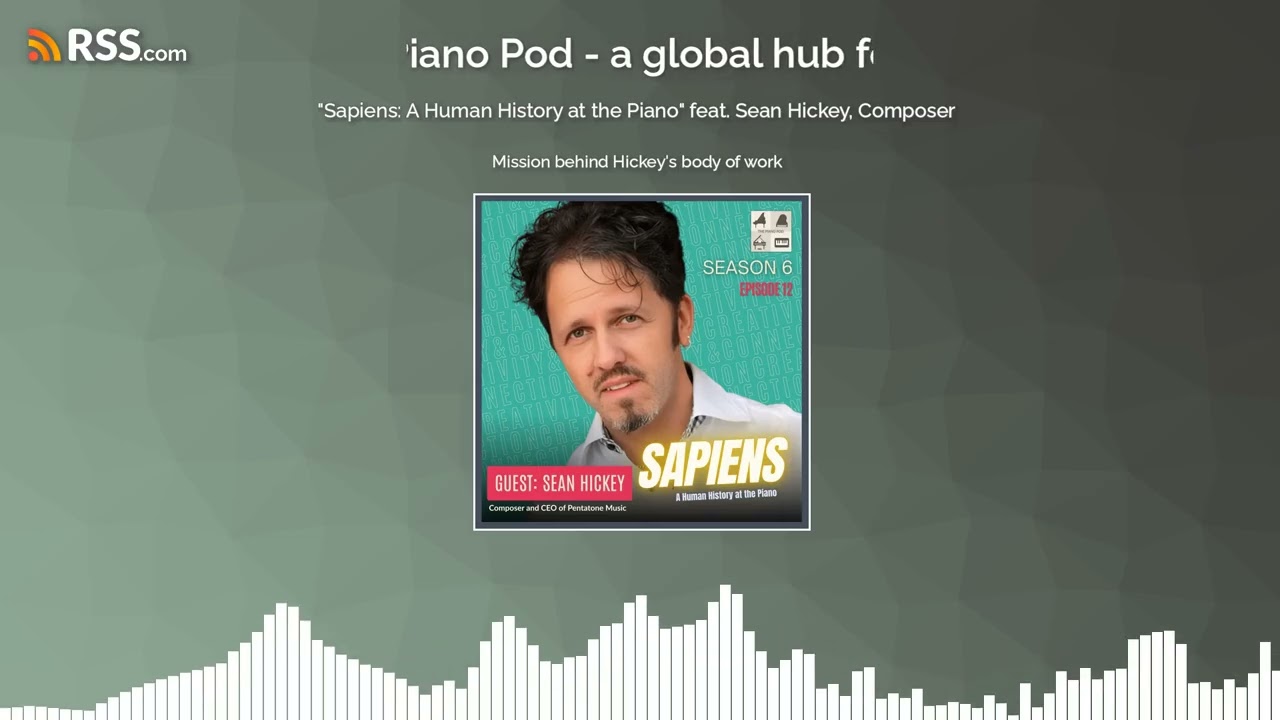
This content was created by The Piano Pod with Yukimi Song. This content was uploaded by The Piano Pod with Yukimi Song. This is a YouTube podcast episode titled "Sapiens: A Human History at the Piano" feat. Sean Hickey, Composer (The Piano Pod with Yukimi Song). The excerpt is an English interview/conversation (recorded/published 2026-03-25) between host Yukimi Song and guest Sean Hickey (composer and CEO of Pentatone Music), with occasional producer/narration interjections (Speaker B). They discuss Hickey’s 50-minute solo-piano cycle Sapiens: A Brief History of Humankind — its inspiration from Yuval Noah Harari’s book, the work’s eight sections (Prehistory, Lascaux, Fertile Crescent, Jericho, Mean Temperament, Double Helix, Confirmation Bias, Commonwealth), compositional techniques, programmatic meanings, and performance context (development, recordings, and premieres). Metadata: YouTube content, title as above, created_time 2026-03-25.
Chapters
Hey everyone, it's Yukimi Song with The Piano Pod with Yukimi Song.
Welcome back to another episode of The Piano Pod with Yukimi Song.
This season, we are exploring creativity and connection, highlighting artists who are reshaping what it means to perform, create, teach, and inspire people through piano across the modern era. Today's guest, Sean Hickey, embodies that spirit as a true visionary of the 21st century music landscape. A celebrated composer whose work spans solo, chamber, and orchestral projects, Sean also brings a unique perspective from deep within the industry, currently serving as the CEO of Pentatone Music. His musical journey began with the electric guitar in Detroit, and that early curiosity has evolved into a career dedicated to exploring the profound intersections of humanity, memory, and scale. In this episode, we dive deep into his most ambitious work for solo piano to date, Sapiens: A Brief History of Humankind. Inspired by the landmark book by Yuval Noah Harari, this 50-minute cycle acts as a meta-instrument observing 70,000 years of human evolution, from the first primeval breath to the complex global systems of our modern world. It is a work that challenges us to look through the lens of history to find meaning in our own period of rapid acceleration and change. Before we dive in, a huge thank you to our listeners for supporting The Piano Pod with Yukimi Song with Yukimi Song with Yukimi Song. Your engagement, whether through sharing episodes, leaving a review, or simply listening, helps sustain this growing community of artists and thinkers who are redefining what it means to make music today. If you are watching on YouTube, please take a moment to like and share and subscribe to our YouTube channel and hit that notification bell. If you are tuning in from Apple Podcasts, Spotify, or any other platform, please follow the show and leave a rating or review. It only takes a second, but it's the best way to help others find these conversations. Here is Season 6 of The Piano Pod with composer and industry leader Sean Hickey. Please enjoy the show.
You are listening to The Piano Pod with Yukimi Song, where we talk to the brightest minds in the industry about how they are bringing the piano into the future and thriving in a complex, ever-evolving world. Sean, welcome to The Piano Pod with Yukimi Song. It's really a It's such a pleasure to have you today here.
Thanks, Yukimi. Great to be here.
I appreciate it. Thank you so much for being here. So before we dive in, where are you joining us from today?
I am joining you from New York, New York, particularly and specifically Brooklyn, from home.
Oh yeah, I'm in Brooklyn too. Where in Brooklyn?
Bay Ridge, right on the water at the entrance to the harbor.
Oh nice. You've lived there for a while?
Uh, well, I've lived in— I've lived in Brooklyn for— since what, '99? Uh, but we've lived in this place, my family and I, since 2019.
Yeah. Oh, okay, great. And I live in Williamsburg, so I mean, we're a little far but still within the same— yeah, uh, borough. So cool. Yeah, great. And I'm so happy because, uh, we met once, uh, actually it was a few months ago at The Piano Pod live event. You came and I was so, so happy to meet you. Thank you so much for being there. It was a very special day.
It was for me too. I thought it was really great and really stimulating conversation. And I was invited there by my dear friend Eleanor Bindman, who was part of your discussion, who you've spoken with I think more than on one occasion for The Piano Pod. And She's a dear, dear friend and supporter of my work. And, uh, don't hold it against her, my former piano teacher when I first moved here. So yeah.
Oh, no way! I didn't realize the connection. Really? Well, she's a fantastic pianist.
She is. I, I, however, I'm not, and I am her worst student. But, uh, no, I don't think I got a lot out of it, I have to say. And a great friendship with her and her family.
Wonderful. Yeah, she told me about the— I think a week before my event, so that was October 4th, so a week before that you actually had a presentation, a concert at the same venue.
Yeah, at the same venue. So we, um, my piece, uh, a very epic piano piece called Sapiens: A Brief History of Humankind, uh, which actually was, uh, partially developed and workshopped in that exact same room. This is of course at the Mannes School of Music at the New School. In New York City. We concluded a small US tour of the piece there at Mannes when I saw you in— whenever that was, September, I believe. And yeah, with a brilliant pianist that I've had the great pleasure of working with and who has recorded the piece, and his name is Vladimir Rumyantsev, and he's a true force of nature.
Wonderful. Yeah. And then Elena told me how fantastic the event was. And then, so the following week when I had my event, I was like so surprised to see you. And afterward, I think we ended up at the restaurant together and this seating together. That was fun. Great. So it feels especially fitting that we're here today focusing on a conversation on Sapiens, as you mentioned, A Brief History of Humankind, a work that reflects on humanity, memory, and the shared spaces we move through, particularly in the light of the profound shifts and uncertainties that many of us are experiencing right now. So, but before that, let's start with this question. So you've been described as one of the most successful American composers of our generation and a deeply influential leader within the industry in the— when it comes to arts administration. So looking back, what is the core artistic impulse or mission that has quietly like tied together your diverse body of work over the years?
Well, that's a big one and, uh, one to really kind of, uh, grapple with, I think, overall. I mean, when I started, uh, so I started in music at age 12, so it wasn't exactly a young prodigy or whatever, but I— my parents essentially said, you're going to do something this summer other than sit around and, and do nothing. You're gonna, um, do something constructive. And in my case, we rented an electric guitar, and within minutes of doing so, I had already written my first song. Not nothing about it, but, uh, and certainly not memorable. But, um, from that point, I've just always been obsessed with, you know, creating music. And just, you know, it's just been an impulse to me that I can't quite fathom living without. And, you know, certainly over the years I've composed a lot of music. I think I've composed about 100 different works in a variety of genres, nearly everything except for opera, which I'm not personally particularly interested in. But over time, and certainly in the last, oh, I don't know, say 9 or 10 years, you know, my work has really been focused on a lot of issues of, well, just sort of societal things, changes, uh, the systems that we have, um, in the world and in our country specifically. And I've been particularly, I suppose, in the last 10-15 years, moved or influenced by a lot of things that I have seen or heard or read, so that my work over time has been, at least in its framework or as the initial inspiration, inspired by and guided by some bigger and broader concepts. And that wasn't something that was happening when I was, say, in my 20s. I wanted to write a string quartet, I called it String Quartet, and that was it. And then I wrote another one, so that was number 2. You know, things have changed and I've developed over the years.
Then, of course, this magnificent piano music, Sapiens: A Brief History of Humankind that also tied together what you just mentioned. So for listeners encountering this music, piece of music for the first time, what is Sapiens and what kind of response were you hoping to offer through music?
Well, to me, this was among most of the pieces I've written, like a real, real artistic imperative for me. Um, in, I believe, early 2018, I read the book of the same name by Yuval Noah Harari, Sapiens: A Brief History of Humankind. And, uh, it's the first of the, I think, 6 published books that he has done and hundreds and hundreds of articles. Uh, he is a great, uh, historian and thinker, uh, and, um, not necessarily a sociologist, but certainly, you know, a very very brilliant writer, um, and someone that I at least can draw a lot from in nearly everything that he's written. And Sapiens, uh, when I read the book, was one of those books— maybe the only book I've ever read— that after reading the first page, I could hardly turn it, um, because I was just incredibly inspired by and moved by this incredibly large and wide scope of things. And, you know, in, in the last 25 to 30 years, uh, in, in sort of the broad things of nonfiction, there's been a lot of micro histories like, you know, Salt: The Spice That Changed the World and Cod and, you know, various things having to do with, um, how certain things, uh, you know, have really influenced our current living. And then there's the mega, mega macro histories and macro looks at things. And Sapiens is probably the best known example of such a book, and among the first. Um, and for me, I read it and I had no idea what was to come next, but I just felt that it was imperative for me that in some way I was going to fashion a piece of music out of the inspiration that I found in this book.
Yeah, I, I read it too. I think I read it during 2020 when I was home and then finally being able to read such a massive amount of content in a really focused time. And it was, yeah, as you mentioned it, like first few pages I had to reread over and over again because it was such a shocking thing to read.
It really is. Yeah. Yeah. And it's such a big and broad scope of things. And, you know, I just, I think it's amazing how this utterly brilliant individual— and it's not the only book that he's written, his other books are almost no less, uh, no less shocking to me and impressive, but this was the first of them and therefore it really stays with me. Um, yeah, I mean, I, I felt the same way and then read it again the second time, and as the pandemic bore down on our city and our world, uh, and, um, I, I really kind of redoubled my efforts at the end of 2020 to finish a piece that I had started a couple of years earlier.
But what stood out for you? To me, one thing is, as you said, it's the scope of, of the book, you know, how basically he writes 70,000 or years of human history or longer into this book. And such— and here I am, you know, reading from my apartment in Brooklyn in 2020 by myself. I just felt overwhelmed too, about the history. But also, at the same time, I felt at the end of the book— I don't know, it's a strange thing— but was also be able to be hopeful about humankind. I don't know, how did you experience this book?
I mean, in the end, that's kind of the way I come— I came away with it. I mean, I know that some people have, uh, you know, maybe read the book or read his work in general and felt that, oh, we're doomed as a species, and it It might be easy to say that for, you know, ecological collapse and the world that we've inherited now where everybody's in their, you know, fixed camps and pointing knives at each other and all that. But there is, there's quite a bit in the book that I find quite hopeful in that I find it comforting, and I don't know that everyone agrees with me, to understand how small and insignificant that I am as a cog in the wheel of human history, very small one. Uh, and, um, yeah, I, I, I think that, you know, many of the concepts that are explored in the book, some of which I helped or tried to use as inspiration for my piece later, uh, allowed me to, you know, feel very confident. And I think, yeah, I think, as you say, a little, a little more hopeful in a time of great great uncertainty— I'm referring to the pandemic, I'm referring to our modern world and all of what was coming unraveled in those few years and still is in my mind— that, you know, understanding the fact that, you know, throughout all of human history, all of what we're talking about, the span of a single lifetime, mine or yours, is, I mean, frankly, utterly insignificant in the march of time. And then Compare that to geologic time. I mean, human history is 70,000, 80,000 years, but geologic time goes back 7 to 8 and 9 million years. And all of the species— and that's kind of how the book, you know, starts to establish itself— that didn't survive— some have, some haven't— but why did we? I think it's fascinating. Why, why and how did we develop these brains that allow this conversation to happen? I think is I think it's quite fascinating.
Yeah, and then he says that it's the, uh, because of the, of course, cognitive revolution, he says, and then being able to understand the sort of abstract concept, whether that is being able to dream. Um, I don't quite remember, I have to revisit, but do you remember?
Yeah, so the cognitive revolution is, uh, you know, the development of the minds to, uh, to the minds of any sentient living human being to understand some of the things that we understand. So right now we're speaking in a shared language of English that when I speak it, you understand me and you speak it, I understand you, or hopefully most of it in most cases, in both cases. And these are just, these are symbols. These are things that we've adopted as a culture. That's part of our cognition and our developed, widely developed brains that maybe the animal world doesn't have. But, you know, one of the things that the animal world does have to some degree is that I know if I'm walking down the street with you and you stand behind a tree, I know that you're still there, even if I can't see you. And, you know, that was one of the kind of breakthroughs in the cognitive revolution that the animal world, for the most part, has understood and recognized that just because I can't see or hear a particular thing or a person or a threat doesn't mean that that person or thing or threat is gone. So, um, that, that's, you know, one small example of, you know, what a dog or cat might understand. You're still present if you're standing behind, behind a tree.
Yeah, so I need to revisit and reread again. It's such a wonderful book. So how many movements make up this cycle of your versions, uh, savings?
So there are 8 movements or 8 sections, um, and I chose, as, um, you know, if, if, if you know the book and you know that, know it well, it's not as if I, uh, titled my sections after the chapters. I instead took what I think are some broad concepts, and maybe kind of added one in the end of the last section called Commonwealth that is mostly my own, to some of the teachings and understandings of the book. And just to talk about one of them, the first time is a section called— that I call prehistory, which, you know, is just one of those fascinating words that to me is like prehistory, what happened? But it's like kind of like postmodernism, it makes no sense at all, but we throw it around a lot and it sounds good, and generally we understand what it's supposed to mean. Prehistory really, uh, you know, attempts to determine what— or there's a word used to define what happened before humans, before our species Homo sapiens really developed into the individual individuals that we are now. Um, and I should mention that first, you know, when I was inspired by the book, I didn't know what didn't have any idea how to shape the piece, didn't even understand and recognize, uh, who it was going to be for. Was not a commission. I'm fortunate that most of my work in the last 10 or 15 years is on commission, so, um, this was not a case. It was just something that I wanted to do. My additional— initial idea was to write for ensemble, perhaps orchestra, and then you know, as my idea, my broad kind of drafting and ideas started to take shape, um, I realized that this was probably not a work for orchestra. And I had a huge amount of sketches of the piece which are now archived at a great, um, great other place in Brooklyn called Mind to Music. The Mind to Music project has, uh, some of my very initial sketches of Sapiens on there, which because I sat at the piano and drafted them, in the end it really kind of morphed into a work that I felt was going to be a very substantial work for piano. And I find the piano very intimidating. I find it also comforting to sit at and write at, which I've been doing for years. But as I said, I think at the start, I'm not a— I'm not a pianist per se. I really can only perform one piece of music I've ever written in my life. And, uh, but in the end, that seemed to be the, the, the, um, the sort of suitable instrument for me. And when I really kind of embraced the idea of the piano as this sort of meta instrument, um, you know, we know the incredible expressive range that comes from this instrument, the modern instrument. We know the fact that it the modern instrument developed out of other things that might have been a little less expressive and less complex than we have today. And yet it has largely stayed fixed for the last 200 years, just about. And I imagine the piano as sort of a voyeur or witness to history at the birth of music. So my particular piece that starts Sapiens is called Prehistory, as a subtitle, and it consists of a very strange amount of music that doesn't really sound music. In fact, the very first instruction in the piece is for the pianist to breathe into the instrument, you know, a single exhalation, single breath. And it doesn't really start on the piano, starts at the piano. And from there, music in series of Cs really kind of grows out of that particular impulse. As if someone hadn't, you know, been launched into this strange thing and encountered it for the first time, and what would they make of it? That's— then really the piece grows out of that, those first impulses.
Wow. Yes, I, I've been listening to this whole series over and over, and then, yeah, I first— I started— I, I hear— I heard the breath, and also I— you mentioned that I I realized there's a— there are a few pieces that are centered in key of C major, so I thought, uh, maybe is there a message behind that?
Yeah, I think maybe not a conscious one, but so yes, it starts with a bunch of C's, maybe not C major, but the pitch C, the note C, in various octaves. It ends, I think very hopefully, in a particular section called Commonwealth that to me is among the most successful parts of it. And it's also fairly rooted in C as well. And there's also a work in the middle section in the middle called— sorry, Mean Temperament. And Mean Temperament consists almost entirely of the note C in every one of its iterations on the piano. There are 7 of them. And I really felt challenged to make a piece of music, or a section of a piece of music, that incorporates a single note only. It involves a huge amount of jumping around of hands because each of the octaves of that particular C only happen one at a time. And, uh, mean temperate— mean temperament, of course, is a bit of a double— I don't know, ironic play on words. Mean temperament, obviously referring to the pitch and the tuning of a modern instrument and modern music, for Western ears anyway, and also maybe a comment on our nature as a species too. And yeah, that movement came together rather quickly, I have to say.
Yeah, wow. And I want to go through each one of them, but when you first read the book, you thought, wow, I want to write music about this. I mean, did the inspiration come like immediately?
The inspiration to write the piece came immediately. What I was going to do with it did not. I should mention that everything that you hear in the piece, I did write sequentially. It's not like I started with Section 7 or whatever and went back to Section 2. So it was sequential. Uh, I went and read the book. I reread the book. I read the graphic novel, which is fascinating too. Sapiens, um, which is also graphic, uh, graphic novel and quite interesting.
Oh, there is a graphic novel?
There sure is. Yeah. And it's really, really quite good. Um, yeah. And, uh, so the idea to write the piece was, was, was quick, but how it was going to take shape was not. Um, but I really wanted to focus on, you know, the sort of key principles that I took some inspiration from when reading the book. And that really kind of gave me the sort of broad architecture to start putting things in place.
So you mentioned that it starts with the prehistory, then the next piece is the Lascaux, right?
Yeah.
So the inspiration for Lascaux is, you know, though it's been eclipsed by some other findings in the last, last several years, Lascaux refers to the cave in central France. Where some of the first instances of representative art were found on the— painted on the cave walls. There are some 40,000 years old, 45,000, I believe. And it was a major breakthrough in that, you know, the thing that I do and that we do as artists, which is to, you know, is to explore and act upon this impulse to do something that doesn't necessarily better the world. It doesn't, uh, you know, keep a structure intact or keep you warm or feed you. The things that really directly relate to survival, these are things that an artist would do because he or she feels a very strong need. And the Lascaux cave drawings are as mysterious today as they were when they were discovered, which is to say, probably, uh, a mystery for the intervening 45,000 years that depicts buffalo hunts, that depicts men and women, weaponry, various things having to do with life in that part of the world at that time. And I wanted to use it because, uh, I took some inspiration from that, um, which of course is talked about in the book. As a particular, as, you know, as a particular piece. And that particular section of it is, I think, clouded in a lot of ambiguity, a lot of mystery. It's a little more— you can, I think, sense the piece in terms of sort of a metric and rhythmical structure kind of coming together a little better in that section than it is in prehistory. So you're seeing the sort of evolution of a piece start to take shape just as humankind said, I am— I at this moment am going to create art, and I'm doing it for reasons that are unknown to history.
And it's quite impressionistic in style, right?
Yeah, yeah, I think so too. I mean, the pigments of the walls, and, and I, for the record, I've never been to Lascaux. Um, I've only read about it and seen it, uh, and on the page or whatever. But, uh, you know, the pigments of it, uh, I think are, are very evocative, and they almost look impressionistic for me. Um, and the fact that something is so— I mean, I have had the benefit of seeing some, you know, really interesting, um, Navajo and Ute art, and, and, and that in the desert Southwest of the United States. Uh, this is very, very different. Much of that art is no more than 1,000 years old. This is 40, 45 times more than that. I mean, it's quite, quite ancient.
So yeah, yeah. And then moving on to the third piece, Fertile Crescent, and I thought, whoa, this was quite contrast to Lascaux, quite fugue-like, you know, lots of conversations happening.
Yeah, so Fertile Crescent is probably the biggest and densest piece. Uh, it's the longest in the, in the work, longest section in the work. Fertile Crescent, of course, is, uh, inspired by, uh, something else that Harari talks about in the book, and that's the Agricultural Revolution. And the Agricultural Revolution, like the cognitive one beforehand, allowed— which is about 12,000 years old— allowed for something that we very much take for granted now, is the ability for human beings to gather together in groups and cooperate in some way or another. So whether you live in New York City or a small town, or you work in a factory, or you work, uh, in any endeavor, we often usually need the help of others to, um, to survive and to create. And that was not necessarily, um, the, the, um methodology for most of human history. For most of human history, uh, Homo sapiens was solitary. They traveled in very small groups, perhaps as a family, perhaps as a couple of families. Uh, they hunted game for survival. Uh, they found the appropriate foods to eat that would allow them to thrive and give them the appropriate amount of vitamins, protein. Um, and they kept on the move. They did not necessarily have homes per se. They kept on the move. Often across very wide geographic regions. The Fertile Crescent, of course, refers to the band of something that happened, which is the plantation of crops in a rough stretch from western Turkey going to the east and around into the Sinai Peninsula in northern Egypt, modern Egypt. It encompasses many of the countries in the Middle East. Interestingly, many countries that we would very much consider to be dry and desert-like now were at that time fertile enough to support the planting of crops. And many of the first grains and cereals were planted in that particular region. And when they were planted in that particular region, it required the ingenuity and gathering of people together in small— smaller groups. And it's no surprise that the first established cities happened in some of the river valleys of the area, namely the Tigris and Euphrates rivers, modern-day Iraq, and that allowed for people to settle together. And one of the other interesting things that allowed people to settle together was the fact that when they did settle together, longevity improved because people were and would over time develop immunities to one another and develop immunities to the livestock around them at a time when our first livestock, where people were herding animals into small places and living with those animals or living in close proximity to them. And, uh, this incredible— the reason that it's not just called agriculture and that it's an agricultural revolution is that revolution almost in a matter of a handful of generations, we don't really know who, almost doubled life expectancy. Um, maybe up to age 30 to 35. For a lot of people. And so all of that is a background of my piece called Fertile Crescent. And in it, I have essentially two crescent-like shapes. One is the shape of a particular figure in the right hand that really kind of opens the piece, that goes up in a crescent shape and comes down lower in pitch and volume and is presented Several times. But the bigger one is the midsection of the piece, which starts with a very low pedal in the left hand and a series of very dense and chromatic chords, almost hard to really discern the pitch. That entire section— chord, chord, chord, chord— essentially rises to the upper limits of the piano, the upper limits of the volume that the piano is capable of producing. And each measure going up to that particular point, a half a beat is slashed off of each of them, to the point where when you get to the end, there's no more beats to slash off. It's essentially the there's no more notes. And then at that point, everything turns around backwards and a retrograde inversion mirror image of itself, uh, that exact same section is, um, played backwards and upside down. And that is the broad fertile crescent of that whole particular movement. And, um, it's quite, quite a challenging thing to, to play. And I have to say maybe concept to understand too. But I have to say that that particular movement probably took me as long to compose as the entirety of the rest of the piece.
Oh really?
Yeah, because I had the idea in my head, and I have to say I'm not, uh, such a dogmatic, uh, composer that I play around with, um, uh, particular theories or whatever. I'm not a serialist, I'm not a, uh, you know, not— I don't consider myself a serialist or minimalist or any of those things. I write the music that I wish to write and not, not be constrained by any of the isms that are out there, but I had the idea of, you know, this series of chords, and I could understand the pitches and how they would very, very, very slowly and imperceptibly modulate to higher pitch levels, and a half a beat lopped off of each measure until you ran out of room, in which case everything turned around and flipped. And that was just a very big and broad crescent that probably took me a couple of months to— more than a couple months to compose.
Wow. Then followed by Jericho, which is the name of the city. Also, it's a biblical city, right?
It sure is. Yeah. So Jericho is, uh, you know, the, the biblical Jericho and the modern Jericho were, um, well, I should say the biblical Jericho is best known as, um, a walled city. And why do we, why do we at some point in our history put walls around our cities to protect ourselves from invaders and hostile forces? Um, but for me, Jericho, and maybe this departs from the book a little bit, uh, is symbolic of the fact that, you know, one of the greatest and most diabolical human inventions is the wall. And, um, obviously it provides us comfort. I'm surrounded by them now. It sounds like you are too. It keeps us, you know, free and separated from our neighbors, allows for privacy, it allows for warmth and comfort and safety. And that's, you know, critically important. But in history, no wall has ever stood for very long. And Jericho is probably the first example of such walls. I mean, the horn of Gabriel blew down the walls of Jericho in the Bible. And You know, I, I started to think of, you know, sort of the development of the wall, um, you know, certainly the Great Wall of China and Hadrian's Wall in northern England, neither of which stand completely as they were intended. Um, and then the ridiculous thing of a border wall, uh, across any two countries, which was very much in the news then and still now. And I was inspired to write a piece that is very brittle, granitic. The pitches aren't, you know, as specifically defined. I was very much inspired by some of the composers who wrote in this idiom. I'm a big fan of Alberto Ginastera, great Argentine composer, and his piano sonatas, which I think are fascinating and incredible. So more along the lines of Ginastera, Bartók, and a few others. You know, composed this particular work in homage to the wall as being imposing and ultimately futile. And, you know, there's a particular point in the piece where a very thick set of clusters— I think they're 10-note chords— are resounded 13 times, exactly the amount of times that you hear in The Rite of Spring, in the third section of The Rite of Spring. And to me, that's sort of a sublimation of the walls that come crashing down.
In Jericho.
A fairly successful section of the piece overall, and it's a pretty big contrast to what is around it, I have to say. So, and again, it's— I think if I just called this piece and gave it an anonymous title, not anonymous title, but a different title like Piano Sonata or something like that, and that was plopped in the middle of it, I think it would have a very different meaning, even if you didn't understand the book or didn't read the book or understand the concepts. The fact that it has a title, Jericho, and that has that particular sound world that's very different from what comes before or after, hopefully it's understood by listeners.
Yeah, evident. Then that followed by mean temperament, which you mentioned. So, maybe we should talk about double Helix. This is my— one of my favorite out of 8 pieces. So it's about DNA. Yeah, right.
So inspired by one of the great, uh, scientific discoveries of the 20th century is, is DNA, of course. And, um, you know, in the discovery of DNA, you know, we have determined that, uh, quite a lot of human history and all of the suffering that we must endure is, you know, can be enshrined in these little microscopic strands. I mean, it's pretty revolutionary that this particular discovery has happened. And I think in, in many ways, uh, it, it's so big and so unwieldy and so earth-shattering that we might be able to look at it, something like this, and determine when we will die. Unless we're hit by a bus or some other external factor, is overshadowed by the fact that it's, uh, it's quite frightening in the way that AI is frightening today. Um, in the 20th century, I think the discovery of DNA was frightening to the people of the 20th century and, and through to today. I took it as kind of an inspiration, uh, of a particular piece. It's a very big and mysterious piece. The left hand in its entirety plays in one key, B-flat, and the right hand plays in another key, key of D. And this is a bit of a mind-melt for the pianist, I think, and it was for me to write. But once I established that, I mean, what I came up with in terms of combinations of sonorities and chords was to me very deeply satisfying. And the middle of the piece is truly two strands of melody. So that is a rare instance of my music, very rare, of a fugue. And the fugue in the right hand is in D, and the fugue in the left hand is in B-flat. And yet it does observe the rules of the fugue with the introduction of the subject, the transition up to the fifth, the stretto at the end, and then coming out some different music altogether. Interweaving of the strands. I mean, the DNA molecule is a weave-together pair of strands, uh, that we, I think, know and understand in its shape. And that was kind of the shape that I was, uh, referring to in my particular movement.
Wow, engineering is involved into your composition, I guess. Yes, that's cool. Then that followed by Confirmation Bias. So tell us about the piece.
So perhaps a little bit also of a departure from the book, but maybe not so. But, uh, I think one of the most dangerous things of our time, uh, certainly any time, but particularly so in a time when we are divided into our camps and determined that our opinions are right and perhaps everyone else's are wrong except the people that agree with us, is the concept of confirmation bias. And the confirmation bias, of course, refers to the fact that, you know, if I believe something to be true and I hear that that's something that confirms that what I already believe to be true is true, that therefore it must be, and there's no further proof needed. And this is a particular thing that Homo sapiens do, and likely the animal kingdom does not do, and the plant kingdom does not do, uh, and I find it very, very dangerous because what has it done in our era of the internet and social media, it's allowed us to, you know, only surround ourselves with people that really kind of confirm our biases, feed them on these algorithmic, uh, structures over time and further entrench us in our particular part of the world. And I find that incredibly dangerous. I deeply question social media for a variety of reasons. Uh, something that I limit myself very, very, very strictly to for reasons of mental and physical health. Uh, I don't— I'm purely in the minority in that. But, um, so confirmation bias, uh, as a, you know, musically starts with a particularly falling octave, G-flat and F, with a chord in the middle, which I think is B-flat and C. Yeah, B-flat and D. And, uh, that particular falling thing, which is really kind of a sort of— man, sort of falls, and there's a huge amount of activity in that work around that falling thing, but that falling figure occurs in every single measure, every single one. And it's a very blank and mysterious and enigmatic kind of sonority there. Uh, and that piece was also composed rather quickly too. That section was composed rather quickly, but there's a huge amount of activity, a lot of a lot of noise, a lot of outside influence, a lot of things that essentially are telling the player, the pianist, the composer, the listener, no, consider this, you know, look outside yourself, you know, here's another perspective. And the player essentially ignores it the whole time. And that falling thing, that tolling, that tolling figure which maybe I lifted from Ravel a little bit in one of his, uh, uh, pieces. Um, this on the present throughout the whole thing until the very last, very last chord. It kind of almost resolves upwards, um, you know, sort of stasis, sort of peace, equilibrium.
Wow. Then ending with Commonwealth, and I like the title, and also it actually ends with like a— toward the end of probably 20, 30 seconds, it's silence, right? Or maybe something else is going on, but tell us.
Yeah, so, um, I'm glad you find the word Commonwealth resonates with you. I like it very much too. As I was deep in the piece and writing it, I really wanted to have a title or a word or a series of words in the final section that I feel would maybe just personally represent what I would want for humanity, what I do want for humanity. And the, the word Commonwealth probably embodies that better than most words that I know. Uh, and you know, the, the idea of a commons, a public space, which is the foundation upon public parks and public spaces of any kind in a city where people can gather together and exchange ideas and argue and fight or whatever is very appealing to me. That particular word common is used a lot in, you know, certainly Puritan England and New England, where it exists in many towns and cities. Boston Common is one of them. The Commonwealth, of course, refers also to the British Commonwealth of Nations, which to me is a very pejorative, very negative thing, which is, uh, you know, uh, is, is a, is a sublimation of empire. Um, but the word itself, um, I think is, you know, to me is a gathering together of peoples with the understanding of, of, um, hopefully achieving prosperity for a group, and that no one should be excluded from that particular group., you know, in any particular way, and that, you know, wealth and security and, and, um, progress can be enshrined in this particular concept of commonwealth. And that, to me, um, you know, certainly touched upon in Harari's book quite a bit, but not explicitly so, not at all. But it's something that I really wanted to end my piece with. So it, it it starts with a series of whole notes, rather thick chords starting quietly and ending loudly. And then that set of chords repeated again. And then it really kind of explores. And again, as you mentioned, we're really in the key of C again, almost entirely in the piece. And I think— I'd like to think it ends hopefully big positively, optimistically. I do think that, you know, maybe not to get on any sort of soapbox, and I certainly can't predict anything, but I choose to live in a world where I think there are better days are ahead of us. And even if I have absolutely no influence on any of that other than the fact that I can contribute to the world a modest piece of music, um, then I want to be the one to do that. And Commonwealth is a way of me, you know, essentially saying that this is, you know, this is my contribution to it. And ends at a very, very, very loud and high note at the top of the piano. It's also a C. There's actually also a little quotation in there for those that are paying attention. Um, I am deeply, um, moved by one of my artistic heroes, which is the composer Dmitri— who is a composer— Dmitri Shostakovich, who of course was the Soviet Union's most celebrated composer and lived in a time of incredible oppression, unbelievable circumstances that I cannot as a white male American and born when I am, imagine at all. And in so many of his works, starting with the Eighth String Quartet and this piano trio and the Tenth Symphony and on and on, has a particular series of pitches that outlines his name: D, E-flat, C, and B-natural. And even that is in the very beginning, because even in the very end of Commonwealth, because that to me is one of the brave artistic utterances in music history, in that this man, this brave man who survived incredible oppression of Stalinist Soviet Union, uh, put his stamp on everything that said, this is me, this is who I am. And I wanted to have one small, sublimated, hard to hear quote in that, which I've used in another piece. My cello concerto uses it as well in my particular piece.
So, well, incredible work and congratulations.
Thank you very much.
Yeah. How do you feel about creating such an expansive— it's like a total length of this piece itself is 50 minutes or something like that.
It is. Yeah.
Yeah.
I mean, I have to say I have a kind of a hate-hate relationship with music after I've written it. I mean, I just, I find sometimes what I do hard to listen to and I'm usually on to the next thing and really focusing on that and feeling that I can do more, do better, do different. But Sapiens is just, to me, it's been quite successful and in the hands of such a great interpreter, Vladimir, who frankly, um, I happened to meet in the middle of its composition. So I had very, very different ideas, um, for Sapiens. Um, as you know, you mentioned when you were reading the book in 2020, uh, we had quite a bit of change in our particular family circumstances. And, um, the idea that when I finished writing the piece in '21 that we would do some sort of global premiere in 3 different continents with 3 different pianists taking sections of the piece, and we do it all on Zoom. And to be perfectly honest, I just got overwhelmed by the logistics of doing that, and I just didn't have my heart in it. I like the idea. I had 3 pianists in 3 continents that were willing to take it on, which I think would have been very cool. And in the midst of it, I was introduced to Vladimir by a dear friend of mine, Cheyenne Wong, who commissioned and premiered probably my second largest piano piece, which is called Cursive, years ago for Lincoln Center. And Cheyenne is on the faculty at Mannes too, and she said, you have to hear this guy Vladimir Rumyantsev. He's one of the handful of people that I think could really play your massive music piece of music and, uh, realize and articulate your ambitions for it. So, um, we were at the time— my daughter was at Interlochen Arts Academy. We were living— I was in residence there. We were living temporarily in Northern Michigan supporting her, uh, and Cheyenne sent me a clip of him playing one section, Confirmation Bias, actually. And I said I had to meet him when I come back to New York. So when I met him, we hit it off. He gave the premiere, uh, here in New York. We did the recording at the Sono Luminous Studios in February of last year, which is in Virginia, uh, and we, as I mentioned, in the fall did a little tour in Chicago, New York, um, where we performed the piece. I lectured and talked about it, did some interviews, and it's just been such a great experience because he is, uh, truly one— I mean, I've been blessed to work with a lot of brilliant musicians, especially pianists. It seems that he just— there's nothing in his, uh, nothing seems to intimidate him at all. And he has an incredible memory for tempi that I do not have at all. And, um, well, in fact, everything about him is exactly what I love about him. I don't possess it in myself. So, um, it's really been, uh such a great experience. So he's, uh, we wouldn't be here, wouldn't be having this conversation if it weren't for Vladimir.
And just out of curiosity, have you ever had any direct contact with the author Harari, Mr. Harari?
So, um, not direct with him, but I do have the permission from his, so his, uh, publisher and for Sapienship, which is the nonprofit organization that Harari started, uh, to promote the ideas and the vision in the book several years ago, um, before I really got— well, I shouldn't say before I got started, while I was started and, uh, you know, really thought that this was going to come together, I contacted them. It took a while for me to really pin them down, but they gave me the blessing to utilize the work and the inspiration of the book, provided that the author was acknowledged, which most certainly he is in every interview I do and every piece of text that we write about, it's inspired by him. But I've not yet met him directly, and I would have to say I would love to.
Yeah, and he should listen to your music. He might have already. So yeah, I hope so.
I've sent it to him and to his people, and they're very, very aware of it, but I haven't heard her back yet.
So you mentioned you've been traveling touring with the pianist Vladimir with the piece, right? So he will be— he is performing, and at the same time, are you giving like some sort of like lecture master class together?
Uh, yes, so we did that at the Mannes School, um, where I met you a few months ago. Um, you know, basically a lecture demonstration on my inspiration for the piece and some of the signposts to listen throughout it. He, of course, performs it. We did a somewhat similar thing in Chicago at a very cool new venue called The Checkout in early September. That was more of an interview with Seth Boustad, who runs Access Contemporary Music there and is the owner of the venue. So, you know, we like to be able to do this as a sort of, you know, collaborative thing. Where I don't touch the piano at all, but I'm happy to talk about the piece and the inspiration behind it, and he's happy to play it. We'd like to do more. We do have Wigmore Hall in London on our horizons. I don't have anything firm yet, though I did meet with them 2 weeks ago and at least planted the seed, so I'm hopeful at some point we may be able to make that a reality sometime in the next couple of years. It has not yet been played in Europe or Asia or anywhere else for that matter. So my hope is that the recording will, like any recording should, give it life outside, you know, my feeble little head and the hands of one performer. And hopefully, you know, others will be inspired to play it too. There's surely a ton of great pianists that could make something of it. I would love to continue working with Vladimir, and we definitely will. But, you know, we really want to expand it into performances in other parts of the world and discussions if they're merited.
Yes. And then I saw, I think, photo or video of you at Manas with The Piano Pod with Yukimi Song. And then also I saw, how do you call it, projector or screen showing the— but have you ever done any of these things like where there's a picture showing while performing or something like that, or have you thought of it?
I have thought of it, and I have to say I hadn't thought of it before that, and that's problematic because a couple people came after— up to me after that show and said like, you know, this is great, great talk, great thing that you had the image of the album, which is, you know, right here, um, right up there on the screen, but, um, what you didn't have is, uh, at the very least letting me know what section I'm in, because even though there are pauses between all but one of the movements, the people weren't really clear where they were. And a couple of people said, wow, the piece sounded shorter than it was. I can't believe that was 52 minutes or whatever it was. So at the very least, I would like to do something where we can indicate the movement sections in sort of an AV type presentation. And maybe, just maybe, if we want to, You know, I would love to one day commission someone to do a film to accompany this. I have a colleague who I met within the last couple of years. I actually met him at another piano recital that I had of another piece of mine early last year. His name is J. Henry Fair, and he does an enormous amount of film and video and photography. Taken from airplanes and helicopters of, uh, and his focus is on what man has done to the landscape of the world. So there's a lot of very interesting, you know, river deltas and, um, you know, polluted and degraded landscapes and mine tailings and things like that. It might be a little depressive, but there's certainly a lot of inspiration that we could, you know, maybe look at for something down the road. So yes, I would like to do that for sure.
Yeah, it would be amazing. It's such a great piece. So as a pianist, you know, but as a composer, do you hope the pianist to play that in its entirety, back to back, in order, in one concert, or can we play maybe one separately?
Well, as I mentioned, one of the— Confirmation Bias was performed a couple of times by Vladimir on its own as part of a recital program Mozart and Haydn and Chopin or whatever else. And I think that's just fine. I would prefer it performed as a whole piece, but I would never— well, I don't think in any case of anything I've ever written say that it would be not right to play a section of a piece. You know, I have two of my concertos that I've written have been excerpted. The final movement has been played of each, which I felt was just fine. And, you know, I don't really consider this a multi-movement piece, but it really is a multi-sectional piece. So I think if someone feels particularly connected to one or more sections of the piece, by all means, you have my blessing as a composer, for sure.
Is the score available?
It sure is. For anyone who asks me, I send it out all the time via my website. It's not there present on the website. To view in its entirety. There are, I believe, segments of it, but for anybody who wishes to contact me directly, I'm happy to share it with anybody. It is— I work with a couple of different publishers, but much of my work is published in my own company called Cantabile, and I make it available freely and without charge to anyone who wants any of my piano work. So it's just reach out to me Of course. Yeah.
So how can we be in touch with you? It's through website shaunhickey.com.
shaunhickey.com is there. Contact, uh, contact me page. Send me your info, I'll get the info email, and either I or my assistant will, uh, have it emailed. And for those that want it printed and bound, uh, just require a bit of postage for that, we can ship that out. That's not a problem.
And then where can we listen to your music?
So, um, you can, and I hope others do, follow me wherever you listen to music on any of the platforms— Spotify, Apple Music, Amazon. Uh, you, if you go to my website, shaunhickey.com, you will see listen links and buy links for most of the recordings I have. Sapiens, I believe, is my 12th commercially available recording. I had another, another one, uh, earlier this year, another piece on a program this year, um, interesting program. Um, so, uh, wherever you listen, you can find me. I would encourage your viewers and your listeners to follow me on Spotify or wherever they normally listen to music. The vast majority of the people— and this is what I do in my other job, uh, you know, stream, as opposed, you know, where access is more important than ownership, uh, in our world of streaming You can access my music anywhere, and it's as easy for you as it is for the person next door. But for those that really want to buy and purchase and experience the physical manifestation of the piece— again, that's it right there— um, you will be able to buy that wherever records are sold. So Amazon, record stores, or via the website sonoluminous.com. That's a record label based in Virginia run by a dear friend of mine, Colin Ray. Who, uh, really got behind the recording of this piece, uh, when I first presented it to him. So sonoluminus.com as well.
Sonoluminus.com. Great, thank you so much. Is there anything else you want to mention about your— this album, Sapiens?
I think I just encourage people to, you know, to listen, to listen critically. It doesn't necessarily need a program at all, hopefully, to enjoy it. I think it lends itself a lot to greater enjoyment if you do have an understanding of the program and, you know, all of my sort of reasons for doing it as this piano is the sort of meta instrument as voyeur and witness to history, not just our deep, deep past, but our present and maybe our future as well, united in the sort of common cause. But, you know, ultimately, I think people can and should enjoy it without understanding or knowledge of that program. I just want to have this particular piece have a bigger and better and greater life beyond the handful of performances that it's had and beyond this recording, which I'm very happy with. So I encourage others to pick it up. I encourage others to listen. I hope people reach out to me via my website and stay tuned for more.
So now I want to change the subject. Um, with over 20 years at Naxos and now leading Pentatone, which is an independent record label, you've seen countless records come and go. I'm sure. So in your experience, what is the secret sauce that allows a record to transcend its era and become truly timeless?
Well, I would direct your listeners' attention to an article I wrote recently, which you'll find on LinkedIn and also on the Pentatone website, the news section of the Pentatone website. And the title of the article is "Release Rational: Why and Why Now?" And, um, this I think relates to Sapiens and is a good segue from Sapiens. Um, the, the whole point of a successful recording in this industry— and you're right, I've been in it for more than 3 decades— is, uh, storytelling needs to be at the heart and the center of everything a recording artist must do. A recording should never be a list, it should never be a concert program. Unless that concert program has storytelling at its heart. And in that particular article, I did my best to articulate— so at Pentatone, you can imagine we receive roughly a dozen or more submissions every week from unknown artists to some of the biggest artists in the world, big, big names that you and your listeners will know very, very well. And sadly, many of them don't put a whole lot of thought in to, you know, what is important to them. Um, and on the piano over here, I have tacked up on the, uh, on the side of it, uh, something that I— is there to remind myself. But it's a quote from Arnold Schoenberg, who's not a composer I feel particularly simpatico with necessarily, uh, but he said one, one great thing is one must be convinced of the infallibility of one's own fantasy, which is another way of saying be yourself. Right? Uh, be your best authentic self. And, you know, that's really the thing. A couple calls I had before you are with a couple of rather notable artists that I had to kind of say, you know, let's, let's flesh out your idea a little more, let's understand a little more about what you're trying to do and trying to say. Um, the— there are roughly 6,000 commercially available classical music recordings released annually. That's how many there were last year. I am the chair of one of the Recording Academy committees for composition. I'm the chair of that. We reviewed, um, over 2,000 submissions in classical, which is, I'm told, more than twice hip-hop and rock. So, um, you know, there's a huge amount of music being written. There's a huge amount of music being recorded, and there's a huge amount of music being released every year. And in order for your particular project and your, you know, your— and the infallibility of one's fantasy to stand out is to put storytelling, I think, at the heart of, of everything that you wish to do. And when you do that, there's a lot more interest from media, there's a lot more interest from our DSP partners— Spotify, Apple, etc. And, uh, makes our job easier because we help tell the story with the artist. And at Pentatone, we have 11-person staff. We have in-house sales, marketing, PR, communication infrastructure, uh, that, uh, routinely teases out of the artist why it— why is it that they do what they do? What makes it important? Why is it— why is what you do unique, uh, in the world? I mean, there's, as you know, there's surely a lot of people in the world that can play Chopin on the piano. And it takes nothing away from the talent of any one of them. It certainly takes nothing away from the brilliance of that particular composer, because in my mind he's more brilliant the more you listen. Uh, but one must ask why, and related to that, why now? And then maybe related to that second question, why me? And if you can't fully answer that question, it's probably not time to necessarily make a recording., or maybe a time to make something that is a little different than what you had set out to do. That's a huge part of my public speaking work, and my work at Pentatone is discussing that with artists around the world.
Wow, that's incredible. Then, so you also teach, you know, entrepreneurship to fellow musicians. I, I've seen the video before on social media, and so Well, you know, about with the streaming and also we have to think about sustainability as an artist, and then AI is creating also music these days, I guess. So from everything you've seen as a musician and also as someone who is a CEO of Pentatone Music, so do you still feel hopeful about our industry, music making? Well, What do you think? Yeah, yeah, go ahead.
I wouldn't be in it if I wasn't hopeful, because I think, as I mentioned earlier, I wanted to end my piece with some degree of hope. Uh, and I definitely believe, because I choose to believe, that there is a lot of hope. I mean, uh, the one thing that, uh, you know, I did not— I am not streaming native, and I'm not iPhone native, but those that are 20 years younger than me are. And I very distinctly remember a time as I worked in one that people discovered music in two ways: either on the radio or going to a record store. Or a third way, a friend turned you on to a particular thing. All of those things are valid now, they still very much exist. Um, but the fact that streaming, uh, opens, you know, the window to the world's music and You know, with the access, you know, just your particular device to be able in a moment's notice to be listening to something that you haven't heard of, or you're curious about this artist or this composer or that work, and to be able to do it just at a touch of a button is something we take for granted, but it's utterly, utterly revolutionary. Of course, same is true with video, same is true with on-demand anything, same is true with delivery of, you know, whatever, whatever your next meal is going to be, you know, being able to dream it and envision it. And if you live in New York, probably at your front door in an hour. So all of these things are quite revolutionary. And someone who's my age, I don't ever want to lose the sort of sense of wonder that we have with these, with this development of technology. There certainly are threats, I feel, and I've written about this too. There's both huge threats and huge opportunity as a result of AI. The biggest threat that I think AI poses from the issue of rights is the ability to take money out of the pockets of music rights holders, which is to say songwriters and composers and record labels. Because right now, if you want— if you're, say, a music director of a production company and you have a particular scene in your movie that you need whatever, 7 seconds of quasi-Eastern-sounding violin music that starts quietly and ends loudly, and maybe there's a choir in the last 4 seconds. That is a question that we at Pentatone get almost every day. And just as an example of one, and we might have a number of hours only to respond to it with the knowledge of our catalog. AI can crawl our catalog and determine what is the most suitable stuff that might fit that particular spec. But to take it further, right now artificial intelligence can produce exactly that on spec in a matter of seconds, and there's no rights behind it at all. So there's no remuneration for a creator because there is no human creator behind that particular 7 seconds of music that's used in the film. And I think that's very detrimental and damaging because it takes the human element You know, if you have a human filmmaker, why would you not have a human composer? Um, but all of that said, uh, there's also a huge opportunity for AI. Uh, you know, I think there is quite a lot of opportunity, and a lot of people use it as a compositional tool to organize thoughts, just like you might organize— you utilize ChatGPT to organize a framework or an outline or a bio. Um, you know, the same is true, you know, in music. It's not necessarily something that I personally want to do, but, uh, I don't make a value judgment on those that do. Um, and a number of other things. I mean, AI, as far as I'm concerned, if AI can do anything really good, um, and lasting in, uh, this or any lifetime, is find a cure for the diseases that ravage our world, starting with cancer. Um, almost everybody I know has been touched by cancer in one way or another, and if it can do that by replicating quickly and methodically all of the things that human beings have been slow, relatively, to do thus far, uh, whatever damage it might cause music and the creators might increase longevity. And is that a trade-off that we're willing to make? I would say that many people would be okay with that, but that is, um, you know, AI is something that we, we deal with and talk about all the time in the record industry.
Yeah, it's a really scary thought, but I don't think AI can ever recreate us, our stories, and I don't know, I'm still hopeful.
Yeah, I don't know that it can recreate either, but I was at a conference 2, if not 3 years ago, where there's a music panel on AI. I wasn't part of it, but I was in in the audience, and, um, and a woman played, uh, started her talk with, um, a piece of music, like 30 seconds of music, and then 30 seconds of another piece of music, uh, and asked the audience to identify which one was AI-generated. And it was quasi-Baroque sounding, maybe Italian. To me it was Vivaldi or maybe Corelli or something like that, though I couldn't recognize the piece. Not that I would. Um, uh, and the answer in the end was, was both of them were. Um, and, you know, these kind of experiments are replicated quite a bit. Um, so, you know, it's, uh, yeah, we don't know what the future, uh, has in these areas. Um, you know, for me, the most important thing is to do all we can to protect the rights of the creators and the rights of the people that try to guide the creators, the labels, the distribution entities, um, you know, everybody in the sort of music ecosystem that helps us translate our ideas into commercial, um, realization.
When humanity looks back— hopefully there's humanity still decades or hundreds of years from now— and when your music outlives us, how would you like sapiens to be remembered?
It's a good question. Well, uh, I guess I would like to think ultimately that this is my small contribution in the overall scope of humankind to, uh, you know, present something that I hope is hopeful and lasting, and which is no different than, uh, the Beethoven Symphony or what have you. Not to equate myself with Beethoven, but I mean, he and and I think I've taken on some pretty ambitious and broad and universal concepts, and that I hope Sapiens is, you know, viewed in that light. But I also hope that it's, you know, that my work is something that ultimately— I mean, I hate to be dispassionate about it, but it's the work that I need to do. It's the work that makes me who I am. I can't imagine a life where I'm not doing it. I can't imagine living and not making music. I've been doing it since I was a child. And, um, you know, it's, uh, I just hope that others can find some sort of fulfillment, some sort of enjoyment, and maybe some recognition of themselves in it, especially as I, uh, try to tackle some particular concepts that I think, uh, you don't, you know, necessarily need to have a whole lot of knowledge of those particular concepts, but it might help you like with sapiens, understand a bit more of the reasons behind everything. I think there's an issue with classical music broadly that some people feel that you have to have, you know, a huge amount of knowledge to really understand and appreciate the music, and I do not believe that to be true. I do not believe that you need to know what Brahms had for breakfast every morning in Vienna, wherever, when he was writing his piano sonata or whatever, That might provide some interesting background if you ever go to these great places where the masters lived and you experience how they might have lived a little bit. It does, does help understand it if you're privileged enough to, to do some of those things. But classical music requires one thing of you, one thing of the listener overall in my mind, and that's time. Time is incredibly valued— valuable, uh, and it seems our attention spans continue to contract and get shorter, not because we want them, but because the world is saying like, we're going to give you more and more and more and more. And music is codified into a really horrible word. I call it the C word and that's content. And my music is not your content. My music is mine. Only I can do it. At least I believe so. And, you know, anyone's music is their art. It's no one's content. Content is a term utilized by the tech companies, by Big Tech, to, you know, overlord all of the creative activities of a great many artists throughout human history. It's not content. It may look like content, it may feel that way. It's another video, it's another sound file, it's another stereo file uploaded onto a platform. And broadly, yeah, I understand what you mean, but that makes music and art sound like a potato chip. You know, it's just there, uh, and you can consume it to your heart's desire. And when you're done with it all, how satisfied are you? Maybe not, not too much.
Oh, thank you for answering all these questions. Some of them are tough, but I learned a lot. It's a master class. So tell us what you have coming up, uh, like besides touring for the Sapiens, but do you have any other exciting maybe performances or another new endeavor?
I do indeed, yes. So, um, in April my guitar concerto will be premiered. It's called Congregate Settings. Yep. And that will be in Miami at the Frost School of Music, and it's a rather unorthodox concerto in a couple of different ways. It was conceived when I was at Interlochen. It was commissioned in conjunction with Interlochen, but we're ending up having the premiere elsewhere. And it's a two-section work, two-movement work. But what's— two things that are different about it is that it's conceived one movement for the classical guitar and the second movement or second section for the electric guitar. And it is not a standard symphony orchestra, but a wind symphony. There's a particularly American type of ensemble—winds, brass, and percussion—and a very large one. So that will have its premiere in April in Miami at the Frost School of Music. And then I go to Tallinn, Estonia, where I am curating the next Audio Classique conference, which is a great gathering of labels and musicians and artists and artist managers or just about the most notable one in the world, uh, that I'm curating some of the discussions and panels around. Um, so that's happening just coincidentally right around that same time. And then, um, my next work is one that has been commissioned by the great violinist Philippe Quint, um, who I've worked with in the past. He's commissioned a violin concerto from me which is called Systems of Oppression. And, uh, we are in the fundraising stage now. We just had an appeal go out pretty widely to a group of people that we hope to, to raise funds to, um, to produce a recording of the work. We have commitments from 3 orchestras in 3 different countries. I'm very excited about, uh, to get premieres in '27-'28, uh, but we, uh, we're at the fundraising stage right now, which is It's part of the sort of, I don't know, what do you call it, mechanics of being a composer sometimes, dealing with a lot of this communication, operational stuff. Yeah. Yeah. Well, that's exciting. Thank you.
Yeah. So for our listeners, please go to seanhickey.com to learn more and also to get the latest updates about Sean's work. Right?
Thank you for doing that. I appreciate it.
So it's been a really, really wonderful conversation. And so, but before I let you go, we have one more thing to do. It's called The Piano Pod rapid-fire questions. And I asked some questions. I want you to answer them with the shortest response as possible. No explanation is necessary. Well, here we go. It's just a way to end our conversation on a positive note, I guess.
I'll try to do short.
All right, all right. Question number 1: What is your comfort food? Pizza. Ah, great. How do you like your coffee in the morning? Black. Cats or dogs? Dogs, though I have 2 cats. Sunrise or sunset? Sunsets. Summer or winter? Summer. Okay, level 2. It's going to be a little harder. What skill have you always wanted to learn but haven't had a chance to? Ooh, uh, skiing. Hmm. What is your word or words to live by?
Have a good time all the time.
Hmm, nice. Favorite venue you have ever performed in, or dream venue maybe?
Uh, that I've been in or had my work done in? Probably Wigmore Hall in London.
What is the most important quality you look for in other people? Uh, truth. Name a composer you wish more people knew about.
Oh boy, I could give a huge range of answers to that one. Picking just one, I would say I don't know, since I talked about him earlier, Alberto Ginastero.
Name one piece in your current playlist. I know it's hard. Ooh. Doesn't have to be classical.
In my current playlist, lately the music of William Walton and also Brian Eno.
All right, so the last question. Fill in the blank: music is blank. Salvation. Ah, beautiful. Sean, thank you so much for joining us today, for sharing your artistry, your journey, and thoughtful reflections. And congratulations once again for your magnificent Sapiens: A Brief History of Humankind for the piano solo. They are amazing pieces, and I would love for my audience to check them out on shaunhickey.com, or you can listen to them everywhere on all major streaming platforms. And to everyone listening, thank you for spending this time with us. I hope this conversation stays with you, and I'd love to hear what you thought of this episode. Feel free to leave a comment or share your thoughts on your social media page and tag us @ThePianoPod with Yukimi Song. We'll see you Next time on The Piano Pod with Yukimi Song with Sean O'Leary.
Thank you, Sean. Thank you so much. I really appreciate it. Great conversation. Oh, wonderful conversation. Thank you.
More from The


Spirit, Body, and Soul: Pianist & Composer David Berry on Virtuosity, Creativity, and...



Season 6 Episode 20 | "Spirit, Body, and Soul" feat. David Berry, Concert Pianist & Composer


Beyond Borders: From Argentina to Poland to Texas—Oscar Macchioni reflects on a life in music

Sound Liberation: Joe Williams on Black Artistry, Legacy & Belonging in Concert Music


