Season 2 Episode 12: Claudio Constantini--Concert Pianist, Recording Artist, Bandoneonist, &...
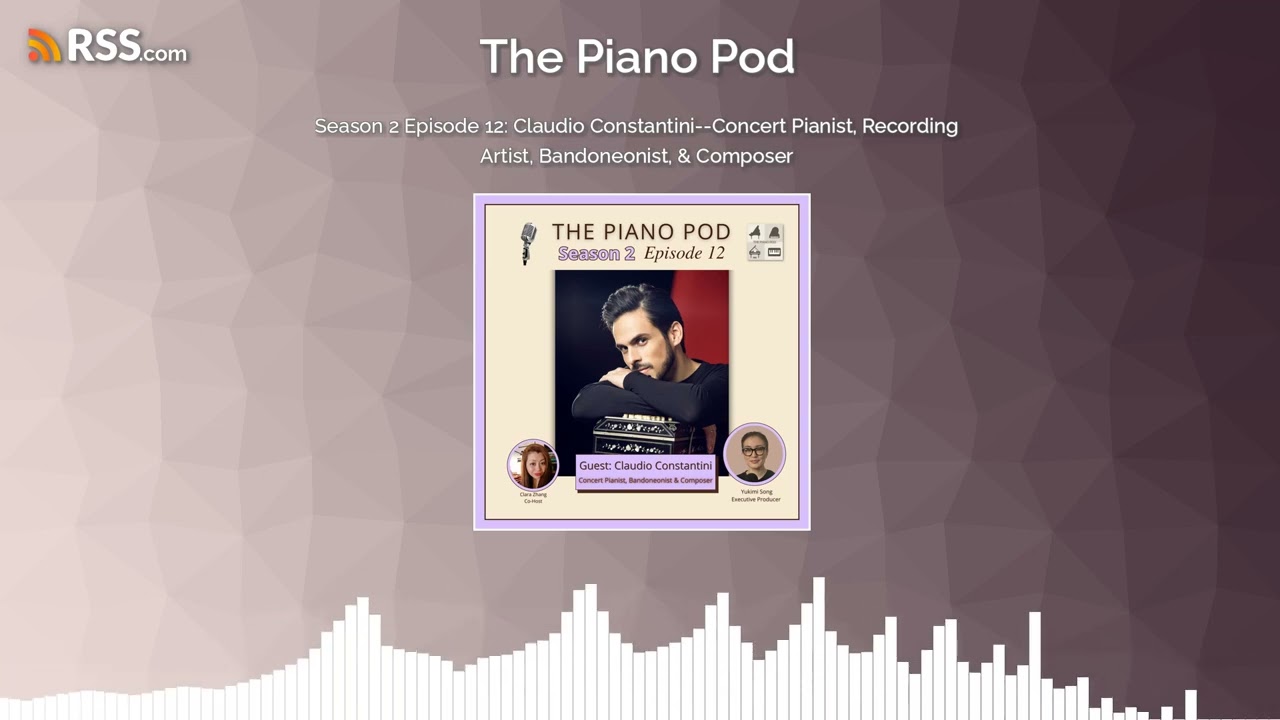
This content was created by The Piano Pod with Yukimi Song. This content was uploaded by The Piano Pod with Yukimi Song. This is a YouTube podcast episode titled "Season 2 Episode 12: Claudio Constantini--Concert Pianist, Recording Artist, Bandoneonist, &..." (posted 2024-02-16). Hosts Clara Zhang and Yukimi Song interview Peruvian-born, Madrid-based multi-instrumentalist Claudio Constantini about his musical upbringing and training, his dual career as a classical concert pianist and bandoneonist, his Debussy recording project and future Ravel plans, his composition "Genesis" and a bandoneon concerto (commissioned for Piazzolla's centenary), performing piano and bandoneon simultaneously, the role of social media, and how the pandemic influenced his creative work.
Chapters
Welcome back to The Piano Pod with Clara Zhang.
Hi everyone, I'm Yukimi Song.
For anyone joining our show as an audience for the very first time, so glad you're here. Yukimi and I are both classical pianists and piano teachers from New York City. This podcast is for anyone who plays the piano for fun, loves listening to the piano music, or for someone who is pursuing a career in piano or is simply curious about the world of piano. Piano music.
In each episode, we interview a guest speaker who has been breaking exciting new ground in the music industry. Before getting started, we want to thank our listeners for tuning in. Please rate our show or review on Apple Podcasts because every rating and review will help people find our show.
That's right. So for this episode, we are about to interview the sensational Peruvian pianist bandoneonist, Mr. Claudio Constantini, who currently resides in Madrid, Spain. Yukimi discovered him through social media and shared with me one of his reel posts on Instagram just a few weeks ago.
Oh yes, the one that he holds and plays the bandoneon on one hand and the other hand he plays the piano, right? And he's playing his original composition, Genesis, I think.
That's right, that is the one. Yeah, I really loved it. And he, you know, I've never seen anyone do that. And not only that, his musicianship, oh my goodness, wow, it was so electrifying. So Yukimi, tell us more about how you discovered him.
Sure. I mean, so, you know, as podcasters, we're always searching for potential guests on our show, and we'll look for someone who is bringing new ideas or new ways to reach out to the audience into the classical music world. Either through hashtags or random Instagram suggestions when you tap the search icon on the app, I discovered that particular reel post. And Mr. Constantini actually has many posts like that on his account. Anyway, I just could not help but Google him and find more video clips on YouTube and start listening to his music on Spotify.
Hmm, so glad you found him and shared a post with me. Just by watching it, I could tell he was a classically trained pianist, and when you look at his left hand playing the complicated, you know, arpeggios. And of course, you know, he turned out to be an international concert pianist who performs in major concert venues around the world. So I can't wait to hear how he decided to incorporate these two instruments as part of his artistry.
Yeah, me too. Well, he is here, so let's get the show started.
You're listening to The Piano Pod with Yukimi Song. Where we talk to the brightest minds in the industry about how they are bringing the piano into the 21st century.
We are very excited to introduce our guest of Episode 12, Mr. Claudio Constantini, an internationally acclaimed multi-instrumentalist, piano and bandoneon, and a composer in demand. Born and raised in Lima, Peru, into a musical family, his unique style is defined by its his solid classical roots paired with a passion for popular music genres, among which Latin American music and improvisation play a key role. Mr. Constantini has performed worldwide in top venues such as Amsterdam's Concertgebouw, the Berlin Philharmonic, the Los Angeles Opera House, among many others. In the next season, Mr. Constantini will appear as a soloist with distinguished orchestras such as the WDR Symphony Orchestra Cologne and the Robert Schumann Philharmonie. He will also premiere his own bandoneon concerto, which the piece was commissioned to commemorate Astor Piazzolla's centenary of birth, and perform a Rhapsody in Blue with the Tacoma Symphony in Seattle. Mr. Constantini has released 6 CD albums. One of them, titled America, has earned him a nomination for a Latin Grammy Award in 2019 in the category of Best Classical Album. He has been working on the Complete Piano Works by Claude Debussy, of which he has already released 2 albums, and the first volume was selected among the 10 best albums of the year 2015 by Fanfare Magazine USA. So today we're going to cover topics including Mr. Constantinis' upbringing, his career as classical pianist and bandoneonist, and his latest projects such as his brand new composition Genesis and recording of complete works by Debussy and so much more. So Claudio, we're so honored to have you today and welcome to our show and thank you for joining us.
Well, thank you, thank you. It's a big, a big pleasure, big pleasure to be here and to speak with you. I love your podcast.
Oh, thank you so much. Well, we, we love your work, so thank you.
So it's mutual then.
Oh yes, that's very important. Great. So, you know, I found you on Instagram because, you know, we're always looking for someone to interview, and then I happened to come across one of your Instagram posts, and on your left hand you were playing the piano, on the right-hand side you're playing the bandoneon. I think you were playing your piece Genesis, and I was just blown away, so I quickly texted Clara and shared the clip with her, and like, oh my gosh, who is this? So, um, first thing I did was I really wanted to share this music to my audience. So the idea is to put your piece into a playlist. So I asked your permission, and you were like, so kind, yeah, of course, please, sure. So that's how we started our conversation, and here we are, here you are, um, you're here. So we're very happy now, um, So for the audience who are listening, I really highly recommend to start listening to his pieces, but I suggest that you should start with Genesis. I mean, it's just a perfect piece. Genesis is, you know, it's the start. So, um, but it was just— it's another level of tango. Like, you know, Piazzolla was the new tango, then there's another level. So later we can discuss more about it, but Claudio, so you're tuning in from Spain, and how is Spain? How is Madrid right now?
Well, right now we're in winter, but, uh, it's quite, quite warm, quite warm outside. We've got 17 degrees Celsius. I don't know how much that is in Fahrenheit, but it's very enjoyable. You can go to the street just like this, so you don't need that much, but it's unusual, highly unusual. But anyway, so Madrid is wonderful city to live in. I get very inspired with the friendliness that I have here. I also live right next to a big park, Parque del Retiro, which is kind of like the Central Park of Madrid, much smaller, of course, but it's anyway, it's a big park. And I love spending my mornings walking there and getting some fresh air and some inspiration.
Oh, wonderful. Yeah. But you're not originally from there, you know, you're from Peru. So we're very curious to know your beginnings. How your musical study or musical journey started. So can we start from there?
Yeah, sure. Well, my parents are both musicians. My mom is a conductor and my father was a pianist. So I got— I was involved with music since I was a young child, since before I was born, actually. My mom conducted a concerto once while I was still in her belly. So I listened to music even before I was born. I nevertheless, I wasn't really interested in music until I was 12 years old. I could play the piano, like I took some melodies by ear and I played them with finger, but that's as far as I could. But then when I was, when I was 12, I got so in love with, I fell so in love with music that I started playing piano all day long. So I learned really quickly and I woke up at 5 o'clock in the morning so that I could practice before going to school. And then when I came back from school, I was playing till the night. So it was absolutely crazy. And so I learned really quickly and I could enter to the conservatory there in Lima. I was there till 18, then I left to Finland. I studied my bachelor's degree in Finland. Then I did my master's degree in Holland. And then I did a diploma in the École de Cantorum in Paris. So that was my trajectory. Then I stayed living in the Netherlands for some years, working there. And then I decided to come to Spain.
Oh, wow. So you have such an incredible classical solid training, but it just, it happened like almost like all of a sudden, like You know, before then it was like, you know, music was already always there because of your, you know, upbringing, but all of a sudden the desire just woken up or something.
And yeah, yeah, suddenly it was— I, I remember exactly the, the reason, and it was that out of curiosity I started putting the LP discs of my parents on the long play player. And I started recognizing the music that my mom conducted and that my father practiced at home. So Brahms and Chopin and Schumann and everything. And suddenly I just, I saw it, I heard it like with new ears in a way and fell in love with it.
How was your schools like, or any particular teachers or events that really spoke to you or influenced you?
Yes, I was very lucky with all my teachers. So my first teacher was my father. He was my teacher throughout my studies in Peru because he was a teacher at the conservatory. He was a very, very, very talented pianist. He actually graduated in Juilliard. He was studying with Agustina Nievas many years ago and with Oksana Jablonskaya also there in Juilliard. And afterwards, when I went to Finland, I studied with two different pianists who were Fantastic teachers, really, uh, fantastic people as well. They took me really much into care because, you know, I was a young boy who went to the other side of the world and it was not always very easy. Of course, it was very different than my culture and, uh, and it was also tough for me because I had to work a lot to be able to sustain my studies. But so they were great human beings and they were great teachers as well. And finally, in the Netherlands, I studied with Aquiles de la Viña, who was a student of Claudia Arrau. And he was a fantastic, fantastic master, one of the best teachers I've seen in the world, because I've taken many master classes and I've seen many classes. And he was really a special person. He knew how to how to nurture like the best side of yourself, you know, how to— he taught you in a way how to find yourself, how to find your own voice, your own personality in the music. So he didn't teach anybody in the same way. His lessons were always full of people where they were like master classes, all of them. So when he gave a lesson, there were always like 40, 50, 60 people, even from different disciplines, you know, violinists and cellists who came to listen to the lessons because they were so intense and so interesting. And he was so generous. He actually passed away just 2 weeks ago or 3 weeks ago. So it's a big loss. Yeah. He was very, very close to me, but anyways, he was probably the greatest musical influence I had in such a close relationship.
It's always those mentors who change your life, you know, it's in such a way that sometimes really influence or sometimes determines your career. Yeah.
Yeah.
So it sounds like you're very fortunate to have mentors like that. Wonderful.
Yes, I consider myself very lucky.
So, you know, we can't underestimate the power of social media, right? Like, we feel like we are posting it for nothing, but actually, you know, we discovered each other here.
So, yeah, you never know what will catch the attention of of whom. I mean, it's, yeah, it's a really interesting times like never before.
Exactly. And then with this Zoom, I mean, hello, we're in New York and you're in Madrid, and we're talking something quite intimate. So it's a very interesting thing. Anyway, so we want to know your performance career. I realize that you have substantial, not only the background but also career path as a soloist, as a solo classical pianist, so, and you performed with numerous orchestras and so forth. So can you tell us your brief, let's say, history and your career in your musical career as a pianist?
Well, my career is always— it has always been difficult for me to actually define what I do because I do so many different things. I mean, for me, it's really clear in my head. I like this and I like that and I do this and I do that. But it's very hard for me to communicate that to people because, you know, if you are an apple distributor and you also sell chickens, then it's like, what are you doing? You don't get a clear message. So that has always been a source of conflict for me when I present myself to the public. So as a pianist, I started with a very, very linear classical classical path in mind, especially while I was a student. When I was studying, of course, I was completely immersed with my studies and with the classical repertoire. And the real change started when I bought my first bandoneon. I was about 20, 21 years old, and then my horizon expanded somehow, which is funny because before, and when I was in Lima, I used to work in a piano bar and I always played popular music. I always played a bit of jazz. I always played Latin American music, but that was kind of like the hidden side of me. And when I brought the bandoneon in, this flourished in a professional way, not just in an amateur way. And it influenced a lot of my piano playing, of my piano, of the decisions that I would take further as a pianist. And so I tried to mix them up as much as possible. I tried to play When I can, I try to play piano and bandoneon on the same evening, on the same recital. Even if it's with an orchestra, I often play a piano concerto and a bandoneon concerto on the same orchestra because I feel like one instrument only tells one side of me and not the full picture. So I try to offer the full picture. And specifically with piano, I've specialized, I've tried to focus in specific projects, you know, so not really like before I wanted to play all the repertoire, but then when I started recording, then I started focusing more. The first classical album I did was with Debussy. And so that was a big focus and it certainly changed and influenced a lot of of my playing and of my performing preferences. Because there's actually a phrase by Artur Rubinstein, who's my favorite pianist ever. I love him. And he said that you should never play a piece that you don't feel absolutely comfortable with. So if you don't— I mean, of course you can study everything. You should study, you should learn by yourself. But if, if there's— if you have trouble communicating with a piece, then you should not concentrate on that one. You should concentrate on what you really feel that is yours. And there's people who can manage that with a vast repertoire, but mostly people feel more comfortable with expressing their— I mean, their personality is expressed better with a specific composer or specific type of music. So that's something I've taken to heart.
You know, Claudio, honestly, to me, the message you are, you know, giving is very clear to us. So I think it's the contrary of what you think about yourself, but everybody goes through this phase where you know, we have this discipline of, let's say, classical music or some other disciplines, and then, you know, tradition that you inherit from the previous generations, right? Then all of a sudden you hit the point where, wait a minute, that's who I am too, but I am also— I have this other side of myself, and you feel like there's a disconnect, but it's actually connected. And so, but that makes you— I'm very interested interesting artist, and that makes you a unique artist. So the message is very clear. And so that's why I wanted to know more about you as an artist and as a person. So there's one thing I wanted to ask. So speaking of that, as a classical pianist, let's say right now we're going to focus on you as a classical pianist, and then you're currently working on a Debussy works, right? Uh, you're trying record entire Debussy collection. So, and then I saw on the Spotify you produced CD album, first one and the second one. So what's your obsession about Debussy? How do you relate to the pieces, works of Debussy?
Well, Debussy is very special to me. I think that he's one of the few composers that when I play his music or when I hear his music played, it sounds like it's being created on the spot. It's really— it has a spontaneous feel to it, such a spontaneous feeling. Uh, it's like really like it would be improvised in the moment, and, and it speaks from so deep within. You know, there's a big difference for me between Ravel and Debussy, who are like the the two big representatives of so-called impressionistic music. In my mind, Ravel looks backwards, kind of like Brahms, you know, Brahms coexisted with Liszt, but his kind of writing was coming from Beethoven or from, you know, looking back while Liszt was looking forward. And for me, it's the same thing sort of happens with Ravel and Debussy. Debussy had imagining— his imagination was somehow less fixed than Ravel's. Of course, this is not better or worse. It's just a characteristic of his music. Ravel's framework somehow— actually, you know, Ravel is the next composer I'm going to record the full music once I finish the— and Ravel is— he— there's a funny thing about putting oneself limitations. It actually gives it can give you more freedom because Ravel puts strict forms in his, uh, stricter forms, or more or less, than Debussy in his music, and somehow creates a magnificent piece of music. And, uh, his imagination flourishes within that framework. Debussy cannot use really a framework. His imagination is free. He does— he cannot have constraints. So it's, it's coming from his childish hearts in a way. So I feel very identified and connected with, with this.
We just got to hear the inside scoop about your future project, which is Ravel, so we can't wait for that. That's wonderful. And then you also have this another album, well, classical music album, which is called America. When I heard, there were let's say, original pieces composed by Gershwin, but also is the Summertime Variations composed by you?
It's my composition, yeah.
They were incredible. I mean, one of the variations really literally sounded like Debussy. Yeah, there was that.
Most probably, yeah.
I love—
Yeah, go ahead.
While we're here, Claudia, you mentioned earlier before we started the interview that you were in Paris for a few years, or even France? How long were you there?
I was actually, um, I never lived in Paris. I lived in the Netherlands, and I was studying in Paris, so I was going twice a month and staying a few days to study because it was, uh, it's called La Scuola Cantorum, and it's, uh, it's a school that was founded by Gabriel Faure, César Franck, And actually, I received— it was such a special place. I received my lessons in the same place, uh, where César Franck's organ was. So he was playing and composing there. It was so inspiring, it was amazing. And you know, this, this year is César Franck's anniversary, so he said he's also a great composer I, who I love. And anyways, uh, so I, I didn't really live there, I— but I was studying there, uh, so going there back and forth.
Do you think that has a lot of impact on why you're loving French music so much? Debussy?
Yeah, probably. Yes, probably so. Probably so. I'm absolutely in love with Paris. I have two favorite cities in the world, Paris and New York. Completely different cities, but they're my favorite ones.
Yeah. Yes. When you're here, we'll take you everywhere. So please let us know. Yes.
Wonderful.
Wonderful.
Great. So, so America. So we live in America. So, and then you are originally from Peru, which is Latin America. So let's talk about your CD, Back to America. I love the arrangement of Piazzolla pieces on The Piano Pod with Yukimi Song, right? And then I particularly love the Verano Porteño because that's one of my favorite pieces is by Piazzolla. So I want to talk about Astor Piazzolla. I mean, if you talk about bandoneon, if you talk about tango music, obviously he's God. So we have to talk about him. I don't know where to start even, but tell us your feeling, your influence from—
Well, I discovered Piazzolla in the same way as I discovered classical composers, which is by a CD. At home, which my parents had, and the music sounded fascinating to me. I actually had never heard of Endonian before, so I had no idea what that— where the sound came from. I didn't know what the instrument looked like because the CD didn't have a picture. So I imagined like some kind of this weird instrument, so I could only imagine it. And years later, I, I just— there was of course no, no, there was internet, but at home when I was a child in Peru, we didn't have any internet, so I couldn't even, uh, research on the net. So years later, I discovered what a bandoneon looked like, and I learned that it was absolutely difficult to play because it's, it's a very complicated instrument. I fell in love with Piazzolla's music from the first minute because it, it was, uh, It's spoken in such a direct way, passionate way, and honest way with such a sincerity. There's a phrase by Piazzolla that he said that he plays the bandoneon standing up while the traditional bandoneonists play sitting down. And he said that he stood up, he played the bandoneon standing up because he wanted to have it closer to his heart. And that's where all his music came from. And that's how it sounds to me. That's all his music.
So Claudio, I, you know, to prepare for this interview, I did some research, but I realized I really don't know what this instrument is. I have never seen one in person. So I'm very curious.
It's over there.
Oh, okay. Can you like maybe describe to our audience that might also be a little clueless like me.
Yeah, sure, sure. Well, I'll bring it closer so that you can get a glance.
Yeah, yeah, this is an accordion.
It is similar to an accordion. Yeah, it's actually a kind of like a cousin of the accordion.
Oh good.
So, so it has bellows in the middle, open like this, and it has a keyboard like this.
That's right.
Yeah, and it's It's a very, very complicated system.
Beautiful.
Because, you know, when you press a button and you open the bellows, you get a note, and when you close the bellows, you get another one. So that means the keyboard changes. So, for example, if I have C, I open it, and then I press the same one and close it, and it's a D. Wow. Yeah, and there's no relation whatsoever. I mean, it's It's not— there's no interval relationship. Can be a fourth, it can be a second, a third. So it's really, really crazy instrument to learn.
That is beautiful. When did you start learning this instrument?
When I was about 21 years old. I was living in Finland. I was living in Finland and I bought one. I asked for a loan and I bought one. It came from Buenos Aires. All the way from Buenos Aires. I bought it by post mail, so I couldn't even get to see it, but, uh, it was good, unfortunately.
Oh, that's so beautiful. Yeah, I always loved accordions. And, you know, I grew up in China, and over there in the beginning, I remember I had the choice of learning keyboard or accordion, but I was so small and I was like, I can't carry this, this is so heavy, you know. So, but it was like a popular instrument And fast forward, my teacher— actually, I still have a teacher, he's Argentinian, and he plays with accordionists very often, so I get to listen to it. I mean, at least pre-pandemic. So it's a beautiful, beautiful instrument.
Yeah, it's very, very beautiful, very warm.
And so I know you, you said you, you started studying it when you were, when you were older, right?
21. Yeah.
And how were you able to eventually sort of match that within the piano? And did you have to, like, how long did you have to practice every day to become really good at it?
I actually quit playing the piano in order to be able to learn it. When I finished my bachelor degree, I quit playing piano for almost 2 years, and I dedicated full-time to the bandoneon. And then I came back to the piano and I did— Yeah, well, not really. I was, uh, 22 or something like this, 23. I mean, when I bought the bandoneon, I still had to finish my piano studies. And so I did that with the bandoneon. I dedicated fully to that, to learning music, to listening to music, transcribing music, and, uh, and getting to learn the instrument on my own, of course, because there was no teacher there.
Wow.
So it was a big, big challenge, very big challenge. But I was so dedicated that within 6 months of having had my bandoneon, I had my first concert.
Oh my goodness. Oh my goodness. I would love to come to your bandoneon. When you come to New York, you have to bring— well, I'm sure you will.
Yeah, I would love to. I would love to go.
When did you realize this was part of your identity as a musician? Because you were starting out as a classical musician and then you discovered this instrument and and you got obsessed, and then now this is part of you as an identity, right?
Um, but yeah, I couldn't say exactly because, uh, you know, when I bought it, I thought that I'm never gonna be able to play, uh, at a professional level because it's such a difficult instrument to play, and, and I'm actually a pianist. So, you know, I was kind of lying to myself and putting a limit to myself, which which I shouldn't have. But anyways, I said something, but I acted otherwise. I acted as if I'm going to dedicate to this. So, and I think that the bandoneon was a part of me even before I started playing it, because I listened to music with bandoneon before I got the instrument, and it was the music I listened to the most, actually. Piazzolla music and other Argentinian tango players as well.
You dedicate this one piece to celebrate Piazzolla's 100th birthday, uh, birth year, which was last year. So you composed a bandoneon concerto, correct?
Yes, yes, that's right.
Can you tell us a little— and you were about to perform this next year in the United States. So can you tell us more about it, please?
Yeah, sure. This was a commission from the, from an orchestra here in Spain, in Andalusia, in the south. So we did the premiere in April of last year, of 2021. We played two concerts, and then I played it also in July with Málaga Philharmonic in Spain also. And I'll I'll perform it, as you said, in Seattle. I can't remember now if it's in March 2023. And that's going to be with the Tacoma Symphony Orchestra. And it's a great opportunity. So this concerto is about 30 minutes long in 3 movements. So it's a tribute to Piazzolla. And in a sense, it has a lot of Piazzolla elements. But it's modeled as a classical concerto. So it has the classical concerto form, especially the first movement. It's quite structured, you know, with a concerto form. I wanted to create a music which is not too contemporary in sound so that it can reach— so that a wider amount public, of audience can understand it, you know. So it is kind of modern in a way. It doesn't use traditional harmony all the time, but it's quite simple. If, I mean, if you compare it to modern academic music, it's not atonal. It's always in tonality, and it's very melodic as well. So I wanted to make it very enjoyable. Because it's also quite long, 30 minutes long. It's quite a long piece for full orchestra as well. It's— there's not many bandoneon pieces for orchestra. Not even Piazzolla himself composed such full, such large-scale pieces. I mean, he composed concertos, but the orchestration is usually for a chamber orchestra. So it is either strings or either strings and winds. So not a full symphonic orchestra.
Is there any way we can listen to this?
Yeah, it's on YouTube. The premiere is on YouTube.
Oh, wow, really? Okay, so we can just type in— what's the title of the piece?
Bandoneon Concerto. But now I have to look up how it's actually put on YouTube so that you can find it. Yes, because I don't remember if it's in English or in Spanish.
Spanish.
Yeah, because it also has a subtitle. Title, which is Concierto Porteño. And Concierto Porteño is— is Porteño is like, you know, Estaciones Porteñas from Piazzolla. Porteño is, uh, it means that it's from Buenos Aires because Buenos Aires is the port city, and, uh, the people from Buenos Aires refer to themselves as porteños.
Oh, I see. Okay, wow.
Yeah, so that's, that's why it's named like this.
Just, uh, let us know the link later, and then We'll make sure to put that in the description section on YouTube and also in SimpleCast so that everybody can watch it. So with this, you know, Piazzolla influence, you have the album called Obstinado. And are they all pieces by Piazzolla?
No, Obstinado are mostly my own pieces. There's just one or two Piazzollas.
Yeah, I see. And then you have also the album called 20th Century Tango and Piano Cosmos. And so Piano Cosmos are all original, your piano solo compositions of tango music. And the 20th Century Tango was an arrangement or?
20th Century Tango is an album which I recorded with my wife, who's a pianist. And, uh, and I'm performing bandoneon in this album. So it's a piano-bandoneon duo. And the idea there was to play, uh, tango compositions of classical composers. So there's Tango of Satie, of Stravinsky, of Milod, Schnittke, and they are paired with some traditional tango composers such as Dino Salussi or Horacio Stamponi or Horacio Salgán or Piazzolla. So you have a contrast there.
Stravinsky wrote a tango?
He wrote one tango, yeah.
Really?
Originally for piano solo. It's a very short tango.
Very interesting. Just every day I learn something new. That's why I love what I do with this podcast.
You have worked with a lot of orchestras, right? As a pianist and also as a— I'm still learning—
Pordonist.
Pardonist.
It's hard. Yeah, it's hard to play and it's hard to pronounce as well.
That's right. I have to learn pronunciation first. So how was your experience working with all these different orchestras?
Well, fantastic. Last year I played with quite a few, maybe like 30 or something.
Oh my goodness.
Yeah, in Spain. So practically all the Spanish orchestras, and it has been great. It's been really, really great. I've performed my own concerto, I've performed Piazzolla's concerto, I performed Gershwin, I've performed some piano arrangements of myself, of Latin American pieces. So it's been a lot of different repertoire. I love playing with orchestra. It's one of the things I enjoy the most, and usually you don't get to do that so much, but this year has been quite unusual in the number of orchestras that I've played with.
And I think you're really setting up a good example for, you know, all the musicians in the world that it's possible, you know, even during the pandemic you were able to work with so many different orchestras. Must have been very exhilarating, like, experience, right, during this time that when live music not as present as it used to be.
Yes. So that is beautiful.
And we also, yeah, and I know that you sometimes play— we talked about this before— like you play on one hand on piano and the other hand on bandoneon. Like, how do you even balance that?
Well, that's quite— that's crazy, crazy thing. No, actually, I saw a Finnish bandoneonist doing that.
Okay.
Uh, yeah, a Finnish bandoneonist called Mikko Helenius. He's a wonderful musician and a friend of mine. And once he tried it out, and, and I thought, oh, that's crazy, that's impossible. He must be a genius. And I told this once to another friend of mine who I often play with, who's Erwin Schrödter. He's a world-famous baritone opera singer. And he told me, next concert we do together, we're going to play like this. You're going to play piano and bandoneon, and I'm going to sing together with you. And so he challenged me, and so I took the challenge, and we did it. We played in the Munich Opera House, over 2,000 people. And, uh, and I did, I did that there for the first time together with him.
Wow, so special. You know, I, I think these days that we were talking about social media, right, that's like the new age. A lot of things really happened with like these 100-day practice challenges, or, you know, like all kinds of different challenges it comes about. And then we kind of force to our limit, okay, let's do it publicly. And so are you just mostly doing this for fun, or do you intend to actually make a recording of that?
I was, I was doing it just for fun, uh, in the past years, but actually my next show, my next, uh, big project, which is, uh, my next album, I'm gonna perform it in that way. So I'm gonna perform on piano and on bandoneon, both separately and together. And I'm busy now learning all the parts. The first show is going to be in April. At the end of April. So I've still got a couple of months to learn it, but it's really probably the hardest thing I've ever had to do. So no, no Rachmaninoff or no Ravel is as hard as this.
I was sitting here thinking, like, you know, before the show you were sharing that you work out every morning and listen to the podcast. I'm thinking, wow, this has to be like, it's not exactly light, right? It's pretty heavy too.
So to be able to stay in the balance and Yes, but I've found a way. I've tried it out quite a lot and I found a way. Actually, I use a strap to strap it to my leg, to one of my legs, so then I have a better balance and it doesn't fall out. Because that was actually the main issue, how to actually get a good sound. Because if you don't have— you're not in control of the instrument, then the sound is weak.
Wow, so that's such a unique combination, and you're probably one of the first people to do this in the whole entire world, you know. And so we can't wait to, you know, hear the recording of it eventually. It's so cool.
That's right. Was that a pandemic project or like something to do during— okay, so we have to speak about pandemic. Obviously this has changed all of us, especially particularly musicians, how not only we lost the opportunity of live performance, but, and most of us, that was the livelihood. Now then, you know, we had to shift attention toward more digital world, and then maybe that's one of the reasons you started some— something silly, something to have fun. But yet now, like, maybe you're trying to make recordings or something like that. So can you tell us about the effect of pandemic?
Sure. Yeah, actually, the pandemic When it hit, suddenly all my concerts got cancelled, of course, and I spent most of the year with no performances, no income. So it was a very tough time emotionally and financially, just like for everybody else. But I think it was probably the one of the most positive things that has happened to me in my life was to get the opportunity to shut everything off and rethink many things musically, personally. It has been a really new beginning for me as a person, especially as a person. And of course this affects the music because I don't think that you can separate one from the other. I learned to be absolutely honest with myself and with the decisions that I make and with the things that I value and the things I stand by. And this affected all the musical decisions and paths that I took. Piano Cosmos actually is, which is a series of 5 EPs, so 5 short albums, was a product of the pandemic. So I sat at the piano every day for hours just writing music and playing. And I selected pieces from what I wrote, and I decided to go to a studio, record them, and publish them without really expecting to do much with that in terms of concerts, because of course there was no possibility of concerts. But I just wanted the music to exist in other than just in my head, and that's why Piano Cosmos exists. And in Candescence, which is my upcoming upcoming album and project, of which Genesis is the first single. It was— it's actually a conceptual album. I don't really speak about it, but in a concise or open way, but I planned it from— I did a short story. I imagined a short story, a story of things coming from the subconscious of this like the spiritual side of oneself and how, um, many things are not erased but blocked by all the things that we have to go through in our lives. You know, we, we even, uh, artists tend to go in straightforward paths. You know, you study, you try to get a job, or you try to get concerts, or you try to do this or that because you know the paths of all the people that have come before you. So you try to imitate the ones that you prefer, the ones you like the most, or the ones that you would wish that you would do. And on the way, you might forget or you might oversee many things which could be important to you, which are important actually to you. And one of them is, for me, the connection to other people. And this is something that I really, really concentrate a lot in my music and in my performances. And that's one of the things I actually love about social media is that I can directly communicate with people in an open and honest way and in an immediate way by a post or by a live or by a reel or by whatever. And I take this in the music that I perform also publicly and in Candescence, this project, which started in the pandemic, has all to do with that. It has to do with everything that comes from the subconscious and all the possibilities that we don't nourish because of these blockages. And so it's really the story of the journey of a person from the subconscious towards a sort of enlightenment and connection with everything and with the surroundings and with the people. People. So yeah, that's kind of like the short version of the, of the story of Incandescence.
That's pretty deep. And, uh, yeah, but these things you think during a time like pandemic where, you know, everything has stopped and you just have to— I don't know, it's a scary time and it makes us feel so vulnerable and searching for answers. Answer. And sometimes you, whether you are religious or not, you just look up and just pray for something, right?
Yeah, yeah, yeah, yeah. Because there's things that are just bigger than, than oneself. And it's very easy to forget if you live a busy life in which you concentrate on just a few things, even if they're very important things. Once you concentrate on a few things, you're immediately overlooking others. And you're— everybody is destined to do that, of course, but, uh, there are certain levels, you know. You can overlook a few things or many things. And, and I took a holistic— I don't know if that's the right word, but, uh, holistic, um, approach to life, concentrating in, in all of my surroundings. I started to meditate. I started to, to read a lot and listen to podcasts a lot. And so that being more aware of the immediacy of the moment.
Have you started meditating for a long time, or is this— Yeah, during the pandemic.
During the pandemic, I started actually, it's been maybe a year and a half since I was meditating. And I've been wanting to do it before because I learned of all the benefits it had, but I didn't know how to do it. So I investigated a lot and finally I found this, that Transcendental Meditation goes very well, works very well for me.
Yes.
Oh, really?
TM.
Yes, I'm a TM practitioner. Yes. Wonderful.
Yeah.
Well, that's wonderful. Yeah. So I do it every day and it has changed. I mean, a lot has changed because of that. Of course, it's not only that, it's an approach to everything. Because once, you know, once you start changing one thing, like, uh, you want to have better health and so you start eating better, but maybe you also want to go next level and you meditate, then you do exercise, and then good things just start piling up. So it's a— I like to try to get used to good habits.
We do this thing where we try to keep ourselves busy all the time because we don't want to be in that place, you know, because it's such a scary place to be. But this pandemic taught us it's not as scary as you think, and you have to come back to yourself, you know. And meditation, of course, is one of the tools to help you to get there, but there are so many other ways to connect connect with yourself. Yeah, thank you for sharing that. Um, so you mentioned briefly about, you know, Genesis. So let's talk about Genesis, right? So that's, that's the first thing I heard on Instagram, and I just couldn't help but sharing that to Clara first. And then Clara was like, oh my gosh, who is this? What is this? And then this is a new level of tango. I mean, you know, you talk about Piazzolla is Nuevo Tango, but what is this genesis? So tell us about this, you know, your composition. But also there is an album. This is one of the 12 pieces of this album coming up. Yes. So can you tell us a little bit more?
Yeah, sure. Well, this album is called Incandescence, as I said, and Genesis is the first piece. It's, I mean, the album is a mixture of many of my influences as a composer, as a classical composer, as a tango performer, and as a jazz musician. So it's, I don't like really putting labels, but if I would have to say what it is, it's kind of like a jazz fusion album. I would say. So when you hear bandoneon, you hear tango. So that's kind of— if you know the bandoneon, if you know the tango, the sound is of the tango. So there's always going to be a little bit of that. But I always, I always try to take the bandoneon out of the context of tango because actually its origin has nothing to do with tango. It's a German instrument which was invented to play in churches, you know, church music and salon music as a piano would play. And it got to Argentina and to the tango by accident. So it's really a versatile instrument. And in Genesis and in the whole of the album Incandescence, I— is one of the things I do to show this versatility of the instrument. And of course, in this album, I also play the piano. So I overlap, I overdub. Myself playing the piano and playing the bandoneon. And actually, sometimes there's even more than one bandoneon or even more than one piano at the same time, so I play over myself a few times. Of course, the show is going to be just in quartet format. I have to rearrange the music so that it fits, but the album, I really didn't want to put any limitations to myself. If I use thought that a second piano is needed here, I just put it in, and that's it. Because it's such a conceptual album, and Genesis is— I spoke about the subconscious, so Genesis actually does subconscious, is the piece in which many themes will reappear in later pieces throughout the album. And this is generating all these, all these ideas, and all these melodies are generating in the subconscious, and but they don't really get a a proper development, or they don't really get to somewhere. They're just like floating around, and then suddenly they finished and a new one comes. So that was the idea of Genesis. That's why it's such a crazy piece.
So you briefly mentioned to me, uh, us, that, uh, so there's a series of pieces. So I think I saw another piece, but the same design, album cover. So Genesis, and there was a second piece that you just What's the name of that piece?
The second piece is— it's called Alone, and it was released last Friday, so you can listen to it on Spotify, iTunes, everywhere.
And then you are slowly producing each one of these until May?
Yeah, so the album is fully produced, but I'm releasing a single one single each month, not the whole album. So I'm going to release 4 singles, and after the 4th single, then I will release the full album. Will come out in May.
Okay, listeners and viewers, be sure to check out his Genesis and Alone. They are out right now on Spotify or, um, and also Apple iTunes.
Yeah, iTunes, Google Music, these are all of the streaming platforms.
This is our tradition, and, you know, we're honored to have so many amazing artists come to our show. So any last word of advice for young musicians and young piano music learners?
Well, there's so many different valuable advices that I, I could say, and each case is— each individual case is special, but I, I believe that to, to be a musician or to be— to have any profession, you need to have such deep love for what you do. It might be a bit difficult or it might not necessarily be the thing for you, but that's probably one, one of the biggest pieces of advice I would say.
It's so beautiful. Thank you so much for sharing that. Yeah, our audience will benefit from all these very much. You know, and you're really making yourself as this 21st century musician for all different media, you know, social media, and your different way of presenting yourself and the music that you're playing and different instruments. That is really cool. So thank you so much.
Thank you.
Thank you. Big pleasure.
Now we are going into a fun segment of this show. So we're going to end on a positive note. Very much pun intended here. So let's start. Claudio, we will ask fun questions and we would like for you to answer them with the shortest answers possible for each question.
I'll try my best.
Okay, nothing to be scared of. Okay, what is your comfort food?
Hamburgers. Oh, cats or dogs?
Dogs.
What is your word or words to live by?
Passion and purpose.
Passion and purpose. Amazing. Excellent.
What is the most important quality you look for in other people?
Honesty.
What is the worst quality in people you want to stay away from?
Falsehood.
Name 3 people who inspire you. Living or dead?
Arthur Rubinstein, Astor Piazzolla, Bill Evans.
Bill Evans, great. Yeah, great artist.
Yes.
All right, so name one piece in your current playlist.
Genesis.
Yeah, yes, and then it's in our playlist as well, so check it out. Excellent choice.
Stories this week, so tune in. And one book title in your library?
Oh, how do you say this in English? Uh, this is from Herman Hesse.
You can say in Spanish.
El Lobo Estepario, which is this— the Wolf, something like The Wolf, from Hermann Hesse.
Interesting.
It's a classic. I just read it, uh, I finished it last week for the second time, so that's why it's fresh in my mind.
Do they have an English version?
For sure, yeah, for sure, for sure. But I just don't know the English title, but it's one of his, uh, one of his top, uh, works. So something to do with the wolf, something to do with—
You get only one song or piece to listen to for the rest of your life, what is it?
Well, that's very easy. That's the Brahms Requiem.
Kim. Yes, actually, actually, previous guests said the same thing. Yes. Oh, really?
You know, I've, I've thought about that question many times in my life, and, uh, and actually it is one of my top pieces, but it's not necessarily my top piece. But the reason why I would choose it is because it's so long that I could— I, you know, I can discover more things, and it also has so much orchestration. Because otherwise I could also choose a very short piece like a Brahms intermezzo. Brahms is my favorite composer, by the way. So, uh, so, but, but it's so short and that then 3 minutes I would have to listen over and over again.
Yeah, yeah, that's right. Absolutely.
So it's kind of a logical-based answer.
All right, well, last question, last not least. Music is blank, fill in the blank.
Life.
Music is wonderful.
Ding ding ding ding ding!
You won!
Yay!
Thank you so much, that was really fun.
Yeah, it was nice.
Yeah, thank you so much.
I'm surprised I could, I could answer so briefly.
Oh, really good.
You were very, very brilliant. And then thank you so much for this wonderful conversation. Are very inspiring, and I'm sure, I'm sure it was the same for our audience as well. So sadly, this concludes this episode of The Piano Pod with Yukimi Song with Claudio Constantini. And thank you, Claudio, for joining us today and sharing your wonderful stories, insights, and expertise. And you can find more information about him on his website at claudiocostantini.com. And I want to encourage you audience to listen to his latest song, Alone, Peace Alone, and also Genesis and more, so much more. So all the links are listed in the description.
Thank you so much.
Oh, thank you so much. Yes, and the fans for tuning in today. If you enjoyed today's episode, please rate and review on whatever podcasting platform you use. If you're watching us on YouTube, Remember to hit the thumbs up button and be sure to subscribe to our channel. You can also find us on Facebook, Twitter, Instagram, and LinkedIn. The links are in the description below.
If you're interested to be the guest or want to recommend someone to be on our show, or you'd like to sponsor or collaborate with us, shoot us an email at thepianopodnyc@gmail.com. Www.thepianopodwithyukimi.com or send us a direct message via social media.
We'll see you for the next episode of The Piano Pod with Yukimi Song with Claudio.
Bye everyone, and thank you, Claudio.
Thank you very much. Very fun, big pleasure. Gracias.
Thank you.
Gracias. Gracias.
More from The


Spirit, Body, and Soul: Pianist & Composer David Berry on Virtuosity, Creativity, and...



Season 6 Episode 20 | "Spirit, Body, and Soul" feat. David Berry, Concert Pianist & Composer


Beyond Borders: From Argentina to Poland to Texas—Oscar Macchioni reflects on a life in music

Sound Liberation: Joe Williams on Black Artistry, Legacy & Belonging in Concert Music


