Season 3 Episode 10: Lisa Yui -- "Musical Phenomenon," Yamaha Artist, and Educator
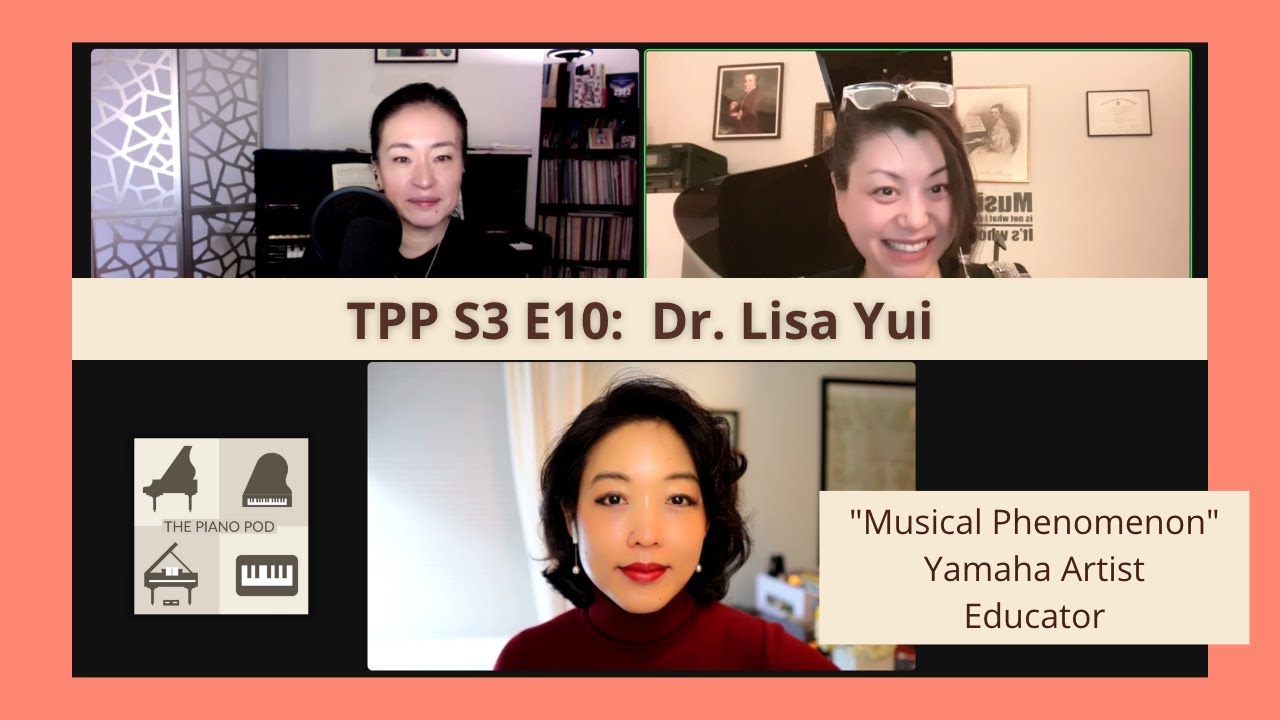
This content was created by The Piano Pod with Yukimi Song. This content was uploaded by The Piano Pod with Yukimi Song. This is a YouTube podcast episode (Season 3, Episode 10) titled "Lisa Yui -- 'Musical Phenomenon,' Yamaha Artist, and Educator," published January 11, 2023. The episode is a long-form interview-style conversation hosted by Yukimi Song and co-host Clara Zhang with guest Dr. Lisa Yui (Lisa Yui/Yu), a pianist, educator, and Yamaha artist. Topics covered include Lisa Yui’s childhood and musical training, international performing experiences (World Exposition, cruise-ship tours), recordings and a Beethoven DVD/Blu-ray, Yamaha Disklavier technology and remote teaching, her lecture-concert series “Lives of the Piano,” and a new course on piano music by Asian composers; the hosts also include sponsor/read ads for Forte and promote a Patreon. The episode is an English-language interview intended for piano students, teachers, and classical-music listeners.
Chapters
Happy New Year from The Piano Pod, and thanks for watching or listening to the very first episode of 2023. I am Yukimi Song.
I'm Clara Zhang. And Happy New Year to you, Yukimi. How was your holiday?
Oh, it was great. I just came back from visiting my family members. And so, how was yours?
It was nice, and I did a lot of recording, so I was being a nerd this holiday season, but it was beautiful. So for anyone that's listening or watching our show for the first time, welcome! And Yukimi and I are both classical pianists and piano teachers from New York City. This podcast is for anyone who plays the piano for fun, loves listening to piano music, or for someone who is currently pursuing a career in piano or works in the industry professionally.
In each episode, we interview a guest speaker who has been breaking exciting new ground in the music industry. Before getting started, We want to thank our amazing fans and listeners for tuning in. Please rate our show and review it on Apple Podcasts because every rating and review will help people find our show. So as the first episode of 2N23, we have Dr. Lisa Yui, the musical phenomenon, Yamaha artist, and educator. And Clara, you know her personally, right?
Right, yes. I was very honored to be meeting her at a concert series that she put together at Manhattan School right before the pandemic, not very long. And she— I believe we have a common very good friend, who Apollo, a composer that has been on our show in the past. And so we have crossed paths a few times, and I have always admired her work. And I love watching her video with sometimes her fur friend. I believe it's Schubert, a Franz, and Ludwig Beethoven, her two cute cats, that are in her lecture videos that I share with my students.
Can't wait to interview her and hear her story, so let's get the show started. You are listening to The Piano Pod with Yukimi Song, where we talk to the brightest minds in the industry about how they are bringing the piano into the 21st century.
We're honored to introduce our guest, Dr. Li Soo-yoo, a musical phenomenon, Yamaha artist, and educator described as a musical phenomenon in Pianista magazine. Ms. Yu enjoys a multifaceted musical career as a pianist, lecturer, teacher, author, and musical director. Since making her concerto debut at the age of 7, she has performed throughout North America, Europe, and Asia as a recitalist in venues such as Satori Hall in Tokyo, Théâtre du Châtelet in Paris, and the Liszt Franz Memorial Museum in Budapest. On other major concert venues around the world, and as a soloist with prominent orchestras such as the Tokyo Symphony, Polish National Radio, Toronto Symphony, and more. Ms. Yu's exciting performing arts career includes her performance at the World Exposition in Japan in 2005, where she performed a program of works by Liszt, Ravel, and Canadian composers François Moreau and Colleen Mistui is also a recording artist. Her CD album of the music of Carl Maria von Weber and Jan Ladysław Duszek was awarded the highest rating by the French music magazine Pianista. In addition, her DVD/Blu-ray recording with commentary of 4 piano sonatas by Beethoven received rave reviews from musical— music critics. As a dedicated educator, Ms. Rui teaches keyboard literature at the Juilliard Extension, as well as graduate piano literature, keyboard skills, and the piano music by Asian composers at the Manhattan School of Music. She is the recipient of the school's 2018 President's Medal for Distinguished Service. So, Lisa, welcome to our show. Thank you for being here.
Yeah, welcome.
Thank you so much, Yukimi Song.
Thank you.
Happy New Year.
Happy New Year to you too.
Oh my goodness, it's been a long time coming, and I've been wanting to invite you to our show from the beginning of our season 1, and it's so great to have you finally. I have been to your concerts, and that was really exciting before pandemic happened, you know, the world was still sort of somewhat normal, and I was always very inspired by all the concert series you put on and So obviously we have our mutual friend Paulo, and who was also on our show a couple seasons ago. So before we start, we would like to discuss about your music background and how you got started in the very beginning. Would you tell us a little bit of, uh, you know, what was your youth like? I believe you speak quite a few languages as well, and I was just watching a 11-year-old Lisa playing Prokofiev, and I was just like so inspired. So tell us a bit.
Thank you. Yeah, that Prokofiev was maybe my musical highlight, you know, and everything is downhill from there. It's certainly a memory I hold very dearly, and there's something about 11-year-old experiences that remain very special in one's heart, and I'm very happy it was recorded. My childhood, well, I was born in Japan and we immigrated, my family and I immigrated to Canada when I was 3 years old. There we met a Russian pianist couple and my sister started taking piano lessons with them and it was quite serious from the very start. My sister was very quick in learning and very talented and she started playing solo recitals, entered competitions. I was the younger sibling who who was just accompanying the lessons. And eventually, I believe my mother felt pity for me and started teaching me notes as well. And I started taking lessons from this teacher as well. And in a way, the rest is history. I think that meeting was a very life-changing event for our family because we would never have become so serious from such an early stage in our lives if it weren't for this couple.
Absolutely. Wow. Sometimes the beginning says the whole, you know, story of the whole—
especially in classical music, because there are exceptional people who begin rather late in life, like Paderewski or Harold Bauer. But for the most part, I think it's very, very important to acquire a pretty solid technique and a large repertoire that could only begin usually before the child is you know, really expresses a deep interest in music.
Actually, personally, I have always been curious because Yu Yu, isn't that— is it a Japanese last name or Chinese last name? I was always wondering.
Yes, it's kind of a mishmash. It's a made-up name, actually. So I was born in Japan, but I have a Korean background. And so— are you—
are you seriously? Zainichi? Zainichi? Do I need to?
Hi.
Yes. Well, me too. Oh my goodness. I'm so— I grew up only speaking Japanese, and my father changed his name to kind of just assimilate into Japanese culture. And so it's actually complicated when people ask me, what is your background? I mean, do you give the long version of I'm Korean, born in Japan, moved to Canada, now in America, or I just say But you're not Chinese, right? No, no, I'm not Chinese. Okay, got it. I have many Chinese friends.
I always, you know, I was asking Paulo, he was like, I don't know, you have to ask her for me.
Yeah, but it's the same reaction I get when I try to explain my nationality as well. Yeah, wow.
And it's an identity. I mean, when you're in America, you don't feel that as much, but definitely there is this search for an identity, you know, throughout one's life when you have such a mixed up— I was about to say messed up, but a mixed up heritage. And in a way, I'm, I'm, I kind of like it now because I don't have to be categorized in any, into any culture.
Yeah, I totally understand. And having to— but, you know, especially I grew up in Japan as a Korean for a long time, so, you know, having to have two last names and, you know, those things, I totally understand, but also it complicates your identity too. But, you know, we're here in the United States and you can just be whoever you want.
So, right, everyone comes from somewhere else, right?
Yeah, absolutely.
That's so amazing. Thank you so much for sharing all these very interesting background details, you know, that our audience— yeah, and I believe that also sometimes gives us certain incentives or uniqueness into our musical making. So now we're all musicians. And would you tell us a little bit of your training, maybe where you went to school? And I believe I saw that you were also studying with Edna Golinski.
Yes.
And she was on our show, and I also— I know, I was a friend of her long time ago, and just amazing. So, uh, and what was it like? I know you also studied with Mr. Emanuel Ax, and I wouldn't say, you know, I played for him once.
That's about it. But yes, after this, this Russian couple, they moved to several different cities after that, Vancouver and then Toronto. And I eventually, when I was 14, I moved to Toronto and first lived with a host family away from home and then eventually lived on my own by the time I was 15. And so I, in Toronto from age 15 to 21, I lived pretty much on my own. I don't even know if that's legal. But I went to high school and then went to the conservatory. There was a pre-college program, an excellent pre-college program there. And then I studied with the same Russian teacher. And after that, I moved to New York to continue my studies at the Juilliard School, and then Manhattan School, and then— I stayed on and on and on at the Manhattan School. And of course, I had other teachers with whom I studied with periodically, such as Edna. But with Edna, that was much later in my life. And for me, that was the perfect timing because I felt I was mature enough, and I played for many, many different people up to that point. And so to assimilate the new technique she was incorporating was quite easy. And for, you know, some of your viewers who are not who might not be familiar with Edna, Edna Golanski is an amazing teacher who has studied with Dorothy Taubman, and she really specializes in piano technique, and not, you know, not only on technique, but for me, she fixed a lot of hand injuries and strain in my playing.
And also you studied with pianists like Leo Fischer and Alicia de la Rocha.
Alicia de la Rocha, yes. So Alicia de la Rocha, I played in a master class again at Manhattan School of Music, as I did with Emanuel Ax. But Leon Fleischer, he actually was a regular visitor at the conservatory, and selected a number of students who auditioned got to play for him every month whenever he visited. And so I was fortunately one of those pianists. And so I did get to play for him on a monthly basis. In hindsight, I feel that I wish I was a little older, you know, because I think I could have absorbed more of what he said. But we also— but I still remember very well some of the things he told me. And we also, of course, sat through all the other people playing in the master classes, and they were really quite phenomenal.
What was it like to start out your solo career? And after you went through all the school, and did the school teach you anything? Of course the school taught you technique, literature, amazing, you know, meeting amazing colleagues and teachers and everything. But sometimes life teaches you more than— and so is there any memorable performances or the life lesson you learned? Is there any anecdote you can share?
I actually have to go back and mention, I kind of skimmed through my Manhattan School of Music studies, but, you know, other mentors who were incredibly important were Byron Janis, who I studied with at Manhattan School of Music. And of course, he was a pupil of Horowitz, as was Eduardo Salim, who I know you interviewed before. And David Duval, who was— I was his assistant for many years and of course, was the author of many books, including books on Horowitz, and a radio programmer. And of course, I was deeply influenced by him and Mark Silverman, who was piano chair until this last year. But so I had many, many, many mentors, and sometimes I have to remember to give them their honor because I wouldn't be here. Without them. But answering your question, Yukimi, I was pretty active. I mean, more than today, I think even when I was a student, I was really— I performed a lot and I traveled and toured a lot. Summers, I rarely attended summer festivals because that was when I was performing. So that— the division between school and performance career didn't really exist for me because it was concurrent. Um, but school was, uh, very important, of course, because right now, um, so much of my life is involved in school and my students. Um, one aha moment was when I had to miss school at Juilliard for a good number of weeks, like 2-3 weeks, and I got permission from the teachers to miss and catch up on the work. And I remember The week I returned, there was going to be a piano literature test on 20th century music. And the teacher said, well, you know, you're going to have to take this exam, but you're welcome to go, and here are the materials we'll be covering. And so I missed 3 weeks of classes. And I took with me a book by Paul Griffiths called Modern Music. It's still, you know, it's a classic still. And not a large book, but it— Paul Griffiths was the music critic of the New York Times for many years. And I read this book and it was so interesting. It talked about, you know, all the political events of the 20th century through music. And I read it and it was like a story. It wasn't like in 1925 this happened and so-and-so was born, but it was like a story to me. And I thought, this is really interesting. This is like, it's so easy to remember because it's like a story. And I read it 3 times and I went back to school And I looked at the exam and it was easy, you know, because I knew all of this. And I realized, oh, I can learn all the stuff we learn in classes on my own, right? You don't have to sit in school to learn information. And that was a really eye-opening event. And so that made me think, what is school for then, right? If it's not to acquire information, it's something else. And, um, that something else could be many, many other things like building a network, making friends, being inspired, right? And, um, but it's not— school is not about learning information, or it shouldn't be, at least.
In your bio, there were two memorable concerts that you mentioned, or maybe it's a series or performance opportunity you experience. The one is the World Exposition in Japan. I don't know how long ago that was, but you performed but also hosted in English, Japanese, and French, and that's quite amazing. And performed the program works by Liszt, Ravel, and Canadian composers. So can you tell us a little bit about this experience?
So this was the World Exposition in Aichi, Japan. And I'm a Canadian citizen, and I nominated myself to be one of the performers. I think there were 5 performers or something who were going to be chosen of all, you know, not just pianists of course, but all performers in general. And I was happily chosen. And so I remember Misha Bruegger-Guzman, who's a really eminent singer, opera singer in Canada, was still just, she was just kind of coming out, you know, emerging artist. And she suddenly had this blossoming career soon after. But we went to Aichi and we each prepared a short program. And as you mentioned, I was asked because I spoke 3 languages, Can— um, English— Canadian, uh, English and French are the official languages of Canada. And also we were in Japan, so I was able to host in Japanese as well. Um, so that was very challenging for me because I'm not equally fluent in all three languages, but it gave me an opportunity to really brush up on the— especially the French and the Japanese. And also, um, Yamaha was kind and generous enough to lend us a Disklavier. And a Disklavier is basically like a computer piano, acoustic computer hybrid, onto which you can record yourself and it will recreate or reproduce your performance with incredible accuracy. So I played a two-piano piece with myself. I prerecorded the other part by— it's a gamelan, Balinese gamelan transcription version by the Canadian composer Colin McPhee for two pianos. And so I prerecorded the other part and I performed the other part live in person. And so that was a really, really memorable, very special, odd, tiring event.
Wow, that's incredible. But, you know, how long ago was this?
This was 2005.
2005. Yamaha Disklavier already existed.
Oh, Yanok Disclavered existed for way long before that. I wish more people were, you know, I mean, were more aware of it because it has, you know, I've worked on this for decades and it has been constantly improved. And you could teach remote lessons, which you can imagine how useful it would be during the— it was right during the pandemic. And Juilliard faculty taught using using the Disklavier during the pandemic. And also really cool things like playing duos with yourself or with someone who's far away is possible.
We heard quite a bit from our guest Frederick Shu a while back.
Yes, oh yeah, he's a pioneer.
Also the last guest Magdalena also mentioned Yamaha Disklavier and how they can record not only your performance but really the weight that you're putting onto the piano and everything.
It records the velocity of the key down, the velocity of the key release, the velocity of the hammer speed, and something crazy like almost 200 levels of the pedal. And I'm thinking, you know, I don't have 50 levels of pedaling. But the accuracy is phenomenal. So you can imagine what's being done now is you could record in a place where it might not be ideal environmentally because of sound and so forth, but you can record anywhere you like and then simply move the piano to an ideal, you know, space like a hall and just you know, playback that recording and record that, and you don't have to edit anymore because you've done all the editing beforehand. So that saves an enormous amount of location time.
Wow.
It's really quite a phenomenal instrument.
Yeah. And then there's so much potential. I mean, even more, right? And especially I'm also interested in about remote lessons using this Klavier too.
Well, you know, I have to say, the past 2 years teaching, all of us taught lessons remotely. But I have to say it was a very easy transition for me because I've taught remotely using the Disklavier for so many years that I knew things like muting yourself, you know, when you're listening or teaching without having to touch the student, right? And being able to explain yourself without showing every little detail. So it was kind of a blessing that I never knew I was going to receive.
I used to have this Yamaha grand piano in Japan with the player piano. I don't know if it was called Disklavier or not, but it was installed in my piano.
But yeah, oh yeah, it's probably an early version of it.
Yeah. I think so. And then you have to put the disc in it. And then in the back—
that's a Disclovir. Yeah, that's a Disclovir. Yeah.
So, and also, I'm also curious about this, uh, tour of the Japanese cruise ship, and it was like 101 Days Around the World tour. Yes. Did you— were invited twice. Were you, were you on that, on the ship for like 101 days? Yeah.
No, I haven't. You know, I have, I have work and I have like other life things. Um, so this was a Japanese cruise ship and you can imagine who has time for 101 days? Older rich people. It was 100% Japanese and, um, not a very large ship. And I don't know if you've ever been on a cruise ship, but generally the small— the larger it is, the less movement there is, and this was kind of on the smaller side. I was on it for 2-3 weeks, which was plenty long enough, and I had to play somewhere between 6 and 10 recitals during, like, different programs during that time. And, you know, I didn't play, like, cocktail music, but I had to actually play real music, like Pictures at an Exhibition and Chopin Sonata and all that, right?
Oh my goodness.
And I discovered I get very motion— you know, I get a lot of motion sickness. And so basically the first time I went on and I just kind of like— I'm sorry to your guests who might be eating, but I just barfed everything but my organs, right? And I was going through the hallway with a bag all the time and I just wanted to die, you know? And I couldn't get those really, uh, the strong motion sickness shots because I had to perform and I didn't want to feel drowsy or anything. And so, um, it was kind of horrible and wonderful because the experience was great. I met some fantastic people. I boarded on in New York, we went through the Panama Canal, went up to Vancouver, and I disembarked there. So I saw some incredibly beautiful places, but in general, um, because the performance space kind of doubled as a ballroom, the only time I could practice was when everyone was kind of outside in Acapulco and all that, right? And here I was just like practicing, and I was getting up at 1 AM when people finally went to bed, these, you know, 60, 70-year-olds were partying the night away and then until 1 o'clock, and I would crawl out of bed and I'd be practicing. And so that was my first experience. And you think, why would I go again? You know, Yukimi, the saying, you know, "No tomo to toire ba atsumo wa sureru," you know, once the hot liquid goes through the throat, you forget about the heat. It was exactly that. I thought, hmm, Maybe next time it won't be so bad. And I went and it was still terrible. Uh, again, terrible and wonderful. I lost 20 pounds, uh, in 2 weeks. And, uh, it was like, if anyone wants some intense dieting, go on a cruise ship. But I do remember my last concert, I had lost, you know, 20 pounds and I was kind of in the basement rocking myself, getting prepared to play this huge program that ended with pictures at an exhibition. And you know those religious monks who fast and they don't eat for several weeks and then they see visions? It was pretty much that. I had lost so much weight and I was playing pictures and I— and, and the ship was moving because there was a storm and I kind of like reached a spiritual high that I don't think I've ever reached. It was something mystical, you know. It was the starvation and the pain and the will to play this piece. And I actually played one of the best concerts I could remember, or maybe it was in my mind, but I felt that it was a very special concert. So you never know, you know, you kind of think you're sick, you're not in top shape, you never know until you do it. Sometimes it can turn out to be one of the best performances you give. That's another thing going back to this question of, you know, things that you don't learn necessarily in the classroom are these things that like your limit, you know, you think that you have a limit and when you are brave enough or stupid enough to make yourself do something that's way beyond what you think is your limit, that's often how I grew. And I, I can think of many examples of, of that when I did something I didn't think I would do.
This episode is presented in collaboration with our good friends at Forte, a free alternative to Zoom purpose-built for music teachers.
We're happy to announce that Forte will always be free for music teachers, no strings attached.
That's right, Forte offers features optimized for classical music lessons, including audio quality far superior to existing platforms and allowing you to hear every nuance of your student's instrument. Their colleagues at the Royal College of Music, Aspen Music Festival, Curtis Institute, and Berklee College of Music have even used Forte in their own programs.
Forte's mission is to radically expand across access to high-quality music education worldwide Forte always puts teachers and their students first. This means you can use Forte with your own students for free forever, and Forte will soon introduce paid features allowing you to connect with new students around the world.
Sign up for free today at fortelessons.com. That's F-O-R-T-E-L-E-S-S-O-N-S.com, or click the link in the description.
Let's continue with the episode. And we also were curious, curious of this Beethoven DVD Blu-ray, the Moonlight, Appassionata, Waldstein, and Opus 10, No. 2. Can you tell us a bit more of that CD?
So I believe in 2005, that was my introduction with my work at Yamaha Artist Services in New York City off Fifth Avenue. There was this beautiful salon. There still is, but it had recently opened. And I really wanted to do something there. And I thought, you know, Beethoven, 32 sonatas, I wanted to learn more about it, right? I love the Beethoven sonatas, but I felt that this would be a good opportunity for me to really get to know all of it. And so I performed, I invited some of my colleagues, I invited some really prominent names like Frederick Szyewski playing his version of the C minor variations. Jerome Lowenthal played a couple of cadenzas from the Fourth Concerto. That was kind of for an extra concert that had nothing to do with the sonatas. But this is— it's a bit of a long answer to your simple question. But that was my real introduction to really getting into Beethoven, who I always loved, but I was not a specialist, you know, on the Beethoven sonatas. What was interesting is after that series, which was a 7-part series on a weekly basis, people started to assume I was a Beethoven specialist, you know, and that was not a label I placed upon myself, but that was something that people just assumed because I had this Beethoven series. And that gave me— people started inviting me to give lectures on Beethoven sonatas. They assumed I play all the sonatas. Which I didn't. I don't still. And then so I began to kind of spend more time with Beethoven. And one day I thought, I really want to play 4 Beethoven sonatas in one concert. And I actually did one with 5 Beethoven sonatas, but that was a little long. So I chose these 4 sonatas, which I thought were attractive and varied enough. And I played that program many, many times. And it was— a very satisfying concert for me. I felt really good. I felt confident about it. And that's when I thought I should record it, you know. And by that point, I had recorded one CD already, and I was very frustrated by how that label kind of treated my music, and I felt I had absolutely no power over it. And so what I decided was to create my own label. And I took control of the recording and the location and all of that. And at that point, video, DVD and Blu-ray, they were pretty still new to release as an album. And so it did quite well. But now, you know, it's funny you mentioned that because last year finally I digitized it. And now it's available. Um, it's a challenge to— no, actually, I decided to do it on my own, on my— through my own website, because I'm a bit of a control freak. And rather than— I wanted absolute control over my recordings. And so it might not be wise, but I think all of us are currently classical musicians are trying to figure out how to release our recordings. Because it's— gone are the days when you can actually make money from CDs. And at least for many of us, you know, I'm sure some people like Long Long and Yuja Wong are fine. But for me, I mean, I have no expectations to make money from my recordings. But still, at the very least, I want control over it. That DVD, Blu-ray, um, they were converted to— they were digitized last year.
Is it more like a subscription-based, like a Patreon kind of thing, or—
no, you just either rent it or buy it through Vimeo On Demand.
Oh, okay.
Yeah, Vimeo On Demand is actually— I mean, I searched a lot to see what the best method would be, and Vimeo is quite good. I hope they pay me a commission for saying that.
Yes, pay us commissions too.
That's right, that's right. Exactly.
I love all the videos that you have also on your YouTube channel. Especially, I was teaching this lesson last night. A student is playing the "Reach Over Penny." And then, so I don't know how, but I mentioned to him about your fur friend, your Beethoven, and then So he was so curious that he had to watch all these videos. So, you know, I think that it's kind of exciting, right? That he was like, oh wow, a Manhattan School professor. It's very interesting. Okay. Classical music can be fun.
Oh, that's really nice.
Thank you. Yeah.
Yeah. I mean, I think making things fun is very important for me because I think teachers My philosophy in teaching is that you can't make people learn and you can't stuff information into people. And what teachers should try to do, and the best way to teach, is to help them want to learn. And, um, and that's why it helps when the students like the teacher, you know, and find them interesting. I mean, my favorite teachers— I've had many wonderful mentors in my life, and all of them were interesting people and I wanted to learn because I liked them. And I don't necessarily think all of them were good teachers, but they all made me curious about what they were passionate about. And that's quite largely how I learned. But then coming back to the returning to the videos, you know, I like to talk. So when I study a piece of music, there's a lot of background research I do on the biography of the person. And I'm— I can't really play a piece unless I understand every phrase and understand the meaning of why this note is there and so forth. And I find that really interesting. And so obviously I want my performance to show that, but I also like to tell people, you know, what I love about it, what I discovered about it, and happily, now I could tell a whole classroom of people and get paid for it, right? So essentially, I'm a big— I was always a big talker, and my mother, when she got angry at me, she would say, you know, "Are you going to make money from talking?" And now I can say, "Yes, Mother, I can." Well, that's awesome.
You know, in The Way, we have this beautiful profile photo of each artist, right? And then when you hear the music, like from, you know, music streaming services or even CD cover or whatever. And then you sort of imagine this person as this perfect figure, in which you are still to me. But also makes you as an artist more personable, like approachable, and then make the music more come alive. We're not just hiding behind the door and then practicing all the time, but, you know, engaging in audience in creative way is one of the most important skills as an artist to have, I believe. So we're very curious to know, not only you are a pianist and concert artist but, and recording artist, but also you're an educator. So you are currently teaching as a professor at MSM, Manhattan School of Music, and also you're teaching at Juilliard Extension as well. So first of all, we're curious to know about more about the lives of the piano. That is something you started when you were a student, correct?
That's right, yes. Um, I started Lives of the Piano, which is a lecture concert series, and each concert has a theme, um, such as the piano and nature or the piano and the East. And, um, actually this school academic year, the focus is on the influence of Asia, um, and we just had last October a concert on compositions by European composers influenced by Asia. And in February, we're going to have a concert centered around Asian composers. But this series is now in its 22nd year, and it began when I was a doctoral student. And all doctoral students have to play a number of solo recitals and what we called then a project, a performance project, and 99% of the students would have a chamber music concert. And I, despite having taught a course on chamber music, on the history of chamber music, wasn't big on collaboration. I was a very antisocial kind of musician. I might still be. And I said, no, no, I don't want to play a chamber music concert. Instead, I said, "How can I have a 3-part concert where I trace the history of the piano?" And the dean at that time, I went to him with this proposal, and he said, "Sure." And I said, you know, this is where I don't even know how I had the nerve. I said, "Well, you know, can I have a couple of hundred dollars so that I could promote it?" And he said, "Sure." Right? And so that's how it started. And so I invited my colleagues. I played, my colleagues played, some faculty agreed to play very generously, and I talked about each piece. And it was so satisfying, and I think it was a great success. So I basically asked the next year, can I continue this? And they said, sure. And I just kind of somehow like snuck into the school calendar. And then boom, 22 years.
Wow, you've been doing this a while. So it's a series, lecture performance series.
Yes.
Yeah. And I think the upcoming one is all Asian composers.
Yes, it's this on February 16th, and it is related to the course, the new class that I'm now teaching at Manhattan School of Music called piano music by composers from Asia. And so it seemed like a timely theme to program.
Can you tell us a little bit more about composers from Asia? I'm very curious to know.
I just wrote an article on it, which is going to be published in March, I believe, for Piano Magazine, Francis Clark Piano Magazine. But this grew out really from the pandemic and the Black Lives Matter movement. And our school, like all these schools in, in the world, really, we started to consider how to make music courses more inclusive. And at that time, a student from China wrote to me and said, Dr. Yue, my friends and I really have no idea about anything about Chinese composers, and we feel a little ashamed about it. Is it possible for MSM to have some sort of class about it, and I thought, great idea, right? And great timing. And I never thought I would teach it because, as you know, as I've mentioned, I mean, I was 3 when I moved to Canada. My background, my educational background, is completely Western. I grew up playing Beethoven, Chopin, Bach, and so forth. And so I didn't see myself at all as the person who's going to champion this. But I put out the word to my colleagues and those around me, and everyone said, "Great idea." And even despite several urgings, after a year, I saw that nothing was being done. And no fault to them, because I think everyone is very busy, and everyone has their own projects to— and emergencies to deal with. But it really frustrated me, and I occasionally do self-hypnosis, right, which is kind of similar to meditation. I do that in the mornings before practicing, and that particular day, it just, you know, the phrase in my mind that entered out of nowhere was, "Eff it, I'm gonna do it myself," right? And it wasn't eff, though, it was like, like the full phrase. And that, and that surprised me so much because why would I think of that? And I realized, you know what, I care about this more than a lot of other people. And so this is another thing, Yukimi, that I learned from outside school, which is you don't have to be an authority on something to start something, and you become an authority out of passion and desire. And so people often think that you have to be really good at something to start something, and it's not true. The person who cares the most is the one who will get it done. And so I realized I care, right? I care because I realized I grew up never learning anything about Asian composers, and it's kind of a remnant of colonialism, right? Of we have to somehow reach the heights of Western music and we'll never reach it because we're always being taught by the Westerners, right? And so that kind of— it's a bit of a complex, I think. And I'm not saying it's all— that is a conscious you know, feeling of all teachers and so forth. But this feeling that we're trying to emulate, you know, the music and the ability of Western art is something old-fashioned, you know, something dated, I felt. And so I started, I said, I'm gonna do it. And one thing I realized was there is nothing on the history of piano music in Asia. You can find some information about piano in Japan, piano in China, but as a whole, there was nothing. And so I started from scratch, and there became this overarching story, and that is of colonialism. Of you start thinking, how did the piano enter these countries, right? And they're usually Christian missionaries, very often through political strategy. So in the case of Japan, for example, the island of Japan was shut until 1870s, right? It was closed to outside forces. 1870, they sent out 100 people into Europe and America to study the— basically the military, you know, structures and strategies of the West. But they came back realizing A, oh, there are all these pianos in dance halls where people dance. In schools, there are pianos where kids learn patriotic songs to become great Americans or, you know, great Germans. And they realize the piano is an important tool for political means. And so very quickly, within 2, 3 decades, Japan incorporated Western music into their school system. They brought Western teachers to create music schools. The national anthem of Japan, originally composed by Westerner, later on recomposed by one of his students, a Japanese student, but orchestrated by a German, right? And so, Do you ever think, why are all the national anthems in Western tuning, right? And so those kind of things are very interesting. And so you start seeing that every Asian country has an interesting political history. So China, for example, has a lot of very Russian-influenced Shostakovich-like pieces because there were many Soviet composers coming and going. To China. And so it's an interesting history of something that starts with emulation, a country that tries to copy and imitate a Western, you know, style. And then eventually there emerges composers who start thinking, what does it really mean to be a Vietnamese composer? What does it really mean to be an Iranian composer, you know? And that's when what I think really interesting compositions begin to emerge. And so it's been a really fascinating several years of studies for me.
Wow, thank you so much. I'm learning a lot. I'm taking notes right now.
I learned a lot. Yeah, I learned a lot.
Me too.
Are there courses of these I know they're offered at Manhattan School. Are they also offered outside of the Manhattan School or?
No, it's only— it only started at the Manhattan School, but I'm hoping similar, you know, courses could emerge eventually. But it's the first experiment and I'm very, very grateful to MSM for allowing me to kind of head this this class because I think it's going to keep, um, evolving. And, uh, it's, it's really— the first semester of a class is never solidified, but it's— it was a good start.
I think maybe perhaps these sort of courses would be so useful. I know there are, uh, like Harvard offer a lot of classes online these days. I'm sure so many pianists would benefit so much from this information.
I think so. I mean, my classes, uh, especially in piano the majority are from Asia. And when I ask them, name me some composers, it's— I won't say shameful because it's just so prevalent. People don't really, or they know very select few compositions, and they're not necessarily the good ones. There was one very important composer and educator at Columbia University Chou Wen-chung. And yes, and you say, yeah, but none of my students at MSM knew of him. And I would— because he was the teacher of Tan Dun, Chen Yi, right? And all the kind of prominent composers in the West from Asia. And he was the one who really bridged not just China, but the East. And the United States. And I would even say that so many of these students in my classes might not even be there if it weren't for his incredible work during his lifetime. And it seems kind of ungrateful to not know of him. And so I think it's very important to bring back these names, these people who spent their lives trying to develop the music of their country and to bridge the gap of the oceans. And it's kind of their— it's our duty, I think, to keep their names alive.
Hey guys, we're officially on Patreon!
Yay! I'm so excited about our next step on this podcast journey.
Same here. So dear TPP fans, we love what we do, and it's been an incredible journey for both of us for the last 2 and a half years, and we are now on the 10th episode into season 3. And more than ever, we need your support to continue our work by bringing you highly valuable content biweekly by interviewing the A-listers in industry.
So please go to patreon.com/thepianopod and become part of the TPP community by subscribing to us. With your subscription, you'll you will receive monthly subscriber-only exclusive content from our show.
That's right, and once again, it's patreon.com/thepianopod.
We can't wait to connect with you on Patreon very soon. So as an educator of this century and beyond, I think we are responsible for how we can bring this classical music to the next generation, but in such a way that we're not just talking about white male music from 200 years ago, but there are more, right, in the classical music, under the umbrella of classical music, because we're classical musicians. So how can we do this, accomplish this?
I think a lot of it will be outside the classroom, because we spoke many times about what we can learn outside the classroom. And it's not possible, I think, to have courses that cover everything that's necessary because I do believe in the importance of the tradition, of understanding at least, you know, we have to know history in order to understand now. And I'm noticing that there is less general, what we consider to be general knowledge about history, right? Music history. So that is a little surprising to me because I think it is necessary and possible to have a firm grasp of history as well as what's going on today. And so I think the answers will be given hopefully to the students I'm teaching today, right? And I can't have the full idea, but I want to encourage them to open up their minds to what classical music is, what acceptable music is. I gave one project, final project during the pandemic of— because I couldn't really give listening tests through Zoom, I decided instead to ask all of them to create a syllabus of this imaginary piano appreciation class and how would you organize 14 weeks, right? And I expected after all this, you know, political trauma of the country and so forth that people are going to include video music, you know, pop songs, jazz, and I was really excited because frankly I wanted to learn from them, right? 99% started with Bach and ended with Prokofiev, right?
Of course.
And I thought, I thought, oh my goodness, they're more old-fashioned than— I mean, this could have been, this could have been taught 50 years ago or maybe even 75 years ago. And I realized, oh, the educators have to show them a vision of the future, right? I can't tell them what to do because I don't know. But I have to at least kind of like pave the road to show them that the road is wider than what they think. And so I try to do that with such as, you know, this course from Asia. I have great, you know, love for pop music, rock music, world music.
Really?
You do? Yes, I'm a child of the '80s.
Yeah.
Okay, cool.
Yeah.
And, and I love I love good current music as well, and I love it when my students introduce me to, you know, whatever current fads, and what's good is good in my opinion. And so I think it's really important for me to be also curious with the music that's being created now. I think the internet generation is fantastically interesting. Kills focus, the ability to focus in many ways, but it could be used in a wonderful way. And in any case, we can't go back in time, so we have to kind of evolve. And I think if people can evolve constantly and not be set by who they are now, I think that is the greatest talent one can have, the ability to change all the time.
Wow, thank you. You're brilliant. So really, thank you. And then in related relation to what you just mentioned, and maybe I'm repeating myself, what does it take to be the pianist of the 21st century or Gen Z and beyond? So you, we mentioned social media, how we can really, with the technology, we can be very creative, how we can engage audience, but also how we can be educated from internet as well, right? So, but what do you think, what does it take to be the pianist of this new generation?
I think the ability to communicate with the online audience is a very important skill. And so that would mean the ability to talk to a camera in a very engaging way, to be at least somewhat adept with technology, with camera, mixing music at a certain level. And I have deep admiration for the professional audio engineers and people who work with videos. But I think it's very important for pianists to have some basic ability, as you two have, clearly. I don't know if you've always had it or you learned it, but it's absolutely impossible to survive today, I think, without some sort of online presence. But also, when I look at my students, I want to tell them that you don't have to be limited to the music that you've been taught, right? And I feel like people who compose on their own, who like pop and anime music and so forth, they seem a little embarrassed about it, right? That this doesn't really belong. But I think it's very important for the young musicians to think, to consider, what do I really like? You know, what really turns me on? Because most likely what turns them on is what will turn other people of their age on. And so how do you incorporate yourself and your cultural background and your taste into this thing called classical music and to seamlessly you know, go back and forth from Bach and Beethoven to Art Tatum to anime music to video game music to your own composition. I think that kind of fluidity is probably what we are going to see in the most successful musicians.
As a tradition, we would like to ask you, what is your advice for young musicians today that are just growing up?
I think a lot of it is, you know, what we talked about, but in a nutshell, um, try to protect your passion as well as possible because I think a lot in life will try to ruin it or kill it or dampen it. Um, passion is the most important thing because passion makes you do— take risks and do things that you don't think you can do. Um, I'm seeing a lot of realism and kind of reasonableness in students these days, which I can understand considering how expensive school is and how they have to, you know, pay back their debts and so forth. So they want to look for stable jobs and so forth. But I would, you know, some things that I miss are like this kind of stupid passion, you know, in the musicians, because it's not always stupid. You can, you can find answers when you're really, really wanting something. So protect your passion and also, you know, open up to what you think, what you might think is what a classical pianist is, and to really consider what you love to do. Because once you're outside school, you have to choose, right, what, how you're going to spend the days and you're gonna have to live with yourself and your work days and might as well spend as much time doing what you really love doing. And so to think about what do you really enjoy doing and how can I keep doing it? And that might be how do you make money doing it? Or how do you do, how do you make money doing something else so that you can do what you love, right? And so as is the case with anything you love, you have to work hard to protect it as much as possible. And that might mean for some people not playing music professionally. You don't have to make money from it, right? And if protecting it means not associating it with money, how can you make money and kind of, uh, protect this little time of practice or a recital a year, or, you know, whatever satisfies you? So, um, I think the first thing though is protecting your passion, you know, and really that means you have to really know what you're passionate about, and that requires a lot of self-reflection. And it might not be what your teacher is saying or what your parents are saying, but you really— that, that's a lot of therapy, right?
That's true. Thank you.
So enough about, you know, students now. You know, before we go, it's almost time. So we want to end our conversation with your project. So what does Lisa Yui at this point, maybe 10.0, I don't want to say you're— I'm saying this because I'm sure you've made a lot of, you know, rediscovery or reinventing yourself at this point. So after all you've done as a soloist and educator, artist, and what's your vision and plan for the future career as a concert recording artist and educator?
Um, I have never made long-term plans. My plans tended to be always, what do I want to do next year? What is the next project I want to do? What is this class that I want to teach? And so forth. So my plans tend to be more immediate, and I've learned to trust myself with that because I found that if I really want to do something, it's good for me. You know, it turns out to be good for me, such as this Asian Composers class, right? I had no long-term plans for that, but I decided I wanted to do it, and it turns out that it's really good for me, right? I learned a lot. It's kind of opening up meetings with new people. And so my plan is, as I've mentioned, you know, what I would suggest I ask to students, which is to protect my passions. And that means, what do I really, you know, what do I want to do now? What really, you know, gets me excited? And it's true that for many years I was a little bit of an existential crisis of playing the same repertoire, the Beethoven and so forth. And I felt, am I really doing something that's relevant to today? And so this Asian composer thing was really for myself and not for my students because I needed to feel relevant. And I'm so happy for myself that I'm learning so much and I'm doing something that I think is— turns out to be necessary for the world. And so what's good for me, what I feel good about, usually is good for the world. And I think we should always remember that. And so I just want to keep being excited about what I do.
Amazing. Wow. So your Lives of the Piano lecture concert you organize at Manhattan School of Music, which feature works composed by Asian composers, that is coming up on February 16th at Manhattan School of Music, which is open to public, correct?
Yes. Yes.
Yes. Great. And I'll be there. Yes. Yes.
Yay!
Great.
And it'll be a good program.
Oh yeah, I can't wait. I really can't wait now. And also your recording project is, I think, coming up in spring, this coming spring. And yes, a recording of Schumann Fantasy and Liszt Sonata.
Yes. Speaking of old repertoire, this was actually recorded 3 or 4 years ago. And the reason why I I didn't edit it all these years is exactly because it didn't feel relevant, you know, during the pandemic. But then I thought, you know what, I'm happy with it. I'm proud of it.
Yeah, it's—
why not?
They are both gorgeous pieces.
They certainly are.
Yeah. So all the information— and Lisa has more projects coming up, so all the information you can find at LisaYui.com. And, uh, also she is very active on social media as well. So now it's time for us to, uh, move on to rapid-fire question. We'll ask some funny, fun, silly questions, so I would like for you to answer them as short answers as possible, short as possible. So Clara, can you go first?
Sure, I'm going to start. What is your comfort food? Fries.
Cats or dogs?
I know this answer, but actually dogs, but I've, I've acquired two cats and now I'm obsessed with them.
Okay, I hope they are not being jealous in the background.
They don't care about my feelings.
Okay, well, they're true musicians. What is the word or words to live by?
Um, integrity.
What is the most important quality you look for in other people?
Honesty.
Name 3 people who inspire you, living or dead.
Beethoven. Oh, I don't want to be so typical, but Liszt. Um, I don't want to say Schubert, but I think it's going to become those 3. I'm so boring and predictable.
Yes, okay, great. Now, can you name one piece in your current playlist?
Eminem. Yes, I think he is an amazing poet. He's amazing, I think.
Yeah.
Yes.
You get only one song or piece to listen to for the rest of your life. What is it?
Oh my goodness, that sounds like torture. Oh God, uh, this is terrible. You should never ask a musician that. Can I count Beethoven's 32 sonatas as one piece?
Yes. Okay, the last question. I would like for you to fill in the blank. Music is blank.
Music is expression.
Yes, beautiful. Thank you.
Thank you so much.
The Piano Pod with Yukimi Song. Thank you so much, Dr. Yu, Lisa, for joining us today and sharing your stories, insights, and expertise. You can find more information about Lisa through her website at www.lisa.com. We want to encourage our audience to check out her albums and concerts. All the links are listed in the description below.
Thank you to our wonderful audience and fans for tuning in. If you enjoyed today's episode, please rate and review it on whatever podcasting platform you views. If you are watching us on YouTube, remember to hit the thumbs up button and subscribe to our channel. You can also find us on Facebook, Twitter, Instagram, LinkedIn. The links are in the description below.
If you're interested in being the guest or recommending someone to be on our show as a guest, or if you'd like to sponsor or collaborate with us, shoot us an email at thepianopodwithyukimi-song@gmail.com or send us a DM via social media.
We will see you for the next episode of The Piano Pod with Yukimi Song with Yukimi Song with Yukimi Song. Bye everyone, and thank you so much, Lisa.
Thank you so much.
Thank you.
More from The


Spirit, Body, and Soul: Pianist & Composer David Berry on Virtuosity, Creativity, and...



Season 6 Episode 20 | "Spirit, Body, and Soul" feat. David Berry, Concert Pianist & Composer


Beyond Borders: From Argentina to Poland to Texas—Oscar Macchioni reflects on a life in music

Sound Liberation: Joe Williams on Black Artistry, Legacy & Belonging in Concert Music


