Season 3 Episode 11: Pablo Estigarribia -- 2022 Latin Grammy Award Winner/Tango Pianist/Composer
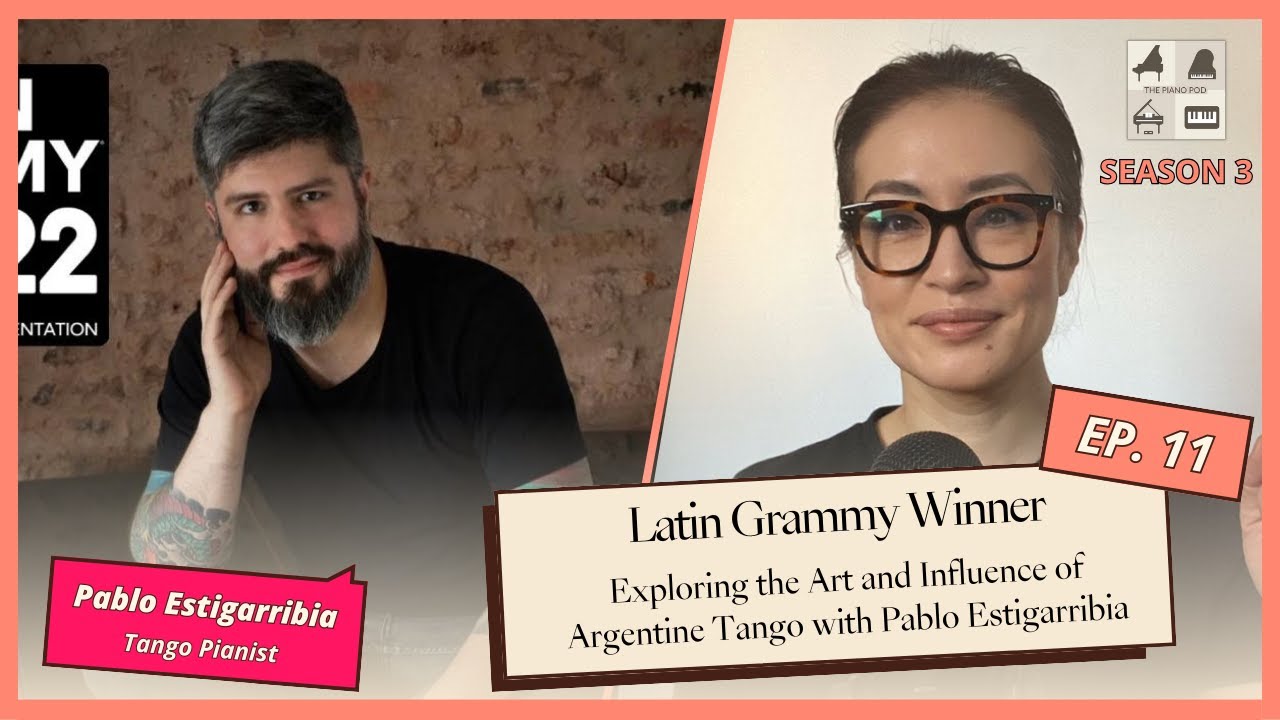
This content was created by The Piano Pod with Yukimi Song. This content was uploaded by The Piano Pod with Yukimi Song. This is a YouTube podcast episode (Season 3, Episode 11) of The Piano Pod with Yukimi Song, published January 25, 2023. It is an interview-style conversation in English: host Yukimi Song (The Piano Pod) interviews Pablo Estigarribia, a tango pianist, arranger, composer and 2022/23 Latin Grammy Award winner (Horacio Salgán Piano Transcriptions). The discussion covers Pablo’s musical background and training in Buenos Aires, his shift from classical and jazz into tango, the transcription/research project and album honoring Horacio Salgán, his recordings and collaborations (including albums Tangos para Piano and María y Pablo), teaching and outreach, stylistic features of Argentine tango (rhythm, phrasing, piano technique), and upcoming projects such as a tango concerto premiere. Metadata: title 'Season 3 Episode 11: Pablo Estigarribia -- 2022 Latin Grammy Award Winner/Tango Pianist/Composer', content type YOUTUBE, created_time 2023-01-25T01:00:10Z.
Chapters
Welcome back to another episode of The Piano Pod with Yukimi Song. I am Yukimi Song, and today I am solo. Yep, Clara is not going to be with us with this episode, and she has a lot of exciting projects coming up and decided to take a little hiatus from podcasting. So Clara fans, don't worry, she'll be back very soon, and please follow her on social media for now, and her accounts are listed in the description. So for anyone listening or watching The Piano Pod with Yukimi Song with Yukimi Song for the first time, welcome. I'm a classical pianist and educator from New York City, and this podcast is for anyone who plays the piano for fun, loves listening to piano music, or for someone who is currently pursuing a career in piano, works in the industry professionally. Each episode, we interview a guest speaker who has been breaking exciting new ground in the music industry Before getting started, we want to thank our amazing fans and listeners for tuning in, and please rate my show and review it on Apple Podcasts because every rating review will help people find the show. So today, oh, get this, this is really good, the Latin Grammy Award winner as our guest speaker. Yay! I can't believe it. Do you remember, uh, Claudio Constantini? He was our guest last season, and he's the, you know, Peruvian concert pianist and then also bandoneonist from Spain. Actually, he lives in Spain. So he texted me and I should be in touch with this new guest. So let me introduce. His name is Mr. Pablo Estigarrilla, tango pianist, arranger, and composer. His latest album, Horacio Salgán Piano Transcriptions, won the 23rd Latin Grammy Award in the Tango Album category. I am so excited. I really can't wait to interview him and hear Pablo's incredible journey to achieve such a milestone as a musician, to, you know, become the Latin Grammy Award winner at such a young age. So let's get the show started. You are listening to The Piano Pod with Yukimi Song, where we talk to the brightest minds in the industry about how they are bringing the piano into the 21st century. The Piano Pod with Yukimi Song with Mr. Pablo Estegarribia. The Piano Pod with Yukimi Song with Mr. Pablo Estegarribia, Latin Grammy Award-winning tango pianist, arranger, and composer. He began his training as a classical pianist and studied at the National Conservatory in Buenos Aires and performed on prominent concert stages in Argentina, collaborated with the Congress Chamber Orchestra, the National Radio Orchestra, among many others. Seeking to broaden his musical horizons beyond the classical realm, Mr. Estegarribia took a brief detour through jazz, where he ended up discovering tango in 2005. He rapidly established his reputation as a nuanced and masterful tango performer and recording artist all over the world. His album Tangos para Piano won the prestigious 2015 Gardel Prize for Best Tango Album by the New Artists Soon after, he had the opportunity to perform in one of the most iconic jazz venues, Blue Note Jazz Club in New York City. Mr. Escalivia is also a dedicated educator. He is a recipient of the Argentine Tango Society's Medal of Honor for his educational initiatives at the Stowe Tango Music Festival for multiple years. He aims to share the beauty of tango's rich lineage and reopen the passage of tango repertoire with new generations of musicians through his composition, teaching, and performances. So, Pablo, welcome to The Piano Pod. Thank you for being here today. Yay!
Thank you so much for having me, Yukimi. It's my pleasure.
Thank you. And big shout out to Claudio Constantini, who is your friend and concert pianist, bandoneonist. And actually, he was on my show, this show, in last season, and he messaged me toward the end of last year and told me I should reach out to you for a possible interview. You, so here you are. I can't believe it, but thank you so much.
Well, I'll— hi, Claudio, thank you for recommending me. I'm very happy to be a part of this.
Thank you, and first of all, congratulations on your very recent huge achievement. You won the 23rd Latin Grammy Award with your latest album, Horacio Salgán Piano Transcriptions, which was awarded with the highest recognition, the Best Tango Album of the Year. Wow, that's a big deal.
It was a big one. Yes, yes, I actually, um, I'm very humbled by the award, and I, I honestly didn't, didn't expect it to go that way, but you know what, I'll take it.
Of course. Yes, it's great. Now, did you actually attend the award show?
I did not. I was, I was actually teaching a tango workshop, in, um, Northeastern University of Illinois.
Okay, so you missed it.
I, I actually— I mean, I had a concert the day after in Chicago, so the people in the university told me that if I wanted to, I could risk it and go to the ceremony and then take, take a flight, you know, just arrive the same day and play. And I thought about the blizzards and all that. I mean, I lived in New York for 3 and a half years, so I know about that. And I thought, you know, I don't want to risk it just to go to the ceremony. And I thought to myself, I'm not going to win anyway.
Yeah, wow. And then you won. And I mean, even just being nominated by the, you know, Latin Grammys is an honorable thing. So when you received the news of your, first of all, nomination, Where were you and how was it like?
Oh, it was, it was pretty amazing because, I mean, the, the project that I presented to the, to the Grammy Awards in 2022, it's actually kind of like, um, is like an educational project really, and it's all piano solo, right? So it's, it's not really commercial-oriented, you know what I mean? It's— it was more like, okay, I want— I think this guy was one of the greatest gems in, in tango piano that we have, and there's not a lot of scores available, so I'm gonna make them available. And, um, a collector friend of mine sent me an unofficial recording of him playing his only piano solo concert that he ever did. He died at 100 years old. He just did one, and this guy had footage of that, unofficial footage, and I just transcribed all the concert because, I mean, it's amazing. It's a treasure. So I thought it was very important to transcribe this concert for this music to be played all over the world, you know. It's—
right, right.
It's amazing music and it should be shared by all people. And the thing is that when I finished all the transcriptions and some of the log notes, because it's kind of like a research, you know, I actually— the book doesn't only have, you know, the transcriptions per se. It also has some data that I was recollecting how many times he recorded this. Sometimes the recording was not great, so I had to patch from other recordings that I got from other collectors. I mean, it took a long time, but I think it arrived to a good result. And my main goal was the pianists all over the world to be able to access this music. Then when I was going to release the book, I have a a lot of students— I teach mainly online, and I have a lot of students in the US because I used to live there— and everybody was saying, hey, but you need to release a CD as well, you know, to match the book, just to have, you know, the, the whole package. And since the recordings I was working with were not official, I couldn't— I, I wasn't able to release those for cover right reasons, so I had to record it myself. And that's how this album came to life.
Yeah, it's like academic research.
Yeah, actually the book is not notated as a, as it, like a regular, you know, your songbook. It's, it's, you know, I try to make an introduction, explain what, what the song means, when was it recorded, you know, and all that. I, I I thought about a document, you know, when I was writing the book, you know, like a history book. You know, you go to Mozart and you have a lot of materials, and then you go to tango and there's not a lot. So, and actually it goes back to when I fell in love with tango. I was born in Argentina and raised in Buenos Aires, and, you know, tango You could hear tango in the city, and I don't like it at all.
Oh, really?
When I was younger, it was kind of like old people's music, and it was harmonically very simple. And I was very much into jazz. I was with Chick Corea or Herbie Hancock, Keith Jarrett, and all that. So the music seems harmonically simpler. And I didn't like it until someone just gave me for my birthday, I think, a CD of Horacio Salgán. And he had an amazing, you know, harmonic conception of tango. You know, it was very forward thinking with all, you know, with all the way. He actually took a lot of harmonies from Ravel from, you know, and came up with with something that it's definitely tango because all of the, uh, defining elements of tango are there, but it's still so innovative and, and new. And, uh, and he was a, he, he was a pianist, right, Horacio?
Mr. Salgán?
Yeah, yeah, he's, uh, he was actually, of course, classically trained. And he had, he had the same maestro than Martha Argerich. They, they went to the same guy.
Wow, you know, there are a few clips available on YouTube. Like, I think it was toward the end of his life, and, you know, he's playing, performing with other instruments as well. The way he's playing reminded me of, in many ways, Vladimir Horowitz.
Right, right, right. Yeah, he definitely has classical influence. He actually recorded some classical pieces. That are on, on Spotify. I mean, he, he had a piano duo at some point with Dante Amicarelli, who was Piazzolla's pianist, and they recorded Mendelssohn's Midnight Summer Dream. Is that—
yeah, yeah, yeah.
And Ave Maria by Schubert and, and some, some other stuff.
It all goes back to Mr. Horacio Salgán for you because, um, that's how you really won the Latin Grammy Award. I know just a few, you know, tango artists. Unfortunately, I need to study more. You know, for example, of course, Piazzolla is the big name. And then so, but I knew of Mr. Horacio Salgán, and particularly I love Don Agustín Bardi, which is like a really iconic piece, and the Independiente Club. And especially your transcriptions, and I really love it. And I can't wait to purchase your transcription, your music from your website, and then try it out. So when you transcribe all this music, are you really faithful, try to be faithful from your, from Sagan's compositions, or are you adding a little bit more? Like to make it like—
actually, uh, well, this, this is the thing. Transcription in Spanish doesn't mean exactly the same that in English. Um, when you change something, it's not a transcription anymore. Transcription means like taking dictation for us, you know. Uh, if, if you change something, that would be an arrangement. So, um, what I did in this book is just take whatever arrangements he did on, on some of the tunes and transcribe them literally into paper so you can play exactly what he played. That, that was my intention.
Okay. And then all these pieces are only written originally for piano or written for piano plus other instruments? And then you transcribed to solo, as a solo piano piece?
No, no, no, no, no. This, as I was saying before, this is the— this was transcribed from an unofficial recording of Horacio Salgán playing a piano solo recital, which was a very special occasion because he never did that in his life. Okay. I thought it was special and, you know, it needed to be you know, decoded into a book.
I understand. Thank you for clarifying. With this highest point of your career right now, and it still continues to grow as young as you are, and there's of course always the humble beginning. So firstly, just a few minutes ago you mentioned that you hated tango, so obviously you started as a classical pianist. But how did you discover the love for music at the beginning? Were you from a musical family? And also, we're— I'm curious. Yeah. Oh, really? Tell me. Yeah, yeah.
My mom is a cellist. She's a cello teacher at the conservatory, at the Buenos Aires Conservatory. And my dad is an engineer, but he plays piano, he plays bass, and he loves jazz. So there was always music in my house.
Wow, how nice. And then like, tell me more about your training and teachers. And, you know, you started as a classical piano student and became— I think you also have some extensive classical concert careers as well before 2005. I think I saw your bio that— yeah, so can you tell me more?
Yeah, so I started being my mom's student. I started playing piano when I was 5. And, uh, she got tired of teaching his son by when I was 8, so I joined the conservatory when I was 8. And, um, I started, of course, you know, classical music training, um, when I was 8. And then that went on and on. And, uh, I had a private teacher as well here in Buenos Aires who was amazing. He helped me a lot. And when I was a teenager, like 15-ish, I started just feeling that I wanted to be a part of the jazz world. I went to the jam sessions, you know, every, you know, it was like a big smoky place with everybody drink whiskey, you know. And I said, okay, I want to be part of this. Let's see how it goes. It was very difficult at the beginning because, you know, nobody teaches you how to improvise or harmony with that color, you know, in the conservatory. So I started just digging on my own. Fortunately, I spoke English, so I was able to read some books on jazz training in English, and I started just playing a little bit in the jam sessions, just little by little, just, you know, trying to improvise. I, I never became a professional in this, but it's something that I, I really enjoy. When I was about 16, or around the same age, I started, um, tango lessons, but as a dancer.
Oh, you did? Yeah, yeah, yeah.
That I actually— that's how I started just listening more often to tango music, because that I, I was, I was going in, in my high school, there was, um, how do you call it, extracurricular? Yeah, yeah, yeah, yeah, yeah, extracurricular activity. There was tango lessons, and I thought it was cool, so I just went there. It was a great way to meet people, and, you know, everybody's so nice, so I started dancing there, but I didn't like the music. I actually kind of You know, it wasn't my thing.
Okay.
No, even the audio is really old. You know, people dance to music from 1930, 1920, so the, the audio is all grainy and old, you know. But that was really interesting. And then when I, when I came across Sagan's music, I started playing tango. I joined, uh, on what, what it's called, the Orchestra Tango School. It's just they form an orquesta típica, which is like a rather large ensemble of tango, you know, like 4 or 5 violins, viola, cello, 4 or 5 bandoneons, bass, and piano. This is like the equivalent, the tango equivalent of the big band of the '40s in jazz. We had a lot of amazing maestros there teaching us and all that. Until that point, I was still doing my classical music thing. I actually won a national competition here. I started, you know, going on tour playing Rachmaninoff, Chopin.
Did you enjoy that part of you? Like, enjoy the career as a classical concert pianist part of you?
Well, for me, it started being a little too much. To be honest. I was overstressed all the time. I was, you know, I was having anxiety attacks and all that. And that's when I realized maybe this is not for me. And tango, aside of that I started really loving the music, was a quite different way of approaching performance. You know, it was more relaxed. You usually played in groups. The environments of the concerts were not usually like very solemn theaters, but were more like bars and grills and all that. And I started really liking that. I found myself like having a better time in that context. So tango started just, you know, feeling right. And I remember 2008, I was, uh, I won a scholarship to go to Brazil to a chamber music festival. Where there was, there was amazing teachers. I don't know, the— there was Kurt Mazur, actually. Yeah, it was, it was, it was amazing. You know, Brazil had such great music training initiatives. And, um, I had a teacher, Oksana. She was from the Saint Petersburg Conservatory, and she was training me and all that. And of course you know, we were living in, you know, at the country, you know, at a kind of a retreat of some sort. Of course, I was practicing, but I was playing tango at some point because I really liked it. And the teacher heard me and she told me, like, I think it's great what you're doing, whatever, but you have to make a choice, like, right now. Like, you wanna— if you wanna be like a a good tango pianist, you need to go to Buenos Aires, you need to get your training from the people that really know how to do this and all that. If you want to be a classical musician, I'll get you a scholarship to, to go to Saint Petersburg and you can become a proper classical pianist, right? But you need to choose. You're growing up. When she said that to me so clearly and I started thinking about what my life would be in 10 years from that moment, I realized that I would like more my life as a tango pianist. So that's what I did.
And it blossomed and flourished, and you really quickly built your reputation as a tango pianist internationally. You know, as you mentioned, as a tango pianist, you don't have to do it on your own. You have the group of other musicians to do. It's not even the concerto. Piano concerto is your solo and then the orchestra behind you, but—
Piano concerto is scary.
Yeah, yeah, yeah. Although you mentioned that we're going to talk later, but you wrote piano concerto, but the tango music, right? You wrote, but so now I see some albums you collaborated with other musicians and obviously you have your solo pieces. So can you tell a few? Fun anecdotes maybe with working with other musicians?
My first New York collaboration comes to mind. I was just nearly moved to New York and I get a message from a guy called Achilles Liarmakopoulos. He says that, "Hey man, I heard that you're in town. I would love to meet you and maybe record something with you, whatever." I say, "Oh, that's great." What do you play? And he said, I play the trombone. Trombone, really? You play tango? And he says, yes, I actually recorded a CD on the Naxos label that it's, you know, Piazzolla songs with bandoneon and trombone.
Okay.
And when I heard him play, it was like, this guy can really play. Who are you? And he was a trombonist of the Canadian Brass. Wow, you're interested in recording with me? I'm interested in recording with you. Let's do something. Let's make it happen. And, uh, he asked me to, to compose some pieces for trombone and piano, and, and, and I did, and we recorded it. It's, it's on Spotify. It's called Tango y Milonga for Trombone and Piano. And well, you gotta hear this guy. He's, he's amazing.
This episode is presented in collaboration with our good friends at Forte, a free alternative to Zoom purpose-built for music teachers. I'm happy to announce that Forte will always be free for music teachers, no strings attached. Forte offers features optimized for classical music lessons, including audio quality far superior to existing platforms and allowing you to hear every nuance of your students' instruments. Their colleagues at the Royal College of Music ASPE Music Festival, Curtis Institute, and Berklee College of Music have even used Forte in their own programs. Forte's mission is to radically expand access to high-quality music education worldwide. Forte always puts teachers and their students first. This means you can use Forte with your own students for free forever, and Forte will soon introduce paid features allowing you to connect with new students around the world. So sign up for free today at fortelessons.com. That's F-O-R-T-E-L-E-S-S-O-N-S dot com, or click the link in the description. Let's continue with the episode. How long ago was it that you lived in New York?
Well, just before pandemic. I actually— what happened to me is that I was supposed to go back to New York on March 24th, 2020. So that didn't happen. Of course, and I stayed here and I found my partner, so now she lives here. So I kind of come and go. I, you know, I, I'm— I travel a fair amount to San Francisco and New York, and I'm traveling about 4 months a year, and then I come back.
Okay. And, um, do you have any plans to perform in New York? Or in the United States anytime soon?
Yeah, well, I'm gonna premiere my concerto, my tango concerto, in the Kennedy Center in D.C. Oh, wow! In October.
Really? That is so fantastic. Wow. And then I know you just wrote this extensive work of concerto recently, right? Right.
Yeah, yeah. I'm, you know, I'm embracing composition as a way of life as well. And I really like it. You know, it's like, it's a totally different feeling when you're playing something that you wrote.
Of course.
When you're interpreting something that somebody else did.
Um, yeah, especially training coming from classical music and you have the performance career of classic— as a classical musicians, one of the reasons we sort of face this, I don't know, wall, or maybe sometimes it comes with the different shapes and sizes, but, um, anxiety or whatever, because it's— you have to sort of strictly follow the notes and present the piece of work, and it needs to be perfect.
I am not perfect.
I am not either. But the thing is, then when it comes to your composition and also even the transcription, it's the process of creativity, and that you feel like you are Don't you feel like you're contributing something when you do your creative work to the society?
That's one of the things that I thought when I decided to become a tango pianist. I felt like I had something in my hands that I could really make a difference because there was not many people, you know, with the information that I had and the, you know, the skills that I had to do something about it. And then just take these skills and, I don't know, record Beethoven sonatas will not be as useful for, you know, for music as me dedicating my time to tango, which was a very unknown and kind of secret music genre for the rest of the world. So I felt, I guess I felt more useful in that regard.
And then being able to use your creativity.
I mean, I started doing arrangements. I found myself writing music, and just, you know, it's really great to play music you wrote because it's tailor-made for you. It's like, it seems like you play better.
Arrange your pieces or compose your pieces instead of, you know, performing the pieces written by someone from 200 years ago and then following every single note faithfully. It's two different things.
Yeah, yeah. I always liked that freedom of, you know, change stuff when I was playing. Tango is kind of like a middle ground between jazz and classical music because you get a score and you get most of the things that you need to play on the score, but there is a lot of articulations that you can— that you need to figure out yourself. Also, if you've got a solo, sometimes you just get the melody line and you have to come up with something. And if you're playing, um, let's say a little solo intervention, you're allowed to change it as long as it matches the harmony of the rest of the arrangement. So, wow, it's not like jazz where you, you can just, you know, solo for a couple of minutes. Maybe you have 8 bars to do that, but you can. And it's, it's like easier to, to say, hey, this is my voice. I use, I don't know, this type of chords. I use this type of runs, you know. And it's, it's, I mean, it felt good for me.
And then do you improvise on the spot meaning, you know, of course you practice, rehearse with other musicians, but when on the stage, those 8 bars given, is it different each time?
I'm starting to try that nowadays. Till now, what I do is I figure out whatever I want to say, I write it down, I play the same every time.
But that's really fun, being able to improvise. And improvisation is not something that really strongly recommended or taught when you're going through conservatory. And now, yeah, I feel like, wow, I want to try more of the improvisation now. So you lived in New York. Can you tell me about the Blue Note Club, a jazz club? That's a really iconic place. Yeah. Tell me.
I was actually playing there with a Japanese violinist.
Oh, violinist.
Machiko Ozawa. She's a tango violinist. She used to live in New York. I think she's back in Tokyo now, or in Paris. I don't know. I meet her in random cities around the world. She's great. The thing is that when I went to New York, there wasn't many tango pianists, you know, in the city. So I got a few very interesting calls really quickly, and one of these was you know, uh, Machiko saying that she had a show in the Blue Note and she needed a tango pianist to, to play with her. And I said, yeah, I'll be there, you know.
Right, right.
That, that was about like 6 months after I landed in New York.
Oh my goodness, what an opportunity.
It was, it was amazing. It was amazing. I, I, I would look at the pictures of me playing in the same piano that, I don't know, Chick Corea and Michel Camilo played and said, wow, this is This is amazing.
Then you also, you are obviously amazing recording artist. And then I was listening to Tangos para Piano, which also the award-winning album, I think.
Yeah, that was my first award ever.
Hmm. And are they your arrangements or?
Yeah, those are all my arrangements. And there's actually a few pieces that I composed as well. And that— the story of that album goes as that I came from classical music, so I had a lot of friends in classical music and a lot of Argentine tango players— Argentine piano players that wanted to play tango. And since they didn't know how to, they didn't have the scores, because scores in tango is also kind of tricky. It's not easy to get a proper score, you know, well-written and ready-to-play score, right? So that's how I came up with my first book, which is Tango de Concierto. It's like a virtuosic, like, concerto version of some traditional tangos. Or I was thinking about a good encore for a classical pianist, you know, where you can play it after Scriabin and it sounds complex enough. You know, to be played right after that.
And, you know, so the arrangements I heard with the Tangos para Piano, some of them are very impressionistic, like Debussy style. And then some—
Yeah.
And then some of them are like Liszt, Franz Liszt style. Like, for example, I love the Lo que vendrá. Am I pronouncing correctly? Yeah. Yeah.
Lo que vendrá. That's a solo song.
Right, right. Amazing piece of music. And then you did it in such a way that the opening is like a Liszt. Yeah, yeah, a lot of octaves and chords. Yeah, yeah, I love it. And then some of them, uh, like, uh, Chapado à la Antiga. And then, oh, this is the iconic one, you know, everybody knows this piece, La Camparsita.
Yeah, yeah, yeah.
Are they four hands? Right? Four Hands?
Those are two pianos that I overdubbed myself.
Oh, two pianos. Makes sense.
I had an orchestra arrangement and I want to record it. So I played the piano part and after that I recorded a reduction of the orchestra on top of that.
Really? That's awesome. I loved it. So, you know, especially the La Campesita, I hope I'm pronouncing correctly. Super iconic and everybody knows, bum bum, bim bum, you know.
Yeah, it's kind of the tango anthem.
Yeah, but it was— the main theme was so subtle, almost you can't recognize, but you can recognize when you listen to the harmonies, but that was really, really, really well done. Wow, I love them.
I'm really happy with that. I mean, there's a thing with La Cumparsita here, especially after Piazzolla, that the song is so well known that you're free to just put it somewhere and it's good, you know? It doesn't have to be as obvious as it was in the 1940s.
And then this is also— this entire album is also available as score, or no?
Actually, yes. There's, there's many of the songs of Tangos para Piano that is— that are included in the book Tangos de Concierto. That's a great one.
Got it. Oh, wonderful. So is the Piazzolla's Loche Vendrá, is it in—
Ah, yeah, yeah, it's there.
Wow, because I would love to try that transcription.
There you go.
I also want to talk about this, um, album, María y Pablo. So she is a tango, I guess, singer.
Oh yeah, she's the best. Her name is María Graña. She's one of the iconic female singers here in Argentina. And, uh, we started working together, uh, as a piano singing duo. And, uh, you know, people started asking if we were intending to record anything, and we really didn't because there was no label for that. You know, it's kind of like a very niche thing, you know, like piano and singing tango. It's kind of like, like very niche. So I produced it.
You produced it?
Yeah. If you're— I told her, if you're willing to record with me, I'll produce it, you know, I'll do it. And, uh, yeah, I came up with these arrangements.
You came up with the arrangements also?
Yeah. And are these all like traditional tango pieces, songs, or Most of them are traditional tango pieces. She actually was kind enough to record a song I wrote. So that was a pretty nice one for me. She recorded a version of La Cumparsita also.
Oh, I have to listen to it. Yeah.
There's a singing version of that.
She has such a soulful vocal quality. Like, it makes me cry, makes me want to cry. You know?
Yeah, me too. It's— it's— she's very moving. Yeah, I don't know. One of the most difficult things of playing with her is like not— I mean, just being connected to her so we can play together, but not too connected so you don't— it doesn't move you in the way that you cannot play anymore, you know? You started sobbing, you know? It's like you can't do that.
Yeah, I love that. I, I love it.
It was— it's funny you should mention when, when, when we play it live I always notice that, you know, the first row, everybody crying. Oh, always.
I bet. I mean, just by listening from Spotify made me cry, so I can't— yeah, I can't imagine what it's like to be, uh, as a live audience, you know, listening to him.
He's very soulful.
So then we talked about a lot of, you know, your pieces and your compositions, so Let's talk about tango. And I know the basic information of tango, and as in a little bit of history, you know, tango music was born around early 1900s, and now tango music became more like, you know, you see it in the pop culture as well, where, you know, Hollywood movie uses tango music in certain scenes, obviously the famous ones like Scent of a Woman, Moulin Rouge, you know, the Shall We Dance, that kind of thing, right? So I also watched your little bit of YouTube clips where you're teaching. I think you maybe you recorded during the lockdown or something, but you were explaining about what makes tango tango. So you are defining the expressions and rhythms and So, and then I also took a little bit of ballroom dancing. Oh, that's cool. It was a joke. I'm not good at it. But one of my favorite dances obviously was tango. And another one is cha-cha. There are two very different ones. But the tango teacher told me tango step is T-A-N-G-O. That's how you remember. That's the basic rhythm. I was like, okay. But can you tell us about what, what defines tango music?
First of all, I, I should say that I'm— I, I play Argentine tango, which is different than— there's different types of tango all over the world. Uh, for instance, there's the Finnish tango, there's a Brazilian tango, there's flamenco tango. Oh, that's true. Um, there's ballroom tango, which is not the same music that we use for our Argentine, you know.
Got it.
Um, so what, what I can say is about, you know, traditional Argentine tango, that, that's, that's what I, that's what I do. Well, our Argentine tango has mainly, I don't know, just 2 or 3 characteristics that made it pretty unique. Uh, first of all, there's not a lot of syncopations going on, you know. When you, when you think about Latin American music, like, I don't know, salsa, son, you know, whatever, all the bass, all the bass, and I go, so you— they never go on the beat. Tango is exactly the opposite. It's like, it's always down to earth, you know.
Wow.
Um, of course we use simple meters, so There's no swing, you know, there's da da da da da da da. No, there's always like two, da da da da da, it's more like that. Something that is really interesting about tango and that it makes it difficult to play in a way is that, you know, compared to all other Latin American music, it has one characteristic that makes it unique and is that we don't have percussion instruments or drums in our traditional ensembles.
That's right.
It kind of— that has some ramifications that really make, you know, this basic characteristics of tango. Number one, when you, um, you know, tango has mainly rhythmic parts and expressive parts, but when you are in an expressive part, you can do rubato, which you don't do in salsa, or, you know, it's all about the beat and the percussion. Then you can also spot in the tango singers. Tango singers never sing on time. There is no such a thing as, I don't know, you think about, I don't know, something like, "La vida te da sorpresas, sorpresas te da la vida, ay Dios." So that's very in rhythm. If you're ta-ta-ta, ta-ta-ta, ta-ta-ta, You could write it down very easily as a rhythm. In tango, that's not the case because the singer kind of mixes, uh, like spoken phrasing when they're singing. Nobody would sing, uh, primero hay que saber sufrir, después amar, después— that's not how you do tango. You do 3, 4. Después hay que saber sufrir, después amar, después partir, y al final— See that? I'm going around, I'm going around it.
Interesting.
So there is something about time that's different in tango, especially in expressive parts, than when you're playing rhythmic parts of the tango. Um, there is, you know, for string instruments, there's a lot of extended techniques to actually make them sound as percussive instruments. You know, there's a lot of tapping on the, on the, you know, on different parts of the instrument to get, you know, percussive sounds. There is, um, there's using, you know, the, the bow of the violin behind the bridge so you can, you know, that they have different Oh yeah, yeah, yeah, yes, yes, yes.
Well, that, that's the Argentinian, uh, tango. That what— that's what makes this genre unique.
Yeah, yeah, it has its own language, right? And even piano is played in a different way.
Oh, how so? Tell me.
Well, it's played as a lot more percussive than, than than classical music or jazz even. We use a lot of— I used to teach a lot of gravity involvement. Actually, when I used to do classical music, I stayed closer to the keyboard. When I play tango, I allow myself to just have a little more range to just So the free fall is, it's a little bit more rhythmic, you know. And also, you know, the inner beat has to be spotless because The Piano Pod, usually, you know, left hand of the piano is the walking bass and is duplicated by the bass, by the contrabass. So you are the metronome of the orchestra. I mean, it's, it's, it's got to be right there and it's We don't have percussion instruments, but rhythm is very important because there's, there's dancing involved. Of course, there's a whole thing there that I think is very interesting, and it really— I found out that it really helps to play classical music as well.
Hmm, tell me, tell me more.
To me, it goes both ways. Like, when, when you play tango, your, your inner beat gets a lot better. And the fact that you cannot move the beat in certain situations that in classical music you do, it kind of forces you to phrase with dynamics, touch, and other stuff other than tempo.
Tempo, right? Yeah, I see. Right, right, right. We tend to do rubato, we tend to do, you know, alla grande to make expressive, but yeah, right.
It kind of makes you more conscious on when are you using rubato and where you're not. It's not like there's not like a rubato default, because otherwise you, you couldn't play with others.
Of course, right, right. Interesting. Yeah. So how can I play tango? Well, I mean, you explain everything, but I just don't know what, what to do, like where to start.
Well, um, there is, there is some, uh, I mean, I, I would recommend getting tutoring, but also I, uh, I released one book called Tango for Intermediates that is to kind of design— it has some etudes to practice certain stuff that you will use, you know, when you play tango arrangements and such. That's also my website.
Yeah. Yes.
And I'm going to release a second book of arrangements for intermediate-advanced this year. Oh, because I, um, that, that's a big part of my life right now. I'm, I'm half-time, uh, an online teacher, half-time a performer.
How do you like teaching?
I love it. I love it. And I think especially when it comes to teaching tango, it's very important. I think there's a lot of people that feel very good playing this music. And, um, and there's not a lot of people that can teach this, this type of, you know, of course, uh, because I mean, simply that there was not like an academicization of it, you know, like in jazz, for instance, you have thousands of books on how to play jazz. You have universities of jazz all over the world. That didn't happen with tango. So you, you do have a university that has tango career here in Buenos Aires, but I think it's the only one. There might be another tango bachelor— no, not bachelor, but I think tango masters in Holland, and that's it.
Well, then you're the person to really go to, right? You're the go-to person, but also there's so much potential to grow because, you know, I've been interviewing a lot of guests and, you know, especially in the United States, what happened during the pandemic was the music, classical music world has changed tremendously. We are using more inclusive literature and we are encouraged to perform more unknown composers, composers of color, for example. And so in so many ways, I think I want to include in my own repertoire a few Argentine tango music if I can play, or I want to introduce my students how to play tango, not just limited to the regular go-to guys, and they're great, but why don't I play something different, some different, by unknown composers, right? So I think—
yeah, and I think, uh, different genres have had different skills to offer, you know. I, I definitely learned— I, I, I'm still using skills from every genre I play, you know. Classical music gave me, uh, technique to, to, you know, to face difficult passages. Taught me about how to look for sound, you know, just how Debussy is different than Bartók or Mozart and so on. Then when I was playing jazz, jazz taught me that if you forget something, you can invent it on spot. You should relax, you know, and it gives you all of this concept about the now, that the now, you know, how music is, is happening right now and how should you approach, uh, certain aspects of it, you know, especially for live performance. Uh, improvising jazz to me is life-changing because it gives you a type of freedom, you know, and confidence, you know.
Oh, I bet. I tried, I tried a little bit, but jazz was so hard for me.
Yeah, well, it's, it's, it's kind of like a different skill, right? It's, it's like, uh, I wouldn't think that because, uh, you know, someone plays classical music necessarily you, you can play jazz. I mean, it's like, is it— of course you have a huge advantage, which is that technically you have no problem, but I think it's interesting. The thing is that it takes patience, you know, it, you know, it's something that you need to do every day. It's like learning a new language, right?
Right.
You know, it's like you need to, you know, but even a small little thing, you know, like learning one scale and just playing, play the blues scale on, on a 1-4-1-5-4-1 structure. That's all. It's about a feeling in your body that, okay, I can play whatever, and if I don't have any idea, I can stop for a while until I get something. And, uh, it's like talking, right, right, right, right. And when you're a classical musician, it's like, oh, you know, I, I, I remember being, you know, before a show and say, oh, I, I can't forget this. What was this note? And just opens it. Okay, yeah, that's Okay, how about this piece? This piece had this coda and then it repeats how many times, it's, you know.
Yeah.
Um, and it's very stressful. And then you see, you know, I remember the first time I, I got really caught by jazz. I mean that not the music, but, but the, you know, a live show. It's like, these guys are smiling, you guys are relaxed. These guys are having a beer, right?
That's impossible when you're playing classical.
I, I might enjoy that, you know. Yeah, yeah, yeah, you know, it looks great.
Yeah, right. Yeah, um, absolutely. Yeah.
And yeah, I was used to, you know, the, the classical music competitions when everybody has, you know, the pack of ice just to, you know, and warmth, and everybody's nervous, you know, you put your hands in water and then you, you know, you do the exercises. But in jazz it's not like that. They don't care.
Hey, I'm in the wrong, wrong industry then.
Um, I think, I mean, I found the balance at some point because, for instance, I, I really enjoy solo piano recitals where I do tango, which is not frequent at all, you know. Uh, tango pianists usually don't do solo recitals, right?
Yeah, absolutely. Yeah.
But it's more like a classical music thing. But I found, you know, the—
right, you marry the two, tango tradition and classical. That is so cool. Then do you like, do you give master classes based on like, uh, you know, introducing tango literature or how to play tango better? Do you do any of that?
Yeah, yeah, I actually, uh, do master classes workshops. Uh, I did— well, I was telling you, I did one in the Northeastern University of Illinois. I did one in San Francisco Conservatory. Um, yeah, I, I, I, I am faculty in the So Tango Music Festival, which is a festival for musicians. Um, they come from all over the states, and it's, it's very amazing.
Does it happen in Argentina? Buenos Aires? The festival?
No, no, it's in Stouffermont.
Oh, oh yeah, yeah, yeah, I saw it. Yes, got it.
Um, so yeah, it's— I'm, I'm very committed to, to teaching and actually have like 20 private students as well that I teach online. And, uh, yeah, I, I, you know, I always am trying to put you know, new stuff out there for people to, to learn more effectively or enjoy some pieces. Actually, what I'm doing right now is, um, to teach the accompaniment, the accompanying role, and the, you know, the, the solo role of the piano in an ensemble. Of course, it's very difficult to find bandoneonists and tango bassists in, in the U.S., so what I do is I put together two piano workshops. So kind of what I did in La Cumparsita, that I have the piano part played by someone and then a reduction of the orchestral part by another person. I do that with students.
Wow, cool.
So they, you know, they, they can accompany and lead and then swap, and it's a good experience.
Wow. And then do you like are they geared toward more advanced piano students, advanced pianists, or intermediate, or?
I have some beginners, I have intermediate, and I have advanced. I have actually a couple of students that are piano teachers. You know, they have their own studio and they want to learn how to play the tango style, you know, where I don't focus on technique with them. I just focus on tango extended techniques and stylistic aspects of the music. Then I have intermediates where I still teach some classical music to get more technical tools to, you know, to be able to approach the most difficult tango pieces. And then I have beginners where I teach some— I teach classical music for technique, I teach easy jazz pieces to make them improvise just a little bit, you know, just for them to get the feel of it. And then I teach tango as well. I have to write my own arrangement because there's no beginner tango book there yet.
In relating to you as a teacher, so any advice for young musicians?
Yeah, don't limit yourself to one genre. I mean, if, if you find something interesting, go for it. And, uh, find someone that— I mean, today is really easy, you, you know, with Zoom as a tool, you can take lessons with anybody around the world, you know. Just find someone that you like how, how he performs or approaches whatever subject you're trying to to approach and just go for it.
This online format of teaching, it gave us a lot of opportunities to meet a lot. Yeah. So then what's next for Mr. Pablo Escobilla after achieving so many, you know, so much already, so young? What's next?
Well, vacation, that's for one. No, I'm— well, I, I was telling you, I, I'm I'm planning to release in April 2023 a second volume of this collection of tango for intermediates that I'm working on. Mm-hmm. Um, I am gonna premiere my concerto in the States. Uh, that's going to be in October in the— in the—
that's right, the Tango Piano Concerto, uh, 3 movements, all tango music.
Yeah, yeah, composed by yours truly. And, uh, then I'm gonna play it in the San Francisco Conservatory as well with a, with a community orchestra in San Francisco. And then I have my solo recitals that I would play in Portland, Oregon, San Francisco, uh, Vermont, probably New York.
Um, those are all tango music, your solo?
Yeah, I, I'm, I'm right now I'm 100% tango musician.
Okay, wow.
I still play some music for myself, but that's it.
Great. So for TPP fans, I would like for you to check out, you know, Pablo's Horatio Salgan piano transcriptions recording available on all music streaming services— iTunes, Spotify, Amazon, and more. And also For this, you can also get the scores of this Horacio Salgán piano transcriptions from your website, right, Pablo? Exactly. Yeah, pabloestigabedia.com, and of course all the links are below. And then also, if you— if my listeners want to listen to the Tango Piano Concerto in advance, is that available on YouTube? Or—
well, it's not on YouTube, uh, as a public video for copyright reasons, but if someone is particularly interested in hearing and watching the video, they can just follow me on Instagram, just, uh, send me a message and I will give you a private link.
Oh, great, wonderful. So now we are going to end our episode with rapid-fire questions. So, Pablo, I want— I'm going to ask some silly questions, and I would like for you to answer them as short as possible to each question. Okay? You don't have to explain, just say it. Okay? Are you ready?
I guess so.
All right, here we go. What is your comfort food?
Milanesa.
Cats or dogs?
None.
None? Okay. What is your word or words to live by?
Enjoy.
Good one. What is the most important quality you look for in other people?
Kindness.
Name 3 people who inspire you, living or dead.
Horacio Salgán, Bill Evans, and Rachmaninoff.
Great. Name one piece in your current playlist.
Rubber Glass for Black Radio.
Okay, that's interesting. I have to check it out. Now fill in the blank: Music is blank.
A way to know yourself.
Oh wow, that's beautiful. That's it, Pablo. Bing ding! That's the end of the rapid round.
Okay, yeah, I got nervous. I was like, oh, okay.
You did great. You did great. Okay, good. Wonderful. Okay, so this concludes this episode of The Piano Pod with Yukimi Song with Pablo Arredondo. Thank you, Pablo.
This was so nice. Thank you for having me.
No, thank you. Thank you for joining my show today and sharing your stories and insights and expertise. And you can find more information about Pablo through his website at pabloarredondo.com. Estigabili.com, and we want to encourage our audience to check out his Latin Grammy Award-winning album Horatio Sagan Piano Transcriptions on major music streaming services, plus the sheet music of all the pieces from the album is available to purchase from his website, and all the links are listed in the description. And thank you to our wonderful audience and fans for tuning in. If you enjoyed today's episode, please rate and review it on whatever podcasting platform you use. If you are watching us on YouTube, remember to hit the thumbs up button and subscribe to our channel. You can also find us on Facebook, Twitter, Instagram, and LinkedIn. The links are in the description below. And if you're interested in being the guest or recommending someone, or you, you'd like to sponsor and collaborate with us, shoot us an email at thepianopodnyc@gmail.com and send us a DM via social media. Well, I'll see you for the next episode of The Piano Pod with Yukimi Song with Pablo Arredondo. Thank you, Pablo, and bye everyone.
Thank you so much.
Thank you. Thank you so much.
Bye-bye.
More from The


Spirit, Body, and Soul: Pianist & Composer David Berry on Virtuosity, Creativity, and...



Season 6 Episode 20 | "Spirit, Body, and Soul" feat. David Berry, Concert Pianist & Composer


Beyond Borders: From Argentina to Poland to Texas—Oscar Macchioni reflects on a life in music

Sound Liberation: Joe Williams on Black Artistry, Legacy & Belonging in Concert Music


