Season 3 Episode 13: Krista Jadro -- Music Learning Theory & Audiation-based Learning Specialist
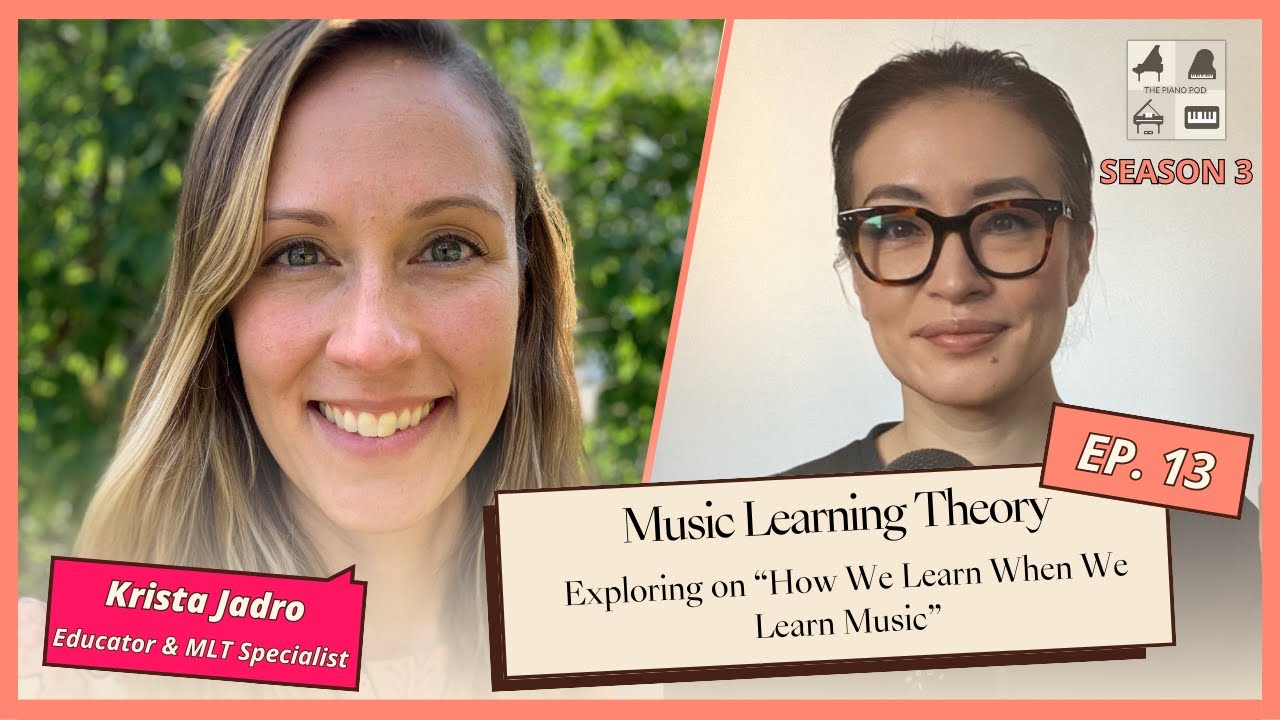
This content was created by The Piano Pod with Yukimi Song. This content was uploaded by The Piano Pod with Yukimi Song. This is a YouTube podcast episode (Season 3 Episode 13, published 2023-03-01) of The Piano Pod with Yukimi Song. The host (Yukimi Song) interviews Krista Yadrow, a Music Learning Theory (MLT) and audiation-based learning specialist and founder of Music Learning Academy, with Suliana Shelyashka joining as guest co‑host. The conversation explains MLT and audiation (definitions, 8 types and 6 stages), contrasts audiation-based vs. traditional piano teaching, and gives practical studio examples and activities (rhythm patterns, tonality work, improvisation, short-tune repertoire, transposition), plus references to resources and workshops.
Chapters
Yadadam bum badum bum bum!
Let's improvise and mix a little in—
Bum bum bum bum bum bum ba da da dum! Ba la la wa da da bah la lah! Bum bum bum bum bum bum bum! Bum bum bum dum dum dum dum dum! Bum bum bum bum bum bum ba da dum!
Hi Lucy, so we're going to improvise in Mixolydian. Can you show me the tonic? Can you show me the subtonic?
Excellent. Do, day, do, ready, play.
Welcome back to another episode of The Piano Pod with Yukimi Song. This episode is going to be all about how we learn music when we learn, and it's called Music Learning Theory developed by Dr. Edwin E. Gordon. Today you will hear a few terminologies unfamiliar to many of us, for example, audiation, sequencing, and of course the name of the theory itself, MLT, Music Learning Theory, is new to many of us. So today I invited a guest speaker Krista Yadrow, who is a music learning theory specialist and founder of Music Learning Academy. This is a big topic to discuss, and honestly, I needed a little help from someone knowledgeable in this topic as my co-host, so I decided to invite Suliana Shelyashka as a guest co-host and to assist me and cheer me on during the show. Suliana is a pianist, educator, and a music learning theory specialist from California. So welcome, Juliana, and thank you so much for being my co-host today.
Thank you for having me, Yukimi Song.
First of all, how you discovered music learning theory and audiation-based music teaching?
I would say the most brief answer I can give is that I was looking, browsing through some teaching groups on Facebook, and something caught my eye that talked about musical understanding and it was someone who was a music learning theory teacher at that time. And that's what led me to Krista, to discovering Krista, her group, her courses, and the whole thing.
So you were browsing through Facebook because you had some questions on your mind about teaching piano, right?
Yes. I had been teaching for many years and I always tell the story, even from the very first lesson I taught from you know, opening up the very first method book that I was using, I saw intuitively, I knew intuitively that some things were off. They seemed positioned in places where I felt were not appropriate for where the student was developmentally. So they were out of sequence, out of place, either rhythmically or it was a musical concept that just didn't fit. And over the years, that sort of proves itself because I kept getting that same problem. And then when I spoke to other teachers, they kept saying, oh yeah, this piece is one that always gives students trouble, or this or that concept in this or that method book. So it really gets you thinking, you know, are those method books following any sort of sequence at all? What is behind the design of those method books? And so I began to really question seriously about the way concepts were presented.
How long you've been studying music learning theory?
I would say seriously for about 3 years.
What was missing in traditional teaching? So after, you know, you've been studying for 3 years about music learning theory, and so what do you think is missing in traditional teaching according to you?
Sure.
So according to me, what I always wanted to see more of in my students is I wanted to see them have more music in their minds. Um, and I felt like I had to put music there and I constantly had to be the facilitator of that. And I just wished that the student would have been more of an initiator and that the student would be more a part of the, of their own learning, more in charge of their own learning. Have more autonomy. And I was looking for, you know, what is it that I don't know that can help me get to that place where I feel that my job would have more meaning and it would be more impactful to the student.
So how has it been? What sort of change have you seen in your piano studio since you started teaching piano using Odeation-based teaching?
Well, for once, I've had to do more lesson planning. And I think there are a lot of benefits in that for the student because there are very specific goals that we accomplish, meaning musicianship goals. But also it's allowed me to be very spontaneous in lessons. And I think students have really appreciated that aspect that they can— we could just go off of a creative thought that we have during a lesson and we can explore that thought for the rest of the lesson. And the lesson is less about the particular piece we're learning and more about the skills that the student is acquiring through the learning of the piece or through the learning of a skill like improvisation or arrangement, or like Chris is going to mention, we learn to do mashups and we learn to bridge from one piece to another. And they're short, specifically short pieces so that the student has a large repertoire. Ideas of patterns that they can string together and make something unique.
Wow. So this approach is very different from traditional because it makes the students think, and students, they, they actually have to take actions. It's not the passive way of learning, right? Yeah.
I see myself more as a facilitator and as a supporter And of course I'm doing a lot of teaching, but also the student is teaching me something. They're teaching me something about the way they think. They're teaching me about what they need in order to be ready for what I want to teach them next. So it's that readiness that I wasn't fully aware of before. And that's so amazing.
Let me tell you how I met Sliana. Once again, it's Facebook because she's in the West Coast and I'm in the East Coast. And then I think somebody tagged my name on Sulianna's one of the posts about podcasting. So you're about to start podcasting, we're going to talk about that in a little bit. But, and we sort of exchanged the messages back and forth, and then Sulianna mentioned about music learning theory. This is how I teach piano. I was like, whoa, what is that? I, I've heard the terminology before somewhere, but it's not really something that came across very often, honestly. So then Sulianna sent me some links, and I started reading about it, and then got me thinking about how I learned English, right? Because obviously this is not my first language, and then because I always associate music learning is like learning language, native language. But by learning second language gave me the different perspectives about learning language, because for 20 years I didn't speak, you know, when I was in Japan. It was the learning English was all based on reading letters, reading words, and nobody taught me how to pronounce. Nobody taught me. Nobody spoke to me in English, and I wasn't able to practice. So then really got me thinking, oh, maybe this music learning theory is all about that. It's all about how we really learn to play an instrument, musical instrument, or music. So then I got connected with Juliana and then asked her if we can interview someone from music learning theory specialist, and then she hooked me up with Krista Yashro, whom we're about to interview. So then also, Juliana, tell me more about your podcast. You're about to publish an episode, I think your first episode. So what's that your podcast is going to be?
Well, it's still in the works, but I do have an idea that, or My main goal of that will be to bring more awareness to music learning theory, to the research and to the connection between that research and, um, you know, research in psychology, neuroscience, uh, education, general education, other subjects, uh, just the way that we learn. And, uh, perhaps, uh, talk about some myths and clarify some things. Um, and also interview people that I think are interesting and have something to say and interesting perspectives. So, but basically bringing this to the world of musicians, but also to everybody else who is curious and perhaps has aspirations to have their child enrolled in music lessons or, you know, early childhood music is very interesting. It's become very interesting to me for the past 1 year or so. And it's really the root of everything and the way we are brought up as as newborns and very, very young children and toddlers is very telling of how we're going to do in the future as musicians.
Then also you have a Facebook group, right? So anyone who is interested in talking or learning more about music learning theory, they can join your Facebook group, correct?
Yeah, and I think my email list is, is the best place because that's where I'm gonna announce workshops, uh, which I plan to host, uh, just to show that sort of do demos of how a typical lesson, MLT-based, audition-based lesson in piano goes.
If you are interested in Celia's project and Celia's workshop and other work, please see the show notes, and I added some links and the information about her, and then you can join her email list so that receive the latest information, latest news from Celiana. So Celiana, this is going to be a really big episode for me, and it's a completely new subject, and I'm so happy that you're my co-host for this episode, and I really appreciate you for being here. So I feel so supported, and I feel also energized by your presence. Before inviting the guest of this episode, Ms. Krista Yadro, I want to welcome everybody who is listening or watching this the Piano Pod with me for the first time, I'm a classical pianist educator from New York City, passionate about creating a thriving and meaningful community of the classical music industry through this podcast. Please visit yukimisongstudio.com to find more about my work. In each episode of The Piano Pod, I interview a guest speaker who has been breaking exciting new ground in the industry. Before getting started, I want to thank everyone for tuning in. Please rate the show and review it on Apple Podcasts because every rating and review will help people find the show. Okay, Solliana, are we ready to start?
Yes, we are.
Great, so here we go. Dear friends, please enjoy the show. You are listening to The Piano Pod with Yukimi Song, where we talk to the brightest minds in the industry about how they are bringing the piano into the 21st century. I am delighted and honored to welcome Krista Yadrow, music learning theory specialist and the founder of Music Learning Academy from Massachusetts, correct, Krista?
That's correct. Yep, right outside of Boston.
Oh, cool. With my guest co-host, Ciliana Shelyashka from California. So welcome, Krista and Ciliana.
Yay!
Thank you.
Thank you so much for having me.
Thanks for being here. And I'm so excited to learn more about music learning theory from both of you today. And so Krista, before introducing you to my listeners with more details, I want to start with this question: What is Music Learning Theory?
So Music Learning Theory was developed by Dr. Edwin E. Gordon. He was a researcher, an author, a teacher, an overall wonderful person. I'm so honored that I got to meet him and learn from him before he passed in 2015. And music learning theory is an explanation of how we learn when we learn music. And through a carefully sequenced approach, students learn how to audiate— that is, they learn how to listen to, perform, create, improvise, read, and write with music understanding. And there are a number of reasons why music learning theory— or you hear people say MLT For sure. A number of reasons why it's important. But since I know we're going to be diving deeper into this, I'm just going to name two of those right now. So first, according to Dr. Gordon's research, everyone has the potential to learn music. Everyone. And too many times I hear people tell me, oh, I just, I wasn't talented. I couldn't sing in my choir. I didn't have the talent to play in band, or I quit piano lessons at 8 years old because I just couldn't read music. Like, I'm not musically talented. And we're all born with an aptitude for learning music. And this is what he found in his research.
Wow.
And as teachers, I know it's, it's, it's big. And as teachers, we can be armed with the knowledge of how music is learned so that we can support and teach every student that walks into our studios. And second, why music learning theory is important because through sequential and this research-based approach, MLT provides the information that we need to guide our students' success, right? We want them to be successful in learning music and learning piano. And when my students experience a challenge in lessons, without exaggeration, I can likely say 99% of the time I know why and what I can do to help them. So common problems like keeping a steady beat, that student likely needs more flow to be able to feel the space between the beats. Uh, do they encounter a challenging rhythm, right, in one of our folk tunes or piano repertoire? Then I know that I'm going to pull them away from the piano and we're going to practice rhythm patterns of that same function. We're going to chant that pattern, we're going to play it on one key, we're going to improvise with it. And I know that likely when they go back to that repertoire, back to that rhythm pattern, they're going to get it, they're going to understand it, they're going to bring that understanding with them. So because of the sequence that music learning theory provides, I know what readinesses my students need to be successful and how to sequence my instructions so that they learn in a natural, fun, and frustration-free way.
Dr. Edwin Gordon is the one who created this theory?
Yes.
Yeah. Okay. And then why music learning theory? Maybe you may have already answered, but why is it to you is important?
Yeah, I think that knowing how our students learn is essential, right? If we're teaching them music, we want them to learn music, knowing how that happens and knowing that this has been researched, right? And there's decades of extensive research to show that you know, this is the sequence that we can follow for students to be able to audiate. And that understanding is the goal of— at least my goal of music education. I want my students to be able to understand what they're doing and then to use what they're doing to be able to express themselves.
So you got me thinking, because I think we are all here musicians and music was natural to us, really, almost like a second nature. So we don't think of so much of a process of learning music, right? Because it was so natural. And then we were very young when we started learning the music, so we forgot what was it like to be learning, you know, step by step. So I think it's nice to have that sort of theory in backup with your— backed up with your teaching, right?
Yes, absolutely.
Yeah, I think music learning theory allows us as teachers to understand the process of teaching, not just for our students to learn in a sequential order, but also for us to know exactly what's going on and exactly how to help everyone, which I think is fascinating.
Yeah.
And it's very inclusive, right? Not just only for the good— yeah, a talented— talent— so, so-and-so-called talented students to learn, but also everybody can learn. Yeah, that's great.
But even the talented ones can learn so much more with this approach.
To my listeners, I want to officially introduce Ms. Krista Yajiro. Let me read a little brief bio. Krista has a bachelor and master's degrees in music education from University of Delaware, where she focused her studies and research on music learning theory. Over the years of teaching, she has applied the theory in many settings, including early childhood, instrumental, general music, and piano. She has presented her research and expertise on audiation-based instruction internationally and continues to do so. Krista has completed professional development levels from the Gordon Institute for Music Learning, including early childhood, elementary general, and piano, and is currently on the piano faculty. Krista's passion for music learning theory inspired her to open Music Learning Academy in 2019, where she provides online courses, webinars, and workshops for teachers interested in audiation-based piano instruction. Krista is also a podcaster. She has a weekly podcast, Keys to Music Learning, with her co-host Hannah Mayo, where they discuss music learning theory and audiation-based piano instruction. So I asked this question to Juliana before interviewing you, Krista, today, but so now I want to hear your story, Krista. What got you into music learning theory? But for you, let's start with where your musical journey started as a child, and how did you end up learning about music learning theory you know, years later and pursuing your teaching career in that direction?
Yeah, so I started piano with a traditional reading-based approach. I'm from a small town in New York, and my first teacher was a high school student. I remember, you know, I started with middle C. I have such vivid memories of sitting at her piano and playing the C scale for some reason, even though I was so young. Um, I remember at 9 years old begging my parents to quit, even though I was, I was pretty good at what I was doing. I still, I hit a point where I was like, oh, I just don't want to do this anymore. And so we switched teachers, um, to another teacher in town who passed away just a few short years ago. And she taught for so long, and I think she only charged $10 a lesson from when I was, was taking lessons from her for years after. She was such a sweet lady, and I really started to enjoy it at that point. So from about 10 years old on, I also picked up the flute at that point, and I was a natural. I could pretty much pick it up and just play. So piano-wise though, you know, I accompanied my school choruses, I played in a church. Um, so I always— I think I always had the music inside of me, right? I, I didn't necessarily have the labels or understand the music I was playing like I do now, but I always had that passion for music and for making music, right? And I also knew from a very young age that I wanted to teach. I wanted to be a music teacher and I wanted to work with children. So I ended up going to University of Delaware to major in music education with a concentration on the flute. I continued piano lessons my freshman year. I was intending to minor on piano. However, when I met Dr. Burton, who she studied with Cindy Taggart, who studied with Dr. Gordon. So we call her like a grandchild. She introduced me to music learning theory and I was like, that's it. This is what I'm going to do. This is the direction I want to head in. And before music learning theory, I envisioned music education as what I had been through. Right? So general music, all the kids are sitting in a circle and The ones who could do it, who could sing in tune, they were called on the most. And the other ones just kind of resigned to the fact that music's not my thing, right? I'm going to sit through class, but my thing is something else. I'm not going to be good at this. And then band, I imagined, you know, the 4th grade, the 10-year-olds with a conductor waving their baton and out of tune playing and lots of toe tapping. And the audience sitting there kind of cringing with a smile on their face, um, and knowing that, okay, well, that's how band starts, but then it gets better. But sadly, how it gets better, I think, in a lot of programs is the kids that again kind of resign to the fact that, oh, this is not for me, I can't do this, drop out. And the kids who are either highly motivated or have the aptitude, a high aptitude for learning, they're the ones that stay in. Right? So it gets better. Similar with piano. My idea of a piano lesson was what happened with me. You sit at the piano, you open up a book, it starts with— we can all picture those pages, right? It starts with middle C, um, and you need notation to play. With all of this, my thought was, okay, you need notation to play, and those people that can improvise and hear music, they're born with that. I wasn't born with that, so I'm not going to be able to do it. And that's okay because I enjoy reading music from notation. And the turning point in all this, not only meeting Dr. Burton, was I was sitting in band methods actually, and my professor, Dr. Strachvis, put in a video of Dina Alexander's students. They were maybe 4th or 5th grade jazz band students, and it was on like an old VHS, and The conductor stood there, um, and she goes, 1, 2, 1, 2, ready, and, and then she walked away. And this group of— wow, yeah, she walked away. My, I was— my jaw dropped. I was like, this is not, this is not possible with 10-year-old band students, right? And then they stayed together, they played in tune, and then kids stood up individually and improvised. Like it was just—
oh my goodness—
them, they stood up with their instrument and they improvised during this piece. And I was, I was amazed. And, and after seeing that video, I just said, if I can't do anything else, right, like, this is possible, but how, how can I do anything else? So through my under— that was maybe freshman or sophomore year, so that was pretty early in my college career. And after that, through my undergrad, and then I stayed on for my graduate studies with Dr. Byrne, I dove into learning all that I could about MLT through my classes that she taught, um, through extra workshops, through professional development courses. And then she also oversaw me doing a senior thesis and master's thesis all about patterns and improvisation. So I just really dove into learning all that I could and teaching early childhood classes and, um, just giving myself that experience. And then after I graduated I taught in a variety of settings, all applying music learning theory to instruction. So I taught at a school for autistic students ages 3 through 21. And that experience especially, I went in and I said, everybody can learn music. We all can learn music. And it was a fantastic experience. Wow. And during that time, I also had a piano and a flute studio. I was just getting started with teaching Music Moves for Piano around that time too. I also led early childhood classes, and then that was in New Jersey. And in 2013, we moved up to Boston, the Boston area, and I found Brookline Music School, which is a lovely community music school where I served as director of early childhood education for a number of years. I developed a thriving early childhood program and introduced Music Moves for Piano classes. They called them kind of the group class program because we taught them groups. Um, and I, I still teach there. It's, it's just a wonderful place to teach. I guess this is 10 years that I've been there. But yeah, so that's where I am now. And through my work with the different teachers at Brookline Music School and just, you know, my communication with other teachers through the Facebook groups, um, I noticed that there was a desire to learn more about this approach. It's so different than the traditional methods that people were nervous. They, they didn't know what it looked like or what it could be. So with Marilyn's blessing, that's when I launched Music Learning Academy in 2019. I said, this is really needed. The teachers all over the world are at least interested in learning more about this, um, and they need that access. They need access to somebody who's going to help them and support them. And sometimes you need your hand held, you really do, through something. Oh, Of course.
Look at me. I needed Siliana's help today in order for me to feel good about interviewing you because this is totally new territory for me. And so how do you guys know each other, Krista and Siliana? Because Siliana is the one I asked, Siliana, does she know anybody who is a specialist, specializes in music learning theory? And then she said, oh, let me, let me get Krista. So how do you know each other?
Facebook.
Of course.
Facebook was the place that I was, that I first heard about music learning theory. I was looking for something deeper in terms of understanding the learning process and the teaching process. And I don't know who it was. I think I joined your Facebook group, Krista, the Audiation Based— what is it called again?
Audiation Based—
oh, it's got such a long name. It's Introduction to Audiation Based Music. Piano Instruction and Music Moves for Piano.
Yeah, and then I wanted to teach from those books, and of course Krista was the expert, so I started taking her courses, and I have a huge respect for her. She's, she's an amazing educator.
Thank you, Juliana.
Wow. Yeah, I met Juliana through Facebook too, so these days you just meet, but you know what's great about these social media is that you look for people at a certain quality or expertise, and you can find some. That's great. This episode is presented in collaboration with our good friends at Forte, a free alternative to Zoom purpose-built for music teachers. We're happy to announce that Forte will always be free for music teachers, no strings attached. That's right, Forte offers features optimized for classical music lessons, including audio quality far superior to existing platforms, and allowing you to hear every nuance of your student's instrument. Their colleagues at the Royal College of Music, Aspen Music Festival, Curtis Institute, and Berklee College of Music have even used Forte in their own programs. Forte's mission is to radically expand access to high-quality music education worldwide. Forte always puts teachers and their students first. This means you can use Forte with your own students for free forever. And Forte will soon introduce paid features allowing you to connect with new students around the world. Sign up for free today at fortelessons.com. That's F-O-R-T-E-L-E-S-S-O-N-S dot com, or click the link in the description. Let's continue with this episode. Let's talk about audiation. So there are several terminologies that I encounter as I was browsing through websites and, you know, learning a little bit about music learning theory, as much as I could with this amount of time I had. And first thing is audiation. Every time I type audiation, they autocorrect to either audition or addiction, the worst one. So I was like, no. So what is Audiation. And then can you give us the definition? Because it's really— no matter how many times I try to remember, it's like goes away because I'm still learning now. And then also, I think one of the episodes in the podcast, you mentioned that there are 8 types of audiation and 6 stages. So, okay, so let's start with the definition, please.
Well, let me first tell you what it's not, because I feel like audiation really has become a buzzword in recent years, and I've seen it defined as hearing music in our heads, like an inner hearing, aural imagery, or aural perception. But really, there's, there's so much more to it. That's kind of the tip of the iceberg when you use those words. Audiation is the cognitive process that brings understanding to music that we listen to, perform, create, read, and write. Just like we use thought to bring understanding to words, that we listen to, right? Everybody's listening to this right now and they're understanding what I'm saying. And I know what to say because my thought process, right, and my vocabulary and words, I can speak what's on my mind and communicate. And then also to read and write with understanding, right? So Audiation is different than just hearing music in our heads because I can memorize a tune, sing it silently in my head, but not understand it, not understand its tonal and rhythm elements, its harmonic structure, right? Audiation is different than aural imagery, which to me implies seeing something, like visualizing music notation. I did that a lot when I had to memorize back before I was audiating. I would visualize that music notation in my head as I was playing. Audiation is different than aural perception. Which is hearing music the moment it is produced regardless of understanding. And of course, aural perception is going to be one of the stages of audiation, right? Because we have to orally perceive before we understand the music. But I always compare to language. So if I were to say, "Doberdan, kakosi?" You hear me, you orally perceive what I am saying. If I wrote it down, you could read it. Right, if I wrote it out for you. But chances are, unless you speak Croatian, which I don't, but my husband's family does, so they gave me that phrase, um, unless you speak Croatian, you're not going to understand what I said, right? You can imitate it, you could say it silently in your head, especially if I repeated it a few times, right? Dober dan, kakosi. But that doesn't help you understand that I'm saying good day, how are you. So With music if I sing bum-bum-bum-bum—bum-bum-ba-dum-bum-bum-bum-bum! Bum! I knew if I waited long enough somebody would say that resting tone. And you may not know that tune; Siljana probably knows that tune. It's from Music Moves for Piano. It's a folk tune called Old Woman but because you are familiar with major tonality And with duple meter, you were able to identify, oh, something's missing. You were able to anticipate that I was going towards the resting tone, right? So what else are we auditing when we hear that tune? Well, we're auditing that resting tone, bum, which is do, because we're in major tonality. You hear tonal patterns in there. You hear bum bum bum, so mi do, which is a tonic. You hear bum bum re fa, which is a dominant.
You're also auditing duple meter, bum bum bum bum bum bum.
So you're feeling doo day doo day doo day doo day. You also hear rhythm patterns, bum bum bum bum bum bum, which is do do day, do do day. And then we have do day do day do day do. So all of this is— you're hearing, you're audiating that as you're listening to the song. There's more that we can audiate. If I sing it again, can you audiate the roots of the harmonies? Can you audiate that bass line?
Bum-bum-bum-bum— right? Bum-bum-bum-bum-bum bottom!
Now another step that we could do—we can keep going—you can go so deep with any song—is you can improvise with that bass line, right? Um... um... bumbumbumbumbumbum! And I'll have 7-year-olds do this. They can do it easily. They can do it. It's just if they started, especially if they started at 4 years old with informal instruction and keyword games, by 7 or 8 they can do this not only in major tonality, but I've had students in different tonalities as well. But, um, so you can improvise over the bass line. We can go even further by changing the tonality, right?
Bum bum bum ba dum bum ba da dum bum ba dum bum.
So we can change it to minor tonality, or you can change the meter. I'll— maybe I'll keep it in minor tonality, but I'll change the meter.
Bum bum bum bum bum bum bum bum ba dum bum bum bum.
So I just changed that to a 5, right? An uneven— my macrobeat was uneven. So when you're familiar with all, I guess, these like languages, you can take music and you can use that, right? You can use these vocabularies to make changes and to dive deeper with anything that you do. So, audiation has all of these levels. And how would this, I guess, look in piano instruction? So I do a number of short tunes in piano instruction. I do Old Woman because those are kind of building blocks. We can learn skills with those short tunes. That's where I teach students to change the tonality, change the meter, improvise, play the bass line, create accompaniments. There's so much that you could do. Create medleys. So take a couple of those short folk tunes and create a medley, create an introduction, create an ending, create transitions to go from one to the next, transpose, right? There's just so many things that we can do with short tunes. And so when students have a large repertoire of short tunes, The possibilities are endless. Um, but we, we're not just teaching short tunes, right? We want to teach piano repertoire. So, um, what could this look like? So I just taught Berg Müller's Arabesque to a student not long ago, and I think many of us have taught that. Um, but what does that look like when we include audiation, right? When we want our students to audiate deeply with that piece? I'll take you through the instruction that I did with her. So week 1, I played the piece for her and she moved, and that was it. I played it a couple times for her, she picked her movement. It was kind of like a flowing movement, I'm sure, because that's what we're kind of used to doing, and she moved. No expectations, nothing, just listen and absorb, right? And then week 2, I did that again. I played for her, she moved, but then we focused on rhythm— we labeled them meter , isolated and chanted the rhythmic patterns like ba-ba-da-papa pa-papapa da... So we took their rhythms' patterned chants to identify it within each piece; also played that one key improvising over those beats! Wow!!! And when you do all of this then I play the music for her again think about how much understanding she's now bringing into these pieces. Right. So much more because she had that opportunity to isolate the rhythm and create with the rhythm and then go back to the whole, right? And then week 3, we did something similar, but we focused on tonality. So I played the piece for her. We listened for same and different. We listened for whether it was minor tonality or major tonality. It's minor tonality, but what happens at the end of that A section? Oh, there's a brief part that's major tonality. They can hear that. They, oh, it changes to major there. And they might even say, oh, it changes to major and uses tonic and dominant. Like, that's the kind of language that they will use and talk to talk about pieces. Wow. Yeah, it's nothing short of amazing. I'm always amazed by my students. Well, that's impressive.
Yeah, I think because they were taught, they were given the language, right? Because— Exactly. Yeah, because even like when I am teaching adult students and they've been playing for a while, they're still reading notes one by one, and they have to use that most annoying acronym, every good— that's how they read notes. I'm like, no, you have to really figure out the pattern. And, you know, not only the melodic pattern, up and down and skipping and skip down, but also rhythmic pattern. You can see, as you can see, you know, 16th notes plus one quarter note, how does that supposed to sound. But, you know, no matter how— maybe I'm not doing in the order that I'm step by step to teach them. But yeah, they're still like figuring out 16th notes means there are 4 notes in the 1 beat. So that by the time music lesson is over— rhythm patterns.
Rhythm patterns are magical. And it's also a great place to start when you're just kind of dipping your toe into music learning theory is to start with rhythm patterns. But yeah, after we do tonal work, so we'll sing, we'll play the tonal patterns, we'll improvise with them, then we bring more tonal understanding to the piece. So by week 4, when we sit down to play the piece, usually the kids are itching to play it, like dying to play it, and they already play so much of it just because we did all this exploration already and have all this understanding of the piece. Um, this particular student that I just taught it to, she learned the whole piece probably in about 2 weeks, I would say. And it doesn't take the whole class period. I mean, I'm just— this is just part of the class period. I'm doing all other things with them as well. Um, she learned it in 2 weeks, but then it wasn't done. And this is what's so exciting, right? So she learns she can play the piece. Um, she does— she's not reading the music, but she has it in front of her so she can see the dynamics, the articulation, you know, how it's all put together. Now it's time to have the fun where we transpose it. Can you play it in D minor? How would we play it in D minor? And we go through the harmonic structures so that she's understanding, okay, this is what I would do. All right, I can play it in D minor now. Play it in major tonality. What does it sound like when you play it in major tonality? And at the end of that A section, maybe change to minor tonality. Kind of explore what that might sound like. And I think the most fun we had with the piece was we took the whole harmonic structure and she created her own piece pieces. So at first she used a lot of the same rhythm patterns because, you know, this was kind of new for her to do a very long piece with. Um, but then each time she did it, I just kind of encouraged her, and I was doing it too, we were doing it back and forth. Um, I encouraged her to, to go farther and farther away from the rhythm patterns of the piece and just keep that harmonic structure. And by the end, she had these, all these ideas, and it was So cool because you could hear what it was based on, but it sounded like a different piece. And it was just like, it was a really fun activity for her to do. And it really shows that understanding, right? When you can do that, you are understanding the piece that you are playing.
Yeah, that is very impressive. What are the 8 types of radiation and 6 stages?
If you can tell me. I'm going to keep it short just because I don't— I feel like I'm throwing so much information out there. But really, you can understand the types and stages. There are 8 types of audiation, and it's important to remember that we're not just audiating when listening to music. So the 8 types of stages— um, sorry, the 8 types are when we audiate, right? So we audiate when we're listening to familiar and unfamiliar music. We audiate when we perform music. We audiate when we are creating or improvising music. Sometimes we're creating and improvising music just kind of from the top of our heads. Sometimes we have to improvise music with already established bass line, like if we're in a jazz band and improvising. So those are different ways that we create and improvise music. Um, and then we're also audiating when we read music and when we write music. So the types The types of audiation are what— during which situations, I guess. When are we audiating? And that's similar to language, right? We're bringing understanding to what we're hearing, what we're speaking, what we're communicating, reading, and writing. And then the stages of our— of audiation. Say when you were listening to me sing the song, right? Old Woman. You were going through the stages of audiation, especially since you sang the resting tone at the end. You were hearing it in the moment, okay, that aural perception of hearing it. You were identifying a tonal center and also the macrobeat, which helped you establish that we were in major tonality, we were in duple meter. You are familiar with major tonality and duple meter, so you are able to retain and recall patterns that you already have in your vocabulary, and then also anticipate right? When we're listening to music, especially when it's in a tonality or meter that we are familiar with, we can anticipate what's going to happen. So if I sang, um, I'm sorry, that's it.
Oh, that was beautiful.
Bum bum. Yes, you were. Yes, that was beautiful.
So you were audiating minor tonality. You knew we're in duple meter, and you knew I wasn't finished, right? Bum ba da dum ba da dum bum bum. And you were brave enough to create an ending for me today on the spot. So I did it. I appreciate it. So you are familiar with harmonic minor tonality. You were, you were able to hear it recognize the tonality and meter, um, and ultimately create an ending for that, for that song. Now there might be other tonalities that you are less familiar with, and I just got to get my brain into the tonality first. All right, listen to this song. That's Locrian tonality. Oh my goodness, likely many people are not as familiar with Locrian. It took me a long time to hear Locrian tonality. It was one of the last ones that I could really hear and feel comfortable with. I could sing it if, like, I had the music, but, um, to actually understand it and hear that resting tone was hard for me. So many of our listeners now, if they're not familiar with Locrian tonality, likely did not go through all those stages of audiation. They probably heard it in the moment, called momentary retention, but might not have been able to locate that tonal center. And if you couldn't locate that on tonal center, then you wouldn't be able to retain and recall and predict what was coming next. So those are the stages of audiation. The types are all the different situations where we are audiating, and the stages are kind of what our processes are when we listen to music. Interesting. There's so much fun though. They really are. And if if anybody listening would like to, to kind of go deeper with the modes, I suggest going by functions and not by scales. What are the functions that support— what are the harmonies of each of the modes? And you will hear them faster than if you go by the scales.
Wow, really? Okay, let me try that. I need to practice. Juliana, how are you doing with these modes? Great.
I love them. I, for me, it's because I have perfect pitch. I just remember the sounds. So I know that a lot of my students are not going through that same process that I am. And so it's really important for me to know the process that most people go through to hear. And as Krista knows, and as Edwin Gordon found or said, you know, we learn about major and minor more by learning all these other tonalities and modes. So I— but that's one of the ideas why we expose our students to those amazing other kinds of sounds and combinations of sounds.
Wow, that is fascinating. Then I just briefly learned about odiation. It's going to take some time to sort of digest everything you mentioned, but now then another terminology I faced was sequencing. So I know the word sequence, sequencing, but in terms of the sequencing in the music learning theory, that's very new, obviously new to me. So what does it mean by sequencing?
Yeah, so, uh, and I've already used that word a couple times as we've been talking these last 40 minutes. Um, so music learning theory lays out a wonderful sequence for teaching students how to audiate.. And I really think the best way to describe the sequence is actually to compare it to the process of language learning. So music learning and language learning. And when learning a language, 5 vocabularies are developed. We have listening, speaking, thinking, conversing— kind of the same vocabulary there— reading, and writing. And the listening vocabulary is the foundation of language learning, right? For a native language, it begins as soon as a child can hear, which is in utero. And it's all about absorption and developing the ability to identify and to discriminate sounds and to build a listening vocabulary of words. And it's important to note that we build a listening vocabulary of words in language, not individual letters, right? Individual letters help us to spell out words, but that's not what's important. That's not our communication. And when a child is born, yeah, the exploration of sounds begins, which we call babbling, and it's the beginning of the speaking vocabulary. As soon as they begin to discriminate the sounds they hear, though, they begin to imitate. And those sound imitations first have no meaning, right? They might say da da da da, but it usually doesn't mean the actual da da da da. Um, but eventually, however, children naturally break the code of language. And they begin to put sounds together into words that have meaning. And it might be short words. It is, it's short words at first. Like, they might point to something and say, "Juice, juice, juice," for juice, right? Juice. Um, but eventually they string those together with the help of their thinking vocabulary and their conversing vocabulary. That, "Can I have juice, please?" Right? So that thinking and conversing vocabulary, that's Thought again is that process that gives meaning to the words that are heard and spoken and communicated. And now the children are attaching meaning to the words, right, and using them for communication. And finally, those last two vocabularies, reading and writing. Children need a solid foundation of listening, speaking, thinking, and conversing, forming a very rich vocabulary. The richer the better, right? The more words they have, the better. Um, words that are understood and words that are used in communication. And without those 3 vocabularies, reading and writing are going to be severely limited, and comprehension is not going to be easy when reading and writing if we don't have really rich vocabularies before that. And when you think about it, all those students I feel like are learning to read and write earlier now than ever, but they still aren't formally introduced to reading until maybe 5, 6, 7-year-old, you know, 7 years old, depending on where they are. So think about all the language that they have had before that. So much practice before they are reading and writing. So just like language learning, music learning has 5 vocabularies, and one is listening, of course. The second is going to be performing instead speaking. And then we have audiating improvising instead of thinking and conversing. And we have reading and writing. So listening like language is the foundation of music learning, and this vocabulary develops as one absorbs the sounds of music, the sounds of the singing voice, the inflections of rhythmic chanting, tonal and rhythm contexts, harmonies. There's lots to absorb with music. And remember, in language we don't form a vocabulary of individual letters, we form a vocabulary of words. In music, we form a vocabulary of tonal patterns and rhythm patterns. Patterns are the words of music, and those are necessary for audiation development. And similar to the speaking vocabulary of language, the performing vocabulary, which includes singing, chanting, even playing an instrument, begins exploration and with babble. And eventually this babbling will begin to imitate the sounds of that musical environment, and children will break the code. They'll begin to sing and chant and play patterns, the words of music, more accurately and with musical meaning and coordination as well. And then, yeah, and then this brings us to the audiating improvising vocabulary. The most important one. Um, and audiation again is what thought is to language, that process that brings meaning to what we're listening to, performing, creating, reading, and writing. And the ability to improvise, which I was never taught growing up, not in any of my programs, not in general music, not in band, not in piano. Um, is really important because it, one, it demonstrates one's understanding. It allows them to use their vocabulary to create something new. It also— and I love this, Marilyn Lowe had said this— but improvisation cements music learning. That act of taking what we know and using it in our own way is so important. It's vital for our retention of what we're learning. Um, So that audiating improvising vocabulary is really important. And then finally, and I usually put this on a pyramid with listening on the bottom because it's really the foundation, and then reading and writing are at the top. They're, they're the tip of my period— of my pyramid. And once students can understand the music that they're listening to, performing, and improvising, once they have the labels for the music they're understanding, like major tonality dominant, tonic, duple meter, triple meter. Those labels are really important. Um, when they've had a lot of practice with those first 3 vocabularies, then they can learn to read and write with understanding. And I have many students now that are reading and writing music, and they're older, they're 12 years old. Um, they are abstract thinkers now, which really helps with, with notational, um, audiation. But what they see on the page, they hear in their heads, right? We sing it, we sing in parts. Sometimes they'll take the, um, the treble clap and I'll take the bass clap, and when we'll sing it in parts, and this is all before going to the piano to play it. And then when they take the music to the piano, they play patterns, not individual notes, and that makes a big difference. Not only in their understanding, of course, but once they play the piece, they can transpose it like that. They just can play it, and it's not a memorization thing. They haven't memorized the piece. It's because they're looking at the patterns and they're really fluent in many different key-alities, and they can take that music almost right away. And I can say, if it's a C, C# piece, I can say, okay, now play it in G#. Now play it in E-Do. Now play it in F-Do. Now play it in F-sharp-Do. And they do okay. Wow. And it's amazing. It is.
And some of the things that you mentioned, because I was trained, but I learned, but you talk about hours and hours and hours and years of training I had. And finally being able to dictate because I learned dictation, but in a very boring way. You have to sit down an hour and then listen to the melody and then do this. But that's really fascinating when being able to really teach that to students of all levels. That's really fascinating. And it also reminded me of how I learned English because this is my, obviously, my second language. And then for 20 years I couldn't speak because the way they teach you English language in Japan was kind of wrong, right? Because it starts with the reading And that's not how you associate language with, you know, basically you're reading letter by letter, and that's not how. And then half of that class, classmates asleep because it's boring. And then I was so frustrated. I want to speak just like one sentence out of my mouth, but it took me 20 years. And finally I came to the United States, voilà, I was able to do it because I was forced to do. And then, right?
Yeah, I hear so many stories like that, right? You take years and years of a language you can— you go to that country or whatever and you don't— you're lost, right? I went to Spain after taking 7 years of Spanish and I ref— I like froze. I could not do it. But then you— there was an exchange student, one of my friends in high school went to Germany for a year and he came back speaking German, like, because he had to do it. He was surrounded by it. He was immersed in the language and he likely went through all those stages. Likely it first just sounded like a run-on sentence and then he was able to differentiate the words and start to say them and communicate with them, and then you learn.
I know. Yeah, yeah. So thank you for really clarifying this. I, yeah, I, I, it's, it's, I totally agree with you. And Suleyana, is there anything else that you want to add?
Yeah, I have my own story about learning a language. Uh, so when I was in 4th grade in Bulgaria, we had to learn Russian. And I always tell that story because it relates so much. I was the best reader in the class, so the teacher always picked me. Siljana, read. And I would read and read and read the whole year. I would read and I would not understand a word of what I was reading, but I was reading so well and so fluently, and I knew all the rules of pronunciation. Even I could figure out inflection and all that stuff, but it was meaningless to me. And that's what I see my or I used to see my students do in their performance, that it was even at the advanced level, they just didn't put so much meaning in it, and the music didn't give so much meaning to them, which I think is one reason to do music in the first place.
Right. Yeah, that's a good point. And I can so relate to that, Juliana, as a piano teacher too. Yeah. Like almost like they're just memorizing everything and there's no like frame of reference to the music because they don't understand, first of all, and there's no cultural reference either, right? So yeah, wow. When you first encountered music learning theory, Krista, what did you think was missing from the traditional way of teaching and learning music?
Yeah, that's a good question. So I think the sound before sight. And not only the sound before sight, because there are methods out there that don't introduce reading right away, and there are teachers that see the value of not introducing reading right away, but really the sequenced sound before sight, right, that is purposeful and research-based. And really, there's not a rush to read. And while my students definitely— my young students definitely see music notation, I don't shy away from it. It's on, you know, The Piano Pod with Yukimi Song with playing a piece, and I'll point to patterns sometimes and say, look at the musical pattern that we just chanted, it's right here. Do you see another one of the same pattern somewhere? And they'll look and they'll do matching. But really the goal is for the students to audiate and to understand music, right? And to have a robust and organized vocabulary of rhythm patterns and tonal patterns. As well as experience creating and improvising using their Audiation Pattern Vocabulary. Like I mentioned, learning lots of folk songs and piano repertoire, knowing how to play in many keys and many tonalities. That's my sound, right? That's my sound before sight, because those are all necessary readinesses for Notational Audiation, which is our reading and writing.
Then As I am learning, you know, MLT, a little reading here and there, and I noticed that there's a lot of attention to tonal and rhythmic patterns in audiation. So why is there so much attention focused on the tonal and rhythmic audiation?
So that's what's going to help us develop that musical understanding, the tonal audiation and the rhythm audiation. And of course we audie other things. There's actually aptitude tests that tests for not only tonal and rhythm aptitude, but also phrasing and structure and style and, um, and things like that as well. But Gordon found that really when we're doing the tonal and rhythm audiation, that's what's giving us the most understanding. So that's what we're going to focus on. And to develop that, we need that vocabulary of patterns, of rhythm patterns and tonal patterns. That outline functions, right? And that we can organize into contexts with our major tonality, minor tonality, duple meter, triple meter. Yeah, because context is really important, right? I can give you a pattern, bum bum bum, but that means nothing. You might say, oh, that kind of sounds like this, or that sounds like this, or it could be this, but really it doesn't mean anything. It's just our word, right? A pattern. The context is what's going to give it meaning because we can't examine the parts, the patterns, without context. So just for an example, um, listen to my song.
Listen for bum bum bum, which is do mi so. Bum bum bum bum bum bum. Bum bum ba da da da dum bum bum. So you're listening for do mi so bum. Ya da da dum bum bum bum bum. Ya da da dum bum bum bum bum. Ya da da dum bum ba da da dum.
So now that do mi so was entirely different, right? Because it served as my subtonic in Dorian tonality. So it's really important to have that whole, that context, and part, those patterns, and then back to the whole. So we establish that context with a song, a chant, a piece of repertoire that the students are working on and learning, and then we can explore those parts, the tonal parts and the rhythm parts. And we do those separately because that's how our brain learns and that's how our brain processes pitch and rhythm. We do it separately and then we put them together. And then when our students go back to the whole, they bring more understanding of what they're hearing or performing. Wow, you literally tricked me.
I was hearing just "do me so" the whole time. Yeah, context is very important. Yes, thank you. You proved it. Does the focus on tonal and rhythm audiation mean that the other elements of music are ignored?
It does not. So I I feel like, um, if we were just singing tonal and rhythm patterns the entire time, then it would be ignored. But we're taking the skills and that audiation to piano repertoire, to classroom activities, and really they lay a really important foundation for developing musicality and style and phrasing. We can't understand phrasing without understanding rhythm. Right, um, an understanding of harmonic functions. We can't understand harmonic functions if we don't have those tonal patterns that outline the harmonic functions. So really, the, the, the tonal and the rhythm, uh, focus lay an important foundation for learning all the different elements of music. And just the fact that we as teachers bring all those different elements in naturally through the repertoire and through the class activities that we're we're doing with our students. Okay, thank you.
So does using music learning theory mean abandoning the traditions? So traditions that we were taught, traditions that I have growing up, and even as a teacher I use. So is all the training I received as a student is total a waste?
Well, I'm going to answer this now, but I also would love to hear from Siljana after after I talk a little bit, because I was lucky enough to be introduced to music learning theory when I was 18. I mean, at the very beginning of my teaching career, I was introduced to it. So while I had a kind of a thought of what music teaching would look like, I was still very flexible. You know, I hadn't actually done it yet, but it doesn't mean abandoning what you know. But it, it's definitely a shift of thinking and maybe even of your philosophy. So, you know, what do you want your students to learn? What do you want them to know? How do you want them to interact with music? And for those students that you have that don't continue piano instruction after middle school or high school because kids are busy, like, what do you want them to carry with them, you know, through, I guess, the rest of their life, right? And I want my students to be lifelong musicians. I don't want them to have to rely on notation to play Happy Birthday at a party, or I don't want them to freeze if they see a piano and somebody asks them to play something, because for years I froze. I don't know what to play. I need music of some sort. I need some notation. But when music is a part of them, when they are the musicians and the piano is an extension of themselves, that is carried with them for a long time after they stop lessons. And when they see that piano and are asked to play, then they can create something on the spot. And I just, I know every student that walks through my door can learn music and the majority will not go on to study study at a university or a college, but music is a right, right? They have the right to learn music. They have the aptitude, and, you know, I'm there for that. I'm ready. I'm ready to have them walk, uh, walk through my door. And, you know, there is currently a way of, of teaching, um, music, of teaching piano, of teaching band, right? That's notation-based, and that's accepted, and that's likely the way we were all taught music, but it's not the way music was always taught and was always learned. And I think it's important to remember that before the invention of the printing press, what did people do? They audiated, right? They audiated. When, when music started being printed, that's when a change happened. That's when composed music could reach lots and lots of people. And music started to be taught more from the page than from listening and from, you know, by ear. And, um, I firmly believe that I cannot change people's minds. I don't think I can change— even if they're listening to this, I don't think I'm changing anybody's mind. But I can plant a seed, and that's my goal. I can plant a seed that might not sprout tomorrow, it might not sprout next year, but maybe it'll be just enough that when you know, whoever is listening experiences a challenge or a situation in the future, they'll reach out to me or they'll reach out to the Facebook group or pick up a book or listen to a podcast to, you know, to learn more about this way of teaching. Well, you guys have definitely got me interested.
I mean, thanks to Suleyana and of course Krista, the way you're telling us, telling the story. So now, Suleyana, it's your turn.
Yeah, sure. So that, that sprouting of the seed, uh, in, in me was quite slow, to be honest. Um, because I had a lot of questions as a classically trained pianist, and I had a lot of questions about how this would look in long term. What would be the long-term results? And would I be still able to do everything that I am inspired to do, which is teach classical music in a classical tradition. But as Krista just mentioned, and that's very true, you know, in the time of Bach and Mozart and Beethoven, people were improvising. They were learning music this way. And this is the true traditional way to learn. So we're not really saying that this has never happened before because, because it has, and it's proven to be a much more musicality-building way of teaching and learning. And nowadays, though, it's much easier, I think, with the modern approaches— not modern, but, you know, reading-based approaches— it's much easier to test and evaluate students. And it's just a— they're there for different reasons, I think, especially in schools. So for me, it was a slow process, and I'm always very open about that because if I could convert, so to say, not really convert, but if I could be convinced that this is truly an amazing way to teach and to learn, then anyone really out there could benefit from just even reading one book or listening to one of the wonderful podcasts, Audiation-based podcasts. Out there, they can be inspired to teach in a way that's more meaningful, that has greater impact for the student in the long term, like Krista said. And I think we all come to a point in our careers that we ask, what is the point of this, which I'm doing? What is it bringing to the world? What is it bringing to the student? And those are very big questions. And some of us ask them a little later than we wish we would have asked them. You know, it took me over 10 years, 15 years to really start to dig deep into the answers to those questions.
But thank you. And then both of you are also answering to this really common question that I am asked all the time as a piano teacher. I want to be able to read notes so that I can play any song I want. So that's actually sequencing and audiation, right? It's not about really reading notes one by one and being able to do. So what sort of music teachers can benefit from music learning theory? Is it for everybody? Or teacher might like myself, piano teachers?
Or what do you think? Yeah, I'd say all of them. So I liken this, and actually Marilyn Lowe had said this in one of one of the first workshops that I went to with her, she said she would never see a surgeon who didn't understand how the body works, right? And as music teachers, we owe it to our students to explore how they learn when learning music. So whether you're an early childhood teacher, a choral teacher, a band, piano, maybe even you're teaching ear training or piano methods at a university, it is really important for us to know how our students best learn. Right. So Liana, anything to follow?
No, I agree 100%, 1000%. Great. Anyone can benefit. Yeah. Even musicians to learn. And I think Krista has mentioned that many times on her podcast, but we as teachers, but also as musicians, we become better musicians. Through learning through Audiation and how—
and understanding the sequence of learning. If I were to start today about learning or teaching even Audiation, if I want to, you know, and then— oh, I want to. Now, do I have to shift immediately to teaching Audiation or can I go gradually transition into Audiation? Because, you know, like next thing Okay, I'm just going to do 100% different thing and I am going to call myself an orientation teacher. But I don't think I can do that. So what do you think?
So really, either way, I think you will see more changes quicker if you jump right in, right? If you go right into it. But human nature, that's hard to do. That's not easy to do. And in fact, Jana Olson, which is a colleague of ours, she asked Dr. Gordon, she said, how do I get started with this? This is, this is overwhelming. And he suggested starting with one thing, one thing at a time. And I've talked to teachers who started with rhythm. Rhythm seems to be a really great place to start, incorporating rhythm patterns with the beat function syllable system. So like doo-day-doo, doo-day-doo would be duple meter. Doo-dah-dee, doo-dah-dee, doo-dah-dee, doo-dah-dee would be triple meter, incorporating movement as well. And once they saw how quickly their students started to progress with rhythm and felt comfortable doing it, then they started adding more. And, you know, I've also talked to teachers who tossed their method books and said, nope, this is what I'm going to do from now on, and you can either stay with me or leave. And that's what I'm doing. I believe in this so much, ready to do it. And that, like I said, it takes a little bit more courage, I'd say, to to completely start over, but the teachers that have done it said, you know, I couldn't have done it any other way. So it's really up to the teacher. It's up to you. Whatever you choose though, I really suggest finding a community, joining the Facebook groups, joining GIML, which is the Gordon Institute for Music Learning. They have workshops and professional development courses. And even faculty chats that you can just go to and ask your questions. My courses with Music Learning Academy have created a really wonderful community as well because we have live, live classes and live workshops and things like that. But I think that's one of the most important things is to find those people that you can talk to and ask your questions so that you feel supported in the changes.
Is audition-based learning and teaching becoming more more mainstream?
I think more teachers— and let's see if Siljana agrees— um, are realizing maybe what traditional teaching methods are lacking in terms of reaching every student. Um, people are looking for ways to ease those common struggles, such as keeping a steady beat, playing musically, singing in tune. Reading music is a big one, especially for the younger students. Playing rhythm, you know, playing rhythms correctly and kind of so on. And there's an ever-growing community of teachers that are saying, hey, look at that, this works. You know, I was hesitant at first, but I dove in and this, this is working for my students. My students don't have those issues, and, and this is why. So social media has probably helped a lot, as well as, you know, more accessible training and information as well. To how to apply music learning theory to piano instruction.
Now, are there any successful music students or stories of successful music students to maybe musicians born from, you know, MLT training?
So this is an interesting question, and I guess it depends on your definition of successful musicians. So my students are younger. My oldest is 13 or 14, so, but I've had them since they were 4. Um, but with my relocation, you know, I've only been teaching for about 10 years in this area, so I don't have anybody that's older and out of my hands yet. Um, but Marilyn had a number of students. She, she's one that wrote Music Moves Her Piano, and she's kind of the pioneer of music learning theory in piano instruction. Um, she started teaching— she's one of those ones that threw away her method books as soon as she met Dr. Gordon and said, this is what I'm going to do. She asked if there was a piano method. He said no. And she's— why don't you write one? And she said, okay. And, you know, she started that in the '90s. So she has brought many students through, um, an audition-based piano approach. And I know that one in particular has this doctorate in piano performance. Um, she talked about some of her other students being composers. I remember a video she posted once of a past student. He was an adult and he was improvising and arranging music for his kids that were in the background. And honestly, I consider all those pretty successful musicians, right? And we recently had a guest on our podcast who, despite studying piano performance, had trouble calling himself a musician. So because of his, his lack of audiation and his lack of understanding at that point. So while outside he was achieving success, right? He was going for a piano performance degree and probably had a very high level of achievement. His piano teacher was probably over the moon, right, that he was doing piano instruction. It's interesting that he didn't feel like a musician because of that lack of audiation, that lack of understanding, and the inability to improvise and to create music, right? He looked at the, you know, people improvising and creating and just kind of jamming together, performing, And well, those are musicians. I'm just reading the page, right? So it's interesting to think about the words in that way.
And, you know, I interview many classical musicians and there are a few who admit during the show that we're just cover artists, like as classical musicians, because we are not creating. And they're right, you know. Then, you know, I began to question myself. So as a piano teacher, what can I do? And I used to be able to improvise even better. Now I'm, you know, as I— my classical piano training got more intense, and then forget about improvisation, just, you know, you learn the notes. And that's also, don't get me wrong, beautiful learning Chopin etudes and Liszt. And but then we forget about how we actually are creative people. And so music learning theory is very, very inspiring. Now, music learning theory is a theory, so it's not a method, right? That's correct.
Yes. So it's a theory of how we learn when we learn music, but many methods have been creating— applying— created, sorry, applying music learning theory to early childhood, band, chorus, piano, of course. Yes, but that's the theory.
Okay, now I want to ask both of you, so at the end of, you know, uh, Episode 5 of your podcast show, uh, Krista, I think what your co-host Hannah mentioned that students who learn piano through audiation tend to stick to lessons for a long time. And because I, I know around age 9 and 10 they started liking other things and also so many other reasons. I mean, playing the piano itself is, it's, it's very difficult, you know, when at a certain point you really need to practice a lot, you know, because technically demanding and so forth. So what do you think about— so do you agree with your co-host Hannah?
I absolutely agree with my co-host Hannah. Yes, my students are, are all past that 9-year-old age. I have lost Very, very few. I just lost one, but he's going to be in jazz band in school, and he said that he would come back to me if he needed any help. Um, but that was one in the last maybe like 3 years. It has been— they've— it's, it's just, it's not frustrating coming to class, especially I teach groups as well. So I teach with 2 students, which I think is also motivating for the students to come and be with somebody else. And many of them have been together for years, the pairs, um, or I overlap them, or it's in some way I do a group with, with students. But yeah, and then they progress even if they don't practice. For those students that are just not practicers and may not have made it very far in a traditional lesson where they did have to practice a lot, um, they are welcome in my studio and they progress in my studio and they learn and they're doing challenging pieces in my studio because they have the understanding to do it. Now, if they practice, would they progress faster? Likely, right? Because we'd probably have to do a little bit less review. But they're still learning, and there is still loads of music making going on. I look at those lessons as this is not, this is not me just teaching you for an hour. This is us making music together for an hour, and I'm, I'm in charge of sequencing and of guiding you and your learning. But we're all music makers together and it's pretty wonderful.
So, Liana, how about you?
I'll give you an example. I was teaching a brother and sister last week. It was a very heavily pattern-based piece. I mean, what piece isn't pattern-based? But it was a very heavily pattern-based piece in, I think, the RCM book, Repertoire Book B, and they both wanted to learn the same piece. And so I could have just taught them the same piece and that's it. And that's kind of boring. Uh, instead I taught the first one, one way to change the piece, which was to make it from major to minor. And I taught the other one to do a different kind of change, which is substitution. I taught substitution.
Any advice for pianists or piano teachers who are just starting out their teaching careers.
Teach each other what I taught each of you. Well, guess what? That's more fun than just them playing the same thing, you know, or me teaching them the same thing twice. So I'm sort of going to answer the question indirectly.
I think that answers it. Any advice for pianists or piano teachers who are just starting out their teaching career?
Take time to learn, right? If you enjoy listening, you can listen to our podcast, Keys to Musicality. Or I just said the wrong podcast. Take time to learn. And if you like podcasts, you can listen to our podcast, which is not called that. It is called Keys to Music Learning because I was thinking of Everyday Musicality, which we haven't mentioned but is a wonderful podcast, not about piano instruction but solely about music learning theory. So that should definitely be on your list. Um, if you're a reader, The Ways Children Learn Music by Eric Bluestein is a wonderful book. To get if or when you're ready to kind of see it live in action. If you want to see it, uh, you can invest in a course. I have lots of demos on my courses. There are hours and hours of me teaching students, um, there. And if you want to learn live with an instructor, my courses have live components to it. But you can also take a workshop virtually through Music Learning Academy, or GIML, as I mentioned, offers lots lots of workshops as well. And also, don't wait, don't wait too long to apply something that is going to help your students to audiate, because you don't have to have it all figured out. It takes years and years and years and years. And I, I've been doing this for 20 years. I don't have it all figured out. My students are constantly teaching me. As they're advancing, they're, they're teaching me more and more. And as they're advancing, my younger students, I bring that down with me and I'm able to do more with them. Them. So you're never going to have it all figured out. That's just— and it's exciting because you, you have so much to learn, right? It just keeps it really exciting. It keeps teaching really exciting. Um, but you're going to learn best by doing, right? So don't wait too long. Just try some things in your studio. Just try one activity to help your students gain a little bit more understanding of what they're hearing and what playing. No complete method overhauls are necessary. And then I guess my last one would be what I mentioned before, and is it's to find a community. Take advantage of what's out there. Join the Facebook group. As Siliana mentioned, I run a Facebook group, Introduction to Audiation-Based Piano Instruction and Music Moves for Piano. Reach out to us, connect with other teachers, both new teachers and experienced teachers. You can go join the Gordon Institute for Music Learning, gimmel.org. And it's just connecting with other teachers who are doing this is really important. So if you're just starting out with teaching in general, or if you're just starting out with audition-based teaching, that would be my advice. How about you, Selena?
Yeah, I agree with Krista. No need to wait. I think checking one thing out and if you like it as you like it, to check one other thing out and apply one idea to one lesson and see how it goes. And I think MLT is definitely something that keeps you on your toes in a good way though, in a really, really good way. And it also helps students to be more surprised in lessons. So that's another really, really great outcome of the whole approach.
So you have the Music Learning Academy, Krista, which provides online courses, webinars, and workshops for teachers interested in Audiation-Based Teaching. Now, diving into this new territory or world of music learning theory can be really intimidating, and most of us don't know where to begin. So Krista, tell us a little bit more about your academy.
It started with the keyboard games. Comprehensive course. So Music Moves for Piano, as I mentioned, by Marilyn Lowe, is right now— it's the only method of piano instruction that applies audiation and music learning theory. So Marilyn said, yes, please help me teach teachers how to do this. So it all started with that keyboard games course, but it's, it's pretty intense. Siliana is in my, my courses, and there are there's just so much to it, and I wanted it to be comprehensive, so I wanted everything in there. So if they have a question, it's answered, or there's a video that shows it in that course. Um, so of course some teachers are just not going to be ready for that. So after I started offering the Keyboard Games course, I said, okay, we— I need some other things for teachers that are just not ready to invest, which I completely understand. And I have a team of wonderful teachers— Jana Alson, I'm gonna forget some people, Hannah Mayo, Jenny Fisher, um, Sarah Boy now, and Sarah McGaffrey Ritchie, and Scarlett Kerr. They're all amazing teachers, and we kind of formed a Music Learning Academy team, and, um, they, they gave webinars. So the recordings of their webinars are on there, and there's more coming up, um, pretty much once a month we have a webinar on some audition-based topic so that people that are interested can either watch a previously recorded one or sign up for a live one. Um, there's also going to be— I mean, I would love for people to get on my mailing list because I was just thinking this morning of everything that I wanted to offer, uh, this next coming September through June. In the past, I offered a study group on the modes, so learning all of the different modes by ear in a sequenced way. We did in the past, we did the skill learning sequence diving into Dr. Gordon's Skill Learning Sequence and music learning theory. We've done book clubs. In the future, I want to do, um, my newest idea— I don't know if I'm going to do it, but I would love to take like a 4-week session and almost give teachers a piano lesson. What does it look like to learn a repertoire piece and go through a couple lessons of Book 1? And then what does it look like in Book 2 and Book 3 and in Book 4 and Book 5? So I'm just always trying to think of new ways to, um, to give teachers just experience with audition, both for themselves and also how to teach their students.
Wonderful. And all the information you can find on your website at www.musiclearningacademy.com. Okay, thank you, Krista. All right, so Both of you. Now, this has been such a fun and inspirational conversation, Krista and Siljana, and I enjoyed it so much. Before I let you go, we have one more thing to do. It's called TPP, Rapid Fire Questions. So this is a part of the show where I get to ask fun questions to each guest. So to my— and then to my co-host today, uh, Siljana. So I want you both participate in this game. Here's a little warning, as silly as these questions may sound, Your answers may reveal who you truly are. So question number 1: What is your comfort food?
Macaroni and cheese.
Pizza. Cats or dogs? Cats. Oh no, dogs.
Okay, I only said cats because I have one now, but really, oh, I think I'm a dog person.
Okay, so what is your word or words to live by?
Take one thing at a time.
Selena? I breathe music and piano.
Wonderful. What is the most important quality you look for in other people? Christa?
Kindness. Honesty, compassion.
So name one piece in your current playlist.
Oh, can I be a band? Depeche Mode.
I have all of their songs on my playlist.
I love this. You know that, Yukimi? Yes.
Krista, go for it. You know, sad, my mind went to playlists because all I listen to are what my kids listen to. So it's like Mario Odyssey music. But if I wasn't listening to their music, I would say anything by the Avett Brothers. No Hard Feelings, that's a really good one.
Here's the last one. Fill in the blank. Music is blank.
Life. Ah, that was mine.
Life. Wonderful. Yay. Ding, ding, ding. That's it. Thank you so much. So this concludes this episode of The Piano Pod with Yukimi Song with Krista. Thank you, Krista, for joining my show today and sharing your stories and your insights and expertise. And you can find more information about Krista's work through her website at musiclearningacademy.com. And please check out her weekly podcast Key to Music Learning to learn more about music learning theory. And thank you, Suliana, for being such a great guest co-host for this episode. All links about Krista and Suliana are listed in the description. Thank you to my wonderful audience and fans for tuning in. If you enjoyed today's episode, please rate and review it on whatever podcasting platform you use. If you're watching us on YouTube, remember to hit the thumbs up button and subscribe to my channel. You can also You can also find my show on Facebook, Twitter, Instagram, LinkedIn. The links are in the description. I will see you for the next episode of The Piano Pod with Yukimi Song with Yukimi Song. Thank you, Krista. Thank you, Suliana. And bye, everyone.
Thank you so much for having me. Thank you.
More from The


Spirit, Body, and Soul: Pianist & Composer David Berry on Virtuosity, Creativity, and...



Season 6 Episode 20 | "Spirit, Body, and Soul" feat. David Berry, Concert Pianist & Composer


Beyond Borders: From Argentina to Poland to Texas—Oscar Macchioni reflects on a life in music

Sound Liberation: Joe Williams on Black Artistry, Legacy & Belonging in Concert Music


