Season 3 Episode 14: Jeeyoon Kim -- "Force of Nature," Concert Pianist, Arts Activist, & Author
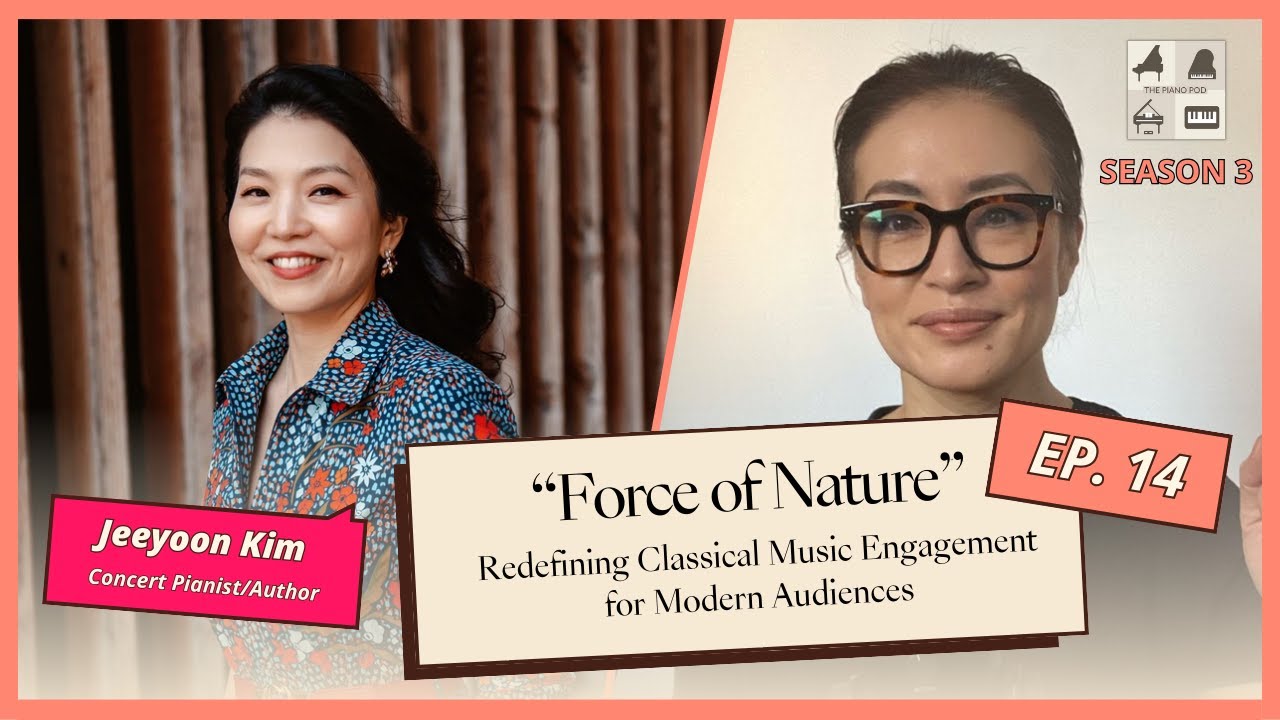
This content was created by The Piano Pod with Yukimi Song. This content was uploaded by The Piano Pod with Yukimi Song. This is a YouTube podcast episode (Season 3, Episode 14) of The Piano Pod with Yukimi Song (published March 15, 2023). The content is an interview-style conversation in which host Yukimi Song speaks with concert pianist/author Ji Eun (JooYeon/Jiyeon) Kim about her artistic mission, audience engagement strategies for classical musicians, her book Whenever You’re Ready, building a digital presence (YouTube, livestreams during the pandemic), crowdfunding and recording an album, teaching and running a studio, career training (Korea → Indiana University), and personal pursuits like surfing. The episode also contains a sponsor read for Forte and a mix of produced podcast narration and back-and-forth dialogue between host and guest.
Chapters
Welcome back to another episode of The Piano Pod with Yukimi Song with Yukimi Song with Yukimi Song.
I am your host, Yukimi Song. For this episode, I invited Dr. Ji Eun Kim, who is described as a force of nature who lives for that special connection with a live audience. I just finished interviewing her, and this quote is such a perfect description of Ji Eun as an artist. I'm proud to say that this episode is going to be epic. I've wanted to interview her since the get-go, and I knew of her even before I started The Piano Pod with her YouTube channel, which we will discuss in detail during the show. Anyway, I got an email from her publicist during the lockdown of 2020 to see if Ji-young can be on The Piano Pod with Yukimi Song because she just finished writing her book at that time. The book is called "Whenever You're Ready." Oh, by the way, this book is really awesome, and I have read it a few times, and I highly recommend it. The book tells you about her real life as a pianist, and it also gets quite philosophical, like what does success look like to you? What do you want to bring to the world as a pianist? So anyway, finally, after over 2 years, I was able to invite her to interview, and I am excited to share this episode with you today. Now, I wanted to start a podcast show because for the longest time I felt a huge gap between the classical music world and the general public, whether they are potential listeners or music students or their parents. And I, I wanted to start this show to fill the gap. Ji-Yoon seemed to have the similar or same question or curiosity as mine, and she dedicated her career not only in her concert performances but also in audience engagement by creating innovative concert programs, recordings, writing a book, creating a fan base on digital of platforms and more. So today I want to focus on how we as classical musicians should be in touch with the rest of the world and connect with our audience in this modern and complicated world in a creative and meaningful way. So before inviting the guest of this episode, I want to welcome everyone who is listening to or watching The Piano Pod with Yukimi Song for the first time. I'm a classical pianist and educator from New York City, passionate about creating a thriving and meaningful community of the classical music industry through this podcast. Please visit yukimisongstudio.com to find more about my work. In each episode of The Piano Pod with Yukimi Song, I interview a guest speaker who has been breaking exciting new ground in the music industry. Before getting started, I want to thank everyone for tuning in today. Please rate the show and review it on Apple Podcasts because every rating or review will help people find my show. So everyone, are we ready for episode 14? All right, here we go. Dear friends, please enjoy the show. You are listening to The Piano Pod with Yukimi Song, where we talk to the brightest minds in the industry about how they are bringing the The Piano Pod with Yukimi Song with Ms. JooYeon Kim.
I am honored to welcome Ms. JooYeon Kim, described as a force of nature, who is an award-winning classical pianist, recording artist, art activist, author, and educator. She has delighted audiences globally with her sensitive artistry, impeccable technique, and engaging and innovative concert experiences. Her dedication to pushing the boundaries of traditional classical music to connect with a new audience has inspired a dedicated and passionate fan base, both at concert venues and on digital platforms. So Jiyeon, welcome and thanks for being here. I'm so excited to get to hear your stories today and then learn from you, especially having me. Of course, thank you. And especially on the topic of audience engagement and how you are creatively engaging your fans. And I think that's one of the hottest topics right now in the industry, in our industry, especially with the rise of social media and digital platforms. But it's not just about our digital footprint or presence. It's more to do with how we as classical musicians can relate to and reach out to the new contemporary audience. Yeah, so, and I consider you as like a front-runner or the model in our industry in that way because you've been really dedicating your career and life to audience engagement in many, many innovative ways. And so Chi-Yun, I want to start by reading this quote from your book whenever you're ready. I totally enjoyed the book, by the way. And so let me quote: "Having a mission beyond just fulfilling my own life's need or self-satisfaction was one of the key incentives for me to keep going despite difficulties." End quote. So it is clear to me, and I'm sure to many readers and fans, that your that you're such a messenger. And so what is your mission statement in 2023 after we've been through this pandemic as a pianist and person? So where are you right now?
I'm actually very grateful that you mentioned that our mission changes over time, and I think it should. It always— we have to be nimble and be able to change with the time. But I think it didn't change much for me. I would say I'm a classical pianist who strives for a unique connection. That word is very important to me, whether that is public speaking or private conversation or teaching piano, recording, or piano performance on stage. I believe that I can make a difference in the world to spread the beauty of classical music one person at a time.
Wow, thank you. That's very well said. By the way, I love the background. Is it a huge tuning in from your home, home studio.
Yes, yes, this is my place that I practice every single day. And, um, you know, as you— I don't know, you can see there's nothing but piano. That even the couch, it doesn't even serve as a couch. So for me, it's that empty space that simplify my environment, um, just, just emphasizing the important thing, which is a piano, only thing in this space really helps me to focusing on my life.
Wow, and with the beautiful paintings and photos in the background, what an inspiring space. Now, what's the secret to finding out your own mission in life?
I think, you know, first we all have to believe that we all have our own unique reason why we exist in this universe. I think we all have to start from that belief. It may or may not have anything to do with your jobs. So from that belief, I think it's important to know ourselves. What do I like? What, what are the things that makes my heart pumping? What is my tendencies, preferences, personalities? What is important to me? What are the things that I do gain energy by doing, not draining? What makes me in the status of flow, feel like I lose time and time doesn't even exist. Then I will turn that into what I enjoy the most, into what I can do well, collecting necessary skills and trainings and perspectives. That I think we devote ourselves to improve ourselves in anything, we are more invested in that, not only we get better but So we— our enjoyment grows. So the next step would be then ask, how can you help one person in this world? Not thousands, but that one person with that very thing that you love and you're trying to be better. And I think that is your mission, that finding who you are, then in connection with others, then to contribute to the world in the way who you are.
Wow, thank you. Because I think at one point, you know, you practice so much as a pianist and you get stuck, right? And you feel like, what are all these hours of practice? And where do— where am I going to from where I am? Yeah, right.
I think we have to remember there's a reason why you love playing piano. And I often— we're so bombarded with environments of a competitiveness or other things that you forget that, and then focusing on other things. But if you really listen to yourself, the very thing is music. If that very thing is piano, then you can uncover the layering out and then try to be in tune with yourself.
I think discovering that secret such an early you know, stage in your life, especially your career, I think that's a big plus. I mean, it's a lot of journaling, and a lot of— maybe for some, it's a lot of therapy to do. Probably. Yeah. So also, you mentioned in the book that you feel deeply connected with your listeners in the very moment of sharing music. And at one point, you realized that you wanted a concert to be a shared experience, not a passive participation, you know, traditional, you know, you'll come out and bow and then go backstage. So, but when did you start realizing the love of how creatively you want to engage with your audience?
I think when you mentioned, and people actually even don't know me, what I do, would think that I go do such a crazy thing, but I think at In the end, I'm just trying to get to core of what I do. It may be just talking about the music, but not about in the historian perspective, but actually what it means to me emotionally. And I might say, you know, I feel like I'm swimming in a pond. There's nobody, but I hear this nature. It's peaceful and quiet. And that might set one piece that I'm about to play. I'm not talking about Wen Xiumin born in the 18-something-something. And I think what I realize is is that I grew up in a very unrealistic setting, which is surrounded by pianists, surrounded by classical musicians. My audience were professors and students who memorized all the Beethoven sonatas by opus number, and they know. But then when I went into the real, real actual audience, they don't even care. They don't know anything about it. And then when I play certain pieces, pieces. And in my head, I was thinking, I made that mistake, or I made a memory mistake there, or I could have done that technically better. Doesn't make any sense to them. More important that I realized is they want to connect with me. And I often thought about my grandma, who has no interest in, in classical music. She was actually really into this classical Korean song that is called Tsuru tu. And, you know, she— if I was thinking, if I were playing a piece of music for Grandma, I would not start, Grandma, Beethoven, born in 18-something, and then we're talking about, Grandma, I play this piece like, oh my gosh, I love it. Because, you know, you know, then I will really come into a compassionate and kind but loving way that I want to so share this piece of music with my grandma that may not care, but then she also, I believe, that want to connect with me. So then in that place of loving and friendly gesture made a huge difference to the real audience. And I taste that in the outside of academia. You know, of course, when we prepare for the degree recitals, we go out to the retirement center or some other settings that play. And every time I play some other settings, I feel like the audience are different. Like, is this real or is this that get a good grade in academia is real? You know, I got really confused because at the end I have to come out of this unrealistic laboratory setting to real world. But then that transition was so huge for me in my mind that I have to change. My world, unfortunately, the world I live in, you know, peer pianists or musicians or even my teachers would not change. But I have to come down from this pedestal of classical music, but come down to the real people and not from the person who knows but from the person that who enjoy this so much and can't wait to share in a meaningful way. And then when I tried to do that little by little, then I saw the connection amplify in the degree that I can't even measure in any way. And I think at the end, they help me to be a better pianist, better Messenger, and people actually get it. I mean, it's, it's not like I'm not selling something that is not sellable. I am selling the most sellable content. Chopin, Rachmaninoff, they will die, they will love it, but they just don't know how to get to it. But we know, so I have to find a way to connect it for the dots for them, right?
I totally understand the part of they don't know how to get there because I live in a big city, New York City, and I, I teach students who are not really a musical connoisseur, right? They're just, you know, doing this. Most of them are doing it for hobby, seriously, but hobby. And then, but they live so close to Carnegie Hall, for example, but they hardly go there because they don't know what to listen to. They don't know where to start. What's the story behind it?
And I think our generation, it, you know, sometimes find the classical— not sometimes, all the time— classical music is boring, or for that, something for grandmas, not for me. But then when I bring my friends who's not musician, come to my living room and ask them to sit down, like, I'm working on this piece, I want to play for you and this means something, this heartache, I don't know what was Brahms was thinking, but this I feel. And then I play it and they were like, what is this? I never heard anything like that. I mean, they're the one who listen to pop music everywhere they go. But then they get it immediately, you know. So I believe that just they need a better context, and we need to give that context as a musician. And I think that context is not that, like, fancy thing. It doesn't have to be, but it's really talking about the core message that we feel as a musician and just talking, but then actually practicing the delivery story of it so that you don't really get into the boring lecture recital, but more really like coming from the empathetic mind to share. And I think if you do that, people genuinely connect with that music and then they become a fan of classical music. And once they become a fan, then they can go explore chamber music, other whatever, the avant-garde of classical music. But first of most, we need to get them into this corner first. And by doing it, it's more about really nothing fancy, but openly talking about why you love this.
Now, your way sounds like a two-way, so it's not just you giving them this performance, but also sounds like you're also receiving something from them. So by engaging with your audiences, how did they change your life or perspectives?
I think every performance has actually changed my life in a small or big way that I cannot measure. But I know every performance is tremendously difficult, and after every performance, I gain something. I'm stronger. And, you know, we all the students will say, "I practiced so much and I did never make that mistake, but in front of someone so-and-so, I made this mistake and that mistake." And you know what? That imperfection, but yet alive, feeling alive, also all of your senses are like heightened. That's why we do this music live. Music's supposed to be connected through souls to souls. And in that space. And I believe that music completes the circle when we play and share life. And I think that's why every time whenever I perform, it's difficult, but that's the function of the music that I give, but then I receive. And, you know, the most beautiful concert or the most— I would not say perfect, but the most rewarding concerts, it's not last mistake concerts, but then the concerts that I felt the most engaged with the music, with myself in the music, and inevitably with audience receive as well. And I think always I feel that I do something completely unimaginable in the concert if I'm open to it, if I'm open for the color to be more different, or in this way, if I try even harder for certain section to be closed differently, if I experiment on stage, then because I am different on stage, the music responds differently, and in that very moment, I gain something that I can't measure in words. So I remember the very first concert in grad— in undergraduate study that I play Chopin Fantasy or certain parts of that Chopin— ah, Schumann Fantasy, sorry. And that part moved me and I felt like, oh my gosh, so beautiful. Wow. So beautiful, you know, like it's me but not me. That environment, that piano, that people, That hall, everything gave me that another layer of life, another dimension of life, which I become a fuel for my life. So, I think that it's complete circle. But people thank me all the time, like, I really, you know, appreciate what you do. I loved your concert, that, you know, all of those compliments are wonderful, and I'm, I believe truly I appreciate their feedback, but at the end of the day, I gain the most.
Wow, that's very beautiful. Thank you. So you are an award-winning pianist, recording artist, author, educator, YouTuber, public speaker, and podcaster. And did I miss anything? I mean, we're gonna talk more about your career later, but, you know, honestly, I'm curious to know about your YouTube channel because, you know, I have my YouTube channel with this podcast Yes, too. So your YouTube channel, like, it's like a lifestyle channel as a concert pianist and very entertaining too. And you have over 3,000 subscribers. And so when did you decide to start engaging with your audience on YouTube, and what motivated you to do this?
I think, um, you know, at some point, I think in 2019 or '18, everybody started talking about, you should do the YouTube. I don't know, they still talk about it because I'm already in YouTube world. I don't hear it anymore, but everybody was talking about, you got to start YouTube, YouTube, you know. But in back in my mind, like, maybe, but not for me, you know, in front of camera. Like, I've— I definitely had that fear or conflicts within me that I didn't want to be in front of a camera. Definitely there's a challenge that it's against my personality. Actually, podcast fits me better. It's just like talking about, you know, intimate conversation, or writing fits me better. But then camera, oh, something about it was very challenging. But then I was thinking in my head, because it's so challenging, because I felt the conflicts, I had to face it, at least at first. So I just tried to, uh, think right before pandemic, 4 or 5 months prior to like quarantine started, I, I was actually in New York and thought maybe I record something on my camera, I mean my phone, and see how it, how it feels like. So I did it, and then surprisingly I found out that I can just talk to the camera like a friend. Um, so then I realized, okay, It's better than I thought. I will try a little bit more. But then pandemic hit, and by the time that pandemic hit, I already produced maybe 10 or 15 videos that I already have cameras and kind of knew how to edit and everything. And by that point, everybody had to transition into digital world, and by that time I, I was already doing it. And So for me, it was not transition, but something like, oh my gosh, I'm already in it. And I was like a step ahead of others. And then that's where I felt that the power of this world, that I could connect with people that I can never connect in Peru, Malaysia, that people actually unrealistic to come to my concert in person. But then there were real connection that I could make in online world in a meaningful way. So then I started to look at the world differently, like, okay, the pandemic happens and the world gonna end. What am I gonna do as a performing artist or a pianist? What does that mean? But then I found hope in a digital world that I could still connect through music, through, you know, in the just different platform. And it required me to be resilient a lot more. And I did like weekly live streaming concerts. I think I was the most active during pandemic in the digital world than any, you know. Right now I'm a little more struggling because of the time and everything, but I think at that moment I really felt the power of digital world that I think is at this point for everyone, but especially for musicians existing in a digital world, it's not an option anymore, but a must.
I agree with you. Yes, totally. So to my listeners, I want to officially introduce Ji Eun Kim by— let me just read a little brief bio. So Ji Eun began studying the piano when she was 4, and her love of music propelled her through her undergraduate studies and piano performance in her native Korea. After moving to the United States, she received her Master of Music and Doctor of Music Arts in Piano Performance with distinction from one of the most prestigious music schools in the United States, the Indiana University Jacobs School of Music. Ji-Yoon has shared her fresh perspective on classical piano performance with audiences at venues such as Carnegie Hall in New York City, Chamber Music Society in San Francisco, and the Stradivari Society in Chicago. During the pandemic lockdown in 2020, she wrote and published her first book, Whenever You're Ready, offering readers a personal glimpse into her life as a concert pianist. This self-help book in a concert-style structure shares wisdom and insights gained from JiYoon's musical experience. JiYoon currently resides in San Diego, where she happily practices her piano daily and maintains a studio full of dedicated piano students and surfs each morning at sunrise. Wow! You are also a surfer among many other things. Is there anything you cannot do? Tell me a little bit about being a surfer. I'm curious.
Well, I don't think there's not many classical musician surfers, to be honest.
Yeah, I've never heard. Yes.
Because that's so against our disciplined mind in many ways because It's in surfing you have to let go so much. I want to drill so much in surfing. I want to get the trainer and get the perfect form and how to do surf, but then in surfing you just have to wait for nature to give you waves and you have to ride that wave when nature gives you and respond to. It's almost like jazz. You have to always improvise and you have to play like a child. But in my mind, I want to practice surfing to be better. So there's a really complex within me, which is helpful for me to be doing so totally different thing, you know, with the piano, what I do. And in piano, easily I can stay home for days, days without even foot outside. I'll be happily being indoors. But surfing, you have to be in nature. You have to, you know, then you realize that life is about connecting with nature, really brings you to certain place that nothing else can take you. It's like walking nature or hiking. Surfing is the same thing. When you're in the middle of ocean at 5, 6 o'clock in the morning, You see pelicans catching fish for the breakfast, or dolphins swim by, and you kind of feel like, you know, everything is fine.
Wow, you're living the life!
This episode is presented in collaboration with our good friends at Forte, a free alternative to Zoom purpose-built for music teachers. I am happy to announce that Forte will always be free for music teachers no strings attached. That's right, Forte offers features optimized for classical music lessons, including audio quality far superior to existing platforms and allowing you to hear every nuance of your student's instrument. Their colleagues at the Royal College of Music, Aspen Music Festival, Curtis Institute, and Berklee College of Music have even used Forte in their own programs. Forte's mission is to radically expand access to high-quality music education worldwide. Forte always puts teachers and their students first. This means you can use Forte with your own students for free forever, and Forte will soon introduce paid features allowing you to connect with new students around the world. Sign up for free today at fortelessons.com or click the link in the description.
Well, you mentioned that in the bio, you know, you started your musical journey at 4. So how did you discover a love for piano?
You know, I think I'm very thankful for my parents to put me in this piano institute when I was 4 years old. But my parents was not a tiger mom or never really pushed me to do anything. They were actually very busy busy to their business. And it was my responsibility to go to institute every single day. They never really told me to do anything, but I remember my first lesson, which was like 5-finger pattern, whatever. I don't know, I remember what was it, but I can just assume what that was, would be C major or something, up and down. But then my teacher play accompaniment part. But at that moment, I feel like I'm a concert pianist already. I was so in love with the rush of sound coming out of these black and white keys. Although I was simply moving my key, you know, up and down, but I felt that the power of the instrument that gave me, and I fell in love with it instantly. And I think my parents not pushing me, but I was really drawn into music. Music, and I was a happy musical kid, always want to sing. I think I knew right there and then I would be musician, you know. Sometimes I feel like I chose piano, but I often believe the instrument chooses you. So piano chose me, a flute choose someone else, trumpet chooses some— someone So piano suits me, and I am very biased, but I still believe piano is the queen of the instrument. You know, it can be independent, interdependent, solo, chamber, concerto, intimate yet powerful. There's no other instrument can imitate orchestra yet most intimate sound that you can create. So I mean, it's a chameleon of the instrument, and I'm so grateful that The Piano happened to choose me.
So what was your training like? So since then, so you had intensive training, I'm sure, in South Korea. I think you're from Busan? Yeah, yeah. And then you went to even undergraduate, throughout undergraduate you went there. So tell me just a little briefly about your training. What was it like? Was it really intense? How was your state of being there.
I think, you know, I think it'll be Japan as well. Any Asian country, especially Korea, very competitive. No matter what you do, it's competitive. So, but I was actually competitiveness-free until I think it's, you know, second grade of middle school, because I was just going to institute doing my thing, la-de-da-de-da, practiced it, but I was not aware of it. But then one day, I think my teacher or my mom told me, you need to go to art high school in order to major in piano. So like, okay, but in order to do that, you have to audition to art high school. Then you have to change teacher to more serious. Then you really have to commit. And like, okay, I guess I commit. And then I did not realize what that commitment meant, but they Commitment meant that I have to survive. If I make just simple, like, wrong notes in Chopin étude, you are going to place, you know, low ranking in every piano exam in our art high school. Everyone plays similar pieces, and then you can direct comparison of, oh, so-and-so plays faster, so-and-so plays more cleanly, you know. So like, that That was my environment at art high school that was very competitive and perfection is required, polished performance. I guess in that setting, I try really not to be bombarded with the comparison to each other because at that time, I was really having a difficult time, personal life and my my parents divorcing. So I could not afford myself to be in that mindset but really survive on my own personal life, right? Which was blessing in disguise at the end because I just— piano was oasis for me, not a place that I have to win. So then afterwards I went in Korea, National University is also much cheaper, so I only had a choice, either going to Busan or going to Seoul University, which is the best school in Korea. But I failed to getting into Seoul University, and I thought my career as a pianist is crashed. Definitely that's a failure, you know? There's no other way around it. I didn't get in. But then later I realized that staying in Busan, which is my hometown, it's not that exciting. I went to university from my home, my own home, you know, nothing exciting. But then I was in the full scholarship, so I did not pay any money on undergrad studies. And I feel like I gained that perspective. I hibernated, hibernated and prepare myself for the bigger world, extended studies afterwards. And I could pace myself in non-competitive environment again. I think if I went to Seoul University, then to any piano major, whoever they were, they're very competitive. Again, I would really maybe burn out, who knows. But, you know, as you know, the study in classical music goes for a long time. By the time you go undergraduate, you're already playing piano 16 years already of your life, Right? In 20s, you already been playing 16 years, but then beyond that is life just starting. Even education barely started, but then everybody quit after undergrad even because I've been— I'm done with this, you know what I mean?
So I totally—
yeah, I feel like I gained that energy. I actually regenerated during my undergrad just to rethink what I love and do I want this. And at the same time, I was just taking my time, which is not— it's a luxurious thing that I thought it was such a not fun, you know. At that time, I did not like it. Why I'm in Busan still, you know. I've been here for my life, but I'm still here, you know. But I'm very thankful now.
Then that probably, I don't know, staying there led you to maybe have the energy to think about coming to the United States, no? Yeah.
And then, um, you know, I always knew that I have to come out or go outside of Korea. Obviously, classical music is Western music, and I need to learn something from outside of Korea. So I always thought of it, but I, in my head, I thought either going Germany or USA, but I wasn't sure in my undergrad, but I just knew that I would go somewhere outside. And so before making that decision, I lived in Germany for 2 months and I lived about a month in America, actually exchange students in undergrad and South Carolina and all places. So I tasted Before I make decision. And from that taste of life in Germany and USA, I've learned that in Germany I could tell that, oh, well, Schubert must be walking on the street, or, you know, Beethoven was living, you know, all of that was such a, so close to the tradition. Yet I was foreigner. I, for the first time, I felt that I am, I am Asian. What is Asian? I was always Yun. What is Asian? But I felt that I'm Asian. Every single day, which I realized that I can't get over that. Hopefully this is better now in Europe and in Germany. But at the time I really felt that for first time ever in my life that I am not Ji-young, but I'm Asian. And some that I decided also German was so difficult. I cannot even fake German. And I decided, okay, US. A is the way to go. And then I Yahoo, you know, search at that time what is the best university in, uh, in, in America. And there's, uh, Juilliard and Indiana University in Midwest and then, uh, USC in West Coast. So I auditioned all three and, um, I actually got in all, but I chose to go to Indiana.
Indiana is a wonderful school. Everybody wants to go there. Yeah. And how was experience at Union University? It was like a really straightforward, all glorious?
Well, yes.
Oh wow, that's great.
Very fantasy way. It is a fantasy world. That because of that reason, it has pros and cons because you are detached from the real world again. It was really special place Bloomington is special place in the middle of nowhere, Indiana. This is the one of the best school in the field. Then there's the best music, you know, library and the teachers all, you know, all over the world, you know, Pressler, Stocker, George Scheppach, and all the great pedagogues there. And then everybody is, you know, talking about classical music. The 4 different concert hall has at least 2 or 3 different concert, grand, Steinway to choose from. I can nerd out about Beethoven's sonatas with friends for all night long and doesn't feel anything different about it. And all about classical music, classical music environment, even for the, you know, people who live locally, very into opera and whatever. So I didn't want to wake up from that dream. I did not realize that was a dream and to see. And well, I did it for a while, but I'm glad that I sensed that world even for a time period.
Yeah, yeah, that's, that's great. Yeah, to be able to experience— like, you need— we all need that sort of experience as an artist, right? Yeah. Then you go to the real world. So yeah, so speaking of real world, so tell us about what you experienced after you graduated from, you know, Indiana University. Was it all glorious? Like all the jobs lined up and gigs lined up and then with the red carpet. Is that what it is? I wish.
I thought— I never actually thought about it, which is very naive thinking, but I didn't even think that it's naive because my teacher even didn't mention it. My teacher was all about how to make this Chopin better, how to phrase Bach better, all of those things. And we never talked about the world beyond my my study, and I'm thankful for that, to live in the fantasy world so that I can really be my own artist in that time and dive deep into the music. But yet I was so detached, and I thought maybe at some point that something will work out. Something will. I'm doctor, you know, I'm— but then that when I get the certificate of Dr. Kim, only thing different was that people can call me doctor, but then same morning, same sun goes up, and yesterday, today, it's the same. Nothing changed. Knock on my door, "Ji-young, let's tour to the world." You know, the job application for, you know, after they become a doctor, I thought maybe professor is very secure track, you know? And I really thought that that's what I wanted or that's what I should pursue and that's safe. And maybe that was a dream of my mom, I don't know. So I pursued without thinking much because I, you know, but then after rejection after rejection, I was like, I felt so small that just with my resume, like I studied so much, but then that's become just one line. She got her doctorate degree in Yale University. That's it, that's it. Like, what? I did so much. I'm more diverse person than just one line. But how could I share that, you know? But then I pursue and pursue. I don't know how long. I think it was after that I actually went back to school to study piano pedagogy and master's degree. By that time, people thought I was crazy to go back to school. But it was a genuine curiosity of how I could teach better because I wanted to teach 4-year-olds as well as the most advanced Chopin pieces. But I could do that advanced pieces, but I had no idea how to— yes, well, start 4 years old, right? That gap was so much, and I— it bothered me so much. So in the meantime, when I'm figuring out my life, let me get to learn about this because I wanted to be a better teacher. So in the meantime, I was applying, you know, everywhere. I'm hoping that maybe this degree will help me to get to another job. Like, what else do you need? I get that, you know, doctorate and then another degree in pedagogy. I'm like, I'm a dynamo in terms of degree can go. But then still no, you know. And then the final rejection that I got was so close. I was a final 3, and that by that point I was thinking like, I got this, I've got this. They should want me. Like, I am the one for you, you know? But then I still didn't get it. And that was a hard no. That was hard to take at that time. It was in San Diego, you know, one of the university. And that time though, because the no was so close, but yet still no was no, at the end, and I started to think, wait a second, do I even want to be a professor? I don't want to be in some foreign land, start from that, ladder up. For what? You know, and I started to really question my motivation of becoming a professor. And then more I search for it, then I actually like the financial security comes with it, not the job itself. I really like the idea of it. But I really would hate to teach Piano 101 for every year. I would hate to write emails after emails, you know, committee members and all of those job follows that, like, I was suffocating. It's not actually academia, although I was there, academia all my life, but I hate it. I hate the structure. So then I like, you know, I am gonna close the door completely, not just adjunct to hoping that I get into some lecture position. None of that. I'm just gonna— no. Would that be okay? And I thought, you know, it sounds fairly miserable for me, for my personality, to stuck in there somewhere just for what, you know? So from then, then I was started to think, okay, now I'm still jobless, still like nothing. And from there, I started my own business of teaching studio from the knowledge that I gained from pedagogy classes and all things. And I took it as a really serious business, and I, I opened Dr. Kim Piano Academy in the thinking that I'm only gonna take 5 students because I want to I'm going to do something else too. But I started very legit business model and policies and everything. And that was one channel. But then in my mind, I want to now devote myself as a pianist. How can I do that? And that's one of the way I thought, as a first step, one of first step is that I want to create an album. I wanted to, always wanted to have an album, but how one starts album? Is that the Deutsche Grammophon is have to contact me. So they're supposed to contact me, but they didn't, you know. So then like, I wanna start, I wanna make album. I have idea. I wanted to create an album, that collection of all my dear friends, that one of the dearest to my heart, so that I could play every concert encore, always like, Among all of my studies, those pieces always come weaving into my life, come and go, you know? So I have maybe 12 pieces of those and I want to collect it and I called it as a "10 More Minutes" because it represents for me the longing, longing for not 10 years, 10 days, but 10 more minutes. And with these pieces that I always wanted to long for more, And so I wanted to present this idea to the world. And that was also mind-boggling idea. Like, why would, you know, I'm not starving to death, but why I'm asking for money for others to, you know? So it was very uncomfortable. I was really uncomfortable place to ask for money for my album. But I decided, you know, I am an artist that I'm contributing with what I can do to create this. It's not for me, but to create a beauty into the world. And people donate to the art, they can donate to the symphony or this organization, they can contribute to my project too. So I was kind of like started to like mentally train myself and started to talk about it, talk to the world that I have this idea, it would be wonderful, if you can, you know, be part of it, part— join me, you know, join me to experience this process. And I did that through Kickstarter. That was $30,000 pledge, and that felt like, you know, a lot of money, you know, and who could do that? And, and I even talking to my friends was difficult. Like, I was like, oh, you know, I have a song project, but I don't know if you can do it, you know. I was very shy about it. But the more and more I talk about it, and I feel like it's okay, you know, you don't have to even, even just give me like a go for it, you know, you're doing great. That is enough too. Then it became successful. It's miracle itself. I mean, there's, there's many miracles, but one of those are that kind of miracle that because I do my best, but I'm not in control over that outcome. But the outcome was successful. So I'm thankful. But I made that move. I was vulnerable in front of people that wanted. And the interesting thing was that people donate even a dollar for this album, felt like it's their project.
Hmm.
The project became everybody's project. And it felt like this is becoming a playground with so many people together. I shared that, oh, now I'm in New York recording this project. Wish me luck. Oh, I just, you know, now I'm doing, you know, cover the photography. You know, they were there every step of this album and they become like faithful lifelong fans. And then, you know, in the similar timeframe about that time, one of my friend came to Carnegie Hall and went to Michiko Chida's concert and gave me this postcard and asked Michiko Uchida and say, can you write it, "Why not?" on top of the postcard? And she said, why not? And then it's like, yes, yes, please, why not? For my friend who's pianist. And so she gave me that postcard signed by Michiko Uchida and saying, why not? And until that time, Carnegie Hall is something like so far away, you know, like everybody's like, oh, when are you gonna play Carnegie Hall? Hahaha, like, you know, it's more like a joke. It's— it'll be nice, but then it's so far, you know.
Why?
How? Or do I even need it? You know, I justify myself. And then when I look at that postcard, I felt like, why not? Yeah, why not? I mean, it's, it's not like I've, I've done worse, you know. It's just another concert.
But how?
I was genuinely curious. So I called the next morning at Carnegie Hall booking office. And I called 9 o'clock when they just opened the office. And I called and then someone get up and get the phone like immediately, just like a New Yorker, you know? And they, hello, Carnegie Hall booking office. And I said, you know, you don't know me, but I am classical pianist. I'm just wondering, I was wondering, how can one play in Carnegie Hall? And I was like, when I said that word, I felt like how ridiculous it might sound. At the same time, how many calls this person gets a day? You know, all of those above. And then she was talking about a long list of things that why you need. You need a presenter, you need the credentials, so you need to like, you know, whatever that was. It was like a long 10 minutes of She told me what I might need. And then I hang up. And when I hang up and looking at the wall and thinking like, at that very moment I felt that there's some light turn on. Like, oh, this is not fantasy. There's the steps. If I follow the steps, I play Connie Hill. Just like that.
Right?
It's not a— it's not just like in La La Land. So then I was thinking like, what was the steps that she mentioned? Like, what do I need? And I made phone calls, whatever that I needed. And, you know, to make a long story short, I was in the Carnegie Hall debut concert with the people who donated so much in 10 More Minutes Kickstarter project from Indiana, from San Diego, from San San Francisco. They wanted to fly.
Oh my goodness, trying to get home.
I have no connection in New York. I don't know anybody, but it was sold out. People wanted to be there. And then in the backstage, I could hear the chatter noise, and I knew that became sold out on the day. I knew, and I felt like, who am I who deserve this love? Who deserve— and it felt like it's not my life, it's for them, it's for them. I need to give 1,000% to give back what they gave me. And when I went out onto the stage, as always, there's microphone, no program. People are very confused. What is she gonna play? And then I get onto the stage and I I turned on the microphone and said, "Welcome to my dream." And that moment was dreamlike, but it was reality, but it felt like a dream. And people were walking into my dream. And that's how I feel like my life has been. Yes, I made a phone call. Yes, I put the idea into the world. About Kickstarter, my album. But then when I did that, there's another force carried me. Then I go and I go, but the first step was always me. The first vulnerable, courageous move was always me. But then when I did vulnerably open myself, expose myself, there are people that carried me. And that's, that's a magic. That's the, the part that I can't do it on my own.
Wow, beautiful. What a beautiful story. And you're coming to New York again, right? Yes, we're gonna talk. Yeah, that's great. We're gonna talk more about it later, but that's so amazing. Yes, maybe I need to get a ticket and come and see you.
Hey friends and listeners, The Piano Pod with Yukimi Song is in its third season. Thanks to all of you for watching or listening to every episode since the launch in 2020. I started this show with a simple question I have had in mind for quite some time, which is: How can we as classical pianists and music educators present the beautiful tradition of classical music to the 21st century audience in a fun, contemporary, and engaging way? It's been an incredible journey for the last 3 years, and I love what I do through this The Piano Pod with Yukimi Song, providing a platform for pianists and educators to think and discuss freely without any judgment about how we can keep the classical music industry thriving and relevant in this constantly and rapidly changing world. Now more than ever, I need your financial support so that I can continue my work by bringing you highly valuable content biweekly by interviewing groundbreakers in the industry. Your support will go directly to all the costs of The Piano Pod with Yukimi Song with Yukimi Song with Yukimi Song, such as yearly subscription to the podcasting platform, software I use for high-quality recording sessions, and tech gears, as well as all the hours I spend researching and audio/video editing. You can make one-time donation or monthly pledge by clicking the PayPal link link in the show notes or go to The Piano Pod's website at thepianopod.com. As a thank you, you will receive The Piano Pod's fun logo sticker in the mail. So please support my show today and don't forget to subscribe to my channel, continue listening, and tell your friends and colleagues about The Piano Pod. Let's continue with this episode.
Then you're— you've been really candid, you know, about your success, but also sometimes mistakes or failures, that's part of it, right? And then, but that's the juicy part of our lives that makes us, our lives really thriving and alive. And so, and then I totally enjoyed reading your book, Whenever You're Ready. Actually, uh, before, I knew of you from YouTube, you know, the one with the algorithms and triggers, and I saw your video. But then afterwards, during the COVID time, I got an email from probably your publicist or whoever to reach out to me because we started the podcast and then you just published the book, right? And then we didn't get to interview you till now. I didn't get to, but I was reading the book during that time and it was very, very good. And it's starting out sort of, you know, it's intended for all the readers, not just limited to pianists. So the way you're explaining, you know, this is like, this book is like a movement of sonata and then it goes like this. And then in each chapter you have this sort of exercise for readers to do certain things. And then the first chapter, first few chapters were, I mean, easy to read. Then it gets actually quite deeper, philosophical almost, yeah, and the way of life, right? So yeah, and then I was able to reread again to just to prepare for this interview, and it was very encouraging. And there are some topics that are a little uncomfortable to tackle, but I want to go there today too, so I hope that's okay. Can you tell me how this is structured and then what motivated you, what inspired you to write this book?
I think, you know, I mean, the "Whenever You're Ready" is where it comes from, is that, you know, every concert stage, often there's a stage manager holding that door to the stage and saying, whenever you're ready. And then I look at that person and thinking, am I ready? Will I ever be ready? But then I'm thinking, dig deep in that moment and create a courage and strength within myself and make a decision to walk towards the stage. And that, in order to make that transition into the split second of whenever you're ready to— okay. In order to make that transition, I have to do so many things daily basis. It's not just easy, okay, I'm ready, go. It's so much of a mind training, so much of how lifestyle reflects to that decision-making. And so that I wanted this book to be like written answers. So that's why I structured in such a way the movements, that each movement has deal with the different topic. And the first movement about like perseverance, discipline, and then about second movement is negativity, and the creativity on the third movement, and fourth movement is about connection with oneself or others, and the fifth movement about the, the body itself, the, the environment. And then in between there's intermission mission where I get to be a missionary of classical music again and talk about one of my favorite pieces, and there's a QR code there for them to go to listen to it, and then there's encore at the end. And what I was thinking is that whenever I prepare for a concert, it feels like preparing for a life, and I often think that we all have a stage called a Whenever we have a difficult phone call, when we have to face difficult decisions, a difficult conversation, embark something new, unknown, life challenges us. But that very moment, like, you still, mm, I'm gonna do it. That mm is what I wanted to give the sense of inspirations, those of strength strength to the readers in their performance of life whenever you are ready. And it's not like, go do it, but it's like, I'm giving you a moment, and so when you're ready, you go, but it's on you. So I feel like this book was intended for musicians. I think they get it because they live that, but most, more me for other people through the lens of classical musician. And by you going through my life, they realize, oh, that is a life, that I do have a stage called life. So that I wanted this book to be not from someone who knows better or went through more, but more as fellow friends and fellow human beings who struggles as much, and as if we are sitting in a café, very friendly, light, but empathetic, warm, honest, vulnerable, so that we all go through this. It's not only you, me too, but this worked actually, this really helped, maybe you try. So that's why my voice is not like more dominant, but more of, hey, did you try that? It worked for me. Then you're like, you know, maybe many of these tools that I mentioned in the book already, but since because I say it, because you feel like I'm your friend, you think like, oh, maybe I try meditation. I know that's good, but maybe something out there, you know, that was my goal for people to remind that these tools are already always there, but from my delivery, just like classical music, through my performance, they get it. Maybe there is one or two more people, they pick up on those life tools to make their life better.
In the first movement of the book, you know, and I really appreciate you for clarifying the myths about becoming or being a pianist. Like everybody says, oh, you're He's so talented, he can just play on the fly, but you have no idea how much of a work, how much of ups and downs of life to go through to get there, right? So, and I love the quote, "It is not willpower but habit that makes things happen," because, you know, willpower is exhausting, and that's why a lot of people quit. But the delayed gratification is a really difficult lesson to learn. Teach also. And so where is a good place to start learning this important lesson in life, like, or delayed gratification, meaning building a good habit?
I think they, you know, as early as possible, which is why now it's good place to learn. Um, I, I think it's important to know that every learning has the learning curves, like boiling water. It wouldn't boil until 100 Celsius, but you all along, it has been boiling, but we don't feel it. But we have to believe that we are making progress even though we don't see a progress. And I think that is really important for us to remind ourselves. I get frustrated. Too, because I practiced this much, I thought it would get better, but it's not yet. But then it's not yet, never. It's not never, but it's not yet. So growth mindset is something that we can train ourselves. It's not like you have or you don't, but it's, I can make it better. Maybe not yet, but I'm making it. So I think focusing on the system, which is a habit, is the key because if I have to think when I'm going to practice a day, every single day, have to think about it, it's exhausting already because my day, I have to do this, I have to do that, when I'm going to do it, it takes already like I'm exhausted even thinking about it. But if I have a habit of just a certain amount, not all the time, but certain amount of practice is right after breakfast I'm going to practice at least, let's say, an hour or two, then that is secured no matter what because I became a habit. After breakfast, even though I have this conflicts, I don't want to practice, I'm already sit down and play piano. And it's funny, people would think that it's my willpower to make me practice every day, but it comes from I know why, I know already own why. Why is I love piano, right? But I don't question that why anymore once I own it. I don't question like, do I want to practice? Do I love piano? Like, of course you love someone today and you don't love someone tomorrow because, you know, they so-and-so acted this way. But it's an old couple. They love each other. They know even though they hate each other, they could bury themselves, you know, they do things for each other, they do it by showing the action, not— maybe not feeling is so flimsy thing, you know, you were focusing on, oh, do I love piano, do I love this person, you know, the answer is that it will change every single day, even every hour it might change, you know, so someday we like this and someday we don't, sometimes we're angry, sometimes we're happy, happy, but do joy, but sad, all of it, it's so flimsy. Our emotions are not reliable thing. So once you own the love, why, then I, even though I would think that like, oh, I hate practicing, but I ignore that chatter because I don't question that. I don't question the core meaning, but I sit down and play. Once I sit down and practice it, 99% I would say 99 times I love it. You know, not maybe first 5 minutes, it's still, there's a conflict, but then I get into certain section like, oh, this needs some cleanup. Oh, this, oh, this is nice. You know, more likely 30 minutes pass by, an hour easy. And, and then after an hour I feel good because I overcome myself. I, I, I made music. I actually enjoyed it. But if I I question it when I do it, then I already adjusted and I don't think I would keep up with piano practicing. You know, I'm 42 years old. I started when I was 4. 38 years of practicing every day, forget it, right? I mean, ask someone to do something constantly all the time other than eating and sleeping, you know, this is not major human, you know, instinct thing, you know. So for me, it's very important to make that transition easy as possible. I prioritize it and try not to think as much as possible, at least the first section of the practice. Then if I wanted to add more, some days more, some days less. So then whenever you wanted to add on to your life, if, if that is important to you, then own that Why? Really ask seriously why, because you can go back and forth. So let's say that, you know, the exercise is important to you. Then you really want to make that working out as a part of your life that you don't question that you want to do it or not want to. Once you own it, then make a system. Let's say you wanted to, you know, work out every single morning. When? Like when, after wake up or after before breakfast, then make it a small, very, very small amount, like 10 minutes of stretching. And until you get that habit into your system for at least, you know, couple, a month or two, don't push yourself too much because you have to have a longevity of a lifestyle, not like a month, gym, gym every single day and then the next From February, everybody's like, go back to their couch, you know. If you want something in your life, you have to start slow. But then what I really emphasize is the 2-day rule, which is you can skip a day but not 2 days in a row. I do skip practice sometimes, but never 2 days in a row. So that rule gives me some room to wiggle, but then ask myself gently back into the track. And then also not too hard on myself. Yes, you can skip a day. It's fine. The world still continues. But what is important is that you gain yourself again and continue. So I think it's very, very important that you own why and then create a system that hopefully that system is actually right after you always do, which is eating is always good to, uh, tag along or drinking coffee or something already existing habit. You build onto it and make it small, very small. If you want to read a book, just read up one chapter, one page, not a whole chapter, you know? And then try every time you finish, you know, we always feel good. Like on Afterwards, I feel great. Then I remember that feeling savory. Just take a moment to think how amazing that feel after workout or after the practice. So every time you feel that resistance, I don't want to work out, or I don't want to practice, go ahead to feel that joy. Think that joy, that moment. I'm going to feel amazing afterwards. Then it will be easier for you to do it. To go there. And then the truth is that we are not in the marathon. You're not going to become Olympian by working out. You're not, even though there is miniature goal or long-term goal of whatever we do, or piano practicing, or maybe concert coming up, but the real truth is that I love playing piano. I am playing piano. I'm expressing my love of piano. Channel every day by doing it, which means I'm loving this very day. I think that's the key. You're not going somewhere. You're thinking so much of a goal, then you lose why you're doing it. The reason you're doing it, because you want to do the very thing. So thinking about the activity and the reason we are doing it is so that you love your today.
Yeah, great advice. Yeah, I am into that now. So creating a habit of action but also movement too. You talk about creating a good habit of your mind, guard your mind. And then so let's talk about the elephant in the room, you know, negativity in our industry. So sometimes I have quite a good group of students, advanced students, and then they get more harsh criticism than others who are doing it for fun. That hurts my feelings so much. Now, there is constructive feedback, of course, and then everybody should get that, but there's this insult that is just not really necessary. And sometimes people say, oh, don't be so naive, you know, it's just a little feedback to help you, but This is actually not really a feedback. It's not really helpful for anybody, you know, when you— something like this to happen. What do you think about this?
Um, yeah, I think when you're young, it's definitely harder because you're forming yourself, your mind. And if you have like, you know, very harsh teacher, which is often in music, unfortunately, um, the higher their level is, the harsher they get. And/or parents, the more harsh parents, that is very difficult. So I really empathize with the young people who go through it. But I think we also, because this is the piano community as well, the dear pianists, the dear piano community, let's not be a nerd. It doesn't matter how so-and-so plays fast or this tempo or how they phrasing. At the end of it, it doesn't matter. But I find that the more classical musicians ourselves are such a hard critic to each other. They degraded each other and saying, "Oh, she's not that good. I don't know why she got that." Or, "Oh, well, so-and-so win the competition," which means that there's one last position in your, in in your life. Or, you know, the scarcity mindset really is toxic. There is enough in this world. That world— love goes around. The— all the things you want to do beyond your imagination if you make that action. So that if you— we start to compare, compare each other, competition to each other, that's where it becomes toxic. Whether the so-and-so fellow pianist that advanced students think that, oh well, he plays like, you know, I don't know, he was like really sound bad, but he won that competition. I don't know what the judge was thinking. Whatever that is, that it comes from jealousy and comes from the scarcity mindset and competition to each other. But if you think that, you know, just for a moment moment. So-and-so winning that competition, did it do anything harm to you? And think it as a joy. If so-and-so win the competition, how joyous that is. If you kind of sense that joy and get a crumb of that joy for yourself, you can actually make your life so much more joyous. So then your life is much more positive. And I always find that without, without we trying, it's going to be always negative. Just know that it's always going to be negative. So we have to do something about it to be neutral, even at least less negative, because the world is more negative tendency. So especially negativity from outside world is that I say that it's avoiding is not a sign of weakness. But it's wisdom. So because why you keep facing the trash, you just throw it away rather than, you know, just look at it and talking about it. And I think the best advice that I could give for you for the negativity from outside is unless you accept the negativity into your heart, No, none of the negativity works, has that power. It's you allowing the negativity works to your heart. So I think it is important for you to recognize that it's not them, it's you to allow it. So whenever I go get into the trap all the time, but if so-and-so or some teacher or someone else side of the world to be negative towards me, then I chin up and think, try to ignore as much as possible. Again, it is not criticism, you know, like constructive feedback, it's coming from love. It's not coming from love, then I recognize that and then try to erase as soon as possible. And also, if I don't you don't allow it, it doesn't have a power. So just, just last the content of it. And, you know, I use that quote that if someone came to your house with all bag of, you know, filthy trash and threw it in your house, what would you do? You'll be like, what, what are you doing? You know, but if you allow other people talking bad. And if you allow that, that means you allow in your living room, in this filthy trash, to your mind. So then you have to protect it. You are the one who protects it. It's not, you know, there's all the people out there, it's gonna try to throw the garbage inside of your mind. So you have like so much vigilant about it, and hopefully there's one less can, trash can, is coming into your mind, right?
And the same goes with our mind too. We always battle with negative and positive thoughts, and negative thoughts are referred to as cognitive distortions. So sometimes we exaggerate. Let's say I made a little mistake on stage, and then, but in my mind, it's like, oh my gosh, that was a fatal mistake, and I can't recover from that now. In your book, you talk about it too, but briefly, can you tell us?
Right.
I think it is, you know, if we are talking in the context of the performance, performance anxiety, I would say we have to separate, are you ready? Are you ready to perform yet? That's also, I'm assuming all the tips that I actually want to give is based on you are ready. All the steps that you made, efficient practice strategy, and you are ready to perform, but but still there's performance anxiety. That's two different things. So I'm gonna assume that you are absolutely ready to perform, and then you have these negative voices in your head. And to know that the tiger inside of you never gonna go away, no matter how advanced you are. Even Horowitz has to be kicked out to the stage because he was like, "I don't want to go to the stage," and the manager will kick him out, you know. So it's not depending on the level of your performance. It's a human mind, you know. So just know that our pain is your pain too, then it feels a little easier to deal with it. And then we see we still have to deal with it though. And I think that one of the most effective ways to any issues that you have in your life, it's writing down. Writing gives you, gives a closure floating to your thoughts. If you only think in your mind, that's just floating and, you know, randomly bites you. But if you start to write it down, it feels like, oh, it's nothing. We, as you said, we tend to exaggerate. But if you actually grab it down and write it down, what exactly am I worrying about? I am worrying about people think that I'm bad. I'm worrying about if I'm gonna make that mistake, you know. So, so Writing down all of the negative thoughts is bothering you, then define it. Define it. Where is this coming from? Is it coming from my own voice, from my teacher in the past? What is it based on? And then also defend these tendencies with a positive voice, like, no, you're gonna be great. This performance, no matter what, it's gonna be a beautiful experience. So you actually come back with negativity with at least 5 different positive sentences. And that exercise helps in the moment of battle. I battle in the— during the performance, that, oh, the difficult section coming up. And then you—
the—
this angelic voice that you train so much and think, oh, you got this, you got this. And even if you make mistake, it is just a small— you just pick it up and keep going, you know. All All of those ready-made, prepared positive sentences will help you. And also write the affirmation sentences saying, "I am excited to play this concert. I'm going to connect with audience. I love expressing this music." Or, you know, all of those affirmation sentences that you say out loud. It's like fake it until you make it. And also write a visualization in your actual performance, the most positive way in details on the day. You write it down, it sits, you know, read it out loud. This visualization technique is not, you know, unknown to other field. It's a sports or Olympian will do all the time before their game, you know. So you, we have to give a food to the positive, positivity. Positivity more. Otherwise, we all have a tendency to be more negative. So, um, and that comes down to how we use words. And we— I can't emphasize more about the power of words, or how you say, whether writing or the say out loud, either with yourself or with others, but mostly saying out loud. Notice yourself how negatively you are saying 'Oh, this is difficult. Oh, I'm gonna make a mistake. That was horrible.' If you think that it will be, it'll be okay because you're just telling to yourself, but it's not.
It—
you are, but for that moment, you're giving the power to the negativity. So even though you think that moment that way, just don't say out loud. Then at least you can make that into a little more power. So even when you're saying with others, notice yourself. Are you saying something negative about this thing with others or someone else? Are you gossiping? Are you complaining? Are you giving a bad energy to someone? All of these things ultimately come back to you. So it's, it's all of it is, it's to protect yourself, but it's also creating the environment so that more positive people gonna come to you. You know, negative people want to grab the negative people. They want to gather in a restaurant and talk about negative things. They love that. So you don't want to be part of it. If you choose not to be in that negative group, you know, you will find out the world is great because there you will see those positive people. Ji-young, you're doing great. Oh my gosh, you're gonna do great. Oh my gosh, I'm so excited for your project. Wow, I can't wait to be there in your concert. They're not gonna come back to you like, oh my gosh, that's gonna be so difficult. How are you gonna fund that? So you create your own environment. That's the only way.
Well, thank you. And then, you know, going to Movement 3 of your book, you talk about create dream play. And then, uh, what struck me was the quote you say What is success? What does a successful life look like to me? So, Jiyoung, what is it to you?
Um, you know, it's very difficult to live in this time of era. Everything is pneumatic, you know. So some people will say if you make X amount of money, then you are successful. If you're like $100,000 a year, is that successful? Is it 200,000 then successful? Is it 80,000 then it's not successful? If you have 100,000 followers, is that successful? If you win a number one competition on Ben Clyburn, is that successful? It may look successful to our eye. It's like, yeah, we love to win that competition. But then why do they are depressed? Why some Some people commit suicide, you know, they have millions and millions in their bank account. So, you know, I hope that we are not limiting ourselves to being happy only if you accomplish something tangible or expect of you, because that's a dangerous trap, because you can never get enough. If you get X amount, you need another. If you have $100,000 of spending that you will— your spending is so much that you need $200,000, you know. So I think it's very, very important for us to think life as a game, that all of your projects, all of these things, like, it's fun game, you know. You, you push it as much as possible with all intensity, but then the outcome is not out of your control. If it's, it's, it's you just detaching yourself, self-value, with what you do. I don't think that my dream of success is not depending on what I do. Yes, I do play piano, I do all these things, but it's not measure of my success. My success is the status of my being. I do what I love to do in my life daily basis. My picture of success is not shaken by, you know, if I don't make that money or if I don't get that concert or I, you know, fail something. It's not depending on that.
My—
I want to keep my mind content, happy, simple, calm, and able to to generate myself a self-energy of life. And so that I'm in a happy place on a daily basis. You know, who can say to you, you are successful? I mean, they're not in— they're not living my life. If I say I'm happy, I am— that's a success. So I really believe that you can be successful today, as of now. It's because it's based on your mind.
Thank you. So, um, I want to get to your, you know, the recent project, Sium, very soon. But then I think the lockdown, you know, of 2020 had something to do with it, probably, to get to that project. So I, I, I, when I read your book, I kept all the quotes from the book. So let me quote one more. So you You're saying in the book, "We may need to find ways to deliver the core values of what we do without physical contact even after this crisis. Many jobs have disappeared and new ones have been and are being created. As much as it can be daunting and frustrating, it can also be liberating to reset one's life course. The change is already here, and we just have to be much more active and forward-thinking to accept it." End quote. So I could not help but say amen out loud after reading that specific quote because I feel the same way.
And how—
but how can we keep the classical music tradition while the world changes so rapidly?
I think first we need to change with the change. We can't just be stubborn. Our classical The musicians are also in heart, right? Because we are dealing with Bach and Mozart and love. We can be in touch with those music because we have that soul in us. But we are only moving forward. We're not going back to 1800 where one of The Piano Pod with Yukimi Song is the most exciting thing happening in their life. So we have to kind of reassess where are we, you know. The good news is that what we're doing, as I said, the classical music has the ultimate power and beauty, which is timeless. So be confident with this content. If we are selling, I don't know, like a laundry machine or something, you know, if you're really confident this laundry machine is the best in the world, you will sell it. Right? Same thing with the classical music. It has such a beauty and power. You believe in it. So then we have to just find a way to deliver. You know, I believe that people will go crazy over Mozart and Chopin or Rachmaninoff. We just have to tweak the delivery. No more straightforward recital. You just just show up and, you know, no talk at all and play intermission. And yes, that tradition is still going, and there are some people going too. But you— that's the danger right there, because the presenters and the concert boards are older and older, and the younger generation don't even bother to even go there. And but it's still continue. I think we are have to about people-focused, you as a person who is a messenger, you know. So I think the change might be more connection-based, you know. People want connection. As much as we have these fancy devices and all of that, but we still want to be, you know, cozy up and hearing, listen, really listen, you know. So, I think when I even create an album, I create a manual, album manual, which is a very simple manual, which is, can you spare an hour from your life? Not as a background of music when you're cooking, but actually using good sound system and read each paragraph that I wrote about this piece and close your eyes close their eyes and dive into an experience. Isn't that just simple? It's— but nobody ever told them. Nobody ever told them how to listen. They thought like music is something they hear while they drive, you know. But since we know how to listen, because we know the beauty of live music or just hearing someone play in front of you in the living room, that connection So we wanted to, as a teacher mind or friend, empathetic mind, that you have to open yourself to people, the vulnerability, like the belief in the power of storytelling. The storytelling can be, you know, I love this piece. I hate this piece too, you know, because this has such a technical challenge. It's like, it drives me crazy. That already starts storytelling, you know, or open up your life and ask them to join into the experience. Passion is contagious. It's so contagious. If I think like, oh my gosh, this piece drives so good, and then they'll be like, oh, what is it? You know, because I am so passionately talking about it. So being a missionary of classical music, I believe that any small efforts doesn't have to be anything fancy. Oh, visual or illustration doesn't have to be anything. We just make small tweak to want to connect. That makes a big difference to the audience, especially the young audience. And keep thinking about how could you deliver that music, how to set it up so people can experience the deeper way. We are not changing this one to the new age. We are not going to be all of a sudden drum set next to piano.
Piano is piano.
You know, music is going to be right there, there, you know.
Right.
I think what we want to do is that just how to get there in empathetic way, connecting way, warm and friendly, you know. And then thinking as how much barrier can I get rid of. Is this bowing in between pieces necessary? Intermission necessary? Is it clapping in between? Question every tradition other than the music itself. Question it and try to different and experiment and see if people respond differently. You know, then they want to feel you. They want to feel you who delivers. Yes, they care about Mozart, but not as much as you. Turn yourself into a delivery man, messenger, open up yourself, then people will get it. People will get the Mozart no matter what.
Right. Yeah. So where does your— this gift of seeing hope in despair and possibilities in failure come from? You know, you're all about— but you know, I don't believe in toxic positivity either, and you're not in denial of, you know, failures and despair, right? So where does this come from? Is it therapy? Is that a meditation you do, or philosophy you read, or is it some sort of a religious belief? What is it?
I do believe the resilience that I have is a strength that I have, as something that probably I cultivated throughout my life. Um, you know, I, I cannot say I only have difficult times because we all have difficult times of life. So, but I, I'm so thankful that my parents who gave me unconditional love so that I could learn to love myself in the first place and not rely on others to give me that value to me. So whenever the storm of my life hits me in a hard way, Since I care for my life, my own, I got up, started to walk again, knowing that life goes on, that it's still beautiful as it is today. You know, funny, but something I learned that when I was young about like going to dentist, you know, like as much as I hated going to there, my mom always reminded me that, you know, the dental problem never goes away on its own. Only worsen over time, right? Better go and fix it now. And I think it's similar to life. Life is short and finite. I wish it could last forever, but it doesn't, you know. So more, more days you waste with the negativity, the last days you would enjoy this beautiful time on earth. And I think this limit of life gives One perspective of appreciation of what we already have. But I also want to add that that is coming from all kinds of conscious training throughout my life, especially in the efforts to see positive, being careful with words that I said with others, or writing and journaling all the time, being aware of my own voices through meditation, daily meditation, and of course always trying to learn something, wisdom, from all of the people in my life that has a broader perspective. And life is never easy, but I think it's definitely some pathway that we can learn. You know, meditation was in the thousand years of history. Yoga was thousands of years history that, that all people use somehow. To deal with this life. And then we can learn from those wisdoms and adapt and make it easier for ourselves. And I think, you know, I believe music is one of it to make it all better, you know.
Right, right, absolutely. Let's talk about your upcoming project, which is— you've already done this project, I think, right after immediately we were released from the lockdown. It's the Siam. You did the concert, which Is it a concert, right? And 2022, and you're doing it again in Carnegie Hall, June 7th, and tickets will be available very soon, or is it already available?
Um, if, if this is aired after March 7th, it will be, uh, yes, available to purchase today.
Okay, perfect. Now can you tell us about the theme? Yeah, what is it about?
Yeah, so, well, this is my returning appearance in Carnegie, so I'm so excited about it. So if you're in New York or if you need an excuse to come to New York, please use it as an excuse. For this project, Shuum is my COVID baby. It took almost 2 years to make it into appearance, first appearance to the public. And "shi" means poetry, and "um" is first part of "umak," which means music in Korean. So my idea started as I wanted to use poetry. I never tried poetry, and I wanted to try the poetry. And then when I thought of it, I loved that idea, although I had no idea what is poetry. You know, English is not even my main language, but I was just like tackling this words, you know, writing a book and courageous moves. But to me, I always thought music is poetry and poetry is music with the words, you know, that succinct process of editing and editing and editing and practicing and practicing and practicing, making into something, that polished delivery is very much it's some in line with the classical music. And so I wanted to pair with the poem per piece, and that process was not really easy, very rocky at first actually, because I commissioned entire like 13 pieces in my album or a concert, one poem, which I'm gonna not tell who because I did not like any of it what he did. And I was really desperate because I thought creating something new would be the way to go, but then I was not connected with that he did, and then I was in a very difficult place. What now, you know? So then I had to dig deeper and asking so many advices and realize that still I am the messenger, I am the creator, so whatever I feel the most strongly match with the piece. That's all we need. I'm not looking for the greatest poem out in the world or in the East history. I'm not looking for that poem. I'm looking for the poem that reflects the very feeling that I'm trying to convey in that very piece of music, which only I can know very best in my interpretation. So then I gain a little bit of strength in the choosing. So the 13 different poems that I selected are some from the past poet that passed away or the newly commissioned that which I actually liked. So each one is self-selected, or some poems already existed and then I asked for permission. And then afterwards that I thought, oh, what if I have created something to hold this music, to hold the poem? Which came about very randomly from a friend of mine who is a photographer in his 60s. He's now in late 80s, and he showed me these boxes of negatives, you know, black and white film photography. And I was like, what is this? You know, and it's like almost like about to throw away. And I was looking into it, into the light, and I was thinking like, oh my gosh, Oh my gosh, what is this? Like all the nature photography he took. You know, film photography goes so much layers to it. You go to darkroom and develop from negatives, going to same spot multiple times to get that perfect shot. It's not like digital that you can take thousands and choose one. And when I saw his photography, it was so poetic. Sometimes it's the sunlight reflecting something, you don't even recognize what that is., but then you make you think. And that was the place that I'm going to hold this all three elements together. So in my Xi'an project on concert and an album, there is one nature black and white film photography projected on the screen. Before I play, I tell about the story or sometimes recite the poem that I selected. And then out of this project that I created You know, nowadays people say they don't have a CD player, and in fact, I don't even have a CD player anymore. So that is like, but as a recording artist, like that's really heart-wrenching, you know, reality. So then I thought I still want to create, but we still want to create music. So I created this package, which is the postcards, 13 different postcards match per piece, 13 different poems. And then there is download card of this album. And then the backup postcard that on my request or idea of this packaging was that think of someone when you listen to this music along with the poetry and photography, write a note to that person on that postcard and send it to that person. And there's a QR code on the back of postcard and that person can also listen to my album. So this project starts on my end side but end on your side, and that's like the way of interacting with the audience that they may not see me in person. And I love that idea that again, you start from the poetry, it's a random idea, but then turning into something beyond my imagination and turning into some beautiful thing that I can share. But on top of all of it, what I wanted to share, maybe that Scala di Sonata, you know, that maybe all of that is that I wanted to share that very piece Rachmaninoff, A Better Way. So I explained all this process, but at the end of it, the music is the reason I did it.
Wow, so at Carnegie Hall you'll be— maybe without the photos, but somebody will be reading the poem?
I am the reader. So in my concert there's always the signature thing, which is a microphone on stage. So sometimes people are very uncomfortable because I often don't give out program at the beginning but give out at the end when they walk out. The idea is again, you don't have to know anything. Let me guide you. Just let it go. Let it go. You want to know the future in 20 minutes from now? Let's be there. I prepared this one so thoroughly, you know, beforehand for you, even from the appetizer to dessert. So just take me into— take you to the experience. And so I will recite poem sometimes. I tell you some story about a piece, but the more importantly, you will get a deeper level of experience of the very piece that you never heard or you heard 1,000 times already. So that's going to be experience in Carnegie Hall. Unfortunately, there's not going to be a photography, but I'm on tour of Xi'an still currently, and you more likely if you catch me you will have that photography. And if you can't catch me, you can always, you know, purchase an album or the postcards and experience on your own way in your living room. And I think in April— I forgot the date— but if you come to my website, there's another concert coming up in Chicago. So the SHIUM is coming in Chicago as well.
Wonderful. So make sure to check out Ji Eun's website at ji-eunkim.com. Yeah, right? Yeah, all that information.
Best way to connect with me is through newsletter, and so you can sign up on that on my website where I write once, maybe 2 or 3 weeks, about things that I've learned in that week. So it's, it's about like ongoing process of communicating with people in the written world, which is the most fitting for me actually, besides talking. I mean, today was very much fitting in my alley, but I think that would be the closest way to stay connected. Of course, you can follow me on Instagram or YouTube and podcasts and all that, but I think the most intimate way and direct will be newsletter.
Okay, sounds great. So then the tickets for the Carnegie will be available very soon. I mean, by the time this episode will be released, it's up. So it's the concert, it's at Weill Hall Carnegie on June 7th, and then I hope to be there also. Yeah, yeah, yeah, yeah. So Ji-young, this has been such a fun and inspirational conversation, really, and I enjoyed it every moment. So thank you so much. So before I let you We have one more thing to do. It's called The Piano Pod Rapid Fire Questions. So this is the part of the show where I get to ask fun questions to each guest. Now here's a little warning. So as fun and as silly as these questions may sound, your answers may reveal who you truly are. So are you ready? Okay. Yeah. Please answer them with the shortest responses as possible and no explanation needed.
It.
Okay. All right, number 1: What is your comfort food? Ramen. Yes. How do you like your coffee?
Oh, I like matcha.
Oh yes, that's great. Now, cats or dogs?
Oh, tricky. I, I'm always cat person at heart. Okay, but I love dogs too.
Yes. What is your word or words to live by?
Peace.
What is the most important quality you look for in other people?
Honesty.
Name 3 people who inspire you, living or dead.
Hmm, all the people you may not know. My teacher, Ray Kunericky from Indiana University, David Bremer, who was my mentor who passed away. I think my mom.
Beautiful. So name one piece in your current playlist.
Oh, I listened to yesterday Arensky Piano Trio and I couldn't get enough of it. And it's— I think it's the third movement, Scherzo. Ding, ding, ding, ding, ding. You know, I love that.
Okay, great. Now the last one, fill in the blank: music is blank.
Gift from God.
Beautiful. Ding, ding, that's it, you won. Thank you, thank you so much. So this concludes this episode of The Piano Pod with Yukimi Song with Yukimi Song. Thank you, Ji Eun. For joining my show today and then sharing your stories, insights, expertise. And you can find more information about Jiyeon's work through her website at jiyeonkim.com. And please check out her YouTube channel at Jiyeon Kim Pianist. And thank you to my wonderful audience and fans for tuning in. If you enjoyed today's episode, please rate and review it on whatever podcasting platform you use. And if you're watching us on YouTube, remember to hit the thumbs up button and subscribe to my channel. You can also find my show on Facebook, Twitter, Instagram, and LinkedIn. The links are listed in the show notes. I will see you for the next episode of The Piano Pod with Yukimi Song with Yukimi Song with Yukimi Song.
Bye everyone, and thank you to you.
Thank you.
Thank you.
More from The


Spirit, Body, and Soul: Pianist & Composer David Berry on Virtuosity, Creativity, and...



Season 6 Episode 20 | "Spirit, Body, and Soul" feat. David Berry, Concert Pianist & Composer


Beyond Borders: From Argentina to Poland to Texas—Oscar Macchioni reflects on a life in music

Sound Liberation: Joe Williams on Black Artistry, Legacy & Belonging in Concert Music


