Season 3 Episode 16: Brian Field -- Multi-award-winning Composer & Environmentalist
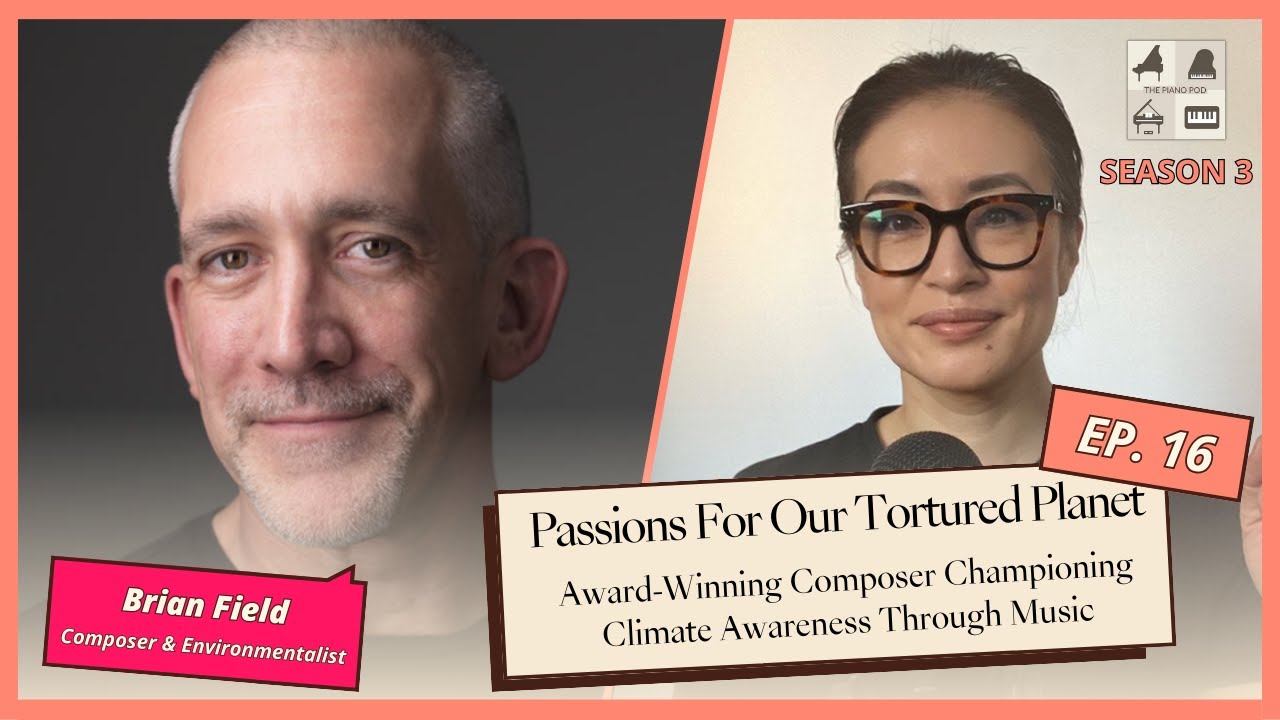
This content was created by The Piano Pod with Yukimi Song. This content was uploaded by The Piano Pod with Yukimi Song. This is a YouTube podcast episode titled "Season 3 Episode 16: Brian Field -- Multi-award-winning Composer & Environmentalist" (published April 12, 2023). It is an interview-style episode of The Piano Pod with Yukimi Song in which host Yukimi Song speaks with composer Brian Field about his climate-change project "Passions for Our Tortured Planet" (a suite of three piano movements: Fire, Glaciers, Winds). The conversation covers the genesis and structure of the pieces, performances and outreach (streaming availability, Earth Day events in Brooklyn, multimedia presentations), how musicians and non-professionals can participate (free scores, social media, donations to the Union of Concerned Scientists), challenges around climate-change advocacy, and broader thoughts on multidisciplinary approaches in classical music. Other voices include show production/ad reads (promotional mentions of Forte, sponsors like Yamaha and Patagonia) and brief narration/intros. The episode is aimed at classical pianists, music educators and listeners interested in using music for environmental advocacy.
Chapters
Welcome back to another episode of The Piano Pod with Yukimi Song. Hey guys, next Saturday, April 22nd, is Earth Day, and to commemorate the day and appreciate our planet Earth, I thought I should focus on the topic of climate change for this episode.
According to United Nations, climate change is defined as long-term changes in climate and weather and has become an alarming issue that threatens many human lives. Sadly, we as humans, our activities are the main cause of disastrous weather events. And in recent years, more and more people from all walks of life have been raising awareness about climate change. In our industry also, some musicians are already stepping up using their music and performance to remind us that our dear planet is in danger. And today's guest Multi-award-winning composer Brian Field is one of them. He has recently started a project about climate change. So if you are a musician or music student, I hope you get inspiration from this episode to use the power and gift of music for the greater cause, whether performing, composing, or teaching music. So before getting started, I want to welcome everyone watching The Piano Pod with Yukimi Song with Yukimi Song for the first time. I'm a classical pianist and educator from New York City, passionate about creating a thriving and meaningful community of the classical music industry through this podcast. Please visit yukimisongstudio.com to find out more about my work. In each episode of The Piano Pod with Yukimi Song, I interview a guest speaker who has been breaking exciting new ground in the industry. Before getting started, I want to thank everyone for tuning in. Please rate the show and review it on your favorite podcasting platform because every rating, review will help people find my show. So please stay with me till the end of the episode because Brian will tell us how all of us music lovers can get involved in this incredible project to save the Earth. So here we go, dear friends, please enjoy the show.
You are listening to The Piano Pod with Yukimi Song with Brian Smith.
You are listening to The Piano Pod with Yukimi Song where we talk to the brightest minds in the industry about how they are bringing the piano into the 21st century.
I am honored to welcome Brian Field, a winner of many notable awards, including the grand prize of the Vivaldi International Competition and the first prize of the Briarcliff Choral Music Competition. But his talent and passion go beyond these recognitions. Brian has recently started a project about climate change. He has written Passions for Our Tortured Planet for solo piano and invited many pianists worldwide to perform and support this project. So here we are today to discuss Brian's project Passions for Our Tortured Planet, what this is all about, and how we as pianists and listeners of piano music can participate in his project. And also, we will discuss how classical musicians can be part of social environmental issues and inspire others to support a cause through the gift of music. So welcome, Brian. Thanks for being here today. Yay!
Thank you very much, Yukimi. I'm very pleased to be here with you.
Oh, thank you so much. So I saw your recent Facebook post about your composition, Three Passions for Tortured Planet, which is the center of our conversation today. And then this set of three pieces has been awarded first prize at the 7th International Moscow Music Competition, correct?
That's right.
Wow, congratulations, congratulations, well deserved. Yes, and I really enjoy listening to all 3 pieces, you know, starting with Fire and then Glacier and then the third one is The Wind, right?
That's right.
We're going to talk more details about that. So finally I'm able to invite you today. We've been communicating, you know, through emails for quite some time, and then, um, but now I'm ready to really talk to you about your project. So let's Let's talk about Passions for Our Tortured Planet, which is based on your compositions under the same title. So what is this project about?
So the project really stems from the increasing polarization around the whole issue of climate change. And it's no surprise that it's in the media, kind of in the cyclical nature. You know, something, some big piece of news happens media outlets talk about climate change, you know, for a moment in time, and then it subsides. It's on to the next headline. And the need for us all to take action and begin to build a much more unified groundswell around action, it requires more consistency in that message. It can't be just a periodic, I turn the TV on one day or the radio on one day and I hear about it like, oh, well, I better do something. And then tomorrow people are thinking about something totally differently. And so this whole effort was an opportunity to create a consistent year-round, week-to-week, month-to-month, day-to-day, actually, opportunity to keep the discussion around climate change in the public sphere, in the audience regularly. And so the whole design of this is essentially a suite of 3 movements, as you noted, and each pianist who wishes to participate— and they can be a professional concert pianist, they can be an amateur pianist, it doesn't really matter— can download the music at no charge. Can choose to play the entire suite, can choose to play one or more of the movements in recital formats, in social media, and posting it across social media. It's really an opportunity to continue to keep it on the forefront of social media and media in general to engender discussion around this topic. It's— in so far, we've been quite successful with it. We launched just at the beginning of last year, of 2022. And, you know, the piece is originally conceived and written for a fellow Juilliard alum, the pianist, South Korean pianist, Kei Kyung Eun Kim. And, you know, she took it out and premiered it in Seoul. Subsequently, we've had over 50 pianists joining this project from around the world. I think we're on pretty much every continent now except for Antarctica. Still to come, I suppose. We'll get someone down there to play a movement. And the groundswell around it, you know, has been very meaningful in fostering that discussion. You know, we have obviously several live performances and recitals that have taken place. We have one— and I know this episode is going to be airing in April. You know, we have one around Earth Day, which is the 22nd of April, which will be in Brooklyn, New York. And so, and that's going to be a multimedia extravaganza.
Really? Brooklyn where? Because I live in Brooklyn.
So it'll be this piece performed by the pianist Francesca Khalifa. And it will also include a short film by a filmmaker by the name of Anda Karbouchia. And it's being sponsored by Yamaha and Patagonia Brooklyn. We'll have, hopefully, knock on wood, different scientist representatives there as well for discussion purposes. And the entire proceeds for not just, you know, the, that particular concert, but this entire project are being donated to the Union of Concerned Scientists, which is an organization that's been around for 50, 60 years now at this point. And it's a group of scientists that are creating programs, educational types of programs in support of of this issue. So I felt it was a great opportunity to, you know, to donate to their cause, to their activism, and has been, you know, greatly appreciated by them and by the performing musicians so far as well.
Right.
Wonderful. Thank you so much. So when did you conceive this idea of of this project. Did you have any specific experience that influenced or inspired you to start this?
Yeah, so my parents live in California. I'm just outside of New York City, but my parents live in California. And actually, my sister lives in California with her family as well. And so recently there have been a whole spate of fairly significant forest fires that have been threatening the Northern California coast specifically, but it's not isolated just to California or to the United States. A few years ago, almost the entire continent of Australia was on fire for a period of time.
Right.
And so, you know, this notion of really radical and dangerous environmental episodes happening across the world certainly was impactful in the realm of fire. I also, um, had recently been to Alaska where, you know, saw these glaciers and the, the, the people that were, um, locals there, you know, took our family up to this particular glacier and said, oh, you know, really, uh, sad because this glacier 10 years ago used to be much, much bigger and now it's like a stub of what it used to be. Oh my God, it's melted considerably just in a short period of time. So that was another particular telling moment that was an inspiration to this piece.
Tell us more about the pieces for this project. There are 3 movements, as we just talked about, and then can be played all 3 together or individually, as you mentioned. And then those 3 are Fire, Glaciers, and Winds. And then I particularly love Glaciers of all 3. I like all 3 of them, but my favorite is the second one. So can you walk through each piece?
So there are 3 different, as I mentioned, that, you know, we've over 50 participating pianists so far and just got another one this morning. So 51 at least. And so, you know, so these 3 represent different geographical areas that have performed this. So, you know, the first one Kazuki Nagagoshi is a pianist out in San Francisco, so he's the one that's playing fire. Kei Kyeonung Kim is the dedicatee of the piece, and her performance in a local Steinway Hall in Seoul represents kind of an Asian performance. And then I hope I don't butcher her last name, Vassalisa Borgotskaya is the performer for Winds, and she's out of Moscow. So, you know, great performances all, and I hope as, you know, listeners, watchers of your show see these excerpts, they enjoy the excerpt and then seek them out in full form. On YouTube or other outlets.
Right.
So the overall structure of it is fairly traditional in the kind of fast, slow, fast type of Western mode. The first movement is Fire, as you mentioned, and it starts out very simply with a single note, essentially an ostinato that starts out slowly with pauses in it. Begins to build and build. It becomes fairly contrapuntal early on, kind of quasi-Bach-ish, before really growing and expanding. This is the kind of the wildfire spreading and spreading and spreading until it becomes very, very violent and very consuming and then finally dies out at the very end. The second movement, Glaciers, is more ponderous and quasi-Debussy-like almost in many ways. And it's, you know, explores the, you know, the very highest and lowest registers of The Piano Pod with these big chords. And then towards the maybe about two-thirds of the way through it, becomes interrupted by these really sudden arpeggiations down to, you know, these big kind of crashing clusters of tones, which is meant to represent the shearing of ice from the glaciers falling into the ocean beneath. Um, so that's, uh, the second movement, Glaciers. And then the third movement, Winds, which again, depending on where you might be in the world, could be, uh, representative of hurricanes or typhoons or tornadoes for that matter. You know, begins very simply, almost sort of a gentle breeze, and then begins to build and build and build and build to this sort of destructive type of nature, which then finally concludes as well in kind of the dying down of it and, you know, the reverting back to that breeze type of that feeling.
You know, there have been so many, you know, powerful hurricanes, storms.
Actually, it's, it's not so much the frequency, much the intensity of them, um, have really grown over the past years, right? I mean, we've always had, uh, you know, some elements of hurricanes and typhoons around the world. That's a natural weather phenomenon, but the intensity of them has, you know, increasingly, um, been the issue, right?
Um, yeah, and they're quite disruptive, and it really changes people's lives for forever. I myself experienced quite a few hurricanes. I used to live in Florida, and then I've experienced a couple of them. And I was there when Katrina hit in New Orleans, which was not really far from where I used to live. And now in New York, I also experienced Sandy, which was a huge disruption in many, many ways. And some—
Flooded the entire subway system.
Right, exactly. Then they are still, you know, rebuilding the subway due to that disruption.
And I think it's important also to point out that, you know, even though this particular topic of climate change, you know, can become so alarming and people can become so desperate around it, you know, it's so apocalyptic feeling sometimes. These pieces all end in a fairly hopeful manner. It's not, you know, the world's destined to destruction, but rather we have an opportunity to change things. Increasingly shorter and shorter runway of that opportunity to change things, but nonetheless, still an opportunity. And so all three of these pieces end with some element of hopefulness.
Sounds like, you know, you are already sparking the conversations. I saw so many publications and they have been written about your project. And so any challenges you faced, you know, any project that we, we do, there's always a challenge, and then challenge that worth overcoming.
So, you know, I think that the challenge, interestingly, is part of the reason for the very reason for the piece. The challenge is around the polarization of this topic. So, so many people obviously, you know, see it and they see the scientific evidence around climate change is so prevalent. And, and so people take it as, you know, just a— it's a fact. And yes, we have to do something. And, and, uh, try our best to, to do those things. There's another whole segment of the population that doesn't believe it, that believes that it's some sort of conspiracy, uh, invented by the government or invented by plutocrats or invented by, um, you know, some other people. Um, I mean, I guess there are still people that believe the Earth is flat, uh, as well, uh, regardless of Evidence to the contrary. But, you know, that's, I think, one of the reasons for the genesis of this project in the first place is to be able to engender a discussion without there being a screaming match attached to it, right? It's a little bit easier to do it softly through artistic mediums rather than having a verbal debate which due to the echo chamber of our current reality oftentimes is met with disbelief or just, you know, there's no changing people's minds in that kind of a forum. In a gentler way, perhaps there may be. And so that was part of the genesis of the project. One of the challenges around this, it continues to be while promoting performances and pianists that take it out. There's still a social media flaming going on around how, what a ridiculous thing this is. Of course, we've always had bad weather. And this is not a weather-related type of incidents that we've been seeing. This has actually been, you know, a change in the overall global climate. And so I think that's part of the principal challenge of the whole project. As with any type of advocacy in this, in this, you know, field and climate change, there's always going to be people that say, no, I don't believe that this is actually a thing.
Right. And then, you know, as we see sometimes in the news where young people go to the museum in Europe and then throw food at one of those, you know, famous masterpieces, that's— I get the point, but I think you are doing the opposite way. You're using art to educate people and influence people, not to twist their arms and then, you know, force them to believe in something but a more subtle way. I think music can do that, right?
And then I can appreciate the desperation of the, and the group I believe is the Last Generation, they call themselves. Um, you know, so it's, it's a, you know, it's an act of desperation. It's, you know, trying to do peaceful protesting, getting nowhere. It's an opportunity for them to newsjack. And get people to talk about it. As I mentioned earlier, that sort of, you know, peaks and troughs of the mainstream media. Of course, the mainstream media is going to cover, you know, people throwing soup at a Van Gogh or, you know, gluing their hands to, you know, the Audubon, you know. But those kinds of peaks, and I mean, that's a moment in time, and now, no, you know, like we're talking about it, but mostly people have forgotten it, or they just think of, you know, those some crazy youngsters who are doing something destructive. And isn't that horrible? It's not very helpful to the overall cause, certainly in the longer term.
Is there any specific positive news about this project? Like after you've done this over a year of this launch of this project, is there any like specific positive news that you can share?
Well, I think that, you know, early on in the project, it's, you know, like any project, it's an idea and, you know, one or two people support it and, you know, it begins very softly and slowly. And now there's a regular cadence of performances and the carrying out of the messages. And frankly, some— and I love the fact that in some cases I don't even know about it, which is perfect. I'm like, I don't need to know about it. People that are doing it just on their own, doing it organically. Posting things on social media around it. Again, it's around taking the message and consistently keeping the message in the forefront wherever possible. This opportunity that I mentioned for this Brooklyn event, another great opportunity because this will be the first time where there's— it's a multimedia event with other artists and with the kinds of corporate attention to help support, you know, the overall effort in an aligned way. Right. It's not like, I mean, if Exxon were supporting it, we probably wouldn't be doing it. But, you know, but Patagonia is a very aligned brand. With the types of environmental activism that they do on their own.
Patagonia is the sporting company.
Yeah. So it's an apparel company, large outdoor apparel company, and very, very committed to outdoor activism, to environmental activism.
Right, right.
So great example there. And perhaps the first of many more similar types of things to come.
Well, those events are going to be really powerful using multimedia equipment to music that supports and also visual arts to support with the presenter being present. And that is going to be really a powerful thing.
This episode is presented in collaboration with our good friends at Forte, a free alternative to Zoom purpose-built for music teachers. Forte offers features optimized for classical music lessons, including audio quality far superior to existing platforms and allowing you to hear every nuance of your student's instrument. Their colleagues at the Royal College of Music, Aspen Music Festival, Curtis Institute, and Berklee College of Music have even used Forte in their own programs. Forte's mission is to radically expand access to high-quality music education worldwide. Forte always puts teachers and their students first. This means you can use Forte with your own students for free forever, and Forte will soon introduce paid features allowing you to connect with new students around the world. Sign up for free today at fortelessons.com. Or click the link in the description.
Now, what is the next step and next stage for this project? Would you like to add more pieces, or would you like other composers in the future to participate, for example?
You know, that's a good question, Yukimi Song. It's, you know, certainly, you know, I'm not alone in those composers that have, you know, written on this particular topic, and there are plenty of visual artists. So I can certainly envision that there, you know, maybe things in the future perhaps centered around particular points in time. Earth Day is a great example, you know, it happens annually, and, you know, an opportunity to create a larger multimedia type of event. It's all a matter of of overall support and time and, you know, being able to organize it. But, but, you know, certainly a great opportunity there.
Wonderful. So, and then what sort of long-term effect from this project do you desire?
Well, I suppose I would desire, you know, that the Union of Concerned Scientists, who's the beneficiary, you know, of this project, continue to see it as a bit of an annuity to the types of activism programs that they support. And really, I think that that's the primary opportunity, that this becomes a fuel for their efforts.
Now, how can we participate in this project? So as a musician myself, pianist, And you mentioned that I can download a score and then perform to bring awareness. And as a non-musician, how— you know, I have quite a lot of non-musicians, maybe they play the piano but play for fun. How can they participate?
Yeah, I mean, they can participate as well. You know, the movements are structured in such a way that even non-professional pianists or just music lovers, as you know, like Glaciers is a great example. I mean, that's not— it's not a terribly difficult movement for performance. So even those that are not professional pianists can download it and learn and upload to social media and lend their voices to, to the project. Um, those individuals, uh, likely have spheres of friends and, uh, influence on their own. Um, so being able to, uh, you know, to, to share that and then also to, uh, you know, reference, uh, potential donations to the Union of Concerned Scientists is a fantastic way for broad participation regardless of the, um, the particular abilities of any one pianist.
Right. Now, these 3 pieces are also available on music streaming services like Spotify and Apple. Now, by listening to them, are you raising funds?
Well, as you know, unless you're Elton John or Beyoncé, Rolling Stones or something like that, or Beyoncé, yeah, the royalties, sadly, that come through to composers and musicians through streaming services are paltry at best. Nonetheless, any of those that are collected will be donated to the union.
Hey, TPP friends and listeners!
The Piano Pod with Yukimi Song with Yukimi Song with Yukimi Song.
The Piano Pod with Yukimi Song with Yukimi Song. Thanks to all of you for watching or listening to every episode since its launch in 2020. I started this show with a simple question I had in mind for quite some time, which is, how can we as classical pianists and music educators present the beautiful classical music tradition to the 21st century audience in a fun, contemporary, and engaging way? It's been an incredible journey for the last 3 years. I love what I do through this podcast, providing a platform for pianists and educators to reflect, and discuss freely how we can keep the classical music industry thriving and relevant in this rapidly changing world. Now more than ever, I need your support so that I can continue my work by bringing you highly valuable content biweekly by interviewing groundbreakers in the industry. Your support will go directly to all the costs of The Piano Pod with Yukimi Song, such as a yearly subscription to podcast hosting platform, the software I use for high-quality recording sessions, and tech gear, as well as all the hours I spend researching and audio and video editing. You can make a one-time donation or monthly pledge by clicking the PayPal link in the show notes or going to TPP's website at thepianopod.com. As a thank you, you will receive The Piano Pod with Yukimi Song with Yukimi Song. Fun logo sticker in the mail. So please support my show today and don't forget to subscribe, continue listening, and tell your friends and colleagues about The Piano Pod with Yukimi Song with Yukimi Song. Let's continue with the episode.
So let's talk about Mr. Brian Field. You're the multi-award-winning and multi-genre composer. You've written for orchestra, chamber, choral, vocal, piano solo, jazz, funk stuff. And I also listened to this morning electronic music. That was really wild. I loved it. Now, I particularly enjoy your choral and then the piano solo pieces. And so how and when did you discover your love for music?
Oh boy, that goes back quite some time. So I'm 55 years old. And, uh, you know, started, you know, playing piano when I was, you know, 8 years old or so. And, uh, you know, even at that early age began sort of dabbling around and trying to write down music as well. And I had no idea what I was doing, of course, but, uh, but even at those early ages, um, you know, had an inclination to try to, you know, write down what I was thinking about, what I was hearing. And that really took, you know, took a real firm hold on me in sort of my later teenage years, where, of course, as I, you know, continued to play piano, also began to sing in choirs, and encountered a graduate student at Bowling Green University. Then at the time, I was living in Ohio. Who really was seminal in my kind of thinking about and writing down music, you know, actually becoming the beginning of a composer. And it was all about learning past music, grounding myself in Renaissance tradition, in Baroque, you know, in the classics, and a lot of, I guess this is sort of, you know, the way of the past, like copying, hand-copying Bach to be able to understand how the contrapuntal elements of Bach style work. And so, you know, through that sort of old-school process, I suppose, found myself increasingly excited about writing and writing for not just the instrument that I started playing, but writing for voices and writing for other instruments as well, gathering together young musicians and youth orchestras to play my early works. You know, all great fun. You know, I ended up going to a liberal arts college. It wasn't a conservatory, but I majored in music there at Connecticut College. Um, another great opportunity because it was a small setting, um, where I was able to do a lot and, you know, again, pull musicians in, uh, you know, to be able to, uh, experiment. Um, and then, uh, did graduate work at Juilliard, uh, studying with Milton Babbitt there. And, um, and then finally my doctoral work at Columbia University, uh, with Mario Davedoski and then George Edwards as well. So, you know, great, uh, you know, great background and training and schooling, um, you know, and then to, you know, subsequent to that, it's, it's really a matter of, um, you know, being passionate about writing music and connecting with musicians and learning all the time.
I particularly, as I said, enjoy listening to your choral music. Like Christmas Carol was very beautiful, and then I don't know if I'm saying correctly, but Beatitudin?
So it's a The Beatitudes. It's a setting of the Beatitudes for chorus and chamber orchestra.
Yeah, and then Aurora Lucis— I can't pronounce the words. Yes, sorry, I should have—
there's always a problem. Uh, really tuning in and becoming excited about choral music in my sort of later teen years. You know, driven by fantastic teachers. I think that's really a key, uh, point to, to share is that, you know, an individual, uh, musician in a— certainly in a nascent stage, but really any stage— can be so transformed by an excited and passionate mentor. And, you know, that kind of thing is, um, is so powerful. Um, and I was fortunate to have that, uh, when I was 16, 17 years old in the choral, uh, world, right? Where before it was like, okay, yeah, let's sing, let's— that's fine. Um, but then, you know, tuning in, uh, with this particular individual— his name's, um, Steve Whitley, um, and, uh, he's obviously retired at this point, but, um you know, exposed me to so much, um, you know, kind of the richness of really serious, uh, choral music, you know, of Debussy and Mozart and Bach choral music, and, um, you know, William Schumann, like modern choral music as well. Um, so it was a really, um, exciting, uh, time that then got me excited about writing for choirs.
Right, and then I wonder if you would think about writing choral music for the project, for the, you know, current project, maybe eventually?
Perhaps so, perhaps so, yeah. I mean, I've actually— I mean, I'm working on a couple of projects, one that I can't really talk about right now, but another one that's kind of a broader social commentary on things happening in the world today. And that's going to be an instrumental vocal piece.
I also love the Three Moods for Piano. And then, oh, I had a question about this Four by Four piece. So there was like a Five Four by Four and then Two Four by Four.
So yeah, it's really funny. So it's a a little trick I picked up from Bach and I suppose Handel as well, which is reusing music as well. And so there's, you know, there was a piece that I wrote for two violins and, you know, kind of a jazzy piece. And I used it essentially as the springboard to begin to kind of blow it out into different types of ensembles. So that one piece which is called "And All That Jazz," because it is a little jazzy, then found its way into different permutations of, you know, like string quartets. So now it was, you know, kind of 4, 4, 4 by 4 or 4 by 4. And it's a kind of a square, you know, it's in 4/4, right? And so but then because of the jazzy sort of improvisatory nature of it, you know, it kind of bends and becomes more fluid. But I took that and then took it in and changed it into a wind quintet and then a wind sextet and then a nonet and then a string orchestra piece. So it, you know, it was fodder for a bunch of different essentially arrangements of the same piece in different instrumentation.
Yeah, that's right. Wonderful. I enjoyed listening to them, and then especially the arrangement for the wind quintet, which you won the Vivaldi International Competition, and congratulations. So that YouTube clip I really enjoyed. Now also, you compose electronic music and then jazz funk stuff.
So do you have any backgrounds Uh, well, so I mean, in electronic music, obviously studying with Davidovsky and Babbitt, I mean, both of them were really old school, uh, you know, uh, early adopters and early pioneers in electronic music. Learned a great deal from, from both of them. Less so, um, Babbitt in electronic music, who was much more of a super broadly minded composer. Davidovsky had a whole set of kind of acoustical nuances and almost orchestral tricks. And, you know, that he certainly used over and over again in his synchronisms. So I tried to use some of that, that kind of technique in my work. You're going back to Babbitt for a moment, you know, a fascinating fellow because of his, you know, broad intelligence and incredible encyclopedic knowledge of a vast variety of different types of music. You know, people tend to think of, you know, they listen to Babbitt's music and they assume that he was very pedantic about writing in his particular style, which is absolutely not the case. You know, I would come to him with choral music that was, you know, highly chromatic and not a serial type of thing at all. And, you know, you'd love it. You know, Stephen Sondheim studied with Babbitt. You know, there's, you know, a great deal of kind of, again, practical insight that he was able to share regardless of the particular style in which any composer was writing. And he just, uh, you know, and his background was actually in jazz and popular music.
Wow, wow, interesting. How interesting. So now let's just get into a little bit more philosophical questions. Let's talk about the vision or future of the classical music industry. So under the umbrella of classical music, how far can we push in terms of multidisciplinary works and performances? As you write, you know, different— I mean, you're a classical music composer. Most of the pieces are based on this traditional, you know, classical music. However, you write sometimes, you know, funk, jazz kind of things and electronic music.
So it's certainly transforming. Um, and I think that there's a— there are a couple of different elements in play, one of which is the availability of technology that can— inexpensive technology that is now widely available to pretty much anyone. You know, certainly, you know, even 20, 25 years ago, you know, you'd have to buy a bunch of expensive equipment, thousands of dollars worth of expensive equipment. And now, you know, through oftentimes free apps, inexpensive types of mixing tools, inexpensive sampling that's available now today, anyone that has the inclination to compose in whatever style can do it. Now, that doesn't mean they necessarily have training around it, but that frankly doesn't matter. They're doing it. They're making music. And, um, and I think that there's going to be a, a continued kind of synthesis of what quote-unquote classical music is with the rest of music, much the same way that we see remixes of kind of tried and true pop songs now being, uh, remixed and mashed up with modern R&B and rap. So I think there's going to be this ongoing fusion. Is it like, are people going to be having the same kind of concert experience that they have today, sitting in a solo piano concert in another 20 or 30 years? I'm sure there still will be. And there'll be other stuff too. There'll be— I just came from a performance this past weekend in Arizona, and there was a pianist who was surrounded by this massive multimedia display of colors and augmented electronic sounds along with it. And then also at one point got up from the piano bench and began to dance.
Oh my goodness.
And then went back to the piano and continued to play. So the kind of fusion cross-disciplinary thing, you know, can be really, uh, can be really engaging, uh, for audiences too. I saw another one, um, and I forget which, which piece it was, um, uh, with a similar type of dynamic where the pianist was on stage, um, with a group of modern dancers, uh, probably about 6 or 7 dancers, and actually was a, uh, a interacting with the dancers, you know, so, you know, would be playing both hands and then at one point would be playing just left hand and his right hand would be up and, you know, moving around with the dancers, you know, so that again, interesting type of collaborative work.
That is interesting. So, yeah, then along with that question, so how can we as classical musicians reach out to the 21st century audience with— in a creative way? You may already have answered some of the questions, but—
Part of it is to also ensure that there's a bridge to those that may not be regularly exposed to, again, quote unquote, classical music.
Right.
Leonard Bernstein is a great example of this, you know, in the the types of programs that he would run to talk about the pieces of music that were going to be played and to deconstruct them and to provide context to an audience that, I mean, in those cases, you know, people at the, you know, sitting at the New York Philharmonic were probably already pretty primed and ready for some good old music. But for those coming to a general recital, having some kind of context, you know, being able to speak to some degree to the audience about what they're about to hear, you know, to, you know, to, you know, kind of break the third wall and, you know, talk about themes that they might— and play potentially plays themes that they might be hearing, and here's how it's going to transform over time. Okay, now let's hear the piece. We'll play the piece, as opposed to potentially being, you know, the kind of traditional walk on stage, play, intermission, play, and now the concert's over.
It's all about giving them the context, right? Yeah, and then I feel like that's exactly what you're doing with this, uh, Passion for Our Tortured Planet in many ways, because, um, uh, the title obviously reflects the cause, but also, um, as a pianist, if I chose to play those 3 pieces, I would I first of all speak to my audience and say, hey, this is the project and this is the cause, and then hear me, listen to the piece that I'm about to play. I think it's important to giving them the context so that they can engage in the music better rather than just good old, you know, come up on the stage and bow and then play and then bow again and then leave. Yeah, that kind of thing. Yeah. That fits for a specific audience, you know, go to Lincoln Center, Carnegie Hall, and so forth. But yeah.
Yeah.
But, you know, even, I mean, Bernstein was doing it and he was at Lincoln Center.
Oh, yeah. That's true. They should do more.
So I think in some cases it just requires a little bit of bravery, you know, to break the mold of what the traditional recital is and instead make it much more of an interactive type of experience.
Absolutely. Yeah, you're right. So now I'm going to go back to your passion for Our Tortured Planet. So, you know, you are bringing awareness really in a subtle way. So how do you think music can uniquely bring awareness of social and environmental issues and inspire others to support a cause compared to other forms such as writing, speech, poetry, or visual arts?
I think they're not— so none of them are one better than the other. And in some cases, they're an amalgam of different types of mediums. You know, where there's a text, you know, whether it's a choral piece or a song, there's the written word as well as the music. Visual film, for example. Video incorporates oftentimes music as well, along with the visual images. But there is a— and I think that the distinction here is that there's a— in the kind of pure music sense, you know, absent the visual elements, there still is that that sort of ineffability, the emotional piece of it that people can respond to in a way that they may not necessarily through an explicit text have that same kind of experience because everyone brings their own personal histories then in the absence of having the written word or the spoken word attached to it. So those types of things can be visceral, um, you know, and a purely emotional response. And oftentimes those emotional responses are the things that push us or drive us into some sort of action, um, or at least help drive some of that action. Um, and so that's where I think the, the, the purely musical piece can be helpful in, um, in helping to drive a particular social cause, but married with visual elements. I mean, we're all visual creatures as well. That can make it very powerful too. And that's, you know, why, you know, having this kind of social media amplification element of the Three Passions is also very important. Some of, some of the pianists have already done, taken it upon themselves, and they've created almost like, quote unquote, music videos, almost while they're playing. You know, there are some pianists that have done that with glaciers where they actually start to juxtapose, you know, images of glaciers and the shearing of the ice.
I've seen that. Yes, that was very powerful.
Right. And so, you know, now you've got the marriage of the visual and the audio together. You know, there and certainly have been, you know, plenty of vocal pieces on the topic of climate change and around social issues. And those too can be very powerful when integrated with music and visual media.
Yeah, there are so many ways to do that. There are so many ways to— let's say, let's talk about your project. So not just a good old traditional way of playing in front of the audience, but we can reach out to audience by you know, putting together a visual and then the audio and post it on TikTok or Instagram, for example. Yeah.
Oh yeah, yeah, yeah.
That's great. That's good to know. Yeah, that's also spark their curiosity and conversation and hopefully, you know, for some to change their minds about, you know, environmental issues. Yeah. Any advice for younger musicians? So what skills are they required or demanded as musicians of the 21st century, do you think?
Curiosity, I think, is the name of the game. Being curious and being open to new ideas, to new things that you hear, to trying out new things, as I mentioned, with the notion of bucking the traditional recital paradigm. I think there's— I mean, I was at a college about a year ago or so, part of a choral rehearsal of Peace of Mind, and we had a discussion afterwards where a lot of the college students there could ask whatever they wanted to. And there was a young woman there who asked that same thing. She's like, I'm really interested, but I'm not a trained musician. I like singing in this choir, but what do I know? And I hear some people saying, oh, I've got to go through a bunch of formal training and I've got to learn a bunch of stuff. And I was like, no, no, you don't. All you got to do is have a passion around it. And to do it. Be passionate, be curious, and do. I think that was Maria Callas's in the— okay, play master class, you know, where one of the students of the master class came up and said, well, I'll try, I'll try. And it's like, don't try, darling, do.
Absolutely.
Yeah, be curious. Be passionate, take action, and all the rest will follow. Like, you know, if you're, if you're curious and passionate, you'll be curious and passionate about the musical world around you, uh, you know, whatever that might be, and continue to expand it as you gain more information.
So if you're interested in checking out, please go to passionsforourtorturedplanet.org to find more about Brian's project. And also you can go to his website at brianfield.com so that you get— you can hear his music. On his website, and then also most of the music is available on streaming services, correct?
That's right.
Yeah, wonderful. This has been such a fun, inspiring conversation, Brian. But before I let you go, we have one more thing to do. It's called TPP Rapid Fire Questions, and this is part of the show where I get to ask fun questions to each guest. Now here's a little warning: as silly as these questions may sound, Your answers may reveal who you truly are. So, oh, are you ready?
Terrified.
No, it's gonna be okay. So please answer them with the shortest responses as possible, and then no explanation is necessary.
Okay, all right.
Yeah, yeah. So number 1, what is your comfort food?
Pizza.
All right, amen to that. Now, how do you like your coffee?
Black.
Cats or dogs?
Cats.
Okay.
What is your word or words to live by?
Passion.
Great. What is the most important quality you look for in other people?
Integrity.
Yes.
Name 3 people who inspire you, living or dead.
Abraham Lincoln, Milton Babbitt, and Steve Wolf.
Okay, great. Thank you. I know that that's a tough question usually. All right, name one piece in your current playlist.
The Dimming of the Day.
The Dimming of the Day by who? Who is that?
Oh, people are gonna have to look it up now.
Yeah, okay, I'm gonna look it up. Now, last question, fill in the blank: music is blank. Power. Ah, great, ding ding, you won. Thank you so much for answering all these questions. So this concludes this episode of The Piano Pod with Yukimi Song with Brian Field. Thank you, Brian, for joining my show today and sharing your stories and insights and expertise. And you can find more information about Brian and his project through his website at brianfield.com. And if pianist, I urge you to partake in his project, Passions for Our Tortured Planet. For more information, please visit passionsforourtorturedplanet.org. And thank you to my wonderful audience and fans for tuning in. If you enjoyed today's episode, please rate and review it on whatever podcasting platform you use. Remember to hit the thumbs up button and subscribe to my channel if you are watching this episode on YouTube. Follow TPP on social media to get the latest piano news via Facebook, Twitter, Instagram, and LinkedIn. I will see you for the next episode of The Piano Pod with Yukimi Song with Brian Smith.
Bye everyone, and thank you, Brian. Thank you so much. Thank you so much.
More from The


Spirit, Body, and Soul: Pianist & Composer David Berry on Virtuosity, Creativity, and...



Season 6 Episode 20 | "Spirit, Body, and Soul" feat. David Berry, Concert Pianist & Composer


Beyond Borders: From Argentina to Poland to Texas—Oscar Macchioni reflects on a life in music

Sound Liberation: Joe Williams on Black Artistry, Legacy & Belonging in Concert Music


