Season 3 Episode 18: Priscila Navarro -- "The New Peruvian Figure of the Piano"
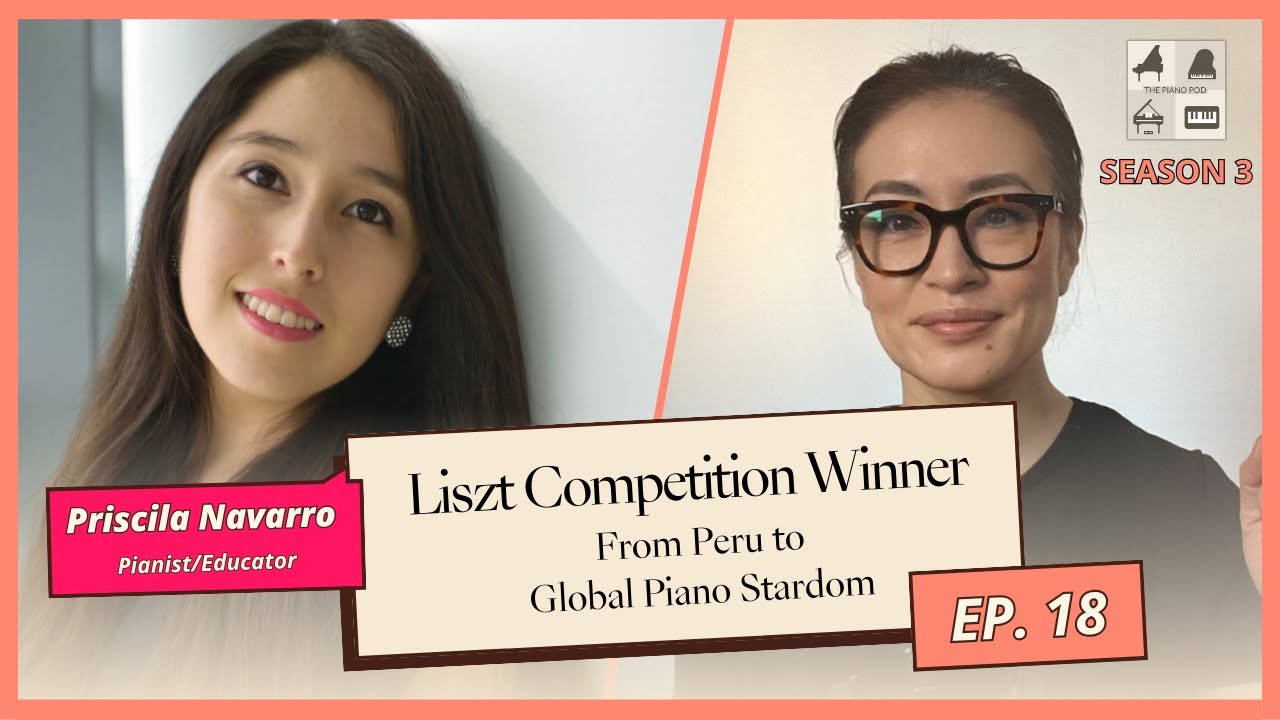
This content was created by The Piano Pod with Yukimi Song. This content was uploaded by The Piano Pod with Yukimi Song. This is a YouTube podcast episode (Season 3, Episode 18) of The Piano Pod with Yukimi Song (published May 10, 2023) featuring an interview between host Yukimi Song and guest Dr. Priscila Navarro, a Peruvian multi‑award‑winning concert pianist, chamber musician and educator. The conversation covers Navarro’s competition history (Liszt competitions, Vigo prize judged by Martha Argerich), her January 2023 recital at Yamaha Artist Services (including a self‑made transcription of a Peruvian waltz), her training and mentors (Lidia Hong, Dr. Michael Baron, Santiago Rodríguez, Kevin Kenner), duo recordings and performances (including Carnegie Hall), and her work founding the Parnassus Music Society to give back to Peru. The excerpt is an interview-style, spoken conversation published as a podcast/YouTube episode.
Chapters
Welcome back to another episode of The Piano Pod with Yukimi Song. So for this episode, I invited Dr. Priscilla Navarro, multi-award-winning concert pianist, chamber musician, educator, and advocate of Latin American pianists. So I went to this concert in January of 2023. It was hosted by American Liszt Society New York-New Jersey Chapter, and there were 3 amazing young concert pianists who were performing that night. And then Priscila, today's guest, was one of them, and her performance really stood out. Don't get me wrong, all 3 pianists were Spur. However, I don't know what it was, but Priscilla's performance took me to, to a different place. Like, I felt like I was on a journey somewhere, and all the five senses got activated. It's really something special to experience that when you attend a piano concert. Since then, I wanted to invite her, and I just finished interviewing her, and she is not only an amazing pianist, but she has a lot of wisdom of life, and she's doing some amazing things for her, uh, the community of her native country, Peru, creating a bridge between the classical music and then the society in a much bigger way. So you get to hear all these amazing stories from Priscilla. So before inviting the guest of the episode, Dr. Priscilla Navarro, I want to welcome everyone who is listening or watching The Piano Pod with Yukimi Song with Yukimi Song for the first time. I'm a classical a pianist and educator from New York City, passionate about creating a thriving and meaningful community of the classical music industry through this podcast. Please visit yukimisongstudio.com to find out more about my work. In each episode of The Piano Pod, I interview a guest speaker who has been breaking exciting new ground in the industry. Before getting started, I want to thank everyone for tuning in. Please rate the show and review it on Apple Podcasts or review it on wherever you get your podcasts, because every rating review will help people find my show. So here we go, dear friends. Please enjoy the show. You are listening to The Piano Pod with Yukimi Song, where we talk to the brightest minds in the industry about how they are bringing the piano into the 21st century. I am honored to welcome Dr. Priscila Navarro, multi-award-winning concert pianist, chamber musician, and educator who was described as the new Peruvian figure of the piano. So welcome, Priscila. Thanks so much for being here today.
My pleasure. Thank you for this invitation.
Oh, of course. So, you know, I went to the concert back in January of this year. It was a cold night in New York. It was at the Yamaha Artist Services in Midtown Manhattan, and I was invited by Gila Goldstein. She is was in charge of American Liszt Society New York-New Jersey chapter, and then she sent me the invitation of the concert, which featuring 3 young winners of Liszt International Piano Competitions. And then one was Jihyun Kwak, and then another person was you, and then the third person was Derek Wang. And I was really blown away by all these 3 amazing young pianists and playing beautiful Liszt pieces. And but you caught my attention because, well, I have to admit, you know, it's very rare still, unfortunately, to hear accomplished Latin American female pianists, you know, winning multiple competitions and play, I mean, you know, exquisitely. And then I was blown away with your performance. But also, I think the way you presented your concert, your program, which struck me so much, and how you were able to connect with your audience. Although, you know, audience members, they were all professional musicians mostly was attending, but even then I really was impressed by the way you were connecting with your audience. So I want to know about the concert experience, but before that, can you tell me about the competition?
Yes. So, um, I participated in many LIS competitions. The first one was in the LIS Gerritsen competition in Baltimore, Maryland, and that was, uh, way back in 2013. And I was a winner then. Um, and I met, uh, Gila Goldstein there as well as many other LIS experts. So, but then years later in 2021, there was a New York LIS competition. The first edition of the New York List competition, and I won second place in that competition. And the year before that in 2020, I was a semifinalist in the Netherlands List Utrecht competition. Uh, but unfortunately that competition was canceled due to COVID.
There are so many, sounds like, list competitions. Are they all sort of related? Like, let's say, now the one in Utrecht, Netherlands. That's like the really big deal, the biggest, almost like, uh, you know, Chopin competition, right?
Yes, the one that Liz Gerritson that I won way back was organized by the American Liszt Society, and the New York Liszt Competition is directed by Adam Georgie. And the Liszt Netherlands, like you said, is probably the biggest, and that is you know, a whole organization that puts up this competition every 3 years. But yes, for a Liszt lover, it's fortunate that there is a lot of competitions honoring Liszt, and they all have different repertoire, different focuses. So I've been happy learning all this music for competitions.
So tell us about your experiences with this competition, especially the latest one that you won second prize. So you were able to perform with two other amazing artists. How was it like to, uh, win and also perform with them?
Um, it was, it was wonderful. Um, that competition was all online on the first edition, so I actually presented all my videos. I am a big Liszt lover, so I always have Liszt repertoire that I'm working on or that I've recently performed. So I, at that point, I submitted Beethoven Symphony transcribed by Liszt, the first Beethoven Symphony, along with Sarabande by Handel. And I believe the Weinenklaeger Sorgensagen Variations by Bach transcribed by Liszt as well. So, but that just happened to be the repertoire that I had that year from Liszt. More recently in the recital, I actually performed different works. As you may remember.
At the concert at the Yamaha in January 2023, which I attended, you performed all waltz. So Waltz by, you know, Liszt. And then you ended with this Peruvian Waltz, like, which is transcribed by you, right?
So when, when Gila presented us with this opportunity to perform, you know, share a recital between the three, three winners of this competition, I wanted to present a program that went beyond just what, you know, good music represented. So, and Liszt, one of the wonderful things about him is that he composed so many works, and he had so many different facets that you can really showcase different areas of his works. So, for this one, I chose waltzes. Of course, he wrote many more waltzes than this, but even in the samples that I played, you get a good sense of a wide range of Liszt compositional stages. So I put— I played Mephisto Waltz No. 3, which is a later work. It's kind of an exploration of different sonorities. It's not entirely— it is tonal, but it's not as centered as his early works. You know, it is virtuosic, but that's not the main focus. And then the Valse Impromptu is a great example of a more salon-like piece that he might have written in his youth. And I also think it's severely— it's not played as often as it should. You know, it used to be, and probably Sifra has the best interpretation of that work, but I still feel like for young people, it's wonderful to discover, you know, things beyond what people normally play by Liszt. And then the Waltz from Faust is fairly popular, and it's a wonderful work, and it's really an audience pleaser, and it shows this kind of superstar side of Liszt's personality. And then I connected it to a Peruvian waltz because It's very important to me to not only, you know, excel in the classical music world, but connect to my roots and to people from Peru. And, you know, coming from a family and a population that where really classical music isn't a main focus, it's important for me to kind of bridge these two worlds and show that we have more in common than we might think. So the waltz was actually imported from Europe to Peru hundreds of years ago, and it became a main form of popular criollo music. And the waltz that I played is one of the most popular. It was declared a national kind of cultural heritage, and it does have a man who composed it. Augusto Polo Campos, but it was made popular in the voice of a female Afro-Peruvian singer who is usually identified with this piece. So, and it's a song that every Peruvian will know and will almost, you know, be able to sing along. And we had members of the Peruvian community in the recital. So it was important for me to include this work as well.
Wow, that's so neat. Now, I didn't realize it's actually a song-song, right?
Oh, absolutely, yes. So, criollo music usually involves a voice, a singer, then guitar, cajón, and then any other accompanying instrument. So it has lyrics. The title is 'Come Back.' You know, it's kind of a love song. Yeah, it's a very, very popular song, and I made a piano transcription.
Wow, the title is 'Come Back.' Yes. What a perfect title for you to arrange, right? And you are from Peru, and then you came to the States and established your life here and your career and even artistry. This is where you were able to pursue your career. Musical career, yet Peru, your native country, says, "Come back." And then you, you came back with the arrangement of this waltz. Do you do a lot of like transcription work or arranging or playing by ear, for example?
Oh, absolutely. I've throughout my life, it started, you know, when I was a kid and I loved anime. As a child back in Peru, and I made a lot of arrangements of songs from that. But what's interesting is that in many ways that helped me even with classical things. So when I write, you know, Mozart cadenzas and anything creative that involves not only playing what's written but adding kind of your own take, So, that all, I feel like it's all a creative side that oftentimes in classical music we kind of leave behind. In, as far as Peruvian music, this was my first, like, official transcription that I made, but I'm working on several others, and I would like to, you know, continue publishing it. Many people have actually asked me for the sheet music for this arrangement. So can you get it?
Can I get it?
Yes, you can on my website. Yes.
Oh, really? Oh, cool. So your website is priscillanavarro.com and I can find the score and wow, I will definitely do. So no wonder your performance was memorable because probably one of the reasons was this creative side of you was really speaking loudly throughout— through your performance, and—
Thank you.
Thank you.
Yeah, I really believe in creating a rich musical experience for the audience so that it's not just that they're going to listen to great classical music works, but that they are in some way having this whole experience that is, you know, designed for them. And intended to help them connect to the composer, to the performer, to the music world in general, you know, and there are many ways of doing that. Creating a program that is engaging is one of those ways, and then showing all the sides of your identity is also part of, you know, being a full artist. I believe.
Wonderful. We're going to talk more about this topic later. So to my listeners, I want to officially introduce Dr. Priscila Navarro by citing her brief bio. So Peruvian pianist Priscila Navarro performs solo recitals and chamber works and a large selection of concerti with orchestras in renowned concert halls worldwide. Her talent has been widely recognized by winning first prize at several international competitions, including FISST International Competition, the Chopin International Competition of Texas, the Haydn-Hermann International Music Competition, and more. Priscilla holds a Doctor of Musical Arts degree in piano performance and pedagogy from the Frost School of Music at the University of Miami, where she also completed master's and artistic diploma degrees as a student of Santiago Rodríguez and Kevin Kenner. Besides her busy performance career, Priscila is a passionate educator. She currently serves as a faculty member at her alma mater, Florida Gulf Coast University, where she received her undergraduate degree. In addition, Priscila is the current artistic director of the Parnassus Music Society, where she hosted the first International Piano Competition, an event born of her initiative to showcase and promote talented Latin American pianists. So here we are continuing our conversation to learn more about Priscilla's adventurous life and career as a multi-award-winning pianist and educator, which started in Peru and trained and nurtured and flourished in the United States to become the first prize winner of the world's renowned piano competitions. And you will hear how she is giving back the gift of music to the people and musical community of her native country, Peru. So, Priscila, how did you discover your love for the piano and music?
Well, I was born in Huánuco, Peru, which is a city about 9 hours northeast of the capital of Peru, Lima. It's a city that is between the Andes and the Amazon, and it's renowned for having a great, great climate and weather.
Oh my gosh.
But, um, but, um, my family and many of the people in the community, um, didn't really have classical music in their environment. You know, there weren't classical concerts. I never attended a classical concert until I started studying the piano. It wasn't part of our daily lives, really. But, uh, when I was 5 years old, my father wanted me to learn an instrument. So I actually learned several instruments. I learned guitar, I learned cajón. I think we were trying to go with something that could play popular music as well. But I ended up landing on the piano and I actually owned a keyboard and that's where I learned for several years, you know, and I had wonderful, loving teachers at that point, but kind of my more formal training came when we moved to the capital when I was 9. You know, my teacher from Huánuco told me that I needed to go to the conservatory, that the conservatory was the place for me. And so I prepared for the entrance exam, and, um, you know, my mom and I, we moved to Lima. She was pursuing a master's, and I was kind of entering into all these opportunities, new opportunities. And one of those was the conservatory. I was very lucky to be admitted and I, um, ended up with the best teacher for me at that point. Lidia Hong is her name. Uh, she is actually currently the president of the National University of Music in Peru. And, um, she was my teacher for 7 years and there I really fully discovered classical classical music, and I fell in love with it. You know, gradually it just, you know, like most young people at one point, you're just immersed in this world where you feel connected to the composers. You feel like you have this higher purpose of, you know, sharing the gift of classical music. And I trained there, and she really taught me most of what I needed to know about the piano and styles. And, you know, she gave me a great, great foundation. For 7 years.
But now, I, I also read this article about you and saying your parents are actually engineers, your family, whole family is. And then, and also the country Peru is really sort of encouraging people to produce more engineers or something like that. Is it true?
Yes, yes. So I was very geared towards the mathematical side. My parents and many of my aunts and uncles are engineers. My grandparents were, you know, physics teachers high school. And, um, so I, I did at one point considered following that career path as well. And when I was a child, I was kind of recruited to a program that was intensely designed to gear children towards engineering. And when I was 13 years old, I remember was when I made the choice to, um, you know, dedicate my life to music. So I left this this program because it usually lasted all day and it didn't give me time to practice or do any musical activities. So I decided to go back to a normal school. And, you know, my teacher also told me, you have to, you have to, um, be a musician. I think she could see that I really loved it. And even the teachers at my school said, you know, they, they had seen, uh, something about me on TV because I was promoting a concert. And they said, you know, you really belong in that world. We have enough engineers and, you know, physicists and all of these experts, but we don't have enough musicians. So that's kind of when I really made the decision to pursue music professionally.
But, you know, it's a cliché to say mathematics and music are connected, but you're the proof, right?
Absolutely. I feel like I really haven't used my mathematics in years, you know, but I, I think part of the attraction in music was that it is organized in a system, you know, where everything falls in place and you can, you can see the structure and all these things. And yet it has this also meaning beyond it that can't really be put into words.
So your teacher, um, Lydia Hung, so Ms. Hung, uh, she was actually really the one who changed, almost changed your life. Like your pathway?
Oh, absolutely. I, I, you know, and to this day she's been an influential person artistically, you know. Every time I would go back, I would ask for her feedback, you know. She taught me, you know, how to dress for the stage and walk on stage and take a bow and, and everything. And, um, I think that has influenced me not only as a pianist but as a teacher I would like to, you know, have that kind of mentorship towards my students and really show them how wonderful music can be, even though it is hard and you will many times doubt whether you made the right choice. But having that support really makes it worth it.
You also have another wonderful mentor, Dr. Michael Baron, and Fast forward, you guys collaborated and performed at Carnegie. We're going to talk more about that, but let's start with, uh, The Piano Pod with, uh, The Piano Pod with, uh, The Piano Pod with, uh, Dr. Baron, and then he is the one who prepared your path in the United States, right?
Yes. So, um, when I was finishing high school back in Peru, I struggled a lot. You know, we didn't own a piano. And so I had to find many places to practice. Lima is a very chaotic city. And, you know, even going to concerts and thinking about how I would get home and if it's dangerous and all those things, it was just very difficult for me to pursue music. And honestly, also for my family, it was very nerve-wracking to think, you know, because there weren't many musicians who we knew that were living from music and able to support themselves, you know. So they were very concerned, and my teachers saw that it was kind of unsustainable. Sustainable for me to pursue music staying there. So she said, you know, you, you should go to the U.S. You should go to a school where you can have a place to practice and have a teacher that is committed to your career. Coincidentally, Dr. Baron had started going to Peru to give concerts and master classes and was recruiting students. So my teacher Lydia, she met him. I wasn't actually there. I was I was in the US for some summer camp, but, uh, she met him and she saw him teaching, and she thought that he would be a mentor in the way that she had been, and that he would be a good person for me to have as a guide that would not only support me, you know, music-wise, but that would also have understanding for all the things that I needed at, you know, a 15-year-old coming to the US from a very different culture requires a lot.
Did you come here by yourself?
I did.
Yes. Oh, wow. So young. Oh my goodness.
Yeah. So she spoke to him and, you know, I sent him some videos of like an audition on tape and he offered me a scholarship and, um, I was able to come and he really was a wonderful mentor. He had this whole community of people that helped me adjust culturally, that would take me shopping. You know, if you know, in Florida, you don't really do anything without a car. And of course I didn't have a car. I didn't even have a license. Nobody in my family drives. So it was a whole adjustment, but he was really committed to, you know, overlooking my well-being. And then pianistically, he really let me flourish and kind of grow into a bigger potential.
Wow. You know, so I, when I, I try not to read someone else's, like, artist bio until after I listen to the whole concert because I just don't want my mind to sort of disturb the beauty of music, you know what I mean? Disrupt the— all the information sometimes mess up my judgment, right? Or perception of music. Then, so I listened to your concert. Afterwards, I finally read everybody's bio in January, and then I saw your bio, and then I realized, wow, you didn't actually go to this big, big old name schools. Like, that's something that you— I usually see, especially the level of performance you do. I was expecting the big, big name schools somewhere, right? But I realized now that starting from— I'm not saying anything bad about or negative about your— the school you went to, but actually the community of people are supporting you. And it's not about going to school and then you know, get better at piano playing, but also you have to really, especially international student, I was an international student too when I came to States. So I know what it takes to sort of be in the society. And then you have to learn, I have to learn to drive the opposite way. I'm from Japan. All these things that made me, which is, that's just a minor thing, but everything. So now I understood how important it is as a young person, as a young female student to have this community of people helping you and waiting for you to come to the States?
Oh, absolutely. I feel, you know, a lot of times I feel like, oh, I wish I would have at some point had that experience of being at a big school or like at a musically, you know, long-established. But I feel like my education was just as rich. It was just different. And the fact that I had to do all these things on my own, and I had to really fight for my place, you know, even in competitions, I was always the only one from my schools in these big competitions. I was always the only Peruvian from— in competitions. And I really feel like I had to forge my own path, and I got this whole community of people that helped me and enabled me to do that. And I think that that's wonderful. And I feel like as a teacher, you know, I can tell my students that it is possible and that it is, um, it's all a matter of determination.
Your determination is quite admirable. This episode is presented in collaboration with our good friends at Forte, a free alternative to Zoom purpose-built for music teachers. Forte offers features optimized for classical music lessons, including audio quality far superior to existing platforms and allowing you to hear every nuance of your student's instrument. Their colleagues at the Royal College of Music, Aspen Music Festival, Curtis Institute, and Berklee College of Music have even used Forte in their own programs. Forte's mission is to radically expand access to high-quality music education worldwide. Forte always puts teachers and their students first. This means you can use Forte with your own students for free forever. And Forte will soon introduce paid features allowing you to connect with new students around the world. Sign up for free today at fortelessons.com or click the link in the description. After so many years, fast forward, you formed a duo with Dr. Baron. And recorded and released an album, right? It's a piano— four-hand duet?
It's both four-hand and two-piano. So we have a piano duo. We play, you know, a lot of times it's difficult to find a stage with two great pianos. So we do a lot of four-hands, but we also have two-piano repertoire. And this— the album that we recorded, It was difficult to choose because we'd played almost every— everything in the two-piano repertoire, but we wanted again to find a program that made sense and that had linearity of a narrative. So we chose French music for piano duo. So we have works by Satie, Debussy, Ravel, Poulenc.
Oh, wonderful. And then is this album available on music streaming services?
Yes, yes, yes. It's everywhere. It's on Apple Music. Um, it's, you can buy the actual physical CD on Amazon or on the website of the recording company.
And what's the name of the album?
The album is French Music for Piano Duo.
Oh, okay.
But if you look Baron Navarro Duo, that might be easier to find.
Oh, great. Now what it's like to come to the point where you get to perform with your mentor. That's special.
Yeah. So we, we started playing actually when I was a student. I was, you know, I was kind of the student that was doing the most as far as, you know, concerts and all of that. And so we, we started playing together then. I feel very lucky because he had all this experience of playing in piano duos. It's really a very specific ability, especially four hands. You know, you would think that you have fewer notes and it should be easier. But being able to balance everything and share your sonority with someone else, it's really completely different and very difficult to do well. So he had already all this experience. He had a duo with his former teacher, and so he had, you know, visions of how he wanted each piece, and I feel like we just, complemented each other really well. And, you know, we've had this wonderful, long, long relationship of, you know, first I was a student, then we started playing together. Now I teach alongside him at FGCU. Yeah, it's wonderful.
Also, you performed with him at Carnegie Hall last year.
Yes. So part of our— we wanted to do a premiere recital. In Carnegie Hall. So we got to do that in March of 2022, and we had a great reception. Again, we had members of the Peruvian community there as well. Of course, members of the FGCU community. So it was a wonderful experience.
FGCU is the Florida Gulf Coast University where you are teaching. Yeah. Wonderful. Now we're going to go back to where we were. So then after you graduated from your undergrad, then you went to study at the University of Miami for School of Music.
Of course, when I get— when it came to my master's degree, I auditioned everywhere and I considered a lot of teachers. There's so many good teachers, but I wanted someone who really fit my personality and would help me find my own personal voice in music. Because at that point, I was a good pianist. I was a very professional pianist. I had, you know, all the foundation that I needed, but I was still— I hadn't found my own personal contribution to music. So I met Santiago Rodríguez at that point, and I spoke with him, and I just felt like we really had a connection where he would help me grow and find, um, who, who I was as a musician. And not just a good pianist, but me, you know, an irreplaceable voice that made me feel like I needed to play because nobody else could do that. Yeah, I just really connected with him, and I decided to go to Miami. I first went for my master's I did my master's with him. Then, um, he said, you know, yeah, we, we do so well together, but you should get other, other experience from other teachers. And he sent me to the new teacher at that point, who was Kevin Kenner, who had just joined the faculty. And he was also a wonderful person. I actually had the honor and privilege of bringing him to Peru for his kind of South American debut. You know, he's a huge, huge superstar in Europe, Asia, and the United States, but he hadn't really performed much in Latin America. So my organization Parnassus did his, um, his— organized his debut there, and I learned so much from him. But he's also just really inspiring because he's a wonderful, caring compassionate person. Anyways, and then I did my doctorate, and I also studied with Dr. Naoko Takao, who was my pedagogy teacher, and she made me passionate about benefiting from the research and wealth of knowledge that comes in piano pedagogy. Up to that point, I— before I met her, I liked piano pedagogy, but I thought piano pedagogy was about teaching children only. Yeah, I had a wonderful time in Miami. I made wonderful connections. I played with many of the teachers there, and I still keep in contact with them.
Now, before getting into more into your contribution to the Society of Peru, I want to talk about your passion for piano competitions. One of the competitions you did, it's the International City of Vigo competition in Spain, and it was— you won this special Bach prize and the jury presided by Martha Argerich. What is that?
Um, yeah, so I've, I've entered competitions throughout my life. I can't say I really enjoy them always, you know, it feels like you're giving all of yourself and not necessarily seeing the return right away. It really helps you to be at that kind of top, top level. Of accuracy and where you feel you're completely in control. And, um, and then I just love the opportunity to travel. You know, I got to do so many competitions in different places. I ended up attending the Imola Academy, um, after I won a competition there in Imola in Italy. I, um, you know, got to know so many cities around the world through competitions. And also, as a young person, it often seems like the only way to further your career Um, because it's so difficult to be creative, you know, people are like, oh, you can do anything now. You can do whatever you want, but there aren't many obvious ways of increasing your career. So competitions was one of the main, main ways to do that. Yeah. So in 2019, I was surfing the web for competitions or events, and I found this Vigo competition in Spain, and I love Spain. I play a lot of Spanish music. And, um, and then I saw, you know, Martha Argerich audition and that she was going to be the head of the jury. But not only she, but there was going to be Nelson Freyre.
Oh my goodness.
Sergio Tiempo and Tamás Vásáry and Pablo Galdo, who is the director of the competition. And so I said, wow, you know, to play for Martha Argerich. Of course, growing up, you know, and discovering her videos and just her whole figure. She was such a historical person for everybody, of course, but especially for us Latin American girls, seeing that this Argentinian woman had basically, you know, taken the world in her hands and just gone like all the way to the top and become probably one of the best living pianists. So the idea of playing for her, or even, you know, that she would know that I exist was very, very motivating. So I decided to enter, and of course there were like 400 people who entered because who wouldn't want to be, you know, go and play for Martha Argerich. So I went and, you know, in the first round I played some of my Bach. I love Bach. And, um, I was fortunate to be one of the 5 finalists there.
Oh my goodness.
And some of the other winners I later met at like Leeds competition or other, you know, they've gone on to win, you know, all these other competitions. But I received this special Bach Prize and it was very meaningful to me because I love Bach and I'm very passionate about the way that I feel I play Bach. I feel reflects at least to my interpretation kind of this deeper, more human side of Bach that is not always just, you know, correct baroque playing. And the fact that she would give me this prize, it was almost like, if she's okay with my Bach, then nobody else can criticize my Bach.
Oh yes.
A lot of times people will be like, oh, it's too romantic, or oh, it's because you're Latin American, you know, it's too passionate or whatever. And So I feel like now that if Martha Argerich was okay with my Bach, then everybody should be.
Right. Well, you have the stamp of approval, but also, you know, we should not forget that Bach is a musician, was a musician. He composed music. So we have to be musical. It's not just about this accuracy of playing Bach or, you know, counterpoint and dots, but it's really the music that drives his music, his composition too, right? Yeah. So, but which Bach pieces did you play at the—
um, at the Vigo competition? I only played the Fantasy and Fugue in A minor BWV 904, one of my favorite pieces. Um, in fact, I'm playing it again this summer. But, um, you know, throughout my life I played— I played, um, Goldberg Variations at semifinals in several competitions.
So you have a wide range of repertoire. Thank you. Do you play like most, like all 4, 5 different periods?
Yes, it's very important to me. And that's partly due to my teacher, Lydia. She kind of showed me the richness of Baroque and early classical. And kind of, you know, I know everybody loves, has to love Mozart and Bach and Haydn, but, you know, seeing that there is a different richness there that is not just, you know, we see everything through romantic lenses now and we see things, you know, as pretty and this and that. But during the classical era, music was more like speech and being able to see all those little details and find more in that light is very important to me. So I love all stages of music. I play Baroque, classical. I can't really say that I play a lot of Baroque besides Bach because I feel Bach is so— there's just so much to do there. But I do play occasionally Scarlatti, or Antonio Soler or other Baroque composers.
Speaking of Baroque music, instrument was very different. So basically we're playing sort of like a piano transcription, although we're not changing much. So what do you think about all the articulation issues to phrasing even? Now that you have the stamp of approval from Martha, so you get to say this.
Well, I think that, you know, I did research once in my master's about how piano students perceive Bach, and I found that a lot of my colleagues and a lot of people, you know, all around wouldn't choose to play Bach. If they could choose their own program, they wouldn't include Bach. And that's evident, you know, even from really, really famous people, unless you are, you know, under Schiff or more a pariah, or you're not regularly performing or hearing Bach in big concerts. You know, we hear Rachmaninoff, Liszt. And so I feel like John Eliot Gardiner, one time in an interview, they asked him, you know, what's the purpose of historically informed performance or the HIP movement? And he said it's really about just making this music more relevant. To today. Because the problem is that when we perceive that music through the lenses of Romanticism, there's only a little we can see. We only see that it's structured, we only see that it's perfectly made, we only see that it might be beautiful at times. Um, but that is so limited when we bring in these articulations and we realize that you know, it's basically like speech. There are forms of articulations. And so, it just becomes so much richer. You're able to bring to life a lot of this music. And it isn't that there is one right way to do it, because as you say, it's a transcription. But we can use kind of common sense in finding ways to make the music as rich as possible. In the modern piano. So obviously the modern piano is heavier. We can't, you know, play all 4 voices as loud because we just wouldn't be able to hear them. We have to make a lot of things lighter, but we also have dynamics. So besides articulations, we can distinguish the functions of the voices by giving them different dynamics and giving them different colors. And we don't use as much agogic because we don't need to. You know, we use a little bit because it needs it, especially if it's a dance, it needs to breathe, but not nearly as much as we would on the harpsichord because the harpsichord doesn't have dynamics and colors. So I feel like there is a way to— a reasonable way to compromise that, as you say, still makes it music. That's the main point. It's music, it's human, it's that, it's fun. It's, um, you know, it's even Bach, you know, you might think, oh, he was such a religious man and always talking to God, but it was— it's this human side that he was talking to God but about regular daily life things.
I'm sure, I'm sure, especially with this, him being the father of how many children, and I'm sure he Help me, right?
Very, very practical man in many, you know, many ways. He was always complaining about not having enough musicians in his, in his choir, and, you know, these people not being as serious as they should be. And, you know, one, I think he was just a very practical person that made this amazingly perfect, amazingly structured music made by a regular man.
Hey TPP friends and listeners! The Piano Pod with Yukimi Song is in its third season. Thanks to all of you for watching or listening to every episode since its launch in 2020. I started this show with a simple question I had in mind for quite some time, which is, how can we as classical pianists and music educators present the beautiful classical music tradition to the 21st century audience in fun, contemporary, and engaging way. It's been an incredible journey for the last 3 years. I love what I do through this podcast, providing a platform for pianists and educators to reflect and discuss freely how we can keep the classical music industry thriving and relevant in this rapidly changing world. Now more than ever, I need your support so that I can continue my work by bringing you highly valuable content biweekly by interviewing groundbreakers in the industry. Your support will go directly to all the costs of The Piano Pod with Yukimi Song with Yukimi Song with Yukimi Song, such as a yearly subscription to the podcast hosting platform, the software I use for high-quality recording sessions and tech gear, as well as all the hours I spend researching and audio and video editing. You can make a one-time donation or monthly pledge by clicking the PayPal link in the show notes or going to TPP's website at thepianopod.com. As a thank you, you will receive The Piano Pod's fun logo sticker in the mail. So please support my show today and don't forget to subscribe, continue listening, and tell your friends and colleagues about The Piano Pod. Let's continue with the episode. Now we kind of want to shift gear toward a little bit more your vision. So first thing I realized that you're giving back the gift of music to the community of your native country. So let's talk about that. You toured with Jody Levitz. She is a professor of viola at the Frost School of Music, right?
Yes, I met her during my master's studies. I started playing for a lot of students. I've always accompanied a lot throughout, throughout my career, you know. It was a way to get income, and I loved the music. So, um, I played with several of her students, and we connected really well. And she's an amazing viola player. So after, you know, when I was in my artist diploma, we had found— I had founded this Parnassus Music Society, and we wanted to bring more concerts. And I said, you know, oh, she would be wonderful. And I asked her if she would be willing to come, and she was, she was absolutely willing to do it. So we went to Peru, we played in several cities, we were on national TV, we played in like this historic hall, she gave master classes, and it was, it was just a wonderful experience.
Yeah. And then, uh, I think I read this on the article, I think you performed on a historically important Pleyel piano?
Oh, yes. We have some, you know, pianos that have survived throughout time because Peru at one point was one of the main destinations for, you know, Europeans. So there is a Pleyel piano in the city of Arequipa. And Jody also happens to be an expert in historical performance, and she has played with 40 pianos and everything. And we had a program that included Schumann and Brahms. And so it was perfect for this, for this piano. And it was in this beautiful monastery. So yeah, it was a wonderful experience.
Also, you gave a masterclass in Peru, right? Was it like at the same time while you were touring?
Yes, I've given many masterclasses in Peru. I've, I've even been on the faculty at the National University of Music. When it went to online, they invited me to participate, and I had, you know, very few students. But, um, yes, I've been in contact and organizing things with Peruvian institutions throughout my whole career. I wanted to find a channel to do that that would kind of enable me to do that in a more organized way, so that's why I founded the Parnassus Society, which has, you know, many other members. My role is as an artistic director. And through the Parnassus Music Society, we organized this tour with Jody Levitz, where she gave masterclasses, I gave masterclasses. We also organized a tour for Dr. Michael Baron and I to do a duo piano concert tour. And we went to 5 different cities. In Peru. We went to a city in the Amazon. We went to my hometown, which now has a grand piano and now has a music school.
And—
oh wow, really? Yeah, yeah. And we went to Arequipa, and we went to Trujillo, which is another city on the coast. So part of my mission is, uh, bringing music to many parts of Peru, not just the capital. You know, because the capital Lima does get Yuja One and Evgeny Kissen and, you know, the big, big names. Sandra Schift has many times played there, and Nelson Freire I first heard at that in Lima. But outside of Lima, there aren't as many classical music concerts. So part of my mission was decentralizing music and bringing it to many other cities. Wow. And the other side of my mission was bringing artists that were not just, you know, fantastic pianists and musicians, but that had something to contribute to the musical community of Peru. Jody Levis was perhaps the first. She gave these wonderful master classes. She has this vision of, you know, sharing and helping young musicians. And that's very important because there are a lot of young music students in Peru who benefit and need these inspiring opportunities to learn from great musicians. So now we have two main events that we kind of alternate between. We have an international course for piano pedagogy and performance that started last year with Kevin Kenner. He came, and over the course of a week, he gave lessons to 12 piano students from all of Latin America, and he gave a solo piano recital, and he gave a concerto performance with a quintet made of Peruvian musicians. Wow. So, um, it was really a successful and incredibly wonderful, and it great for me to have, you know, you might think it's kind of like my festival, but I don't see it like that. It's not attached to my name. I'm just— I see it as this wonderful opportunity to bring my vision to reality, to have people that I believe have something so rich to contribute and give it back to students in Peru and the Peruvian audiences. And besides that, we also organize an international competition for Latin American pianists. And our first edition was fully online and we had winners from Brazil, Peru, and Colombia, I believe. Yes. So Brazil, Peru, and Colombia, but we had participants from other countries as well. We had participants from Bolivia, from Ecuador, from Central America. So, And our prizes, of course, besides the monetary prize, many students received scholarships to attend US schools. In fact, at FGCU, we have a Colombian student who was a finalist at the competition and ended up receiving a scholarship to come. One of the Brazilian students received a scholarship from Kevin Kenner to attend the Chopin Academy. So it has just opened doors to these amazing opportunities And we hope that it will continue. Our next event this year is bringing Michelle Kang to Peru. Wow. Her South American debut. And so I'm super excited because she is another person that I feel is inspirational beyond her performance. I know you've met her as well. So I met her at the Gilmore— festival. Of course, I knew of her before, but I kind of got to know her there, and she was so supportive and inspiring, and I said, I have to bring her to Peru. And we were able to set this up, so she is coming. She will be teaching, and she will give the South American premiere of the Florence Price Piano Concerto.
Amazing. Well, but Priscilla, that— to make that to happen, because I know a lot of, you know, my colleagues and myself, you know, try to make things happen, but it's not very easy to do, but you're doing it. But, you know, how are you doing with like funding? You know, how are you doing with that?
Well, we are very lucky because we work with a lot of institutions. So we, this festival, we co-organize with the National University of Music, who has been very supportive. And of course, it's a great opportunity for them as well because they're going to get to work with Michelle and see her, you know, firsthand. But having precisely Lydia Hung as the president of the university, has someone who sees the vision and value of these events and is able to support them. And then my Parnassus Music Society, the members have been amazing, incredibly committed. You know, we spend so much time, we donate our time to make these things happen. And we've received the support of many other institutions who have basically funded or, you know, given their support to our events.
That's incredible. Now, also, you mentioned that, you know, for example, the students who won the competition through the Parnassus Music, then they come to the United— they have the chance to come to the United States to study for a short, certain amount of period of time, then you are also, you have to be in touch with consulate, embassy, that sort of thing. Yes. Right.
Yo. Yes, absolutely. And, um, we've been, uh, lucky also. Well, I've been lucky in, uh, cultivating relationships with the Peruvian consulates all around. Um, we've worked with some of the embassies in Peru, and we're hoping to work with the American Embassy for Michelle if they could, you know, show some support, especially with the premiere of the Florence Price Piano Concerto. It's been helpful also to work with the Peruvian Consulate here. You know, there were members of the embassy at the concert that you attended, but I also work with the cultural attaché in putting together a concert at the Kennedy Center for Peruvian and Ecuadorian works because we were celebrating 25 years of the peace treaty between Peru and Ecuador. So having those, those kind of collaborations with consulates and embassies is very important because artists in a way are ambassadors for their countries.
You're also promoting the music by Latin American composers by performing. And as you— we talked about, you know, Regresa, which the Peruvian waltz that you did the piano transcription. But also I saw the online performance by Manuel Ponce and then Ernesto Lecuona. Lecuona is the Cuban composer. So, you know, ever since the summer of 2020, when the Black Lives Matter movement shook the whole world, including in the classical music world, right? And then there are more and more pianists and educators and organizations and musical institutions encouraging all the pianists and piano students to diversify the repertoire list. And you have been obviously doing that before then, but what do you think about this whole shift in the classical music world?
I think it's wonderful, of course. It's difficult, obviously, because because we still love Bach and Beethoven, you know, and so going to the other extreme of saying, you know, we're not going to play any of the standard repertoire, I also think it's not healthy. It kind of defeats the purpose of this. The purpose of this is that we are enriching the repertoire by bringing in all these voices that have been either neglected or just haven't received the attention that they deserved. And also, I think it's important because as musicians, classical music has often been only about the European tradition, and that is not always all of our identity. You know, our identities are complex and they have many facets, and music is a way of reflecting that. And for audiences to see that, I think, makes it much more attractive and much more relatable to know that it's not just, you know, a museum piece that you are to observe and pass by, but it's actually a human being who is expressing themselves through this wide range of musical expressions. So, of course, as Latin American, my legacy is in Latin American music. I love Bach. That's part of my identity too. But I also want to explore what happened in my part of the world through those centuries. So a lot of it is, to me, doing research on what actually is the history and not just, you know, the clichés. And, you know, we all love Ginastera and Villalobos, but there is a lot more to Latin American music. And so I've devoted a lot of time to exploring that. I did a recital of Latin American music at the Hilton Head Bravo Piano Festival. You know, you mentioned Manuel Ponce is one of the kind of romantic Mexican composers. Then from Cuba, we have Ernesto Lecuona, but we also have Ignacio Cervantes and many other, you know, this tradition of Cuban dances that has been passed on. Currently, I am working on a program of music by Tania León. It's a Pulitzer Prize winner composer and the only musician to, you know, be awarded in the recent Kennedy, Kennedy Honors. Very, very inspirational Cuban American, uh, Black American. So her identity also, even just in trying to describe her, is like she's all these things. Obviously she's not just one thing, but that's part of it. And, you know, acknowledging that and seeing that our voice includes many facets. So, and then on the Peruvian side, I've played— I premiered a piece by Jimmy López, and Jimmy López is a Peruvian composer who lives in San Francisco, in California, but he really lives in the whole world because he's, you know, having his works premiered. He was in New York actually close to the time I was there because the New York Philharmonic was playing one of his orchestral works. He's been composer in residence at various orchestras and he's just very, very successful and was a big inspiration to me in seeing that a Peruvian artist can have success in the classical music world. And, you know, to get to play his pieces was just like an added bonus.
I want to talk a little bit more about, you know, philosophical topics. So let's start with this. You're a musician, but also you chose the path path of being an educator, which shows, you know, obviously you are teaching full-time at Florida Gulf Coast University, but also with this organization you created, Parnassus Music. That's, you know, part of being an educator, right? So what do you think, what are the skills that are required or demanded as musicians of the 21st century, especially the classical musicians?
I think that it's very important to acknowledge that the world needs something besides the traditional pianist. You know, we used to think that being a pianist was, you know, practicing all day and reading the biographies of composers and, you know, having the best Liszt Ascendental Etudes or achieving that kind of, you know, only artistic excellence. And of course, there is the side of that. That. But the world today needs an artist who is able to engage audiences, because the audience is not any— it isn't anymore ready-made. The audience is not just there. We have to create the audience. We have to show that classical music is relevant. It's relevant today, and it's relevant to to regular people. And it— that is part of our responsibility. It used to be that your responsibility was practicing and the manager was doing something else and the organizer was doing something else. But more and more we see, you know, just recently in Florida, an orchestra nearby had to close because they were running out of funds. And that's happening all around the country, and not to mention, you know, the rest of the world. So we see that we need, as musicians, we need to engage audiences. And there are many opportunities to do that. Part of what's difficult as a teacher is that you can't just say like, oh, create a YouTube channel, or oh, start your own series, or, you know, there's all these possibilities. But it is our responsibility to show a student that they have to be engaging musicians. They have to be able to talk to audiences. They have to be able to speak about their pieces and why they're— they have to be able to put into words why what they're doing is important and why you need to listen to this Bach piece, you know. And I think that part of why I see that so much is because I had to do that. Introducing my family to classical music, I couldn't just be like, oh, you have to listen to Bach because Bach is important, or, you know, you have to listen to Mozart because Mozart is— I like Mozart. No, I have to think about what value am I adding to your life by introducing you to this music. Do you actually need to have Mozart and Bach in your life? And having to think about that made me much more aware and sensitive to doing the same thing for young people because young people are just as estranged often from classical music as my friends were back in Peru, you know. My roommate is not, you know, listening to Mozart on her, you know, morning drive. So, I think that, That is one of the main things, and that can take many forms. You know, students, I have friends who have started their own, their own series, who have started their own nonprofits to, to be able to hold concerts, or people who are successful online, who have these wonderful YouTube channels, who start this video series of, of things, or, you know, it, it can just take so many forms, but the root of it is understanding. That you have to create your own sphere. You have to find your own niche of where you will thrive. And you have to do that because it's not ready for you. It's not just made for you. It's not waiting for you. You actually have to build it.
Absolutely. Well said. Yes, I agree with you. And then, um, uh, the reason why I started the podcast is really about audience engagement. That's— I've come to realize, well, we really have to do something, you know, actively. Relating to that topic, what is your thought on keeping classical music relevant and the music industry thriving in this fast-paced society and especially the post-pandemic era?
So I think that part of it is also in our focus as musicians. You know, oftentimes we are focused on playing the best that we can, on being accurate and professional and being a good pianist. And that's great. And we should be good pianists, but we have to be more than that. Even in music itself, I find that oftentimes we present music as kind of this circus act of, you know, this really amazing thing that this person can do, or look at what I can do. And that to people is, is cool, and it might attract a first comer. That's what we find— people go one time to a concert, but the problem is that they don't come back. Because if it is a circus show, if it is just an act, we don't need to see it again because we've already seen it. So our focus must be in what are we communicating, you know, what are we, uh, How are we connecting with our audience in our music itself? So having colors, having sensitivity, and having a personality, a uniqueness about your interpretations and finding that personality is so worth it. Not just being good and not just being able to play a good Rachmaninoff Third Piano Concerto, but what exactly makes that interpretation you? And why is it that we need to hear you play it? Because if it's just good, we already have good Ragmana of Thirds. We already have good everything. You know, what we need is a new vision of each and every work, a vision that reflects our current world. So I feel that, you know, starting already with musicians and with the way we see our own music career, we have to shift our focus a little bit. And then in the way we approach audiences, you know, I do a lot of home concerts. I do a lot of this kind of intimate settings where I get to talk to people where even if they've never been to a concert, they are welcome to come and they're welcome to ask questions and they're welcome to, you know, if they don't like it, they can leave. It's not an obligation. And having those kind of friendlier settings is also helpful because some people might not be ready to dress up and go to a full 2-hour concert, but they might be willing to come to somebody else's home and get to hear what is this interesting thing that somebody else is doing. So having different outputs and settings where we can present classical music is also very important. And the last thing is in, in teaching and in the way that we teach. You know, one thing that I find in many, you know, conservatories and the long-lasting legacy and that is that the teaching itself is so, uh, limited to the world that used to be, that is no longer true, you know. And it's so sad to say, and I, I love these teachers, and it's inspiring and it's great to be in that world. But when you go out into the real world, you know, not much of it is necessarily transferable.
Well, let me pause. So what exactly do you mean by that? I can agree with you, but specifically what's, let's say, the old school way of teaching. I mean, I was taught that way. Yeah.
And many of us are. And like you go to your undergrad, right? You study, all you do is talk about the music. All you do is, you know, be inspired by this. Oh, but when Brahms met Liszt and this and that, and, you know, and, and that's great. You never talk about what you might end up doing. You never talk about, um, how to speak about your pieces. You never talk about how to engage your audiences. You never talk about career paths.
Never.
That, that can, that can happen, you know. You don't even talk about possible injuries. You don't even talk about about the economic side of things. You know, you're just, you just assume that you do all your life on your, on the side, and you come here just to talk about Brahms and Bach and, and, uh, you know, so, and, and, oh, we prepare for competitions and, but I feel like it's, it's so limited and it's so honestly now unrealistic because truth is you're gonna go out and most likely not going to be just playing Bach and Brahms for your living. So it might be— it's good to talk about those things, you know, and tell your students you need to be ready to explain why you like this piece. You need to be ready to have other skills, other personal skills. So that's what I mean mainly that, um, you know, and, and you teach the same way someone that is, uh, pursuing a concert career as you teach someone who just wants to have music on the side, as you teach someone who is, uh, you know, there's music educators, there's music therapists, there's all kinds of different musicians. And a lot of times in that kind of really high-end conservatory thinking, we only think that musicians are the people that are practicing 12 hours a day and playing this high-level music. And instead of embracing the full kind of palette of types of musicians that there can be and using that as a bigger community.
Thank you for saying that. Amen. I get to interview a wide range of pianists and composers. And so sometimes I invite, you know, musicians from like a few generations before my time. So then they would say, oh, conservatory should be just music only because that's the only time you get to be 24/7 musicians. And once you're out, you really have to learn the real life. But then to me, it's like, yes, but you know, I live in 21st century, and then actually our lives are much more complicated. You know, my, my job as a piano teacher is of course to teach piano lessons, but also how to relate to people, right? How to be in the society. That's actually really important.
Oh yeah, absolutely. I think there's this, there's this whole question that we should constantly ask ourselves, and it is the role of music in society. And if we don't ask that, if we just assume that what we've been told is the truth and is the only thing that there is, we could be in trouble. And the COVID kind of put a light on that because it showed that we could do without a lot of things, that we weren't really thinking about making music an important part of society. And, and precisely because we're putting ourselves into this little sphere. Um, and I agree, yes, college is the time to practice as much as you can. To discover as much as you can, because you might not get to practice as much when you graduate. But at the same time, if we leave it all for after— and I've seen this with my friends— it is such a difficult experience to finish and realize that all that you've learned, you might never get to use. Like, you might not be able to show that. So it, it would make for a smoother transition if we thought about it just a little bit earlier and we thought about how we can still use our music and how we can remain a musician and we made that part of the transition and the education process. I think it's, at least for me, like I know there's a lot of things that I would have liked to know that I didn't and that made it very difficult after I finished. And I tried to do that with my students. I tried to tell them like, look, this is what you're going to have to might end up doing, start doing it now. See what parts of it you like so that you don't have to start from zero. And it's not like you jump into this freezing pool, but you, you know, take steps towards making that transition.
Yeah, absolutely. Let's talk about your next phase, next step in your career.
Um, so, well, this summer we have the International Course of Pedagogy and Performance in Peru. The Piano Pod with Yukimi Song. It's in August, it's in mid-August, and we have Michelle Kang and I will also be performing and teaching there, and it's very exciting. We're gonna have a concert with the orchestra of the National University of Music as kind of the pre-closing event of, of this festival. Beyond that, I'm going to be working with Jeremy Denk at the Music Academy in Santa Barbara, and I'm really excited because because I've also been a big fan of him as the way he presents classical music in this different light. And, you know, he plays the Goldberg Variations in a very personal and unique way. So I'm excited for that. I'm going to be having some performances out there in California, and then I will be at the Maverick Concert Series in August where I will be performing music by Tania León. Jimmy López, and Isaac Albéniz. I will play the first two books of Iberia and then works by living composers, Daniel León and Jimmy López.
Wonderful. I did Iberia. I did number 3. I skipped 1 and 2 and then went to 3. Oh, so difficult.
I love Iberia. You know, part of what Santiago Rodríguez did for me is connect me to Spanish music. So I love— Goyescas and Iberia are my big— to works, you know, I've performed actually Iberia as a set in this like 2-hour concert and it's—
Oh my goodness.
Ridiculously crazy. But it again is music that I feel is underappreciated and often not seen in its full light because it's not seen under the right lenses. So I feel part of my contribution is showing that. So, wow.
Yeah. Beria. Yes. Wonderful, wonderful set of pieces. Great. So now, uh, before we go, advice for younger musicians.
Okay. So, um, first of all, fall in love with music because honestly, the career path, if you are a music major and this is your career path, there's going to be a lot of difficulties. But if you're in love with music and you see the value that you're adding to society, it's worth it. And it makes it worth all the instability that there might be and the uncertainty, because our career paths are not, you know, as straight as you go to university, you get a job, and you're, you're there. No, we have to go through this whole process. So fall in love with music, find out why music is relevant, why you think that it's important, And of course, work hard. Of course, you do have to practice, but think about what you're adding to society and what the value in what you're doing is beyond just being a good pianist, you know, and then be inspired by people who are doing this, by artists who are going beyond the being a great great pianists, but who are actually living a long-lasting legacy that is impacting the music world itself.
So Priscilla, this has been such a really fun and inspiring conversation. So before I let you go, we have one more thing to do. It's called The Piano Pod with Yukimi Song with rapid-fire questions, and this is part of the show where I get to fun questions to each guest, and now here's a little warning: as silly as these questions may sound, your answers may reveal who you truly are. So, are you ready? Yes. Okay, so please answer them with the shortest responses as possible. No explanation is necessary. Question number 1: What is your comfort food?
Fried things.
All right. How do you like your coffee?
Cappuccino, or if it's drip coffee, just black.
Cats or dogs?
Dogs.
What is your word or words to live by?
Um, hope and love.
What is the most important quality you look for in other people?
Loyalty and persistence.
Name 3 people who inspire you, living or dead?
Johann Sebastian Bach, my mother, and Lydia, my first teacher.
Name one piece in your current playlist.
The Wanderer Fantasy by Schubert.
So last question, fill in the blank: music is blank.
Music is life.
Great! Ding ding, you won! So that concludes this episode of The Piano Pod with Yukimi Song with Priscilla Navarro. Thank you, Priscilla, for joining my show today and sharing your beautiful stories and insights and expertise. You can learn more about Priscilla and her amazing work through her website at priscillanavarro.com and her social media accounts. All the links are listed in the show notes. Thank you to my wonderful audience and fans for tuning in. If you enjoyed today's episode, please rate and review it on whatever podcasting platform you use. Remember to hit the thumbs up button and subscribe to my YouTube channel if you're watching this episode on YouTube. Follow The Piano Pod with Yukimi Song on social media to get the latest piano news via Facebook, Twitter, Instagram, and LinkedIn. I will see you for the next episode of The Piano Pod with Yukimi Song. Bye everyone, and thank you, Priscilla. Thank you so much.
Thank you. Bye.
More from The


Spirit, Body, and Soul: Pianist & Composer David Berry on Virtuosity, Creativity, and...



Season 6 Episode 20 | "Spirit, Body, and Soul" feat. David Berry, Concert Pianist & Composer


Beyond Borders: From Argentina to Poland to Texas—Oscar Macchioni reflects on a life in music

Sound Liberation: Joe Williams on Black Artistry, Legacy & Belonging in Concert Music


