Season 3 Episode 5: George Ko -- Young Steinway Artist, Composer, & Improviser
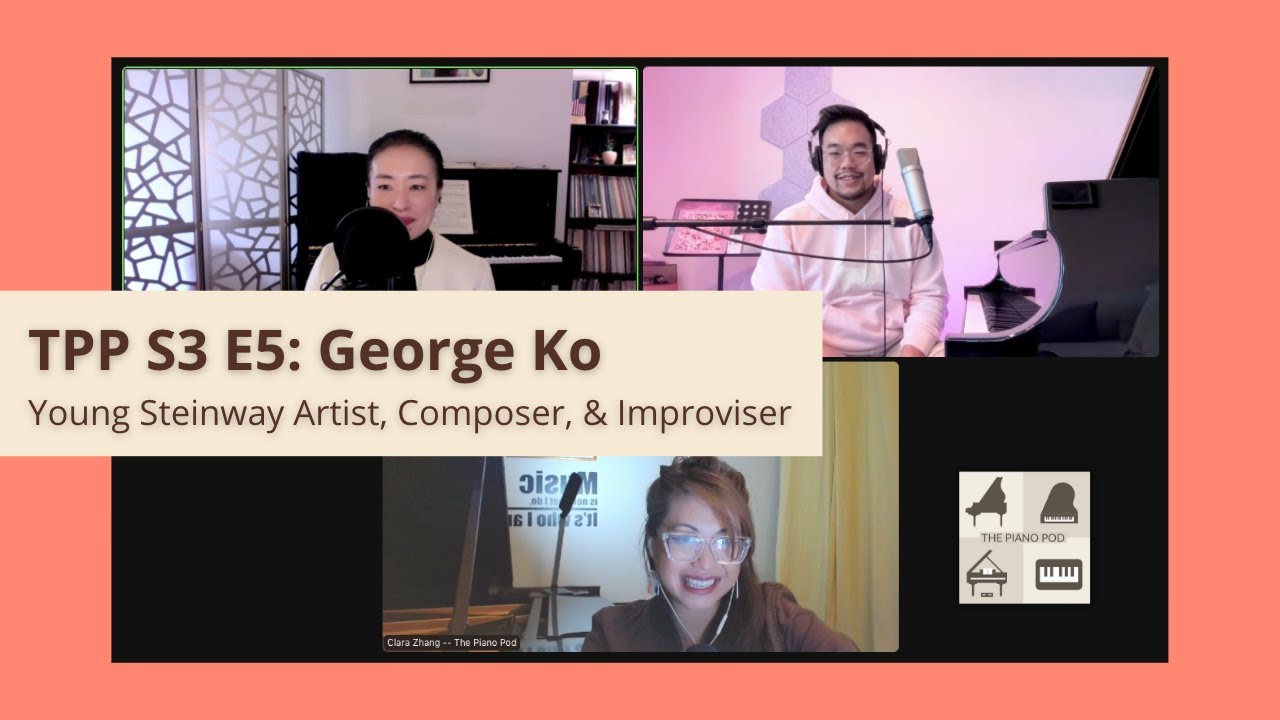
This content was created by The Piano Pod with Yukimi Song. This content was uploaded by The Piano Pod with Yukimi Song. This is a YouTube podcast episode titled "Season 3 Episode 5: George Ko -- Young Steinway Artist, Composer, & Improviser" (published Nov 2, 2022). It’s an interview-style episode of The Piano Pod hosted by Clara Zhang and Yukimi Song, featuring guest George Ko. The conversation covers George’s musical upbringing, Harvard and musicology experiences, his tech/entrepreneur background and awards, his relationship with Steinway, selling a grand piano, how he rediscovered music and developed improvisation during the pandemic (including Clubhouse sessions), and practical advice for classical musicians about improvising. The clip also includes a short improvised performance and a sponsor message for Forte.
Chapters
Welcome to another episode of The Piano Pod with Clara Zhang and Yukimi Song. For anyone listening or watching our show for the first time, welcome! Yukimi and I are both classical pianists and piano teachers from New York City, and this podcast is for anyone who plays the piano for fun, loves listening to piano music, or for someone who is currently pursuing a career in piano or works in the industry professionally.
In each episode, we interview a guest speaker who has been breaking exciting new ground in the music industry. Before getting started, we want to thank our amazing fans and listeners for tuning in. Please rate our show and review it on Apple Podcasts, and because every rating review will help people find our show. So today, uh, before we go, Clara, are you okay with your voice today?
Oh yeah, it's a little funny, right? I've been getting over a cold, but you know, I have to say, it's 3 years of pandemic, this is the first time I got sick, and it's not COVID, so I'm gonna be okay, but I might cough a little.
It's okay, I was just so concerned.
Thank you so much. So today we have a very unique pianist coming to our show. His name is George Koh from California, who is a young stunning artist, composer, and improviser.
And from what we know, he is not only a pianist but also someone who is very innovative in technology and media and visual art. Interesting fellow, right?
Very interesting. Yeah, I really can't wait to interview him, hear his stories.
Yeah, well, he's here, so let's get the show started.
You're listening to The Piano Pod with Yukimi Song, where we talk to the brightest minds in the industry about how they are bringing the piano into the 21st century.
We're honored to introduce our guest of Season 3, Episode 5, Mr. George Koh, young Steinway artist, composer, improviser, who is pushing classical music forward by blending Chopin-like virtuosity with the vast landscapes of cinema. George's music revolves around improvisation, a practice typically confined to jazz music, which he has brought into the realm of classical music. Many of George's songs are one-take improvs, allowing maximum creativity and spontaneity. Mr. Cool has appeared on stages worldwide, from 2,000-seat auditoriums to Carnegie Hall, and his music has been heard at film festivals, television broadcasts, and music festivals in Italy, Germany, Luxembourg, and China. George is also a successful entrepreneur, having founded several companies and nonprofits for which he received the CES Innovation Award in Robotics in 2019, the Harvard Governors 2.0 Award for Innovation in Politics, and a patent in data management. During the pandemic, despite his success in the tech and media sector, he realized his true calling was playing the piano, so he left his job and began focusing on playing piano professionally for the first time. He's now a Young Steinway Artist, and Steinway has described him as, quote, "making classical music accessible and exciting for the masses," end quote. So George, welcome to The Piano Pod with Yukimi Song with George Liad. We're very happy to have you. Thank you so much.
Yes. Oh, thank you, Yukimi. Thank you, Clara. Thank you so much for having me. And that was like, uh, being referred to as Mr. Ko makes me sound way more important than I should be.
So yeah, well, you are, you are very important to us. So yes, and to our audience. So I, we are very happy to have you. So where are you joining from today, George?
Yeah, I'm tuning in from Pasadena, California, just east of LA. So wonderful.
Yes. Yes. And then I see the piano. I assume that's a Steinway piano and—
Oh, no, it's a Yamaha.
Oh, okay. Oh, no, no, no, no.
I was just kidding. Steinway. Steinway. I love your pianos. Please, please, please don't. Please don't expunge me. No, this is— yeah, this is— I'm very lucky. This is a 2012 Model O from New York.
Wow.
And the fun fact about this one is this is the very piano they recorded La La Land on. It's actually in one scene of the movie. I think it's been on 3 other TV shows. And I'm very lucky to have it in my apartment, a grand piano in my apartment. So thank you, Steinway. Thank you.
Oh, wonderful. So actually, Ryan Gosling touched that piano.
Oh, yeah. And they recorded all of the music on this piano. They used this piano for the soundtrack.
And oh my goodness.
Yeah, it's pretty crazy. And then I think Eric Garcetti, the mayor, He christened this piano as like the La La Land piano. And so I— I didn't have a piano in LA and, you know, Steinways are incredibly expensive. And this is during the peak pandemic. And I just moved to Pasadena and I asked Steinway, I said, hey, you know, I still play piano. I'm not doing it like full-time anymore, but I'm building back the music. And I was just wondering Could I borrow an upright? And then an upright turned into a Boston Grand, and then a Boston Grand turned into, we'll just loan you this Model O because no one's using it. And then I tried it and it has like the most beautiful soundboard. It sounds like a B, even though it's an O. And I was like, oh, okay, sure.
I know we checked out your website and videos and all the audios and everything, and you're an amazing artist. So we assume, we assume the love of the music was sort of like a love at first sight, right? I— we want to know. Okay, so how did you start your musical journey? I want to— we want to know your childhood, how you were raised, and what sort of teachers you had.
Yeah, uh, well, guessing from my complexion, my childhood is pretty predictable. You know, son of immigrant children, you know, with the hopes and dreams of their parents on their firstborn's shoulders. And, uh, I think my mom's dream was always to be a concert pianist, but, um, she didn't quite make it there.
And mom played piano.
Mom played the piano. I also was misdiagnosed with ADHD. Um, misdiagnosed. Misdiagnosed.
That's okay. Uh-huh.
So, so my parents and child psychologist thought that I had a severe case of ADHD. And so my mom— but my mom refused to give me pills, which actually this kind of stereotype worked in my case because I was a mistake. No, but, you know, most, most East Asian people don't believe in mental health medicine. I saw the child psychologist have an obligation through my preschool, but So my mom refused to give me medication. And so she, she was like, let's use piano as a way to help you learn how to do tasks one at a time. Absolutely hated it. I really—
you hate it?
I hate— I hated the piano. I probably hated the piano until I was 21, honestly.
Wow.
And I— yeah, I like— my piano lessons were like 2 minutes. I would run away. I would say, go use the bathroom, and I'd I'd run away. Like, I'd be at my teacher's house, I need to use the bathroom, and just run out the door. Um, so I hated the piano, and, um, I know it was never serious. I played like 1 hour a week, but I, um, I seem to have— I was not a prodigy, so I wasn't one of those kids on YouTube at 12 playing. I wasn't doing any of that, right? Um, but for for some reason I could pick it up quickly, um, and, and I, you know, I just didn't practice. And I don't have perfect pitch. I have, I have, uh, what a previous teacher called one of the worst relative pitches I've ever seen. So I, I was, I was very— I was most, most— I was not really— I didn't really feel like I was good at piano at any point. I, but I knew there was pockets and moments where I had some aptitude in it because it would take me— sonically, it would take me very little effort to develop something. So like, for example, if I listen to an artist play the piano, like, someone who was really influential for me was Rubinstein and Lan Lan. But if I heard a Rubinstein recording or when I heard Lan Lan live, like I understood what— like for Lang Lang, I understood what projection meant. Like I knew, like for some reason after watching one of his concerts, even though I hated the piano, I knew— I truly hated it, but I knew how to play for 3,000 people after one of his shows. And I remember playing for him one time and he was—
Playing for Lang Lang?
Yeah, when I was like really young and I still hated the piano. And he was kind of like, wow, you have a concert skill. Sound, and that was like a huge compliment. But I— so I knew how to do that without much practice, but like all the technical stuff, like, oh, I just cut my fingers, I can't do that.
Oh yeah, right, right.
Yeah, that was all practice later down the road. But yeah, I hated it. I hated it. Truly hated it. Sorry, that was a long ramble on hating it.
No, that's okay.
On a piano podcast.
Yeah, no, no, no, no, that's okay. But how did this hate, like, turn into love? I mean, we all have this complicated relationship to music, right? I mean, as much as I love, you know, sometimes depends on the phase, the certain phase of your life, or maybe— well, teachers matter, right? Certain people.
Absolutely.
Tell me more. Tell me more.
No, yeah, I think, um, when did it turn into, like, a passion. It's fairly complicated. I just turned 30, so I have 3 decades of stories.
Welcome to the hood. Congratulations.
Thank you. I've crossed the Rubicon, as Rosen said in his book on Beethoven. Anyways, that was a deep classical cut. Anyways, I think there was like a series of inspirational events. Um, and I think, I think a really big failure that led me to love music, um, for me, like, first, the first time I saw piano as a beautiful instrument was really when I, I saw Long Long Live for the first time when I was 13. He was playing, uh, oh no, he was playing, uh, Brax Marino. Yeah, well, we were late and because the traffic was so bad in San Diego and, um, and I remember like they weren't letting anyone in between pieces.
Yeah, yeah, yeah.
Let alone movements. And so my mom said, hey, my son's studying piano. She made up all this BS that I was like, I love Lan Lan. So like, could they let me— could they at least let me in in the second movement? And I didn't want to go in. And so the usher was like, fine. So my mom pushed me in. And I didn't know where I was sitting, and I was just walking to my seat, and then this— and that's when Lan Lang played, and I was just like, oh my God, that's like the most beautiful thing I've ever heard. And the orchestra happened to play in tune that day, and, uh, because California orchestras at that time, we weren't at the musician we were now. Uh, um, I think I just digged at San Diego Symphony. San Diego Symphony is great right now. Please don't get mad at me. It was a different time. It was a different time. There was less budget.
Uh, okay, okay, okay.
But, uh, no, no, no, but like, it was, it was so magical. And I was like, then I started to appreciate it. I didn't love it, but I appreciated it. Um, and then I, in college, I, I, I had a startup and it was one of the first Harvard-backed startups.
So you went to Harvard?
Harvard University? Yeah, yeah, I did.
Great. And what, you studied music there or what?
No, I did not want to be a musician. I thought, I thought I was going to be like the next Mark Zuckerberg. Talk about being a, like, having a really idiotic narcissistic mindset going into Harvard. But I, I, I really wanted to do tech, and so I had a company And it was like, it was like it had some buzz in Boston, but then it failed spectacularly. You know, we lost all of our money. Um, every— all the product didn't work. And I was feeling kind of down. And I remember, uh, Harvard is like—
this is—
talk about privilege. The Boston Philharmonic, led by Xander, uh, performs at Harvard twice a semester. For free, and they do a lecture series for all the students for free with Ben Zander.
And then there is a Landmark graduate, so he's like very famous, uh, personal development seminar.
Yeah, exactly.
Yeah, yeah, I'm also part of it, so I'm—
oh, fantastic. Wow. Yeah, yeah, he— and so like he even uses the orchestra as like a guinea pig, like just like, um, just like, uh Bernstein did with the New York Philharmonic. So it was like, it's like I just go for the educational component, but they were playing Brahms' Fourth Symphony that night, and I don't know what it is. Yeah, I don't know what it is about— uh, uh, oh shoot, oh God. I don't know what it's about the Fourth Symphony, but when I heard it, I I don't know, I called my parents and I said, I'm dropping out of Harvard and I'm going to become a musician. And, and so I, um, did they almost have a heart attack? Oh yeah, my dad didn't talk to me for a year and a half. And then like, oh, that's classic, classic, classic Asian trauma. Um, and, uh, you know, my family was shocked, uh, but I agreed to go back to Harvard to finish my degree. Um, but so I decided— so I, I studied at Colburn, uh, for one year, and then I also started conducting at the same time.
Wow, conducting!
Yeah, so I don't have my baton with me, but in Boston, at Harvard. So I took a class at Harvard initially just to kind of get an idea of it, but I really studied conducting with George Mester, and he taught me Everything. And like, he was a harsh teacher, but like, he really didn't care that I wasn't gifted. He really taught me everything. Baton technique. He and his teacher was— I mean, he studied with Zell and Schulte. So, wow. So, you know, like, I even learned— I don't have a baton here, but like, I learned how to like hold an orchestra like and like do like full legato and then like even like cue in different instruments while playing, like he taught me everything about baton technique and how to guide an orchestra, so I did a gap year of that and I was so bad at piano, I couldn't even play like— like I would play with mistakes all the time or I couldn't play like, uh, I still— I can't play it now, but you know, I couldn't play any big repertoire. And so during that year of development, I, I, I— it was the first time in my life I practiced. I practiced 8 to 10 hours a day every day for one year. And then I went back to Harvard, I switched my major to music, and then I pursued classical music from there. And so that's when I really got nerdy into music. Like, I was in the music library every day. Harvard is very fortunate. They have the most complete classical music library in the world. That's true. So I read everything. Like, this is when, you know, going to Harvard is stupid. Like, I pulled out a Bach book, you know, and I opened it and I noticed it was handwritten. The whole book was handwritten, and it was a— it was an archive of all his pieces. And I remember I went to the librarian, I said, is this the first Bach manual? Like, is this where BWV numbers came from? And they're like, oh yeah, that's the original.
Wow, it's right there.
Yeah. And I said, why isn't this in a museum? We could just check it out. Like, yeah, I, I did a paper on Bernstein and I had the original sketches of West Side Story. I just checked out— I didn't wear gloves.
Wow. Oh my God.
I just was like— and I have, um, Bruckner 5. I had the original score. Scholte used, all his conducting notes.
Oh my goodness.
I've just seen the weirdest things.
Do you think it's because Yu-Yo Ma went there and so he invested a lot of— because my cousin went to Harvard and he was, I mean, he's a scientist, but he studied cello at Harvard and he was telling me, but he was trying to sneak me in into the library, but I didn't have an ID, so I was like in Kansas. So they would—
oh, oh no. So the Harvard Library is open to the public.
Oh, I don't know why that day I couldn't get in, but that's because it's Harvard and they're, they're pretentious.
Is, is—
you think? Oh no, no, I don't think. I know.
Trying very hard, and he really tried to get me in and I just couldn't.
I mean, they, they do— Harvard likes to gatekeep because they like to—
yeah, well, he's not Christopher, so, you know, we have—
no, we have access to If you're an undergraduate at Harvard, you have the most access to all departments and any department at Harvard. So when I was— you have access to all 50-something libraries and all archives. You're also allowed to take every class at Harvard. So it doesn't matter if you're an undergrad, you can take the grad classes, PhD, you can do research.
Really?
You can take everything. Wow.
And so you were music major at Harvard at one point?
After switching my major the 7th time I ended up being a music major. And yeah, like, it was crazy. Like, Bob Levin was a faculty emeritus, so he had, he had a Bach-era harpsichord, he had a Schumann-era piano, he had a Brahms Streicher piano. So like, I got to practice. I practiced Mozart on a Stein.
Wow.
You know, Like the access was—
What an opportunity.
Yeah, it was crazy. So like I dived in nerd deep, and so Harvard was actually really deep into classical music before Yo-Yo, and they were really big on musicology, Western classical music, Western. So like they've probably been the top, one of the top musicology departments probably since the early 1900s. So they've just been building their archives. And Harvard was also a springboard for a lot of important composers. So Stravinsky gave his first lecture on Rite of Spring at Harvard. Poulenc commissioned a lot of choral works for the Harvard a cappella groups and choirs. So a lot of composers would come to Harvard to do commissions. Ernst Bloch was a composer in residence at Harvard. Um, you know, Elliott Carter graduated from Harvard. Um, John Adams is down in residency at Harvard. Uh, and the Parker Quartet. Yeah. Oh, genius. Uh, yeah, yeah, both, both Luther and John Adams.
Yeah, yeah, yeah.
And then, uh, and yeah, the Parker Quartet is in residence at Harvard. So it's just, it's always been a center of music. Um, and I think that's why Yo-Yo, Yo-Yo went there was because like you could keep it up. I mean, it's— and now they have— uh-huh, sorry.
Did you ever meet, uh, George Lee?
We—
George? Yeah. All right, you guys, of course I met George Lee.
We have two Georges.
Oh, sure.
I'm Chinese. I'm Chinese-Taiwanese American. But like, yeah, you have two Georges. Yeah, both Chinese, both at Harvard. It's funny because like, um, he would—
George also kind of got famous because after he played for Long Long, right? In the beginning.
Like when he was super young. Yeah, super young.
Like 8.
He became famous because he won—
Rapido.
Yeah, he won the Tchaikovsky Piano Competition.
That's his biggest thing.
But he— yeah, it was funny. He would practice like— he would practice the staccato and I would play— I would just play up a half step.
Oh my goodness.
Just to mess with him. No, so yeah, like—
We should get both of you on our show one time together.
Nah, you just need him. He's the superstar. You don't need me. Like, you just have his Fantasy Wanderer is fantastic. I know now I'm getting like way sidetracked, but—
No, no, no, no.
But no, no, yeah, being at Harvard was super intimidating. Like the musicianship, just imagine everyone who got into Juilliard and Curtis and then decided not to go. That's the musicians at Harvard. And so I was like at the bottom, like real bottom of the totem pole. Like, I— like when I was in school, no one would really give me opportunities. And so I had to like— I think maybe that's how part of my career is. Like, I had to produce my own concerts because Harvard wouldn't support me. Um, Harvard wouldn't give me opportunities to perform. I had to fight for them. Because I wasn't a famous musician. And so like, um, I organized a lot of my own concerts. Um, good for you. You know, I like, I had concerts in my dorm room, like on a keyboard, or like I would, um, I would negotiate with like, I would negotiate with like student organizations, be like, hey, can you sponsor my concert? And then I will donate all the tickets back to your organization just to play. And I think like back then I was kind of bitter because like I saw it as like, wow, all these talented classmates are getting all the opportunities. But then I look back and I say, no, they deserved it. They worked really hard. They are really gifted. They're like, there's so many prodigies for some reason. And but, but at the same time, it forced me to be creative. And so And so now, now I don't look at it as like bitter because like, you know, as classical musicians, we constantly compare ourselves to other people.
Of course. Yeah, yeah, of course.
Toxic. But yeah, right.
Yeah, totally. I am. I totally— so that's why we wanted to interview you. So we love the creativity, how you are really using your creativity to reach out to your audience. It's awesome. And a lot of musicians should learn from you. Now, one thing before we talk about other topics. We want to know, did you have any jazz training while you were at Harvard or anywhere else?
Uh, for piano, zero. Oh, okay. Zero. Um, I played in a jazz combo, but I couldn't improvise, right? And I just read. I was really good. Yeah, I was really good at sight reading. Like, I played jazz alto, so like, so I had I was the worst jazz musician. Harvard also has a jazz band and it's really good. I was the worst person in the band. The only reason why they kept me was because of two things. One, I was really good at sight reading, so I could read all the charts. Two, I had a really good sound. That was the only reason, but I was not allowed to improvise at any point. That was so bad.
But it is so ironic, but now here you are, you're an improviser, right?
Yeah, that's all I do now.
It's really cool. But you know, you sort of make fun of yourselves, but you know, you got this amazing award from Harvard, like Harvard Governor 2.0 Award for Innovation in Politics. I mean, it's amazing. What are all these things like? You know, before you became the musician, you had this, you know, startups and everything. Can you tell us a little bit?
Yeah, I, um, I always tell people I have a very schizophrenic career because I just do whatever interests me at the moment. I have no, like, this idea of career planning or, like, you know, I'm 30 and a lot of my peers have planned out their careers since college and I've never approached life that way. And so I think that lends to why I've done so many different things, like In my, in my adult life, I've been a professional like photographer. I've been a designer, entrepreneur. I ran my own media company. I was a journalist. I was a food critic. I, you know, I've done manufacturing to software to brand strategy, and I worked in higher ed for a little bit. And so, like, I'm not going to super random—
have experience of everything. Wow.
I know, but I don't—
only 30.
Oh my gosh.
I, I think it's just because I never did the, like, I need to stick 10 years into this. I was just like, I'll do this for a year and see what's up. Um, and so, so yeah, I, I would say like the, the, the two big things after I left college that I worked on were, um, uh, a media company, uh, uh, that was specifically focused on Asian, Asian American stories. Um, which I launched with the original founder of the magazine Giant Robot. It was called Giant Robot Media, and I did that for 2 years with him. And his documentary is coming out actually tomorrow, and it's super exciting. But yeah, he was like— that was really fun. And then I worked on a robotics company with my brother, and that was kind of like the biggest, I guess, things aside from music that I've worked on the last 10 years. And, uh, that's pretty cool.
So while you were doing that, did you keep going with your music career?
Yeah, so I guess I was explaining that, like, so after college, um, Steinway, one of, one of the board members at Steinway heard me play a concert at Carnegie and they were a fan. And so that's how I became a Young Steinway artist. I was, I was asked to participate in that process. And so afterwards, I teamed up with Steinway and they kind of backed my career after college. And I played piano like in tandem with them for about a year. And then, you know, I thought this was the dream and I was playing like 70 concerts.
Oh my goodness.
And when was this? This is a recent season.
This was when I was 23. This is when I was 23, and— but I hated every second of it.
Wow.
I hated every part. I hated the practicing. I hated the perfection of it. I hated that I couldn't collaborate with anyone, right? Because you're a solo piano for a year.
Yeah.
And then I hated how everyone was so, so narrow-minded, and I didn't like how everyone was so mean. Like, no one told me everyone was mean. Like, like, there are like Emmanuel acts, Manny, lovely person, Yo-Yo's lovely, you know, um, but then like some people are only nice to you if you're a prodigy. And I was just like, what is this? Like, why am I, why am I suffering so much for this life? Like, this makes no sense. And it actually reminded me a lot of my experience at Harvard. It was like one of the hardest experiences of my life. It was super condescending, super negative environment. I didn't even want to go there. So I was just like, why am I doing this again? This is so miserable. And so that's when I quit. That's when I left music. And then from when I was 23 to 28, I didn't play professionally. I would just occasionally play gigs. Like, I was doing a business trip in Japan, and then Steinway Tokyo was like, oh, we'd love for you to play for our audience. And I was like, I haven't played live in like 3 years. But then I was like, okay, this like 2017. I was like, okay, I'll give a concert. So I'll just do one-offs. But I wasn't really serious for like 5 years. I just did not— I think since I was 23, I didn't really play classical music anymore. I just kind of—
And at this point you were living in New York, you said.
Yeah, I was in New York because I was getting most of my gigs in New York. And yeah, like we were talking about, my apartment was literally literally piano and bed. And just to give— okay, so I was very lucky with the piano I had, but just to give like the realities of being a musician in the industry. So Steinway was very kind to me and basically they gave me at a ridiculous discount for the same price of a much smaller piano. And with all my life savings, I got a 9-foot Steinway. And it was the Boston Symphony Hall D. It was a CD668, and it was the one that Kissin would use every year.
Oh my God. And it was still Kissin's piano.
Yeah, well, it was probably one of the best New York pianos I've ever played in my life. And then in May of this year, I sold it to fund the career.
That's amazing.
I mean, that's like selling a leg.
If I have to ever sell my piano, I'm like, That would be the end of everything.
Yeah, I agree. Like, it's— but like, I put it the way I got around. I mean, I was really sad. I mean, I just drank whiskey every day for 2 weeks, but not saying you should do that. But I basically thought about— and I played on a Hamburg a few weeks before that, and it was one of the best pianos I ever played in my life. And so I thought, Okay, if— I'm also way too young to have a 9-foot, you know? Like, I got way too lucky too young. And I said, it will come back one time again. And I'll find the magic piano again. So it's okay to sell it right now.
Yeah.
And that piano went to a wonderful professor's home. And he's like— he's like texting me every day how like it's the best Steinway he's ever played in his life. And I would text him back, I know it has its own story, right?
Yeah.
So I feel like it'll, you know, but that's just the realities of being a musician.
This episode is presented in collaboration with our good friends at Forte, a free alternative to Zoom purpose-built for music teachers.
We're happy to announce that Forte will always be free for music teachers, no strings attached.
That's right. Forte offers features optimized for classical music lessons, including audio quality far superior to existing platforms and allowing you to hear every nuance of your student's instrument. Their colleagues at the Royal College of Music, Aspen Music Festival, Curtis Institute, and Berklee College of Music have even used Forte in their own programs.
Forte's mission is to radically expand access to a high-quality music education worldwide. Forte always puts music teachers and their students first. This means you can use Forte with your own students for free forever, and Forte will soon introduce paid features allowing you to connect with new students around the world.
Sign up for free today at fortelessons.com. That is F-O-R-T-E lessons.com or click the link in the description.
Let's continue with the episode. I want to know how eventually— so at this point you're 2017, right? And then we are—
you—
nobody knew pandemic was going to happen a few years later. So what happened within the next few years? And then how did you, you know, eventually come back to it during the pandemic? Oh my gosh. Yeah.
So I had some pretty big life events. Like, I think my career went this way. And, you know, I would say like the catalyst of all music, I had a pretty bad breakup. So I think both of those things happened.
It's always part of our stories, right? Yeah.
And then I think— and then COVID happened.
Right.
But right before COVID I was like, you know, I— What do I want to do with my life? I think that was like the first thing. And I remember like waking up, you know, one day and I'm back living at my parents' place and I'm like, why am I living at my parents' place again? You know, I felt, I felt like I failed, even though now after doing therapy for 2 years, I realized like I didn't fail. It's just everyone was going through a rough time. I, I asked myself, what do I really want to do? 'Cause you are right, like I'm very lucky before I was 30 I tried a bunch of things already, so I knew what I liked and what I didn't like, but what did I want to do? And I wanted— I'm a person who loves craft, like I love the idea of working on something for decades and perfecting it, and so I was like, but what's going to be my craft? And I thought it was classical, so I started digging up old repertoire, I started like relearning. I started— I actually auditioned for the Chopin Competition, and I was like, I'm gonna go back. I was like, I'm gonna go back full time.
Yeah, yeah.
And, um, but then I was like, you know what I always wanted to do is improvise, you know? And I think that's the thing every classical musician wants to do, is just like play at the piano and just play something, you know? And I like It's insane to me. Like, I study composition and I could play all these complicated classical pieces, but I can't play anything for me because at the end of the day, like, the artistry of a classical musician is the interpretation and the ability to inspire people. But the thing that's not in our wheelhouse is our music, like our composition. That's not our notes. Like our job is like, we're the best cover artists of all time. But like we, and that's a hard thing to accept, right? Because the beauty of studying music at Harvard, even though it was incredibly condescending and difficult, was that you had to learn about all kinds of music. And I was just like, I want to be like Jimi Hendrix. I want to be like you know, Wynton Marsalis and oh my god, now they have Esperanza Spalding as faculty, which is— so like, I was just like— and I got to study with amazing people like Vijay Iyer and Yosvany Terry and all these amazing improvisatory performers. And then the Silk Road Ensemble did workshops with us like 5 times a semester, and I was like, yeah, I want to do that, right? But I can't. I don't know how to do that. And so I remember it was March of 2020, right, right at the beginning of the pandemic.
Exactly.
I woke up and I was just like, you know what, I'm gonna play whatever's in my head. I don't have perfect pitch, I've never improvised on the piano, I don't know how to— I'm gonna try to figure it out. And I honestly don't know what happened. I sat at the piano and I did it. I was playing what was in my head.
That's amazing.
And then I was like, this this is not possible. I was like, this is a movie, this is not real. And so I asked my brother like for requests, and I would tell him, I would ask him to give me requests of songs I've never played in my life, pop music I've never— and, and then I could do it. And then my brother couldn't believe it. Then I got my mom, and my mom asked me to play all these old Chinese songs, right? And I don't— I've never read the music for that, and I could do all of it.
And then I was like, yeah, what does it mean? Go! It's my rare horsey voice. Oh my gosh, the old classics are all coming back.
Beautiful.
So yeah, like, yeah, like, you're like, I never, I never learned the sheet music. Thank you. Uh, but it just started clicking and, um, and then so I started like, there was this viral app Clubhouse during the pandemic and it was like this audio app and a lot of people were on it to make friends because we're all bored. Okay, great.
Yeah.
So I went on Clubhouse and I just started improvising for people Wow. Yeah, and like it grew from 1 room to 5 to 100, and I think the biggest it got to was like 5,000.
You know what, no, I'm thinking maybe I have seen you on there because I feel like your name is some— feel like felt a little familiar when Kimmy was telling me in the beginning, you know, when you guys— yeah, maybe. Wow, that's amazing.
But George, so do you want to like improvise for us? Like, yeah.
Oh sure, we can do it. This is a piece I wrote, uh, it's for an ex. It's for an ex, but, uh, it's called "For You." Okay. And it's in the style of, uh, yeah, it's inspired by Bill Evans, but again, I don't know how to play jazz, so this is me faking jazz.
But let's hear it.
All right, this is for you, George's Fortune. Beautiful.
Thank you.
Thank you.
Thank you so much. That was for you.
Excellent. Amazing. So, you know, as I was listening, so challenge as a classical musician myself is to try to play by ear or improvise on the piano on the spot, right? So, yeah, it's not that we I can't. Thankfully, you know, majority of us have this really strong training in solfège, ear training, all the stuff. And then so, but actually what blocks us from is the—
we're—
because we are afraid of going outside of our comfort zone. I mean, I mean, okay, that's not right because playing Chopin Étude and Liszt Sonata is not my comfort zone. Okay, yeah, that's true. Yeah, yeah, yeah.
But then things.
Yeah, right, right. But then improvisation is another thing, and we tend to be extremely judgmental of ourselves. So any encouragement you have towards, you know, classical musicians on how to start improvising?
Yeah, for sure. I mean, so like, the thing is, I hopefully that comes through on the improv is if you heard, I don't try to shy away from any of the technique. I think that's really important because a lot of times when we think of improvisation improvisation, especially from the classical tradition, we think even if we're playing things like— I don't remember any of it— or like— like even if we're playing things like that, when we improvise, we suddenly dumb down our technique because it is difficult. There's that fear component. But I think hopefully like when I improvise, I try to— like, I try to incorporate as much technique as possible, or like, to kind of show that all of this stuff is hidden in our subconscious somewhere. So like, the way to tap into that part of our brain is there's a lot of different layers. So when we're learning classical music, we're taught very systematically what to do.
Right, right.
And so, but we don't— when we're learning a piece, we're not learning it specifically from the perspective of songwriting. And I think that is the biggest hurdle before you talk about improvisation. So just even before you talk about improvising, when you learn like or you learn like, you know, like I'm just playing Chopin, but like, you know, if you're learning any of this, try to see why things work the way they do harmonically, or like from a vo— like a melody perspective. Like, why does this work? You know, why does, why does, why does that work? Work, you know, like, and so that, that kind of mindset is important if you're starting from the classical tradition. And for me, what was really inspirational was my two of my teachers study with Nadia Boulanger. She teaches her students, of course, that perspective is teaching composition from the perspective of songwriting, not necessarily for the piano. So you need to have a very strong understanding of music. So that's before you get to piano and technique. What happens is a lot of classical pianists, when they try to improvise, they start from the technique. They don't start from songwriting. So when a classical person, when you tell them to improvise, say, an A, like A minor, like if you tell them to improvise an A minor, just A minor, they don't even know where to start. They might play the chord, the triad. Maybe they'll play the 5. This is like what normally happens when you ask a classical person to improvise, but if you study songwriting like Mozart, Mozart loves using first inversions. So you might go 1, 1, first inversion.
Mm-hmm.
This is, you know, a D minor.
Mm-hmm.
Maybe a suspension. And then if you like Brahms, you'll move to here. Like, so if— so like that, but that improvisation comes from knowing good songwriting. So that's the first thing. The second thing—
oh, sorry. No, that's all right. I just had a quick question that I was like, it's been popping in my head. Do you feel that— because you said it was kind of like came as a surprise, right? And I kind of remember that in the conservatory back home. I'm Long Long generation, so, you know, it's— we all went to the conservatory around like 11, 12-ish, and, uh, you know, in mainland China, and all these kids are very talented, right? And I, again, just like, like I was not well trained in the beginning, and I just somehow got in. So I witnessed a lot of greatness from the very beginning, but I realized at one point by the time we were 13, 14, all of a sudden some kids in my class start to play for malls, for like cafes, or like, you know, we get paid to do. And then they were just so good. And so I, like, now, you know, I obviously have a piano studio and I study a lot of philosophy and I also do a lot of studying of the brain. I wonder if it has something to do with certain repertoire where forced to learn at a certain point. Like, and I even see some of my own students at some point— I don't teach them improvisation, but at one point they would just automatically kind of start to pick up certain things.
That only happens if they're extraordinarily gifted.
But do you think that— you said at one point you start practicing 8 to 10 hours a day.
Is—
did this happen right after that, or was it separate things?
No, no, no, this probably happened when I was was like March 2020.
Oh, when the pandemic hit. Wow, interesting. Very interesting.
Yeah, it's so like—
I mean, you had actually had a little break.
Oh, I don't know. I literally woke up and it did it. And I think it's because of the songwriting perspective, because like I knew songs and I love like John Mayer and I love Jimi Hendrix and I love Alicia Keys and I love like great rap, like, or hip-hop, like A Tribe Called Quest and Handsome Boy Modeling School. And I think because I like good— I like songs. And I think that desire to play songs and understanding of songs is what tapped into that, which is, I think, what you're experiencing with your students. But that, like, I'm not— I don't— it's weird to talk about yourself, but for those students, it's like, because that only happens if they're extraordinarily gifted.
No, it's not everyone. Right, right.
But there is a way to figure it out.
But it's also, it's the time when they start to like pop songs. I think that also has, you know, and now thinking back my childhood, like my friends, when maybe when— yeah, that's true, when you start to listen to songs, right, rather than just compositions.
But actually classical music were great, the greatest pop songs of the day. Like people forget Mozart was known as a pop writer. He was not writ— like Beethoven didn't play his own music. He was known as the greatest improviser in Europe and the greatest keyboardist, but he was not known as a great composer. Haydn was the— right? Johann Christian Bach, CPE Bach. Mozart and Beethoven were— Mozart was an opera composer, right? Right, right. So like everyone kind of forgets that. So like if you examine Mozart, like he plays I-V-I, but how does he do I-V-I? He doesn't go— he goes Right? He's all circling around C, so when he leaves C, it's more exciting. So like, these are all components of good songwriting. It's like when the Beatles, you know, right, when they lay like circle around G. And instead of going back to I, they go— they delay it, right? They go to IV. And then instead of going back to I, they do a first inversion. So if you look at The Beatles, they have the same songwriting components as Mozart because they knew how to write good songs. And so like that, if If like we taught music that way, like classical, it would be— and also like styles, like when we learn Ravel, right? It's so difficult. But if you can grasp the idea of the style, then you can do things like Then you can improvise in style of Ravel because you understand how he writes songs, right? But anyways, so that's kind of like interesting how to tap into— and the, the fear component is you have to be okay with making mistakes always and accept you're not a robot and that playing perfectly is a myth and playing perfectly was created by Mahler and Mahler ruined classical music. Once you accept all of that, no, like Mahler truly ruined the fun. Mahler took the— Mahler took— made classical music the most unfun thing in the world. He created the concert hall we know today, which is the raised stage, and you can't see anything in the first 3 rows. And he created this idea of or text. Or text didn't exist before Mahler.
He—
did you know that he even— Mozart would change the score of Figaro every night.
Right.
And Mahler was about to throw all of it away because he said it wasn't the perfect edition, and this monk saved it. And so, so this idea of perfection is completely overrated and it has pervaded into classical music and totally ruined the fun and joy out of it. And so like, that's, that's the first— that's another thing, the fear thing, is you have to deprogram that world. You have to go in with having fun. You can't go in with like, everything needs to sound perfect. I mean, for me personally, when I improvise now, like, obviously I can't play perfectly-ish with, with a Band-Aid on my finger, but like, like I do sometimes, like when I improvise, sometimes I purposely play mistakes so people know I'm improvising. Because I've noticed sometimes when I play my shows, and I guess this is weird to talk about yourself, but like sometimes people would not believe I'm improvising. They think, oh no, you wrote the piece. No, no, it's completely improvised. And so like sometimes I purposely put in mistakes so people would know I'm completely making it up. So I think this idea of perfection, you have to kind of get over it and you have to have fun. And once you have fun and then you have these ideas, good songwriting, it'll come. The third skill is can you actually— do you actually know the notes? And what I mean by that is when you read a score of music, like, can you actually read it? Like, instead of reading, like, for example, are you reading this on the piano, like the hand positions, or are you reading E-flat, D, D, uh, but actually it's actually, it's B-flat, it's, it's, it's a, it's a B-flat 7, but just with a D and F. Can you read it like that? And this is moving, this is pushing it down into resolving into A-flat first inversion. And like, if you read music that way, then you, you probably start improvising or writing music very quickly. But if you read music as, this is where my finger goes, this is where my finger goes, this is where my finger goes, then you'll never get there. So I think it's all those components put together, and I'll stop rambling. That was a lot.
No, it's okay. No, no, no, no, no. But you know, as a pianist, we tend to think that way. Oh, this finger goes this. Yeah, because that's how we think about music, right? Yeah, I am learning as I am interviewing a lot more artists now, and like the way pianists tend to think about music. And also conservatory graduate or, you know, conservatory training, that's another whole thing. And I'm not saying—
training your brain—
yeah, I'm not saying yay or nay about anything, but I think our tendency is to think certain ways about music, which is, oh, so different from composers' mindset and also improvisers' or even conductors' mindset, right? Yeah, so in so many ways it makes sense that you study conductor, to be a conductor rather than piano itself, right? I am curious about your albums and EP. I know recently you just produced the latest one, it's called Nomad in the Sky, is the latest one. Now, so tell us Nomad in the Sky. I checked it out and it says an exploration of your favorite anime and TV shows embodied the hero's journey, and you wanted to create a piano suite that encapsulates the mysticism and— oh, and then— and so it— of an epic voyage. So it's like every single album or EP you produce seems to have a theme, and also there's a collaboration with a visual artist. So can you tell us?
Yeah, so I guess it's kind of like program music in a way.
Oh, cool.
But yeah, I try to have a theme for everything because I think it's fun and it's just, it's just when you, when you create a body of work, it's just nicer when there's a story, you know? Like, like it's funny, even though we think of these older composers, like we think of— like we think, okay, that's like the Third Symphony, but like, and then we named it Eroica later, but like You know, Beethoven did write that for Napoleon. And that's a cool story, right? You know? And so I think we are gravitated by stories. That's the kind of people— we're social beings. And so I think that's kind of why it lends to the themes. And then I really love art, you know, and I've been very lucky to work with a lot of great artists like Maggie Cheung. She's a Taiwanese-American artist. She did my EP. And then, uh, you know, um, and then, uh, I, I collab with this artist, uh, couple, Georgico— no relation, but that's just their artist duo name. But like, they, they painted, um, the art.
Yes, yes, I, I noticed that name. Uh, I thought it was like— well, did you find them just because—
yeah, we're just fans of pure coincidence.
Really? Oh, that's because, uh, they designed your vanguards of The Cosmos, right? Yeah, I wanted to ask you about that album too, because one, Impromptu for No One was like really Debussy-like, and then also you challenge yourself, you challenged yourself to be the part of this Paganini Variation Club with Liszt and Brahms and Rachmaninoff and Bercovich, and you know, so yeah, tell us.
Yeah, yeah, um, that album was like an homage to the classical world and So like the first piece was like Prelude for Chopin, and that was like a piece for, you know, Chopin, and then Impromptu for No One.
Yeah.
Yeah, it's like, it's like a piece. It's just kind of like one of those aimless pieces like Debussy-like or Pavane for a Dead Princess. Like, is there a point to it? No. But there is meaning, you know, it's kind of like one of those pieces. And then I wanted to do something really stupid, which was improvise an etude, like a whole etude set. Like, I just thought if I could, because for me, my entire— a lot of— a big part of my classical music journey was proving to classical musicians that I can play. And I was very much discouraged my entire career. I've been told by very famous professors who teach at the world's best conservatories— here are some of my favorite quotes are: "It's obvious you're very passionate about music, but you can never play, so you should give up." Um, "You would be a great pianist had you been born in China and not the United States." Um, "You're probably the worst student I ever auditioned, but we'll give it a try." And so like I've been told like the craziest stuff. I've been— and there are very famous musicians today who have been very not kind to me about my musicianship. And so I felt like that particular theme, Improvised Variation, I wanted to prove to real players that I can improvise at a level where you would think I wrote this etude and like I practiced for hours. And so that's why, that's kind of like part of the reason I did the improvised variations was one, it was a challenge for myself, but at the same time it was to prove to serious musicians that I can play. And so I decided to do the most difficult one, which is do a version of, my version of Paganini. Because you know, Liszt and Brahms did their like crazy versions and You know, Brahms had the octave gliss. Oh, which I— oh, I figured out how to do it really easily, but that's like another— that's another interview. And so, so yeah, so I tried to explore that and I really wanted to see if I could improvise etudes for like all these different unique variations, but also have all the ebbs and flows of a true complete set. So have a very mysterious, esoteric, you know, slow part, but like harmonically very complicated. And then really cap it at the end with this big show-off etude. And, and yeah, that was really done all in one take, that entire— well, that all my albums are in one take, but really everything's in one take. I don't, I don't micro-edit anything.
Wow, that's incredible. You are sticking to being an improviser. That's amazing. That's That's very inspiring.
So literally I have written no notes on any of my pieces ever. So like, even when I play impromptu for no one, like, everything is different every time. It's never the same. And I just keep it that way. Like, I refuse to write down any of the notes. So people ask me for my arrangements and I say, it's not an arrangement, it's I played that for you in that moment. I don't know how to do it again. I honestly don't remember how to do it.
I wonder what came to the dream that night. Stuff— everything just changed.
No idea. I'm just so grateful it happened, and, um, I have a, like, starting of a career for it, and I'm just super happy.
I wonder if it's also just a mixture of different experiences, right? You really had a very unique music experience, I think. Than a lot of other musicians probably, you know, that just stay in the conservatory or whatever, however they— everybody is. So one of the earlier guests of our show, uh, Reemac, which you just, uh, I don't know if you know him, he's like a YouTube YouTuber, uh, pianist from Malaysia. And he like an early generation, you know, like when YouTube first came out, and he was like the most well-known in Asia. And yeah, but he was my student briefly for a a year, and he couldn't be a music major because he was playing video games so much that he like couldn't really read. And so he was like, you know, improvising because he was like, he didn't want to tell his dad he was playing too much games. But anyway, and so I remember he's like about the same age, like a couple years younger than me, so, you know, we were good friends, but I was technically also his professor. So he was like— and then, you know, I was teaching these classes, uh, in the university where everybody else is a music major, and here he is, an economy major, you know. He was like, so he was like, but you have to have feelings, feelings, you know, like he's trying to tell all these other music students, and they were like, what is that? Like, I gotta practice, I have no time for that, you know. It's just really interesting. So seeing what you have, uh, gotten, I mean, I really, I cannot wait. One day, maybe when the inspiration comes again, maybe you will have a class, you can teach other people how to improvise the same way. I would take that class totally.
Oh, yeah. I actually did. I was a guest lecturer for ToneBase for a month.
Oh, wow.
That's cool. Congratulations.
That's right. Well, I've guest lectured at like Juilliard and Tanglewood, but never— that was like for classical or for music technology. But I've never done— I wish I could do it at a conservatory. But yeah, like—
Well, maybe it's not time yet. Maybe, you know, At some point it will come through. Right now you have maybe too many other things. And yeah, and I have another question that I really want to— because I am— I mean, Yukimi and I, I think we pride ourselves for being a little bit untraditional as well, you know. That's why we have our podcast. And then you have this— you're pushing classical music forward by creating like audience, you know, engaging events and recordings. And I know you also have all these other sort of interest. Like, uh, Yukimi was showing me this beautiful gang of, uh, it was designed by Guo Pei, and I believe Rihanna wore it one time. And I think you were performing for the event in December, right? And how does this— all these things, like, um, or, you know, impression of how, like, I don't know, how, how Do all these ideas that were experienced that you have had from Harvard, from Asian parenting, from growing up in California, from living in New York, and from, you know, playing all these different gigs, and the— and from liking and not liking it, from people saying no to you repeatedly, and to people who are like, oh wow, you're not a stammy artist, you know, even though you were doing other majors. Like, did you at one point just kind of like, all right, this is me and I'm just gonna put everything together? Like, did you have a moment like that?
Yeah, um, I guess the— to my, uh, advantage or detriment, I, I, I just really always wanted to do what I wanted to do and Um, so like growing up as an Asian American kid, that was not easy because I never wanted to do what my parents wanted to do. Uh, and I, I think like having fun is like the other component. And so like, for example, I've been going to classical music concerts since I was 3 every week, and I rarely had fun.
As a kid, you know, because like, I was just gonna say good job, Mom and Dad, and then you were like—
what's crazy is like, I guess this is my talent, is I've noticed my, my true talent in music— I have two. One is sound production. For some reason, when I play any instrument, I know how to produce a good sound. So I know that's my talent. My second talent is musical memory. So I even remember the first concert I went to, Pacific Symphony. I was 3. They played Mozart absolutely hated it. But I think like, I just realized, I just, I was, when I, when I was doing these events, I was like, classical music is great, or like, now I'm just doing improvised classical music. And I said, but, but I want people to have fun. And, and I remember in school learning about what it was like to go to a classical music concert in the 17th, 18th, and 19th centuries. And that was way more fun than today. Like, you know, you went to a Mozart opera. Yeah, you could have breakfast, you watch like part of it, then you have a 2-hour intermission. Yeah, yeah, you come back, maybe drink a little bit, eat a little bit, whatever you want to do. Or like salons. Like, every great composer you could think of hung out basically at a pub. Yeah, in Paris, a very posh pub, and they just played piano for like 8 hours and got drunk together.
Like, we have a salon series here. We're going to have a salon.
Fantastic.
You know, we serve drinks and then, you know, people, we were like, get drunk before we start playing.
Exactly. And so like, I want to— exactly. And I think we're all in that same vein. Like, I want to bring that fun to people my age. So like, most people in my audience are like 22 to 35 because, you know, I think I'm trying to create experiences what they would enjoy. And so like, whether that's in food or in fashion or like, like even like Like this Saturday I did a concert at Colburn and we had over 100 people and everyone was— almost everyone was under the age of 35. And I just remember like security guards at Colburn were like, this is the youngest audience we've ever seen for an adult, right? Like, that's not community school event. They're like, this is the youngest audience we've ever seen. And they're like, and they're like, we were watching through the monitors and looks like a lot of fun. And I was like, that's That's exactly what I'm going for, is fun. But like, the other thing too is respecting your audience enough where you won't dumb down the music. So even when I'm improvising, I don't dumb down from the harmony. Like, if you wanted to analyze in a theory class, I'm doing augmented sixths, I'm doing diatonic tones, I'm doing common tone, uh, pivoting, I'm doing triadic chromaticism, I'm doing motivic development, I'm doing inner voices, I'm I'm playing 5-voice harmony, you know, I'm not dumbing down the music for my audience, but I'm presenting it in a way that's fun. And I'm respecting my audience for their musical knowledge. And I think when you combine all of that, then you get to do exciting events like playing piano for Guape's like winter gala, which is super fun. Or, you know, like, like, uh, on November 17th, I'm doing a show in K-Town, in Koreatown, And it's gonna be at like this, like, it's like SoHo house for like people who are into Asian culture, you know, it's like, it's like a club. And, you know, Steinway, like we did the show last month, like Steinway brought in a 7-foot, you know, stereo B, and then I just play piano and, and like I play an actual show while people are having dinner.
So, wow. Yeah, no. So in so many ways, our philosophy and yours are similar. Like, we are, we're also not dumbing down the audience and also even teaching. Our students are smart, but maybe they're not in this classical music world, right? But then it's really my job is to how to present this tradition of Western music, classical music, to my students and to my audience, to our audience, right? This It's really totally up to you, and you can do as creative as the way you're doing, and as creative as what— how we are doing, try to do with this podcast. So I really appreciate you sharing this honest opinion. So in relation to this topic, so what's your vision for this classical music industry? I know you are sort of you know, bridging classical music to other fields, other genre in music, but you have this classical training, so what's your vision for this classical music industry?
Yeah, because in a few years— yeah, because I can solve all the problems in a few years. Um, I, uh, I think there's a lot of things that need to change. One is that I think classical people or people who run organizations need to realize this is not a white industry anymore. This is more an Asian one. And I think times change. And I think it's like being more open and diverse about that. I think it's a more female one. There are way more female musicians studying now than men. I think it's like 60-40%. If you go to Juilliard, most of the applicants that apply to Juilliard are female. So I think having more female voices is incredibly important. Of course, that will hurt my career as a man, but I— You know, that's just the truth.
It's just so funny, it just occurred to me, I just remember this from so long ago, but when I got into the conservatory, you know, at that time they like choose 8,000 kids, all the 30 from 8,000, right? And I remember literally there were like, in my class there are pianists and violinists and there's 9 boys altogether. And then, you know, we were talking about how eventually all 9 of them will have a career and none of us, like even at 11, we knew that. And it's like, you know, we never even thought that deeply at that age. But that's interesting you're saying that. Yeah.
No, yeah, I mean, like, that, that, uh, that, that is like a trend we're still seeing today. That needs to change. Um, I think the way, the way we educate music in America needs to change. We've forgotten why American conservatories were great. American conservatories were great because we didn't just teach you how to play the instrument, we taught you how to be a person. If you look at the classes they taught in the '50s, you were required to take very difficult musicology classes, philosophy, linguistics. Um, how do you play Chopin without knowing how to dance? How do— ballade, mazurka, waltz, jig, barcarolle— you know, like, you need to know how to dance.
These are—
this is dance music. And most musicians, most concert pianists don't know how to dance. Or you'd be surprised, like, I taught a master class at Tanglewood and no one knew orchestra excerpts, and they're playing Brahms, and I would quote like Academic Festival Overture, and they had no idea what it was. And so we need to change how we approach music, teach music. We need to get music appreciation back into public schools.
Amen.
Like, the reason why the classical music audience is aging is because all the people going in the audience had a great public school education, and all of them had One thing in common, they went to music appreciation. And the other thing is the classical industry needs to finally recognize that film music is the opera of today.
Mm-hmm.
Accept it because no— because I'm also a film composer and I can confidently say no one who wants to have fun, who has musical ability, wants to write music for classical anymore. We all want to write it for movies. 'Cause that's fun. And like, it's just as complicated, you know, if you look at— I mean, John Williams would be like early, early Brahms complexity, but it's still complicated and great music and it moves us. And every time you hear, bah, you know, every time you hear— you're like, oh my God, you know, you're back into the mood, like you're put back into that place in a long time ago in a galaxy far, far away. So I think all those things need to change. And, um, yeah, and then I think also the way we teach music, like, we should go from the perspective of having fun doing it well, but not from a place of negative judgment. Because I can— on my hand, I can count how many people are happy doing classical music, but I would run out of limbs to talk about how many people have been hurt by classical music. Ugh, like truly hurt.
Yes.
So we need to change that mindset, and then, and then you'll see the change. Also, just accept classical music is a niche genre. Throughout history, only that most, at most in a society, 3% of people listen to classical music. That was the most of all human history. So we have to accept that the money is different and, and, and scale back our expectations. But, but I think if you change all of that And you make it fun again, and you go from the perspective of a positive engagement with it. I mean, still doing at a high level, but with a positive engagement, I think you're gonna see a lot, a huge shift. And then let people Instagram during concerts.
Who cares? Yeah, yeah, yeah.
And what I've noticed, if you're good at what you do, they'll Instagram for a little bit and they will never look at their phone again.
Right.
So that's a good test for you as an audience. It's like— and I've also noticed when I tell people in the audience they can take photos, they take way less photos. They do it once or twice and then done if you're a good musician. And so like, I don't know, I have a lot to rant about.
No, no, no, but this is great. No, so, you know, then one more, then I think we have to, you know, it's time for us to go to the rapid fire. But before that, Any advice for young pianists, piano students?
Don't forget why you're doing it. That's the first thing. It's like, you're doing this because you love it. If you're not doing it because you love it, reevaluate. And it's okay to reevaluate, and it's okay to fail, and it's okay to quit. Because I quit, a lot of people quit, it's okay to quit. Um, but remember why you're doing it. Um, the second thing is that it's going to be incredibly difficult. And third is even with all the hard work in the world, you may not have luck. So for instance, with my career, I would say most of my career has been without luck. Like I haven't made it yet. I'm still an emerging artist. Like I had to sell my piano to make, you know, keep the bills afloat. You know, I'm still getting— I self-produced 60% of my concerts, right? I'm still unsigned in the United States. I am I'm chasing down leads constantly. I am networking every night. I'm drinking at K-Town every weekend to find the next person who's going to pay for my gig. Yeah, like you just have to. I work out 5 times a week so I can be in stage to look decent on stage, you know? And like, like I have brand partnerships with fashion designers. Well, I'm a big fan, but also like I don't have money to buy clothes to change at every concert. So I need to make— you need— if you have to accept, if you want that life, it's going to be incredibly difficult, right? And you may not make it.
Yeah.
And like, you kind of have to be okay with that. And it's hard to be okay with it. Some days I'm not okay with it. Some days I literally just don't do anything and I like wrap myself in a blanket and I watch like Naruto and I cry. You know, like something, you know. So like, if, if you accept all of that, then mentally it's going to be Oh, and get a therapist. Just have one on the back. I go to therapy every week since March 1st, 2020. It will just— it will keep you level-headed because you can get into a dark place. So yeah, that's for the emotional—
Earlier you also said, you know, have that positive mindset, even accepting all of this, but yet still stay positive.
You have to.
He's so huge. That's so huge.
Well, thank you. That's great advice, and you are being so candid and open to us and trusting us, and I really, really appreciate it. So we want to promote your show on November 17th in California, uh, in San Diego.
No, it's in Koreatown.
Oh, it's Koreatown, LA. Okay, okay.
There's gonna be, there's gonna be a lot of great food. They have this amazing duck that's like cooked in Peking duck stock. They have, uh, cocktails. Oh yeah, you should come. Uh, if you come, if you come a few weeks ago. Oh yeah, yeah, like we have crafted— they have crafted cocktails. They're made by the same people who do Bestia, so they're award-winning cocktails. Um, there's like 3 bars. It's like, it's like a cool place. And then Steinway's bringing a 7-foot stereo, so that's—
oh my goodness, that's so amazing. And also another thing is you just produced a Nomad in the Sky, which is the latest EP. So you can listen to his, uh, the latest, you know, production on any streaming services. So be sure to check it out and also check his, uh, website out. Uh, it's georgeko.co. Yeah. Okay, so with this mood, let's get into this rapid-fire question. And then, George, we need The shortest answer possible for each question. Okay, you don't have to explain. We don't judge you, just answer.
All right, judge myself, but yes.
Oh yeah, yeah, no, no. Number 1, what is your comfort food?
Pizza. Oh my goodness, New York pizza.
Oh wow, best.
Yeah, the best pizza.
Cats or dogs?
Oh, dogs. I'm deathly allergic to both, but dogs.
All right. What is your word or words to live by?
Live every day like it's your last.
Beautiful. What is the most important quality you look for in other people?
Integrity.
Beautiful. It's the opposite. What's the worst quality you want to stay away from?
Selfishness.
Name 3 people who inspire you, living or dead.
Uh, John Mayer, Hiromi Ohara, Rubenstein.
Great. Name one piece in your current playlist.
Oh, um, "Skate" by Silksonic.
Okay. Oh, I don't know that. I want to check it out.
Yeah, we have to check it out. You get only one piece or song to listen to for the rest of your life, what is it?
Brahms' Fourth Symphony, specifically Carlos Kleiber conducting the Berlin Philharmonic on the original vinyl from Deutsche Grammophon.
Ah, Carlos Kleiber, wonderful conductor. Yes. Now the last question, fill in the blank: music is blank.
Hard.
Thank you.
I love that.
I love it.
Yes.
Oh my gosh. Thank you. Thank you. Wow. What a fun interview we had. Thank you so much.
Yes.
Thank you. Thank you, George. Oh, this was incredible. So this concludes this episode of The Piano Pod with Yukimi Song with George. And thank you, George, once again for joining us today and sharing your stories and insights and expertise. And you can find more information about him and his on his website at georgeko.co, and we want to encourage our audience to check out his events on his website, and all the links are listed in the description.
Thank you to our wonderful audience and fans for tuning in today. If you enjoyed today's episode, please rate and review it on whatever podcasting platform you use. If you are watching us on YouTube, remember to hit the thumbs up button and be sure to subscribe to our channel. You can also find us on Facebook, Twitter, Instagram, and LinkedIn. The links in the description below.
If you're interested in being the guest or recommending someone to be on our show as a guest, or if you'd like to sponsor or collaborate with us, shoot us an email at thepianopodnyc@gmail.com or send us a DM via social media.
We will see you for the next episode of The Piano Pod with Yukimi Song.
Bye everyone, and thank you, George.
Thank you so much.
Thank you so much. Thank you.
More from The


Spirit, Body, and Soul: Pianist & Composer David Berry on Virtuosity, Creativity, and...



Season 6 Episode 20 | "Spirit, Body, and Soul" feat. David Berry, Concert Pianist & Composer


Beyond Borders: From Argentina to Poland to Texas—Oscar Macchioni reflects on a life in music

Sound Liberation: Joe Williams on Black Artistry, Legacy & Belonging in Concert Music


