Season 3 Episode 6: Kyle P. Walker -- Activist Concert Pianist and Educator
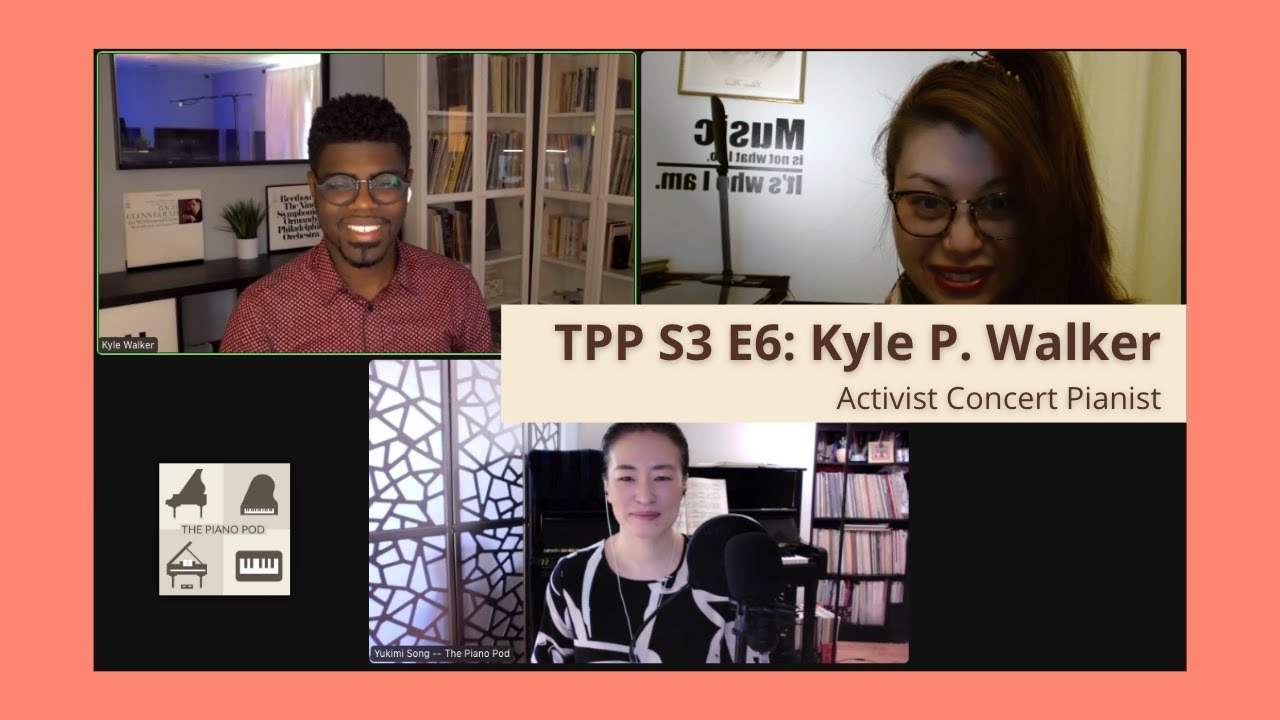
This content was created by The Piano Pod with Yukimi Song. This content was uploaded by The Piano Pod with Yukimi Song. This is a YouTube podcast episode (Season 3, Episode 6) titled "Kyle P. Walker -- Activist Concert Pianist and Educator," published November 16, 2022. The episode is an interview-style conversation hosted by pianists Yukimi Song and Clara Zhang with guest Kyle P. Walker. They discuss Walker’s background and training, his projects promoting inclusive repertoire (Bach to Black Notes, performances of works by Margaret Bonds, Florence Price, Irene Britten-Smith, etc.), his activist ensemble Dream Unfinished, audience-engaging programming and commissioning, his piano–cello duo, and outreach/education efforts. The episode also includes sponsor/Patreon plugs and references to the Forte platform.
Chapters
Welcome to another episode of The Piano Pod with Yukimi Song and Clara Zhang. For anyone listening or watching our show for the first time, welcome! Clara and I are both classical pianists and piano teachers from New York City. This podcast is for anyone who plays the piano for fun, loves listening to piano music, for someone who is currently pursuing a career in piano or works in the industry professionally.
In each episode, we interview a guest speaker who has been breaking exciting new ground in the music industry. Before getting started, We want to thank our amazing fans and listeners for tuning in. Please rate our show and review it on Apple Podcasts because every rating and review will help people find our show.
So Clara, we have Mr. Kyle P. Walker. He is the activist concert pianist and educator as our guest for this episode. So you know him personally, right?
Yeah, absolutely. Yes, so Kyle was a close friend of some of my friends from Kansas, uh, and they were attending schools together, I think at Madness, and doing their graduate school together. When I first opened my studio, not long after I opened the studio, and I was doing a lot of concert series, you know, in the city, and I brought them in to do a Clara Schumann, uh, Clara Schumann, Robert Schumann trio. Uh, so I played the Clara Schumann with them, um, and Kyle was the pianist for the Robert Schumann, and it was a beautiful concert at the Steinway, and it was just very inspiring, you know. They were still in school, and they were— but they were just very grounded and just such good musicians. And I've been following his career all this time, and recently I've been seeing him a lot in the community and just awesome work he's been doing, especially being a strong advocate in social equality using the power of music. And it's just such an inspiring thing. So I decided to bring him on our show.
Cool. I was just watching one of his YouTube clips, and he's playing the COVID of Aretha Franklin's "I Say a Little Prayer," and that sounds like his own arrangement. And so I wonder if Kyle has any training in jazz or composition. And so I can't wait to ask him about it and get to know him during the interview.
Yeah, that's true. Yeah, he is here. Well, let's get the show started.
You are listening to The Piano Pod with Yukimi Song with Yukimi Song. You are listening to The Piano Pod with Yukimi Song, where we talk to the brightest minds in the industry about how they are bringing the piano into the 21st century.
We're I'm honored to introduce Kyle P. Walker, activist, concert pianist, and educator, as our guest of Season 3, Episode 6. A strong advocate for social equality, critically acclaimed pianist Kyle P. Walker believes music can speak to social issues better than verbal language. The understanding of which he brings to both traditional Western repertoire and music of the living worldwide composers with whom he collaborates. His performances have been featured on media broadcasts including The Green Space at WNYC, NPR's Public Radio East, CNN, and PBS. He has been featured in recitals at New York's Weill Hall at Carnegie Hall and with orchestras in Stern Auditorium at Carnegie Hall. Highlights of past seasons include solo performances at the Apollo Theater, the Gomburg Center for Research in Black Culture, the Metropolitan Museum of Art, the Lied Center of Kansas, and more. Mr. Walker is a pianist of Thor and Kyle, an innovative piano-cello duo and 2021 recipient of the Chamber Music America Ensemble Forward Career Grant. The award-winning duo is committed to bringing excellence and respect to all underrepresented composers in the canon. Walker also performs with the Harlem Chamber Players, an ethnically diverse collaborative of professional musicians dedicated to bringing high-caliber, affordable, and accessible live classical music to people in the Harlem community and beyond. Kyle, welcome to our show. We're so excited and happy to have you here. Yay!
Thank you so much for having me. I love what you all are doing with this show. It's amazing, and I'm so honored to be a part of it.
Thank you so much, Kyle.
That means so much. Yeah, so Kyle, oh my gosh, it's been so many years. I feel like you were like still a baby when we first met you.
It felt like it, right?
And now you're a professor at MIU and all that. Oh my gosh, I cannot wait to hear more, but tell us what's been going on lately. How is everything?
Oh my goodness. Well, life has been moving so fast and it's, you're right. It felt in some ways like I was a baby when we first met, which must have been, I don't know, 2015 maybe.
Yep. Yep.
Yep.
And, um, you know, a lot's happened since then, but at the same time, like I remember at the time feeling like I was just so ready to be, I think I was maybe still in school or was just about to graduate. And, and I just felt like so ready to just like do the thing, like just like play the music that I wanted to play and not just because of jury requirements. Exactly. And just like be active doing it in the practice, like, you know, doing the process day in, day out of being a professional musician. And now I'm happy to say that this is what we do, you know, we are professional musicians and congratulations. It's a fun life. That comes with its challenges, but it's really, really— yeah.
Before any further, I want to ask you a couple of little questions. I mean, of your past, your— how was your childhood like? How did you discover your love of piano?
So I grew up in North Carolina, which is in the South of, you know, United States. And basically in the South, it's very common to be brought up in the Christian church. Uh, so I grew up going to church and my mother sung or sings still. She sings a lot, not professionally, but in her church. And, um, it's felt to me as a child that like everybody's parents, everybody's mother particularly sings just because it felt like, you know, sitting in the front pews of the church, seeing my mother sing up front, then you would see my friend's mother get up and sing. And I remember I had another friend and was like, well, why doesn't your mother ever get up and sing? Everybody else's mother gets up and sing. And I didn't and realize, oh, that's not such a common thing for your mother just to get up and sing. But it felt like that was a pretty common thing. And so for me, music was always a part of my childhood, uh, in the sense that she would sing everything to me and my sister. Right. And my sister is 4 years older than me.
Mm-hmm.
And she took interest in piano and she started piano lessons. And one day she— I was practicing my sister's music. Um, just by ear of basically what I had heard her playing. I was going up to the piano and trying to figure it out myself. And her mother— I'm sorry, her teacher was on the phone with my mother and thought that my sister was practicing in the background. And it turned out to be me practicing my sister's music. And, uh, she generally didn't start students that young, but, uh—
And how old were you at this point?
I was 3, maybe going on 4.
Oh my gosh.
Actually, if I remember correctly, I, I started with another teacher, uh, around that age. I started in a Suzuki method, actually. Um, but, and it's funny in hindsight, like, the way from a teacher's perspective this makes sense now, but I remember this, or my mother remembers this teacher being tardy for piano lessons very often, and to the point that it just wasn't worth— because it was all the way downtown, which was not close to where we lived, and so it was like a schlep to get downtown for these lessons. And I guess we had a tight schedule. So anyways, that didn't work out for too long. Eventually I switched to the teacher which was right down the street from my house, the one that my sister was studying with, and she took me from the beginning up until I had her around until about 9th grade. And then I was accepted into the University of North Carolina School of the Arts, which—
Mm, that's a great school.
It's a great school. I was just like so lucky to be in a town that had this amount of arts happening in it, especially in the South. And So therefore, I mean, it's a boarding school, but therefore I didn't board. I just stayed at home and went to school every day. But it's a conservatory.
Okay.
And since it's a university as well, it has, you know, high school, college, graduate school. So I was just like immersed with people that were just like miles better than me. And it was the first time I was exposed to Chopin Études, Chopin Ballades. I just remember all of this like very big repertoire.
Yeah.
My first couple of months there sitting in studio classes listening to.
And this, at this point you were in high school?
I was in high school at this point. And so it was a really, I feel like, um, now being an educator myself, when I see high schoolers, I feel like it's the most, almost the most important time in somebody's life. Yeah, you know, to really get what draws them musically.
Yeah.
And I just think like that time in my life was when I fell in love with the music that I can always fall back on, that I just like always can turn on and listen to and find enjoyment in, or sit down and play. So it was a really crucial time in my life. From there, I wasn't 100% sure that I wanted to be a professional musician.
Mm.
Because I just saw so many people that I felt like were better than me that auditioned for some of the best schools and didn't get, didn't get in. And so I was like, well, I don't know how I'm going to fit into this. Um, even though I still have a love for it. And so I was also interested in, uh, television news and writing. So I, uh, went to East Carolina University for my undergrad. And I did two majors, one in piano performance and one in broadcast journalism.
You and Yukimi have some in common. Oh my gosh.
Yes, I did broadcasting as well. Yeah.
Oh really?
Yeah, yeah, yeah. So I wanted to ask you. Yeah. So, you know, when I saw your bio, you were drawn to this journalism and, you know, as you mentioned, you double majored and you said, those experiences really opened your eyes to the shocking lack of awareness that many people have surrounding not only the world issues, but the issues happening in the local community. That really struck me. So can you tell us a little bit more about that and how you are connecting that journalist experience to probably that's affecting your, you know, being a musician, correct?
Absolutely. Absolutely. And I mean, it's one of those things where, you know, before you're kind of through these two very, in a way, very different fields, music and journalism, before you go through parts of them, you don't really realize how similar they actually are. But the way that every day as— so I worked for about a year as a reporter in eastern North Carolina, and I just, every day I would meet different people and completely different stories, from very positive stories, heartwarming stories, to the very negative, like lowest point of a person's life sort of a story. Um, and it just was like, wow, there's so many, uh, equality issues that affect us. And, and, and I think part of what made it sort of a— I don't want to use the term wrong, but amazing process to go through, um, was just the fact that like these are in all areas of the world. It wasn't just in the, in the center of New York City necessarily, where it's like you might have stories covered. This were, these were people that were sort of living in the middle of nowhere, had very little money, um, and wouldn't ever really have their stories shared. But once their stories were shared, it's like, okay, that was Tuesday, now it's Wednesday, now it's, you know, next morning meeting. What are you going to cover today? And you'd go to a completely different situation the next day that would have to do with nothing that you did the previous day. And I loved that aspect about it because it was like every day was different and you never really knew what you were going to do, where you were going to go, who you're going to meet the next day. But at the same time, after just a few months doing that, I realized how it was like, there are all these loose ends, you know, and you meet these people, you share these stories, but then You as the reporter, it's not your job to follow through and make sure that this person has food on their table the next day if they're struggling or whatever it might be. Um, and, and then they're kind of just forgotten, you know, their, their stories were shared and no more. There's some sensational, sensationalism that happens perhaps right at the moment when the story comes out and, and then it dies again. So, you know, then we fast forward to a few years later, as I think was probably around the time I met you, Clara, where, um, where there were just bigger things in our society happening that felt like it was affecting not just small communities, but like everybody in the nation was feeling these things.
Sure.
And I felt like as a musician, we have a really I mean, pun intended, we have a really loud microphone, like, that we can use, that we can speak through. And something that is accessible to everybody and something that also is relatively inoffensive to people. I think oftentimes when we, when we use our words and we're talking about maybe political issues or issues that shouldn't be political, but they've been politicized, It can be very divisive, uh, but everybody loves music. And if you can start with that, then that starts to open up the conversation about other issues. For example, why only certain composers are taught to us in school. And, you know, if we study, I feel like, you know, we, as we learn different pieces, different composers, we have to learn about the composer, about their life.
Right.
And, um, there's just so many stories as you go down that path that you learn more about. Um, and I hear— I feel that in my own life too. Like, I, I am a pianist, but I'm not just a pianist. Like, there's other things that happen in my life every day, and I would like to, to bring that out, um, from composers and other musicians as well.
Right.
So it sounded like a very actually unique training experience, you know, that you went through from the very beginning, you know, the first teacher who did not work out, and then to the next teacher who accidentally hear you on the phone, and then fast forward to North Carolina, um, there's a music school conservatory, right? And then, and then so where did you go to college? Is that the same, uh, conservatory or—
so it's a different school, but it's within, it's kind of like SUNY where there's different campuses. So it's part of the University of North Carolina school system. So this was NCSA, which is the North Carolina School of the Arts.
Okay.
Which is now the University of North Carolina School of the Arts. Same school, they just added an extra word to the beginning of the name. Um, and then I went to East Carolina University for, for, for college, for my bachelor's degree.
Okay.
Um, so it's part of the same system.
Yeah. And then after that it was New York, right? So you came here.
And then after that, New York.
Yeah.
You were also doing your master's when I met you guys. You were. And then did you eventually do a DMA as well, or— I can't remember.
I did not. So I actually, as I was saying before, I was so like antsy. I just was so ready to just be doing the thing and like not be in school because I felt like, you know, you mentioned DMA, like people that go to school starting, um, as a freshman in college for music, so they spend, say, 4 years in their bachelor's, 2 years master's, and then another 3 to 4 years doing DMA.
Yep.
Um, I went to NCSA for high school.
Exactly.
And then I went to East Carolina, not for 4 years but for 5 years.
Yeah.
And then, uh, just because with the double major it was kind of a lot of work, and so it was good to draw it out for 5 years. I had an extra year of just lessons, a very light The Piano Pod to prepare for grad school auditions and then the extra 2 years for a master's degree. So I'm not claiming by any means to have the training of somebody with a doctorate, but at the same time, I feel like I had the same amount of time in the classroom and I was just like ready to be trying this thing for real.
So like, as you mentioned about, you know, bringing awareness through music. So, you know, you were a journalist, you are a journalist, you are a musical journalist, I guess. So we would like to know about your projects. The first thing came to my attention was this Bach to Black Notes project. Can you tell us more about that? Absolutely.
So I love Bach, as you could tell right behind me, I have this Glenn Gould album, you know, so I—
It's true, Bach fun right here.
Yeah, it's like I have to sort of have some of it every day at some point. That's harder to do now, to be completely honest, because I feel like a lot of people sort of say, "Oh, I play Bach every day," which is great if you have the time to do so. But I'll be 100% honest, I don't have the time to play Bach every day, but I would want to play Bach every single day. And back in 20— I guess it was 2016, maybe shortly after we met, I decided after graduating, sort of a rite of passage I felt was time to conquer, was to learn the Goldberg Variations. And so I spent a long time, you know, learning them that year. And then I found it was actually kind of difficult to program them because they take up so much of the program, right? You can't really put much else on the program with them. Um, so I did get to do a few performances with them, and then I did a few performances with abridged versions of it, which was sort of odd. You know, it worked, but it felt kind of wrong in some ways. But, um, you know, there was all this other music I was interested in, in performing, and I felt like so much of that feeling I keep coming back to about the antiness and wanting to graduate school and wanting to sort of express this art in a way that I hadn't been able to yet was by learning more about these composers that I was hearing more and more about, but I never really had the chance to dive into the repertoire. And so composers like Samuel Coleridge-Taylor and Florence Price and Margaret Bonds, and now the list could continue going on, so I won't waste your time just naming off names, but these were sort of some of the first pillars that I was discovering. And I felt like using Bach as sort of the beginning of what we think about many times as Western classical music, though there was clearly a lot of history before Bach too. But, you know, Bach in terms of keyboard music is thought of as like, okay, that was the standard, you know, that was set and So I felt like now is a great time to pair these two things, and that came to Bach to Black Notes. Um, and now that program idea has sort of shifted over the years. I did away with trying to put the Goldberg Variations in and just sort of put other pieces of Bach that I love to play. So, um, I did the first partita, I did the sixth partita, I did the chromatic fantasy in fugue, a few preludes and fugues, you know, just different pieces. I tried it out at different times with different other pieces on the program, and the more recent version of this, what I'm currently performing these days, actually has no Bach on the program. I was sort of bitten by the Rameau bug. That a harpsichordist friend got me into, and I just discovered the beauty of Jean-Philippe Rameau's music. And yes, yes, so I've been playing this Gavotte and Six Variations, which is oddly enough kind of a mini version, if you think about at least structurally, of the Goldberg Variations. Maybe just structurally, you know, as a theme and variations. Because it's certainly not Bach. But it's, it's still, I mean, this, this music that like, it's like a magnet to me. It's something maybe even more about Baroque music than just Bach. But now I've also been discovering some works, both of composers that have fallen through the cracks in terms of their dates, but also in terms of their musical output. So one of the pieces that I'm juxtaposing it with, for example, is by a lady named Irene Britten-Smith. She was born in 1917. She lived until 1999, and she was of African and Cherokee descent. She lived in Chicago and was a very, very good composer who I have really only heard like one piece of hers out there. On the YouTube recording database. Um, and this is her violin and piano sonata, and it's a beautiful piece. I haven't personally gotten to play that one yet, but I discovered all of her works for piano, which are available for purchase all in one very tidy packet. And I've been playing her Passacaglia in C-sharp minor, which is neo-baroque, I suppose you could label it as. So it pairs perfectly with Baroque music, and it's because of apostolia, it's variations on top of this recurring bass line. So it really goes quite well in juxtaposition with the Rameau, and yet it also possesses maybe some like Rachmaninoff-esque type of romanticism within it because it is relatively modern and it's it, you know, it's using the piano, not the harpsichord. So she's like full use of pedal and huge octaves. And it's a really powerful piece.
But you know, these days, like we are so encouraged to really do the inclusive repertoire. And I think it was a gradual process, but more so around the time of maybe during the COVID of course. And, you know, all these, even during the COVID so many things, racial issues, and were brought up in much bigger way. So, and I'm so happy to hear your program, and it sounds so exciting. And actually, this morning I was listening to a few recordings of yours, like on YouTube, and I was very, very impressed with your performance of Troubled Water by Margaret Bonds, and it's just so beautiful. And it has, of course, it's spiritual, right? And but also has this influence of jazz and impressionism, maybe. So can you tell us a little bit about that Troubled Water, the piece, and also composer, and what you think about that piece?
Oh yeah, so Troubled Water has become like a staple of my repertoire for multiple reasons. One being it's great music and it's really fun to play, like physically very fun to play, I would say. Uh, it's also, it's based on a tune that many people might be familiar with, and if they're not familiar with it, when you hear the very beginning, it's very easy to catch along with it. So you can learn it very quickly. Being that it is a spiritual, it was passed down from through generations, just by rote, you know, just by singing and, and, and was not written down until a composer named Harry Dacre Burleigh came along and decided to put spirituals into music, like into sheet music, that is. And so that's essentially how now spirituals have been captured and, and, and put into not a time capsule, but a way that we can sort of point back to this original, original version of it, more or less. And so now there's, there's sort of different arrangements of these spirituals. So I would say that Troubled Water is an arrangement of Wade in the Water, but Margaret Bond— and now I'll talk more about the composer— Margaret Bond, who was a student of Florence Price.
Oh, really? Okay.
Yeah, so Margaret Bond's was—
by the way, I love your little visitor behind you. Just for those audience that are watching.
Oh, did you see it?
Oh, I'm like, well, she's like, we're talking about spiritual. She was like, I'm going to make appearance.
Why not? Yeah, exactly. This is Nina Simone behind you.
Oh my goodness, Nina Simone! Oh, I love that singer. I, I love Nina Simone.
Yes.
Yeah. So she comes to join our conversation.
Yeah, she often comes in on my piano lessons too, and And then walks over on the piano and everything.
Yeah. Cats love piano. Yeah.
Oh yeah. Oh yeah.
She's smart. Yeah. Yeah.
She is very friendly. So, well, Margaret Bonds was a composer that lived in until the 1970s and she, um, was around during the Harlem Renaissance. And so the Harlem Renaissance, what happens from the 1920s to 1930s and was a a very pivotal time for, uh, modern jazz. Now, when I say modern jazz, I don't necessarily mean like modern jazz, like what we might coin as that term modern jazz today, but I just mean in terms of the turning point within musical history that it became a very integral part to the fabric of American music. Um, and there was so much art of all forms happening. And so this was a really, you know, crucial time within our nation's history, but also within the empowerment of the Black population, particularly in Harlem. And so it was just a very, very concentrated time of a lot of creativity. So you had great poets like Langston Hughes, who she was like best friends with, essentially, writing amazing poetry. Directly reflecting the experience that they were living in. And so she also took some of that poetry and used it in her composition of art songs. And I think even though Troubled Water is in no way, shape, or form an art song, number one, because it has no singer, it's just a solo piano piece, but I do think that it still possesses many, many of the same qualities. Of her art songs. And, and it's like, I use this term time capsule. It really is in many ways a time capsule of the musical, um, like what was most concentrated within our culture, uh, at that particular time. So you're right, you do hear many influences outside of just straight ahead classical music within that music as well, particularly within the last section. There's a very like rhythmically driven theme, and it's just really— it's a wonderful fun piece to play.
And you performed so well. I was so drawn to it, and I've actually known that piece a little bit, like I've heard some others performed on YouTube as well, but Your interpretation has just something like— yeah. This episode is presented in collaboration with our good friends at Forte, a free alternative to Zoom purpose-built for music teachers.
We're happy to announce that Forte will always be free for music teachers, no strings attached.
That's right, Forte offers features optimized for classical music lessons, including audio quality, far superior to existing platforms and allowing you to hear every nuance of your student's instrument. Their colleagues at the Royal College of Music, Aspen Music Festival, Curtis Institute, and Berklee College of Music have even used Forte in their own programs.
Forte's mission is to radically expand access to high-quality music education worldwide Forte always puts music teachers and their students first. This means you can use Forte with your own students for free forever. And Forte will soon introduce paid features allowing you to connect with new students around the world.
Sign up for free today at fortelessons.com. That is F-O-R-T-E-L-E-S-S-O-N-S.com, or click the link in the description.
Let's continue with the episode.
Another project, or another thing that you're participating in, is the Dream Unfinished. It's an activist orchestra that supports New York City-based civil rights and community organizations through concerts and presentations. Can you tell us about this organization? This activist orchestra sounds so amazing, and how this You know, orchestra is impacting the community because to me, privilege is not just about a certain position. I mean, it's not just about the wealth. To me, it's the accessibility. That's the number one thing. Accessibility of information, just the information that you are dying to get. I wish I knew this before, that sort of thing. So bringing this wonderful music of, you know, from Bach to, you know, the composers of contemporary, it's to— I don't know, I think it's so incredible that this organization is doing so.
Yeah, it's really taken on a community in and of itself, I think, which is one of the most amazing things to have to see happen. With it. So this also was coming together all in 20— I would say mid-2015. Um, our first concert. Yeah, our first concert was in the summer of 2015, and it was one year to the day, I believe, of the murder of Eric Garner. And it really, I think, was the first, I would say, out of a few that we've had at this point, peaks of, in our society, this level of energy and sort of disgust for police brutality and just inequality in ways that now is, is like an onion, you know, it's being uncovered on, on some other levels. I would say now in 2022, as we're doing this, but in, in 2015, there was just a lot of anger. You know, I remember protesting, particularly that year, there was just so much energy in the streets of New York. And, and there's so much media attention on it. And it felt like, on some way, or in some level, it felt like, wow, this is the first time that I feel like I've been able to sort of be a part of something in terms of like like maybe making a difference, but at the same time, it's sort of also just felt like I was still just like a number in a large crowd of protesters in the streets. And oftentimes as classical musicians, we are, I think, good historians and good at looking at the past and sort of helping, um, helping people look at the past through an artistic lens, but we very seldomly actually make statements on today's society, on today's political culture, and specifically in any of the uncomfortable parts of that.
Yeah.
And so I think myself, but more importantly, so many other people, classical musicians, felt like this was our way to do something, to speak in a way that we felt like we could actually do it in. And so this orchestra, which it functions more as a collective than an orchestra, because a lot of our concerts are chamber music concerts. So, um, you know, it might just be me and a singer, or it might be a string quartet. Um, or in some cases it's just solo piano. Um, and in some cases it's a full orchestra, but basically it's, it modifies to what it needs to, to go anywhere and fit anywhere. Um, and it's—
do you go into certain venues or homes to, uh, do this concert?
They're mostly venues, indoor and outdoor venues. So, uh, Oftentimes these are like in just community spaces. So for example, last month for the— I want to make sure I say it correctly— the kickoff of voter registration. So it was called Voter Registration Day. We did an outdoor event in Union Square, which was, you know, just, it's open, it's an open space. So it's, it's not any sort of super formal setup.
Right.
But it's a way to really, really be on the streets engaging with the community and bringing music that the majority of people have never heard before and raising awareness about, in this case, registering people to vote so that we can actually make the changes that we want to see.
Well, I'm curious, like, so did you bring a keyboard or something for you? Yeah. Okay. And what sort of repertoire did you play? Tell us.
So this particular one, I actually played troubled waters on that one. Oh, yay!
That's so cool.
Yeah, and I also collaborated with an amazing soprano who is Cassandra Douglas, a great friend of mine, and she performed pieces by Undine Smith Moore, who is another really prolific composer, especially in the art song field. We did a few songs by Florence Price, one that's called "Monologue for the Working Class," which is using the poetry of Langston Hughes, as well as what I was saying before, which is that Margaret Bond's music tends to use a lot of that as well. But it's— the words really speak very directly to the community. It reminds me of another song that we often program, "I Too Sing America," which is another poem by Langston Hughes. And it's just the words that just like, if you know nothing about classical music, you hear these words and you're like, oh, this is like, it feels like it was written today, like for us, for, and by us, I mean society, you know? Um, so yeah, I think every one of our, our projects, our programs really tries to bring awareness to the majority of people and not just to sort of novice classical music listeners.
Right, right.
And, but with that being said, we've also put a large emphasis on commissioning. So we've commissioned a good bit of new works at this point, and we're building a database particularly for both new and not so new works that people can refer to for basically assistance with figuring out like, okay, I'm going to this particular type of community or this particular situation is happening within our society. Is there any music that speaks to this? Is there any music that speaks to this particular community of people? So that's something that is, is our kind of long-term project as an ensemble right now, to start really putting out recordings of pieces that have no recordings of them so that there's a database that people can listen to as well as a directory to find the music.
You know, I'm sitting here listening and I had almost this— I don't know, something came to my brain. I felt like I never even realized this earlier. You and Yukimi Song were talking about how this is kind of like activism is almost like a privilege, right? Like sometimes at some point we like the first time I went to a protest in Kansas when I first arrived, you know, and I was like, oh my God, this is kind of cool, you know, but it was fine. But coming from where I was coming from, and then, you know, just know when you were talking about Union Square, and then funny story, my aunt was in the hospital and there was one person that was, uh, that, uh, that know as a positive for COVID. This is 2, 3 days ago. And then because of that, now she's locked in a hotel along with 800 people that has seen this one person, or there's one doctor, you know, the whole entire hospital. So my mother was like, my mother has an amateur modeling company or team, so she and this 60-some-year-old ladies, they have a pretty, you know, happening TikTok account. So she was like, we're gonna come to outside of your, you know, so my aunt is staying in this fancy Vienna a hotel. I mean, to the credit, she was like, they gave her, you know, great food and even like counseling and psychologist on call. But she's locked there for 2 weeks without— and she didn't even put— so my mom was like, how about we go outside of the hotel and we do a modeling show to like raise awareness? And then my father was like, and then you get put in jail, you know? I'm like, I like I'm looking at all these messages. I'm like, wow, I never thought of this. Like, I thought this is 2022. And then I'm realizing that is the one privilege people over there don't have still, you know? And it's like, I've never really realized what a privilege we have to live in this country, you know, until this point, really. So anyway, thank you for doing what you do. It's just opening up my eyes. You know, I've been American for like 2 years now. I'm still learning every single day.
But you know, Kyle, you're doing in such a way that it's very audience-engaging. You're not really offending anybody. I mean, I mean, what you're doing should not offend anyone, but you know what I mean? Like, uh, so music just, um, is so powerful and inviting. And also through just a conversation right now, I get to know a lot of different repertoire and composers, and I think it's It's that way this classical music should, you know, from now on even thrive more in, you know, in this industry, you know, not just limited to what we know, the regular, you know, composers, but also I think just to have all these repertoire and you are presenting in such a way that it's so engaging. I really— bravo to you.
In addition to the other pieces I also put on Bach to Black Notes, it's funny because I do find some of the other, like Beethoven, God Save the King Variations is something that I've also been having on the rotation on the Bach to Black Notes program. And it's so interesting because now that's not such a, say, political thing necessarily, but I mean, now we have a king, you know, not we, but the world has the King of England now. You know, again, so, you know, it is interesting when we reflect on history and we can see ways that it can still relate to the present in many ways and, and in very, yeah, inoffensive ways. It's just a mirror on society, more or less.
Hey guys, we're now officially on Patreon!
Yeah, I'm so excited about our next step on this podcast journey.
Same here. So dear TPP fans, We love what we do, and it's been an incredible journey for both of us for the last 2.5 years. And we're now 6th episode into season 3, and more than ever, we need your support to continue our work by bringing you highly valuable content biweekly by interviewing the A-listers in the industry.
So please go to patreon.com/thepianopod with Yukimi Song and become part of the TPP community by subscribing to us. With your subscription, you will receive monthly subscriber-only exclusive content from our show.
That's right. And once again, it's patreon.com/thepianopod.
We can't wait to connect with you on Patreon very soon.
Now let's continue with the episode.
So now I want to move forward and talk about your duo, your Dara and Kyle Innovative Piano Cello Duo, and you won the award of Chamber Music America. Ensemble Forward Career Brand. That is what the formal title. How did you guys first start your duo?
So, okay, I guess to explain it, I grew up in North Carolina. My wife grew up in Virginia, so not too far. We went to undergrad together, and her high school experience was somewhat similar to mine in the sense that she also went to a music, you know, high school. And so Many of the friends that both of us had in high school are now still our close friends. And Dara was one of her close friends in high school, and they grew up playing in youth orchestra together and everything. So Dara moved to New York, um, actually before I did. And while I was here in grad school, my wife was in school in Canada. She was going to McGill University in Montreal. Oh, that's great. So she, yeah, she introduced Dara and I and the three of us played some music together, trios together and things like that. And then Dara and I continued playing some duos and just over the years we've just been playing, you know, sonatas together and things like that. And in 20— I want to say it was, I actually don't even know right now as I'm saying out loud, whether it was right before the pandemic or right when the pandemic or somewhere within 2019, 2020.
Got it.
Um, we decided, yeah, let's try to like formalize this duo because I mean, I think part of what are the part of the things, part of the thing for people that are in school that is so valuable about being in school is that you work on chamber music for, or at least I did for an extended amount of time. You might work on one piece for an entire semester. You might even work on just a movement for, you know, half or three-fourths of the semester. And there's something at the time that's a little frustrating about that, perhaps, but then there's also something so amazing about that in the sense that you really become an ensemble. It's not that you're just playing the music together at the same time, but you're really building art together. And so Dara and I shared a similar passion about this. And in order to help us formalize this, we, you know, we applied for this grant based on a lot of the things that we were just doing. You know, we were just performing, we were just doing concerts together. We were just playing, uh, a few competitions together, not even chamber music competitions, but things like she was competing for, you know, some cello thing and I was the pianist and it's just like kept us playing together. And we applied for the Ensemble Forward grant and were granted it, which is awesome. And that allowed us to— that allowed us to structurally formalize just rehearsals that are just consistent, to find music that we can really spend a lot of time, not just like, what's the easiest thing to throw together for a concert at the last minute kind of a thing? And to think about like, how can we, as our predecessors have done, grow this repertoire, grow this field of cello and piano repertoire and also maybe collaborate with other artists as well. But how can we do some commissioning projects and things like that? So this was a great way of getting that off the ground.
And you're doing so much. Yeah, unstoppable. Yeah. And then I know this event is coming up on November 19th at Coffee Street Studio in Brooklyn. You and Endara are performing together, and we're going to promote again. But exactly, are you playing? Like, what sort of repertoire?
So for this concert, we're actually performing music that we are recording soon, um, in January. So our Ensemble Forward grant was for 2021— sorry, 2021— and now there's another— we were granted another Ensemble Forward grant, but it's a recording grant, and this is for 2022. And so, uh, So this is the repertoire that we're recording. We are recording Nadia Boulanger, 3 pieces for cello and piano.
Yeah.
Yeah. Okay. George Walker. Sorry, my cat here, Nina, is bumping my microphone.
Nina Simone! Hello, Nina!
Hello again.
So we're recording George Walker cello and piano sonata, which is an amazing piece that we have grown so much on. I think we've been playing that piece since 2015 or 2016. And, you know, we were just rehearsing through it yesterday and it really is feeling like home now in many ways. And it did not for a very long time. It's a very demanding and difficult piece. And it's just feeling like really like this is why you rehearse, right? For like an extended period of time as an ensemble. And that's just really nice to start you know, really feeling like that. And then we're also performing some Piazzolla.
So which one? Which Piazzolla piece?
It's Le Grand Tango, which is—
Oh my goodness.
Oh, yay.
Sorry, I have to ask one more question, Clara. So I was listening to your cover of Aretha Franklin. Oh, by the way, so you have the cat named Nina Simone. Which Nina Simone song is your favorite? Oh gosh, you have to tell, tell us. Yeah, right. Um, okay, let me, let me tell you mine. This is like Feeling Good. That's, that's my favorite.
Yeah, yeah, yeah, yeah, yeah, sure. Can't never go wrong with that. Yeah, I mean, I like the, I like the more, uh, you know, divisive ones perhaps. Mississippi GD, LKG, you know, but the ones that are just like really divisive might not quite be the right term, but the things that are make— that made her really, really unique in terms of the language that she chose to write with that people were not doing. Like, it's almost— it was very offensive in many ways, but that's why it it raised people's hair. It was like, what is this? Wait, what? Oh, that's what she's talking about? Oh, I agree with that. Like, you know, it's, it was really this way of civic engagement through music that had never— I hadn't ever heard done, uh, in at least in music that I've heard of before her. Not that I was around before her, but you know, of music that I've heard, um, prior to her, I, I've never heard anything of that type of of, uh, that emotional quality within it. Um, and, and it's also different too. Sometimes I listen to her really late stuff, uh, and it's just so much more from the soul in a personal way, not so much as a society as some of her music perhaps from the '60s and '70s was more in terms of just like protest music, society music. I feel like later in her life it was a lot more personal, which I think also expressed in terms of her life the way that she had suppressed a lot of her, or had to sort of suppress a lot of her artistic abilities. And I mean, because she was a phenomenal pianist actually. Really?
Oh wow.
She, yeah, she was like, uh, She was rejected from Juilliard, uh, just based on her race. And I mean, there were so many things that sort of happened in her life that, that ended up causing her to eventually have the amazing career that she did. But that was sort of out of necessity that she had to start, uh, performing in bars to make a living, um, because she couldn't really get away with performing classical music. Being taken seriously.
Now, so, you know, I know you did the COVID of Aretha Franklin's, uh, "I Say a Little Prayer," which was beautiful. So that's your probably arrangement, right?
Yeah.
Yeah. And then, so, no, it's beautiful. I, I really want to hear your Nina Simone cover sometime. Like, I don't know if you have it. Yeah, but that's my, that's my personal request. Wish. Yeah, exactly. So do you have any training in like a jazz style playing or any of those, like an improv style thing or?
Well, so I played, so I played and I play a lot in churches, um, which is something that people might not really know that much just because I don't tend to broadcast a lot of that out there in terms of like on my YouTube and things like that. Um, but I think the nature of growing up in church and then later on being hired to play at churches, like, right, you know, there's a certain level of pressure that comes with that. That's the reason I bring up that element of it. But I think in that regard, um, you sort of learn to go with the flow and improvise and make things up. And I mean, my first job was in high school playing at an AME church. It's an African Methodist Episcopal church, which is, uh, me too.
I did, well, not in high school. Yeah. In Topeka, Kansas.
Oh my goodness.
So you know this, like, no idea what was going on, but it was cool. It was so much fun. I feel like I was in party.
All the time, right? It's like you have no idea. That's a great way to describe it. It's like, I have no idea what's happening, but I know I have to play right now.
Exactly.
Let's go. Yeah, somebody might stand up and just start singing a tune that they know and everybody else in the room knows, and you're like, I might know this, but I'm not really sure that I, that I know it. But you got to figure out, okay, what key are they singing in? Let me just join in and support them. And so, um, That, that, that was a huge growing point for me that happened in high school. And I think just, um, starting in college and, and I mean way beyond, I've always been open to just doing projects that aren't right straight ahead down my comfort level. And so, I mean, for example, tomorrow I'm meeting with a singer to help her with an arrangement. And I guess I'm arranging something for her for a wedding that she's singing in, but it's— I should probably know the song off the top of my head. I have to go and do some work on it later. But it's, you know, it's some French popular song of some sort. I don't know what it is until I have a look at the text message again and know what it is. But, you know, those are the things that it's like, I could just say, I don't do that. That's not my forte. That field of expertise. But, you know, we have to give ourselves credit. Like, we've played a lot of music, all of us musicians, and it has left an imprint on who we are as people and our personalities as musicians. And so we can repackage that and share it, and somebody else can be so inspired by that, right? For the betterment of art.
And now you are a faculty member at NYU, and you can actually, you know, I think, have such influence on your students, and I also know you are part of the— or are you just collaborating with the Harlem Chamber Players? I have some friends who have played with them, and I have a great respect for them. And it's a— can you tell us a little bit more of this, uh, your collaboration there?
Yeah, so the Harlem Chamber Players is, as you say, made up of quite a lot of musicians, actually, and They all are amazing. Like every time I have an opportunity to play with the Harlem Chamber Players, it's not easy music. And it's also like, you know, you have to be really prepared for the rehearsals because we don't have many rehearsals a lot of times. Last year around this time, maybe a little— yeah, I guess it was around this time last year. I was doing a series of concerts of piano trios with them, and they were all very demanding piano trios. And we were doing multiple concerts with these trios. We played David Baker piano— piano trio by David Baker, who is a composer that had a huge influence of jazz, and his music is both technically and stylistically fairly challenging yet also very rewarding. We were also playing a flute trio by Undine Smith Moore, who is a composer I think I mentioned a little earlier, but she primarily wrote vocal music, and these were based on spirituals, and they weren't maybe the most technically demanding, but stylistically, it's like when you play spirituals, there's sort of two different ways that one could approach it. One would be out of, say, the church, which is like a very very, um, I don't know, uh, from the heart way of playing it. And, and I think it should always be played from the heart, but there's also a— the concert spiritual, which is something I'm more and more interested in. I would describe the Troubled Waters, what we were talking about earlier, as an example of like a concert spiritual. So it is a spiritual, but it's also very technically demanding. And that's how this Undine Smith Moore flute trio was. And then we also did the Ravel Piano Trio, which I don't know if you all have ever played the Ravel, but it's not the type of trio that you can just have one or two rehearsals on. It's not the type of trio— like this Haydn trio I'm playing next weekend. Yeah. Like I'm playing a Haydn trio next weekend. You could learn it in, you know, a few days. Like it's not that hard. Right. But the Ravel, it's like, no, you have to really You've got to have that learned well in advance. Just to get the notes off the page is very difficult for that piece.
And so tell us your experience. Just we're approaching the very end and we are going to go into our rapid fire very quickly. But I just, in a couple of words, how has your experience been like as a professor at MIU? How long have you been there?
So I've just started this past term. Fall, technically.
Um, go NYU! Yeah.
It's my alma mater.
Right.
It's such a, it's such a, I mean, innovative institution.
Yes.
And I feel like I meet people all the time that went there for so many different— I mean, there are many of them are musicians, I guess the people I'm talking about, particularly musicians, but they are doing so many diverse things within classical music and outside of classical music. Too, that it's such a sort of place to be able to workshop ideas. And so that in and of itself is like, it's a two-way street, I think, where it's, it's not only this, like, how do I now start to look at the past of what I've been taught? And I'm, I'm, as you mentioned, I'm still learning, like, I'm, I'm totally a student and So when I think about being an educator, particularly on a higher education level, it's very easy to start thinking about, like, or not even to think about, but to feel, I think, what we all feel at times, which is imposter syndrome and feel like, well, I'm what, how am I a professor? Like, how am I going to teach people? Um, but you know, if, if there's anything with, with New York, with NYU, with that particular part of town, I think as well, that we can learn is that it's a two-way street. You learn, they learn. It's just this constantly flowing thing. It's more or less a conversation than it is a sort of lecture type of a role.
It's very exciting that NYU have you as a faculty member. So before we go, any Advice for young piano students or young artists who are just about to take off their career?
Oh yeah, sure. So I think a big thing, particularly for students in the Northeast, uh, that, that being New York and Boston, um, and this applies to everywhere actually, not even just the Northeast, but I think maybe it's a little bit more prominent in the Northeast, but I don't feel like we have to just play concerts, like recitals. Um, these are things that are really rewarding and they, and they require a lot of work and a lot of, uh, like, you know, you feel yourself preparing and it's like you run a marathon. So that's, I think, important to fulfill maybe the, the the sense of yourself growing as a musician. But also in terms of growing, like, there are so many really tangible opportunities that are around us all the time, and people need pianists. Like, pianists, we are so fortunate. Like, we're— we just have so many more opportunities than a lot of other instrumentalists do, and singers in that way. I mean, singers need pianists, right? And there's always been this sort of— I don't know if stigma is quite the right word, that might be too negative of a word, but, um, there's definitely a very clear differentiation within school between the pianists that focus on solo music, uh, concertos, solo recitals, and, you know, maybe they dabble in chamber music, is kind of the way it felt. And then And then there's the collaborative pianist, the accompanist. And I don't think it should at all be this way. Now, I guess if somebody knows that they want to particularly perform concertos, that is what their goal, their mission is to do. I'm not saying to don't do that, but I think, um, some of my most fulfilling and like artistically changing are, like I said, playing in churches. Like, I play quite a bit at different churches. One of them is Abyssinian Baptist Church, which is a huge church in Harlem. It's like, it's got so much history. Speaking of Harlem, speaking of the Harlem Renaissance.
Yes!
Shout out to Harlem. And to be around, yeah, and to be around that history while you're performing music of like Margaret Bonds, and it's like, oh, Margaret Bonds probably attended this church. At one point, um, you know, to play with a huge choir. Like, last week I got to perform for Dolly Parton.
Um, and wow, yes, that's right, it was in Carnegie Hall, right?
It was, uh, it was for Carnegie Hall. It was Carnegie Hall Medal of Philanthropy, which was held at Gotham Hall. But yeah, it was part of Carnegie Hall. But, um, but Dolly Parton, you know, which is like, she's a huge country music star, like Wow. You know, like that's something that I did because I was playing with a church, like, and then it's like, yep.
Wow.
It's really fun too. It's like, oh, to perform, like I get to perform with a drummer and with a bassist and like all this stuff. So just, I guess my main piece of advice is don't feel like you have to stick on this one path, right?
Amen to that.
Yeah, you know, that it's just like there are so many opportunities out there and they can shape us and we can still do what we want to do. Like, I can still focus on playing solo recitals, or I can still focus on my duo, Dara and Kyle, or I could still focus on this ensemble, the Dream Unfinished, or—
and then you can do these things, then you can make your own opportunity, right? Instead of waiting for the opportunity Opportunities come. Yeah, yeah.
All right, are we ready? Remember, short answers. I'm going to start. Okay, just don't think. Ask Nina to help. What is your comfort food?
Thai food.
Yummy.
Yes. Oh, I know the next answer. Cats or dogs?
Cats.
Imagine if you say dogs.
No, I grew up with a dog. I do love dogs. I have nothing wrong with dogs. It's just they require way more work than cats. And if you're, you know, when you're traveling and stuff like it's, I can't, uh, you know, you know, I travel so Nina, she can take care of herself.
She is independent. What is your one word or words to live by?
I would say just always have a sense of gratitude for everything.
Absolutely.
So what is the most important quality you look for in other people?
I guess when I, when I hear just honesty in all ways that that means honesty, both in the voice and, you know, text of speech, whatever you want to call it, but also within the music that people play and share and and like.
And the next question might be a little harder, but no, don't think hard. What is the worst quality in people you want to stay away from?
Just people that, that are just not nice, that are just, that are just rude, that are just mean, that are just saying things to other people that are in no way uplifting. That's a horrible quality to have. Like, there's nothing good that that's adding to the world.
Well, we're gonna go on to the last, second to the last question. Name one piece in your current playlist.
Oh, that should be the easy one. Yeah, yeah. I was just this morning, I was just, I, I discovered a new album by Jacob Collier called Piano Ballads, which is like, it's amazing. It's like so good. It's like, yeah, I haven't even gotten all the way through it yet. But I mean, this is a guy that could go into— I keep bringing up church. I mean, he could go into like any church, and I'm talking about like big black church where it's like improvisation is like a component, and just like, I mean, play like crazy good. I mean, just like there's so much to learn when I listen to him, and that's just him in terms of a pianist. I mean, he can play like so many different instruments. He sings, he does all of these other things, but just as a pianist, he's like so inspiring to listen to. And it just makes me want to sit down at the piano and just like create, because I'm like, oh, he's just sitting down at the piano and just creating, and he's just getting amazing sounds. But of course, it's like you sit down at the piano and it's like, uh, it's a little harder than that. So just like his mind, the way he can think about theory in real time.
Wow. Yeah. Insane. We all want to have the ability, right? Okay. So last question. Last question. Music is blank. Fill in the blank.
It's funny because my first thought is a super cliché. Music is love, but I don't actually feel that way. I mean, I do feel that way, but I, but I feel like I'm just saying that to feel like, oh, that, that sounds good as a slogan. Um, no music I think is for everybody. And, you know, music is, uh, is, is present in everything we do, and it's present in almost everybody, right? I mean, it's just like, it's this connective tissue in society that both brings people together, but also it, it provides a sanctuary when you're by yourself, you know.
So wonderful, beautiful, beautifully said.
Wow, thank you so much, Kyle. Wow, we wish we could keep on going on and on, and, you know, and it's just so amazing to talk to you. I could not believe— I'm like looking at the time, wow, wow, it's been a little while. So thank you so much, and that concludes this episode of The Piano Pod with Yukimi Song with Kyle. Thank you, Kyle, for joining us today and sharing your stories, your insights and expertise, and you can find more information about him and his website at kylewalkerpiano.com. We want to encourage our audience to check out his events on his website. All the links are listed in the description.
Thank you to our wonderful audience and fans for tuning in today, and if you enjoyed today's episode, please rate and review it on whatever podcasting platform you If you're watching us on YouTube, remember to hit the thumbs up button and be sure to subscribe to our channel. You can also find us on Facebook, Twitter, Instagram, LinkedIn, and the links are in the description below.
If you are interested in being the guest or recommending someone to be on our show as a guest, or if you'd like to sponsor, collaborate with us, shoot us email at thepianopodwithyukimi@gmail.com. Www.pianopod.com or send us a DM via social media.
We will see you for the next episode of The Piano Pod with Yukimi Song.
Thank you so much again, Mikhail.
Thank you, Kyle. Thank you so much. Bye everyone. Thank you so much.
More from The


Spirit, Body, and Soul: Pianist & Composer David Berry on Virtuosity, Creativity, and...



Season 6 Episode 20 | "Spirit, Body, and Soul" feat. David Berry, Concert Pianist & Composer


Beyond Borders: From Argentina to Poland to Texas—Oscar Macchioni reflects on a life in music

Sound Liberation: Joe Williams on Black Artistry, Legacy & Belonging in Concert Music


