Season 3 Episode 9: Magdalena Stern-Baczewska -- Innovative Keyboardist/Yamaha Artist/Educator
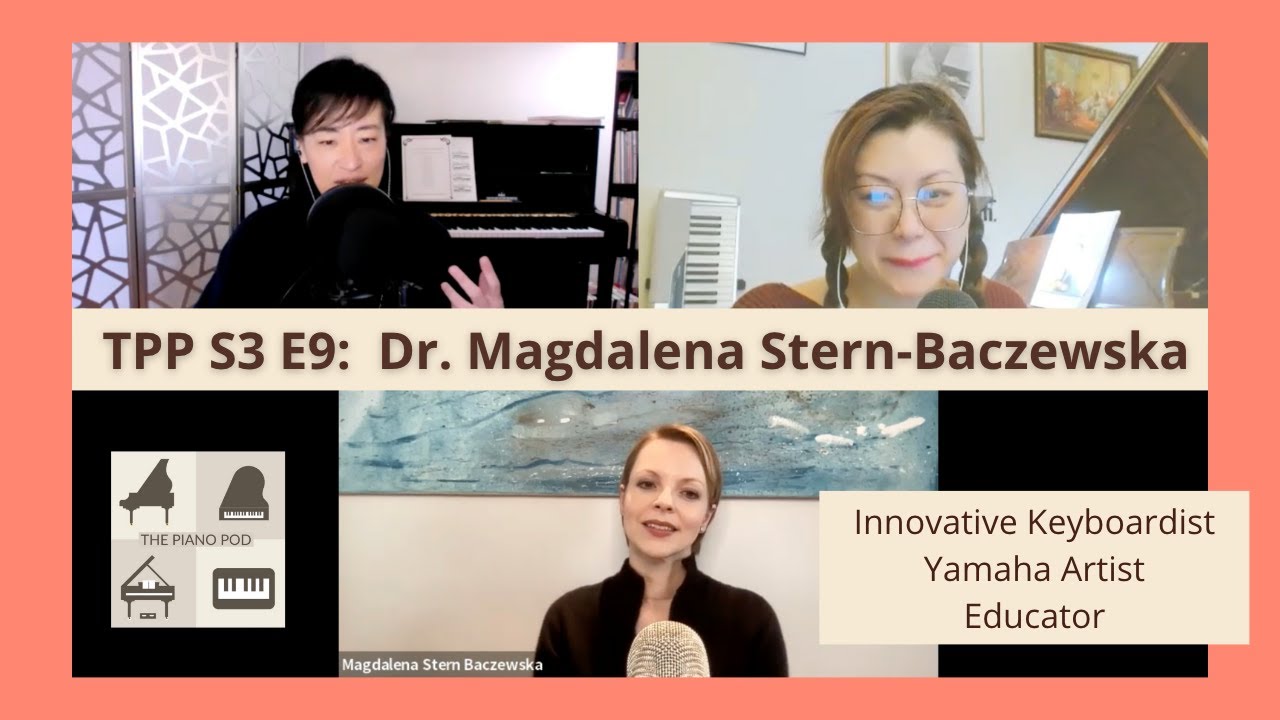
This content was created by The Piano Pod with Yukimi Song. This content was uploaded by The Piano Pod with Yukimi Song. This is a YouTube podcast episode titled "Season 3 Episode 9: Magdalena Stern-Baczewska -- Innovative Keyboardist/Yamaha Artist/Educator" (published/recorded 2022-12-28). The excerpt is an English interview-style episode of The Piano Pod (hosts Clara Zhang and Yukimi Song) featuring guest Dr. Magdalena Stern-Baczewska. The conversation covers Magdalena's Polish musical upbringing and training, her move to the U.S. to study with Jerome Rose, dual career as pianist and harpsichordist (including her back-to-back Goldberg Variations performance), her recordings (including Hip Hopsichord and Music for Dreams), collaborations with Tan Dun and other contemporary artists, pedagogy and lecture work, and anecdotes about performance practice and historical performance. The episode also contains brief sponsor messaging (Forte) and references the podcast's audience and mission.
Chapters
Happy, happy holidays everyone! Welcome to another episode of The Piano Pod with Clara Zhang.
Happy holidays, I'm Yukimi Song.
Wow, this is the last episode of 2020. Oh my gosh, I'm gonna miss 2020.
No, 2022.
2022! What, what am I talking about? Yes, 2022 already. Oh my God, the world. Well, so thank you everyone for listening or watching our show throughout these years, and then we had a terrific year of 2022, and we look forward to the year of 2023.
Indeed, we have an awesome— we have, we have had an awesome year going from the second half of second season 2 to now season 3, and we're very proud of what we've accomplished throughout this platform and and we have you, dear friends, to thank.
Thank you so much. And so for anyone listening or watching our show from the beginning, for the, for the, for the first time maybe, and, uh, welcome. Yukimi and I are both classical pianists and piano teachers from New York City, and this podcast is for anyone who plays the piano for fun, loves listening to piano music, or for someone who is currently pursuing a career in piano or works in the industry.
Professionally.
In each episode, we interview a guest speaker who has been breaking exciting new ground in the music industry. Before getting started, we want to thank our amazing fans and listeners for tuning in. Please rate our show and review it on Apple Podcasts because every rating review will help people find our show.
So as the last episode of 2022, we have Miss Madgalena Stern Bacewiczka, innovative keyboardist, Yamaha artist, and educator.
Yes, we received an email from one of our guests last season, Donna Wang Friedman, to introduce and recommend Magdalena to us as a potential guest.
Oh, I know Donna is the best! A quick shout out to her. Hi Donna, we love you!
Yeah, we love you! Yay!
Thank you so much. If you have not listened to Donna's episode, please do so. She is quite a storyteller, and her episode was Season 2, Episode 16.
Yes, so going back to our guest of this episode, Magdalena, I actually met her at the presentation she gave in 2016 or so. She was a lecturer at that day for the organization we both, you know, belong to, and she gave a lecture about how folk culture music affected the music of Chopin, particularly in his mazurkas, and the music of another Polish composer, Karol Szymanowski, And as a member of the organization, I still have the access to the video. So every time I pick up, you know, Chopin's mazurkas, I go back to watch the lecture. She's not only knowledgeable, but also she has a wonderful— she's a wonderful presenter, you know. She is— something about her that really engages with you, the way she speaks or carries herself, that leaves you with such an impression. So anyway, as I was prepping for this episode, I learned that she's also a harpsichordist, and then quite an accomplished one. So in In fact, she's done Goldberg Variations on both piano and harpsichord in one concert, back to back. Oh my gosh. So she also has done some interesting collaborations with prominent hip-hop artists.
And wow, I cannot wait to interview her and hear her story. So let's get this show started.
You are listening to The Piano Pod with Yukimi Song, where we talk to the brightest minds in the industry about how they are bringing the piano into the 21st century. We are honored to introduce Dr. Magdalena Stern-Bacewska, an innovative keyboardist, Yamaha artist, and educator hailed by the press as one of the most innovative, even radical classical keyboardists in the United States. Ms. Bacewska enjoys a multifaceted career as a concert pianist, harpsichordist, educator, and speaker. Having made her solo debut at age 12 in her native country, Poland, she performed internationally with the world's leading orchestras such as Philadelphia Orchestra, San Francisco Symphony, and China National Symphony, among many others. Ms. Bożewska is also a recording artist, and her recordings include pieces by traditional composers such as Bach, Mozart, Chopin, and Debussy, as well as contemporary composers such as the Oscar and Grammy Award winner Tandon and more. She recorded an album called Hip Hopsichord with a New York City-based composer and rapper, Gene Pritzker. This inventive album combines the virtuosity of harpsichord playing with electronic hip-hop techno R&B rhythms. Ms. Baczewska is also a professor of music and director of the music performance program at Columbia University. And she has given master classes, lectures around the world. In addition to sharing the timeless beauty of the music through her performance and recordings, her musical mission is to educate her audiences in each performance by giving them tools to enjoy music more profoundly. So, Magdalena, welcome to our show. Thanks for being here. Yay! Welcome!
Thank you so much for inviting me. I'm excited to be here, and congrats on all you guys do.
Oh, thank you, and then congratulations for all you do, and you're very inspirational. So, you know, Clara and I are both executive board members of The Piano Teachers Congress of New York, which is a New York City-based nonprofit organization to support piano teachers and students in the New York tri-state area. And then I actually attended one of your workshops that they host, and you were the lecturer, and it took place at the Yamaha Artist in Midtown. It's a beautiful place, and you gave a lecture on folk influence in the music of Chopin and Zimanowski, and it really gave me such an impression. So I, I'm, you know, I, I can't wait to really discover more. And as I was doing your, the research, I, I, I couldn't believe you're also such an accomplished harpsichordist.
It's really nice of you. That, that lecture was actually a lot of fun on the folk influences and the music of Chopin. I really enjoyed looking at his music through that lens, right? And as somebody who's born in Poland and who understands the language and the group, you know, having grown up in that culture, I was in that unique position, right, to look at the music at that— from that point of view. Of course, Chopin's music is so versatile and that one can really look through various lenses at his music. I recently have been lecturing on the subject of bel canto and operatic vocal style that is reflected in Chopin's nocturnes. So it was really a pleasure to, to do that folk-influenced lecture. This was a while ago, wasn't it?
Yeah, it was, I think, 2015 or '16. I think around the time you had this album also about Chopin and then Szymanowski. I think you have the first half is a Szymanowski prelude and then the Chopin Mozart, Mozart to follow, and I listen to all that. But yes, thank you, thank you.
Yeah, that makes sense. Yes, I was in that album, I was trying to demonstrate the influences that Chopin had on later composers. Of course, that is undeniable, and so many composers, including Scriabin and Debussy, right, were very inspired by the lyricism and beauty of music of Chopin. But, um, Shimanovsky seems to be lesser known, at least in the United States, so it's It was a great pleasure to introduce his music also.
Speaking of Poland, right? So we want to know how you discovered the love for music. Did you grow up in a musical home? And of course, you're from the country where Chopin was born, so maybe you were surrounded by beautiful music at all times. And also, we also want to know your training before you came to the United States.
Oh, sure. Yes. I, you know, the love of music was always there in my home because both my parents are professional musicians and my mom works to this day as a chamber music coach in the music academy in Katowice, where I am from. My father, before he retired, was a singer in a professional choir. So it was really always there. I don't remember a time when music wasn't a part of our lives and my parents, never really seemed to have hired a babysitter. So wherever they went, we sort of tagged along. And whether that meant my mother's coaching sessions, you know, I got to— I was told to sit quietly and not make a single move, but I was always listening to what she was saying to the young students. And those included singers. So that was very, I think, formative for me as well. And then of course, when they concerts, they would also take us with them. And I'm talking about us because I have two sisters who are younger, and they're twins, and they also became professional musicians.
Wow!
They're string players. They, uh, they play violin and the viola. And so we would go to my parents' concerts, and we were told there again to just sit in the audience and not make a move until they come and get us at the intermission. And so this way we got to hear a ton of really amazing music, you know, the B Minor Mass, Carmina Burana, you know, the Franck sonatas, Brahms clarinet and, you know, cello sonatas. So it was really a very kind of fortunate coincidence that music just sort of naturally became a part of our lives as kids. And of course, having parents who are very versed in music was really convenient in that, you know, I could ask my mom over dinner, hey, Mom, what is, you know, figured bass or, you know, you know, what is a diminished 7 chord? It was so much easier than other kids must have had it, right? We had all the music encyclopedias. This is, of course, before Google and the era of the internet. So it felt— yes, it was a great privilege to have access to the music or even to the musical scores. If I wanted to take a look at the, you know, at a Chopin étude that I wasn't yet allowed to play, I could do it because the scores were at home. So, of course, the recordings as well. As well. That's— that was a very big deal. But I did start my former lesson— for more formal lessons at age 5. My parents sent me just to kind of see how things work out, and I got incredibly fortunate to have most angelic and patient and loving piano teacher with whom I am still friends. She is now in her 90s.
Wow, no way!
Yeah, but whenever I go to Poland, I make sure to, you know, have a little tea with her and Her encouragement really is what kept me going. I just wanted so much to be a good student and to make her happy. And yeah, she was always just really living and breathing music, and it was a pleasure. I couldn't wait until my next lesson.
What a wonderful way to start your musical journey, right? And so, but But till you came to the United States, I know, I think you've done college and higher education in the States.
States.
Yeah, yeah, yeah.
So when I was in high school, and in Poland we still had that system where high schools were— this was a specialized school for music kids. And so which meant that we would have, you know, ear training and music history on a daily basis. Meanwhile, math and geography, all these kinds of academic subjects were a little bit more sparse, right? So this school, this curriculum was kind of geared toward kids who are truly focused on performance and are going to competitions and so on, right? So I was doing that, and my, uh, you know, my track was to, yes, to go to as many competitions as possible and play with orchestras and so on. Um, and at age, uh, must have been 15-ish, I was invited by this fund for talented kids under 18 to go to Warsaw and participate in a master class with a professor from New York by the name of Jerome Rose. I again knew nothing of him because, uh, you know, I just simply didn't have this kind of access to the technology to find out about the, you know, Mannes School. I had no clue. So, but there he was, and every student had just an hour with him. And I remember playing the and Scriabin sonata. And working with Jerome Rose, it was completely different approach from that that we had, you know, in post-Soviet Poland, very strict, kind of punitive, right? All of a sudden he comes in to this lesson and like a storm, and I felt like I had no— really, I did not know what came over me. It was such a memorable, very strong musical experience. And for those of you who know Jerome Rose, you know that he has a very stormy personality, and he's extremely passionate about music. And when I was playing the second movement, he was actually yelling because he was so excited about, you know, creating this really incredibly passionate, right, emotion in the music. So after the masterclass, I remember there was some sort of a coffee break, and I had just enough English to be able to have a basic conversation with him. And at that point he asked me, well, how would you like to come to New York and study with me? You know, he could have just as well asked me if I want to come to Mars, because this is the '90s, I'm 15, I didn't have any, you know, friends or family on this continent. So I'd never been on a plane at that time. So it really sounded completely nuts to me. But I came back home and I told my parents about it. They said, well, you know, it's really nice, but how are we going to even afford this, right? Again, you know, in, in the post, uh, you know, Soviet Bloc countries, the, uh, the wages and everything was completely disproportionate. Um, so I kind of forgot about the whole idea, and I was starting to work on more competitions and perhaps getting into the music academy in my hometown. They do have a very good music academy. Actually, Christian Zimmermann is one of alumni.
Yeah.
Wow.
Alumnus. And so, uh, my, you know, my— this plan was not bad at all. But then one day I am home with a flu and the phone rings and it is Jerome Rose. Wow. This is a year after, right? And he says in his big Tulu voice, he says, are you coming or not? I, at this point, I just really— I was so flabbergasted that he even kept my phone number, right? Um, and he, to this day, this is 25 years later, he tells me that if I hadn't been at home that day, he would not have called again. So this really was a life-changing moment for me. And I said, yes, I'm coming. I'll just figure it out. He asked, are you able to just buy yourself a plane ticket to come to auditions and I'll take care of everything else?
Wow.
I said, sure. We did it. And he actually gave up his apartment for me and went to sleep on somebody's couch so that I could practice and sleep during the audition week. So from the beginning, he really showed so much love and support, this kind of fatherly, right, support that I really could not have asked for more. And so, you know, when I got in, I came back in September, you know, and that was a big adventure that began. And again, I was just so fortunate to be in lessons with him. He would say things like, you know, it's your decision if, you know, how you want to play this Beethoven sonata. I remember I was working on the E-flat, uh, Major, you know, Opus 7, and he— I would ask him, oh, is this too much, you know, crescendo here? He says, why did I— this is your responsibility, it's your performance. And first I thought, my goodness, this is so different again from how I was taught in, you know, back in Poland. Um, you know, every little detail used to be chiseled with the teacher, you know, and if you something differently, you know, you would get yelled at your teacher after the performance. And, um, in this way I was a little stunned thinking, well, what do you mean you're not gonna hold my hand? I thought, you know, I was your student. But then I quickly realized that he was empowering me to become a mature artist. He was teaching me not to need him anymore. And I thought it was just such a grand way of thinking about performance and about artistry.
Wow. But it just takes one, this one person to change your whole perspective and even your career in life. And obviously he— but you know, as a teacher, we also look for a student or mentee that we connect with, right? So I think he felt that way. That's why he Fondue after a year. So that's, that's incredible. Now, before, you know, going any further with more questions with that, um, your piano career, I'm also curious about you being a harpsichordist. So when does that happen? Does it— is it like you— were you learning piano and a harpsichord sort of simultaneously, or harpsichord came later?
Right, the harpsichord came much, much later. I was already in college, and you know, when I was growing up, the conception of the harpsichord, the whole— my idea of harpsichord was that it was a failed pianist, you know, that if you couldn't get into a conservatory as a piano major, then you would major in harpsichord and everything would be well. But I realized when I started listening to the music and discovering the whole world of, you know, so-called early music, that it is not at all the case, that this music harpsichord music, first of all, is written for unbelievable virtuosos, right? And that's— yeah, you cannot— it's not enough to just be a failed pianist to play the harpsichord. So I signed up for a class called Harpsichord for Pianists at Mannes, and it was led by Arthur Haas, who is a world-renowned harpsichordist. And it, again, it was something that just immediately clicked. I didn't find it easy at first to, to play the instrument because even though I spent years by then at the keyboard board of the piano, all of a sudden the action weight was completely different. The keys were a little narrower, and the sound that was produced was impossible to really mold, right? The harpsichord is not capable of any dynamic gradations. So that was a little shocking at first, but it really was also the music itself that completely made me really passionate about the aesthetic of making music. You know, these days, um, the so-called early music has made it really into the mainstream, right? The Juilliard School has a historical performance program which is wonderful, amazing faculty there. But yeah, when I was there, the harpsichord was still really sort of an underground thing. And so it was also thrilling for me to be a part of that underground movement and going to concerts, you know, out in Long Island and Stony in Brookbrook. They also have a wonderful early music program there. And here are these people playing with Baroque bows, playing on gut strings at a different— with different tuning systems, right? And different A, right? And 4/5/3 versus 4/4. And I was incredibly attracted to that type of sound, also to the freedom, right, that the Baroque and pre-Baroque music gives the performer, right? You all of a sudden realize, oh, the musical notation is really just a foundation upon which you build, right? And you improvise and you ornament. And so that of course led to reading all the important treatises, you know, the Johann Joachim Quantz on playing the flute, and of course the CPE Bach, um, you know, playing keyboard instrument. There is also a short treatise by Couperin, you know, L'Art de toucher le clavecin. And I thought, well, I never thought I be reading treatises, you know. I'm a performer. But, but they were really such practical methods on how to bring as much passion and, you know, life to this music that I just, I couldn't stop. So that's what really set it off. But for many, many years, I didn't even say I played the harpsichord. I didn't find myself worthy of calling myself a harpsichordist because we all know, right, how, how long it takes on the piano to even start calling yourself of a pianist. And so I thought, no, no way, this is— I, I will never be good enough. And then one day I said, I said, well, it, it really helped to finally purchase an instrument of my own where I could spend as much time as I could on both instruments. So now finally, after all these years, I feel comfortable switching from one instrument to another and being able to kind of change gears immediately. But that was a long process. And so yes, when the Goldberg Variations— because you were—
yes, yeah, I was going to ask, I actually watched the whole thing. I think it was the one video, this video was you were performing for the International Keyboard Institute and Festival in 2015, and first half was done by on the cembalo, a harpsichord. And then second half, same variations, came back in a different outfit. I noticed it's beautiful. And then on the piano, and I was like, wow. So we want to— and I read some comments, some people like, oh, I prefer the piano better, or some people say, oh, I prefer harpsichord better. And then you were at the beginning, you were like, it's not about comparison, you know, comparing one over another, but it's about different styles and stylistic choices and everything. And so tell us about the performance and why you wanted to do that in the beginning.
Wow. Well, thank you for taking the time to watch the whole thing. It was a very beautiful— yeah, thank you. You know, and the outfit change was also very premeditated. I am not one of these pianists who change outfits for the second half, which, you know, which is fine.
It's the Asian thing, no?
Actually not done, you know, and it's really lovely, you know, if you have enough outfits to show. I love fashion, so I'm the last person to criticize that, but I wanted to really focus on the idea of completely different aesthetic again, right? So for the harpsichord, it was a really interesting preparation process process because it's like working on completely two different pieces. So after a few hours on the harpsichord, I would sit down at the piano and, you know, one might think that psychologically it would be exhausting just to play the same piece, but after a moment these became completely separate pieces of music, right? So yes, so all the technical aspects aside— well, I should do— I should mention them because they're important. You know, I did talk a little bit about the action of the harpsichord, how the sound you basically— it's on or off, right? You need to really control the sort of how you take off your finger from the key, otherwise you're producing this really ugly clicking noise. For legatos, for example, you— on harpsichord, you overhold. So if you're playing a 5-finger pattern and you want it to sound like legato, not just just typing, you have to actually overhold all the things. This is not exactly what you would do on the piano, right? Things would start sounding a little muddy. So yeah, I had to train myself to do these two completely different things. Then there is of course the question of the two manuals, right? So on harpsichord— and, and that's the beauty of playing the Goldberg on the manuals, is that you finally to have the space that you need, right, to perform the piece without having to fight for the key with your thumbs, you know. So that was great, but that's also something that requires training, right, because you're playing on two different levels.
Very different.
Yes, and then of course the harpsichord has all these stops which I wanted to, you know, show the full capability of the instrument and and to change the stops, right, to create the colors, right, that the instrument possesses. And so for all of those who may have never heard a harpsichord performance, you know, they were fascinated. They were wondering, what is that that you were doing over there on the sides? You know, they had no idea. And it was a beautiful discovery. So, and then you sit down at the piano and like I said, it's a very different piece. Some things don't work maybe as well on the piano as they do on a harpsichord. There were a couple of variations which I simply really treated in a completely different manner. Like, I believe it's Variation 7. So on the harpsichord, I made this into a kind of a type of gig, which is this canary, which goes really nice and fast with these dotted rhythms, kind of like a tambourine-like vibe, right? Very sparkly. And then on the piano, I thought it just doesn't work, so I may as well chill out, bring the tempo down, and make it sound like kind of a siciliana type, you know, just much calmer. And, and I thought that was really quite effective, and I started pushing more and more in that direction, realizing that that, you know, the two instruments have completely different things to offer, right? That the piano being dynamically so expressive should be used as such, right? Also that there's no point in keeping the music, you know, flat and uniform because that's not at all what Bach would have wanted, right? When you listen to his vocal music, to the violin music, there's just so much expression. There is no way on earth, right, that Bach would have liked you to keep things flat and uniform. So yeah, that was an amazing process and a great discovery, and it seems to be really appreciated by the audience. I remember Geza Luká— she is a German pianist, she was also on the faculty of the International Keyboard Institute that year— and she said to me with that adorable German accent, she says, "I thought that the piano version was going to be normal, but it was not normal." What is normalcy, right? Right. You know what, that's the greatest compliment I've heard because it is— the music is— you, you can— you never really should get over it, right? And I'm sure that we all have this feeling of magic when we put on the recording of the Goldberg's, right? That we know that something special is going to happen, so it should never be normal to us.
How long did it take for you to feel comfortable as a harpsichordist in the beginning? Because you said you study— you started studying in your college life?
Yes, so I was in my early 20s. Yeah, so this is, you know, a decade and a half. And I gotta tell you, I— before I got on that stage, I said, what am I doing? I am such a fraud. I, you know, like, why am I even agreeing to do this?
I know the feeling.
I mean, in China, it's— I grew up there and I went to the conservatory there. They say if you're not a pianist, then you can be a composer. So when I was 11, they offered me, and I was like, no, I don't want to be a composer, I just want to be a pianist. And now I'm like, well, I could have, you know. Anyhow, so yeah. And then speaking—
this episode is presented in collaboration with our good friends at Forte, a free alternative to Zoom purpose-built for music teachers.
We're happy to announce that Forte will always be free for for music teachers, no string attached.
That's right, Forte offers features optimized for classical music lessons, including audio quality far superior to existing platforms and allowing you to hear every nuance of your student's instrument. Their colleagues at the Royal College of Music, Aspen Music Festival, Curtis Institute, and Berklee College of Music have been— have have you even used Forte in their own programs?
Forte's mission is to radically expand access to high-quality music education worldwide. Forte always puts teachers and their students first. This means you can use Forte with your own students for free forever, and Forte will soon introduce paid features allowing you to connect with new students around the world.
Sign up for free today at forte fortelessons.com. That's F-O-R-T-E-L-E-S-S-O-N-S dot com, or click the link in the description.
Let's continue with the episode. So yeah, and then speaking of composer, and we also know that you have collaborated with Mr. Tan Dun, Professor Tan Dun, right? Such amazing person. I still always wish that maybe some days we'll run into him on the street, you know, because he is still in New York sometimes, right? I think.
Yes. Yes, I think he's now between Shanghai, New York, and upstate because he's a dean at Bard.
Right, exactly. He's the dean there. So for those of our fans that don't know, Tan Dun, Mr. Tan Dun, is the Grammy Oscar winner, composed music for movies such as Crouching Tiger, Hidden Dragon, and also Among Pianists, of course. Eight Memories in Watercolors is a famous piano suite, which I think Lan Lan plays often, and a lot of students that plays. I remember ABRS and British examinations, they like to play these pieces as well. So tell us a bit of your experience of collaborating with Mr. Tan Dun.
My goodness, you know, this was another absolutely life-changing moment for me to meet Tan Dun. It was a very kind of accidental meeting just in the hallway at Columbia University in the summer. Nobody was there, and I just met him that way. And he asked me, well, what do you play? Do you have any performances coming up? And I thought, my goodness, Tandun is asking me about my performances. He will never come. But I told him anyway that I was doing a recital and he did show up. It was just so incredibly nice. And in a few weeks after that, I heard from his assistant who invited me to play his piano concerto. In Beijing, and it was of course, you know, beyond imagination. I was so honored. I couldn't believe that he invited me, and really working with him toward that performance, of which we then ended up doing quite a few in various cities, and we've traveled to China multiple times. The way that Tan Dun works with sound is most fascinating. You know, I think that it's important to realize that this is somebody who grew up during the Cultural Revolution in China, right? He, as a young man, was a rice farmer.
Yeah.
So unlike all of us who were there in the practice rooms, right, practicing away, he was in the farm. Um, that's right. And he was really not allowed to have access or listen to Western music. So not at all. Exactly. So when he first discovered it, he said he was already in his 20s, and, and it blew his mind. Right? So you hear that fascination with sound in his music, in everything he does. You know, he— and that's not only just the Western music sounds. He's so sensitive to sound in general. I don't know if you're familiar, but he has this paper concerto where he is— where the performer is tearing different types of paper at different speed with different techniques. To discover the sound that it makes, right? And it has, you know, I wouldn't, I would probably say that it has quite a bit to do with the fact that Pandun, when he moved to the US, he was studying with John Cage, right? And John Cage had that approach to music, right? Listening to the different sounds. And, you know, he has this piece, Water Walk, where he, he's, you know, you can hear him put Flowers in a Vase, and you know that these, all these sounds are the composition, right? Not to mention famous Or 33, where it is the sound, the lack of deliberate sound, right, that is the piece of music. So very highly philosophical. Tan Dun, I think, really adopted a lot of that, but in his own unique way. He also has a water concerto where it's a percussionist usually who he teaches this special technique of working with water in a bowl. It is heavily mic'd, so you really can hear everything very clearly. And by manipulating the water in certain ways, you know, you discover the sounds that you really never think of. So that kind of freshness of approach and the fascination, and you have the deep listening, is something that was very deeply humbling, right? Because we take We take so much of what we do for granted, right? And there is Tan Junwen really bringing all that passion and all that sort of that freshness again. I will reuse that same word to the music and also to the audience, right? Yeah. In China, I'm sure you know, the audiences are just so passionate, right, about about the performance. And I think it really comes from the fact that they were deprived, right, of orchestra music for so, so long. And so enthusiasm among the audiences is tremendous. But Tan Dud really brings the music to them. He makes it accessible. He also uses multimedia, right? He uses film on the screen. So that has been a really interesting interesting for me to work with because it's not just the conductor and the orchestra. It's also what's happening on the movie track that you have to be aware of. Let's say if you're changing tempos, you have to be there with the multimedia.
And was the piece that you were working on called the Martial Arts Cycle? That's the sonata and trio for piano, violin, and cello?
Exactly. So this was the piano concerto version of the triple of the, yes, of the trilogy, martial arts trilogy, after which follows a triple kind of piece for violin, cello, and piano. So the beautiful thing is that I was never the only soloist, right? There was always a violin concerto, cello concerto based on the Crouching Tiger, and then I was there on the, with the piano concerto on the Legend of the Scorpio, right?
Wow.
And after that, we would all come together and play this piece, which was a tribute to Wagner's Ring. So we got a lot of kind of very charged content. And of course, you know, collaborating with these amazing, uh, soloists, you know, from all over the world was fantastic. What Tandun did a few years later is create a chamber music version of this this martial arts trilogy, and I was very honored to be invited by him to record that as the chamber music version. So I did that with a Norwegian violinist, Albjørk Hemsing, and Zhao Xin. She's a wonderful cellist, okay, cellist who lives in Belgium. And so we also did travel playing that, that I got to also perform it in Tanglewood, which was— Oh, great. Yeah.
So were you— so you were just in Beijing, or were you in different cities in China as well?
Beijing, yes. We went to— the recording was actually in Zhujiajiao, which is— oh, beautiful. Oh my gosh. Venice of China, right? Beautiful water town. They have a beautiful facility there that's called the Water Heaven. And Jun has his show there based on water and the various ways of hearing the water. So the recording took place there. We went to the Guangdong Province also where we performed in various cities. So— Shenzhen. Yeah, Shenzhen, exactly. Guangdong, yeah. So that was a fascinating trip. I'm of course devastated that the pandemic took it all away.
Oh, it was recently. July, was it right before?
Yeah, my most recent trip to Beijing was actually January 2020. So, oh my gosh, you've been here, you've been there sooner than I have.
I haven't been there since like July of 2019 and I can't go in, you know, I don't have a passport anymore. But that's, uh, yeah, but I hear You probably also know Professor Zhou Long and Chen Yi. I don't know if— right? And they are all friends with Mr. Tan Dun, I believe. And one of my best friends is a composer in Hong Kong, and she lives between Hong Kong and Shanghai, and she studied with all three of them at one point. But she was just saying how nice all three of them— like, you know, it's like grandparents, or they're not even at the grandparent age, but they They're just so nice, you know, to young musicians. And just—
and they were really that first wave, right, of composers from China who were very first in the West. Yeah, they were all students of Professor Chou Wai-chung, who passed away a few years ago. But he was— I really, I got to, to meet him a few years ago at Columbia, and he was really, uh, you know, one of those philosophers types, beautiful storyteller, so much to say. He actually said about Tan Dun that he decided to meet him when he heard his music on the radio being ridiculed. Somebody on the radio was saying, well, listen to this idiotic music, and Professor Cho Won Chang said, I want to meet this guy, and that's how it all started. Wow.
Yeah, well, thank you for sharing. It's, you know, because we are all pianists and then we tend to just stuck in a practice room and following the notes and we just forget about how beautiful the sound, the sound we can create. We tend to focus on the notes and phrases, but yeah, we forgot about the sound. So to meet an incredible composer like this It's— I'm sure it's inspirational. So we have a few more questions regarding your exciting recordings because you are not only the harpsichordist and pianist, but you are also the recording artist and you have several amazing CD albums that I'm curious to know. Now there are some that are, you know, traditional, like I think Bach, you did the Goldberg Variation that's on the album. And Chopin, Szymanowski we mentioned. And I'm curious to know about this hip-hoppsichord because, you know, my impression was like you were, you know, from Columbia University professor, you looked very— I wouldn't say traditional, but, you know, professorial figure. And, you know, when I first met you back in 2016 or So when I saw the album of this hip-hop score, I couldn't believe it, but it just sounds so amazing. So can you tell us how did this happen?
Thank you. Thank you for listening to it. Yes, you know, I'm always just fascinated in also what my musician friends are doing, right? And this is something that I love doing, to go to their performances and see, because like you said, Yukimi, right, we're always locked up in the practice room all by by ourselves, you know, at least the string players, they have their orchestra and their ensembles. Yeah, it's very healthy to get out every now and then and to hear the music of your peers and support them also, right? So I met Jean Pritzker a while ago through yet another musician friend, and I heard his pieces at the Poisson Rouge, which The Piano Pod, which is a fantastic venue in New York City, right? One day they will have a classical concert, another day they have sort of a rave.
And so I love that venue.
Yeah, it's wonderful because it really shows that music is just one thing, right? And there shouldn't be— as much as we like to categorize things and label them, music is there to enjoy, to be a part of, right? Some beautiful collective activity. So I heard his amazing amazing Bach transcriptions which were performed by him, then the Absolute Ensemble, and Simon Dinnerstein. And I thought, my goodness, wouldn't that be amazing to collaborate with him one day? And so we have done a project, actually, this is a while ago, maybe 2016, '17, when I did my album Music for Dreams. So speaking of not traditional, I have to kind of back up to that. I made Music for Dreams as a commission from my now husband, who is a sleep specialist. So he asked me— actually, he heard me play the Goldberg. You see all the rows go back to the Goldberg Variation. He heard me play, you know, back a while ago, and I mentioned before the concert, because I always like to talk before the concert, just a few sentences so the audience knows what's going on. And I said they were commissioned by an insomniac, right, Karl Kaiserling, who couldn't sleep, and he commissioned Bach to write a piece that would help him spend these sleepless hours looking at the— and so Dr. Stern looks at the— thinks about this idea, and he came to me after the concert and asked if I could record some music for his patients to help them fall asleep. I thought, this is completely crazy. It's not what I do, but I did it.
I did it.
And after some time, there was a company called Metronaps. They have these kind of napping pods all over the world in some airports and so on. They asked if we could make music for their pods, but they didn't want it to be strictly classical. So remembering Jean and how fluent he was with the electronics, I thought, let me ask him, maybe he can help me. And he created this lovely, beautiful track that is still, you know, playing all over the world. And so we did this piano and electronics. And then I approached him another time right before the pandemic for the fourth iteration of the Music for Dreams. We already We had 3 albums which people really enjoyed for themselves and their children. They said they were really helpful. But then there were some patients who would say, well, do you have anything non-classical? So again, I turned to Jean and he created from some of the tracks that we, that I had recorded before, he created these remixes that sound very, very hip, you know, I wouldn't even thought of that, of those ideas. But he kind of takes you on the world journey with, you know, different vibes, different sounds, different rhythms. And I thought that was just incredible. And then the pandemic happened and we all got locked up and I stayed in touch, you know, with friends as much as I could. And I know that Gene was doing a lot online. He just kept writing. He already has, he's up to, is 800 now.
Oh my goodness.
He writes all the time. He's amazingly creative. And he asked me, how would you like to do a piece for harpsichord and electronics where you record your part and, you know, to the click track and then, you know, we release it as a remote collaboration? I said, absolutely, sign me up. You know, it was a marvelous thing. Both of us, you know, we share this love for hip-hop. And we talked about it on multiple occasions. You know, when we would spend time after concerts, you know, we'd listen to this music, and it was a wonderful way kind of to bring our other interests into the equation.
Wow. But do you find any sort of common denominator, like, between hip-hop music and then— well, I would say Baroque music, but, you know, you're using a Baroque instrument. So let's say Baroque music, or is it the opposite attraction because it's— they are so different, that's why these two attract each other? Or maybe there are some similarity, I don't know.
Right, well, this piece definitely is the only one of its kind, right, at least for now. So I don't think that Jean was necessarily thinking about the harpsichord in the very Baroque terms, you know. He thinks of it it as sound, and his writing wasn't very idiomatic in terms of, you know, Baroque. He wasn't really going for that. And so to me, it was also interesting, you know, in sort of adjusting the tempos or thinking of ornamentation. It felt very much like new music, right? So really, the only thing that was Habsburg was really the sound of it. But yeah, I think what attracted him was the— kind of the clicky nature, the very sparkling nature of the sound, right? And I felt that there was a lot— a lot of it happens in very fast tempos, and I think that he was attracted to that. Yeah, so, yeah, so I think that really was more of kind of an experiment on his part, and he does a lot of these. And I thought it worked really well. It was super fun to put it together. And, you know, that collaboration sparked another one with another DJ who is not classically trained. And I did— he asked me to listen to his track Robo Tribe, and I did improvise along with it, first on a harpsichord and then on the piano. And then I did that. I thought, well, you know, this is— I've always loved all kinds of other music. I love EDM. You know, I love heavy metal. It's, it's one way to bring out these various facets, right, of your musicality. And so I recorded these improvisations and he actually just released The Piano Pod with a remix a couple days ago in Barcelona. So I'm excited. I never thought that my name would be associated created with, you know, an electronic acid EDM kind of music.
That's cool, that's super cool. You know, you started as a pianist and you, you know, by chance you came to the United States and one thing another, harpsichordist, and now EDM. Hey, yeah, you're living the life. That's wonderful. But also, before I stop asking you too many, too much questions, I have one more question about with, you know, working with Jean. So you have "What Matters." It's a single, and then I think you appear in this song as a harpsichordist. It's about Mr. George Floyd and Breonna Taylor, right?
Yes.
Can you tell us a little bit about it?
Absolutely, yes. So we all know, we all remember those days, and you were in New York City as well, so you still probably hear in your memory the noise, right, of protests and the shouting and the outrage that occurred after the deaths of George Floyd and Breonna Taylor. And artists were all trying to figure out where their place is in all this, you know, how do we reconsider what we do, right? Especially in our field, right, which is so focused on a tradition of kind of white male music, while male performers and so on. And this was— this really shook all of us up, right, in many, many ways. And there was again an email from Jean saying, I'd like you to be a part of the song that I'm writing to commemorate those and to join the protest, right? And so again, it was one of those remote collaborations. I am still to meet the other musicians who featured on it, the singer and the drummer. But yes, What Matters is a song that joins the Black Lives Matter protest.
Hey guys, we're now officially on Patreon.
Yay!
I'm so excited about our next step on this podcast journey.
Same here. So dear TPP fans, we love what we do and it's been an incredible journey for both of us for the last 2 and a half years, and we are now at the 9th episode into season 3. And more than ever, we need your support to continue our work by bringing you highly valuable content biweekly by interviewing the A-listers, uh, listers in the industry.
So please go to patreon.com/thepianopod and become part of the TPP community by subscribing to us. With your subscription, you will receive monthly subscriber-only exclusive content from our show.
That's right, and once again, it's patreon.com/thepianopod with Yukimi Song.
We can't wait to connect with you on Patreon very soon.
I have to say that, uh, when we initially, uh, Yukimi and I were talking about, you know, interviewing, and I did a little research, and then we, you know, found out about the harpsichord and the hip-hop and all of that. Very interesting. So it was quite inspiring that I have a keyboard, you know, right here and then behind my standmate. And I have some little students that don't really enjoy the sound of a metronome, right? So sometimes I have them use the metronome like just a flashlight, you know. And then one day I forgot, I think it was, I forgot why, but I was not using the piano. And then I remembered what you're doing and I was like, you know, What? So now when they play, practice Bach or Mozart especially, sometimes I will change the harpsichord sound on there and I use those electronic rhythm, you know, is because the rhythm are in 3/4/2 anyway, right? So it's kind of all of a sudden they're much more interested in using the metronome.
I'm like, oh great, that's great, that's amazing, that's brilliant.
Yeah, so a couple of teenagers now they're saying, oh, maybe we should record something with I was like, okay, you know, we have to like really think of an idea, right? Like, it can't just be— but it's kind of fun. And even for me, I play, I practice a lot of Bach, you know, like when I'm depressed, I practice Bach, when I'm happy, and late at night I practice on the keyboard with my headphones on. And there are days, you know, raining, whatever, I will actually— I like to use the metronome. Like, I'm kind of addicted to metronome. I like the sound, and I will use these different sounds. You know, it's a, it's a very, it's just so new, right? That I'm still just getting these like tinkly feelings.
But it's so brilliant, Clara. Yes. No. And, and as humans, I think we're all very sensitive, very receptive to rhythm, right? Right. You hear it on the subway, you hear somebody play their drums and your body immediately follows, right? And there's something so powerful about the rhythm. And so it's a brilliant idea idea to play conga or hip-hop to their Mozart.
You are leading the way. So I'm going— I cannot wait to introduce to my students about all the projects you're doing. Speaking of, and we know during the pandemic you also had a Debussy on Fifth Avenue, right? And the piano and the two books of image for Debussy. But why Fifth Avenue?
New.
The album was produced also using Yamaha Disklavier, right, technology.
So that's right.
That's interesting.
Yes. So by now you've, you've figured, right, that I'm always ready to try something new. Situations in which I learn. And I think we all agree that you best learn when you become a little uncomfortable, right?
So yeah, it's just Yamaha Hall is on Fifth Avenue. I mean, I remember the Coach, you know, Coach store is right across the street, right? I know this place, but I never knew Yamaha Hall was just across, you know, from it inside, because you wouldn't be able to tell from outside if you don't know.
Yes, because it's not a storefront. Yes, but it's a very, very elegant place. Yes. And I have to tell you that I actually used to work there as an employee of Yamaha Corporation of America for about 4 years. I was doing—
oh my goodness—
what's called artist relations. So I was responsible for organizing master classes and recitals, attending competitions at times to support the Yamaha artists and future Yamaha artists and expose them to the brand, you know. So it was interesting to learn a little bit about music from that other side of supporting other artists. And by then I discovered, of course, these are marvelous pianos. And of course, the tender loving care, right, the TLC that the piano technicians give to them, it's something that I just admire. I could sit and listen to one of the technicians just tune the piano for hours because perfection that they seek, the time that they're willing to spend, you know, and there are so— they're very surgical also, right, with their preparation. There is no chewing gum.
There is—
it's a complete focus, you know, almost like a surgeon. Um, so I had very much by that. And, uh, I was introduced to the Yamaha Disklavier technology even earlier when I was invited to participate in a master class as a student still. I was a grad student at MSM, and the teacher was Japan. So I thought, well, how is that going to work? I came late at night to Yamaha Artist Services, The Piano Pod with Yukimi Song, and in Japan, of course, it was already the next day, 13 hours forward. And I played the, I think, Chopin's Third Sonata and had a lovely master class. And then I heard this applause, and I realized that there were 600 people actually on the Japanese side sitting in the audience. Audience, and they heard me play on that other piano, right? Because they're connected with internet.
Wow.
So they're kind of like player pianos from 100 years ago where you had piano roll, but now it's digital technology. So I'm playing on a gorgeous acoustic instrument, but the movements of the keys and the pedal are recorded exactly, right, and transmitted, I think, 0.2 seconds or later and the audience in Japan heard the exact performance except I'm not on the piano bench. So I thought this is the coolest thing ever, you know. And so ever since I've discovered that, you know, you can do wonderful things pedagogically on the disklavier. Of course it requires both sides, right, to have disklaviers, but I've had many lovely opportunities to work with schools, you know, in Philadelphia, in Texas, North Carolina, teaching on a disklavier. But, oh, and then I thought about doing a project. I was actually inspired by some of these unbelievable kind of ghostly, almost freaky things that are done on a disklavier where you can hear Rachmaninoff himself play, right? So you transform the audio of what Rachmaninoff did into the MIDI file that is being played on The Piano Pod. And you actually hear Rachmaninoff, you hear Glenn Gould do the Goldberg, you hear Art Tatum, you know, do crazy improvisations. And I thought that is incredibly cool. So that always has stayed in the back of my mind. And then a day came where I proposed the project project to Yamaha Artist Services. How would you like if I did an album on a disklavier? So I recorded the music into the disklavier, meaning that the outside noise was not at all important because the sound were just— the sound was not recorded, it was the depth of the keys, right? And so the file later gets edited as a MIDI. So it looks, you know, you just see it on a computer screen, all Notes are there, and let's say if I brushed a note or something, you could just click on it and delete it. It's— it was insane how you— yeah, you didn't have to do a second take. If you just brushed a note, you deleted the wrong note. Um, and then I realized, oh my gosh, you can actually make all your runs perfectly smooth. And, uh, and I thought that possibilities are endless, but I decided, you know what, it's gonna start sounding like a robot if I do all these things. So I just asked to erase the brush notes and I left it. So it was essentially a live performance. And then what they do once the file is edited, they put the USB port back into the piano and then the audio is recorded from this second corrected file, right?
Wow.
So, but by then I'm just sort of sipping tea and looking at the piano do its thing, you know. It's kind of amazing. So that's why I call called it ABC on Fifth Avenue because the salon is on Fifth Avenue.
I see. But I didn't realize of the technology. I mean, I knew, I thought I knew, but I thought it was more like a recording device, but it's recording your movement, your how much you put weight.
Wow, that's it. So I think they have it up to more than 1,000 speeds that are recorded on it, on the key, and 250 on the pedal. Something crazy like that.
Oh my goodness, that's fascinating.
This is more crazy than even AI, right?
It is.
Yeah, it's very ghostly when you look at it.
You are obviously an educator as well, and then you use this technology for masterclass, remote masterclasses and everything. That's very, very fascinating. But so we want to really get to know you also more about you as an educator, and obviously you're teaching at Columbia University. What's your vision for students? Because I'm a teacher too, Clara is also. So through music, what sort of message you want to, you know, give it— give to your student?
That's a very beautiful question, you know, and just from what Clara, you what you were saying before about finding all these innovative ways to engage your students, right? I, I just want to, you know, tell everybody who's going to watch this podcast that teaching piano is probably one of the most exhausting things, right, that I can do, um, physically and mentally, right? And the fact that, um, you know, I wasn't teaching piano on during during the pandemic because my duties are slightly different at Columbia. But for everybody who was teaching piano throughout those 18 months on Zoom, I just want to bow my head down because the absolute nightmare of not only hearing the Zoom sound but also trying to stay with the students, you know, with the complete absence of, you know, physical contact, it really, really, really was super challenging for so many, both the students, their parents, and of course, the teachers. So, you know, bravo on that. My duties at Columbia are, first of all, I am administrative, so I run this music performance program, which is a wonderful group of about 400 students who play music on a high level, but they major in totally different disciplines, you know, computer science and whatnot. So some of them are in the Juilliard Columbia Exchange. So what that means is that they attend actually both schools. I never thought it was possible, but they, they're really very special kids. And so my— aside of mentoring them and making sure that they are provided instruction and performance opportunities, I also teach what's called music humanities, and it's a combination it's group class, combination of music history and appreciation for non-majors, right? So it's a required course, it's part of the famous core at Columbia. Everybody has to take a semester of music, art, literature, philosophy, and so on. Science, I believe, also. Um, and so to get 25 students who are are completely green. They have no idea what's going to happen in the class. To get them to understand that this is important, right? In today's age where music is done, you know, just by clicking something on your laptop and really taken for granted, uh, it's, uh, it was a really interesting challenge. Now I've been doing this for over 8 years, so, so, um, it's, you know, I feel increasingly comfortable with it. But many of the students, you know, they're brilliant minds, of course, and amazing scholars, but they may have never been to a concert or to the opera. So you have to sort of introduce them to all these experiences. And there are a lot of very interesting discussions because, you know, they're coming from totally different backgrounds and they're bringing, you know, ethics, uh, history, psychology, human rights into the discussion. So every semester texture is fascinating and very different, right? But, you know, you were asking Yukimi what the philosophy is. I guess my hope really is that they come out of this course understanding that music is not just entertainment, that it is a transformation, right? That when something— when you play a note in a room, something happens in the air, right? That, that's after after certain concerts, certain events musically, we just come out different people, right? We are new inside, something clicks, we are feeling lucky to be alive, you know, to experience something greater than ourselves, right? And that's, I think, what arts do. And, you know, when you look at a great painting, you can have a similar feeling. And so that's really my hope, that the music music is not taken for granted, right? You keep saying before how you saw that, um, yeah, we're so used to the sounds that we make, we're always obsessing about all the details of what we do, but the truth is that we are so lucky, right? Privileged to be creating something so beautiful, and that's, that's something that can change lives, right? So that's really my biggest for the students.
Really? Wow. That's, you know, we are in many ways similar. We have the similar idea because why are we doing podcasts? Because we really want to be the bridge between the, you know, novice, maybe classical listeners and professional musicians like ourselves. And I felt like there was something missing, you know, before COVID of it, it's like, hmm, you know, there's something missing that we really need to come together and understand, you know, from this novice point of view and a professional. So I think what you're doing is amazing and how you are, you know, reaching out to these, you know, brilliant students but who have no idea with the classical music. And so, so speaking of that, what do you think of this traditional classical education Some are trying to break away and then try to come up with this really progressive teaching music ideas. That's super fantastic. I'm not really closed-minded about it, but I myself coming from traditional training education, but I'm open to progressive ideas and also progressive approach to learning. So yeah. Yeah, definitely.
I mean, yeah, it's— it feels like this very traditional way that we were educated, right, from our childhood, going through keyboard harmony and a theory sequence and music history. It seems to be increasingly rare, right? And very, very specialized, very— yeah, it really has been a privilege now that I think back to it, to have spent my entire life perfecting art, right? Which the moment you step outside the door, nobody seems to be interested in these days, right? So, you know, our— I think that our biggest challenge these days is to reach out. And so that's what you're doing through the podcast. You know, I think that what Tonebase is doing— I know you had been on— uh, what Tonebase is doing is also phenomenal, bringing the kind of mindset of a tech startup The Piano Pod with very quick, you know, acting, high-level content, right, high-quality videos to highlight the excellence of pedagogy and also the unbelievable complexity that comes with making music. I think that's really something very worthwhile. So I'm really watching what they, what they do. I have had a great privilege of being involved in some of the creation of the content. And so I think that that's a wonderful new direction, and that is really very separate from trying to dumb down, right, the— what we do, because I don't think that that serves anything, right? We want to make sure that people understand that high, you know, high art is high art. You know, you go to the Metropolitan Museum, you see paintings that may be complicated, that may require several visits to understand, right, or to ponder about. But there is really no need to dumb it down. I think, you know, we need to give our audiences credit because they're smart, they're the people who understand, right? Especially music is so very intuitive also, right? You can have PhD in musicology to understand to have goosebumps, right, when something special is happening in a concert situation. So that is, you know, something. And I see that the young generation is, is really thinking about that a lot.
I—
another class that I teach at Columbia is this performance seminar. I started that out of the students' requests to always play for me. They say, oh, you're a pianist, oh, can I play for you? I'm getting ready for competition. And then I had so many requests that I said, oh my God, guys, you know, let's make this a class, right? That's a great idea.
Yeah.
So, so actually we now have, uh, all kinds of instrumentalists in the group. So we have both brass, woodwinds, uh, you know, strings and pianists, which makes it, uh, really interesting because I'm unable to help a cellist around the fingering, but I'm able to communicate, right, what it is that we want to experience and want to hear. And everybody gets to speak and give feedback in the class.
So what is the class called?
It's Performance Seminar.
Oh, cool. No performance class in college. That's amazing.
That's fine. Yeah, yeah. And it's seminar so that everybody really gets to give constructive criticism and also, you know, sort of teach or learn pedagogy in a practical way, right? How do you get to somebody? How do you get them to understand what you would like them to say in a helpful and respectful manner, right? But yeah, but what I'm seeing also, you know, coming back to your question, Yukimi, is that, that these young musicians, they know that they will be working for, I don't know, Spotify or Goldman Sachs one day, or they may be, you know, inventing the next vaccine, you know, for whatever comes our way. But they are thinking of music in that, yes, very kind of global sense, in that, in the believing in transformative power rather than something that is a niche for, you know, a specialized group of people.
We would like, as a tradition, to ask you what is your advice for young musicians, like very young musicians that are just starting?
There's always so much to say, you know, and I, I don't really know that I have, um, one piece of advice, but, you know, I suppose just be open and be in touch with your emotions, you know, when you are talking about music, right? Because so many— I know that there are a lot of young kids out there who are, and as you said, they're very diligent and, uh, you know, really doing it seriously, but some of them may be mostly focused on the college application. But I think that music is really— so many students say this to me, that, you know, it's what keeps them sane and what keeps them free from the pressures of the academic life, you know, and all the maybe social situations that are unresolved in their life. It keeps them in touch with their emotions. So I would just say, you know, be open and don't be afraid to let in the feelings, right? They may be very complicated, right? There may be a lot of sadness. There's so much music that can make you weep, but just allow yourself to be vulnerable.
That's a beautiful thing.
Thank you, Magdalena. You are truly a 21st century musician because not only you carry the tradition of classical music, but also you are engaging with your audience in a much very creative way, whether that is listeners of your, you know, concerts or the recordings, but also with your students as well. So we really applaud you for that, and thank you so much for being here today. So before we go into the next fun segment, I just want to promote several things. So I would like for my audience, our audience, to check out Magdalena's YouTube channel at Magdalena NYC, and especially the Bach at Home series, where I think you started doing the series during the shutdown, the lockdown, and talk about not only limited to about Bach but also other composers as well. And you are you are explaining, but also performs most of the pieces on the piano and harpsichord from your New York City apartment home. So I would like for you to check out, and then also your performances with the Cassatt Quartet, and they are coming up very soon, and they're performing— you guys are performing the music of Florence Price and Amy Beach.
Yes, yes, it would be a wonderful pleasure to perform this amazing quartet of all women, to perform music of all women. So I think it will be a very, you know, inspiring program.
Yeah, wonderful. That's great. So, and of course, you can— anyone can listen to your amazing recordings on your— any favorite music streaming services like Spotify and Apple Music. Amazon, and so forth. So let's get into the rapid-fire questions.
What is your comfort food?
Oh my God, nachos.
Nachos, great, good choice. Cats or dogs?
Cats that act like dogs.
Yes, I like those.
What is your word or words to live by?
You're not the center of the universe.
What is the most quality— uh, important quality you look for in other people?
Openness and compassion.
Name 3 people who inspire you, living or dead.
Okay, well, definitely my my parents, Jerry Rose, my teacher, uh, there is my husband, and there are a lot of people out there whose names we will never know. But you know, when you think about all those people who are out there toiling away while we were in lockdown ordering food, uh, you know, I, I'm very inspired by those and always grateful.
Name one piece in your current playlist.
My current— okay, so there will be some pieces from the '90s, and that are rap metal. That is Rage Against the Machine, uh, keeps playing. And I've recently gone back to listening to a group that I don't think exists any longer, Biohazard.
Desert.
Um, very heavy, heavy, very different from what you do, but I really enjoy it. It's amazing.
You get only one song or piece, maybe from that list, to listen to for the rest of your life. What is it?
You know, I think I'm with you, Clara, on the Goldbergs there.
Yeah, wonderful. Of course, yes. So the last question Final question, fill in the blank please: music is blank.
I think that's, you know, what I've already been saying, but music is transformation.
Thank you so much. Yay, you passed!
What?
Yeah, yeah, yeah, great job, wonderful, A+. So thank you so much, Magdalena, for being here today. And this concludes this episode of The Piano Pod with Yukimi Song with Magdalena Mrozowska. Thank you so much for really joining today and sharing your stories and insights and experts. And you can find more information about Magdalena through her website at www.magdalenanyc.com. And we want to encourage our audience to check out her, you know, website, but also go on to Spotify or Apple Music to check out her music, and of course, uh, you can check out her YouTube channel to learn more about classical music. And all the links are listed in the description.
That's right. Thank you to our wonderful audience and the fans for tuning in today. If you enjoyed this episode, please rate and review it on whatever podcasting platform you're using. If you're watching us on YouTube, remember to hit the thumbs up button and subscribe to our channel. You can also find us on Facebook, Twitter, Instagram, and LinkedIn. The links are in the description below.
And if you're interested in being a guest or recommending someone to be on a show as a guest, or you'd like to sponsor, collaborate with us, shoot us an email at thepianopodnyc@gmail.com or send us a DM via social media.
We will see you for the next episode of The Piano Pod with Yukimi Song. Thank you so much again.
Bye everyone. Thank you, Magdalena. Thank you. Thank you.
More from The


Spirit, Body, and Soul: Pianist & Composer David Berry on Virtuosity, Creativity, and...



Season 6 Episode 20 | "Spirit, Body, and Soul" feat. David Berry, Concert Pianist & Composer


Beyond Borders: From Argentina to Poland to Texas—Oscar Macchioni reflects on a life in music

Sound Liberation: Joe Williams on Black Artistry, Legacy & Belonging in Concert Music


