Season 4 Episode 1: Dr. Michael Kaykov -- Concert Pianist/Recording Artist/Educator
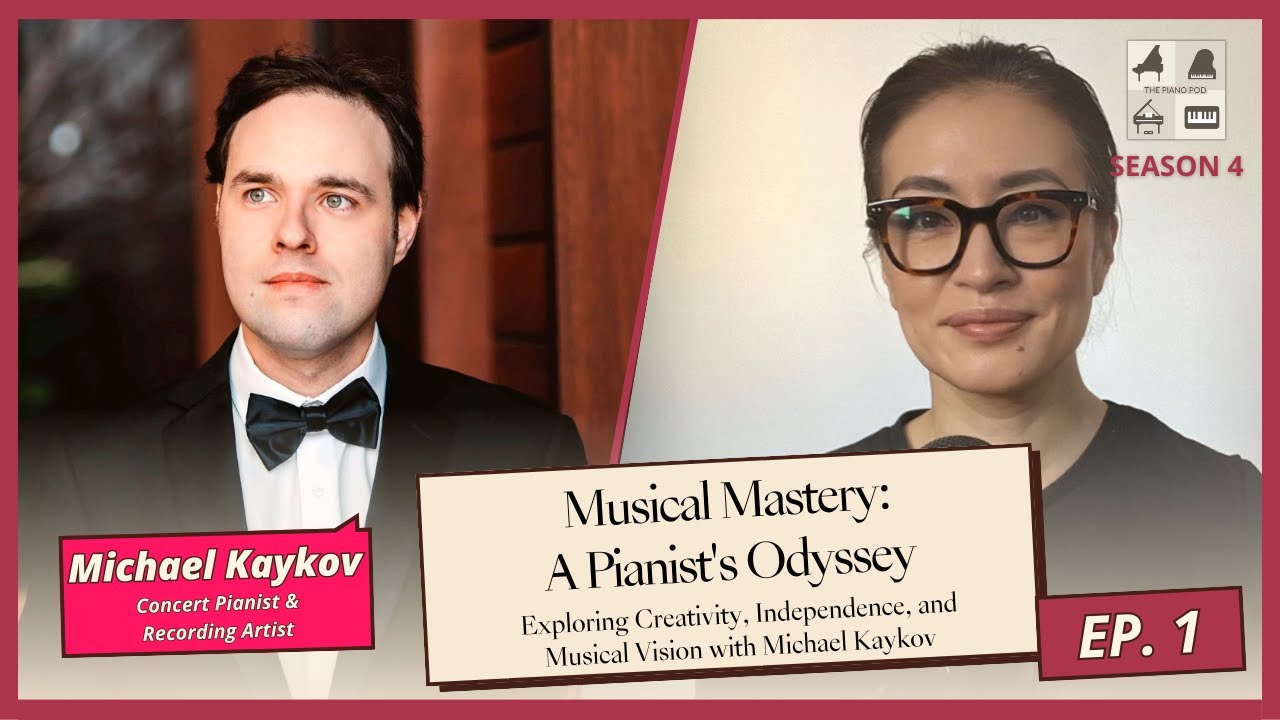
This content was created by The Piano Pod with Yukimi Song. This content was uploaded by The Piano Pod with Yukimi Song. This YouTube podcast episode (Season 4 Episode 1, published Sept 6, 2023) is an interview-style episode of The Piano Pod hosted by Yukimi Song featuring guest Dr. Michael Kaykov (concert pianist, recording artist, and educator). The host introduces the season and the guest, and their conversation covers Dr. Kaykov’s research on Scriabin and synesthesia, his musical training (Mannes, Juilliard, Manhattan School of Music), career development through the pandemic, teaching and self-managing a performing career, and an upcoming Liszt-focused recital and recording project. The episode also includes a sponsor ad for a sheet-music app (Musiq) and practical discussion about programming, recording, and promoting concerts.
Chapters
Hey there, Piano Pod friends and listeners. How was your summer? I missed you. So we're kicking off the first episode of Season 4, and I am your host, Yukimi Song. It feels good to be back in the podcasting groove. I've missed this so much. As much as I enjoyed my break, there's nothing like connecting with all of you, sharing stories, music, and all the piano magic we've got lined up this season. Welcome to all of our first-time listeners and viewers of The Piano Pod with Yukimi Song. I'm a classical pianist and educator from New York City. Whether you're diving deep into a piano career, working professionally in the classical music scene, or simply have a passion for piano tunes and a curiosity about its universe, this podcast is your backstage pass. Let me tell you a little bit about The Piano Pod with Yukimi Song. It is a one-of-a-kind podcast that delves deep into the fascinating world of classical music with a specific focus on the piano. In a biweekly format, we engage in intriguing discussions with guests breaking exciting new ground in the classical music industry. Our mission is to cultivate a vibrant community that champions fresh perspectives, ensuring that classical music remains alive and resonant in our ever-evolving world. Before getting started, I want to thank you amazing TPP fans and faithful listeners for tuning in today. Yay, it's Season 4 thanks to you. Please rate and review the show on Apple Podcasts or any other podcasting platforms because every rating review will help people find my show. Kicking off Season 4, I am thrilled to introduce Dr. Michael Kaikoff, an American pianist of international acclaim, Dr. Kaikov has dazzled audiences worldwide, both as a soloist and in collaboration with industry giants, including the late two-time Emmy winner Glenn Roven. Hailing from a lineage of musicians, Dr. Kaikov began his musical journey at the tender age of 6. His distinguished academic journey led him through prestigious performing arts schools such as Mannes College of Music and Juilliard, studying under maestros like Jerome Rose and Jerome Lowenthal. In 2020, he completed his DMA from the Manhattan School of Music, penning a dissertation on the Scrapping Etchews, a topic on which his expertise has been sought by international publications. But that's not all. Dr. Keikoff's discography is equally impressive. His third album, Unrivaled, received accolades from Fanfare magazine, celebrating his virtuosity and passion for music. Beyond the stage and studio, he is nurturing the future of music, imparting wisdom at institutions like Virtue Academy and the Church Music School of Music and Art. So, dear friends, here we are today to learn about Michael's incredible journey as a pianist, educator, recording artist, focusing on his research on scribing and music theory, as well as more practical subjects like how to manage one's career as a pianist. So please stay with me till the end of the episode, as our conversation will lead to a more philosophical discussion later. So let's begin The Piano Pod's first episode of the new season with a guest, Dr. Michael Kaikov. Please enjoy the show. You are listening to The Piano Pod with Yukimi Song, where we talk to the brightest minds in the industry about how they are bringing the piano into the 21st century. Welcome to The Piano Pod with Michael.
Thank you, such a pleasure to be here.
Thank you so much for being here today, means so much. It's such a pleasure to have you as actually the first guest of the new season, and I know we've been connected on the social media for quite some time, and you have been kind enough to liking my post. I guess that's how we keep in touch and stay connected with it. One another these days, right? Or whether that is personal level or professional. So, you know, actually your name has been in the guest wish list of mine since the get-go. Nice. Yeah. Yes. And I can't, I can't believe I'd not— I didn't reach out to you till like really recently to be on my show. So I've been listening to your recordings and also I read your scholarly, you know, article about Scrabin's idea of tone-color relations, and it's fascinating, interesting. And, and, you know, Michael, honestly, I learned so much from your writing, and this is the very reason I do what I do, which is podcasting, because I get to study about, you know, each guest but also their expertise and wealth of knowledge. We'll talk more about your recordings later in this interview, so let's start with Scrabin. Your research. Tell me about the article a little bit.
Yes, well, I, I have several articles, and I think the one you're referring to is the, the one on his synesthesia and the, the, the mapping of colors to different keys. So I mean, the gist of that article— first of all, that idea was presented to me by my thesis advisor, Dr. Green, who helped me get published, and he guided my whole dissertation. He thought, well, maybe you can do something a little bit more practical and actually get, you know, get published with it if you pick a sort of interesting enough topic. So he suggested that, and the, the article, basically the gist of it is the latest consensus is Scrabin may not have had complete synesthesia. And, you know, the, the interesting thing is he may have been inspired by his conversations with with Rimsky-Korsakov, and he came upon the idea of having like a really rigorous, really rigorous system where he would map different keys. And for Scrabin, he supposedly only felt that major keys may have a color, because as we know, if you look at the overtone series, the actual— the minor third doesn't come there until much, much, much higher in the, in the Overtone Series. So it was, you know, it was only major keys and only a couple which he felt, you know, are concrete. And, you know, that being said, if you look at all the various archives, including that in the Scrabin Museum, he had several valid complete schemes for colors, and they're all different. So basically the latest consensus is he might not have had true synesthesia. And that it may have been just a way of trying to kind of formalize some of his instincts in that regard. So it's pretty fascinating. So it's kind of— the article title should be Scrabble synesthesia debunked. Now the— yeah, and the other interesting thing is if you look at true synesthesia, it may not be consistent across the spectrum. For example, how come all the keys are colors? How come one of them isn't a smell and another key is like some kind of unrelated sensation? You know, if you look at the, the actual studies of synesthesia, it's usually a completely irrational response that's not in any way consistent.
Interesting.
Yeah.
Wow. Yeah, yeah, yeah. So the whole this time I thought it was the synesthesia issue. So I thought he was in one of those, you know, neurodiverse spectrum or something.
He may have been. I'm not saying it's, it's completely— it was completely an act, but like the way this started was really he was inspired by his conversations with Rimsky-Korsakov, and he did have a couple of keys that he agreed with Rimsky-Korsakov on in terms of like what they represent. Um, I don't want to say anything off the top of my head. You have to like read all the different— because I might get misquoted. Right. You have to read the specifics because they vary across the different sources.
Mm-hmm.
Yeah. That being said, later on, for Scrabin's sort of final vision for that Mysterium project, it was supposed to encompass, you know, some kind of dance, some kind of projection, some kind of visual aspect to it, including colors and even perfumes. So perfumes, yes, like smell, that was all supposed to be part of his final kind of Mysterium, which never materialized. So in a way, it doesn't really matter whether how complete his synesthesia was, because the way it inspired his, his craft. And furthermore, every single late period composition that we have of Scrabin was, was an offshoot of that. Scrabin felt like the, the massive Mysterium project is just too huge to materialize. So he took a lot of those ideas and he presented them in very compact forms, such as the sonata form, the prelude, the etude. But in the back of his mind, the end goal was this massive, you know, mysterium.
Yeah. Very fascinating individual, you know, and a little disturbed, but in many ways—
But that we don't know. We don't know how disturbed he was. The, the, uh, the people that knew him said he was extremely organized and he loved to dress up. He loved dressing up. I don't know if that suggests disorganization, you know, some something disorganized. We don't know. We don't know. It may have been this, this, uh, popular artist persona that people want to cultivate, but he may have been extremely rational. And the music kind of suggests that, like the, the crystalline clarity of his harmonic writing and textures suggest that he was completely, completely sane.
Wow. You know, maybe he was just way ahead of his time. That's why people described him as like cuckoo. Or yes, yes, maybe so. Because, you know, um, because after I read your article, uh, and then so I watched the Prometheus, Opus 60, by the famous Yale Symphonic Orchestra, you know, performed in 2010, which is actually the rendition of, you know, I, I guess Scrabin's vision, because, yes, you know, it was at that time when he wrote this piece, it was exactly 100 years ago, and he was not able to— technology was not obviously at that level of being able to visualize his vision, you know what I mean?
Yes, they were not able to project colors in real time.
Yeah, right, right.
I've seen that Yale, um, that Yale performance, and they, they were, they were trying to kind of recreate what some of his, uh, some of the indications in his score. Again, we, we really don't know the specifics, but there's a couple of things that he did indicate in the, in the, uh, in the first edition of the score regarding colors. Yeah.
Some people have the tendency to associate our feelings, whether that is anger or sadness or whatever that is, to associate with certain keys, right? So C major sounds like this. C major represents purity, whatever that is. You know, F-sharp minor is this feeling or represents this. But Scrapping is more specific, like every single note has the color, the shade.
Yes, yes. Well, I mean, even from personal experience, I don't have perfect pitch, but I can tell if a piece is played at the incorrect pitch. If we look at recording transfers and sometimes when something is transferred, well, like in the case of an LP, if it's transferred down a semitone or up a semitone, I can recognize something's off. If I look at a piece of music, I can hear it kind of in the original key, but unfortunately I can't tell random notes on the piano. I can't tell what clusters are, so I don't have that kind of perfect pitch at all.
But I guess you can sense, I don't know, maybe through certain vibration. I don't know.
No, I think if you know a piece well enough, if you know a piece well enough and you've always played it in one key, you're going to tell something's off if it's suddenly down a semitone. You know, you hear it. There was a record transfer, I think, of the— I think it was something like the Chopin Sonata in B-flat minor, and it was up a half step, and it was kind of jarring to listen to. Right, very strange, very, very strange.
Yeah, yeah, yeah. Let's really start from your beginning of your musical journey, right?
Yeah.
I'm curious. You are quite accomplished. Concert pianist, but there's always the beginning. So tell me about your upbringing. I know you grew up in a musical family, right?
Yes, both of my parents are musicians. My mother was a, you know, is a concert pianist now. She works as a pianist in New York City. She does a lot of ballet classes, vocal coaching, like really everything, everything except piano teaching. I'm the piano teaching artist in the family. But Yeah, so I learned a ton from her, and that's my— it's not just my early training, but every program that I do, I play for her, and I get advice, and I know it's going to be completely unfiltered, and it's something that I can trust because, you know, you need somebody when you publish a commercial album that's going to be listened to repeatedly. You can't unrelease it. You can't withdraw it from the market. So it's— she's like one of the people that I completely trust to give her unfiltered opinion. Before I set it down. Absolutely. One of the really, one of the highest trained professionals that I know.
Wow. You're lucky. Yeah.
Lucky. And it's also very tough, obviously. It's very tough.
But that makes you a, you know, better pianist every day, each day.
Sure. Sure.
Yeah. And then so you went off to, first of all, started as a college at Mannes. And studied with Mr. Jerome Rose. And recently I interviewed someone who studied with Jerome Rose as well. So tell me about the training or the study with him.
Well, under Jerome Rose, basically when it's, it's not just the training, it's also just like life circumstances. So I got to Manus and I remember Jerome Rose asked me, I brought in the Chopin Ballade, I brought the Chopin Ballade No. 1. And then I brought him a couple of excerpts, and he thought— he said, well, do you want to do the Chopin competition? I said, you know what, I want to do the Liszt competition, because they were happening at the same time. It was 2010. And he said, well, let's go for it. So I looked at the repertoire list, and I think the summer of— I started preparing, but it took around 2 years, and I learned about 3.5 hours of Liszt piano works from scratch, including the Sonata in B minor, and all of those things. And I wasn't a prodigy in any sense. I didn't have a big repertoire. When I auditioned for Juilliard and Mannes for undergrad, that was the first time I actually had a complete recital program under my fingers. So to go from that to suddenly working on 3.5 hours or more of Liszt's music from scratch was like a massive, massive jump. So it's not just the studies with him, but it's also like the circumstances, because I just had to do it, and I had to learn all of that myself. And when I brought the pieces into him, they had to be memorized and in tempo and performance ready, and then he would give me feedback. So in a way, it's a kind of advanced— it's a pretty advanced training. And if you look at even teaching artists like Liszt or Anton Rubinstein, if you'll read Hoffman's memoirs, I mean, right, they would bring in these things already. In tempo and kind of performance ready to the master.
You know, you're humble by saying, you know, oh, I'm not a child prodigy or anything, and— Not at all.
Not at all. Late bloomer, if anything. Really, if— who else? When I was 17, that was really the first time that I had a complete recital program, and I remember the recital program. It was the Bach E Major, Preludium and Fugue Book 1, the Beethoven Waldstein, my first like complete Beethoven sonata, extremely tough, like really tough, uh, his Graben Etude, Opus 65, Number 3. Ironically, that's also one of the etudes I focused on for my theoretical dissertation, so it's like I really know that piece inside and out, obviously. And I also had the Liszt Mephisto Waltz and the Tchaikovsky Doomka. That's it. That's literally— that was— and I worked on that program for over a year just like trying to get it into shape, and it was, it was tough. So I wasn't, I wasn't a prodigy, something like below average, below average in terms of speed, in terms of speed of development. So not, not a late bloomer, not, not like a late starter, but I didn't show anything exemplary, exemplary at all. There were people much, much further along than me when I really wanted to get into this, which is cool. That's how I didn't run out of steam yet.
Well, you know, you know, you don't want to, you know, run out of energy. This career is a long shot. It's not just one time you win something and then, you know, disappears. It's really the lifelong career, right?
Yeah. There's also misconception. I had an argument with somebody online and they said that every single great artist was some kind of child prodigy. That's just so— that's false. That's completely false. And the fact that popular culture makes— it's— there's such a premium on a completely freakish feat that's supposed to somehow come easily, you know what I mean?
Right, right.
It's— if you read somebody like Samuel Feinberg, for example, one of the first pianists in the Soviet Union to present the 32 Beethoven sonatas, he played the works of all the avant-garde composers. For his graduation concert, he presented all the Bach 48 Preludes and Fugues and the Rachmaninoff Third and, you know, all the crazy stuff. And he mentions in his, in his book on pedagogy that he had like a more normal kind of memory where he would just have to sit down and absorb things at a pretty slow pace, and he didn't like to rush it. And he could learn things on demand quickly when needed to, but he preferred like a more kind of normal working pace. So it's not like you could hear a piece of music and reproduce it faultlessly like, like Joseph Hoffman. So it's, you know, so it's just something that I see, at least in the 21st century, such a premium on, on so-called talent and natural ability where it really shouldn't be the case. It should be a premium on training.
Oh, amen to that. Yeah, yeah, yeah. And also this prodigy or the talent being showcased so much, like almost like a celebrity level of attention, right?
And there's a, there's a place for that. I mean, look, you're trying to stand out, and you know, I did a fair share of competitions, and I didn't really place anywhere, but you know, I learned from that. It helped me develop. But if you see just from like a marketing standpoint, it's a little bit disturbing because there's always like the latest and greatest, and then gradually it gets replaced by the next, you know, crop of talent. And it's always like really sensationalized. I don't mean that in a bad way, but I think we're just talking about like marketing. So everything has to be sensationalized. Like YouTube, okay, next YouTube video idea: I learned this piece in one day without the piano, and then publish it. It has to be something, something sensationalized. I was reading something online, an interview with a pianist, and she mentioned that she worked as a software engineer, but she had like this kind of freakish talent, and then she memorized the Rachmaninoff Third Concerto in a couple of days, and then went to perform it with orchestra. One of my students reached out to me and asked me, like, is this normal? And I said, it's not necessarily normal, and it's just the media I'm not saying her case is not true, it is, but it's just the media trying to make it seem like unless you can learn the Rock 3 in 2 days while not being even a professional, you, you shouldn't be able to do it. I think that's— there's a, there's a broad spectrum of natural abilities, and they all can be, they all can be utilized towards the same end goal. Who cares how long that it— how long it took? And who cares how easy or hard it was, you know?
Yeah, yeah, absolutely. Yeah, yeah. But there's like the really meaning in, I don't know, working so hard to craft your artistry, right?
So yeah, and you have also, also one, one other kind of small thing. Let's say you, you, let's say you can learn something, but let's say you are in the position to learn something very quickly. And you get the notes down and you have it memorized and performance ready, how much longer does it actually take to finalize the interpretation and to craft that? Much longer. It's still going to be another 4, 6, 8 months, a year on and off. And then you keep going, you come back to works again and again. Does it really matter? Because it's a masterwork that's going to stay with you your whole life and you're going to come back to it again and again. It doesn't matter. Like, you know, in the case of the Liszt Sonata, I learned that in 2010. I put out my commercial recording of it in 2021, I could still come back to it and redo it and have other ideas about it. That can be— it can be better, it can be a lot worse.
Wow, you learned the Liszt Sonata when you were 10?
No, no, 2010.
2010. Okay, okay.
I was 20-something. That was when I was preparing for the initial Liszt competition.
Mm-hmm.
Yeah, yeah.
Okay. Yeah, I know. So we're going to talk more about this you know, misunderstanding of our career later on.
Yes.
But yeah, tell me more about your study with Mr. Jerome Lowenthal at Juilliard. He is a legend, living legend.
Well, I was at Juilliard for only 2 years for my, for my master's. Yeah, and the general workflow was very similar. You would, you would have to present something and He didn't have a hard and fast rule about things being necessarily memorized and in tempo. There was— some of my friends would tell me they could just bring in the stuff from the score and not, not prepare it at all and read it in the lesson. But it's— Jerome Lowenthal knew when that was the case. You know, just if, if you think your teacher doesn't know that you're taking the easy way out, don't, don't lie to yourself. You— how are you going to come into a lesson with reading Chopin Nocturnes from the score, preparing it like 1 hour before. If you can get away with it, it doesn't mean that you're getting the most value out of your lesson. Absolutely. But I digress. But that's just a funny— just a funny thought. But yeah, I had everything. I always brought things in tempo and memorized, and he would give me general sort of interpretive advice. But one thing of his that I really learned a lot from. It seems like a really slight detail. I was playing a passage in a Liszt Rhapsody, and he said, you know, if you play it so evenly, if you play the notes matched so evenly in volume, it doesn't sound beautiful anymore. It doesn't matter if you have finger control and evenness. It doesn't matter. It has to be kind of shaped. So that's really— I think that's profound. That's really profound. It's such a minor kind of observation, but I think it has a huge impact.
Oh wow, yeah, thank you. So then, but you know, you afterwards, did you go directly to Manhattan School to finish your— Yes. Okay.
Yes, I did everything in a row. It's like this mad rush where at the end of each, at the end of the degree program, you would kind of audition for the, for the next one. You know, my parents were actually kind of puzzled by that because when they went to school in the Soviet Union, you would finish, you would finish your degree program And then that summer, I think you would audition for the next one. It's, it's so weird that you are— you're in March, you're already in— sometimes, no, in the case of pre-screening, you are in the September, October area of your last year of school, yet you're auditioning for something else. Isn't that kind of weird? Think about it. I mean, yeah, so you're, you're already thinking about the next step where you're actually in the most rigorous year of your program and you're, you're planning ahead for the, for the next thing. Very tough. I don't know why it's, why it's like that. Maybe auditions should be held in over the summer.
Yeah, but you did finish Manhattan School of Music and then you got your DMA, correct? Yes. Before continuing this fun episode with Dr. Michael Kaikov, let's take a moment to hear from our valued sponsor, MusicApp. Whose generous support helps make this podcast possible. Introducing Musiq. Ever heard of it? If carrying heavy sheet music binders drains your energy, this app is your solution. On iPad, iPhone, and web, Musiq is a sheet music reader that will revolutionize your music life by creating a tidy library. No more mess. Musiq has enchanted 400,000 professional musicians worldwide. With its collaborative features, musicians can share their scores and annotations in real time. Musiq is also the best companion for amateur musicians. Musiq created its AI to help musicians of all levels in their daily practice. Get a 1-month free trial using the code PIANOPOD23 exclusively for The Piano Pod listeners. Claim your free month with Musiq today. So you studied with all these famous amazing music schools in the world. After graduating, was your career red carpet ready and everybody is just cheering you and waiting for you to have this big concert career? I bet it is not.
Not at all. Not at all.
So really, what happened?
Well, first of all, first of all, the— if you look at the DMA program, it's 2 years of coursework, then it's something called ABD, all but dissertation. So at that point, you can kind of hang around. I was very fortunate that my third year of doctoral studies, I was able to extend my kind of teaching duties there. So all the way up until 2020, when the pandemic hit, I was teaching some of those keyboard skills classes at the Manhattan School of Music. Very little, just a couple of hours a week, sometimes less, like a symbolic amount, if any. But all that time, I was, I was teaching and building the experience working with like a variety of students every single year, which is awesome. That's really the— I think that was the real value, to get a workflow for, for, for adult learning, for, for college education. It was also ended up being very good for the resume because you have a, you know, so-called, you know, experience kind of teaching in a row. Not, not my accomplishment. I was just very lucky to have that, to be able to teach not just required piano but also keyboard skills and harmonization, transposition, things like that, score reading. Yeah. So, and so you're asking how, what was that like? Well, and then the pandemic hit and obviously the kind of teaching stopped, actually stopped a little bit before that because the position kind of rotated, but everything went fully remote. And I was actually in, I went to Florida because my parents felt like it's a good idea to maybe escape the pandemic and go there. And there was a place to stay there, and I ended up spending around 4 months in Florida without really— I had a little keyboard there, but without any piano, and I just sat there writing my dissertation. There was literally nothing else to do, and I was refining the dissertation and going back and forth with my thesis advisor and really correcting every word It was ridiculous in a good way. It was so detailed.
So by the time you finish your dissertation, so that was actually while you're writing dissertation, it was during pandemic.
Yes.
Yeah, yeah, that's right. That's true that I didn't realize how recent it was. Now then, so what's like to be a concert pianist now? So is, uh, how are you managing your concert pianist career.
Well, yeah, so I understand. So it's, it's sort of— well, let me, let me tell you how I kind of got to this point and how I came upon the idea of just like self-managing and self-promoting and investing some, some income into this, because things have to kind of click in place for this to be possible. And I was extremely, extremely fortunate. So when I Even when I was in school, all but dissertation, I was applying to various college jobs and just looking like, how am I going to make an income? How am I going to make an income? And if you look at college teaching positions, nobody's going to offer you anything that's even remotely like full-time. It's going to be a part-time, and you're going to be looking into possibly like relocating And I'm not saying this as a complaint, but you'll be relocating for something like $100 a week. And if you look at the workload that you're going to get, only a couple of keyboard classes in a community college, which is a very desirable position, very desirable, but you're going to look at something like $100 a week, which is not sustainable. So I was applying to all of those, getting constant rejections. And I thought, you know, what, what can I really do? So I started looking into remote, remote work. That kind of clicked into place, and I started working for, for two different, two different companies. And then eventually I just settled on, on Virtue Academy because it just— it's like a more flexible, much more flexible work and scheduling. And I love it because, I mean, do the math for a minute. If you can literally teach from home. You don't have to commute. Your schedule is flexible. If something comes up, you can reschedule or move the lesson around. They manage the— I'm not advertising them, but I kind of am, and it's not a paid sponsorship or anything, but they're really like— if you look them up, they have a huge variety of teachers. They have a huge roster of even piano, piano teachers. They have like pages and pages and pages of of people that teach for them. So it's great. And in terms of income, it's kind of freelancing. It's not stable, but it's a lot better than applying to just any open college position and really looking desperate. Because when you're desperate for work, I think recruiters can tell. They can tell that you're going to settle for pretty much anything. Right?
Right.
And when you apply to a school, at least the way I— because, you know, college employment is still like a long-term goal for me. I'd love to teach in a college setting again. I'd love to. It's really like, it's a— it's part of my kind of career goal, and I think it's going to open up more doors for, for performance as well, because these things are— they're connected. It's not like a separate, separate thing. But yeah, so in terms of like advice, I would say just don't apply constantly to any open job, but really research the school and see what you can, you know, where you might want to work at and have real concrete reasons why you might want to relocate there.
Now, how about your concert activities? So after graduation, so that was sort of still in the height of pandemic.
So yes, yeah, almost, almost non-existent. And my friend Jeremy Jordan, also a Juilliard graduate, we kind of connected ironically, like, during the pandemic. He's— he was also on the faculty of the Harlem School of the Arts, and I kind of remember him in passing from Juilliard, but we never really kind of connected until, until after graduation. Very weird, but just the Juilliard life in a nutshell. You don't really know anybody. He had this little concert series right in his house where he would do streams, so I thought, you know, why not just go over there and stream a lot of the repertoire that I was going to record. So I did, I did multiple, multiple streams for him, and that was basically my, my concert activities that year during the pandemic. And right now I'm kind of pivoting towards just renting out venues and looking at advertising and managing this myself. It's awesome.
Wow, you're managing all these you know, your concerts by yourself?
Well, by all, I mean, I'm starting out with just this one in September, but it's the first one that is completely self-funded, that is nonprofit. It's completely free for admissions, and I'm not looking to make any money from it. It's literally just to kind of— it's not even that big of a financial hit if you look at the tax write-off, that it's a potential tax write-off for this. So it just— I think that's also like a valid goal if you're looking at this, because there's people that are concerned about it. They're wondering, how can I make an income from this right away? And if you're looking at doing too many things at once, you're going to be deeply unhappy. You're going to be deeply unhappy. You have to pick one. If you're looking at consistent profits, or are you looking at artistic development and playing how you want, what you want, you know. So just, I would just say, like, if people looking to get into this, like, just go for it. Find an affordable venue. Clever House in New York, very affordable. Rent it, advertise it, go from there. That's, that's, there's nothing more to it than that. And preferably with live streaming, you can build up an audience or a small team of people that are going to support you. No matter what.
And so tell me about this concert. So unfortunately, this episode will come out after this concert at the Clubhouse in— that's in Hell's Kitchen area of New York City, correct?
Well, it's going to be streamed and archived somewhere, so it's not that much.
Oh, wonderful. Yes. Well, I actually, I will try to be there in person, so I'm very excited about that. It's going to be on September 2nd at 5 PM. So tell me about the concert. It's going to be, I think, the all Franz Liszt pieces, right?
Yes, yes, it's a, it's an all Franz Liszt program. And I pitched this program to one of the record labels that I work with, Audredec Records. It's kind of— I want to sidetrack here because when I did my first all Liszt album, I just released it on, on Bandcamp and Spotify. It was like a totally self-published— you literally just go to a studio. They give you the recorded masters, they give you the video. I edited everything myself, and it was like a very, a very affordable, very low-budget thing, but the sound quality was great. So I used that, and I found the— this record label, Audra Deck, which was special because they take submissions, and they— these submissions are judged by a team of people who are actually already recording artists for Audra Deck. So right now I actually judge some of their— some of the stuff that comes in, and it's all done completely anonymously. So I, I sent them the, the materials from my first self-published list album, and they approved this second, the second release that I kind of done through them. So this, this upcoming thing is going to be my third all-list album, but it's only my second commercial album with Audradec. The program was picked first of all because these works are really underrepresented. They're easier to pitch. Nobody's gonna— you need a very good reason if you want to record, you know, Chopin 24 Preludes, 2nd Sonata, and 3rd Sonata, things that have been recorded 100 times, right, every year. I'm not saying that in a bad way, just it's a little bit less unique just from the fact that it's been done so, so many times, right, versus something like this where there's only a handful of commercial recordings available. So it got accepted. The proposal got accepted, like, through an anonymous kind of judgment thing, and I'm fortunate to do it. Yeah.
Well, that's great. So tell me the list of pieces that you'll be recording and also performing at the concert as well, because they are— they're the same piece, right?
They're exactly the same, and probably in the same order. As you know, what you play live in one setting might— should— it might be better to order it a little bit differently than on an album where the first track has to like completely grab you, because you assume that the listener may not make it past the first track. I don't mean that like in a demeaning way. It's a very different listening to something at home on a kind of a passive—
Right, right, absolutely.
It's a different medium. It's a different medium entirely.
Absolutely.
So the ordering on the album is going to be different. But for the recital, I'm going to start out with the Handle List Sarabande and Chaconne transcription, which is rare, very rare, one of his last compositions in that kind of style. So that's the first one. Then I have the Impromptu in F-sharp major, very beautiful late work. It's well known. Vladimir Horowitz recorded it way back in 1985, I believe. 1985, yeah. Then I have the Takáta, which is a rare, really rare, rare piece, and there's a couple of add-ons to it that Liszt sort of, he revised it towards the end of his life. It's unclear when it was composed, but probably in the 1870s, so the last decade, last decade of his life. And then the very last Hungarian Rhapsody, the Rhapsody No. 19.
Wow, that's awesome.
Yes, that's the first half. It's great. The funny thing about that piece, it's a transcription. It's actually a transcription. So it's based on motifs by other Hungarian composers. We can't really find the originals, but it's not like a— it's not original material. It's really a transcription. And that's kind of the first half. Second half is the Csárdaš Makábr. Again, one of those like extremely, extremely virtuosic pieces that he wrote towards the end of his life. When people think late Liszt, they may not associate it with like extreme piano feats, but that piece is pretty extreme, full of tremolos and all sorts of things. Very tough, very tough. It's sort of like the late Liszt equivalent of the Grand Galop Chromatique, I would say. It's something like that. So, uh, Czardas Makábor. Then I will do the Trauervorspiel und Trauermarsch. So it's a late kind of late, late composition. Very interesting. I wasn't really aware of it before I kind of picked it. It's pretty awesome. And I have the Mephisto Polka and the Third Mephisto Waltz. Now, third—
oh, that's rare. That's rare. That's rare. Yeah, yeah, yeah, yeah, yeah, yeah.
And he— Third Mephisto Waltz and Mephisto Polka. So interesting thing about Mephisto Waltzes, Liszt has a total of 4. But number 4 never really got completely finished. Yeah, there really isn't like a consensus. Leslie Howard found some more like additional drafts that Liszt did of that 4th Mephisto Waltz, so he kind of combined it into one version, but it never got finished. So the 4th Mephisto Waltz never got done. That's why it's not on my, on my list. Yeah, well, and then the Mephisto Polka in the Tchaikovsky, Tchaikovsky Polonaise from the Evgenia Inegin. Composed the same year as the Handel. So it's like an arc. It's like an arc. Start with the transcription, end with the transcription.
Wow. That's going to be amazing. I can't wait to actually hear you perform all these pieces live on September 2nd. And then also the album will be probably available sometime next year, you said?
Yeah, it'll be done before the end of the year. It will be recorded definitely before the end of the year. I have the recording sessions. Booked and planned. I'm going to record it actually in New York City. It's Skillman Music in Brooklyn.
In Brooklyn. Yes, yes, yes.
Which is a well-known studio, probably the most affordable solution right now that's still going to give you a very good sound that's obviously worthy of a commercial release. I like doing these things under a reasonable budget.
And they're self-funded.
Yes.
Wonderful. Now, so, you know, we've been communicating back and forth to prepare for this interview, you know, and then in one of the, I think, emails you mentioned that you only started grinding your own album projects and really diving deep into recording and playing what you want and how you want after a certain age. So playing all this program for your upcoming concert and then the, you know, album, is that what you mean by playing what you want and how you want?
Yes, well, if you— my first album, like my first all-list album, was something that I've done basically as I was coming out of school, as I was finishing up the doctoral. So I only really started playing and thinking about these things after graduating. I think the school mentality and the idea that you're gonna pick a sort of well-known selection that everybody plays, and you're gonna present those for a competition and hopefully win and get a management, that may not be the most. You can try that, but it may not be the best kind of path. You also have to do something on the side where you have to think about things like, is this kind of rare enough? Is it going to contribute something to a label? Can I get somebody on board with this sort of repertoire? And why am I playing it? Why am I— if you pick something like Chopin Four Scherzos that I did last year, why would you play those? I did it. But why would you do it? Artur Rubinstein recorded all 4 Scherzos in 1932. Right now it's 2023. I mean, you know, why? You have to answer that if you're going to work on something really standard.
Yeah, absolutely. Yeah. Being a freelancer and then, you know, self-funding and then you are also managing your career, I think. But a lot of us pianists are that way. But, you know, with the— Accessibility in technology, and you'll be able to do if you are willing to do this, take this path.
No, yes, absolutely. You have to, you have to be completely behind it, and then you can't back down. Once you go for it, you go for it. You know something? When I started investing my own money into this, I started playing better. Really, it's like a really bad thing to say, but it's like, no, when your own money is on the line, you are absolutely going to prepare to your best ability. There's no— you're going to look at every detail, and you can't unrelease a record. You can't like unrelease it. Once it's out, it's out. It's up to you to present your, your, your best version of it and improve it.
Yeah, but in many ways, you can create your pathway, right? Your, your career. This is, this is your brand. You as Michael Kakov, that's the, that's the brand. So nobody is going to tell you, you know, what to wear, how you present yourself, yes, to what sort of repertoire to prepare, but you can create your thing and you can create your audience as well, right?
Yes. And you can also, you know, you can take as much as you want on any project. You can always extend the deadline to a certain, to a certain limit. Of course, it's, it's so awesome, right?
Wonderful. Yeah. Now, so tell me your love for Franz Liszt and Scriabin?
Well, you know, Franz Liszt is really my favorite. Scriabin contributed a lot towards the development of harmony, and he really came on like a really unique— he came up with a really unique harmonic system. That being said, if I had to pick one, I would pick Franz Liszt. It really goes without saying, just the sheer amount of works that you can explore and the— the amount of different styles that all of those compositions encompass. And you can also look at his transcriptions. I mean, Liszt transcribed stuff from Bach preludes and fugues for organ to completely free fantasies on Bach works, to things that are like multi-stylistic, like this Handel transcription, things based on popular tunes, like a ridiculous amount of variety. Really experimental works. So with Franz Liszt, you're just never going to run out of repertoire ideas. I mean, Leslie Howard recorded the complete Liszt, and that's what, 110, 115 CDs?
Right. Yeah, yeah, yeah.
You're not going to— it's safe to say you're never going to run out of material.
Absolutely.
Unless you're Superman.
Yeah, yeah, I'm not. So yes, it's true. Yeah. And how— so how about Scrapping? I know you recorded Etudes. Before?
Uh, yes, I've done the— I've done the 65, 65 number 3. I did the 6th Sonata. I did— I did— I worked on the complete Opus 8. Scrabin is on my radar. I will definitely release a Scrabin album at some point. What grabs me the most in Scrabin's output is the late period compositions, the late period stuff after Opus 61. Absolutely. There's no question about it. I would say it would be enough to say that all of them are worth learning. Every single opus from '61 up until '74, his last composition for piano, worth learning.
In your opinion, what makes them special and worth learning?
They're special because he came up on a harmonic system which is still based on acoustic principles. And if you look at the development, he actually didn't throw away the previous relationship, like the acoustic relationships. He's very aware of how the overtone series works, which— how the sounds are actually formed based on the overtone series. It doesn't go against that. And even though you have things like the Sixth Sonata, which I recorded, probably his most dissonant composition, it's still— every single chord can be explained. And just the meticulousness of the writing and the way the material develops is extremely traditional. Very true. My teacher, Jerome Lowenthal, said that Scrabbins' late music is as clear as a Mozart sonata. It's like even more clear in terms of composition than Mozart. And he's right. There's like nothing in there that's out of place. The level of craftsmanship. Yes, of course, when you hear it, it sounds chaotic, but—
Yeah, yeah, it's true. Yes. Hey there, TPP family! The Piano Pod with Yukimi Song is now into our 4th season, and it's all thanks to you. Since 2020, you've been with my journey with the TPP, exploring this burning question: how do we make classical music resonate with today's audience in fresh and captivating ways? 4 years in, and the journey has been nothing short of The Piano Pod with Yukimi Song isn't just a podcast; it's a movement, a space where pianists, composers, and educators brainstorm, debate, and reimagine classical music's place in our fast-paced world. We're together on a mission to ensure classical music doesn't just survive but thrives in our modern age. But here's the thing: to keep bringing you these insightful biweekly episodes, I need your help. Every bit of support goes into the podcast essentials, from hosting to high-quality recording tech and the countless hours behind the scenes. So do you want to be part of this journey? Click the PayPal link in the show notes or head to thepianopod.com to donate. And as a token of appreciation, I will personally mail you The Piano Pod's snazzy logo sticker. So hit the subscribe button, spread the word, and let's continue our mission and journey as classical musicians. Now let's continue with the show. You are a dedicated music educator, piano teacher, and you teach online mainly, and we can talk about the convenience of it and everything. Yes. But tell me what it's like to teach at the Harlem School of the Arts.
Well, at the Harlem School of the Arts, I currently have one student who has been with me for many, many years. She started with me when she was 3 years old.
Oh my goodness.
It was really kind of— probably for a lot of people they would say it's too early, but we kind of stuck with it and we really worked, really worked hard with her. And my sort of end goal would be to have her audition for a couple of maybe college prep programs and things like that. I have a couple of private students that auditioned for different kind of pre-college programs, and I have one person that's currently— who got into the Manhattan School of Music pre-college. It's very nice to also prepare for like, like really high-stakes sort of professional goals, but a lot of people also want to take this as like a sort of like a fun class, or not necessarily to have like some kind of end result like an exam in mind. So it's a spectrum. I have some people online that are preparing for the RCM or the ABRS. I'm also, you know, very valuable. I like that there's a standardized repertoire list and it kind of makes my life a little bit easier because as you know, selecting repertoire is actually really, really important. Of course, how to pick pieces that showcase what you can already do and how you can grow. So that's, that's that. Everyone sort of comes to me with a different goal. In mind. I also teach a lot of like adult beginners, people that used to play piano as a kid and are coming back to it again. So it's a whole spectrum. I've seen everything.
Great. And then so you only have one student at Harlem School? Currently, currently, yes. Right, right. Then most of the students are through online?
Yes.
Wonderful. Now, so let's talk about online learning. So e-learning. Has become such a big thing, obviously, after 2020, because that was the only way for many of us to be connected with each other, but also only way of learning as well. So tell me your thoughts on that. Uh, a lot of times pre-COVID, it was a huge, like, uh, resistance that I felt from among fellow educators and among students as well. But I was actually giving an online lesson even before COVID I had one or two students who lived in Upper West Side, and I couldn't go to their home. So the only way was through actually FaceTime before Zoom, because I did not know the existence of Zoom before COVID honestly. So tell me your thoughts on online lessons, e-learning.
Online lessons and their success a lot of the time is dependent on the, the weakest link, the internet connection on both sides and the kind of basic equipment people are willing to kind of invest in, either some kind of keyboard with preferably 88 keys or an acoustic instrument. So occasionally I make people go and purchase a microphone, like a standalone thing that's going to kind of circumvent the Zoom compression. Something like this. Yes. If people can't afford it, I can take a financial hit on the first lesson and just buy this thing for them just to ensure that the lessons aren't a waste of money and they can actually— I can hear them and they can hear me. Seems like a really basic thing, but it really isn't because there— it does take a little bit of special equipment to make it feasible. Otherwise, they cannot really— if there's too much of a lag in the internet connection, it's also not a good value. You can't, you can't really teach. Absolutely. Yes. Now, online isn't ideal for complete beginners as well. I have those, but it's less than ideal. And I think people that go into it, they know it might not be the best thing, but it can work. With enough dedication, it can work. But the best results online that I found were people that already had some lessons prior, and they kind of— they already have like a very clear very clear goals.
Yeah. And then how do you like teaching online?
I love the convenience of it. I love working with people who already come to me with a kind of a motivation, because if you're seeking these lessons out online, it's pretty clear that you're kind of interested. You're not passively signed up for some kind of program, you're just going through the motions. So it's very, very, very nice. I've had people reach out because they're they do have an in-person teacher, but they want a second opinion as they prepare for an exam. I've had college students reach out to me also that are enrolled in some program, but they want like an extra, extra lesson or also like a second opinion, or just even to play through some pieces and see what I, what I say about it. So it's pretty cool.
Yeah, that's a great way to do that, uh, using online. Makes sense. Yes, yes, definitely. Yeah. Yeah, yeah. So as an educator, what do you see in these students, especially the students in, I guess, in of Gen Z? I wouldn't say Gen Alpha because I don't think you're teaching really young students, young, young students, but you know, Gen Z, uh, I'm sure you have students in that, or maybe you are too. You are Gen Z, maybe, I don't know.
Well, born 1990, what does that make me?
Uh, the millennial. Yes, you're still, I think, still—
well, pre-millennial.
Yeah, but the, the era is called millennial generation.
Okay, well, I'm a millennial. Oh my God. Yeah, I'm having an existential crisis right now.
No, no, no, no, no, no, it's, it's, it's called Gen Y. You're, you're in Gen Y. So Gen Z is like— yeah, Gen Z is the, you know, I think the age under 23 or something.
Okay.
Yeah, so anyway, what do you see in students of that generation?
It varies. Well, people are much better suited to using technology. They're quite fast with it. A lot of people already had to go through a lot of the schooling online just because of the COVID thing. I mean, they had to attend regular school online. A lot of university students had to have online college lessons even for their major. We're talking about like the, all the big schools, even Juilliard. Even people like in the dance program there, they have like online dance classes just through Zoom. So I feel like those students are already kind of well adapted to this. It's definitely— it definitely needs like— you need a certain level of tech savviness, and working online requires greater concentration on the part of a student because you can't— you can only communicate these ideas. You can't like directly show it at at the keyboard, you know. It's, it's more, it's more advanced. It's difficult. It's more difficult, of course, and you're not gonna, you're not gonna argue otherwise, but it allows for consistency of lessons. It allows for flexibility in scheduling, and it can, it can give you a decent result.
What kind of skills are required or demanded as musicians of young generation? You're young as well, so, you know, that's skills that you didn't necessarily learn from all the schooling you went through, you know what I mean?
Yes, I, I wouldn't say it's a skill. I think it's a mindset. I think it's a mindset. At some point, at some point, you have to really think, how do I want to play this composition? Or, you know, what do I want to play and why am I picking it? And You know, you know something, even as I am playing this, this repertoire, there's spots in the 19th Hungarian Rhapsody where I've always felt strongly when I listen to recordings of it that it might need like a cadenza, or it might need like an embellishment on the repeat. And I went ahead and I, I composed a couple of inserts very carefully so they don't, they don't sound intrusive, but I make tiny changes in the, in the score. These are things that are really not encouraged, not encouraged in school. We're so glued to the score. I mean, it's— I know some people would be horrified listening to a Liszt Rhapsody and then looking at the repeat passage and seeing that I added some things in there. But ideally, ideally, it has to be done very sparingly, very sparingly. It has to sound organic. It's a matter of taste, but— At least I think when, when you get to the point where you can play what you want and how you want, I think that's already a very— that's already a win. That's a win. Think about it for a minute. Early training is based on restriction, what not to do, and you also learn by imitation. That's a very good thing up to a certain point. When you're finally given a completely free pass to do whatever you want What are you gonna do? You know? Yeah, that's true. That's an interesting— when you get to that point, that's pretty interesting.
Yeah.
What are you gonna pick? How are you gonna play it? And why?
That's a very different perspective, right? From—
yes. And I've only been thinking about it recently, relatively recently.
Yeah, that's a very important question to ask. Yes.
It is, and you, you have to come to this. I, for a certain period of time, I was collecting old recordings and listening to all the, all the recorded output of like Rachmaninoff, Friedman, Gadovsky, Horowitz, like everybody. I have all the collections in my hard drive. I hardly listen to the stuff anymore, but I'm kind of aware of what the pianists of the past sounded like, and it was just an era of extreme freedom, really strong individuality. I mean, look at Alfred Courtauld. Everyone, all different, all so different.
And yeah, that is something that you should absolutely, absolutely—
you should cultivate. You should cultivate. It goes without saying. Otherwise, why are you recording it if you can't bring something new to it? And I don't mean something new in a completely tacky contrived way.
Yeah, yeah.
But if you're not going to present something new or have your own ideas about it, why not just put a recording of Rachmaninoff on? Even something like the Rachmaninoff Third Concerto, which I haven't done. I have a wonderful recording of Rachmaninoff himself playing it in 1939. It gives me a good reason to play that concerto again. You know, that's what you have to think about when you learn a composition. It may sound arrogant, but I'm not saying it's a competition between you and Rachmaninoff. No, it's like what's there? What do you have extra to say? And why are you picking it? And do you think that you can present something that's like unique enough when you select something?
Well, that's a good point. And actually, that will lead us to more philosophical conversation here. So because you are not only a concert pianist and recording artist, but also you're an educator. Let's talk about the vision of the classical music industry. So I want to— I'm curious to know your thoughts on how we can keep this classical music tradition or even classical music itself relevant and thriving in this fast-paced society.
It's still relevant. The markets of it have changed, but it's as relevant as it always has been. There's massive audiences online. You have to just find a niche. You have to find something that's like unique to you, and I think there will be an audience for that. Uh, you know, I saw a posting recently and it was an artist, and he said that he basically doesn't want to continue posting his stuff on YouTube because he feels it's unappreciated and he just wants to take down the whole channel. And I feel What are you doing this for? Are you, are you setting out to build up, you know, 400,000 subscribers, or are you getting your work out there? Because it's two very different, two very different goals. So I would say you, you have to be patient. You have to find the audience that's right for you, um, that, that loves specifically what, what you do and what you, you select. And it's, it's a matter of just staying patient and creating more, creating more so-called content, but like on your own terms. If you go into this with this specific mindset of growth, you might have to go and study marketing first or look at something else because it's— it's this— it may not be immediately sort of comparable. Also, one, one pretty interesting thing, all the major streaming platforms, they've peaked, haven't they?
Mm-hmm.
They think the time to be on YouTube was right before YouTube was, uh, was purchased by Google, right? The time for that was like 15, 20 years ago, however long ago that was. You know, right now it's—
you—
the market is so oversaturated that you really have to be on the lookout for the next kind of big platform. I know, for example, when you post an Instagram Reel it gets more organic views than stuff on YouTube or Facebook because Instagram is actively interested in promoting their kind of new, sort of newer platform with longer video. So when the next sort of big thing comes out, you have to be ready for that. For example, I worked a little bit with this company Muse Live, which I think they're going to go. Dr. Lisa Yui, By the way, also played a couple of, uh, for them from Hughes Live. Yes, I think it's gonna— it's— they have an app and it's gonna go, it's gonna go live somewhere around this year or maybe next year. We'll see, it's a slight delay to it, but that's just a streaming platform where it's audio only but it's uncompressed audio, so you can stream potentially like in high quality.
Oh, wonderful. Then what is your thought on our responsibility or duty, or you may say gift, as classical musicians to society at large?
That's a very good question. You know, I would say our duty in classical music isn't to cheapen the content so that it's available, readily available for mass consumption. I think that's an error. If you think that you can get more views by, by doing a certain thing that your heart isn't really in it, and it's all just like marketing, and you— I think you know what I mean— when you kind of posting certain things that are there just for the, for the views, I think people have to sort of reconsider Really, what is classical music? It's really come to the point where you might not want progress. You just want to do it. Let's do it well again. Let's do it well again. I mean, if you look at the past, look at the past 100 years, look at the past 100 years of the recording industry and of all the great artists of the past. I don't mean that to discourage people, just on the contrary, but a lot of this has already been done. Let's keep the level where it is. Let's kind of match the level. Let's not, let's not degrade it. Let's not cheapen the art for mass conception. What I mean by that, even like, um, platform limits. I know for, for certain Instagram clips, and I've been guilty of that myself, but you can only post a tiny sound bite that is 30 seconds long. I don't know if that's the best sort of— I don't know if that's the same, but the best medium for the art? Is a Chopin scherzo all about the coda, the last 30 seconds? I don't know. Is the Liszt Sonata, you're just going to post the octaves, just the octaves, all the climax section, that's all the people are going to hear? I'm not so sure. So it's just, it's a question of media. Also, what mindset are you when you're on social media and looking for so-called content to watch, kind of scrolling by? Are you going to listen to a late-list masterwork when you're— when you can't completely focus on it, or it's like a background music? I don't think so. I don't think so. So it just— it's a question of kind of redefining what, what these platforms are for. I don't mean that— I don't mean that in a pessimistic way.
Right, right, right, right. Yeah, totally. I understand that. Why do you think it matters to each one of us at one point to explore and examine our sense of purpose or mission as performing artists and music educators?
Well, I think we have to think about that anytime. I think just with rigorous schooling, with staying in a more kind of confined thing where you have 1,000 things going on, your number one concern is when I graduate, am I going to find it? Find a job. Am I wrong? Is it— that's really— that kind of weighs you down, and it completely— it may crush some of your creative instincts, right? Let's, let's say you wanna— let's say your main goal from recording is to make a profit. It's not going to happen. If you look at streaming, what streaming pays, and if you look at like the various platforms, I mean, you're— it's not even close to— not even close to minimum wage. Of course, there's things like Bandcamp where you can sell like a physical product or people can donate, and these things are actually changing already. But in the case of the most popular one, like Apple Music and Spotify, it's safe to say that the streaming income that you make from that will not cover your production costs. It's— these things have changed. They've changed very rapidly. Went from CDs, physical CDs being relatively profitable in the '90s when record labels were actively looking to duplicate the catalogs previously available in LP. There was a mad rush to get the stuff documented. That's when companies like Philips, Sony, and others would actually pay a very decent amount of money and royalties for that. Right now, I don't know. Right now, I think for the recording, it's more— it's going to go in a library somewhere. It's going to go in one of those— students, I'm sure, know this— with the Noxus Sound Library, where you can access pretty much anything on demand for streaming. So the purpose kind of changed, but I think it's still worthwhile. You think?
Yes. Life is hard.
Look, if you're number one— because I'm only saying this because people have asked me this, they're saying, well, there's what you're telling me, there's never going to be any profits in this, or absolutely there may never be any profit. And the best that you can hope for, for some of this, is you, if you're a freelancer and you produce a project like that, is a nice tax write-off. Get a good accountant, get a good accountant, write off those thousands that you invest in your career. It might be worth it. And then something eventually will click in place because you're spending basically on— it's an advertisement, isn't it? You're also taking a so-called loss just to— artistry can't exist in a vacuum. You need an audience, you need a specific goal. It's not like a treadmill where, oh, I'm just going to do this to get better, just for self-betterment. It's no, it's— that's not it entirely. You need an audience. You need at least one person out there that you're going to communicate with as you play. And it may reach somebody. Just one. It takes one person.
Yes.
Right.
So, yes.
Yeah. Yeah. When you make a recording, you're playing for the sound engineer in the booth.
Mm-hmm. Mm-hmm. Yes. Well, thank you, Michael. It's been a really great conversation. I am really enjoying this. Now, time is running up and we're toward the end of our wonderful conversation here, but I just want to know a few more things. So one is, what is your next step or next phase in your career? What's your next goal? Not that it doesn't have to be the specific— we know the specifics, like that your recording is coming up, your concert is coming up in September.
But no, it's you, it's— you asked a very good question. The I, I want to play more live and I want to start booking more venues and playing because recording can only take you so far. I want to just go live. I want to do more, more streaming, more streaming and more, more live.
Okay.
And more live, more live concerts.
Yeah, yeah, yeah. And it will happen and I'm— I can't wait for really the concert, you know, to attend in September and more, you know. So yeah, that would be great. Wonderful.
It's enjoyable. You know, look, you cannot set concrete career goals because you never know how the industry is going to change and what's going to click into place. All you can do is be very alert and look at a variety of like different options and see what clicks into place. Otherwise, you're going to be deeply unhappy, deeply unhappy if your number one goal here is to secure a traditional management by a certain number of years. I don't know if that may ever happen. I'm fine with that never happening for me. I came to terms with that. But in music school, everybody is sort of grinding the same thing. They're either doing, you know, competition after competition, hoping to secure a traditional management, which is, which is going to last only a couple of years anyway, with in most cases 3 or 4 years if you win something. And then they, they kind of grind these degrees and then you hope to secure like a college position by a certain amount of time after which people have told me, you know, if you don't secure a college professorship like an X number of years after graduation, you may not be hireable. I'm fine with that.
Yeah, but you know, honestly, yeah, but it's not true though. It's not true though.
And it's not entirely true, but you can't set like artificial deadlines for yourself like that, and you can't You can't just start doing the same thing, you know, getting into a mood where you're doing the same thing over and over and hoping something's going to finally click into place. That's a definition of insanity. Yeah.
But you know what? Unknown makes us thrive. Yeah. It's hard, but the unknown makes us who we are as artists. That's why our industry, this performing arts industry, is so interesting. And you can really push so hard, so far, right? Because of the unknown that you're presuming, right?
Yes. Your only enemy is what's inside your mind, like the limitations that you create for yourself. You think it can't be done. Actually, it probably can. Just do it. Just do it. Just go for it right now.
Before we go, I want to promote— so I know the concert is coming up on September 2nd, but this show comes up on the 5th, so unfortunately it won't be much of a promotion, but For listeners, if you're listening and who are interested in learning more about Michael, please go to michaelkaykoffpiano.com. And also, he will have the next all-list album coming out sometime next year, early next year, 2024. So please on the lookout for his recording on any music streaming services, I guess.
Yes, yes, and Bandcamp and others. Yes.
Okay, great, fantastic. So Michael, again, this has been a great, fun, inspirational conversation, but before I let you go, we have one more thing to do. It's called The Piano Pod Rapid Fire Questions, and this is the part of the show where I get to ask fun questions to each guest. Now here's a little twist. As silly as these questions may sound, your answers may reveal who you truly are. Oh, and then, uh, so, uh, I want you to answer each question with the shortest responses as possible. So, and then you don't have to explain anything, just, just do it. All right, are you ready?
Yes.
All righty, number 1: What is your comfort food?
Pasta.
Yay! How do you like your coffee?
Espresso, double shot with a little bit of steamed milk.
Cats or dogs?
Dogs, preferably Basset Hounds.
Sunrise or sunset?
Sunset.
Summer or winter?
Winter.
Good old paper book or ebook?
Ebook.
Okay. What is your word or words to live by?
I don't think I have any. I don't think I have any. It might be an obscene word, might be something obscene when you in a frustration you say something like that, but I'm a product of the 21st century, unfortunately.
That's okay. So what is the most quality you look for in other people?
An openness and good intentions. Just open to new things and not looking to beat anybody down, because there's really kind of two types of people.
I want you to name three people who inspire you, living or dead.
My mother, I would say also Franz Liszt, and maybe for pianists, for pianists of the past, it's really, really hard to say, really hard to say. Maybe somebody like Ignaz Friedman.
Oh, yes. I love his interpretation of Chopin Nocturne.
Oh, that's a great one. That's a great one.
B major especially. Oh.
The E-flat, the E-flat, E-flat major. There's a B major piano roll that you're referring to, but there's also the acoustic recording of the E-flat, the late one. Oh, yeah. Yes, yes.
Oh, wow, wow.
Yes. Yeah.
Great. Now, name one piece in your current playlist?
Uh, probably a bunch of Art Tatum stuff, something like Art Tatum Night and Day. Oh, 1946.
I love that pianist, jazz pianist, so much. Oh yeah, he's incredible. All right, so last but least, fill in the blank: music is blank.
Life. Music is life.
Wonderful! Yay! Ding ding, you won! So this concludes this episode of The Piano Pod Thank you, Michael, for joining my show today. No, thank you.
It was great to be here.
Oh, wonderful. And then thank you for sharing your stories and insights and expertise. You can learn more about Dr. Michael Kekov and his amazing work through his website at michaelkekovpiano.com. And you can listen to his recordings on all major music streaming services. All the links are listed in the show notes. Thank you to my wonderful audience and fans for tuning in. If you enjoyed today's episode, episode, please rate and review it on wherever you get your podcasts. Remember to hit the thumbs up button and subscribe to my YouTube channel if you are watching this, uh, this episode on YouTube. Follow The Piano Pod with Yukimi Song on social media to get the latest piano news via Facebook, Twitter, Instagram, and LinkedIn. I will see you for the next episode of The Piano Pod with Yukimi Song. Bye everyone, and bye Michael. Thank you so much.
Thank you. Appreciate it.
Thank you.
More from The


Spirit, Body, and Soul: Pianist & Composer David Berry on Virtuosity, Creativity, and...



Season 6 Episode 20 | "Spirit, Body, and Soul" feat. David Berry, Concert Pianist & Composer


Beyond Borders: From Argentina to Poland to Texas—Oscar Macchioni reflects on a life in music

Sound Liberation: Joe Williams on Black Artistry, Legacy & Belonging in Concert Music


