Season 4 Episode 11: Miki Sawada - Pianist & CEO of Gather Hear, Inc.
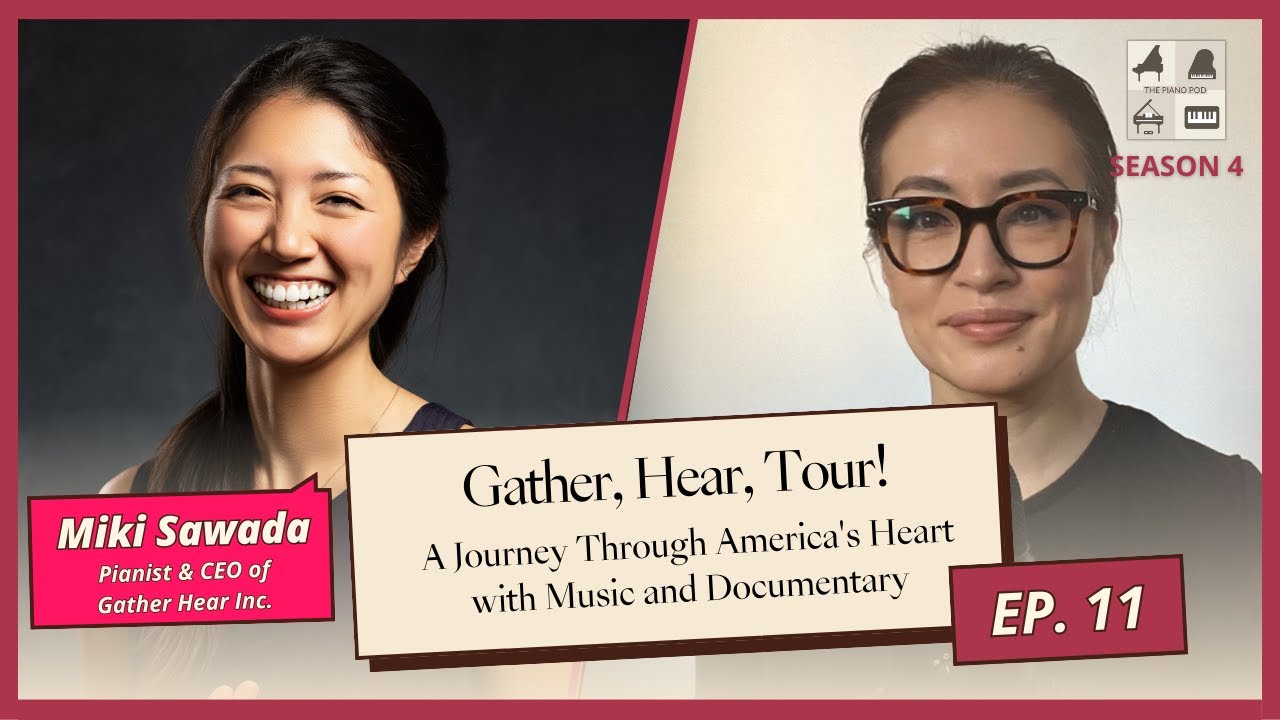
This content was created by The Piano Pod with Yukimi Song. This content was uploaded by The Piano Pod with Yukimi Song. This is a Season 4 episode (YouTube/podcast) titled "Season 4 Episode 11: Miki Sawada - Pianist & CEO of Gather Hear, Inc." (published Feb 7, 2024). It is an interview-style conversation hosted by Yukimi Song (The Piano Pod) with guest Miki Sawada, a pianist and founder/CEO of Gather Here Inc. The discussion covers Sawada's Gather Here Tour — traveling state-by-state with a piano to perform free concerts in non‑traditional, rural community spaces — and addresses logistics (hybrid uprights, van transport, filming, tuning), motivations (bridging divides, immigrant perspective), specific state tours (Alaska, West Virginia, Massachusetts, Utah, Louisiana, Alabama), encounters (churches, prisons, reservations), documentary/film festival work, funding and nonprofit formation, and how the project reshapes classical music’s relationship to diverse American communities.
Chapters
Was sitting on the sidewalk where these two people— this young lady was playing a piano. I am so excited that we're going to turn it over to Nikki and she's going to play whatever God put in her spirit to play. The ramp just kind of fell apart and we were like in this doorway, both holding up a piano that's like about to fall on us and kill us.
Welcome back to another episode of The Piano Pod. Here, tradition meets innovation. We bridge the timeless beauty of the piano with the dynamic pulse of today's world. I am I'm your host, Yukimi Song. Today I invited classical pianist and CEO of Gather Here Inc., Miki Sawada. I discovered her and her passion project Gather Here Tour through social media a couple months ago, and I was so impressed with her work through the, her annual tour she does within the United States. I'm sure she will tell you more about it during the interview, but check her out on YouTube at Gather Here Tour. Miki picks one state per tour, drives a van on her own with an upright piano in the back of the van, and gives multiple concerts in non-traditional concert venues in rural areas of the state. That's already quite impressive, but what is more about her initiative is that she documents each tour using high-tech gear and later creates a documentary, one of which, or I think two of them, were featured in the film festivals. So yeah, I know, wow, right? Anyway, I don't want to give you too much of a spoiler right now, so let's invite Miki. But before, let me just read her bio very quickly. Pianist Miki Sawada, recognized in the Boston Globe's Best of Arts 2021 list, is defining classical music through her innovative project Gather Here Tour. Miki travels state by state bringing her piano to community spaces instead of traditional concert halls. Her mission is to bridge divides and connect with Americans through music, offering free concerts in places like Alaska, West Virginia, Massachusetts, Utah, and Louisiana. Films about Gather Here Tour have been featured at the Independent Film Festival Boston in 2023 and No Man's Land Film Festival in 2022. When not on tour, Miki enjoys a diverse career in solo and chamber music with a focus on contemporary pieces. In 2022, she made her solo debut with the North Mississippi Symphony Orchestra and Portland Columbia Symphony, and she has been featured at renowned venues worldwide, including Carnegie Hall, Helensky Music Center, and the Metropolitan Museum of Art. Miki's debut album, "A Kind of Mirror," released in 2021, is a 5-movement electroacoustic work inspired by long-distance running, composed by Brandon Randall Myers. The album received acclaim and even featured in a commercial for Tracksmith, the running apparel company. Her musical journey encompasses a rich tapestry of performances, interviews, and accolades from various platforms, showcasing her unique approach to classical music. So here we are today to explore what this Gather Here tour is all about. So before getting in, a warm welcome to new listeners and a big thank you to our faithful TPP fans. Please don't forget to rate and review the show on your favorite podcast platform. So I am thrilled to welcome Ms. Miki Sawada to start our conversation. Please stick with us for a reflective discussion on keeping classical music relevant in today's changing world. Please enjoy the show. You are listening to The Piano Pod with Yukimi Song, where we talk to the brightest minds in the industry about how they are bringing the piano into the 21st century. Here we are with today's guest, Miki Sawada, pianist and CEO of GatherHere Inc. Welcome, Miki, to The Piano Pod.
Thank you. I'm so happy to be here.
Thank you for being here today. And so I discovered your project Gather Here Tour, and of course I discovered you through Instagram when I made a post about an upcoming episode where I got to interview the team of ASAP, A Seat at the Piano, which was earlier in the current season. And I think you commented or liked the post or story that I made.
I actually just met Annie. Annie Zhang. I just met her in person, so we were still Instagram friends then, and I saw that. And so, oh great, yeah.
Oh really, was she visiting? Uh, you're right now currently, you're—
I'm in Boston, but I went to UNCG to actually give a presentation about Gather Here, so she invited me.
Fantastic. Yes, I had a great time having her and her team on the episode, and I'm so happy that you're here now. And then, but I mean, that's how we got connected and then got me really curious about your work. And then I checked out your Instagram and then visited the website. Wow, what I found was the video of Gather Here Tour 2022 video, which was in Louisiana, right? Blew me away. The message, cinematography, as well as what you do during the tour. I have interviewed so many innovative pianists here on my show, but I had never seen anything quite like it. Yay!
Okay, amazing.
Really, and I never heard of someone who does you do, and I'm genuinely in awe because there are two aspects of what you do, which is the tour itself and going to those rural areas of the United States and talking to people and performing, giving concerts. But also the other aspect is you, you know, tape it and it made it like 50 minutes of film, which is amazing. So I have so many questions. So On the website, on your website, it says traveling 50 states with a piano in the van, connecting with Americans across divides through classical music. All concerts are free to the public and held in community gathering spaces. So what is Gather Here Tour? Oh, hello, little cat.
Okay, so I have a dog with me who's really needy, and if she's not in the room with me, she's going to be whining in the background. So she'll be here chewing on her bone. You probably can hear her sometimes. The Gather Here tour, it's a project where I travel around the country with the piano in a van. And yeah, I play in community gathering spaces instead of formal concert halls where, you know, not everyone might feel welcome or they might not even have geographical access, you know. So I bring the music to the people, really. And yes, all my concerts are free. It's all about making classical music available to everyone who wants it or who may not even know that they want it. You know, like a lot of people I play for have never gone to a classical concert and yeah, and they show up because I'm playing in their, you know, local cafe that they like to go to. So they just happen to be there and enjoy the music. And yeah, and so, but the tour is really about getting to know America. Really deeply on a level that, um, not many other people are. And trying to find a common, common humanity with everyone who's, you know, on different sides of the political spectrum, the economic spectrum, you know, these racial tensions, everything in America that can keep people apart. I'm trying to find something that brings us together which can be classical music.
Wow, that's so amazing. But may I ask why?
Yeah, that's a great question. So, um, so I'm not from here, I'm from Japan, and I, I went through a phase in my life, I guess like right after school, where I wasn't sure what I was doing with piano and what I was doing with my life. And I grew up internationally, so I wasn't even sure if I really wanted to stay in the United States. And then when Donald Trump was elected, that was like— I thought I knew America, and I just realized how little I knew. Now that I know more, I look back and I'm like, oh, that moment made sense in time. But at the time, it was just a total shock to me, just realizing, yeah, how little I knew about the country. And then as an immigrant, you didn't necessarily feel welcome at that time. But I saw that as an opportunity to kind of embrace the difficult things. And yeah, it made me really want to get to know what's really happening in this country.
Wow. But that takes a lot of courage, right?
Yeah. Yeah, that's for sure. It's scary. It can be scary, first of all, to like go sometimes by myself to places where I have no idea what people are thinking. You know, there are like guns everywhere, which I don't really— I'm not a fan of. And often I'm the only Asian person in the county or something that I'm visiting. Um, yeah, so it is scary. And also the scariest thing is like, what if you play and they don't care? And they don't listen, or they're negative towards it. So that's always the scariest part. If, like, yeah, like, what if people are somehow offended by this music or something like that? But generally everyone's really open to it. Yeah, I've never had, like, really bad things happen, and I think people are kind of disarmed by, you know, like, this Asian lady coming in with a piano. Like, a piano as an object is really disarming, right? Like, this is part of where the project started, was like the piano as a gathering space and like how when there's a piano in a room, people have associations. It reminds them of home or of church or like it has this magical gravitational pull where people want to come around and play and like sing. And yeah, it's just a really magical object.
Wow. And also, for some people, uh, if they are churchgoers, they are familiar with— they are surrounded with music. Yes, all times. So music is not foreign to them, or live music is not, or even music making is not foreign to them.
No, right? My, my point of view from like a conservatory, you know, raised child, it's easy to be like, oh, you know, like there's no music in these rural parts of the country, but that's really wrong. And yeah, it's just not true. There's, there's music everywhere in this country.
Yeah, absolutely. So how are you making this happening? Um, I'm just curious.
So your force, willpower?
Yes, yes. To do a tour like that, you think of how are you going to be able to find the piano? But when I saw the video, the trailer— well, actually, the whole 15 minutes of the film I saw, you are actually bringing your own instrument.
Yes, I always bring my own piano. Wow. That's a big part of it.
The brown piano, Yeah, that upright.
So for Louisiana— Louisiana was a tour that was really different from any of the other tours because I did it where I didn't plan anything, right? Like, if people watch the film, they'll see that I'm just— I'm just driving around and setting up the piano spontaneously and playing for whoever wants to listen. But usually, usually on a tour, I— everything is planned out. Months in advance. And yeah, it takes a lot of prep work. And in Louisiana, I decided to bring— to use an upright piano for the first time, which was not— I don't recommend it. I'm not— I don't think I'm going to do that again, first of all, because it's so heavy and it almost didn't fit in the van because the height, the clearance of height in the van isn't that high. And then we we put these heavy-duty wheels on the piano so that we could move it everywhere, but the wheels are like 4 inches in diameter, so that added too much height. So like, it just cleared if I took off the lid of the top. It cleared it by like a quarter of an inch.
Oh my goodness, that was silly.
It also wasn't like— it's not loud enough, like outside especially, people can really hear me.
Right, right, right.
Usually I travel with a hybrid piano, which, you know, like Yamaha Avant Grand was probably the first one. There's a Kawai ones which I really like, but I have a Casio now, and so that's the one I use the most. Right.
Yeah, I saw some hybrid piano in the different videos. Yeah. So I was wondering about that. But, you know, it was so dramatic just by watching you trying to, you know, put the piano into the van, out of the van, every venue you go to. Yeah, that's, that's just something.
Definitely symbolizes the struggle of the story.
But the film was well made. So when did you start this?
Oh, you know what, I said the wrong date. Maybe earlier. I meant when Trump was elected in 2016. So in 2016, I had the idea, and then 2017 was the first tour in Alaska. And I've basically been doing one state a year. So Alaska, West Virginia, Massachusetts, Utah, Louisiana, and I just went to Alabama a few weeks ago in December.
So how long does each tour last?
It's 2 to 3 weeks. 3 weeks is pretty long because it tends to be like multiple events a day, you know, and driving, right?
And you probably go to multiple locations during that time.
Yeah, all over.
But why did you pick Alaska first?
Um, I guess because it felt most foreign to me at the time. I mean, now knowing America better, that's not the most foreign place for, for someone from the East Coast. Um, But it just felt really exotic to me, and I'm a big outdoors person, so I wanted to be outside and see everything. And it also had a really splashy factor, right? Like, for this new project, she's going to Alaska, and people really like that, right?
Yeah, yeah, yeah.
It's very romantic.
Tell us in details how the tour went and what was it like in Alaska.
So in Alaska, that was— I mean, I had never done anything like this, so I really had no idea how people would respond. And like I said, I was afraid of how people would respond if they were going to ignore me and I would be background music or something, or if people might not be welcoming because I'm coming from the outside, like very much an outsider. And so I really didn't know. But like, that tour really showed me that yes, people will listen and they want to listen. And like, people just love music so much. It's really hard to hate a musician. Like, most people love music and musicians. And I guess like, at that time, I was coming pretty fresh out of school and I just didn't know, like, outside the bubble of music school, like, do people care? No idea. So that was really an experiment for me. And yeah, like, jumping deep off, uh, off the deep end. And yeah, that gave me a lot of confidence in being even more bold after those tours.
You said that the tour in Louisiana was like completely like you didn't plan any concert. But for Alaska, did you plan?
Yeah. Yes. All the other tours have been like, everything is planned.
How would you find a place? Like, a contact local?
Yeah, that's most of the battle of this tour is how do I find out where I want to go? How do I find the right partners who really understand what I'm doing? Because it's really up to the presenters to get bodies through the door because I'm not they're not going to know who I am. So they're in charge of marketing and stuff. It's a lot of Googling. It's a lot of clicking around on Google Maps. It's pretty random, which is scary. But yeah, and it's not so much word of mouth because no one is doing what I'm trying to do. And so it's not like there's a set path for me to follow. But sometimes people will have— once I start to book things, people will recommend me. Other places I should go, stuff like that.
You are an accomplished, trained classical pianist. You know, you went to schools like Yale and Eastman. What are you doing? I'm sure you, you do this because you, you want to give, but also you gain a lot, right?
Oh yeah, I think so. I always say that I gain as much or more than people do for my performances on tour. I feel really lucky to be able to do this. Someone was asking me, like, do you play differently now that you've done these tours and how? And it's like, yes, I do play differently, but how is really hard for me to say, you know. But just like your sense of like reading the room, understanding how people are reacting in the moment. You just become better at sensing those things while you're playing. And I don't know, I'm not like consciously trying to play any differently. I'm not like, oh, people might be bored, I'll play a little louder. It's not like that, but just like just some kind of sensitivity about the room and people and being so aware of the fact that this art form is what it is because you're sharing space and time with other people. And what does that mean, you know? And it's— you, you get that in concert halls too, but it's just a lot more direct on my tours because it's in such small spaces. And yeah, and people are really close to me.
Yeah, yeah, yeah. I'm gonna get to more, you know, profound questions later, but I just want to get through the, the state. So afterwards you chose West Virginia. Yes, Appalachian country, right? Yeah, that's a different culture.
In a lot of— yeah, in a lot of ways that was scarier than Alaska because, I mean, especially around like the Trump era, there's just so much negative press about West Virginia, you know, like The economy is so bad, there are so many drug problems, everyone is a Trump supporter, um, just very conservative, like back, backwoods kind of, kind of thing. And so even though it's so close to like Washington, DC, you know, it's just— yes, like half hour drive— not half hour, but really close drive— but it just feels so far away. I had no idea what to expect, and it turned out to be one of my favorite tours.
Really?
Maybe still one of my favorite tours. It's just the Appalachian spirit of everyone's really into making things. Everyone's a maker or artist or artisan or farmer. They love the land, they love the mountains, and of course their music. Appalachian music. So I just found people to be really artistic. Yeah, just really interested in what I was bringing and actually like very open-minded about what I was bringing, which was a pretty like avant-garde show that I brought them. And yeah, they loved it. And it was just really special to hear people talk about why they love West Virginia and what, just their commitment to making the state better. And yeah, just really amazing people.
It's amazing how the media portraits and stereotype people. Yeah, I actually was, uh, went to school in Florida, so I know, and especially Florida, we're really close to the border of Alabama. And then I used to go to, so, you know, speaking of Louisiana, you went, and I used to go to New Orleans on the weekend quite a bit.
Wow, okay.
Yeah, that's— I'm old, so that's pretty pre-hurricane Katrina. Yeah, so then that glorious era of New Orleans that I've experienced. So then, you know, southern states are actually really beautiful and rich in culture, history. Well, you know, sad history too with the plantation and everything, but not that the media is portraying what it is, right?
Right, because the media is gonna— they need to— they have to sensationalize and focus on our differences, and because that's, that's what makes drama and story. But, you know, even if I don't agree with these people on their political views, religious views, like you can still find a lot of people who are good and just wonderful people.
And good people are everywhere as much as bad people.
Yes, exactly.
Now then, tell me about Massachusetts.
So Massachusetts and Utah were supposed to happen in 2020, and then of course I had to push them back. But I'm actually really proud of Massachusetts because we did that in May 2021. We like immediately replanned everything so that I could do it all outdoors. And so if you remember, May was the time that everyone was getting their vaccines and when everything was starting to open up. So I was actually one of the first musicians to be back performing. And so I got to catch a really interesting point in time where like the audiences hadn't been to a concert in a year and a half, and I hadn't played in a year and a half. And so it was just really electric. And I had a piece that I was playing that I commissioned called "Before I Die." And I had commissioned this before COVID but I was inspired by this project by this artist named Candy Chang. And she puts up these murals all over the world and they're in public spaces and it says, "Before I die, I want to." and there's chalk. And so everyone who passes by, they're encouraged to write down their answer. So I had a musical version of that. I commissioned a piece by a composer named Ariel Friedman. And so she wrote a piece where I— it was incorporated that I would collect, like, I would have note cards that said, "Before I die, I want to," and I gave them out to the audience beforehand. And during this piece, I read the answers, and it turned out to be so timely with COVID because, like, everything was pushing towards reopening, and we must be productive and go back to normal. And there was, like, such a pressure, but there wasn't a moment to, like, collectively reflect on what we had gone through. So, like, through that tour, I was able to provide that. And it was, it was really emotional.
Oh, I bet. Yeah. Well, that's— and also powerful in how you are connecting people with music, with the message. Wow.
Yeah.
And then, uh, your, your— this Massachusetts part of the, the film was chosen for the Boston Globe's Best of Arts 2021.
Oh yes, that was my concert. Yeah, it was.
That was a concert.
It was called The Concerts That Made Me Fall in Love with Classical Music Again.
Yes, yes, yes. And then, but you at the time, did you live in Boston area?
Yeah, yeah. So that was another thing I had. I had moved here like pretty close to COVID, so I didn't feel like I knew this place at all. So that was part of my like getting to know Massachusetts tour.
I'm actually Korean, but I was born and raised in Japan. And so we are fellow Japanese natives here. And then you mentioned briefly that you lived in foreign countries growing up. Is that correct? Yeah. Okay. So why you chose to live in America? I mean, I don't know if it's a really personal question. If—
No, I think in the end, um, it, it's a country that lets me be who I am. Like, it is very free. Coming from a place like Japan, where especially women are expected to behave in certain ways. And, you know, I think classical music too, it's a very conservative path that's available. And so being in this country, like, of course, we always talk about the problems, but also like, it is a privilege to be here and yeah, to like to do this crazy thing. And, you know, people appreciate that I'm doing this thing that other people aren't doing, and I'm not chastised for it. And I think that's a really special thing.
Now let's continue. So I also watched the Utah film, so which was the tour in 2021 or '22?
I don't remember. Uh, '21.
21. So you did two tours?
I did two that year, yeah.
And then tell me, uh, I love that film because it starts with this— where is that?
That's on the Salt Flats. Oh yeah.
And then tell me, is it filled with, um, religious people there? Oh yes, yes, really?
Oh yeah, absolutely. So that was interesting. That tour ended up being a lot about just the landscape, which Utah is so special with. And yeah, the people, I mean, so much of the population are of the Mormon faith. And that can have a negative rap too. And it's hard, it's hard to like, to understand that point of view from from how I live. I love coffee. So living without coffee, what?
What? Really?
No coffee, no beer. But I mean, because I stay in people's homes when I do these tours.
Oh, I see. Okay.
Yeah, it's really amazing to stay with people and hear about their religion. And there was one night when I asked so many questions for hours, and people are just answering, and they're happy that someone's curious. Yeah, so that was interesting. Um, that was also a very tough tour. Um, Mormons, they, you know, they hang out at church or they have very, very, very like select places where they gather, and that's not necessarily a secular place where I would be allowed to go. So it was hard to find community gathering spaces where I could play and also people would come. So yeah, that was a tough tour in terms of like attendance, but like still I spent a lot of time outside running. Like a lot of my footage is from running and I felt like I understood that state. Like I went to reservation. The, the story of indigenous people there is so important. So I'm really glad I got to interact with that and there's an episode about going to a former Japanese internment campsite, you know, which was very big in Utah. And oh, I did not— I hadn't— yeah, I hadn't even thought about it before I went. And to go and be like, oh, like, actually, this is, you know, because I'm first generation— I mean, I'm not American, but I'm first generation immigrant from Japan here, and those people who were in camps were like first, second generation. So it's like, oh, it's my, my situation, you know, like, and I hadn't really had to think about that. So that was, that was part of that story of that film.
Wow, it sounds really complicated, that state.
Yeah, very complicated. Yes, but I'm glad, you know, I Because I think a lot of people will think of Utah and be like, oh, it's pretty and there are a lot of Mormons. And it's true. That's basically what I said. But to go beyond that and to try to make my way in using music was, I think, was a worthwhile endeavor.
Wow. Amazing. I can't even begin to imagine what it was like to be there. Yeah, bringing music. But you know, Mormon Church is known for big music.
Yeah, they have the choir, right? The famous Tabernacle Choir. I'm not sure what their music is like on the day-to-day. They do have music and they have pianos and, you know, yeah, they're generally big music people.
People, right? Yeah, yeah, yeah, that's what I thought. Let's talk about Louisiana. 2022. And that film is powerful. Start— started with this woman singing spiritual or gospel. Did you enter this film to a film festival?
Yeah, so that was premiered at the Independent Film Festival Boston last year. Yeah, 2023. So Louisiana was my first time in the Deep South. Like really trying to get to know the Deep South. And I just felt like I had no idea how to plan this tour. Like, I felt like I knew so little and it was kind of wrong of me to like pre-plan which communities I would visit and not. So then I decided, well, let's just not plan anything and let's just go there and see what happens. So that's what we did for 2 weeks. It was kind of like, at that point, it was like, how does— I had no idea how classical music can interact with Black America. You know, that's a question classical music today grapples with a lot, you know, like since Black Lives Matter. And yeah, so I just didn't know like how everyday Black Americans would respond to classical music, I guess. And so I just wanted to go and find them and play and see what happens. And yeah, the culminating moment of that tour was when that pastor who heard me playing on the street, I shared my piano with him and he started playing gospel and he's so good. And he invited me to come to his congregation. And that was like such a big deal symbolically because the Black church is so important in Black culture. And as outsiders, like, how do we, how do we get to experience that and like to be invited? And yeah, to be— and I was so welcomed, like everyone was so happy to see me and they invited me to play and I shared Florence Price with them and Yeah. And then they were sharing grape soda with me afterwards and their singing. Yeah. Their singing was just so amazing, so mind-blowing, so loud. That was like the loudest thing I've ever heard in my life, was the voices of these women. Just so powerful.
Wow.
Yeah.
What an experience you're having. Yeah.
I'm starting to be able to say that I understand America more than most people.
Yeah, you do. Yeah, you're fortunate. I mean, to do this, it's a lot of work. But then you went to— once again, you went to Deep South Alabama.
That's right.
This year. And then the film is yet to be—
Yeah, it won't have like a proper film. I'll probably do some blog posts. Like 4 or 5 episodes. That was really, really meaningful. I think that a lot of things that I learned in Louisiana, I was able to apply to Alabama. So I got to see like such a big range of Alabama Black life, you know, from— there's just, there's so much I could talk about. But for example, I went to a public school and in some of these counties, like, the schools are entirely segregated by race, like 100%, like literally 100% segregated, with public schools having 100% Black kids, even if the county is like 60-70% Black, because all the white people will send their kids to private school. And so like, I went to one of those schools and played for the kids, the public school, And yeah, and I like, I went to a prison for the first time, which is really meaningful. And you played? Yeah, in a men's prison. And I also went to a town, tiny town called York, which is 90% Black, and they have an amazing art center. And there's really a thriving art scene because of that art center. And so I got to play there and like, yeah, so like a mix of tragic realities and also really uplifting things and just, yeah, like a really wide range of Black American life that I got to interact with and play for.
Wow. Prison. Yeah. Wow. Did you, I mean, did you have a sort of plan to do that?
Yeah, so all these, all these were planned, and the prison visit was in partnership with a group called Alabama Prison Arts and Education Project. So they, they do arts education in prisons, so they were the ones who helped me get there.
What was it like playing for—
I mean, it was, it was one of the most profound experiences of my life. Because like, um, like when I went to the reservation in Utah, I played for a high school and it felt like there was just like no energy in the room because the kids were just really like closed off. And I was told, you know, they carry a lot of trauma and so, you know, there's just tend to be in their shells. So I thought maybe in the prison it might be like that. And this was on a sign-up basis. So everyone who was at my concert had volunteered. They wanted to come to my concert, and everyone was like so enthusiastic and like very lively and cracking jokes. And this is like an extremely tough place where, you know, people die in there because of violence, and there's just a lot of corruption, um, and mostly because of a lack of funding. In these systems, but it's really a terrible place to be. And, you know, like, they're not— most of the time, I'm sure they're not treated as if they're human. But in that hour we shared together, we were human together. And like, what more, what more can I give, you know?
That's, that's really truly amazing. You, you, you should be like a— you are already a journalist.
Like, yeah, so, so that, that's where the documentation, like the films, come in, and a lot of writing as blog posts. And I'm trying to just, I'm trying to share everything I'm seeing with a wider audience and be like, this is, this is my take on America, this is what's happening.
And then this is not just about music making anymore.
Right.
Music is just a tool to get in.
Exactly.
And wow, what a way of journalism. This is really fascinating.
And I'm there, I'm there with a gift, right? Like, I'm there to give something, and so people are welcoming, they open up.
Is this something that you— more than what you expected?
Oh yeah, I don't know, I don't know what I was expecting. I wasn't expecting anything. Um, and it's always evolving. Like, I didn't think I would go play in a prison, but here I am. And so I'm always, I'm always open to taking new directions with the tour and take more, more chances.
Who knows, maybe someone who is watching and then they, they want to invite you. Yeah. So you mentioned that you traveled with a videographer for Utah?
Sometimes.
Sometimes.
Um, Utah I travel by myself. Louisiana I traveled with the videographer.
But how did this whole drone thing and everything happen in Utah? Did you do it by yourself?
Oh, I see the one in Utah. No, there was a day that I spent with the production team, so all the pretty shots we did like in a day by, you know, like these people I hired for a day. Um, and then everything else I like took on an iPhone selfie. And then at concerts, I hired some local people to film the concerts.
Yeah, but you have a knack for it. Do you like filming and working? I do.
I made a vlog series for West Virginia, and I think in a way that series captures the tour better than anything else. But like the, you know, the production value isn't there. It's a little hard to watch. So I am trying to like— yeah, this month I'm learning how to properly use editing software and stuff.
Yeah, there's always new one coming up. You always have to learn. I know, I know. But are you staying safe? I mean, you're staying at someone's home.
Yeah.
But do you sometimes sleep in the van or anything?
Are you I have when I was with other people, like in Louisiana, you know, there's a scene where we're camping and stuff, but I saw it.
I saw it. You're washing your hair in the Mississippi River. Yeah. That's wild. When you are actually bringing the, whether that is the brown piano that I sew or whatever, do you drive from where you are, Boston, to get to to the destination?
So usually I fly and then I source the piano locally, but in Alabama, actually, yeah, I had someone drive my piano down and then I drove it back from Alabama to Boston. And the—
what's it called—
the Casio that I have, it actually comes apart so it fits in an SUV, which is pretty awesome. So Yeah, that's— it's just so easy.
Yeah. Oh, the keyboard, the capsule.
Yeah, it's a hybrid, but yeah.
Okay, got it, got it. You know, I used to be very proud of myself driving from Florida to New York when I moved.
Long way.
Yeah, when I had a U-Haul, but I can't beat you. Wow, drum. That's so cool. That's so cool.
Okay, but now how does this funding Yeah, so we incorporated as a 501 nonprofit just last year, so we're still starting out and getting our footing kind of as an organization. But in the past, tours have been like 60, 70, 80% funded by individual donors. A lot of, a lot of small, small donations, which is cool because like I want this project to be about the people, but it's like for the people. So it's awesome when it's funded by the people. But I do get grants, you know, usually like state arts council grants. And so now that we're a 501, we're looking at ways to, you know, have more diversified streams of income. So that's what we're working on now.
Wow, that's great. Hey there, TPP family. The Piano Pod with Yukimi Song is now into our fourth season, and it's all thanks to you. Since 2020, you've been with my journey with the TPP, exploring this burning question: How do we make classical music resonate with today's audience in fresh and captivating ways? 4 years in, and the journey has been nothing short of magical. The Piano Pod with Yukimi Song isn't just a podcast; it's a movement, a space where pianists, composers, and educators brainstorm, debate, and reimagine classical classical music's place in our fast-paced world. We're together on a mission to ensure classical music doesn't just survive but thrives in our modern age. But here's the thing: to keep bringing you these insightful biweekly episodes, I need your help. Every bit of support goes into the podcast's essentials, from hosting to high-quality recording tech, and the countless hours behind the scenes. So do you want to be part of this journey? Click the PayPal link in the show notes or head to thepianopod.com to donate, and as a token of appreciation, I will personally mail you The Piano Pod's snazzy logo sticker. So hit the subscribe button, spread the word, and let's continue our mission and journey as classical musicians. Now let's continue with the show. So as classical musicians, our training is known for its really emphasis on precision, specificity, and the deep understanding of music theory and literature, blah, blah, blah, fostering a disciplined approach that enables us to convey complex emotions through our performance. But then real life happens, then we need to learn to improvise a lot. That's one skill that we need to have in order to survive as an artist. Particularly what you're doing with the tour. So what sort of skills did you have to learn, improvise as you toured?
I feel like there's so many things. I feel like everything is improvised. I mean, it is true that so much is out of my control. It can be out of my control. So really the best I can do is to be the most prepared I can be on my end, right? So it does really come down to practicing and just like the dedication, commitment to the artistry that, that never moves because that's something I can kind of control and put time into and have confidence that whatever happens, like when I'm on stage, I can do my thing. And I can do it well. But outside of that, yeah, like, you know, something might go wrong with the piano, like the sound system's not working for some reason, like all these things, you know, the presenter that said this but it's actually like that, whatever. But yeah, just in order not to panic, just having, having, you know, once you sit down being able to take control of the, of the moment and the space and the time. It's, it's up to you as a performer to do that. Um, and also like trying to leave enough time in the schedule, like getting there early enough. It's still important to warm up even if you play the same program 14 days in a row. Like, you still need to prioritize getting there early enough so so that even if something goes wrong, you still get to move your fingers because, you know, you don't want to hurt yourself. It's very physically, physically demanding to, to do this tour.
Oh, I saw it in the video.
Yeah, so to take care of those things, you can't—
you're doing everything.
I am.
Yeah. And then I even saw, um, you're tuning your instrument.
Oh God, that was terrible. Yeah, I tried. I don't know what I'm doing, so I apologize to all the piano technicians out there.
But you know, you gotta do what you gotta do, right? Yeah. Then I was wondering about the choice of repertoire. So you mentioned about Florence Price. Price, yes. Her piece that you played. So did you select certain pieces for certain states or like expecting to meet certain group of people or That's something that's evolved since 2017.
And I used to never think about diversity. I thought there was no diversity in classical music. And then, you know, thank whoever for everything that's happened and the things we talk about and, you know, all this big reckoning. And of course nothing is solved, but I think it's important to talk about to vocalize what the problems are. And so I think especially since 2020, I've been thinking about how— especially because I'm doing this tour, it's like, if I'm playing for the people of America, what is the music that reflects that? And not that all of my program is that, but I think it's important to include that. Like, people see it, people will come up to me afterwards always, and they say, "oh, I'm so glad you played this," you know, like, and especially in Alabama, because half my program was by Black American composers, and people will be like, "I had no idea there were African American composers, and thank you for including them." And, but it's important to me to include standard repertoire as well, just because you know, that is where our art form comes from. That's what I first fell in love with and continue to love. And I think people want to hear that. And so just curating the program in a way that feels like it's a good mix. And there are so many things you can do outside of the repertoire to make things more inclusive. So in Alabama, you know, like even though I had all these Black composers, no one was from Alabama. So I decided to pair each musical set with a poem from Alabama by an Alabama writer. And I had audience members recite these. And people loved that. They like absolutely loved that. Like they loved that. They loved that, like, you know, their neighbor's daughter read a poem and that they felt a connection to the land and that they could see, they could imagine connections between that and the music. So that's like so simple actually in the end. Like I've commissioned works where like it's way more elaborate how I involve the audience. And this was actually the most simple thing I've done yet and so effective.
How creative. What's the next chapter for Gather Here tour? So Alabama 2023 is done, so where is next? And then also, do you have a big vision? So maybe you want to complete 50— all 50 states?
So right now we're working on, um, actually setting some roots in Massachusetts, um, since we've become an organization, nonprofit, um We're incorporated in Massachusetts and like, to be honest, to get a lot of funding, we have to be active in our state of Massachusetts, which we're currently not. Also, I think it's just good for us to have a home base. So we're looking into having some programming here, like year round on a permanent basis. So one thing I'm really interested in doing is, um, playing in prisons here, having some kind of partnership. Where I can do that regularly. Um, that's a big priority. But yeah, so we're thinking about launching something in Massachusetts, maybe the end of the year, probably 2025. And, uh, yeah, I would love to do another state tour this year. It's an election year. So we were just talking, my board and I, we were talking about like maybe I should do something in November, maybe somewhere like Pennsylvania, you know, which is very interesting. At election time, but I'm, I still need to decompress from Alabama, so I haven't thought about it too much. But it's like, okay, if I do want to do something in November, I actually need to start planning in February, March. So I don't have that much time.
Right, right. It's always, yes. Can you share some insights about individuals you encountered during the tour who left a lasting impression on you? I'm sure there are so many, so many.
But I always love— I love when people look like really stereotypically like the place you're in. Like, you know, in West Virginia, someone will come out in like a big hat and cowboy boots or something like that, like in flannel, and they just look like, you know, stereotypically they would never go to a classical music concert. And then they come up to me afterwards and they'll be like, actually, I didn't even want to come to this concert, but like my wife made me or whatever, and I loved it. And that's always cool when like it's so unlikely, the kinds of audiences I have. Um, everyone's a character, everyone wants to talk. They know I'm there to listen to them, so they'll, they'll tell their life stories with me, and it's just a lot of people.
I want you to maybe think of the lessons learned from your tour experiences. Maybe I'm repeating myself, repeating the question, but interactions with diverse people. It seems that in the end, embarking on a significant project like Gather Here tour becomes a profound learning experience for someone like you, you know, initiator, right? It's it's really about like, why am I doing this podcast? Because actually I'm learning a lot. What do you think the lessons that you learned by doing all these tours?
Oh, everything. I mean, I'm a different person because of this tour, and I'm a different musician because of this tour. And I mean, how can you not be changed, you know, by like going to these places and meeting so many people and just like, yeah, I mean, my sense of—
my sense—
I mean, I'm guessing that most people— this is like a huge generalization, but I'm guessing that most people don't encounter people that are so different from them on a pretty regular basis. And I get the chance to do that, and that just changes your worldview and your place in the world. And, you know, like all these kinds of social conflicts that are in this country or like between any groups of people, you just start to understand like where these things are coming from and like human nature. And I just understand the world differently, I think. And, and you start— I'm pretty anti-establishment, if that's not obvious. So like, you know, I am— I'm always looking at the classical music world with a critical eye and to be honest, I think it's problematic in so many ways. And I think it's good to be aware of that, and I'm— to not be like living in a bubble for the rest of my life. Yeah, it's just good to be not woke, but you know, it's good to be aware of how things work and why things are the way they are. And that's such a gift.
It's hard to be that way because, um, in on any, uh, side you are in, red or blue or purple, whatever, it's very hard not to be one-sided, you know.
It's human nature. I'm also weird. I like, you know, I like to be by myself. I'm not really like a group kind of person, so I'm just like, I like to observe things from a so it's just kind of like the way I am.
But yeah, but I'm curious because you were— you grew up in Japan. I mean, maybe, um, you're— you were born there, right?
I was born in England, but yeah, I moved to Japan pretty quickly after.
I see. Okay, okay.
So I spent 9 years in Japan total.
I see.
Yeah.
Was it a little different experience? Like, did you feel a little different from the rest of the population?
Oh yeah, because I went back for 2 years in high school, in the middle of high school.
So in Japan?
In Japan. I went back to Japan. So that's like—
that must be really weird.
Really weird.
Yeah, right?
Oh yeah. And I just didn't belong in any way.
But what influenced your choice to pursue education in the United States? You lived in England, back and forth.
I had spent the most time here, and I finished high school here, so— and I liked it here, so it was— it wasn't really an option for me to go anywhere else. But my parents went back to Japan, um, by the time I started college.
Oh, on a fundamental level, what did you find to be the most valuable takeaway from your training and education and play the role in what you do right now?
I mean, I learned so much from my teachers. I'm really grateful for all the schools I went to. Yeah, I think like that commitment to pursue something so narrow is, is a beautiful thing. I think it's a very uniquely human thing. To like to be so obsessed with, you know, one score, something like that. I think that kind of dedication is something that carries to everything. The discipline— in the end, you need a lot of discipline to do something that's very individualistic or free even, because when you're making a path for yourself, you have to motivate yourself every single step. And that comes from discipline, having routine, having a standard for yourself. That kind of like standard setting that's in classical music, I think that's amazing. Like this kind of like, especially at Eastman, I had a Russian teacher, Natalia Antonova, who's an incredible artist and like her attitude of like nothing is ever good enough, it really wears you down. But to have standards like that, it's pretty rare, I think, these days. I think especially in the way kids are raised these days. Yes.
Everything is a good job.
Yeah, it's like everything is good job. Yeah, it can't be like that. So I think it is like pretty amazing what we go through in music school. And it's a privilege.
Yes. But you know, that sort of focus and dedication and a little bit of obsession come through, comes through your project, but also you're an avid runner. Yes. That's cool.
I know.
I know. I mean, oh my God. And then you also have this coaching business, Fumosa Running. Tell me, tell me about running. And then wherever you go, where that is, Utah or Louisiana, you were running in the video.
So yeah, I'm always running. So I run ultramarathons. So that's technically anything longer than the marathon, which is 26 miles. But I like to do long races, like 100K, 100 miles in the mountains. Wow. So like going up and down, up and down mountains.
Wow.
It's just fun. 100 miles. Like, how in the world can anyone do that? But you go, especially in the day of social media, you go and you see all these people who look normal and they're running 100 miles and it's like, oh, what's possible? And it is possible if you put in the time and effort over a long period to train. Um, it's just like really cool to see what the body is capable of. Um, so that's fun for me. And like, the, the discipline that that takes, the running, definitely carries over into this project or being a pianist. And it keeps me on track for piano things to be So disciplined in my running because yeah, I guess like habits transfer over, but in running it's really easy to like plan out my training plan for 6 months and see the progression of things and like how things add up. And this is why every day is important. And so like I have that mindset. So for projects like Gather Here where it's not so like clean in a chart, I can still bring some of those skills over and like map things out in a way that like I can take it day by day. It's just like I need to do something every day and the steps will add up, or I have to believe that they will add up and have that long-term vision. And yeah, it's, it's like the same thing. It's like doing something that seems impossible. Like this tour feels impossible every single time, every single tour. But like, you lay out the steps and you do it and it's fun.
And then, but on the practical sense, you get to really see the place you visit by running. And so, yeah, it's different from just driving, right? But also, and then you really need the physical stamina to do this tour, then probably running is helping you to have that body. Right.
For sure. Yeah. Yeah.
So I want to go into a little bit more philosophical questions, if that's all right. So now, how can musicians adopt an entrepreneurial mindset to build a fulfilling career, viewing themselves not just as artists, but also as entrepreneurs? Or is it uncomfortable if I refer to you or you prefer you or connect you with the term? Entrepreneur. I don't know.
Um, no, that's fine. I don't necessarily think the artist entrepreneur have to be separate entities. I see Gather Here as creative work because we're performing artists and we're interpretive artists on stage, and I don't necessarily feel like it's creative, but like for a project I think it's where your creativity can shine through because you really are imagining what's possible in the world and creating something to achieve that. And I think that's part of an artist. What part of what an artist can do is, is that is like connecting the dots, seeing, seeing dots that could be connected and finding like an interesting artistic way to connect those dots. And it's really— it's a fun way to look at the world around you to see what's possible. Like even in your subway ride to wherever, to a concert or whatever, and seeing like what kinds of people are on the subway and they're not really interacting. But what if they did interact? Like what would happen? And what if you put music here and there and what could happen is interesting. So yeah, I think everyone should be entrepreneur, create something.
Yeah, absolutely. Yeah. Now, what, what are your thoughts on maintaining the relevance of classical music and ensuring the thriving of this industry in this country? Classical music appears to be, you know, absent from the daily lives of Americans, as you might have observed during the tour, during your tours, but even where you live, or where I am, I feel that same. I live in New York City, big city, but classical music is not really a daily thing for many, right?
I don't think it has to be a daily thing. I think it can be a special occasion. But yeah, I do think, I mean, this project is rooted in a belief that classical music can be enjoyed by more people than is currently. And it's a matter of being brave in where you take your music, thinking outside the box, being aware of current events and what people are talking about and what issues and how can classical music interact with that. Yeah, just being present in the real world.
Maybe this is also something related to the previous question, but this is for fellow musicians or maybe younger generation musicians. But what is your thought on your— on our duty or gift as classical musicians to society?
Yeah, I try to say this in my presentations at school, is like, it's It's so easy when you're in music school to take your skills for granted because everyone around you is doing it. But actually, like, so many people in the world wish that they could do what we do, and they think it's amazing, like mind-blowing when people can play the piano as well as we do. And it's this crazy, crazy thing we do where we can actually make people feel things. It's like, what a privilege. And it's like we're magicians in a way. And I think it's important to keep that sense of wonder and yeah, just how special it is and not tune it out.
Each of us at one point to explore and examine our sense of purpose and mission as performing artists and music educators. And, you know, you found this sense of purpose and passion through this Gather Here tour. Now, so what's your advice on how we find it?
I guess I would start where, where you have most questions about the way things are, wherever you see like this is not right, you know, like something in you tells you this isn't right, like this could be better. Whether it's something you're not happy about with the classical music world, or it's something like seeing a homeless person on the street, right? Something like that. It's like, you, you're not making systemic change because we're musicians. Um, maybe if you want to make systemic change, you should think of a career change, like being a lawyer or politician or something, but we're musicians, and what are we here to do is to make people feel human and feel people feel connected to each other and not alone. And how can you serve? How can you solve some of these? How can you make these problems better by giving your gift of music? And yeah, I think just the spirit of giving is going to give you more fulfillment than thinking about taking or money or things like that. Just, yeah, being generous in your spirit.
We're almost at the end of our conversation, but apart from musical proficiency, what other skills do you believe are essential for classical pianist students to possess?
Writing emails.
Writing.
Writing, really writing grants is gonna be a part of your life.
That's true.
Writing press releases is gonna be part of your life. Writing emails, cold emails is what I do all the time. How do you communicate in a way that people can understand you in 20 seconds? Because that's all they're gonna give you and present yourself through your words.
Thank you. So thank you. Yeah, it's been a great, wonderful conversation. I'm really enjoying it. It's I'm so sad that it's time for us to go, but so for the, for those who are watching or listening to this episode, Miki's Gather Here Tour, you can check out the website at gatherhere.com and you can support Gather Here Tour through its website. Also, please subscribe to her YouTube channel. It's youtube.com/@gatherhertour. This has been a great, fun, inspirational conversation, Miki. But before I let you go, we have one more thing to do. It's called TPP Rapid Fire Questions. This is a— I'm ready. Okay. It's a short— they are silly questions, but you know, they tend to reveal who truly you are. Let each guest answer, so be prepared. Okay. So let's start with the easy ones. Level 1. What is your comfort food?
Ooh, ramen.
Oh, yay. How do you like your coffee?
With the tiniest bit of cream, like less than half a second.
Okay, that's very specific. Yes. Now, next one, I know the answer. So cats or dogs? Dogs. Okay. Sunrise or sunset?
Sunset.
Summer or winter?
Winter.
Paper book or ebook?
Paper.
Level 2. What skill have you always wanted to learn but haven't had the chance to?
Ooh, woodworking.
Oh, cool. What is your word or words to live by?
Uh, YOLO.
Absolutely. That's the lifestyle you're having. That's amazing. You live by the word. Okay. So what is the most important quality you look for in other people?
Openness.
Name 3 people who inspire you, living or dead.
Ayanna Pressley, Courtney Dauwalter, who is the greatest ultra marathon runner of all time currently, and my dog Shakira.
Okay, Shakira, how cute. Okay, now level 3. Name one piece in your current playlist.
Brahms Cello Sonata F.
Last question, fill in the blank: music is blank.
Music is love. Ah, that was tacky.
No, it's okay. Wonderful, wonderful. Thank you. So this concludes this episode of The Piano Pod with Yukimi Song with Yukimi Song. Thank you, Miki, once again for joining us.
Thank you for having me.
Thank you, it was fun and sharing your stories and insights and expertise So for The Piano Pod listeners and viewers, please visit mikisawada.com to learn more about her career and connect with her via Instagram @gather_here_tour. You can also find out more about her Gather Here tour project and support it through its website gatherhere.com. And you can listen to her solo album, which I didn't get to ask about about A Kind of Mirror. That's the title of the album, on all major music streaming services. All the links are listed in the show notes. Thank you to my wonderful audience and fans for tuning in. If you enjoyed today's episode, please rate and review it on whatever podcasting platform you use. Remember to hit the thumbs up button and subscribe to my YouTube channel if you are watching this episode on YouTube. Follow TPP on social media. So thank you, and I will see you for the next episode of The Piano Pod with Yukimi Song with Yukimi Song with Yukimi Song.
Thank you, Miki. Thank you so much. Thank you. Bye, everyone.
More from The


Spirit, Body, and Soul: Pianist & Composer David Berry on Virtuosity, Creativity, and...



Season 6 Episode 20 | "Spirit, Body, and Soul" feat. David Berry, Concert Pianist & Composer


Beyond Borders: From Argentina to Poland to Texas—Oscar Macchioni reflects on a life in music

Sound Liberation: Joe Williams on Black Artistry, Legacy & Belonging in Concert Music


