Season 4 Episode 13: Sherry Grant - Classical Pianist, Cellist, Poet, and Festival Organizer
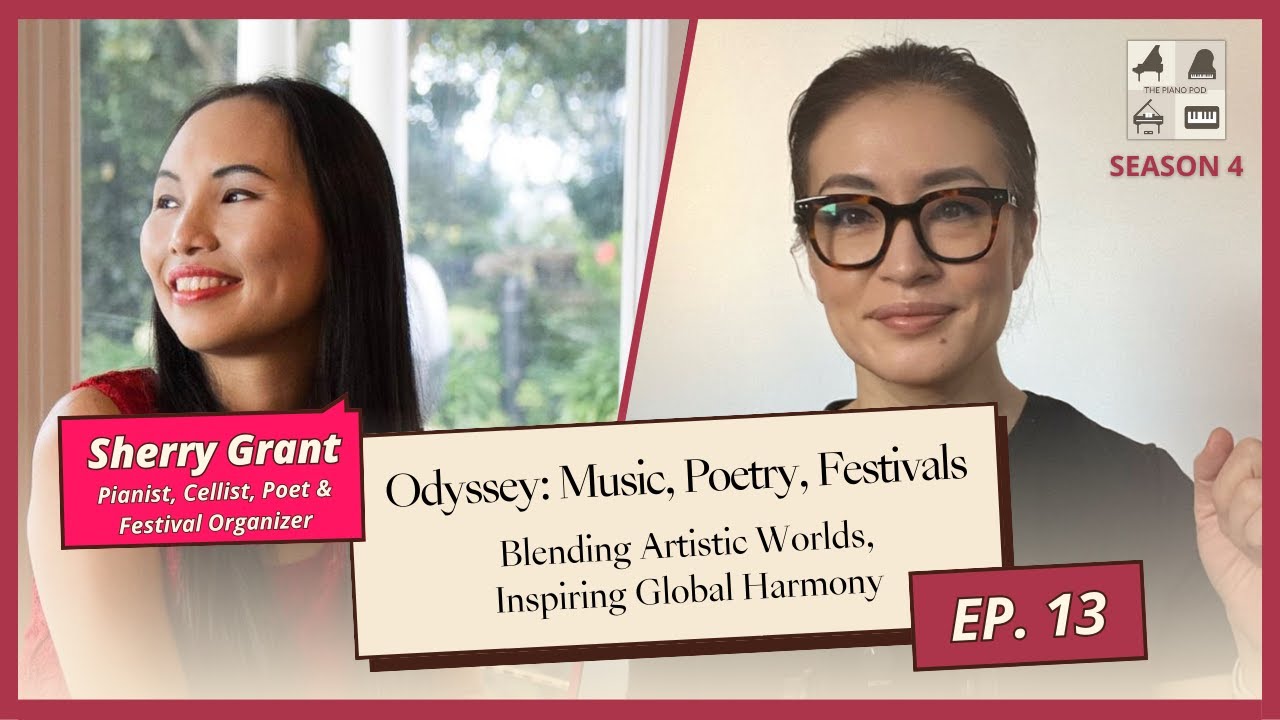
This content was created by The Piano Pod with Yukimi Song. This content was uploaded by The Piano Pod with Yukimi Song. This is a transcript of a YouTube podcast episode titled "Season 4 Episode 13: Sherry Grant - Classical Pianist, Cellist, Poet, and Festival Organizer" (posted 2024-03-13). It is an interview-style episode of The Piano Pod in which host Yukimi Song (labeled in the transcript as YUKIMI SONG) interviews Taiwan-born New Zealand musician and poet Sherry (Sherri) Grant, with appearances by Sherry’s daughter Zoe Grant. The conversation covers Sherry’s musical and festival-organizing career (piano, cello, multidisciplinary festivals), her rapid emergence as a haiku and renga poet, examples of short-form poetry (haiku, monoku, renga), her projects (Catch-23, Scriabin and Katherine Mansfield-related events), and collaborations with her children. Content type: YOUTUBE; date in metadata: 2024-03-13. Language: English.
Chapters
Summertime: A Fantail's Quick Branch Switch. Summertime: A Fantail's Quick Branch Switch. Sherri Grant. Welcome back to another episode of The Piano Pod. Here, tradition meets innovation. We bridge the timeless beauty of the piano with the dynamic pulse of today's world. I am your host, Yukimi Song. By the way, the introduction you just heard was a haiku crafted by Sherri Grant. A multifaceted artist hailing from Taiwan and now making waves in New Zealand as a concert pianist, cellist, poet, and festival organizer, who is our esteemed guest for today's episode. Sherry will take us to the magical world of poetry with a special focus on the art of haiku. She'll also share her insights into the intricate relationship between poetry and classical music, offering a unique perspective on how these two forms art converse with each other. Later in the show, we'll be joined by a very special guest, Zoe Grant, Sherri's daughter, who at the tender age of 10 is already showing remarkable talent as an artist. So stay tuned for an episode filled with insight, inspiration, and incredible talent. So before we invite them, let me read short bios of our today's guests. As artistic director of 4 festivals since 2019, Sherry has been actively performing both in New Zealand and overseas as a pianist, although she was trained primarily as a cellist. Many composers have written music for Sherry to premiere since 2019. She is also the mother of 4 children who often perform in concerts with her. Sheri has published poetry books, edited haiku and renga journals, hosted online poetry gatherings, and judged several haiku competitions. And with her youngest daughter Zoe Grant, Sheri have appeared in numerous interviews in 5 countries since 2021 with a goal of building the next golden age where they will touch and inspire at least a billion people around the world with their creativity. Sheri is currently planning the 2024 VIO Latino Concert Tour in South America, Scrabbing 2025 Festival, as well as Hill and Car Festival in 2026. Her events are generally multidisciplinary where several art forms are combined. So here we are today to delve into Sheri's fascinating journey as a pianist, cellist, and poet, exploring how her multifaceted career has interwoven fostering collaboration, and yielding exquisite creations. Before we dive in, a warm welcome to new listeners and big thank you to our faithful TPP fans. Don't forget to rate and review the show on your favorite podcast platform. I am thrilled to welcome Ms. Sherri Grant to start our conversation. Please enjoy the show. You are listening to The Piano Pod with Yukimi Song, where we talk to the brightest minds in the industry about about how they are bringing the piano into the 21st century. So here we are with Taiwan-born, New Zealand concert pianist, cellist, poet, and festival organizer Sherry Grant. Welcome, Sherry. Thanks for being here today.
Thanks, Yukimi, for inviting me.
We met through Facebook, I think, and then I think you saw one of the posts I made about my previous guest Was it about Alison and Carlos Franzetti?
I don't remember my previous guest.
Yes. Do you know them or no?
Not so well. I just saw it just by chance pretty much.
And then that's how we started our conversation. And then as we had the conversation, you told me you are also a poet and I was like so inspired and impressed. Sherrie, you are a touring musician and your musical career started as a cellist. Then your love for music expanded to piano. And from what I read, you have always had a love for languages, particularly in English, and you picked up passion for poetry in recent years. And passion is actually an understatement. You became a poet. I mean, not only did you start writing poetry, but, you know, how many How many poems did you publish?
Uh, I don't know how many published, but, um, over 70 journals and anthologies in a very short time. I've been writing for a bit over 3 years, maybe approaching 4 now, and it's like, um, yeah, I've written over 4,000 poems.
Oh my goodness, wow, that's quite impressive. So how in the world did you decide to become a poet?
I've always enjoyed reading poetry, but I didn't even know I had this. It's almost like discovering one's superpower, but it's actually ever since after the first lockdown. So I think COVID was bad, but not all bad. It's actually getting people to actually calm down and actually maybe discover some extra things that they didn't know they could do before.
But you're already doing extra things like, you know, being a cellist and pianist. And you also have 4 children, right?
Yeah, 4 kids.
Oh, wow. That's a lot. And then I hear your children are also very musical and artistic.
Yeah. Yeah. All of them play different woodwind instruments, even though I was actually dreaming of a string quartet, which fell through and they turned into a woodwind quartet.
Oh, wow. That's so, so cool. Do you ever play music with them?
Yeah, and we do a lot of online concerts and sometimes I just say, yeah, come and play, perform with me. Actually, there's one coming up in a few days at my house. We're going to do that one hybrid fashion. So a composer friend of mine is coming visiting from China, but he's actually a New Zealander and another clarinet player friend who are joining force and playing just pretty much just works by this composer. His name is Ross Carey.
Wonderful. So sounds like music is really very much a big part of not only your life, but also your family's life. And music playing is casually there, you know, it's not like a big effort. Or maybe, I don't know, you as a mom, you have to sort of tell them how to practice.
It's the hard part. These days I just like, yeah, as long as you are prepared for your lessons. Then we're all good. I'm actually— I used to get them to do competitions a lot when they were younger, but now it's just like, yep, yeah, you already know. And, and I actually went through the string instruments and piano as well, but they all settled on the different woodwind instruments, so I'm not going to push them to try and learn too many instruments.
But they're playing their instruments. That's awesome. So before getting deeper into a conversation on your career, your new career as a poet, In order for our listeners to understand your multifaceted career, I think our conversation should start with your musical journey. So can you share it, how it all began? What connects these diverse aspects of your career together?
Yeah, it starts with my training when I was young. So my parents sent me to these special school and all the way through to end of high school. And then actually we just moved to New Zealand and I was thinking, oh, no more music. So in Taiwan, you had to do a lot of academic work and on top of that, music as well. And that's like, yeah, it's a lot of pressure. But I moved to New Zealand. I thought, well, what can I do? Back to music I went. And I actually, because we had to choose just one instrument, I used to play two instruments, but not Yeah, not very well, I think, at the time. But yeah, I chose cello because that, well, you can join the orchestra and there seems to be more opportunities for chamber music and it's just a little bit less lonely.
Right. Oh, as a pianist, I get it totally. But are you like from a musical family? Like, because you are creating a musical family with yours, children.
Well, not at all. Actually, my parents, they don't know how to play music. But however, my dad, even though he couldn't actually play music himself, he was able to train one of the best, I think, marching bands. They always won the competitions in Taiwan. So I think he's got a musical ear even though he didn't have the training himself. And because of that influence, I think I've been very comfortable as a pianist, as the accompanist, or they call it like a piano, uh, what, collaborative pianist these days.
You, uh, when was the time you realized, oh, I want to pursue piano? Or are you both, are you both active cellist and pianist?
Uh, cello is taking a bit more of a backseat because you have to spend time to practice, right? Every day. And a fact that I really don't like traveling around, especially overseas with the cello. It's just too much hassle. Yeah. And actually, my cello had a little bit of wee accident coming back from the UK once when I was younger and the fingerboard just fell off because it was too dry. So after that, I just said, no more. I'm going to become a pianist. So I don't have to travel with the cello anymore. Or I actually got to borrow the cello sometimes when I was actually in two concerts, two solo concerts in America a few years ago, two years ago. I was able to borrow some really nice cellos and I didn't want to return them at the end, but I had to. One of them was made in the 1700s. I sometimes do that.
The reason because you were able to shift to piano was because you had also training in piano as almost like a secondary instrument as a child.
Yeah, that was a requirement, but I was never very good at it because I think I was just so tense. It's hard to actually— yeah, I can play fast, but not very well, I think, at this time.
But now, so when was it like you decided to put more effort and focus on piano?
Actually, I started playing again at the start of 2019, as soon as the youngest kid turned 5 and started school. I said, oh, I'm free. So I started doing all the planning, all these festivals and concert tours. I did a tour in Wellington and Auckland, just around New Zealand with the principal of the Auckland Philharmonia Orchestra, the violist, principal violist. Yeah, Robert Ashworth. And also, but before that, I planned a whole festival and invited my friend from the United States, from New York City, principal violist from the Met to perform with me. That was my first time coming back on stage. I performed with somebody like a big shot, but I was not.
Is that the 100 Years Journey concert tour in 2019?
Yeah, that was the second event. But the first event was the War and Peace Festival. So that was actually my very first festival. That was the only in-person festival as well. I actually put together an art exhibition and I shifted to like 3 places. I even did one in Wellington. And yeah, there was arts and also poetry. I invited a lot of friends from Auckland, the poets. Yeah.
You're already thinking to do sort of multidisciplinary collaboration, I guess, not just the music, but, you know, inviting—
In my first festival, I also had a really, really diverse program. There was one concert that was totally just jazz. And there was one that's just for singers and one that was just string and just with wind and one of them was Chinese traditional instruments. And I performed in one of the pieces as well. Yeah. All sorts of Chinese traditional instruments. It's really amazing finding all these locally.
Yeah.
Yeah. Then also you've done so many different projects, but one caught my eye was Child of the Sun: A Celebration of Katherine Mansfield in Song. World premiere of works of New Zealand. So I know you have such a love for Katherine Mansfield, who also played a musical instrument, but she was a writer. She was a poet, right? Mm-hmm.
Oh, not just poetry. I think she was more renowned for her short stories.
Oh, I see. Okay. Okay. Now we're going to dig deeper into her story, but tell us about this concert, I guess.
Okay, that was a world premiere of new works. Actually, I ended up receiving 19 songs for mezzo-soprano and piano from 12 New Zealand composers, and that the whole project actually took only about 3 months, about 3 months from the finish of, you know, like the conception of the idea to the world premiere Indonesian. So it's pretty amazing. I worked with a really fine mezzo-soprano. I think she's originally from America, maybe, Tessa Romano. And then, yeah, the School of Music at the Otago University Indonesian, the they helped a lot with the concert, promoting it, and we had a lot of like interview and publicity around there in Dunedin. I really like the city.
I think you were showcasing the composers from your country, New Zealand, no? Yeah. So can you introduce us to New Zealand composers?
There are so many, but they are pretty much unknown to the world. I think it's a real shame. That's why I play concerts around, especially taking my— also my idea last year was 2023. I designed a program called Catch-23. So instead of Catch-22, you had Catherine Mansfield in this Catch-23 position. She was— yeah, actually, her life was a little bit of a mess, I think, her personal life. But her her works was amazing, right?
So it was the Katherine Mansfield theme. So you took her poetry or poems and then put music to— all the composers put music to it. Is that what it is?
Yeah, that was for Child of the Sun. But for K23, it's really just showcasing composers from Katherine Mansfield's time and also contemporary New Zealand composers. So I chose 23 pieces and then I had multimedia presentation of New Zealand artworks and paired with my own published short form poetry, mostly haiku, yeah, and along with the music. So each piece I can just use my remote to change the slide and everybody really, really enjoyed that. They thought it was really quite interesting seeing that instead of just like dozing off in a concert.
Oh, yeah, yeah, yeah. We have to talk about that. But you've been doing this really creative way of engaging audience, right? So like it's not just this traditional way of performing, playing music and displaying this beautiful composition, but also you're using art visual art and presentation, and plus, you know, reading poetry, I guess, to more engage with your listeners, audience.
I think that's how we inspire one another. Just like, yeah, it's not just— they're all the same in principle. All the arts are the same.
Then just tell us a little bit more about the fest, because since you are a festival organizer, so I'm curious about Now you mentioned about War and Peace Arts and Music Festival 2019, and you really have this love for viola. So it was like a collaboration with violist, as you mentioned. So what— but tell us why you love viola so much. You're a cellist, you're a pianist, but you have this love for viola. Why is that?
Actually, when I was little, I always wanted to be a violinist because I thought 'Wow, the repertoire I love so much.' And there is such a huge repertoire to choose from. And then I only got to pick the cello because I was too slow. And then carrying the cello is a major, major thing, right? It's really quite difficult for a little kid. But later on, it was actually after my eldest child started playing the viola, and then I discovered how amazing the viola Actually, it's like combining the violin and the cello. And actually, but they only have like the mid-range.
Let's talk about other festivals. Like you had Hindemith and Copland International Music Festival 2021. That sounds interesting. And also you did the Scrabbing 150 in 2022. And you're also a board member of Scrabbing Society of America, which I became a member of. I'm very proud.
I'm glad you joined us.
Yes, I did. Anyway, so let's start with the Hindemith and Copland International Music Festival. What was it all about? Obviously it was about Hindemith and Copland, but actually not just about them.
It was more about their pupils. So I was showcasing— actually, I did that whole festival online and not a lot of people joined in, but that's okay because that was my first attempt of doing an online festival. And that was actually during an Auckland lockdown. So no, I couldn't go anywhere. So I had to do the whole thing online. And yeah, just like, so I had to go and select, I had to do a lot of research and then finding out who the pupils were. I actually did a few interviews as well. And I invited Festival Petron, very famous composer, also the pupil of both of the composers, Mr. Samuel Adler, to be the festival patron. So, and he, yeah, he accepted that and did an interview with me. I think it was the second time I ever interviewed anyone. I was there with Mr. Adler, and I'm actually going to try and do another festival for him later on.
Great. And then in Scrabbing 150, Tell us, what was it like? What this festival is about? Obviously about Scrapping, but—
That was actually Scrapping's 150th birthday. So that was 2 years ago in 2022. And then I thought, wow, that's very important. He's my favorite composer ever. And I just really wanted to celebrate him. And actually, I wanted to be able to to learn all his pieces. And actually, just before the festival, I curated— I played 40 Scriabin pieces online in a concert, and that was the best attended concert I've ever had, probably because my host was quite famous. And I had 15.4K people actually listening online.
Oh my goodness. You said your Her husband is famous?
No, no, no. The host.
Oh, your host.
Oh, I see. Playing out concerts. And I think maybe on the metaverse or maybe she's doing something to do with that. So I think there are a lot of people came and became curious and I'm just happy to be pushing, screamping music out to anybody in the world. You don't have to be a musician to be able to appreciate His music is just like really like magical. I listen to his music all the time, every day.
I can kind of understand because you're a poet and his musical— I mean, his compositions are known for poetic. So I'm sure you have so much really relate to his music, no?
Yeah, yeah. I have actually found that a lot of people that I try to showcase, they end up being or my favorite composers or people, there are like musicians and poets or philosophers. So it's all connected somehow.
So once again, your love for Katherine Mansfield went into this festival, International Katherine Mansfield.
That was last year. That was her centenary. So she died 100 years ago. Yeah. I see.
Okay. So let's discuss who this woman was. Who was Katherine Mansfield?
She was originally from New Zealand, actually. That's also part of the reason I wanted to celebrate her, because some people I spoke to didn't realize she was even a New Zealander. But of course, I think earlier on, people were— kids here, school kids there were required to read her works. Maybe not so much like that these days, but Yeah, her short stories are extraordinary, but what I love even more are her, actually, her like letters and journals. And I've actually written a book I can quickly show you here called Being Catherine. So my first book, I dedicated 100 poems to her, and this is half of them, 50 poems in here. I wrote in 50 days.
You wrote poems That's a compilation of poems, right? About Catherine Mansfield.
Inspired by her, yeah. Oh wow, yeah. So it's just mostly actually inspired by her. Well, it's not just poetry, some of them by her poetry and some of them, most, a lot of them actually by her letters. I just love reading her. She was so sincere, I think, and quite Yeah, she's got a sense of humor that— and she's very observant of everything. And but she had a very short life. She died at 34.
And then, but who was this woman to you? What's the strong connection? And not only she was a writer, but also she played a musical instrument.
I think she was a cellist. I think I really identify with her because she was like, if she was racing one country, and she really wanted to go out to another country. And then she just didn't want to be in New Zealand. She thought it was like not much happening here. And she really wanted to be in Europe to kind of just study. And then maybe her talent actually shifted to writing later on because I believe that her parents thought she was not very good and they didn't want her to be just a second-rate cellist in the end. And I thought, wow, my parents complain at some point and they say, well, why are you still playing music? You're just a mom. You need to take care of the kids. But I think I want to show them that I can do this. I can do all these things even though I'm a mom as well.
I want to read her stuff. And also I'm curious to read your book. What's the title of the book again? Being Catherine?
It's Being Catherine. I'm yet to put it on Amazon, but it's not quite available. Obviously, these just yet, but I will try and make that happen soon.
Oh yeah, that would be wonderful. I would love to read it.
The purpose of this book is to pique people's interest to actually go and read her works because these were inspired by her and tells a little bit of her story. It jumps from place to place.
But yeah, but you decided to do this big festival. So what's the inspiration? What inspired you to do it?
Oh, because I just feel so important. It's like Normally you need a whole team of people and maybe to promote and to do everything, but I'm the person who wants to do everything, I guess. I made it my mission to actually promote her and actually New Zealand along with it. So I guess I'm the self-appointed cultural ambassador for New Zealand somehow. I made all the Catch-23 concerts free last year. So that people get to listen to New Zealand music.
From your rich background as a classical musician to your recent exploration into poetry, how do you find the creative process of music and poetry intertwined? And how has this transition, you know, from being a musician— and you're still a musician— but into a poet influenced your perspective on your musical career?
I find a lot of similarity, like play music, especially like chamber music, because I've always been more of a collaborative pianist and chamber musician until 2022 when I actually played my first solo recital because somebody suggested that I should play solo. Why should I just be playing chamber music? So that was actually— I started playing solo piano. Only since 2022. And yeah, why I'm saying that it's very similar is that I'm really into writing renga, which is like a short form, a more modern kind of renku, the Japanese renku. It's like a series of only— the renga only has 6 verses of haiku. And it's like writing with a group of friends. Usually it's 2 people. So back and forth. Back and forth. I actually got invited to give a workshop and a presentation at the 2021, I think 2021, yeah, sorry, the Haiku Society of America. The president actually found out that I was writing renge. That was only maybe one week into my— yeah, after I've written my first renge, but somehow they just invited me to give a workshop and And I think maybe almost 200 people attended online. So I knew not very much about renga at the time, but very quickly I had less than 2 months, maybe a month and a half. I quickly invited a lot of people. I probably invited 50 people to write renga with me. And quite often I wrote multiple ones, multiple poems with different people at the same time. So it was really fun. It's like playing chamber music, right? Going back and forth really quickly. You have to read your music. And you have to express it, you have to match. And yeah, it's so much fun. I highly recommend it.
So now that you talked about renga and everything, so I would love to learn a lot from you today about haiku. Although, you know, I am a Japanese native, I'm Korean. My grandparents are Koreans, and then, you know, I was raised as a Korean, but Obviously, I was born and raised and educated in Japan, so I learned about haiku and then tanka and, you know, and everything. But honestly, I wasn't really interested at that time, and then I was more obsessed about, you know, English. So I have to learn from you. So at the beginning of our conversation, you told us briefly how you became a poet in recent years, and about what exactly is the tipping point that you immersed into this art form?
Oh, that was straight after the very first lockdown in New Zealand, and we just came out of lockdown, and I guess I had some ideas, but it was not clear. And one day I was just thinking, well, it felt really— I had this urgency, I really, really need to write this down. And I wrote my first ever poem, and it's, um, yeah, hold on, that's, uh, I think it's called Darkness of the Night or something. And then after that, and within the next 5 days— oh no, actually maybe 5 days, I wrote, I don't know, at least 5 more poems. And I can't remember the exact number. And I thought, actually, I feel like this is another way of expressing myself apart from being a musician. And my English is sort of good enough to do that. And so I actually got to know another haiku poet in New Zealand. She's She was an editor of a journal and then I just did email correspondence with her and she sort of just very gently told me about this form and that form and there's this journal, there's this competition that you should try out. And then it was really nice. Yeah, her name is Patricia Prime and I'm really grateful. She's like a great mentor to me.
It's really the mentorship or somebody that you meet that changes your life, who changes your life.
And yeah, this is actually my youngest daughter Zoe. She does that with me. So we host a lot of like haiku, um, actually renga gatherings internationally. We do it regularly. This is the third year. And yeah, I think not all— maybe we've been doing it since 2021.
You know, I actually started really liking reading poetry, but it happened like in my adulthood. And I was on the New York City subway, and then there was like a poetry like posted on the subway car, and all of a sudden I just felt this emotions, right, as I was reading. And then just, I don't know, it's almost like, like listening to music, and then, you know, this, this hits you, right?
I know.
What people told me when they came to my Catch-23 concert is that, well, you look at just 3 lines, but it makes you think so much, and it makes you think about your own experience and how that just resonates with you. I think that poetry is really powerful, and especially haiku, but haiku is just another form, right?
So speaking of that, so you, you write haiku, and then you also write renga, and then other forms too. So, and then you also created this form, Noh Naku.
Yeah, Noh Naku.
Okay, I know haiku, but for those who are still like, you know, trying to figure out the differences, so what's haiku?
Haiku is a traditional Japanese form of short-form poetry. In Japanese, it's actually not written in— I think traditionally it was just in one line, but then people know where to divide it into sort of 3 sections. So it's actually 3 lines. And the modern haiku, unlike the traditional one, actually works better in Japanese, but not so well in other languages. It's in 5, 7, 5 syllables for each line. But it doesn't apply in English, especially. It just feels so long if you try and fill it out. So maybe you get more 4 or 4-6-4. It's not really set. So these days for modern haiku, we just say short, long, short is like the standard. But you can also break that. And actually in haiku, you don't even have to be in 3 lines. I think from 1 line to 4 lines, they can all qualify as haiku.
So there's no set numbers of syllables?
I think that's the thing that's actually making it really stiff. Yeah.
I see. Because in Japanese, I think it was very strict. Has to be 5-7-5.
Yeah. And I think that really puts people off. Now it's just a lot more flexible. I think in Japanese, it actually works really well for 5-7-5. But in English, it just feels so long. A lot of modern haiku, and you just can't stand a very long standard one. It's still taught that way around the world. People still say, haiku, is 5-7-5. But now, it's the— we're actually, Zoe and I, we are journal editors, and we just say, well, we don't mind if you want to send us 5-7-5, we'll still look at it, we'll probably accept it too.
Wow. Now, also, there is a variation of haiku, longer version, it's called tanka. That I remember, 5-7-5-7-7 in syllables, I think.
Yeah. But he says In English, we just do like a short, long, short, long, long. I wrote some tanka that actually got accepted in journals as well, but less often because tanka is actually quite different. It's very emotional.
Do you have like a haiku that you can read? Sure, I have.
It's actually just a one-line haiku here. It's actually somewhat music related. It was published at the Cold Moon Journal in November 2021. It's very short. Let's go. It's just in one line. A kettle's memory, perfect pitch. I'll read that again. A kettle's memory, perfect pitch. So the kettle, if you use the old-fashioned one, kind of blows the notes, but it remembers the same notes.
You said that's nonaku?
Monoku. Monoku. Just one stitch.
English.
So it's just one line. I really like monoku because unlike in three lines, everything is kind of clear. But in one line, there are so many possibilities. Like if you divide, put, group these words together and then that part, or you just like, if you put like a comma somewhere else, it becomes a different meaning. So sometimes it's like that. So it's, yeah, haiku has so much potential. At first when I started reading haiku and trying to write, I was very descriptive and I was just thinking, well, what's so, it's only like some, so few words. What can you say with so few words? And wouldn't people be sort of starting to repeat other people's ideas? But no, the more you dive into it, the more you find and yeah, and then you can You can actually tell that really good haiku, why are they good? They can be very emotional and it just hits you, right? And the not so good haiku, you can also tell.
It's a really difficult art. Okay, now do you have any example of renga?
Renga may be best read with Zoe.
Okay, so let's invite Zoe. Hi, Zoe.
Hi.
How are you?
Good.
Great. Thank you so much for being here. I know, um, uh, you had school and then you got out of school early just for this, and I appreciate you. And Zoe is already a professional poet, and also she is quite an artist. You drew pictures for the book, the Batgirl, right?
Yeah.
And so many other things. And you also collaborated with your mom already. Oh yeah, that's the book. Yes. So we're going to talk about that book. But before that, let's do the renga session. So can you guys read that renga poetry?
This is possibly the first renga of me and— by me and Zoe that got published, I think. So it was published at Failed Haiku issue 71, November 2021. It's called Failed Haiku because it was actually just taking senryu. Senryu is a different type. Haiku is mostly about the nature. But senryu is more like humorous and it's about people more. So it's a different focus. So that's why they call it Failed Haiku because it's not haiku anymore. Okay, so this one is called Encore. Fashion week, all the rodents out for a catwalk.
Little ballerinas, too much makeup on.
Encore, they shout. He just wants to go home.
Speech night, forgetting what to say next.
Paparazzi, A dog comes sniffing.
New movie. I write my doll's script.
So the main thing for people to do in a renga is you have to link and shift. So you kind of get inspired by something in the first verse and then first haiku, and then the next person needs to take that and kind of write something starting from that, but then going away from it as well. So it's got so much possibility.
Yeah.
You never know what's going to happen next.
Yeah. This just blows my mind. But is it— so you were going back and forth between you and then Zoe. So you both wrote it. So the line that you read is written by Sherry and the line Zoe was— oh, wow. Is that how it works?
Yeah, back and forth. It's a lot of fun. But you can also have, because it's 6 verses, you can even write solo Renke by yourself, which is not as much fun, by the way. But the standard is 2 people, but you can also have 3 people writing 2 verses each, but also taking turns. And then you can also have a 6-people version, which is just like each person contribute one. So I think it's a highly social, yeah, thing to do. It's really a lot of fun.
And then it's like you can improvise.
Oh, yeah. Improvise.
Wow.
It's totally about improvising because I can write very fast. Sometimes I can finish a renga maybe within 20, 30 minutes with friends just online. We've been doing a lot online, and sometimes I do multi-renge. It's like I we do with a lot of people or the same person, but we write, say, well, if somebody gives me 6 or 10 starting verses, I probably reply to all of them. They're all different. And then we just carry on and then we end up with like 10 renga at the end of the exercise. And then we just, um, yeah, we just send them off to different journals and then sometimes the journals take them. It's really great. And then Zoe and I, we actually started our own Renge, um, journal called Renning Renge. So this is the issue 1. We started last year.
Wow, what, what is that?
Yeah, a lot of people submitted from around the world, and it's just a whole bunch of, um, maybe over 20 renges. And there was an essay— I, I wrote an essay as well. I think it's got a history of, um, about 30, 31 I think it's about 31 or nearly 32 years old now. It was invented by my friend Gary Gay. And we host these sessions twice a year to invite— well, we invite guest speakers to come in and talk about haiku or renga or anything haiku short-form poetry related. And then we write together. And we've been getting consistently about 20 people 20 to 30 people each session, and we run 2 sessions each time we do it. We do it twice a year. It's called International Renge Gathering, and it's quite popular. We've done 5 of those. I think the 6th one's coming up this April. I'm looking forward to that.
Wow. It's like a totally jam, right? Like an improv jam.
Yeah, we're jamming with people except with words. Like jam sessions. And then at the end of it, you have a product. You can send it to journals and all. I just say, just send it to us through Reading Renge and we can publish it.
Oh my goodness. I don't think I can ever do that. My mind is mind-blowing. But Zoe, this is incredible. How do you like doing this?
It's very fun.
Yeah? And then have you been writing your own poems and everything since you were a little, little kid?
Yeah, since 2020.
Since 2020. Wow. That's like 4 years ago.
So, yeah. She was 6 years old. That's when we actually wrote Batgirl. So it was like maybe 5 or 6 months work with her. Just these were actually particularly poems that I wrote with her or inspired by her. And is it okay if she reads one of them?
Yes, please.
It's raining cats and dogs. It all started with a single dark cloud. This cloud, feeling lonely, invited friends over for a party. In their drunken uproar, the clouds started fighting. They began throwing cats and dogs at each other. After hurling thunder and lightning, little Zoe, who never had a pet, came out went outside with a great big box, collected raindrops filled with cats and dogs. The next day she put up a sign which said, "Pets for sale with free ginger ale." Many customers queued up. So the next time when it pours, I wonder what other animals will drop from the sky. Perhaps goldfish or sheep I get to bring home and keep.
So we were kind of exploring rhyming at the time, and she did this great picture for it too. So that was her, Zoe, trying to collect cats and dogs in the raindrops. I don't know if you can see.
Wow.
Beautiful. Thank you so much for reading. Wow. It just comes from your heart, your impression about the, you know, storm, the rain. It's I can almost hear the music.
It was actually, it was inspired by a song, right? You had to learn at school that was kind of on and off. We had a lot of lockdowns, but that was in between lockdowns, I think. And it was also called It's Raining Cats and Dogs. And then we thought, oh, okay, we can use this. And then we will write a poem about it, inspired by it. Yeah, it has nothing to do with the song anymore, but we just made our own versions. That's actually all what my poems were about. I take one thing and turn into something else. So I see, I see an artwork and then I feel inspired by it and I write some poem inspired by that. Or even it can be news from the day. Yeah.
But I can really sense that vibe from you. Like, that's why you have, you have such a multifaceted career. You take one instrument and that inspired to go to the next. And so forth. And so, Zoe, are you still writing poetry?
Um, not so much anymore, but I do still do it.
Okay. And then do you still like drawing? I know you drew a lot of drawings in the book Batgirl, and then also maybe other books as well.
Yeah.
And then are you still playing— you're playing musical instrument. Which one?
I'm playing the flute.
Wonderful.
Zoe's actually been involved with a lot of these festivals with me, maybe since the Scrapping 150 2022. She read 250 short form poems, mostly haiku, during the 3 days. We did a lot of recording, so she was very patient. I had to make all the selections. It was about sound and music, and so I was looking everywhere online and journals and things. And then the hard part was getting all the permissions from poets, all 250 of them. And then so I recorded them.
Wow, that's great. Hey there, TPP family. The Piano Pod with Yukimi Song is now into our 4th season, and it's all thanks Thanks to you! Since 2020, you've been with my journey with the TPP, exploring this burning question: How do we make classical music resonate with today's audience in fresh and captivating ways? 4 years in, and the journey has been nothing short of magical. The Piano Pod isn't just a podcast; it's a movement, a space where pianists, composers, and educators brainstorm, debate, and reimagine classical music's place in our fast-paced world. We're together on a mission to ensure classical music doesn't just survive but thrives in our modern age. But here's the thing: to keep bringing you these insightful biweekly episodes, I need your help. Every bit of support goes into the podcast's essentials, from hosting to high-quality recording tech, and the countless hours behind the scenes. So, do you want to be part of this journey? Click the PayPal link in the show notes or head to thepianopod.com to donate, and as a token of appreciation, I will personally mail you The Piano Pod's snazzy logo sticker. So, hit the subscribe button, spread the word, and let's continue our mission and journey as classical musicians. Now, let's continue with the show. Yeah, let's talk about what's next for you guys.
So I've done Scriabin, I've done Catherine Mansfield, Hindemith, and Copland. Next is back to Scriabin, actually. This year I was planning to have a festival as well, but then I thought, well, maybe it's a good time to have a break from festivals because I'm also planning concert tour to South America. So in 2022, I toured Canada and America. In 2023, I toured Asia. So that was Thailand, Hong Kong, and Taiwan. Taiwan, I only had one week. I was like, 20 years I haven't been back to Taiwan. One week, 3 concerts in 3 cities. It was a whirlwind. And then this year it's going to be South America, maybe 3 countries. It's always like after the International Viola Congress, I go off and do a tour afterwards. So this time, I'm actually collaborating with a violist from the Netherlands. His name is Emlyn Stem. And yeah, we're just going to play 10 new works by 10 composers originally from South America, but all living overseas. So it's got a theme of like, diaspora. So it's called Vio Latino. Vio Latino. And yeah, and but at the same time, we're going to try and showcase poetry, very short, not haiku, but shorter poems by poets from those countries, and also artworks. So I'm still organizing that because there's a lot of permissions to get. People don't always reply, so I have to send out so many.
Right. And then also you mentioned that you are trying to build a cultural bridge between Australia and New Zealand.
Yeah, that was supposed to be this year's festival because I want to celebrate the New Zealand composer, New Zealand and Australian composer, Alfred Hill. And it will be maybe his 150th birthday. Birthday this year, but it doesn't matter. And also the number doesn't matter so much. I was just thinking, well, it's time for people to recognize this composer because he's not really recognized very much anywhere. But then I thought, well, maybe I need a little bit more time because I want to build that bridge. And I've got this project also, it's called Dialogues Down Under. So I want to try and get invite New Zealand composers to write for Australian, maybe youth ensembles, and then vice versa. So Australian composers to write for New Zealand ensembles and/or choirs. So concert bands or brass bands, you know, it can be any configuration. But I think that would be really fun to build that bridge and getting, you know, the Sydney Conservatorium maybe to work with New Zealand School of Music. That sort of thing. And I also want to put on maybe like Alfred Hill International String Quartet Competition, but that requires time and funding, which I'm going to try and find. So I think I need an extra 2 years to try and secure that, hopefully. And I'm still a team of one, pretty much. I have some advisors and festival patrons, but I think it's about time I start building a team to try and do different works because I am the organizer, I'm the performer, I'm also the promoter, all sorts of things.
Yeah. So Zoe, what do you think of your mom? She's— your mom is a power woman. She has such— she's a source of power, no?
Yeah. But next year I'm going to see if I can get back to performing in America. And because I want to celebrate Scriabin's 110th, yeah, since he died, I think we should celebrate that. And I would really, really like to see International Piano Competition for Scriabin happening, maybe the first one ever in America next year, if that's as possible. I want to try and organize that. And maybe you see a lot of maybe new works inspired by Scrabbing or a bit of crossover, maybe jazz people. I actually incorporated a little bit of jazz. There was one lecture about Scrabbing and jazz. What if you play Scrabbing's music in a jazz fashion and vice versa? So yeah, that was So yeah, that's a lot of fun. And maybe get some transcriptions going on, getting other instrumentalists, then pianists to know Scrapping somehow. Yeah, that would be my goal. And maybe if I can, I want to find alliances from around the world. I want to build like a Scrapping empire. Wow. Well, I think there's a Scrapping Association in the UK and there's one called Scrabbing Club in Netherlands, and there's potentially also one in Croatia. I don't know if it's still active. And the one in America is actually just revived 2 years ago when we did that festival. We revived it at the same time. It was inactive for maybe over 10 years at that time. And I want to build one especially for New Zealand, Australia, and Asia. But this time, if I'm going to South America, I might talk to the pianists there and composers there and see if they want to do something about building a Scrabin Society there too.
Oh, wow. Amazing. Wonderful. Well, you know, when you come to the United States, just if you're in the New York City area, just let me know.
I really appreciate my friend Joel Petrich. Because he was the host for my very first solo piano concert recital at the Clavier House.
Oh, yeah.
And actually, I'm dedicating this 2025 Scriabin Festival to his memory because he passed away last year. Yeah, I got sister project of Scarlatti. Scarlatti 555. You can imagine what that's going to be about. So Scarlatti 555 Now, because I think it's time for people to look at his music again. And I want to see if I can find 555 pianists or harpsichordists to participate in this project. Videos from around the world. Each person doing a different keyboard sonata by Scarlatti. And I'm pairing it with Scriabin just because the last name starts with the same two letters.
Tell me about your 100, um, 100 days challenge or something.
Yep, yep, yep. So recently I was down with COVID unfortunately, but A nice thing that came out of it is I started writing, reading plays with, well, with the writing plays in mind, maybe at the end of this exercise. So I've set myself, well, in the next 100 days, I am going to read 100 plays. But you know, plays, they can range from, say, 50 pages to the longest one I've seen, maybe 150 pages, thereabouts. So, but I aim to do one a day. So if I don't, I have to catch up somehow. And I'm actually, actually on target. Today is day 15 and I'm about to start reading my 15th play. And it's really amazing. I mean, I was doing poetry before, but I mean, there is a limitation because only very, very short space. You probably don't have enough spaced words to express everything. But I think in the play you can even talk about your hopes, your philosophy, and a lot of things can go in there. I really appreciate this exercise. And this is not like set by school or teacher. It's set by myself. It's a challenge to myself. I want to see if I can do this and at the end maybe write a play and people are looking forward to it. So I share my progress on Facebook. Every day.
So we're coming toward the end of this conversation, but speaking of philosophy you mentioned, so I have like one or two philosophical questions. So one is, in the era of this dominated by popular music, what are your thoughts on maintaining the relevance of classical music and ensuring the thriving of the industry?
I was thinking a bit of a fusion is actually not a bad idea, and introducing it to a younger crowd, but how to actually make it interesting is the— I think it's the hard part. So maybe getting the young kids to promote themselves. So that's why I get my kids to actually perform. And maybe it's going to be a little bit more appealing for the kids to see the kids performing, but not because they are pushed to perform in the setting of, like, say, a competition. And it's all different. This is— we're doing it for fun. I think we have forgotten a lot about like playing music for fun. That's why I really want to bring us back to the next— actually, the next golden age, which is about, you know, there's like a lot of people inspiring one another. They're all different disciplines. So it could be a poet and musician and painter or all sorts philosopher, they're all in the house or at a café and they're all talking and they're just, yeah, getting ideas from another person. I think it's really essential. So I'm doing house concerts now with my kids and my friends, and I'm hoping that, yeah, when the arts intersect, we're just beyond. I think there'll be magic.
Wow. Yes. All right. And then one more. What is your thought on our duty or gift as classical musicians to society?
Zoe, what do you think? I think just we can use our music to touch them because at the end of my concerts, and even just online ones, I had feedback from my audience saying, wow, this is like, yeah, I felt so touched or moved by I enjoy this better than like big, you know, famous pianists who felt so distant. So I think we really, what we should do is to bring it ourselves closer. We're not like a glorious, you know, famous musician up there, like not approachable. I think that the thing I like about, say, the haikus, haiku circle and the violists, it's like they are all very easygoing and approachable people. There's no such thing as like, I'm so famous, I'm not going to talk to you. Yeah, yeah, yeah. And I have security all around me. No, nothing like that. I think I like talking about things in my— yeah, or about the pieces or about different things. I dedicate things in my concerts. I always like to include scrapping at the end of my concerts if I can help it, if I can to choose. So I like talking to my audience and finding out how they feel and interacting. I think it's really important.
Wonderful. Okay, this has been really a great inspiring conversation. Sherry and Zoe, thank you so much for being here. So, but before I let you go, we have one more thing to do. It's called The Piano Pod Rapid Fire Questions. This is part of the show where I get to ask fun questions to each guest. Now here's a little twist: as silly as these questions may sound, your answers may reveal who you truly are. So, uh, are you ready? Do Zoe, you want to participate as well? Okay, yes, I will ask you a question, and then— but I, I want you to answer them the shortest responses— with shortest responses as possible. Question number 1: What is your comfort food?
For me, it's sushi.
Chicken noodles.
Chicken noodles. All right. Maybe this question is not for Joey, but how do you like your coffee?
Oh, I don't even drink coffee anymore. I like tea. Earl Grey.
I love Earl Grey. How about you? What do you like to drink? Boba. Ah, boba tea.
Yay!
All right, number 3, cats or dogs?
Oh, cats, for sure.
Cats.
Yeah, we've got a cat.
Cats, great. Number 4, summer or winter?
Summer.
I think summer. Yeah, I can't live somewhere with snow.
All right, next question. What skill have you always wanted to learn but haven't had the chance to? Maybe this is not for Joy because Joy is still very— 10 years old.
But, um, yeah, my parents always said, why are you not a composer yet? I think they assume that, uh, being a musician, you must be able to compose. So I, I am yet to be a composer. I want to compose an opera, but I want to be able to also write the libretto. So I'm learning to write a play now. So that would come, but it would take time.
All right, next one. What is your word or words to live by? Sherry?
Hmm, I think just being curious all the time. Curious.
What is the most important quality you look for in other people, Sherry?
I think it's sincerity.
Yeah.
And friendship. And I mean, just being able to open yourself up and, you know, and to two people.
Yeah.
Being approachable. But, you know, I, I think Friendship. It's really important. And I've learned this a lot. Like, at the start of the journey, like the poetry journey, I went and just tried to add everybody on Facebook, whichever name I see on the journal. And that was actually proved to be really fruitful because later on I actually became good friends with them and they submit to my, yeah, to our journals. Or competitions. Zoe actually judged a competition on her own last year. Yeah.
All right. Now, 2 more questions. So name one piece in your current playlist.
Oh, it's always Scriabin. I'm planning to learn all the 10 sonatas. I haven't because I wasn't actually like a solo pianist until say 2 years ago. So that's on my bucket list. So I'm listening to Scrapping all the time.
Okay, great. How about you, Zoe? Can you name one piece in your current playlist?
What do you like to listen to?
Taylor Swift.
Okay, that'll be fine. Yes.
Taylor Swift, which one? Which song do you like?
Blank Space.
Blank Space. Okay, I don't know that one. I have to listen to. So last question, fill in the blank. Music is blank.
Music is emotions. But music is everything.
How about you, Zoe?
Music is cool.
Yay!
Yay, music is cool. That's a great answer. So that concludes the episode, this episode of The Piano Pod with Yukimi Song with Yukimi Song with Zoe. Thank you, Sherry and Zoe, for joining for the show today and sharing your stories, beautiful stories and insights and expertise. So for The Piano Pod listeners and viewers, please visit artsinfinitypress.com to learn more about Sheri's work and also Zoe's. Thank you to my wonderful audience and fans for tuning in. If you enjoyed today's episode, please rate and review it on whatever podcasting platform you use. Remember to hit the thumbs up button and subscribe to my YouTube channel if you are watching this episode on YouTube. Follow The Piano Pod with Yukimi Song with Yukimi Song with Yukimi Song on social media to get the latest piano news via Facebook, Instagram, TikTok, and LinkedIn. I will see you for the next episode of The Piano Pod with Yukimi Song. Bye everyone, and thank you, and bye Zoe and Sherry. Thank you so much.
More from The


Spirit, Body, and Soul: Pianist & Composer David Berry on Virtuosity, Creativity, and...



Season 6 Episode 20 | "Spirit, Body, and Soul" feat. David Berry, Concert Pianist & Composer


Beyond Borders: From Argentina to Poland to Texas—Oscar Macchioni reflects on a life in music

Sound Liberation: Joe Williams on Black Artistry, Legacy & Belonging in Concert Music


