Season 4 Episode 18: Keys to Identity - A Profound Conversation with Grammy Award-Winning...
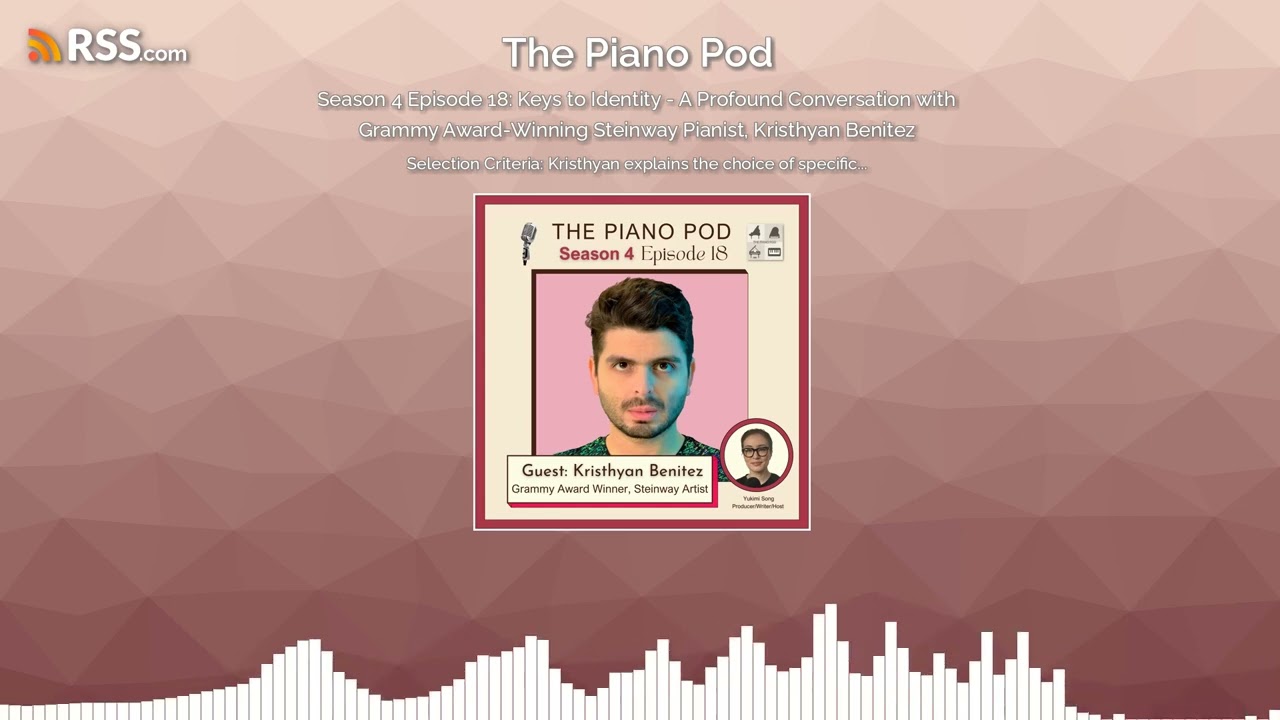
This content was created by The Piano Pod with Yukimi Song. This content was uploaded by The Piano Pod with Yukimi Song. This is a YouTube podcast episode (Season 4 Episode 18: "Keys to Identity - A Profound Conversation with Grammy Award-Winning...") of The Piano Pod with Yukimi Song (posted 2024-05-24). The excerpt is an English interview-style conversation in which host Yukimi Song speaks with guest Christian Benítez, a Grammy-winning Venezuelan pianist and Steinway artist. They discuss Latin American piano literature, Benítez's albums (Latin American Classics — 2021 Latin Grammy winner; Afro‑Cuban Dances — 2023 nominee), repertoire selection, characteristics of Venezuelan and Latin American music, improvisation and creative process, career highlights, awards, and related production/recording notes (Steinway/Spirio). The excerpt includes an opening narration introducing the guest and episode context.
Chapters
Welcome back to another episode of The Piano Pod with Yukimi Song. Today we're thrilled to have the esteemed presence of Grammy Award-winning pianist and Steinway artist Christian Benitez. His exceptional album Latin American Classics won a Latin Grammy for Best Classical Album in 2021. Throughout the season, we've had the privilege of delving into the rich tapestry of Latin American piano literature, engaging with artists and Latin American music experts like Carlos Franzetti, Alison Brewster-Fanzetti, and Walter Aparicio. Each conversation has unveiled the profound diversity and fusion present within Latin American music and culture. So with Christian's perspective, who is based in vibrant New York City but rooted in his Venezuelan heritage, we aim to further explore the depth of Latin American music and culture today. So with The Piano Pod's guest roster spanning from Peru to Bolivia, Argentina, and now Venezuela, our journey promises to uncover the rich, multifaceted layers of this captivating musical landscape. But before we dive into our conversation with Christian, let me take a moment to explore his illustrious background. Known for his vivid and passionate concerts, Christian explores a rich blend of classical and Latin American music, earning acclaim as a leading figure among a new generation of dynamic Venezuelan virtuosos. Praised by José Antonio Abreu, founder of Venezuela's El Sistema, as a crucial leader in Latin America's musical movement, and mentored by Philippe Entremont, Christian's performances resonate worldwide. He has performed in iconic venues like Philharmonic Hall in Berlin and Davies Symphony Hall in San Francisco, collaborating with top, top conductors including Claudia Abbado and Gustavo Dudamel. In 2019, Christian's prowess was showcased during a 13-city recital tour in China, reinforcing his global reputation. His album Latin American Classics captured a Latin Grammy for Best Classical Album, featuring compelling compositions from across the continent. His latest work, Afro-Cuban Dances, also earned a Latin Grammy nomination in 2023. Mr. Benítez's discography includes over 50 tracks for Steinway's Spirio and albums such as Miniatures, which won a bronze medal at the Global Music Awards. His leadership extends to educational roles, having served as assistant conductor of the Philharmonic Orchestra of the Americas and artist-in-residence for Venezuela's El Sistema. Christian is a recipient of José Félix Rivas Award for his cultural contributions. So join us as we explore Christian's remarkable career achievements, including his accolades, awards, and examine how his multifaceted identity influences his, his creative processes. We'll also delve into how he has pioneered new ways of experiencing music through innovative approaches to music production, extending from his traditional concert performances to more experimental projects. Before getting started with this special episode, I want to welcome all of our first-timers today to The Piano Pod with Yukimi Song with Yukimi Song. I'm a classical pianist and educator from New York City. Whether diving deep into a piano career, working professionally in the classical music scene, or simply having a passion for piano tunes, this podcast is your backstage pass to the fascinating world of piano music. To our incredible TPP fans and loyal listeners, welcome back! Your continued support means the world to us. If you enjoy today's episode, please take a moment to rate and review the show on your favorite podcasting platform. Your feedback helps others discover the joy of The Piano Pod with Yukimi Song. Now, without further ado, I'm thrilled to introduce Mr. Christian Benitez and kick off our conversation. So sit back and relax and please enjoy the show. You are listening to The Piano Pod with Yukimi Song, where we talk to the brightest minds in the industry about how they are bringing the piano into the 21st century.
Welcome, Christian, to The Piano Pod with Yukimi Song.
Thank you. Hi, how are you? Thank you so much. I'm so honored to be here.
Thank you. Oh, honor is ours. It's an honor to have you, and thank you for being here. You know, this season on The Piano Pod, I've had amazing opportunities to chat with some incredible talents from our industry who either hail from Latin America or passionately promote and perform Latin American music, and I learned so much, and I'm so looking forward to diving deeper into the world of Latin American music and culture today with you. So I'm ready to learn. I'm excited. Great. Let's start with this. Your album, which one of the albums which won the Latin Grammy for Best Classical Album, which in 2021, I believe, and the title is Latin American Classics, which was also produced under the Steinway label.
That's correct.
Wonderful. And congratulations. And so I watched actually one piece from the album. It's called Adiós, Cuba by Ignacio Cervantes. Yeah. So, yeah. What inspired you to create the Latin American Classics album?
So I am originally from Venezuela. I grew up in Venezuela. And as part of the musical education that I got in the conservatory, we were always encouraged and we need always to add as part of our repertoire music from Latin America and from Venezuela. So I kind of like grew up with that. That was part of like my DNA. And through the years, I saw that sometimes people were referring to those type of, you know, music as like a different, a separate part of the classical music world. And I started like researching a little bit. And, you know, some of those composers were actually friends and colleagues of the classical— composers that we know, right? So I was like, yeah, so why there's a difference, you know? If I, you know, recall, and as we know as musicians, a lot of composers were inspired by folklore, right, by traditions, same way as Latin America. So one of the things that sometimes people were making a differentiation about it was that, oh, in Latin America they were using more folk music, folklore. And I was like, yeah, but for example, Brahms was using folk music, Dvořák was using folk music, you know, Smetana. You know, you have a lot of composers that use that element, French music as well. So it was like, this is the same type of music. It's just like classical music from composers that were born in Latin America, right? So I needed, you know, to be able to share show audiences about what we are. And when I say what we are, I'm not only talking about being Venezuelan, but being from Latin America. It's like different countries with an extremely rich culture that must be put there in the world. I think like the same way that we musicians are, you know, been working on so hard on exposing contemporary music, new composers, new ways of doing music, we also need to kind of like activate some sort of way of like the nostalgia of what happened there. There are so many different composers, a lot of them unknown, with fantastic music. And so, I have that, you know, urge to show a little bit of who we are as Latin Americans.
Well, thank you. Well said. I mean, Latin America, the continent itself, is so diverse, right? I mean, so how did you go about selecting the specific pieces for this album and why you chose these particular pieces from Cuba, Argentina, Brazil, then of course your country of origin, Venezuela, and Mexico as well.
You know, um, I started doing a project with Steinway about creating this catalog of Latin American music, and, uh, the first thing that came, uh, to my mind was I, I wanna play the music that I love, that I grew up with. That makes me happy and makes me want to, you know, showcase better. I think like when we have pieces of music that we perform that we really love, the way that that interconnects the artist with the audience, it creates some sort of magic. So it was like I want to create that. But at the moment, it was just like just doing a catalog for Stanway's Spirio piano, which is a high-resolution piano. And then I started to just record music that I knew since I was a little kid, music that I, you know, that I wanted to perform, that I wanted to be part of that catalog. And then it changed, you know, the whole project because like that catalog became the album. And then when we talked about doing the album, I was— thinking, okay, I want to make a structure, I want to divide it into countries, I want to, you know, to make like a bigger thing, a bigger project. But then the pandemic came, and I remember my producer calling me saying like, you already recorded 24 tracks of music. I know that we have a plan that you want some structure, but we don't know what's going to happen with the pandemic. And I think this is really good material that we have here to release an album. Would you want to do it? And then I was like, yes. And I was happy at the same time because everything that I was selecting at first was just coming from the fact that I want to be more connected to the music that I grew up with, that I love. So that album specifically, have music that I really cherish, that I really love, and that I wanted to show audiences. So it was like a really rewarding, nurturing process. And then, of course, from that, then I started like, you know, making more structure. Like, I want to add more country. You know, there are so many composers, you know, like I can just make maybe like, 10 albums of just one country, like Mexico, for example. That, you know, musical culture diversity is just like, is so rich. But I need to just kind of like select, you know. And sometimes selecting is complicated. But it was just trying to follow my intuition and then connect with music that really connects with me emotionally. I think musical connection, is something that is very, very, very important, especially after everything that we've been through, you know, that human connection, that magical connection, that chemistry, that electricity that creates the artist with the music, and then we transfer that to the audience, you know, is very important. So I was just trying to connect emotionally with music, with Latin American music to show in that album.
Then do you have any favorite piece on this album? If so, what makes it stand out to you personally? Or maybe you love all of them.
I love all of them. I have to say that in that album, there's a piece by Ginastera, the Suite of Creole Dances. That piece, actually, I cherish that piece so much. And I, you know, like, I always thank Ginastera and that piece because it was a piece that actually started the whole project. It's interesting because it's a piece by Ginastera from Argentina, but he composed that piece in New York when he was living in New York. So for me, it was some sort of like, you know, me, a Latin American that living in New York, start, you know, to build some sort of path with Stanway at that moment. They didn't know who I was, you know, anything like that, and then just kind of like connect. So because of that piece is that we are doing what we're doing right now. So, I would say like I love them all, but that piece specifically is something that is very important to me. Also, the Adiós a Cuba by Cervantes that we also did after, we did a music video with Stanway. It talks about the fact that a person have to exile a country. So, for me, you know, being an immigrant and everything that is going on right now in my country, with exile, that is something that has been always very close to me. And, uh, and it's hard, it's painful, but we create magic through pain as well. So I think I needed also to show that in that album, and that's also a very, very important piece for me. We live in the States and we're not necessarily from here. Like, we weren't necessarily born here, we live here, we are from here. But that story is kind of like relatable to any culture, you know? Like, when you have to— you leave your country for many different reasons. You leave your country because you want to leave your country, or you're forced to leave your country, your country, or life happens that you have, you know, like things like that. Um, so it's a very like universal story. Um, for anyone, like even from people that live here in the United States, that they have to move from a state to another. Like, you have to move— that moving part, that emotional journey that we all live, even if we like move two blocks away, you know, there's an emotional movement there. And I think we have to pay attention to that because, um, especially as artists, we can open universes, we can create from that feeling. And we have to be overconnected with feeling. I think like that's a very important thing. I know that in classical music, you know, we need to build up technical skills like to the top level. And we all were all doing that or we did that at some point. I think we're still doing it, you know, while we keep, you know, practicing and evolving. But the emotional part, Uh, that's something that also have to be nourished, you know, like you have to be, you know, like we have to water it every day. Um, and we, um, we can be better human beings if we are connected to it.
Sure. And then that's, that's one of the reasons we play music. And also, you know, all of a sudden music comes alive, right? When you put that part of yourself into the music, music making. Before, you know, I go to the next question, I want to know the characteristics of Venezuelan music. So, you know, I got to interview Walter Bariscio. He is also the champion of Latin American music, and he actually is the one who recommended you, one of the people who recommended me to interview you. He's obviously the foundation for the Bolivian artists, so he told me many things about Bolivian music. So fascinating, the mixture of indigenous culture to, you know, European influence to so many others. So how about Venezuelan music?
Yeah, so, you know, I think like I have some sort of like flag now, you know, that, that like motto that I, you know, this kind of like— have you ever— I'm sure people have seen like this Instagram trend, like the dude with the sign, you know, like, yes, I'm the one that's saying like We are from Latin America and we have a superpower, and the superpower that we have is the mix of cultures, you know. Um, we, uh, all of Latin America in different, you know, percentages, we have influence from European culture, we have influence of course for indigenous because they were there already, and also we have influence from Africa, you know, like The Spaniards were bringing slaves from Africa at that time. But the most beautiful thing is the way we were kind of merging together. And even if you don't have in your DNA that little part of, let's say, African culture, which I'm sure we all have that a little bit in Latin America, we are splashed by it, by the music, by the culture, by the festivities that we celebrate. One of the most interesting things is like how the Catholic Church had to some sort of like adapt a little bit to the African culture and to indigenous culture in order to blend, you know. There was— they were forced, but right now when you think about it, like traditions and all of that, it's all together. And sometimes, you know, we were thinking, um, I think in the past that people were not conscious about that. And it's actually a superpower, like our— it's part of our identity. We're a mixture, and being a mixture, um, gives us, um, variety, gives us— but, but, but natural, you know? It's not forced, it's not something that we have to make up, we have to kind of like make a construct to— we're just born that way. And I'm not saying that we are better than everybody else, but it's something that's through history, we were kind of like, oh, the Latin culture is kind of like a, you know, like a lower culture. On the contrary, like we have— we adapt. And we were open, forced or not, in the past to that mixture. And that gives us a lot of color. And I think that's something that's interesting. And that's why sometimes like our music sounds in a different way. There's some sort of like colors, some sort of like— of course there's rhythm, um, um, a specific rhythm. And when you go through all, uh, Latin America, you know, like from Mexico all the way to Argentina, Chile, although we, we are different, like our accents are different, the way that we feel the music and the way that we want to create, it's some sort of like equal, like the same, like we come from the same core. Um, and in Venezuela we have that, you know, like, um, we have influence, uh, of indigenous, we have influence of African, we have influence of European. Venezuela specifically, um, not like in the, like in the 1900s, but like in this like Second World War, for example, we had a lot of immigration from Europe, uh, Italian, French, um, uh, Portuguese, uh, Germans, you know, like, so that mixture, like, even now, like, you talk to a German, you know, person that immigrates Venezuela, and then they some sort of like, they have this interesting way of seeing life that is, is different, you know, um, and that's because it's kind of like nurtured by what we are giving, you know, maybe we're like I don't know, too informal sometimes. And that informality, you know, is something that gave us the door, like that opened the door for immigrants to came to our country and then have more mixture. So we're a part of a mixture. And being mixed is so important and so fulfilled. You know, you feel so full of joy, full of color, full of— and then that transcends to everything, you know, arts, music, um, um, different expressions. So in, in Venezuela, uh, we have that. We are very— although we're from South America, we are on the coast, uh, of, of South America. So we, we get that Caribbean also, like, flavor into it. Um, it's— it, it is, it is interesting. And then it is also interesting, and I encourage people to have some sort of playlist or listen to music from Mexico all the way down or from Argentina all the way up. And then you'll see there are a lot of similarities, but also the variety is just astonishing.
Obviously, you won the Latin Grammy, and that's a huge, huge milestone. Where were you when you received the award?
So When I, when I got the nomination, I was here in New York. I, um, I never expected it. I, when, when I saw it, I was like, oh my God, I cannot believe it. Like, this is insane, this is not happening. And I remember that still, like, I, I have it right here, um, with me.
Wow, wow, I see it. Oh my God.
Yeah, um, and I still, like, till this day, sometimes it, it, it it, it feels like it was a dream, you know. Um, I, I always thought like of Grammys of being, you know, like for like pop music and rock and like, which, you know, all of those genres are amazing. Um, but then for classical music, I don't know, like I never understand it. And I went to a ceremony that was happening in Vegas at the time. It was like post-pandemic, so it was very weird situation, like the whole thing. And, uh, I was just trying to enjoy the moment. I was like, I think this is like the only time in my life that I'm gonna be walking a red carpet, you know. This is like insane. I, I never expected that. I, I don't do music for that, you know. It was just like, um, and, uh, we went through the whole process. I saw the nominations, and then when I heard Latin American Classic, my name, my producer named John Feiner, we were just ecstatic. We were just extremely happy. And when we were walking on the red carpet after, one, a very famous artist, Jorge Drexler, is a singer-songwriter, pop artist, like a huge, you know, a guy. He approached me. And he said, like, you know that classical, like, the classical, like, grammar for classical music is, like, one of the most important things here. And I'm like, no, it's not possible, like, no. And he's like, yes, it is, because a classical music album, you cannot add effects to it. So what you, what you listen to, you know, besides of, like, editing or, like, a little, you know, thing, there's nothing. It's very, like, naked. It's raw. Um, there's no Auto-Tune, there's no, you know, special effects to— especially when you're doing an album that is only piano. Um, and then that kind of like resonated me, you know, resonated with me. And I was like, okay, I think we're doing something that is important, and, uh, I want to keep doing it for the rest of my life. There was some sort of like reassurance of this is a hard path, uh, because it's not easy for musicians, but it's not easy for, for any, any, anyone. Like, you know, life is just complex. But it was so happy to be part of the musical, um, world, uh, just a little bit, just like one little dot of that huge universe, um, and representing who I am, you know, as an artist and as a person, uh, with my culture. So it was just incredible.
Wow, well, congratulations again. Thank you. And also your another, um, album, latest album Afro Cuban Dances, was nominated for Latin Grammy in 2 years later, 2023, in the Best Classical Album category. So this album is filled with pieces by Cuban composer Ernesto Lecuona. Why you chose his music?
Well, I, I feel like part of my heart belongs to Cuba somewhere or the other. I, when I was growing up, I had the opportunity to, to study with a fantastic Cuban pianist. And then it happens that when I came to New York, to start— I studied at the Manhattan School of Music. I also studied with another Cuban teacher, Solomon Mikovsky, rest in peace. And I don't know, I feel like Cuban culture and Venezuelan culture, they kind of like, they feel very similar. I need the— I had the urge to show a little bit more of what Cuban culture was. And, you know, some people, like it, some people don't like it, the fact that the Spaniard with the slaves, they— the first country that they came and conquered was Cuba. So everything happened there first and then expanded through Latin America. Lecuona was actually the first composer in history, and this is something that not a lot of people know, and that was also the reasons for me of like creating kind of like this album. Is he was the first composer that added African elements into classical music and put it into a regular classical music stage. And it was very controversial, you know, the fact that he was like adding like, you know, drums like into like piano rhythms and like doing things like that. It was like, what's going on with this? You know, like I think this is something that people should know and feel proud of it. And at the same time, all of these selections of pieces that are for Cuban dances, which is a suite, and then I added 4 more pieces, but this selection of this suite, it talks a lot about the Carnival celebration. And I was— as I was telling you before, so the Carnival was, you know, instated by the Catholic Church, but actually, the festivities of Carnival were in masks. Of being, you know, like hidden. It's all African. So it was a, it was a very interesting moment when they were celebrating the carnival, the processions of carnival. They were having the parties, you know, outside the celebrations with masks on. So they were all equal, right? There were no Spanish, no indigenous, no African. They were all wearing masks. And then it was very, very interesting because at night you know, they took off the mask and then they were going some sort of like underground parties or like celebration without that, but they were all mixing together, but it was something like hidden. So I, I wanted to show, um, also that, uh, in this album. Also, it was an album that is very dear to me. I, um, I created the idea— is the first time that I, um, play a piece of my own. I— there's a piece of my own in the album that I dedicated to Ernesto Lecuona, like in his style. Also, I'm highlighting his sister, Ernestina Lecuona, which was the reason that Lecuona became a pianist and a composer. And she was kind of like overshadowed. She was part of Cuban musical tradition and history. She wrote a lot song she wrote, you know, like she was famous, she was important, but she was forgotten. So I wanted to highlight that, and I did an arrangement of one of her songs, um, and put it in the album, you know, understanding that she is a— she was a very important part of who Ernesto was. Um, the other important thing is, uh, that I, I relay that, and I was doing that in concerts especially here in the United States, is that Lecuona and Gershwin were really, really good friends. They were exchanging letters. There were like a lot of communications. And when Gershwin wrote Rhapsody in Blue, in response, kind of like a satirical response, Lecuona wrote a piece that is called The Black Rhapsody that nobody knows. And I think it's been recorded just like the piano solo version, but there's a piano and orchestra version, like similar to what Gershwin did, but using African elements and like using the language of the congas. So it's very interesting, you know, like how we are like connected and we don't even know. So for me, it was very important to highlight that, and then I also, I dare to,, to draw the, the COVID of the album. So the COVID is, it's me doing it, trying to like, you know, kind of like put there the, the what I, what I feel about the album, you know, the colors, um, the rhythm, the culture. And, um, so, you know, it's a project that is kind of like a baby. Uh, I was really, really, really involved in like creating the, the idea, and I have to say that The piece, my piece that is in the album, it was a product of an improvisation. And I was very, very, very scared to do it for an album. You know, I do it like for myself. But I feel like, you know, I've been trying to kind of like open up myself into that world. And I know a lot of people know that this is not something new. Like improvisation in classical music exists. Since Bach, you know? And for some reason, classical musicians were kind of like, you know, take off that element. You know, it's like, oh, you cannot improvise. Improvisation is for jazz, or, you know, and it is not true. So I want to kind of like get in touch again with that feeling. It was very scary, I have to say. And it's a funny story. When I was recording it in the studio, I just did it in one take because it was an improvisation. When I finished, I remember telling my producer, this is not going to work, um, this is too short, I cannot, you know, this is like over like, like 2 minutes, uh, like under 2 minutes, I don't think it's gonna work. And then he said like, Christian, you've been playing for 7 minutes. And I was like, I cannot believe it. Like, it was really mind-blowing for me, experience liberating also. As well. So for me, that album represents a lot, and, uh, and I— and makes me want to continue, like, do more research and do, uh, you know, because it's not just like putting music and that's it. No, I, I, I mean, at least for me, I need some sort of like research concept, something that will, you know, get to people and start like seeing music, Latin American music, on a different way, you know. I understand that sometimes people feel a little bit intimidated by Latin American music, or they feel that it's like minor, like all the little, you know, pieces. But I encourage people to— you don't have to like it necessarily, but just try it, listen to it, and then you'll see. Same thing happened with regular standard classical music, you know, like not a lot of people, um, necessarily love opera, let's say. I don't understand that, but some people just say like, it's too much for me. Yeah, but within— even within opera, there operas, they're different. So give it a try. Just, just don't block that, you know, right away. And there's so— this beautiful worlds to, uh, worlds to discover once you give yourself permission to listen and to experience a little bit more.
Absolutely. What's a— what, what a great marketer you are too. Like, there's a call to action. That's so awesome. No, well, I mean, I want to talk more about you as an improviser, but oh, I didn't realize it was just a one take. You sat down on the— in front of The Piano Pod with Yukimi Song with— and then you did it. Yeah. Oh my goodness, that is incredible.
It was an amazing experience. And you know, I have to say, I turned that piece into a score, so the process like was backwards, and it was so hard to try to you know, with the inflections and with the time that I was taking like while improvising because it's some sort of like a low-paced piece, like slow, slow side. But then put it into a score, it was also like a challenge and an amazing experience, you know, to transform that into like actual rhythms that kind of like match, you know, time signature and like— so it was really— entertaining, a lot of hard work, but I will do it again a million times.
So if I want to get a score, is it available?
Yeah, yeah, yeah.
Really? Oh, yes, hook me up. I'm going to buy it. Yes, I want to try it because, yeah, I thoroughly enjoyed the album. Yeah, very much. Anyway, so to all our listeners and viewers, I strongly encourage you to check out Christian's Grammy Award-winning solo piano albums, Latin American Classics and Afro-Cuban Dances. These albums are lively, delightful compilations of works by Latin American composers, sure to captivate anyone who gives a listen. So you can find them on all music streaming services, right?
That's correct.
Yes. Okay. I will also post the links in the description. So We just started talking about improvisation, and I also watched your improv chops on YouTube channel. One was called, uh, The Carnival After Dark.
Yeah.
Wow. Fantastic. So improvisation plays a significant role in your career, sounds like. And could you describe your creative process when you approach improvisation in the studio or during the live? Performance.
So this is a, you know, when you say like it takes part of like in my career, um, yes, I, I, I, I had to kind of like turn it off for so long. And I'm telling you a story. When I was 7 years old, um, and, uh, this is, this is an interesting story that I discovered recently with my therapist. So everyone that have access to a therapist, please do it. It's the best thing ever.
Amen to that.
Yeah. Oh my God, yes. Um, so when I was 7, I had to— I— it was the first time that I was performing, um, a concerto with orchestra. And, and it was a piece, uh, that a Venezuelan-Argentinean composer wrote for me. Alejandro Slobodianik is his name. It's like, like The Piano Pod with Yukimi Song, but it's composer from Venezuela, Argentina. And it was a brand-new piece. He gave me the manuscript, and I had to learn it. And it was during summer. I was 7. So, for me, you know, finishing school and then have summer vacation was like the dream come true, you know? And I remember at that time, my teacher in Venezuela, she said like, "No, you have to, you know, keep practicing all summer. You need to learn your new repertoire and then the concerto because you have to play the concerto in September." and then it was June, so I had like very little time and it was a new piece. Um, and then, you know, I was a little like mad. It was 7, and I remember my mom— and none of them in my family, there are no musicians, I'm the only one— but my mom was very dedicated, you know, to understanding, you know, the pieces. She was probably like the most strict judge that I had performing. Like, it was so interesting. Like, she really learned, like, the pieces, and she was understanding, and she was like, oh, you're, you're rushing there, and you're doing too— you know, things like that, that it was really interesting. But at that time, she didn't know the pieces because she had to, like, go to lessons and start listening to the pieces in order to, you know, get— and that new piece was the new piece, you know, like, it didn't exist. So She said, okay, so the plan for the summer is you're gonna practice in the morning, and then in the afternoon you can play soccer. I love playing soccer, playing soccer, and then play with my Nintendo, my video game. I was like, okay, 7 years old. And but, but at the same time, I was mad. I was talking to my, my friends at the time, and they were like, oh, I'm at the beach, I'm like doing this and that. I'm like, I'm here, you know, like So what I did was that I started improvising pieces, like, and every day I was doing something different. And then my, my mom, I think like after 2 or 3 weeks, she called my teacher and said like, yeah, he's ready. Like, he's been playing the pieces for me and they sound great, and like, I really like them, you know. I was trying to always add some similar things so my mom could recall that same piece. But it was like, you know, just do like shenanigans, you know, like when— and then my mom said like, okay, so I talked to your teacher. You're going to have a lesson because you're already ready. And then I started like weeping, like crying. And I was like, I have to confess everything is made up. Like I didn't, you know, learn the pieces. And then, and then so of course she was mad, but at the same time laughing. It was like a situation that And I remember that going that time to my teachers that I kind of like turn off that because it was kind of like forbidden. Like, why are you not learning the piece and you're being like playing with the piano, like literally playing games with the piano. And I didn't understand it at the time. So I learned the piece after and, you know, it was like just doing my standard repertoire. But I remember at some point, like, adult age, remembering that story, I'm like, oh my God, I have that. I had it. It's still there. And it was like a very interesting process to kind of like getting it back. I think like one of my biggest reference in terms of improvisation and also as a musician is Venezuelan pianist Gabriela Montero. I admire her so much. She's also a really good friend of mine. And I remember talking to her a little bit and saying like, I don't wanna— I don't want people to feel that I'm trying to copy what you do. And then she turned to me and then she said like, remember that improvisation exists not because of me, it's because of music, because of Bach, because of the beginning of times. And I'm just telling you, the way you improvise is a completely different approach of what I do. So please go and fly and do what you want. And, and, uh, so my process is actually— is just connecting with the feeling that I have at the moment. Like, sometimes it works, sometimes it doesn't work. And I'm happy that if sometimes doesn't work, it's okay, you know. We're humans, like, it's fine. Um, and it's just like, I just let it go. Sometimes I, I think of a key, but it's so interesting that every time I start in a key, I finish in a different key. Uh, is the key that the feeling like drives me to But, um, and if I need to be like, you know, have some sort of a structure, I kind of like say, okay, maybe I have to do like a two-part thing, but that never happened. You know, if I do, I'm gonna do like an ABA form, it ends up being like a completely different thing, you know. Um, and I, I like that. I know that some people, they improvise with structure, and I admire that. Um, myself, I, I don't. And I feel like if I start like adding elements of structure to that, I will kind of like— it would kind of like lose the natural element of what I imprint in my improvisations. So I kind of like let it go a little bit and just like do what I feel at the moment. It's a scary moment as well. Because when you let it go, you have to let it go also everything, like things that you like, your fear. So everything is right there. The monsters are like next to you, but it's okay. It's part of you and you have to let your monsters out and have coffee with you sometimes. And if they want to improvise with you, they are open to and I want them to be there with me. They're part of me. You know, so it's, uh, it's, it's, it's, it's just, uh, it's scary sometimes, but when, when I'm finished, uh, it's like, okay, let's hear. And funny story is like, I, I don't remember when I— what, what I do. Like, it's little things, but like there are things like, oh, I use that chord, like, oh, that chord is nice, you know. And then like, but I never like came up with a specific plan. So that's just my way.
Yeah, but it's almost like a free writing, like, uh, so you're really in touch with yourself, inner self. So you, that's, that's maybe one of the reasons you don't remember specific chord that you use, no?
Yeah. For me, it's like a, like a meditation. I remember during the pandemic, everybody were like sending you like, okay, so start like meditating and then like these apps and like everything, which I think they're like amazing tools. But my way of meditating was actually improvising. I was sitting at the piano and then just let go. And then I could even like, you know, cry, laugh, everything. But it was like always through piano. Um, it's like, uh, yeah, I, I think like I don't see myself not in this life or not in our life without the piano. It's, it's, it's crazy, but it's just like it's who I am. It's part of me. So it's like, it, it's my, it's my everything.
I was listening to many pieces this morning by you on Spotify, playing through, and then I came across your 2016 album Miniatures, which you earned the bronze medal at the Global Music Awards. And obviously this album is entirely of your improvisation, no? Or arrangement.
Yeah.
Yeah. Wow. And then, you know, I loved the piece called Two Poems, Opus 32, No. 1, F-sharp major. And then also the intermezzo in E major. And then "Mañana, Mañanita, Caracol Indian." Yeah. Wow. Am I pronouncing okay?
Perfect.
Okay, did I pass? Okay, good. Oh, that was so good. So Tell me, are they like based on certain melody or certain poetry?
The poem is by Scrabbins.
Oh, okay. Oh, yes, yes, yes. Got it.
The whole idea of the whole album was to just— it was playing live in a concert. Everything was live.
The whole album?
Yeah, the whole album is live. So it was a concert that I did in Mexico City. I had— I lived there for a year, and it was just right when I started living there that I had this opportunity to play this— this recital. I didn't add all the pieces of the recital, but then this little jewels that I add here and there, uh, were like very special to me at that time. Still, they, they still are. And this Kravin, um, it's, it's, it's nice that, that you mentioned it because I've been talking to some, uh, Russian friends of mine and they say like, yeah, I like it, but it, it's, there's something different there. So I, I don't know, I think, you know, sometimes we are— we grew up with the fact that we have to, you know, we follow the score, everything that the composer, you know, writes there, we have to do it. And yes, of course, but there's a moment in time in life that as performers, you know, also we want to kind of like imprint a little bit what we are. And it's not just saying that the composer is wrong. I mean, there's nothing to do with that. It's just like we have this some sort of like necessity of show who we are. And if we play pieces written by different composers, then we also, you know, we give a little, you know, space to add here and there. I mean, of course, if I'm going to a piano competition and do that, like, I'm not going to pass. But after you pass all of that, which I think is an amazing experience to have, you know, competitions and like concerts and all of that, and of course school, You need to learn the structure. That's something that a dear teacher of mine told me always. You need to first learn the structure and then you deform it the way you want it. But you cannot deform it first. You need to know, understand how it sounds. You need to understand why the composer is writing that. Why is that happening? You know, and it was a very special teacher that I had. In Germany. I was going to Hamburg for several summers, and her name was Elgin Roth, pianist, very, you know, from the old school. But it was so interesting that when we were learning Beethoven, we learned all 5 piano concertos by Beethoven, one of the big things that we did. And she was always saying that to me, um, learn the structure first and then, you know, remember that Beethoven was a creative. Beethoven, you know, when he was not able to hear the music, he was feeling the music. He was— his universe inside was so big that it couldn't, you know, um, stand the real world. So it was like For me, it was eye-opening. And it's not that I'm do whatever I want, no, but like understanding the structure and then, you know, you take little licenses here and there if you feel like it. It doesn't have to be that way. And then you see famous pianists, you know, I think like one of the most amazing concerts that I've listened to in my life was here in New York, Lincoln Center. Marta Argerich playing, and Rostropovich was conducting, like the last years, you know? And she played Beethoven's First Piano Concerto. That's a concerto that she played like since she was a little kid. And the way that she was playing that at that time, I'm sure like she's— like if I listen to that concerto right now played by her, it's going to be a completely different world. But it was so amazing, so unique. And I remember saying like, I want to be that pianist, you know, I want to be that artist, I want to be the one that, that understands music, respects music, because I respect music so much, I respect composers so much, but at the same time I want to put all of that in my own universe and in my own world, and I want to say it with my own words. Um, you know, sometimes when you're reading a book and then you're explaining the book, you're not saying what the book is saying, that's, you know, you need— you use your own words. So when we have to use our own words to express ourselves after we understand what is it about.
So hey there, TPP family! The Piano Pod with Yukimi Song is now into our fourth season, and it's all thanks to you. Since 2020, you've been with my journey with the TPP exploring this burning question: how do we make classical music resonate with today's audience in fresh and captivating ways. 4 years in, and the journey has been nothing short of magical. The Piano Pod with Yukimi Song with Yukimi Song with Yukimi Song isn't just a podcast; it's a movement, a space where pianists, composers, and educators brainstorm, debate, and reimagine classical music's place in our fast-paced world. We're together on a mission to ensure classical music doesn't just survive but thrives in our modern age. But here's the thing— to keep bringing you these insightful biweekly episodes, I need your help. Every bit of support goes into the podcast's essentials, from hosting to high-quality recording tech, and the countless hours behind the scenes. So, do you want to be part of this journey? Click the PayPal link in the show notes or head to thepianopot.com to donate, and as a token of appreciation, I will personally mail you The Piano Pod's snazzy logo sticker. So hit the subscribe button, spread the word, and let's continue our mission and journey as classical musicians. Now let's continue with the show.
And then there's another aspect of you that is very interesting, that it's people that you work with, the collaboration. And I listened to the album Nosotros, which also— am I pronouncing correctly? Nosotros? Nosotros.
Nosotros.
Which also won another award. And so, and you collaborated with many incredible talents in Latin music industry. Jorge Glen, Laura Guevara.
Yeah.
Yeah. And so many others. And I really enjoyed the album. That, that album is so special. So tell me about the collaboration. Tell me about that one.
That album is a, um, homage to Venezuelan music, but, uh, Venezuelan music of different genres, um, from classical Venezuelan music for piano, um, all the way to like pop, and, you know, boleros, like love songs, like all of huge range with my current, which at the moment when I recorded that, it was, you know, I would just want to try to make a fusion between classical music and/or classical elements or my way, like I'm a classical pianist, trained pianist, merge with all of that and create some sort of like a minimal, elegant approach to this music. And then the idea was to collaborate with people from completely different genres, like not classical musicians, like all from different music worlds, like singer-songwriter, pop, rock, folk. So it was really nurturing. It was amazing, an amazing process. I wish that that album had more impact, but it got released right when the pandemic started.
I see.
It was kind of like frozen in time, I guess, like it's stuck in a little capsule. I love that album. Like, it taught me a lot. It taught me a lot of what I want to do and what, you know, this kind of like homage that I was paying to to Venezuela, I was like doing arrangements also, um, of, of my own, and I asked other people to help me with our arrangement. There's like a famous pop song that I turned into a kind of like a Rachmaninoff list piece, uh, so it was going like, you know, using like pop music, you know. I was like, imagine Rachmaninoff listening to this song and creating his own arrangement, transcription of it, things like that. And then I added, uh, there's one track that I collaborated with, uh, a really good friend of mine. We, we add very 19th century Venezuelan tune and we turn it into electronic music with acoustic piano. And then it was like an interesting process, you know. Um, I don't know, it was some sort of like paying homage to my country, but at the same time paying homage to composers, uh, and creators that they are daring to express themselves through the years. And I think like one of the people that comes to my mind is Steve Reich, um, that I remember the first time that I listened to, um, what was the piece, like piano with electronics, like the— or The Train, like what, like all of his compositions, like, it really like blew me up. I was like, oh my God, like, this guy is, um, amazing. And, uh, so I wanted to, you know, some sort of like— not— it's not the same, but I'm saying like just thinking of, of people that I, um, admire a lot. And Rachmaninoff, of course, is one of them.
Yeah.
And also there's one track, uh, inspired by jazz and I admire so much Oscar Peterson. So it's like people that I, you know, listen to regularly that I want to kind of some sort of like get some sort of influence, but using classical music. So it was a very interesting project. Also, it was a project where my husband was executive producer. I think it was like the first one with the idea, um, of, of doing things like that. He's a journalist, uh, he doesn't come from the music world, but the way of that he sees like aesthetics and like, yeah, I don't know, like interconnections in art is very particular. And so he was the one that came up with the idea of that, so it was very like significant. For me.
Yeah, I love that. I love it so much. Yeah. Now, so far we've talked about you as a pianist who plays Latin American music, but also, of course, you're a classical musician, you're a classical pianist, so you have that training as well. And so I'm curious to know, how was it like to perform under the batons of renowned conductors like Claudio Abbado? Oh my God. Gustavo Dudamel. Oh my goodness, and he is going to New York in 2 years?
Yeah. So first of all, I, um, I grew up in Venezuela, and in Venezuela there's, uh, this social movement, musical movement called El Sistema that was created by José Antonio Abreu. Um, my very first concert that I did, um, when I was 4 years old, it was dedicated to José Antonio Abreu, and that from that time I started having some sort of like a connection with El Sistema. And I think, I mean, I feel very honored and privileged to say that I had the opportunity to play with orchestra since I'm 7 years old. And I don't think like there's a lot of pianists that have that opportunity yet, like even like at like an older age. And I never took that for granted, and I owe that a lot to that program like El Sistema, that I was able to perform, you know, like, I think like the most that I did, I think, in my career has been like playing concertos. And that's something that I love, that I adore doing it, and I keep doing it. But it was because of of, of that, you know. I was growing up with all of these fantastic musicians, and one of them was Gustavo Duhamel, was growing up there, and we, we had the privilege to play together, and it was amazing. Now, of course, he's a superstar, um, but, um, we kind of like grew up together. So like seeing all these people like shine as artists and also be nurtured by that through the years, uh, has been, uh, just Amazing. And the moment when I— well, one of the things is I have to thank Elaine Grimaud, the pianist, because she got sick for a concert. And because she got sick, I'm sorry for that, that's when I got to play with Claudio Abbado. It was like a last-minute thing. I played Rachmaninoff's Second Piano Concerto with him. It was the scariest moment of my life when I came to the first rehearsal because I had only one week to prepare. I didn't know like that that was gonna happen. Uh, I think like I practiced the most, I don't know, maybe like 14 hours or something like that. It was like crazy, like I was just like— and you know, also the responsibility, you know, it was like playing for someone that I have albums, that I own albums, that it's like, you know, the biggest, you know, the biggest of the biggest. Uh, and it was one of the most amazing moments of my life, how kind he was, how connected with music he was. Um, and, uh, I learned so much from him. He wanted me to do at the very at the very end of the third movement before the coda, like the big, you know, climax, he wanted me to add like some octave there. And he's like, I really like it. I mean, I know it's not written, but can you please play the octave like, like playing some octave there? And I keep playing those octaves till today. Every time I play a concerto, it's like, and it really, it was an amazing time. He was playing a concert in Caracas with the Simón Bolívar Orchestra. And then Ellen, she came after and played a concert with him. But then like for the first concert, she was not able to. And then I really thank her for that. She doesn't know me. I mean, we met there, but I don't think she remembers that even that moment. And for me, it was like, you know, a moment in my life that it was just amazing.
But you are amazing because, you know, Rafa wanted to go, oh, it was a last minute thing, Rafa wanted to go for the intro number 2. I mean, it's not something that last minute thing that anyone can really, I mean, I'm sure you've practiced in the past, you know, before, but wow, that's so touching.
Yeah, I feel like growing up, and then you see that's one of the things that probably like growing up in Latin America or in Venezuela, that some things happen because of improvisation, you know, because a last minute thing. And I had concertos that I had to learn, and I, like, last minute, um, I played Brahms' First Piano Concerto that I had to learn in one week. And I remember that, I mean, if I'm thinking about that right now, I'm like, I'm completely crazy. But at that moment, I don't know, I just felt like I, I had like, like that rush, uh, of playing this and learning. And, you know, like, of course the amount of stress was inhumane. But, um, but I, I, I, I really appreciate that because, because of that is that I have like, you know, so many concertos that I perform, that I have them like on my repertoire, that I can, you know, uh, and, and also learn from that. It's like a different configuration. Um, you have the regular configuration of like learning a piece, I have the whole process and I have enough time, um, to do it. And then, and then also I had the opportunity to have that work experience, which is not ideal for everyone. There are people that they're not suitable for it. Um, I was doing it because I loved doing it. I love playing piano. I love playing with orchestra so much that it was like, I don't care, I'm gonna do it, you know. It was, it was just like that. And, um, it taught me a lot. It taught me, it taught me a lot how to like approach, um, music in a different way nowadays.
Not just practicing in your own practice rooms for hours, hours, but actually to do it with the orchestra, to do it with other musicians. That, that's when you learn the most, right? Yeah.
And I, I believe in collaboration. I believe in collaboration so much. I think this is one of the things that sometimes like in the, like the old school of classical music, that was not necessarily something good, like to collaborate or to, you know, but I always feel like I, I'm a better musician when I collaborate with others. Or, you know, if I have an opportunity and I can help a friend get that opportunity as well, you know, that is something that makes me happy. And I, and I truly believe in that. I, I think that was something that maybe, you know, sometimes like ego, uh, or like, you know, there are people that are like, I don't want, I don't want to give you my sources, or I don't want to give you my wisdom because, you know, and that talks a lot about insecurity, and that's a, that's another different topic. Uh, for me, it's all about what, what is right and understanding that in the music world, regardless of the genre of music, there's space for everyone. That doesn't mean like if there's someone that is extremely famous and there's another person that is also equally famous, that doesn't mean that they're gonna clash, you know. They have their own moment. The audience— like, this is subjective, you know, uh, this is something that— and you're able to like 10 different artists, it's not just one, you know. Like, and, and I, I believe in that, and I believe in like the given opportunity to people, uh, collaborating with other people, interchange experiences, wisdom. And I think like one of my, my biggest dreams Um, is I, I, I, I always said like, I want to be extremely famous, but not because of fame or ego. I don't care about that. It's because that will be like my only way to help other people. Like, I want to have a foundation, an organization that helps young musicians to achieve their goals, something that not a lot of us had, you know. There's no— like, there are organizations doing it, but like something that, you know There's so much talent in the world. And one of the most important things for us that we are in this stage or in this age at this moment, after all of the experience that we had, is to plant, you know, to seed, to plant that seed for next generations, you know, by teaching, by giving masterclasses, by helping others. It's not just about winning Grammys and playing concerts. That's nice, receiving the applause of the audiences, that's amazing. Um, the energy is, is, is wow. But it's more wow when you see, uh, that everything that you're doing and that you're working on, that you're like, you know, fighting for, it's getting, you know, new roots and it's like developing in a different way. So I think that's one of the most important things for me in terms of like Fame, collaboration, interaction with, with, with other musicians. Like, I, I love to play with musicians that they don't have to think the same way as I do, but some sort of like same values, you know, the values of, uh, of artistry, the values of, of being human, and the values of humility. For me, they are very important. And passion, always passion.
I'm from Latin America. I can, I can really sense your passion for gear. Yes, no worries. No, so, but just, just to be a little bit of, I don't know, I don't want to sound so cheap or anything, but, or cheesy or anything, but you know, Gustavo Dudamel is coming and is there any collaboration, future collaboration with you and him?
Um, yes, I'm doing a, I'm doing a project, uh, with the Venezuelan American pianist Vanessa Perez. And composer Stephen Bach, we have a special project of Latin music and classical. It's a two-piano project. It's a solo recital two-piano project and a two-piano and orchestra project that I don't know if I'm allowed to say it, but I'm going to say it because, yeah, why not? We premiered the two-piano project last year in Romania, and we— the plans are we're— I'm going to record the project. It's called A Fuego Lento, and it's a mixture of really famous music of Latin America turned into two piano arrangements by Stephen Bach and some like original works by him as well. But turning like into like in a level of difficulty that is like, you know, classical pianist, like, you know, like, technical and like contemporary music, and of course the Latin rhythm of it. And then we are mixing that, uh, with, uh, Rachmaninoff Second Piano Suite and, um, and some other things. So it's like a— it's a product that we have that we, uh, if someone is listening to this that is interested in, we're more than happy to played for you, um, anywhere in the world. That's the idea. It's an amazing project, and working with them, they're like family to me. It has been just a, a blessing. And one of the most important things is that we think alike. We want to expand the universe, we want to expand the universe of music, we want to help other people, um, and collaborating with great people. And there are so many great people in the world that That, yes. I mean, like, I think this is something, uh, worth mentioning, uh, that project. And then, um, yeah, or projects and/or people I'm collaborating with. Um, yes, I cannot say that right now, but it's, it's coming.
Okay. Now let's talk about identity. So I watched a YouTube clip of your performance of Piano Concerto in A Major by Ivencio Castellanos, Venezuelan composer, conductor. And so, you know, your music production profoundly embodies the spirit of Venezuela. I can really sense that. So, uh, what significance does your native country, Venezuela, hold you in regards to your music making?
I mean, Venezuela is where I, where I, where I, where I was born, where I grew up. Venezuela gave me the love of music. Venezuela gave me my family, my traditions. Um, Venezuela gave me a lot of things and took away things from me as well that shaped me into the musician that I am right now. It also showed me, uh, the beauty of arts through people, not necessarily through like landscape. We have beautiful landscape. Venezuela is beautiful. It's amazing, amazing country. But I'm just saying like just be touched and be who I am through the people that I grew up with. And then it gave me also the opportunity to learn overseas. And I think that the most thing that I, that I owe to my country, that it kind of like, it gave me, uh, and my family of course, the support, um, but it gave me that kind of like platform to go and understand the real world. Um, I think I, I left— I, I, I, I lead a, a life, a privileged life full of love, and I'm grateful for it, for my family and my friends and my teachers. Um, and, uh, but I, I also need to, to, to see myself. What do I want to become? And that, because I was living in Venezuela, that gave me the opportunity to be, you know, outside and understand me more. Um, and, uh, so yeah, Venezuela gave me, gave me my family. Venezuela gave me my husband. Venezuela, you know, like, gave me so many things. Uh, and even though I'm here and I've been in the States for so long Um, Venezuela is still in me and it will always be, but it's just like on a, on a, on a different way. I don't see myself, as I told you in the very beginning of this, as a Venezuelan necessarily, but more as a Latin American. And even further, um, just as someone that had the chance to get some sort of spark from the universe and create. And I have a duty with that, so kind of like a worldwide artist. So just giving what I was given to the world.
Then also you mentioned, you know, when we were communicating that You know, you as not only Latino artist, but also you mentioned bisexual artist. So can we talk about experiences as a Latino and bisexual artist in the classical music industry? How have these aspects of your identity influenced?
It's interesting. It has been rough, I have to say. Venezuela is not necessarily like the open country that, you know, it's very close. And I always felt that it was some sort of like alien, you know, it was like weird. I was like, why do I have this dual, you know, way of seeing life, you know, like I like and everything's like dual. You know, like for me. And I felt it was weird. And sometimes, you know, people think that the music world, the art world, it's like, oh yeah, everything happened. The art world is super open and you can just do whatever you want. And it's not true. Sometimes it's the country, you know. So I think like one of the things like now that I'm like older is that I'm proud of who I am. I've been like going through like this like identity process that also influenced my music. I feel like the way I'm playing piano right now is completely different from before, and that not mainly, but there's a lot of percentage that is due to understanding who I am and being proud of who I am as a human being. It has been tough, and you get like, I don't know, and any other experience but mine at this moment, but sometimes bisexuality is always seen as, we're like the underdogs, I feel, of the LGBTQI community sometimes. I mean, I'm sure like a lot of people feel that way and they belong to a different group, but in my experience, it's like they always like take it like, oh no, you're just closeted, or oh no, this and that, you know. And, uh, I think the only entity, to call it that way, that understood myself, understood me all the way, has been the piano. Like my best friend, my, my everything. So I, I feel that, that when I was playing piano, I was able to be completely myself, and I don't have to give any you know, uh, excuses to anyone. Just let it go. And so for me, like, playing piano as well has been like very kind of like a cathartic, like, experience. Um, I was able to, to tell people who I was or who I am without telling it with words. Now I, I, I'm, I'm happy and I can tell it with words, and I'm proud, and I'm like And I want all people that are feeling that way, especially young kids, which I'm sure that they're more advanced than us, for sure, to feel comfortable in your own skin. And the more comfortable you are in your own skin, the better artist and human you can be. And sometimes that doesn't go together for some people. It is so important. The, the stimulation that you get from, uh, like, exterior, like, agents, like, even like watching TV, going to a park, everything influence the way you approach music. So if you're not happy with who you are, then the music is going to be broken. You want that to be a beautiful sphere, you know? And if you want to break it, it's your decision. It's not because the social construct or people or bullying or anything. I'm completely against that. Um, so yeah, uh, I've been always— I think like I've been okay with the fact that because I have The Piano Pod with Yukimi Song with myself there, I didn't have necessarily that urge before. Also with the Latin culture, you know, which was very like macho, you know, like oriented. Um, and now I'm just who I am. I'm free, I'm happy. And, uh, if there are people that they feel threatened or they don't like it, or, or they— it's okay, it's fine. I think like that's part of like the diversity, that there's— you don't have to like everything. But respect is something that we all have to give and we have to receive.
Thank you. I didn't mean to really, you know, label you in any ways, you know, by talking about, you know, bringing Venezuela, for example. And I understand you've lived in this country for a long time. So, you know, when someone does that to me about, you know, my origin, native country, it's like, you know, sometimes it's like, please, I've been here too long, you know. So I don't mean that, but, you know, I was very fascinated. About the how complex we are as human beings. And then these days, as hard as you mentioned, challenging as it, you know, can be, but then you still can express yourself that way in a complex way. Yeah. Does that make sense?
Yeah.
So that's, that's, that's the reason I asked all these questions. So I don't mean to really—
I don't take— no, no, no, no. Thank you. I think like this is like it's, it's good. It's liberating for me. Thank you for— yeah, thank you. Like, I, I— sometimes people get scared of asking things, and there's— the worst thing that could happen is I can tell you, no, I'm not gonna— as you say, like, I'm not— I'm happy to— I'm an open book, especially now.
I appreciate that. I appreciate you. Yeah, it's a great conversation. Anyway, I want to know your alter ego, Benitez, and because Mr. Benitez has his own, uh, Instagram account, and I'm following you. And then also the music streaming service account as well. So tell, tell us.
So Benitez is an extension, uh, of me. Benitez is, um, well, you know, it, it's a reason to say that I love music regardless of the genre. I come from the classical music, and I will be playing classical music of my life because that's part of me and I, I love it so much. Uh, but also, um, I can do other things, you know. People are, are, um, they have the right to do other things and just not be labeled for one, for, for one thing. So the reason to create Benitez was to explore, um, a little bit of my my side of creating music, always using the acoustic piano, but go a little further using electronic elements, doing music for film. I am actually— I just worked in a fashion film. I did the music for a very small fashion film. Entertainment Latin America. And so it's amazing, you know, that you have to like— your universe expanded, you know. It's not just piano. It's not just like the way you— it's also like, okay, you need to understand a visual. You need to, you know, give it a different place. Creating music right now, I think Benítez is going through like a lo-fi era is creating music with acoustic piano and like electronic elements. Uh, one of my dreams, I would say, is to play a concert. It's Christian Benitez and Benitez in the same stage, you know, and then showing me classical pianist and then showing Benitez and have kind of like a collaboration together. It's like Christian Benitez featuring Benitez.
Wow, that sounds so amazing.
Yes, um, where the— these two worlds, they're, they're the same world. It's just like sometimes it's not, um, understood by, by everyone. And I think for now, also for me, like, I'm like entering this new world and it's good to kind of like separate it. And then I think eventually it just will merge into just one. So maybe Benitez will be just everything. In the future, who knows. Yeah, but I encourage people to— first of all, to all classical musicians there that you love classical music but you also love electronic music, you look pop, you love rock, you look everything else, do it. It's gonna enrich your classical performance, it's going to enrich you as a human being. And if you have moments where people are saying like, oh, so now you are a classical or you are a pop or you're electronic, or you are— you can, you can be everything. Just always do it with love and with a lot of responsibility. Just don't take it, you know, as like, oh, whatever. No, do it with responsibility, do it with discipline, do it with love. But you're— you can do everything. And that's true, that, that is not a cliché.
Wow, thank you. So powerful. So What's your next phase? I know new album is coming up soon. Yeah, yeah.
So we have the, um, the Latin American Classics Volume 2, uh, is coming in, in the fall. Um, so we, uh, in this one, uh, I'm trying to add more countries. It's inevitable not to add Venezuela. Venezuela is there, Cuba is there. Mexico is there again, Argentina, but then I'm adding Brazil, Colombia. There's, for Walter, Bolivia that actually Walter gave me some suggestions of repertoire that I really thank him a lot. So it's going to be— there's going to be a lot of variety. In that. And, um, and I'm looking forward— I'm, I'm, I'm looking forward to this, to this album, to continue the catalog. So the idea is to create in the future 3 volumes, um, of this. So, you know, the fact that we're doing the second volume right now, it's a, it's a dream come true. Um, there are going to be some side projects, uh, like Afro-Cuban Dances, who was kind of like a It's part of it, but it's like just specific for, for Lekwana. There's something, uh, coming there, Lekwana related again next year. Um, and, uh, just stay tuned. Just, you know, go to my social media. I always like post things. I'm not as regular as I should be. Sorry for my husband that he always like encouraged me to post more things. Um, but, uh, I'm always trying just you know, to be myself and post things that I like, um, and play and improvise. And, and, uh, eventually I want to be able to, you know, to communicate more with, with, with people. I— one of the things, and this is changing just a little bit the subject, but one of the things that I remember, uh, when I won the Grammy is that I remember someone told me that Oh, you're famous now. Then what are you going to do, like replying to people, you know, messages and all of that? And I said, like, I don't care if I'm like, you know, famous as the most famous people in the world, I will always go and reply to every single one of them. And I remember when I won, I got, I don't know, it was like maybe like 3,000 or 4,000 messages. And I reply to every single one of them because they're taking the time to listen, to celebrate with you, to listen to your music. They're giving you time, and I'm giving them, you know, my appreciation and my time and my thank you.
Well, thanks. What a wonderful conversation I had. I enjoyed thoroughly. My heart is full because of— it's a really enriching conversation. But Before I let you go, we have one more thing to do, which is The Piano Pod Rapid Fire Questions. So whether you like it or not, here we are. So I'll ask some silly questions, but be careful because these questions tend to be a little tricky because that shows really your answers may reveal who you truly are.
Okay.
So get ready. And so I want you to answer them as short as possible. So we'll start with level 1.
Okay.
Question number 1. What is your comfort food?
Pasta.
Oh, yes. How do you like your coffee in the morning?
Double shot espresso.
Sounds great. Cats or dogs?
Definitely dogs.
Sunrise or sunset?
Sunset.
Summer or winter? Fall. Okay. I'll allow it. Level 2. What skill have you always wanted to learn but haven't got the chance to?
To dance like NSYNC.
Dance like NSYNC? That's a very specific era. What is your word or words to live by?
Passion.
Passion. What is the most important quality you look for in other people?
Truth.
Name 3 people who inspire you, living or dead.
Rachmaninoff. Rubinstein. Wow. There's so many.
I know, right?
I'll say it's "creamin'." Okay, great.
Now, 2 more.
Now, these are difficult ones. Name one piece in your current playlist.
One piece? Like classical music piece?
Anything.
Godowsky, Java Suite.
Okay. Last question. You're in the black. Music is blank.
Music is my everything.
Ding ding! Thank you, that was great. So this concludes the episode of this episode of Piano Pod with Yukimi Song. Thank you, Christiane, for joining my show today and sharing your stories and expertise. I enjoyed it so much. So for The Piano Pod listeners and viewers, please visit kbenitez.com, K as in letter K, benitez.com to learn more about Christian's career and connect with him on social media. All the links are listed in the show notes. Thank you to my wonderful audience and fans for tuning in today. If you enjoyed today's episode, please rate and review it on whatever podcasting platform you use. Remember to hit the thumbs up button and subscribe to my YouTube channel if you are watching from YouTube. Follow TPP on social media to get the latest news via Facebook, Instagram, TikTok, and LinkedIn. I will see you for the next episode of The Piano Pod with Yukimi Song with Christian. Thank you, Christian. Bye everyone.
Thank you.
Thank you.
More from The


Spirit, Body, and Soul: Pianist & Composer David Berry on Virtuosity, Creativity, and...



Season 6 Episode 20 | "Spirit, Body, and Soul" feat. David Berry, Concert Pianist & Composer


Beyond Borders: From Argentina to Poland to Texas—Oscar Macchioni reflects on a life in music

Sound Liberation: Joe Williams on Black Artistry, Legacy & Belonging in Concert Music


