Season 4 Episode 2: A Team of "A Seat at the Piano" -- Promoting Inclusion in Piano Repertoire
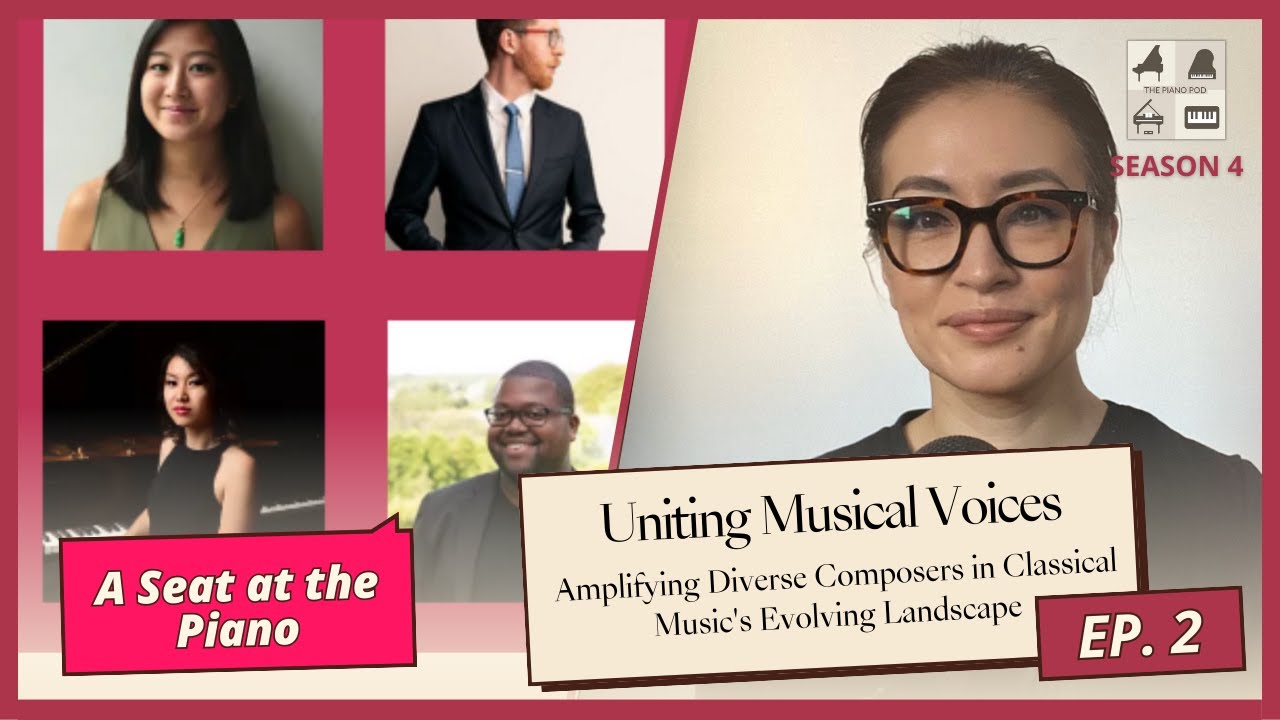
This content was created by The Piano Pod with Yukimi Song. This content was uploaded by The Piano Pod with Yukimi Song. This is a YouTube podcast episode (Season 4, Episode 2) of The Piano Pod with Yukimi Song (published Sept 20, 2023). The episode is an interview-style conversation in English in which the host (labeled here as SPEAKER A / the podcast host) speaks with four co‑founders of the nonprofit A Seat at the Piano (ASAP) — Annie Zhang, Brendan Jacklin, Evan Hines, and Susan Yang. The discussion covers ASAP’s origins (founded in summer 2020), mission to promote underrepresented pianistic composers and repertoire, the structure and features of their online database and blog, outreach efforts (interns, programming guidance, contributions/donations), searchable metadata (levels, genres, recordings, scores), impact and recognition (e.g., MTNA/Francis Clark award), site metrics (≈1,000–1,500 monthly unique visitors), and practical advice for teachers looking to diversify repertoire. The episode also includes a sponsor ad for the Musiq sheet‑music app.
Chapters
Welcome back to another episode of The Piano Pod with Yukimi Song. So today I invited a team from a nonprofit organization called A Seat at the Piano with Yukimi Song. They are Annie Zhang, Brendan Jacklin, Evan Hines, and Susan Yang. ASAP, short for A Seat at the Piano, was founded in the summer of 2020 in the midst of social and racial reckoning around the world. ASAP is run by these dedicated classically trained pianists with varying backgrounds and experiences who strive to raise the voices of those who are less heard and to inspire more thoughtful, inclusive programming within the performing and pedagogical spheres. Let me quickly highlight each guest by citing their bio. Let's start with Annie Zhang. She's the founder of ASAP. A renowned pianist and educator. Annie has performed globally from the Kennedy Center to festivals in Italy and Spain. Passionate about contemporary music, she has researched its pedagogical capabilities, even creating a resource introducing unconventional techniques. With a DMA from the University of Michigan, she is now an assistant professor at the University of North Carolina at Greensboro. Then Brendan Jacklin. He is the co-founder of ASAP. Canadian-American pianist Brendan Jacklin, based in Nashville, is a fervent advocate for contemporary music, premiering over 50 works and championing interdisciplinary performances. A sought-after speaker, he's graced stages from MTNA to NCKP conferences. As assistant professor at Piano at Fisk University, He brings a rich educational background with a DMA from the University of Cincinnati and mentorship from renowned musicians. Then let's move on to Evan Hines, also the co-founder of ASAP, pianist and educator. Evan, an Oberlin and University of Michigan alumnus, has flourished as a pianist and collaborator. He's been part of the Ann Arbor-based trio Continuum, toured Mexico, and performed at Kent Blossom Festival alongside renowned artists like Joella Jones. Having served at Oberlin in various roles, he is now pursuing a DMA at the University of Texas at Austin. Then finally, Susan Yang. She is also the co-founder of ASAP. She is a distinguished performer and pedagogue managed by the National Federation of Music Clubs. She's won numerous awards and recently performed with orchestras like the Nashville Symphony. Her debut album, Doorways: Half-Remembered Music, showcases her talent. A passionate educator, she's presented at various conferences and champions community outreach. Currently, she's a piano faculty member at Vanderbilt's Blair School of Music, with degrees from top institutions and mentorship from renowned pianists. So dear TPP fans and listeners, I can't wait to interview these brilliant pianists and educators and learn what Seat at the Piano is all about. Stay with me till the end as our conversation will lead to more reflective discussion on how we as trained classical musicians should keep classical music alive and thriving in our fast-paced world, and more. So here we go, dear friends. Please enjoy the show. You are listening to The Piano Pod with Yukimi Song, where we talk to the brightest minds in the industry about how they are bringing the piano into the 21st century. Welcome Annie, Brendon, Evan, and Susan to The Piano Pod with Yukimi Song with Japanese. This is my first time ever interviewing more than 2 guests in an episode, so I'm super excited and a little nervous. Just kidding. So, so this is going to be fun. I got an email from one of you guys, uh, back in April or May of this year that you have been following The Piano Pod's Instagram and listening to the episodes, and which I am really, really grateful for. And then I got to know your organization then. And since then, I have been checking out the extensive database of unknown composers and compositions, many of which I have yet to learn and discover. So later, I will let you guys introduce yourselves to our audience, but for now, let's start with this: what is A Seat at the Piano? Is it an organization, program, database? And who is this for?
So A Seat at the Piano is essentially a platform to raise the voices of a lot of composers who have been less heard or historically excluded or underrepresented. And so it is a database, it is a resource, it's a blog, it's kind of a lot of different things that we've combined into one, kind of a one-stop shop for a lot of pianists, teachers, students to go to if they're seeking seeking different kinds of repertoire that are outside of the normal kind of canon. So that's kind of it in a gist. I'm sure we're gonna talk a lot more about it and how it all started as well.
Yeah, great. Thank you so much for explaining. So what is the mission of A Seat at the Table? May I call the organization ASEP, which is a really cool 4 letters.
I actually love that you slipped a little bit right there, 'cause you said a seat at the table.
Oh, sorry, sorry.
And actually that's partially why we called our organization A Seat at the Piano. And maybe Susan, if you want to maybe talk about our name, because you were the genius or part of the genius behind coming up with the name of A Seat at the Piano.
It's been a long time, but I just remember we were all brainstorming, just like dumping names that we could think of into a document. I remember some of it was like A Seat at the Bench, A Seat at the Piano. What were the other ones? Or something like database for promoting piano inclusion.
And we wanted something that was, you know, this is serious stuff, but we also want to make it fun and engaging. And when speaking of, you know, having more voices, more conversations at the table, which is a more common kind of phrase that we use, of a seat at the table, and we think about a bench, a bench which is so limited sometimes in front of a piano. But if we have more— what if we had a longer bench, you know, that could fit a lot more of these voices and a lot more of these identities and personalities?
Yeah. And I noticed, actually, I think Brendan and I did at the same time, we were just going over the names and we were trying to come up with a more fun name instead of just calling this a database or a website or something. So, and then we were like, oh, a seat at the piano, abbreviated to ASAP, and people should be doing this kind of work ASAP. So that was like a kind of fun coincidence. So then we settled on the name right away because that just seemed to be Yeah, the most appropriate out of all the ones that we came up with.
Yeah, and it's really catchy, right? And then, sorry, I was really saying the wrong name, but A Seat at the Piano, right?
Yeah, you're actually not the first one. Yeah, we've— I've had a lot of— I've heard a lot of people say A Seat at the Table on accident.
Yeah, yeah, but I really like the background of where the actual name came from, and I like the shorter version ASAP, which is really catchy. So What is the mission of ASAP?
The mission of ASAP is to promote and include the music of composers that hasn't necessarily been in the forefront, you know, and I was actually thinking earlier today that there are so many of these pieces from the big names that we know, Beethoven, Mozart, whatever, and what— something that has been really exciting about the work that we've done is that you are starting to see sort of some very specific pieces become a part of the canon nowadays. And I started to think, oh my God, like, of course they're playing this piece again. But also you have to remember that, like, one is better than none. Like, the whole point is that, like, yeah, this— like, we might be seeing the same pieces over and over again. However, it's already hundreds and hundreds of years too late. So, like, even if there's one more I know that the work that we're doing is working and very important. And yeah, so basically we're trying to catch up with the inclusion of works of piano music from composers from historically excluded groups.
Why did you want to start this organization? And was there anything obviously missing, right? It was like the composers, unknown composers, unknown compositions. Which amazing works of unknown composers, which were missing from our program, from our even teaching repertoire and so forth. But was there anything else that was missing that you motivated to start this program, this organization?
During the summer of 2020, which was obviously during the pandemic, and we're all in isolation, a lot of time to reflect, of course, our whole nation was dealing with solitude and also racial reckoning, social reckoning, a lot of the disparities that are within our society. And I think there was a big call to action. It's unfortunate that the circumstances had to create this call to action, but that there is this urgency that we had to do something. And so whether or not that was going out to the streets and protesting and saying your voice, or, you know, showing the ways that you're supporting other communities in other different ways, I feel like as musicians, even within our silo, within our bubble and our sphere, we can still do a lot of influence. And so this started actually just, you know, in my bed on my laptop, just kind of doing my own personal research when I was doing my self-reflection and like kind of mad at myself that I could only maybe name like off of the 5 fingers of my hands the number of composers that I had played that were not by standard typical white male, you know, Western European composers. And so I started just kind of coming up with a list, and this was really just kind of for me to kind of think about, okay, when I am assigning repertoire, maybe in the fall semester, like, maybe I'll pull from this list. And what was kind of fun about this project is that it's very easy to kind of go into this, like, spiral and this, like, black hole of a lot of, like, amazing pieces that you just never heard of. Um, and so I just started cataloging it, putting it in this Google spreadsheet and including things like, you know, obviously the composer, the names of the pieces, the duration, difficulty in leveling as much as I could, a recording, a score, shared it on social media, 'cause that was our main form of communicating with a lot of folks just within that time of the pandemic. And there, I just kind of put it out there as a feeler of like, okay, what do people think about this? I'm working on this thing. What do you all think? And it seems like a lot of people were actually in need of it. We have a lot of great resources as it is already, Institute for Composer Diversity, but that tended to gear more towards like larger orchestral band works. We have Cassia, which is a vocal database, Music for Black Composers, which is specifically Black composers, and we really wanted to be a little bit more broad with the scope of the diversity in terms of composers that we are reflecting. Funny enough, Susan and Brendan, who I know very, very well from going to grad school with, and Evan as well, actually. But Susan and Brendan came to visit me during the pandemic very safely, and I told them that this was like a thing that I was working on. And what better than to ask your friends for help? And so I realized very quickly this is not something I could do on my own that I wanted to even do on my own. That's where it all started. And this all started remotely, you know, I saw that there was this need within the piano community. People were asking on forums like, "Where can I find pieces by Latin composers, Black composers, First Nation composers?" And there wasn't really a resource for it. And so now, given that we really wanted to see this change and a lasting change, a sustainable change, we were able to say, "Well, you don't have an excuse anymore." You know, like, here's everything. And we just keep on expanding that.
So wonderful, beautiful. So I want you guys to introduce yourselves for our audience one by one. Let's start with Annie. You're the founder, right?
So, um, so my name is Annie, uh, and I am the founder and I'm also the executive director of our board.
Great. And you are joining from where?
Oh, I'm joining from Greensboro, North Carolina.
Hi, my name is Susan Yang, and I'm joining from Nashville, Tennessee. I'm a co-founder of A Sita at the Piano, and I think my new title is Director of Special Projects and Community Engagement.
Hi, I'm Brendan. I'm also coming to you from Nashville. I'm also one of the co-founders, and I'm Director of Operations, which is a lot of the tech stuff.
And I am Evan Hines. I am coming to you from Austin, Texas, and I am, I guess, a co-founder as well and coordinator of database operations.
What made you guys decide to do it together? What was the inspiration? So, Brendan.
Yeah, I come at it from a pretty different background than a lot of people. I grew up in Canada, and so there is an organization, the Royal Conservatory of Music, that I grew up playing their syllabus from, and they actually have always included a lot of composers, usually Canadian composers, and Canada is a pretty new place. So we've always had female composers and people of color and everything in that syllabus. And then both my parents are musicians. So I was actually working with composers when I was a kid, including my high school teacher, Sarah Kineskny. And so I actually didn't realize till I moved to the US that that gap was there. And so for me, part of wanting to do a seat at the piano was to sort of give people the experiences that I was lucky enough to have, that I never really realized how different it was, because I was playing composers since I was, you know, probably 6 years old that we find in our database, which is different. And then I also do a lot of contemporary music. And so it's just a big draw for me on a personal level. So I just love finding all the cool new stuff that's out there. Just every time I find a new composer, I just sort of dive into their music a little bit when I'm working on the website. And so that's, you know, also just fun for me.
Tell me a little bit, elaborate a little bit about the difference. So I know I myself from originally from Japan and I'm Korean, but, you know, I was brought up there. So obviously there's a culture shock and cultural differences, especially as an educator. And even like within the United States, I used to live in Florida and then coming to New York City was a big, you know, huge cultural shock in many ways. And not just in terms of like a culture, culture itself, but I think every neighborhood I go to has its own cultural difference, especially a place like New York because it's so diverse. So Brandon, what did you notice about being coming here in the United States? As a music educator, maybe?
There's just a different mindset about what the culture is. So Canada, it's a big country, but population-wise, we are very small. And so there's a lot of things in Canada that are meant to protect and sort of promote Canadian culture. So a lot of our, even our radio broadcasts, you have to do 50% Canadian content. So Canadian performers, Canadian composers, something has to be Canadian in them. And then when you come to the United States, like, it's just default American. And so it's a little bit of a shift in what is sort of normalized that way. And that was a big sort of shift. And I've always made it a point to continue to play Canadian composers and to work with Canadian composers even since I've moved here. But I would say in terms of mindset, that was sort of one of the bigger things that I've noticed.
So how are you bringing your, let's say, your background into this organization?
In terms of the composers on the database, I can tell you that when we first started, I added a lot of Canadian composers. It was very Canadian heavy for a while till we started working on adding more. And then I also have not a great tech background, but I do work with a lot of electronics and performing. And so a lot of what I've done for the organization has to do with like building the website and learning to code a little bit so that the search functions at least mostly and sort of tackling it from that end, which is something that a lot of classical musicians don't necessarily have.
So now, Evan.
Originally, it was, I'm pretty sure, a text or a Facebook message from Susan saying, "Hey, do you want to join us?" And Of course, it was also at a time where, of course, we had a lot of time. So I was, of course, really enthusiastic about being a part of it. In terms of the work, I can say growing up, so my mom was a pianist actually as well, and my dad, although he passed, he was a vocalist. So that's how they met. He needed a pianist. The rest is history. And so growing up, I certainly was introduced to certain Black composers through the vocal repertoire. And like anybody, you know, we come to things with our own experiences. And however, as a pianist growing up, I certainly found myself being— for those that are only listening, I'm an African American pianist. And so I found myself making it a point to prove as a Black pianist that I could play Bach, I could play the Mozart, I can play the Chopin étude as well as anybody else because you don't see a lot of us in this space, you know? So, but because of that, I wasn't necessarily rejecting learning about more Black composers because it was still a part of my upbringing to a certain extent. But I certainly wasn't going out of my way to necessarily make it a part of how I programmed, a part of what I was necessarily just at the forefront of my curiosity a lot of the time. So I was really excited to put a lot of effort into just expanding my knowledge of not only Black composers, but of course that's where it started.
So how about you, Susan?
When Annie first called me about this project, and I just said, "Sure, yeah, we have so much time. We're in lockdown. Well, I'll help you. I'll do this." But in terms of doing this work, I actually— unlike what you asked about Brendan about, bringing his own background into this, I actually think through this project, I'm finding a part of my own identity because— so I'm an immigrant too. I grew up in China. And learning to play the piano was, you know, a lot of the Asian culture, they try to westernize things and learning to play piano was like such a classy, elegant thing, you know, and I, from day one until I graduated with my DMA. I've been playing Beethoven sonatas, Czerny etudes, you know, like what Evan said. So the more I got to work within ASAP, the more I found all these cool composers that, you know, I almost feel like I was robbed of like learning this in my primary education because there's so much great music out there that I just didn't know about. And I'm— I'm also a first-gen college student. So, and working on this project kind of made me, you know, realize this is also part of who I am. Like, I need to celebrate my identity instead of always trying to hide, you know, being embarrassed about being a first-gen college student or being embarrassed about being an immigrant. So, I guess working on ASAP has been really empowering in certain ways to, you know, it really resonates with me that I do acknowledge I did have a lot of privileges growing up, but I also have, I share marginalized areas with these composers that we're trying to promote and advocate for. So that's where I stand with this project.
Thank you so much for sharing such a personal story. Yeah. So, you know, then when it comes to the question of what is the true meaning of inclusion, right? So I think that's the really the mission that you are on. And by using the diverse repertoire and putting that into database, but I think it's— in the end, it's more than that, and you are just really there to help every artist, every student to find their own pathway, right? So before continuing this fun episode with the team of A Seat at the Piano Pod with Yukimi Song, let's take a moment to hear from our valued sponsor, MusicApp, whose generous support helps us make this podcast possible. Have you ever wished for a smarter way to manage your sheet music? The Piano Pod presents Musiq, the revolutionary sheet music app favored among over 400,000 musicians worldwide. Compatible with iPad, iPhone, and the web, Musiq lets you build a well-organized library of your pieces, all stored within a sleek and user-friendly interface. But that's not all— experience the power of its smart AI, crafted to assist pianists of all levels in their daily practice. Whether you are a solo artist or part of a group, Musiq's collaborative tools and seamless access to IMSLP scores and sheet music purchases will revolutionize your musical journey. Get a 1-month free trial using the code PIANOPOD23 exclusively for The Piano Pod listeners. Claim your free month with Musiq today. How are you accomplishing your mission? So, um, you know, you have this beautiful website, but can you tell us a little bit in details, maybe. I'm happy to share the screen with my audience.
So on the front page, I try to keep it updated so that if there's new composers added to our database, or every once in a while we do a small sort of featured composer. So right now it's Jessica Barbara Allenhammer, which was actually written by one of our summer interns, Katie Larson. And then during the year, I'll add those, we have our blog, Thoughts and Conversations, which is— has the featured composers. I wrote a couple articles when we started adding piano concertos to our database in the spring, and sort of goes through all of that. We'll have an upcoming series. Another one of our interns, Chan Jun, this summer wrote a series of articles, sort of biographical composers based on composers whose Wikipedia articles are stubs, are very, very small. And so we'll have that coming up, probably starting at the end of September. And so we'll be doing that with the blog. Um, the database is the main part of, uh, the website.
And should I click this one?
Yeah, that'd be great.
There we go.
And so on here we have I don't even remember, 2,700, 2,800 pieces right now. And we have 6,000 on our research list that we're working on adding. So it will be, it will be over 6,000. And when you go to it, the default is just like a browse. So it's arranged reverse chronologically and you can go through and then you can also sort by name and year. Level, showing only living composers, showing only Contrerti, and then there's a search function that you can use to search for pieces that way. You can use different identifiers, nationalities. I will say all of the identifiers that you can search by for our database, for every living composer, we do get their permission to use those identifiers, and everything is public information. So basically, it has to be on their public bio on their own website for us to use it. For example, I have a couple friends in the database who identify in various ways, but not professionally. And so like, you wouldn't be able to find them that way. And so it's, it's sort of done like that. And then from the database, if you click on a composer, it takes you to a composer's page. And if you click on a composition title, it'll take you to a page that has links to recordings if they're publicly available, scores, if we can find it. So this piece here doesn't have a recording, but it does have a score, and you can contact, in this case, Carolyn, about purchasing the music for that. And so it's sort of set up to try and make it as convenient as possible for everyone.
Wow, very, very detailed. It's great that you can search by level. You know, sometimes as a teacher, I, really don't know where to start. So being able to search by level is very, very helpful. I also want to talk from the provider's point of view. Let's say I have this extensive research on certain composers, uh, it may be composers from Asia, for example, and then I want to contribute. Is that possible?
Yeah, so we have a submit page where you can basically submit whatever you found. So we do have— a lot of our composers are our own research, but we definitely have lots of people who submit composers or pieces, or even if they find a recording for a piece that we haven't found yet, they also will— sometimes you can submit a recording, and that way we can update our own database to start including more and more information, because we're well aware, like, we only know what we know, and we don't even know what we don't know. And so we're always welcoming anyone, you know, who knows pieces or composers or anything just to sort of contribute that way. And we have a big list of composers we're working on adding from these sort of public submissions. You can also find more information about— we have suggestions for how to program this music in like a thoughtful way.
Where can I find that?
So that's under a— database. Sorry, I'm forgetting how I did this. Using the database.
Okay.
So we have sort of our own suggestions for programming so that way you can sort of— we want to avoid tokenizing composers and we want to sort of help people present the music for its true worth and to sort of look at it that way. We also have links to other organizations whose missions we also just believe in. And so if you're curious about finding other resources, these are databases and composer federations or performers and other sort of things that we have found that we are also adding to this. Sometimes we get suggestions for this page as well, and that's always exciting because then we get to sort of dive into to some other thoughts in how to sort of approach this idea.
Also, if we want to contribute, we can donate to your organization, right? Yes, yes.
So we do accept donations. We are pretty much entirely donation-run in terms of funding for paying for the website and everything like that.
You mentioned that in the tab Thoughts and Conversations there, it's basically the blog page, right? So who is contributing the content for the blog?
We have, we were lucky enough to get summer interns from a couple different organizations. We have one from Lawrence University and one that's sponsored by the Jack Kent Cooke Foundation. And so we've always asked our summer interns to write blogs about something that interests them. It could be about their experience or however they want to approach it. Annie has had students write write blogs for us and we do pay students for those. So we get to work with them and then they get to sort of explore something that's of interest or one of their research projects that sort of aligns with our mission. And sometimes we have had people just like solicit us and just ask us if they could write something and then we'll get in touch with them and sort of work through it that way. And so there's, it's pretty open about who is there and it's sort of just, can we work together to figure out a way that's beneficial for everyone and offer something of value that way?
What's the qualification to be listed on your database? Like, has to be living or has to be dead or a genre? Even dealing with contemporary music right now, the classical music sometimes goes a little edgy and then sort of having to have like a multidisciplinary compositions and—
It's pretty open. Right now, it is— we do try to find like published, written out solo piano repertoire and concertis, but there are pieces on there that use electronics or extended techniques, and we just make a note of that in the database, like just to let people know that you do need this extra equipment for those pieces. Yeah, it doesn't have to be—
Everyone—
I don't remember the oldest composer in our database right now, but it's several centuries ago, all the way to people who are quite young. Like, makes me feel old how young they are. And so it's pretty open as long as they are, you know, sort of representative of some sort of historically underrepresented group that way, then it's It's pretty open.
Wonderful. Yeah, I saw that birth year was 1999. Oh my goodness, I feel so old.
Oh, I think our oldest composer— I was just looking at our database— I think it's Élisabeth Jacquet de La Guerre, who was born in 1665.
Cool. Yeah, so you have really extensive data there. So now, do you have any other way besides blogs to reach out to more classical musicians and educators, like, for example, maybe creating a playlist. Because, you know, my podcast, actually, my podcast was born on the same, I think, around the same time that your organization was born. So we share the same birthday, right? So, and then I actually, last year I got so busy, but I was monthly creating a playlist for listeners, like, you know, to have a diverse repertoire list in my playlist. So have you thought of any of these things, or you are maybe already creating something like that?
Yeah, we're doing a little bit of that now. Um, additionally to the blogs, we have social media as well. And so through our social media platforms of Instagram and Facebook, um, we will celebrate composers' birthdays and then therefore also feature some of their works during those days in our posts. We also started creating not really playlists, but our favorite top 10 kind of pieces each month. And they were typically themed. So for October of last year, I remember we did spooky pieces that were in our database or wintry pieces in December, holiday pieces. But I love this idea of actually creating an actual playlist and maybe we'll do that and feature that as a blog. So thanks for the idea.
Yeah, we can collaborate, you know, I can feature your playlist on my— yeah, that would be nice. As a teacher, okay, I've been teaching for a long time and, you know, we are so busy, so we tend to stick with the same good old pieces, you know what I mean? Like, uh, in any level, because you get so comfortable with them and you are very familiar with them, whether that is elementary pieces to very advanced. So For those folks like myself, what's your advice just to expand the horizon? Because we get so caught up in our daily day-to-day lives, and you know, as a teacher you have to also do a lot of admin stuff. It's very hard for me sometimes to get out of my comfort zone and do a lot of research on contemporary pieces and that I mean, there are so many amazing contemporary pieces out there, I know, or unknown pieces, hidden gems, right? So what's your advice?
Yeah, this is actually something that we speak to music teachers about all the time. Well, it's great that you acknowledge that there's this gap in your teaching, and I think it's not as easy as it sounds. You do have to, you know, just carve out some time to do your own research, but I would say start with ASAP Resources. That's why we built our database. So one of the cool features about the search bar in our database on the website is that— I think Brendan's gonna work on refining that a little bit— but you can search by genres or, you know, different types of pieces. If you're teaching, say, like a minuet, you can just type in Minuet. So this kind of like delves into the area of repertoire substitution. You know, instead of teaching a Bach minuet, you can teach a minuet written by Delaguerre. So if you just type in the search bar minuet, ideally all of the pieces titled minuet should pop up in the database. So yeah, this is something, I mean, I think we all struggle with. We— this is like a presentation we gave 2 years ago, you know, like we all love what is familiar, it's really easy to just go for the pieces that you've already played and you've already taught so many times. But just know that there's so much more cool repertoire out there that we're missing out on. But yeah, looking out for resources like ASAP or for other, I guess, disciplines or non-pianists, I guess, you know, like all the database that Annie mentioned earlier, just keep an eye out for those But I think to begin with, you know, if you have the desire to look for these kind of pieces, um, if the desire is there, then I think, uh, you just, you kind of, you do have to go out and look for these pieces on your own. So part of our mission is to, you know, make this widely available. And this is why we're doing podcasts like this, interviews, um, creating that online course. Advocating on social media to just spread the word. So, Evan?
Well, I was just going to say, it really— it just starts with one piece, right? You know, like, it can be so overwhelming. And what, you know, is actually nice about that is that proves that there's so much music out there. The excuse that I don't like any of it cannot apply, right? At this point, there's bound to be something that you like enough that you're going to want to teach, learn yourself. A very specific thing that came to mind because there's so much out there, you know, we have like the Czerny exercises, the Hanon exercises, but there's also a woman, French composer Hélène de Montserrault, who has like the most extensive package of études, exercises, like short pieces. So like if you want to think about a huge set of things that are geared toward a specific sort of technique or something. I would start there, maybe. Yeah, there's plenty. You'll find something.
Yeah, that's a wonderful problem being a piano— pianist and piano teacher, right? Like, it never ends. Like, we have too many pieces. Yes, we have to live—
totally—
yeah, 2, 3 lives to be able to accomplish that.
Well, I just wanted to add that, um, You know, I think one of the things that teachers, experienced teachers, all teachers will do is that they go towards anthologies because everything is in one book. It's very easy. You flip a page, you look for another piece. And one of our future projects that we're going to be working on is creating anthologies of the works that are in our database. But that's not stopping you also from kind of creating your own anthology. Like, I've kind of been doing that on my own of just like creating these booklets of pieces that I like. I have my standards of teaching certain technique, and now I'm building up another set of list of pieces that also do the same, but just within our database. So it's just kind of creating your own resources. And also by creating it, then you have so much more ownership of it and you feel like you really know it. So I think it's just kind of piquing your curiosity. And I love that Evan says just start with one thing, because usually if you start with one something, like, you will find other things too.
Hey there, TPP family! The Piano Pod with Yukimi Song is now into our 4th season, and it's all thanks to you. Since 2020, you've been with my journey with the TPP, exploring this burning question: How do we make classical music resonate with today's audience in fresh and captivating ways? 4 years in, and the journey has been nothing short of magic. The Piano Pod with Yukimi Song isn't just a podcast; it's a movement, a space where pianists, composers, and educators brainstorm, debate, and reimagine classical music's place in our fast-paced world. We're together on a mission to ensure classical music doesn't just survive but thrives in our modern age. But here's the thing: to keep bringing you these insightful biweekly episodes, I need your help. Every bit of support goes into the podcast's essentials, from hosting to high-quality recording tech and the countless hours behind the scenes. So, do you want to be part of this journey? Click the PayPal link in the show notes or head to thepianopod.com to donate. And as a token of appreciation, I will personally mail you The Piano Pod's snazzy logo sticker. So hit the subscribe button, spread the word, and let's continue our mission and journey as classical musicians. Now let's continue with the show. You know, since the summer of 2020, you've been working on this, so it's been over 3 years, right? For me, it's the same thing. This is the 4th season, so I am very grateful for this opportunity. So What's been like, what's the impact of ASAP in our industry, in our community that you started to feel, you know, after 3, 4 years? Brendan?
This will be a little egotistical.
It's okay.
One of my favorite things to do every once in a while is I just Google the seat at The Piano Pod with just to sort of see what else is out there. And it's really neat. How many different universities and organizations and competitions have just started listing us as a resource, and we had no idea. And like every couple of months, I'll just do a check just out of curiosity, and there's always a few more that have added us. And so I think, you know, just even that sort of growth with these institutions of various types offering these very different resources for people, I think does show that it is having an impact through that way at the very least.
Maybe Brendan can correct me if I'm wrong, but our website gets about on average 1,000 unique visitors a month.
Yeah, we're between 1,000 to 1,500 unique visitors a month right now, which has grown. I believe the first month our website, I remember it took about 4 months to break 100. And so that was, this is a pretty good growth.
I feel like we're also seeing the change amongst local and national state organizations, whether or not they have festival performance festivals. And they're, you know, a lot of these organizations will have required repertoire that students have to pick from when they're doing these festivals, and seeing that they're also utilizing our database and adding more diverse works what we've noticed a lot is that if you don't require it, sometimes people aren't really going to do it. And sure, we'd like to say that we don't need those kinds of requirements, but unless people are at least exposed to it in a certain kind of way, and in this way, by requiring certain repertoire for competitions or festivals, that really ensures and guarantees that people are at least listening to it or learning it. And that's a really, really great start. So, you know, even my own studio, my students at my university, at University of North Carolina at Greensboro, my students have to learn at least one of their pieces each semester is of a non-traditional composer, either of a genre or of a different background. And I found that students actually are like very excited about this, maybe a little bit hesitant at first, but then we're really, really excited. Now Susan is doing a bit of this as well, and all of us are just encouraging our students and those around us to really be exploring these works. And sometimes that just little slight nudge of gentle requirement is what you need to do.
Yeah, yeah, that's exactly— yes. Okay. Oh, Susan, your baby. Ah, so cute.
The baby is awake. I guess a fun fact, I don't know if you know, but Brendan and I are married and this is our baby.
Oh really?
Okay.
Yeah, it's our first ASAP baby.
ASAP baby. Oh wow, okay. So you're in a different room right now?
He's at work and I'm at home.
Gotcha. I hope your baby is okay. Is he sleeping well? Yeah, all right, good. Mostly, mostly.
Yeah, mostly.
Yes. Wonderful. Now, so then since you started, did you receive any recognition or awards?
Yes, we've definitely, I feel like, received a lot of attention and everything from a couple of different organizations. This past March, we were given the MTNA and the Francis Clark Center have teamed up to give like a National Pedagogy Award, and we were honored enough to be given that this past year, which is really exciting. And we've been in talks with both Francis Clark Center and the Music Teachers National Association as well, just to sort of like integrate our ideas into these big national organizations. And I think I think that is also sort of indicative of the institutional understanding of the importance of a project like this, which was really exciting.
Yeah, that is very exciting. And congratulations. I mean, double congratulations, Brandon, because you are now a father of the little baby girl too, but also with these awards and recognition that your organization is receiving. Annie, you want to add something?
I think just that we were— very honored, of course, to get this award, but we were just kind of shocked. A lot of this work that we've done, and maybe Yukimi, you can empathize with this, of having started during the pandemic and getting things off the ground. It's like you don't really see the fruits of it until much later. And so we've just been kind of doing this casually for the past 2.5, 3 years now, and then all of a sudden to have all this talk about it, whether or not it's on the internet or now, like, nationally through these two organizations, it was really kind of just jaw-dropping. Like, oh wow, people see what we're doing. I had no idea. Or like, you know, at these conferences and people will reference us of saying like, oh yeah, like, I got this information from Asita Piano. We're like, oh my God, like, this is amazing. So that's just been, that's just been really, really lovely. And, um, also the most recent NCKP, National Conference for Keyboard Pedagogy, conference, we were also featured as like a PedEx talk. And so Brendan was over there and he gave a really great talk about our organization and competitions and festivals and things like that. So, yeah, it's really amazing to see all the work that we've done and we really have put a lot of work into this, and so much of it has just been volunteers. Like, we're not getting paid, and, uh, which, yeah, so, so to get that recognition, it's like, oh, that's really, that's really lovely.
And Annie, really, really congratulations on that. You know, it's, it's the hard work, but also I admire, uh, your passion too, right? Because we are all passion-driven people, and being able to see that you know, visually, in tangible way, is so encouraging for not only just you guys, but also for me as well, to hear that wonderful news about your organization. So throughout this journey, what did you gain and what important life lesson did you experience from building this organization? For me, it's been a really amazing experience doing this podcast, being able to meet you guys. Otherwise, there's you know, I would never have, right, in a virtual way like this. And eventually I would love to meet you in person too. But what's— what sort of important life lesson did you receive by building this organization?
I think for me, an important lesson I've learned is focus on the quality and progress, not success. So, you know, earlier when you were asking us, oh, how are you achieving your mission? But I'm thinking I'm thinking, well, I don't know if we're ever going to be completely achieving our mission. This is like, it's about the process. It's not about the end goal. And I don't even know what the end goal is going to look like. Yeah, for me, you know, and like Annie said, we did 3 years of this work and then we finally got recognized. Not that we were looking for this recognition, but it's, it's, it's about our passion. It's about what we're trying to do instead of seeing like an achievement, an accomplishment. So I think that's been the biggest lesson. I'm sorry, I'll end with that.
Okay. Thank you. She is agreeing with you. She's like, amen. Annie?
Yeah, I love that, Susan. Yeah, I think process is everything. And our process, even with this project, it goes in ebbs and flows. I think one of the big things that we've realized as a group and as a team is that we don't have the luxury of time that we had during the pandemic. Of course, there are lots of other things that we had to be occupied with as well, but we really were able to devote a lot of time to researching and adding to this database. We all have full-time jobs or being a doctoral student, and it's busy. And so having to fit this in We do as much as we can. And so the little bits of progress that we're able to make either with this, with the research that we're doing or how much we're able to share is, I think, the little successes that we can celebrate. Something I really have learned a lot is just how much passion and curiosity can drive people. And so just in sharing some of these works with my students, a lot of my students they have never even traveled outside of the state of North Carolina. And so by sharing these kinds of works, it's able to enhance their perspective of the diversity of the world through music. And that's a really kind of incredible thing that we're able to do as musicians and artists. And, you know, like anyone is capable of making this kind of change. We say this all the time, it's just a matter about doing the work. You've got to show up and you've got to do the work and just being excited to share that with others. A lot of times we've talked a lot about vulnerability and when we started this, like, oh my goodness, are we even the right people to be doing this kind of work? And it's uncomfortable at times, but I think as long as we continue doing it and to be passionate about it and to see how fulfilling it is, in going through this process. It's worth doing it.
Amen with that. You have no idea how many times it's like, what am I doing? But then, you know, it's the passion that drives, right? Yes, yes, totally agree. Now let's go a little deeper into our conversations. Now it's a little bit more philosophical question. So what is your thought on keeping classical music relevant and industry thriving in this fast-paced society? You know, we hear, oh, I live in this, you know, I live in a sports-oriented town and nobody cares about music, and to encourage my students to continue piano lessons is just so difficult. I hear sometimes like this, or, you know, I live in a really big city where everybody is so busy, and just to have one focus on one instrument really sometimes seems so impossible. So what is your thought on that?
Wow.
Did I catch you off guard?
No, it's just like, it's so— it's hard, right? We all have our own lives. We all have, you know, just like things to do. Who am I to be telling you what to do, right? However, I think what's more important is that every little bit counts. I just think the more that we remain just ambassadors for this kind of work. You never know what little thing you might say to someone that can totally change the— it sounds so dramatic, but literally the trajectory of their life. I think of back when I was in undergrad, all it took was one conversation to sort of completely change my direction in music. I think also be willing to— you kind of have to talk to people, I think, For a long time, I've been the kind of person that I'm a, I would say, rather reserved individual. So a lot of the time I'll say, well, I'll let my work speak for itself. Or like, I love being especially a collaborative pianist because I'm like not the only one on stage. Sometimes, yeah, all it takes is one little conversation to really, to make a lasting change in someone., and that one person knows a whole different set of people, right? So as overwhelming as it looks, yeah, we are more effective than we might think sometimes.
What is your thought on our duty or gift as classical musicians to society at large?
I mean, part of it is, I think, the joy and the hardest thing, I think, as well, is about being like any type of artist, musician, you know, actor, whatever, is that I think the best thing you can do is just be sort of true to yourself when you're doing your art, whatever that might look like. I don't personally, I don't know if I have a, would describe it as a duty to an audience because I think it's more of a duty to your own artistic integrity. And just kind of like looking at it that way. And then people might like it and people might not, and that's okay, you know? And then the other thing is just to realize that like there's so much more out there as well. And just to be constantly exploring new things. So right now, I am not by any means a jazz musician. Musician. My dad is, and I can do some basic stuff, but I have a lot of students at Fisk right now who want to study piano and they want to learn to improvise. And this is new for me to do, even though I've listened to jazz my whole life. And so I think part of my sort of shifting identity as an artist and sort of of what I'm doing right now is I'm also just reacting to the needs of the community. And I'm like studying how to improvise right now. And so that way I can be a more effective teacher. And I don't know if I'll ever be what I would consider as a good improviser, but I think that sort of reflection of you have to present yourself and you have to sort of react to your community, that sort of duality of being an artist is really important to hold on to as you're sort of going through this work.
Yeah, I agree. So now next question would be, what sort of innovative approaches can classical musicians employ to connect with contemporary audiences?
I mean, I think that audiences today are very different from audiences that we've had 100 years ago. We have shorter attention spans. We are all about our devices and phones and scrolling endless content, yet never exactly do they want endless classical music concerts. And so I think that the interacting with our modern-day audience today is all just about engagement and how to make it either having a really thoughtful and genuine theme or idea that you're trying to convey through performance. I think a lot of times, especially young students, get into that mindset of, I program a recital to hit all the checkboxes that I have to play for my recital jury, you know, your Baroque piece, classical, romantic, contemporary. But there are more creative ways, I think, to program whether or not that's thematic or whether or not that's based on a genre or some kind of idea, a quote that inspires something. I do find visual elements, sometimes they can be extremely helpful, sometimes not. But if it's done well, if it's done effectively, I think it can be very, very engaging. Or I've had friends who've done concert that have apps that go along with the concert with like live time kind of program notes. So, you know, I think of sportscasters all the time. Like if when they were watching sports and they like tell you detail by detail, I do not really understand sports. So like I appreciate that a lot. So if someone was doing that for me and listening to classical music, that's fantastic. That's great. Or having like interactive things. I've done some concerts where I've had people like write down words through also an app and it gets projected onto a screen. And so people get to share their ideas and create a word bubble of, you know, the way— like kind of anonymously too, which is nice because you don't have to like, you know, speak out loud— of, um, what does this piece make you think of? How does it make you feel? Maybe like putting up an image or a video that also kind of accompanies a piece. I think that we especially as pianists, we tend to be very kind of solitary in the way that— ways that we work. But the more that we're able to collaborate, whether or not that's with other people or other terms of media, um, that's always going to be, I think, a lot more effective. And of course, like, yeah, we wish like the music could just speak for itself, like kind of with— or, you know, we do art for art's sake. But I think that's kind of just, um, it's, it's a romanticized kind of way to think about how we operate as musicians and artists today, and we need to do a little bit more.
Right. Absolutely. I agree with you. What's the next phase and short-term goal of ASAP?
So we have a couple things on the docket that we want to get to. One is the anthologies that Annie mentioned previously, which would be just exciting for us to like figure out how publishing works and also more importantly serves as like a tangible resource based on our database that just makes finding this music even easier. And then we do want to expand the types of music in our database. And so we are hoping to build up our data on works for piano four hands or for piano chamber, including two-piano works, and then piano with other instruments. Instruments to sort of keep expanding what we can that way. And I know those are two big things that we want to sort of build work towards in the future.
Wonderful. So the last question is, any advice— this is just from the perspective as you being the music teachers, piano teachers— but any advice for young musicians?
We all work with students. Every single day. And there are moments when I'm teaching where I like to think of myself as being optimistic, but it's very easy to think like, oh, being a musician is really hard. Like, what am I preparing you actually for? What kind of career are you looking for after this? Um, and the only thing that like kind of helps me to keep going, and I like to think that it's the same for students, is that they are pursuing these interests for curiosity, for enjoyment, and also for hope. Because I think a lot about the Brazilian pedagogue Paul Freire. He wrote this book, Pedagogy of Hope, and he says something along the lines of, like, there's no change without a dream, just as there is no dream without hope.
Hope.
So if you don't have that hope and you don't have— it can be kind of abstract in any kind of way, but we have to have something that's driving us. And that my hope being for them is that they're able to impact someone's life, whether or not it's through their music or through their interests in art in some kind of way. I like to pull quotes from other people because I feel like they say it much better than I do. But another person I think of is Brené Brown, who's just a really wonderful speaker. And we talk about this too within our group and our team of we're not here to be right, but we're here to get it right. And so it's all about process and the process is going to be forever going. A sprint where it's— we did actually a whole presentation about this, that like our process in this is really an ultra marathon, the longest distance that you could go, because our goal really is to keep on doing this for as long as we can.
Right, right. Absolutely. Yeah, yeah. Thank you. So I know I want to ask this question to everybody, but time is running out, so we have to go to the next segment. But before we go, give a special mention to all the pianists and piano teachers and students tuning in today who might not be familiar with your organization. So just the last, like, a quick promo that you can do.
Yeah, come visit us at aseatatthepiano.com, um, or visit us on social media. Uh, there's a lot to explore, and I can promise you that you will find something that interests you.
Thank you. So, uh, all of us can go to uh, a seed at thepianodotcom, right?
Yeah. Yes. And you get there ASAP.
Okay. Yeah. You get there ASAP.
Yes.
That was perfect. Great. This has been such a fun, inspiring conversation, everyone. Annie, Evan, Brendan, Susan, thank you so much for being here. But before I let you go, we have one more thing to do. So it's It's called The Piano Pod with Yukimi Song with Rapid Fire Questions, and this is the part of the show where I get to ask fun questions to every one of you. And here's a little twist: as silly as these questions may sound, your answers may reveal who truly you are. So ready or not, question number 1: What is your comfort food? Annie?
Tacos.
Evan?
Phở. Okay.
Brandon?
Uh, chips.
That's probably bad.
It's okay.
Susan?
Ice cream. Yes.
How do you like your coffee, Evan?
A little bit of soy.
Brandon?
Uh, a lot and black.
Susan? Black, sometimes with milk.
Annie?
Black and bold.
Okay, wow. All right, cats or dogs? Brendan?
Dogs. We have a dog.
Okay, okay, Annie?
Dog.
Dog.
All right, you're all dog people here. Great. Now, uh, summer or winter? Susan? Winter. Annie?
Oh, definitely summer. Winter.
Brendan?
Winter in Nashville, but summer where it's somewhere not as hot.
Yes, amen. All right, now, what is your word or words to live by? Annie?
Curiosity.
Evan?
Pick your battles.
Brendan?
Um, I guess be willing and flexible.
Right. And Susan?
Be nice.
Okay, now name one unknown composer whom you discovered through your work at ASAP and admire. So one unknown composer, uh, start with Evan.
Oh, I can't remember their name. I just like found their YouTube I would hate to be able to say.
Okay, I'll get back to you. So, Brendan?
Yeah.
I would hate to call her unknown because I think she's actually really well known except to me, but Sarah Kirkland Snyder is somebody that I found and love her music.
Okay. Susan?
Vyacheslav Kaplovava.
Okay.
Oswald Russell is a Jamaican composer.
Oh, wow. I need to check him out. See, I'm really learning. Evan.
I can't remember. I'll say shimanosuka.
Okay, great. Thank you. So name one piece in your current playlist, Brendan.
Snarky Puppy's newest album, Entreact, I think it's called.
Okay. Susan.
Florence Price Concerto.
Wonderful. Annie?
Hozier's new album, Eat Your Young.
Okay, great. Evan?
Mahalia's new album, IRL.
Great. So now last question, fill in the blank: music is blank. Susan?
Powerful. Annie?
Music is empowering.
Amen. Evan?
Profound.
Indeed. Brendan?
Music is necessary.
Ah, so good. Ding ding, you're done. So you all passed. Congratulations.
Yes.
All right, so this This concludes this episode of The Piano Pod with Yukimi Song with Annie and Evan, Brendan, and Susan for joining. And so, uh, you have the baby. I didn't want to ask the name because sometimes, you know, you want to hide, you want to be anonymous with the little ones. But, um, thank you. Yeah, thank you, little girl, little baby, for joining. So, um, sharing your stories and insights and expertise. You can learn more about A Seat at the Piano with Yukimi Song through their website at accedethepiano.com, through Insta— and also through Instagram and Facebook. Thank you to my wonderful audience and fans for tuning in today. If you enjoyed today's episode, please rate and review it on whatever podcasting platform you use. Remember to hit the thumbs up button and subscribe to my YouTube channel, and then also follow The Piano Pod social media to get the latest piano news via Facebook, Twitter, Instagram and LinkedIn. I will see you for the next episode of The Piano Pod with Yukimi Song with Yukimi Song with everyone. And thank you so much, everyone. Annie, Evan, Brendan, Susan, thank you.
More from The


Spirit, Body, and Soul: Pianist & Composer David Berry on Virtuosity, Creativity, and...



Season 6 Episode 20 | "Spirit, Body, and Soul" feat. David Berry, Concert Pianist & Composer


Beyond Borders: From Argentina to Poland to Texas—Oscar Macchioni reflects on a life in music

Sound Liberation: Joe Williams on Black Artistry, Legacy & Belonging in Concert Music


