Season 4 Episode 3: Ludovic Zamor -- Concert Pianist/Recording Artist
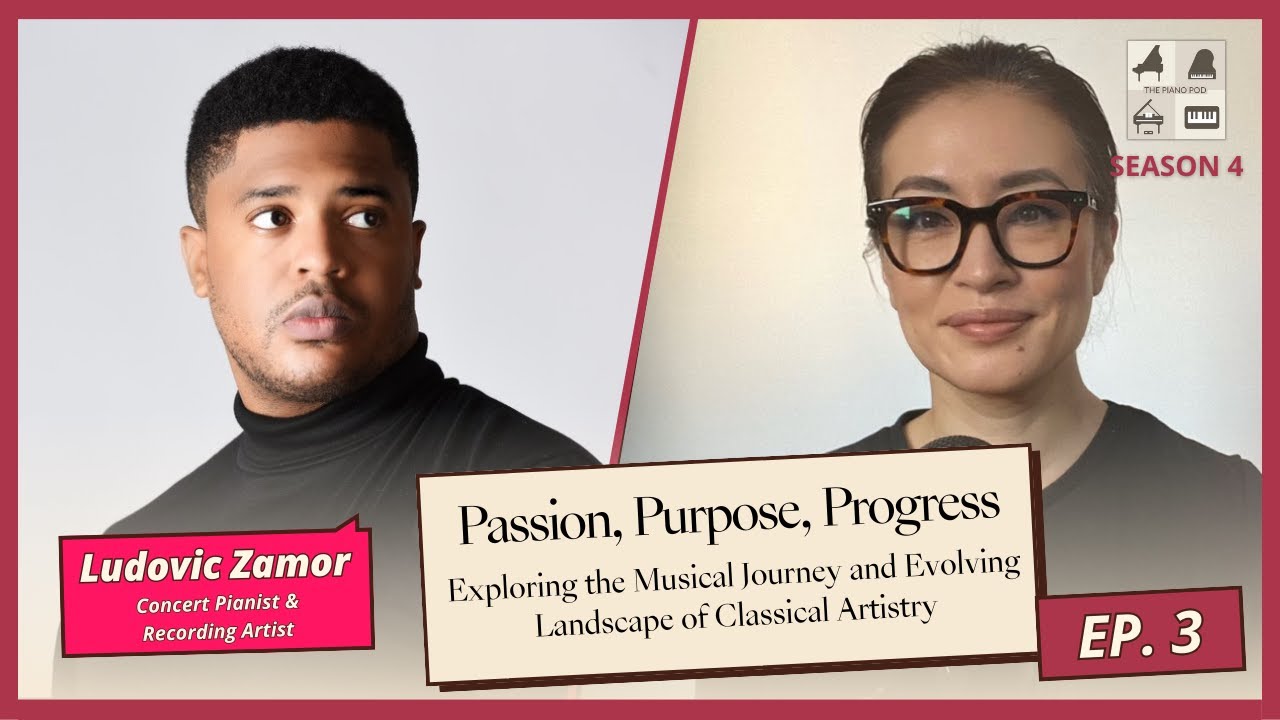
This content was created by The Piano Pod with Yukimi Song. This content was uploaded by The Piano Pod with Yukimi Song. This is a YouTube podcast episode titled "Season 4 Episode 3: Ludovic Zamor -- Concert Pianist/Recording Artist" from The Piano Pod with Yukimi Song (published 2023-10-04). It is an English interview-style episode in which host Yukimi Song (The Piano Pod with Yukimi Song) interviews concert pianist/recording artist Ludovic Zamor. The conversation covers Zamor's debut album Amour (repertoire choices and interpretation), his recording process and challenges (including a spider bite during recording), early training and mentors (father, Karen Amato, Abraham Sternklar), concerts and touring/post-pandemic return to performance, physical fitness for pianists, outreach and scholarship/charity plans, strategies for engaging 21st-century audiences, and reflections on meritocracy and identity in music. Metadata: YouTube content, Season 4 Episode 3, created 2023-10-04.
Chapters
Welcome back to another episode of The Piano Pod, where tradition meets innovation. We bridge the timeless beauty of the piano with the dynamic pulse of today's world. I am your friend and host of the show, Yukimi Song. So what did you think about the opening episodes of the season? Episode 1 brought us the incredible Dr. Michael Kaikoff, a concert pianist who's not just a Scrabbing expert but also a recording artist known for his interpretation of Liszt pieces. And then in Episode 2, I had a pleasure of chatting with the brilliant minds behind A Seat at the Piano, aka ASAP: Annie Zhang, Brendan Jacklin, Evan Hines, and Susan Yang. ASAP is a platform to raise the voices of composers who have been less heard or historically excluded or underrepresented. I'm curious about your take on our recent conversations with Michael and the team of A Seat at the Piano with Yukimi Song, and would love to hear from you. Connect with us on social media or leave your thoughts on our website at thepianopod.com. Remember, your insights play a crucial role in guiding the future of our show. For this episode, I am thrilled to introduce Mr. Ludovic Zamour, a Canadian-American concert pianist and recording artist known for his unique talent and unrivaled performances. Let me quickly highlight his career by citing his bio. Mr. Zamour's musical journey began under the guidance of his father, diving deep into the intricacies of the piano at a young age. His teenage years marked significant achievements as an emerging pianist, including his solo debut at the prestigious prestigious Weill Recital Hall in Carnegie Hall at 18. Earlier this year, he released his debut Romantic-era classical piano solo album titled "Amour." This achievement propelled him to the forefront of the 2023 classical music scene. His journey is a testament to his unwavering dedication to music. He believes in the power of devotion, emphasizing that true magic happens when one is fully absorbed in their passion. Before continuing with this episode, I'd like to welcome you who is listening or watching The Piano Pod with Yukimi Song with Yukimi Song for the first time. I'm a classical pianist and educator from New York City. Whether you're diving deep into a piano career, working professionally in the classical music scene, or simply have a passion for piano tunes, this podcast is your backstage pass. In each episode, I interview a guest speaker who has been breaking exciting new ground in the classical music industry. Before getting started, I want to thank amazing TPP fans and listeners for tuning in. Please rate and review the show on your favorite podcasting platform because every rating and review will help people find the show. Oh, before I forget, I want to apologize to you, my friends. During the interview session with Ludovic, I forgot to turn on my microphone— this mic that I usually use and turn on during the taping of the show. If you're watching this episode on YouTube, you will see it in front of my face, but It was not on, so the sound quality of my voice is not that great. So what happens is that when this external microphone is not turned on, the recording platform that I use automatically selects the built-in microphone on my computer as an input device, which captures the sound and noise in the room not focused on my voice. So my vocal quality during the interview is not so great and muffled. So, oh well, after 3 years of podcasting, I still forget to turn on my microphone or something had happened. I am not really sure. So I apologize to you everyone. And, but I promise to you that content of this show is amazing. Thanks to my wonderful guest Ludovic. We discussed his exciting journey as a concert pianist and recording artist, focusing on his passion for music in the Romantic era and delving into timely topics such as life as an artist in the post-pandemic era and more. So these discussions will lead us to a more introspective conversation on a topic such as the importance of exploring our sense of purpose as classical musicians in society. We even talked about artificial intelligence how the tech of AI is changing our lifestyle. So let's begin this fun episode with a guest, concert pianist, recording artist, Mr. Ludovic Zamor. Please enjoy the show. You are listening to The Piano Pod with Yukimi Song about how they are bringing the piano into the 21st century.
So welcome to The Piano Pod with Lubavik.
Thank you. Thanks for having me.
Thank you so much, and it's really nice to finally meet you. We've been communicating for a few months on social media, and finally the day has arrived. By the way, um, what a lovely name, Lubavik.
Yeah, high school attendance was awful when I was growing up with it, but now it actually, as an artist, it has a little bit of flair to it.
Of course, and I understand that your father is a pianist?
Uh, yes. He's not professional, he's actually a doctor, but he grew up playing the piano, and then as he had children, he tried to force it onto us.
Did your parents intentionally name you after Ludwig van Beethoven?
Uh, Ludwig, as in Ludwig? Maybe, I'm not sure. I'm actually a junior myself. I don't know where it came from, but I guess it fits. And you're kind of destined with the name.
Yeah, of course. Yes. And no pressure. What's it called?
Like, non-determination or something like that?
Yes.
Or like a strong will or something like that. Yeah. I have been listening to your solo album Amor, which truly showcases and captures the essence of romantic era and displays your passion for the music of the time period. This album was released earlier this year, right?
Yes, it was. It was released earlier in July. It was a long time coming. I wanted to release it in 2020, but my original plan was to tour with it on concert, and then after the tour and concerts, then release the album.
So what was the main inspiration behind this album?
I wanted to create an album that felt like a journey to listen to, like you can listen to it and connect emotionally and feel as if you're on a trip. Just enjoying it. And to have both the balance of the virtuosic side and then also the conservative side, like the same way how, you know, the war of the Romantics being Brahms and Liszt and everything like that, but just to have a good dichotomy between both.
And why the title Amor? I mean, maybe it's not completely a rhyme with your last name, but, you know, without the Z It's Amor, is that what it is? Or—
Well, Amor is a direct translation for love, and I guess it fits because you can't write some more without love. But, um, part of it was I, I thought, as literal as it is, to have a romantic album with love within it, and I thought it was a little bit poetic.
Yeah, it is indeed. And so let's talk about the choice of your repertoire. You started with October from Tchaikovsky's Seasons, and it's such an iconic piece in such a way that really captures the essence of Romanticism, right? And then followed by Vocalise, and I love the piano transcription by—
Zoltán Köcsis, yes. Yeah, I opened with the Tchaikovsky because this set is exactly what I would play in concert for at least this season. And in the past, I've always opened with like, you know, big showy pieces like, you know, the Fantasy Stück or anything like that. I found it as a bad habit to start off, you know, really hot, so I wanted to start off really slow and, you know, warm into it. And it was a good somber beginning to it. The Seasons, out of all of those pieces, I felt like the October, the autumn song, was very emotional, especially emotional, and opening with it set a really great mood for the concert I was trying to set. And as for the vocalise, It was— at least the vocalise itself is one of my favorite tunes, and the Zoltán Köcső's transcription with the more arpeggios at the end, it just was a joy to play. And especially for a person who loves, like, you know, the Lisztian type of the world and everything like that, I just gravitated to that naturally.
Yeah, that arrangement is very special. I think there are a lot of variations in terms of the transcriptions. There's a variation with a string instrument and the piano and so forth. But this arrangement, especially as you mentioned, toward the end of the section where arpeggiated, it just creates a lot of emotional stuff. And you know, you've also— my favorite, one of my favorites from that album is Nocturne in C Minor. I played it myself too, and your interpretation is very sensitive, yet passionate in capturing the nuances of Chopin. And, but I really appreciate that, the fact that you don't start so fast. A lot of people do.
Yeah, well, there's actually a story behind that too, and we'll eventually get into that. But I felt as if the way I wanted to interpretate that piece, it was I looked at it through the lens of almost like a Liszt etude, kind of, where they were presenting a theme and I wanted that theme to be so apparent and so digestible, and then towards the end to not just throw it in your face, but just to show the capabilities of the piano the same way Liszt would.
And, you know, honestly, the tempo you took, you know, from the right— on the right hand, from the first note G to the next note A-flat, that gap to feel because, you know, piano, once you play that note, it's gone, right? But to be able to connect the G to A-flat with that tempo is— wow, I was very impressed.
Thank you. Thanks a lot.
Is it "andante sostenuto" at the beginning? At the tempo marking? I don't remember.
At least from my edition, it had no tempo marking whatsoever. So it was kind of like it's open to interpretation. I also got a bunch of flak from some adjudicators because they were like, you're playing like a Hungarian But especially when you're on the stage, you have a little bit more liberties and stuff like that. And it's not that I don't care about critics, but I want to make a performance at least. And when I think about that, I have a little bit more liberties, I think.
There's something so simple yet gentle about your playing and in thought and emotional, emotion provoking too. So I really enjoy it. I mean, you played Brahms, and then lastly, oh, Moomoo musical number 3 and number 4?
Yeah, the direct translation to English is Musical Moment, the number 3s and number 4 by Rachmaninoff. Those were my favorite, and it's actually in the future I want to play all 6 of them in concert, but that's in the future after I learn them. Amongst the 6, I felt like the 3 and the 4, they were exactly the fitting within the the concert type where you have the dichotomy between the emotional side, the almost slow and reserved, and then you have the more bombastic virtuosic side. And to play them in a set between 3 and 4 directly after each other, that's exactly what I wanted to do.
Tell us your— the challenges and triumphs from the day you conceived the idea of this project to the day of release, like you know, for example, choices of repertoire to marketing. So tell us the moment of you felt like, whoa, I did something to, you know, there are moments where we always have struggle with certain things.
So when I originally wanted to play all these pieces in concert, I had Paganini etudes, I had Chopin ballades in there and everything like that. And as I was studying for all of this, it was during the pandemic. So I had all the time in the world. And it was almost as if, you know, you bite more than you can chew, kind of. So I had to be a little bit more reasonable and everything like that. I had to cut some pieces out, and then I eventually settled on what I still have now. And even then, some people say, like, as I'm like, if I would go to a piano store just to, you know, tickle the keys or so, people are like, "You play all of that in concert?" But it is a daunting repertoire to play. But it is fun at the end of it. But as for the biggest challenges of it was actually recording day when I recorded the album. And the day before I actually got bit by a spider. And yeah, it was very disappointing because I did not become Spider-Man. But yeah, I got bit by this venomous spider and my throat closed up to a point where I felt like I was breathing through a straw. And when it came time to record in the studio, you know, I did not want to defer even longer, so I just went through with it. And it felt like my ears were underwater. I was running a fever the whole entire day. And even till today, I still have a little bit of like a frog in my throat.
Oh my goodness.
Yeah, it was, uh, it was, it was very challenging to record the whole entire thing. And if you actually listen closely to some of the pieces, you can actually hear me wheezing in the background. But it was, uh, I didn't feel as if I was 100% when recording everything, but I tried my best.
Well, but I think maybe that's one of the reasons. I mean, I don't want to give credit to this evil spider.
Oh, I hope there are no spider enthusiasts, but I murdered that spider and their whole entire family afterwards.
But what did it happen when you're at home practicing or something? Or—
oh, I— it might be a personality quirk, but I believe like a clean room is a clean mind kind of thing. So especially before a big performance or a big recording day or something like that, I would just go find something to clean. And I happened to go into my garage, and that was my mission for the day, to clean the garage. And there happened to be a spider in the way for me.
Oh, wow. Okay. Wow. But, you know, it's, it's, I think in the long run, when you become a certain age and look back, this will, the spider, the whole situation will be sort of, you're part of the legacy of Rio as a recording artist, right?
Yeah. It's a, it's a good story to have under your belt at least.
Yes, sure. But I'm glad you made it through the recording. So can you walk us through your recording process?
My recording process, it's mostly— I want to say before every piece I play, I just try to remember in my head or just repeat the mantra of just trying to remain intentional and what is the purpose I'm trying to convey. And that's what I keep running through my mind. Whether it's a piece where I'm trying to personify love or deep emotion, or if it's not so much in this repertoire but some other pieces. For example, if I was playing an etude or something like that, what technique am I trying to show? But it's all about remaining intentional.
So then I'm also curious about brand as— well, let's talk about this album, for example. So to select certain pieces, you think about your listeners as well, right? Not just you— that, of course, you want to play certain pieces, but I'm sure you think about your audience too. So what did you have in your mind in terms of your listeners?
I would say I wanted to not just have easy listening, but Um, what's a good way of saying this? I remember in 2018 I had a good season where I was very, very productive. I'd wake up at 4 o'clock every morning, meditate, and then go to the beach. As we're in Long Island, you know, beach is always 20 minutes away. And as I would go to the beach, I would always put on either a Kati Ben Atishvili album or a Rubensong side album. And when I would listen to those, I would just walk and I guess get in the zone. And I wanted to recreate the same type of feeling of, I guess, just pure emotion. And for them— for the listener, rather— to zone out and just completely appreciate the music, not to throw anything so much in their face as if it was like, you know, the Hungarian Rhapsody No. 6 or something like that, but just to have them just flow with it. And that's what I wanted to choose when I chose my pieces. So nothing is too in-your-face, nothing is too bombastic, but it still showcases virtuosity.
So you mentioned two artists now. So are these artists— are they heavily influenced the sound or direction of this album?
Most definitely. It was interesting because I grew up listening to I guess like part of the reason why I have, I guess, somewhat of a good ear is because my father, he would always— every piece I would listen to, I would either have a Horowitz recording or a Rubinstein recording to listen to as comparison, or this is where the ceiling is, or this is where you're trying to strive for it. And as I would listen to these pieces, and especially the tone quality, especially from Arthur Rubinstein, it felt as if the piano was completely different instrument. And when I was searching for studios to record my album, I wanted a piano that would have a more reminiscent tone. So that was what I was looking for. And as for Kate Bush, officially, one album that I listened to many, many times was her Motherland album. Are you familiar with that one? It's fantastic. But as I would listen to to. It recreated that same feeling that I always wanted, like a journey.
A journey, beautiful. Well, speaking of journey, so let's turn the clock backwards. So, so, you know, you've come through this, you know, phase of your life right now, but I'm sure there is a story of beginning. And as I mentioned briefly in the you know, as I was reading your bio, your father was the first person to introduce you to this world of classical music. Sounds like— is it true?
Oh yeah.
Yeah.
Okay.
So can you tell us how did you discover the love of music? By the way, by the way, before we start, I love the background. What a beautiful house you live in. And then, and I see the— I can see the Steinway piano. Yeah. Tell us a little bit about the piano. What is this? Is it B or A or what?
Uh, this is a Steinway Model D, and it was—
D? Is it Concert D?
Yeah, it's a Concert Grand. Yeah, I'm very lucky. Um, we didn't always have it, but, uh, actually, um, growing up I started learning on a Baldwin SF-10, and our house back then had no type of air conditioning. No type of humidity control or anything like that. So the piano naturally became really, really heavy. So I think that is probably some of the reason why I actually gained good technique, because you're forced to really work at it. But my dad was my first teacher. He's actually a doctor, he's not a professional musician, but he grew up learning the piano, and when he had children, he wanted to teach teach them. And I was the only one of his kids actually stuck with it. But, and I guess he had a good trial because I was the last kid, so he learned his mistakes until me. But we learned, and it was until I was 7 or 8 when he realized like, oh God, we have to get him a better teacher because there's almost as much as he can teach me. So I hopped around from teachers to teachers for a couple of years until I found Karen Amato. She's actually based in Long Island and she stuck with me for, I want to say, 20 years.
Wow. Wonderful. That's, that's beautiful. So you're right now currently based in Long Island, right?
Yes, I am.
Okay. So you had a wonderful teacher for 20 years, but who are the other influences and training mentors, maybe?
I still see Karen every now and then. It was only like, I think, right after college she was telling me like, you know, we have to get you another teacher because we're neck and neck and there's only so much we can teach you. So, you know, she's trying to push me off to other people, whether it was pro music judges or something like that. But I eventually found myself with the late Abraham Sternklar. He was a renowned concert pianist and chamber musician, and he actually was a professor at Juilliard at one point. And I actually met him when I was, I think, 7 years old, and I performed in— I forgot which one, but it was a random competition. And then it was just, I guess, kismet that we eventually met each other later in life, and he took me as his pupil. And learning from him was a dream because as I later became more professional, I focused more on intention. And as I was with this old master, it was like every word that he spoke, every lesson that he taught was gold. So I tried to cling to every single, you know, lesson that he taught, and it was just It was amazing to be around him. And if you want to hear a funny story, uh, at one point I was going to one of our lessons, and these lessons would go on for 2 hours and such. And from day one, he always said, never be late. And as you know, New York City potholes are atrocious. And at one point I hit one of the potholes, and not only did I burst a tire but I bent a rim. That's how bad the fuck hole was. And I drove an extra 15 miles on a bent rim just to get to my lesson on time. And as I got there, I was like, listen, listen, I am the number one because I got here even though I had a bent tire and everything. And he was like, oh, you got here on a bent wheel, you know, world's smallest violin, Boohoo, when I was younger I was dodging bullets in Israel and Palestine because that's where he was from. And it was just, uh, it was funny because he was telling me, um, when he was in his conservatory he had to cross a street that was, I guess, in dispute between Palestine and Israel. And every time a student or a child would walk by, they wouldn't aim at them, but they would just aim in the vicinity just to scare the people. And essentially, every time he had to go to school, he had to dodge bullets. But it was just— that's the type of professionalism that I grew up with.
Talking about tough. Wow, that's, that's tough. Yeah, right. Well, thank you for sharing that. So then you mentioned that you, you'd like to talk about Abraham Sternkler Scholarship Program and a Will Burton Scholarship Program. So were you the recipient of these scholarship programs?
No, actually, as I have my concert career and I guess we're hearing it first from here, every time I perform and I want to donate an alloc— or allocate an amount of the proceeds or the profits towards these funds that I'm making. And they're going to go to— whether they are undergraduate students or high school students, I want to donate it as charity. And that's the story behind Abraham Sternklotz. He was one of my, uh, I want to say, professional inspirations. And as for William Burden, he was my first ever manager. And they actually both passed away from COVID in 2021. But—
Oh my goodness, wow, I'm sorry to hear that.
It was a rough— because they passed, uh, one month away from each other, and I lost both of them at the same time, essentially.
Oh my goodness.
Yeah, William Bergen, he was a very, very kind man, and it was, uh, I want to say he was my first ever, I guess, contact on the business side of show business. And he was, I would say, the, the kindest awakening to it. And he was just a very sweet man that was essentially asked for nothing, and he was more than fair. And I found that when we would do projects, sometimes he would just do them for gratis. He would not want anything out of it. And not only did that, He did that with me, but he would also do that with other young professionals or other people fresh outta college. And he gave people chances, he opened doors for people, and I wanna do the same thing for other young professionals as I succeed. Wow.
There are so many wonderful people like that in our industry, right? And really sacrifice their time and their life to dedicate to mentor and educate someone with the potential, someone with dedication. That's amazing. So you mentioned that your performance, the concert proceeds partially goes to these two foundations, to two programs to help other young musicians, correct?
I am going to start going to high schools after I start performing again. I'm going to try to find a a couple kids who are, I guess, hungry for it. And whether it's a small amount, whether it's a large amount, just to get the ball rolling to make them feel as if they're supported the same way I have.
That's beautiful. Okay, then I also want to talk about your concert career. So I know you have one— you had just one big memorable concert at the historical theater, The States. May 21st in Westbury, New York, which is your home. Yeah, tell us about the concert.
So we had the choice of having, I guess, a premiere concert for my set, and I chose to do it in my hometown. There are two major theaters. There is the NYCB. I don't know if you're familiar, but it has like a circular stage and it's just a large amphitheater. And then they also had The Space, which is, I guess, more of a more traditional setting where it's just, uh, it's open that way. And I chose that one because it was a lot more aesthetically pleasing. And this was in, as you said, May, right after 2022, and this was right after the pandemic, so A lot of people were actually worried about coming out, especially right after the pandemic, so it was not anywhere near filled to capacity. And it was actually really sad because, uh, earlier in my career I made a good habit because I heard some advice to get email listings to everyone that goes. So that is part of the reason why I would ever have, um, good attends for concerts. So when I threw this concert, I had hundreds of emails saying, "Sorry, I'm not coming because we're elderly and we don't want to risk it." But I'm still very thankful for all of the people that still came despite the risk.
What did you play? Did you play some of the pieces from your album?
I played the whole album, and then on top of that, I played a Scriabin etude at the end of it.
Wow. Which Scriabin etude did you play?
I believe the number 12. Um, uh, it always escapes me. It was not the— it's not the Opus 42. I think it was the— of the— of the 12 Etudes, the— the 12th one.
Okay, wonderful. That's a great piece. You mentioned, uh, you know, while we were communicating, and you said you want to talk about journey back to feeling ready to perform. So are you referring to your mindset toward performing in front of the audience after Uh, yes.
One thing that I found so interesting, and I never thought about that before, uh, in my whole entire life I stayed in reasonably good shape. And during the pandemic, I actually gained 70 pounds because I couldn't go outside. All I did was weightlift, no cardio. And one thing that they never tell you in a conservatory or in college is you need to be physically shaped to play, to be in shape to playlist because your heart literally becomes a factor into it. Yeah, when you take so much time off physically, it really becomes taxing, especially when you're trying to play some of these pieces. So now I'm on the journey back to getting ready for it.
I see, I see. Well, but you know, I didn't think that way about playing, like, let's say Brahms' List, you know? I know playing Franz Liszt pieces, like especially Transcendental Étude, for example, or, you know, Hungarian Rhapsody or whatever. And they are really physical, right?
Exactly.
The whole entire upper body involves. And so you have to be fit in many ways, but I didn't think of that will translate to your cardio endurance.
Exactly. I never thought about it either, especially like some of my earlier teachers As I mentioned Karen Amato before, she was telling me that when she was in college, she stayed away from lists. She's like, you know, the amount of effort, just stay away from that. And I never thought anything of it when I was playing Pagani 18s myself because it was just, it was just work. But when you're trying to do that when you're a little bit more hefty and it becomes a lot more taxing, especially in concert, you don't want to look like you're sweating. One thing is when you're performing, you're supposed to look as if this is effortless. This is supposed to be second nature. And to be big and sweating, it's not a charming look. But yeah.
Yeah. I mean, that's part of our job, I guess. It's a job description. Yes. Wow. So we talked about Liszt. So let's talk about your love for composers or compositions. In the Romantic era. So tell me.
My favorite— it's like choosing a favorite child. I don't have any children, but it's almost as if trying to choose—
Yeah, but you know, your love for romantic composers or compositions, what do you love so much about these, you know, era, genre?
Romantic era, it feels as if this is the upper limits of tonal harmony and at the same time virtuosity. I don't want to say that like Mozart was boring or anything like that, or Bach was boring, not at all. But if anything, Bach is becoming even more— as I'm getting older, as I'm getting more maturity, I'm looking at those pieces and realizing the complexity and the inner depth behind them. But the Romantic era in itself I felt as if this was the upper limit. This is as far as the ceiling goes. And to play those pieces are more entertaining than the rest.
How are you engaging with the 21st century audience? So what are you doing differently or creatively to reach out to your fan base?
That is very interesting because I want to say in the past, 3 or 4 years, I don't know if I want to say that I'm having a paradigm shift or a change on thought process, but as I was younger, my initial look was romantic era classical music. This is so spectacular. That still holds true to now. This is such an in-depth genre, and when you're listening to the radio all of it is kind of boring after a certain point, right? You know, like, um, when I was 18, I remember that some of my teachers and I, we would sit down for 20, 30 minutes just trying to break down a Chopin ballad and just trying to understand the structure behind it and say, what is that chord? What is that chord? And compared to listening to pop music right now, you could just— you could break it down in 2 20 seconds. So it felt as if— so music was so much more entertaining back then. And my mission years ago was to almost not convert, but to show people like, look over here, this music is so much more rich than what you're listening to now. And that was my mission for some time. And then now it's almost as if It's not that I'm giving up on trying to show people, but it's almost as if people are just not interested in it. So why should I almost try to convert people that are not willing? So that's where I'm almost at. Just go after your fan base, stop trying to convert new people because, you know, they're just gonna listen to what they want to listen to.
Sure, sure, sure, sure. But if there is an introductory to classical music in a certain way that people may tune in, right? Not everybody, but certain people. There's a potential, right?
Of course.
Yeah.
So I'm not closing the door completely on it. If someone asks me to play, I'm going to play for them, even if not everyone in the audience is a classical music fan. But actively going out and trying to bring in people, that's— I don't know how I feel about that anymore. It's Maybe I'm jaded, but—
No, no, but yeah, you have a point. Yeah, it's true. Yeah, you don't have to do that, but there are, you know, a lot of people who would be interested but never had opportunity or being exposed to, right? Yeah, those are the people that we need to reach out to. Then related to that topic, what is your thought on keeping classical music relevant and thriving in this fast-paced society?
Hmm, that's a very good question. If you want to hear a very short story, only I think like a month and a half ago was the first time like one of my random friends from out of town, they were coming to New York and they invited me to go to the Brooklyn Mirage. Are you familiar with the Brooklyn Mirage? Yeah, it's a— and it should actually be like a YouTube video or something, concert pianist goes to the Brooklyn Mirage. But as I went there, I was just so overwhelmed because they had lasers, they had fire, they had all this type of stuff. And it was— at the end of the night, I was reflecting and I was trying to say to myself, wow, you know, this is what we have to compete with as classical musicians because we're taking so much stimulus, and then now what I'm doing is almost as if it's back to the basics, it's back to the roots. And how do I, I guess, show people this rich genre? And that's, I guess, something I've been trying to ponder with for a long time. You go to Carnegie Hall, there's no light show, or at least maybe in Zankel Hall, but in Wilder Sidle Hall or the Sterne Auditorium, there's no light show, there's no fire, there's nothing like that. So it becomes a moral question of what can we do? It's something I've been working with for a long time. And the answer that I'm coming to is just to try and give a very, very pure performance. And hopefully, like you said earlier, maybe they will just be exposed to it and somehow fall in love with it the same way we do.
Yeah. But who knows, maybe there comes an opportunity where you have the concert, you know, piano concert with a laser beam, you know. Maybe. Yeah. Yeah. You know, I got to interview Michael Kekoff as our first episode of this season. And then we talked about Scrabbing and Scrabbing actually tried to do it, right, with his orchestral work. For the— I think it's almost '60-something. So it's pretty late work. And then, but, you know, with the technology, it wasn't possible at that time. But 100 years later, Yale University made it happen. And then there's like a really— yeah, it is even like almost his like called Paris score of this orchestral work. He puts the specific color. That he wanted to produce, you know? Yeah, so who knows, maybe that's something that we can think about, right? Then you mentioned that why the belief in the meritocracy is liberating and inspiring. You want to talk about that. Will you elaborate on this? What do you mean by that meritocracy?
My dad, he grew up in, he grew up in the Caribbean. It's a very, uh, it's almost like a caste system over there. And when he came over to Canada to practice medicine, he also suffered, you know, I would say, like, especially back then, astronomical levels of racism. And one thing that he learned and he instilled to his children, instilled to me, was after a certain point, when you become really, really great at your craft whether it is medicine, whether it's law, whether it is history or music or performance, after a certain level they don't see a Black doctor, they don't see a Black lawyer, a Black historian, they don't see a Black musician, they just see musician. So that is what you're supposed to strive towards, where the qualities that you're born with that you have no control over, these things all become irrelevant. After your greatness, hence merit. So that's kind of what I try to envision myself, where these qualities, as if, you know, being a person of Black descent or such, I don't want that in the narrative. I just want a great musician, a part of the narrative alongside, you know, if you can inspire someone that comes from similar background, that's great. But my main focus is just to be great, not necessarily fill in the blank and then such.
So not because of your background, let's say, right? So that's not something that you want to express. So to be equal means you arrived here because you worked hard. Exactly. Right. I totally understand the concept. In that sense, it makes sense. But so while I was listening to your story from the beginning today, it really does make sense. So this meritocracy system works, right? So whoever has this ambitious and also, you know, work really hard. Let's say American dream come true, no, in many ways. But then, you know, the word meritocracy triggered me a little bit because I remember reading books about it before COVID and there's one book is called The Tyranny of Merit. The other one, I don't remember the title of the book, but they were written by One is written by Harvard professor, the other one is written by Yale law professor. And then there's also, there are plenty of YouTube clips about these books, and then they are on the, you know, TV shows or whatever to promote their books and try to make a point. And then one is Michael Sandel, he is the Harvard philosopher. He'll also be a professor and he argues about this concept of meritocracy. So I think in a nutshell, your father's generation, I assume he is in the middle age right now.
Oh, my dad is in his 80s. He was born in 1941.
Oh my goodness. Wow.
Oh yeah. So he's from a way different generation than I am. I am.
Okay, but even more so then, it does make sense, right? Because they want to break that barrier of color, and it comes— that comes with probably the financial background to economic disparity too. I'm not speaking about your father because I don't know, but I assume about this group of— let's say you're from— your generation is coming from Caribbean. And so then now those people, I'm not talking about your dad, but, you know, who grew up in that era of believing in meritocracy, that system, if you work hard, doesn't matter the color of your skin or background, your economical disparity, you get a chance. And then that's how they grew up. Then your generation,, then your generation will raise the next generation. Then they argue that there's a flaw in this meritocracy system because in the end, what happened during, let's say, COVID, obviously we saw that huge stark difference between the richest and the poor. That was really the one of the things that we noticed. And then guess Who was working really hard for us? The, right, workers, right? Essential, yeah, essential workers and delivery people. And so this idea of meritocracy gave us a false sense of, like, for example, for those who succeeded, it gives the sense of false sense of success, right? Because The success actually came from your father's generation. They're the one who thrive, struggle to achieve this, and then we are benefiting from their struggle in many ways. And thus the financial also success to many, many of our generation. And it didn't happen overnight. It didn't happen just because I worked work really hard, or, you know, my generation, but someone works really hard, but actually it's a generational thing. And then for those folks who don't seem to success, doesn't seem to be successful, then we label them as failure. No way, right?
I would agree with you. Yeah, not at all. Uh, there is, you know, generational wealth or such for some people, and sometimes when they say meritocracy see them that way. It seems as if they're the people that worked hard. My vision on it is more along the lines of the idea of a meritocracy is almost liberating because I believe in the idea of like almost like extreme ownership. The more I do, the more that you have control over, the more that you have responsibility over, the less of being able to say some things are out of your hands. Is powerful in itself. So if you say that everything that is bad that's happening over me, or everything that's good that's happening over me, and the more that you're able to say that you have control over, that itself is giving you more power. So if in my case, accepting— being accepted to certain conservatories or programs or winning competitions, not necessarily that I care about competitions, competitions anymore. I've actually had my own philosophy on competitions, but being able to step on a stage and delivering a good performance, getting up to that point, it was not because I come from a certain background. It's because I worked my butt off to get to that stage.
I understand that. I understand the point of view. Yeah, yeah, yeah.
So tell me, you just briefly touched on your thoughts on I'm gonna quote Béla Bartók: "Competitions are for horses, not for artists." So, and when I was younger, those competitions, not only did they burn me out, but it was almost as if, how do you say that one piece of art is objectively better than another? After a certain degree, you know, you could say such, but sometimes it's very, very difficult to say one thing is objectively better than the other. And it's the way I feel about it now. The idea of competing, it's almost distasteful now.
You know, it's interesting. The way you perceive the word meritocracy is different from mine because you said, you know, you just quoted, you know, Bartók and you agree with his you know, vision of music, right? I totally agree. Although I'm guilty, I put my students into competitions because, you know, classical music is also becoming, oh, I achieved this medal, I achieved this certificate, and thus I get to go to this school, right? So that's how— yeah, tell me.
Um, I would say In some cases, competition might be good for someone, and especially in their development, because you're exposing them to other people who are passionate. You're exposing them to where the ceiling is for their age groups, and you're exposing them to different people's repertoire. You know, sometimes in a competition you might hear a piece that you never heard before. I'm like, oh my God, that transcription exists. Oh my God, you know, there are Liszt transcriptions of Schubert. 'Oh, I never knew that.' And sometimes some kid on the other side of the planet is playing that in a competition that might open, broaden their horizons. In that sense, a competition is great. It gives a student something to strive towards. Sometimes for some people, unless they don't have the inner drive themselves, they're never going to work. So unless you put a finish line or a goal in front of them, you know, some students might not strive But at the end of it, I want to say that, you know, competition mindset, especially for a professional artist, it might not be appropriate. Maybe they should be focusing on their own lane, focusing on their own craft and not focus on other people. But for a student, maybe that might be different for her.
So competition is not everything, right?
Definitely not everything.
How do you find the sense of purpose or mission as a classical musician in this world?
Being a classical musician or a performer, it is a dream come true. It is— it's one of those very, very gratifying jobs because you get to affect people on a large scale every time you perform. And it's one of those jobs that doesn't feel like you're you're pouring glass into another and pouring it right back, and it's not as if you're going nowhere. So our missions, at least for myself, it is to affect people, whether it is emotionally, whether it's spiritually, whether they have a spiritual experience after it, as if, um, the same way how Bach or Liszt did. Those are goals. But is every performer supposed to feel that way? I'm not sure. It's tough, but it's very interesting because is every performer supposed to be on a stage? Maybe after sometimes performers retire, they're supposed to go into editorials or go into teaching, or at least that's where I'm looking at it.
So did I— maybe this is repeating, but what is your thought on our duty or gift as classical musicians to society at large.
It takes years of study to develop the gift. It takes how many different generations of people, um, just like how I mentioned before, Abraham Stenclawr, it felt as if he packed 90 years of knowledge into me. And when you have that responsibility on your shoulders, it's almost as if it's a duty to share that with everybody else. And when you step on a stage, it's that opportune— whether you're streaming it on top of that, but you have 1,000 people in the audience and you have a perfect opportunity to share what composers wrote and their feelings. And it's almost as if you have a duty to do right by them. I don't even know how to put it. It's, um, I don't want to say like the most most important job in the world, of course not, but it's definitely as if you're almost doing like missionary work in a way, kind of.
With all the difficult questions, the last question in the philosophical segment of this podcast would be: any advice for young musicians?
I've made my fair, or more than fair, series of mistakes and I've learned from them. I guess like, uh, as a musician, you have a fear in your head. You don't want to become a diva, you know, and you're afraid of expressing your desires or your wants. And one thing that I always like kept in my head is like, don't become a diva, don't, don't become a person that asks a lot, and exercise patience. But one thing I've learned, especially in the music industry and how dirty it could be, is if you let people, they will waste your time. If you just sit on your hands and you don't, you know, say how things should be, they will just, you know, walk all over you. So my advice to young people, especially if you're a musician or a performer, you understand how much practice, how much education it takes to get to where you're going. And the idea of having another person, I guess, gatekeep before your dreams and such. Don't let people stand in your way and don't stop yourself from pushing of what you deserve and what you really want.
So wonderful. Yes. Take initiative of your— take control of your career, right? Yes. What is next? So, uh, Ludwig Zamor 2.0, or maybe at this point 10.0, I don't know, but what's your next what's your next phase in your career?
Actually, I'm working on my, I guess, if you want to say, the volume 2 of the Amore, where I'm actually learning a completely separate set of Romantic era pieces. And I guess the end-all goal is to play all of these pieces in concert, hopefully 16 pieces all together in one concert, separated by an intermission, usually between before I played 4 pieces and commission 4 pieces. But what I'm going to try and do now, if it's daunting, you know, whatever, but to play 8 and commission another 8. But that's my end goal for now.
Wow, beautiful. Now, um, if that's the case, are you going to perform at Carnegie?
That is the goal. I'm gonna try before I play all 16. I'm gonna try to play this, this album in Carnegie Hall before If that happens, please, please let me know because I would love to attend. Of course, I'll send tickets.
Yay! I'll definitely be there. Yes, with lots of bouquet of flowers. Yes, I'll be there.
Hey there, TPP family! The Piano Pod is now into our 4th season, and it's all thanks to you. Since 2020, you've been with my journey with the TPP, exploring addressing this burning question: How do we make classical music resonate with today's audience in fresh and captivating ways? 4 years in, and the journey has been nothing short of magical. The Piano Pod with Yukimi Song with Yukimi Song with Yukimi Song isn't just a podcast; it's a movement, a space where pianists, composers, and educators brainstorm, debate, and reimagine classical music's place in our fast-paced world. We're together on a to ensure classical music doesn't just survive but thrives in our modern age. But here's the thing: to keep bringing you these insightful biweekly episodes, I need your help. Every bit of support goes into the podcast's essentials, from hosting to high-quality recording tech, and the countless hours behind the scenes. So, do you want to be part of this journey? Click the PayPal link in the show notes or head to thepianopod.com to donate. And as a token of appreciation, I will personally mail you The Piano Pod's snazzy logo sticker. So hit the subscribe button, spread the word, and let's continue our mission and journey as classical musicians. Now let's continue with the show.
Is there anything else before we go to—
I actually had a question. One thing that I found very, very interesting was your use of AI. And it's almost as if, how did you come to that? And what are the benefits?
Ah, that's a good question. Yes. I'm actually quite, I don't want to brag, but I'm interested in technology. So let's put it that way. And it's not like I know computer code or anything like that, but I like gadgets, so I think I grew up with these cameras, not camera at me, but, you know, video recording as I growing up, and I think my interest led me one to another, and somebody introduced me to this AI. It was one of those Zoom meetings, and I know that somebody else was in the Zoom room, but it's not a person, so I asked this person who was hosting this meeting, I asked him, what is, what in the world is this thing doing? You know, who is that? And he said, oh, that's an AI taking notes for us.
Oh, it's amazing.
Yes, it is.
Do you find personally, like, has there ever been anyone giving you flack because you're a classical musician and then you're on the other side, the really progressive technology, or is it just welcome combination?
I think, you know, I don't separate my world that way. So I welcome every— because this is who I am. I love something timeless and classic, like classical music, but also in the industry of classical music is evolving to where a lot of people now, you know, expressing themselves, you know, through classical music, but in a very different way. As you said, you don't want to— some people don't want to identify themselves as a classical musician with their heritage, right? Like, you want to be the classical musicians who love to play romantic piece. That's your identity. But some people identify themselves with their heritage, whether that is Asian or, you know, Caribbean or whatnot. So anyway, but for me, my identity as a musician is this. I have such progressive idea. I welcome all these ideas, and then some of them work really well, some don't, but, you know, but I love— I'm just very, very curious about technology and the AI is going to help my work, especially, you know, daunting tasks like admin work, you know, writing or coming up with, let's say, social media posting ideas. Sometimes I ask ChatGPT, give me 10 different ideas about posting, you know, some interesting, engaging posts about certain things.
What are your thoughts on ChatGPT or any type of AI writing, as if like, um, write me a song as if Beyoncé would write a song? What are your thoughts on—
you know, it's interesting because this morning I tried, um, write me a haiku about podcasting, and then AI wrote me a beautiful haiku but I didn't credit myself. I posted on Instagram story and then I, at the end of the haiku, I said ChatGPT. So, but you know, that's a very legit question. And then I use ChatGPT to really give me some ideas about, let's say, social media posting or what sort of, there's so many things you can do. With your, you know, when you are doing a lot more creative work, it really helps. However, you know, I listened to one of the podcasts about AI and this lawyer got in trouble because basically he used ChatGPT to come up with, you know, whatever. And, you know, it was not his language, right? So yeah, so I We really have to be careful.
Do you see it as a tool or do you see it as like an intuitive, I guess, separate entity where it's almost like, you said like the lawyer just now, it's almost as if they're cheating or they're plagiarizing, or would you look at it more as if it's a tool that's just a calculator or, you know?
Well, okay, so I think in many technologies there is ups and downs. About, you know, how to, how we use them, right? So for example, even like the rise of internet, people are freaking out, oh, am I going to be able to purchase something online? And then what if someone stole my credit card information? But no, I mean, there's always the bad people in the way we can use internet can be also bad. There are a lot of predators out there too. I mean, I don't want to talk about something so much, uh, dark, talking about things here, but at the same time, we are able to connect this way with internet. I'm able to do podcasts because of the power of internet. I think it's the same thing with AI. Honestly, I have no intention right now or never to use it to, I don't know, cheat. No, no way. And then even through this conversation. Let's say if I ask AI, write me a script of my podcast, I can totally do that. But do people know that I am just reading off of a script? Yes, they do. And I don't want to do that. So you also have to fact-check. Fact-checking is something that we all have to do, whether you use AI or not, or internet You know, like almost like, do you believe everything in internet? No. Do you believe everything that's written on Wikipedia? No way, right?
It's very interesting.
Yeah, but it's not about me. So anyway, but did I answer your question?
Yeah, you did. It's very interesting. I'm just, um, one thing that just popped in my head was this, uh, what if they had AI, I guess finish Mozart, you know, just— or Chopin died very young in age, have AI write pieces in Chopin style and such. Or it's just— I'm just imagining the possibilities.
Well, yeah, there are lots of possibilities like that.
In terms of, you know, Hollywood is on strike right now, and I'm just wondering whether they're going to really ban that the use of AI or scriptwriters and the use of writers' rooms and everything like that. Or, uh, I don't know if you're a movie buff, but if you ever watch the movie Dune, one thing that they instilled in that, I guess, uh, dystopian future is certain amounts of technology are not allowed because they're afraid of sentience within artificial intelligence. So I'm just wondering of, especially in art, how far is artificial intelligence going to go?
I know it's, it's a very interesting topic, but also scary too. I totally understand. And, you know, AI takes over everything, then are we disappearing? Are we disappearing from this Earth? But, you know, I don't know.
Uh, is humanity due for extinction? Probably not, because I would say that You can run a computer program to write— to play music, rather, but it will never be the same as a human would because maybe part of the beauty is in the imperfection itself. Maybe part of the beauty is in the wheezing as you're recording the album and you're bit by a spider. Maybe that little bit of humanity is what creates art in itself. Who knows?
Absolutely. Absolutely. And then that's the point, right? Yeah. Yeah. I totally believe in humanity and our ability because of imperfection. I think in the end we win. Yeah. We have to. Right. I'd like to believe that. Now, before going to the next fun segment, let me just remind my listeners that Ludovic's album Amor is available on all music streaming services, correct?
Correct.
Like Apple Music?
Apple Music, well, my distributor, they're still writing the contracts with Apple Music, so it will be released soon.
Okay, so Spotify, Amazon for sure?
Correct. Everything but Apple Music Classical right now.
Got it. And then to learn more about Ludwig's work, please visit Ludwig zamoor.com, and I will list all the information in the description. So this has been really fun. So before I let you go, uh, we have one more thing to do. It's called The Piano Pod Rapid Fire Questions. And yes, and this is part of the show where I get to ask fun questions to each guest. Now here's a little twist. As silly as these questions may sound, your answers may reveal who you truly are. So are you ready?
I'll try my best.
All right, good answer. So please answer them with the shortest responses possible. No explanation is necessary.
Understood.
All right, question number 1: What is your comfort food?
Burgers. Or no, steak. Steak, rather.
How do you like your coffee?
Black.
Cats or dogs?
Cats.
Sunrise or sunset?
Sunrise.
Summer or winter?
Summer.
Are you a good old paper book user or ebook?
Paper book.
What is your word or words to live by?
Try your best.
I don't know. Great. What is the most important quality you look for in other people?
Discipline.
Discipline.
Mm, yes, I can see that. Why? After that conversation. All right, name 3 people, 3 people who inspire you, living or dead.
Sergei Rachmaninoff, uh, Frédéric Chopin, Marcus Aurelius.
And name one piece in your current playlist. Uh, doesn't, doesn't have to be classical.
Okay, Autumn Song by Peter Ilyich Tchaikovsky.
Now, last question. Fill in the blank: Music is blank.
Music is love.
Of course! Amor! That's true! Perfect answer! Ding ding ding! You won! So this concludes this episode of The Piano Pod with Yukimi Song with Yukimi Song. Thank you, Ludwig! For joining my show today and sharing your stories and insights, expertise. You can learn more about him and his amazing work through his website at ludvigzamor.com. You can listen to his album Amor on all major music streaming services except for Apple Music currently, and all the links are listed in the show notes. And thank you to my wonderful audience and fans for tuning in. If you enjoyed today's episode, Please rate and review it on whatever podcasting platform you use. Remember to hit the thumbs up button, to subscribe to my YouTube channel if you are watching this episode on video. Follow TPP on social media to get the latest piano news via Facebook, Twitter, Instagram, and LinkedIn. I will see you for the next episode of The Piano Pod with Yukimi Song with— Bye everyone, and thank you, Ludwig.
Thanks for having me. Thank you.
Bye everyone.
More from The


Spirit, Body, and Soul: Pianist & Composer David Berry on Virtuosity, Creativity, and...



Season 6 Episode 20 | "Spirit, Body, and Soul" feat. David Berry, Concert Pianist & Composer


Beyond Borders: From Argentina to Poland to Texas—Oscar Macchioni reflects on a life in music

Sound Liberation: Joe Williams on Black Artistry, Legacy & Belonging in Concert Music


