Season 4 Finale: "Conquer Performance Anxiety," feat. Dr. Jon Skidmore, Performance...
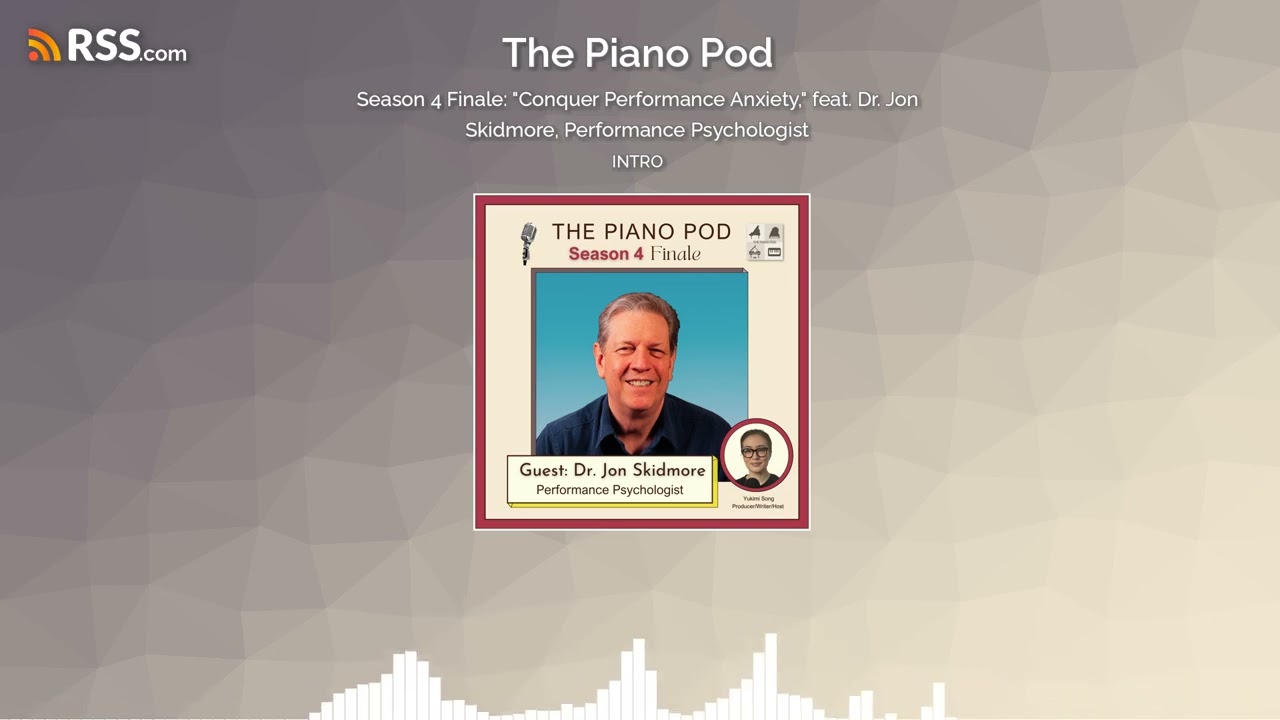
This content was created by The Piano Pod with Yukimi Song. This content was uploaded by The Piano Pod with Yukimi Song. This is a YouTube podcast episode (Season 4 finale) titled "Season 4 Finale: \"Conquer Performance Anxiety,\" feat. Dr. Jon Skidmore, Performance..." published June 12, 2024. It is a conversational interview between host Yukimi Song (The Piano Pod with Yukimi Song) and returning guest Dr. Jon Skidmore, a performance psychologist and author. The episode opens with hostess remarks about the show (Season 4 wrap-up, audience milestones and growth) and then moves into an in-depth discussion of performance anxiety and mental-skill training for performers and educators. Key topics covered include reframing stage fright as an activation/skill deficit, activation management (breathing/relaxation), narrative/self-talk, attention and focus, pre-performance routines and debriefing, daily mental-skills practice, and practical teaching suggestions for students. The excerpt also references the podcast’s history (first guest returning), audience metrics, and a call for guest nominations for Season 5.
Chapters
Welcome to the season finale of The Piano Pod with Yukimi Song. I am your host, Yukimi Song. Hey, TPP friends, thanks so much for sticking with us this season. It's been an incredible ride, and we couldn't have done it without your support and listenership. We're especially grateful for those who recommended guests and donated to the show. The entire team at The Piano Pod appreciates every single one of you. For tuning in and being so supportive throughout the season. To wrap up Season 4 and show our appreciation, we are bringing back a remarkable guest, Dr. John Skidmore, the renowned performance psychologist and author. Many of you might remember him from our very first episode back in September 2020. It feels like the perfect way to close this chapter, especially considering how this all started. So I've wanted to start a piano-related podcast since my graduate school days at NYU in 2008. One of my professors suggested it, but it wasn't until the COVID lockdown that I finally took the plunge. Well, during that difficult time, my piano students began experiencing performance anxiety due to the sudden lifestyle changes., and I really wanted to find answers or at least some clues to help them. I started researching and discovered Dr. Skidmore, who has decades of experience as a performance psychologist. After an inspiring and exhilarating conversation with him, I knew it was time to launch the show. I wanted to bring these valuable insights to a platform where other pianists and music educators like you could benefit. And here we are. Reflecting on the past 4 years brings back memories of challenging times like the COVID-19 pandemic, Brexit, and economic uncertainty. We also saw rapid technological advancements and the powerful impact of the Black Lives Matter movement. Through it all, I am so proud and grateful for our community's resilience and adaptability within the classical music industry. Over the past 4 years, The Piano Pod with Yukimi Song has grown and had the privilege of interviewing over 70 trailblazers in our industry, covering a wide range of piano-related topics. We've also achieved impressive milestones, including over 150,000 downloads on audio platforms and 2,700 subscribers on YouTube. All thanks to our dedicated listeners and viewers like you. But don't worry, we're just getting started on this journey. After a brief summer hiatus, The Piano Pod with Yukimi Song will return for Season 5 with an exciting lineup of guests. Oh, by the way, if you know someone in the classical music industry who would be a great fit for our content, please nominate them as a guest for the next season. You can find the guest nomination form in the show notes. Now let's return to Dr. John Skidmore. Not only is he the first guest ever on the show, but also will he be the first guest ever to return to the show. It's the first time ever we are re-interviewing a past guest. Anyways, if you haven't listened to our inaugural episode with Dr. Skidmore from September 2020, You can catch it on our YouTube channel or wherever you listen to podcasts. Before diving in, let me share his brief bio. Dr. John Skidmore is a dedicated performance coach who helps performing artists around the world find freedom on stage and in life. He's not only a psychologist, but also a singer, educator, speaker, and author. His mission is to help artists develop the psychological skills necessary for peak performance. Enabling them to confidently share their gifts, tell their stories, and play their musical instruments with joy. So today, we will gain valuable insights into the topic of performance anxiety from Dr. Skidmore, focusing on his thought-provoking statement, quote, "Stage fright is not a pianist's number one enemy nor a disease. It's a skill deficit," end quote. Before getting started with this special episode, I want to welcome all our first-timers to The Piano Pod with Yukimi Song. I am a classical pianist and educator from New York City. Whether you are diving deep into a piano career, working professionally in the classical music scene, or simply having a passion for piano tunes, this podcast is your backstage pass to the fascinating piano world. To our incredible TPP fans and loyal listeners, welcome back! Your continued support means a lot to us. If you enjoy today's episode, please take a moment to rate and review the show on your favorite podcasting platform. Your feedback helps others discover the joy of The Piano Pod with Yukimi Song. Now, without further ado, I am thrilled to welcome back Dr. John Skidmore and kick off our conversation. So sit back, relax, and please enjoy the show. You are listening to The Piano Pod with Yukimi Song, where we talk to the brightest minds in the industry about how they are bringing the piano into the 21st century. Welcome back to The Piano Pod, Dr. Skidmore.
Thank you, thank you. It's a delight to be here again.
Oh my goodness, it's such a pleasure to have you on our show again, and you were our very first guest on season 1, episode 1, back in September 2020. I mean, can you imagine? It's been 4 years.
Oh my goodness. It's surprising how quickly time flies, isn't it?
I know. And then these 4 years have really flown by so fast. And when I think back to that initial interview, it feels like a, you know, at the same time, a lifetime ago. So, I remember back then, spring of 2020, just right after the lockdown happened and everything, and I think I discovered you through like one of the articles and that you were the featured guest in the article.
That was the Clavier article.
I think so. I think so. And then I discovered your book and I really love the book, Conquer Anxiety. For my listeners, if you haven't checked out Dr. Skidmore's co-authored book, Conquer Anxiety, please check it out on wherever you read books these days. Anyway, so afterwards I emailed you and then we started the conversation, but you are really the inspiration and driving force behind the launch of The Piano Pod with Yukimi Song with Yukimi Song. So it's so meaningful that you are back with us today. And guess what? You are also not only the first time ever guest on the show, but also first ever returning guest. So congratulations. Thank you. Thank you. So how have you been? Please just give us your update.
You know, it's amazing to watch all the things that come and go with life, and life is always happening. And one of the most exciting things for me is that, uh, I have retired from my clinical practice as a psychologist.
Wow.
Yes, that's a very big step. It's something I've been wanting to do for a long time. And so now I'm in the full-time role of performance psychologist. And so whether I'm working with people individually or like last weekend, I was with the Classical Singer Convention in Washington, D.C., got to work, did 4 presentations with some just amazing young up-and-coming singers, semi-professional, wanting to be professional singers. It was just a delight to be there. And to share with them the tools and skills from the mental side of the game. So fun.
Wow, that sounds like fun. And so looking back over the past 4 years, what are some of the most memorable moments or maybe significant developments in your work now that you successfully transferred your career from clinical practice to coaching, performance coach.
So, you know, the one thing that I'm seeing now more than ever, and it really is that the up-and-coming performers need these tools. What I'm really seeing is, I mean, the world of performing arts has always been a very competitive arena. It's always been competitive. And what I'm really seeing is that, as there always will be in any situation, there will be some competitors that rise to the top. I mean, they just, they just get there. Okay. But what I'm seeing is the pressure and the social media pressures, the, in some cases, the fewer opportunities to perform, to make a living in this arena is creating an inordinate amount of stress and pressure that in some ways is for too many, not certainly not for everybody, but it's crushing their talent. It really seems to be having a negative impact in the talent because they can't make it good enough. They can't make it big enough. They can't seem to succeed with it. And so, it's really just amazing to watch that. The other thing I've noticed, which has been a really interesting surprise for me, is I've referred to it as performance dread. I've been talking to a lot of people that just like, I dread this, this love-hate relationship with performing. I want to do this and I dread it. And so that's been interesting. That's not a new thing, but it's just interesting that it seemed to have shown up a little bit more frequently is that, you know, I'm driving to the venue and it's like, I'm just kind of like dreading this, but I want to do it. And anyway, it's delightful. It's really exciting to watch performers drop that dread and step into the excitement of let's share the gift. Let's express myself. Let's be open to the experience. Let's enjoy it. And that's really what I get excited about.
Yes. And then, you know, as I got to know your practice and the books, and obviously, you know, I interviewed you 4 years ago, and since then I am becoming more aware of how important it is to equip yourself as an artist, uh, about performance, performing anxiety, and conquer performance anxiety, but also as an educator to teach that, right? So let's talk about the importance of mental skill training. So you emphasize the importance of mental training for performers, right? And can you explain what mental training involves and why it's crucial for, you know, pianists, but also more than— not only just the pianist, but performing artists?
You know, when we develop a craft, whether it's with the piano, with surgery, uh, playing chess, whatever our craft is, we will spend a tremendous amount of time, energy, resource to develop that. There's no question about that. And one of the things that we assume is that our mental ability, our mental skills, will just kind of come along the way. And we'll just be able to kind of somehow have what we need to do this. And it's so common as I talk with people, um, when we talk about where did you get a solid understanding of the sense of stage fright, performance anxiety, most people go, ah, I think that somebody mentioned that in a masterclass like 5 years ago. Or where have you learned the tools and skills about attention, focus, and control? How to direct and manage your attention. Because if you're doing that, you're going to be in a better place than if your attention is just being drawn wherever it goes. The question about negativity, how harsh should we be when we make a mistake? Now, this is kind of a cultural shift and a big picture, but yes, there's still plenty of people that are very, very negative about mistakes, thinking that's going to help them. But we also know that's not the most effective way to improve performance in terms of being negative. Now, being realistic, being constructive is certainly better, but the idea that we can, in a sense, shame or yell or threaten ourselves or punish ourselves into a better performance, that doesn't hold anymore. And so really it's the idea of developing the mental skills to support the expression of our musical craft, our musical skills. And it makes the journey so much more enjoyable. I've seen great artists that just dread and stress and fret as they go into their performance. They seem to do okay. They feel sometimes okay about it, but there's this deep anxiety about it rather than a joy and an excitement. One of the lines that I spent an hour and a half— it was just one of those interesting things. I'm trying to put together a little flyer for my experience in Washington, D.C. And I called 3 or 4 different people and I'm wrestling with this phrase for about an hour and a half. What do I want to say? What do I want to say in this like 5-word kind of thing? And no, that's too big. No, that's not saying it. And finally, it was like, your voice is ready. Your song is ready. Are you ready? It's like, am I ready? Like the idea that we're supposed to include— yes, we want to train our ability with the piano. We want to get that song, that beautiful piece of music in those fingers, in the mind, in the body, so we can just play that song. But am I ready? And so that's one of the things that I love to talk about, because most artists would say, well, if my song is ready, then I am ready. But they also have a real challenge with the idea of, is my song ready? Like, is my song really ready? But there's always more I could do. It could always be better. It could always be— so is it ready? And so to be able to look at this and say, okay, my song is ready, yes, and my skills, they're solid, they're ready, and am I ready? And we can bring that trio together, we can find an amazing experience on stage.
So How am I going to be able to get myself ready then?
Okay.
Yes. So what's the secret? I know there are so many steps to take.
I know the secret.
Okay. What do you think the most important part of prep yourself?
Well, to me, it's really about stepping out of I'm getting ready for this big performance. And putting it into the perspective of, I am ready. And what does that mean? It means that this is something that I'm clearly invested in. I am choosing this. I'm wanting to do this. That's where it starts. And I'm also aware that this is going to be a challenging journey, this challenging journey that we are on. So sometimes we're really in line with, yes, this is who I am, and I'm ready to do this. And then sometimes we get knocked off base, so to speak, and we go into self-doubt, we go into criticism, we go into anxiety. And so it really is important to be able to step back and say, it starts with, is this what I'm choosing to do? Do I choose to do this? When you think about it from that perspective, the student who was complaining about her senior recital and just how much stress she was experiencing, I said, "Well, why are you doing this?" And it's like, "They're making me." And it's like, "Whoa, slow down, slow down. Who signed you up for a degree in music?" "Oh, I guess I did." All right, so you'd heard about this thing called the senior recital, right? "Oh yeah, I've heard about it for years. Oh, I'm choosing to do this." Okay, so then it's a question of, yes, this is what I'm choosing. And then it's really the question of how to develop the mental skills and what are these mental skills? Now, I like to put these mental skills, oh, somewhere around 6 or 7, maybe 8 different skills. Let me just kind of go through these really quickly. I could do an entire presentation on each one of these, right?
Right.
Which we're not going to do this morning. So, it's really like saying, okay, do I understand what's happening to my body? See, I call it activation. The sympathetic nervous system is activated. Do I understand this? Do I recognize this? And have I been taught specific tools and skills to manage it? Typically, in any group that I'm working with right now, less than 10% of the people will raise their hand when I say, "Who in here has a regular practice of daily meditation relaxation exercises?" About 10% or less will raise their hand. There was one time I did this, only one hand went up, and she was a former student. Oh, hey, great, nice to see you, Dr. Skidmore. Yes, Susie. And so we need to understand this system, and we need to be able to train this system. We can't train it out of ourselves. That's actually a question on my final exam. True or false, you can train your stress response out of you?
False.
It is so deeply ingrained in our brain, we can't train it out. But we can understand it and we can manage it. So there's a lot to recognize that. And simply by referring to it as activation rather than anxiety changes so much for so many people. I'm activated. Well, I'm here to sing. I'm here to play the piano. So what? I'm activated. But if they have that energy of somehow being activated is bad or wrong, then it gets in their way. And it becomes more and more frustrating. I mean, one simple little fact here, it can take 20 minutes or longer for the energy of being activated, getting that stress response triggered, for it to fade away. So too many people are thinking like, well, I'm all stressed out and activated, stage fright. Well, I should do a breathing exercise. It didn't go away. No, it's going to take 20 minutes for that to fade away. Wow, how interesting.. And so to be, to be able to understand that and to be able to say, okay, it's gonna take some time. And if I focus on it as a problem, it's gonna get worse. If I focus on it as something that's here, I know what it is. It's not gonna trip me up. And I can do a few breathing exercises so it will calm things down. And then I'm free to move on with this. I talked with one professional violin player. And he had the idea that he was supposed to eliminate this activation. He was talking about how he was still way too nervous on his performance. I said, okay, from a 0 to 10, how activated were you? 6. Okay, 0 to 10, 10 being just massive problems, it created so much energy for your performance, it really just interfered with your performance. 0 to 10, what would be your rating? 10 being just, oh, just really devastating. Oh, it didn't bother my performance, it didn't impact me at all. It's like, okay, so you can comfortably perform great at a level 6 activation. Let's not worry about that. And the less you worry about it, the lower it's going to get. But so that is one really important key. Stage fright is not our enemy. It is not the number one enemy. It's a skill deficit. And we need the physical skills like the relaxation strategies. We also need the mental skills to manage that as well. So the whole idea behind activation management is one of the things I really focus on. Another thing I really focus on is the whole concept of storytelling or self-talk. What are the stories that we're telling ourselves? Are auditions humiliating, terrifying, embarrassing? Are auditions a source of defeat and disappointment? Or are auditions the gateway to opportunities? And suddenly that can shift. And so we have to really become aware of what we're telling ourselves and what's the story and what are the words we're using. I mean, the simple, I can do this versus I can't do this is huge.
It is.
It's just absolutely huge. And to say, okay, what are we telling ourselves? So we've really got to take on what is in our stories. And that's the word I like to describe. What's the narrative we're telling ourselves about it? And we need to understand what the present-day narrative is. In a sense, what are the words that actually came out of my mouth? But what is our historical narrative? For example, there was a young lady who was going to play a Chopin piece at her sister's wedding reception. She was like 13 or 14. Well, she got ready to play and it was time. And so she started to play and she was so embarrassed and so upset about how she performed. It's like she just told herself right then and there, I'm never going to play Chopin again. It's like, I'm just not going to play Chopin. And it wasn't until her senior recital when her professor said, look, Chopin is going to be on your program. He's got to be there. And then she was in my office and said, look, I don't want to play with Chopin. I don't want to do this. I don't want to do this. And we got her through that. So that's a piece of history. That is absolutely impacting today. And this is a connection we don't often really find or see very quickly. And so yes, looking at our historical perspectives and what kinds of experiences, what kinds of stories, what kinds of, in some cases, traumas we had and how they're impacting. So here we had, we could say she had some trauma with Chopin And ever since then, she's been avoiding Chopin until she had to play with Chopin again. And I joke on that, play with Chopin. You know, just, I don't want to play with Chopin. I don't want to, I don't like him. He beat me up last time we played. It's like, no, no, no, I don't want to do that. No, it's like, okay, this is just a beautiful composer. Why limit yourself?
Right. Yeah. And so it's, it's, I know, but you have several strategies to change the narrative, right? But, you know, first impression of, let's say, failure, quote unquote, and you experience, especially as a young student, experience the trauma of that mistake, failure, it's not as bad as you think. You know, you're trying to tell— Yeah, but for the person who experienced, it's like, oh my gosh, because the certain part of the brain is activated. I think it's called amygdala or something.
Yes.
Old part of our brain, the part that we inherited from. And then so that's the part is warning you, right?
Yes.
Basically. But how do you change that signal to something you don't have to be so scared about it, or you can have a more, let's say, positive insight, positive memory of that.
You know, sometimes changing these patterns is really, really difficult. I wish there was just a hypnotic trance I could put everybody into and it'd be gone.
Yeah, right.
And, you know, I've had a lot of hypnosis training and I use it as a tool in many different ways when it's appropriate.
Oh wow.
I haven't ever felt like it was magical, like somehow doing that will just take this away. It's a tool in the toolbox. But anyway, what you're really talking about is an awareness that this pattern, one, it's not necessary. In fact, here's a simple way to describe this. I think this would be great for all of your teachers. Okay, think of my hands as the two spheres of my brain, the two hemispheres of my brain. And so the thumb is the amygdala and the fingers are all the frontal cortex. So I have these two parts of the brain inside my head? Well, based on survival, we want to be able to recognize very quickly those things that are going to hurt us or harm us. We don't want to have to relearn that rattlesnakes are dangerous every time we see one. We don't want to learn that putting your hand on a hot stove is going to burn us every time we see a hot stove. So those things are stuck in our brain that will automatically just fire off and send us into that fight or flight response. That's exactly what it's going to do. So here I am walking down a beautiful trail in Zion National Park in Utah, and I hear that buzz of a rattlesnake, at which point my brain totally activates.
Wah!
Ah! Okay, now this is called the ABCDE of the brain. So you could say A is for the amygdala and activation. But are you in danger? The answer would be no. Okay, I don't need this. Well, the body has been supercharged. All kinds of adrenaline hormones are coursing through the body. Well, can I start to do the breathing and find that balancing point, get the body restored to a sense of balance? Can I check my thinking? What's the story I'm telling myself? Let's check and correct our thinking. With correct thinking, then we can decide— that's the D— we can decide what we want to believe here, and then we want to engage in that. So one of my favorite assignments in my performance psychology class is to have students write a description of their worst performance ever. And these are dramatic performances, these are dramatic stories, very painful stories. Well, you can see they got activated, yes, but were they in danger? No. Was their body completely out of control? Yes. Was their thinking out of control? Yes. Could they decide on where to go? No. And they wanted to run away. So it's just like, ah, they were stuck in this like, ah. But when we start to rewrite this story, it's like, oh, I wasn't in danger. Let's calm down the body. Let's correct the thinking. Let's decide what I want to do with this performance again. And let's go in that path. It's really interesting to look at it from the perspective that inside of every performance, there is a victory there. There is something of tremendous value. There's some gold in there. We got to find it. It may not always be what we expect it to be, but it's something that can really make a difference for us. But if all we're thinking about is the dross, all we're thinking about is the waste, the horrible stuff that happened, we don't find the gold. I guess when I'm thinking about gold, I'm thinking about this is what's going to help me shine. This is what's going to give me value. I can use this in my next performance. It's going to help me be that much stronger, that much more powerful, that much more sensitive, more musical. So it's the value that this has. Most performers could come up with a list of performances, sometimes more than a few, where, okay, there was nothing good in that. And this was embarrassing. And this was bad. And they're still dragging that around with them. And it's like, okay, they haven't been able to find the good stuff in that performance that's allowing them— it will support their next performance. And so, so we start to look at this, and again, our brain is designed to give meaning. It, it will give a meaning to everything. So it's going to give meaning to that performance too. And especially in the world of auditioning and competing, if people have winning means I'm great and losing means I'm bad, They're on a roller coaster every time they are putting themselves out there. You know, so here I am at this classical singer convention and the idea, I mean, what are the odds of them really winning? Well, it'd be like 1 in, I don't know who took the grand prize. I think they'll find that out. No, they found that out last night. I need to find out who that was. But it's like there were 600 singers there. So you have a chance of 1 in 600 to be that ultimate winner. You know, well, you go to audition for a major symphony orchestra. There's going to be 150, there's going to be 300 people, you know, vying for that tuba place. Well, that means there's going to be at least 10% of that group, any one of them could do it great. At least 10%, if not more than that. And so that sense of being good or bad is the roller coaster we don't want to get caught on. And again, it's our story that we're telling ourselves. So we start talking about activation management. Our thought management, um, is a real important thing. The story we're telling ourselves, our past and present stories. Um, we got to look at how we manage our attention focus. See, we're not really trained. We're kind of told to concentrate and focus and pay attention a lot, but what are we supposed to pay attention to? And what happens if we're Being distracted by what? What do we do? So that's another important skill and tool. In my performance psychology class one night, I thought, I'm going to be a little bit, you know, kind of crazy with this. And so I invited 5 or 6 performers to, you know, get ready to perform something. They went out in the hall. They came in one at a time. And then I intentionally had our class members try to distract them while they were performing. Like literally throwing paper airplanes at them or asking them questions. Excuse me, where'd you grow up? You know, just really random kind of questions. And at some point they had to decide what is most important right here, right now. And I loved it as one singer was up there singing and she decided, at first there was like, and all of a sudden it's like, oh, I know what's going on. So she starts to move her hand and she's gesturing with her hands as she's singing her song as she's knocking paper airplanes out of the air as they were coming toward her as she was singing her song. Now, is that an ideal place to perform in? No. But it was a great exercise in her deciding what's most important. And so that's one of the challenges we have as performers to decide what's most important and to keep our attention there. I invited a delightful, wonderful pianist, Robin Hancock, at Brigham Young University to perform for my class one night. And he played fantastic. It was a beautiful piece. And now we're kind of debriefing his experience. And I asked him at some point, did your attention shift anywhere during the performance? And he goes, oh, it certainly did. Well, tell us about that. Well, in the middle of his song, he heard the heavy metal doors of this green room open and clank shut. And his next thought was, did I reserve this room? What if somebody else needs this room right now? Well, that was a shift of attention focus. Now, he didn't stop and say, excuse me, do you need this room? It's like, well, he decided very quickly that playing his song was more important than whatever problem that could be, but his attention shifted. And so we've got to know we have just milliseconds sometimes if our attention takes us off track to get it back on track. He was able to bring it right back on track. He didn't spend the rest of his piece worrying about whether or not he, uh, had this room reserved or not. So that was an attention shift. Another skill I think that is just so important is the skill of properly debriefing a performance. In a sense, really looking at what worked and what didn't, not just on stage that night, but in the entire process from the decision to perform and motivation to all the mental practice skills to completing your musical preparation to the pre-performance routines. See, these are a whole different set of skills that we don't often talk too much about. We often develop certain kind of rituals around some of these things. But to actually start to develop what I call a launch sequence. What am I going to do that I can have control over anytime and every time I perform? What is that launch sequence going to be? What, what can it be? And it's often a breath or breathing or a visualization kind of thing. And so we develop the pre-performance routines and we develop the debriefing process So again, we can find out what worked. And typically with most performing artists, the majority of what they want to do shows up on stage. It shows up that night. The majority of it does. And there may or may not be some things that didn't show up. Well, what would you do next time? Too many performers, and I've met many of them, who post-performance were so effective in their post-performance bashing that, that thought of never doing that again felt better. So I said, okay, I'm never going to play with Chopin again. Nope. Oh, oh, I feel so much better. Okay. Not doing Chopin.
Yeah. That ultimatum. Yeah. Like makes you feel like you're in control, right? Yeah.
Right. And so that's just important to be able to recognize. And so just knowing that developing a mindset to equal your musical skillset is an important thing. And we don't just get it along. We get a toolbox of survival skills in the home that we grew up in. Whatever we had to deal with and experience there, we had to figure out how to survive. And many of those same tools would help us and support us throughout our entire lives. But some of those tools were learned by a 5-year-old. And we don't want a 5-year-old in charge of the decision-making process as a performer. Oh, Chopin's too scary. Nope, we're not doing Chopin. Nope, nope, nope, nope, nope. Not doing Chopin, right? You know, and so, um, recognizing that we need a set of tools— and what are these tools?— then, then we can start to really refine them and develop them, and they can make such a difference for us in what we're doing as performers. So it's really about the idea, first and foremost, to retrain is to start to claim the idea that, okay, I want to get mentally tough, I want to get mentally sharp, I want to develop a mental edge. That's going to really support everything I do as a performer. And with that mental edge, I'm going to manage whatever shows up in a better way. Just like a sharp, a sharp knife certainly can cut through a tomato a lot more efficiently and easily than a very dull knife. Let's get that edge really sharp. And so just knowing that there's tools and skills is the first thing, and then just developing them, and then we're always developing them. Because we— life is such a dynamic, uncertain process that we get to deal with things in new ways all the time. And when we're often stuck in the idea of controlling everything in the context of perfection, a surprise can be really shocking, if not difficult. And what we want to be able to do is step back and say, okay, I want to figure out how to manage this. So just knowing there's a whole set of musical tools, skills out there, mental skills out there, And as we start to develop those, they support us in amazing ways. And it takes practice. It really, really takes practice.
Just like performance. So this mental skills also needs a daily practice.
Yes.
Yeah. Yeah.
You know, two things that I like to talk to students about that are part of a mental skills practice. One is to explore or talk about one part of the performance process that you don't like? Okay, what would you have to let go of? What would you have to do to like that part? So again, the person who's driving to the concert venue is thinking, I dread this, I hate this. They're not enjoying that. Well, how could you create a meaningful experience here? One student talked about how, oh, I love performing, I hate my lessons. It's like, okay, Well, what we found there was a lot of anxiety in her lessons. She felt like she wasn't doing things well enough. And as soon as she gave up the idea that she was supposed to do things perfect in her lesson, she started to enjoy her lessons and her progress just like— just expanded because she was now able to enjoy the experience of discovering and learning rather than feeling like it was proving that there was something wrong with her. Now, again, those are changing old stories. You know, just a simple practice of making a decision for something. For example, what if you said for a 24-hour period you weren't going to have any sugar? See, that would be something you'd have to remind yourself of. I'm not going to eat any sugar today. Now, is that going to change your world or your life? It might help it a little bit. One thing's kind of interesting. Think about this. You're in the shower and you want to turn it on to cold. Well, who would want to do that? Well, it would take a conscious choice to be uncomfortable to say, I can handle being uncomfortable for 15 seconds and turn it on to cold. It's like that, but that's like a mental training kind of thing. To look out for certain words, words that are like detrimental, words that are like, oh, I can't do that. My daughter's gymnastics club, if they said the word "can't" in the club while they were working out, they had to do like 30 push-ups.
Oh, maybe I should have my students do the scales 30 times, right?
Scales 30 times and you say the word "I can't." Yes, yeah, let's do that. Let me know how that works if you try that. I'll be curious. So again, we have to look at this and say, okay, this isn't about mastery as much as it is the continual practice. And just as we're practicing the musical skills, we get to practice refining those mental skills and it becomes a practice. And so the thing there is, you know, how do we teach our students to develop a practice of mental skills training? And so that might be as simple as starting every lesson with a breathing exercise. Or to have them start their practice sessions with a breathing exercise. And so they're actually practicing these skills along with what they're doing.
Now, what, you know, all the practical tips that you gave, gave us right now, there were, uh, I heard a lot of mindset, the word mindset quite often. So let's, let's talk about the word mindset. It has become such a buzzword in recent years, and some might even say it's becoming a cliché. However, I believe that the essence of the word is often misunderstood or misused by, you know, those outside of your field. So can you share your extensive research on the power of designing a mindset?
Growing up will give us a mindset about everything. We have attitudes about it. So, in one of my presentations over the weekend, I have a big black bag. I don't have it handy or I'd show it. And I start to pull objects out of it. So, I pull out a chocolate bar. Who'd like it? I had like 90% of the hands in the air like, "Give it to me! Give it to me!" I pull out some roasted seaweed. Like, one or two hands went up. So, I gave out the roasted seaweed. So, like, you know, chocolate versus roasted seaweed, depending on who you are. Some people might prefer the seaweed over the chocolate. And so just recognizing that we're going to have a mindset and what is this mindset, and then to step back and say, did we design this mindset? You know, the research that I did was a lot of fun with this, where we took 150 junior high school kids, we had them go into a musical practice room with a request to sing Happy Birthday as musically as they could. And then we had them go to the control group, which was back to choir, or with the treatment group, which was with me for 40 minutes. And in these 40 minutes, all we did was talk about designing a mindset, and we practiced designing a mindset. We practiced stepping into the mindset. And I've got so many stories, so many places where Oh, let's see. That was as big as I could be, huh? Well, could I be bigger? Could I be more expressive? Let me try. And then it gets bigger. And so we're able to find statistical evidence that when you start out with the intention of being bold, confident, free, or expressive, dynamic, creative, or whatever words work for you that inspire you for your song, If that becomes your mindset, you have a target. Am I aligned with that or have I shifted from that? It's kind of like, okay, I can see this happening. Okay, I want to be inspired and hopeful and excited. Okay, let's talk about someone setting those three words as the intention for their senior recital. Inspired, excited, hopeful. And three weeks from the senior recital, they were feeling excited, hopeful, And you know, they were really excited about this. 3 days, they slipped into this place of, "This isn't very good. I can't do this. I'm overwhelmed with this. It's not going to be good enough." So they went from a designed mindset into a negative mindset, which is really common for us. But what we've got to be able to do is get back into that positive mindset and saying, "Okay, how can I let this go?" And again, This is where we often need to talk to people, talk to teachers and coaches. We get to talk to friends, sometimes psychologists, coaches, but it's all about how do we get back on that stable platform that we designed. See, mindfulness is a term we also hear a lot about right now. And see, mindfulness is about being aware of what's in our mind. And choosing what's in our mind and choosing to be present right now. And so the mindset for it to be supportive, creative, positive, and just knowing that that's going to help us every way it can when we're in a positive mindset versus a negative mindset. But it starts with designing that mindset. So that's just a lot of fun. I, Often in workshops I do, I'll have people write their words, these empowering words on a little name badge. And two stories about this I thought are really interesting. One, I asked for volunteers and not a single person in the room raised their hand. Like, pick me. No. And I watched this guy in the front row look down and he goes, okay, I'm bold. So he was aware that he had shifted away from this. The boldness, the excitement, the confidence. And he stepped back into it by putting his hand in the air. Another interesting story about mindset, which I thought was really fascinating, was I'm in kind of my little spiel about, I'm going to sign you up to volunteer for this. And I was in the process of doing this. I hadn't even asked for volunteers yet. Yes, I'll do it. I was like, wow, okay, come on up. And of course, when he did that, some other people volunteered. So now I had to like skip that whole part. And I said, what are the words on your name badge that you wrote down? The only word he had on there was hungry. And we're like, what? Hungry? Uh, he goes, I'm hungry to perform. And was he totally in line with that by volunteering before anybody else did? Yes, he was. So, doing that mindset check is so important. See, we can get activated, yes, but are we in danger? No. Let's calm the body down, then we can check our thinking and what's in our mind. Oh, let's correct that. Let's decide what we want to put in there, and then we can engage with that. We can move forward with that. So, that's the, again, the ABCDE of the brain. That's just one way how that works. But yeah, mindset is vital. And we've got to recognize that when our mindset shifts and we go to a negative space, we got to be compassionate first, and then we can change that. There was a young singer at Classical Singer Convention last year in San Francisco, and I asked her, okay, what are the empowering words that you feel when you want to perform from an empowered place? And she had just incredibly great words. Well, if your mindset shifts and you go to this negative place, what word would you use to describe yourself from this negative place? And she just goes, talentless, which is just like, oh, oh, so painful. Like somehow all your talent just disappears, poof, it's gone. So that's really the power of mindset right there in recognizing if we can establish a mindset that now becomes the goal. So Anytime you perform, in a sense, you could say, I have a goal to perform the music beautifully and musically, but I also have a goal to maintain a mindset that's powerful and supportive and uplifting. Mindset's very, very important.
Yeah. And then I love the fact that you said stage fright is not a pianist's number one enemy. Stage fright is not a disease. It's the skill deficit. Oh, yes. So cool. Yeah. Makes sense.
Well, when you start to learn these skills, you're gonna start to say, oh, I need this. And it's really fun when I will talk to people and debrief their performances and it's like, okay, so you got really activated, didn't you? Yeah. And have you like practiced any kind of strategies in the last few weeks to help you with that? No. Okay. So there's some skills you're not using that can make a difference for you. Let's get you those skills. And it's like, Oh, okay. And they just feel so much better about it.
Also, I want to talk about this old school way of approach to peak performance. So traditional way would be, you know, focusing only on relentless practice, right? I mean, relentless, relentless. Yeah. That's like the perfect word for that. And however, both research and the experiences of pianists and educators have shown this to be insufficient. Or rather to be wrong. How does the modern understanding of brain science, neuroscience, change our approach to achieving peak performance?
Well, I joke about being trained in the old school approach, and I can refer to it as the old school approach because that's what I was taught over 50 years ago. It was all about the practice. You practice, you practice more, and you hope. Like, that's just what it was. Yes. And with that, what was I told to do? Well, okay, we have a recital coming up. So go play for the neighbor, go play for grandma, play it for your mom and your dad, your brothers and sisters, your dog. And you just play it so much that you don't have to worry about it anymore. But there's also a piece of this that's kind of interesting is because every person you'd go play it for, you would unconsciously give them a rating. Okay. High stress, low stress. Oh, grandma loves me. No stress here. My dog loves me, no stress here. My mom, well, I know she loves me, but there's some stress here. We would give them a rating. And so the idea that somehow we could practice enough to make stage fright go away and that we would perform at our best and have that peak performance experience just does not hold in terms of brain science. So when you start to look at the brain science approach, when I did my doctoral dissertation on the experience of the peak performance with musicians 35 years ago, um, we didn't have the brain technology we do now. We basically had all kinds of anecdotal stories, and we had all kinds of beautiful little examples and stories of how— what this peak performance, this incredible experience was like. Well, now we can actually see how it impacts the brain. And we discover there's things that we can do to create and set up these peak performances. Now, obviously, there's going to be a point in terms of our preparation and our skills that have to meet. It's like preparation, skill set, where they meet, that's when we're able to really have a peak performance. But that can happen at any level. The first real peak performance experience I recall ever having, I was like 12 years old at a trumpet recital. And I've been working on my song really hard. It was coming together pretty good. I'd never really just nailed it yet. But I got up there that afternoon and I started to play and it just like sang. It flowed right out of my trumpet. And I was like, well, I must be really good. I must be really good. This was really good. My teacher goes, John, how'd you do that? I have no idea. It's Bruce. I don't know how I did that. Well, he was thinking I was really good too. So For the next recital, he gives me a piece that really was too hard. It was too difficult. And the week before the recital, we both concluded that I just don't have this. I can't play this. And he apologized for giving me a piece that was too hard. But there's also the mental skills that we need to help set up this flow experience. You know, anytime someone has jumped into a pool to go swimming, they've had to give themselves the command to jump. And to be able to say, "I'm gonna jump into flow." Well, we can do that too if we understand that. I'm gonna give myself permission to jump into flow. And that's where we get to see all the mental skills and the relaxation visualization skills, the cleaning up some bad performances so they don't come back out there on stage with us, managing the mindset, the attention focus. These are all tools and skills that we use to really stay focused. And if we get distracted for whatever reason, we want to get back. I mentioned my friend Robin Hancock where, okay, he was wondering if he'd reserved this room, is he going to be in trouble? Is there going to be a problem? Well, he's like, but letting that go, I'm bringing my attention back here. And it didn't bother him anymore for the rest of the performance.
Now, so speaking of flow, this is a very important word. Of what you do and what I do as a performer, but what I do as a music educator to teach, right? So I was interviewing someone a couple episodes ago, and we talked about this peak performance, the flow, in the zone, in the flow, whatever you— however you describe it.
Yeah, the groove, whatever you want to call it.
Yeah, exactly. So do these flow fluctuate, meaning it's not all— but this pianist particularly mentioned that they could only have this perfect performance maybe several times a year. You know, they perform quite often, but that peak performance where they were in the flow, like 100%, like so focused and so expressive, and it just happened quite only a few times a year.
So good question. Are we always going to have this peak performance flow state?
No. Okay, good to know.
Um, are the things we can do to set it up, to encourage it, to increase the frequency? Absolutely. There are so many variables on a personal level, on an environmental, on a social cultural level, on the temperature in the concert hall, the touch of the piano. There's so many variables that we can't control.
Right, right, right.
Absolutely.
Okay.
And even within a performance, I think it's important to recognize there'll be times where we're going to be really in the flow of it. Then we're going to be able to back off a little bit, or we're going to be not quite in the flow the way we were, and we'll get back into it. So it's really a dynamic process. It's not like just locking a laser on and there we are and it's over. That's very, very quite, that's quite rare, but it's kind of like, I mean, I'm sure my Robin Hancock was in the flow of his performance. He had this big interruption, like plank, the door shuts. Took him out of that flow experience, he's able to get back into it. You know, and so that's really one of the hallmarks of the great performance. Yukimi, another thing you're talking about is what I like to refer to as the gap. See, as artists, we have an ideal, an expectation, a knowledge of what it should sound like. And so many people think that that peak performance means I nailed it. I mean, there was no gap. There was like, I was there. It was amazing.
Okay.
Well, if there's a gap, there's a gap, but we're still at an amazing level. The number of times when people have said, oh, I made a bunch of mistakes in that. It's like, did anybody hear a mistake? No. Well, I didn't sing it quite the way I wanted it to. I didn't play it the way I wanted it to sound. You know, that kind of thing. So recognizing we're dealing with that flow state, you know, how to set it up, how to step into it and enjoy it. And sometimes how to get back into it or manage if we get kind of brought out of that flow. But we also need to be able to give ourselves some, uh, some compassion, some grace that, okay, we may not be at that peak level all the time, but you know what, it's still going to be amazing. You know, the audience is going to love it, and, and they typically do. So just recognizing that gap is something that we're the only one that— we got to be careful not to be too harsh with ourselves if we discover there's a gap.
Absolutely. Hey there, TPP family! The Piano Pod with Yukimi Song is now into our fourth season, and it's all thanks to you. Since 2020, you've been with my journey with the TPP, exploring this burning question: how do we make classical music resonate with today's audience in fresh and captivating ways? 4 years in, and the journey has been nothing short of magical. The Piano Pod with Yukimi Song isn't just a podcast; it's a movement, a space where pianists, composers, and educators brainstorm, debate, and reimagine classical music's place in our fast-paced world. We're together on a mission to ensure classical music doesn't just survive but thrives in our modern age. But here's the thing: To keep bringing you these insightful biweekly episodes, I need your help. Every bit of support goes into the podcast's essentials, from hosting to high-quality recording tech, and the countless hours behind the scenes. So, do you want to be part of this journey? Click the PayPal link in the show notes or head to thepianopot.com to donate, and as a token of appreciation, I will personally mail you The Piano Pod's snazzy logo sticker. So hit the subscribe button, spread the word, and let's continue our mission and journey as classical musicians. Now let's continue with the show. I want to talk about you, Dr. Skidmore. You've been— you've had a long and really exciting career working with performing artists. Of course, you had a career as a psychotherapist. That's a different story. But also That influenced, obviously, you to be who you are today. So can you share with us how you first became interested in the field of performance psychology? And I know you are— you yourself are a singer. And so how does that part of you influence your work as a performance psychologist?
Well, I relate to people pretty well in terms of feeling confident or unprepared for a performance. I relate to mistakes on stage. I relate to preparing for something. And so that's been my own personal experience. But you know, when I was working on my master's degree in counseling and I was singing with the Premier College Choir, it's like, whoa, these are the tools and skills that I wish I'd had years ago. And you know, one of the phrases I can hear from my dad so many times was the right tool for the job makes all the difference. I don't know how many times I heard that growing up. And so to me, it's about, hey, there's a tool here and a tool here. And look at all these tools that we can give you. And they are the right tools for this job about getting ready for a performance and enjoying a performance. And it's not just about practice. Practicing is one of the tools. There's a lot of other tools out there. Let's get those in that toolbox. Let's get you using those. And, you know, I, I've really enjoyed it. I've had a lot of fun from a clinical side. The two sides have melded really well because I bring a lot of my clinical experience into my coaching, and I brought a lot of coaching experience into my clinical work. Clinical work. I'd actually have people singing and dancing in my parking lot. And I love one guy goes, John, if you'd have told me I was gonna be doing this today, I'd have paid my missed appointment fee and not shown up. But he was happy he was— did that. It's like, oh, I stepped out of my comfort zone. And so I love to see how these tools really work together to expand that comfort zone, to create that sense of excitement and intention about what we're doing, and then be able to give us tools we can use as we face the different challenges of the growth that we have personally and professionally and musically. It just makes things so much more effective, so much easier, so much more enjoyable.
You mentioned about tools, and I know there are several practical tools that you mentioned 4 years ago during our interview session too. But also, I am learning more about you, your work, and then also you mentioned something about juggling.
Yes. You know, I love the metaphor of juggling. And in fact, I was talking to somebody recently who I'd met in the Taos Opera Institute about 7 years ago. And he goes, I still remember how to juggle, Dr. Skidmore. You know, it's like, awesome. And what's so interesting about that is a beautiful example of 3 important things. One is an example of how we develop motor skills, how we actually develop the skills to No, I didn't have the skill of doing 3 balls. Oh, now I do. Well, that's the same thing as a very difficult fingering on a new piece. At first, you don't have that. You don't have the motor skills. You don't have the— it really takes some time before it like gets locked into those fingers and it's just there. So that's the motor skill development. Secondly, anytime someone drops the ball, I get to see how they respond to the literal dropping of a ball and looking at how that applies to when they musically drop the ball. Oh, I'm so stupid. Well, wait a minute, you're learning how to juggle. And so the phrase of woohoo, I'm learning to juggle is one of my favorite things to do. So usually when I'm working with a group, at some point I'm teaching them how to juggle and I'll say, okay, the next time you drop the ball, I want to hear a shout out like woohoo, I'm learning to juggle. I'm learning to juggle. And so as I coach people, I actually send them juggling balls and they're like, what are you doing this for? So, um, I want you to, one, develop a familiarity with how we develop new neural pathways. Two, how you react to dropping the ball. Can you react in a positive way? And the third thing that's really fun about juggling, it actually gives us a great example of the struggle into flow. This is really kind of intriguing because to get into that flow state, there's a struggle space. We gotta stay in there long enough and suddenly we'll like, oh, there it is. And it's just like the person who's struggling to do 3 balls in the air. They got 2 figured out. They're struggling, struggling, struggling. All of a sudden, whoa, just did.
Yeah.
You know, it's like, I just did it. I just did it. And so it has a lot of power to it. It's a lot, and it's a lot of fun.
Oh yeah. You have such, so many creative ways to teach. Your clients and students how to, or develop the skills of conquering anxiety. So anyway, as you might recall, I reached out to you in, you know, 2020, and then that's when I started, you know, reading Conquer Anxiety, the book that you co-wrote. So I came to understand that that book was actually written in 2020.
Yes.
Yeah, it's such a practical book. And also, but it starts from how our brain functions, and it's really, it was, it's, it's a transformative book for me.
Thank you so much. I appreciate that.
Yeah. So for those who are listening, I really recommend you to get this book, Conquer Anxiety, that Dr. Skidmore co-authored. So we live in such a complex world with vast amounts of accessible information, and then it's clear that just practicing for hours on isn't enough to overcome anxiety. So how important is it for music educators like myself in this new era to have the skills to help their students conquer performance anxiety?
How important is it? I think it's essential. Once you as a teacher embrace that I get to teach two sets of skills, I get to teach everything I know musically, and that's certainly your domain. But I also want to teach the skills to express their musicality. So it's no longer an expectation. When it's caught in the domain of expectation, what we end up feeling is disappointed and angry and frustrated. I did not meet that expectation. But when we start to look at this and say, I want to teach performance skills. I love the story of a string studio that was getting ready for a violin recital. And I watched a young lady intercept the teacher as the teacher was walking to the front of the room to start the recital. This student intercepts her and stops her and looking at her like, goes, "I'm nervous." And the teacher's going, "You'll do fine." And let's just say that young lady did not look reassured as she went back to her seat. But see, what if that teacher could have said, Hey Yukimi, you're activated, aren't you? Yeah. Okay, look, we've talked about 3 different tools. Which one could you practice right now to help you with activation? Oh, the breathing exercises? Yeah. Hey, go try that. We'll talk about how that works in your lesson on Friday. You'll do fine. So that's one of the ways in which I see educators really needing this because we'll always teach what we know. Okay. And my Most of the time that works out pretty well. But when we can have more tools, we can share more of what we know. Now, the other thing too that we want to recognize as educators, that this is not about the perfect performance. This is about, in a sense, the perfect lesson. So how do we teach the perspective that yes, we want excellence. Yes, we want beautiful. Yes, we want amazing stuff out there. That's what our top goal is. That's what we want to do. And so everything is just going to help you get better. Everything's just going to help you get better if we can look at that as a positive thing, if we can use that in a positive way. And so to bring a sense of compassion, to bring a sense of, you know, enjoying the journey, enjoying the struggles, that these are part of it, these paths that will take what we learn from this. Yes, we get to look at this and we get to learn from it, and we're going to go on from this, and we're going to keep building with this. And then teachers have a whole different relationship with the students than if it's just all about this is right and this is wrong. The other thing I love to talk about to music educators about, and virtually every music educator I've ever talked to understands the very beautiful privilege it is to work so intimately and so closely with somebody and to see them in this struggle and this process of growing up and growing through their experiences and growing into their musical abilities. And what a beautiful thing to be able to share and to do. It's just really wonderful. And so again, it's about just having more tools to share and you'll get to see them move forward in new ways. And again, it's really about embracing that mindset of you're the student as well and that you are teaching them the new things you're learning and discovering. And, um, you know, making it a powerful and meaningful experience.
Teaching resilience is one of those things that, you know, I have to, I guess, incorporate in lessons, not by force, but, you know, performing in front of people takes certain mindset but also courage too.
Yes.
So how do we do that? How do we teach us? Maybe it's not just my job. It's the parent's job too, where most of the time I see a lot of helicopter parenting style, and which prevents from teaching young, young students of resilience sometimes, unfortunately, right? And then, so it just becomes my job, but I'm like, I think this is way above my pay grade. To do that?
Well, I think it's important to recognize that anything you teach a student, anything they experience, is going to be landing on their experience with their parents, their early childhood environment. And so what you want to make sure you're doing is really reinforcing the positive, the compassionate, the creative, uh, the discovery kind of thing. When I coach a parent, I'll say, okay, We're now talking about parenting. Can you view your child through the lens of discovery and they're in the process of mastery? And what is the relationship you want them to develop with themselves and their world as they're discovering and mastering? And so when you start to look at that and say, okay, how do I develop, help them develop a relationship with themselves as they're seen as someone who's growing, learning, discovering rather than failing, being stupid, wrong, and bad. And with expectations, with culture, there's a lot of things that are going to be already in place. And so, um, again, you're in a very privileged place to be able to have such a positive impact and such a growth-oriented experience with this child because you become a mentor for them. I've talked to so many people that Their teachers have become wonderful mentors. And I've talked to a few that have been really, shall we say, unhappy with how they were mentored by their teachers. Not every teacher works for every student.
Right, right.
Yeah. But the main challenge here is to take on that this is a privilege and that you want to help them enjoy this discovery mastery process and create a great experience with music, a great experience within themselves, with those around them. As they are, you know, moving forward. You know, our real confidence, our real resilience is not built by always hitting home runs or winning competitions or succeeding. It's really how we manage those difficult moments.
Absolutely. Absolutely.
And so again, to drop the expectation that there aren't going to be any difficult moments is important. And to keep working with students that, okay, this is something we're going to go grow through, go through, you know, we're going to go through, we're going to grow through. And that's great. We get to the other side of this, we're going to be better off. So let's, let's just go through and grow through and let's get to the other side and let's figure out what we got to, you know, learn. And we don't want to be carrying with us things that are going to be, um, let's just say a burden later down the road.
Thank you. So we talked about your book. That came out 4 years ago, but I believe there's a new book coming out, Coping with Anxiety from a Cow's Perspective.
Yes.
Tell us what that is all about.
Oh, it's a beautiful story. Kristen J. Lloyd is my co-author and she's the illustrator. And she's a former student in my, for my class at Brigham Young University. And we have been collaborating for the last year and we're just about done with two books. But it's really about her story of growing up on a farm with a befriended cow and her friend, her cow became her best friend. And it's really conversations between her and her cow about having, she broke a bunch of eggs when she shouldn't have. So she's really scared.
Okay.
And so how her cow talks her through the process of being able to get clear in her mind and really help her talk to her grandma and to get back into, yes, I can gather eggs. And just a very wonderful story metaphor. I'd encourage anybody to look at Kristen J. Lloyd. She has a beautiful song called Find My Brave. My Brave is her song. And she's written an original song for this book as well called Butterfly Forward. So that's something that is basically a metaphor for how thoughts can change. They can butterfly forward. And so, oh, it's just been a wonderful project. And I've also got other projects I'm working with. But yeah, this is really a fun, you know, fun thing.
And yes, and another book is the 30 Days to Peak Performance. It's the workbook, right?
Yes.
Yeah, tell us that this workbook go along with your original, which came out 4 years ago, Conquer Anxiety?
Yes. It certainly does. What it really is is just a great reminder of what do I need to do. If I had 30 days to get ready for a peak performance, what would I want to do? What are those key things I would want to do in this journey? So certainly, there'd be practice, be mental practice. There's reminders about daily mental practice skills. It's about recognizing that this process of the 5 stages of peak performance, which is definitely what my book is all about, It walks a person through those 5 stages within that 30-day context. What are you doing and why? What's the mindset you've designed for this? Okay. How you're preparing musically and mentally. All right. When are you declaring that preparation complete?
All right.
What kind of pre-performance routines are you going to incorporate in this? Okay. You performed. How are you going to debrief this? So in that 30-day experience, you can keep moving forward.
Wow. That's going to be helpful because I really love the book and I always refer back to your book because sometimes I need it for myself and for my students. And having to have the 30 Days to Peak Performance Workbook will help. It's more practical.
Yeah.
Yeah, right?
It's very hands-on. I will send you a copy here when we get done. And yeah, I'll be happy to get you a copy of that.
Thank you.
And it's just a great reminder of, okay, what am I doing every day that's going to advance, promote, move me forward? Or somehow I'm doing something that might be like a retreat, a stop, a pause. Okay. Even like slide downhill kind of thing. And so it's just a great reminder. It's really especially good for helping you look at your mindset.
Yeah. Dr. Skidmore, what, what a journey it's been, right? I mean, 4 years and you've accomplished so much. Congratulations.
Thank you. It's a delight. It's, it's such a privilege and it's so amazing to be able to see how these tools and skills open doors. They open the doors to the stage and in some cases they've opened doors that have been shut and now they can get back out there on stage and it's just exciting to see the difference that makes for people and performers and really one of my primary goals is You know, I'm privileged to be able to help people create freedom on their stage and in their life. I just love that idea that, yes, I get to do help people create freedom on stage and in life.
Connecting the performance arts and, you know, music and the life itself together. That's beautiful. Yeah.
Thank you.
So how can we sign up? I would love to, for my audience to sign up for your masterclasses maybe if you're hosting or so. I know you can— we can get in touch with you through your website at johnskidmore.com. What else?
Okay, um, I'm also on Facebook and social media things, but my website's probably the best place to get hold of me and just email me. Be happy to talk to you. One of my favorite things to do is to do workshops specifically for studios So I will, whether in person or on Zoom, we'll just spend some time with the studio and we're just working with that studio together. That's one way we can do things. I have a course called The Musician's Path to Peak Performance, which is a 5-week course. My next one for that is scheduled in November. And again, that's on my website. I'm going through another studio in Denver that I'm working with is sponsoring that. And I've got stuff happening all the time. Two things that are really interesting: every month I do a Peak Performance Masterclass, and this is a free opportunity. I don't charge for this. A teacher will contact me and say, hey, I have a student I'd like to have you participate in your masterclass. It's like, great. And so they perform, and whether they're playing the piano or singing or playing the tuba, it doesn't really matter to me. But we masterclass this from the psychological perspective. You know, what were you thinking? What were you seeing? What did you experience? How did you handle the fact that there was a problem with the internet? All these kinds of things. This is on Zoom. And so that Peak Performance Masterclass is really a wonderful opportunity to connect and to get to know me a little bit better, to see how I work with students. Students just watching that get good information. It's like, oh, I had a 13-year-old. I asked her, so what did you get out of the masterclass? And she goes, well, I kept hearing people talk about how it really didn't matter what other people were thinking of me when I was performing. I never really thought of that before. I thought that was really important. And so the 3 people that performed that day, we talked this through and they were able, and that was just one of the things that she took away from that experience. So I do a 9 o'clock in the morning Mountain Time on the second Wednesday and a 5 o'clock in the evening on the third Wednesday of every month. So that'd be another opportunity that'd be really fun to connect with and to invite your students to sit in on that or perform for it. I'd love to talk to more, you know, more teachers.
Sure. Yeah. And then I know you sent me the link, that Zoom link, that registration link. So I'll Make sure to put that in the description as well. And then also you offer half an hour free discovery consultation as well, right?
Yes. You know, that's really an amazing opportunity because first off, for a lot of people, the introduction of performance skills is relatively new. They're not quite sure how this is going to make a difference or what they are. If someone's in a crisis and they're coming to see me, that's a different story because they're in crisis, they want help. So yes, I'm happy to meet with somebody for a 30-minute consultation, and we're just talking to see how mental skills training can make a difference for you and what direction to go with that. And if I'm the direction to go with, we'll talk about how to, you know, work individually with me or with your group with me. Or other times I've referred people out to— I actually referred somebody to Toastmasters the other day. It's like, you're a performer, but I think Toastmasters would really help you. Like in terms of just getting up and, you know, publicly presenting yourself. And so that's really what that's all about is to get to connect with people and to be able to see if the tools, you know, what I can share can really make a difference for them. And we'll go from there.
Wonderful. Well, it's been a great, wonderful, inspirational conversation, but I have like just a few more questions to go. I hope that's okay. So these are going to be a little bit more philosophical ones.
Sweet.
So how can we shift the cultural perception of performance anxiety from a personal weakness to a natural aspect of the human experience deserving of compassion and support?
Yes. Wow, you said that so well. We need to help people understand that this is a natural part of the human experience that needs, you know, needs compassion. Needs support and needs tools. It's not a disease. So, what you're describing, Yukimi, is exactly the goal here. I've talked to students and talked to teachers who just assume that performance anxiety is normal, like it should be part of the experience. People have said things like, "Well, if you're anxious, that means you care." Well, that doesn't help you very much. Okay, I care, but I'm still anxious and this thing is taking over and I'm not happy with this and I don't know what to do about it, it's going to get more anxiety and more problems. And so the other part of this is, as educators, be really informed and to find out as much information as you can from as many different sources is how do we bring the tools and skills and make them a part of our lesson. Teachers who will start a lesson with a 1-minute breathing exercise have a very different experience in that lesson. I mean, even if it was as simple as put a finger right here, breathe in, breathe out, and think, "I am bold. I'm confident. I'm expressive. I'm going to discover a lot today. I'm going to discover a lot of stuff in my lesson. I'm going to just be really open in my lesson today." I mean, that's establishing mindset. It's helping get connected to the mind and body. There's so many different things like that as a simple tool. One thing, for example, like just having that mindset established for your lesson, what that can do is when you discover there's like frustration has kind of crept in or there's some like even anger or there's some disappointment, you just have to say, so John, what's your mindset right now? I am really frustrated. Okay, we get to acknowledge you're frustrated. Now that's not what you created the intention for today in this lesson. So what can we do to get that frustration out of the practice room here, out of the lesson? Let's get you back into the expressive and the confident and the creative. Oh yeah, I guess I kind of forgot that confidence wasn't doing it right and knowing I could do it right. It's knowing I can handle whatever shows up. Oh yeah. Okay. I can handle this. Let's go step back into confident. Okay. Now let's play this again from confident. So it becomes a really great little tool that way. I would love to hear from you or from any of your other, your friends, other teachers, how something from this podcast has made a difference for you teaching. I would love to hear, please contact me. I would love to communicate with you about that because I learn a lot from those who I talk with. This little exercise here, when I taught it, it was like squeeze your fingertip. Well, somebody I was working with says, you know, I do that a little differently, John. Well, how do you do it? Well, I slide my finger up and it feels kind of nice. And it's like, oh, I love that. So there's so many different variations of what we can do here. And so to be able to learn more about that, learn from you, I would love to learn from you. And if you're running into some very specific problems or issues with specific students, have some questions, please feel free to contact me. I'd like to be seen as a resource.
Yeah, and I'm sure there are a lot of questions from performing artists to music educators today because these are really ongoing issues.
Yes.
And I don't want to say issues, that then that's also the negativity, but it is true. And then something that we want to solve for ourselves and for our students, but it's where I feel like I've— in the past, I felt like I wasn't equipped enough. So that's why I, you know, obviously reached out to you 4 years ago. Anyway, so how can we use our vulnerability and authenticity in performances to our advantage, particularly in connecting more deeply with our audiences?
We all relate to the human experience, and none of us are perfect, you know. And sometimes we've gone to concerts and programs and we're expecting that absolutely amazing musical experience, and we've often talked about how that's supposed to be close to perfection. It's really about being confident enough and strong enough within ourselves to say, "I got lost. Well, I will fix that," if we get lost. Or we move through it and we bring compassion to ourselves and we finish strong, we finish excited and we finish musically rather than, okay, we've struggled with something and then we're like berating ourselves and angry and frustrated and it just leads to more of a cascade into disaster. And it's really about just the enjoyment of the realness of our experience. In our digital age, we can make, I mean, autotuners are a thing with the voice these days. You know, and a good artist can alter the sound, can alter the tempo, can take out one little bit of sound and replace it with another little bit of sound. And we don't see the hundreds of hours that could go into a recording to make every note sound perfect. And so the other thing on that is our cultures, we get to just embrace the reality of life and just look at this as a privilege to be a part of someone being willing to share their talents. And you as the performer being willing to share your talents. In that sense, I love to talk about the gifts we have to give, the stories we have to tell, the songs we have to sing, and the pianos we get to play with. So you get to play with a piano. My mom was a delightful pianist, and I, you know, so cherished my experience with her as accompaniment for many, many years, and also with the, you know, the neighborhood recital and inviting friends and family into the front room around the grand piano to just enjoy that kind of beautiful musical experience. And so, you know, creating a culture of fun and enjoyment is such an important part. And so I really appreciate what you're doing with your podcast and how you're wanting to deepen the experience for so many people and to create that freedom to enjoy expressing themselves through the piano.
Oh, thank you. It means a lot because you gave me the push to do this podcast in many ways. So yeah, yeah, yeah, because, you know, I really enjoyed our conversation on the phone. I was like, oh, I can, you know, put this— our conversation on the podcast platform so that everybody else can benefit from our conversation, right?
Oh, thank you.
Yeah, but this has been a great conversation. Thank you so much once again. And so for our listeners, please visit johnskidmore.com, which is J-O-N-S-K-I-D-M-O-R-E.com, to learn more about Dr. John Skidmore and his work and then all the workshops that he mentioned, a half an hour discovery consultation, and also his Peak Performance course in November that's coming out, and plus new workbook and so on. Before I let you go, we have this thing, the rapid-fire questions, and I ask some fun questions to each guest. And here's a little twist: as silly as these questions may sound, your answers may reveal who you truly are. So I want you to answer each question with the shortest response as possible, and then—
I love it.
No explanation is necessary. Let's start with an easy one, level 1. What is your comfort food?
Oh, probably soup.
How do you like your coffee in the morning?
You know, I'm actually not a coffee drinker, so I don't do coffee in the morning.
Oh wow, okay.
Okay.
Cats or dogs?
Oh, definitely dog. I'm allergic to cats.
Okay. Sunrise or sunset?
I love the sunrise. I'll often go hiking in Utah. Oh, no explanation. Sunrise. There we go.
All right. Summer or winter?
Oh, winter. I'm an avid cross-country skier.
Really? Oh my goodness.
Wow.
You see a lot to discover from these questions, right?
Yes.
What skill have you always wanted to learn but haven't had a chance to?
Two weeks ago, I threw my first pot. At a potter's wheel. Oh, and I've been so excited about that. My daughter-in-law gave me that for Christmas, and I just threw my first pot, uh, 2 weeks ago, and I'm gonna go back there again and do some more of that. That was fun.
Wow, that's awesome. What is your word or words to live by?
Risk, fail, risk again.
Yes, I remember that. What is the most important quality you look for in other people?
Hmm, honesty.
Name 3 people who inspire you, living or dead.
Certainly my mother as a pianist and musician inspires me. Um, I have to put my father because he's a psychologist.
Oh wow, okay, runs in the family.
It runs in the family, it runs in the family. Um, Benjamin Franklin has inspired me a lot. He, he was a man that clearly had vision. He clearly could see what was coming down the road, and he took actions in a powerful way to make a difference there. And so I've enjoyed reading a lot about him.
Yeah, he had so many skills. He was an inventor, but he was a diplomat. Amazing. Yes. All right, now level 3, not two more questions. Name one piece in your current playlist?
Um, Orange Colored Sky by, um, oh, the name just blocked. I mean, little performance anxiety right here.
I'll look it up, no worries. No worries.
No, it's, um, I shouldn't— why can't that name show up right now? Orange Colored Sky. Anyway, it's a beautiful song.
Okay, I'll look it up. Fill in the blank: music is blank.
Music is life.
Beautiful. Thank you. So that concludes this episode of The Piano Pod with Yukimi Song. Thank you, Dr. Skidmore, for joining my show for the second time today and sharing your stories, insights, and expertise. So for The Piano Pod listeners and viewers, please visit johnskidmore.com to learn more about Dr. Skidmore's work and his program. Of course I encourage you to follow him on social media @DrJohnSkidmore— all the links are listed in the show notes. Thank you to my wonderful audience and fans for tuning in today! If you enjoyed today's episode please rate and review it on whatever podcasting platform you use; remember to hit the thumbs up button and subscribe to my YouTube channel; and follow The Piano Pod with Yukimi Song on social media to get latest piano news via Facebook, Instagram, TikTok, and LinkedIn. I will see you for the next episode of The Piano Pod with Yukimi Song. Bye everyone. Thank you so much, Dr. Skidmore.
It's a privilege to be here. I'd love to chat with all of your friends and to see how I can support them in their quest to create freedom on their stage with their students and in their lives.
Great. Thank you so much. And thank you for your incredible support through throughout Season 4. Have a wonderful summer, and we look forward to seeing you in Season 5 starting in September 2024.
More from The


Spirit, Body, and Soul: Pianist & Composer David Berry on Virtuosity, Creativity, and...



Season 6 Episode 20 | "Spirit, Body, and Soul" feat. David Berry, Concert Pianist & Composer


Beyond Borders: From Argentina to Poland to Texas—Oscar Macchioni reflects on a life in music

Sound Liberation: Joe Williams on Black Artistry, Legacy & Belonging in Concert Music


