Season 5 Episode 11: Practising the Piano – Neuroscience, Technique, Musicality, and...
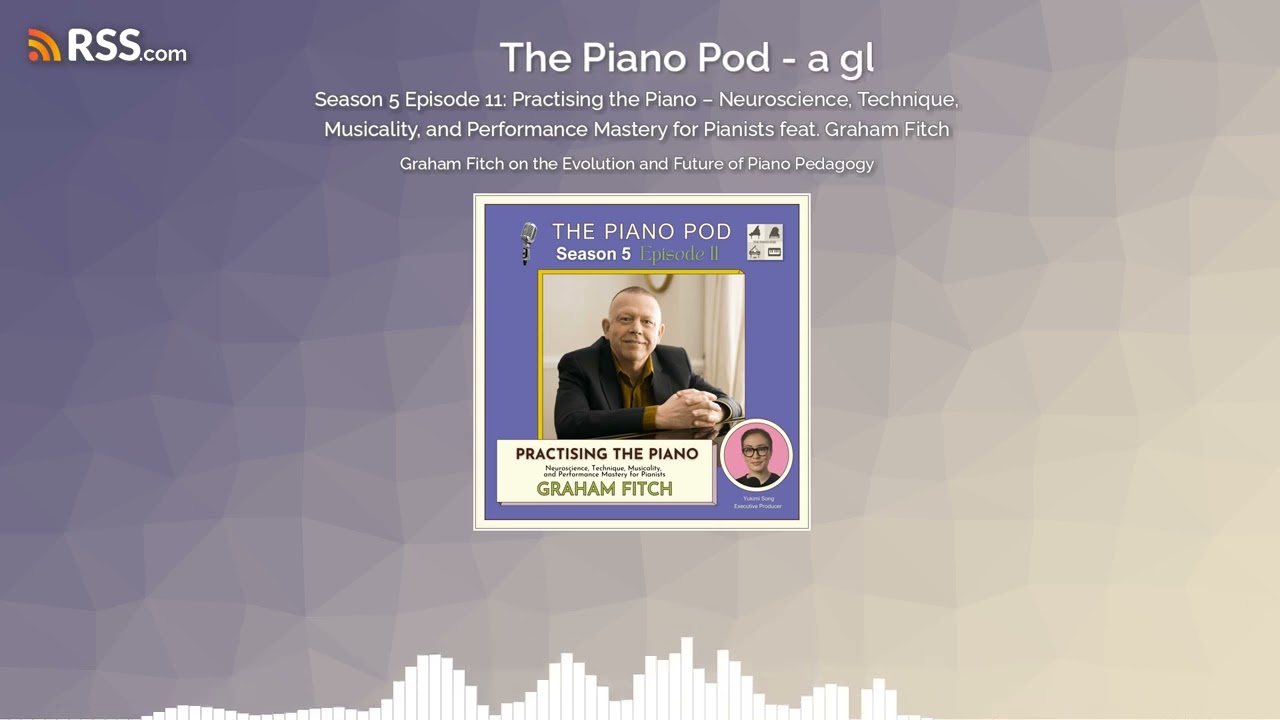
This content was created by The Piano Pod with Yukimi Song. This content was uploaded by The Piano Pod with Yukimi Song. This is a YouTube episode (Season 5, Episode 11) of The Piano Pod with Yukimi Song, published March 12, 2025, featuring an interview between host Yukimi Song and guest Graham Fitch, a pianist and pedagogue based in Southwest London. The conversation focuses on effective piano practice and pedagogy—topics include student-centered teaching, 20-minute focused practice sessions, variable/creative practice, the role of sleep and neuroscience in learning, practicing performances (run‑throughs, reflection and spot practice), and technique and musical hierarchy. The episode blends practical teaching advice, anecdotes from Fitch's experience, and references to research and historical pedagogical approaches.
Chapters
This episode is brought to you by The New York Piano Group, whose support helps make this show possible.
Do you ever dream of connecting with a community that shares your passion for piano? Discover The New York Piano Group, where adult pianists of all levels come together to learn, perform, and grow in a supportive and inspiring environment. From monthly Zoom performance meetups to live concert opportunities, you'll hone your skills and connect with fellow enthusiasts. Join today at newyorkpianogroup.org or join our community on meetup.com and start your piano journey with us today. The other thing I didn't talk about that is important is the control of the sound on the repeated chords. To get that sound working, you need to stay inside your key. You need to actually be at the bottom of the key. Don't release the keys all the way up to the top. If these are too noisy, that's going to drown out your, your top. So the objective there would be to keep these actually quite light. So in terms of tonal hierarchy, we've got the melody line, which has the lion's share of the sound, The next level would be the bass note. Substantial, not loud, but firm. Firm enough to support the sound above. And then finally, these chords, as light as you can get them. So I think those ingredients will help you to get that line singing above the quite substantial background.
Welcome back to another episode of The Piano Pod with Yukimi Song with everyone. Today I have the pleasure of speaking with Graham Fitch, a pianist, educator, writer, and one of the most influential voices in piano pedagogy today. His work has transformed how pianists approach practice, technique, and musical expression, offering a structured yet flexible method that empowers musicians to play with both technical ease and artistic depth. As someone who has dedicated decades to teaching piano, I know firsthand the challenges and rewards of mentoring students. My journey as a pianist and educator began over 20 years ago, working with students of all levels, from young beginners to pre-conservatory prodigies and lifelong enthusiasts. I've had a privilege of guiding students from all walks of life, from those who have gone on to win competitions and pursue professional careers to those who simply find joy and fulfillment in playing for their own enrichment. Whether teaching in higher education or running a thriving piano studio in the heart of New York City, I've constantly sought to refine my approach, balancing technical rigor with musical expression, structure with creativity. During this journey, I discovered Graham's videos on YouTube, created in collaboration with The Pianoist magazine. His instructions were a game-changer in my teaching, especially as I began working with more gifted students who required a higher level of technical and artistic refinement. His approach to practice is revolutionary, not because it introduces an entirely new method, but because it refines and clarifies the principles that truly make a difference. Graham understands that effective practice is about more than just repetition; it's about precision, problem-solving, and mindful exploration. His guidance reinforced my belief that practice should be an active, thoughtful process rather than a mindless routine. What makes his work truly groundbreaking is his ability to blend historic piano pedagogy with cutting-edge research in neuroscience, offering pianists practical and innovative tools for learning and improvement. His teachings don't just make students play better; they transform the way they think about music, technique, and interpretation. Graham has built an international reputation through his highly regarded masterclasses, his contributions to Pianist Magazine, and groundbreaking educational platform, The Piano Pod with The Practicing the Piano Online Academy. Based in Southwest London, he works with professional musicians, educators, and dedicated pianists worldwide, helping them unlock their full potential through structured yet adaptable teaching. His approach integrates principles of psychology, biomechanics, and injury prevention, making his insights essential for anyone looking to improve their playing while maintaining long-term physical and mental well-being. In today's conversation, we will explore the art of effective practice, holistic piano technique, the role of mental practice, fostering creativity and individuality in teaching, and his pioneering work in online education. This episode is packed with practical strategies, thought-provoking insights, and inspiring ideas that will benefit pianists, educators, and music lovers alike. Whether you are a performer striving for deeper artistic expression, a teacher looking for new ways to inspire students, or someone passionate about the piano, Graham's perspective will give you a fresh and effective approach to practicing and performing. Before we begin, I have some exciting news! The Piano Pod with Yukimi Song is now on Substack! This platform allows us to share exclusive content, behind-the-scenes stories, and early access to episodes. Your support on Substack helps us continue bringing meaningful conversations with guests like Graham Fitch, exploring the many dimensions of piano playing and pedagogy. So please join us, our growing community, at thepianopod.substack.com. Now, without further ado, let's welcome Graham Fitch to The Piano Pod. Please enjoy the show. You are listening to The Piano Pod, where we talk to the brightest minds in the industry about how they are bringing the piano into the future and thriving in a complex, ever-evolving world. Welcome to The Piano Pod with Yukimi Song with Graham Whitmore. Thank you, it's such a pleasure and honor to have you on the show. So where are you joining us from today?
I'm coming to you from London, from Wimbledon in southwest London. Rather rainy day today, but I'm, you know, sitting in the warm here and enjoying our chat.
Great. And I like your background. There are so many music scores.
Yes, this is just one room, one wall upstairs. I've got things like chamber music, and then in the other room I've got textbooks. But this is like day-to-day scores that I need for my piano teaching and my own playing and practice. Piano's over there, out of sight but not out of mind.
Okay, great, looks beautiful. So I am genuinely so excited to speak with you today. Over the years, I've watched countless video clips, uh, you've created in collaboration with Pianist Magazine, and your videos are widely celebrated for their clarity, depth, and practical application. And I completely agree with the praise. Combining these, you know, 3 elements into 1 video is not easy, but what truly stands out is your ability to demystify complex, not just techniques, but also techniques combined with interpretations. Well, that's really, yeah, breaking them down in a way that's accessible for pianists of all levels. That's quite impressive.
Thank you very much. I'm not aware that I'm doing that. I just do my thing, you know, and hope that people get something from the videos. And yeah, Thank you for that.
Yeah. And then, so for instance, for example, your masterclass on organizing practice time is full of practical advice that's both insightful and actionable. So typically there are countless videos focusing on techniques and how to play, not— so mind you, I said play, not practice. So those type of videos are out there. But a video dedicated to the how of practicing felt truly groundbreaking to me. And of course, your insightful lessons on piano techniques are equally remarkable, and your approach to scales and arpeggios transforms what can often feel like routine drills into imaginative and engaging sessions. So it's clear that your work not only fosters technical mastery but also nurtures a deeper understanding and appreciation of the art of piano practice. So before we dive into the main conversation, I'd love to get your thoughts on this. Graham, as one of the most respected and sought-after figures in piano pedagogy and piano world today, you've witnessed the evolution of teaching from the traditions of historical pedagogy to modern cutting-edge approaches. With so much information and technique now available online everywhere, what do you think defines effective piano teaching in today's world, and where do you see the future of pedagogy heading?
That's a huge question there, Yukimi Song. I think the first thing that's changed, one of the, one of the things that's changed is the student-centered approach to teaching. In the old days, I think it was the student was just sitting there on the piano stool and the, the teacher told them what to do, and there was never any real engagement with the, um, with the student, um, and certainly very little respect for the student. I think that's the, you know, the, the, the, the student is the equal in terms of adult-to-adult communication, even if they're children. There's a, the adult part of me, the adult part of them. I mean, I teach very, very few children, but, um, that, that's number one, I think, the, the student-centered, um, approach to the, to the learning respect for the student. Also, there's a move away from the conservatory model, which is this idea of, you know, developing technique through polishing a certain number of pieces and spending all day doing études, which, you know, science has now shown probably don't do quite as much good as we had originally thought. You know, back— if you look back to the evolution of the étude, the Czerny-Clementi model, So, you know, you were supposed to sit there for hours a day. You could read a book if you wanted, um, you know, and develop double thirds from, from dry exercises. And then you were supposed to be able to just attach that to a piece of music. Well, we now know that that's— it's not quite as simple as that. Um, so, you know, the conservatory model versus the— I call it the Baroque model, which is the rounded musician, the way that pianists or musicians— not pianists because the piano hadn't been invented then— but back in the day, you know, when Bach was around, he would be teaching keyboard technique, he'd be teaching musicianship, he'd be teaching composition, he'd be teaching theory. All these subjects that have been so neglected. So there's a kind of swing away from that conservatory model where everybody has to fit into that toward the option of, you know, maybe producing a more— a structure for a student that's a little bit more broad-based, where they learn more than just pianistic skills. These are a few of the things. So I could spend all day just answering that first question. I think the other thing I'm finding, certainly with my own work, is that the student should be a part of the process, the creative process. So rather than the teacher saying, make a crescendo there and play that note detached and then take a little time here, and the student blindly doing it without any reason why, they're just doing it to obey the teacher. I think I would rather do— rather teach by experimentation. What would it feel like if this note were a little firmer than the others in that phrase? Try that and see how they try it. What do you think? In other words, I'm asking for their feedback. I'm asking them to tell me whether they liked that or whether they appreciated that. I've got one particularly bright young man— well, he's 13— who I'm teaching at the moment, who doesn't tell me very much verbally, but he tells me a lot in other ways. I was suggesting at one point that he could, at a cadence point, let's take a little time at the cadence, and I could see His reaction was, no, I don't want to take time there. I don't feel that. And I could see that. And I said to him, okay, try it your way and see if I buy it. So he tried it his way. And I said, I can see where you're coming from, but it just feels like we need a little space there. Can you find another way of doing it that makes you happy? So he found another way. And then I said, I'll buy that. That works for me too. So I had— he had led me to lead him to a solution that was authentic to him. It wasn't just something that I told him to do. Yeah. And also getting them to evaluate themselves rather than my telling them at the end of a performance of something what I thought of it. I might say, how did you feel about it? 'What did you enjoy about your performance there? What do you think you did really well?' You know, start off with the positives. And they'll usually say, 'Well, yes, I think I'm beginning to learn how to project the melody above the left hand,' or whatever it may be. You know, and then I'll invite them to say, 'Are there any areas or any spots that you feel could use a little bit of improvement, or where you need a little bit of help?' And they say, 'This bit over there, that didn't work very well.' So they'll point to some place on the score, and then I'll say, 'Well, what do you— whereabouts exactly was it that you weren't happy?' And I'll get them to— they think for a moment it was there, and I get them to diagnose what it is. And maybe I'll then ask them, 'So how do you think you could solve that problem? And what do you do in your practice that will help you to get more comfortable with that moment?' then they'll usually stop and think. And when they've been with me for a while, they have a repertoire of practice tools that they know about and that they can apply. So that's a hell of a long answer to a question, but it's a big question.
Sure, sure. Thank you so much for explaining. Now, student-centered approach is— yeah, I agree with you— is not just in music, but I think that's That's a trend that I feel in many different fields of academics too. So it's more interactive. It's not this one teacher standing in front of the classroom and telling them what to do, but that's how my generation— that's how I learned things.
I know, I know. See, the thing is, you've only got to listen to, say, 10 different recordings of a particular piece to hear 10 different tempi. 10 different approaches to the articulation, the pedaling, the musical message. So how can it be that there's just the one that the teacher wants to espouse? How can that be true? It's not true. It's the teacher's opinion. So I think I'm trying to get away from that. I think the teacher guides the student toward something that's authentic to them. That's expressing something from within them, not pasted on, copied and pasted from a teacher.
Right, right. But, you know, that's how I learned. So when I started teaching, it was confusing. It was like, oh my goodness, actually teaching in this modern age, modern students, is completely different from how I was taught. So it was like a whole relearning process for me too. You know what I mean? Yeah.
It's challenging. It's challenging. Yukimi, can I tell you a little anecdote? I've just remembered it now. It was years back. I was teaching at the Purcell School, which is a specialist music school for very talented youngsters. And I had this girl who had come— I think she'd come from— come somewhere from Asia. I forget exactly what country it was, but she had had that exact same tradition. And one lesson— and I was getting a little bit tired of her bringing in just the notes, and she wanted me to tell her exactly what to do with the notes. So I can remember one lesson she brought in the exposition of a sonata or the first movement of a sonata. Don't remember which sonata it was. And I said, let's try a little experiment. So we divide— she had two lessons a week. So I said, let's spend the first half of this lesson doing one thing and then we'll break at the half point and then we'll do something a bit different. I guided her through an interpretation that made sense within itself. In other words, it was logical. If you do this here, then it leads to this here. And then she tried it and her eyes were lighting up. Oh, she liked that. Yeah, nice. And then at the half-hour point, I stopped and took it right back to the beginning again and started again with a different approach, like a different interpretation. And so at the end of the lesson, she was left with option A, option B, and she said, 'Which one of those do I do?' And I said, 'I don't know,' meaning go away and think about it. Go away and try this, see where that leads you. Go away and try this, see where that leads you. So in that moment, she was confused, but I wanted her to be confused because, you know, there was nothing that was coming from within. It was all external, right?
Right. Yes. Yeah. So it was a big adjustment, but your videos really helped me, especially on when you talk about how to practice. It's not the what to practice, but how. That really makes everybody, anyone think, right? So coming from where you are, and I like to start with the practical Piano Practice Method.
Yeah.
So Many pianists struggle with how to structure their practice time effectively because we're living in such a busy, busy world. And but piano literature is expansive, massive. I mean, there's no way we can learn the entire piano literature out there in one life. But—
No.
But that's the reality. But what do you believe are the essential components of a productive practice session? And how should students prioritize their time? Let's start with Al.
That's such a vast question, Yukimi. Yes, I would— goodness. So I'm a great believer, first of all, in the 20-minute practice session. I wrote a blog on that topic, the 20-minute practice session, which is a short, task-specific session where before you even go to the instrument to sit down and twiddle fingers, you've got a plan for what you're going to do. So it could be, I'm going to work without the pedal on the first section of this piece at a slower tempo, or I'm going to play with— I'm going to practice pianissimo, whatever it may be, or I'm going to do I'm going to work in tiny one-measure sections and I'm not going to go on to measure 2 until I've absorbed everything from measure 1. Whatever it may be, there's a plan. And at the end of that 20-minute session, because that's about the length that the human mind can focus on one thing, there's a break. Oh, I wish I'd brought my little cube. Oh, I'd have to go out of shot to get it. But I've got a little— I don't remember, it's like a dodecahedron where it's got several sides and you turn it up and you can spend 20 minutes on this thing and then a little alarm goes and then you flip it back the other way and then you can take a little break for a moment. I think that's really important to get to take a break at the end of the 20 minutes, even if it's just to, you know, do a little bit of stretching and move the body or not so much of a break, you know, just to go on to another activity so that you've scheduled the activity ahead. Because I do find that a lot of people go to the piano with their music sort of sitting there and they haven't any idea what they're going to do or why or how that fits into the bigger picture for what they want to do for the week or between today and tomorrow. Bigger pictures with the practicing. There's so much to say about this because I have found that a lot of people seem to think that practicing is some the results of the practicing should happen at the end of the practice session. And they, they're very surprised when I tell them, no, it can't happen that way. You've got to allow— first of all, there needs to be a good night's sleep, or a night's sleep, because the information— I'm no scientist, but I'm interested in neuroscience, and I'm very lucky to be working with Professor Adina Morrell, who is an expert in this very very subject. We're collaborating on a couple of projects, and she's told me what happens in the brain. The information goes to a certain part of the brain and it sits there until we sleep. And when we sleep, it goes up somewhere else and then goes into the long-term memory. So, you know, those people that are sitting there practicing, maybe they'll do a little bit of slow practice, or they'll do some practice with accents and rhythms or whatever it may be. And then they will try it out again and they'll be most disappointed it hasn't worked. And then they say, oh, this doesn't work. So they go back to their playthroughs because students love to just play through, you know. It sounds like there's a, you know, those platform games where you've got monsters and you have to blitz them. So what I've noticed students do, including Juilliard students do this, they're playing, playing, playing, playing. They come across a spot that doesn't work, so they hammer at it, you know, until it yields. Somewhat, and then they go on. So what they've practiced is getting it wrong 10 times and right on the 11th attempt, and they think that that's enough. But I've often— I often say to my students, and I have to remind myself, that I do a little bit of practice, a stint of practice, and then I leave it. I leave that to assimilate. I leave it to move from this part of my brain to the other part of the brain, whichever part, that is. I've forgotten the labels for these bits. So the process there is, first of all, knowing what to do and then trusting the process, trusting that it's going to take time. You're going to need to repeat those steps probably again and probably again before you can expect any kind of, you know, tangible result. My last teacher, Nina Svetlanova, who sadly passed away last year, very important teacher to many people, including to me. She would often say, without the benefit of neuroscience but with the huge benefit of her great tradition, the best of the Russian tradition, she would say, what you do now shows up in your practice, shows up 2 weeks later. And that's now been proven scientifically. It's fascinating, isn't it? So she would never change anything 2 or 3 weeks before a performance. She would— if we went for a lesson and she knew we were playing the piece in 2 or 3 weeks, she wouldn't do anything much. It certainly wouldn't change anything. No fingerings changes or no big sort of interpretative shifts or tempo shifts. We just— she would just go very gently with what we'd got then, which was so sensible, you know.
Practice is often associated with repetition. So you mentioned about 20-minute practicing. So, you know, we have this thought, more and more you practice, the better. So all the pianists, they would lock themselves in the practice rooms for hours and hours. That's the sort of tradition that I was taught.
Yeah. So there's so much there that's important to understand, I think, with repetition, because what happens is if we repeat something in the same way more than once or twice, the brain habituates to that and there's no stimuli that get in. So the brain says, 'Been there, done that.' So there's several things to say about this. One is, I think, that we need to— when we repeat, don't do it too many times the same way before you start changing things around a little bit. So let's say you're repeating a passage. Change the tempo, change the dynamic, change the touch, the articulation, change the meaning. You know, all sorts of different things. Play one hand stronger than the other, play on the surface of the keys, or one repetition— could that not be done in the head, visualizing? That's one thing to say. So I mean, I'm often asking students how they're practicing, and I'm asking them to demonstrate, and I will model what my teachers did to me. So they'll do one thing, I'll say, yes, great, and, you know, And it's, what else? So we've got a list of about 10 things. But I think for going back to what you were saying about repetition, and to me there are two main necessities in each practice session. One is the presence of an inner quality control inspector. Now, a quality control inspector is the sort of person that inhabits the end of a production line. So maybe you could imagine a cookie factory somewhere where— I'm trying to remember US cookies— Entenmann's or Pepperidge Farm or whatever it may be. So at the end of the production line, there's a hairnetted creature who's looking over the cookies that are coming up and spotting any that are defective, or maybe this one's got a crack in it, or this one's got a raisin missing from it, or a chocolate chip has removed itself. So the quality control inspector promptly removes those from the conveyor belt, stuffs them in her handbag, for later use. And then, you know, the product that gets packaged up and sold on, it has a certain level of quality. Now, I firmly believe that that quality control inspector can be fostered and developed within even the youngest student by simply asking them, what mark would you give for yourself out of 10 for what you just did there? And it's completely non-judgmental. I'm not giving them a mark, And they may say 7, and I would say, oh, I would give you a 7.2 or maybe a 7.25. I mean, we make a little joke about it, and I say, well, where did the missing 3 marks go? You know, why didn't you give yourself a 10? And they stop and think about it for a minute, and then they, with a little bit of prodding and cajoling, they will often come up with exactly what it was that stopped it from being a 10, because there's me asking them. So after a while, what happens is that they embody that inner quality control inspector and use it for themselves in their own practice so that they don't— if I've asked them to, say, practice the left hand by itself without the pedal, they won't just do a sloppy job with it. They'll do a really good job with it. That's one thing. I wish I had a whiteboard or something, but I can illustrate this using little graphics in the air. So I'd like to for your listeners, viewers to imagine there's 3 separate bubbles, let's say, horizontal bubbles. You've got Stage A, you've got Stage B, and you've got Stage C. Now, Stage A is where you plan what it is you're going to do. So I'm going to play the left hand of bar 6, and I'm going to make sure I play a C# on the 4th beat. And then you execute that plan, you play that thing. And then Stage C, which is where people don't go, is you evaluate, you judge, you appraise. Is what I did in Stage B what I intended to do in Stage A or not? And if it is, then you give a little checkmark in the C stage, the evaluation stage. If it's not, you put a little X in there and feedback the information to a new stage A. So I'm now going to play this bar paying attention to that C-sharp, and the focus of the mind is on that one thing so that when you repeat, you've got a good chance of actually achieving the thing that you're focused on. But without the focus, it's chimps dancing on the keyboard. You know, the— what's that book? The Chimp Paradox. So I reckon here we've got chimps. We need to train these chimps. I've got two here. Two feet. These need to be trained to do what the mind wants them to do, and the mind has to be attuned to what the composer wants them to do, or the teacher, or whatever. So I think a lot of practice ends up being mindless, mindless repetition of the playthrough type, just bang-a-bang-a-bang away until you bludgeon this thing into some sort of shape.
Right. Yeah, yeah, yeah. So that's like, that's the pitfall of practicing, right? So what you're suggesting is by creating variations to one practice, one passage, for example, do staccato, do, you know, left hand only, change the key, for example. By doing that, you are more aware of progress. You're more aware of what you're doing. Rather than just mindless practice for hours.
Yes, and you're bringing a sense of playfulness into the process, which is educational. Because if you think about it, we play music, we play the piano. Why is practice so often drudgery? There's no sense of fun in it. But if you give a student a challenge, like I've sometimes said something like this, so there's a— let's say there's a chord stream, and I'll say, can you play your right hand but only play the second fingers, just play the notes that the second finger plays, don't play any of the other fingers. Um, that really makes them think. Or can you play the— just the thumb notes in this, whatever it may be? And that's educational because it forces us to concentrate on the material. And it's only when we're concentrating, um, burning glucose in the— wherever it is happens, uh, that we make the connections and we learn. Otherwise, it's mindless and we may as well be doing something else. I think a lot of time people may as well get up away from the piano and do something more profitable. If they're not concentrating on what they're doing, they're not learning. Yeah.
And then, you know, even like preparing for performance or something and playing, being able to play through this piece. And if I am not practicing with my mind, then I start thinking about something else. Like this happens to especially young students. And then like while they're playing the piece in front of me, they're thinking something else. So they're like, I don't know, smiling or something. And I asked my student, what were you thinking? And, oh, I was thinking about what happened at school today. It was so funny. Right? Yeah.
Yeah. See, I think what's important for me is that we need to be thinking in the practice, but not thinking in the performance. We need to be concentrating. When we're performing. But I think the difference is we need to let ourselves go and let the music emerge as a communication, not worrying about what the wrist is doing or not doing at this point, or worrying about our pedaling, or we're intent on communicating the message of the music to the listener. So what you've just said there brings up two kind of elements: the practicing mind and the performing mind. Funnily enough, I've just finished an article for Pianist magazine where I quote Jascha Heifetz, you know, the great violinist who is such an inspiration to me. I just love listening to Jascha Heifetz violin playing. It makes it sound like a voice. He said, practice like it means everything in the world to you, perform like you couldn't give a damn. Yeah. So when we're performing, we're not worrying about whether we play a wrong note or, you know, whether we remember to do what teacher said about our forearm here. We're just going with the communication of the music. We're in a different state of mind.
Well, that's interesting. So speaking of performance, so prepping for a live performance is a completely different thing. Or maybe is it— does it should be like— should it be part of the practice process? Yeah, not completely entirely separate.
See, well, I think the danger is when people are learning a piece that they're going to eventually perform and they use the repeated read-through method, which is a practice session whereby you start at the beginning and you play to the end and you say, oh, that was terrible, let me do it again. And they go back to the beginning and they play through to the end, and it was probably just a tiny bit better, and they spend an hour doing that. They get to a point by the end of the practice session where they feel like they've made progress with the piece. Fact is, they haven't. What they've done is busking through it 20 times and making something that approaches maybe the music on the 21st attempt. Whereas in performance, we've got to get it the very first time. So I'm very much in— stressing avoid that repeated read-through method when you're first learning a piece that you're going to perform. Do some deep learning. I've got this story of the Three Little Pigs. It's not my story. I don't know, do you know the story of the Three Little Pigs? Yeah, so everybody knows it, which is why it's good. It's only the third little pig that bothers to dig the foundations and then build his house with bricks and proper materials that are going to last that ward off the big bad wolf. So no amount of huffing and puffing from the big bad wolf is going to blow that third little pig's house down because he or she has invested the time in digging down, digging deep, and not just erecting some structure that will get blown away by the first gust of wind. Which I think there's a parallel with that and how we learn a piece that we're going to eventually perform, which is to to engage in deep learning techniques, variable practice, as much different types of practice as possible. And I'm reminded of the wonderful pianist Egon Petri. I don't know if you know that name, Egon Petri, Petri, maybe P-E-T-R-I, a pianist from yesteryear who was asked by an admiring student, how come your performances are so impeccable and you know, he said, well, I wouldn't dream of performing a piece until I'd run out of ways to practice it. Creative practice, you know, variable practice. So that's one thing. But then the other side of that coin is when we get closer to a performance, we're absolutely going to need to play the piece through for ourselves. And actually, Yukimi, I have a wonderful memory of my last teacher, Nina. She used to teach often till quite late at night, and in the later years she wasn't performing because she was so busy teaching. But how could you expect somebody who's busy teaching to have time to practice? But there was a time in her career when she was performing. So I think my lesson was something like 10 at night. I think it was pretty late. And then I said to her after, after the lesson— it was always pretty strictly an hour— now you can 'Now you can relax, you know, put your feet up.' I think I even suggested that she might have a vodka or something. She said, 'But my dear—' Everything was 'my dear.' 'No, I have now to sit and play my whole program through.' So after a day of teaching, she would go to the piano and religiously play from the beginning of her program right up to the end, whether she wanted to do it or not, no matter how good the playing was or not. She was going into training. She often used that expression, going into training, for what she would have to do on the day, which is to start on the first note of the program and finish on the last note of the program. So if we haven't practiced doing that regularly, how can we expect the performance to emerge from the practice room? We need a final stage, which is something I call practicing a performance. Well, practicing a performance is where, if you imagine those three stages, A, B, C, so A in the planning stage, I've decided now I'm going to play through my whole performance from the beginning to the end for the first time for myself. And then I execute that. I do my, my, my, my program from the beginning to the end. And hopefully the first time I do it, I'll record it. And then when I go through my judgment, the evaluation, it's not very pleasant actually, because it's a little bit like looking at yourself in one of those makeup mirrors, you know, mirrors that exaggerate. First of all, you're only going to see the blemishes. We've got negativity bias as human beings. We only see what we don't like. So very important that we go away from the piano. We have a little notebook or a clipboard. I quite like my clipboard for this, and I make bullet points. I first of all make bullet points as I'm listening back about things that I liked. Yes, that the phrasing there, beautiful. I like my pedaling there. I liked my characterization here. But when it gets to bar 11, my left hand is unclear. So I put a little bullet point: bar 11, left hand clear. And then it may go on a little bit more. Bar 16, and then the measure— so we say measure in the UK. Measure 16. So we say bar in the UK, you say measure in the US. Yeah, so whatever, I'm sure we all know what we mean. Measure 16, my 16th notes in the right hand were uneven, or whatever it could be. So, but at the end of the the reflection stage or the appraisal stage, we're left with a piece of paper, a sheet of paper with bullet points of things that we need to attend to, those things that didn't quite stack up in a performance. Those bullet points inform the content of the next practice session, which Nina always used to call spot practice. So the process was practice the performance, reflection, spot practice. And the spot practice could be done over the course of several days, or could be done if, let's say, you did your run-through in the morning, you reflect a little bit in the noontime, and then in the afternoon you do spot practice. You know, you can tweak this for how you want. But she would do that daily for about a week, this process: practice the performance, reflection, spots. And then after the week, I mean, I experienced it. I'll tell you in a moment how I experienced that. Then she would go back to more kind of normal maintenance practice, polishing, finesse, because I think we pianists never stop working on refining, finessing, polishing, you know, bolstering up the memory, all those things. So she would do the practice performances in tranches of several days and then go back to other things. And I did that when I was studying the Liszt Sonata with her. So I got it to the point where I was playing it, but it was very unseasoned. And she showed me this process and I did it daily one summer. I think it was 1983. I'll never forget. The neighbors didn't like it. I was living in an apartment and the neighbors didn't like hearing the Liszt Sonata every morning. So I'd get broomsticks on the door, on the wall. I do feel sorry for neighbors who have to listen to pianists practice. But anyway, so, you know, after the first couple of days, I didn't notice any improvement at all. And it's— but I trusted this because she told me. By day 5, day 6, wow, this piece is getting shorter, this piece is getting easier. I can hold this piece in the palm of my hand. And after about a week of doing it, She told me the next stage, which was to play it through twice in a row in, in one sitting. And she told me about the Richter story. The Richter story was because she was a classmate, or certainly they studied with the same teacher, you know, Neuhaus. Um, Richter would play through his piece or his program 10 times in a row without stopping. Now, I don't recommend that because we're living in an age where we've got injuries, problems, and, um, you know, that's not good for the body to do that. But I think what he would probably do would be to play it through fully once and then mark— just mark it through the second time, like a singer would do, you know, under the breath. Yeah. And so what you've got then is something, a product at the end of that which has been fully seasoned, stamina like you wouldn't believe. Um, with— obviously everything has a shadow side, so the shadow side of that would be overplaying, overuse. And unless you were free of injury or free of tension, that could cause problems. I never had any such problems, touch wood. Knock on wood, sorry. So, but this was the rigor of the practicing a performance, getting ready for a performance, which I learned from her.
So you mentioned, so back to back, so you just do the whole program from the beginning up to the end and then do it all over again?
Yes. Now I never managed to do it more than 2 or 3 times, but Richter apparently 10 times in a row. So Liszt Sonata, if you were to, it takes about half an hour to play. No no bathroom breaks or anything. Uh, so if you're doing it 10 times, you're sitting there for 5 hours. Not very healthy, actually. Right. Yeah, not recommended.
Oh no, so you don't recommend?
No, I, I don't actually. I'm just using it as an illustration of the rigor that, uh, some pianists of that generation would go through. See, when a master pianist comes out onto the stage to perform, everything looks so effortless and so easy because it is. But what they don't— what the average audience member doesn't appreciate is what's gone into that. There's a wonderful meme of an iceberg where the tip of the iceberg is showing through the top of the waves, and then the underneath— oh, I see I've let off all sorts of balloons as I did that— the lower part of the iceberg is under the sea. So this represents what the audience sees, the tip of the iceberg, and this represents what's the work that's gone into it along the route. That's why it looks— it's not effortless, of course. Wow. Yeah, makes sense.
You know, I've been— fortunately, I'm teaching gifted students quite a bit for the last several years, and that's— I actually started watching your videos more. Learn about the different ways of practicing. And that's why I really wanted to invite you to talk about all these things. And then, but when it comes to teaching them how to practice for that performance, we do so many different ways. And, you know, play for this person, play for your friends, and all these creative ways. And we do that, but your just the story that you shared. Although I'm not going to make my students do two performances. Once is enough. Once is enough. But it really helps. I understand they have to go through the program, like one week of doing that every day, even that really helps. And then taking notes afterwards and then do the spot cleaning you mentioned.
Yes. Yeah. Yes. I had a student a little while back who was a very serious player, very serious, and a studious, and she was preparing for her Grade 8. I don't know if you know about the ABRSM exam system. Yes, I'm familiar. Yes. Okay, so she was preparing for her Grade 8, and she'd learned all the pieces very thoroughly. And she came for a lesson, and I said, 'Right, let's have all 3 pieces, just like you're going to have to do in the exam.' And I think it was the first time that she played through all pieces back to back. So afterwards, she was very disappointed, and I could see why she was disappointed. First of all, I could see that she was disappointed, and I could see why. And I said, 'Anna, I've got a little secret here for you now. What you're going to do is— and I explained the day-by-day, playing through the whole thing day by day, and I said, you won't notice any improvement in the first couple of days, but trust me. And so, okay, she went away. She was highly intelligent. She knew what she had to do. She came back the next week, and as I opened the door to her, she was beaming. She was absolutely glowing with delight, and I could sense from that glowing smile what I had shown her had worked for her. And she was playing the 3 pieces absolutely wonderfully at the end of the week of doing that training. But the other thing that Nina used to get us to do, and funnily enough, a voice teacher who I used to play for in New York when I was a student did the same thing. So just before a performance, he would— Nina and the voice teacher would make the student have 3 practice run-throughs in front of a small audience. Instruments, preferably on bad pianos, because we get so spoiled by having always beautiful Steinways to perform on. So if you can get an upright, the pedal has to work, but it doesn't matter if there's, you know, it's not a particularly distinguished instrument. And just being able to negotiate an instrument that's not perhaps optimal, and you're dealing with the anxiety of being in a different place and having people listen to you. And that again is part of the procedure for performance preparation. You can't just take it out of the practice room and stick it on the road, you know, it's got to go through a seasoning process in the way.
Sure. And then, you know, I'm trying to do in the creative ways to you really teach them that too, you know, you got to get out of comfortable practice room and then experience the real lifelike performance, right? Yeah, yeah, absolutely.
And I've got this little thing I developed a while back. And do you have— you probably have your own equivalent, but here we've got something called Britain's Got Talent. Do you know that? Oh yeah, yeah, talent shows. Maybe it's America.
We have the American version, America's Got Talent.
Yes. Okay, so you've got 3 people who are judges and the the person comes out and they do their act and then the judges give their feedback. So what I did for the kids at that point, I was teaching more kids, was I made a little version of that whereby the student came up with their own judges. So I said, you've got a Judge A, Judge B, Judge C. Who do you want for Judge A? And they usually say, I want Granny. So because Granny is always kind to them, you know, Granny gives them money and Granny gives them sweeties and things. So Granny is Judge A. And then often they'll choose some authority figure from school. Maybe their form teacher at school goes in as A, and then somebody else is C. So then they do their playthrough, and from their own perspective, they speak through each judge. So they write a few little comments, what Judge A would say. Granny says it's really very good, and it'll be fantastic on the day. Maybe I just need to do a little bit more practice at the end. And then Judge B, who's the school teacher, said, yes, it's coming nicely, but it needs a little bit of work just to make it even more tidy, or whatever it is. And so these are not my words, these are the students' words as seen through these three judges of their own making. So there's no way that the teacher is actually influencing that. It's coming from within. And I found that they love doing that and they often find that that helps them a lot, as you know, to progress for themselves. Yeah, people telling them what to do.
Right. But that approach, once again, going back to student-centered approach, is so important because the integration of what they are learning, you know, in a practical way is so important. But thank you for sharing all these stories and then also practical tools. They are really helpful for me, and as well as I'm sure for those who are listening who have been teaching for quite some time and then really trying to find the ways to, you know, make improvements in their teaching as well. So now I want to even go further into this practicality, which is piano technique, which is so important. Now, wow, yeah, it's a big subject. I know, I know. So huge. So instead of maybe getting into the nitty-gritty of practical things, maybe philosophy would be great. So I mean, there are so many piano technique school of techniques out there. Yeah, I'm, I'm very, very interested to know because because when I watch your videos, they are really, really high quality production, and I truly, truly appreciate. Now, you don't just go with one school of piano technique or, you know, technical book. You just have— you have such an extensive knowledge of piano technique out there. You've studied each one of them. So, plus your neuroscientific insights, which you mentioned that you're interested in and you're working with a neuroscientist, which is amazing. So yeah, I, I don't know, I want to know what's going on. So how do you define piano technique and what do you see as ultimate purpose in serving both the music and the performer?
Wow. Okay. Let me see if I can dig into that a bit. Um, yeah, piano techniques, plural, because the, you You know, I don't believe in a one-size-fits-all approach to piano technique. You only have to look at the great pianists who are playing to see that the masters— a mastery of the piano can come from any number of different national schools of playing. So you've got the French school, which is certainly in the old days had a kind of more of a fixation on finger technique. Technique. And then you've got the Russian school, which was obsessed with sound and usually big sound, so lots of arm. And then you've got various other more modern techniques, which are all fantastic in themselves. And, and, you know, there are certain precepts, I think, that come out of it. Um, to understand these, we've got to go back a little bit into the history of piano teaching. When you think about the, the earliest piano teachers with Clementi, uh, they were, they were teaching on the, the new piano, the new piano which was just coming out of the harpsichord. So they taught using a harpsichord technique, which is— now you, you will get some people who will disagree with this, but basically you can't use any arm weight or any movement into the key from the arm or wrist on the, on the harpsichord. It's, it, it looks like it's mostly fingers is, although you could argue that there would be micro movements of, you know, rotational movements or whatever else would be involved in that. But basically the, the technique is much more from the finger. So what do Czerny and Clementi do? They, they formulate a system of playing the keyboards that they had, which made sense to the keyboards that they had, you know. Um, the elbows were in by the side. Well, you could do that because if you, you could reach the edge, edges of the— you can't see me, but you could re— yeah, usually F to F, you can reach that with your elbows in by your side. Um, you could do most stuff with, with the fingers, and that's how they were trained. And then as the pianos began to get a little heavier, the action was getting a little heavier, the keyboard was getting a little longer. I, I'm not sure if this was Czerny, possibly, but he invented— it could have been Clementi— invented a technique called little hammers. Which was, ah, the action's getting a bit heavier, we need to strengthen the fingers. Well, they didn't know anything about neuroscience, they didn't know anything about anatomy. This book hadn't yet come out. I'm going to flash this on the screen. Do you know the Thomas Mark, uh, What Every Pianist Needs to Know About the Body? Well, I highly recommend that book. Um, so, so what, what happened was that they, they thought, sensible, you know, well, let's lift the finger high and lift each finger high and— you know, will— there, but there will strengthen the fingers. That maybe that worked for a little bit, for a while, but it— trouble was that that idea went far beyond its expiration date and is still being taught now. That's the problem with it. It's still being taught as the, the way to play, which is to lift the fingers high and with precision. Now, why is it still being taught now? Partly because because somebody's— some Mr. X's teacher taught that because their teacher taught them that. And so you trace it back to, you know, Adam and Eve or Clementi and Czerny. It's out of respect for one's elders, out of respect for tradition. So it's difficult to break with tradition. Not only that, but also if you go to any music shop now, any music store, and you— let's say you ask the assistant, I've got weak fingers, I play the piano, I've got weak fingers, what would you recommend? Chances are they'll throw you a book of Hanon, right? So you open the Hanon and you see the instructions that you see there are to do with old-school lifting fingers, which died out, or should have died out, a century ago more. And yet there it is in black and white, a brand new book that tells them to lift the fingers high and with precision. So what do they do? Um, they sit there and they lift their fingers up like this, and they virtuous doing so, but they, they don't realize that unless they're doing that, those Hanon exercises in particular ways. Now, there are ways of doing them that can be— I don't use them, but they, they can be helpful. Let's say you take exercise number 1. I'll do it on the back of my hand, and you do it the wrong way, that's going to do you harm. But if you do it with a little bit of lateral adjustment, it can do you good. If you do it with a wrist circle like this, this, perfectly fine. It's just a pattern of notes. It's an innocuous pattern of notes that moves from one position to the other and actually can be very useful in teaching, provided you don't do what it says on the tin. So, you know, I've now nattered on for so long I've forgotten the first part of your question. But, but I think what a lot of people are doing is, is teaching old-school technique. Oh yeah, I know, I'm now back on track. So what we've learned What we've learned, I think, is the buzzword alignment. But even before that, nothing in the finger without the arm, the involvement of the arm, and nothing in the arm without the finger. So it's like a combination of fingers and arm together, this together, this. Some people say, no, it's only up to the elbow. Others, oh, it's the shoulder, it's the back. And then you'll get people screaming and shouting each other in disagreement. So, you know, you're never going to get, you know, everybody agreeing on this thing. But the basic principles, I think, are involvement of the arm, be that through lateral adjustments of the wrist, so that if I'm playing my— let's say I'm playing a 5-finger position, I— and I play in thumb alignment like this, it's great for fingers 1, 2, 3, but it fingers 4 and 5 feel weak. I actually had an example of somebody bringing in something recently, Beethoven Opus 14, number 1, E major development section where the left hand has— can you place it? The left hand has some common chords that are broken up, sort of Alberti— not Alberti style, but, you know, from the lowest note to the highest note and repeating, repeating. And before she even started, she said, I'm going to need you to show me some exercises improve the strength of my 4th and 5th fingers, which are very weak. And I smiled inwardly and asked her to play the, the spot, and she played it, and she was fixed in thumb alignment. And of course 5 and 4 are going to feel weak. So I said, let's just see if we can free this up a little bit. And I just got her to move laterally, and it was like, wow. I asked her, does your 4th finger feel weak now? No, no, because she was— the arm was behind that finger as she was playing it. Then we explore explored wrist circles, then we explored some rotational movements, and then we— I asked her to sort of go back and noodle with those ideas and see if her body would come up with a way of assimilating all of that that made sense for her. You know, like a pinch of this, a little bit of that, a level teaspoon of this. And her body then coordinated. So by the time she came back next week, it was flowing beautifully. It was no problem with weakness in the finger. But if I hadn't challenged that. I would have looked at her and said, yes, your fourth finger is weak, let's do Hanon, which would have been completely the wrong thing to have told her to do and wouldn't have helped her at all. So, you know, the idea of alignment. What other things are bad? Well, unhelpful stretching out, you know, when people do this, they, you know, you've seen this, I'm sure. So move, move the forearm to the the place. Certainly we're not lifting fingers up like this. What else? You know, and just this idea that we have to do whole loads of dry, boring exercises, which we don't.
Sure. I mean, I grew up Hanon and Chani, and none of them really— I don't know, did it work? I'm not sure. But I had to do do it. And then there's like a whole hierarchy of, you know, start with Hanon and then do Czerny, this opus, and that, you know, you have to get to this Czerny number 60, like volume of 60, realize that that's the highest. And after that, finally, you, you're going to be able to play Chopin Étude. But by the time you're like old, older, that, you know, you could have done Chopin Étude much earlier, you know, and then learn from the masterpiece, right? Exactly.
And you see, it's a fallacy to assume that, or to believe that— let's say you're doing whole loads of octave exercises, you know, this type of octave, that type of octave, and then you come to, let's say, the Chopin Octave Étude. Um, Martha Argerich even said the same thing. She never did any exercises. And you may say, well, she's a special case. She certainly is. She's an extraordinarily special case. But she did say that, you know, you could do all the octave exercises in the world. When you come to this particular octave passage in this piece, you have to organize it from scratch. You can't transfer those skills. You can't assume that you can transfer those skills across. You know who I would— what I would recommend? There's a wonderful book that I've just finished reading by Walter Ponce. Ponce, P-O-N-C-E. I apologize to him for mispronouncing his name, but it's called The Tyranny of Tradition in Piano Teaching. You must get him on here, Yukimi. Get him on your podcast. He's very much on the other end of, you know, don't, don't, you don't need to do these things. So you, or you could take a more of a middle path. You could say, as I have done, I do maybe a little bit by way of studies and exercises for a particular reason and find good ones. I prefer Moskovsky actually than Czerny. Czerny can be very dry, boring, and the trouble is the material. If the material is not engaging, who's going to want to practice it?
I know. Yeah, yeah, yeah. So I don't do Czerny anymore. But yeah, so there's so much to talk about. So I learned this technique as a young adult. It's just basically using arm weight to play the piano, which helped me tremendously because after going through Hyunon and everything, that was a groundbreaking thing. Now, but what happened was this technique, I believe, is made for someone petite particularly because— petite? Yeah. So I am I'm 170 centimeters tall, 172 centimeters tall, so which is 5'8" in the United States. So I'm tall. And then so I, but I was told to sit a little higher. So elbow has to come a little higher than the keys. So basically almost like it looks like Rubinstein would play, like he would play like so, but it just didn't work for me. And then it was a journey of really discovery. And then I had a privilege of learning from Édouard de Salim, who was the last student of Horowitz. And he really, it was much later in my life, but taught me about certain ways to play. And then it really clicked me. I'm not saying I'm this genius and I understand everything. That's not what I mean. But physique-wise, I'm tall, I have long fingers, so it made sense the way he showed me. But body weight obviously helped, and I did a tremendous amount of spending using body weight and circular motion, in and out motion, and then using entire upper body, especially arm to play the piano. But just using arm arm to learning arm motion actually doesn't work either, right? No, no.
So if you, if you go back to the, to the history of piano teaching, so the finger school was what, what we call the finger school, the Czerny-Clementi. Then they realized that didn't work with the— it was the Stuttgart Piano School, I think, somewhere around the 1850s. Leibert and Stark were very serious, earnest people, but they, they they took the finger idea to its illogical conclusion. They— all these contraptions that you were supposed to use to strengthen the fingers, you know, um, mechanical devices, the handrail, which was totally misguided. And of course everybody was reporting injuries and it was a total disaster. And then that fizzled out. And then, then you get the arm weight school where people sort of flopped around the keyboard with no fingers at all. That didn't work either. And then you get— you start get schools of piano teaching, piano pedagogy, where things got started to get combined. So fingers and arm, of course, but not just that— the imagination, um, the central nervous system, all of these elements that, that had been sort of separated off and, and now, um, starting to, to be incorporated. And I think modern piano technique is, is very much geared toward the modern instrument. Finally, it's caught up. I'd love I'd love to— can I read you a tiny little thing from— oh yes. Can I read you from the— is this allowed on copyright? The Thomas Markk? I think so. Go for it. Yeah. So it's a paragraph. I'll read it. So saying that we play the piano with our fingers is like saying that we run with our feet. The fingers move when we play the piano, and they are the only parts of the upper body that touch the piano. Similarly, our feet move when we run and are the only parts that touch the ground. But a runner who tried to improve his running by keeping his legs motionless and doing foot exercises would be ridiculous. He is similar to a pianist who keeps his arms motionless and exercises his fingers, although what the pianist does has the sanction of tradition. We play the piano just as we run by complex coordinated movements of our whole bodies. I love that. I think that just sums it up beautifully.
Can you tell us again, show us again the book?
And then, yes, so it's by Thomas Mark and it's called What Every Pianist Needs to Know About the Body. You can get it in the next— if you go on Amazon, you can get it by tomorrow morning. It's published by GIA Publications Inc. And it looks like that.
Yeah. Great, great.
Yeah, um, so that's, that's a, that's a book I, I highly recommend people look at because it, it's also got a section on there for organists. Because we're still getting— I'm sure you're getting the same— people coming through the door with fingers that, that just operate from like little pistons from the, from the end. Um, you mentioned in and out movements. I mean, that, that for me is so vital, you know, that we've got long fingers and short fingers. I had a colleague who is a very famous celebrated concert pianist— I won't mention his name— who was injured for most of his career. And he would play with the big conductors. We're talking about, you know, a couple of generations back. And he would be in the green room with towels wrapped around him, and poor soul, you know. And then he would— the call would come, he'd take the towels off, go and play his concerto magnificently, I gather, and then, you know, put his towels back on. And then he told me one day, he said, I had a sudden realization about about the piano keyboard and that I hadn't ever seen before. And I thought, what could it be? You know, somebody at the pinnacle of the career suddenly having a realization about the piano keyboard. And I, I couldn't wait to hear what it was. I was thinking it was going to be something amazingly, you know, arcane. But he said, I suddenly realized that the black keys were higher up and further away. I mean, that from there he was able to change his whole technique because he was reaching for the black keys as causing tension rather than moving up. You know, very simple really. But if your training has told you otherwise, you'd be going against your training to move up and in, you know.
I have so much thought on that. So I've learned all that, you know, to adjust your position, right? So instead of stretching your fingers to reach for or, you know, black keys, or right, and twist your wrist. Although Chopin, sometimes, you know, Eduardo told me his way of playing is like you kind of have to twist your wrist to do it, but it's not really— yeah, because especially like Etude Op. 10 No. 2, A minor, that annoying— yeah, you kind of have to twist a little bit. It's so annoying that attitude. Anyway, well, so go ahead, please.
There's a difference between something where, let's say, there's a little adjustment that lasts for a nanosecond and then it comes back into alignment. That's fine. It's a little bit like the wrist. Now, I know there are some schools of piano teaching that forbid this, but the Russian school— and there's no slouches in the Russian school— goes through the wrist like this. So at that moment, the wrist is— I can't even do it— at that moment, the wrist may be lower, but it comes immediately back up. So it's It's not fixed in a position. I think that's the danger is when you fix in a position. So there's bound to be moments when there's a little bit of, you know, yeah, I would—
now then, in this new school, so we have done research, you know, so many of us have done research. So the blend of, you know, not limited to finger movements, but arm movement, but not just doing this arm balance, arm movement, arm weight but now, so in the modern time, blending all these, what would be the great exercises to do? Or should we just do the technical things from the literature, directly from the literature? Wow.
Yeah. You see, I'm not a great believer in whole loads of exercises and studies. Unless they are artists' art studies like the Chopin, the Liszt, um, but, or something like the Moskovsky, which, you know, I forgot the opus number. I could probably reach for them, but 70-something or 90. Yeah, um, I wonder if I can reach for them. Yes, I, well, I don't want to go—
please take your time, please take your time to reach for it.
Uh, um, MOS Yes, these are all alphabetized here. No, I think I'd have to stand up. What's that? That's still Mozart. My arms aren't quite long enough to reach the Moskovsky. Please take your time. I think you know the ones I mean. There's two sets.
The short— is it the shorter ones? Yes, the shorter ones.
And then you've got the long ones. But the shorter ones would make a very good substitute for the sort of more advanced Czerny ones, or not even more advanced, sort of intermediate and up. But, um, I've got in front of me something that I like to do, which is— I don't know if this is visible here— Rudolf Ganz. Now, okay, you have to be terribly careful with these. You can only get them on IMSLP, a Petrucci Library. You can't buy them, but you can, you know, scan them. And I got these printed off. There's one particular one that comes from Blanchet, Émile Blanchet, 36, that I have been doing for a while. And to warm up, just to warm up in the first thing in the morning, you know, when I want to practice, there's several things I would do to warm up. This I can show you a little bit. It's— if you should find this PDF, and you can, you can get it, it's on page 36. And I saw, interestingly, I saw Marc-André Hamelin use this and discuss this and talk about it. So you probably search for him on YouTube. And, um, he likes to do this. It's, it's this. So it's, it's very non-stretchy, but it's got— it involves each hand in, in two parts. So you've got 5, 4, 3, 5, 4, 3, 5, 4, 3, and you've got 1, 2, 1, 2 underneath it in note values that are half. So eighths on the top, uh, quarters underneath. And you have to think. And but there's no stretching involved, there's no lifting of the fingers involved, but it, it really is fantastic for setting the hand up if you, let's say you've just got out of bed and you want to warm up a bit. So I believe in things like, um, doing some chords. I love doing chords. Nina used to get us to do this, just go through the common chords in all their inversions, and she was very insistent that the chords be— the fingers were engaged in the chords. So there's a— imagine I've got a chord under my hand here. I pluck the chord and then physically there's no tension at all. I release the tension on the effort rather immediately and then go through. And then I can go very fast like this actually, and then up 2 octaves, down 2 octaves, major, up 2 octaves, down 2 octaves, minor. Um, you can change the color of the sound, you can change the lengths. So that I find incredibly wonderful for warming up. But sitting there doing huge amounts of, you know, finger exercise— I would never do finger exercises, although I do like my double thirds. I do very much like my double thirds, but I issue a health warning with them. Um, here's where I— here's what— this is interesting because I remember observing one of Claudio Arrau's students talking about something they call the vibration of the wrist, which is a very fast— you probably can't even see it. So with the double thirds, um, what you'd first do would be to drop. Notice that when I drop, I'm not dropping my wrist lower than level, so I'm starting a little higher. So in each pair of thirds, not only am I dropping through my wrist, but I'm aligning through the wrist. So there's a tiny little adjustment that goes through the wrist, and then as I get faster, the movements get— I can't I can't do it here. The movements get smaller and smaller till I feel like I'm vibrating. And that way there's no effort at all. There's no finger effort at all because again, nothing by arm without finger, nothing by finger without arm. The arm, in this case the rubberized wrist, is pulsating very, very quickly through to the fingers. And I get this exhilarating feeling of being able to play fast and loud if I wanted double thirds. Yes, and that is again something that I like to use as a warm-up because double thirds are great, aren't they? You know, it's wonderful for coordinating the fingers within the hand. So this, going back to this Blanchet exercise that you find in the Rudolf Ganz set, does just that. It's two things, two elements going on in the hand at the same time. I think that's more useful.
Yeah, I need to check. I'm asking all these questions because I truly, truly respect your expertise and the wide range of knowledge and your research. So it's just endless. Anyway, then, you know, now I want to talk about piano technique and neuroscience, right? So, okay, yes, okay, here we go. Now, when I was— I believe a couple months ago we talked on the phone discussing the content of this show, and I totally enjoyed— even like that phone conversation in and of itself could become the, you know, another episode. Anyway, well, I didn't record it, so— oh well. Okay, but you mentioned that the— oh, you know, Yukimi Song, where does this— you think the physical tension come from? I'm like, I don't know, just we we just practice too much and then we get tight. But you said it's actually more mental.
Ah, I think there are two things to say about that. Tension can be physical and it manifests itself physically by tightened muscles or locked positions kind of thing. But often it comes from the mind. The mind is careful. I can give you a very good example of this, actually, very good example, my own experience. So many years ago, I was— when I was a student at the Royal College of Music, my professor had assigned L'Île Joyeuse of Debussy for me to learn, and he said, let's hear that, and he gave me a date whenever it was that he wanted to hear it. So I diligently learned it. I was very, very diligent as a student. I like to think I still am, but, you know, I was very, very diligent in my practice, and I wanted to please him. I wanted to show him how, you know, what a good job I've done. So anyway, I was playing it fine at home, you know, this whole thing about, but I can play it perfectly well at home, right? So, so I go in for my lesson and give him the score and play, and I'm so disappointed, you know. I'm so— it's nowhere near where it was the day before at home. And I'm thinking, oh, there's something fundamentally wrong with my technique, or there's something fundamentally wrong with me. And he He was very wise and a very kind teacher. You know, not every teacher's kind. He was very kind. Now he said to me, okay, Graham, I'd like you to play it again now, and I'd like you to try and make as many mistakes as you possibly can. Try and, you know, fill it with wrong notes and splashes and slops and everything else. And I was like, oh, okay. So then I played it again immediately with no practice or anything anything. All he had done was to flip a switch in my brain. And it— I wouldn't say it was flawless, I wouldn't say it was recorded, you know, recording quality performance, but it was chalk and cheese. And if you have that expression in the US, it would— total contrast. One was physically tight and locked, and a piano teacher who was looking at me would say, oh, but you're not moving here, or you're not doing this. But the second version was free and enjoyable and effortless. And it was how I practiced. What was different? Mindset. So with a fearful mindset, what happens is that the body is flooded with various chemicals. I think it's adrenaline being one of them, various other things that literally do take the blood supply away from the small muscles and give it to the legs and into that heart because we need to run away from the tiger that we're afraid of. Um, we're endowed with superhuman, uh, strength, but not when it comes to playing the piano. It rather gets in the way of playing the piano. So I experienced tightness in my muscles and stiffness, but it was because of the chemical that my brain had pumped out into my body. So, you know, I, I will find positive self-talk and positive talk from the teacher, both those can go a long way to alleviating some of the negative stuff. You know, often teachers are just very unkind. You know, 'I thought I told you before that that should be the— you should do this fingering,' or whatever, or 'No, no, no, no,' that kind of thing. Rather say to the student, 'I see you're still having a little problem with that. Let's see if I can help you loosen that 'get up' or something. In other words, the attitude of 'let's roll up our sleeves together and, you know, collaborate on sorting out this thing,' rather than acting from an egotistical place, which a lot of teachers do. And I think it's because they've received that themselves. They've received a kind of baggage from their teacher who's— it's probably unresolved psychological stuff from the teacher that didn't get resolved properly. So then it gets thrown out, you know, 'I can't 'You handle it, you handle it.' It's all unconscious anyway. So the student then has to deal with it, and the student then, if they're smart, will sort it out before they pass it on to their students. But it often doesn't happen that way. So yes, tension, I think tension can come from all those things that we looked at. Keybedding, in other words, pushing into the keyboard, physical tension, I mean, lifting the fingers in isolation from each other. That's horrible. And yet it's part of our tradition. Stretching between the fingers, you know, that twisting, all those things that are just physiologically bad for us will cause physical tension. But I don't think physical tension is exclusively physical. I think a lot of the time it comes from our mind.
Wow, that is interesting. I mean, we can go further into into this topic, but, you know, I still want to learn more about different aspects of teaching, so we have to keep going. But before we going into the next segment, I want to do a quick round of rapid fire. Usually, you know, usually this comes at the end of our conversation, but I'm curious to know. I want you to answer them either yay or nay. I will just dump all the, you know, traditional to new school of technique, and I want you to say yay Yes.
Can I qualify it with a little something at the end or not? Sure, you can.
You can do that. Yes, you can do that. Okay. So first one, hänön, yay or nay?
It depends on how you do it.
Okay. Yes, I understand that. Pishna?
I don't really, I've never used pishna, so I wouldn't. Černý? Again, some of it, some of it's good and do it in moderation. Moderation. Don't binge on it. Kramer's etudes? Yeah, the more useful ones. Again, maybe half of— maybe the first 4 bars of chunks of them.
Doniani?
Uh, some of them, some of them are all right.
Some of them— avoid the stretchy ones. Oscar Beringer?
Again, it's the same sort of thing. They're all much the same. Um, when used sensibly, they can be good when they're done well.
They can be of use. Great. Okay. Now here are— maybe is this myth or we should do it? Scales and arpeggios.
Oh yeah, we definitely need to know our scales and arpeggios for sure. Yes. Thank you.
I'm going to show this to my students today. All right. Next one. Bartók's Mikrokosmos.
Oh, it's fantastic. Yes. If it's— again, if it's presented imaginatively, it's amazing. The little structures they're beautiful.
Liszt technical exercises.
I don't think he really believed in them, actually. I don't think he did. He threw them together toward the end. I mean, he thought, oh, everybody else is writing technical exercises, let me write them. They're sort of a recycling of what everybody else has done. I don't think many people do them, do they?
No, no. But I have this, like, really thick book of his exercises. They're quite challenging.
Probably useful as a doorstop.
Courtauld, Rational Principles of Pianoforte Technique.
I have a soft spot for some of Courtauld. The Rational Principles, maybe not, but certainly his study editions of Chopin, if done very, very cautiously, some of it can be wonderful.
Now, The Art of Piano Playing by Heinrich Uh, I've, I've been calling his last name Newhouse, but, uh, well, Neuhaus, or if you're Russian, it's Negaus.
Uh, now that was my teacher's teacher. I, I'd love to be able to tell you something about this. Maybe at the end of the rapid fire I can tell you something more about that book. But that book, absolutely, yes, yes. Okay, two thumbs up, more thumbs if I had them.
Great. So now, uh, two more. Alberto Masters School of Piano Playing and Virtuosity.
It's astonishing what he's got there. There's some really marvelous things in there, but again, it's— but it's— there's so much gymnastic stuff there that I'm wondering if life might be a bit too short. Moderate it.
Yes, it's quite extensive. Yes, I know. Now, last one: Graham Pitch, practicingthepiano.com.
Oh, it should be on every pianist's shelves.
Yes, definitely. Yes, it's the best. Okay, so tell us more about that, um, uh, Neuhaus, Heinrich Neuhaus.
Heinrich Neuhaus. Now, okay, so go back to— I'm now going back to when I was a kid. I didn't start till I was quite late, so it's quite old, but I had a fascination for piano and piano playing. We didn't have a piano at home, but I used to go down to my local library, which was in a very rural part of, you know, suburb of London, put it that way. And there was this book on the shelf, Neuhaus: The Art of Piano Playing. Now I was constantly taking this book out and renewing it, putting it either to take it back and then put it back on the shelf. And then I'd— I don't— I've lost count on how many times I took that book out and read it, and I was absolutely fascinated by it. I love it. And then little did I realize that years later I was going to end up studying with one of his students, which I did. Nina Svetlanova was a longtime student of the great Neuhaus, and so I have a, a real kind of soft spot for Neuhaus. But you'd mentioned something else in the list. You've got down here the Walter Gieseking Piano Technique. Yes, yes, yes, I skipped it by accident. You skipped it? Okay. Yeah, so this goes back to what we were talking about at the— toward the beginning. You know, the thing is, this book's called Piano Technique, Walter Gieseking and Carl Leimer, his teacher, Gieseking's teacher, Leimer. It's an old book. You can get it, I think, for nothing on IMSLP. Okay, it's called Piano Technique. Show me where it talks about physical movements. It doesn't really talk about physical movements at the piano, the bits that I'm thinking of anyway. It talks about about mental practice. He's got an analysis of the C major two-part invention of Bach where he is quite dry. You have to be in the mood for it. You've really got to be— you've got to get your kick somewhere else that day because it's a very, very dry approach. But it's led me to recommend it to students, and then the students will come back and say, I was able to memorize great swathes of my Beethoven sonata thanks to this approach. What it does is it's basically an analysis of the patterns that one sees in the score. So I'm sure most of your listeners, viewers, will know the two-part invention of Bach. So we're starting on the, the keynote C, and then Bach goes up, uh, 4 steps from the C to the F, and then he dips down by skip, um, one note, then he goes up another step. And in other words, he's describing Globally. Okay, so can I shift this into another gear and just go into a little anecdote about a Leon Fleischer class that I was privileged to be in? I was in Fleischer's class for a year at Peabody, his class for piano majors. There was one— I, I would call it a miraculous class— where somebody was playing the Appassionata Sonata of Beethoven. And Leon Fleischer went around the room. It was crowded out with pianists, and he asked everybody to state a fact from what they saw on the score. Just the first 8 measures, I think it was. So one person said, both hands are in unison. The next person said, and 2 octaves apart. The next person would say, until measure 2 when there's a chord. And then the next person would say, oh, and that chord is the dominant in its first inversion. It would go around the room until everybody had said something, and then he'd go around the room again until we'd exhausted all the possibilities of analysis for that opening. And it was wonderful. And I did this myself at a piano teacher's course. I was doing a workshop on memorization, and I had the score up on the board, you know, the whiteboard. And we did the same thing. Everybody said something, and I was packing my stuff away to go, to leave the room, and I was chatting with somebody over here. And then one of the students went up to the piano. There was no score there, and he didn't have the score, and he found himself able, with never having touched the score, never having touched that sonata, of playing. After a couple of fumbling starts, he was able to play the first 8 measures of that sonata. And was dumbfounded. His mouth, his jaw was dropped. He could not believe that he could do all of that by brain rather than muscle. Right. So, you know, this, this Otto Gieseking book talks about mental practice because I have found that a lot of piano students seem to think what they've got to do is to drill stuff into their muscles. We've got muscle memory, we've got aural memory, we've got brain memory, and the brain memory is the one that gets neglected. So I've come up with my own terminology for that. I call it PPR, Personalized Pattern Recognition, because what I notice today is different from what I might notice tomorrow and is different from what the next person might notice, you know. So what I try and tell my students is muscles last. Can you hear it first? Play it with the wrong hand if you want, hear it first, analyze it in whatever way is meaningful. It can be a quick and dirty analysis. Then attach the muscles, put the fingering on, and work on muscle memory so that you're, you know, rather than relying on muscle memory, which is so easy come, easy go, isn't it? We've all experienced that, but I can play it perfectly well at home, and then you play it in front of, you know, play a memorized performance and forget because it's not bedded in here or here, just bedded in here enough.
Wow, that's fascinating. I definitely need to explore this further. Thank you for sparking my curiosity. Now let's talk about your extensive research, Practicing the Piano Online Academy. It's an amazing online resource that anyone can go to and then start searching for something. Now, your, you know, online academy has become an invaluable resource for pianists worldwide. And what inspired you to create this platform, and what gap in the piano teaching industry were you hoping to address?
Right. So, okay, so there was a point in my life when I wanted to just start doing a blog. I thought not many people— well, there were some people that were doing piano blogs back in, what was it, 15 years ago? There were. But they mostly seemed to focus on technique. And I thought, okay, so for me, practicing is the technique of learning. Let me write a blog called Practicing the Piano. So I got the domain name and started writing, and then I realized, ah, so we English spell it practicing with an S, the Americans spell it practicing with a C. So I would start to get emails from people to say, don't you know how to spell practicing? So anyway, we then found the domain name that, that was practicing with a C as well, so you could search for it either way, you'll still come up with the same site, practicingthepiano.com. I would write weekly blog posts, um, and seemed to get quite a lot of traction. People were very interested in it. And then after a while, uh, I started to collaborate with a former student actually, um, who came on board with it and encouraged me to to write ebooks on, on the— so there are 4 volumes called Practicing the Piano in ebook form, which you can get, um, by either you can just get them by themselves as standalone or as part of a membership, um, subscription rather, to the online academy, which— so if you go toward, uh, go to practicingthepiano.com, in there there will be a tab directing you to, uh, the online academy. Academy. Now that has grown exponentially since we started it. I'm trying to even remember what we did at the start, but it's basically video-based. There's not a huge amount of text to wade through. So for example, the latest ABRS M graded syllabus that they're over there, I went through and did video walkthroughs of most of the syllabus, and they— some of these videos are quite long. They could be 30, 40 minutes, and they're divided up into various chapters, if you will. And I look at not just the technical side but also how we can practice, how we might practice these pieces, the structure, the musical structure. I like to introduce a little bit of harmony here and there, a little bit of theory, not too much, just enough to add interest and engagement. And we will talk about narrative, musical narrative. What's piece about? What's it describing, or what could it be describing? So there's a whole kind of package there in the, the video walkthroughs. We've also got technical video walkthroughs. Some of them are in the form of courses where you look at little tiny videos, minimal text videos, and then you can move on from that to the next video when you've mastered the particular thing that we're looking at. Um, we've got on board, we've got people like William Westney, we've got Adina Morrell, who I'm working with, um, Fred Karpoff, various contributors who contribute their own material, and it's all under one umbrella, it's all under one, um, you know, one site. And yeah, there's all sorts of different stuff there. There's technique, there's style, there's psychology, there is theory. We've got Lona Kozik on board with theory. She does that in such a way that people are absolutely in love with her because she makes theory relevant and interesting. And, you know, people want to learn more about theory. And I found myself saying at a recent summer school— wow— because I do a lot of tutoring, I found myself saying, the more theory you understand, the easier it is to play the piano, which I believe to be true. But not dry theory, uh, theory as it's applied to, to music. So we do also do online workshops where on Zoom, and the recordings get sent out afterwards to the participants. We have done sort of in-house, you know, events in the past, but we probably will again at some point. But quite a lot of workshops talking about particular subjects. The next ones I'm doing are coming up fairly soon, and they'll be on the practice tools, applying the practice tools. So there will be me demonstrating a particular practice tool, and then there will be a breakout session where The participants go to their instruments and I kind of eavesdrop and listen in and give them a few pointers if they need it. And we come together at the end and discuss discoveries, challenges, whatever. And then the next practice tool, little demonstration from me, they go off and try it and that sort of thing. And people have really loved those because they're structured, but they get to try things out in the privacy of their own studios because it's Zoom.
Right. Sure. Now, so if I have any, so let's say things, maybe my student is working on the Debussy preludes or something like that, for example, or, you know what, Schubert impromptu, for example. And then as a teacher, even when I practice, oh, I have a question about this interpretation, or maybe the way to practice, then can I just type in search bar? Yeah.
And yeah, we don't, we don't have all the piano repertoire yet. Give us another 10 years. We, we, we've got enough and we've got quite a lot. But for example, you mentioned the Schubert impromptus. So I just did a video walkthrough of the G-flat impromptu. The Piano Pod with Yukimi Song, where I, I think probably if you look at the whole thing, it would be certainly over an hour. It's in 3 videos, probably way over an hour, where, you know, you can get information on the structure of the piece, some the harmonies, the chords, some of the beautiful things that Schubert does harmonically, the texture, the pedaling, the fingering, and the practicing. And, and I'm hope— I hope that it's inspiring to people. It's that what they get from it is inspiration as well as information. Yeah. So we've got tons of, tons of things like that. Video walkthroughs, just video. It's— we do that. And, you know, I'm trying to think what if I've missed anything out there. That's probably, that's probably what we do with a whole library of, you know, other things as well.
Yeah, I'm just curious to know the difference between practicingthepiano.com and informance.biz.
That's— it's the, like, the parent site, if you will, the, the business side of it that runs. I'm not even sure what that is either, um, but it's— yeah, it's, it's the, the umbrella, the, the, you know, the business account. And then if you go to practicingthepiano.com, everything will be, uh, you you can get to. Yes.
Okay, yeah. So for example, if I, um, maybe if you tap one link that leads to a course or something, then that maybe directs to informance.biz. Maybe that's what it is, right? Yeah. So what's the difference between like a subscription? Like if I subscribe a month, uh, then you get this like a certain amount of video videos per month?
Is that what happens? No, you get full access. Uh, I'm— interestingly enough, I don't deal with the business side of it, but if you would go on the site, you can see the various subscription offers we've got. You know, you can— if you subscribe for longer, it's cheaper. So that we've got many people who subscribe for— a lot of people will— may start off taking a monthly or a 3-monthly subscription and then realize that there's tons of stuff on there they're never going to through not even a fraction of it at that time. So then they realize, oh, it's actually really good value to take out an annual subscription. And most of these are renewed. Most people renew them. And I've had many people say to me, particularly piano teachers, who've said, ah, it's really one of the best resources we've got. And they're very grateful for it. But also pianists who want to know repertoire and they want to learn how to approach a piece. How to practice, how to solve problems, technical problems. There's all sorts of things there that we do. And again, it's multiple, multiple contributors. Wow. It's not just me, not just me droning on.
Yeah, yeah, yeah. That's exactly what we need as pianists because we are— we practice by ourselves and sometimes we need a community or encouragement or some sort of guidelines or, you know, guidance. Yeah, to practice. Yeah, that's great. Yeah, I think so. Yeah. And it— I know you mentioned you offer a discount code.
Um, yes. So I think what we'll do is, if we could— I don't have that to hand, but if we could put that in the description, uh, below, wherever you, you put it on your Piano Pod blog or on YouTube, it can go on the, um, in the description.
Yes, I will do that. And I think you'll get like £30 British pounds off an annual subscription. I have that code and I have the link as well, so I will put that in the description. Wow, this is great. So then also you have like a teacher training?
Yes. One thing, one thing that we— I'm a part of is it's called The Piano Teacher's Course UK. And again, you can find that out just by Googling it, Piano Teacher's Course UK. I'm now a guest presenter, guest lecturer. I was at one point a you know, a full tutor on that course. But what happens is we sort of rotate every few years and new tutors come on. It's the most astonishing piano teacher's course I can think of. It's a part-time— we get people coming on who are maybe just graduates from the conservatories and they need more than the conservatories give them in terms of teaching piano, resources for teaching piano. Piano. We get people maybe who are doing career changes, they get to retirement and they want to do— want to learn how to be piano teachers, or, you know, people who want to supplement their regular work as musicians with teaching and they want to do it properly. So we— because we've got many different tutors, each, each has their own area of specialization. So we've got Lucinda McQuith-Young, who's wonderful with the improvisation, playing by ear, psychology side. Um, we've We've got— I don't want to list each of them, but everybody's got their own particular skills. And it's— there are almost more tutors than there are tutees. We don't call them students. No, there's probably 1 tutor for every 5 tutees. So there's a lot of individual attention. And you'll see that there's some residential course. But since COVID we've done quite a lot of hybrid. So people from overseas are doing it as well. We've got people from Hong Kong. Who take the course and rave about it. And people who, from the US, some are doing it. And then so you can go to the residential if you're in the UK, or you can do it online. And then there are some areas of the course, some components of the course that are just online. So you do that from a Zoom platform. So it's a hybrid course now. Wow.
So speaking of a hybrid course, so You, you know, you have this extensive private practice, uh, teaching, and then, uh, you also teach online lessons, connect, you know. Uh, yes, I love— yeah, tell, tell us more.
Yeah, well, I love, I love doing online teaching because I've made friends with, or students that I've, I've got to know only through, through the internet. And it's amazing how you can form relationships studentships just the same through the internet. So I've got students that I see in Australia, in Switzerland, in America, various parts of the US, all over the place who see me for lessons. Malaysia. And what we do is we do this on the Zoom platform. You don't need fancy equipment. You just need— I've got a little bit more fancy equipment, but you just need a good external microphone. I like the Blue Yeti. You just— you can use your laptop. You don't even need an external camera. It's helpful to have a wired internet connection, but it's again not mandatory. Provided you've got a good microphone, I can hear through the Blue Yeti every little detail of pedaling. I can hear what you're doing. People are surprised, how did you hear that? Well, the microphone is good now, nowadays, and I think if it hadn't been for lockdown, we wouldn't have got the technology that we have. So I'm working with pianists, they can be professional pianists, a lot of piano teachers, and a lot of amateur pianists that come to me, and I don't distinguish between between them. I don't have any sort of tier system that, oh, that's only an amateur. I love the amateurs because they— the passion that an amateur pianist would have for playing the piano is to me just as valuable and just as valid as the training that a, you know, a piano teacher would need, or an advanced student, or even not an advanced student. So I'm working with the whole range of levels of ability, ages, and give everybody exactly the same attention. Doesn't matter. Yeah. So if you're interested in contacting me for that reason, you can do that also via the link in the description, the online account, Practicing the Piano.
Yeah. Great. Now, so as we are closing up this episode, I want to just ask one or two more. So, yes, go ahead. Your career spans decades of performing. You know, we didn't get to talk about performance so much, but you're, you're a concert pianist, and also you're obviously teaching. You are such a great writer, leaving an incredible mark on the piano world. And then you're still young, but when you reflect on everything you've accomplished, what do you hope your legacy You will be.
Wow. Okay. Right. Well, going back to some of what you said there, I'm doing less and less playing now out of choice than I at one point did when my stomach was stronger for that sort of thing. You know, when you're teaching a lot and writing a lot and your mind is on other things, I haven't got the time to be sitting there practicing all day as I used to do. So, so my my legacy would be more in, I think, empowering people to play the piano freely, whether that means, you know, physically at the instrument, definitely psychologically. I'm very concerned that I treat everybody kind— like to think that I treat everybody with kindness and respect, and I'm very non-judgmental in my teaching. I don't judge anybody, so people soon get used to that idea that, oh, he's not actually judging me, he's He's helping me. So assisting and facilitating and just notice helping people to realize that there's no such thing as the one interpretation of this piece that we have to follow, that there are many different ways to play the piano. There are many different interpretations of any given piece of music. And I'd like to think that my legacy, a big part of my legacy, was showing people what to do when they practice. So that they've actually got some tangible skills, tools that they can use when they sit and practice. That's the biggest thing probably, isn't it?
Yeah, yeah, definitely. Yes. Wonderful. You're a wonderful, great teacher. And as I am speaking with you, I'm learning a lot. And then maybe one of these days we'll see each other in person. Yes. Yes. And I know I know you've lived in the United States quite a number of years. I did. I did.
I would like to just give a big shout out to one of my teachers there who I didn't study with in an official institutional capacity, but Julian Martin, who has been on the faculty of Juilliard for many years. Julian, if you're watching or listening, just to say that you were one of the biggest influences on my piano journey, hugely amazing musician. Musician, pianist, um, who, who gave me a tremendous amount. So, you know, Nina Svetlanova, of course, Anne Schein, who I was studying with for a short time there, and, and Leon Fleischer, whose influence has been immeasurable. I mean, I draw on his influence every day almost. I mean, he's helped me, you know, rewire myself, I would say. Um, so yeah, I was a New Yorker for 7 years and a Peabody for a year before that and had an amazing time in New York. But I'm now happily living in London and very happy to be here.
Wonderful. Yeah, one of these days I'll visit London and then I'll stop by your piano studio. Come over for a curry. Yeah, sounds great. Yeah, yeah, yeah, great. So before we go, uh, for our listeners, please, please visit practicingthepiano.com to learn more about Graham's incredible contributions to piano pedagogy. It's quite resourceful. And as he mentioned, there's video, there's course, there's ebook, there's blog, everything there is to know about piano and piano technique and how to practice and so on. And also, as I mentioned, with an annual membership, there is a special discount code available for our listeners. So please go scroll down to the description section of this episode to find more. And also, you are quite active on YouTube and Instagram and so on. So Instagram handle is Informance Music and YouTube @informance. I mean, you guys need to check out his videos. They are impeccable. And then also details of technique and interpretation. I really love watching those videos, so I also recommend for my audience to do the same. Is there anything else before we go to the rapid-fire questions you'd like to say?
Or— just if somebody wants to come on one of my piano courses, I tutor regular courses at Finchcocks, F-I-N-C-H-C-O-C-K-S, which is a manor house in Kent in England, the most magnificent place a 300-year-old building. We do piano courses there. I also tutor courses in Blonay, Switzerland twice a year. That's for amateurs, The Piano Pod with Yukimi Song. And yes, that's what I'd like to add. Oh, great. Now, how—
so I can just list the links in the description and then they can access? Yes, I've sent them to you. Yes, yes, I have received. Wonderful. Thank you so Thank you so much. Thank you, Yukimi. So this has been a fun and inspiring conversation, Graham. And but before I let you go, we have one more thing to do, which is the rapid-fire questions, the real rapid-fire questions. So let's start. They are silly questions, but I just want you to answer them as short, brief as possible. All right. So question number 1, what is your comfort food?
My comfort food? Chilli. I have chilli with everything I eat.
Oh, sounds great. How do you like your coffee in the morning?
I like it strong with a little bit of milk.
Cats or dogs? Dogs, for sure. Okay. Do you have— do you have one?
No, unfortunately, my lifestyle won't permit.
Sunrise or sunset? Sunrise. Summer or winter? Summer. Okay. Level 2: What skill have you always wanted to learn but haven't had a chance to?
Oh, um, jazz piano. Oh yeah, that's great.
That's a great one. What is your word or words to live by?
My words to live by? Um, be kind, be, be fun.
What is the most most important quality you look for in other people? Respect. Now, next one is a little difficult. Name 3 people who inspire you, living or dead.
Oh, okay. So I have to go through my teachers, don't I? Leon Fleischer, Nina Svetlanova, Julian Martin. There we go. Great.
That was easy. So level Rule 3: Name one piece in your current playlist.
One piece in my current playlist? Oh, there's so many. Okay, well, I'm looking at the Mussorgsky pictures at the moment. Oh, great.
Now, last one: fill in the blank: music is blank. Is everything. Ah, beautiful.
I wasn't expecting any of those.
It was very, very good. All right, thank you so much for answering all the questions. So that wraps up this episode of The Piano Pod with Yukimi Song with Graham Clark. A heartfelt thanks to you, Graham, for joining us today and sharing your incredible stories, insights, and expertise with such joyful and authentic manner.
Thank you. Yukimi, you've been wonderful. You've been such a great host, and thank you so much for the opportunity. Opportunity to talk.
Oh, thank you. So to our wonderful audience, you can learn more about Graham and his work by visiting his websites at practicingthepiano.com and follow him on Facebook at Informance and Instagram at Informance Music and YouTube at Informance. And of course, thank you to our faithful listeners for tuning in today. If you enjoyed today's episode, please give it a thumbs up, and subscribe to The Piano Pod on YouTube. Don't forget to share and review this episode on your social media and tag The Piano Pod. It's one of the best ways to help us grow, and we'd love to hear your feedback. For the latest piano news and updates, be sure to follow The Piano Pod on social media. I will see you for the next episode of The Piano Pod with Yukimi Song. Bye everyone. Thank you, Graham. Thank you so much. Thank you.
Bye-bye.
More from The


Spirit, Body, and Soul: Pianist & Composer David Berry on Virtuosity, Creativity, and...



Season 6 Episode 20 | "Spirit, Body, and Soul" feat. David Berry, Concert Pianist & Composer


Beyond Borders: From Argentina to Poland to Texas—Oscar Macchioni reflects on a life in music

Sound Liberation: Joe Williams on Black Artistry, Legacy & Belonging in Concert Music


