Season 5 Episode 14: Mastering Musical Heritage feat. Jose Ramos Santana, Steinway Artist
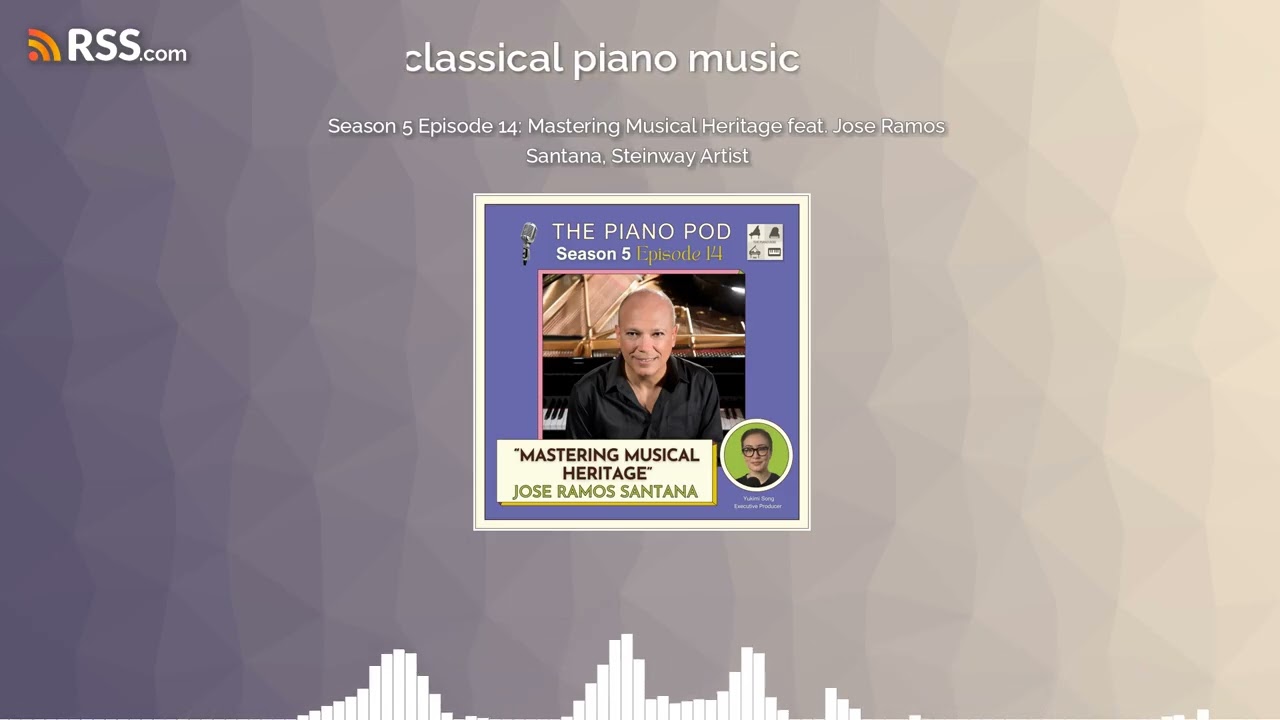
This content was created by The Piano Pod with Yukimi Song. This content was uploaded by The Piano Pod with Yukimi Song. This is a YouTube podcast episode (Season 5, Episode 14) titled "Mastering Musical Heritage feat. Jose Ramos Santana, Steinway Artist" published April 10, 2025. The excerpt is an in-depth interview format led by host Yukimi Song (The Piano Pod) with guest José Ramos Santana, a Juilliard-trained pianist and educator. They discuss Spanish and Latin American piano repertoire—Isaac Albéniz's Iberia, Granados, Manuel de Falla, regional Spanish musical influences, ethnomusicologist Felipe Pedrell, mentorship from Alicia de la Rocha, Puerto Rican classical music, composers like Xavier Montsalvatge and Roberto Sierra, performance/edition issues, and pedagogical lineage. The transcript also includes brief announcer/producer interjections promoting the show’s Substack and episode details.
Chapters
Welcome back to another episode of The Piano Pod, everyone.
Today I am thrilled to welcome José Ramos Santana, a pianist internationally acclaimed for his interpretations of Spanish and Latin American piano music. A Juilliard-trained virtuoso, José has performed as a soloist with major orchestras including the New York Philharmonic, Royal Philharmonic Orchestra, and Detroit Symphony Orchestra, and has graced prestigious concert halls around the world. His artistry and dedication to Spanish music earned him special recognition for the Isaac Albéniz Medal, an honor acknowledging his contributions to the genre. In addition to his performing career, he is a devoted educator, serving on the faculties of New York University and the Hartt School of Music. In this episode, we'll explore the rich world of Spanish piano music, what makes it so distinctive, how regional influences shaped its development, and the pivotal role of ethnomusicologist Felipe Pedrell in defining its nationalistic style. José will also share insights from his work with the legendary and late Alicia de la Loja, one of the greatest Spanish interpreters and truly a legend among legends. Her influence on Spanish piano music is unparalleled, and we'll discuss how her mentorship shaped José's artistic approach. Beyond Spain, we'll take a deep dive into Puerto Rican classical music, a tradition that remains underrepresented in the broader classical world. José will highlight key composers, discuss the connections between Puerto Rican and Latin American musical styles, and share how his Puerto Rican heritage informs his artistry. His journey from growing up in Puerto Rico to training at Juilliard and establishing himself as a leading concert pianist offers a fascinating glimpse into the life of an artist navigating both tradition and innovation. As an educator, he continues to shape the next generation of musicians, and we'll hear his thoughts on the evolving landscape of classical music and the challenges young pianists face today. Before we begin, I want to share something new with you. Every Friday, I publish a blog on Substack where I go beyond the podcast, offering personal reflections, behind-the-scenes insights, and thoughts on music, creativity, and the evolving role of classical musicians. If you enjoy these conversations, I invite you to subscribe at thepianopod.substack.com for exclusive content and deeper discussions. Now, let's dive into this incredible conversation with José Ramos Santana. Please enjoy the show. You are listening to The Piano Pod with Yukimi Song, where we to the brightest minds in the industry about how they are bringing the piano into the future and thriving in a complex, ever-evolving world.
Welcome to The Piano Pod with Yukimi Song with José Andrés. It's such a pleasure and honor to have you on the show.
Thank you. It's my pleasure and my honor to have you as a host. Thank you for having me.
Oh, of course. And then I know you're in like a New York tri-state area.
Yeah, in Connecticut right now.
Connecticut. Well then, thanks. So thank you for joining me on this cold and icy February morning. So, you know, I've always been fascinated by Spanish music. It's instantly recognizable, you know, the moment you hear a piece by any Spanish composer, say, you know, Granados or whatever. Even if you don't know the name of the composer, you know that's Spanish music.
Right, right. Yeah, absolutely. Yeah.
And then there's an incredible fusion of folk traditions with regional diversity and classical structures, and then an ex— really expressive passion and rhythmic vitality that's really, I feel like, sets it apart. So I've also been really always drawn to Spanish culture in general, and the language, poetry, and the cinema. You know, they have such a amazing cinematography, a list of films that they have. And then, so I really like the way that these films really capture something raw and deeply human and emotionally intense, well, just like Spanish music. So today I am absolutely thrilled to explore the world of Spanish piano with you and someone who has truly lived and breathed this repertoire. And of course, I'm excited to talk about Puerto Rican music and composers, which I am yet to learn, and, uh, the— this amazing music of your homeland. So let's start by getting to know you a little better. So you've received numerous accolades and performed on some of the world's most prestigious stages, and then the distinguished Steinway artist yourself. You are undoubtedly one of the most celebrated pianists from Puerto Rico. But in your own words, can you tell us if you were to capture the essence of your artistry, mission, and passion in just a few sentences, how would you define who you are as an artist today?
Well, I'm an amalgamation of many things because My artistry, I was very privileged, very lucky to have had the last, I guess, part of the 19th, 20th century tradition of musicians, you know. When I was born, it was the time that Pablo Casals was in the island and he brought that, you know, his own tradition. Some of my teachers had studied in Europe before Second World War. So, akin to the Spanish culture, two of my teachers have studied first at the Real Conservatorio de Música de Madrid and then to École Normale when it was first founded by Alfred Cortot. So saying that, some of my teachers were, came very much influenced and they studied with people like Ricardo Viñes, who was one of perhaps the most famous first interpreters of Spanish music. And although he lived in Paris at that time, And in Spain, they studied with or were associated with Fernández Arbós, who was one of the notable conductors of the Sinfónica de Madrid at that time. I think one or two of them studied with a lady called Lola Rodríguez de Aragón, who studied with Anton Rubinstein. Stein. So there was, you know, this influence, and the Spanish music was always a very strong kind of definition in my upbringing. So therefore, I think that I— and I loved it— so I think that my mission is to continued that with that old tradition, and of course later on I met Alicia de la Rocha and so on and so forth. But as you said, the Spain culture and the Spanish tradition in me was deeply rooted, and so I feel that, you know, I'm a conduit for the new generation from this point of view. My mission, as I— that's part of my mission. My mission is also to educate young generations of pianists. And right now, for example, I have started in Puerto Rico, Puerto Piano and Strings for Puerto Ricans and also international students to come to the island and just participate in this wonderful festival with international and national artists. So I think that this is what I want to make sure that I establish, you know, as my legacy and as my mission. Also, again, I'm being very fortunate And I'm very thankful for life for having had great teachers in my background from Puerto Rico to, you know, to the end of my studies. They all carry a tradition that is lost. And so anyway, I feel that I am a link to that old tradition too. That of artists in artistry in the piano.
Thank you so much for sharing. So speaking of Spanish music, so let's really dive into this wonderful world of Spanish music that is still yet to be played, should be played more often, I feel like. And because, um, it's still the mainstream is the German and French school and the post-romantic of Rachmaninoff and so on, but Spanish music, I feel like it's underrated still. Right, right. So Spanish music is often associated with flamenco and guitar, but there's so much more to it. Can you walk us through the diverse regional influences?
Yes, for example, let's start from the north. You have typical dances, and of course the Basque Country has their own language, but The Basque have their very complex rhythmic dances. One of them is called sortziko, which by the way, Albanese wrote a piece based on that. It's a 5/4, 1, 2, 3, 4, 5, 1, 2, 3, 4, 5, 1, 2, 3, 4. It's a kind of unstable rhythm like that, but it's very beautiful. And then you also have the Galician, influence which comes from Gales and Wales and the British Isles, so that they also have their own musical language and, and dances typical of their region. Then if you go down, you have, well, today to the east you have the Catalan, the Catalonian ones, also it's amalgamation of Spanish and French and Basque. Then you have Aragon, which you have the famous jota, which you can find in Liszt's Spanish Rhapsody. That's the main theme is a jota from famous jota. And you have jotas also in some of the Albanese Iberia. You find the jota in the Malaga. The first of the fourth book. So, and then of course, the ones that we know most as Spanish music is the flamenco, the south, the Andalusian. And that's amalgamation of flamenco, gypsy, and, but there are also rhythms, for example, in Manuel de Falla and harmonies that are not flamenco. Basically Moorish. So it comes from the Moorish culture, you see, which runs sort of, I guess, parallel to flamenco, but it dates even farther back than flamenco. So I think those are the ones, the, you know, different regions of Spain that you can identify as Spanish music. Those are the cultures, the general musical languages you'll find in the peninsula.
Yeah. Fascinating. Yeah. As I was studying a little bit more about Spanish music for this episode, I'm learning a lot more. I've known Spanish music, the background of it, but it's just the historical background is so fascinating. Right? Yeah.
Right. Yeah, it is.
So then I come across this name, Felipe Pedrell?
Pedrell.
Ethnomusic— yes, ethnomusicologist. I think he holds the key to this quote-unquote Spanish piano music because he's the one who influenced 3 big names you mentioned: Avanés, Granados, and De Falla. Mm-hmm. Yeah. Can you tell me the background of this story? Do you know?
Well, Felipe, as you said, he was an ethnomusicologist. And as an investigator, he delved into all these rhythms and cultures that the peninsula has had. And he encouraged Balbeniz and de Falla and Granados to write in the style of Spanish language, of Spanish folk music, Spanish tradition. So he was a precursor of, let's say, Nadia Boulanger, that in the 20th century also, she motivated all the composers that went to study with her from different countries to write in their own folkloric language, like Copland or Astor Piazzolla, Bernstein. So he was actually the, I think, the first one to recognize that the peninsula has a great cultural tradition in music and dance, and it should be put into the composer's pages, you know, it should be written down as music. And of course, in the case of these people, they were pianists, and so that's how they demonstrated. Distill all the things through pianistic writing. And at that time, you know, it was late 19th century, the influence of Franz Liszt was very much in vogue among everybody in Europe, pianist-wise. And so they, they, they wrote like this in this Lisztian super pianistic way.
Right, right, right. But also, I, I remember these three big Spanish composers, uh, Albéniz, Granados, de Falla. They also spent quite a long time in France. Yeah, I think that, that was like the cultural center around that.
Yes.
So you hear the influence of French music as well.
Oh yes, very much, very much. For example, I think the one that you can see this, the most of this in the Iberia Suite of Isaac Albéniz, when he wrote it in, when he was living in Paris. And he wrote it as impressions of Spain, titled, I'm paraphrasing, but this is what he had in mind. And it was the publisher who said, you know, well, let's find a more marketing title and why don't you call it Iberia Suite? So, yeah. So, but again, Albéniz concentrated in the southern or the Andalusian rhythms of flamenco and distilled by the, Impressionistic. He was a good friend of Claude Debussy. Claude Debussy admired his "L'Albaisine," the one of the greatest pieces written in that period. So he had this— Paul Ducasse, all these composers at that time had a distinctive influence. And thank God, because I mean, his writing is just unique and phenomenal. He took the impressionistic and made it his own with this marriage of flamenco, Andalusian Spanish music.
Absolutely, yes. So for those who are listening right now, we're discussing about Isaac Albéniz's amazing— his masterwork, Iberia. Iberia has 4 volumes, and each volume each volume has 3 pieces.
Correct.
Right. But it's not the little tiny dance suite or anything. It's like each one has— is massive.
Right, exactly. Right. It's also a piece in itself. Yeah.
Oh my goodness. Right, right. And then I know that you performed all of them. It's physically extremely Difficult.
It is, because the problem is that they don't get easier as the volumes progress. The most difficult is the fourth volume, and the more complex and the longer ones like Erez. It's very difficult. It's hard to keep the concentration, of course, the memory for that long period of time with so many notes that he wrote. And when he wrote it, he thought, I don't think anybody's going to be able to play this. It's unplayable. So there was a pianist called Blanche DeSalva that did play it. And she says, no, no, no, this is possible. It takes work, but it's possible.
Really?
Yes.
Well, you know, personally, I did Book 3, all of them.
Yes.
But I didn't perform 3 of them back to back. There's no way I could do. But It was extremely difficult, but I fell in love with it, with them, immediately when I was introduced. So what makes this work really special for you?
Uh, yeah, I think it's my cultural background, my family. I was born toward the end of— my mother was 45 when she had me. So she was quite old. And many of them were born when Spanish— Spain was still dominant. It was the— Puerto Rico was a colony of Spain. And so that root of Spanish was always present in my family. And of course, my teachers too when I develop also they. So that's what I felt so drawn. Also Spanish music seems to be very happy music. Stress the happiness of the human race. The joy of living and the enjoyment of this moment of cultural ecstasy that we have. Because as you say, Spain and, It's so rich and so beautiful in so many ways. But you know, the southern part of Spain and Puerto Rico were very much alike, you know? There's beauty in Puerto Rico too. And there's, you know, at that time, you know, as I said, we were still very much influenced from with the Spanish culture in the island. Yes. So, I found a voice with them, you know? And I was gonna say, when you said before that the pianist education nowadays concentrates, well, I mean, of course, the base of the pianic education, as you say, the German, you know, romantic, even going back to Beethoven, Haydn, Mozart, every pianist has to do that. That's the background, that's the base. But there are other influences that should shape a pianist and education. And let's start first with the French, you know, Fauret. You don't hear Fauret anymore, very little. And Debussy even is becoming not that popular. Ravel, some works because of their pianistic challenge, but But that's another part of the pianistic development that has to be cultivated. The other one is, of course, the Russian music, Rachmaninoff, Scriabin, Tchaikovsky, and all the Russian, and that's also very, very important, and the Spanish. Uh, be quiet in Spanish because the Spanish music frees your spirit to be very creative but yet very disciplined. So you have to really learn to have a free spirit within very disciplined structures and rhythmic patterns and things like that. And that And that helps because if you're playing, you know, I don't know, Chopin, all the Romantics, Liszt, and even the Russians too, Rachmaninoff, you have to have this free spirit in your playing, but yet has to be very, very disciplined. So all these things, all this culture, musical influence, share the same, the same value from a different point of view, different perspective. And the more culture, uh, I think the more you are exposed to as a student, you grow up with that. And I think it's, it's great for the development of a pianist later on when they mature. They have all this resources to, to follow and, and, and fall on, you know. But they are making up interpretations about different styles and things like that.
Absolutely. Yes, yes, yes, yes. So, and this, you know, Iberia, they all— 12 movements out of 12, 11 of them are sort of Andalusian influence, right? And, um, and you mentioned you have such a deep sort of, uh, relatability or closeness to that culture, the southern culture. But except for one, one is the— I think Lavapiés is not from Andalusia.
No, Lavapiés is from Madrid.
Okay.
Yeah.
Why is that so hard? Yeah.
Well, because if you, Lavapiés is a, it was, but it still is called Lavapiés, but it was a kind of an ethnic ghetto, if you wanna describe it that way, where the gypsies used to live and, you know, but they intermingled with other cultures Spaniards. And so it was very, very typical. And then of course, Madrid has their own personalities and their own type of, I would say, yeah, characters. Then you have the characters of the guy and the girl who, the Chotis, the Chotis dance, which is very madrileña. Dance. And of course, the Paso Doble is also there. So, "La Bapiés" was what Albéniz remembered hearing all this confusion. It's a little bit like Charles Ives, you know, that had all these memories when he heard, you know, all this evangelical, hymns, with parades, and with, you know, other hymns from the Republic, and everything together. And he, of course, in his own dissonant, highly complicated language, pianistically, contrapuntally, harmonically, you name it. So, La Vapieuse is that type of piece, you see. That it sort of brings this confusion when I would, I can't imagine Malbén says, God, I remember all that. They had a, like a little organ that you just pumped like that. There was a little monkey that kept, you know, dancing to it. And there was somebody asking for money. And then there was this, the florist selling, you know, the flowers. And there was all kinds of things happening. Very, very colorful. And he tried to write in notes all these dissonant sounds, all these clashing experiences, and that's why it is so difficult.
Yes, yes, yes. And then, but I've, I've heard, you know, many, several performances. Well, one stand out was a live performance by Yuja Wang. She played beautifully, but some recordings, they played it so clean, too clean to me. It's just a miss— it missed out the cultural, like, a little messiness, in my opinion.
Well, the— yes, it— because it's difficult, you know, you have to sort of make a choice, but whether you're going to be very, very clean or just emphasize the rhythm. The one I think that is most I find is De La Rocha, because she has that rhythmic backbone with all this cleanness that she used to play with. And it's fantastic how she does the proportions of sound and form, and everything sort of works for her. Unfortunately, the piece also lends itself to be bombastic, and I think that's already distorting the idea that, you know, it's not bombastic. It can be bombastic because it's so huge, but that's— I don't think what Mr. Albanese had in mind. It was just this super colorful writing, very complicated, and you have to sort of strike a balance between both of those.
Wow. So speaking of Alicia, De La Rocha. So first of all, what was she like?
Well, she was the typical, you know, either Russian teacher or, well, the Spanish grandmother, you know. She was like, you know, for her, her pupils were, you know, part of her, and she took a personal interest in each one of them and their development and their careers. And, you know, so she was wonderful. Yeah.
So you actually studied with her and she gave you—
I, I, what I did with her is I, I studied the Iberia with her, the whole, the whole—
No way.
Yes, I did.
Wow.
Yes. I think we did 11. There was one that I couldn't play for some reason, but we did 11 of, of the 12. I, I worked here with her.
How special. Wow. What stands out of all the probably advice you get?
Yes. Well, it's very funny. I like to tell this story because when I first came to the Juilliard School, well, you know, study with Adela Marcus, of course she knew that I was from a Hispanic Spanish background and she emphasized that I should play this music. So, and at that time, I think I only have done maybe one of the Iberias. Then she introduced me to another one. Well, the Triana, of course, and the first one, Evocación. And she played Evocación in such a convincing way when she was in the studio. Her best performance was in the studio. There she could play like you have never heard anything like it. But what struck me was the understanding of the style that this lady had. She had never been to Spain, and she had never studied with somebody from Spain. She studied with the Levins, the Russian and German school, Schnabel, And yet she was able to capture this, the flavor, the spirit, and even the rhythmic turns and did it so well that it just, I was in awe, you know, how she did it. I think she used to play also Andalucía from the Falla, again, in a manner that the other person I've heard play like that is De La Rocha. So when I went to De La Rocha, I played some of that, and De La Rocha said, "Oh my God, you play very beautifully. Who was your teacher?" So I told her, then she, De La Rocha called the Academia Marshall and told them about me and blah, blah, blah. But so, studying with De La Rocha was like a continuation of what Marcus was doing. I remember doing once El Albaisín with her, and of course, you know, sometimes you forget, uh, the— there's, you know, they're so complicated that you just try for getting the notes right and clean. And she said, no, no, no, no, no, phrasing, phrasing. It was just like listen to Adel Marcus teach. Yeah, so, uh, it was, it was very, very interesting, very illuminating. She gave me some information about you know, what the dances are, the intricacy, the intricate complexity of the dances. And for example, she pointed out to me La Jota in Málaga, in the middle section of it. She says, this is a Jota, you know. And so you want to see what a Jota is, you go and download one of those YouTube videos of the dance in Aragón and you see what the Jota is. But she was just wonderful, just wonderful.
Wonderful to hear that. And so, you know, obviously, I have this personal question. As I said, I learned a few from Iberia, and I often notice that his notation is quite messy, you know? On the score, even the ones that printed on the print. There's some— I feel like some of the notes are wrong, wrongly notated, or maybe sometimes the accidental is missing. Or am I wrong?
Well, yes, you have to be very, very careful. The only two editions that are true to what the composer, Albanese, wrote— well, the only one really is the Urtext. The German urtext, they have it, and that all the notes in the urtext are correct. This is a very interesting topic, what you just brought up, because with Beethoven and composers like that, it was very difficult sometimes. He erased and he wrote on top, and you didn't know what really the notes, what he meant. But with Albanese, when you see the script, you go to the Library of Congress or you go to, The Morgan Library of Iberia is so clear. And how can editions in France like Durand misinterpret that? I still, it's mind-boggling. I don't know what, they did a very sloppy job sometimes. So it took somebody like de la Rocha and this to say, look, let's do a real good edition. And she promoted. You know, the real note correct writing and reading of the notes. So I think she had a lot to do with that. In that album, I think there are a lot of wrong notes that she corrected. She says, no, no, this is not the original. It's this, this is. So, and of course, you have to redo what he did. You know, you cannot really play it as it's written. It's unplayable. You have to take things into hands, you have to, you know, and you have to voice them properly sometimes. So you have to make easy. For example, when you take the one that everybody is so afraid, Triana, there are ways of playing it that makes it more possible to play., you know, and, uh, in, in a way of not affecting the music and the music impulse or the music phrasing because of the difficulties. So if the arrangement helps that, why not? Really? Yeah.
But that's something that I have to learn from someone like you.
Yeah, yeah, yeah, yeah. You have to rearrange many of those pieces. Adela Rocha did too. Rearrange many of them.
Really?
Yeah. Yeah. The LaRocha's hands was interesting because she had, they say small, but she had long fingers. So she was able to, you know, uh, when you have long fingers, that's a, that's a plus. Even though you have a sort of a small hand, but you can do many things with long fingers.
I see.
You have short fingers like mine and it's, that's more challenging. Joseph Hoffman had short fingers too, and yet he was great as virtuoso. So, you know, it's how you manipulate the piano.
I see.
Yes, De La Rocha used to say.
Huh, that's interesting. And then it's, it's so true. Yeah, yeah. Well, thank you for sharing this, all these insights about Iberia. I've always had big question marks about interpretations and things like that. So just coming from me, especially studying with someone like Adel Marcus, and then of course with Alicia de la Rocha's insights, it really just all of a sudden the music even comes more alive to me.
Right. Yes. Yes. And, you know, as I said, my main teacher was Marcus, but de la Rocha, I only studied the Iberia with her, but she, she considered me one of her pupils. I was like, honored. I said, well, thank you so much. Oh no, I'm like, pupils always mean a lot to me, so keep me posted of your career. She was so sweet. She was like a grandmother.
Oh wow.
Yes.
What a, what a, what a great story.
Yes.
Yes. Wow. So now, can we now move on to Granados? And I— yes, uh, Granados also, you played his most famous Guayasca's piano suite. So can you tell us what makes this, these series of pieces so—
Well, Granados was, you know, the improviser. All of that you've seen in page was improvisations that he did.
No way.
So yes, everything is improvisation. So he decided, or somebody, I can't remember, decided, say, you have to pen them down, you have to write them down because they're too precious just to left in the air. So he did. Goyescas is based on the opera Goyescas, which scenes from Goya's painting. And so the style of Granados is much more conventional in the sense of pianistic writing, you know, like more Lisztian arpeggios and double notes and things like that, uh, in a more clear way, not harmonically as integrated. Uh, but there were two main influences in Granados' upbringing. That was Robert Schumann and Domenico Scarlatti. Oh, okay. Yeah. So many of his writing has this type of Scarlattian clarity and bite to it, you know, with this very romantic, I guess, French salon style. But Amalgam, the Goyescas is a throwback to classical Spanish music, meaning from the classical period. Arriaga and composers like that, which weren't that many, but his tonadillas were all, you know, based on classical Spanish music, not necessarily flamenco or Andalusian. It's different.
I see.
You have a piece called Zapateado, for example, which is, it's a part, Zapateado is, well, you have that later on in Latin America, in Mexico, Zapateados means to dance with your foot in a particular manner and rhythm, you know? So even the gauchos have Zapateados when they, it's like a cowboy dance, became a cowboy dance, in Latin America, but it stems from dance, from the dance with the feet in Spain. Then you have pieces like "Alegro de Concierto" or "Cenas Romanticas," which is very much romantic piano music, which, with a Spanish flavor. That's mainly what it is. And also, I must say that You know, he was the founder of the Academia Granados. It's— he was a pedagogue. He loved to teach. Albéniz was not much of a teacher, but he loved to teach, and he loved to— and he lived in Barcelona most of his life after he came from Paris, and he founded this academia. He did treatises on piano playing technique. Pedaling, production of tone and sound. And it's very interesting because I read somewhere that he came to the same conclusions as Theodore Leschetitsky did in terms of approaching the instrument. I don't think they knew each other, but it's interesting that they both found out this way of playing, this way of listening to sound, which is, you know, part of the old romantic pianistic tradition.
Right, right.
So that's why you have somebody like Frank Marshall, was a great teacher and teaching Alicia de la Rocha. Her, you know, she has this approach to music, the structure, the grandeur, the the production of a sound, the pedaling, which is not taught anymore. You know, people just put the things— they say it was by ear. Yes, but you have to train the ear to hear it properly, how to play it all. And it's a whole discipline. So Granados wrote a treatise on pedal, how to pedal.
Wow, that's interesting. So Alicia's teacher Miss De La Rocha's teacher was Frank Marshall. Frank Marshall studied at the Academy.
Yeah, he studied with Granados. He was Granados' pupil and assistant, and when Granados died, he, you know, he did continue the Granados Academy. He called it Academia Marshall, his own name.
Wow, really interesting. So with that tradition Yes. That Della Rocha had, and then now you have the tradition coming from her, right? Yes. Yeah, that's very, very intriguing. So, I mean, there are more pieces that we can discuss, but I also want to really get us some sort of sense of Dafaya from your point of view, Manuel Dafaya. And you've performed the Nights in the Gardens of Spain.
Yes, I will perform it next year again. Yes.
Oh, wonderful. That's such a unique orchestral plus piano.
Yes, a very beautiful piece.
Yes.
Um, the orchestra sets a background of, I guess, uh, uh, I would call it Moorish impressionistic sounds and, and textures. The piano has, uh, the more of the cantejondo flamenco role and, and rhythms also, uh, also colored by this beautiful impressionistic and neo-romantic harmonies. Always, I think, considering the— he always had the sound of of the Andalusian music in his ears. So he was able to write harmonically as he heard the sounds. But in Fantasia Betica, he uses some of it, but he goes back to the Moorish tradition, which with the quarter tones and things like that. So he tried to imitate that at the piano the best he could, and he was quite successful.
Yeah. So to do that, do you use trills a lot?
You have to use the pedaling. You have to be very careful how you pedal to create this harmonious overtones and blurs to give the impression of these overtones that the Moorish instrument gave.
Wow.
Yeah, he was also an ethnopsychologist inclined. He didn't write too much. He was a very ascetic man. He lived a very— he almost was like a monk. And of course, he moved to Buenos Aires, Argentina at the end of his life. But everything he wrote was so well planned and so well thought, you know, that not one note was out of place.
I see. Okay. Yes. Wow. I have yet to really learn his pieces. I've touched upon a little bit, but not quite.
For example, the Four Spanish Dances. The first one, it's a jota. Pa-pa-pa-pa-pa-pam. Ta-ta-ta-ta-ta-tam. The real jota. The last one is a totally gypsy flamenco dance. With the taconeado and things like that. And the other ones are again amalgamation of impressionistic Cuban habaneras, very exotic. So the Latin America and Spain later on, they fuse much more and more, and so sometimes it's difficult to distinguish. For example, The best example is the tango by Albanese. He wrote this tango, and tango was brought from Argentina to Spain and to Europe, and Albanese immediately wrote this beautiful piece called the Tango.
That's true. Yeah, yeah, yeah. The Piano Pod with Yukimi Song is now on Substack. If you're wondering, Substack is an all-in-one platform platform where creators like me can connect directly with you, share exclusive content, and build a thriving community.
By subscribing, you'll get behind-the-scenes updates, early access to new episodes, and special perks designed just for our audience. Your Substack subscription helps us create more of these meaningful conversations and support initiatives that uplift the classical music community.
So join us on Substack and be part of this journey.
Please go to thepianopod.substack.com/subscribe or click the link in the description to subscribe today. Thank you for your support, and I look forward to sharing more joyous and meaningful experiences with you on The Piano Pod with Yukimi Song with Yukimi Song with Yukimi Song.
Let's move on to the 20th century Spanish music, which you've done the complete piano violin works by Xavier Montsalvatge. Montsalvatge, yes, yes, yes, yes. Very hard to pronounce.
I know, yes, means wild forest.
Oh really? Oh my goodness, yeah, but his music is like a wild forest.
It is like a wild forest.
Yes, right, and like he Just he has this, some of the, I've listened to his solo pieces as well and then has the sort of Afro-Cuban influences too.
Oh, yes. There you are. The amalgamation of Caribbean and Spanish music. And of course, he took the poems of Nicolás Guillén, great poet from, and he set them to music with this just delicious, pieces, harmonies of Habaneras and Afro-American, Afro-Cuban dance at the last one. It's just fascinating in the hands of a Spaniard.
Yeah, yeah, yeah, yeah. Beautiful. So for my listeners, please check out Mr. José Ramos Santana's recordings of some of the pieces I mentioned, especially this violin and piano works by Monsalvache.
Yes.
Monsalvache. And then also you have other recordings, obviously.
Oh, so yeah, I did, I recorded the Glossas Piano Concerto for piano and orchestra with the Royal Philharmonic by my friend with my colleague Roberto Sierra, noted Puerto Rican composer who's having a great, great career to this date.
Oh, that's right.
Yes, yes.
I know the album. But don't you— didn't you also record like concertos, like Ravel concertos?
Ravel G and the Saint-Saëns G minor.
That's right. That's right. Yes, they are incredible. And then I can't wait to talk about Roberto Sierra. But before that, I kind of want to know your upbringing in Puerto Rico, and then, you know, how you discovered the love for music. And then, you know, later on, you moved to the United States and studied at Juilliard with Adel Marcus. So, how was music introduced to you?
Well, my— as I grew up with my mother's— from in my mother's side of the family. My mother went back to live with them and she took me. So since I was, you know, a baby, my aunts and my uncles, they all love music. They weren't professional musicians, but they were amateur musicians. And my aunt studied voice with the great tenor Antonio Paoli, who was a very, very important figure in Europe in the early 20th century, late 19th century. He even sang under Verdi, one of the Otello productions, I think, in Covent Garden. So my aunt loved music, loved opera. So, and then, but my other aunts all took piano. My uncle loved music. They were founder members of the first Pro Arte Musical in the 1930s in Puerto Rico that brought all the great artists, Segovia, Rubinstein, Claudia Rau, Jascha Heifetz to the island. They used to stop in Cuba and then in Puerto Rico. And so that was the background of my, when I grew up. Then my next-door neighbor moved to be a pianist herself, her daughter, and both, actually she started with this great pianist. She's known as Mexican pianist, but really she was born in Gurabo, Puerto Rico from a Puerto Rican father, Angelica Morales Fonsauer, and Angelica was a pupil of Franz, Emil von Sauer, who was one of Liszt's pupils. Yeah. So I had that next door to me, this teacher who studied with her. I used to hear her practice. So I started because of course we had a piano and I used to hear her practicing. I used to go to the piano at my house and try to pick up by ear what they were practicing. So she calls one, my mother, she says, wait a second. Is somebody trying to play what I'm, the Greek concerto that I'm practicing? I said, oh yes, that must be my son. So anyway, so she said, really? I was 4 and a half years old. So she said, well, send that boy immediately to me. So I started with her, but I developed mostly with the Figueroa family after a period of time. When I was 7, 8 years old, I went to the Figueroas and they were, They were the ones to really, really develop me. Carmelina Figueroa, my teacher at that time, was the head of the High School of Performing Arts in Puerto Rico. The Free School of Music, it was called, or it is called. And she studied in Paris. She studied à l'École Normale with all her brothers and sisters. They moved there and they were under the umbrella of Cortot, Casals, Thibault. They formed the quintet, Figueroa Quintet, at that time in Paris. And if it weren't for Hitler and the Second World War, they would still probably be there. But then Second World War broke, then they had to come back to Puerto Rico and they started teaching there. So my teacher, it's interesting, 'cause l'école normale at that time, You have people like Dino Lipatti, René Giannoli, Gitta Bachauer that went through the École Normale or studied with Cortot, but it was meant to be like a pedagogy school, I was told. The Conservatoire of Paris always was the performing, it was the Juilliard of Paris, but l'école was more of to train good teachers. So my teacher started with an assistant of Cortot, Jeanne Blancard, and she was a great pedagogue. So she gave me a very, very good foundations. So when I went to the Juilliard School and I played for Marcus, she was like, "Wow, you really know how to play the piano. Who taught you?" And so I told her. And so when I went to Marcus, I had that already., you know, under my belt. So Marcos just really developed me and disciplined me and all of that. But I had a very, very good foundation, good training, good sense of musicality and an ear for sound and all of that.
That wonderful, wonderful ear.
Very, very privileged. Yeah, very lucky.
But developing ear is like the Really the most priority, most important thing, and the most important thing.
Absolutely.
Yeah.
Wow. And what was it like back in Juilliard days?
Well, Juilliard, they used to call it a professional school, so it was a very professional school. Um, it was a big shock for me, you know, coming from Puerto Rico to, to just be in New York at that time. And, but my mother moved with me, and the training that Adele Marcus expected was just very tough. She was a very tough, demanding teacher, and I've talked, talking later on nowadays with my colleagues, the ones who studied in Moscow, the Moscow Conservatory, it was the same kind of training. You had to be able to, you know, have pieces. I remember I had 8 works in one semester by memory. She demanded you have to have it by memory the second week, and it was really that type of training, like in old Russia. But that gave me a tremendous discipline, and, you know, later on, she was not the most easiest person to get along with. But later on, in the later part of her life, we became very, very good friends. So we used to have a laugh and dinners, and we talk about music. She would hear me for hours, and she would sit down and advise me, and it was wonderful.
Yeah.
Wow, wonderful. And then your career as a soloist and —recording artist flourished, right?
Yeah, flourished. Yeah, after that I immediately signed with Herbert Barrett, and then I went to several competitions. I was the finalist in the Bach Hour, uh, then I won an affiliate artist that gave me opportunities to play with many symphonies across the nation, and included in New York Philharmonic, Detroit Symphony. Yeah, so that was That was a good, good St. Louis Symphony, good break in that time, my career. I was very lucky. So, you know, if you ask me then and now, it has been such a different, you know, what the young people face now and that from my time when I was at that age, at the younger age. It has changed quite dramatically, completely, I would say.
Yeah, I think so too. Now then, maybe we can talk about that. You're an educator, you're teaching at currently in Connecticut, it's a hard school, and, uh, uh, also you also teach at NYU.
I am, yeah, one of the artists faculty.
There's such a huge difference between the time that you spend as a youth, as a young professional, to now. Drastic difference. And as a musician, or young musician, they are all required to have multiple different skills, not just as a pianist. Yes, time has changed. So that has changed. Yeah. What do you, what do you see?
Well, um, of course the demands are different now, you know. From where I was, but I believe that the students, for example, when I was at the Juilliard School, besides piano, I took courses on improvisation. I took courses on accompanying, transposition, orchestral reading, many, many other things that prepared me to do things that I needed to do. I even took organ. So, you know, I was in a strand as a musician. I needed to play for a church once. I did it, you know, it was no problem. So the education I got at the Junior was very, very valuable. I think they planted the seeds for what I have become. Later on, the best education I've really gotten is by teaching. I have learned so much I learned so much from teaching. I, you know, I discovered so many things that, you know, that has really, has been my education. So for my students, what I'm shocked nowadays is, I don't know, maybe it was like that, but I wasn't aware, but, you know, they don't know the piano repertoire. I remember, just to give you an example, I had a student once who came from a prestigious Ivy League school with a prestigious music department, and I was shocked. I mean, things he didn't know. I said, "Well, you're a pianist, you never thought—" "No, what a culture you have." I said, "Well, I think that how can you be and not know those things, you know? How can you be complete musician and not know these things?" things, you know. And, uh, the same thing, you know, with the art, you know, I was exposed to museums, to opera, to chamber music, to theater. This— they are not— they're just very much on the practice rooms and trying to win a competition. And this is very stifling because especially nowadays, if you don't win a competition and you What are you gonna do, you know, if you don't have all these other skills developed, if you wanna be in music? So I insist on this well-rounded education to my students, and I provide them myself. You know, I take them to museums, I take them to the opera, I tell them what to listen for. Yeah, I think this is very, very necessary, and it's lacking. In their education, or it's been given but very, very lightly, very superficially, and not enough, you know.
It's not integrated into their lives, right? Absolutely not. No.
And it's not realistic, but as I say, because they only think in terms of competition. But if that— how many people can compete and win? 1, 2, 3 at the most, you know. That doesn't even guarantee a career, it just tells you, you know. Absolutely. A few years of concerts and then what? See? So, uh, you have to be prepared for the then what, you know, because that's going to be most of the time of your life. Yeah, and you have to be an entrepreneur, you have to know how to become creative, you know. The classical music is challenged now by pop music, which is a great competition. So I think that in a way it's been our fault because we've been so in such a bubble, you know, all the time that we don't realize there is a world around us and we have to connect with the world and the needs of the world and the needs have changed. So I believe in bringing classical music to Everybody, not just an elite or just, but everybody should be exposed because this is such a gift to just enjoy this great universal music. I hate to put it classical music, say universal music, you know, that bind us together and things like that. And I think should be access to all kinds of economic, social economic levels, not just a privilege.
Yeah, I know. And I see that too. So even when I see— I'm raising quite a few young, small, but talented students, but then they're so focused on the competitions because that's how the industry is right now. And even not just the music, classical music industry, but I think in general, If you wanna get into this school, that school, then you gotta win this thing or you gotta score this thing. It's not about being exposed to a different culture. No.
When I went to school, I didn't go for the school. Once Leo Fleischer told me, what do you think, Juilliard is gold? No, I didn't go for Juilliard for gold or for Juilliard because it's gold. I went to Juilliard because of a teacher. See, I wanted to study with that person. I wanted to get that legacy. Kids don't think this way anymore. They just think in terms of the names of the school. And that's unfortunate. That really is unfortunate because this, we're not in a, this is not, I mean, there is a certain sport and commercial aspect of our profession, but the root is art. And as Adel Marcus once told me, Your career starts at the piano. Nothing else. If you, you know, if you're really good at the piano, if you're really an artist, do that. Life will take care of that. Life will take care of you. But you have to have that first. Yeah, and this is what is not— this young generations don't don't really have in mind. It's a little bit empty, hollow, their approach to, yeah, to everything.
Yeah, and later on, yeah, they discover about it. I want to go back to your roots, Puerto Rico. Yes. So, you know, because I still want to learn about composers. You mentioned about Roberto Sierra. Yeah. But I also know González de Jesús. Núñez and then Adlan Cruz. And yes, um, so can you just tell us about this beautiful, beautiful music of Puerto Rico and what—
Okay, so let me tell you my, my view of Puerto Rico. Puerto Rico is a nation. What by saying is a nation is that it has all kinds of music. I'm talking from a musical point of view. So we have obviously the salsa, we have the pop music, we have what we know of Puerto Rican music, the Caribeños music, that it's universal now. But there is also a parallel world of folkloric music that has not really been popularized. For example, the music from the mountains, The jíbaros, they have their own way of singing, which comes from the Canary Islands in Spain as a root. You have the African, Puerto Rican population, bomba and plena, which is also not known so much. So having mentioned those, let's say, three, and of course you have the European influence from Spain and France. Those music we had in Puerto Rico, polkas, we had in Puerto Rico mazurkas, and all sorts of a European form of music written by composers from Puerto Rico. I'm talking about the 19th century. Many of these composers like Julio de Arteaga, And Manuel Tavares in 18— I'm talking about 1865, 1870, 1880, went to France to study at the— in France at the Conservatory, or people with or from the Conservatory. There was a Marmontel was a very famous piano teacher at that time. I think he was a pupil of Carl Brenner. And this one you mentioned, Gonzalo Núñez, who later moved to Cuba, and I think he died in Cuba, but he was born in Puerto Rico, studied in Paris with George Mathias, who was an Englishman who was one of Chopin's pupils. Oh, I see. Yes, see? So he was supposed to be quite a virtuoso. I think he played in New York once in Aeolian Hall, a very old hall that doesn't exist anymore. Existing in ages, but he settled in Cuba. So he wrote music again with kind of habanera rhythm, but very French salon style, you see. Now, Tavares was— he stayed in Puerto Rico. His daughter, Elisa Tavares, was a pianist, and she became a one of the— she was like the Rosina Levine of Puerto Rico in that time. And she studied with Isidore Philippe in Paris, and she studied— she played in New York too. She started Academy of Piano in Puerto Rico. Many of the pianists of the early 20th century studied with her, Elisa. But Manuel, her father, was the one wrote danza, la danza puertorriqueña. He was the father. The danza comes from the Cuban contradance and the Cuban habaneras. People like Ignacio Cervantes Saumel wrote in Cuba contradances and dances who were just salon pieces with a promenade for first A section, then the dance, the B section, and goes back to this A. Well, there's introduction, A, B, A. That's the format of the danza. In the hands of Cervantes, was very, very short, maybe 1, 2 pages at the most. In the hands of Mr. Tavares in Puerto Rico, it was 3, 4 pages long. So he, you know, expanded that. Form of danzas. And as I say, danza means to dance, but it also means to listen. So it's like a masurka, it's a combination of dance and song. So you can sing it too, yeah. So, and one thing about Cervantes, even though he was in Puerto Rico, he was Cuban, he was living in Paris at that time. He studied there and he lived near Franz Liszt. And Mr. Liszt walked one day through and heard this piano music, very weird, very exotic. So he knocked on his door and Cervantes opened the door when he saw Mr. Franz Liszt in the footsteps. And Franz Liszt came in and he played some dances that he composed for Liszt.
Really? No way.
Yes, he did. Yeah. That's so cool. It's cool. Yeah. So, but Puerto Rican dances in the hands of Manuel Tavares, then there was another Juan Morel Campos that came at the same time. He was not a pianist, but he wrote a lot of dances for piano. And Mr. Morel Campos never left the island, yet he was the most prolific and inventive. I mean, he had very, very innovative way harmonic, even, to impart to the danza Puerto Rican. He wrote over 500. Oh, wow. Yeah. Then in the 20th century, that tradition of danza has been still, you know, up to this day. There, I had a pupil of mine who wrote a danza, but it sounds like a danza written by Richard Strauss. So chromatic and so, you know, but it still has that, yeah, that habanera kind of rhythm, you know, the Afro-American, the Afro-Puerto Rican, Afro-Caribbean, and the French. So it's fascinating. So that's one genre that the Puerto Rican classical music has cultivated. Then in the 20th century, composers like Hector Campus Parsi, Amaury Veray. They were born in the '20s, so they got to study either in Paris with Boulanger or in United States, Campus Parsi studied at the New England Conservatory with Aaron Copland, Irvin Fine. And so they went back to Puerto Rico. They had positions of administrative and teaching positions at the conservatory in the government, and they wrote pieces based on other Puerto Rican folk idioms like la bomba and plena, which is Afro-Puerto Rican music. Mr. Campos Párzquez wrote a plena for piano that is very, very effective. Planner, written the concert planner, he called it. And then you have somebody like Roberto Sierra, who was a pupil of all these people, and he was already a product of when Casals, Pablo Casals, founded the Conservatory of Music in Puerto Rico. And Roberto was a pianist. I remember him being a pianist and participating in student recitals, but then he decided to continue as a composer. He went to Utrecht, I think, in Holland. He studied with Ligeti, and so he became one of Ligeti's students, and, you know, the rest is history. He has been very successful. Just now Dudamel and the Berlin Philharmonic play some of his music. He's being recorded by Deutsche Grammophon, and he's written a lot of music for piano. He has, I think, 19 sonatas for piano. No way. Yes. And his writing has evolved tremendously. He also has the 24 preludes based like in Chopin's preludes. Do you plan to play any of them? Yes, I've done some of the preludes, I haven't delved into the sonatas because they're very difficult. I haven't had the time, but I have some students of mine that I want them to study solo because they're really, really wonderful pieces. And yeah, yeah, very, very innovative. But imaginative, they're very difficult, very complex. But yeah, they're wonderful works.
I need to get the score. Yes. The score's available.
Yes. Yes. Ah, Subito Music, I think, is the publisher, I think.
Yeah. Yes. Yeah. I'll check them out. Roberto Sierra. Sierra. Wonderful. Wow. So, I mean, all these composers, Latin, especially Latin American music, is underrated. So that's why someone like amazing artists like you is promoting the music of Latin American music and Spanish music as well. Right. So, yeah. How is it going?
Actually, I teach a course in for graduate students in Latin American piano repertoire. It's part of Piano Literature courses, advanced.
And at Hartt School?
At Hartt School, yes. We examine country by country. With Mexico, Brazil, Argentina, Venezuela, Colombia, Panama, you know, so we take a good look into the composers that shaped the 20th century in those countries, and we're very, very fascinated. For example, we just finished Chávez, Carlos Chávez, And Manuel Ponce, and the difference between both two composers from the 20th century Mexican piano writing, it's really, really striking. Not to tell, you know, the ones that are now still alive that are very more on the aleatoristic style and things like that. So there's a great wealth. There's a great wealth in piano music in Latin America. We just know maybe the frosting of it, but there's a lot of other very— in Argentina there you have Alberto Williams, you have, well, José Castro, of course Ginastera, and you have Osvaldo Goliov now. So Richard, it's another one that I'm forgetting the name. But there are a lot of composers that written for piano music that is fascinating and is worth discovering because it's very, very well written and very, and you know, our ears have maybe 50 years or 70 years ago, it was a little bit shocking, but now our ears have, the evolution of our ears is great. Has the capacity of, you know, absorb this music much with more intelligence and understanding and appreciate the cultural aspects of them. Yeah. Yeah. Wonderful.
So, you know, as much as you've, you know, become this artist and, you know, gain your reputation and artistry worldwide, but seems like you are giving back to your home country, your— where— yeah, your heritage, by doing a festival, the Puerto Rico International Piano Festival, but also promoting Latin American music as well. Tell me a little bit— I know you mentioned a little bit about the festival, but Yes, I must give a plug on my festival.
It's happening, we're going to celebrate the 10th anniversary. Oh wow, congratulations! Thank you. It's held at the Conservatory of Music in Puerto Rico, in San Juan, Miramar, which is a beautiful conservatory thanks to the one my colleague María del Carmen Gil, who fought for it and got that building and transforming it to, it was one of the 40 most beautiful conservatories in the American territory. And not only that, but it's an old Stanway school. No way. Wonderful. Yeah. So there are wonderful facilities for practicing, for playing. The pianos are kept in tip-top shape. And it's usually in the summer. This year is going to be from June 22nd until June 30th. Yeah, and we have a roster of wonderful artists. Eduardo Salim has been a part of it, Eteri and Japaritze. We have had Pavlina Dokovska from Mannes. We have had people like Andrés Cárdenas in the violin department, Amit Pellet, the great Israeli cellist. So we do chamber music. We also— and piano. Yeah. And of course, the Puerto Rican teachers like María del Carmen, who's here, who's the head of the piano department. And this year we have Diana Figueroa Pabón, another distinguished part of the faculty from Puerto Rico. We have in the violin also Francisco Cabán, who's a wonderful pedagogue, and Luis Miguel Rojas, although he's Venezuelan, he's been in Puerto Rico for many years. He was part of El Sistema, great cellist and a great teacher. So we also have Daret Atkins in the violoncello department from— he's going to visit us this summer from Oberlin and Juilliard. He's part of the faculty there. So we have Manuel Laufer, who's— NYU, yes. NYU, specializes in 20th and contemporary music. So we have a wonderful, wonderful Festival.
Wow. Yes. And then age is targeting like the professional age, or it can be if it's under 18, they can be—
they need to be accompanied by a guardian or a parent, but they can, you know, they can come. And, you know, and then grads, undergrads, you know, students.
Great. Yeah, I will make sure to list the link in the show notes. Yeah, that would be great.
Yeah, it's a one— everybody goes, they love it because they fall in love with the history, the culture of the island, the performance facilities, and the teaching that is very intense, but it's excellent, excellent. I did this because there was a lapse in where I hear my colleagues from Puerto Rico, oh my God, You know, the piano department is not what it used to be. You know, we're not producing, we're not getting students. So there was a shift mostly for opera, and there's a great voice talent in the island, but I think the piano was a little bit abandoned. So I thought, well, let me see if I can infuse them with a new, you know, innovation of doing a festival for the conservatory, and it has created a lot of enthusiasm, and some of the kids from the conservatory have proven that they have come here. One of them is studying at the Eisler School in Germany, in Berlin. The other ones has been here at NYU and Mannes. So we're beginning to see, you know, local students cross and become very, very competent pianists. Oh, wow. So that's— I'm very happy about that.
Yes, yes, yes. Great. So is there any upcoming concert you have or any recording? That you want to perform?
Let's see. Well, I'm supposed to go to— we're also working with— in Spain with Barcelona and Zaragoza, the conservatory. So I'm supposed to go there and give master classes. I'm going to Shanghai, China. Yes, I was there last summer. Had wonderful connections, especially the Shanghai Conservatory. And so that's coming up, and my festival is coming up. And so, and I'm playing the Nights in the Gardens of Spain with the Puerto Rico Symphony of the Fire next season. So I have a few things to look forward to.
So my audience can check out your website to get the latest news. Your website is at joseramos santana.com, correct? Yes, yes, yes. Right. Well, it's been a really wonderful conversation. It's almost time for us to go. Thank you so much, José, for really joining. But before, I forgot to tell you, we usually do a little rapid-fire questions before we go. They are silly questions, but every guest has to do it in order for them to be dismissed. So I want you to answer them as short as possible. And they are really just trivial questions. So let's start with one. Okay. First question: What is your comfort food?
Oh, my comfort food is Puerto Rican food.
Oh, yes. How do you like your coffee in the morning?
I can't live without it. I cannot live without it. You cannot live without it. Puerto Rican coffee. Okay.
Are you a cat person or dog person?
Both, but I tend to be more cats.
Summer or winter? Summer. We need to get out of this miserable winter. Yes. Okay, now level 2. What skill have you always wanted to learn but haven't had a chance to?
To be an artist, a painter.
Oh, what is your word to live by, or words to live by?
Uh, don't you lose your, your focus and don't lose your faith.
Great. What is the most important quality you look for in other people?
Innate goodness, integrity, innate honesty.
Name 3 people who inspire you, living or dead. Uh, that's hard. I know, just whoever comes to your mind.
Well, one of them is Mr. Casals, Pablo Casals. I admire him greatly and great respect for him. My teacher, Del Marcus, was a great, great influence on me, and I'm very thankful for her. Um, and The last one is, I would say, well, my mother. Wonderful, great.
So last question, fill in the blank: music is blank. Music is life. Beautiful, great. This concludes the episode of The Piano Pod with Yukimi Song with José Andrés. A heartfelt thanks to you, José, for joining us today. Thank you. And then To our wonderful audience, you can learn more about José and his work by visiting his website at joséramosantana.com and start listening to his incredible recordings. And then of course, thanks to our faithful fans and listeners for tuning in today. If you enjoyed today's episode, please give it a thumbs up and subscribe to The Piano Pod with Yukimi Song. And don't forget to share and review this episode on your go-to podcast platform. I will see you for the next episode of The Piano Pod with Yukimi Song with José Ribeiro. And thank you so much, José, once again.
Thank you very much for your opportunity. It was a pleasure to be with you.
Thank you, José.
More from The


Spirit, Body, and Soul: Pianist & Composer David Berry on Virtuosity, Creativity, and...



Season 6 Episode 20 | "Spirit, Body, and Soul" feat. David Berry, Concert Pianist & Composer


Beyond Borders: From Argentina to Poland to Texas—Oscar Macchioni reflects on a life in music

Sound Liberation: Joe Williams on Black Artistry, Legacy & Belonging in Concert Music


