Season 5 Episode 15 "Reimagining Raga and Jazz" feat. Charu Suri, Pianist & Jazz-Raga Pioneer
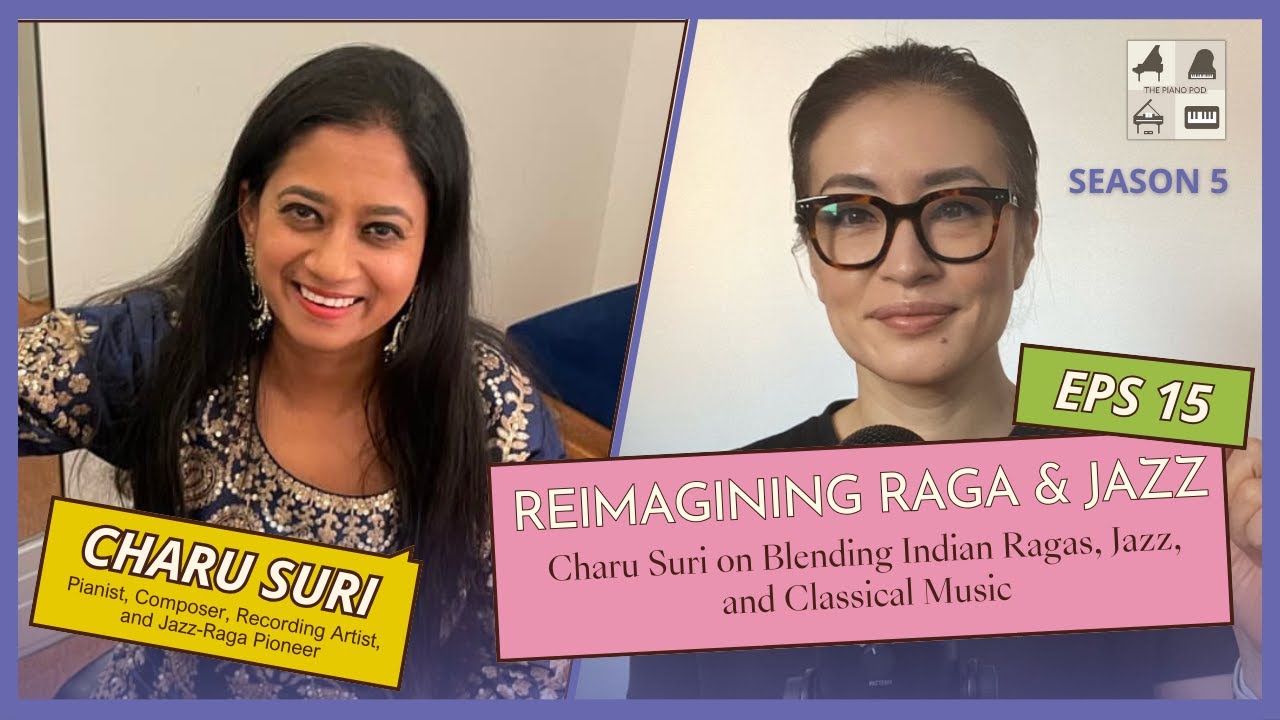
This content was created by The Piano Pod with Yukimi Song. This content was uploaded by The Piano Pod with Yukimi Song. This is a YouTube podcast episode (Season 5 Episode 15) titled "Reimagining Raga and Jazz" from The Piano Pod with Yukimi Song (created 2025-04-16). It is an interview-style conversation hosted by Yukimi Song (appearing as YUKIMI SONG) with guest Charu Suri, a pianist and pioneer of "raga jazz." The discussion covers what a raga is and how it differs from Western scales, the overlap between Indian raga improvisation and jazz, Sufi influences, Charu Suri’s upbringing (born in Madurai, childhood in Nigeria and India, classical training, later immersion in New Orleans jazz), and the creative stories behind her albums (The Book of Ragas Volumes, Ragas and Waltzes, Rags and Ragas). Metadata: title "Season 5 Episode 15 'Reimagining Raga and Jazz' feat. Charu Suri, Pianist & Jazz-Raga Pioneer", contenttype=YOUTUBE, createdtime=2025-04-16T00:00:06+00:00.
Chapters
Welcome back to The Piano Pod with Yukimi Song with everyone.
I am so glad you're here because today's episode is truly special. My guest is Charu Suri, a trailblazing jazz pianist and composer whose music defies conventional boundaries. Charu has crafted a sound entirely her own, weaving together the intricate beauty of Indian ragas, the improvisational soul of jazz, and the spiritual depth of Sufi music. The result is a sonic landscape that feels timeless and entirely new. Charu's journey is just as compelling as her music. Born in India and raised across 4 continents, her global experiences have shaped a musical voice that is rich, rooted, and refreshingly original. She is one of the very few female jazz composers of Indian origin to have graced the stages of Carnegie Hall, Lincoln Center, and Berlin Jazz Club. Her critically acclaimed albums, The Book of Ragas, Ragas and Waltzes, and her most recent work, Rags and Ragas, have redefined what it means to blend jazz with Indian classical traditions. With renowned collaborators, Charu continues to push boundaries of genre and storytelling through music. In our conversation, we explore how she developed her signature fusion of jazz, ragas, and Sufi influences, the creative journey behind her genre-defying albums, and the challenges and breakthroughs in blending musical traditions from different cultures, and what it means to be a South Asian woman forging her path in a jazz world. But before we dive in, I want to take a moment to share something important with you. Creating this podcast, curating meaningful conversations, producing high-quality content, and growing our reach takes an incredible amount of time and resources. If you have been enjoying these episodes and believe in the mission of The Piano Pod with Yukimi Song with Yukimi Song, I invite you to support this work by becoming a paid subscriber on Substack at thepianopod.substack.com. Your support helps sustain and grow this platform, making it possible for us to continue highlighting diverse voices, exploring creative journeys, and expanding the conversation around classical and genre-crossing music. Even a small contribution goes a long way.
Now let's get into it. Here is my conversation with the brilliant Charu Suri. Please enjoy the show.
You are listening to The Piano Pod with Yukimi Song with Yukimi Song. You are listening to The Piano Pod with Yukimi Song, where we talk to the brightest minds in the industry about how they are bringing the piano into the future and thriving in a complex, ever-evolving world.
Welcome to The Piano Pod with Yukimi Song. It is so wonderful to have you here.
It's such a pleasure to be here. Thank you for having me.
Oh, thank you. And then I assume you're in New York?
New Jersey, actually. Very close.
Yeah. Okay. Wonderful.
Close to Montclair.
Oh, great. Wonderful. Beautiful area. I live in Brooklyn, so we're not too far, right?
Not too far. Not yet.
Wonderful. So your music is truly one of a kind. I've never heard anything like it until I was introduced. And so really seamlessly blending jazz and Indian ragas and even Sufi influences into a sound that really feels both innovative and deeply rooted in multiple traditions. I can't wait to really dive into your journey, creative process, and the vision behind your music. But to start, here is my first question: if you were to capture the essence of your artistry, mission, and passion in just a few sentences, how would you define who you are as an artist today?
I am an artist who seeks to create music that transcends genres and boundaries. And borders to deliver music that reflects my heritage, but also that heals and pleases the listener.
Beautiful. I love the part where you said healing. We all need some healing.
And that's why I started doing what I did, because I had to heal myself. And in the process, I ended up healing a lot of people who ended up listening to my creations, and I'm very grateful. We all need healing.
Oh yeah, but to get there, that must be a journey. Very much. Hmm, you know, spiritual journey maybe?
Yes, very spiritual. I'm very much guided by the higher powers and the universe, and I've always been an advocate of taking risks and listening to that higher purpose, because most of us go through life just trying to fit neatly into the boxes. I did as a, you know, concert pianist. We can talk about that. But yes, it definitely was a spiritual journey.
So I can't really wait to dig into even deeper. But now, I— first of all, I'd love to explore this innovative, innovative genre of raga jazz that you've pioneered. But first, could you briefly explain to our audience what a raga is, just to differentiate between— obviously there's a huge difference but maybe you may find some similarity in between those two completely seems like a complete different genres.
Absolutely. So I'm going to illustrate that on the piano. So obviously, when we go through music in the Western tradition, we play a scale. And almost every single student of music has been introduced to music this way, to learn the 12-tone scales and the relative minor and then go on to the next major scale, etc. So we have 12 major and 12 minor scales that we know, and the Western tradition— that's how I learned music. But I also concurrently learned Indian ragas, and a raga could be— or— Now that is a scale, but it's a very different type of scale. It's a raga. It actually can't even be called a scale because a raga means modal scale. So when, and I, when I perform, I try to explain and also educate my audience that the West, Western way of doing music is what we normally think of music. Normally, from the church hymns to the piano repertoire to the orchestral repertoire. All is a universe that stems from the 12 major and the 12 minor scales. That's just how we know it, and that's how people have heard of music. There are over 500 ragas. It's, uh, the universe is actually staggering how big that universe is, and most people don't know any.
Yeah, at all.
It's a niche that really hasn't entered mainstream music. It has in certain pieces that have become popular, but people don't even know that's a raga. They don't know what that is. So a raga is a modal scale like what I played, where the ascending and the descending don't necessarily have to be the same. That itself is one step that's different way of thinking than the Western scale, because we are all used to playing 12, you know, notes up and, you know, 8 notes up and 8 notes down, and using the, the, the exact same notes ascending and descending. A raga does not have to be that way. But what also makes a raga very special and also deep— that's why it takes years of study— is that the— it is played in a certain time of day, which is a very spiritual way of looking at music. So normally when you think of pieces like this— now, the Moonlight Sonata wasn't even named by Beethoven, but immediately when we hear it, we are of a certain time of day. We're thinking of the moonlight. But pieces like that, and also like Chopin's Nocturnes, are few and far between in Western music because they evoke a certain aura, a certain time of day, a certain vision that comes. Whereas in a raga, that was always the thinking, that when you play a scale like Kalyani, which is the Lydian scale, that is supposed to be played right after sunset. It comes— each raga comes with that thinking as part and parcel of the aura of the raga, which shows you how intensely spiritual and meditative that whole thinking and mindset is, right? So when you— I compose pieces in Kalyani, which is akin to the Lydian scale, and One of my pieces sounds like this. So I really try to use the notes of the raga, and immediately when you hear that, you do feel like it's after sunset. The energies are very different. And I've composed pieces, the morning raga, Sankara Bharanam, which is the same as the Ionian scale, which is the perfect major scale. So there is some overlap, but a raga is a very ancient scale. It's over 2,000 years old, and it has not been really discovered or put into mainstream music as much. It's so beautiful, by the way. I have so many ragas. I myself am learning this process, and each raga can really anchor you into that hyper meditative state. So I always joke yoga originated in India and raga originated in India. The purpose of both of them are very similar.
Yeah. Yeah. And it, you know, I used to be a little bit of a yoga junkie and so, so I, I would attend a class and where you know, the teacher would play actually with the instrument of raga. And it was just amazing how the music of raga is so connected to humankind, human being, spirituality we hardly talk about, unfortunately, in any other genres of music, right?
We don't. And you know, it's so healing. And that's the reason I started doing it, because I was— I'm a very sensitive soul, as I think a lot of artists are. I am shy of, you know, anything that's brutal or negative. We want to be loved and feel warm and fuzzy. Artists are that way. And I started to go to the ragas to find my healing place. And in that process, I created my own works because that's the way I wanted to be healed. It's just amazing how the journey happened. I was not planning on any of this, really. I started playing with the ragas in jazz and in classical jazz style that I do, and people heard this and they're like, "What is that you're playing? It's so beautiful. Can you play more of it?" And I'm like, "What do you mean? This is how I hear music," you know. I did not know that I was hearing something new in my head because this is how I heard about music. And then I started, you know, composing and putting pen to paper and then recording. And they're like, this— people who listen to this, like, this is amazing, play more of that. So that's how this whole raga thing was born in my music.
So that's where the raga jazz—
yes, that's how it ended up being raga jazz. That was the journey to get to that, because I was schooled when I was very young as a child as a concert pianist in Mozart, Brahms, Beethoven, Bach, you name it. But I was also schooled in Carnatic and Hindustani ragas. I would sing that with my teacher. So concurrently, when I was growing up as a child in India, and I started playing the piano when I was 5 years old, and I started learning the, the ragas when I was 8 years old. So concurrently, I was doing both of these things simultaneously. And that's how kind of I've always thought about music, I guess.
Wow, interesting. So, well, then let's talk about your, you know, where you grew up. And then obviously you mentioned you were born and raised in India. And then so, but where did the jazz influence come from?
Yeah, that's a really great question. Jazz is actually relatively recent for me. It's only 5 years ago that I went to New Orleans and I fell in love with jazz, with Preservation Hall. And that's when I started writing jazz and my jazz albums. So It's so, so recent. People like listen to it, they're like, we can't believe it, we think you've been doing this all your life. No, I was really a classical trained musician and a concert classical pianist. So my earliest memories of performing were performing everything from Chopin's waltzes to the nocturnes to Beethoven sonatas and Mozart sonatas, like every other pianist pretty much. Does. And then I went to New Orleans, and that was the city that changed my life. I still now talk, and the New Orleans musicians are playing my raga jazz, which is unbelievable. I mean, it's incredible, uh, what's happening here, and they want to learn more about raga jazz. But I— what I loved about jazz was obviously it had an improvisational element to it while being structured, and that is also reflected in the way Indian music is done with the ragas. So you start with the raga with an alap. Like, an alap is an introduction of a raga. I'm playing a raga that's a late morning raga, that's Charu K.C. Raga, my namesake raga. So it might go like this. That's a late morning raga, and that, that's an unfolding of a raga, you know, when you when it comes to Indian music, you start with like an unfolding of the raga, then you go into the song, something like this. And then, and then the actual melody would come. Now, the interesting thing about Indian music is there's an element of improvisation in it. They'll go and then they'll start doing really fast, uh, you know, vocals and everything. So what attracted me to jazz, to get back to your question, was the improvisation improvisational nature of jazz and the improvisational nature of ragas were almost— they had amazing parallels and overlap. The only difference being jazz had harmony and Indian music doesn't. So jazz would be something So once you start putting the harmonies into it, you've created something totally different called Rajah. That's how it all happened.
Really? Wow. New Orleans is an amazing place. I know that.
It is. It really is.
Yes, I've been there a few times. I used to live in Florida, so it was a very quick drive there and it's a special place. And so when you just really see the jazz music in New Orleans and, you know, maybe you saw several jazz musicians and did you hear the raga is also coming together, like in your ear?
What I heard in New Orleans was the fact that some of the melodies were super simple with an amazing rhythmic structure like this. Stride piano. You have that amazing— that, that— those are the qualities, those are the music I heard from New Orleans with the rhythm and with the, with the stride piano, with the chordings. And then the simple lyrical melody. It isn't that complex. It's not like runs all over the place, you know. It's, uh, that's Hello, Dolly! By, and that's one of the favorite jazz standards. I loved that simplicity, that amazing song-like melody, that lyrical melody that you can hear, that you can hum and take away at home, and that amazing rhythmic structure. So that inspired me to take those elements of the rhythm and the harmony and weave it into jazz. So for example, one of my most well-known pieces is based on Raga Hayamant. I took that, uh, style of New Orleans to heart, and I came up with this. So that is my own piece based on Raga Hemant, using some of that simplistic rhythmic harmonic style found in your list. Can you hear the parallel?
Yes, I do. What a special blend. So the right hand is really following the Indian tradition.
Yeah, the raga, the notes, but using melody. But the left hand is trying to do more of the stride and the harmony, simple harmonies, nothing too crazy. I might get more jazzy later on as I take risks with the jazz chords. But yeah, that was where I started my raga jazz journey.
Oh my goodness. But just to start jazz music is, you know, as a classically trained It's not easy.
So hard. Tell me about it. Oh my God. And most people listen to my work saying, oh, you've been doing it ever since I was a child. I'm like, no.
That's what I thought.
I fell flat on my face too many times. I can't even.
Really?
Oh God, are you kidding me? I bombed so many times and I bombed concerts and people are like, sweetheart, I don't know about this. And then I kept learning and I kept studying and I still now have a jazz teacher. I have a raga teacher because I really wanted to get to know these genres very well. I put in more effort than most people have any idea, like constantly refining, constantly blending, constantly chipping away to make it sound like it's like really super seamless, which I think right now that's what it sounds like. And I'm, and I'm grateful.
Yes. I'm surprised to hear that because, you know, honestly, 5 years ago is around pandemic. No.
Yes, exactly. Around the pandemic. And I started doing more live streams then I started putting more videos out. People started listening and they were like, wow, we had no I had no idea you could do this. And then I started giving more jazz gigs and jazz concerts, and then it sort of like blew up. And then we played Carnegie Hall, debuted the Book of Ragas, and then people, critics, jazz critics started writing about it. They're like, oh my God, the jazz raga. And then I, last year I went to London and, you know, Marilyn Gordon is Dexter Gordon's, you know, wife.. And she, she gave me her book on Dexter Gordon and she said, you know what? You own your genre. You own it. Nobody is doing what you're doing. And that was for me the ultimate compliment, you know. It's just amazing to hear someone from the jazz circle talk about my music that way. I'm, I was like actually really floored. I was like blown away. And now more people are just emailing me saying, oh my God, tell me more about Braga Jazz. What are you doing? Tell me more. Like, what is that? So I'm hoping to write a manual and a style sheet and a guidebook eventually because, you know, don't you think these ragas are beautiful? Aren't they great?
Beautiful. And then, you know, you hear these raga melodies in like movies. Yeah. They also blend, you know, sometimes like a pop style music into the melody of raga. But jazz and raga, I've never heard of.
Exactly.
I love listening to it, listening to them. They are really spiritually fulfilling, you know, listening to ragga music. So yes, that's amazing.
Thank you.
Yeah, but when you first started blending these genres, like, you know, 5, 4 years ago, whatever, and what was the experience like, like as a jazz, well, classical pianist to begin with, and with an Indian heritage, and did this fusion feel like a natural awkward? Well, you mentioned that. Did it really feel like, whoa, this makes sense to me? No, I—
this is the way I heard music. It was very, very odd. This is the way I started playing and improvising, and I didn't really edit anything in my head, to be very honest. A lot of these pieces just came out, um, completely in its entirety like this. Yeah, I know. I never— I never made drafts. I didn't make any drafts. They just came. Like the Charum Kaseiraga that I showed ended up being French Quarter on my last album. And so trying to keep true to the notes, the piece ended up being And then center, and then pull back. Yeah, so I'm really trying to take it— now that scale, the Charukesi scale, does not exist in Western music at all. It's not even in the modes. It's not a Mixolydian, Ionian, nothing. It's— that's a Charukesi raga. It's half major, half minor.. And I've been trying to find any parallel that exists and really doesn't exist. It's, it's an Indian scale and those are the notes. And I've tried to take the notes using, and, and I created a melody and a, you know, harmonies out of it. And, uh, and I think, yeah, everyone loves that. If everyone loves that thing and it, and it just sort of just came out in its entirety. I can't even explain it.
Oh, wow. Wow. It's, it's It's so beautiful. So for those who are listening, I really would like for you to explore Charu's albums available on streaming services. So let's talk about your albums, right? So that Book of Ragas, it comes within two volumes, and I thoroughly enjoyed, and it's, it's like a foundation of this new genre you created, Raga Jazz.
I think that is exactly what it is. It's a foundation. It's the first time I think Raga Jazz has sort of entered the jazz mainstream in this way. And so Book of Ragas, which we debuted at Carnegie Hall in 2019, and Book of Ragas Volume 2— Book of Ragas is almost all evening ragas, Raga Kalyani, Raga Hemant, Raga Bhairavi, which is not really an evening raga, it's a morning raga, but a lot of musicians in India end the concert using Raga Bhairavi because it's the Phrygian scale, uh, and many, many Indian musicians end the concert using Raga Bhairavi. So I ended up throwing that in there, Book of Ragas Volume 1. Book of Ragas Volume 2 is all morning ragas. I see. Jaankuri, Asavari, Sankara Barnam, which is the same thing as the major scale. And when people— and Sankara Barnam is the only piece I've written using piano and vibraphone, and it's the third track. And people listen to it, they're like, this sounds like the sunrise. And I'm like, that's funny, because that raga is supposed to be played exactly at Sunrise. It sounds like the sun is rising, you know, and when you hear it, it just gives a feeling of, you know, the sun coming out in the morning. And the raga that's used is supposed to be exactly at that time of day. And you know, it's so amazing. I lived with the raga for a while, and this is also a way of healing, of slowing down, right? Of really being in that moment. And when we say in that moment, in that hyper moment, that time of day— and I wrote the Book of Ragas Volume 2 during the pandemic, and I would get up really early in the morning and compose, and that's how I think I ended up using all morning ragas. But the mindset of the West is just to rush and rush and rush and rush from place to place and leave this meeting and that meeting and that. End of the day, you don't even know what you did. I have to be very honest. That's how I felt. I'm like, oh my God, I'm going to lose my mind. I did all of these meetings and concerts and this conference call. I couldn't remember anything. And our memories are very precious, right? Our memories shape our growth and our future, you know, and also our, you know, how we see ourselves. And if I can't remember a darn thing and I'm just doing all of this stuff, then I'm like, what's the point? So I knew I had to, you know, do something that helped me heal. And when we really tried to be in the moment with the music and the ragas, that's how I ended up writing the Evening Book of Ragas and Morning Book of Ragas Volume 2.
Yeah. Wow. Yeah. Now, what's also amazing was I noticed that there was another element or genre that you infused, which is Sufism. Sufi.
Yes, Sufi music. Yes. And that was something that happened because I met a wonderful Sufi singer. We both started jamming, and Sufi music is very mystical and meditative, and there's a lot of— sometimes Sufi concert can go on for hours. I met the singer and she was like, you should just, you know, we should try to jam together. The result was so beautiful. Was so beautiful. And, you know, it feels like you're transported in another, another world. Yeah. So that's how I ended up blending Sufi music, and which is, you know, in the tracks, it was a vocalist. The vocalist on the Book of Ragas Volume 1 and Book of Ragas Volume 2 are different, but they're both rooted in Sufi traditions.
Yeah.
Wow.
It's what a nice blend. And I really, I have listened to both Volume 1 and 2 over and over. Oh wow. For the last few weeks or so. Yeah, I love Sufi music. And then both vocalists, they're beautiful. They are. So then after that, you have this Raga and Waltzes.
Yeah.
And can you tell me a little bit about the backstory of this album?
Absolutely. And there is a very big backstory. So my dad died 3 years ago when I composed Ragas and Waltzes. It's, uh, he was the guiding source for me in my life for music. Uh, he, you know, was the CEO of a record label, and I first actually started my music lessons in Africa where he was the CEO of a record label when I was 5 years old. So I was born in India, then we went to Africa. When he was a CEO of a record label. So he would come home and bring so much vinyl. So at the end of the day, we would listen to, on this beautiful vinyl turntable, all genres— pop, classical, jazz, you name it. He would have hundreds and hundreds of records. And in the house that we had in Africa, in Nigeria, I had a piano. That's how I started playing. And my mom said, okay, she was like— I was like a freak. I was just playing. I would— nobody And I— everyone told me to stop practicing. It was the other, the other problem I had. I could not explain it. My mother just said, we're just born to play this. This is, this is the thing. I don't know how to explain it. So she said, okay, uh, we'll find you a piano teacher. So they put me, uh, you know, and so my dad gave me piano lessons. He bought me my first metronome from Vienna. Then we, when we moved back to India, he gave me, you know, Indian classical musical lessons. He bought my first Bach book, The Well-Tempered Clavier, my first Beethoven books. I still have them. Every single possible piece of music that I wanted to buy to learn, he bought them for me. So when he died 3 years ago, my world fell apart. But the one tradition that we had, he would— he was the reason I know the ragas. He— I would get out of bed and he would be playing a morning raga, and he would be like, Charu, don't you think this is a beautiful day? Listen to this morning raga. Aren't you at an amazing piece? And I'm like, Dad, stop bothering me. I have homework. And, you know, I would do the typical young kid things like, why are you bothering me with ragas? But it was always playing in our house because he was such a fan. But he was also a big fan of Western classical music. He's such a progressive mind. So his way of thinking, you know, inevitably, you know, gave me my way of thinking. And every year, New Year's Eve, our tradition was to listen to the Vienna Philharmonic play the New Year concert. That was our tradition, no matter what happened, where we were in the world, whether in person. He would open a glass of champagne, we would sit down and listen to Strauss and listen to Radetzky March and listen to the Trist Traschperl Polka, everything. That was our tradition, our way of welcoming the new year. It was such joy, it was such energy. The Vienna Philharmonic you know, one of the greatest orchestras in the world. And I had such a passion for waltzes and such a passion for dancing after all of these formative years listening to the Vienna Philharmonic. So Ragas and Waltzes is a tribute to my dad that he gave. Literally, the title says it all. He gave me ragas in my life. He also gave me waltzes. So in that album, I also have all of the songs dedicated to my dad. In fact, and most people do not believe believe this. The waltz for my father, I wrote it, which is probably my most downloaded track, the day after he died. The whole thing, I wrote it the day after he died. And the whole album, I wrote it in 2 weeks after he died. The entire album, it just came out. So Vienna Waltz. So that's the Vienna Waltz, and then the Waltz to My Father, you know, and then there are two raga pieces based on raga Kalyani and Hemant, and the whole album is a dedication to my dad, and I just wrote it. I was very, very grief-stricken. I didn't know what was going on. I just, you know, like many composers channeling my emotions, and that's how the album was born.
Oh, wow. Now then, you know, the latest would be the 2023 album Rags and Ragas.
Yes.
Right. And then so I see a lot of big name— big as a musician.
That was when I really grew up. The Raga Jazz really grew up. I mean, we charted number 1 in India, number 3 in the United States, number 2 in Kenya, number 6 in Turkey. We got features in Rolling Stone. Like, I mean, I made iTunes number 1 in India, not only in jazz, but all genres. It was the number 1 album in all genres, and I had people you know, with Steve Gadd and John Patitucci and James Lastie, you know, it was like a Grammy contender. And, uh, I had people just emailing me saying, what is this? Like, this is crazy. Like, what is this? And I used all different ragas. I used Charukesi for the first time, Raga Hemant I'd done before, Raga Kalyani, and then Raga No. 1, which is Kirwani Bipolasi. And I used all, you know, Bageshri raga Or the last track, that's the evening raga, supposed to be played from 9 PM to 12 AM. It's a pentatonic scale, but what I found was it's so interesting when you do it in jazz. I dovetailed it with Miles Davis's So What chord. So I played around with it. I played— that was when I started to get more and more playful with the ragas and expand the musical possibilities and have have fun with it. And it's a light-hearted way of bringing raga bhagishri to the audiences. And because normally you wouldn't have ever really thought that was a raga bhagishri, you know, right?
Wow. But just— you just played something so special. And wow, then didn't you bring back the piece from the Book of Ragas into this?
I did, right? Yes, Raga Hemant became Bourbon Street Stroll. That was the title track with Steve Gadd playing. That was very special. I also brought back Raga No. 1. It's interesting because this scale in Indian music is called Raga Kirwani. It's the overlap of the harmonic minor, and it's an evening raga. There's a little bit of Bimpalas in the, in the, in the, which is the flattened second and it's got a lot of energy. So this raga number 1 became sort of like my signature piece and a lot of people, you know, like that. So Kirwani really has never really, you know, been jazzified like this. Et cetera, et cetera. And, you know, that is a— that was also there in the album. But, you know, my intention was to really show people how ragas can be super fun. And I had a lot of people emailing me saying, you know, we've had a very stodgy way of looking at ragas, like, you know, they're so old school. We had to learn them, and now this is a fun way of listening to raga. So that was like, I think, my pinnacle of my raga jazz style is the rags and ragas.
Looking back, especially, you know, bringing those, you know, first pieces back to this latest 2020 album, uh, how do you think your sound has evolved or your creation has evolved?
First of all, it became much more jazzy, and I think you can tell. You can tell with the grooves, you can tell with the beat, you can tell with some of the chord choices. They're much more jazzy. So someone, you know, who probably listened to my first album and like singing, this is not jazz, I don't know what the heck is it. In this album, they were like, okay, that's jazz. So that again, you know, it's, it's, it's, it's an evolution. It's a, it's a learning, it's a growth for me as to how to think about jazz because it's such, it's an amazing genre and it's so deep and so layered. So when you want to take two crazy deep genres like raga music and jazz, you've got to really pay your dues to both. So I think the first thing I would say, it started to sound more like the sound that I wanted, which is ragga jazz. And then I also think, you know, given the caliber of the solos, it started to be more virtuosic. You know, like, I love Oscar Peterson, I love Bill Evans, and I love David Brubeck, and I've been listening to these cats for as everybody, you know, for, for the so many decades. And I wanted to do something like that, but in using the ragas. And I think that album comes close to what I was hoping for when I first started this journey.
Oh wow, that's impressive though, because I really thought you were a jazz pianist.
Everyone did. Everybody did. I, I, and, and I had— and I have to say, that was like a huge learning, uh, I know, and, and I'm still learning. I believe in Arnaut. I take weekly lessons with a jazz teacher. So we go over, uh, I, you know, I can't tell you how many hundreds of hours I put into learning and just perfecting and learning and perfecting because our work is never really done, right? Our work is never really done in order to honor these two traditions. We learn everything from the modes to extensions to substitutions to modulations to and runs and all of that stuff, and stuff that I never learned growing up, and how I can translate that into ragas. Like, how can a run be a raga? How can you do a run with a raga as opposed to, you know, a 12-tone scale? They're very different. I mean, it's using the same technique but very different. Uh, and so I want to just— I want to be true to what I'm creating and honor both of these genres. And, and you have to honor it by putting in the work and understanding your in order to create, you know, this.
Right. Well, you know, because I'm a classical musician too, and I sort of fooled around the idea of learning jazz around pandemic, but miserably failed.
And it's hard.
It's so hard.
It is really hard. Yeah.
Because no matter how I try to, you know, improvise, improvisation is, I can do a simple improvisation, no problem. You know, I can play by ear, but everything sounds so classical to me, you know, because that's how I learned music.
And that's the thing. Once you start in the classical tradition, everything sounds classical to you, right? And I just had to learn it. Such a different way of thinking about harmonies. It's a different way of thinking about modulations. Like, you know, if you were doing a classical piece, A jazz piece could be— and you would arrive at a totally different point than where Mozart arrived at. And so I would take my will, and to, to do this, I would take my will old, honed, tried and true classical pieces, kind of like what Jon Batiste is doing now with his, you know, amazing albums blending styles, and just, you know, give it a fresh life in a different way, just for exercises. And that's how my whole jazz learning went into classical— from my jazz learning evolved from classical, rather.
Right. But also you mentioned about your father who would bring you so many different albums to home, right? Whether you lived in different countries.
Exactly.
And so you grew up listening to this music, including jazz. And I can tell, I think there was, although you are strictly you know, your foundation was classical, but being exposed to so many different genres of music growing up and constantly listening to these music in the background, even including in Indian music, I think they are really finally sort of coming together.
I think that they're all there, everything that you listen to, and I tell this to my students, is there in subconscious, and it's there whether you decide you want them to be there or not. They're there, and what ends up happening is they end up influencing you in different things that happen.
Yeah, but tell me about a little bit more your upbringing. It's so interesting. So you were born in India, but quickly you moved to Africa.
Yes, so I was born in India in a beautiful town called Madurai, which is the, the city of temples and poets. Poets. It's a truly stunning city. Lots of famous poets and artists and Indian musicians were born there. So it is sort of like a city that was meant for artists. It's a city not a lot of people go to. It's in South India, but it's so beautiful. I lived there, uh, my earliest childhood years, and then, you know, in South India. And then my father got a job in Nigeria, so So the whole family, my sister was very young at the time and I went to Africa, um, in Nigeria. And there I went to a local school and I started playing the piano and my mom got me a fantastic teacher and I started playing, you know, from the age of 5 and at 6 I was doing all of these, uh, you know, playing Bach and playing some of the more complicated pieces and then we decided to leave the country because it was getting politically and economically very unstable. Um, so we left because there was a coup, there was some anarchy. So we left from Nigeria back to India. Um, and when we went back to India, I ended up living in this, uh, city, major city called Chennai, or Madras, which a lot of people used to know it as. It's now officially called Chennai. Uh, millions of people. Uh, it's a much bigger city than when I was— where I was born. And we hunted high and low for a fantastic piano teacher, like the best of the best. And we were very lucky to find an incredible piano teacher. And I don't know how this happened, but she was a person— her name is Geetha Manon. She passed away a few years ago. She would live in this big house, many, many grand pianos. We had— she had, I think, 3 grand pianos. And uprights, and she had probably every piece of musical piano literature ever written in there. And she had so many students. That's how my love for teaching was born. And she was such a disciplinarian. Oh my God. I, uh, students were not allowed to come to class if they did not practice. They were sent home.
Wow.
I know. I mean, I still welcome my students if they haven't practiced in class, but, uh, my sister got sent home many times. She's an amazing pianist and vocalist.
Really?
Yeah, but she didn't have the piano drive like I did. Um, and we were always— oh, we were— I was taught, uh, really to push myself. And, and at the age of 9, I was sight reading, transposing, orchestrating, you name it. I could read full scores when I was 9. Very, very crazy. Yeah, I had perfect pitch. So we would, we had exercises where she would play something and we would have to write it in alto clef, tenor clef, everything. I every, yeah, I know it's quite, uh, I know it's an amazing, uh, training, you know. Uh, and, and when I went to orchestras, I would take my scores with me. So I would be reading all of the musical parts from flute to woodwind, everything, and following along. Something, a training that, you know, she gave me. So it was very solid, very solid. So reading and writing music became as natural to me as speaking English. And so that was a large part because of what she gave me in the training when I was 9 years old. And then I started performing concerts everywhere and winning lots of competitions and international piano competitions. And then I said I sort of outgrew the, the land, uh, the landscape in Madras. And I told my parents, you know, I should apply to college in the United States. So I got into Princeton. I, uh, came to Princeton for my undergraduate degree in the United States. So that was my childhood to my teenage years.
Wow. Since then you've lived in, lived in the United States.
Yes. Yeah, since I've lived— since then I've lived in the United States. I went to master's degree in Manhattan School of Music, where I met my husband, and he's also a musician. He plays the trombone. We're both classically trained. And, you know, my jazz story, just 5 years ago. But since then, I just made, you know, I composed and I did a lot of I would say safe composing, traditional, beautiful, nice pieces. I've always been composing since I was a child, but when I say safe composing, I say within the universe that I was taught, you know, within the parameters of what you're taught, which is, you know, the universe of the 12 major minor scales, etc. I never challenge or push myself into doing something really groundbreaking or different. But I knew I always wanted to because I wanted to find my own voice. And one of the things that I loved about the composers that I think we greatly admire is, you know, when we play Beethoven sonata or when we play Rachmaninoff, you know, concerto or Debussy preludes, we are drawn into a world that is uniquely the composer's world, and there can be no question about that, you know. When you play Beethoven, you're like, that's Beethoven. There can be no other way around it. And Debussy was one of my great loves, and I played a lot of his work when I was a child, you know. I mean, I mean, who doesn't love this? I mean, all the arabesques and everything which I had in my fingertips also still influence my work today. But the most amazing thing I discovered when I was playing all of these composers were those composers were uniquely their own, like really and truly. Scriabin was Scriabin, Debussy was Debussy, Rachmaninoff, and they really, really put their stamp and expanded the genre. That takes a lot of time. That takes so much time to come to a point as a composer where you are trying to do your own thing and uniquely your own thing. So I had to actually step away from music, and I, I became a journalist, and I wrote pieces. I traveled the world. I, I didn't force anything. Yeah, I've— I'm in my other A life, I'm a journalist. I freelanced many years for The New York Times, uh, right?
Really?
Yeah, writing travel stories, and I've won awards for that too. Sort of been on— yeah, it's, it's amazing. It's sort of been on the back burner now because my music has taken over its own life. But one of the things I wanted to do is I knew I didn't want to sound like everybody else. That was something that was very much— I was very stubborn about it, actually. I was very adamant about it. I was like, you know, people would be like, oh, that's a nice piece. I'm like, yeah, but no, sounds like everything else. So, and then I, and I, and I was a little, um, you know, you can't force or rush creativity. The time comes when it comes, you know, otherwise you end up rehashing things that, that have already been written and composed, and it sounds pretty, but you know, it's not really your own. So I had to really take a step back and reprocess, refine, and do it for myself, for nobody else. You know, that's the thing is like when you have deadlines and we have things like we had to do, it sounds like you're forcing and trying to pander to what the society expects you to create. And that was very frustrating to me. Innately, that was super frustrating to me. I'm like, I don't want to write yet another, you know, sonata that sounds like it's been written before. What's the point? You know, you have— it's already been done. So that, that process I could not rush. It was, you know, it was supposed to come when it's— when it came. So I think the turning point, as I had mentioned, was when I went to New Orleans. It just literally— there was a light bulb that just switched in my head, and I'm like, this is it. I, I know what I have to do now. It's so great. It's so crazy. I went to New Orleans actually on a reporting assignment for journalism, and then I went to a Preservation Hall concert, and I'm like, okay, this is all coming together now. Now I finally understand what I have to do.
You were fortunate that you have this teacher where the music was taught, not just piano.
Exactly, the music.
Music is so important. Anyway, so then, you know, after all these years and decades of training and experiences, and then you thought you left music for a while being a journalist, and then all these things just come together.
And everything just comes together. You can't just throw away those years of practice and virtuosic training and everything. You just can't. It's just there.
This is something that a lot of young musicians should hear this because they are all stuck in the practice room and hoping one of these days they are— they have the shot. But I think the life experience is equally important.
Equally important because I don't want to hear yet another lackluster, important, you know, interpretation of Beethoven's Tempest Sonata. We have enough of that, you know, uh, um, unless, you know, and, and with the concert scene the way it is, you know, unless you're concertizing from the age of 5 or 6, like, you know, Kissen or Yuja Wang, playing that repertoire, it's very hard to have that as a career, you know, and sustain it because it's— everyone knows the repertoire, everyone plays this repertoire. And so I played this repertoire, but I didn't want to go that path. I didn't want to go the path where I was just playing, you know, the same repertoire. I wanted to create my repertoire. But that was a journey unique to me. Like, everybody has to find what it is that they want to do with their pianistic and compositional career. And so this was what was right for me.
When you start doing something different, was there— I wouldn't say backlash, because usually when somebody does, someone like you who are groundbreaker, trailblazers, usually some people are, feel a little threatened because—
Yeah, I got so much pushback. Yeah, pushback, I think is the word you're looking for. I got tons of, ah, don't bother. This is not jazz. We're a jazz club. We don't We don't know what you're doing. I mean, it was very, very much— it was hard to break through. And then I started playing, you know, in venues like Carnegie Hall and Lincoln Center, and they're like, wow, okay. People started saying, okay, maybe her music is good. And then they came and listened. They were like, this is incredible. And then I had New Jersey Symphony play my work last year, and we had a sold-out concert in this, uh, you know, thing called Hooray for Bollywood. And that was incredible. And now I'm trying to get my work into more orchestral, uh, into orchestras to try to, you know, tell them about the beauty of the ragas and how it can really enhance their orchestral work. And string quartets played my works, trios played my work, you know. And now I'm trying to come up with a book of like raga piano pieces and publish them so that pianists can start playing them, you know. So I think that it was the product of a lot of perseverance, a lot of, you know, convincing and to show people. Like, when I would, you know, play this concert, I would teach people about the ragas and they loved it. I had a lot of audiences come up to me and saying, this is just so beautiful, play it again, play it again, you know, we want to hear this, we want to play it, we want to get the sheet music. So then I started, you know, appearing in like bigger jazz clubs and people just started really loving it. And then, you know, obviously I concurrently did the recordings, and release them so people could really understand what I was doing and the style I was doing them in. And then that got us more gigs and more audiences and, and etc., etc. But it was a lot of work. It was a lot of, uh, convincing people, yes, this is something different. Yes, it's really worth listening to because, you know, I don't think anybody really here is doing anything like this. So I feel like my, my, any, anyone who does anything different or wants to do something to expand or contribute to the genre is going to have, they're going to have people who are going to be like, what is this? I want something like, that sounds like Ella Fitzgerald, you know? Uh, and the truth of the matter is like when even Ella was doing her thing or Nat King Cole was doing his thing, he had a ton of backlash. And a ton of, you know, push, pushback. And getting anything off the ground that's different or changing the norm is never easy, is never easy. And, you know, right now we listen to Beethoven and Mozart and Tchaikovsky, even Nutcracker. Like, everyone listens to Nutcracker. Nobody realizes The Nutcracker was a colossal failure when it was debuted. Colossal. Colossal. Like, nobody wanted to hear it. It was not until a ballet company came and put The Nutcracker to their ballet that it started to become a beloved tradition. You know, people don't hear those stories. They just say, Nutcrackers, they're everywhere. So I think, you know, it's tough in the beginning. I'm very passionate about this, obviously, as you can tell, given like I'm putting every single waking minute and energy into creation of this, not only because I believe in it, because I think it's a beautiful sound, but I also think that it is expanding the jazz palette and the musical palette in a, in a good way. You know, it gives people options when they want to improvise. They don't have to improvise necessarily linearly or on a pentatonic scale. They can improvise over a raga. They can do runs on a raga. Like, this is just extending the scope of musicality and sonicness. And that's one of the reasons why I'm like passionate about this. So, but it's, it's taken some time, but I think it's, it's getting there.
Wow. Lots of it. It takes courage, you know, to do.
Yeah. I'm not going to lie. It's not been, you know, bed of roses, especially as a woman in jazz field and especially from India doing this. You know, everyone wants you to be like a doctor or a lawyer. Or, uh, you know, get a job in a corporate office with beautiful views of the city. And, uh, here I am composing and taking my work on the road. Um, but it is right for me because, you know, I had a corporate job before and I, you know, all of them, and it was just, I was like, what am I doing here? I just don't belong here, you know. Yeah, even before I was a journalist, I believe it or not, I worked at Wall Street for a bit as a banker. Yeah, so I've done it all, and I really try to be— show some integrity, to be true to myself. It's been, it's been hard, but I think that, you know, most people, they, they're just— they go through the routine and go through the motions and go through the, the jobs that they don't like, uh, in order to get a paycheck, have a, a roof, a family. And, you know, I'm very grateful I have all of those things. I have an amazing family, I have a roof over my head. But creatively, I was not, uh, at a good place. I didn't want to be, uh, just like, you know, every other composer ever lived. Um, and that was not sitting well with me. It was a very stubborn internal wrestle that I had with me, and I wanted to bring my identity to the table. And that's how I had to sort of— I had to through life to the school of hard knocks, as they say. The school of really hard knocks. Yes, yes.
So what would you give to those, you know, fellow artists or aspiring artists who are yet to discover themselves? And, you know, it's just maybe they just graduated from school and they're starting their career and beginning to really— that's when you actually you know, get to know yourself, starting to get to know yourself, right? So is there—
I would say that, you know, it's, it sounds really hard, but, and it's actually hard to do in practice, but, uh, you don't have to be all things to all people. That's rule number one. I think that's very hard because we have a certain expectation as a society, you know, a musician will play on the concert stage and they will do this and they will practice this and this is your repertoire and that is the way to do things. It does, it works for some people and it doesn't work for others. I think it's important to find out who you are so that you don't have to be all things to all people because honestly, if you yourself are not convinced of your own path and your journey, you cannot convince others. It just is not going to work. You have to be very rock solid and convinced this is your calling and this is your passion. And I would, you know, play these beautiful pieces, and at the end of the day, I would always come home thinking, hmm, I can do something different, I can do something else. And, you know, I love playing the piano. I would never change anything about my journey. I just— this is who I am. This is my office. This is where live and breathe. And for many pianists and musicians, this is their office. If they're behind an instrument, that's their office. But they're not necessarily sure if they have to be playing Mozart, or they have to be playing Haydn, or they have to be playing a concerto. And I'm just saying, find what you cannot live without. You cannot live without something means it has to be part of you, you know. I actually love creating I love bringing this sound. I love— it's something I can't live without, you know, the part of creation and blending and bringing in la ragas. Find what's something you cannot live without. And if you cannot live without it, then you were probably born to do that.
Being a female, especially from South Asian, with a South Asian representation, you know, it's still the industry is male-dominated field. Yeah. So have you— have we seen any progress in terms of representation opportunities?
I think it's— I think people are starting to embrace women a lot more. Like, especially when I travel and tour in India, I'm always blown away by the comments I get from women, especially Indian women, who never really done jazz or know jazz or tried to do jazz. They're like, this is so inspiring, you know, it's new to me, it's amazing. And I gave a masterclass when I was recently played at the Royal Opera House in Mumbai, my second time playing there, which is amazing. And I gave a masterclass at Whistling Woods, which is the largest film school in Asia and also the largest Bollywood film school in Mumbai. And I give a master class to a ton of students and explain Raga Jazz, how to improvise. The students were just like so, you know, mesmerized. And, um, being a woman and doing all of that— getting the band together, getting the acts, traveling by myself, playing a show, composing every scrap of the music, arranging, orchestrating— that's not easy. It's really It's just very hard because, you know, we don't do covers, we do originals. These are all my pieces. So first of all, it's the composing and getting the music done and recording. Second of all, it's booking shows and taking it out. I mean, it's just, it's a lot of work. So, but the amazing thing is, you know, we need role models, we need mentors, because honestly, The glass ceiling has to be broken. We cannot continue in a space where there are no female jazz musicians, especially coming from India or Asia. We have to, we have to be the change. We have to absolutely show that it can be done, uh, and you can actually do it. So that way, the, you know, people are inspired and they don't feel that it's absolutely impossible to do. And second thing is, you know, collaborators and musicians are everywhere, and so many musicians want to work with me, and I collaborated with a lot of amazing local musicians, and I love playing with them, and I love collaborating with them. I love sharing my music with them. I'm going to be playing Miami in like a couple of weeks. I love playing with the local jazz scene there, and, you know, so they get to know my work, and they get to, you know, do this. They've been great. They've been great, very respectful, amazing. I have had nothing but amazing experiences with the jazz musicians in India, the local talent there. I went to England and I played with my dear friend Wendy Kirkland, had great experiences there. I recently played in Italy, in Turin. We had a sold-out show festival, hundreds of people outdoors in Turin, showcased ragga jazz there with my dear friend there. Uh, super, super responsive to my music, and my audience has been amazing. It really has been amazing. And I think that taking the courage to do it is the first step.
Our conversation is going, you know, almost ending, and it's just time flies so fast. But maybe just one or two more. So if there's one thing you hope your listeners or listeners to take away from your music, what would it be?
Just appreciate how beautiful the ragas are, how, how we can actually create harmony between cultures and borders, how there are possibilities, and really how we shouldn't pigeonhole ourselves and our thinking in a certain way, because there's so much beauty, so much richness, so much we can learn from each other, from different cultures, from different, you know, countries and different traditions. If we can just open our minds and listen and appreciate and collaborate and come together. That's what I really would love.
And then what legacy do you hope to leave in jazz and the global music landscape?
I really would like ragga jazz to be a thing, more mainstream. I would like people, like how, you know, we listen to country and pop and rock and roll and all of that stuff, which was created. I mean, it wasn't something that that just, you know, existed, created it. I would like that to be more, you know, well known. We had lots of great styles in jazz, you know, we had the Dixie style, the stride, and then we had, you know, American Songbook, which everybody has to do, and then bossa nova, then bebop and hard bop and all of that, you know. So I guess I want this to be like, you an innovation and a contribution.
It is already innovation. So congratulations. And I think there's more, I'm sure, albums and books to come.
Definitely. Yes, I'm working on my first new age album, ambient album, all using Indian ragas. It's not jazz, but it still uses ragas. We are debuting it in Carnegie Hall July 25th. May 5th. Um, yeah, it, um, yeah, it's all healing evening ragas using some ragas that I haven't used before, like Raga Desh. Um, and, uh, and it's, uh, it's, it's a, it's a, it's a new age album, and it's simpler. It's simpler for people to play and learn, and it's, it'll be the first time I think, uh, I've written a hymn based on a raga. It actually sounds like a hymn, like a spiritual hymn, but it's all using, uh, ragas. Yeah, I call it Mohanam Hymn. And my friend heard it and they're like, oh, this is like the Amazing Grace but raga version. And I said, yeah. So it's a simpler— it's a simpler way to learn the ragas. Uh, they're not— it's not jazzy, it's not crazy, crazy virtuosic, but in a way, once I transcribe it and for people to download and play, they can actually play a simple song like Onaraga after that.
So we'll keep speaking of— so I'm sure you have more events to come. So now it's time to promote your current and upcoming projects. The floor is yours, so please take it away.
Oh, thank you. I've had a great time touring India. I will be back in India this summer playing at a big, big auditorium. We're working on the Ambani Center, which is a big, big auditorium. It's like the Kennedy Center in, in India. In a couple of weeks, I'll be playing Miami. I'll be playing the Loomis Park Festival on March 16th outdoors with some fantastic jazz musicians in Miami on the bass and the drums. And then I'll be in the Hudson Valley March 22nd playing at Backbar, which is this venue that is in the Hudson Valley Poughkeepsie area. And then I'll be at Carnegie Hall for my 5th appearance in July, July 25th, debuting my new album, playing with some legends in the music scene, including Premik Russell Tubbs, who's a flute player who was one of the original members of John McLaughlin's Mahavishnu Orchestra. So he's a, he's a big fan, and, and, and he's able to straddle, you know, the, the ragas and the jazz, etc., because that's something what he was doing. With John McLaughlin's band early on. And then in the— in— I'll be touring Spain. We're getting the exact dates and be back in London. Yeah, so my, my calendar, I have all my dates on my calendar for people to, to get bookings and shows on charussouri.com. And yeah, we're, we're, we're planning to play in many more jazz clubs in the country and also abroad. Yeah.
Wow, wonderful. And you mentioned there's a new album coming, or—
Yes. So I'm working, um, I'm not touring as much this year because I am focusing on recording and releasing my album Nidra, which in Sanskrit means sleep. It's all using very calming evening ragas because we are right now going through a very very big stress and turmoil. Everybody is going through some very exceptional stress given, you know, the events, the landscape, personal troubles, and, you know, all of that stuff. And, and, and, uh, the album was born because my— a lot of my friends and even myself had difficulty sleeping. And I don't want, you know, people to resort to taking a pill to go to sleep. I just think that if we can find natural ways, listening to music, a very healing music, and having a good night's rest, that would be the best thing for our health. So all of the album ragas are supposed to be played right after sunset in the evening, and that's how the ancient culture, they've been doing it for years. So I've composed music using these ragas, and we have a phenomenal, uh, talent pool of musicians. On that album that will be coming out in July.
Yeah, I can't— well, I may be able to attend your Carnegie concert, so I would love that in July. Yeah, so before I let you go, I didn't tell you, but we have this rapid-fire questions. Yes, yes, yes. So yeah, just to end our conversation in a little bit more faster pace and a fun way. So yeah, Yeah, I will ask some silly questions, but here's a little twist. As silly as these questions may sound, your answers may reveal who you truly are. So ready or not, let's do it. So question number 1, what is your comfort food?
An Indian thali. It's a silver platter full of many different curries, rice, Indian bread, and like stews. And it's something that I always go to after a hard tour or recording session. I go get that.
Oh yes, that sounds so amazing. How do you like your coffee in the morning?
Steamed oat milk, espresso, and that's it. No sugar. So oat milk latte.
Cats or dogs?
A dog person, but now I've had to adjust to cats because my daughter's a cat person.
Okay. Sunrise or sunset?
Sunset. I'm a night owl.
Summer or winter?
Definitely summer. I was born in India.
Now, level 2. What skill have you always wanted to learn but haven't had a chance to?
I would say cooking properly. I dabble in cooking and make some dishes, but by my mom's standards, you are a disastrous cook.
Oh, always mom. Yes. What is your word or words to live by?
Authenticity, integrity.
What is the most important quality you look for in other people?
Kindness and integrity.
Name 3 people who inspire you, living or dead. I know this is really difficult, but Miles Davis, huge influence.
Oscar Peterson, huge influence. And Dave Bussie, actually. Dave Bussie has been my reason why I think I went into jazz, because because I think he was really the first classical jazz composer.
Good point. You're right. Yeah, yeah, yeah. Name one piece in your current playlist.
I would say Kind of Blue by Miles Davis. It's very modal. It's gentle. It's very much the style of what I'm doing.
Last question. Fill in the blank. Music is blank.
Life.
Ah, yes. So that wraps up this episode of The Piano Pod with Yukimi Song. A heartfelt thanks to you, Charu, for joining us today and sharing your incredible, incredible stories and insights and expertise with such authenticity and joy. So to our wonderful audience, you can learn more about Charu and her work by visiting her website at charusuri.com and and start listening to her wonderful ragga jazz music on all streaming services. And of course, thank you to, uh, faithful fans and listeners for tuning in today. If you enjoyed today's episode, please give it a thumbs up and subscribe to The Piano Pod with Yukimi Song on YouTube. And please don't forget to share and review this episode on your social media and tag The Piano Pod with Yukimi Song. It's one of the best ways to help us grow, and we'd love to hear your feedback. Back. So for the latest piano news and updates, be sure to follow The Piano Pod with Yukimi Song on Substack, TikTok, and LinkedIn. I will see you for the next episode of The Piano Pod with Yukimi Song. Bye everyone, and thank you to Charu once again.
It's an honor. Thank you so much for hearing my story, and from the bottom of my heart, thank you.
Oh, thank you. Thank you so much.
More from The


Spirit, Body, and Soul: Pianist & Composer David Berry on Virtuosity, Creativity, and...



Season 6 Episode 20 | "Spirit, Body, and Soul" feat. David Berry, Concert Pianist & Composer


Beyond Borders: From Argentina to Poland to Texas—Oscar Macchioni reflects on a life in music

Sound Liberation: Joe Williams on Black Artistry, Legacy & Belonging in Concert Music


