Season 6 Eps.1: "Music Transforms" feat. Chad Lawson
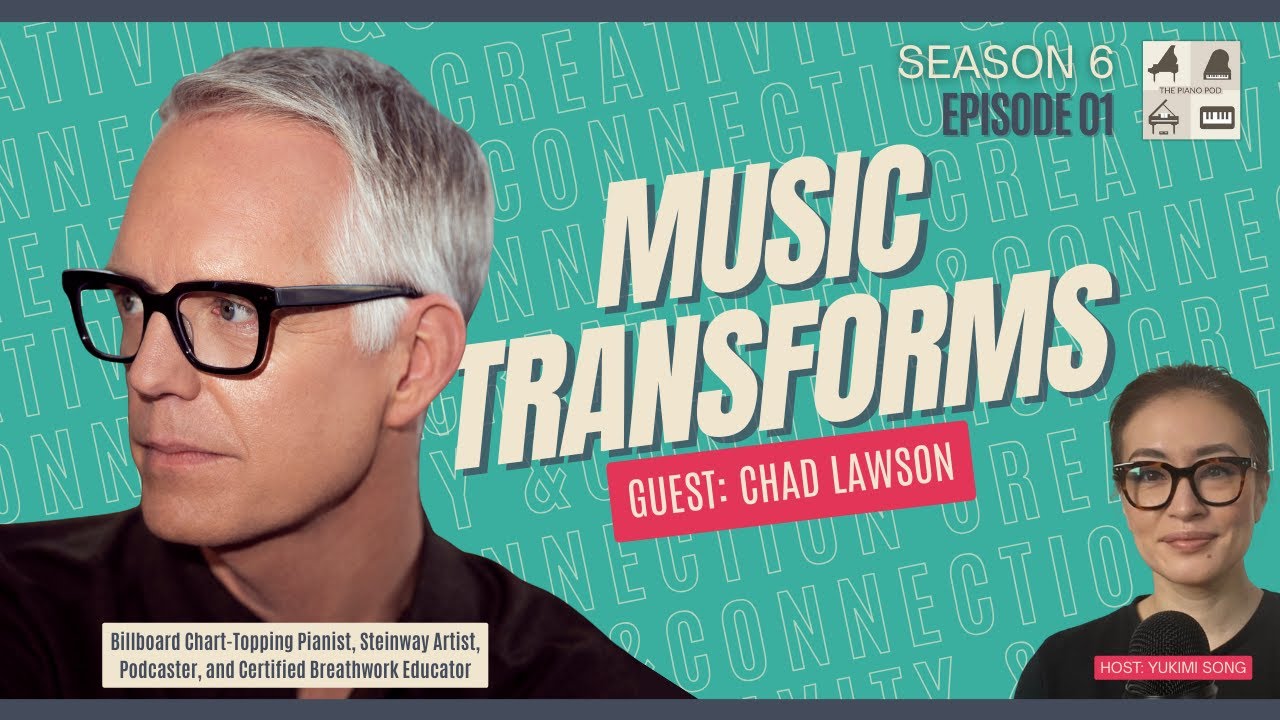
This content was created by The Piano Pod with Yukimi Song. This content was uploaded by The Piano Pod with Yukimi Song. This is a YouTube podcast episode titled "Season 6 Eps.1: 'Music Transforms' feat. Chad Lawson" (published Sep 10, 2025). It's an interview-style conversation on The Piano Pod with Yukimi Song: host Yukimi Song (and an introducing narrator/speaker) interviews guest Chad Lawson (Steinway artist, composer, certified breathwork teacher and UN Ambassador for the World Federation of Mental Health). The discussion centers on creativity, connection, music as healing, Lawson's compositional approach, his album Where We Are / Unity Edition and collaborations, breathwork/mindfulness work, and upcoming live events. Multiple speakers are present and the format is a conversational podcast episode.
Chapters
My role is not to impress the mind, but to impact the heart. My role is to hold your hand through whatever it is that you're going through, and my role is to sometimes even bring forth attention to a need that you may not even know you had. We live in a time where we have seen everything, and we live in a time where we have heard everything, and yet we live in a time where we no longer feel anything. Be in an Uber in the backseat with the window down and to have a smile on your face because this song just tracks so well. That is what I hope my music will do, is invite the listener to simply just feel.
Welcome to the very first episode of Season 6 of The Piano Pod, my friends.
It's finally here.
How was your summer? I had a great one.
Not much traveling, but a really productive summer.
I share more about that in the Season 6 intro episode, which came out last week, so be sure to catch up if you haven't yet. The link is in the show notes. This season is all about creativity and connection, and I can't tell you how thrilled I am to begin the season, new chapter, with you. One of the biggest announcements is something I have been dreaming of for a long time, our very first live event on October 4th, The Piano Pod Live in Concert at Stiefel Hall presented in partnership with Mannes Prep at the New School, a pre-college music program offering comprehensive and nurturing training for young musicians. All the details are in the introductory episode as well. And if you are in the New York City area on October 4th, I'd love for you to join us. Let's celebrate creativity, connection, and live music together. And now let's talk about today's guest. To start this season of creativity and connection, I can't think of a more fitting guest than Steinway artist, composer, and wellness advocate Chad Lawson. Chad is not only a composer and pianist whose music has reached millions around the world, He is also the creator and host of the renowned podcast Calm It Down, where he helps people slow down, breathe, and find a moment of peace in the middle of life's chaos. And in 2024, he became the very first musician to be appointed a United Nations Ambassador for the World Federation of Mental Health, composing The Light Within as the official theme song for World Mental Health Day. But what moves me most about Chad is the way he approaches his artistry, with deep kindness and empathy. A little spoiler here: he told me in our conversation that there are artists who create for themselves, and there are other artists who create for their audience. And he said, "I create because I want to help people with whatever they are going through emotionally. That's my role as an artist." When you listen to his music, you can feel that intention, that he is right there with you, offering presence, compassion through sound. So as we open this new season, I invite you to lean in. This is not just a conversation about music. It's about presence, empathy, and what it means to create with others in mind. And before we begin, I want to thank you for being here. Every time you hit the thumbs up, leave a rating, subscribe on your favorite podcast platform, or share an episode with your friend, it really helps this work continue. It means the world to me. Here is Season 6, Episode 1 of The Piano Pod with Billboard chart-topping artist and UN Ambassador Chad Lawson. Please enjoy the show.
You are listening to The Piano Pod, where we talk to the brightest minds in the industry about how they are bringing the piano into the future and thriving in a complex, ever-evolving world. Chad, welcome to The Piano Pod with Yukimi Song with Yukimi Song. And thank you so much for being here today. What an honor.
Oh my gosh, Yukimi, I mean, honestly, the honor is mine. Congrats on like the new episode series. This is fantastic. I'm going to turn the conversation just a little bit and ask you, um, in the 5 seasons, right? This is season 6, right? My word, so much work. In the 5 seasons, what has surprised you the most about the conversations you've had?
Like right now, I would never have— never thought I would be asked that question. That's a surprise. What, what do you said? What surprised me?
Yeah, if you could like, like what has like Yeah, like what if up to this point? That—
wow, classical musicians, you know, because this is a classical piano podcast. We are so creative people. Yeah, you know, because the training was so hard and as much as we love it, but It was a strict rigor training. But then when I talked to the people, wow, we are such creatives. And I've been— I'm learning so much. I've been so encouraged because the beginning of the reason why— one of the reasons why I wanted to start it was that I was quite angry. You know, it's like The classical music is dead. It's dying. I've been hearing this over and over, and it's like, it is, you know. I'm teaching young children, and then when I see them, they listen to pop music, which is great. But so, you know, that's how I started. But when I dig deeper into this conversation and meet more people, and then lately I've been invited to so many events by Gus, and then I realized, wow, we're a bunch of crazy creative people.
Yeah, well, and I think you really hit on something, um, which is like, I think that there is an audience that we actually don't even see, right? Like, like, like even with my music, and I think this is the case with classical and neoclassical and instrumental music, is like there's a large listening audience for it. I mean, there are, you know,, you know, playlist on streaming music where that's some of their largest playlisting, um, and it's this type of music. And so, and I think the interesting thing is, is like, sorry to dive in here really quick, but I think to your point of like, you know, I was thinking the same thing too, which is like, you know, classical music is dead, it has no longer any relevance, like people are giving away pianos I think the interesting thing about what the pandemic did is it went back and it showed the importance of one, creativity, to your point, and then it also highlighted just like the need for us to create and to like really be able to put our hands to things, but then also to like have that activity of like creating something beautiful that's also like calming music. And so it's one of those things where Um, if you look at the genre of the music that we're doing, like, if we look at my data— I'm a data nerd— like, Sunday night through Thursday, like, my numbers or streaming numbers are super high, which I'm grateful. Come Thursday night, they drop like a rock because nobody wants to listen to this on the weekends. And then, but Sunday afternoon or Sunday evening, they up again, right? And so you, like, you have like this large group of people that just want something on the background to either read or to study or to relax or just not be distracted, you know, when, when they're doing something. And I think it's really interesting what this— the, the landscape has changed so much with streaming music because it's removed that barrier of this is classical, this is not, or this is one genre and this is not. And so like, even now, I mean, you know, my, my oldest son, he turns 15 in 2 weeks, and I'll go through and he'll be listening to like, you know, solo violin, or he'll be listening to Queen, or he'll be listening to, you know, some random bands I've never heard of. But then you go back again and then he's listening to Bach, you know, and it's like I think the incredible thing is it's removed that barrier that it has to be one of these things. And now that— I don't even know if the word curiosity comes into play anymore, because I mean, I think it used to— like, people used to have to be like really curious to find good music. And it's like, no, it's out there, you just have to look for it. And I almost think we're at a point now where it's just like, how much— like, do you really have to go out of your way to find it, you know? And so I think it's beautiful. I think it's Fantastic. Sorry to like, but I also, I think that's why, you know, you're starting off with season 6 because like you have so much conversation and so many people that are not only wanting to share, they're also wanting to hear. And I think it's just really fantastic.
Oh, same. I feel the same thing way about you and how you're reaching to your audience. And then I, in fact, a couple weeks ago, I have a lot of adult students now. Where they have never taken lessons. They live in— I live in Brooklyn and Williamsburg. So the generation is younger, you know, young millennials or Gen Z. I'm seeing Gen Zs as well. And then they— I'm surprised at how much they are eager to learn, you know, and they didn't receive proper music education per se, you know. And so music to them is just pressing their device and listening instead of creating. So, and they love listening to minimalistic music. And then I introduce your music because I got to know your music through this conversation before even then. And they love it. They fell in love. And then they're like, when does this episode come out?
Oh, thank you. It's so kind. Yeah.
So there's a magic that you do. To be able to connect, not just in terms of this traditional concert, live concert setting, but also podcast has your music and also meditative because you're a certified meditation teacher, right?
So certified in breathwork. I have a couple of certifications in breathwork education. And then I go around to universities and just help young adults just decompress. I help them learn what anxiety is or learn how to just kind of downshift, which is— it's, I mean, it's, it's opened doors that I never have ever imagined as far as like the mindfulness space. Um, but I mean, that's, you know, it's funny because like we have two types of artists. We have the artists that they have to produce art because that's just, that is what they have to do. So like the David Bowies, right, or the Todd Rundgrens, or the Thelonious Monks. They, they just, they didn't care. They just had to create, and it didn't matter to them what kind of response they received. So we need those types of artists. And then the other artist is artists that create for their audience, that they know what their audience is and they want to be able to say, I'm creating with you in mind. We need those artists too. And I feel like I fall in that category, which is like, I create because I want to help people with whatever it is they're going through emotionally. And it took me a long time to actually be okay with that. Not okay with like helping people, but okay with the mindset of like, that is my role in creating. And the reason why I say that is because to your point, and you've spoken to many pianists, Like, we spend our lives locked away in a room with one of these things, and for hours on end, right? 6 hours a day to where you're just mastering your craft, you're honing your craft, you're really wanting to be able to play like perfectly, right? And so it only makes sense that as an artist or composer or what have you, that they would then want to bring that music to to fruition. But the interesting thing that I found for me personally, because I came from a really strong jazz background, and so like improvisation, and so it was classical and then it was jazz, and I still study jazz, I still take lessons, but it's one of those things where it's just like when I started doing like this solo piano, like neoclassical, post-classical, minimalist kind of thing you know, my mindset was like, I'm gonna raise the bar. Like, I'm really gonna— like, let's bring something like really creative. And Yukimi Song, the interesting thing was that music fell flat. It did not land anywhere. I don't say anywhere, but it was one of those things where it's just like, it just didn't work. And so I really had to like stop and think about it because I was really trying to like do something incredibly creative in this minimalist space. And what I came to figure out is people don't want to be challenged. And I mean that respectfully. And so let me explain that a little bit. They don't want to be challenged in the sense of, you know, they might work a job that they don't enjoy, or they might come home to like a leaky faucet, or maybe to like a sick kid, or to, you know, fill in the blank of all the things that we, we go through every day. And so like the last thing that they want to come home and, and put on a vinyl or play, you know, on some music and then have the, okay, now I'm gonna focus. Like, nobody has that bandwidth whatsoever. And so like, that's kind of what was happening. It was just like, no, this is really creative, check out this sharp 11 and check out these subdominants and the, you know, tritone substitutions. And people are just like, yeah man, I, I don't have the headspace for that. I just want something that's just gonna like make me feel better. Right? And so that took me a long time to figure out. And then once I figured that out, I was just like, ah, okay. You know, so going back to those two types of artists, the ones that create and the ones that, you know, create for their audience, I fall in that category because for me personally, I'm an empath by nature. And so like, I don't want to create something and then put it out there and then just ignore the audience. Like, like, I want to be really intentional because, you know, my audience, which I'm really grateful for, they're very— they reach out and they share, and they share messages and they share emails and they share, you know, after a live performance they'll come up and they'll want to talk and they'll just say, you know, my father is, you know, struggling through all these things and I just sit and I listen to your music and I, I just I cry. And so at that point, it really becomes less about creating for the sake of just creating, to like, to be esoteric, to be sharp 11 tritone subdominants, to where you're just creating music because you just literally want to help people. And for me personally, that's, that is kind of what I landed on 2 years ago, like specifically Um, I, I waited tables for 15 years. I'm going to go down a rabbit trail really quick. I waited tables for 15 years in New York. Um, Peter Luger's actually was my last job up in New York City.
Oh, I live very near.
Amazing place, amazing people. But I mean, you know, when as an artist, I mean, that's the role. I mean, you have a steak in one hand and you have a promo pack in the other, and so you're constantly trying to like, you know, find a gig while still working and whatnot. But the interesting thing about waiting tables that taught me, the greatest thing, is how to connect with people. Because at every given point, you have about 30 different personalities that you're trying to tend to and navigate and eggshell and connect with and also just take care of. And that's the role of someone— I see it as waiting tables. And so, like, if someone ran out of their water and they had to ask, then I missed that opportunity to take care of them. I totally dropped the ball. Whereas like, if I refill their water without them even noticing that they were low, or without them asking, then I'm taking care of them. I'm accommodating their needs even without them knowing they have a need, right? Now, if the way I see art, for me personally, is the same My role is to hold your hand through whatever it is that you're going through, and my role is to sometimes even bring forth attention to a need that you may not even know you had. And so what that means is creating something where someone can just sit in stillness, close your eyes, and listen to something, and then they begin to peel back some of the self-reflection they begin to ask, what am I feeling? What emotions am I going through right now? Right? Um, and but you— they have to have that bed for that. And I think that's where the creative element comes in. So it's almost as if like we're not creating to— I, I always say this, my role is not to impress the mind but to impact the heart. And I think that's really important as far as creatives. It's just like we have to get to the point where it's like it's not about impressing the mind, it really is about impacting the heart and just letting that really resonate. Because songs are given to us. I have this woo-woo theory that I might lose some people here, um, but what if— imagine, Yukimi, that like every song has already been written Every song, right? So like, imagine like Fur Elise, to where like Fur Elise was already created, it was just looking for that person, like the specific person that was going to bring that song into fruition. So like, who is in the headspace to be able to say, I'll take it, I'm the person that's going to bring that to you, right? And the reason why this is the case, and I'm Just bear with me here. It's just like, how many doors did Für Elise knock on before Beethoven was in the headspace of being like, I'm, I'm the person for this? Because songs are given to us, they're not ours. We are a catalyst of art, we are a catalyst of emotion, we are a catalyst of healing, of comfort, of, of dancing, of singing, of all the things that are attached to art. Right? Um, and so like our role as artists, the way I see it, is we are given something and then we have to release what that is. And so like when we release what that creative piece is, be it poetry, be it music, be it fill in the blank, then that piece of art is going to be able to go further because we're letting it go, rather than us saying This is mine, I created it, and you should like listen to it and then give me praise. At that point, the intention of that art is capped. It has a, a glass ceiling, so that can only go so far. Is it beautiful? It might be, yeah, very much so. But have you just all of a sudden capped where that piece of art can really go? Yeah. And so if we get into this creative— this creative mindset of like We're meant to create, but we also have to realize that creation is meant to like go further than we would ever be able to do it on our own, right? So even with me, when— with writing, with writing music, I never name my songs. So the songs are always like whatever the key is. So, you know, so on the album Breathe, you know, G minor, C minor, D, right? And like even at like on the scores and the charts, they're all labeled that. So because the reason is I don't want to dictate what that song is meant to bring to life. So a lot of times I have no idea what the song is about. And so for me personally, the way I create, the way I write, is I'll get a melody in my head and then another melody in my head and then another melody in my head. And then once I have all of these melodies in my head, then I go to the piano and I write out the melodies. And then I go and I start building the chords and the structure around the melodies. But so I'm not one of those people that just like, you know, sit for 45 minutes every day and just write, you know, this is the time. And there are people that do that, and that's good on them, that's fantastic. For me, I have found that doesn't really work so well. And so we record the album, and they're all called these key signatures. And then I'll usually take about a month away from the recording, so I won't listen to it for a month because I want to like kind of step away from it a little bit. And then I'll just, after about a month, I'll sit and I'll have the album playing very lightly in the background, and I'll just read. I'll read poetry. I'm a huge poetry nerd. And I'll just sit through, and then I'll just, as I'm reading something and I hear something, then I'll be like 'Ah, that kind of connects. Those— what I'm reading right now and that song, they kind of connect with each other.' But the reason why I do this is because I don't want— if I were to write a song and title it 'Sunflowers,' you instantly have an image of sunflowers, whereas like you might hate sunflowers. And so like you would probably see that and just be like, 'Skip, I don't want to hear that.' right? And so like, if we allow ourselves to be giving of whatever the song is— and so case in point, there is a song on the album Breathe, um, called, called G minor, um, called Fields of Forever. And it's very similar to that song. Like, that song began to tell me what it was about during the recording session. So we were at Abbey Road Studio 2, um, I had cellist Peter Gregson with me, and I had violinist Esther Yu. And so the three of us were literally in the same room together. The red light was on. We're playing this song called G Minor, and in the middle of the song, I started getting these images just flooding me of my mom and dad and their happiest moments. Um, and I had lost my dad about 2 years before that, so fairly recent. And it was just overwhelming. And so, like, and they were like these little moments, like them watching TV together or having a picnic or like, you know, driving on the parkway. But like, I instantly started getting flooded with these images and just like to the point where like I'm like, okay, I really appreciate you telling me what the song is about, but could you have waited until after we recorded it? Um, so it was really overwhelming. It was one of those things where, like, I allowed that song to kind of tell me where it was supposed to go. And that is the one song that every time I play that live, someone comes up and goes, you know, I have no idea what that song is about, but I— it just wrecks me every time I hear it, right? So the role of a creator is to be selfless and to rid ourselves of the idea of, like, this is my creation, I own it, I created it, you should be proud of me. Um, to where it's like, hey, you know what, I was given— I was given flowers, and now I want to turn around and I want to give these flowers to you. So that's how I see creativity for me personally. Wow, I know.
No, lovely, beautiful. Thank you so much. Um, so I don't know, it's the way you write songs, music or the way you speak. There's something about you, your artistry, set them apart from others. So what do you think that is besides what you just mentioned?
We all have a different voice. Like every artist has, like, you know, I hadn't planned on playing the piano, oddly enough. But if you look at the piano, let's take an octave for instance. Yeah, you can see that. And if you look at this octave, like, each note is entirely different. So like, this C will always be a C. This D will always be a D. They each have their own tonality to them. I feel like artists are the same way. So like, you know, with certain songs, if I'm in the key of C, more than likely I'm not going to be playing an F sharp. It just doesn't fit, right? And so if you think about how certain notes are really important— they're actually, they're all important, but they're not always needed in that particular environment, such as a song in the key of C. And we know that like when you're listening to something pleasant, it's because you have these keys and they sound pleasant. I feel like artists are the same way. To where like every artist has their own particular key. And for some people, that note is going to ring out really beautiful on a song, but some people might hear that same note or that same song and be like, it's not for me. And it's no shade on the artist that it's not for them, right? Everyone has their own, you know, particular taste. I don't know if you've ever watched that Philip Glass documentary called Glass. The opening scene is one of my favorite things on the entire planet. It's like, it's him on a roller coaster and he's doing this voiceover and he says it so perfectly. The only, you know, Philip Glass is the only person that could say this. And the voiceover is like, there is so much music out there. You have Bach, you have the Beatles, you have the Rolling Stones, you have— and he lists like, you know, whatever. And he goes, you don't have to listen to me. I don't care. Just go listen to something, something that like makes you feel alive. And I'm like, that's it right there. Like, we all have like our definitive note, and the notes that I play, they're going to land somewhere with someone, but they're also not going to land with some people. Whereas like you, Yukimi Song, your notes are going to land probably in an audience that my notes won't. And so I think that's really important for us to like, you know, to create, not compete. That's kind of a mantra to live by. It's like we're not here to like compete, we're here to create and to understand that like everybody has their unique key. Um, and also a really big thing that I, I personally choose to do is not listen to artists in my circle, in my genre. So I— and many of them are friends, uh, they're incredibly talented, but I make it a high priority not to listen to them because I don't want to be influenced by them. And that's really important because like I recognize that they have their audience and that their audience is their audience, whereas my audience is my audience. And so why would I try to deceive my audience and trying to sound like someone else, right? So that's just me personally coming from the jazz background. It's one of those things where like, you know, you hear something and you steal it and then you begin to play it and you begin to make it yours. Um, I want to make sure that I'm, I'm respecting those artists, um, you know, the, the artists that are in this circle. And not trying to mimic or replicate or to steal from what they're doing as well. And so I think, I don't know if that has something to do with why, as you mentioned, which is so kind, you know, my sound might be a little different than others, as I really am trying to keep it as pure and authentic to my own self as I can. That's my hope, at least, for sure.
Let's talk about your actual album, the latest one, Where We Are Unity Edition. So I understand that you mentioned about your audience. So the original, there is an original version which is the 2024, right? Yeah. And then the 2024 version, I believe I read somewhere that there were a lot of DMs or emails from your audiences, your fans, and that inspired to create Where We Are, the original 2024. But that evolved into so many different things and then came together as Unity Edition. So can you tell us what they are, please?
Sure, absolutely. I'd be happy to. So the funny thing about Where We Are um, I had already started writing a whole different album, and it was about dreams, and it was about the dreams we chase. Like, why do you go after that dream that you're going after? And what if you never caught that dream? Like, what if it never happened? Would you still continue every day, like, going after it? So it's very much like, like, appreciating the challenge kind of thing in a roundabout way. And so the album was actually quite different than what most of my albums have been. I wanted to be able to like make it a little bit more classical leaning, a little bit more ambitious and rigorous, and a little bit more demanding musically speaking. And as I'm writing this album, you know, I was applying some of the dreams that I had in my life. There was a studio up in Norway in Oslo, um, that I had always dreamed of recording. So that was going to be part of it, um, coming from the jazz head, the jazz nerds, um, the record label ECM was based out there. So the, the studio, Rainbow Studio, I was like, I've always dreamed of recording The Rainbow. So that was like part of it. And so like we had this date, it was October, um, of '23, um, and so like I had a deadline And so like the album was coming along and I was really, really happy, but I was like, man, something's just not right about this. I can't figure it out. And so I was just kind of torn because it just wasn't feeling like it was completely settled. And then I was doing a live performance, um, at Auburn, um, and this young lady, she came up to me and she was just absolutely— she couldn't form a sentence because she was crying so hard. And she said, my dad is dying of stage 4 cancer and all I can do is listen to your music. And at that point right there, in my mind, I heard, people aren't ready to dream because they're still trying to heal. I have chills right now. And that really resonated with me. And so I was just like, why am I like trying to create something that is, you know, about me. And so I went home and I only had like, I want to say like 2 weeks before the recording date, and I was like, I need to start over and write like a whole new album. And so in 2 weeks I created Where We Are, and that really was like an invitation to heal and an invitation to like to find the idea of that— that young lady, she spawned everything in the sense of people are suffering, people are going through difficult times. And so I wanted to be like, you know, I wanted to create something that is like with them, like where they are, like emotionally. And so, but instead of like being like where you are, I was like, you know, we're all in this together. And so it really turned into like a where we are thing. So I wanted to like sit and be with people, like with them in all of this. And so in particular, there's a song called Sanctuary on the album, and it's like, what is your personal sanctuary? What is that healing space for you that you can just go and just like sit alone? And, and some people have never created that for themselves. I was like, oh, I've never really thought about that, you know. So it's just like, it was an invitation for people just to pause and just to take a moment. And so the whole album was like really about just togetherness, uh, creating something that's like intentional about everyone understanding like what you're going through. You're not alone. Because I get emails all the time, and a lot of times it's the same conversations, different people, you know, different different people, but like kind of the same story. And so when we decided to do Unity, I wanted to extend that. I wanted to open up the idea of like bringing more people in. I've actually really never done like major collaborations. I've had, you know, as I mentioned, Esther and Peter, but for the most part, like, I've never really done any work where it's like collaborating but also like here's the song, do whatever you want to, like put your emotion, put your fingerprint, like what are you feeling when you are hearing this? And it was just absolutely fascinating to work with like Helios and with, um, with Holly Kenneth. I mean, she's just fantastic. Um, and it was just really wonderful to like not— again, going back to the point to where like we're given something, and then in order for us to like let that be art, we also have to let it go. And so like my giving them carte blanche of being like, you know, um, Brian Sinti as well, which is just a really wonderful, wonderful musician, I'm just being like, you have carte blanche, like just put your, put your voice to it, you know. And so that's why I wanted it to be Unity, because it just kind of it did feel really together, even though like we were like— the creation process was not together whatsoever, but it was a continuation, and it just felt really, just really natural and really beautiful, to the point where there's actually something, um, you know, that's releasing in October, October 10th, and it's a 3-song EP, um, just going even further with that, with these collaborations. And the names are just Fantastic. So, but I can't spoil it because this is September. And so, okay.
Yes. Yes. Wait. Okay. But so this new 3 pieces, you said 3 pieces, right?
Yeah. Yeah.
That are coming out of this Unity.
So they're coming out of Where We Are. So there are reworks of Where We Are. So 3 songs from Where We Are. I will say one of them will already have been released September, so that would be a song with Voches8 and the cellist Seth Parker Woods. And then what we did, going back to my being a poetry nerd, we took the poetry of Rupi Kaur. I don't know if you're familiar with Rupi Kaur. So, for those that are listening, her name is spelled R-U-P-I-K-A-U-R, a wonderful poet, Canadian. And so we took one of her poems, and Jeff Lawson— no relation— the arranger, he took her poetry and put it into the vocals, the lyrics for Voches VIII. And it's just stunning. And see, that's so— that's, that's what I'm getting at, like, earlier. And I know I'm kind of like, you know, hitting this nail a little too much on the head, but like when you have— when you can embrace something without suffocating it, there's so much that is going to surprise you. I mean, look at your podcast. Look at your podcast, like what you have done. Like, you were like, you know, I want to talk to musicians, I want to talk about creativity, right? And I just want to hear stories.
This—
now we're in like season 6. Right? And so, like, because you created something really pure and authentic, you know, like, I just want to put this out there, and the energy behind that, and just the, the, the selflessness, like, in what you're doing. Because my word, I know personally how much time podcasts take. It's immense. But like, you're going into— see, you're in season 6, which is just unbelievable. And so it's the same thing, like, with this 3-song EP. Like, I never in my life did I ever dream that I would get to sit and, like, in an old church listening to Voces8, like, sing an arrangement to one of my songs. I mean, like, and I literally, I, I was just like, I wish every artist could, like, experience this once because it was so blissful. Do you? And I think because I've been able to like release the idea of like, this is mine, this is mine, this is mine, this is mine, this is mine. And so when you are— when you turn that around and say, this is everyone's for them to experience, then it's just going to open doors you just never even anticipated, you know. To be able to like work with Rupi and to work with Morgan Harper Nichols, who's doing the artwork for the EP. And like, it's just— I have chills right now, right? Um, so yeah, so that's, that's kind of the parts where, you know, it started with Where We Are and then it went over to Unity, and now it's— this is called Together. Um, so Where We Are Together, that's, uh, that will release October 10th. Um, but yeah, it's, it's mind-blowing. So I'm excited. Wow.
But it sounds like— I mean, I used to practice yoga intensively, and the pandemic hit, and then I've been lazy about that. But what I learned about from yoga is not only about breathing, but also letting go. So it sounds like that's what you're talking about, right?
Letting go.
It's not about you. Yes, it is, but it's not. And once you let go of yourself, this is mine, this is mine, and then you can invite people in and there's more opportunity. Opportunity, not as in the greedy sense, but opportunity of people coming together.
So much. I mean, you, you just said it so perfectly. I mean, if you think about like creativity, I'm a really big fan of reverse engineering. So like, um, you know, what does the end result look like, right? And so the— you have to be kind of careful with that when it comes to art. Now when I say reverse engineering, that's more of like the business side of things, um, whereas like with the creative side of things, I don't know if you can look at creativity with the, the end in mind. You know, I read this really fascinating article, and then I reached out to a friend of mine that actually works at Amazon, and they were like, yes, it's kind of how it goes. And the article goes that before Amazon even begins, like, designing or building or putting anything, like, time intensive into a new product, they build the press release first. And they're like, let's be very specific and write What does this thing do before we even begin, right? And I thought that was really wonderful because then there's like a clear definitive, like, and then they work backwards, like, okay, so it does this. Well, how did we get it to do that? Well, because we put these things into place. Well, how did those things get there, right? And so from a business mindset, which I love talking about business, um, it's brilliant. Now from a creative perspective, I don't think that's really the way to go as far as artistically. So if you think about it, like, if I play this note, I'm not playing it with a, I'm going to record that and it's going to be like epic and it's going to get on a TV series, it's going to get a commercial for Apple, all these things. Just like, no, I play this note because I wanted to hear what it sounded like. Right. And so like, I think we have to— like, when you say letting go, I mean, you hit it spot on, towards— it's like we have to let go of the idea that there is an end result. Like, when we create, if you're creating with the mindset of like, I want this to be X, then you're already again putting that glass ceiling on whatever it is. Plus you're taking the fun out of it, to be honest. But like, if we have the approach of like, if I'm literally just The sound of that note just brings a smile to my face. And if you just like imagine like the color and like the warmth and just like the tone of it, like, well, what can I do with that? I'm gonna have fun with it, right? So you have to let go of the idea, to your point, of their— of it.
That it may not—
that note perhaps that I just played, its only purpose was to bring a smile on my face just now, right? And for that, that's enough. And so like a lot of times I think we're in this, you know, where we are with the world and, and, and screens and all the things, you know. I, I have this theory, like, a social media, they're, they're really— it's boiled down to two things. There are two things on social media. Someone's either screaming or they're selling. And once you learn it's one of those two things, try it next time you go to Instagram. Like, watch every video. Either someone's trying to sell you something or they're just screaming mad about something, right? But like, and so it's difficult for us to be in the mindset of like just doing something for pure pleasure. I'm not trying to sell that, nor am I trying to tell you how amazing that is. I'm not screaming at you about it. I'm just, I'm just inviting you just to be like, watch this. I got this in London. When I was there earlier this year. And, um, this is one of— this thing is like 100 years old, this bowl.
What is that?
So this is a singing bowl, and I have like 8 of them. I have way too many of them. Um, but like, if you think about— if you think about like a singing bowl That moment will never happen again, ever. Like, you and I can get on another interview and, you know, we could have the same lighting, you know, we could wear the same things, and I'd have my little Pellegrino, my dog, snoring like on the other side of the camera. And if I strike this, it's going to be different because we're going to be somewhere different emotionally. We're going to be somewhere different in the day. Maybe, you know, I spilled coffee on myself. Maybe, you know, maybe someone gave me a free donut, right? So like emotions are like really affected by this. And so like the interesting thing about like art and creating is um, twofold, but I'll stick with one just for now, um, as it really is about like, how do I create something just for pure pleasure but also to like bring me into the moment? You know, you were saying earlier that you, you were doing yoga and because it allowed you to let things go, and I love that, um, I actually started yoga at the pandemic, so I've been doing it for like 5 years now, like an hour every day, as much as best as I can. And the reason why I do it is because it gets me out of my head. So like for an hour I'm listening to someone like instruct, and I'm listening to someone guide me through something to where I'm not thinking about a free donut or if someone spoke coffee on me or whatever. And so like, I have that time to where like I'm just literally out of my head. And art is kind of the same way, right? To where it's just like just sitting with a singing bowl or at a piano or in the shower and just singing. That like, that is to really just get yourself out of your head and to just be present in the moment and to actually just enjoy something. Um, yeah, and, and that's, that's— it is sticky because like as a creator that's doing this for a living, um, you do also have like the monetization of this, which is like at the end of the day it's still— let's be blunt— it's a product. Um, because like it is an offering and, you know, it puts food on my family's table, for which I am grateful. Um, incredibly grateful. And so it is difficult to sometimes separate the idea of it being music or being manipulation. One more time, as creatives, it can be really difficult to be able to separate the idea of it being music or manipulation, because anytime that you involved a return on something, then that opens the door for there to be a manipulation for that said return. Right? And so it's really difficult to make sure that you're not all of a sudden turning into a manipulation factory, right? It was like, oh, I know what works to make this end result, so I'm going to do that again. And I think when that happens, I think when we see that with artists, I think that we see that like after 2 or 3 albums of that, people are kind of like Yeah, I'm done. It's not really hitting the same anymore, right? And it's not because the music isn't great, but I think it's because like it's lost what the purpose of that creation was intended for, right? So like, I mean, if you eat the same exact meal for, you know, 6 straight days, like everything's the same, it's going to lose its flavor no matter how much that was your favorite meal to begin with, right? And yes, obviously, you know, we do get tired of things, but also like everything around that meal changes constantly, right? Your emotions, your interactions, you know, the— all the things that are just tied into life. And so I, I think art has to be the same way, where there's like this ever, ever-evolving space of what art is, of creativity is, of what the meaning behind it all is. Which is why it is so important to like grab a singing bowl and to hit it, or to sing in the shower, or to like, you know, turn on the radio dial and listen to something you've never listened to, just because it's gonna like bring you in there just for a moment, you know, or listen to a podcast.
Um, just one, one more thing from the album. I'm curious about The Light Within. Which became the World Mental Health— the theme song for— official theme song for World Mental Health Day, and is also somewhat connected to you being the United Nations Ambassador for the World Federation for Mental Health. So I really would like to know the backstory.
And I tell you, It's one of those things— thank you for asking, actually. It's one of those things where like I still just shake my head at it. Like, I have no idea. Like, I'm in an ocean I don't even feel like I belong in, to be honest. Um, because like, you know, creating music to help people heal, to hold their hands and all these things, um, really it stemmed from my doing the podcast, to be honest. The whole UN and all those conversations So once COVID hit, I was grounded. I couldn't tour, but I still wanted to like be relevant to my listening audience. And so instead of just connecting with them from the stage, I thought I would connect with them through the microphone and created a podcast that centered around mental and emotional health. And so what that did— I thought, you know what, this will be temporary, this will be just for this few weeks for this whole, you know, COVID thing, whatever it is, it'll pass away and we'll all get back to normal. And what the incredible thing is, is it became a whole life of its own. The podcast, um, it's called Calm It Down, as in calm down the mind. And the interesting thing is that opened doors into avenues that, like, I don't know if music would have opened necessarily by itself, but because it was related to music it had an opening which is like, oh, he, he talks about breathing and decompressing and anxiety. Oh, he also plays the piano. Oh, this is great, let's talk to him. And so there was an introduction to, um, October is World Mental Health Day, um, October 10th each year, and in 2024 we started having conversations about, okay, what can we do around World Mental Health Day? And so we met the World Federation for Mental Health, and we just— I had their, um, Secretary General on my podcast, and we started talking about what can we be doing globally for the young adults that are struggling with mental health issues or emotional health issues. And really, we just built this relationship. And then one day I got an email from them, and it was one of those things where, like, I literally will start crying. Um, I'm with my older son, we're out and about somewhere, and I get the email and I open it up on my phone and he's looking over my shoulder. And basically the email was like, we would like for you to be a representative at the UN for mental health. And he looked at me with the biggest eyes. And like, for my entire life, of all the things I've done musically, there's like, okay, whatever. But like, with this, he was just like, that's a big deal, you know? And so like, we had this really bonding moment together of like how cool it was. And I have to admit, I mean, it was just like, even now just thinking about it, it's just mind-blowing. So what— so sorry, I'm rambling. Um, and so like when we started talking to the Federation, World Federation for Mental Health, um, we're like, you guys need a theme song. Like, let's create something that like we can center around World Mental Health Day, and let's talk about the Federation, and let's talk about like what does this young audience need, young adults need right now. And so that's where the idea of The Light Within came, where it's just like, we, we have, we have so many things that we're like trying to find solace in, or hope in, or comfort in, and all of these things. And it's just like, when we can actually sit still and like just like for a moment put those things away, we begin to like search within ourselves. And that's really difficult. It's actually quite difficult because there are a lot of layers in there that we don't want to address yet. But when we begin to like peel that back, and then we begin to heal, and we begin to have conversations with other people about healing, um, and sometimes that means with, you know, a professional guidance counselor or a therapist, we begin to like see that like our true selves and the sense of like, it's really hard for people to love themselves. It is. Oh yeah, there are so many factors, right? Like, we're constantly judging ourselves, right? We're constantly like, we have this grid of a spectrum of like where we should be. But the, the crazy thing about this though there is no spectrum. There is no, like, official 'this is great, this is not great, where do you fall in this category?' Because there's nothing that says officially, well, this, this is great and this is not great, because it's different for everyone. And so when we begin to, like, get rid of this idea that there's this gauge, that there's this, like, measuring system of who's good and who's not. And we begin to like let go of the idea— okay, we're talking the classical pianist right now, right? So if we look at all of the classical pianists that just dominate, you know, I don't want to mention names right now, um, but we all know who they are. I was like, I'll never be like them, I'll never be that great, or, you know, Or I can play better than so-and-so, right? And so there's always like this constant like measuring of pianistically of what we can and can't do. But if we were to like close the lid on that just for a second, and then we ask ourselves, why do I play piano? Like, really, like, when was the last time like any of us actually stopped and said Why do I do this? Well, it makes me happy, right? And then you begin to like peel that back. Okay, so if it makes me happy, then why am I so worried about how they're playing 10 BPM faster than I am, right? It's just like maybe that song is connecting with you at the tempo that you're playing it and letting that be enough. Whereas perhaps, you know, they're playing it at a different tempo for whatever reason that they have, but what their reason is, it's not my concern. Like, I should not be like wrapped up why so-and-so is playing at this tempo, at this veracity that they are, because that's them. What I'm concerned about is like, why am I doing what I'm doing? And then when we get to like ask that of ourselves, like in an honest way, then we begin to understand. I like playing piano because it just makes me feel good, right? Now I'll take that to like ourselves too, emotionally. When we begin to like find that answer like there is this light that's within us, and we're not trying to look at the light that someone else has that's really bright. That's, you know, or maybe it's not, right? So I think for me personally, the whole partnership with World Federation for Mental Health and The Light Within was just trying to illustrate that. It's just like, who are you? And it's really hard to answer a lot of times. It's really hard for us to answer. Because we sometimes— we don't want to go there because then we're just like, well, I'm nobody. Let's, let's open that up a little bit, you know. I know one as a pianist. Why is that? Well, I'm just not like them. Okay, right. And then you begin to go even further with this. Well, do you want to be there like them?
No.
So then why are you comparing yourself to them? I don't know, you know. But then like everyone has the reason why they do something truly authentically. And then I think to some degree we all have like this also idea of what we should be. And I think it's okay to aspire to play that 10 BPM faster, or I think it's okay to aspire to play certain pieces that maybe are just like steps ahead of us right now. But also, like, we have to remember why, why we create, why we're actually at this thing for like 6 hours a day. And it's not to play fast, and it's not to impress, and it's not to like sit center stage and say, look at me.
Right?
Because if we pursue it that way, we're going to burn out. We're going to have that moment to where just like, this isn't fun anymore, right? And so I really encourage anyone listening right now that's kind of like wondering, you know, when will I get there, maybe pause for a second and just be like let me enjoy where I am right now here and just enjoy this and just play a note and just let that like reside in you for a moment. So that's how the conversation with the World Federation for Mental Health— and, and then, you know, it ties into, you know, even I know the UN right now has like mixed, um, not mixed feelings, but like people look at the UN kind of mixed right now, some good, some bad. And I think it's one of those things where it's like the experiences I've, I've had there at the UN has always been about like, how do we take care of people? And I think that's, um, something I've just— I'm incredibly grateful to be a part of? Like, what are we doing to truly just make people's lives better, even just 5%, 10%, 15%, right? And a lot of times that, that's through art. A lot of times that's through what we create, um, as long as it's like created from a pure intentional motive. Sorry.
What you just said— no, please don't be sorry. But what you just said, just really coming through your creativity, like artistry, and you mentioned about, you know, healing and so on. So I'm curious about this one moment of your life. Um, you had some challenge— I mean we all have challenges in lives, in our lives, but this one particular moment of healthcare.
Mm-hmm.
Is, is that okay? Uh, if I ask?
Yeah, absolutely. Yeah.
So did that anything to do with your maybe mission and artistry right now?
Yeah. The interesting thing, so I had ulcerative colitis for many years. And for those listening that don't know what that is, it's kind of like Crohn's and rheumatoid. It's like the, the, the spouse, then the sibling of Crohn's. So, so it's, um, it was quite debilitating. Um, it was very— my dog is no longer snoring now, he wants to be in the interview. Sorry, it's okay. Um, so with— I had all sorts of clients. So basically, like, I lost like 40 pounds in a month and a half. I mean, I was bedridden. I just, you know, went to have like 3 major surgeries, but even before the very first one, I had to be in the hospital for 2 weeks just to let my body heal. The amazing thing is, like, all of that was going on right before I recorded my very first solo piano album called Set on a Hill, which was the very first solo piano album. And so I did— I recorded that album in a day and a half. I think we had 2 days for it. And we were living in Brooklyn, and so we drove up to like Vermont, I think is where the studio is. And during the recording process, I mean, it was rough. It was really, really rough. So like we would record a track and then I literally would lay underneath the piano while my wife and the producer would listen back. And they were like, okay, it's a good take, or can we do one more kind of thing. And so it was really, really, really a challenging time. Um, but I will say like that, you know, the next day when we got back to Brooklyn, that's when I went into the hospital for 2 weeks. So there was like this emotional element behind that album of like as a healing process. And it was, it was kind of a battle for me a little bit because that's where I began understanding where coming from the jazz background that I did and then releasing this album that was very meditative, like the opening notes of that album were very calming, very like draw you in kind of thing. And I had so many people push back on that, like, dude, you can't start an album this way, you gotta like have energy and make it like really interesting. I'm like, no, no, I think it's meant to be this way. And that album is when I started getting feedback from listeners, getting emails from people saying, you know, I'm going through a divorce right now and I just go home and I lay on the floor and I listen to this, or I just lost a loved one and I just, I just put this on. And so that album really began showing me like the importance of healing. And for myself, it was a healing process as well. But the, the power of music and healing, the power of music and being able to just like raise someone. And so that really was like a eureka moment for me, because I will say it's been really difficult because like I joked that I chose the wrong career. I don't like the spotlight. I don't like the attention. Like seeing my name on a marquee is not why I wake up every day. It's actually like I— if I could be on the other side of this camera, I would be. That's just me personally. And so, you know, it's something I really have struggled with because like, that's— I'm just not— I'm a quiet introvert, right? And so this is something I was really dealing with for quite some time. And this one lady, she emailed me on a Saturday morning. It was 7 AM on Saturday morning. I'll never forget this, a couple years ago. And she goes, I'm sitting here listening to one of your songs and the tempo of the song matches the pacing of my husband's breath as he takes his last one. I get those a lot.
Wow.
And at that point, that's where my mind said, you're being on camera or on a magazine or or in a playlist or on a marquee, it's not for your own benefit. It's to bring people some hope, some healing, some comfort, some peace, some calm. That's why you're doing this. And that really— I needed that. I needed to hear that, because then that became my purpose. Of like having the experience physically where like I literally thought I was going to die, and just the struggle that that came with, and how like even just like my laying on the floor underneath the piano during that recording session was almost like, you know, this bomb, if you will, where like understanding that, well, why would my music not be the same to someone else going through something difficult as well? And so that's something I've always have really tried to keep in mind, going back to even where we are, the album and creating the process. I was like, I needed that kind of shake, slap in the face, wake up. I'm like, no, no, don't forget why you do this. Chad Lawson is not meant to like, wow, right? I'm meant to just be like, I needed that, you know? So for me personally, yeah, going back to your point of like having that physical period that I did really allowed me to understand that like the importance of it, the significance behind it. And, and I think that's also where like where I— it's— how do I say this? I think certain people create music just for knowing that, going back to that point, knowing that there's going to be a return, a financial gain behind it. This playlist, this style is doing really well, so I'm going to do something with that. And I have a hard time with that because actually I personally know artists that do that. And it's really— I have a hard time with that because you're messing with people's emotions at that point, right? Like, you're, you're creating something. Those artists that are doing that, they are creating for the sense of seeing that there is something that they can sell, and that just doesn't sit well with me. And so Um, I think all of that stems from the idea of I know what I've been through, and I hear all the time what others are going through. And so, man, shame on me if I ever just decide to try to make a money machine out of it, you know. So because like when you, when you go through something so difficult as what I did, or is what other people are going through as well. Um, our role is just meant to just be there for them. You know, I hear all the time from PTSD, uh, and people that are suffering with PTSD, and it's just the fact that I am able to create something that's allowing them to just find some rest, you know. And it's important to me because like I've been through seasons physically where, you know, it was tough. And so now I understand, I get it, right? So does that affect my writing? It does, absolutely. Because end of the day, I want to create something just to help.
So, but does— is that where this wellness— bring music and wellness together came? The idea of— not idea, but I guess inspirate— inspiration.
Like, yeah, it's funny, music. Years ago, somebody asked me, you know, if you weren't doing music, what would you be doing besides music? And I was like, oh, I probably would be a psychologist, you know, because I love talking about this stuff. And they're like, well, you kind of already are with your music. I'm like, huh, it's interesting to think about, right? But when you see the connection of music and wellness and music and mindfulness. There are— I mean, scientifically, there's a couple things that are going on, but then also, like, when in the wellness space, emotionally, there's a couple things going on. So scientifically, if you look at music, there was a wonderful study by Harvard and Oxford Press that said listening to calming music 3 to 5 minutes, just 3 to 5 minutes, raises this thing called BDNFs. Which is a fancy, like, protein in your body, basically, in a roundabout way. But it's what makes you feel good if you work out, or if you have coffee with a friend, or if you take a walk in nature, or if you, you know, one of those things where, like, you just feel better when you're doing it. Those are your BDNFs that are being elevated. Well, music does the same. But the interesting thing about this study is that music was the only passive thing. Everything else had to be like an active participatory, you know, walking, talking, you know, all the things. Whereas music, you could just lay on the floor and hit play, and then all of a sudden you started feeling better. So like, there's science to this, like neurologically speaking. And so like, you're feeling better scientifically, but then if we look at this from like a wellness perspective or from like an emotional perspective, what music does is it brings us into the present moment if we allow ourselves to be there. But like, think of months ago, I was in LA in an Uber, had the window down, and like a song came on and I literally just started like smiling ear to ear because it was like, it was perfect day. It was like temperature was amazing, the sun and the song came on. I don't want to mention who it was, but like, it was so— it was a pop song. And I'm just smiling and I'm just like, man, like, how often do we just forget to like just enjoy music just for a second? And just like all the things that's related to it, right? Like, I have still all that imagery in my head. But even going back to this, I mean, music if the reason why I love it so much attached to the wellness idiom is that it does bring you into that moment. But the way I like to describe music, um, is it can be a distraction for your distractions. And so what I mean by that is we constantly are being bombarded by like 10,000 things, right? And so we have all of these distractions And this is why I, when I teach meditation or when I, you know, share this with young adults, I talk about even just trying to be still and to breathe, or trying to be still and just to sit silently just for a little bit. Because what you're beginning to do is you're beginning to build this internal mechanism where you can— I don't say turn off those distractions, but you can acknowledge them, you notice them, but they're no longer pulling you, they're no longer distracting you. And so music can be the same thing. So what we're trying to do, for instance, here, I'll do this with you if you don't mind. Um, and if you're watching, for those that are watching, if you would just close your eyes. And with your eyes closed, I want you to wait until I hit the singing bowl. And when you do hear it, just keep your eyes closed. But right now what we're doing is we're simply waiting to hear it. No peeking. Keep your eyes closed. You can open your eyes if you want. So during that 30 seconds or so that we just did, we had our mind focusing on one thing, waiting for the sound of the bowl. We weren't thinking, is my car on the wrong side of the street? Am I going to get a parking ticket? We're not thinking, you know, all the things. We're literally focusing on when is he going to strike the ball. And so what just happened is we began meditating, we created a distraction for our distractions. And so what we're trying to do is we're trying to get our mind to focus on one thing. So we have this thing called the ANS, basically, like your nervous system, that we're trying to get it just to focus into one thing. Music can be that distraction. So be it practicing piano, be it focusing on scales, be it focusing on Bach and the fingering, that is meditation. So a lot of times people are like, I don't know how to meditate. What's something that you really enjoy doing? Right, so for us as pianists, it's practicing, like, slowly, intentionally. And if our mind begins to wonder— I'm hungry, what's going on in the news, I should check my phone— but if we pause and if we bring back to 1, 4, 2, 3, 1, we— right, we are returning to meditation. We're creating that distraction for our distractions. Or when we listen to music, if we turn everything off and we close our eyes and we put on Horowitz, right, or we put on, you know, Murray Perahia or Yuja Wang, and we just listen, that's meditation, right? So that's, that's why I love, like, I mean, I feel like it's just wellness and music, they're just, they're one if we look at it in the right way. Um, and that's at least how I see it.
Oh, thank you. Wow, I really needed the 30 seconds. Yes, it's so good, right?
Yeah, look how good you felt doing it. Like, even myself, you're just like—
it's good.
It's a brainwash, that's what I call. No, you just close your eyes and just imagine like you're just like scrubbing your brain. You're like Oh, this feels so good. Why don't I do this more often?
So I want to talk about your podcast. So bringing everything together, basically your wellness and music, and also you are literally speaking to people. And every episode comes in like bite-sized, you know, 10, 15 minutes. And, and you also do meditation, like 2-minute episodes where, right?
Yeah, morning. I do a morning affirmation. Yeah.
Oh, they are so great. I— and then every episode has a specific message, whether that is anxiety or whether that is, I don't know, different topics. I think so.
Yeah. So again, going back, and you know, I'm not licensed, I'm not a therapist, I just— I'm really curious and I love to read. And, you know, with the podcast, it took me a little while to figure out, took me a little while to find my own voice, as all of us with our pianistic approaches. And what I found, like, was two things: bite size, because I tried different, like, lengths of the podcast. Like, I think 30 minutes was the longest I ever did, but when I started getting around that 15-minute mark, that's when people really started being able to comment and just kind of, hey, I really liked that, it was really wonderful. Because also, this is a very— it can be a heavy subject because we're dealing with heavy things. And I wanted to make sure with the podcast— it's called Calm It Down— I wanted to make sure that it was lighthearted, encouraging, and that there was always one or two little takeaways, like something that the listener could take with them until the next week that that they could work on and try through. Because I had found, for me personally, a number of podcasts in this space were kind of heavy, you know, because it is such like a heavy topic that I almost felt worse after listening to the episodes. Um, so I was like, you know, I want to create something like kind of lighthearted and just encouraging. And so with Calm It Down, it really is meant to be just, you know, 10 to 15 minutes of something really encouraging. Now the subject matter is really interesting though. Like, where do I find the subject matter? And I have to be honest, I get it from TikTok. So because you have this young audience who, they are unapologetic in how they feel, and they are just without— they are just brazen and they just put it out there. This is what I'm feeling. Right? Whereas like, I feel like maybe my generation and my parents' generation, it was complete opposite. It was very suppressed, and we don't talk about things, and we just keep them inside. And I feel like this younger generation, they're just like, no, like, this is what I'm feeling, I want to share. And then you have other people, they're like, oh my gosh, that's exactly what I'm going through. And now you've got this shared opportunity. I mean, there are a lot of shade that we can throw to social media, such as, you know, TikTok and whatnot, But also, I think there's a lot of things that are like good about it, right? So it's getting people to talk, it's bringing up conversations, it's bringing up points that like people feel like that they're just alone in. So most of my stuff, as far as topics are concerned, it comes from TikTok. Again, going back to being the data nerd that I am, my listening audience, um, is 73% female. Aged 14 to 28. It does go up to like 32, kind of in that area, um, and it's over 7 million downloads right now. Um, that is a lot, and it's one of those things where like I literally thought it was just gonna be temporary, and even to the point where like when the last I think even 2 years ago, I'm like, you know what, I should not— I just really want to get back to my piano, you know, because it's like 2 or 3 days I didn't have in the week to begin with. Um, but each time like that's come to mind, there's always been like an email about, you know, all the things, right? I mean, I get emails that literally say, you know, I woke up this morning and I was going to take my life, and I heard your episode and decided 'One more day.' So like, how do you say no to that? How do you say, 'I wish you well'? You don't, right? And so like, this is the part of like art that I was saying earlier, to where it's just like, you create it because like there is an audience that really, really is affected by it, right? And so I'm fortunate enough, I'm grateful enough, and there are many other podcasts in this lane, some are great, um, like, and like, I am fortunate enough to be one of those people to where it's just like, I feel like what I've been given to say is resonating. And so I'll continue doing this until it no longer resonates. And, um, it's a lot.
It's—
but you know, if you, if you think about it, like, the whole idea You know, my average listening audience for the episodes, um, is roughly around like 20,000 or so per episode. And, you know, I think of that number and I'm like, okay. And, and I shared this with a friend recently, and they were like, you realize that's a stadium. That's literally a stadium listening to you every week. I think that really got me because I was like, oh, to look at it in that perspective, right? But I don't look at it in the perspective of like, here's a stadium listening to me, but here's the stadium of 20,000 people every week that are wanting to like find help. Find hope. Like, find what it is that can, like, make them look forward to the sun coming up the next day, you know. I'm not saying that, like, you know, my listeners are, like, all, like, you know, manic depressives. That's not it at all. But you do have, like, you do have to look at it and say, these people, they need encouragement, right? That's— we all do. Right, we all do. Um, and so like, and that's really just hard to let the podcast just kind of slip away and just, you know, go back to my selfish practice time. It doesn't— that's not— because then I think if I were to do that, I'd be at The Piano Pod with Yukimi Song, and that probably would even affect like what I'm producing musically speaking, because now it's about me again, and I want no part of that. So I appreciate you bringing up the podcast very much.
Oh yeah, of course. And so it's called Calm It Down and available everywhere on podcast platforms. And also you can check out, uh, Chaz's website for his works. And oh, I was wondering, so all the music you produce, do you have scores, sheet music?
I do, yes.
Oh, great. Oh, wonderful. So they are available on your website at chadlawson.com?
Yes, absolutely.
Wonderful. So, I mean, we're coming to toward the end of our conversation, but I have one more question. That would be, I know you're not the me, me, me person, and then, you know, what you do is, like you said, it's to serve, like service, right? To people. But I'd like to ask this: what do you hope your artistic legacy will be? Hmm, I know you're still very young, but—
oh, thanks, I appreciate that. Yeah, very kind. Um, as a man of 50, um, my legacy I hope— I mean, there was an amazing book years ago called Good to Great. And in this book, Good to Great— I mean, obviously a big reader— in this book, Good to Great, this guy followed all of these businesses throughout decades, and he was curious why some businesses were able to, like, sustain whatever the scenario was, and some would start and they would fizzle out. And he was like, what, what was it about these ones that last, you know, for even to today? And he, he coined a phrase called just cause. The ones that were successful, they each had a just cause. And that just cause was basically, what did this company stand for? What was their purpose? What was their meaning behind it? And it wasn't like an elevator pitch, but like, if you could put like into like one or two words what you do, what you are, that is your just cause. And I had to sit with that for a little while because, I mean, you know, I'm 50, I started playing when I was 5, so I've been playing piano for a really long time, and it actually made me stop and ask Why do I play? Why, why do I do this? What's my point? And that really brought to the attention— and I chewed through this for like months— and I came to the— to help people. Those three words, like literally to help people. And if you look at it, it could be through the podcast, it could be through music, it could be the breathing, it could be conversations, it could just be just sitting down with someone. And I think for musically speaking, my hope is not for someone to hear my music longer after I'm gone and to be like, that was incredible. My hope is for them to say, I really felt something, like, that's so emotional. Like, my wife can't even listen to my music. She's like, it's just too emotional. So it's like, um, yeah, so I guess my legacy, I would, if to use that word, um, is to invite people just to feel. Okay, that's— and, and I'll end on this, um, because I think that's something that we've kind of lost. Yeah, I, I hope— I open, I open every show with this. I say we live in a time where we have seen everything, and we live in a time where we have heard everything, and yet we live in a time where we no longer feel anything. We've seen it, we've heard it, but we don't feel it. And I think that's the importance of music, is for us to like understand, to strip away everything and to be able to have the wherewithal to just sit and to listen to a singing bowl, or to listen to someone play Chopin, or, you know, or Billie Holiday, or whatever it may be. To be in an Uber in the backseat with the window down and to have a smile on your face because this song just tracks so well, right? That is what I hope my music will do, is invite the listener to simply just feel. That's my hope.
Well, thank you. Oh, so now what's next for you? Like, uh, I know you mentioned there are 3 songs coming up. In October. But is there anything else, some ideas, cooking, or—
I start hitting the road soon. Um, end of September I go to Tokyo.
Um, that's where I am originally from. Oh, fantastic.
Um, I am, uh, speaking at a UN World Health Organization engagement there. There's a conference going over there, um, as well as doing a performance. My very first time in Tokyo. And then I have some dates in Europe in October. I'm in Dublin, Amsterdam, Hamburg, and then in London. So London is some private things, there are no, no live performances. But if you are in the Dublin, Amsterdam, or Hamburg area, do look up on my website. I would love to see you come and say hello. So yeah, I got a couple of busy months ahead of me. So a lot of practicing, a lot of practicing.
Oh, that's wonderful. That's wonderful. Great. And in the meantime, we can listen to your podcast, right?
Indeed. Every Tuesday. Every Tuesday.
Every Tuesday. Got it. Wonderful. So it's been a wonderful conversation, but before I let you go, we have one more thing. It's the rapid-fire questions. So it's the— each question is silly and fun, and I would like for you to answer them with shortest response possible. No explanation is needed.
Okay, so level 1, can I like plead the fifth? There's like a fifth?
Sure, sure. All right, uh, first one: What is your comfort food?
Sushi.
Great. Ah, amen to that. How do you like your coffee in the morning?
Oh, Black, 100%.
Sunrise or sunset?
Ooh, sunrise.
Summer or winter?
Winter.
Okay, level 2. What skill have you always wanted to learn but haven't had a chance to?
Handstand.
Oh, handstand.
Okay.
What is your word or words to live by?
Be kind.
Oh, wonderful. Do you have any favorite venue you've performed in or a dream venue?
Oh gracious, uh, I mean, Concertgebouw and El Philharmonie. I've done both of their recital rooms. Hopefully one day I'll be doing their, their main rooms.
So that's—
oh my God, those two, that's what I'm looking forward to.
Oh wow. Yes, and I, I know your dream will come true. All right, what is the most important quality you look for in other people?
Kindness.
Name a composer you wish more people knew about.
Oh, fantastic. I really, um, I can't even pronounce her name, to be honest, but can you give me 2 seconds?
Yeah, yeah.
I'm sure many in your audience know her, Mel Bonis. Are you familiar with her at all? So she came— she came— there we go. She came out of like the Debussy, Ravel kind of era. Look her up.
I didn't— I don't know.
I didn't know. She is— I have 3 of her books. I'm trying to like go through and like, like not only analyze but just play her stuff. Um, this piece— sorry, I know this is supposed to be rapid fire.
Oh, it's okay.
No, no, no.
So look for this on streaming. Come on, there we go. Ophelia.
Ophelia.
Oh, um, and again, Mel Bonis, M-E-L-B-O-N-I-S. You may see her name listed as this. There we had it. Yep, right there at the very top. Okay, um, beautiful, gorgeous. Like, I'm, I'm all things like female composers. I wish, I wish more people talked about them. When I am asked to create playlists for Apple, if they are like, hey, will you create a playlist? Or Spotify or anybody, I have a very strict rule, and my team knows this because someone tried to tamper with it once and I got vocal. I have a very strict rule of 60/40. 60% female, 40% male. Because I think a lot of times in this space you have the same people over and over and over again that are always in the playlist, and it's very male dominant. And I'm like, that's bunk. Um, so I think, you know, for me personally, there is a very strong 60/40 rule when it comes to anything related to art, in my opinion. Um, because there's a lot of creative women out there. I have an internal team, um, not related to the label, but that are 7 people, and all of them but one are female. And there's a reason for that, because I think women are smarter, to be honest. Um, because you all see things that, like, a lot of times— like, I'm speaking just from my own personal experience— um, we don't. And so, like, there's some insanely creative women out there, and I'm like, why are these women not being put into the spotlight more. So Caroline Shaw, buckets. Like, why are people not listening to Caroline Shaw like as much as anybody else, right? Um, sorry, it's a little tangent of mine. So check out— I'm, I'm— no, I'm pronouncing her name incorrectly, but Mel Bonis, or Mel Boni, or I don't know how it's pronounced, but definitely worth looking into.
Yeah, I will check, check her out. Thank you so much for sharing.
And I'm sorry to go back, but there's one more going back to the rapid-fire thing when you said what do you look for in people, um, or do you wish people could be, um, curious as well. Curious is one of my favorite words. So sorry.
Yeah, yeah, no, it's okay. Thank you. So speaking of playlists, name one piece in your current playlist.
A BTS fan. Um, so MAPS, I guess. Um, you know what, and also let me see, now I'm really curious myself. I've been listening to a lot of traditional Indian music lately, like a lot. Again, I like listening to things that like are outside of my circle, um, just because it makes me learn something, and that's I'm not really exposed to.
So great. Wonderful. Last question. Fill in the blank. Music is blank.
Everything.
Ah, great.
Yeah.
Chad, thank you so much for joining us today.
Oh my goodness, Yukimi, you have been so kind and so inquisitive and so like patient with my rambling. So thank you so much.
No, it's been like over 90 minutes, and thank you so much for staying with me and then sharing your artistry journey and an innovative spirit with such openness and creativity and connection. So to our audience, if you'd like to explore more of Chad's work, please visit his website at chadlawson.com. Follow his YouTube channel at Chad Lawson Piano and Instagram at Chad Lawson. And of course, you can please listen to his enlightening podcast, Calm It Down, wherever you listen to your podcasts. All the links will be in the show notes. And of course, a huge thank you.
Yes, you're so kind. Congratulations on season 6. Fantastic.
Thank you so much.
Amazing.
Thank you. Thank you. So for those who are listening, and please, uh, stay tuned for more episodes on The Piano Pod with Yukimi Song with Yukimi Song on YouTube and wherever you get your podcast. And then follow us on all the social media platforms. I will see you in the next episode of The Piano Pod with Yukimi Song. Thank you, Chad, so much. Thank you.
Thank you so much. My dog is saying goodbye.
So, so cute.
More from The


Spirit, Body, and Soul: Pianist & Composer David Berry on Virtuosity, Creativity, and...



Season 6 Episode 20 | "Spirit, Body, and Soul" feat. David Berry, Concert Pianist & Composer


Beyond Borders: From Argentina to Poland to Texas—Oscar Macchioni reflects on a life in music

Sound Liberation: Joe Williams on Black Artistry, Legacy & Belonging in Concert Music


