Season 6 Eps.10 - "Mirrors and Echoes" Aïda Lahlou, Pianist/Artivist/Artrepreneur
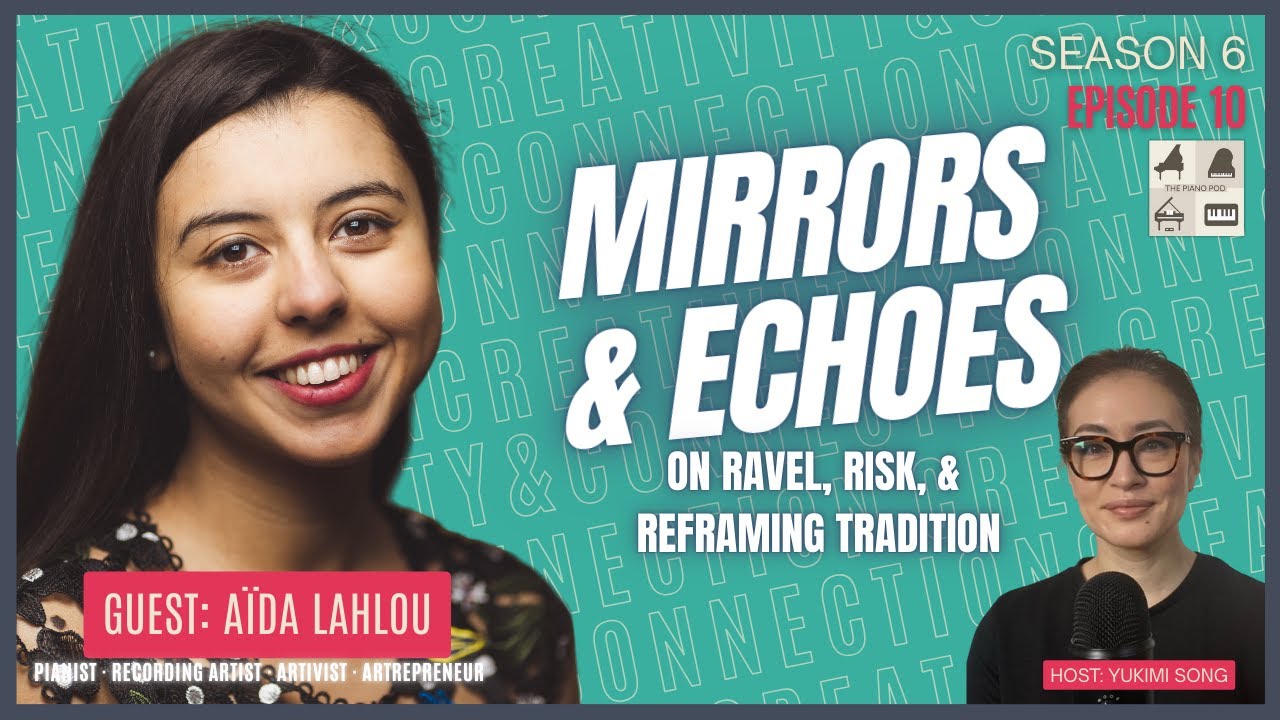
This content was created by The Piano Pod with Yukimi Song. This content was uploaded by The Piano Pod with Yukimi Song. This is a YouTube podcast episode (Season 6, Ep. 10) from The Piano Pod with Yukimi Song titled “Mirrors and Echoes” (metadata: uploaded 2026-01-28). It is an English interview-style conversation between host Yukimi Song and guest Aïda Lahlou, a Moroccan-born concert pianist, creative director, activist and entrepreneur. The discussion centers on Aïda’s debut album Mirrors and Echoes — a cross-cultural reimagining of Ravel paired with piano miniatures from five continents — covering program order, specific pieces and arrangements (including a Brahms motet transcription and an Arabic song “Lama Bada Yathathana”), her arranging/improvisation practice, spiritual and environmental themes in the album, reception and releases (Resonance Classics), and Aïda’s background and training (Casablanca, Yehudi Menuhin School, Cambridge, Guildhall) plus her genre-blending performance work (including a one-woman show combining comedy and piano). The excerpt includes host narration, the interview, and descriptive/promo copy for the episode.
Chapters
The basis for my artistry is really my humanity first. I would say whatever I want to achieve as a human comes first, and then my art, uh, the fact that I happen to be a pianist and that I've got this technique on this instrument, or I've got this voice that I can use on the stage, and so on, that's just a vehicle to try and achieve those things. I'm really attracted to both the meaning behind the pieces. So how do we translate an inert piece of musical notation into something that has meaning for real living humans with a beating heart? Impact is something I should chase a lot more than recognition. I wish more musicians would fly fly with their ideas and actually make something that they own and that they can, you know, move the needle in a way that benefits artists and benefits our industry in real terms rather than benefits institutions.
Welcome to another episode of Season 6 of The Piano Pod with Yukimi Song, our season of creativity and connection where we explore how artists are reshaping our musical landscape with bold ideas and meaningful storytelling. Today's guest embodies that spirit in every possible way. Aïda Lalou, a Moroccan-born concert pianist, creative director, activist, and thinker whose debut album, Mirrors and Echoes, reimagines Ravel's memoir through an extraordinary global lens. Her album weaves together piano miniatures from 5 continents, revealing hidden kinships across cultures, histories, and sound worlds, and offering listeners a new way to experience classical music as interconnected, imaginative, and deeply alive. Aida's career spans major stages around the world, from Wigmore Hall to Bozar, but her artistry extends far beyond performance. She's a true artivist and entrepreneur, creating new concert models, engaging in environmental and political work, directing a one-woman show blending stand-up comedy with classical piano and actively challenging what institutional success means for musicians today. In this conversation, we dive into everything from Ravel's elemental sound world to artistic agency, intercultural storytelling, activism, curiosity, and what it means to build a career with purpose. Not permission. Before we begin, thank you to our listeners and community. Every rating, share, and subscription helps us continue bringing these conversations to life. Here's the new episode with pianist, creative producer, and artivist Aïda Laloux: Mirrors and Echoes: A Global Journey Through Sound, Storytelling, and Artistic Purpose. Please enjoy the show.
You are listening to The Piano Pod with Yukimi Song, where we talk to the brightest minds in the industry about how they are bringing the piano into the future and thriving in a complex, ever-evolving world. Aida, welcome to The Piano Pod, and thank you so much for being here today. I've been really looking forward to this conversation.
Thank you so much. It's a pleasure to be here. Thanks for the invitation.
Of course. And your album, your artistic vision, and your work as an artivist and artrepreneur— I love those words— and then just so much to explore today. But before we dive in, I want to start with the foundation of your artistry. Your work has been described as imaginative and poetic and unafraid of exploring sonority, color, and inner voicings. So let me begin here. What drives your artistic choices? What is the core mission or vision behind your music making today?
Wow. What a deep question. We're really starting, throwing me off the deep end, right? Well, I think the basis for my artistry is really my humanity first. I would say whatever I want to achieve as a human, comes first, and then my art, the fact that I happen to be a pianist and that I've got this technique on this instrument, or I've got this voice that I can use on the stage, and so on. That's just a vehicle to try and achieve those things. So that's my first sort of, um, element of an answer. And in terms of, uh, in concrete terms, on the piano, what attracts me. I'm really attracted to both the meaning behind the pieces. So how do we translate an inert piece of musical notation into something that has meaning for real living humans with a beating heart? And then the other aspect that really fascinates me is the mechanics of sound production, making beautiful sound on the piano and just the myriad of ways we can approach that. So that's really interesting to me too.
Wow. Yeah, but it really— those really show in your playing, whether that is the tone color or even the selection of pieces, how thoughtfully curated all the pieces into your album, the latest album, which is your debut album. So let's dive into them. So the title of your album is called Mirrors. And Echoes. You've taken Ravel's Mémoire and set it in dialogue with piano miniatures from across 5 continents and turning it— yeah, so, so wonderful— and turning it into what you've described elsewhere as a kind of a musical treasure hunt. I love that. So what is this album about? So before, you know, we go into details, could you give us, our listeners, an overview of Mirrors and Echoes.
Sure, so the best way to describe this album, it sounds a bit cliché, but it really is a journey. Um, because normally in albums, let's say, there's maybe one overarching theme, but maybe we're going to explore different aspects of the theme in a sort of ordered, well, or sort of sectioned approach. Whereas here, the themes are explored in a much more organic way, so they're much more implicit. There's nothing so obvious. However, somehow you do feel a connection through all the pieces. And those connections— if I were to describe the atmosphere behind the album, what it feels like listening to it, it's very introspective. There's a lot of space for, well, reflection, uh, which we come into with the mirrors theme a little bit, um, and also about, um, feeling things within you that you might have forgotten about. So for example, um, old songs, old rhythms, things that you viscerally may feel connected to even though they are very remote from, let's say, your everyday life, what you listen to on a daily basis. So it's about reconnecting with, um, well, a deeper aspect of ourselves, I say.
And when I listen to this album from the beginning up to the they have to be in that order? Like—
Yes, it doesn't work. I've tried, but really the order is absolutely essential, um, which means that when I have to do slightly shorter versions of the recital, um, it's really putting me in a pickle because I have to think very carefully about what makes sense because I've conceived these so carefully from start to finish. And then if I have to do a 30-minute version, I have to start somewhere in the middle that makes sense somehow, but I can't just pick and choose the pieces.
You're starting from Beethoven, but it's Polonaise. No, not a lot of people play Beethoven Polonaise.
Yeah, it's very obscure. I'm kind of— this is me provincializing the Western classical canon. I mean, if I had put any other piece by Beethoven, it wouldn't have fit because the point is to disorient the listener. A little bit. And, you know, you look at the program and you see Beethoven and Brahms and you're like, okay, familiar territory. And actually not at all, because the Polonaise by Beethoven, who no one's ever heard of, and then an obscure motet by Brahms that doesn't even exist for the piano, that I've transcribed for the piano. So it's really— I'm kind of playfully putting everyone in a difficult situation.
Yeah, and then mission accomplished, really. And then tell us more about the pieces. So composers, right? So the second piece, so starting out with Beethoven's Polonaise in C major, then followed by— are these French words? Air de danse, kytarma?
This is not actually a French word. I'm assuming it's either, yeah, Ukrainian words or something Slavonic or something like that, because it doesn't mean anything in French. It must be the name of the dance itself. So yes, the Beethoven starts off as a sort of curtain raiser. It's very much out of character with the rest. The Beethoven is this really jokey, sort of tongue-in-cheek composition that I use just to put everyone in a good mood and act as a big contrast between that and the desolate, sort of very eerie atmosphere of the piece that comes after. And that is really the start of our journey. I mean, the bait of it is just, just a curtain raiser.
This dance piece by Armenian composer Spendyarian was followed by La Vallée des Cloches from Miroir by Ravel. Why you didn't put Ravel's pieces in order?
So one of the reasons was in order to accommodate that larger narrative. The other reason is I feel that as a set, they work really well, of course, one after the other. But also each of them is so individual and so good at setting its own little bubble and character that I think putting them out of order is not, you know, sacrilegious to me in a way that Um, you know, perhaps another set wouldn't have worked as well. I think for this particular selection of 5 pieces, they can be taken apart. So I just, um, yeah, I just thought they offered the perfect framework to build a larger narrative because they're each so, um, good at transporting us to very different ambiances. Like, okay, what about, um, just imagining a story that links all of these very, very distinct elements together? What might that look like and sound like. And that's basically what the album ended up being.
Wow. And yeah, almost like you're sharing your playlist. You know what I mean?
What do you mean by playlist?
Like, for example, before your time, there was a thing called cassette tape. Yeah. I don't know if you heard of it.
Yeah. I'm not that young, you know.
Okay, good. Well, then I would create the— we call it playlist now, but I would have a favorite songs or favorite pop songs, favorite piano music into this one cassette in the order that I want, and I would give this cassette tape to someone else. That sort of idea.
Yeah, exactly. I mean, the album, if you wanted think of it like that. Yes, the album is a playlist in that the order is as important as what's on it. So yeah, it's a nice way to describe it. In fact, the whole project started as a playlist on Spotify. I was researching— this is totally, you know, kind of a separate avenue of the album, but I was researching folk music on the piano. Before having any idea about making album or anything. This was just out of interest, out of curiosity. I was a little bit tired of always, you know, hearing the same pieces. When we think of folk music on the piano, we think Bartók, Kodály, that kind of stuff. And I thought, how about we find other traditions? How about Scottish music on the piano? Or I don't know, traditional, like Andalusian music on the piano and so on. And so I started just compiling these things and actually a lot of the pieces I found through that search ended up on the album. Um, because, um, yeah, it sounded like all of these pieces from very, very different traditions actually had some sort of, um, spiritual connection almost. It's like they were all tapping into something so deep within our humanity. That it didn't matter where it came from. It all sort of pointed back to something very, very fundamental in our human nature. And I thought, wow, how fascinating that, you know, a piece from Andalusia or a piece from, you know, like Scotland or whatever can speak to each other and resonate in, you know, in such a deep way that, that was very interesting. And I thought, hmm, there's something there. And that was one of the sort sort of, um, paths that led me to the album as it is today is looking at folk music and the intersections between, yeah, these genres.
I'm also curious to know, you've done two arrangements in this album. One is a piece, choral piece by Brahms that you mentioned. And then at the end of this album, "Lama Bada Yathathana." Yathathana.
Yes, very good. Well done.
Thank you. Yeah, it's on Arabic music. Right.
And it's absolutely—
and I listened to the orchestral vocal version of this piece this morning. Gorgeous. Played by Arab Symphony or something like that.
I mean, this is a standard. It's like saying Autumn Leaves or something, except it's from the 14th century. So it's— everyone in the Arab world would know this song. And there's no strict arrangement. I mean, what we have maybe is just the notation of the melody, but really it's always transmitted through oral tradition. And so across centuries, people have just improvised on it, made versions of it for their instruments, sung it. And so, yeah, it's not— there's not a particular sort of authoritative version. It's just so embedded in the culture. Yeah, so I made my little— I had a little play around with it, and I ended up with a sort of Rachmaninoff impressionist-infused piano version.
Did you learn to do this sort of like doing your own way, like arrangements, for example, or playing by ear, or maybe improvisation as you were being trained as a musician?
Yeah, I did have quite a lot of improvisation lessons, although they were quite formal classical improvisations. And I think that really helped me actually to engage with classical repertoire a lot more than just doing my own improvisation. I just felt like I had suddenly a window into what a composer might think of when starting a piece of music, knowing how to create structure, how to create certain expectations, understanding the harmonic language. So I would say, yeah, my— ironically, my improvisation um, lessons really helped me understand written compositions better rather than like actually turn me into an improviser, which I wish I could be, but I'm just so terrified of doing it. Um, however, I do enjoy playing around and I love arranging because I think in arranging you have the freedom of expressing yourself, but it's like a little also intellectual puzzle about, um, how do you turn this given material into something new, and you take off the pressures of having to do it in real time, um, which obviously you would have to do if you were improvising. Um, so yeah, my process to write this arrangement actually was a lot of noodling on the piano to try and find interesting chords and interesting rhythms and so on, and then piece it all together. Um, so I suppose, yeah, I did improvise some bits, but in no way did this just flow out of my mind in a way that, I don't know, Mozart would just improvise.
Yeah, but it really— I'm very impressed with your skills as an arranger. They're both wonderful arrangements. Yeah, I wish that— are they available as a score or sheet music?
Not at the moment, although I would like to share them. So if you or any of your if listeners are interested in having them, they can send me an email and I'll send them to them.
Okay. And then your— I think the best way to be in touch with you would be your website at aidalalou.com, correct?
Yeah, there's a contact form on there. I'm also very responsive on social media. Great.
So what inspired you to reimagine Ravel in this intercultural context, build these bridges across cultures rather than just playing, you know, his pieces, 5 of them, and maybe other pieces by him, for example, or other composers, but in a chunk, for example, you know?
Yeah, of course. Well, I'll answer in two parts. First, Ravel, I feel, was extremely cosmopolitan in his musical writing. I had a teacher who said, you know, Ravel is extraordinary in that he writes music of a certain nationality better than the people from that nationality. So of course, he was half Spanish through his mother, so you can trace that. Through there, but he also wrote Greek songs. He wrote the Romani style with Zigan. He wrote the Chanson Madécasse, which is like after Madagascar. So, I mean, this is just a small example, but he just wrote in so many different idioms. So I thought I was very much at home with this composer and also my love for exploration of music of different cultures. I don't think he would have disapproved at all. I think is very much up his alley. But also within the specific opus, The Miroir, I think there are so many influences that I can hear. So obviously Alborada is in the Spanish style, is a very clear Hispanic influence. But in La Vallée des Cloches, for example, I personally hear quite Eastern influences. I hear sort of almost Tibetan temple bells or something, um, ringing in the distance. I know some people think it's more Switzerland bells or Parisian bells. We have different theories floating around, but for me it's just so serene and so, um, out of time that I really imagine myself in this sort of, um, extremely meditative ambiences. And for me, that can only be somewhere very remote. Switzerland, perhaps, but I think I'm a bit more Eastern in my imagination. And then there are also other allusions, things like I hear, I mean, through the harmonies that he uses in somewhere like Wasotriste. For me, this is very, very influenced by jazz and things that were coming out of, you know, the new wave of writing at the turn of the 20th century, slightly more experimental with harmony, slightly less, say, classical. And of course, the two pieces that I haven't spoken about so far, the Nocturne and Une Barcelonaise, also transport us to different locations. Even though they're not specifically named, we are very clearly in the forest in Noctuel and Oiseautriste, and we are also just on the move on a boat in Un bar sur l'océan. So there's already this idea of travel, of voyage. And also we have also different, say, stops in different locations. So that's why I felt allowed in a way to expand on the message of this.
Tell me more about other pieces as well. So, Four Piano Moves by Alexandra Tanzmann, and then also there's a Scottish piece, What the Fairy Piper Told Me, Ronald Stevenson and Cadish. Is that how you say?
Yeah, yeah, yeah, yeah.
That's also— that was arranged by Szilárdy.
And by Maurice Ravel. Yeah, and there are always links to Ravel. So some things I actually found out after having done the program as it is today. I contacted the chairman of the association Les Amis de Maurice Ravel, and he told me, oh, you know that Tanzmann and Ravel were friends, right? I said, oh yeah, of course I knew that. I did it. But it turned out they were actually friends. I didn't realize that before I found this stylistic connection between Un bar sur l'océan and The Townsman. So what happens in my mind at this moment is we're checking the roads on the boat in Un bar sur l'océan. We are a bit disoriented because we've been on this mega adventure and we've been very much, you know, confronted to the elements, confronted, like challenged emotionally and physically. And then The Townsman comes as this like moment to center back on yourself. It's very introspective. It's only 1 minute long. It's quite psychological, I would say, as a piece. So it just bridges this exteriority theme with the more interior theme of the next few pieces. So that's a nice bridge to "Was es trist" and so on, which are a lot more sort of intimate and one could say even oppressive in some ways. And the Stevenson— so Ronald Stevenson is a Scottish composer with a huge output actually for piano. So you might know him for his huge piece, Fantasy on D.S.C.H., which is 18 minutes long. This is a solo piano piece and it lasts 1 hour and 20 minutes.
Oh my God.
So this guy is used to huge large-scale pieces, so it's slightly ironic that my piece that I included on his album is about 50 seconds long. Um, but I included it partly because it's an example that you can play something that sounds Scottish on the piano, and partly because, I mean, in this piece we're transported to the forest, there's a fairy, nearby, we really feel like we're in the forest. And it's great in that section of the album because we are in the forest very much with "Was so triste," that little piece, and "Nocturne." It's like this supernatural forest where things happen. You see little beings and you're not quite sure if they're real or not. Um, so yeah, I just found it by chance again through research, and I thought this is the perfect piece for that section of the album.
Wow. And then followed by Malagenia by Lekuan. No, after the Nocturnale, then that's the Malagenia, right? And then followed by Kara— Karaev. Karaev.
Yes. So should I introduce— and you asked about Kaddish as well.
Yes.
So Karaev is an Azerbaijani composer. Okay. Apparently the most famous composer from Azerbaijan. I came across his work by chance when I went to compete there. I was invited by Morocco to represent the country in a sort of international competition. And I played this piece for the competition, actually, because it was the easiest of the ones you could choose from to perform. We had a list of things we could choose from. And then I actually thought, hmm, this is so broody and this is so kind of, yeah, almost like full of repressed passion in a way. And it's so kind of, you see it, it's calm on the surface, but there's so much inner turmoil that's just repressed in there. And then I thought, 'Well, we need some sort of link between the forest and the explosive world of Andalusia and southern Spain.' And I thought, that's actually a very unlikely link, but it works exactly perfectly because you've got, yeah, this seemingly broody, seemingly monotonous texture, but then that's the perfect link for the start of Malaguena. I don't know if you remember how it starts, but it's like, really dark chords that then, like, gain in intensity. And before you know it, you're like, phew, like full of, you know, explosion, virtuosity, passion, typical Spanish stuff. So yeah, that's why it exists. It's so funny, my explanation is so much longer than the piece itself. No, it's totally like that for the album. And then we're in the Spanish section, of course, with Malagueña and La Lucía. Alborada, Andalucía. And then I thought, okay, we've had this, you know, explosion of, uh, you know, personality, fire. Um, but then we, in, in the journey, you know, we've, we've met with our deepest emotions and we've confronted them and we've expressed them in this flamboyant way. Now we've kind of come full circle. We come from contemplation, but then we need to kind of make sense of that and digest that and say, okay, who am I as a person in the end? And that's why the last section of the album is actually still infused. So we're still informed by this passionate outburst, but we're now back into an interior mode where we kind of reflect on these things. So the Kaddish and then the arrangement of Lama Bada Yetetendal, you will still find reminiscences of the explosive bursts of passion, but it's done in this almost like ritualized sense of, yeah, like a prayer almost where, I don't know if you know the Sufi tradition of dancing. So for them, so in the Sufi tradition, dancing is like a form of worship. It's a form of spiritual sort of almost enlightenment or meditation. And that's very much the end of the album's vibe. We are back into celebrating our body, but in a sort of connected way also to the spiritual world. So it's not just, you know, just the earthly sort of explosions of passions. We're also just coming back to what it means from a spiritual perspective. And then I don't know if that made any sense.
No, no, no, no, no, it just makes it. And then the last piece, the last song, Lama Bada Yatha Hana.
Yes.
What does it mean?
So the title is, if I translate it, is something like "When My Beloved Was Walking." And the song is just a very simple, beautiful poem about just this vision of your beloved walking and how they're far away from you. And you find it so cruel that, you know, you're not with them. And it's kind of this sort of love song, but there's also spiritual undertones about the love for God and the love for beauty. Um, it's a beautiful little, um, song. It's difficult to kind of translate it in a way that makes sense, but, um, you can find some translated lyrics on Wikipedia if that helps you, um, a little bit to understand what the song is about. It's very much an ambience of But why you wanted to end with that?
Was there those two pieces, right? So was there— did you have some sort of— yeah, yeah. Did you have some sense of like a spiritual message? Not in the, oh, this is what it means, but more like in a, you know, hint or suggestive way that you wanted to include the spiritual message or spiritual duality of who you are?
Definitely. So, I mean, there's a very big spiritual element in the whole album. And, um, also I think different spiritual traditions are referenced throughout it. So of course we've got the Christian tradition with the Motet, we've got the Jewish tradition, and we've got, um, also the sort of Islamic tradition with that song. Um, it's kind of, yeah, a journey through spirituality, but in a way that's not particularly attached to any tradition, perhaps in a way to just show how much similarities, how many similarities there are between the essences of all these traditions. Um, yeah, so I guess we start the album in a contemplative space and we finish the album in a contemplative space as well. To me, I mean, my relationship with spirituality, let's say, is something that is very practical and very embodied. So I think of the album very much as also a reflection of how I view spirituality, which is very much embedded in the world we live in. So, you know, feeling at one with nature, feeling at ease within yourself and connected with the broader world or your fellow human beings. Um, yeah, it's kind of my sort of relationship to spirituality. And it may be that some people view the end of the album as, well, a way to bridge different traditions together, or just a way to celebrate this part of spirituality that is attached to beauty and attached to love. So there's no one way to see it, but yeah, this is what I have to say on this topic.
No, but you know, there's no one way to see it. Exactly. That's why, just, that's why there's music exists and that we can see it in a different ways and everybody has different ideas or feelings. From listening to this one album, right? Yeah. So you're also deeply engaged with environmental issues, using music as a way to think, respond, and act within the larger conversation around climate change.
Well, I think the root cause of climate change is that we've lost, um, our feeling of being connected to nature. Because if people were really still had this connection, there's no way they would hurt the natural world in the way that we do. And the problem now is they don't understand that they're actually hurting themselves. Um, this, for me, climate change is a total— it's a psychological issue to start with. It's the fact that we've completely— we've become alienated from a part of ourselves which is nature. Um, so yeah, I guess that's just my two cents on this issue as an artist. And that then manifests itself in, you know, all the forms of destruction that we see on an economic scale with exploitation, on an ecological scale with, you know, deforestation, habitat loss, exploitation of animals, like industrial farming, all of that. And just the way we eat, the way we travel, I mean, all of that is just For me, it stems from the basic sort of lost connection between us and nature. So yeah, there is a lot of nature themes in the album, which also connects to spirituality, because as I said, for me, climate change is first and foremost, let's say, spiritual or psychological problem.
It's just a very subtle but powerful message that is included in this album.
Yeah.
So congratulations. It came out a few months ago, right?
Uh, yes, just— it's gonna be about 2 months in a couple of days. Yeah.
Oh wow. That's— that's— today is November 13th. By the time this episode will come out, it will be February 2026. But wonderful. And so far, what sort of feedback did you receive?
Yeah, a lot of positive feedback actually. I've been very lucky with the reception. I didn't expect anything like that as a first album from a relatively unknown artist. I was told that, you know, I'd be lucky if I got, you know, one review or something, or— but then I got two radio features from BBC Radio 3. It got selected for Record Review as well as one of the host's favorite albums of the week, which is crazy. Then I got invited to podcasts like yours. I was very fortunate to have these invitations and share my vision and my, you know, this work that I've done. A couple of articles as well. So it's been great. I was certainly very surprised.
Oh, but you know, obviously you well deserve and well done, so congratulations. So thanks for listeners who want to explore this album, and which you all should, please go to any music streaming services. And the title of the album is called Mirrors and Echoes, and in the physical Physical copies are available also?
Yes, you can order them on the label's website. So that's Resonance Classics. And I'm pretty sure they ship worldwide, but I have to check that.
Okay. Yeah. And then I will make sure to insert that into the show notes as well. Now that brings me to a different but connected question: understanding who you are behind all of this. So, because listening to Mirrors and Echoes, it's clear that your artistic choices come from a very specific sensibility shaped by where you come from and the people who guided you. So you were born in Casablanca and started piano at age 5. What do you remember about your earliest connection to music?
Um, really listening was my first connection to music, I think. Um, you know, to my mom sing songs and teach songs to me, but also in the car I was just bombarded with recordings of like Martha Argerich playing the Schumann Concerto or Tchaikovsky Concerto, or Glenn Gould play all the inventions in Symphony of Bach. These are the sort of core memories I have as a child growing up. So I very much loved listening even before I even started piano. I just had this connection with the material, but also I guess the social connection that my mom, you know, she used this to deepen her connection with me. So we shared this. I think it really anchored that love even more. My dad also likes music very much, although it's not so much classical, but we also, again, in the car, I've got my classics that my dad always plays. So that's super nice, you know, every now and then I just put on a playlist and it's like a time machine. So yeah, that was my earliest connection to music, I would say. And then I started piano lessons. Um, actually I had sort of classes to introduce music to children. I think you have that in the States a lot, probably. Um, just, you know, basic children's group with like a teacher with like basic musical instruments and we clap and we sing songs, whatever. And then I started formal piano lessons at 5 with a Ukrainian teacher. Um, I wanted to play violin, but my mom said if it's harder, so I should start with the piano. And unfortunately, I never made it to the violin.
Piano was hard enough, but also probably you fell in love with the instrument, right?
It's a great instrument. I kind of wish I could play violin too, though, but you know, we've got one life.
And piano— with piano, we have too many repertoire, too many piano pieces out there. You can't even accomplish all of them in one life, you know?
Yeah, exactly. There's enough work for one person.
Then your training took off and from Morocco to the famous Yehudi Menuhin School in England, right?
Yeah. So it was created by Yehudi Menuhin, the violinist. He's actually buried there. Um, which is crazy to think about. It was his house. And, um, he started this school in the 20th century with, I think, 10 students or so in London. And then he moved to Surrey. Um, and at the time I was there, it only took around maybe 70 students from all over the world, from age 8 to 18, 19. Um, and I was selected to go there after an audition. Um, in the autumn of 2013, I think. And then I was there in 2014 at the age of 15. Um, it was a very formative experience to be just surrounded by music and by extremely talented young people from all over the world. Um, it was very demanding, but I liked that because I was there to learn. Um, And it was just the level of teaching there was phenomenal. People there were there not because, you know, they were paid great or anything, but because they just loved to be there in this institution. And so we got the best of the best of musical teachers from people who taught theory or composition or things like that, to piano teachers, to harpsichord teachers, improvisation teachers, chamber music. Everyone was just on such a high level. It was honestly the privilege of my life to attend that school.
Wow. Such a very significant age to really learn music, right? 15, 16, 17.
So people usually go— this is considered late because most people go there in primary school sort of age. It's the minority of students that come for sort of the finishing touch of their education. So at 15, I mean, it's quite a late age to really like learn from scratch, but I didn't— obviously I didn't come from scratch. Like, I had, I had won a lot of competitions. I had had serious training in Morocco, but it was, let's say, some people— like, most of the school actually come there much earlier. So I was one of maybe 5 or 6 people who joined at that age, at that time. Um, but yeah, for me it was enough. Um, because yeah, it enabled me to live my life as a kid, like a normal kid in normal school, and then come there for inspiration and learning. And I think that was the right balance. I'm not sure I would have liked to be there from such an early age.
Wow. Then that fast forward, um, you got into Cambridge.
Yeah.
And then later to Guildhall, which is a very, very prestigious school with, and graduated with distinction. So how did these two environments shape you academically?
Cambridge was great because, I mean, it's Cambridge. It's like, you know, Hogwarts almost. In terms of like, I don't know, I'm always a very, I was always a very academically driven person. So going to like such a center of academic excellence and be able to meet, you know, um, specialists in the field, like all my lecturers were just so brilliant and I could just meet them for supervisions on one-to-one, uh, you know, what you, you're sat with them in a room with maybe one other student and you have to discuss their work and sometimes criticize their work, um, to their face, you know.
Oh my God.
And then they criticize your work with their towering, um, you know, amounts of knowledge. Um, that was fantastic. And yeah, it just really broadened my, um, I mean, I already had such a broad idea of what music could be when I left Menuhin School. I realized that it's not just about executing a musical text. It's— music is so broad that almost any skill set, any personality type will fit somewhere with the music. Um, in Cambridge, it was just even more of that sort of idea being reinforced in that I looked also at how it fits with other disciplines. Um, you know, obviously any university now is very big on intersectional studies and things like that. So you see intersections of, for example, music and colonialism, or like how musicology was shaped, the very science, let's say, of musicology was shaped by ideologies that were going around in the 20th century and how that influenced the very knowledge that was produced, all, you know, the focuses of that science. So it was kind of— Cambridge was great to like allow me to look critically on a meta level at any sort of discourse. That I encounter. So not just seeing what the argument is and what it's doing, also asking why is this argument being made in the first place, like what informs that point of view, etc. So that was absolutely great. And also I met people from other subjects, which is very enriching for me, so I could have conversations about politics or economics or anything because everyone is kind of there and interested in everything. And then at Guildhall, very different vibe, obviously back to very narrow music focus. But it's a fantastic group of people, great connections within the music industry. And yeah, I think I'm happy that I did it in this order because it just allowed me to take things I learned at Guildhall with a pinch of salt. Sometimes. Like, I think if you go straight to a musical institution, sometimes you can feel like what your teacher says is the end-all be-all, and if they say something, that's it, that's the truth from God, you know, that's been applied. Um, but having had this background in Cambridge of being used to questioning everything or contextualizing everything, it was useful in Sonos. Surviving the music profession and like looking at it a bit more critically.
Well, I can tell from the way you explained to me, to us about your album. So I almost wondered, your undergraduate degree in Cambridge, did you double major in anything or did you just focus on music?
So in the UK system, there are no such things as double major. Oh, actually in Cambridge you can double major. Other universities you can, but in Cambridge I just did music. Um, but again, it's, it's applied in such a broad way that if you wanted— I mean, I did my— one of my essays was about ASMR and the cultural sort of underpinnings of that and implications on classical music of the time. Um, but other people did things to do with economics or colonialism or Yeah. So it's, you say we're studying music, but really we can study anything just as long as there's some sort of musical link.
Oh, wow. That's brilliant. Wow. How fortunate. Then, um, any memorable teachers you've had in the past?
Yeah, I would like to say, yeah, all my teachers were memorable in one way or another. Um, yeah, I mean, I can't possibly, you know, pick some because it would be— it would feel sacrilegious to pick one or two over the others. So I'll just say, yeah, I've had really fantastic teachers and I've put, um, for my most direct influences, I've written an acknowledgement section, um, on my blog, um, which kind of gives personal thanks to some of them and what they've brought me and I've put into the album.
Wonderful. Then since then you've performed everywhere, you know, Wigmore Hall to Azerbaijan, Ibiza, Morocco. Is there a concert experience, small or big, doesn't matter, that remains unforgettable for you? Something that changed or confirmed something about your relationship to performing or music?
Oh, that's a big question. Um, I think a lot of concerts are memorable just for different reasons. Obviously Wigmore Hall is very special because, well, the piano was fantastic for one. The Wigmore Hall piano is insane. The acoustics were great, and also the occasion was incredible. So it was the graduating sort of concert, and the hall is kind of— the entire school watches you play. But normally when the school watches you play, everyone's kind of in a criticizing mode, like, oh, you've missed a, you've missed a sharp there, like you've made a mistake or something. But at that moment, the whole school is just there to celebrate your achievements. And so you just walk onto the Wigmore Hall stage with like thunderous applause and people shouting and screaming. It feels like you're a rock star. So that was really fun. Um, the comedy, the standup comedy things I did. Were also super, super fun just because, yeah, it was such a wholesome and genuinely fun moment and one that I felt I had a big part in actually creating because I really felt like I had created a show, not just played some pieces, but created something new. And then, yeah, a lot of A lot of others. I mean, it's too many to count, to be honest. How are we feeling tonight? Are we feeling good? Just to introduce myself, my name is Ada. I'm a concert pianist. The funny thing though is that I did not want to be a pianist growing up. I actually wanted to be a brain surgeon, but my parents were not supportive. Yeah, they didn't want a doctor in the family, and they thought it was a bit weird. I still do surgery for fun though, but on the weekend. I've got some kneecap replacement gig coming up. Actually, people often ask me why Did you choose the piano as an instrument?
I want to talk about this stand-up comedy thing.
Yes.
So when I think of comedy with— so you combine comedy show with the piano? Yeah. So I think of the very famous Victor Borge.
Yeah.
And then so is that similar to his style or is it more like— No. Okay.
So what he's doing is more like slapstick, I would say.
Yeah.
Kind of, you know, fun routines and kind of jokey routines to do with the act of piano playing. I don't do that. So the piano part is really serious piano playing and the comedy is standup. So a lot of the material will be tangentially connected to like the music industry or what it feels like to be a pianist or making fun of that. World I inhabit, but it's just strictly stand-up. So I'm not going to make sort of, yeah, fun routines about like, I don't know, playing piano like with my sheet music upside down or something like that. It's not like that. It's really stand-up. Wow.
Where does this love of comedy or stand-up comedy come from? I love stand-up comedy watching, you know. Do you have any favorite comedian or something, someone?
Yeah, I have lots of, I also am a great fan of stand-up comedy. Um, a lot of my favorite comedians are like French speaking, so I'm not sure how relevant for your audience, but, um, yeah, I've always loved stand-up comedy and I thought it's so, I love it because it's so genuine. There's nowhere to hide, but at the same time, there's such a craft in actually making it Good. And I found so many interesting similarities with music, with the timing, the sort of accuracy at which you have to deliver that timing for it to work. Um, the genuineness of it. So like playing with integrity and also just writing and performing with integrity as a comedian. Um, writing material that's also true to you and that's not just you know, hackneyed or stolen or whatever. So yeah, there were interesting connections, and I thought that kind of came out of a period of my life when I was a bit frustrated with my impact as a pianist, because I thought, I want to talk about the big issues of the day, but how can I do that in a piano recital? And I thought, okay, maybe I can actually allow myself to talk And so I did this stand-up show and I didn't hold back. So I talked about all the stuff I want to talk about, you know, my frustrations with politicians and climate change, like the discourse around immigration, things like, um, how people view artists and all of the prejudice, all of that. I really didn't hold back. But yeah, somehow I always connected the two pieces. So for example, like for In Bach Sola Seão, I was doing something about like, you know, how I found some of the discourse around refugees just stupid. And I thought, so this is In Bach Sola Seão. People think it's about a day at the beach, but really it's quite terrifying when you listen closely. And I think it's about the immensity of nature and the powerlessness of humans in the face of nature. And I want to dedicate this to anyone who's tried to cross the sea for a better life. So there was some sort of link between the social commentary and the art, like the, the pieces I was playing. So it was kind of speaking to each other. The two components were speaking to each other, but they were very much respecting each other. So like, I wasn't trying to make the music funny. I was just playing serious pieces. But I think it really helped each other kind of shine in a way, all the different art forms.
So first you performed and then the comedy. Is that how it went?
No, it was completely— it was like back and forth.
Oh my God.
So in total, there was 30 minutes of music and 30 minutes of comedy, but it was interspersed. So I would— I started with like a flashy piece. Then I said, you know, I always start this with this piece, People Think I'm Legit, and then I start with my comedy routine and then I introduce the piece linked to the comedy and then I play it. Then again, it's the back and forth.
Yeah, but you know, the really, that's the spirit or the origin of comedy, right? Like what you are struggling or you have this, you want to bring this challenge into the world, but then what's the best, What's a better way to do it? Of course, comedy, because we can all laugh at something. So, wow, that's very clever. But also, I'm sure it took a lot of courage to do it.
Yeah, but I'm a bit crazy, so it's fine.
That's so cool. So I want to talk more about this, you know, creativity. Um, so because you said something about You know, despite all the awards you collected, you have won 20+ awards internationally. And then you said that the institutional success is often neither achievable nor even desirable for many musicians. Can you explore a little bit more of that, about that?
Of course. I'm very passionate about this. So I used to think that the way to you know, be successful, whatever that means, is to win competitions or be respected by the establishment. So either being a conservatoire darling or win a big competition or get hired by an agent or whatever. And then I saw the results and I thought, okay, well, I see a lot of conservatoire darlings who are getting all the opportunities. And then 2 or 3 years later, there's a new conservatoire darling and then they're not getting anywhere because just in terms of actual concerts and just, you know, outward signs of success in inverted commas. Competitions, same thing. So you might win a competition, even a big one, and then you're still doing gigs that don't pay very much or whatever. So even for the very outward sort of basic crass signs of success in terms of pay or number of concerts and so on, it's not necessarily a panacea. And then, um, yeah, agents again, um, I feel like agents nowadays, um, with all due respect to agents, a lot of them, um, only take you on when you don't really need an agent. So I thought, okay, but let's say as a thought experiment, I say, okay, let's imagine I've won a big competition or I've landed, you know, one of those things. Would that make me feel happier? Uh, what would I have achieved in real terms? And the only conclusion I could get from that answer is an ego boost, maybe a bit more money. But I thought, okay, do I really want that? And the answer was no. Um, I was a lot more interested in just doing something that like has real meaning outside of just the about because these sort of institutions, first of all, I have, yeah, not sure they're always right, but they also perpetuate a lot of the things that I think are wrong with industry. So I thought, okay, um, first of all, if I go into this and I win something in there, I'm just going to reinforce those negative aspects. But also, yeah, even if I look at just the positive sides, for me, it's just not that much. And I thought, okay, well, let's look. There's so many examples of people who achieve those same hallmarks of success without going through the institutional route. So for example, um, let's say there's a money prize for the competition. People achieve that money in other ways, not winning competitions, or you perform in big halls. People have performed in big halls without winning competitions or being a conservatoire darling. So there are ways to do that. And that way you're not dependent on, you know, the approval of one or two people who might just not like you or be biased against you. And I think chasing the approval of just the establishment is such a waste of time. My advice and my sort of experience is you're much better off just trying to make your objectives happen. Independently of whether or not someone gives you permission. Um, and from my personal perspective, like now I, I feel like impact is something I should chase a lot more than recognition. Um, if that makes sense.
Yep.
Yep. So I'd much rather, you know, make a positive change in something that is bigger than just me. Rather than be spotlighted or chosen by an establishment figure. Or—
yeah, but our industry is— the classical music is sort of based on that recognition and being admitted or nodded by or, you know, even since your training era. Does that make sense? Being admitted into this studio, for example, or this school. So that's the sort of mindset, and then everybody is sort of afraid of everybody, right?
Yeah, I would say, I mean, you have to be pragmatic. I was certainly pragmatic in my approach. I said, you know, what's the minimum institutional success that I need in order to be credible? And I think, I mean, most conservative students already have that, but then going beyond that and seeing institutional recognition as the end-all be-all, I think that's inefficient. I think just go and get some credibility that you can demonstrate and an easy way, well, in order to come as an easy way is to get a diploma from somewhere respected. But then take that diploma and do something with it that doesn't require authorization. So for example, I mean, as an artist, you may think, you know, I've released my CD, it's going to be really easy for me to find concerts and so on. It's really hard to find concerts because the environment, at least in the UK, just doesn't pay people enough, or, you know, it's saturated and so on. And competition is the same thing. The amount of money you need to just apply and then they don't even give you feedback when you're rejected and so on. So I actually made my calculations and I started my own concert series, and now I offer paid opportunities for musicians. And I started with zero budget, even though if I had, you know, gone through the route of competitions, I would probably be in the red for, you know, probably several thousand pounds between recording and lessons. And so, yeah, I think it's actually a much efficient way, much more efficient way to start your own thing sometimes than wait for authorization to do something.
But you have the sort of mind to do it. And, and also you are very eloquent. You can express yourself, present yourself with words really well as as well, you know? So I think that's a huge advantage, but I'm sure you had your own, you know, challenges and moments where you probably, you had to pick yourself up and keep going, right?
Yeah, definitely. But to be honest, I find it much easier to be in control. I'd much rather be sad or be challenged by something I own, um, rather than you know, be at the mercy of whatever rejection is going to be on my plate on the day because this jury or that agent or whatever has not wanted to work with me or something. But, you know, enterprises like, for example, your podcast or any artist-led venture that creates real value, like actual value, and creates actual communities and creates actual, you know, positive change, I think it's something to be so much more proud about than just being picked randomly by an arbitrary group of jury members. Um, so in a way, that's kind of the logic behind me trying my own thing is I want to, of course, build something meaningful. We all want to, but also hopefully in a way that's less speculative and a bit more linked to hard work rather than just circumstance, I would say.
Yeah. Well, thank you for including me, my podcast into your—
No, no, of course. I'm very admirative. Um, and I hope, I hope I've said that enough. It's that I'm just very like, I wish more musicians would, you know, fly with their ideas and actually make something that they own and that they can, you know, move the needle in a way that benefits artists and benefits our industry in real terms rather than benefits institutions.
Oh, well said. I'll quote this. Aida, you're very smart. Then you also talked about bringing back this impresario. Oh my gosh, that was a eureka moment because in that sense, aren't we both impresarios? Like, are we doing this because it's all about being a creative person, creative producer? So impresario meant you have to raise funds, you have to put people together, and you kind of have to sort of, you know, taking risks for bold new ideas. Shaping culture is not exactly what you're trying to do. And then I mean, I'm trying to do the same thing.
So yeah, absolutely. I wish agents at the moment were a bit more like impresarios. At the moment, agents, they're just extension of booking secretaries, I would say. They contact concert series and they try and push their artists, but they don't create concert series of their own. That means they don't take any financial risk. Whereas in the past, you know, if you think of the big impresarios like Diaghilev, he would actually pay for the theater. He would organize the promotion, everything. He would book artists he thought could fill the hall, and then he would pocket the, the, you know, the earnings and then pay the artists their wage. But, you know, he was the one taking the financial risk. He was the one understanding art enough to see what would be successful and what wouldn't. And that's something we need more of, someone to take financial risk, but also who has artistic sensitivity to make it work. Um, at the moment, agents don't take any financial risks. Either they book you a concert and then they take a cut, or they don't book anything and then they don't take anything. There's no risk to them at all. And I think for me, it's a bit lazy and it puts so much more pressure on the musicians. Um, so yeah, I wish, you know, at the end of the day, we had a bit more of a side of the industry that took financial risks to put on concerts. Rather than just trying again to convince the establishment to book this artist or that artist.
Right. Wow. So we're coming closer to the end of our conversation, but there's just one or two more questions for you. And, um, hmm, how do you measure success for you now that we spoke about all these things?
Um, I would say happiness doing the work and impact. So I wouldn't say, you know, sitting back and having passive income is success. I think that's not very fulfilling at the end of the day. So I'm pro working very hard, but I'm also pro like making an impact that is positive. So yeah, that's how I would do it in a nutshell.
Beautiful. And what's next for you? So, you know, you just produced an album. Is there any new project coming up? Maybe you don't want to share the details yet, but the floor is yours. So please tell us what's next.
Sure. So of course, I'm very busy with my concert series that I've mentioned, the one I've created. 8 weeks ago. So that's Oxford Concert Circle. So very exciting. We're building partnership, applying for grants, um, and hopefully growing even more into the new year. So that's a nice project. And then piano-wise, um, might have some exciting masterclass and recital projects in the new year in Morocco, but that's still to be decided with the French Institute. So that something might happen in the spring as you listen to this podcast. And yeah, I've got a million ideas, but it's just about what am I going to do next? Prioritizing. And again, with the question of impact, which is increasingly more important to me.
Wonderful. Well, thank you so much. This was a really fun, inspiring, really truly inspiring conversation, Aida. So, but I didn't explain this to you, but before I let you go, we have one more segment. It's called The Piano Pod Rapid Fire Questions. So we take this part very seriously. We've created— you've shared so much depth and insight today, but these questions, carefully curated by my team, which is me, offer a glimpse into who you truly are. So let's do this. Please answer each question with the shortest response as possible. No explanation is needed. Question number 1: What is your comfort food?
Uh, chips.
How do you like your coffee in the morning?
I don't drink coffee.
Okay, do you like drinking tea?
Not even.
No? What do you drink? Water?
Water.
Okay, that's great, that's great. Are you a cat person or dog person?
A dachshund. Oh, so cute.
Sunrise or sunset?
Sunset. Okay.
Summer or winter?
Summer.
What skill have you always wanted to learn but haven't had a chance to?
Maybe violin.
Oh, that's what you mentioned. Yes. Now, what is your word or words to live by?
Be happy. Don't take yourself too seriously. Be a good person. That's enough, I think. Great.
Favorite venue you performed in? Maybe you mentioned, or maybe dream venue.
I'd love to perform in a house, like a cozy house.
Yeah. It's actually trending.
Yeah, especially in the States.
It is trending.
That's a business idea for your listeners.
Yeah, yeah, that's right. Now, what is the most important quality you look for in other people?
Um, honesty.
Name a composer you wish more people knew about.
This is really controversial, but Mozart. I think Mozart is underrated. Oh yeah, yeah, I think Mozart is underrated because, yeah, I don't have to explain, but he is a genius, and it's not because he's written a few hits. He is actually such a master, um, composer, and it's not boring. Please, it's not boring. It's actually— every time he writes anything, it's masterpiece. Please do not say Mozart sonatas are boring. They're not.
Okay. I'm guilty. I say motosonatas. Okay. I will listen carefully. Yes. All right. Then name one piece currently in your playlist.
Schubert's Late Impromptus.
Wonderful. Fill in the blank. This is the last question. Fill in the blank. Music is blank.
Great.
Music is great. Very nice. All right, Aida, thank you so much for joining us today and for sharing your wisdom, artistry, and incredible energy. This has truly been a meaningful conversation. So to our listeners, if you would like to learn more about Aida's work, visit aidalalou.com, follow her on Instagram @aidaxlalou, and listen to her album Mirrors and Echoes wherever you stream your music. All All links are in the show notes. And to our community, thank you for tuning in. Please subscribe, rate, and share this episode. Your support helps us continue connecting through music, story, and creativity. Until next time, this is Yukimi Song and you're listening to The Piano Pod with Yukimi Song. Thank you so much.
Thank you. Thank you so much. That was a great conversation.
Oh yeah.
More from The


Spirit, Body, and Soul: Pianist & Composer David Berry on Virtuosity, Creativity, and...



Season 6 Episode 20 | "Spirit, Body, and Soul" feat. David Berry, Concert Pianist & Composer


Beyond Borders: From Argentina to Poland to Texas—Oscar Macchioni reflects on a life in music

Sound Liberation: Joe Williams on Black Artistry, Legacy & Belonging in Concert Music


