TPP S1 E1 P1: Dr. Jon Skidmore, Psychologist & Performance Coach (Part 1 of 2)
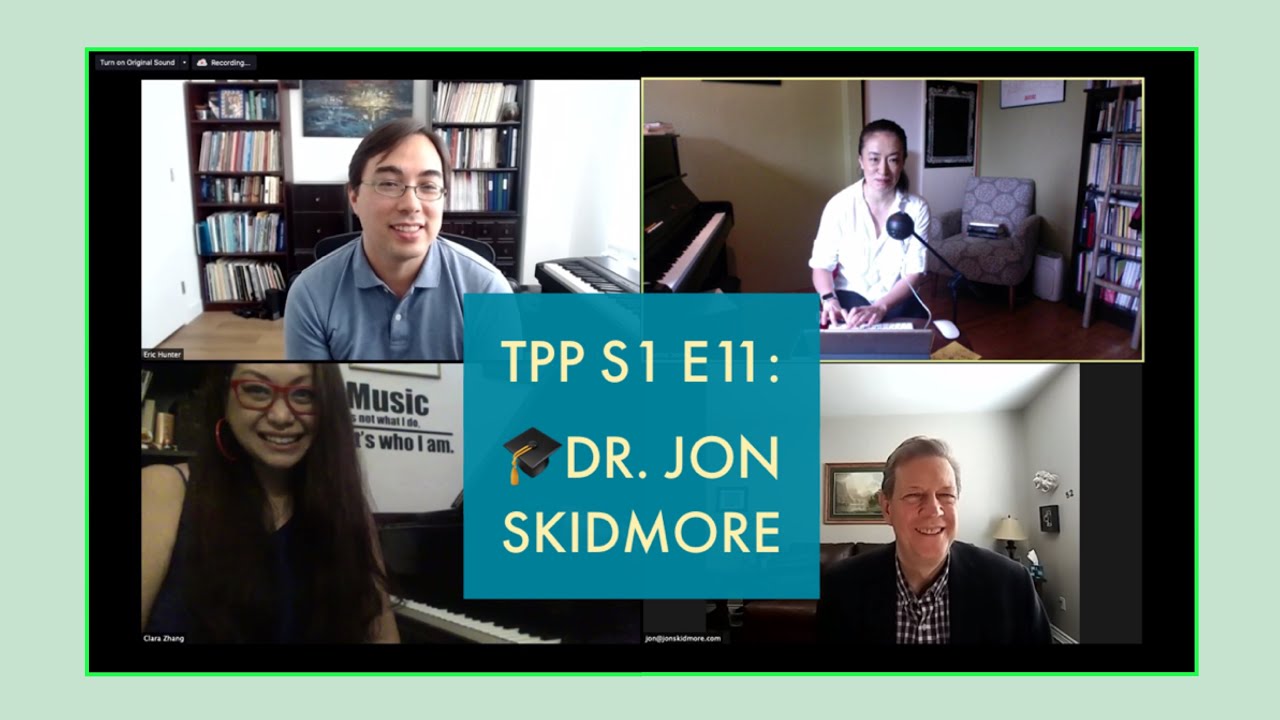
This content was created by The Piano Pod with Yukimi Song. This content was uploaded by The Piano Pod with Yukimi Song. This is a YouTube podcast episode titled "TPP S1 E1 P1: Dr. Jon Skidmore, Psychologist & Performance Coach (Part 1 of 2)" (uploaded 2020-09-08). The excerpt is from The Piano Pod (hosts referenced: Yukimi Song, Eric Hunter, and Clara Jones) featuring guest Dr. Jon Skidmore, a licensed psychologist and performance coach. The conversation covers performance anxiety and Skidmore’s 5-stage process for peak performance (vision/mindset, preparation of skills and mindset, declaring preparation complete, the performance itself, and post-performance review), with practical examples, classroom/workshop activities, and notes on applying the method beyond music (e.g., exams, interviews).
Chapters
Welcome to The Piano Pod with Yukimi Song, Eric Hunter, and Clara Jones. Thanks for joining the very first episode of our podcast. It's a show where three of us invite a guest speaker each month who is in the fields of piano pedagogy, performing arts, recording, music technology, and wellness of piano studios, as well as the mental health of students, parents, and teachers.
We're very excited about this opportunity to explore a variety of piano-related topics and share them with you. We already have several exciting guest speakers lined up for the coming months.
We can't wait to learn from each guest and discuss the topic with them on this platform. If you want to find out more about who we are, what we do, and why we started the podcast, please watch our introductory video on our YouTube channel or click on the link listed below. Our first guest is Dr. John Skidmore, who is a psychologist, performance coach, musician, teacher, and author of Conquer Anxiety. He's going to talk to us about his coaching program, the 5 Stages of Peak Performance. So please join me in welcoming Dr. John Skidmore. Thank you for joining us.
Thank you, thank you very much. It's really just a pleasure and a privilege to be here, and I'm grateful I have a chance to talk about one of my favorite things, and that's really about how we can become better performers. And, you know, it's so exciting to see you as music teachers taking this topic on Oftentimes I felt that in the quest for the perfectionism, the perfection that we often find in the performing arts, the understanding of health and mental health is often neglected. And so I really appreciate your commitment to that, and I'm grateful to be here today.
Oh, thank you so much. Actually, I had a student who was dealing with this performance anxiety due to his past performance at this piano competition, and I was desperate because I wanted to help him. But I was not being prepared to, I was not prepared to help him at all. So I went on Google search and I happened to come across this article, Mastering Their Inner Game: 3 Mind Coaches on Managing Performance Anxiety by Ali Snow. And then she was talking about 3 different performance coaches and their methods, and one of them was yours.. And so I Googled your name actually, and I found your website, and I purchased your book, Conquer Anxiety. And then it was just a mind-blowing thing to read, and I quickly wanted to share the information with my colleagues Eric and Clara. And how do you feel about the book?
Oh, we love it.
Oh, it's great.
Thank you.
Yeah, it's just a very practical approach and very contemporary as well, so we just fell in love. So thank you so much. And so, could you introduce yourself to the audience as well as us? What you do, what is your background in terms of your degree and career?
Certainly. I grew up in a musical family like most of us have, and I was grateful for that. And so I got to enjoy piano lessons and trumpet lessons and voice lessons and participated in lots of different musical programs through my growing up years. My mom actually had a master's in fine arts and so music was a big part of our family. And, um, but no one ever really taught me how to perform. I had a lot of great experiences. I had a vocal scholarship as I got a bachelor's degree in psychology and performed in lots of different groups. But it wasn't until I was working on a master's degree in counseling. And I was also singing with the Premier Performing Choir at Brigham Young University. And it was like, whoa, the stuff I'm learning over here in this counseling program was what I wished I would have understood and known my entire life as a performer. One of the things I love to do is help young performers learn and develop the skills of performing. I wasn't taught that. I was simply told to take a deep breath, practice a lot. Just keep doing it, keep trying it, just keep doing it, you'll get better at it. And don't be nervous, don't worry about it, you have nothing to be afraid of. And sometimes that works and sometimes it doesn't.
That's right. Yeah.
And so as I continued to develop my understanding of performance, optimal psychology, sports psychology, these kinds of things, more and more interest and intrigue developed in how can I really help people bring their best I mean, as a performing artist, we know how much time we spent perfecting and practicing and working and working and working to get this right. And there's nothing more frustrating than being able to go out there and we're hoping it's going to show up good and turn out great and it doesn't. Now, if the performance is actually based in poor preparation, that's just the easiest fix. You just got to practice it. You'll get it. But those aren't the frustrating ones. The frustrating ones are the ones where we prepared this, we know this, this is a pressure situation, this is an important situation, and we don't do what we have prepared. We haven't— we just— it doesn't show up. We get distracted, we get anxious, we get worried, and suddenly we're not in the flow of things. We're— and oh, that is so frustrating. So as I finished my doctoral degree in clinical psychology I actually did my dissertation on the experience of peak performance with musicians. And so really got into this quite deeply and found a lot of the key factors of what it really takes to create a peak performance. And there's no question about it, it takes preparation. You've got to have a skill to present, you've got to have something to give. But peak performance is really about the mindset. It's really about putting yourself mentally in a place where you can freely and comfortably and confidently share your gift. And we're not taught very often how to do that. Now, my next step really, when I finished my degree, was to develop a class. I've been teaching a class on the psychology of music performance for almost 30 years, and I've had a chance to work with thousands of performers and to really refine and develop my approach to performing. And what's so exciting about this is I think it really simplifies performing. See, what I really found as I coach performers and have brought the psychological tools and skills that I've developed as a clinical psychologist— I am a licensed psychologist, I practice in Orem, Utah, I specialize with anxiety disorders— but as I've brought all these skills and tools from the psychology world with my experience as a musician and in my teaching role, I've been able to develop and synthesize it into a 5-stage process. And I want to emphasize the word process. See, it's really natural for our young performers to look at a performance as a good event or a bad event, a winning kind of thing, a losing kind of thing. And the younger the performer is, and even sometimes older performers, winning and losing often turns into, "I'm a winner, I'm a loser." And suddenly that's where a lot of our anxiety starts to come from. But as we start to look at this idea of performance as a process versus an event, we gotta look at these stages. And a simple way to define these 5 stages is this: First, we start with a vision or goal. We want to perform something. We have an intention here. But not only do we create this vision or goal, we develop an attitude, a mindset, to support every part of this goal. See, we want that mindset to be the foundation of the goal. You've seen performers where it's like underneath it all is, "I hope I do really, really well and I am scared to death of screwing up. I am scared to death of just having it not turn out the way it's supposed to." That's at the foundation of their performance. Rather than, "Okay, I want to design a mindset." I want to be able to say, I want to step in there with confidence, with creativity, with expression, inspiration, power, boldness, and I want to bring that to every part of this process. So that's really what I call Stage 1. You have your vision and goal, you understand your personal commitment to why you're doing this, and you're designing your mindset. So there was a student who approached me about the stress and anxiety she was having with her senior reside. She told me this was something she felt like she was not prepared for, and she was just not practicing or getting herself ready for this. And consequently, there was a lot of anxiety. Well, as I asked her these questions that relate to stage 1, what are you doing? Why are you doing this? What's your mindset? It was pretty clear. She was doing this because they were making her, and she was hating this. And that was reflected in everything she was doing regarding her preparation. Well, it didn't take much of a conversation with her for her to realize that she was the one that chose to get a degree in music, and she had heard about this thing called a senior recital. She knew what it was. And why was she doing this? She loved to teach. She loved to see students grow and progress and express themselves musically. This was something that was very exciting to her. At that moment, her energy shifted and she realized, "Oh, this is my choice. I'm excited about this. I can let this be part of that process." So she shifted to Stage 1 in a very powerful way, and her senior recital changed in that moment. She'd been preparing for this for a long time. Now this is Stage 2. What do we do to prepare musically? What she was not doing was preparing her mindset. She was letting the habit and history, she was letting bad habits just take over mentally. And that was such a, such a challenge for her. And so it was exciting to have her in this class, in this program, and she was learning some very specific skills, mindset skills, to support her musical skill set that she was developing. And that became very exciting for her. Now, Stage 2 is really about the mindset and the skill set. There's very specific things that we do as performers. Stage fright actually gets like all the attention, like that's the big issue, but really it's more complicated than that. It's more about attention, focus, and control, attitude management, goals and objectives. There's lots of things that's tied into the the skillset and the mindset together. And when we start to combine these two, we really have a very powerful experience. I just recently, I had a chance to put out there on a blog. I asked a group of voice teachers what their favorite thing to help students deal with performance anxiety was. And, you know, I heard a response back from somebody, which is such a typical traditional response. Well, I haven't practiced a lot. Then I find lots of places for them to perform before they're supposed to perform, and then they perform fine. Well, again, this equation was lacking. What are the mental skills? Where's the visualization? Where's the relaxation skills? Where are the skills to shift a negative attitude into a positive one? See, they're still missing in that equation. And that's— I would just call that the traditional equation. Just practice a lot and just practice a lot and just keep doing it and That does work for a fair number of performing artists. It really does. I also see a lot that this doesn't work for, and that's where, that's where they really do struggle. So if we go from Stage 1 about the mindset and designing it into Stage 2 where we're practicing skill set stuff, we're practicing mindset stuff, we have a whole new toolbox. One of my favorite things to shift from Stage 2 to Stage 3 is a great phrase My preparation is complete. It's a declaration. See, when you declare that preparation complete, you've come to that point where you're not going to practice anymore. You're not going to try to adjust, modify anything anymore. My preparation is complete. See, that's the start of stage 3, which is all about— this is what I'm going to do to get myself ready to perform. This is what I'm going to do to get myself to be in that place emotionally and musically to share the gift that I've created, that I'm ready to share? Well, there's a whole set of skills we can bring into Stage 3, and most of those are about maintaining an appropriate mindset, dealing with anxiety, organizing yourself effectively, and just staying in that spot of mental readiness. Well, the performance— there comes a point in time where we start, we actually do this thing we've been preparing. And, you know, when you think of the disproportionate number of hours we spend practicing when compared to actually performing, and oh wow, way out of balance. But yet we need to be able to get out there and really get ourselves in this space where we can share what we've got developed. The characteristics of a peak performance— I thought this was fascinating as I got into this with my dissertation. They match the characteristics of a child at play in a sandbox. I'm here to play. I'm here to enjoy. I'm here to share. I'm here to express. And what a great place that is. Now, the performance comes and goes very quickly. And typically the vast majority of what we prepared for, what we've wanted, shows up and we're excited about that. There might be some things that don't go so well, um, but typically we do pretty well. Now, there are surprises, and I think it's interesting that most of the worst performance ever stories that I hear about, um, are often associated with a surprise of some sort. Something unexpected, something unpredictable, something, you know, they missed their entrance, or this happened, or that happened, and I reacted poorly to it. Or didn't know how to react to it. And so to really start to recognize, we want to be able to get into that flow state, we want to be able to step into that and just share freely what we have. There's a lot of things we can do to help ourselves do that. But again, these are things we're rarely taught. Well, when the performance is over, we have stage 5. And stage 5 is so important. Stage 5 has the biggest impact on our next performance. Because what we do, what we say, what we experience post-performance is what we remember. And the post-performance bashing is just way too common for performing artists. They get so upset about little mistakes here or little problems there, and then they start to take it very personally. I've talked to too many performing artists who have altogether quit performing because of basically what they did to themselves post-performance. Now, the exciting thing about these 5 stages is what they do, and these are outlined in much more detail in my book, Conquer Anxiety: How to Overcome— or How to Optimize— Overcoming Anxiety and Optimize Your Performance. Um, it shifts the, the performance from the midbrain— is this going to be a good or bad thing?— and brings it to the frontal cortex where you can say This is what worked and this is what didn't and this is what I want to do next time and this is what I learned from this. And this is all part of the experience of being a performer. And as we do that, then we're in a position to move forward. That midbrain is famous for the phrase fight or flight. And it's certainly no fun to fight during a performance. And if we're taking flight and avoiding performing, We're just missing out, and so are all those that we could impact. And so by bringing the Five Stages into the conversation as a student, as a teacher, I like to refer to these as the three promises of the Five Stages. First and foremost, your eagerness, your interest, your willingness, your excitement about performing is going to be there. You are going to want to be doing this. This is fun. This is enjoyable. You are ready to do this. Secondly, as you are in that kind of mindset and that kind of energy, your quality goes up. You are just performing better. You are doing more of what you want to do out there. The third element that is just the third promise really is you are enjoying the experience. I have talked to too many performers who have lost the joy in sharing this gift. I had a student once that described performing as the cruelest form of torture, and she meant that. She was not being sarcastic. She was not joking. This was now a torturous experience to her, and it was very exciting for her to announce, "I enjoyed my master class." last week. I actually had fun doing this. And that was something that she had lost. And I've talked to others that have talked about, oh yeah, thanks for reminding me that performing is supposed to be fun. We're supposed to be able to step out there and enjoy this experience along with our audience, rather than get caught in the fear or the worry about it being perfect or right, or is someone going to be happy or disappointed. So the Five Stages as a tool demystifies performing. One of the things you can do literally is post-performance step back and say, okay, what did my experience in Stage 1 look like? How did that work? Most of the time we don't design a mindset to start a performance process or experience. We just expect it to be good and we know we're going to work hard. We're going to practice a lot. But to talk about being creative, to talk about being full of joy or excited, confident, expressive, free, we don't design that at the beginning. Well, we can go into Stage 2 and say, okay, well, what worked about my physical preparation, my musical preparation? What worked about my mental preparation? What didn't? I can't tell you how many times I've talked to somebody and said, well, have you practiced the breathing exercises? Oh, I forgot about those. Well, did you do any kind of visualization? No, I didn't do that. So again, to look at the different places where these skills come into play. Did you declare your preparation complete? No, I went from the practice room right to the stage. So it's great to be able to look at where these fit. When you stepped out there on— in your performance, Were you able to be there emotionally or mentally? Were you in that flow, or were you, you caught with distractions, with anxiety, with whatever's going on? Okay, what did you do post-performance? Did you do a what worked, what didn't, what am I doing next time? Or did you do the bashing thing? And that's just way too prevalent. And so looking at these 5 stages as tools to simply elevate where you're at in your performing and to elevate your confidence, to elevate your willingness, is really what they do. And it's really quite exciting to practice this. I have a little workbook called Teaching the 5 Stages to Young Performing Artists, and in this workbook I've got some of the activities that I like to use. Because these activities are so important. We rarely practice performing, and we expect a lot of performances. We kind of gear up for the big performance, but to, to just practice performing— and one of my favorite exercises to help students practice performing is singing simple songs like Twinkle Twinkle Little Star. But it's not about how they sing the song, it's about the attitude they bring to the experience. And especially in small groups, you can organize all kinds of things to— well, I'm thinking of pianists. You guys are pianists. So let's say that you had 3 or 4 pianists in a room. Well, if you each had one of them take a different type of weather, thunder, rain, wind, lightning, and say, okay, how would you depict this on the piano? How would you play this on the piano? Well, they can do this. Then you start to have them become in an ensemble doing this and they get to play together. Anyway, something like that is almost difficult because it's like, well, what's the right way to do this? They could do Twinkle Twinkle Little Star because they know how to do that. There's a right way to do that., but to do something like a storm, they have to like commit to this and just play with this. So I have lots of different activities and exciting little exercises that students can do, that teachers can do in groups or individually, that really are a lot of fun. One of my favorites is also having people sing Twinkle Twinkle Little Star in gibberish. Like there's not a right way to do that. And so you have to basically set yourself up to do it. Like, I'm going to be confident in doing this. I was doing a workshop with a group of piano teachers one time, and I watched this. I wish I had this on a video because it would have been so beautiful. But I just simply said, you know, I bet there's somebody here in this room that could play my favorite song, Twinkle Twinkle Little Star. Well, there are 60 teachers in this room, and this wave of anxiety just like hit all of them. It's like, "I'm not prepared." Well, somebody finally put their hand in the air, and what was so interesting, as I said, she played just a delightful, simple rendition of "Twinkle, Twinkle, Little Star." But I asked her a question, "Could you elevate that? Could you elevate that?" We did that 3 or 4 times, and she went from a simple rendition to a very complex rendition. But it just got more and more amazing. And then something interesting happened. She got self-conscious. Like, she, you know, she was like, "Oh, I can't play it that consistent, amazing all the way through." She got nervous about it, and that's where it ended. But it was just really a simple exercise of saying, "Okay, just do this simply. Add something to it. Add something to it. Add something to it." It's just another way of, can you be more expressive with it? So there's so many different things we can do to help teach performing. And as we bring the, uh, whatever it is we're doing back into the 5 stages, it really just makes a very simple yet profound difference.
This is not just performing arts or like musicians, but I think your method can also be applied to, let's say, students who are preparing for exams. Or speech, or job interview, maybe eventually down the road, um, do you think?
Oh, absolutely. It's always interesting to watch students in my class come back in and say, I use this to take my— to prepare myself for my chemistry test. I did this for my internship application and my internship interview, and it was really helpful. You see, it's really about life as a performance. And there's so many different types of performances we have, whether it's in the role of as a piano teacher or as a father, as a mother, as a, you know, family member, as a community member. You know, we all have many different levels of gifts and talents that we'd like to share, and to use this as a process to help us improve and to strengthen what we're sharing is a great thing to do. And one thing I really get excited about is when I can see a 12-year-old using these 5 stages to give a presentation in class as well as a piano recital. And they now have some tools they can do to manage things. And it just is— it opens doors. It opens lots of doors.
More from The


Spirit, Body, and Soul: Pianist & Composer David Berry on Virtuosity, Creativity, and...



Season 6 Episode 20 | "Spirit, Body, and Soul" feat. David Berry, Concert Pianist & Composer


Beyond Borders: From Argentina to Poland to Texas—Oscar Macchioni reflects on a life in music

Sound Liberation: Joe Williams on Black Artistry, Legacy & Belonging in Concert Music


