TPP S1 E12: Jim Ridl--Jazz Pianist, Recording Artist, & Composer
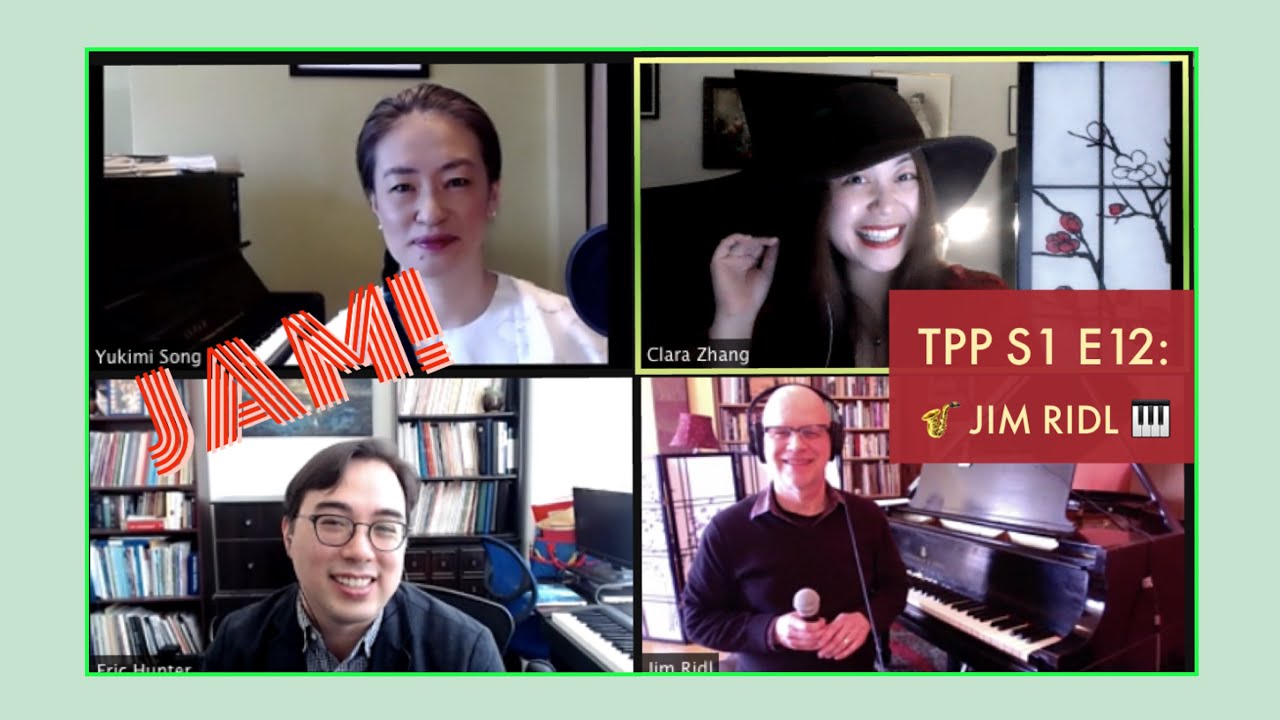
This content was created by The Piano Pod with Yukimi Song. This content was uploaded by The Piano Pod with Yukimi Song. This is a YouTube episode titled "TPP S1 E12: Jim Ridl--Jazz Pianist, Recording Artist, & Composer" (uploaded April 21, 2021). It is an English interview/conversation on The Piano Pod where hosts Clara Zhang, Yukimi Song, and Eric Hunter interview jazz pianist/composer Jim Ridl about his early musical influences, jazz education and listening, the 12-bar blues and improvisation, technical practice routines, teaching approaches for children, and the relationship between improvisation and composition.
Chapters
Welcome back to another episode of The Piano Pod with Yukimi Song with John Edward Hasse. I am Clara Zhang.
I'm Yukimi Song.
And I am Eric Hunter.
Happy April and happy Jazz Appreciation Month, fondly known as JAM, everyone. And do you know JAM was created by John Edward Hasse? Curator of the Smithsonian's National Museum of American History in 2001 to recognize and celebrate the extraordinary heritage and history of jazz for the entire month of April. JAM is intended to stimulate and encourage people of all ages to learn and listen to jazz music. And today we are so excited to be interviewing world-class jazz pianist, composer, recording artist, educator, and my dear friend, Jim Riddle, to celebrate Jim. Welcome, Jim.
Thank you so much.
My pleasure, my pleasure to be here.
Thank you so much for being on the show, Jim. This is a long time coming, and we have been friends for so many years, and I'm so glad that we have this opportunity to do this interview Professionally, and I just want to introduce a little bit of Jim before we officially start. Jim is a busy performing artist based in New York City, performing in major venues such as Blue Note in New York City, Japan, Italy, Jazz Standard, Birdland, and Carnegie Hall. He regularly performs in festivals in America, Europe, Japan, and South America and has toured all around the world. All right, so I, I know we— you have accomplished so, so much in your career, Jim, and, um, but now we get into all these questions we are so desperate that we want to ask, you know. So, you know, I teach a lot of little kids, and I would like to know, you know, um, in the very, very beginning, I'm curious, when did you decide to become a jazz musician? Um, Was that an instinct in the childhood, or you just woke up one day, it's like, I'm going to be a jazz guy? What is it like?
Yeah, it's a very good question. When I was, I don't know, like 8 or 10 or something, in that age period, I think it was through a few recordings that my father had, my brother had.
Oh, wow.
Uh, but not very much. I mean, I was listening to pop radio and, and things that my older siblings were listening to, right? Pop and rock. And, uh, and there was a few jazz recordings. I think André Previn, the great conductor, pianist, but he was also a fantastic jazz pianist, had a recording by him. Uh, anyway, I was interested in music and I was playing by ear, no real study.
So you have perfect pitch?
I, I know, no, I, I, oh wow, I wish I did, but just, you know, kind of when you imitate and you copy, copy something that you hear. So I was interested in music from when I was a little kid, and I was inspired by my oldest brother who composed a piece for the, his concert band in high school, and And so I was like mesmerized by what he did. And then, uh, so I continued just playing, and I did take some lessons at my— from, uh, Sister Rebecca at the parochial school. And I quit after a couple of years. My father wasn't very happy, but I kept playing. So anyway, it leads to I became more and more interested in jazz as an early teenager. And then it's amazing what teachers do because in— I grew up in Dickinson, North Dakota, a very small rural town.
Yeah.
And my father had heard this, this pianist play with a guitar player at this local restaurant bar, and he really loved what they played. And so he asked— his name is Keith Traquair— and he asked Keith, he said, hey, my son is, you know, interested in jazz. Would you be willing to teach him? And he said, well, sure. And so we set up a lesson and I was 15 years old. So when I first heard him play, I go, that's how I want to play. That's what I want to do. It was an immediate moment in that way. I mean, there was music before that, and then that changed my life. And I studied with him and he turned me on to, you know, Keith Jarrett, Chick Corea, Herbie Hancock, Bill Evans, Miles Davis, etc. Stride players, ragtime, country music. And so it started me from there. I— that was my path. All these years later, it's— it'll be my whole life.
Right.
Uh, yeah, so the, the influence of this teacher Keith, and we're still in contact, is that he's a fantastic musician and he, he just retired. He taught like high school band and stuff for concert band, etc., for many, many years. But it's great, we're still in contact.
That is just so amazing, you know, especially for the younger students. I think that, you know, they're The child— our childhood teachers really sometimes mean so much, you know. Yes, yeah, it cuts us into a place that we, you know, we just have that imagination. And also, when you mentioned you were studying at a sister, uh, was, was that— what do you mean sister?
Um, it's, uh, it was a Catholic grade school.
Okay, so, so that's really cool. Even the Catholic No, they are teaching jazz. Is that—
oh, well, no, this wasn't jazz.
I mean, I see.
Yeah, no, it was, uh, no jazz. It was just fundamental piano.
I got it.
You know, so, uh, yeah.
And, uh, well, they're still cool for teaching piano.
Yes, of course.
Yeah, right. So, wow, that is so beautiful. Thank you for sharing that. I had no idea. I didn't know, you know, but I know we all start somewhere. And, uh, yeah, so We have so many questions, but I just have—
Yes, go ahead. Can I ask a question?
Sure, go ahead.
So Jim, I'm curious because the story of how you started out seems to me kind of familiar. I feel like a lot of jazz pianists start in the same way where they get kind of traditional piano lessons from a teacher, and then they might lose interest a little bit and go off on their own for a while because for whatever reasons, I don't want to put words in your mouth or anything, but I feel like oftentimes it's because the they are not allowed to express themselves creatively or they haven't found the sound that they're looking for. And then 15, you know, you're already a teenager and that was kind of like your aha moment. And I'm just wondering, is there anything easier? Like, it seems like you had to kind of wander for a while. Actually, this was the case with Mike Grande also, who was on our show and he's a rock musician, but it took him until he was about that age to find somebody that really clicked with him. Like, is it, can we teach, younger kids jazz from like an earlier age so they don't— or is it just by definition going to be this kind of wandering path before you get into it?
Uh, well, uh, it's a good question. I think it's very different now than when, uh, I was 15, which is many, many years ago, because these days you have the accessibility to the music. It's, it's, it's worldwide. I mean, it was accessible to me in, you know, 1974 or something like that. I mean, it's— so music gets everywhere, all over the world, but the accessibility now through the internet in particular and, you know, YouTube, and then all the literature. There's a million books about jazz theory, about jazz instruction, about how to play, who to listen to. There's just a wealth of things. So for— and I've heard this, you know, like on YouTube when you hear like the little prodigies of playing not only classical music and bluegrass and things like this, but there's like amazingly talented, you know, even 10-year-olds that are playing very sophisticated stuff. Obviously they have a a very tuned-in ear, I think, quite immediately. But of course, yes, you can get into, I think, the mechanics of the music much earlier. But still, it's about the listening, you know, because the recordings, especially in jazz music, the recordings teach us the music both, you know, directly, but kind of in the air because you're listening. And then, because for me, I'll elaborate on this a little bit, one of my early heroes was Oscar Peterson, who you've probably heard of because he's, uh, one of the great jazz pianists of the 20th century into the 21st century. And I wore this one record out, and so I was very influenced by him. It's still in my playing, but that was through that recording. And so, you know, 15, it clicked for me. But certainly, uh, yeah, I didn't— I didn't know until then what I was going to do, but music was with me since I was 5. I know that for a fact. So it kind of took me further. Excuse me. So yeah, yeah.
So would you say that in a way, um, jazz education starts with listening then? Because I think one important distinction to make between jazz and classical is in jazz the reference is the recording, it's the album, right? Where in— with classical music, you know, for Mozart, Bach, Beethoven, composers like that, they didn't have recording technology, obviously, so our reference was the score.
Yeah, but I would ask you guys, so as you were coming up and learning, like, who— like, say, uh, Mozart Piano Concerto, and you go, well, who's your favorite player, right, plays it? Who's your favorite recording? You probably all have that relationship to them, or I'm asking that. That makes sense, right?
Right, of course. Yeah, yeah, definitely.
Because, uh, because, because then for me, uh, you know, the, the The sound of Oscar Peterson got in my playing. Herbie Hancock, Chick Corea, Keith Jarrett, all those things that are very important influences to shape, well, first of all, to gain a vocabulary of ideas and use, literally steal them. If they were on the score, we're all essentially doing the same thing. We're taking the music and then we try and personalize it. In our own way. So, you know, all those players are in me. But then also Vladimir Horowitz, my hero, you know, Arthur Rubinstein, wow, Claudio Rao. I mean, just Martha, Martha Aggerich, and etc. I mean, anybody who plays great, right, and is soulful, I go I'm in, you know.
So throughout the history of jazz, you know, it went through so many different styles. How did you— how do you define jazz? What does jazz mean to you? You know, I would like to know.
Yeah, it's not— I guess it's not quite a simple answer, but it's, uh, while being the age that I am, it's, uh, it's a way of living.
I mean, it's just still 20 years old. You and Gabby always look so young, you know, 20 times 3, right?
Okay, uh, but it's, you know, it's, uh, it's a way of living. Just be— I'm only saying that because I've been in it for so long, but it's, uh, it's one of the freest forms of music to express yourself, and, uh, uh, And I've been always attracted by the feel of the music, you know, how the music moves, but also how it makes me move inside of myself and at times even physically. It's just, I love the groove of the music and the feel of the music. I mean, it's, and of course that's not only relegated to jazz, but it's that and then the, the, the sense of improvisation, that it is an improvisation-based music, yet it— there's a lot of structure to it that is important to convey, you know, as a teacher, but also to people who are listening, who, who want to get into the music, who are either musicians or non-musicians about how it's built, because yes, of course it's very, very complex, but the structures are very, very simple. Very, very simple. And so that, um, anyway, there's a lot of room, and you can be a misfit. Maybe you don't fit in in certain ways. I think because the music, it's over 100 years old, right? And it encompasses so many styles of music from all over the world.
Yes, yes.
You know, and it, and it continues. So, uh, that's what I think is very, very beautiful about the art form. And more and more, uh, you know, classical— I, I like this aspect of how things are evolving, that classical and jazz musicians are really starting to become marching, right? Yeah, integrated. Whereas there's like, uh There's a terrific pianist named Dan Tepfer who's a fantastic jazz pianist but an incredible improviser with Bach, you know. I mean, I, I don't do those things, but I, I can take something and build something. But, you know, great, uh, Brad Meldau, fantastic, you know, certainly classical player. Keith Jarrett.
Yep.
You know, a great classical musician as well. Chick Corea, Herbie Hancock, they all had their roots, but they continued them over the course of their careers. So, uh, anyway, it—
that's beautiful.
So, so it's, uh, I mean, it's a, it's a very good place for me to exist in quote-unquote jazz, but it covers so much. It's, you know, uh, that, that it's It's hard to define just one particular way, but that's my description.
Yes, that's beautiful.
So I have several questions. So I saw your video clip, several videos actually, on YouTube, and then one in particular I really loved was Blues is Free. It says in the description, it says 12 bars with No set melody. So, um, were you basically improvising? Yes.
Oh wow. Yes.
But so the first 12 bars is kind of the theme, is that what it is?
Well, um, the, the, the thing about the blues is that in the tradition of it, it's 12 measures long and it— that's the form. Like it's— then you start over.
Oh, I didn't know.
No, and you, you keep cycling that particular chord progression, and it's built on 1-4-5, you know, the tonic, dominant, subdominant, um, you know, and that's the classic, uh, that's the classic form. I can play it for you if you want.
Sure, yes, that would be great.
A 1, 2, 3, 4. That's the top. So I didn't play any melody, but that was just a comping rhythm, right? And so 1-4-1-5-4-1, that's the traditional, um, the traditional blues. And then with, uh, the more of the jazz influence, we would be this. There's still 12 bars. It's in the key of C. So— So, all right, it's, it's—
I feel like I'm back in the bar again in the Jazz Club.
Yeah, I wish I was too. We all have to wait. Uh, but it's, uh, you still hear the, the, you know, the landing places of going to the 4 chord, the 5 chord, but there's passing chords that are leading in from C, that lead up to F7, that lead back to C, and then there's these passing chords, you know, but that's the jazz influence of, you know, harmonies coming in. But the important thing is it's still 12 measures long. That never ever varies.
Oh, okay.
So like if you think of you're looking at a clock and it goes 12, 1, 2, 3, 4, 5, 6, 7, 7, 8, 9, 10, 11, 12, 1, 2. It's always this cycle. And you have to count and you can't lose your place. But that's all it is. I mean, it's a particular number of measures. Well, of course it's more than that, but the math part of it is 12 bars. There's a few other different forms where there's an 8-bar blues and things like that. This is the traditional, you know, sound. The first one I played in particular, but yeah.
Right. I mean, so I totally enjoy "The Blues Is Free." So for those who are listening or watching, I'll make sure to put this YouTube link in the description so you can watch it as well. But so—
Can I talk a little more about it? Just on that particular performance. Yes, there was no melody. Here I didn't play any melody either. You know, I was just playing the chords. But so in that sense, it's very, very open in that I can create a melody and then come back to that later. But it's a form for expression. I guess maybe in the sense of like in classical music, like maybe a canon or something like that where it's this recurring, or a passacaglia where it's this recurring bass movement that just keeps cycling like Pachelbel's Canon. You know, it's very improvisatory in a way after the initial theme. It would be like this. So in that sense with jazz, it's very rigid, you know, and there's no stretching of the time. It's very constant where one of the things I love about classical music is when you look at a score, a symphonic score, you go, oh, okay, well, it's in 4/4, for instance. But then you follow the score with the interpretation of the music and it's got these nice stretches and little pauses, and jazz music in this sense does not do that. It's always about the groove, keeping good time, good tempo, not slowing down, not rushing. So it's interesting. We learn from each other, I would say.
But Jim, I just wanted to say thank you so much for that wonderful demonstration because that really just cleared up so much for me. You know, I know when people start learning jazz, like taking jazz lessons, they always start with the 12-bar blues, right? And I always wondered, well, how do you get though from 12-bar blues to jazz, which you just showed us? It's amazing, you know, like because the blues is clearly the blues and then jazz, it's a different language, but you can hear the overlap, like the structure is the same. That, you know, same 12 bars, same root chords, right? But then once you have the jazz version, of course, now we have extended harmonies, right? 9th, 11th, 13th, right? You're doing more kind of stuff jumping around the register, right? Like kind of up and down, whereas the first version was much more steady in the same place, more rhythmic complexity. Um, and you just right there in like 2 minutes, you showed us the evolution of one style into the other and how they're connected. It's just really wonderful. Thank you.
Yeah.
Oh, you're welcome. And I, uh, I, I also want to emphasize that, you know, the blues is, is the— for— it was happening before jazz, but that's— jazz grew out of the blues.
Exactly.
And of course influenced by European harmonies and things like that, that extended the art form. But I want to say a couple of the things about improvising. Now, so with the blues, there's the blues scale, and there's two ways of approaching improvisation. So you can do like a horizontal improvisation, meaning, Like with the blues scale, it's 6 notes. I can take that scale and I can play that— those 6 notes in whatever way I want over the 12 bars, right? Over C7, F7, G7. Now in a vertical sense, I can look at each chord individually and go, here's the C7, I can play multiple things that address only that chord. Then when it goes to F7, I'm going to do the same thing of go qualities of F7, qualities of G7. So I'll play it for you.
Yeah, I was going to say, could you demonstrate a little bit?
Yeah, so the blue notes are Wonderful. Okay, so now I'll, now I'll play addressing each chord.
Yay!
Thank you, thank you so much. Okay, so I see, so in the first version basically you're only using the notes of the blue, uh, blues scale, am I correct?
That's correct.
Right, and then the second version is much more chromatic and you basically have access to any scale that fits the chord.
Yeah, yeah, and actually, uh All 12 notes are available, but that's putting the cart a little bit too far down the road before the horse. But the thing is, what's important to remember with improvisation when you're addressing the chords, if I only address the third of the chord, the major third of C, F, and G, then immediately you're getting a sense of what the harmony is. Is it major or minor, right? So, you know, and even if I don't use a bass note There's no bass note, but it was a describing of the harmony. So that's— that in that sense, and of course blues players like B.B. King, of course they would go in and out of this, but in jazz it's all of a sudden We can utilize the modes, the Mixolydian mode, the diminished scale, the altered diminished scale, etc., etc. You know, right, right, right. A lot more things are available. But, uh, the beauty of, you know, the blues, uh, it's like you're— you're— the blues scale, it's like you're floating over the top, you know. You kind of can't make a mistake with those 6 notes. Right, it's, it's great. But, uh, more sophisticated— not, not to sound— that can sound a little bit derogatory. No, it's just more expression, a larger vocabulary, right, of expression. So, right, right, right.
Okay, that clears some stuff up. Thank you. Yeah, so I feel like in classical music you kind of have the black and white of major and minor up until about, I don't know, Debussy or something, right? And it's very clearly major or minor. Yes, there's like, you know, modal mixture, but those are really the two anchoring forces until we get to 20th century music. And then, and then in blues, I think like one of the defining characteristics is you have both kind of at the same time, right? And what you were doing just now, I was like, oh yeah, it's interesting when you really anchor that major third, then it immediately sounds less bluesy to me. And I think your instincts as a jazz and blues player, like, like you kept sneaking that minor third in there as well, right?
Yeah, yeah, true, true.
And then, and then when you get to more what we think of as jazz, right, then all these different scales come in. And like you said, greater vocabulary, much wider color palette, so there's less of this kind of duality. Of major and minor, right?
Yeah, it— well, it becomes— it's all true, but it becomes a mix, and it becomes actually quite personal to the player, you know, like, like with Oscar Peterson, like a virtuoso, unbelievable technique, but very blues-oriented. A lot of that minor third, flat 5, flat 7. I mean, he, he always had that in the mix. Quite often. But you'll hear an element of the blues in practically any jazz musician play. But then somebody like Keith Jarrett, who's got a great sense of the blues and gospel, but he'll go like it all of a sudden is a very, very different language and utilizing much more than Oscar did, you know. Ah, but it's still, it's, you know, it's still very, very personal, but they're still playing on the same chord changes, the same form, you know. But then again, then on top of that is the touch of the individual pianist and, and how they assemble their chords, how they move them. I mean, it's, uh, but It's true. I mean, it's just— and in classical music, such a wealth of amazing harmonic things. Yes, but especially when it started to get into the 20th century, well, late 19th century, but especially 20th century, Debussy, and then of course Stravinsky and— Schoenberg and 12-tone and all kinds of things. I mean, everything is open now. I mean, right, has, has been for a long time. And so, uh, and playing, uh, outside of the key, for instance, so the C7 Great, fantastic. Uh, and, and one thing I learned from, uh, Dave Liebman, the great saxophonist who played with Miles Davis, and Elvin Jones, who played with John Coltrane. Very serious lineage in history was that his. He had just a great concept about, you know, like cadences, you know, tension and release, and where, like this, I can go outside of something, but as long as Occasionally I come back in and I hit a point of resolution and it's like, ah, oh, I'm off again. You know, you can go— and of course classical music, we learned that from classical music of the tension and then coming back home and then going away again, right? If it's only always away, well, that's much more avant-garde, which I love too. But the best avant-garde players, to my mind, are the ones who have a sense of cadence and resolution. Otherwise, it's just kind of like, well, uh, I'm not getting some— I'm not getting enough from it. I, I like some sense of form.
But yeah, it's got to be anchored in something, right?
Yes, yes. And I think that's— and plus, I think it's very much more musically riveting for the listener to go, oh, it's like, wow, how did they get back there? Oh wow, where'd they go? Oh, they're back again. You know, dramatic, makes it more dramatic.
So, right.
So I have a technical question. So, um, uh, it's so envious to watch you guys jazz players because that's your language. Like, you jump in with your language, as opposed to classical musicians, we borrow someone's composition. Then, you know, eventually after so many hours of practicing that piece, same piece, then that becomes my language. It's a different kind of outlet, artistic outlet, you know. So, but fundamentally we're pianists, so there's so many things that we share. For example, technical exercises, you know, and we also have to practice harmonic progressions. All the harmonic progressions in Western classical music to jazz is different, but there's the exercises we have to do in rhythm. So could you tell us what kind of technical practice you do as a jazz pianist?
Um, well, it's my, my own personal thing. I think after playing for so many years, uh, I don't have, uh, I don't have like a, a specific— well, I have a little bit of a routine, but I, I don't go through like all the scales, major and minor. I did when I was studying, you know, and more so in college and those kinds of things. So I first want to say that my technique is very much is what I gained from classical teaching, you know. So yes, we share so much in that sense. But I find I play a couple of ideas here. I play a lot of original music. Meaning by, by, you know, people in my— in the jazz community. If I'm playing with a particular group or recording, I have to learn their music and the arrangement. Also, I have to be able to improvise on that particular chord progression. And the more difficult it gets, the more I have to practice. And I have to go— I need some kind of anchor of ideas because this is very challenging. It's— I'm not so used to it. So technically, uh, I will have to go— I have to find some things that just aren't my normal thing. So technically, I'll need to practice, uh, literally some of the scales where I go, oh, I at least— I, I have something to say by playing such and such a scale, right? That's very much kind of in the moment of, you know, an original piece of music that I have to learn. Um, so therefore that's my technique is being utilized in that way. But in a more, in a more fundamental sense, I'll, uh, I'll sit down at the piano. Well, let me see, let me see what happens. I'll just demonstrate. Some of the things I do. I tend to go there, but I'll totally admit, and this is recorded, I'm like hanging in C, F, and G, and then I'll— but I'm not getting— but then I did C and the key of E at the same time, right? Which was, uh, I like that because it just— it's the actually the same fingering, so it makes it kind of easy, but I like the sound.
Sure, sure.
So that also opens up my harmonic mind, yet I'm still practicing, uh, like the fundamental fingerings of that. Um, and then I would get into some other things of a 6-note scale and then the full 7-note scale and things like that. I'll also do some harmonic things like this. Um, So with this, uh, I started to get into something. I mean, this whole thing, very classical in a way.
It's—
sure, it's just, uh, but I'm going in 6th. Now in my left hand, I'm improvising as I kind of warm up and as I practice. In my left hand, I can go Anywhere I want. Those are things I just will start improvising like that, but I tend to go to the same spot in a way, same area, and then it warms me up, and the more I kind of stay with it, then I'll feel more comfortable to like kind of break out of that kind of key area, maybe move it up a half step, which is more difficult because maybe I'm not playing in that area so often. But the same idea, maybe same rhythmic idea. It kind of gets— I start to feel more warm in my arms and my hands. And you know what it's like when you're a little bit cold, it doesn't flow. Sure. As much, but that helps me. If that— Yukimi, if that's helpful to you.
Very much. And you know what? I am going to tell my students today that how important learning to play scales and chords. I am going to do it today.
Yeah.
Good.
Great.
Because this Maestro Jim Riddle told me so. So.
That's great.
Thank you so much. It's really such a great, Great, great improv that you showed us. So it's wonderful. Thank you.
Well, you're welcome. And also, it wasn't particularly like linear, like say a wonderful saxophone line, you know, like you associate with jazz is to me from the horn players, trumpet, you know, saxophone, trombone. This is idiomatic in a way to our instrument of piano where we have the orchestra and so we can play orchestra like this. You can dig in on some chords. In some ways, I don't know, I'd have to analyze it. What was I playing? Well, I'm not so sure, but another idea of improvising but warming up. So my right hand stayed with these kind of 3, uh, inversions of a major triad. But up, but up, but up. So this thing, my right hand's kind of static, but then it gives my left hand room to go some different places. And it's 12-tone, I don't care, I can go wherever I want. But then I could reverse it keep the left hand more static, kind of an ostinato kind of thing, and then open up with my right hand. So it's, uh, it's kind of free that way, but I'm still accomplishing the thing of opening up my harmonic mind. I'm warming up a bit, and I'm getting into some technical stuff that maybe it will lead me to some new things, you know, that I haven't played before. Which is important as an improvising artist, you know, so.
Jim, will you take me as a student? I mean, I, you know, during the pandemic, I've tried, you know, this online teaching thing, and it was on demand. I was trying to learn how to improv better with jazz. He was a jazz pianist, but it didn't go well because it's on demand, it's not live. And also, you're an amazing teacher. As well, you know, so I want to learn from you.
Sure. I mean, I think I would also say that, I mean, as you guys are performers but teachers, and so, you know, there's— we're giving access to our students to, you know, help them along. You know, but I think in some ways, maybe like with what I just showed, it, it, uh, it's a little more unconventional way of improvising. But I think it's all about just being loose. Like, I, I'm not a classical musician, but, um, some of this was classical technique, I would say. But up, but up, but up. But you hear that in Rachmaninoff Piano Concerto from one of my favorite, the third or fourth or whatever it is, you know. And, uh, and, and, uh, and also like in Chopin and stuff like that where I take it and I kind of go off for a while. So, you know, that, that can be incorporated into, you know, one's own teaching, one's own practice.
So, okay, I have exactly two more questions, but they're kind of big ones. I know we're running short on time, but Jim, you just, you really inspired me with, uh, your demonstration And my first question is, I feel like we've been talking about a lot of high-level stuff. Now the three of us are all teachers of young children. And so what I'm wondering is, how do we demonstrate some of these concepts at that level, you know, for kids who are just starting out? You know, I feel like whenever I've talked to jazzers about how do you get started learning jazz, of course they say the recordings, but they always go throw like this big book at me too, you know, like, oh yeah, go, go check out this book. And then I look at it, I was like, oh boy, this is really thick. And certainly you can't give that to like an 8-year-old. So how would you approach that?
Um, I would— the— it's a great question, and I'll be upfront, I don't teach, uh, little, little kids. I mean, and, and, and I don't teach like way beginner adults. I mean, they kind of have to— I, I That's just been my preference and my way because I don't think that I would be, uh, the fundamentals have to address, be addressed like really, really well, and I might be a little spotty with that. So anyway, fair enough. But this, this is what I can say with, with, uh, with kids. If you do a call and answer, Dee dee dee dee dee da. Dee dee dee dee da. You know, if you do singing, but if you go— sorry, I don't have perfect pitch. You know, where you're You're not even going, oh, it's this chord, it's this modality, it's this tonality. It's just, you're going, no, repeat after me, you know. And then you get into this, this back and forth, and then you go, oh, like, uh, maybe the, the, the first— if you're doing like a, like a Mozart or Beethoven or some whatever fundamental piece and it's a major it's a major harmonic thing, but maybe in the melody it has a major third to the tonic, and you go, oh hey, that's in the little Mozart— that's in the Mozart piece, or the Beethoven, or the Bach, right? And so therefore they, they're just going, oh yeah, it's that interval, okay, but we don't— we're not going to swing the eighth notes. But, but you could do call and answer not swinging it, bop bop bop bop bop, you know, and they go bop bop bop bop bop. They start to get a sense of their ear, a sense of time, you know, and the feel of it, the exchange, the tempo. And in that sense, I think you can lead into jazz because that's where it started, you know, the call and answer in the fields of the of the Black Americans, you know, starting in slavery. I mean, it comes from a very, very deep place, but that comes from Africa.
Right.
You know, all of that. And then whatever. I mean, we have all these resources, but it was like, it's this verbal, I think our verbal exchange, singing exchange, but you can do it on the instrument and I don't know, and maybe, maybe you guys are already doing that, but I think it's a great way to lead into, uh, you know, kind of, oh, here's the inside of— oh, I never realized that was like a major triad. All of a sudden you connect this kind of intellectual or a little more academic thing to it, because at some point they will need to know like what they're playing, and especially with jazz, because It just doesn't fall from the sky. That, that is not true about this music. It's a— everybody works their tail off at it, just like they do in every style of music. And there's a lot of structure to it, but inside the structure it's very free, right? So you, you know, everybody has to put their time in with theory, with technique, tons of listening. Tons of imitating, you know. But anyway, yeah, yeah, fantastic answer.
Thank you so much. I'm definitely going to use that. I'm trying to incorporate more improv into my lessons lately, make that more of a focus. I think call and response is a great idea.
And the blues, the blues scale would be great. Sure, because it's all of a sudden they'll, they'll relate to it because, well, why wouldn't they? There's nothing, no barrier that says they can or cannot, or that they can't. It's just, uh, it's just a scale, but it's going to be this— oh, oh wow, okay.
Yeah, so anyway, so sorry guys, I know we're running a little long, but I have to ask this last question. So when you were warming up, you know, at, um, at a certain point I thought, this sounds very much like a classical etude. You know, he's just improvising his own etude right here. And then that got me thinking, okay, so where— how do you, um, how do I say it? It's like, so where does improv end and composition begin? Like, when do you call something a composition, and what's different about that?
Uh, well, uh, for me, but I would say for probably most composers, not all composers, I write at the piano. So my compositions come from improvising at the piano. And then I— if something starts to develop and I keep repeating this particular chord progression and/or melody together, then I go, ah, I want to develop this further and I want it to be a complete— I want to complete it. So And maybe I want to come— especially becomes a composition if I need to complete it for an ensemble. Okay, you know, so yeah, I mean, there you can, uh, compose, you know, compose, you can improvise a composition on the spot. Okay, still, still really an improvisation, but if you— I suppose if you write it down, if you in some manner that you're going to convey this to other musicians, and you put it on a recording. Well, I don't know, you put it on a recording, it's still an improvisation, like Keith Jarrett, very famous improvisations that in essence were compositions. But yeah, that to me, that's where it starts, is the improvisation gives you these ideas. To, uh, you know, uh, but you know, like Bach of course was a, you know, most amazing improviser. But I, I read this, I believe I got it right, that after a while he wasn't even at the piano when he was composing, right? He was just up in his desk wherever and, you know, writing all these things down. And it's just like, that's like mind-blowing to think of that. But in that sense, maybe, maybe he was improvising in his head, like, ah, no, I'll try this. But he's not playing any instrument. It's freaky, right?
Yeah, I, I know I heard once that Shostakovich used to go to other people's concerts and compose while he was there.
Wow.
Which is a whole other level— listening to one music, composing another. But what I'm getting from you is that basically improvisation is composition. It's just a matter of like, when do you say, okay, that's, that's done, it's, it's in some kind of concrete form now, which doesn't mean it can't still change.
Yeah, I, I would, I, I would clarify a little bit further though. There are some, you know, uh, unbelievable improvisers, and I'll, I'll be specific, in jazz, that, uh, maybe they have very little composing Maybe not so much composing, but like always take incredible solos. Excuse me. And so yes, it's, it's a compositional space, but I, I think it can be difficult for some great improvising musicians to all of a sudden go, oh, I, I need to write this down, because they have to have— of course they have to have their the way to write it down. They have to be very, very clear and go, okay, it can be 12 measures, but what if it's like a through-composed thing? Are they gonna— and who's gonna solo where, and where do these instruments come in? I, I think it— not everybody's so suited to it, but they're like, uh, like, okay, in a jazz big band, there's the lead trumpet player who hits like all the you know, he's leading the pack and he's hitting often very high notes. A lot of times those players, they can improvise, but that's not their thing. They're actually more reading the notes in that kind of classical sense. Okay, but they're, they're not, uh, they kind of shy away from improvising. Of course they improvise because— but they rarely get solos.
I see.
It's the second or third or fourth, fifth trumpet player that does more of the soloing. Interesting. I mean, I didn't know that until later, you know.
But yeah, I certainly didn't know that.
So, so there's some— it's like an anomaly, but they're still improvisers, but their main thing is, is, uh, a particular direction. And then there are some jazz musicians who maybe over the course of their career became like man composition, or the orchestra is their instrument. And of course they're still improvising to come up with ideas, but that's not their public display or voice. Their public voice is their compositions. Like Gil Evans, do you know that name?
I'm not sure.
He was the great composer and arranger that did with Miles Davis did, uh, uh, Sketches of Spain. Um, what else did he do? They did like 3 monumental records. Anyway, a great band leader, composer, but not the player in the sense of what we, you know. Okay, so anyway, different avenues, avenues of expression.
So For now, we're going to go into the rapid-fire questions. All right, are you ready?
Sure.
Good. All right, what is your comfort food?
Um, oh my gosh, that isn't a food group. Oh my gosh, uh, french fries. No, potato chips.
I love it, so American. Cats or dogs? Cats. All right, what is your word or words to live by?
Compassion.
Beautiful.
Wonderful.
What is the most important quality you look for in people?
Uh, quality I look for in people?
Yes.
Uh, kindness.
That's beautiful. What is the worst quality in people you want to stay away from?
Uh, self-importance.
Got it.
Overly self-important. Yeah.
All right, I'm going to next. So, Jim, name 3 people who inspire you, living or dead.
Uh, John Lewis, the great, uh, congressman. Um, Top of my head, Ruth Bader Ginsburg, the Supreme Court Justice. Um, and my oldest brother, uh, who was a poet and, uh, musician and, uh, addictions counselor.
So, wow.
Which historical figure or composer do you want to learn or take lessons from? If she or he were alive?
Bach, for sure. Yeah.
Great.
I'd want to hang with Bach.
Which historical figure or composer do you wish to hang out at the bar if he or she were alive?
Well, let me see. Stravinsky, because I think he liked to drink too. So a bar would be a good—
So what's one piece in your current playlist?
Oh, things I listen to? Yeah, the St. Matthew Passion. Okay, uh, for Easter, and I, I did not listen to the whole thing. It's, uh, it's quite long, but I just love, love that music. And, you know, it's just always, uh, revealing more beauty and depth. But yeah, that's the most current thing.
Okay. Yeah, of course, a piece you can come back to time and again. Uh, what about a book title you're currently reading?
Um, man, what am I reading? I read, I read a lot. Uh, oh, I'm reading the prequel to, uh, Pillars of the Earth by Ken Follett. He's a, a British author, but he had this, this book that was, uh, it's called, uh, The Morning and Afternoon or something like that. But anyway, it's a very interesting book. And it takes place in the 11th century, like when they started to build cathedrals, and it's about cathedral building, but it's fiction.
But it's, uh, so, okay, sounds interesting, the things I'm doing.
Yeah.
All right, our most popular question: if you only get one song or piece to listen to for the rest of your life, or recording, what is it?
This is supposed to be rapid fire. I'm so— I'm such a loser.
No, you're in good company. I think we were worse than any of our guests when we did it, or I was anyway.
So it's like kind of the desert island, uh, yes, it's an island piece. Uh, well, I, I just got to say something. Maybe, uh, Adagio for Strings, which it would be kind of a bummer if that— unbelievable music, but that, that popped into my head. But that's also, it's, it's just so inside that.
Yeah.
You know, so I know I'd think of something later, but—
Yeah, I've actually been listening to that a lot myself recently, but I feel like your days on that desert island might be numbered if that's what you're listening to exclusively.
Yeah, yeah.
Time to go for a swim. Yeah.
Okay, finally, fill in the blank: jazz is blank.
Freedom.
Jazz is freedom.
Okay, fantastic.
Wow, wonderful. Thank you.
You win! That was so great. Well, so, well, we want to keep on going, but for now, that concludes this episode of The Piano Pod with Yukimi Song with Jim O'Connell. Thank you, Jim, for joining our show today.
Oh, thank you. Thank you, Clara, Yukimi, and, and Eric. I, I I appreciate it. My pleasure.
Thank you so much for sharing your wisdom, your expertise, and thank you for our audience for tuning in today. We want to remind the listeners and the viewers of this episode that Jim also continues to perform at the Soapbox Gallery during the pandemic, livestreamed, I assume, to actually worldwide, monthly in Brooklyn. Please follow their Facebook page and follow Jim's personal Facebook page for all the concert updates.
If you enjoyed today's episode, please rate and review on whatever podcasting platform you use. If you're watching from YouTube, please hit the thumbs up button and be sure to subscribe to our channel. You can also find us on Facebook, Twitter, Instagram, and LinkedIn. The links are in the description below.
If you have feedback for us, you can always leave it in the comments, send us a DM, or email us at thepianopodnyc@gmail.com.
Hope to see you for the future episode of The Piano Pod with Yukimi Song. Thank you very much, everyone.
Bye, everyone.
Bye, everybody.
Thank you, Jim.
Thank you, Jim.
Thank you.
More from The


Spirit, Body, and Soul: Pianist & Composer David Berry on Virtuosity, Creativity, and...



Season 6 Episode 20 | "Spirit, Body, and Soul" feat. David Berry, Concert Pianist & Composer


Beyond Borders: From Argentina to Poland to Texas—Oscar Macchioni reflects on a life in music

Sound Liberation: Joe Williams on Black Artistry, Legacy & Belonging in Concert Music


