TPP S1 E13: Madeline Bruser--The Art of Practicing Institute
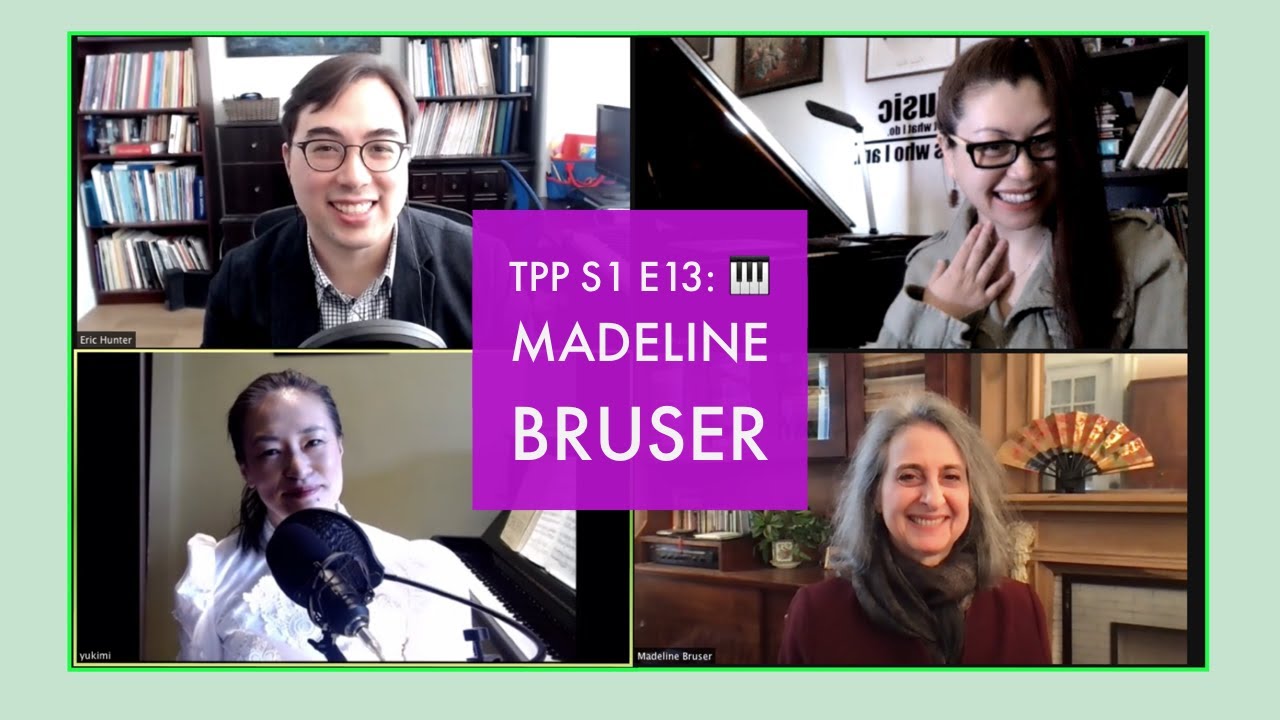
This content was created by The Piano Pod with Yukimi Song. This content was uploaded by The Piano Pod with Yukimi Song. This is a YouTube episode titled "TPP S1 E13: Madeline Bruser--The Art of Practicing Institute" (published May 5, 2021). It is a recorded interview-style conversation on The Piano Pod in which hosts Eric Hunter, Clara Zhang, and Yukimi Song speak with guest Madeline Bruser (pianist and author) about The Art of Practicing, covering body mechanics at the piano, mindfulness/meditation, injury recovery, performance anxiety, rhythmic grouping, technique demonstrations, and an upcoming online masterclass series.
Chapters
Hello and welcome back to another episode of The Piano Pod.
I am Eric Hunter.
I'm Clara Zhang.
I'm Yukimi Song.
Our guest today is Madeline Brusser, pianist and author of the highly acclaimed book The Art of Practicing: A Guide to Making Music from the Heart. Madeline is also the founder of The Art of Practicing Institute, which is dedicated to helping musicians improve their playing by releasing physical and mental tension, often helping them to deal with performance anxiety or even recover from physical injuries. She has helped thousands of musicians around the globe, and we are very lucky to have her here today. Everyone, please welcome Madeline Bruiser.
Woo-hoo!
Hey, welcome!
Welcome! Thank you so much.
Thank you very much.
So I wanted to start with a little personal anecdote about my experience last summer with Madeline's Art of Practicing Institute because it was very influential on me. And I'm going to try not to go on too long because we want to let Madeline talk. But it was one week I was able to attend because it was online because of the pandemic, and it was completely transformative. For me. I had kind of been dwindling down my performing experience the last few years, focusing more on composition and just kind of feeling like I wanted to get out of it. And that week at the Art of Practicing Institute just really turned things around for me. And on the very last day, the last thing we did was everybody went around and said, you know, how they felt about things, what they got out of the experience. And it was supposed to be like really quick, like 30, 60 seconds, because there are a lot of people. And I just, I had like this very tearful, just, oh, I found myself again going on for minutes and minutes. Um, and I wanted to thank you for that first, Madeline. And, um, I hope this interview will inspire people to check out your materials and have similar revelations. Let's, uh, let's talk a little bit about The Art of Practicing and The Art of Practicing Institute. Um, can you tell our listeners exactly what it is? What is this all about? What do you do?
You know, basically what I do is help people connect to themselves so that they can connect to the music and to their audience. And, um, This whole approach that I call The Art of Practicing is, um, in segments, but they all blend together. So first of all, it's about how to use your body and being much more aware of the body and how it works and what it feels like. So there's a whole lot of information about that, and A lot of it is surprising to people. Some of it is surprising to everybody actually.
Mm-hmm.
And I think that's because it developed through many years of meditation practice in which I learned to sit still and notice what's going on inside of me instead of being kind of unconscious and reacting to all this energy without even relating to it.
So what kind of things do you find that everybody's surprised to learn about physically?
I think the most universal thing that is surprising to every pianist, and it also applies in the work I do with other instruments sometimes, is basically how to sit effectively at the piano so that your energy is really available to you. I think what is not commonly understood at all is that the relationship to the ground is central. In other words, just as with an athlete, let's say a baseball pitcher pitches the ball, they don't like lean forward and pitch the ball. They get rooted in the ground, they kind of bend their knees a little bit, and they have that power that comes from the ground, and then they have power in their arm to deliver the the— and I often demonstrate this to people in workshops by having the whole audience deliver a punch into the air in an upright position and then compromise their posture, deliver the punch, and everybody notices that their power is compromised. What's really great about this at The Piano Pod with Yukimi Song is that there's tremendous physical pleasure from the feeling of the play of forces within the body. The feet are solid, the sitting bones are solid on the bench, and then when you spring from the keys, for instance, in the loud chord, you have a third contact point, which is the bottom of the keys. And so as you play and different movements are happening, there is a lot of energy going through the body that's very powerful and feels really great, and it gives you a lot of momentum in delivering the performance, basically.
Right, right.
Whereas if you're kind of like this, which I used to do myself, you know, moving around a lot in reaction to how the music is affecting you instead of just being there for it to enter into you and to go through If you do this, you can't really feel even the arm weight very clearly and can't feel the energy that comes back into your arm from the bottom of the keys when you do this. So you're putting energy out all the time and you're not getting anything back in.
Okay.
This is really transformative for every pianist I've worked with. And as I said, with other instruments, it always applies.
To.
Now these days people are working with the Alexander Technique quite a bit, which definitely is very helpful and along the same lines. But I do think that what I'm doing at The Piano Pod with Yukimi Song is unique because it's very, very clear and defined exactly what the relationship is between the seat, the sitting bones, and this. So that they're all interplaying and you really feel like something is playing in your body. And the whole point of the approach is that music lives in the body.
Right.
So we have to be aware of the body and really connected to it. So how you sit at the piano has a huge impact on what's going on inside of the body and what your options are for movement and for self-expression.
Okay.
So we're really talking about like the efficient use of energy basically.
Right.
Right. It's basic biomechanics. And I think that there's just, uh, I think the issue is, which was certainly the issue with me until I was 37 and discovered this physical approach, is that, um, music is so powerful in itself. It's so emotional for us. We love it so much. And so we get swept away with this very intense feeling. We just, you know, react like this, which is completely understandable, as if you were dancing to the music. But we're not dancing when we're playing. What's happening is the music is dancing within our body.
Oh, I like that.
And we make room for it in there and can really tune into that dance that's happening on the inside. And all that energy is free to play out and really carry to the listeners.
I never thought of this before, but it's almost like we have to balance the subjective experience of our emotions as we feel the music, right, with the kind of objectivity of the body, you know?
Well, actually, I think the body is the most subjective experience we have. Okay. It's intensely personal.
Yeah.
And we actually cut ourselves off from what it has to tell us and what it can do, what it can do for us, what it can give us, uh, when we don't use it according to fundamental biomechanical principles. I mean, it's designed to be used in a certain way, and athletes are generally taught that. Musicians generally are not so much, um, because we consider ourselves artists and we are artists. And so we feel like, well, an artist is a completely different kind of person from an athlete. But when you're playing an instrument, whatever the instrument is, you are an athlete. It doesn't mean you're not an artist, obviously. The athletics is in the surface of the art and of the human being who's making the music and who's listening to the music. So I think it's— my experience is that what's going on in the body is intensely subjective and that we— our biggest problem in our life in general is not having the space or time or encouragement or guidance to tune into what's happening inside of us. So then we're not conscious of how we feel. So then we get mad at so-and-so when it's not their fault, or all these things happen, or we don't do justice to the music. And the other thing about music in terms of the body, there's two other things. One is the sound has to live in the body. So you have this play of physical forces from the movement, and then there's all this sound, which is supposed to move us. If we're not moved by the music, literally physically inside, viscerally, we can't move our audience.
Mm-hmm.
Everything depends on us having a deeply personal connection to the sound on the visceral level and really being able to tune into that. Most often what happens is students are told, well, the phrase goes up and it comes down, so play it like that. And they're operating from their head. It doesn't mean that the phrase doesn't go up and down, but it means that within that general up and down, there are continuous flow of specifics of this harmony, that harmony, how they're juxtaposed, what that does to you as a person inside. And this kind of artist makes people go wild, basically.
Right, right.
Because then that body energy goes directly into their body. That's what happens in a performance.
Okay. So then how do we cultivate the mental state for that?
And what are some obstacles that we might encounter along the way?
So what is now very widely talked about is mindfulness. I actually wasn't trained that way as a meditator to talk about mindfulness a lot. It was more about awareness. But mindfulness is an excellent word because people understand it now. It's part of the vernacular. And it really amounts to practicing connecting to yourself, hopefully on a daily basis, so that your life works better, basically. You know, you don't trip over things and say the wrong thing and all of that. But you have space in your mind. So the general problem we have is that the mind is very crowded. It's very busy. It's thinking about yesterday and tomorrow and next week, and it's feeling all this pressure. It has to do things and it has to do them by a certain time. And it's got a lot of worry, like, well, what if that person really didn't like me because of what I said? Should I apologize? Maybe I should, maybe I shouldn't. And it goes on and on forever. So this is the busyness of the mind. Mindfulness is a practice that allows you to tune into your natural ability to be mindful. In other words, to be aware of what's happening right now.
Right.
And so the practice of, for example, noticing your breathing, and then when you notice that you're thinking, you come back to your breathing. It's a very basic fundamental practice, but it trains literally the brain to return to the present moment. Interesting. It also— when the brain opens, when the mind opens and relaxes, the body starts to relax, the perceptions open, the heart opens. It's like you take a little vacation.
May I jump in? Because I really like the word mindfulness because it's a really an "it" word right now, you know. Every yoga class you take or meditation class you take, there's this mindfulness— is the word that you hear a lot. Is it a connection between your body and what you do and your senses?
Mindfulness is the practice of letting the mind settle down and relax. And then naturally, the natural acuteness of your sense perceptions just opens up. It's always there, it's always ready to be there for you. But when the mind settles down, you can suddenly see and hear and smell and taste and touch, actually feel things and respond in a more natural and beneficial way. So that includes how you touch the piano and your connection to the sounds that you're playing, that you're hearing coming out of the piano, being aware or mindful of that actual note, those actual sounds instead of being in your head and sort of singing in your head. There's a really— there's a world of difference between hearing the music in your head while you're playing and actually being able to hear it as it's coming toward you out of the instrument. That's—
Oh yeah, wonderful description.
Yeah, and that sounds more really organic, true to yourself, instead of just reading the notes and like becoming— sometimes you feel like you're part of just a machine, you know, just reading the notes and play certain ways. But if you have used that mindfulness of playing, performing, and practicing, I feel like it's more organic approach.
Yes, the whole thing is very organic. I'm glad you chose that word. That's excellent.
Thank you.
Can you explain, um, I feel like people might be able to understand how mindful awareness can bring you back to the present moment when you're like worried about something that you have to do tomorrow or some little mistake that you made yesterday. I'm talking about like kind of minor anxieties. What about something like long-term trauma or like severe performance anxiety or something that happened to you long ago in the past that's stuck with you? How does mindfulness help with something like that?
I'm really glad you asked that. I think that there's a line between meditation practice or mindfulness practice and real healing work. I mean, I do feel from my experience definitely that mindfulness is a healing practice, but if you want to go really deep with a very serious issue, Psychotherapy can be essential. There's a practice called The Healing Code. We teach at our programs, and I teach my students a practice called Focusing with a capital F, where you close your eyes and tune into what's going on inside the body. That can be very revelatory, where you get in touch with things on a kind of like a dreamlike level, where imagery can arise and you realize your own wisdom is really in there. But in terms of being traumatized, let's say the common example, the parents or the teacher or both abused the young musician, the little kid, most likely that person's going to need some psychotherapy to really work through that because it goes too deep, it damages too much, it is too big of a wound. And What I have heard, which I really believe, is that when trauma happens, it happens in the presence of a person who hurts you. And having the presence of another person who heals you is necessary because that person is giving you the opposite message and gives you space to feel your feelings instead of telling you that they don't matter. That's really important. And I also feel that community is essential. For instance, with the Art of Practicing Institute programs and with the MasterClass series, we have time for discussion or a conversation. So when people can have a conversation and start talking about their fear of performance and what happened to them and what they're afraid of and all these things, this is really support that can heal also because you're not alone anymore. And I think musicians are beginning to talk about this more. They're not hiding it in the closet so much. It's really, really important.
Yeah, yeah, I agree.
And just speaking from my own experience, I, I'm glad you pointed that out and reminded me, because we would have some long meditations in the morning, the beginning of every day, which would be a kind of intensely personal experience. And then there would be multiple group sessions following that where we got to kind of decompress and sometimes figure out what it all meant, bounce ideas off it, you know, that's absolutely critical to the process.
I was just going to share a little bit last year when I started with Madeleine, and I remember those sessions, you know, it was right before COVID We didn't even know how serious it was going to be, you know, it was just everything, you know, when you— this is so fitting because I think we're going to release this in May, it's met mindfulness awareness minds, right? And this is still new for me. You know, I, I have— I always said I was atheist. You know, I was not really spiritual. And growing up in Asia was, you know, I had to have a mother. So, and I felt pretty confident with myself, you know, when I perform. But I also realized when I started with Madeline, there's a little bit of me that I I think it was during those group discussions that I finally realized I was being that way, so out there, because I was trying to prove something. And because, you know, I grew up in Asia, in China, and I didn't have a very traditional training background. And so I was always there to fight, you know. And so I somehow made it in New York and It's just, you know, I feel like everything is just— when you, Madeline, when you're talking about senses with Yukimi, and I'm like, mind-blowing, you know, like my mind is just— because when— how I knew of Madeline's work from years ago when I was in grad school in Massachusetts. I remember I had this one time I didn't perform well or something. A teacher gave me her book, Madeline's book, And I held on to this book for a very long time. And last year, you know, everything was going well in New York. And then 2 years ago, right before COVID there was something traumatic happened in my life. You know, it's just crazy, uh, personal things, but I don't even know how to deal with it. And then all of a sudden, I decided to go to a meditation retreat. And the day after I returned, Madeleine kind of just showed up, you know, like, and it was through PTC.. And then I got the chance to study with Madeleine. It was just so inspiring. And I remember when I performed finally after the discussion that I realized I was able to just be myself. I didn't have to prove to anyone anymore. I can perform when I want to. I didn't have to have too many concerts, too little concerts. And, you know, and then one thing about the body too, and I have more questions later on, but I would just share this a little bit as a person who has really experienced this. I'm also an amateur ballet dancer, and then I remember what Madeleine described. When I am on stage, I'm so hyper, I'm so excited. It's almost the same thing as my ballet teacher tells me, Clara, you're too jumpy. So yeah, so this is really amazing. I'm sure we'll have more to talk about, but thank you for letting me share that.
Oh, you're welcome. Thank you.
So Madeleine, let me ask you, what are some problems that people or your students typically come to you with? You know, what are some common issues that people want to work on with you?
Well, injury recovery is definitely one of them.
Sure.
And physical tension in general. And performance anxiety is definitely one of them. And then there's the general feeling like, I just want to play better than that.
Yeah.
You know, I'm at a point where I'm not settling for this. And that can take people a long time to get to, but it takes a certain maturity to be able to say, all right, I'm not really where I want to be. I think I should try to go further. And they have some sense that I can help them do that. So it's those 3 things. And it always comes down to being disconnected from the body, the mind, the heart, the sounds, the rhythmic flow, all these, you know, just not having received the full guidance that they've needed. Yeah, those kinds of things.
Sure, sure, totally. I just want to take a minute and validate something because you just, you just reminded me how difficult it is when you have this instinct that something, not even something's wrong, but something could be better or something needs to be different or, you know, it's just an intuition that you have at that point that you want to be someplace different than you are. And, you know, having made my own progress in certain ways. I just remember it's so difficult when all you have is that feeling and you don't know even what the end result is. You might have some ideas about what it is, but once you get there, you find out, oh no, I really didn't know. The only thing that was true is the instinct, right? And I just want to take a minute to acknowledge the bravery of everybody that starts down that path.
I couldn't appreciate that more. Thank you very much. And I face that every day in my life because my art form is teaching, and I'm always coming up with new understanding of what it is that I actually teach. Actually, in the last several months, I've been through a kind of major upheaval because I've gotten more connected to myself and realized I don't want to live in New York anymore.
Oh my goodness.
And we, my husband and I, have looked at 3 possible moving places. And it's been a wrenching process. And just a couple of 3 weeks ago, we made our decision after visiting Philadelphia. We want to live in a suburb where it's green and pretty and quiet. I'm a little too old for that noise.
Wow, Madeline, way to come on the show and drop a bomb.
Oh, I know.
We didn't know we were losing you. Philadelphia.
Internet, right?
Yeah.
But thank you for appreciating me. But it's been a process of really having to come to terms with who I am inside, what I really want, and how to go about doing it. And it's one of the— I mean, it's one of the biggest challenges I've ever faced. And to do it at my age is also feeling like a major challenge and pick up stakes and go somewhere new, although we have wonderful friends there, which is a major plus. But the process has humbled me a lot. It's made me very aware of what kind of bravery it does take to go through any kind of transformative process.
Yeah, totally.
Grateful for it, because when you step into your transformation, you're right, you don't know where you're going to end up. I thought we were going to end up in Northampton, Massachusetts, where it was just going to be peaceful all the time and we sit in front of the fireplace and read and I teach a few students.
That sounds wonderful.
I realized that there's so much more to me than that. I would be walking away from my whole musical lineage, the feeling that the cultural lineage that is in a major place like this.
Right.
We finally— we tried Connecticut and feel like anything for us. And because we thought it would be good, it would be close to New York. And we just decided to go a little further away. And unbelievable, just everything clicked about it. Everything.
Wow.
Suburbs, the city itself, the friends, you know, it's just unbelievable. And it is a major cultural center. And so it's very brave, I recognize myself, to actually step forward into this unknown. I mean, who am I going to connect with in the music world, right? I don't know these people. So it's, you know, we had a program in 2003 called Unleashing Natural Piano Technique, and it was a 5-week series for pianists, 4 pianists, and they each had 3 workshop sessions and 4 private lessons within 5 weeks. And one of these people came because her teacher asked her to do it because she needed to recover from an injury. I had to completely toss out her whole physical approach to the piano, start her out with, you know, ABCs, kind of just one finger at a time, then adding the arm movement. And halfway through, after the second workshop, she came up to me in tears. She said, I don't know what to do. I can't play the old way anymore. And I haven't gotten to the new way yet.
Mm-hmm.
Gave her a big hug. I said, that's how it is. You're going to be all right. She got through it. She recovered from her injury and she was very brave to do that.
Yeah.
Dropped out in the middle and said, this is too much for me. But she knew somehow that there was something going on that was right. And you just like, you're right. You have to trust your instinct. There is, again, in the body, we know the life in us knows what it needs to do. It knows the direction it needs to go in.
Oh, wow. I'm speechless.
Yeah.
I, I, well, I want to take a minute to thank you for what you do, because when I was 21, um, I had a teacher named Mark Sullivan who worked with me for just one month over the summer in a summer program. He was from California, I wasn't out there yet, and at that point in my life, my technique needed a complete rebuild, and he took it upon himself to do that. It was such a generous gift, you know, with a student that you only have for, for one month but who desperately needed it, and I had so much that I wanted to say that couldn't come out, and you take that chance on your students all the time, and, you know, as a teacher, I just can't give you enough credit for that.
Thank you. I think it's my personality. I just have this need actually to be very direct and go straight to the heart of the person because I always believe in them. I believe in every person who shows up and my job is to help them believe in themselves. So I have to go for that heart of that person and know they can do it. And be very encouraging and gentle through the process, even while I'm being very clear. No, not like that, like this, right? It's just has to be very sharp and on the dot while being aware of what that human being is going through. I'm not perfect, and nobody can be perfect with such a big task. I mean, I think there's no perfect teacher, just like there's no perfect parent. You're, you're feeling this desire to help this person, and you can't know everything. And actually, I learned so much from teaching. Practically every time I give a lesson, I'm learning something.
Yes, that's what I love about teaching.
Yeah, yeah, it's very creative that way. So we're stepping into the unknown also. I mean, you know, I'm still a performer. I gave up performing at 37, which is the biggest shock of my life. But I'm still a performer, which means I go for it. You know, I'm a communicator, and I just, you know, that's what I need to do with myself.
That, especially if somebody doesn't even believe in themself yet, and you're trying to help them get there, that requires a tremendous amount of energy and emotional investment. Over the course of your career, have you ever suffered from burnout or just feeling drained from like this constant expenditure of energy that way?
Oh, definitely. I mean, last year's summer program, you know, we did it online for the first time. I was just remembering yesterday what a joyous creative process it was for 4 months to happen. It was very collaborative. I had a lot of help, support from the other teachers, but it was a whole new ball game and we had so much to learn about technology and everything. Program was very successful. When it was over, I was thrilled with it and I was completely exhausted, but I had scheduled a break. Yes. I knew that was gonna happen. So the month of August was, you know, I taught some people, I mean, there were people away, but I just didn't have any other stuff to do. I wasn't planning the next program. It was just, and I got a lot of rest. Just last week I took a week off. Which was phenomenal. And I do that several times a year. And this is also from the meditation practice and community and teachings are always encouraging you to periodically take a whole retreat. You know, it's great to do it daily, but when you take a whole week for yourself and you don't answer email and you don't engage in work, there's nothing like it. I think that we don't realize that we need to be replenished. And I just read the other day that Americans are almost universally sleep deprived.
Mm-hmm.
And overworked.
And overworked. Exactly. And we don't even realize what it's doing to us and, um, that there is another way. So that's why I also gradually encourage people to get into meditation practice so that they can get more in touch with their need for rest and space and relaxation. That's actually going to be the key to higher accomplishment. And in fact, when I started meditating, I didn't feel like practicing the piano for 2 months, so I didn't. When I came back, it was a completely different experience. I would stop for 30 or 60 seconds, sit there on the bench, do nothing, and then see what I wanted to do next. And I would notice things much more, like how my hands were working. I would notice the sounds more, all kinds of things I noticed. And the result was that in 3 hours of practicing, I accomplished more than I had previously in 5 or 6. So this is what I think people need to understand, that just as the body works a certain way, the mind works a certain way. It is designed to have rest built into its life so that you do your mindfulness practice. That's a little mini rest. And then you stop in the middle of practicing. You say, what do I want to do next? Instead of constantly driving yourself. That's a little mini rest. Then if every once in a while you take a bigger break, you know, and give yourself a kind of a treat. This— the human being needs this so much.
Can we back up a little bit and talk about your early musical experiences growing up? Going to school, and then how your early career and how you eventually ended up writing your book and came to The Art of Practicing.
Okay, so you're talking about going from age 6 to— oh, when I was 46.
Maybe not every day, but just basically, how did The Art of Practicing come to be?
It came to be directly through meditation practice.
Directly.
I had been already teaching certain elements of it. As soon as I started meditating at 29, I just was already teaching things like sing the left hand while you play the right hand so that you can really hear what's on the page.
Right.
Notice the sound coming at you instead of thinking about the sound. And also rhythmic grouping. This is extremely powerful aspect of the work. I don't know if I can go into it too much now, but simply to say that rhythm is usually not taught well. It's usually taught that, you know, the first beat is strong, the third beat is semi-strong, and the second and fourth beats are weak, and that's the end of it. So you have to go 1, 2, 3, 4, 1, 2, 3, and this is death to rhythm. Because the first beat is strong by nature. If you emphasize it, you just kill it. Kill all the flow of the music. There are a number of music teachers, not very many, one I know of in jazz and a couple of, maybe 3 people in the classical world of different instruments who understand rhythmic grouping. And there's also a book called Note Grouping. And it's similar in content to my chapter 11 in my book, The Art of Practicing, which is all about rhythm. Rhythm is again in the body. And so when people use metronomes, they are shutting down their body. Human rhythm is not the same as mechanical rhythm. And human rhythm flows in waves. And it's very important that life moves in waves. The heartbeat is like da dum da dum, and breathing goes in waves. Phrases go in waves. Music flows in waves. So that wave it ebbs on the downbeat. It doesn't— you don't go 1, 2, 3, 4. You go 1, 2, 3, 4, 1, 2, 3, 4, 1, or 2, 3, 1, 2, 3, 1, so that it's constantly moving forward. It's kind of complicated to go into in an interview, but It's pretty well covered in the book, but nevertheless, somebody actually has to work and get people to learn this because we're trained to stop at bar lines and to stop before beats. And we don't even realize we're doing it. This actually affects your technique because this kind of rhythm, as Yukimi Song was talking about, it's organic. This is how life flows. And so when you— think of the notes in these groups and you feel these waves in these groups, your body works much more naturally and your technique improves. So what was the question? How did I come to the art of practicing?
Yes.
So I started teaching that along with the listening techniques and I was more aware of what was going on with the hands and arms. So I was able to teach that, but it didn't crystallize until I had been meditating for 8 years. And, uh, at that point what happened was, you know, meditation is a practice of sitting still no matter what's going on in your body. And, and that's the discipline of it, accommodating big energy. So I was accommodating a lot of big energy that spring when I was 37. Um, some heartbreaking things happened in my life and it was really painful. And I was sitting on my meditation cushion feeling all this emotional pain and not moving.
Hmm.
It was around that time that I noticed at The Piano Pod with Yukimi Song with Yukimi Song that I didn't want to move around anymore, that I was able to accommodate the big energy of the music, all that flow of powerful energy without reacting to it this way.. And I wasn't able, I just wasn't able to go back to the other way. And a friend came over and said it sounded better the new way because the music was just coming through to the listener directly. I, so that week I asked all my students sit that way instead of doing like this. And instantly, instantly they all sounded 100% better. That was when the light bulbs were like, I could almost see them flashing in front of me. And saying, you know, you don't have to hit yourself, hit your head against the wall anymore trying to become a touring internationally successful pianist. You are an important teacher. People need to learn this. This is your career. Everything totally shifted at that point. This was after, this was like 6 months after my New York debut, right? I had my debut. Did I know it was gonna be my finale?
The irony.
So I stopped pursuing concerts. I canceled a concert I had in Chicago. I was done. And I started giving seminars on the art of practicing. And then the book just evolved from that. I actually tape recorded a lot of the seminars, including the questions and answers. And those are the questions and answers that are at the end of most of the chapters in my book.
Could you tell us how we should as a piano teacher to maybe introduce meditation to students?
That's a great question. I've never told them to do it. I don't want to proselytize because I don't think it's appropriate. But what I've done is if a person is— just happened yesterday, actually— if a person is obviously kind of in a stressed state, you know, they're speaking in very negative terms, they're nervous, they're just not settled down, I say, well, let's just take a minute to settle down. Just sit there, let your eyes relax, keep them a little open, and just notice your breathing for a couple minutes. That's all I do.
Hmm.
If you start calling it something, it actually is limiting what it is because all it is is a space in the person's mind. You're offering them an opportunity to make some space that their mind desperately needs. And a little space goes a long way. So then if the person becomes interested in meditation after that, which definitely happens to some people, and in these days because mindfulness is such a known entity, people ask for it more often, then I recommend a meditation instructor or a program but I don't try to become their instructor because that's a whole other relationship.
Exactly. Yeah, thank you so much.
Here, the three contact points: the feet are on the floor, the sitting bones are in contact with the bench, then when you play a chord, the ends of those finger bones are in contact with the bottom of the key. So it will actually, you know, in contrast to the excess effort of doing this, when you lean forward, you really do that with a lot of energy. It throws your torso a little bit backwards because of the equal and opposite reaction.
I see.
Right?
Yeah, it seems so much easier when you do it that way.
Right. But then there's also, um, other uses of the forward motion of the arms where instead of initiating it from the fingertips where you're grabbing and your arm is passive, initiate from the shoulder. So you can do that when you just let the arm weight drop in, but you can also slide in and out of the keys, which is initiated from here. And the sliding motion is something that's not in my book, and it is something that I want to really, uh, create on a video for people so they can understand it. So like if I just open a piece, like— let me show you that really close up. Okay, so I'm sliding in and out. So you can teach the student to just slide with all 5 fingers on the board, then they slide this way in and out, and then You'll notice things like I'm sliding in and I'm already coming out before I slide out on that one. This one slides in, it comes back out, then I slide in. So there's a lot of— even on the same key, you're sliding in and out. I've taught them to do a scale like that, you know, in, out, in, in, in, in, out, out, out, out, in, out, out, out. That's how complicated it is, but it's actually a very natural way to move your hand.
Yeah, I can, I can see how relaxed you are when you do that.
The first thing that I always address with every person, um, I don't think I've ever seen anybody who's accomplished this entirely. Actually, one person got it from my book. It's in the book, but to get it from the book is exceptional. It says in the book that you could practice letting the fingers relax on the keys when they're not playing. So if you do— do it down here. You don't do this, right?
Right.
Yeah. It comes down so that the fingers are doing the minimum. And that's because they're not designed for power. And that's very important. People need to understand. What parts of the mechanism are designed for what? The fingers are designed for precision, refined control, sensitivity. Arms are designed for power and flow. This is like the bow for the string player or the lungs for the wind player or singer.
Right.
This is the flow. If you cut that flow, I mean, I could play that Mozart opening without that flow, just like staying in one place instead of sliding in and out, and it limits what I can do. I'll try it, but— It feels awful, and I just don't feel that it creates the same kind of musical flow. So it's a much more freeing experience for the pianist to allow things to keep flowing all the time. Right, right. So you have to— and then the shoulder is designed to position the hand in space. So it's not designed to do this, right? That's not going to help you. And it's not designed to do that, right? So, and then of course, so that's the mechanism, the playing mechanism. And then there's, you know, the whole supportive mechanism, the stability that's provided with the torso when you sit very solidly. There's also, you know, all this that you can do to reach certain distances on the keyboard. And then the wrist, is really designed to move. So the wrist has, uh, 8 bones that are lined up in rows, 2 rows of 4, and it is totally designed to move. It makes ovals all the time. So if I do this, there's a— you know, you can make an oval even holding down a single key. Not that you should do it for no reason, but there's just all kinds of places where this liberates the whole mechanism. It allows you to reach stretches. It makes it easier for the fingers to put the keys down. There's all kinds of stuff. So I just kind of condensed a vast unwritten encyclopedia of piano technique into like this tiny little thing. But this is really what I started out with saying today, where we need to tune into what our natural abilities are. The body is designed to work a particular way. If you use it that way, you'll be able to play the instrument well. It's just having this basic number of facts can really help people stop doing excessive work with the wrong part of the body.
Right. Yeah. Thank you for the demonstration. I think it's really helpful for people to see it in action. Although, of course, this is just the tip of the iceberg. And, you know, for anybody watching, if you're interested in this and you'd like to know more, I highly recommend you pick up the book The Art of Practicing or go to theartofpracticing.com. And Madeline's going to be offering a series of online master classes, yes?
Yes, and I think the second week of June it's going to start. It'll be once a week for 2.5 hours It'll be early afternoon on the East Coast so that people on the West Coast or in Europe can participate. And there will be a 10-minute mindfulness practice to open each session, 20 minutes of group conversation about anything that is coming up for people. And then I will work with each of 3 pianists for 45 minutes, and they will have a minute of feedback from the group. And those 3 pianists will go through the whole 6 weeks. It's called a Transformative Piano Masterclass Series. By the end of the 6 weeks, something will be different.
That's fantastic. Yeah, so if that sounds like something you would be interested in signing up for, please visit artofpracticing.com. All right. So I'm afraid we're running out of time. I feel like we didn't get to at least 2/3 of what we wanted to talk about, but I think Clara has one more question for you, Madeline, and then we've got to get on to rapid fire.
That's right. And for those pianists are thinking, just take the action and enroll now. And I, I, I, I'm still so inspired and from last year. And I really, you know, one thing I have a great question for you, but, but I just want to reflect on one tiny thing that, you know, I feel like if it's not for the master class that I did last year, and I just, you know, happened to be, I don't even know where it came from, it just kind of landed in my hand, and I was connected to you, which I didn't know how to find you, and it was just, you know, through PTC. And I felt like you gave me permission, you know. And I remember it was that night after I performed, I came home and I realized I have to transfer the student to my studio to online because that was the most rational thing to do, you know. And I think that took a lot of courage, and I believe, you know, and then my students actually are playing better than ever. And I have all these, you know, so I want to know what your opinion is. What is, what's the future going to be, you know, from after this year and a half, or what is going to be for pianists 50 years, 100 years from now?
I know that the pandemic is having a major effect on all of us, and I feel that it has a really powerful silver lining.
Hmm.
Hmm.
I think that it's getting people to focus inward more because there's no choice and there's less, so much less distraction. You know, you can't get on the subway and go here and there and all over the place. And you're left alone in your house where your family is, where everything is more intimate and personal, and it can't help but change us. So I think that people have been forced also to come to grips with horrible economic realities of not being able to make a living. It's horrible for performers. And, you know, Some teachers don't want to teach online, and there are some students who don't want lessons online. So I think that this inward awareness, inner awareness, is actually beneficial, but only up to a point. I think it's going to make us appreciate connecting to other people much more. I mean, my husband and I both are getting the second dose of the vaccine this week. And within 2 weeks we'll be fully immune. And we know this other couple that will be in the same position. And I said, let's have them over for dinner. I can't believe what that's going to be like. People are saying, it felt so good to shake someone's hand. I think, and the appreciation of what a performance really means is going to be bigger. So I think a lot of things have been stripped away and we're not going to even know until the pandemic is over. Gradually in pieces will have more experience of being out in the world. So, I think there is that. I would hope, and I believe actually, that making music is a practice that is evolving. The fact that schools are teaching the Alexander Technique, I mean, actually one of my students is is teaching at a college and she's now teaching meditation at her college to the musicians. These possibilities are now more open because it doesn't sound like such a weird thing to the administration of the school anymore.
Right.
20 million Americans are practicing mindfulness. Well, hey, maybe we should get with the program, right? So it's different. It's going to take a long time though. But I'm not sure that that's what your question was, but I do think that each individual is tasked with figuring out their individual situation. I think people need to talk about it, to have guidance from somebody they trust. And one of my biggest— I mean, my whole reason for being on the planet seems to be to help people, as I said, to believe in themselves, to show them that they're capable of so much more than they realized. Yeah, they could play so much better, they could teach so much better, they could help their audience more, they could help their students more. That evolution, that's what I'm here to facilitate. And so I'm hoping that the increase of inward focus and the increased awareness of how the mind and body work with music will actually somehow get people to— and also the forced discontinuation of how they were making a living before. You know, there's a musician who runs, who has a wonderful website. I can't remember the name of it. Her name is Kaylee Miller, and she is a Pilates instructor, and she also has like a podcast, and she's connected with a lot of musicians, and she's into the— she's a major person in musicians' wellness. And she wrote this article I came across recently that said, you know, I've been forced to do other things for a living so I'm teaching Pilates full-time. This is what I'm doing now. And that she appreciates certain things about it. And I've read another article and this other musician is saying, well, I'm realizing that I want to be somewhat into arts administration so that I can help how the schools are teaching music. And I wanna teach body mapping to these musicians and I wanna teach the violin and I wanna perform. That is like a hybrid career. It's really healthy because we're not just a one-track a tech person. Usually you have the abilities and the world needs them. So that's what I think is possible. I think it's, it's, uh, it's very, very painful for people to not be able to do what they love the most, but I think it can be a growth experience.
Wow, thank you, Madeline. That is such a wonderful answer. I really, really appreciate your insight.
Rather new segment called The Piano Pod with rapid-fire questions. Question number 1, are you ready?
Yes.
Right, what do you consider comfort food?
I love almond butter out of a spoon.
Okay, that is quite healthy.
Great, spoonful of it every day.
Wonderful.
Wow, okay.
What is your word or words to live by?
Love yourself and then you can love others.
Great, beautiful. What is the most important quality you look for in people?
Love.
And what do you think is the worst quality in people? Aggression. I will continue. Name 3 people who inspired you, living or dead.
Well, the first would be my meditation teacher, Chogyam Trungpa Rinpoche, who I was unbelievably fortunate to play the piano for 3 times. Uh, actually, the picture of that happening the third time right here. Oh, beautiful. This was the end of a 3-month meditation program, and I played for him in New York when he happened to be staying at a house with 2 Steinway grands.
Oh my gosh.
Yeah, I know you don't want a long answer. It was beyond words. It was like the best piano lesson I ever had, and he knew nothing about the piano.
Oh my goodness.
Wow.
He was a Tibetan who appreciated Western music immensely.
Right.
This is a very, very extraordinary human being. So definitely him. 3 people. I would say Menachem Pressler, who I studied with for 2 years when I was 17 to 19, who emphasized imagination, creativity, sound, magic, all the things about being an artist. I felt like I became an artist studying with him. I didn't have another teacher like that before or after. And was the question who I admire?
3 people that inspired you.
Living or dead.
Living or dead.
I admire Mozart.
Inspired you?
Mozart. Mozart's music.
Name one piece in your current playlist.
Schubert G-flat Impromptu.
Okay, this is a new one.
Um, I don't know about this for rapid fire, but name one change you would like to make to music education in the U.S.
I would like to have a national conference at which thousands of music teachers attend and where the whole point is to open up and talk about primary need we all have to be open, vulnerable, and genuine. And what are the components of making that possible in making music for your students?
Great.
Wonderful. Okay, so if you could only listen to one piece for the rest of your life, what would it be?
That's a tough one. Oh, I know, of course I know. The second movement of the Mozart Concerto in A Major, K.488. The second movement's in F-sharp minor.
Oh, okay.
My favorite piece of Western music.
Oh, there you go. And finally, please answer with one word, fill in the blank, that is, music is blank.
Love.
Perfect.
So everybody, that concludes this episode of The Piano Pod with Yukimi Song, which I am very reluctant to end. Thank you so much, Madeline, for joining us. We want to remind everybody to check out your website, artofpracticing.com. And remember, Madeleine's online masterclass series will begin in June.
If you enjoyed today's episode, please rate and review on whatever podcasting platform you use. If you're watching it from YouTube, please hit the thumbs up button and be sure to subscribe to our channel. You can also find us on Facebook, Twitter, Instagram, and LinkedIn.
The links are in the description If you have feedback for us, please leave it in the comments or direct message us by social media, or you can also email us at thepianopodnyc@gmail.com.
Hope to see you all on the next episode of The Piano Pod. Bye everybody!
Bye everyone!
Thank you, Madeline!
Thank you so much!
More from The


Spirit, Body, and Soul: Pianist & Composer David Berry on Virtuosity, Creativity, and...



Season 6 Episode 20 | "Spirit, Body, and Soul" feat. David Berry, Concert Pianist & Composer


Beyond Borders: From Argentina to Poland to Texas—Oscar Macchioni reflects on a life in music

Sound Liberation: Joe Williams on Black Artistry, Legacy & Belonging in Concert Music


