TPP S1 E15: James Redcay--Pianist/Composer and MidAmerica Productions at Carnegie Hall
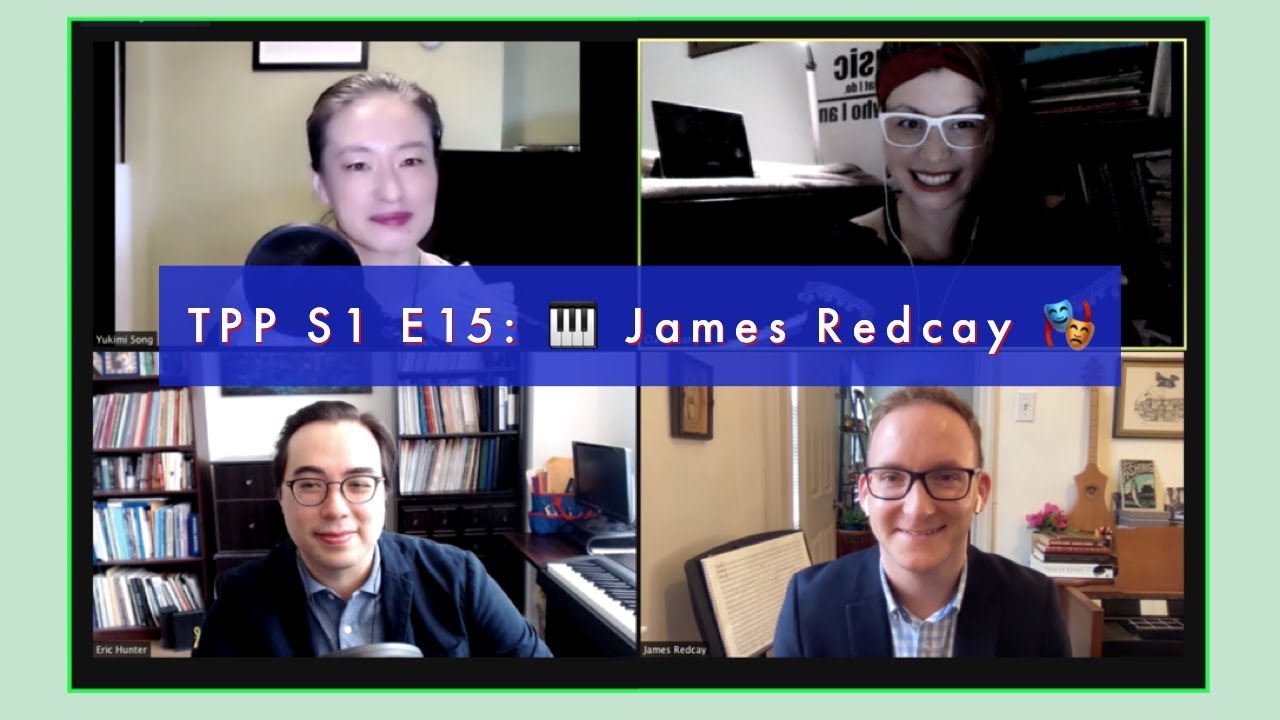
This content was created by The Piano Pod with Yukimi Song. This content was uploaded by The Piano Pod with Yukimi Song. This is a YouTube video (TPP S1 E15: James Redcay) published June 9, 2021 — an episode of The Piano Pod with Yukimi Song in which host Yukimi Song, along with Clara Zhang and Eric Hunter, interview pianist/composer/educator James Redcay. The discussion covers his pandemic-era experiences (the moment concerts began canceling), his career and studies at NYU, six years working in Macau (including managing large entertainment programs for Las Vegas Sands), his role at MidAmerica Productions and producing choirs at Carnegie Hall, operational impacts of COVID-19 and booking/registration changes, cross-cultural and language experiences, and advice for young musicians and composers.
Chapters
Welcome back to another episode of The Piano Pod with Yukimi Song, Clara Zhang, and Eric Hunter. Let me start out by asking some questions to you viewers and listeners, and I'm sure you still clearly remember the moment that the pandemic became reality for you and for your loved ones, and the moment you knew your life was about to change completely. My questions are: Where were you in that moment? And were you with anyone? What did you hear? What was the feeling you experienced? Any physical symptoms you had? So I want to share my personal story, and that was back in early March 2020, and I was still living in the pre-pandemic lifestyle and New York City was still open. And then I was teaching in-person lessons still. So I took a subway, but I was wearing the pair of latex gloves and I bought this most expensive mask from Amazon. And then I was equipped and I took the subway Then as soon as I got out of the subway, there was a phone call. That phone call to me was the moment I realized, whoa, this is real. I'm in it. The life is changing, you know, completely.
What was the phone call?
The phone call, yeah, I was gonna say the phone call, the on the other end was actually a very good friend of mine who is the guest of this episode. And then, so let me just, before I continue my story, let me just introduce you to our guest today, who is a pianist, composer, and educator of over 2 decades. He lived for, he's lived for 6 years abroad in Macau, China, where he created and managed entertainment programs for the world's largest casino company, Las Vegas Sands. He's been back in the United States now and is now a senior executive overseeing operations and sales at MidAmerica Productions, the most prolific presenter of choral concerts in the history of Carnegie Hall. So everyone, let's welcome Mr. James Redke.
Welcome, James. Welcome, James. Thank you so much.
Thank you for having me.
Thank you. So let's just continue the story. So I received a call from you, and then, you know, one of the things was that we usually text each other because our work schedules are so different. So, you know, either email exchange or text. So that was just like the biggest alert. Oh my gosh. Right. Then what also struck me was the tone of your voice. That tone of distress. And, you know, usually you're like totally chilled and poised, but that wasn't the case. So that got me thinking, whoa, I am panicked. I am fearful. And so, and I was like trying to comfort you, but only thing I could say was, oh, you know, it's going to be only 3 weeks. Remember, it started out as 3 weeks and then that became 3, 3 months. And hopefully it's not going to be 3 years. So anyway, so let's talk about that content of the phone call. So I want to know exactly where you're calling from and what was the background.
Well, I was— it was a pretty remarkable time. I was in the middle of representing my company at a handful of regional conventions for the American Choral Directors Association, or the ACDA. Regional conventions that they hold every 2 years. And I had the first week of— was March 2020. I was in Little Rock, Arkansas, doing a convention there. And COVID was— it was something that was in the news, but it wasn't something that seemed to be, you know, of great concern to everyone. And then that convention wrapped up and And I ended up taking a short road trip through the South and made my way to Mobile, Alabama for the second convention that I was doing. And that's when I called you. And I remember that— I will never forget that convention. It was around the second week of March. And, you know, COVID had just started to be this thing that everyone was now starting to worry about. I remember it very well. The convention ended on a Saturday, but this was Friday when Carnegie Hall announced that they were going to start closing and Broadway was going to close and cancel performances and concerts. And, um, you know, being there on the convention floor with all of these little booths that all of the vendors operate, we were just kind of having to bear witness to all of these things just closing and being canceled all across the country, and especially in New York and in big metropolitan areas. And I remember very well, I was talking to a director who was talking to me about her program and, you know, how all the things that they were doing and all these performances. And in the middle of talking to me, she had to stop and take a phone call from the president of her university who told her that she needed to get on a bus and get the kids and get them back to their get them back to their hometown because the whole university was closing and she wasn't legally allowed to have the children on a trip, you know, have these students. Um, and she had to just drop everything and run away, you know, completely end our conversation in the middle of it. And I just thought it was— it seemed like the beginning of, uh, you know, the, the apocalypse or something happening. Everyone was heading for the hills. So, you know, the convention ended early on Saturday, I remember the organizers came to us and they told the vendors, "All the performances are canceled. Everyone's heading home. You're welcome to, you know, head out yourselves. There's probably not going to be anybody here." And that really was the case. And I remember talking to you, I was on the balcony of, I think it was the Downtown Quality Inn in Mobile, Alabama, where my hotel was, living luxuriously, you know, and And I just, you know, everything seemed to be kind of falling apart, you know. So at that time we thought that, and that was only, I think we had 2 concerts canceled at Carnegie Hall at that point in time, which was 2 out of, I think, 15. Little did I know that only a month or so later everything would be canceled for the entire year. And, you know, the company I work for has done 38 years of concerts, almost 600 concerts in that hall without ever having anything canceled on us. So it was quite a, uh, it was quite an experience.
Wow, thank you for describing all that. I mean, I could only really sense, but what a kind of scary experience that must have been, you know. So, um, but everybody can relate to that in so many ways because everybody experienced maybe in different ways but the same thing. So now I'm just curious to know, you know, New York State, the tri-state area announced Monday that they're lifting almost all the pandemic restrictions by May 19th. And the mayor of New York City announced that New York City will open 100% by July 1st. So does that mean, does that include Carnegie Hall? Do you know anything about?
I think part of the provisions in that, if I'm not mistaken, and I'm certainly not a public health official, but I've also seen that they're essentially planning to maintain social distancing, I think, at various venues and restaurants and all of that in the city and the state. But Carnegie has a plan to reopen now for their fall season. So I think that's September, October. Okay. It's been interesting working with them. And the company I work for has a huge history with them. And they've been very kind with us and been keeping us up to date as soon as they know what their plans are. But they've been very incremental. And we understand that, you know, when you're the Metropolitan Opera or you're a Broadway production, you have huge sets and huge casts. And, you know, it's very difficult to open for one month out of an entire season. Whereas, you know, Carnegie can do a solo piano recital or a string quartet. Concert and they have social distancing essentially built in, at least for the performers. They seem very optimistic about reopening in the fall and we're very hopeful for that as well. Mid-America's season operates essentially in from spring and summer of every year, so thankfully our first concerts are not until March 2022. Um, and I think we've learned our lesson in terms of trying to prognosticators for the future. You know, the situation on the ground in September will be certainly different from the situation on the ground in March. So thankfully we're being updated and we're just trying to follow, you know, as everyone is, I think CDC guidelines and New York State and New York City public health guidelines. And who knows what the world will look like in a year or two. Everything looks pretty positive and hopeful. I imagine we've all been vaccinated here. I hope so. Yeah, yeah. And a lot of the people that I've been talking to around the country, because I talk to groups every day from Alaska to Florida and Maine to California, a lot of folks are as well. So everything looks like it's moving in the right direction, but I know all of these venues are being very, very careful about their plans because social distancing is still gonna, I think, be a part of any performance that happens, certainly in 2021.
Right. Thank you for updating that. Yeah, hope that everything comes back, you know, as soon as possible. I miss going to shows and concerts, so who doesn't, right?
So yeah, I've never seen the amount of desire to come and do live music concerts in New York, in anywhere in the world. Um, and so we're very optimistic about having a very big season in 2022. I mean, I— the only concert I played live personally as a pianist last year was a Christmas concert in a church a block from my home, and I was just so happy to be playing Jingle Bells, let alone a Beethoven sonata. Yeah, it is what it is.
Yeah, let's just turn the clock backwards now. And so we went to NYU together. I mean, you're much younger, so I shouldn't say together, but you were undergrad and I was a graduate student, and we were in the same studio. So tell us about your background and what led to, you know, working and going to foreign country and so forth. But first of all, maybe, or NYU, and also as a composer?
Sure. I, you know, as a child, piano was a big part of our family life. I have a lot of musicians in the family, and both of my sisters had studied piano. And so as the baby of the family, it just seemed to be a natural thing that I started teaching myself to play when I was very young. And, you know, for a long time throughout my adolescent childhood, I really actually wanted to be a concert pianist. And I was very fortunate at the time to study with a really excellent teacher in my teens who— she was very harsh and very strict and a real disciplinarian. But one of the things that she really insisted that I practice and learn were all of the Well-Tempered Clavier Préludes and Fugues. And that was the thing that really actually started me thinking about composition and really thinking about, you know, getting under the hood of the car and seeing how everything actually worked. And so I started composing at a very late age. I was 15, 16 years old, but I decided that that was actually what what I wanted to do as opposed to just be a pianist. So, you know, when I was— and I think I also valued a liberal arts education and being well-rounded. It's something that my parents also valued very much. And so NYU was— it was a really a wonderful decision that I, you know, and that I was able to get in and that I was able to go. You know, I mean, I I think you remember, you know, from our friendship and our time there, it was, you know, just being there was an education musically in and of itself, let alone being in class and actually, you know, studying counterpoint and all of that. I mean, just to be there, you had the opportunity to perform with other people who were like-minded, and you were able to go and see 10, 15 different concerts every night in New York City. And so I was fortunate in that I was able to actually work on my way through college and get a lot of experience. And, you know, the education was of course top-notch too, so that didn't hurt anything.
And also I learned a lot from actually outside of campus. I learned a lot from streets of New York. Yeah, so I love the location of NYU. You know, you learn a lot. You see a lot.
I just wanted to say that, James, although you say you started composing very late at 15 or 16, I did not begin really composing myself seriously until I was 30. So I just want to remind our viewers that it's never too late.
I always say that to students too. I— especially in this pandemic, I have seen so many adults. I mean, it was one of the things that I've actually seen I thought that, and I'm sure you all would agree, I thought that I would lose students from my private studio teaching throughout 2020 because people would move or financial concerns. But I've actually, you know, I've grown a studio and it's been amazing to see how many people have flocked back to music and many adults that wanted to pick it up again. And I always tell folks the same thing, it's not too late to pick it up.
Yeah. Okay, so now I want to know all experiences after you graduated. So tell us what happened. Well, I—
so at the time, I, I graduated with my undergraduate degree, um, and I had happened to be in a relationship with a person that was from Macau, China. Um, and so I, I had thought, um you know, in just my own crazy way, I would take a year off and I would go and live there, and I would work abroad. And it seemed to me to be essentially a sort of a personal study abroad in a way, to have another experience that was outside the usual mainstream way of graduating and getting a job and doing things. And so I think 2 days after I graduated at NYU, I actually got on a flight and I moved. I had been there a few times prior to visit, And so I ended up, uh, by a circuitous way, I ended up teaching for the Macau Conservatory there and doing things like ballet accompanying at the piano and all of these things. Um, and I, I taught there for about 3 years. Um, and I had briefly considered coming back and doing graduate work or whatnot, but I ended up meeting— it's a small place, it's only about 10 square miles as the country goes, um, so everybody knows everybody, especially in the arts. I ended up meeting someone who managed the entertainment program for the Venetian Macau, which was at the time it was the largest casino, uh, in Macau. And of course Macau is this huge gambling mecca that makes 6 or 7 times what Las Vegas makes, and the Venetian there is essentially a copy of the Venetian that's in Las Vegas, right? Um, so I met this person that had managed these, uh, these programs, and they needed someone, um, amazingly, who was— had a composition background to come on board and rearrange, you know, shows that they did, um, live in the casino, in the shopping malls that they had. They have a 300-shop mall there, um, and they did programs with classically trained vocalists, violinists, pianists, cellists, guitarists, flautists, you name it. Um, and they would do a 30-minute show here, a 10-minute show there. Um, and, you know, I, I had gotten into— it was something that was very, um, not in my wheelhouse is an, is an understatement, to be in that kind of an industry and that kind of a business setting. Um, it is— there is a big gap between entertainment and the arts in some ways, and that was very scary for me. But I thought, you know, what the heck, I will give it a try. And, you know, I ended up re-editing and rearranging all of these shows that they did, and then it was very fun to do. It was a big challenge, and I ended up also seeing that The department that was there was— they had about 120 to about 130 full-time musicians that were incredibly, incredibly capable, incredibly talented, some really of the finest musicians that I had met. And they, they, you know, hailed from all of these countries around Southeast Asia. It was really kind of It was really remarkable. So I made many friends there, and it was something that I ended up finding that I really enjoyed it.
You know, I know you as especially you're more like a Mozart, Bach, Beethoven player. So knowing that and then working in casino just always blows my mind.
It's a long— it's a huge mental transition from The Well-Tempered Clavier to O Sole Mio. But it can be done. Um, and so I was there and I was working in kind of this coordinator supervisor, um, technically sort of a lead artist capacity in this department. And, um, the company was always building, building, building, building more casinos, building more hotels. Um, and I was there for about 6 months and I, I had put in a lot of time and worked weekends and all of that. This was, um, this was around 2011 when after the global recession in 2008 things were starting to pick up again and the economy was roaring and booming, especially there. And the company started construction again on a property across the street from the Venetian, um, called Sands Kotai Central. And when it was built it was actually the largest integrated resort in the world. It was a 6,000-room hotel, um, and they needed someone in the company to go over and, you know, create and, and, and manage and lead the entertainment department there. Um, and so, you know, I was very fortunate that I was there at the time, and I must have done enough overtime, um, that they asked me to go and do that. Um, so that was another It was an incredible learning experience. I was very fortunate to be able to do that job.
Wow.
James, I have so many questions for you now. I'm originally from China, so I've been to Macau a few times. Well, actually, really after I came here, because I was too young to, I guess, go gamble. So I was in Hong Kong teaching some master classes. We just took a boat. I mean, first of all, what language do you speak? Do you just use English when you're in Macau? Because they use Portuguese and Cantonese, no?
So my Portuguese is terrible. I would only know a few words. And there's not much— it's interesting, Macau is— there's the official— there's two official languages, which are Cantonese and Portuguese.
Right.
But really in business, people mostly speak English or they speak either Mandarin or Cantonese. When I worked at the Macau Conservatory, everything was in Mandarin or Cantonese, and I was the only Westerner in the school, and so nothing was done in English. Even the documents weren't done in English.
Do you understand Mandarin then?
My Mandarin is very limited, mostly to ballet terminology than anything else, but I learned quite a bit of Cantonese while I was there, so I was able to get around and take care of myself and not be totally lost.
Wow, you're living a dream. That must be fun. I mean, I know I'm thinking I've been to Macau a few times, but I think I've only been into the casinos. That's like the only places people go, right? But so when you were there, like, where do the musicians— like, what do they do other than— I mean, they play for the shows. And so you said there's a big conservatory as Well, there is.
I mean, it still is in some ways a sleepy fishing town, you know, that it's been for thousands of years. I mean, it's an interesting place because it is, it is the oldest, and, um, it was the first and it was the last European colony in Asia. Actually, the Portuguese were there before the British were in Hong Kong, and they gave it back to China 2 years after the British gave back Hong Kong.
Right.
So it has an incredible assimilation of cultures there. I mean, there are times, there are streets when you walk down that you think you're in Lisbon, you know, and not in China.
For sure.
And I think much like in Hong Kong, people appreciate being somewhat separate from the mainland, just quite frankly. Um, but there's, there's just an incredible culture there and an incredible history. You know, there's all these UNESCO World Heritage Sites, and, um, I think it's very different from Vegas in that way. You know, I mean, Vegas was created as this stopover point and this gambling town. Macau was, um, there for thousands of years before the Portuguese got there, um, and really before the gambling industry, of course, started, which was not that old. It's only been there for, you know, 60, 70 years. So I mean, the musicians there, there's, you know, there's a symphony orchestra that's there, there are opera performances that are there, there's actually a pretty lively, you know, musical scene in terms of classical music concerts. So there's quite a bit to do, but I think in general a lot of the musicians also teach privately and have studios and things like that.
That's very interesting.
Yeah, but with all these interesting encounters with people and experiences, then after 6 years you're back in the United States again in New York City area, and you're working as, uh, right now at MidAmerica. So can you tell us about what exactly you do?
Oh, absolutely. MidAmerica is a very, very, I think, kind of fascinating entity in and of itself. So the company was started in 1983 by its founder, Peter Taborith, and essentially MidAmerica is kind of the original company that in New York has created festival choir performances At Lincoln Center, some, but by and large, in majority, at Carnegie Hall. You know, at this point we've done something like 592 concerts in Stern Auditorium and a number of concerts, I mean, in the hundreds, in Weill Hall as well. And essentially what we do is we invite conductors from all around the country, largely from the United States, but sometimes from Canada, Mexico, all around the world. And these are folks that are directors of choral activities at major universities. Sometimes they're very accomplished directors from community masterwork adult choirs. Sometimes they're very accomplished children's choir directors, you know, on the national scene. And we invite them to participate in a concert in a program that they do the, the vast majority of the programming themselves from a repertoire standpoint, and then we invite choirs on their behalf at their personal recommendation and referral to us to participate in that program. The choirs all pay a small per-person registration fee, and they get to come here for 5 days to New York City and do rehearsals with the conductor. They all come together. They kind of have this educational collaborative experience. They do a concert with a full orchestra, which we contract to do the concerts. We do the concert at Carnegie Hall. We do a cruise after the— after every concert. We must have done 600 cruises now down through New York Harbor and Statue of Liberty and all that. And then they go home. And that has not changed in 38 years, really.
Wow, it includes a lot of different elements to it, educational, and, um, and it's fun, you know, people from outside of New York come to learn and also to enjoy the tourism.
Yeah, yeah, I always call what we do an experience. And it's kind of ironic to me because that was a word that I never really used until I worked for Sands in Macau. And we always talked about that as the integrated resort experience. You're, you're having entertainment and then you're having shopping and then you're going gambling and then you have a hotel and all of that kind of stuff, right? And here it's, it's in a similar way, it's just a very multifaceted thing. You know, you can, of course, you can book a recital and come in, practice, do your recital, and then leave. And you can do that whether you're a pianist or you're a 200-person choir. But the, the, the value in what we do is that you're giving an opportunity to be on the world's— one of the world's greatest stages, if not this country's greatest stage, to folks from every walk of life, every socioeconomic background, really, um, and without a sort of aesthetic judgment as to what they can and cannot program. You know, as long as it fits within a time limit that we have for every program and the orchestra that we contract, which is a 60-person professional orchestra, we will do that. Um, and even though the choirs do— the members pay to perform, essentially, um, they, they have an experience that is, you know, by and large you can be in New York for 5 days and go shopping on Madison Avenue and spend a heck of a lot more money doing. So I would say every year I get a call from 1 or 2 teachers that tell me that they were students on a concert that America did in 1987 or '88, and now they want to bring their choir. So there's a huge legacy to what has been achieved just by doing these concerts and having people, having all of these people. We estimated somewhere around 150,000 individuals have passed through the stage over these 38 years. So, and then a lot of people that wouldn't have had that opportunity if Carnegie Hall's internal concert season had to come a-knocking. You know, really. And maybe they, and by and large, many of them have deserved that opportunity and then some. So it's been a wonderful thing.
And if anything, I think it's a motivating experience too. You know, when I, I remember when I was, when I first came to this country, I went to Kansas to study. And, but, you know, Carnegie Hall, I mean, I came, I was out here on tour at first before I moved to Kansas, but then we perform in all like Lincoln Center, you know, but we didn't get to perform in Carnegie Hall. And partially it's just like, to me, like to play in Carnegie Hall, you have to be somebody, right? Like, and I was in Kansas and they were going on this tour. And I think I remember I was being chosen as a conductor, the only female conductor. And they were like, oh, you could go on this tour. And then we're going to have a concert in Carnegie Hall. It was like too good to be true that I couldn't even trust it. So I actually never came. And then when I actually later on auditioned at NYU, and I remember I was sitting across the street from the deli. Like, whenever we had a second, you know, I would just like observe all the glory in Carnegie Hall. And then I remember there was Keison that just came out of like the rehearsal hall or something with his teacher, and I was like in shock, and my friend was like taking a photo of me. So I'm curious to know what was it like, I mean, for you to be inside, you know? I mean, I remember I finally played Carnegie Hall when I was like 28, it was like finally a dream come true, you know. But for you, you were there all the time, no?
Well, it's an interesting note you mentioned him, you mentioned Kissen. I mean, I remember once being at the hall and I was right at the backstage door talking with the owner of our company, and he just kind of stormed in and walked past us, and I had to do a double take that it was him walking in. But You know, I went backstage then to Stern Hall, the largest hall, and, um, he was— they have, you know, TV cameras that are monitors for all of the halls at the backstage of each one of them. And I happened to see that he was practicing in, I think it was Zankel Hall at the time, um, and the— some of the stagehands were at the, um, uh, you know, at the mixing board and all of that. And we, we hadn't started our own dress rehearsal yet we had, you know, 300 or 400 people waiting to go, um, and I just turned to some of the stagehands. I said, you know, "Oh, was that him?" And they confirmed it was. And then we had been doing a dress rehearsal for 4, maybe 3, 4 hours, and I went back and he was still there. And every time I had gone downstairs, he was still there. And I said to the, um, one of the head stagehands, I said, "Has he moved?" And they said, "No, no, no, we give him the space for 8 hours." and he, he doesn't, he doesn't move. He barely gets up to run, you know, run to the restroom. He doesn't eat. He just practices straight through, and he has 8 or 10 hours, then he's done, and he comes back the next day and does the concert. And I mean, that's wonderful, you know. I mean, that is sort of— it's what we've all been taught or shown, or, or, you know, kind of, um, shown as, as a young child, I think. And as we, as we grow up and go through music school, that, that is what a musician is, you know. Um, and I think the experience that I've had with Mid-America is that, you know, you, you start to see the value in more than just this focused definition of what an artist is. I mean, there's value in all sides of it, but there's a spectrum, right? There's people that, you know, perform in recitals from, you know, Texarkana to Tacoma to, you know, Santa Fe to wherever. Um, and they make beautiful music, you know. I mean, the, the great thing about Mid-America in a way is we're not in the business of judging who can and cannot have this experience. And I, I thought when I joined, I remember thinking to myself, because I, I, I hold myself to a pretty high standard performing, I thought, you know, what are the concerts going to be like that we do, you know? And I have seen some that, you know, went off better than others to a certain degree, but amazingly I've never seen us do a concert that I didn't think was Carnegie-worthy, at least above a certain bar. And that hall just has a way of kind of catalyzing everyone that's performing there to up their game, you know, to— that's an understatement.
Yeah, I mean, I remember some of those friends that came back from the performance, and, you know, and I didn't know growing up in Asia, it's like you have to make up your decision on what to you want to do when you're like 3 years old, right? But then I remember a couple of friends, they weren't even sure if they were going to be musicians yet, but after the tour they came back, they were like, "Yep, this is what I'm gonna do," and they make a very successful career, you know, I think partially because of this experience. So you guys are doing amazing work over there.
Well, it's good to see a young generation be able to be there too. I mean, I will say it always makes me laugh. We The backstage at Carnegie is of course very, very small, um, and, you know, being built 130 years ago, um, and so all of their standby rooms that they have for— they call them orchestra rooms, but they're really just standby rooms— are on floors that are sometimes 5 or 6 flights of stairs above the stage level. And we are, um, because we have choirs that are oftentimes 100 to 200, 250 people, we have to line everybody up in their rows to get them on stage properly. We can't have them take elevators, of course. And so, you know, we're always lining people up and walking them downstairs. And, you know, the young students, especially when they're in high school, are always, you know, always venting about having to walk up and down stairs. Ironically, it's usually not the adults, it's usually the kids. And I always tell them, you know, many famous people took these stairs. I told them Vladimir Horowitz took these stairs, Edith Piaf took these stairs. I try and relate and I say the Beatles took these stairs. And by and large, high schoolers nowadays don't know who the Beatles were, you know.
Wow. But, you know, as hearing your stories, like, you know, it's not just— performers comes in different shapes and sizes, you know, as you mentioned about Keith Zane. Being 8 hours in that room and practicing, but also there are a bunch of people from different states and perform at Carnegie Hall. It's like a really people's place, right, to express themselves, and the Carnegie Hall is. And then, but also there are people like yourself managing those events and backstage. So you are a musician, and then that's part— you're part of it. So It takes a village really to have that amazing experience, either whether either as a musician or as an audience to experience the whole thing. It takes a village, and that's what you are describing. So that's very encouraging to know as a musician. It's not this one thing that you are supposed— you meant to do, but there are a whole lot as a musician you can do. Right.
Well, you know, when I was in Macau and I was finally managing, you know, at the height of our department's size, we had about 110 artists, uh, plus we had a management team of about 5 to 6 people that were all direct reports to me. Um, and so I, you know, I found myself at the age of 25, 26 responsible for, you know, the operation of a department that size, plus all of these very talented, kind, deserving people, you know. And it always struck me that, um, A, I knew that my success as a manager trying to accomplish something was really based upon the success of all the people that were working with me and for me. Um, and I also realized that, you know, everyone who was working there was probably spending more of their working day at work than they were spending at home, you know, and so I kind of took it very— I tried to take it very seriously, the obligation to create a good working environment and create a pathway for people to grow, to learn new skills, to stay. I developed a saying when I was there. I called it facilitating other people's success. And that's what we try and do at Mid-America now. I tell everyone that we bring on who's helping to manage and produce that, you know, we're not the ones making the music on the stage, but we play a very vital role in making this all happen. And, you know, as you said, Yukimi Song, there's— we have folks that, um, you know, I would say probably the majority of people that are on our concerts, um, you know, this might be the first time that they're ever in New York City. So there's a whole other element to all of this which is— which goes beyond even the performance. It's a cultural experience, it's an educational experience just by getting out of their hometowns, you know, getting out of the states where they live. And since many of them are young, it's their first view of, you know, a different environment, you know, certainly.
It's kind of a cultural exchange, right?
It is, especially when you're trying to walk everyone through Grand Central Station, you know, 8 in the morning.
Yeah, well, New York has its own culture that is certainly unique.
Now, um, we can't avoid this question, so we have to get to it. So it's about COVID So, um, how are you guys doing, and how did your company handle it when, you know, first you— we receive the news? And what's— what has been the most challenging thing experienced? Obviously halting its operation itself, in itself, is extremely difficult, but, but, you know, how are you handling all the bookings and so forth? You could—
well, it was, um, I mean, 2020 was just, um, a very difficult year, of course, you know, for every musician and along the whole spectrum. I mean, being a concert producer, being a musician, um, we of course had to— because by the New York State guidelines and the New York City guidelines and executive orders, the Hall was closed for the entirety of the year. So, um, and it's been closed of course, this year up until the fall. So we have had to kind of chart our way through 2 years of no concerts and 2 years then of no revenue. Um, and so, you know, we were— I remember clearly after that phone call I had with you in March of last year, and, you know, I said to myself sitting down at the desk, in that quality. And I said, you know, I'm really going to need to go back on Monday morning and I need to sit down with, you know, our heads of finance and our heads of, you know, program development and these things. And we have to chart some way forward because this is going to be quite difficult. Um, you know, we, we took all of the performances that were set to take place in 2020 and we superimposed them on a calendar of 2021. And we offered every group the ability to move to 2021 or to receive some partial refund of monies that would not have been spent going into the actual production of the concert. The vast majority chose to stick it out for a year, and plane tickets were moved, hotels were moved, etc. Now, with the cancellation of Carnegie's 2021 season, we had to do the exact same thing. It was, it was the worst déjà vu ever of having to go back to everyone and explain the same situation over and over again. I think the vast majority of groups appreciated the fact that even if we could have done a concert in some shape and form, which of course now is not the case, we know now, but in December and November of last year we weren't sure, You know, we, we were very communicative about saying, look, when you're here, can you eat at a restaurant with 20 students? Can you be on a bus with 20 students? Do you know how you're going to be able to do a hotel accommodation if you're booking it on your own? There were so many. I mean, I think that one of the themes of this year has been, and this pandemic is just the lack of assuredness that life as we know it can be, as we know it can be normal. And so, you know, we, the cruise that we do after every concert, the boats are humongous. They're 3 and 4 levels and they have a seating capacity of 600 people. In any other year, that would be a pretty awesome experience. In a year like this, it seems like that is, you know, the last place people would want to be.
Right.
So we were again fortunate that the majority of groups moved over from 2021 to 2022, and now we're actively developing that season, and it's been a good experience. It's been remarkable that we have so much interest to travel and to perform with live music again. You know, we're being cautiously optimistic because I have conversations every day with educators around the country who are still waiting on school boards to approve travel, are still waiting for the school board to say they can take children outside of the state, for universities to end lockdowns for various COVID outbreaks they have on campus. Um, so, you know, We, we still have to kind of wait and see, but we're very, very optimistic with the amount of desire. It's just overwhelming at this point.
Has this pandemic changed the way the company operates, or any, any biggest lessons you learned, and maybe you can change that toward the future, if you could share?
I mean, I think, you know, one of the things that we have that we have certainly learned from this and that we're trying to update too is the way in which people register. You know, we've understood that people haven't been rehearsing, that people— the mechanisms by which people plan these concerts has changed, of course, dramatically over the year. So if choirs aren't rehearsing, they can't talk to each other, they can't disseminate information that way. They also can't collect registrations and deposits that way. So one of the things we're very thankful for doing is that we've, um, we have implemented an online platform for individual choristers or family and friends and school chaperones and all of that to register online, which is something that amazingly for 38 years we had never had at the company.
We had—
we were always able to do everything by ensembles. Um, so we're really hoping that with a larger social media presence and more marketing directed towards individuals participating in concerts, we might see quite a dramatic shift. I think it's going to take a few years, but we're going to see a shift in the number of individual people seeing a concert on Facebook or Instagram or Twitter that they want to participate in and being able to just sign up and do that, just like you would buy a ticket to go to Paris or a ticket to go to Beijing.
Wonderful. Last question. So any advice for young musicians and composers, if you have?
I mean, I, I think just in general, um, you want to kind of be— you want to keep an open mind in everything that you do. And I think, you know, trying to find— trying to grow your own skills and grow your experiences is really key to just your own personal and professional development. You know, I always would tell any young persons that are just getting out of college or school that going abroad and living abroad is is a remarkable experience, and it gets you out of your comfort zone, and it forces you to, you know, rethink your own home country and, you know, how you were raised. And it gets you to see things from other people's perspectives. So I think that that is, you know, every young person should do that if they're able to. And, you know, another thing that I always found so important at SANS certainly was we always asked our employees to, you know, we would take care of you and we would help you and we would support you, but, you know, please, as much as you can, say yes if we ask you to do something that's a little bit outside of your wheelhouse, outside of your main view. It would not, I mean, it's kind of interesting. It wouldn't, I guess, surprise us at this time that Among the people that hailed from various countries, you know, among those people that we stopped hiring first were oftentimes young Americans who were extremely talented and extremely educated but wouldn't do anything beyond what their contract asked them to do. I mean, not one minute more, not one note more of playing. And so the You know, and I have no fault, of course, with folks that want to protect themselves in various ways in the workplace. I think that's extremely important. At the same time, it's very hard to— it's very hard to move anywhere, and it's very hard to develop and grow if you're not willing to do something that's, you know, you haven't been trained for 10 years to do. It, you know, you have to have a little bit of faith in yourself that you can accomplish more than what, um, is just your normal everyday thing.
Great, thank you, James. All right, so The Piano Pod's rapid-fire questions for James Redke. Question number 1, are you ready?
Ready, uh, ready, set, and raring to go.
What is your comfort food?
Pasta, I would say.
Cats or dogs?
Naturally cats, as you know me.
Yes.
What is your word or words to live by?
Um, service.
Great, that's great. All right, uh, what is the most important quality you look for in people?
I would say just a general professionalism in terms of being there, showing up on time, and doing what you're asked to do.
Great.
What is the worst quality in people you want to stay away from?
I think having an overinflated sense of, and sense of yourself and your own ego.
All right, I'll continue. What is something that makes you happy?
Um, music in general. If I didn't still have a piano at home and play, life would not be quite the same.
But that's a good answer. What is your pet peeve?
Um, I think kind of the same. I mean, uh, well, I would say, you know, Not being able to write an email very well. That's always a big one for me.
I'm sure you read plenty every single day. Name 3 people who inspired you, living or dead.
Um, oh, that's a very good question. Um, I would say Abraham Lincoln. That's always a great— I'm a big history buff, so that's a huge one for me. I would say Glenn Gould is one of my all-time favorite pianists.
Me too.
And I would actually have to say my, my lovely wife, Tao, who is a great inspiration and has accomplished a lot in her own life.
So, and congratulations again to your beautiful wedding.
He just got married, so that's great.
Which historic figure or What composer do you want to learn or take lessons from if he or she were alive?
Another good question. I think that actually if I had to meet and interact with any of them, the most interesting for me would be Scriabin, I think, who was just a phenomenal pianist, an amazing composer. And sadly, so many— no one really took up his mantle, I think, very fully in terms of what he was trying to accomplish.
I see. And which historic figure or composer do you wish to hang out at the bar if he or she were alive?
Um, definitely Mozart. I think he would be the most fun.
That's right.
Bach would give me homework, I'm sure.
Work, work, work as hard as you can.
All right, James, name one piece in your current playlist.
Aha. Um, I would say, uh, John Adams's Dharma at the Big Sur. It's a wonderful piece of music and a favorite of mine.
Excellent. Uh, what about a book that you are currently reading?
Um, I'm actually reading— I'm rereading Doris Kearns Goodwin's, uh, Team of Rivals, which I have on the back there, but I have it on my Kindle. And for anybody that is interested in management or learning how to deal with people, it's a great, great read.
Oh, fantastic. You only get one song or piece to listen to for the rest of your life. What is it?
Wow, that is a difficult, difficult question.
Like everybody's nightmare.
I know. I don't know if I could— I don't know, there's just so many that I don't know if I could pick one.
Okay, just pick one.
Name the first thing that comes to your mind.
I was actually thinking of Peretz Furulina. It's a small one of his first works for piano. Beautiful piece.
Yep.
All right, and fill in the blank: music is blank.
Music is cathartic.
Lovely.
Ding ding! That's the end of rapid-fire questions.
You are the winner.
You win, you win, you win!
I'll pick up my prize.
This concludes this episode of The Piano Pod with Yukimi Song with James Wintle. And thank you, James, for joining our show today and sharing your wisdom and expertise. And thank you to our audience for tuning in.
If you enjoyed today's episode, please rate and review on whatever podcasting platform you use. If you are watching it from YouTube, please hit the thumbs up button and be sure to subscribe to our channel. You can also find us on Facebook, Twitter, Instagram, and LinkedIn. The links are in the description below.
And if you have feedback for us, we'd love to hear it in the comments. You can DM us, or you can always email us at thepianopodnyc@gmail.com.
Hope to see you for the next episode of The Piano Pod with Yukimi Song. Bye everyone!
Bye everybody!
Bye!
Thank you, James!
Thank you, James! Thank you for having me!
More from The


Spirit, Body, and Soul: Pianist & Composer David Berry on Virtuosity, Creativity, and...



Season 6 Episode 20 | "Spirit, Body, and Soul" feat. David Berry, Concert Pianist & Composer


Beyond Borders: From Argentina to Poland to Texas—Oscar Macchioni reflects on a life in music

Sound Liberation: Joe Williams on Black Artistry, Legacy & Belonging in Concert Music


