TPP S1 E16: Ben Laude, concert pianist & tonebase.co
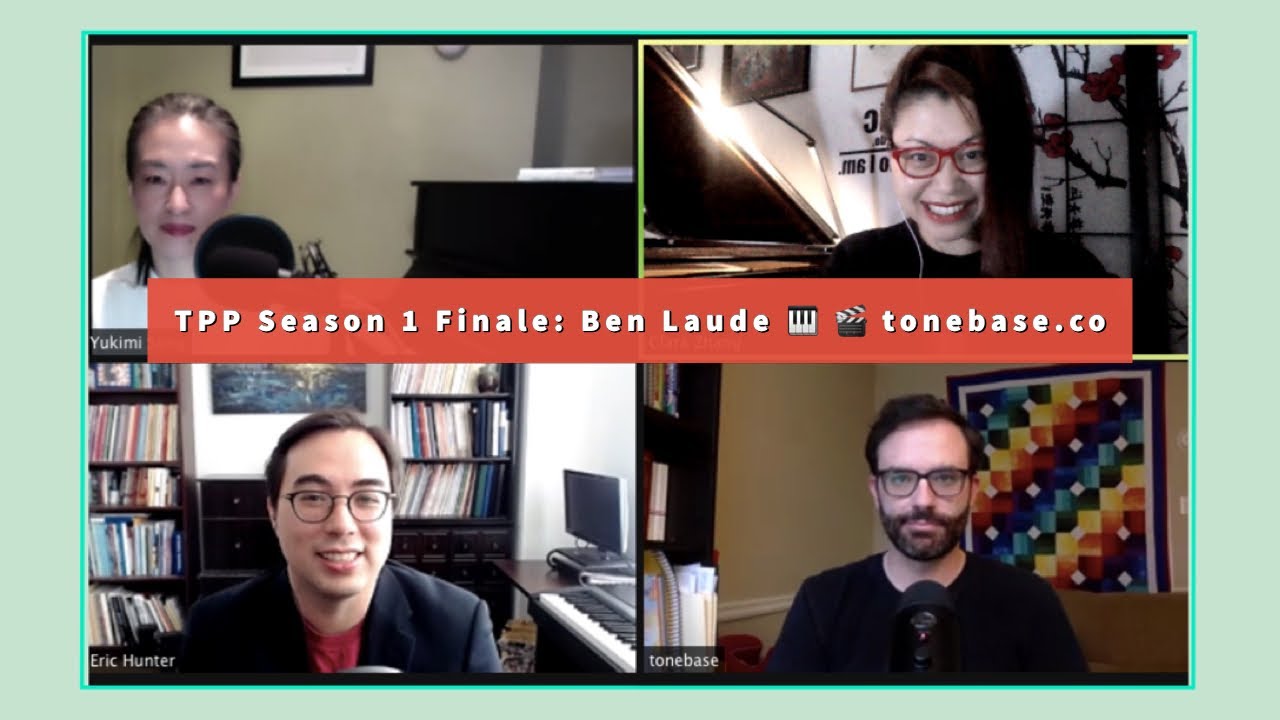
This content was created by The Piano Pod with Yukimi Song. This content was uploaded by The Piano Pod with Yukimi Song. This is a YouTube episode titled "TPP S1 E16: Ben Laude, concert pianist & tonebase.co" (The Piano Pod season finale) published June 23, 2021. The excerpt is an English long-form interview/discussion featuring hosts Eric Hunter, Yukimi Song, and Clara Zhang with guest Ben Laude (head of piano at ToneBase). They discuss ToneBase's mission to democratize music education, its offerings (lessons, masterclasses, progress tracks), artist recruitment and production/technical workflow (studio gear, video/audio quality), and anecdotes about artists like Seymour Bernstein and Emanuel Ax. The conversation also touches on how teachers and students might use ToneBase and behind-the-scenes team roles.
Chapters
Welcome back to The Piano Pod with our season finale. I am Eric Hunter.
I'm Yukimi Song.
And I'm Clara Zhang.
Today our guest is Ben Lodi, a classical pianist and head of piano at tonebase.com. Ben is a graduate of the Juilliard School and the Shepherd School of Music at Rice University. He debuted with the Austin Symphony at age 17 and was a prize winner in the Yamaha Young Performing Artists and Kingsville International Piano Competitions, among others. He has performed at concert halls around the world, including Carnegie Hall's Weill Recital Hall and Alice Tully Hall. Prior to joining ToneBase, he taught at Bard College and worked as an assistant to the well-known radio host and lecturer David Dubal. Ben, thank you for being with us today.
Eric, it's my pleasure.
Thank you so much.
Clara, Yukimi, thank you so much for having me.
Welcome. Great. All right, so we are really excited to talk about ToneBase, which has been making waves this past year. Um, for anybody who doesn't know, can you explain to us what is ToneBase? What do you guys do?
Well, the mission of ToneBase is to democratize music education, which is a loaded phrase. So let me unpack that a bit. Um, essentially, actually, this resonates a lot with what I heard you guys talk about in your introductory episode, which is this phenomenon of piano teachers and practicing pianists feeling the sense of isolation from one another in their craft. It's not like doing sports where you're on teams and it's very communal and there's crowds all the time. There is an often talked about separation between the solitude of the soloist and honestly the teaching craft too, and the audience and the sort of end results. So that alienation, I think, is just one thing that we're trying to push back against with Tomebase in our own way and in a new medium using new technologies. So democratize might just mean create more accessible and affordable opportunities for piano lovers, amateurs, piano teachers spread out wherever they might be to be able to enjoy some of the top artists, top performers, top professors from conservatories and concert halls around the world with the kind of intimacy that we might only get if we get to attend a conservatory. And even then, not so much. I mean, even then it's like, okay, I went to a Murray Pariah masterclass and I sat in the 18th row and maybe I got to shake his hand after. But with ToneBase, there's a sense of— well, we don't have Pariah yet, correct? Fingers crossed, but there's a sense of, you know, being able to actually be right there in the room with them. So it's really helping to deliver a very specialized art form and craft to the masses, if you will.
So can you tell us a little bit about your offerings? Sounds like you have lessons, master classes. How does it work?
Sure. I could show you a little bit if you like.
Yes, if you would like to show us.
If my screen sharing— shops are good. So I just landed on the ToneBase dashboard. I'm already logged in, so I'm a subscriber, but because I work for ToneBase, I don't have to pay. And there we see Seymour Bernstein teaching— teaching me, uh, "Für Liese," as he says appropriately, correctly. And, uh, why is that there? Because it happened to be the last thing I watched, so You know, when you land on the page, you get a variety of offerings and videos. And if you come to browse, you'll see that we have different categories. There's lessons, progress tracks, courses, and then you can sort by composers and artists. So just to maybe take you through a little bit, if I wanted to watch a repertoire lesson, for example, on— I don't know, name a composer, Clara.
Chopin.
Chopin. Oh, I think we have some Chopin, so I'm going to go to Romantic repertoire here. And I don't know, there's some— I like to look at the list. There's our Chopin offerings. And oh, look, there's Garrick Olson teaching the First Ballade. So I can now watch one of the great Chopin interpreters of the last half century and the only American ever to win the Warsaw International Competition prize. Can you hear that? Is— are you hearing that, or is it just me?
I think you didn't share your sound, maybe, but that's fine.
So you see Garrick there in an hour and a half lesson on one of the most, you know, famous cherished pieces. And this is just one of hundreds of videos we have. So that's just a little taste. But you see right there, I'm right next to Garrick, who, you know, I just— when I directed Garrick, I just pressed his on button and he just poured out this, you know, long-form structured lesson about this piece that he's known intimately ever since he heard Rubinstein play it in Carnegie Hall like 50 years ago or whenever. So, uh, this is not something you can get everywhere or really anywhere. YouTube doesn't have it, masterclass.com doesn't have it. There's no real way to experience that level of like very thorough detail, high quality, insights and inspiration into this music that we love and also have resources, a score available and tools to take notes and an edition that we've created, you know, with space for annotation. So that's just one sampling. There's other kinds of offerings. There's progress tracks, which help you progress from maybe beginner to intermediate levels in various musicianship categories and technique. There's interview features that I've just had the absolute honor and privilege to do with some of the great legends of piano, and I hope to do more of those. I just did one recently, actually, and we have got a big, a big release in a month with Emanuel Ax. And so that's fantastic.
Oh, right, big one.
And just, we can talk about him if you want later. I got to, got to meet him and work with him, and he's just the most special person in the world. So Anyway, my job is— I'm really lucky, and but most importantly, ToneBase, I think, is an important thing, and you can get a taste of it there. And I really recommend it highly to music lovers, pianists, piano teachers. Just watching these great artists teach and speak their craft is invaluable.
It's very educational for our level of pianists too, but also seems like you're reaching out to beginner, intermediate levels. So, and it's not only educational but also quite entertaining because I saw a particular one that I remember was John Kimura Parker. He was actually doing his lecture from his home studio, I think.
It's actually, that's his studio at Rice at the Shepherd Center.
Oh, I see, okay.
But he makes it very homey. He's got a couch in there. He's got all of his Star Trek memorabilia all over the walls. So it feels like it's his home office.
Yes, and it's like, feels like he's really giving you a lecture right next to you, right? That intimacy that you're creating, and he shares his personal anecdotes with the piece, connection to the piece. So it's very actually quite entertaining, and I saw not only his lectures but also Frederick Chu, who was our guest of the show a couple months ago. And then, yes, and he's incredible. So I saw a lot of incredible unique things on Tomebase, very distinctive about, uh, from, let's say, YouTube. Because before Tomebase, I used to go to YouTube and look for more materials to learn from, from these old all these big names, like A-listers, right? But now with ToneBase, I think it's more like very well organized. But also I feel like I used to go to summer camp and then, you know, after I graduate from master's in Europe or something, and then I have to pick which summer camp I want to go to because there is the famous teacher on this summer camp, but there's another teacher I wanna study with on. But now, with this ToneBase, I feel like I just get to choose from the home screen with the click of a button. It's, it's just—
That's one of the goals. I hope if we keep growing and expanding and I'm able to attract as many of these great artists as I can, that it really will feel like, you know, not that people will choose ToneBase over summer festivals. If anything, it should help facilitate people to want to go to more and more festivals because they'll be able to meet these artists on ToneBase first. But yeah, it should be, basically a little microcosm of our whole piano world or piano universe. You know, that's a little ambitious. We have a huge repertoire. We're never going to teach all those pieces. We have— there's, you know, 1,000 great concert pianists at least, you know, touring the world right now. We're only ever going to get, you know, a portion of them. But at the same time, yeah, that's— Yukimi, that's one of the ideas is that this is a way to experience that in-person festival, conservatory, concert hall experience, but sort of with the click of a mouse.
In my opinion, I also feel like you're protecting all the artists because YouTube is basically free unless they get sponsors or something. But classical music is usually a niche base, so I feel like With the millions of postings on YouTube per day, I guess our content, the content that I want to watch is pretty much buried. So you are, ToneBase is actually helping all these artists of their content and copyright, I feel like.
I think so. And I mean, YouTube is just, it's everything. It's too much, which is great. I mean, you could get lost in it. We all do. And it will always be a resource. I mean, I think it'll be, be with us forever, you know, until, until the apocalypse perhaps. But, um, before then, uh, YouTube of course still has its limitations, and it sort of requires these other premium platforms to complement it so that maybe you notice a Tonebase video on YouTube, or you see an artist you like, and then you Google them and you say, I want to find more, and I want to find the highest quality Where can I get that? And that's where something like ToneBase or MasterClass or Netflix or any of these premium subscription video content platforms, whether it's entertainment or education, come in handy. You know, for a relatively modest price compared to a lot of things we pay for, you can get this just sort of extensive access to, um, something that YouTube can't achieve on its own. And we— that way we can be a business, we can pay our artists fairly and also be able to promote them in a way that is, like you said, Yukimi Song, is probably lost a little bit with the sort of YouTube effect of everybody's stuff being diluted and sort of lost in the mix. So here's a way that we can say, no, no, in this place there's something special happening, and we can promote that and then take it back to social media and Google and, and even YouTube and say Hey guys, it's like, let's— we want to share this with, with the world too, and we want to invite you to, to come in and experience it.
So Ben, I wanted to ask you, you guys have this incredible roster of artists right now. I mean, so you showed us there's an hour and a half long lesson with Garrick Olson on Chopin. You know, for most people, the only way to get close to him would be to go to one of his concerts if he happened to come to your city that you live in, right? And then you've got other huge names like Leon Fleischer, Gary Graffman, Seymour Bernstein. How did you guys get started?
Let me start with the piano platform because the, uh, the actual— the pilot platform, if you will, was— is for classical guitar. And that was actually started 2 years before piano. And I was hired once the company raised enough funding to expand, uh, to help launch the piano platform. So I came on in the spring of 2019, and the first 4 to 6 months of my job was almost exclusively trying to recruit artists. So for every Garrick Olson I got, there were 20 equal, you know, artists who didn't respond or said no. Now I always treat the door as being open still, and actually some of those artists, including Manny X, I was able to return to. He never said no, but what he said was, "Why me? I'm so—" he's so modest, you know, "I don't know what I could offer you that would be useful." And then we weren't able to put something together, but 2 years later when I was able to show him what we did with Garrick, what we did with Leon Fleischer and others. I mean, I was able to, I was just more experienced and was able to get somebody of his caliber. So it was not easy. I mean, it's a lot of emailing and just grunt work of trying to, you know, these people get asked for stuff all the time. They, you know, they, that's why they have agents, you know, and we try to kind of avoid managers to some degree because we're not going to put up the kinds of fees that Carnegie Hall— we're not going to pay him $50,000. Of course. We don't have that. So, it can't be that kind of engagement from our side. It's still, I think, a very fair price that we're paying, you know, depending on the artist. But it's something more that's, I think, they have to want to do it. You know, it can't be the kind of thing where their publicist or their manager says, "Do this because it's going to be good for your public image or something. And so with somebody like Garrick, I was introduced to him through Nicholas Rizzotto, who's actually the artistic director at 92nd Street Y, wonderful organist. And he knew Garrick from organizing concerts there with him, and he set me up with him by email. Garrick happened to be in New York City when I was, spring or the summer of 2019. We met at the Nice Matin on 79th and Columbus, I think, uh, and, uh, he was staying at the hotel above there, and we just talked about piano and pianists for like an hour and a half. And I was just— that I could have like died and, you know, quit my job that, that night, and I would have been happy. Um, but that was just the beginning of a wonderful collaboration with him that extends to this day. I still am in touch with him. I called him before The Maniacs, you know, session just to be like, tell me about Manny, because you've known each other since you were 15. And so I'm just so privileged and blessed to be able to have somebody with that caliber of a pianist and that magnitude of an intellect to offer his time and services for us and be able to share the extraordinary lessons and interviews that he did with us. So he was a big help at first, but I also, you know, I went to Juilliard, I have connections. I was able to get some professors. I know a lot of successful young pianists and I just did a lot of cold emailing too. At some point I was like, all right, let's just find every major music school and conservatory starting in the United States, but I am branching out to other countries as well. And just gonna start sending basically the same version of the same email to everyone. And that's how I got people like Simona Denarsin and Rebecca Piniz and some others. That worked too. And getting off the ground was the hardest. And now that we've launched and established ourselves and people have heard of us, it's getting easier. But there's other challenges too, because now we have lots of different priorities, lots of initiatives. And so recruiting artists is just one of them at this stage, but I'm back at it. And Martha Argrich, if you're listening right now, I know. But anyway, so yeah, that's just, that's been a core part of the job and it's not easy at all. There's no magic to it. It's just hard work. Right, right.
Yeah, that makes sense. I mean, as a new podcast, we can certainly sympathize, but it does get easier once you have an established body of work to show off. And I have to say, your production values are incredible. I just want to mention that a little bit for anybody who hasn't seen any of ToneBase's videos yet. They have a lot of samples on YouTube, great stuff. Like, I mean, just the camera angles are so informative. You get the over-the-hands shot of, you know, one of these pianists playing, as well as the side angle and, and just top audio quality, video quality. Really good score.
Yes, score, exactly. Yeah, that is very helpful.
Yeah, and all of that is part of a workflow with great people and great teammates behind the scenes and great contractors that I work with around the States. We don't— we're not in a position yet that we can fly a production crew anywhere in the world, So we have really wonderful collaborators, you know, who are videographer and audio crews that, you know, in different parts of the country who we trust and rely on and have just done really great work for us. So, but especially my teammates, I wouldn't be able to do any of this without them. The scores that you see, the editing that takes place, you know, I have my hand in a lot of this or most of it, But, you know, ever since the beginning, where I actually did try to do absolutely everything along with the head of production, Sean Mulholland, we've been able to expand, add more people to the team, bring more people on, and it's really a wonderful group of dedicated musicians and web developers, essentially.
So that, you know, brought me to my question, Ben. You know how we— well, I think sometimes You know, when you keep on thinking about something, that this thing will just show up. So in the beginning of the pandemic, when we first started our podcast, and I remember I keep on noticing Tongbase, you know, online and online, and I registered for this lunch club, and all of a sudden I was connected with Abby, I think, on your team. And then we were like, oh wow, you know, Tongbase. And so I told these two guys, I was like, oh my God, this is amazing. So he told me a little bit about the behind the scenes, you know, how— but I want to know, what is your role as a head of piano? Like, how— obviously you connect all the artists with, you know, but how does it work with the programmers and the, you know, the technology? I think it's very innovative, you know, because as musicians sometimes we are so used to just hide in the practice room and practice, but What you guys are doing are so cool.
Yeah, well, I mean, first of all, Abhi is a genius. Uh, I think he's like 24, which— oh really? I don't know, which means he's very much— and he's one of the— he's one of the founders of Tonebase. So, uh, just to give a little bit of a profile of, of these three, because really this traces back to them and what they started, although a lot has developed since then. Um, Abhi was the third founder to be added to the sort of triumvirate that began all of this. But the, uh, the sort of two original musicians who spawned the idea were Igor Lichtman and, uh, Chris Garwood. And they are classical guitarists who met at Yale. Yale, right? Yeah, during their master's studying with Ben Verderi. And they met in a class taught by a woman named Astrid Baumgartner. I don't know if you've heard of her, but she teaches the music and business class at Yale. She's a philanthropist, amateur pianist herself, lives in New York City. I happen to have given her a lesson once because she still takes lessons. Her primary teacher is Peter Dugan, who's now the host of From the Top, wonderful pianist, just played with Joshua Bell in Moscow and Saint Petersburg. Peter's one of my best friends from way back, and so when Igor and Chris and Abhi were looking for a pianist to sort of build the platform, they reached out to Astrid, among others, and said, hey, who do you know? And Astrid said, well, I know Peter Dugan. But Peter Dugan is so awesome and busy, like, you know, he's not going to have time to do this kind of intense job. I mean, it's a full-time job. It's what I do all the time. But I, knowing Peter, was looking for a job. I was— I had my doctorate and I was like, let's put this to work, you know, let's apply for the tenure-track positions, let's do the whole thing. And so I was— it was just good timing. It was right in the middle of that season when I was like waiting to hear back from, you know, the Boston University had a job open, uh, you know, University of Maryland, uh, Baltimore County had a job. And I'm just like, can I get an assistant professor position somewhere? And then I get this email. Yeah. And Peter forwards it from Astrid, and I read the tone-based job description for head of piano, it just sounded like a joke. I was like, there's no such job that exists. That's impossible. I also happen to be somebody who always loved media and film, and like every high school project I had in class, I wouldn't make a poster, I would go edit something on iMovie and just have a fun time. And I even applied to USC for undergrad because I wanted to do music and film stuff. So I always was like, will I ever be able to do something in video media again? Because it's, it's one of my passions, like dating back to childhood. So I'm just reading this job description. It's like, yeah, you need to be, you need to have at least a master's in piano performance. You need to be well connected in the piano world. You need to know the piano repertoire. Um, you need to have like writing skills and, and, and media. And I'm just like, this is, these are the 5 things that I dedicated my life to, right? And so I just, I couldn't believe it because I was, I had no idea what was going to be the next chapter in my life and I wasn't particularly looking forward to it. So I just consider myself extremely lucky that that happened and that I knew people like Peter. And this is why you make friends at summer camps and stay friends with everybody and are nice to people, by the way, it helps your life out. But, but just that connection really helped. And so Igor and Chris and Abhi. They met at the school, and just very briefly, Igor and Chris first started a kind of Facebook, um, I guess, page that was called maybe Practice Portal or something. I don't know the exact history, but the idea there was just let's, let's have great guitarists film their practice sessions, just like open, right? So you have a window in this kind of a And then they sort of, that was their project for Astrid's class. And then that summer, I believe they got involved with the Yale Management School who sort of mentored them a bit. And that's when they realized, okay, we need a kind of more intentional business model here and we need to find a programmer, we need to find a whiz kid. So that's when they found Abhi, who was an undergrad at the time, you know, a few years younger than Chris and Igor. I mean, he was— he could have gone and made instant, uh, high salaries, you know, being a developer for Amazon or wherever, and he wanted to do something that was his. And that—
yeah, he seemed very passionate to the world.
Yeah. And so just— and he played piano as a kid, but he leads the product team, and the product team has expanded now. So we have developers, some of the musicians themselves, spread out around the country now because everything's remote, and they're working on the back end all the time just to support the platform, to encode everything, and to just make sure it's a smooth experience for our users. And that's a really intense job. And I feel for them because I get to be on podcasts talking to you and talking about how I interviewed Emmanuel Aks or whatever and had coffee with Garrett Olson. And none of this would even be seen if it weren't for the invisible people behind the scenes, you know, led by Abhi, who are, her just working constantly to make sure that it's an awesome platform. So anyway, that's a long-winded answer to, I guess, the behind-the-scenes question, but happy to dive in more if you're curious about specifics about how these things actually end up looking the way they look.
Right, right. Oh my gosh.
Yeah, Yukimi, go ahead. I'm more interested in about the technical part. So you have a team of people who does all the cameras and setting up Audios and yeah, so can you just tell us?
Yeah, so we now do this more and more in-house because finally we were like, hey, let's invest in our own studio in LA. And it actually happens to be in Hollywood, although that's just incidental. It's not like we're in one of these famous studios. We're not Paramount Pictures. It just happens to be on Gower Street, a block from the Hollywood Walk of Fame. Because we found a kind of nice space there that we can convert into a recording studio. So yes, I'm a Hollywood producer. That's what that means. But it's not that fancy. It's just very useful and practical for us. And so finally in-house, we're able to, with the leadership of Sean Mulholland and other wonderful editors and videographers on our team, like, Phil is, is somebody I work with all the time. Um, these guys are just like, they— some of them are musicians, some of them are coming from the media or the videography world. And Phil Ingle is, is just an incredible— like, he was making music videos for like Billboard and stuff before this. And so we brought him in and he's able to share his talents with us. And Sean was a classical guitarist, but he's always had a sort of tech interest and, and, uh, very skilled with You know, just being able to set up microphones and, and just is an audiophile and he just gets this stuff. And so they've helped design this set. They help run our in-house productions. Now we use Blackmagic cameras, 4K, and, and, you know, it's not just 4K, by the way. It's about lighting. It's about a color. It's about recording in a certain kind of flat color profile that's so that when you edit later you can color correct. All of that happens. That's why it looks so good. So it's not just about— like, I saw some ad the other day for a new camera that's 8K, and it says, "Just like film." If you film in 8K and you have bad lighting and the color profile's off for whatever reason, it's not going to look good. It's actually going to look really weird because now it's like 8K and you're seeing very vividly an image that's very distorted. So it's an art and a science at the same time to actually make media look this good. And we're, I'd say we're at, we're second tier to the first tier of HBO and masterclass.com and Netflix shows and Amazon shows that you guys watch. We are, we use some of the same gear. We have entry-level professional equipment, but what they're doing, it requires much bigger budgets, obviously. So I'm very proud of what we have made. I think it looks fantastic, especially for piano lessons. That's not usually something that you get as cinematic experience for. So I'm really happy with where we're at, but it's something that I am meticulous about too. Like, I want things to look as professional as possible and have production values be as high as possible.
I mean, it's a dream come true for all the artists and pianists. Even as a viewer, it's a really dream come true.
Yeah. I mean, I think a lot of pianists are used to seeing bums like us in our homes on YouTube. So I mean, don't sell yourself short. I think the quality is incredible. Thank you.
I mean, I— yeah, I mean, I'm used to just iPhone videos too. Like, I didn't— I'm just lucky that I get to work with people who have access to this equipment. I should mention, uh, Point of Order Productions, uh, led by Christopher and Mary Smith, they've done all— most of our Northeast stuff. And guess what? Most pianists live in either New York or Boston or Baltimore, so— or Philly. So I've been, you know, between those cities with them. They traveled to the Berkshires to work with Manny with me. They have awesome Canon C500s and really state-of-the-art lights. And Christopher Smith just got a Canon R5, which has a stabilizer. So he was able to like do all kinds of motion shots with Manny that aren't without a gimbal. So like, it's actually still stabilized enough to really feel like you're there. I don't know if you've seen the fly-on-the-wall video productions that are made in London, but, you know, Boris Giltberg and and Claire Hong Si have been on them, but you get this feeling that you're like right next to the pianist playing. So we're going to have actually some of that with, with Manny Ax, which is going to be— oh my gosh, I could go watch lots of videos of Ax playing right now on YouTube, but what I can't do is feel like I'm this close to it and that it's even better than real life, the picture quality. So that's— that matters, you know. It's not directly part of the educational experience, but it certainly enhances it. It's certainly part of it.
Of course, because you kind of have to have the entertainment quality to it.
I also want to shout out to those students that are watching. You know, we have all these like young students that eventually turn into teenagers and go to college and they don't know what to do with music if they don't major in music. You know, these are like great examples, right? These days we're all like, they're all high tech. You know, growing up from like a few years old, if they can come up with ideas like this, or, you know, I think TonBase is a great inspiration for the younger generation, right, to just brainstorm. You know, we don't have to be— and also just, I have to tell you a little secret. I was watching you with Seymour Bernstein last night again, probably for the fifth time, and I dropped a little cocktail, you know, tier. I studied with him when I was, um, I, so I moved here from China to Kansas when I was 17, and then at one point my teacher was like, you, you know, if you want to go to New York, go study with Seymour. And so like, I remember writing this email to Seymour in the library or something, and he was like, sure, come. And so like, I dragged my suitcase, come to New York City from Topeka, Kansas, and he was just so nice. He was just so nice to me.
Isn't he amazing?
He was just, you know, the hand, like you guys were talking about the hand, and he was like, you know, Clara, Clara, like Clara Schumann also touched this hand. I was just like, oh my God.
Well, long story short, yeah, there's a reason why he was able to impress somebody like Ethan Hawke at a dinner party so much. Yeah, yeah, that Ethan Hawke had to drop everything he was going to do for a year in order to make a film about this guy. He's intoxicating, he's hypnotizing, he'll be all of your friends, and he will want to be all of your teachers. He's just completely selfless and giving when it comes to, uh, his knowledge of piano. And he's one of the few serious— I mean, he's not like— he's actually weirdly not mainstream in the sense that, like, you're not going to see him. I mean, he has this incredible biography where he quit performing at 50. Sure. He, he wasn't exactly trying to rub shoulders with all of the giants of piano and the professors. In fact, he wrote books very critical of a lot of piano professors. Well, there's one called, I think, Angels and Monsters. Yeah. And there's a whole lot of monsters in the world, in the history of piano teaching, um, which is a whole topic we could discuss. But Seymour is not a monster. He believes in all of his students, and he believes in their potential. And he has, I think, the right philosophy, which is that you should that the job of the teacher is not to push technique and musicality into a student, but to draw it out of them and, and to reveal for them, help them reveal what they already know. This goes back to ancient philosophy. This is an idea of education that I believe in too, even if I don't always practice it so successfully. We're often in positions where we feel like we have to teach it into the student. More so wonderful. And I, I hope in that session with me you kind of see it happening to me. Oh, for sure. That he's actually— it's, it's a magic trick. It's like he doesn't do anything at all. Uh, he, he doesn't say, that's the moon.
He really does have— he sort of—
he helps you look at the moon and discover it for yourself. So it's just— he's wonderful. And he's able to make teaching technique an expressive musical thing, which of course is all of our challenge as a teacher. How do you make technique into something that's not just athletic training, but at all— at one and the same time, a human expressive act. And I think that mission is so important because of course we're always so divided between this false dichotomy of technique and musicianship, or musicality, right? As if you're supposed to work on your technique first and then to sprinkle the, you know, musical sauce on afterward rather than baking them in together. And he always bakes them in together. His recipe is always both.
Well, I think he's also just incredibly kind, right? I remember just, you know, all these things. I don't— did you study with him before you interviewed him, or? No, that's what's crazy.
I met him like 3 days before that. I see. And it looks like we've known each other for years. That's how he treats people. And he's not just kind, he's funny. He's funny as hell. Right. He is. And the jokes in there, just the deadpan. Yeah, he's so wonderful. I mean, I can't believe he's 94.
Well, he looks still very young. My piano tuner, Telly, she's like best friend with him. So I still get update from— I mean, I was actually at the premiere of that movie. My adult student at the time was the PR. And I happened to play this concert at Let's to skate, and he was there. And, you know, I had a friend, and he was like, oh, Clara from Kansas, you're back! Where are you? You know, it's like after all these years, he still remembers everyone. And that's just like, oh my God, you know, how can that be possible? Anyway, thank you.
How do you recommend as a piano teacher to use ToneBase for students?
That's a very good question, and it's something we're always working on. And improving because the platform was not originally intended like immediately, you know, for some obvious practical use for students. Its original intention was more for the kind of capable amateur. These are the atomized amateurs who live all among us, but we don't know them yet. Maybe they end up being our adult students, you know. I had many in New York, but they're the ones who really often didn't get a taste of this education, or it's been decades since they, they got to be in those environments. So that was the original target, and that helped shape the original framing of the platform. But as we started building it, it became clear that there's many different audiences that would be attracted to this product. Uh, and so we sort of internally refer to them as personas. Uh, and so there's, there's beginner personas, casual and serious amateurs, there's conservatory students, Really, I see that as a kind of high school, college age, sort of like potentially pre-professional track, or at least very serious about practicing. And then there's professionals of different stripes, including teachers, and teachers are often performers too, and performers are often teachers too. So it was hard to distinguish those, but there is a community of pedagogues, as we know, and you are among them, and New York has a very strong community with the, with the Congress, with the open forums that you guys have created, of course, is MTNA, and, uh, these teachers are also often not directly connected, especially if they're in Topeka, Kansas, to what's going on in— that's right— Colburn or Curtis, right? So that we realize, like, there is an intrigue there, and Frankly, I have to say we learn a lot from them too. I mean, we're in communication with teachers all the time who are interested in the— in ToneBase. They want to, you know, because we always have a teacher discount, by the way. I should just advertise that. I don't know exactly what it's at right now, but I think it's— Sounds great. I don't want to cite the wrong figure, but in the past it's been 30%. If you're a teacher and you want to subscribe to ToneBase, um, you know, email our, our support team if you don't find the, the teacher discount online, and we'll, we'll get it to you. But we're in dialogue with them all the time. In fact, many are actually giving us feedback and telling us their experiences and sharing them. So I don't see it as just like teachers are our audience and we're creating a product for them. I see it hopefully as a kind of continual collaboration and community building where we can learn from them too. Because guess who doesn't know how to teach kids? Concert pianists. Guess who doesn't know how to teach kids? Uh, Juilliard and Curtis professors. They have no idea. They're the worst at it. I mean, maybe there's an exception, okay? Um, I didn't say that. It's the hardest thing. It's the hardest thing, and it's often the most thankless thing because you wouldn't get— you wouldn't get these great virtuosi who many of these professors, I think, would be the first to admit that they get the spoils of what many nameless teachers around the world have produced. And yes, there's a lot of bad teaching out there. It's true. Uh, and that's partially because these— there's not enough, um, structures of training in pedagogy and, and sharing of knowledge. They're there. They're not always utilized successfully. And there's just a lot of teachers who are sort of stray from this and do their best, but piano teaching is damn hard. And teaching, being around kids is just as hard, whatever you're teaching them. So put those two together, especially with— I don't need to tell you guys this, especially with like short attention spans. And it's one of the most remarkable achievements if you can take a child and turn them into a great musician who actually wants to do it. And doesn't hate doing it. So on top of it all, even if you train them well, they might hate their lives. It's so hard. And so those who have done that should be getting like presidential medals of honor or something, and they're not. And that's work.
The three of us were so great with children.
I'm still waiting for my presidential medal. I know.
Yeah, I mean, I, I commend you. I've done it. I don't think I did it as well as I, I could have. I could have dedicated myself more to it. I would have had to dedicate my life to it because it deserves that, you know. It's not a freelance thing. No. And so, uh, I really appreciate you guys. And, and so, okay, so back to the question: what can we— what can ToneBase do for teachers? Right. We are developing more and more structured materials that I think actually fill in a lot of gaps that, uh, typical you know, piano lessons might not cover. So when I had lessons and I had some good teachers as a kid, I had some ones that, you know, were probably watching TV at the same time that they were like, you know, teaching me Hot Cross Buns. But in any case, there was this sense that like, you need to learn this next piece, you need to learn this next piece. And oh yeah, something about theory and something about just general musicianship maybe, but you need to learn this next piece and you need to program it into your fingers. And then you need to regurgitate it on stage. Okay, well, I'm not saying this is everybody. I do think it's common, and I understand why it's common, because there's an expectation from parents that their little kid has to play a recital at the end of each season. And so then teachers are pressured into this kind of like repertoire-driven track, right? I, I assume you guys have been there. I felt that pressure too. And, and parents can be demanding sometimes. They put their— they're paying for lessons, they put them in their for a reason.
Yeah. They wanna see results.
So why are you sitting there clapping all day or teaching them solfège or helping their ears out or getting them to improvise things? What is that all about? Right. So I think that matters. And I think every great musician who's ever, you know, made it to, you know, a high level had some element, whether it was nurtured in them or whether they were just born with it of a, what I would call general musicianship that isn't specific to the piano, that you develop in your ear, in your mind, in your heart, in your soul, whether it's rhythmic, pitch, phrase, a sense of line and expression, a sense of collaboration, whether you're playing with others or yourself, the way different parts combine. For me, that's the most important thing. And then piano is just one tool we can use to express that core musicianship. I don't think that's taught enough, even if teachers know it. And I don't want to say like, oh, I know it and we're doing it. It's just as hard for us, but we do have the advantage of not having to respond to the demands of teach this, this child a piece so that they can impress their, their grandparents and their friends. So I hope some of our— one of the tools I think we can help teachers with is have these wonderful— we have, you know, we just released 24 ear training labs on Bach subjects taught by a Juilliard music theory professor, Benjamin Groh, and it's wonderful. He— at one of the same time, you're learning all of these fugue subjects, just how they sound, and you're reverse engineering them and you're sort of dissecting their anatomy and putting it in your voice and putting it in your fingers, and suddenly it's both sight reading and ear training and music history and culture all at the same time. And it's not just for pianists, it's for— it's, it's about being a better musician. Okay, well then you watch those, you could show a kid some of those, and now they're singing Bach subjects in solfège or in scale degrees, and now they want to learn. Then you show them the rest of the piece, now they want to learn a fugue, right? So I think that can help teachers. We have Penelope Roscoe has a whole series, uh, Pillars of Piano Technique. She has a giant book published by Peters called The Complete Pianist. So we have a kind of, I'd say, abridged video version of that, and there's labs that go with it, so you can actually practice with her. And she teaches all, you know, just fundamental touches. And she's somebody who sort of like doesn't belong to, you know, any particular school. It's not— it's not— she's not Taubman, you know, she's not— not that she hasn't been informed by them, but she doesn't like belong to any particular like lineage of tradition, which I think is an advantage She sort of reworked a lot of the same ideas herself, and she teaches them very clearly and in a British accent, so it must be true. Oh yeah. So, uh, so that's great. And then there's, there's improvisation materials. Noam Savan, I have to shout out to. He used to be a friend. I saw it at Juilliard, and now he actually has his own, uh, he invented his own degree. I think it's the only one of its kind in Stuttgart at the music school there. It's a— if you want to get a master's in piano improvisation, historic improvisation, go study with Noam Sivan in Stuttgart. He taught these classes that were insanely popular at Juilliard and Curtis. I remember all my friends taking them. I was an idiot and didn't for some reason. And they're coming out after semester and they're improvising like, uh, Baroque toccatas. And so we have a 6-part series called Intro to Improvisation. Why would that be useful to teachers? Well, you can't learn improvisation from, from 6 lessons, but you can learn the— first of all, you can be inspired to want to, and you actually learn a lot. And we have deluxe workbooks and all kinds of interactive tools and resources during the video. And then you get to watch Noam do it. And so you're seeing somebody who's like one of the best historical improvisers in the world. And then he like, from the overhead cam, from the side cam, you know, from the teaching cam, and he's showing you, breaking down his process when he actually approaches something that you might have thought unteachable. If you see somebody improvise, you're like, how— that either you know that language or you don't. But he actually is able to sort of introduce you to the process that one could take oneself from, like me, a kind of bad non-improviser. I play music from a score, classically trained. But watching Noam's videos enough has inspired me to start attempting this. And we actually have a few different historical improvisation series of these kinds. So I think these are actually some of the most useful resources for teachers because it's not directly about learning your next piece, right? It's about becoming a better musician at the keyboard. And so I would promote ToneBase for teachers, especially because of that. Not to mention, it's nice to share long-form videos of Garrick Olson and Simona Denarski and other great artists, John O'Connor, teaching Beethoven and Chopin and Bach. Whether it's the piece you're learning or not, watch this great artist do this and you're going to be fascinated and you're going to want to play more, right? So there's an inspiration element too. And also just as teachers, teachers want to learn from other teachers. That's who teaches them. They don't get— of course, yes, there's no teacher of teachers who's not a teacher themselves. It's a contradiction. So teachers have to learn from each other. They're both always in the process of teaching and learning at the same time. It's one in the same process. And so just the library of videos of repertoire and technique from all the great artists we've worked with, um, those are invaluable, I think, to teachers just to, just to watch. But in terms of just direct structured resources, we're still building them, you know. So I wouldn't say ToneBase is like, you get, you can just send your students there and, and be like, all right, my work here is done, right? And it shouldn't be that because we don't want to replace teachers. That's We're not in the business. Thank you.
I was gonna ask you that. Don't steal.
Yeah. Well, we've had comments on, we've got some Facebook comments, like, you know, I think they just miss, I don't blame people for seeing it this way. They just see the product as like, you know, try some kind of video surrogate for the, the, this sort of irreducible experience of in-person teaching. We're not trying, not only are we not trying to take that away, We're trying to promote that because first of all, a lot of teachers are having to do grunt work teaching technique and things that actually ToneBase might be able to take care of. Hey, go watch some of this so that in your lessons I can work with just you and me personally, the student and the teacher, on your specific problems, because ToneBase can't do that. So there's a lot of general knowledge about playing the piano that I think teachers spend a lot of time on at the expense of the really specific personalized needs of their student. So actually, ToneBase can fill that kind of general knowledge, uh, void, and then teachers can be left to focus on their— the student in front of them. So I hope it's a resource for teachers too, to sort of like allow their lessons to be more enjoyable. You can watch lessons with students, you can send them home, they can come back and be like, You can discuss what they watched. They could practice along with these things. And the people using ToneBase, they're not going to quit their lessons. More likely, they're going to sign up for lessons. Now they want— now they need to take the next step, right? So I hope that, and it seems to me like it's true, that teachers see this as promoting what they do and as valuing what they do and contributing to it.
Thank you for clarifying that. That's very helpful. And thank you. So My last question would be, I want to know the future of TomeBase. There's so much possibility here, and as you mentioned, so I specifically want to know who are you thinking to interview? And, you know, right now currently you have piano and guitar, but are you going to increase more instruments? Maybe, you know, famous duo or, you know, trio? Quartet. There's so much potentials. And which pianists are the Tombe's wish list?
Well, name your favorite pianist and they're on my wish list, and I have them in a spreadsheet somewhere. You know, I'm stalking them. I know weird statistics, like number of Google hits of different, you know, the different pianists. It's creepy, but I'll tell you who, I mean, I was lucky enough to work with Manny. By the way, he's Manny the moment you meet him. He's kind of like Seymour, you know, it's immediate friends. And so everyone can look forward to those releases in July. He basically learned a lot of late Chopin that he'd never played during the pandemic. Like, did you know that Manny Ax never played the Chopin Barcarolle? Wouldn't you have assumed that was part of his repertoire? He just added it. And so we have him talking about it among many other Chopin works. And then he performed the two Opus 55 nocturnes for us. So he's no longer on the wish list. He's real. We're working with Annemarie McDermott in August, a wonderful artist. She'll be just finishing up at Bravo Vale and then headed to LA and teaching the Bach A minor English Suite. So that's going to be awesome. I will say that I don't know when it happens, and I want to say when and not if, but I'm in touch with Marie-Joëlle Perez, who's one of the just great phenomenal pianists of the last generation. Chopin— her Schubert Opus 90 impromptus are the best I've ever heard, so go listen to Perez playing those. I've been in touch with her. She has this festival in Portugal She is developing a lot of her own media. I don't know if she's going to work with ToneBase immediately, but it feels like it's on the horizon. And she's pals with people who are seemingly just out of reach, like Martha Argerich. And, and I— so I've made these kind of connections. Also, Ricardo Castro, who won Leeds in '93, has been a wonderful, uh, just, uh, you know, uh, contact for me and has been very supportive. He was a ToneBase user And we had these user interviews to try to improve the product. And I'm sitting there talking to Ricardo Castro, and I didn't know who he was at first. He's like, oh yes, um, you know, I'm, uh, was in a duo with, uh, Maria João Perez, and, and I just visited Martha yesterday. She's friends with my— she loves my son, and this. And I'm like, okay, well, maybe one day. Not only Ricardo, but Martha Argrich is top of the list. Look, I want to get Zimmerman. He's off limits practically. I want to get Sokolov. He's off limits. Kissen is going to cost a fortune, you know. So they're there, and I think in terms in terms of just next great pianists, we're close to them. Now, there's a lot that are at that caliber, but more accessible. And I do think you're gonna be seeing more and more of them in the next year. I could go through names, but honestly, I don't wanna sort of tease any of these out because there's not immediate prospects, but there's a lot on the horizon. I'm in touch with managers. I'm in touch with some of these pianists directly, and it's just, it's a timing thing. They're busy people. And, uh, but a lot of them, they seem to all know about ToneBase now, and they've seen the great artists we have, and there's more and more of an interest from them. And we're starting to get emails from conservatory professors at CIM and other places saying, can I teach for you? So that's— we're starting to get calls from Curtis, like, can we collaborate? So there's a growing interest in what we're doing. I think that's really great. I hope that keeps up. We're a business, so there's all kinds of business, uh, pedantic business things going on internally that, um, we're trying to make the best decisions for how to sustain the company, stick to our mission, right? Like not betray the mission in favor of some get-rich-quick scheme that wouldn't work anyway for our product. But we are a startup. You know what startups do? They usually create some, you know, bad product and they fail after a couple of days. And it's just, not the kind of enterprise that you usually see this kind of classical music education thriving in. So it's a challenge to figure out how do we grow at this kind of rapid pace while also staying true to our commitments as teachers, educators, artists, and so on. In terms of expanding and growing, I'd say ToneBase's next steps, of course, since the beginning, After Piano was meant to be, okay, let's, let's finish the other instruments. It's been a timing thing because now we're thinking maybe strategy-wise we want to broaden the instruments we have. I know I don't see classical piano and jazz piano as being separate platforms. I see them as part of one history of the piano, and we already have had some great jazz artists on live streams, and I want more and more of that content. So that might be where we invest our energies. There's some thought of maybe strings as a whole being next, or violin and then cello, or maybe high strings and low strings. The issue there is, well, guess what the two major amateur instruments around the world are? Piano and guitar. Yes, there's Suzuki violin and cello lessons, but as you get to the other orchestra instruments, you see fewer and fewer just ordinary people who might subscribe. So this becomes a business challenge. Maybe the next platform for orchestra instruments is about excerpts, and we try to sell it to conservatories, and we get all the great principals to teach those excerpts. That's just an idea that's floating around. And maybe, uh, maybe we go beyond music, right? I mean, one of the founders— you can't be a startup founder and not have ambitions, right? So, of course, part of their ambitions is to not only expand beyond classical genres, but to expand beyond music and potentially, um, teach you cooking or chess or, or, um, arts and crafts of different kinds. Now, these tone-based versions of these things exist, so once you— once we get there, you know, then it's going to be a lot of competition, and maybe partnerships, or who knows what it'll be like. But this kind of space of a creative online education at a high level is— was already happening, and then COVID happened, and now it's about to just thrive. I mean, MasterClass was already there. Now they're doing Outlier. Aaron Rasmussen is starting Outlier, if you haven't seen it. So you can go take calculus and psychology courses and get credit, right? So We're not accredited yet, but maybe we move to a model where we're actually able to contribute to online education. And that opens a whole, that opens a whole like sequel episode that we'll have to do together where we talk about the complexities of brick and mortar educational institutions versus online education. Cuz there's a lot of potential problems there. There's a lot of potential, you know, achievements there. And so I think that's the, that's the new frontier. And COVID rapidly accelerated our journey there. And I think the 2020s are gonna just see a flourishing of this kind of thing. And I'm just happy that ToneBase might be able to contribute in some small way to that.
Wonderful. What is your advice for young and upcoming musicians in this current technology-based and, you know, musical environment?
I probably don't need to be the one to tell them because they're already doing it, but you have to know technology. You have to not just use it, but I would say learn how to produce with it. Um, I could have done that more, honestly. I mean, you might look at me and say, oh, look at this tech musician guy. I, I still feel like a dinosaur around what the 23-year-olds and the 18-year-olds know and are doing. So I don't think I need to impart that advice, but besides consuming your technologies, you know, and your media, learn how it's made and start making it yourself. So get GarageBand or Ableton or whatever if you're a teenager, and get a MIDI keyboard and start making your own jams. Hook up your piano to it. And learn classical music, learn how to improvise and create new kinds of music with it. Create music we've never heard, compose stuff, uh, be creative. And then I used to say this, I used to say, say yes to every opportunity. That's always a fun thing to say. I would refine that a bit. I still believe in that up to a certain age. And then you have to start saying no, but, um, of course you need to be picky. So don't say yes to everything. But don't think that because you're comfortable in one narrow sphere and you're good at that one thing, that that's gonna take you where you think it's gonna take you, cuz it never will. Uh, it's going to be something unpredictable out of your control that will define your life. And the more experiences you have, the more skills you pick up, the more things you try, the more people you meet in music and in life, the more that's gonna set you up for happiness and success, uh, in the future. So that would be my advice to kids is not just practice. You should practice, but if you don't like practicing, tell your teacher and have an honest conversation about why you don't. And, and stop this passive aggression where it's awkward because I don't like doing it and then you make me. Because piano lessons should be the most amazing thing that every kid has. It should be a gift and a treasure. So if that's not working out for you exactly how you'd like, probe that a bit, you know, explore a bit and try some things out. And also cut your teachers some slack because they're trying hard and they've got a tough job. So yeah, those are— that's just a little coda to my advice for kids.
Maybe for those students that doesn't want to practice, they can come to watch some Tombe's videos and listen to some Piano Pod podcast. Yeah, inspiration.
That's why I wanted to practice ultimately, even though I never liked practicing and I never did it very well. It was because not anybody forced me to— that never worked very well. It just made me mad and upset, and my— it made my technique like, ah, I have to do this. It was because of discovering the music. Like, really, the, the music did it. Listen to it. Compare recordings. Listen to these dusty old men and women of yesteryear who've just imparted to us some of the great recordings in music history of any genre. And look, try to follow in the score. Scores are free. IMSLP, go, go right now. Find a piece you're playing, or find a better piece, or, or maybe a more interesting, difficult piece by the same composer. Go on YouTube at the same time, find a rare recording by Courtauld or Horowitz, and follow in the score while you're listening. I didn't get to have any of that access in 1999 or 2002 or whenever when I was— I had to order a VHS of Horowitz playing and wait for 3 weeks before maybe I can watch a grainy copy of it. And I'd had to go buy scores at the store. And it's just— it's all right there. Don't miss this opportunity.
All right, let's move on to rapid fire. Woo-hoo! Woo-hoo! I feel like we've had a very long, in-depth, productive conversation. Time to be totally silly. So let me ask you, Ben, what is your favorite comfort food? Biscuits and gravy. Oh, nice. You're from Texas, right?
With sausage gravy, I should add, but— Okay. Okay, I'm from Texas and it's the most caloric thing you can possibly eat. Uh, I've studied the IHOP menu. Okay, sorry, lightning round, let's go. All right, number 2: cats or dogs?
Cats. Okay, uh, what is your word or words to live by?
Question authority, but also think about what you're questioning and think about how you might be an authority yourself and not know it.
All right. That'll keep us busy. Uh, what is the most important quality you look for in people?
Um, a kind of openness, uh, and, uh, not just open-mindedness, but I like people who like people and who give people the benefit of the doubt. Wonderful.
And what is the worst quality in people that you want to stay away from?
Oh, I've tried to be a Christian and befriend all my enemies, so I don't know if I have an answer for that. But, um, don't be boring. Nobody— I don't think— I don't, I don't think anybody's boring. It doesn't matter if you have a monotone voice and and maybe you're not charismatic, those are some of the funniest, most interesting people. There's no excuse for being boring. I don't care what your genes are. You have— find— there's something interesting about your life that you can share with us. So if you're being boring, I, I just ask you to, to practice harder.
Okay, great. Well, thank you. Name 3 people who inspire you, living or dead.
Well, my mom, it's her birthday tomorrow. Just speaking of gracious people. Happy birthday! And I guess I should be very basic about this. My father, I wouldn't be a pianist without him. Not that he is one, he's a chemist, but it was his Chopin First Nocturne that he was attempting. I heard that as a child. Yeah, I told Seymour this, that was partially why I was fascinated by the piano and got into it. And just as a human being, I admire him, you know, endlessly. So, oh, third. Okay. Well, I should say that my partner Sasha is— I could say the same things about her. And I look up to her as well. She's a fantastic pianist, Sasha Kosman. And She keeps me whole.
Great. Okay. Which historical figure or composer do you want to learn, take lessons from, if she or he were alive?
Of course Bach. But I would say that if I could modify the question to give a more interesting answer, I want Bach to be my sort of musicianship composition teacher. Maybe he can like tell me how to tune and stuff. And then I want Gould on my other shoulder. Oh my gosh. And Glenn Gould can sort of— first of all, he'll be talking with Bach, and I think they'll actually be friends, not enemies like a lot of people say. And Gould will just be there to sort of show me things. I don't think he would ever teach. He wasn't a teacher. But if he were alive, First of all, he would be younger. If he was alive, he would be younger than Seymour Bernstein, Jerome Lowenthal, that's right, uh, Leon Fleischer, right, uh, Gary Graffman. He was born in 1932. He passed away at the age of 50. If Gould were here, he would have already started ToneBase of some kind. He was really into media, and it wouldn't be because he taught you a lesson, but we would film him and Bach together in the same room. Just being in their presence and sharing in their magic. And so I don't even remember your question, but those are the ones that I would want to hang out with.
Name one piece in your current playlist.
Well, my girlfriend is Russian-American, so I've been listening to a lot of Russian, like old sort of Soviet film soundtracks. And so there's some wonderful music, there's a film that you have to go see, or you have to— I don't know how you'd see it. It's called The Ordinary Miracle, and there's just a wonderful soundtrack to that, and I have it stuck in my head all the time, and it's in some playlists because I hear it in the car. But guess what's really good? Soviet film music. Because guess why? Those composers were really well trained, and they were compensated for their work, and It's incredible. I mean, if you like Looney Tunes and Bugs Bunny, you know how good orchestral music can be with film. It's everywhere in Russian film. I mean, just the soundtracks by themselves are worthy of stage performance. So, but I'm actually thinking of more sort of pop sorts of Russian soundtracks. But anyway, that might— that's kind of random.
But, uh, well, we come to the very last question. You get only one song or piece to listen to for the rest of your life, what is it?
I mean, I just out of duty and obligation and consistency, I have to say the 1981 Goldberg Variations recording by Glenn Gould. I mean, it was the only thing I listened— I'm not exaggerating, it was the only thing I listened to for 2 years. I went to Planet Fitness and just bounced along to the to the canons, and it made me want to learn the piece. And after that, I actually didn't listen to anything for a while. So I would probably just— I would take that with me to the desert island or wherever.
Well, so you just answered one of the questions that we were going to ask.
Okay. No, no, you can still ask.
Yeah. No, no. I mean, it's perfect. And I can understand you. I even did the— I'm RI or something with the good you know, edition of Goldberg. So, well, very, very last one. Music is blank. What is your music?
Music is the interior of humanity out loud, made external.
Thank you so much. Dream that. That is so beautiful.
I'll leave you with that. How about that?
A little bit of profundity to Ben, thank you so much. So I think that concludes this episode and this season of The Piano Pod with Yukimi Song. Thank you so much, Ben Laddi, for joining our show today and sharing your wisdom, expertise, and humor. And as always, thank you so much to the audience for tuning in.
If you enjoy today's episode, please rate and review on whatever podcasting platform you use. If you are watching it from YouTube, please hit the thumbs up button and be sure to subscribe to our channel. And you can also find us on Facebook, Twitter, Instagram, and LinkedIn. The links are in the description below.
If you have feedback for us, please leave it in the comments or DM us via social media, or you can also email us at thepianopodnyc@gmail.com.
All right, everybody, we hope to see you next fall for Season 2 of The Piano Pod. Until then, take care. Bye-bye.
Thank you so much, Ben. Bye everyone. Clara, Yukimi, Jörg, it was a lot of fun. I hope to be back some other season maybe.
For sure. Definitely. Anytime.
More from The


Spirit, Body, and Soul: Pianist & Composer David Berry on Virtuosity, Creativity, and...



Season 6 Episode 20 | "Spirit, Body, and Soul" feat. David Berry, Concert Pianist & Composer


Beyond Borders: From Argentina to Poland to Texas—Oscar Macchioni reflects on a life in music

Sound Liberation: Joe Williams on Black Artistry, Legacy & Belonging in Concert Music


