TPP S1 E3 P1: Mike Grande, Rock Out Loud Live (Part 1 of 2)
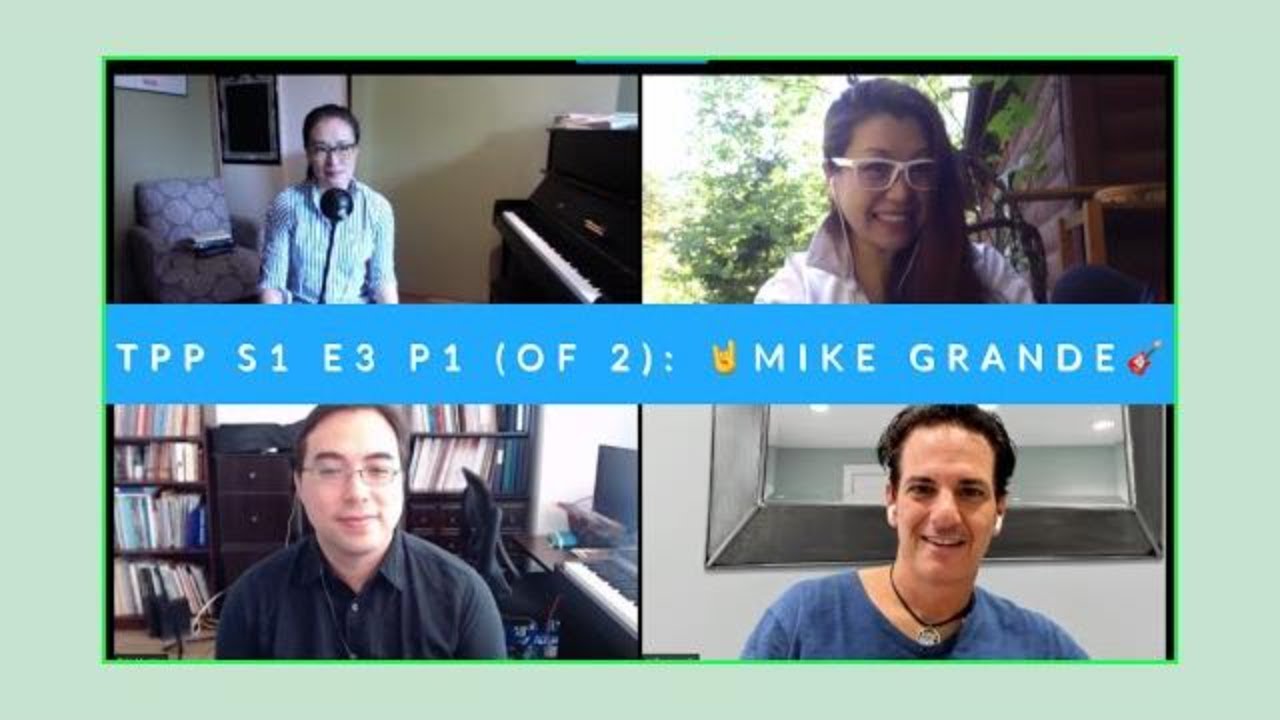
This content was created by The Piano Pod with Yukimi Song. This content was uploaded by The Piano Pod with Yukimi Song. This is a YouTube podcast episode (TPP S1 E3 P1: "Mike Grande, Rock Out Loud Live (Part 1 of 2)") published October 14, 2020. It is an English interview-style episode of The Piano Pod with Yukimi Song featuring hosts The Piano Pod with Yukimi Song, Clara Jung, and Eric Hunter, with guest Mike Grande (creator of Rock Out Loud Live). The discussion covers the Rock Out Loud Live platform — its genesis, rapid adoption (schools, users, weekly lessons), a recently granted patent, and product details such as audio-first design, PDF/sheet-music distribution to students, whiteboard/annotation features, peer-to-peer low-latency duets, network statistics (E2E RTT), and ease-of-use for teachers and students.
Chapters
Hi everyone, welcome back to another episode of The Piano Pod with Yukimi Song.
I'm Clara Jung.
And I am Eric Hunter.
The guest of the third episode is Mike Grande, who is a creator of Rock Out Loud Live, which is a software, a virtual music lesson platform, meaning it's like Zoom, but it's way better.
No, it's not like— well, it's not like Zoom. We just spent the past 5 minutes trying to figure out original sound. My mic is boomy. Eric is telling me I sound worse with the setup on. So it's not like Zoom. So, all right, so sorry.
Sorry, a Zoom replacement.
A Zoom killer. Let's call it music.
Yeah, exactly.
I'm just trying to communicate through our audience because they have no idea. So trying to use that Zoom as an example, but way better in terms of audio. And it's actually specifically made for music lessons, online music lessons, right?
Yeah, that's exactly right.
Wonderful. So anyway, thank you so much, Mike, for joining us today. How are you doing?
I'm doing great. Thanks for having me, especially on a Saturday. I know it's been tough to get me Monday through Friday to take this time, especially on a Saturday morning. When people have tons of things to do on their personal world, I really appreciate you guys making time. So thank you.
No, it's great. Wonderful.
Thank you. Yes.
So we've come to know Rock Out Loud Live from other piano teachers such as Andrew Inkubet of the Music Color Method and Carly Walton of Teach Music Online. And then we've read rave reviews of your software in terms of better audio and being able to do duets. At the same time, like simultaneously with your student, and sheet music integration, so forth. So could you tell us all about Rock Out Loud Live?
You betcha. So it's funny because people have said to me it came out because of 2020's pandemic, which really it wasn't. It was out— I started building this 3 years ago. I was on a podcast. Danny Thompson's got Music Lesson Business Academy, a podcast that he hosts in California. I was on in 2018 and I said, guys, 5-year plan is everything's virtual. He's like, ah, no, it's never going to be virtual. I said, I'm building this application, it's going to be virtual. Uh, Danny has since closed down his school to do only virtual now. So this is 3 years in the making. Uh, literally on Monday, this past Monday, my patent, which was 3 years in just building this patent and working with lawyers in the patent office, was finally completed. I got the allowance on Monday, which is fantastic news. And I've also found out there are a lot of competitors that are using this technology that is now patented by Rock Out Loud Live. So we'll see how we'll handle that. And then, yeah, so that has been 3 years in the making. July 4th this year, after about 7 or 8 weeks of beta testing, we went live. And I think in the first week we had 400 music schools. Today we're almost— I think we're a little bit over 100 days out live. We have 93 countries using this. I think I just posted it today on my Facebook Live group. 23,000 users are using this now. We're hosting about 15,000 to 20,000 lessons every single week. And yeah, we have a couple of thousand schools all over the world subscribed with including students and teachers. Students aren't even counted. So we're actually only counting the teachers because we have no personal information that we require from the students whatsoever. So if one teacher on average teaches 20 kids, about that, it's 20 lessons a week per teacher. If we have thousands of them, if you just do the math, that's an amazing number in such a short period of time. I think that's the market saying, hey, we needed something like this.
Totally.
Wow, congratulations on your success.
Thank you.
Yeah, and then, um, so, um, Rock Out Loud itself is a music school, or music—
Yes.
Yeah, okay.
So I opened up— so I've had the Staten Island School of Rock, which is not associated with the school School of Rock franchise. I've had that now for 16 or 17 years. And if you ever do the numbers of the School of Rock franchise, the only borough in New York they can't get into is Staten Island, because they just can't compete with me. We have hundreds of students. Everybody recognizes us. We've been there forever. And they've wanted to, you know, work with me and kind of combine, you know, schools, which I'm not going to do. But they did say, if you go to Jersey, which is where my second school has opened up, and you do anything School of Rock related there, we'll sue your butt off. So Rock Out Loud was born a few years go, which is about 2 or 3 years ago, the name came up and I found the place. It took me about— it's funny, it took me 3 years to actually open and only 4 or 5 months to build out the space. So then you say, well, what was the 2 and a half extra years? What was that for? That's how long it took my landlord to just give me a vanilla box, which the building was built, there was another tenant, took them 2 and a half years to give me a vanilla box. And when they handed me the keys I said, do you realize Christopher Columbus founded America sooner than it took for you to give me a vanilla box? And how do you respond to that? Because that's such a great question. And they had no answer for that. So 4 months later, we open up in November, November 2nd. It was a great grand opening. And this build-out cost me almost $700,000. The place looks amazing. If you ever want to see the virtual tour, rockoutloud.com will give you a virtual tour. It's about 3,600 square feet. 4 months later we close. And we close and we just transitioned naturally over Rock Out Loud Live, which was still in beta. All my teachers knew it. It was a great transition. It was amazing. And then that's how this whole thing really snowballed. So on July 4th, we just released it live.
Wow.
Wow. I have a question if I could just jump in. So I'm really curious, how did you see this whole online transition coming? Like, how did you have the foresight to start planning?
That's an amazing question. I'm a big reader. I'm a big reader. And Think and Grow Rich has always been a book that I've I love Napoleon Hill. Look at that wave.
Yes. All right.
That's awesome. All right. And they talk about specialized knowledge in one of the chapters, Napoleon Hill. And I thought about it. Just think if you wanted to learn how to speak Italian, you go out to Italy and you learn Italian. You want to speak Spanish, you go to Spain, you speak Spanish. But what if you wanted to learn flamenco guitar? Why do you have to rely on the local music school that maybe just has a, I don't know, a blues teacher who could just teach blues. And now you have to conform and say, you know, I really wanted to learn flamenco, but you know, I guess I just got to deal with blues guitar because there's nobody that you can really find that does flamenco. But if you can get somebody virtually in a different part of the world to teach you flamenco, that's how I thought of the specialized knowledge. If you want to learn, it's like people who go off to a college program overseas to learn the culture of whether it's Japan or Chile, or no matter where it is, that's the best way to do it. And how else are you going to do that as a kid? And it started when I was, um, I was 10 years old. I wanted to learn guitar. My dad takes me to this guitar teacher, shows me an Alfred book, and I'm like, I want to learn Led Zeppelin. The guy's like, sorry, Reuben Reuben first. I'm like, oh, there goes that idea. So 3 years later, I want to learn guitar again. Mom and dad, they bring me to a guitar teacher, and he plays in church. He's like, we can do Kumbaya at my 11 o'clock mass if you can learn an E major chord. I said, that's the end of that guitar lesson. So at 15 years old, I found this guitar teacher. He looked like— I don't know if you know who Randy Rhoads is. He had hair down to his waist, and he had 30 guitars in his basement, a full recording studio. He taught me Dazed and Confused by Led Zeppelin, my first song. And I was bit by a bug. For 12 to 14 hours a day for the rest of my life, I would play guitar for the rest of my life. It just took finding that one special teacher, that one special coach. So if that special coach doesn't live in your local music school area, What do you do? You just give up or you conform? You don't play flamenco, you play blues? It's not the way. So I thought virtual would be a great platform to do that with the tools to provide that ultimate virtual music lesson experience.
Wow, that's a great story. Yeah, totally. It's beautiful. So you know what, um, Eric, why don't you ask some questions about—
yeah, yeah.
Okay, so Mike, I think, uh, Could you talk to us a little bit about what's different about Rocket Lab Live and, you know, how it's superior to Zoom and other options?
Oh my gosh, I love, I love answering this. If this was about a 3-day conversation, I could probably ask for more, but I'll do this as quickly as I can. So first is, it's super important to understand that Zoom was not built for music coaches, music teachers, music educators, music institutions. It's simple, they're built for board meetings and conference rooms. So besides being the most successful failure in music, which I am, I'm also a chief technology officer and a certified a hacker for a company on Park Avenue in New York City, a financial firm. So I know technology. I also know how Zoom works because whenever we do a boardroom meeting with Zoom, it's basically a presentation in PowerPoint and then we all call in on a Polycom because the audio is just so awful. So when you have these Zoom conversations, you pull up a Polycom, you pull up a PowerPoint presentation, it's all for that video. You really don't care if the audio cuts out because you might be looking at some slides. I reversed that. The big difference here is I went from concentrating on video to concentrating on audio, and audio takes precedence where video degrades if you have a poor internet connection. So to me, that was, that was the ultimate experience, is making sure audio comes through. And the next thing I wanted to really focus on was what the real problem is with virtual music lessons. It's not the student, it's not the teacher, it's not the virtual music lessons, it's not being in front of them. It's the mom and dad. I think parents are the worst thing that ever happened to music lessons. And I could just picture you guys getting these hate mail and messages. Look at everybody's like— I'm going to tell you why parents are the killer of virtual music lessons. Mom and dad, this is the reason. After we have the most incredible music lesson with your son or daughter, the first thing we say is we're going to say, "Sally, we're going to email mom and dad that lesson and mom is going to print it out. You're going to practice the whole week and boy, it's going to be amazing. And next week we're just going to take part 2 of this lesson. So what happens is, well, mom and dad's printer is broken. We got caught in spam. They didn't check their email. Oh, I was so busy. I'm so sorry to get a chance to give them that lesson. And then the next week would roll around and little Timmy or Sally doesn't practice. And then you get that dreaded phone call. Well, you know, a child just doesn't he doesn't practice anymore, he's just not interested, he's not showing any interest, and we're going to wait until we go back in person. And I said, maybe that's not the problem. Maybe the problem is the parent not giving your child the lesson. That to me is the problem. So if we remove mom and dad, maybe we can make these virtual music lessons really, really happen. So it's exactly what I did. I created, which was patented on Monday, the ability to upload a PDF in real time in front of your student in seconds and have them download it on any one of their devices. So if they have a mobile phone and they use the Rock Out Loud app, they basically download the music, which I'll pull up now. It is awesome. So let me pull up what it looks like, and hopefully you'll be able to see this visually. So this is the application. So if I pulled up Fur Elise and somebody wanted to learn Fur Elise on my application, right there is Fur Elise on the student's mobile phone. You have 3 options. Those icons, are video icons. So if you wanted to see your teacher, you click that. Then the chord icon, if you want to select the chords, you can see that and all the chords will appear that this teacher provides. And then there's the sheet music and a little button right over there. You download that and that downloads your music lesson. So we wanted to remove the parents from the equation entirely. And by doing that and giving them the tool, that student downloads it and that goes right to their computer, their MacBook, their Chromebook, their PC, their Android, their iPad, their iPhone, every single device. So we actually have testimonials of 4 or 5-year-old kids on their iPad, because that's where it's going these days. Everybody's got their iPads, practicing guitar. This little kid Dean, it was amazing.
So, and kids are better with technology anyway. Yeah, absolutely. I hate to say this, but it's true. Yes.
Yeah, so they're so fast on catching up.
Yeah, yeah, yeah. Tech support for their parents often.
That's exactly, that's exactly right. So by doing that, we've really removed such a big pain point and We noticed that we had such a— it was a smooth transition to virtual lessons because kids, like they were coming to your studios, would walk out with a lesson, except for this time it was just digital. That was the next thing. We also offer features like song searches. We can search— piano teachers especially can search 1.8 million songs, Fur Elise being one of them. Pulls up immediately into the portal and shows up right there in real time with your student. We also have the ability to make this as simple for your student as possible. I knew that going from Zoom and Skype and WebEx and FaceTime to over to Rock Out Loud, we had to make it simple. Because nobody wants to go out and register for their new program, the new application. Parents have to get involved. They have to submit a form. Then they have to go to their email. Then they have to activate it. Then they have to log in for their child. It's like, oh my gosh, I can't do it again. 'Cause this was tough. I mean, music teachers were really thrown right into the fire on March, on March 16th, I think. And we all had to figure it out. I knew it had to be simple. So we don't ask for any personal information. You all join my call. And if you recall, I mean, Eric, you just typed in your name, you joined the room. That was it.
Super easy, yeah.
You didn't have to go out and register and fill out an activation code or any of that stuff. So these are really important things as part of the, keeping this experience very free-flowing, removing the parents and having them— the students to have that ability to get that ultimate virtual music lesson. I think we fulfilled that.
Right. So, Mike, can I ask a question?
Oh, yes.
I've been trying it out, you know, for a couple of weeks, like me. And one thing I noticed, maybe I'm not doing it right, when you share music, you can only share PDF, right? Like, so oftentimes I send my students where they have their music books, you know, in their score. They would take a picture and send to me. So normally on Zoom, I would just share that. But right now when I share, it seems like I lose my face. All of a sudden they would tell me that you turn into the music. Or if I share the PDF, I have to convert into PDF. Is that how it works?
Or—
Well, so just, I'm so glad you brought that up, Clara. And the reason why I'm glad you brought that up is because I listen. People have asked the same exact question. And unlike Zoom, after 4 months you get an email that says, hey, you still having a problem with this, you know, issue that you had? If not, let us know, we're gonna close the ticket. I took that and I went back to my developers and I said, let's create a whiteboard. Let's import PDFs or images or JPEGs or whatever it is the teacher wants into the lesson without sharing a screen. Then let's be able to annotate that right there in the lesson without sharing a screen. And then what if we remove the parents again? Because unlike Zoom, when you share a screen and then you pull up an an image and then you annotate, then you have to connect that image with the picture in the image and create a file, and then you have to email it. We've removed that entire process. So let's say your student sends you something. You can pull it up in your whiteboard, which is in your screen, and your picture of you and your student appear in the bottom right. Pull up that, annotate it, and then your student has a big download button. They can download it right there into their experience. So they don't have to worry about an email anymore. So they can have all of that. And that's the annotation feature. That feature's coming out. Hopefully next week, and that's all for the paid subscribers.
Okay, got it. I have not tried that.
Great question.
Yeah, thank you so much for answering.
Yeah, Mike, I wanted to ask you, can you talk a little bit about duets? Because that is really the promised land when it comes to virtual lessons, right?
Yes, I'm very glad we're going to talk about that. Ear technology, enhanced audio recognition technology. It's based around peer-to-peer connection. It's also, it's limited in terms of what you can do. You cannot do more than 2 people. It's gotta be person-to-person. There is no such thing as no latency, zero latency. I just wanna make sure everybody's on the same page here. You can't get rid of latency unless you're right in front of that person. So unless you wanna defy physics, there's no such thing as no, zero latency. However, we will be able to offer the least amount of latency possible, and I'll explain to you how it works. Peer-to-peer networking is my computer attaches to your computer, Eric, for example, and we connect like this. There's no media server. So what that does is it creates the least amount of lag or the least amount of hops that you can go from point A to point B. So if you have something like Zoom or Skype, they all use media servers, which means you connect your computer to a media server in the cloud, and then Eric, you'll connect your computer to a media server in the cloud, and then you'll redistribute that signal So just there, you're increasing more latency because you have more, more path that you have, you know, you have to basically go from hop 1 to hop 2 to hop 3. So just, yeah, so just exactly, just by removing one of those out of the equation, you've just removed, let's call it 20% latency. I don't know that exact number, but you're removing a significant amount of latency. So just by the fear that the mere fact of creating peer-to-peer networking, you're going to reduce that latency significantly. The next thing that we've done is we removed any ability to have— there's no compression, there's no EQ, there's nothing. It's a raw signal that goes from point A to point B, giving you that HD audio. So depending on your equipment, if you have a USB mic and a good set of headphones, you're going to get an amazing experience. And what we also offered with this particular feature is the ability to measure all of your statistics network-wise. So when you connect on a call, you'll be able to determine the exact amount of latency you're going to expect as a teacher. And that's called E2E RTT. So if you hover over your student's image and you go to the top left corner, there is a Wi-Fi symbol. And that icon gives you all the statistics of your student's network. And that's incredibly important because whenever you connect, you don't know if it's your computer, your Wi-Fi, your student's computer, your student's Wi-Fi. You don't know if someone's on Netflix. But all of these statistics— and they're on our user guide— are there to help you try to figure out where you sit on your, on your experience. If you have poor network connectivity, you'll know that immediately, and you might say, hey Tim, could you ask your brother to stop playing Xbox, or is somebody watching Netflix? Because those are the things that'll really help you. But back to the duets, the E2E RTT is a very, very important statistic for your network. E2E RTT means end-to-end round-trip time. That means those milliseconds are the amount of milliseconds it's taking from your computer to their computer, from their computer back to your computer. So if you can use those to judge how badly or how good your latency is going to be, that's going to determine your experience. So Microsoft deems 20 to 40 milliseconds for round-trip time being optimal for people playing video games. So if you're playing Xbox, that— those milliseconds when you shoot somebody in COD, those are the milliseconds that Microsoft's determined to be a great experience, optimal, 20 to 40. I am in New Jersey and I could tell you I've had between 11 and 19 milliseconds for people in the New Jersey area who are up to about 50, 60 miles away. And that latency was so minute that, yeah, I heard it. But it was not bad. It was not something I couldn't deal with, but it made such an amazing experience. And the last thing I'll end with is when the teacher starts performing and the student plays along, there is zero latency and it'll be in HD quality. So it's all about giving that ultimate lesson to your music student. This is what it's about. So your teacher starts, the student plays along, that student doesn't know if you're in that room or not in that room. So that's an amazing accomplishment, I think, and you get that to hear the ability of going back and forth without squashing, without that underwater garble sound, which drives me mad.
Oh, me too.
Yeah, we all have experience with that.
Yeah, that's all gone. That's all gone.
More from The


Spirit, Body, and Soul: Pianist & Composer David Berry on Virtuosity, Creativity, and...



Season 6 Episode 20 | "Spirit, Body, and Soul" feat. David Berry, Concert Pianist & Composer


Beyond Borders: From Argentina to Poland to Texas—Oscar Macchioni reflects on a life in music

Sound Liberation: Joe Williams on Black Artistry, Legacy & Belonging in Concert Music


