Welcome to Season 2✌️ of The Piano Pod!
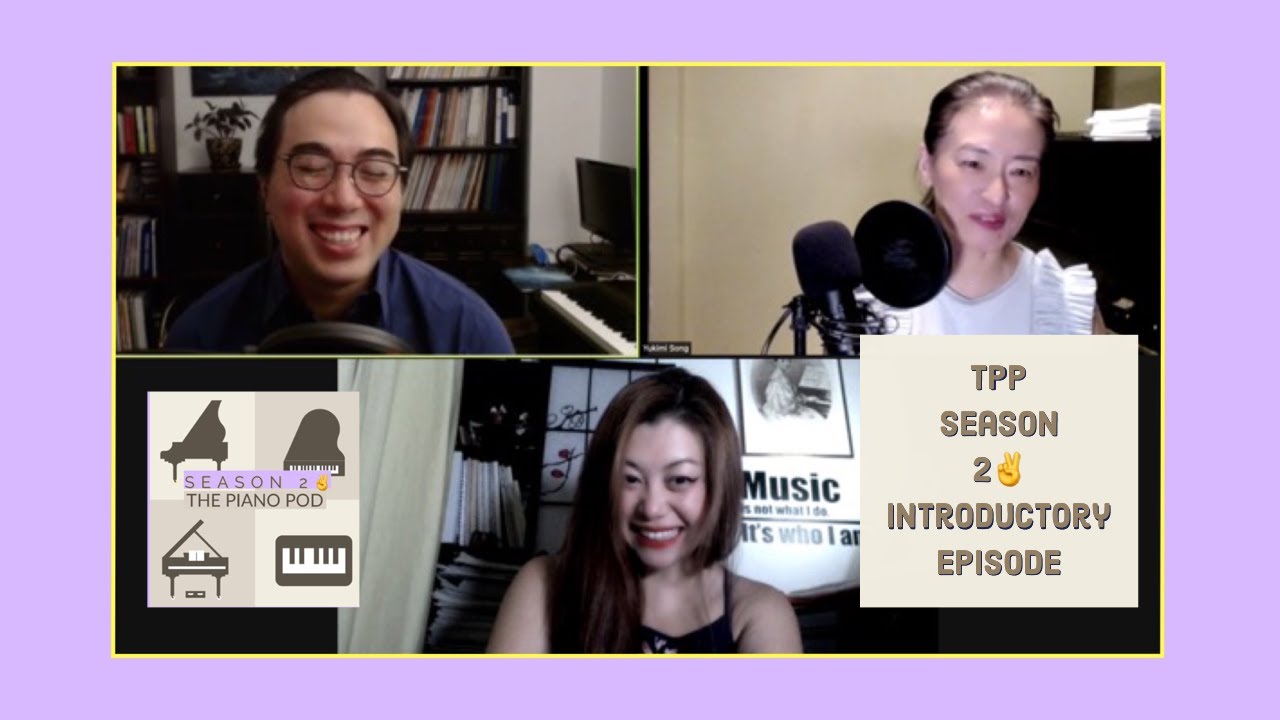
This content was created by The Piano Pod with Yukimi Song. This content was uploaded by The Piano Pod with Yukimi Song. This is a YouTube podcast episode titled "Welcome to Season 2✌️ of The Piano Pod!" (published September 1, 2021). It is an introductory/preview episode for Season 2 of The Piano Pod featuring hosts Eric Hunter, Yukimi Song, and Clara Zhao. They recap their summers, reflect on lessons from Season 1 (guest interaction, more live performance in episodes, adapting during/post‑COVID), describe upcoming Season 2 guests (Jeffrey Beagle, Min Kwon, Josh Massico), announce a Broadway‑themed recital and hybrid livestream plans, promote their video and livestream channels (YouTube, Facebook, Twitter, Twitch, LinkedIn), mention the Open Forum teacher meetings, and give release dates for early episodes (Sept 7 and Sept 21, 2021).
Chapters
Welcome back to The Piano Pod. I am Eric Hunter.
I'm Yukimi Song.
I'm Clara Zhao.
Welcome everybody to Season 2 of The Piano Pod. We are very, very—
yay!
We are very happy to be back. We took a break over the summer to rest up. You know, recharge our batteries, work on our own individual projects, and to prepare for this new season. So now we have a great guest lineup for you. We're really excited to tell you about it. But first, Yukimi, how was your summer?
Oh, it was great. It was a very productive summer. I mean, I took some classes and courses, and then, um, I also— I'm about to move, so there's a lot going on.
Yeah, yeah, moving is always a really big deal.
Yeah, it is. Yeah. How about you, Clara?
Oh wow, I— you guys know I've been to Europe for the very first time in my life.
Yay!
And the whole entire month, and I was teaching at night and being a tourist during the day. And, uh, you know, saw all the Greek side. I went to Vivaldi's house where he was born and baptized, and It was just beautiful and cannot complain at all. And, you know, so our students are still doing well, and we were able to make some podcast recordings even while I was abroad, so that was really exciting.
That's right, that's right.
And Eric?
Yeah, as for me, um, you know, the summer went really quickly. Uh, you know, I spent some time with family, but, uh, my son was in summer school which in New York City, all the kids actually got free summer school this year to make up for virtual school and missing school during the pandemic and stuff. And that was like a huge ordeal and just kind of weird. But also I got some practice in and I worked on some new arrangements, which actually I wanted to tell our viewers and our listeners, we are going to be having another recital. In the fall, right? Right, following our spring recital. And this one is going to be Broadway themed, so we're going to be playing all arrangements and transcriptions of famous Broadway songs. So I was working on a few of those.
I took Madeline Brusser's— she was our guest last season, um, episode 13, uh, and I took her master class, and you guys were actually the audience. And that's right, yeah, that was a really Great series. Yeah, I learned a lot. Yeah, it was great.
Yeah, so Yukimi was playing in the master class and Clara and I were in the audience, and Madeline did some really transformative work. And Yukimi's playing was always beautiful, but it was really quite astonishing to watch the transformation throughout the class. So that was a really incredible experience. Wanted to let everybody know that over the summer we also made some guest appearances on other podcasts ourselves. So we were actually interviewed, uh, first on the podcast All Keyed Up hosted by Ben Capilouto. Uh, that was episode 38, which was released in late July. So if anybody wants to check that out, we'll put the link in the description. And later another podcast called And If Love Remains. The Piano Pod with Yukimi Song hosted by Mike Lovett and Elias Axel Pedersen, an old friend of mine. So we talked about what we've been doing on the show and our own backgrounds and thoughts on piano and music and all that kind of good stuff. That's right. Pedagogy, right?
That was a fun episode. My first day in Milano.
Oh, that's right.
You were logging in from—
yeah, that's right. I was flying and I got there, I was doing tourism and I taught, and then they came to the show, but it was so, so much fun.
Mm-hmm. All right, so now we're heading into season 2, and, you know, we spent some good time discussing what we wanted to do and what we learned from season 1. What do we learn from season 1, guys?
Well, you know, um, remember last time we, us three got together on— well, except for the recital, was the, um, 10th episode anniversary episode, and it was the happy hour episode. It was fun, but we were really making fun of ourselves. We really listed the things we've done so wrong in the previous episodes. So this time I want to say we're very proud of what we've done, especially afterward, like from number 7 and on. I mean, I think we were more prepared and we had more strategies, and so we were able to ask so many good questions to the guests, and the guests were really responsive and gave us so many wonderful answers. And so it was— I'm very proud of it.
Yes, me too. Which is, you know, and not to say that we're not proud of what came before too, but it really feels like we're kind of finding our groove now. And the guests have just been wonderful.
Yeah. Proud of ourselves after each interview now, right? Where before we were always criticizing ourselves a little bit, and now we feel very at home when we're recording.
Which is not to say that we're not going to have another happy hour later and still get drunk and make fun of ourselves.
Of course. Yes. But, uh, yeah, I'm a— where I am, my suggestion is to do on the 25th episode, maybe 25th episode.
That sounds good.
That sounds good.
For the audience, maybe you can give us some feedback and tell us when you would like it.
That's right. Absolutely. Absolutely. So, um, So I would say there's two major things that we learned from the last season, and one of them is that we want to get our guests to play more. You know, it kind of, it kind of really, you know, made a big impression, especially with Jim Riddle back in episode 12 when he just started playing and demonstrating during the episode, and it was just so phenomenal, and it made it so much more than just an interview. You know, that's right. And then we started thinking back about past guests that we had had and realized, oh my goodness, we missed such an opportunity with all these great pianists not to have them actually play during the interview. So we will be incorporating that more in future episodes. Um, in fact, in our very first episode, uh, which we're going to talk about in a little bit, right, right, um, we really took advantage there.
Sure. I mean, especially, you know, we are using multiple medium for our podcast. It's not just the audio podcast, but also we do YouTube, and we also livestream on multiple sources. So why not, right? Yes, why don't we? And we have this amazing, amazing pianist as guests.
So, and also I think one thing we want to engage our audience more with is during before each episode, maybe we'll have some audience interactive activities, right? Guessing the pieces these artists are playing. And so we would love for you to participate in our social media pages.
Yes, yes, definitely more participation in the comments section. And like Clara and Yukimi Song mentioned, I wanted everybody to know, you know, we've been noticing in our analytics that we have listeners to the audio podcast from all over the world, which is just so fantastic, and our numbers have been going up and up, which we're very, very excited about. But I wanted to mention that, you know, we have a video podcast too. So I don't know if everybody knows about it, but we, we're doing all the interviews over Zoom. We record the video and we put it up on our YouTube channel. And also we live stream it when the episode launches on Facebook, Twitter, and Twitch. As well. So you can see the video on any one of those four sources, and there is an additional advantage because for the audio we usually split it up if the episode is long into two parts and release it over two weeks. But if you watch the video, you can see the whole thing the night that it drops. Yeah, so we hope some of you guys will check that out.
Sure. And then also, um, we have a favor, audience, um, that we have so far over 200 20, almost 5 followers on LinkedIn page. So our goal is to make it 500 so that we can livestream on LinkedIn page. So, uh, like us on LinkedIn as well. Just type in The Piano Pod with Yukimi Song and then it will show.
So yes, that would be excellent. Thank you very much.
All right, so on Instagram as well, right? And the Twitter. So So for audience that enjoy those platforms, yes, absolutely.
Yes, you can watch it on Instagram as well. It's just we can't do the live stream there because of technological limitations, but we do post the entire episode. Thank you, Clara, for the reminder. All right, guys, what else do we need to talk about tonight?
Overall, so second half of the first season, I learned we had so many different types of guests. But I think overall theme was how that, that time was, you know, people are starting to get vaccinated, you know, and I will— first vaccination was being available and then starting slowly being vaccinated. So people were hopeful. We're not sure yet what, what will happen, you know, down the road because of all the COVID variants and everything, but I think, um, like this post-COVID, I mean, it's just not gonna go, go back 100% the way we used to live, right? So music making, music listening, music learning has changed dramatically. I think that's the impression I got from every single person I talked to. We talk to, and we have to really do something about it. Uh, we can't just do this traditional way of teaching as a teacher or performing. Um, so that's something that I started to feel toward the end of season 1. I don't know about you, what do you think?
Yeah, totally. So one thing we've been talking about between the 3 of us is how we've seen over the last year, you know, when we began this show, we were still relatively early on in the pandemic and everybody was still just kind of trying to find their footing. But at this point, more than a year in, people have kind of, they've had their depression, right? Pandemic depression for musicians, unemployment, all that stuff. And everybody has, you know, at this point decided I'm going to find a new way. I'm going to forge a new way forward. They've decided on new projects, they've decided on new approaches, they are finding new ways to reach audiences. And so now we're getting to a really exciting time, and we've already done several interviews for Season 2 with some wonderful guests that are doing very exciting things. Um, so, um, Yukimi, would you like to talk about Jeffrey Beagle a little bit?
Sure. So Season 2 The first guest is Mr. Jeffrey Beagle. He is a concert pianist, Steinway artist, and became a composer lately and an arranger. I mean, and then he contacted us through, I think, one of the social media accounts, and we were so delighted that he would be— he wanted to be on our show. And, um, so he has some really surprising facts about his life and how that affected him actually positively in the end. And, um, then what happened was during the interview, I mean, he demonstrated a lot of pieces. Um, I— we were so so blown away the fact that he could just play, you know, one of the most difficult pieces in the world. He can just play it, you know, just like that.
So quite a few actually. Yeah, I mean, Jeffrey Beagle is somebody that can just pull the most difficult repertoire out of a hat anytime, like probably while he's half asleep. And he did that throughout the entire time we were interviewing him. It was really incredible to watch.
And I think another thing about him, by May I realized he was the first person who have ever had a livestream, right, in the '90s, right? So that's like 20 years before the pandemic. Nobody even knew that could be a way of performing, and he did it. So that was really incredible to know.
Yeah, first livestream classical pianist idol. Yeah.
And then how many concerti he's done in the past.
I mean, all of them.
Wow, blew my mind. And he still does. He still— he is learning new concertos and work with other musicians, and his work ethic is just so incredible.
But now he's writing them himself as well.
Exactly.
And then for episode 2, we had Min Kwon. Clara, would you like to talk about Dr. Kwon a little bit?
Yeah, I think it was, uh, well, again, it was— we were so honored to have Dr. Kwon. She is a professor at Rutgers University, and she also recently, she has— she's the founder of the nonprofit organization called CME, and they have these concerts for young younger musicians and also older. And but recently she did this project, it's called American Beautiful, and it was aired on CBS and NPR, I believe, right? And then she, what was it, 100 composers, or at least 80, I think, right? I think around that number. I have to come back to see the exact number. And they're all new compositions and based found this theme, American Beautiful, and she pre-recorded all of them. Some of them were even like in Brooklyn Cemetery, you know, some in the beautiful concert venues near the ocean. And so she came to the show to talk to us about her project and also her nonprofit and her teaching. And I just realized, you know, what a wonderful way of being a musician. Especially during the pandemic, I think, as you guys were mentioning, sometimes we are— maybe we are forced to think of new ways. It had me really remember two guests that we interviewed, especially from last season, from season 1. One was Mr. Frederick True, who did the SmackDown.
Classical Smackdown.
Yeah, that was amazing, right? We were all there voting. And also obviously ToneBase, right, where they interviewed all the wonderful artists. So I think we were so lucky to have Dr. Phong on our show.
Yeah, I agree. Yeah, a really beautiful person with so much generosity and wonderful philosophy of music education.
Surprisingly She is very forward-thinking. I mean, her educational background is this really traditional, you know, Juilliard, Curtis, that approach. However, her mind is just so forward-thinking. It's just so incredible. You don't want to miss it.
Yeah, it was really a privilege to talk to her. And then for the— yes, for the third episode, we have my old friend Josh Massico, who is a professor at Nazareth College. And fantastic pianist, went to Eastman, has degrees in both performance and pedagogy. And he teaches piano pedagogy, functional piano, also music therapy. And he has a textbook out on that, but we brought him on to talk about the state of the classical music industry and how much it may or may not need to modernize because of this art or famous, infamous Rolling Stone article that came out last spring that was entitled, I believe, "Julliard Must Modernize or It Will Disappear." Yeah, right, something like that. Yeah, so after having two Juilliard pianists trained on the show, we brought Josh on to ask him what he thought about this, uh, and, uh, yeah, and he's a really, really smart guy, fantastic musician, and very interestingly, he's from New Orleans and he grew up steeped in a very rich, diverse musical culture. So although he has the classical training, he also plays in a other genres. He's a singer-songwriter, and he has this kind of broad perspective.
Yeah, it was a very interesting interview. We were talking about, you know, we're Americans here, and how music education should reflect the culture, and because otherwise it's not going to be so organic, right? Why we want to do music, why we want to learn music, because music speaks to you and music should reflect our status quo or culture, you know. So I think it was a really important conversation. Sometimes, sometimes, you know, think talking about something like this, it makes us uncomfortable because we were taught one way and we love that tradition. We love that. That's why we are who we are. We are classical musicians, but sometimes we have to have that— some uncomfortable conversations in order for us to see much bigger picture and always thinking forward.
Yeah, which is the purpose of this show, really. Yeah, you know, one thing that I found in common with all our guests is everybody is always still trying to grow still trying to learn new things and change, which I feel is like a pretty rare perspective to have outside of artists. And, uh, and I'm always so inspired when we get these guests on who are like, you know, challenge everything, don't sit still. Um, because as we can see, the world is changing whether we move with it or not. So yeah, yeah, that's why we have this podcast, to promote people who are doing new things while still obviously still respecting the tradition.
Exactly.
I think it's just that also when we learn new pieces, for example, when we teach our students too, sometimes we have to have that constructive criticism, right? Otherwise we just keep on following, following, everybody will sound exactly the same. So that's why these conversations are actually very important.
Yeah, absolutely.
And we have to cycle the repertoire as well. I mean, I don't teach some of the pieces I used to teach 10 years ago because I feel like they just don't work anymore. The kids don't respond to them, and it can be difficult to let that go because at one time they served a very useful purpose and they're good music, but you know, you have to go with what works, right? All right guys, so is there anything else we needed to cover tonight? I think we hit the big ones.
Right. Well, the full recital we mentioned already, but we plan to do hybrid, in hybrid, right? So live audience at the live venue, plus livestream. I mean, finger crossed. We don't know because of all the— still we're in the middle of pandemic. So—
Yeah, exactly. So our first recital, we just streamed from our homes. And then as things were opening up, we thought, you know, let's do a real one in a hall. So we booked the hall, but, you know, it's going to be in November. And right now it's impossible to know what's going to happen by then. So— but either way, it will be streamed. It will be available on our podcast afterwards. So we have that to look forward to. Looking forward to our Broadway-themed recital. And I also want to mention Open Forum, which we've talked about a few times on the show before, because we're about to start a new season of that too. Open Forum is our piano teaching meeting, monthly meeting, which I used to do in person at my apartment for New York-based piano teachers, but now it's on Zoom. And so piano teachers from anywhere can join. Yeah, and I'm, I'm probably going to move the time this year to try to make it so that more different time zones can join. So if you're interested in that, keep an eye on our social media for news about that. The first meeting will be sometime later in September, probably.
Are you trying to have a specific topic to discuss per meeting, or—
Oh yes, thank you, Yukimi Song. Usually we have a different topic every month. But it's always open for anything people want to discuss. You know, that's, that's just a starting point for the conversation. And I found that when you get even just two piano teachers together, the conversation goes on for hours and can range all over. So absolutely do not feel constrained by the topic if you just want to join and meet some other piano teachers and talk shop.
Yeah, and I think especially now it's convenient that a lot of teachers from other states were— in the past it was just New York, right? So, right, interested if you would like to join us.
Absolutely. So last spring we had a meeting where we had our New York base and then we had people calling in from Arizona and Prince Edward Island and Ottawa and all over the place. So it's really cool to get people, you know, when you have teachers from different countries, they often have a different approach or different perspective. It can be really interesting to to learn from them and compare. Yeah, different students too. So we hope that you will join us for one of those meetings. All right, so I think that covers everything, right?
Yes, yeah, we're very excited about this new season.
Yeah, it's, it's gonna be a good one, guys.
Uh, in all the places.
As always, keep an eye on our socials. Yes. And if you're not on the email newsletter, you know, send us a message and we'll sign you up. We send out just once a month. That's all. Just so you don't miss anything. All right.
You will also receive our seasonal playlist, Spotify playlist.
That's right.
E-newsletter. So be sure to sign up.
Yes, it usually highlights some of the artists that we've had on the show, some of their recent recordings or famous recordings. So if you need—
even the pieces they choose to keep with them if they were on the island and stuck there. So you can always find out.
Oh yeah, their desert island pieces.
Yes, that too.
Yes, yeah, one of these days we're going to put 4:33 on there as a joke.
Oh, exactly.
Right, that's been a popular answer for that question.
That's right.
All right, guys, so I think that's going to conclude our intro to season 2. All right, thank you guys always for tuning in. We wanted to let you know that the very first episode, which is featuring Jeffrey Beagle, will be premiering on YouTube on Tuesday, September 7th at 8 PM Eastern Standard Time. We will also be live streaming it the same night on our Facebook page, Twitter, and Twitch. And we do two live streams, uh, once at 8 PM Eastern and once at 8 PM Pacific time for the West Coasters. So hopefully you can tune into one of those. Of course, it will be available after that, um, on all those platforms. And the second episode will be two weeks later, Tuesday, September 21st. Also at 8 PM. And yeah, that's the first 2 episodes, and then Josh Massico, third episode, will be in October.
All right, if you enjoyed today's episode, please rate and review on whatever podcasting platform you use. And if you're watching us on YouTube, remember to hit the thumbs up button and be sure to subscribe to our channel. You can also find us on Facebook, Twitter, Instagram, and LinkedIn. The links links are in the description below.
If you have feedback for us, please leave it in the comments below, uh, or DM us via social media, or you can also email us at thepianopodnyc@gmail.com.
All right everybody, thank you very much, and we will see you for Season 2, Episode 1 of The Piano Pod. Bye-bye!
More from The


Spirit, Body, and Soul: Pianist & Composer David Berry on Virtuosity, Creativity, and...



Season 6 Episode 20 | "Spirit, Body, and Soul" feat. David Berry, Concert Pianist & Composer


Beyond Borders: From Argentina to Poland to Texas—Oscar Macchioni reflects on a life in music

Sound Liberation: Joe Williams on Black Artistry, Legacy & Belonging in Concert Music


