Why Most Female Triathletes Don't Carb Load Enough (New Ironman Study)
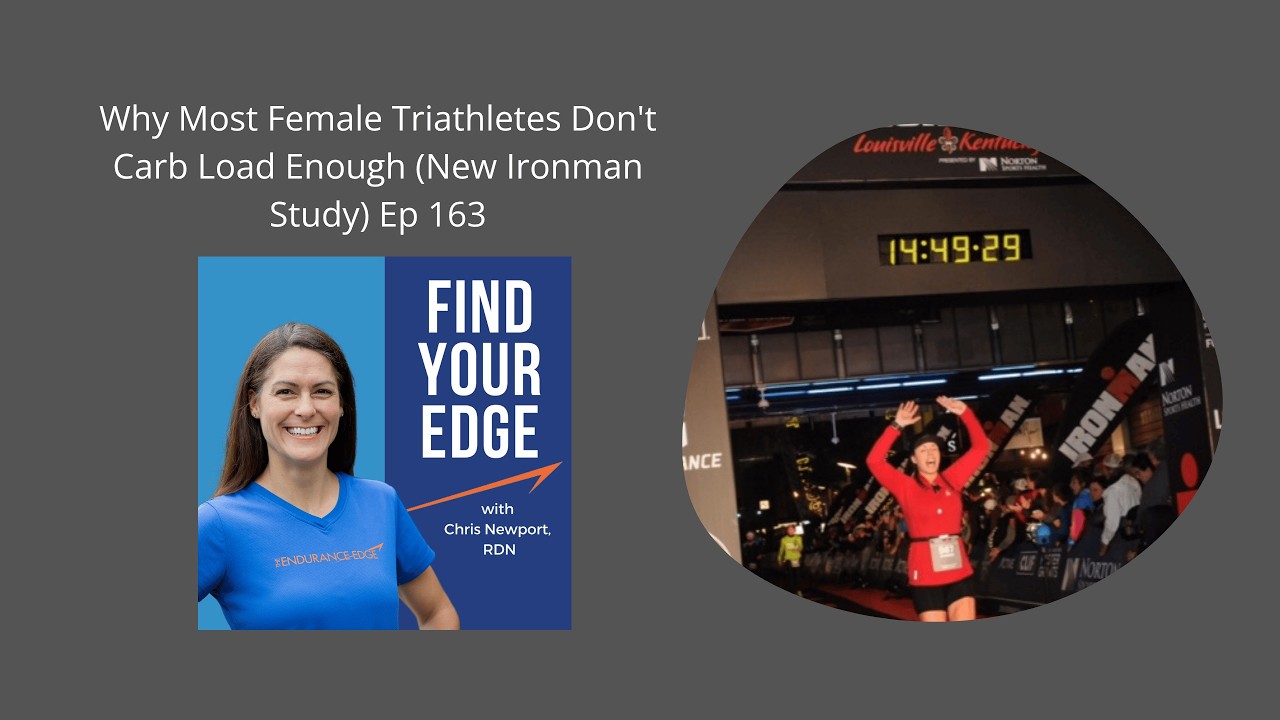
In this episode of the Find Your Edge podcast, Coach Chris Newport reviews a 2024 European Journal of Sports Science study that examined pre‑race nutrition behaviors of 27 female Ironman World Championship athletes. The study found that only about a quarter of the athletes met the recommended carbohydrate‑loading target of 8–12 g·kg⁻¹ body weight in the 1–3 days before the race, and those who did tend to finish faster. Newport uses the study as a springboard to explain why carbohydrate loading must be practiced well before race week, describing the physiological need to train the gut, the standard carb‑loading calculations, and the impact of psychological, behavioral, and logistical factors on execution. He contrasts “competitor” athletes who follow structured, data‑driven plans with “completer” athletes who take a more intuitive approach, and he highlights how emotional state, travel, health conditions (e.g., gout, diabetes), and personal gut tolerance affect nutrition strategy. Practical recommendations include starting gut‑training three months before a long‑duration event, gradually increasing carbohydrate intake, testing foods, drinks, and gels in training, and integrating data into the Hydration Edge app and Endurance Edge services. Newport also discusses real‑world logistics such as packing, TSA encounters, and on‑bike handling, emphasizing that nutrition is as much a behavioral and logistical challenge as a caloric one. The episode ends with a call to athletes to log nutrition execution, experiment with personal carb‑loading protocols, and seek professional support if needed.
Chapters
All right. Hello and welcome back to the Find Your Edge podcast. I am your host, Coach Chris Newport, and today we are talking about one of my favorite topics, carbs, y'all. So if you've ever gotten to race week, and trust me, I get this call all the time, and suddenly realized that you haven't quite figured out your nutrition, this is the panic call. My race is this weekend. What do I do and how should I eat differently? Well, the short answer is that, is that you should have been thinking about that 2, 3, 4+ months prior when we needed to be training your gut while you are training your body. And the reason why I'm bringing this up is because there is an interesting article that I found. And if you are watching this on YouTube, I have it pulled up. It's open access. The article is from the European Journal of Sports Science. From intention to execution, pre-race nutrition behaviors influences and performance outcomes in female endurance athletes at the Ironman World Championships. So how cool is this that this specifically focused on female endurance athletes at the Ironman World Championship? And how well did they actually? Execute their nutrition plan. So I thought this was an interesting opportunity to use this research as reminders for you to be able to make sure that you're training your gut, that you're doing all the things that you need to do as you lead into race week. So there is never a question— there's never a question of what should I eat the week of race day or the week leading up to race day, because the answer is you should have been practicing that already, and it should be like a total Total no-brainer. This is not like something totally different. And I'll give you a quick example. I had a woman who did not ever use any sort of carbohydrate loading, and we're going to talk about that quite a bit here today. And she decided that she would do it the week of her Ironman, and she had not practiced it at all. Her gut was not trained at all. And let me just say that it didn't go well. So again, let this be your reminder that as you train your body, you have to train your gut. It is a literal organ that is meant to deliver energy to those working muscles. So let's kind of dig into this a little bit as we're reading through the abstract. So there were 27 female triathletes, and as you know, this is a big deal. in Ironman World Championships. So they did some questionnaires, they did some 48-hour food diaries, they did some interviews both before and after the race. So their diet plan was analyzed for how many calories they did, what were their macronutrients, and then also looking at what were some of the things that were driving their behavior. So interestingly, only 26% of 6 out of the 23 athletes that actually had the quantitative data Of those athletes achieved carbohydrate loading guidelines. So let me back up a little bit here. Carb loading guidelines currently are such that you consume 8 to 12 grams of carbohydrate per kilogram of body weight, uh, roughly 1 to 3 days out from your race day. So I've got some, uh, various modified protocols. It totally depends on your gut. Again, we're gonna get into that, but these are just the general guidelines. And then they wanted to see how many people actually adhered to those guidelines and then maybe knew those guidelines and did they actually execute it and what were some of their ideas and intentions surrounding that. So super interesting. So an overall average intake of a little bit over 6 grams per kg of their body mass. So do a quick little experiment here. Take your body weight. If you know it in pounds, do that and divide it by 2.2. So that gives you how many kilograms you are. If you're in Europe, God bless you. I wish we were on the metric system, but that's a whole nother story. Anyhow, then let's meet in the middle. So the number is 8 to 12 grams per kg of your body mass of consumed carbohydrates in at least, uh, the day or 2 days leading up to race day. Or potentially even 3 days. There's, there's some variation that you can adjust within that. And again, this has to be practiced, but if you take your body weight in kilograms, so take your body weight in pounds divided by 2.2, there's your kilograms, and then multiply it easily by 10. That's how many grams of carbohydrates you would need to truly carb load according to these guidelines. Then take that number, multiply it by 4. That's how many calories you would be eating in just carbohydrates. So this goes into some of these like misconceptions or misperceptions when it's regarding carbohydrates, especially relating to female athletes. And they get, they get deeper into that in this research article. But interestingly, higher carbohydrate intake was correlated with faster finish times. Shocker, my friends. Um, sometimes fiber had a higher association with GI symptom severity. Again, everybody's different, everybody's guts are different. And the things that oftentimes tweaked or adjusted some of these dietary plans were influenced by, you know, what's going on with your travel, what's going on with— I love how they say emotional regulation. And if only Carly were here to talk about that from a sports psychology perspective. So such interesting things that they looked at the psychological, the behavioral, and the practical factors that influence the decisions of these particular female athletes doing the Ironman World Championship. This was back in 2024, and finding that their carbohydrate loading was frequently below the recommended level. And talk about the event that you would need carbs for— this is it, you guys. So women who consumed more tended to have faster finish times. But I also want you to remember that race nutrition isn't always identical to your everyday healthy eating strategy. So there can absolutely be some adjustments that you can take. So what I find particularly interesting about this, again, is the behavior side. So athletes who identified as competitive tended to be more structured. They followed the rules. They were proactive in their nutrition planning. And athletes who wanted to, they were called, quote unquote, completers, There were competitors and completers. So the athletes who identified as a completer tended to take a more intuitive, flexible approach. And in this article, there are some really— and let me see if I can scroll down a little bit for you— there are some fascinating quotes that they included in here. And as I'm doing this, I'm just kind of doing a quick overview. The participants, again, 27 female athletes. The age ranges, there 4 athletes in the 18 to 29-year-old age group. There were 7 in both the 40 to 49 and the 50 to 59, 3 in the 60 plus, and 6 in the 30 to 39. Their training volume, it totally varied. 2 people out of that group trained 6 to 9 hours a week. 9 trained 9 to 12 hours. 6 trained 12 to 15, and 10 trained over 15 hours. So a big variation there. Going through their previous interviews, various things that aligned with their intention and execution as I'm scrolling down here. But what I want you guys to see are some of the things that people said. So for example, I'm reading this one from mindset. So the mindset, as it says here, the mindset influenced how athletes prepared for competition. Competitors sought control. and precision. And in contrast, those focusing on completing the race, they took a more flexible, intuitive approach shaped by their perception that a rigid plan is less necessary if speed and performance are not primary concerns. Isn't that fascinating? Of course, I'm probably the only one who's like jumping out of my chair right now. So let me give you an example of a competitor and what she said in her interview. She said, why would you not want to set yourself up for the most success, or at least For a good experience. I certainly do what I can to at least avoid any big mistakes. It's about doing your research, but also trial and error. I want to give this woman a hug because that, I would say, is probably one of my main philosophies. Set yourself up for success, you guys. Even if you are just a computer, set yourself up. It doesn't mean that you have to necessarily go down a massive rabbit hole, but, um, you know, shameless plug, you could even just do a 30-minute session with me and you're gonna get a heck of a lot done and have a Rather than doing excessive trial and error, but you still have to practice. You still have to practice your gut training. On the other side of things, here's something else that a completer said. She said, I'm never gonna be the person who counts or calculates these things. I don't need to at my ability. I'm just here to get around. And somebody else said, I'm not here to break records or win anything, so I don't need to be super calculated or do any fancy preparation. I'm not fast, you know, I don't need all that sugar. How interesting is that? So then you add in race nerves. So that brings a whole nother layer of things. So for example, if you are nervous, think back to a time when you're nervous. It might be pre-race, it might be another time. Do you feel hungry or do you not feel hungry? Right? So maybe you don't feel hungry, or maybe you could be more concerned about eating more carbohydrate than usual. Again, Sometimes carbs are associated with challenges. Now, from a health and genetics standpoint, I'm always looking at how many carbs are for the right athlete in the context of their health and genetics. So for example, if you're someone perhaps who has gout or has an issue with uric acid, you're not gonna do great with a lot of high fructose products. For your fueling, which is interesting because fructose is what allows an athlete to consume much larger amounts of carbohydrates, especially for race day. So that's a specific issue within the context of that athlete. And then how do we execute a race strategy or a plan that's not going to increase uric acid levels? And then you might have somebody who their A1C numbers. are a little higher than they'd like, or maybe somebody with PMOS who is more challenged balancing their blood sugars at other times of the day, then we're going to start looking at how can we optimize fueling you because we know that more carbohydrates are going to make you go faster. How can we get the right type of carbohydrates that are going to best serve you? And you could be— this could be a type 1 diabetic, this could be somebody with PMOS, How are we gonna get the right types of sugar in the context of balancing your blood sugar for overall health? And then of course, also for performance. So all that to say is that what seems simple can become a little bit more nuanced. And for some athletes, especially those who've spent years thinking about food in terms of body composition or eating perfectly, oh my gosh, don't get me started on that. But carbohydrates often tend to be associated with increasing weight gain or feeling more bloated or having more issues with GI distress. So that's where I find that this study was so interesting to actually look at that. So that goes into, you gotta train your gut. So as a reminder, if you have a long distance race coming up, this can be I really think of in, from a carb loading perspective, this is gonna be beneficial for like a 3+ hour race. Can you still do it for shorter distance? Absolutely. And I would also encourage you to do, uh, your own N=1 experiment of executing a pre-race high carb loading strategy, if that aligns with your health and your performance. And then doing, let's say, a sprint triathlon, let's say an Olympic distance triathlon, a half marathon, a 10K. And time yourself and then do it again. And again, same thing, time yourself, assuming that the weather is relatively similar. So you might have to go on a treadmill so that you can control for your temperature. But see, see if it works, you guys. That is practice. That is literally training your gut. That's what we're aiming for here. So experimenting with foods, drinks, gels, and combinations that you're actually going to use on race day. Where I like to narrow this whole process down is what we do in our sweat testing process. And now we have our Hydration Edge app that is out, and we are going to start layering in fueling into that too. So stay tuned, open the app, start using it, because the amount of hydration and the amount of electrolytes that you need— the only way that you're going to get close is by tracking your data, understanding your trends, That way, the app can tell you this is exactly what you need. So fueling and hydration are slightly different processes, but they serve the overall purpose of improving performance. So carbs generally need to stay relatively neutral or the same during race day, but overall fluid volume and electrolyte volume needs to vary. So you have to practice what is your sweat rate, what are the foods, drinks, and gels and combinations that you can actually tolerate, and then you need to start practicing. So don't jump straight into an intake that you've never done before. Also bring it up gradually. And if you're somebody who— I hear this all the time, people are like, oh yeah, my gut can tolerate anything. You're probably somebody who can just, just try things and just go for it. If you're somebody who's a little bit more sensitive, then you're going to need to take a more progressive stair-step approach. And of course, underfueling is an issue. So your daily nutrition, making sure that you're keeping an eye on that. Underfueling is very common, especially in female athletes. So being easy on yourself and gradually increasing things that way you physically and psychologically can adapt. Because again, that's exactly what this is showing. We can tell you all day long that carb loading needs to be 8 to 12 grams of carbohydrates per kg of body weight. In the couple of days leading up to the race, does that mean you're actually going to execute it? We have to practice it. And if you are undereating in general, then maybe we start at 3 grams per kg. Maybe we start at 4. Maybe we start at 5. Like, where can we get as a nice balance to gradually increase that? So this is an opportunity. And again, your training blocks are such a great opportunity to train your gut. Consistency is key too. So I was just on a call with some of our athletes. I can down a carbs fuel, no problem. That is 50 grams of carbs all at once, no issues. Um, this athlete happened to be male and, uh, probably had 50 or 60 pounds on me and couldn't do that. So That's just the individual things that we need to find out. So if a particular process or product causes GI distress, we want to find it out in training before you find it out in races. So again, practice, practice, practice. As you'll see in this article, logistics was also a massive thing because I can tell you all day long until I'm blue in the face that I want you to do X number of ounces of Fluid or hydration or fueling or whatever. But if you cannot physically carry it on your bike, if you cannot physically put it on your person, or you can't have the opportunity, then we need to get creative. So you still gotta think through the logistics. You gotta practice the strategy and actually see if you can execute it on your body. Like, is is there? I was just talking to an athlete the other day. Who won't wear a pack. It just makes him too hot, it's too uncomfortable, it moves around on him too much. So he's gonna have to rely on what's actually on his bike and knowing the max capacity, and then how can he refill at aid stations. So same kind of principle goes with your fluid and hydration as it goes to your food. So let me reiterate, when should you actually start this gut training process? I like for this to get to start as soon as you're getting into workouts that are 90 minutes or more. So that might be 3 months before an event, that might be 2 months before an event, that might be 8 months before an event, might be longer than that. So that's when you need to start practicing your gut training and making sure that you're Managing your sweat rate, making sure that you're incorporating the products that you're going to have on race day. You may want to do a little research into the race products. If you're somebody who cannot carry everything with you, you're going to have to rely a little bit on the race. So there's a lot of moving pieces here, but at the end of the day, the final week should be repeating the weeks you've had leading up to training. So if you are specifically going to use a carb loading strategy like this one in this article describes, you need to do that in your training. So this is a great way— if you have a 3-hour run, if you have a 6-hour bike ride, if you have a 4-hour ruck, whatever it is, that is where you have to practice Doing your carb loading in the 1 to 2 days leading— you don't necessarily have to do both, but usually I like for it to be about 2 days, 2 to 3 days prior, eating basically all carbohydrates. And then the next day or 2 should be super, super, super light training, if anything, because we don't want to rip through any of that additional glycogen. And then you actually do your event. So you need to practice Is it going to be ideal to do 2 days out? Is it going to be ideal to do 1 day out? Because usually most people associate carb loading with just eating a bunch of pasta the night before a race. Can you do that? Sure, absolutely. But again, you've got to practice it. If you're going to do a big bowl of pasta the night before a long run, do that in training. And a little reminder, especially based on the quotes that I was just giving you, you don't have to try to win your age group. You don't have to try to win the entire event to get a benefit from this. Again, if why not give yourself the best experience possible? Just like that one athlete said. So your nutrition strategy, whether you just are trying to finish or whether you are trying to win, then it is super important to practice, practice, practice. Practice your nutrition strategy both in logistics. How are you? Oh, another thing I just thought of. Is how are you actually able to get your bottle off of your bike, for example, or actually like getting your nutrition things out of the holsters, or you know working on balance, working on coordination. Are you able to actually do a water bottle handoff? So all of these things, like you got to have the skill, you got to have the strategy, you got to make sure your logistics are planned out. Which reminds me when I went to Worlds in Italy, I had all of my tart cherry juice and I have all of my. Carbs fuel in my bag that was on my person because I wasn't going to check it. I was too worried that I would lose it and then not be able to replace it. When I went through American TSA, they said they stopped me and they went through all my stuff. And of course, they were like, "What are these?" And I told them like they're sugar or juice, and I had them in bags. And then I there I had them all in the same like. Plastic bag. And their suggestion was, hey, that's fine if you want to do that, but next time separate them, like put them in smaller baggies and then put one bag on the right side of your bag and put the other bag on the other side of the bag. And then we get to France and go through the whole situation again, and they opened up my bag and spread everything out and they said, we suggest that you put everything all in the same bag. So So I don't freaking know, y'all, but they made it there. The tart cherry juices made it there. The carbs feel made it there. So sometimes there are things that are unplanned. You drop a gel, you drop a bottle. So having kind of thought through some of those things, and sometimes you just got to think on the fly, right? Sometimes you just got to think of the fly. I like to encourage people to be kind of like a Boy Scout or a Girl Scout or whatever you associate with The degree of preparedness and having a little bit of a backup plan. So at the end of the day, my biggest takeaway for this and to you is that race day nutrition isn't just a calorie problem. It can be a behavioral, psychological, and logistical issue. So all of these things is actually giving me a ton of ideas of what I can do in that Hydration Edge app. To give you guys additional layers of logistical recommendations, psychological reminders, and behavioral reminders as well. So coming soon, be sure to download the app. But you have to know what your body needs. You have to practice delivering it, actually getting it in your body, and make sure your plan still works when, you know, things get a little squirrely, things get a little complicated. So here's my challenge for your next long training session. Don't just look at your pace, your power, or your heart rate. Ask yourself, did I execute my nutrition plan? What worked? What didn't? And what can you make it easier for next time? So be sure to take notes. Again, this is something that you can do in the Hydration Edge app, but you can also log it in your TrainingPeaks or wherever it is that you're keeping track of things, because the goal is to arrive at your starting line with as few unanswered questions, certainly about your nutrition, but also your training. And more confidence in the work that you've already done and practice. And if you need help understanding your sweat rate, your metabolic data, your fueling needs, how to put together a fueling strategy that works for your body, that is exactly what we do here at The Endurance Edge. Super excited to help you. So go out there, be confident on race week. You got this. I believe in you guys and find your edge. Thanks for listening.
More from Chris



Afraid of Open Water Swimming? How to Go From Panic to Confident with Author Hilary Topper

Carb Loading for Female Endurance Athletes: What New Ironman Research Reveals Ep 163

What Are We Training For? Performance, Longevity & Finding Joy in the Process Ep 162


When You Can't Race the Same Way, Find Another Way: Kris Bonot's Triathlon Story Ep 160