Sue Dengate led a two-week additive-free experiment at an Australian primary school, removing synthetic colours, preservatives, and flavours from meals. Detentions dropped from six per week to zero, children slept better, and behavioural problems like tantrums and head-banging stopped. A UK study linked food additives to hyperactivity in kids.
Chapters
Is that your drink? Whose drink is that? Okay, can I have a look at the drink?
And cheese involved as well.
Right, so that's got a colour in it, colour 110. That's an artificial colour.
Food detective and nutrition author Sue Dengate thinks she can find the answer to most kids' problems here in their lunchboxes. You might need to be a food scientist to decode the information, but these children are walking test tubes. It's really bad. In the past few decades, hundreds of additives have crept into their added to food. Colours, flavours, preservatives. At least 60 of them cause problems for some kids. But which additives affect which kids? Food companies are leaving parents to find out that for themselves, and the results have been disastrous.
The authorities have really dropped the ball when it comes to protecting our children.
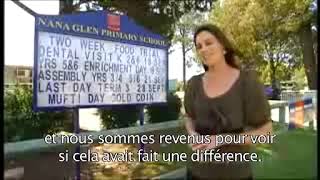
Over the next 2 weeks, these children from Nana Glen Primary School in New South Wales will be cutting the additives from their food. They have a list of nasties to avoid, and for any 6-year-old, it's quite a mouthful. Sorbates, benzoates, nitrates, glutamates— sometimes they're words, sometimes numbers, always in the fine print and hard to find unless you know what to look for. Their parents have been armed with the same information, and the canteen will only serve food with natural ingredients. What food aren't you going to eat now?
I can't eat colours, preservatives, and flavours.
The effects of a food intolerance can be subtle. The child who fidgets, the child who can't concentrate, The child who has no friends. They're pretty good in the classroom, but they really seem to be playing up now.
Is it my imagination, or are they louder since they've been eating lunch? And this is what you expect, and I think next time we're here, you'll see they're quieter and calmer.
It's been 2 weeks since the children of Nana Glen went additive-free. We've come back to see if it's actually made any difference at all.
OK, you guys, hurry up.
First stop, the principal's office. Laurie Renschl had to ask teachers, students, and parents to cooperate, and he was stunned by the result.
Just as an example, this year we've averaged 6 students on detention per week. Over this last week, we haven't had one student on detention. That speaks volumes for itself.
I can see a—
So, on to the classrooms to see the results firsthand. Kindergarten teacher Jenny Wiseman.
They listen to instruction. They're not so impulsive. I think that's probably the biggest change that I've seen, that they think before they do things, think before they act.
Okay, we're gonna put that on the stove.
Yep.
Parents also couldn't believe the most seemingly benign foods could be having such a detrimental effect on their child's behaviour. Helen Barrett found out her son Liam reacted to additive 160B, found in vanilla ice cream and yoghurt. Removing it from his diet changed his life.
His behaviour improved, the tantrums stopped, the headbanging stopped, and basically we've gone from strength to strength from there. It's basically changed our life because now I don't spend my whole day with a child that says no every time I ask him to do something. I have a child that I enjoy being with, and he's just a beautiful, unique creature.
Most tellingly is what the kids say themselves.
I was getting more friends because I wasn't being so mean as I used to be. I've been sleeping much better because before I used to like When my mum and dad talk to me, I'd always take a while to go to sleep, but now when my mum and dad puts me to bed, I go straight to sleep. People used to leave me out because I used to get really angry, and now they like play with me and all that.
Behaviour isn't the only thing affected. There are physical symptoms as well. There were less incidences of bedwetting, headaches, stomachaches, and skin rashes. In fact, 60% of children who appeared to have nothing wrong with them are better behaved on an additive-free diet. We've had nothing but positive feedback. Are you surprised?
You might remember, "I told you so." We've seen this so many times before. You take a lovely school with wonderful kids and then 2 weeks later everyone is talking about the huge changes they've seen.
A study recently published in the UK proved the long-suspected link between food additives and hyperactivity. The food authorities there have already started removing harmful colours from food. How long will Australians have to wait for similar action to be taken here?
I would like to see this program in every school, but more than that, I would like to see these nasty additives taken out of food because it's too hard for parents at the moment to give their kids food that keeps them healthy and happy and learning well.