How A UK Plumbing Apprentice Brought Clean Water To A Nepal Village w/ Daisy Turner
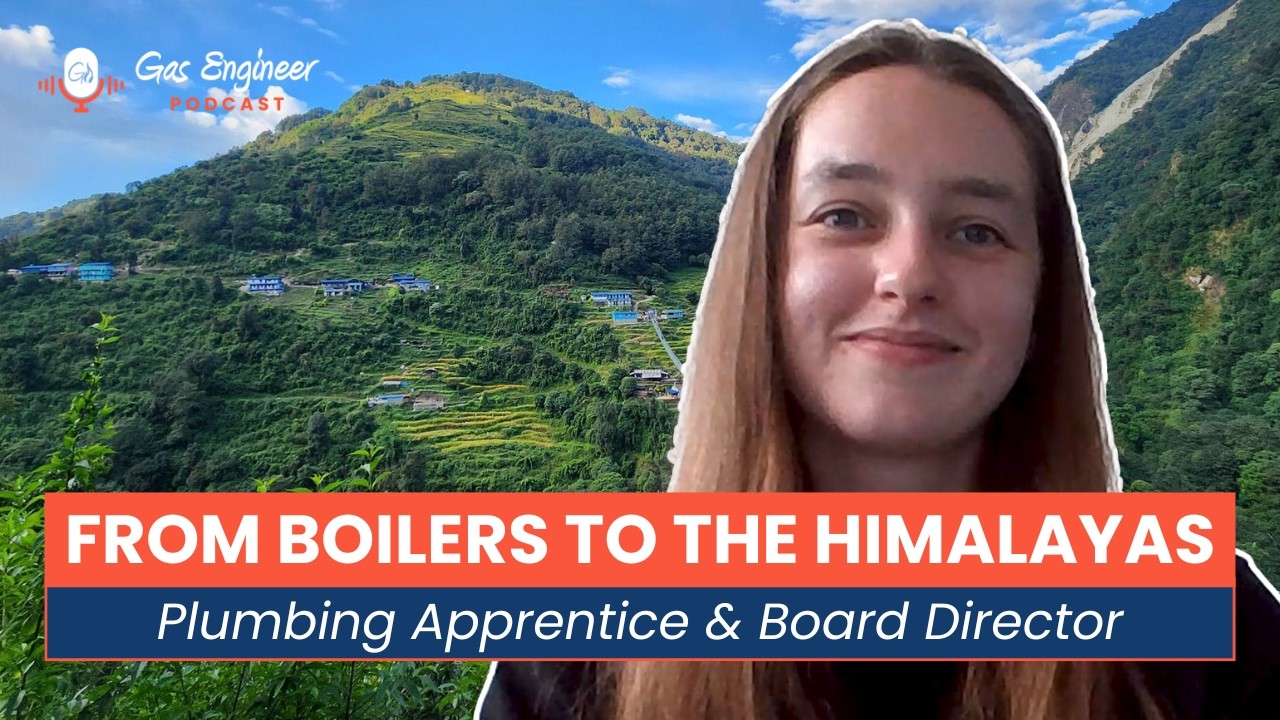
Daisy Turner, a UK plumbing apprentice, helped install a water system in the remote Nepali village of Bukit Janda through the Professional Plumbing Development Scheme. The project ran a 2 km pipeline with a 5,000-liter break tank to serve ten households. Clean water reduced illness and improved school attendance, while the experience showed her how plumbing basics work anywhere.
Chapters
In Nepal, their plumbing training is 2 weeks. Our plumbing training is like 2 years. So their plumbing knowledge is quite low. They just learn on the job.
What has it kind of done for you personally doing these kind of things?
Our skills are so transferable because although we was halfway across the world, we didn't speak the same language and someone said, "Run water," and we said, "Fine," and we did the plumbing. We was at home because we was plumbing. The principles are the same. Water runs downhill. It's just executing that. If you're willing to put yourself out there, willing to put in the time and the effort, then there's So much more to sitting in an airing cupboard every day.
It's the Gas Engineer Podcast. I'm your host Tulloch Priest, and today I'm back with Daisy Turner for a very different kind of a conversation. Welcome back.
Hiya.
Most engineers use their skills to fix boilers and leaks. Daisy used hers to bring clean drinking water to a remote village in Nepal. Today we're talking about that experience, and we're also talking about why engineers should be thinking beyond their day jobs and the benefits that can come with that. As always, if you enjoy these conversations, then please subscribe and follow us on whatever podcast platform you're tuned into. And a sentence or two, why should people care about this conversation?
I think it's just making people aware that the opportunities are out there. If you're willing to put yourself out there, willing to put in the time and the effort, then there's so much more to sitting in an airing cupboard every day.
How did you hear about it or how did you get started and what kind of seeded the idea to go to Nepal?
So I'm part of the Professional Plumbing Development Scheme, which is an initiative from the CIPHE and the Worshipful Company of Plumbers. They sort of saw a gap that young engineers weren't being supported within the industry, so they introduced this group where they put on CPD sessions. So we have 2 meetings a month, one is a technical session. So they, the CIPHE in particular, they have a lot of industry contacts So they'll get different manufacturers in for talks. So we've had ones with Baxi, we've had ones with software, we've had ones that are sort of like technical building off of our college. So in college you learn heat loss calculations, but you don't really have the time to sort of practice real life scenarios. So we've had meetings on sort of practicing, and then they send us away with homework almost, sort of to practice the workings out of it and come back and see if everyone's got the same answers and things like that. So I've been part of that since they started it. So they're now on their third cohort, but I was in the first cohort of people.
How did you join? Because you kind of— it feels like you kind of missed this step, or how did you hear about it initially?
So initially, like I said, I was in the first cohort. So they sort of invited people to join who they see value in. So I'd met the CIPE through the competitions that I did, but the Worshipful Company of Plumbers, I won their bursary scheme a few years prior to them starting the PPTS scheme. So they sort of had an awareness of who I was and they invited me to sort of be part of it. I think we started with 10 of us and a couple of people we sort of lost along the way because it just didn't really fit everyone's lifestyles. It is, it is a relatively big commitment. It's 2— it is and it isn't— it's 2 meetings a month. So a technical session, sort of like a catch-up session, because we found that we'd go on the technical session, we'd be like, oh, how's everyone doing? What sort of jobs are we doing? And we didn't have time to do the both. All in one session, so we started having two sessions a month so that we could have sort of like a chatty catch-up, see what everyone's up to, if anyone wants any advice. So with the Worshipful Company in particular, they have a lot of members that are from across the board, whether they're lawyers, whether they're business coaches, whether they are actual plumbers. There's all different people, so you can tap into that resource, which was— it seemed that college sort of failed to teach you how to run a business and how to run the books and things like that. So they see that gap and they wanted to sort of create a scheme where people could access that help.
Okay, and how did the idea of going to Nepal sort of come up?
So the Worshipful Company of Plumbers have a Plumbers' Charity. The Plumbers' Charity supports the Dolma Foundation out in Nepal. The Dolma Foundation wanted to run a clean water system into a village. So in Nepal, their plumbing training is 2 weeks. Our plumbing training is like 2 years, so my actual qualification was 4 years, but that included my plumbing and my gas. But the actual— if you was just to do a plumbing qualification, it's about 2 years. But out there they literally have 2 weeks, so their plumbing knowledge is quite low, which— well, their plumbing knowledge from college is quite low, but they do a lot of— they just learn on the job. It's very— the landscape is very diverse, so they probably can't really copy and paste systems we can in the UK, because we could just go and fit the same system 100 times and there'd be no problems. But trying to replicate that in Nepal, everything's so different. So most of their learning is done on site, but they'd done a project in the past and it didn't quite work out. So they had contractors, Splash Nepal, who run the job, but Dolma Foundation sort of like— it was their idea, um, and they did all the funding and the fundraising for it. But where the Worshipful Company have the Plumbers Charity, and that was involved with Dolma Foundation, it was sort of, well, is there any chance any any of the UK plumbers would like to come out and share their knowledge, work alongside the Nepalese. So like I say, there was contractors, there was 3 plumbers from Splash Nepal, and then we also worked alongside a lot of the villagers. They all got involved, which was really nice to see because they wanted to know how the system works. They didn't just sort of like sit back, let you install it, and then hope that it works. They wanted to know how it works, why it works, what they need to do to maintain it. So they was really interested, which is really cool.
Hi, Producer Alex here, wondering if you knew that you aren't subscribed to the channel. Well, specifically, 93% of you are not subscribed, and we really appreciate you tuning in right now, but you're missing out on even more interesting content. You're already this far into the episode, so why not subscribe to the Gas Engineers Software YouTube channel? Because showing your support genuinely makes a difference. It's free, takes a second to click, and helps us continue to make the content that you want to listen to. Speaking of, let's get back to it.
And what was the village like condition-wise, and can you give us like a before and after, and maybe like a little bit of insight to what actually you did system-wise?
So it was a very remote village. So we actually flew into Kathmandu, the capital, and to get to Bukajunda, which is where we was doing the water project, it was a 5-hour drive. The roads aren't really made. Some of them are about to halfway made roads, and then it's just rocky on the edge of a mountain. If you go around the corner too fast, you'd end up off the edge of a mountain. But I call them mountains because they're mad. The landscape is incredible, but they're just like, oh, it's just a hill because they've got Everest literally on their doorstep. That's a mountain. So where they are, it's just a hill, but to us it's a mountain. But it was a 5-hour drive. From the capital into Bukit Janda. The before was basically a hosepipe. So the hosepipe run up to the waterfall, dipped into the waterfall at the top, and then on the way down, because it went through a farm, I don't know if it was whether the cows— they had cows and sheep— so it was whether they've sort of damaged the pipe or any of the farming equipment's damaged the pipe, or just that it's old, it's exposed to the elements. They have— it's right in the Himalayas, so they have monsoon season where it literally just rained constantly for a month, and then like I say, because it was so steep, the landscape, they have landslides as well. So where this hosepipe run through all these fields, there was so many holes in it and it was sort of splattering everywhere because there wasn't enough pressure of water. And then once there was enough pressure of water, it was then sort of through the holes it was sucking in all the debris. So by the time you was in the village right down the bottom, the water wasn't very clean at all and it wasn't very reliable. As you walked alongside the old system, it was all tied together with an old t-shirt, a plastic bag, just what they had. They're very resourceful. They are. But it's, it's not ideal.
How long is the run, like, from the waterfall to the village?
So we ran, I think it was about 2 kilometres of pipework.
Okay, so this is a sizeable distance. This is not like a garden hose plugged together.
Yeah. So it was quite impressive what they'd managed with so little beforehand. So there was an intake tank, but that was damaged. Again, I think a landslide sort of hit it and damaged it on its way. So we built a new intake tank at the top. So there was a piece of pipe that was in the waterfall and then that run to the intake tank. We then had another 3 outlets on the other side with an overflow and then one down to our next tank. So it actually went— if it had gone straight from the intake tank to the village, you'd have ended up with 15 bar of pressure. So we had to put a break tank in. So that was a 5,000-liter HDPE tank. So we run all of the pipework to that. So a lot of it, where we could, we sort of dug it into the ground because, like I say, with the monsoon season, the weather's so extreme that if you run the pipe surface or sort of like within the trees, it was getting damaged. So where possible, we did try to dig it into the ground, but like the landscape was so steep, you had to be care— some bits we just couldn't access. So we did just sort of have to throw the pipe in a tree and try and catch it the other side. But to be fair, the villagers were very, very helpful with that because it was their home. They'd run up the mountain in 2 seconds and we'd be like, hang on a minute, wait for us. Let me catch up.
Did you have to deal with freezing at all? Was it sort of above the snow?
Not while we was there, but—
But like in the system design, was it designed to be frozen or the village wasn't that high up.
It doesn't really freeze. They said it doesn't really get that cold. It does get cold, but it doesn't get freezing. Um, the actual pipe and stuff, it is all like protect— the pipe is protected against freezing, so it is quite durable and quite resistant. But the actual water inside, everything's open as well, so nothing's sealed. It's all got vents, it's got overflows, so everything would constantly be running.
And what size pipe was it?
So it varied throughout the system. So the first bit was 50mm, and then it went from the intake tank to the brake tank, which was 40mm. And then it carried on from the brake tank down to the village, and that was in 32mm.
What's the reason for the changing of the sizes?
It was just the flow rate. So the initial piece of pipe that was in the waterfall— so we sort of built like a little rock pool so that the sediment didn't get into too much, but the water could still flow. So that was 50mm from the waterfall to the intake tank, just so that there was that volume of water coming through. And then from the intake tank to the brake tank, that was 40mm, because it was— it's plenty size-wise to get the amount, the flow rate of water through. But if you'd have gone any bigger, it wouldn't have been able to cope at the brake tank. And if you'd have gone any smaller, it would have been a lot slower filling up. So that's sort of why that was sized there. And then also to do with the pressure, so between the intake tank and the brake tank, by the time it got to the brake tank, it was 12 bar of pressure because it had gone that drop, change in altitude. It's then got 12 bar, which is why you needed the brake tank to then reduce it down to 3 bar by the time it's then at the village. So it was 32 mil from the brake tank to the village, and then we Initially, we was only going to put in one stop tap, but because everyone worked so well together and the availability of materials, we was able to put in 9 stop taps. So it's a village of 60 people. I think it was 10 homes, so like 10 properties. So right on the side of the road there was a shop, and then their house was sort of the same building, and then you sort of went down the side of the shop property. 'cause then they had all that, like their, what's the word, where they grew all their crops and things. And they had some chickens and so they sort of had all of their land and then you sort of went down the side and down some steps and there was a few houses behind that. So there was 10 houses in the village and we managed to put in 9 stop taps. So it's almost one per house, but not quite.
Not quite, okay. And how does it kind of, like this is quite different from UK plumbing. You're kind of seeing quite a— like in this case, it must be quite a vast difference for the villagers.
So it is different in terms of the materials. So we used HDPE, whereas at home we just use polyethylene pipe. They use the slightly different, but it is to do with the conditions and sort of what they can produce. So in their colleges, we visited some of the Nepalese colleges while we was out there, and their jointing methods is their butt jointing, so they melt them together. But when we was in the jungle, it was a national park, so we couldn't have the fires and the equipment to melt the pipe together. So where in the UK we have push-fit fittings, they didn't really have that because usually they'd be butt-jointing it all together. But like I say, because it was a national park, they couldn't have the fires and things like that. They couldn't have like the machinery. We then ended up having to thread the plastic pipe, put the PTFE on it, and put like a galvanized steel fitting onto it, which isn't ideal, swapping the materials. So then when we were trying to get the fittings in at strange angles, it just ended up pulling all the thread off because it wasn't quite the right materials to be using. But it was interesting, it made us think, definitely, but it wasn't quite the right one. So we've said in future, if there's more projects, you need to maybe think further ahead, sort of what jointing methods suit that project. Because they've done projects in the past that weren't in the national park and they could use whatever they wanted, but just because the location of it, they couldn't use the usual tools, but even so, their tools were very, very limited. They had— when we got there, they only had sort of like one spade, one pair of Stilsons. So we were sort of like trying to dig in the trenches and there's 9 of us up there and one spade, and we're like, someone hasn't relayed this information.
Yeah, so okay, yeah, you kind of make assumptions of what's there. Must be quite nice to see the, like, the before and after for the villagers, you know, to have clean water. Important.
Yeah, I mean, it's almost life-changing because that clean water now means that they're not as ill as often. We've since heard that the children are going to school in cleaner clothes and it makes them more confident. Their attendance is going to be better, they're going to do better education-wise, they're going to get higher grades. So then that increases their opportunities in the future. Just running clean— I say just running clean water, it's quite a big feat, but Running clean water is absolutely life-changing, especially for the children, because they were the ones— it was school children and elderly people that struggled the most with ill health with dirty water. Sort of adults didn't do too bad, if that makes sense, with the dirty water, but it was the children and the elderly that it affected the most.
Are you fed up with drowning in a pile of paperwork that comes with running your heating and plumbing business? Gas Engineers Software is an easy-to-use, all-in-one job management system made especially for UK heating and plumbing companies. From handling customer details to building quotes, issuing certificates, and sending invoices, Gas Engineer Software will help you save time, eliminate paperwork, and make running your business easy. Start a free trial by clicking in the link in the bio. How does it make you kind of feel about your, like, having that experience? And then, you know, how does it make you feel about your day-to-day working in the UK? Does it change how you think about what you do?
You take it for granted because we call up the water board and say, can you come and connect water to this property? And they'll come out and within 10 minutes they've turned the water on. And to go out there, they don't have the clean water, they don't have the filter— the filtration system. The only thing, the biggest thing that struck me was you sort of, you got to this village and the water was running constantly and sort of looking around to turn a tap off because we're told that all the water is treated and it's a finite resource to an extent that it needs to be turned off and preserved, but out there the water just flows constantly. So we run in clean water and that's a huge step, but it's not filtered, it's not treated at all. But if you was to treat it further up the pipeline, it would be a waste because they use it to— the roads are really dusty, they'll hose off the roads so that it reduces the dust, they water the crops, that they just leave it running because they're used to leaving it running. So if you was to filter it higher up, it would almost be a waste and the filters would run out so quickly. So in future, if we was to go back there or future projects, we'd have to have individual filters at each property so that they could filter the water that they want to drink. But realistically, they've spent years boiling it to make it safe. They're so used to that, they'll probably still do that. So that would kill off all the bacterias, but it wouldn't necessarily take out all the debris, which is why they need the filter.
But with the, with the tanks sort of halfway down, I'm guessing that cuts out quite a lot of the debris as well.
Um, so right at the top there is a filter that sort of— it's just mesh, so it sort of blocks leaves and small debris from coming into the system. So because otherwise it would block up the pipes. And then you get to sort of like the break tank, and even as we was filling it up, there was a few little bits, but it all just sort of floated. So because the actual outlet of the tank was at the bottom, it tended to float its way out of the overflow. So the worst of it does sort of work its way out anyway. If any did come through the system installed a dead leg right at the end of the run in the village so that you could flush the system out, and we sort of taught them how to do it and why they're doing it. And we spoke to some of the Nepalese team a couple of weeks ago now, and they said that they've been doing it every month and they've been keeping on top of it and there's been no issues. They've been really happy with all of it.
Okay, that's a really nice project, so that's good.
Yeah, they was all really, really friendly out there as well, which was really nice because you're literally going into people's village and somewhat taking over for a couple of weeks because you're just like, we're doing this and we're digging up the road. And they're like, all right, okay. But they was really, really friendly. They was really, really helpful as well. Like I say, there was a shop right on the edge of the road and we sort of sat there for lunch every day. A couple of days they'd invited us into their homes for dinner, lunches, and they was always offering things. And we was trying to pay because it was a shop, so we was like trying to pay. And they was like, no, it's fine, you're putting water in our village. How can we put a price on that? And they're just so, so friendly and so welcoming. It was really, really lovely.
And what has it kind of done for you personally doing these kind of things?
I think it's made me realise sort of how lucky we are and how our skills are so transferable, because although we was halfway across the world, we didn't speak the same language, and someone said, "Run water," and we said, "Fine," and we did the plumbing. We was at home because we was plumbing. The principles are the same. Water runs downhill. It's just executing that. It was an incredible experience and I'd highly recommend anyone to give it a go.
And if they wanted to get involved, what would be kind of like a good way to, you know, to be involved?
There is sort of opportunities here in the UK. You don't have to commit to flying halfway across the world. There's always sort of charity projects going on, whether it's a heating install or a lot of sort of Scout Huts and things like that. They're always looking to revamp their facilities. Is that the right word? Um, so there's plenty of options out there, and village halls and things like that, they don't have the money, so there's quite often charity installations going on. So it doesn't have to be quite as extreme as going to Nepal. If you do sort of look out for them, they do crop up every now and then. So there is the opportunities out there if you're willing.
And you're going to present this at the World Plumbing Conference at the Installer Show. Um, what do you want the industry to kind of take away from this?
I think it's just the awareness of— so like I say, we're very, very lucky with the systems that we've got because your water source is at the end of your driveway, whereas their water source is a 15-minute hike up a waterfall, like up a mountain to the waterfall. So you just have to sort of put it into perspective, and people have to appreciate how easy we've got it and that you can always give back.
That's a really nice, um, yeah, Really very nice takeaway. Is there anything that you wanted to add sort of as a final note?
I think just put yourself out there. If there's any opportunities, just put your name in the hat because you never know where it will get you. Like, like you said, I'm presenting it at the World Plumbing Conference, and for me to be at a conference in front of a global stage is incredible. And it's all just because I said yes to an opportunity 2 years ago.
I think that's very good advice. And I think with your other podcast, the theme that came across was take action. And jump in and see what happens.
Yeah, just give it a shot, you've got nothing to lose.
Well, thank you very much for your time, really appreciate you coming on the show, and I hope that others— it inspires others to do something similar.
Brilliant, thanks for having me.
Okay, thank you.
More from Tulloch

Your Profit Is More Than Your Salary: Pricing A Trades Business w/ Doug D'Aubrey

Is taking over another gas business a realistic alternative to hiring from scratch?





He Took Over Another Gas Business After 3 Years As A Sole Trader w/ Dan Giles


