The Honest Truth About Plumbing Apprenticeships w/ Daisy Turner
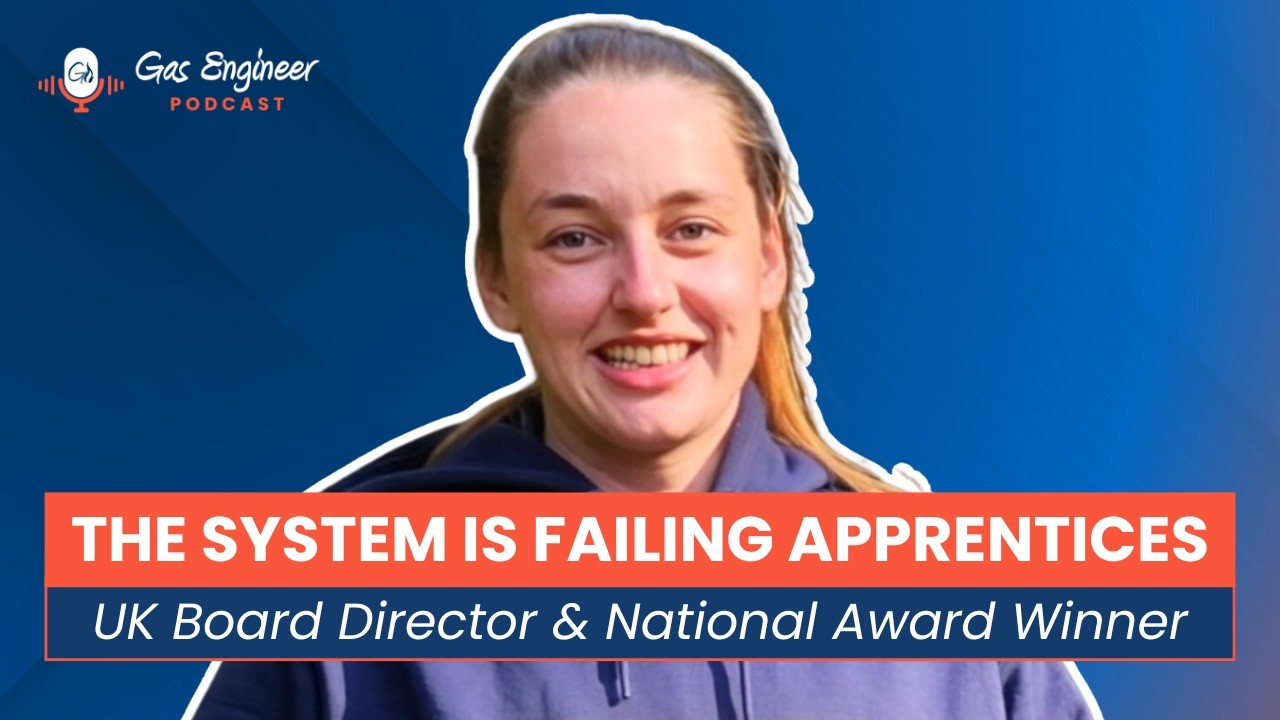
In this Gas Engineer Podcast episode, host Tulloch Priest interviews award‑winning plumber and heating engineer Daisy Turner about the realities of plumbing and heating apprenticeships in 2026. Daisy shares her personal journey—from being steered away from construction at school, self‑funding a Level 2 diploma, to securing a four‑year apprenticeship, winning national competitions, and becoming a brand ambassador. The conversation covers systemic challenges such as the lack of CITB levy funding for plumbing apprentices, the financial strain on employers (especially sole traders) who must pay wages while training novices, and the mismatch between college resources and on‑site realities (shortage of assessors, lack of broken‑part training material). Daisy discusses wage progression (£4 / hour apprenticeship wage rising to £8 / hour after a year) and the time it takes for an apprentice to become productive (around six months). Gender representation is examined; while few women are in the trade, Daisy reports supportive environments and encourages more female participation. She explains how competitions (HIP Learner of the Year, Female Skills, WorldSkills) provided tools, networking, and exposure to manufacturers. Practical advice is offered: be proactive in seeking placements, consider sole‑trader employers for more hands‑on experience, and use social media authentically. The episode ends with Daisy urging anyone considering the trade to give it a try, highlighting the variety of specialisations available and the long‑term job security of skilled trades.
Chapters
He sat me down and he said, "You can't do construction because you're too smart for it." I said, "How can I be too smart to do a course?" When the apprentice first starts, they're not really earning their money. If anything, they're knocking back the engineer's money because they have to take the time out to teach the apprentice. So there has to be a substantial incentive to take on an apprentice. I think a lot of people don't shine the right light on the situation of apprenticeships. They are a brilliant initiative, but realistically they don't work that well.
This is Gas Engineer Podcast. I'm your host, Tulloch Priest, and today I'm joined by Daisy Turner, who's a plumber heating engineer, award-winning, a charity volunteer, and somebody who's packed into more into her apprenticeship than most engineers managed in a decade. Welcome to the show, Daisy.
Hiya, thanks for having me.
In other podcasts, we've talked about the shortage of young people coming into the trades and the challenges with apprenticeships. Daisy's actually living that journey right now, and she's won national competitions, volunteered in Nepal, become a brand ambassador, and a UK board director, all while holding down a full-time job. Today we're hearing what it's actually like coming into the industry in 2026. In a sentence or two, why should people care about this conversation?
I think a lot of people don't shine the right light on the situation of apprenticeships. They are a brilliant initiative, but realistically they don't work that well, but a lot of people are sort of scared to share their experience in the fear that they're alone, but to be honest, everyone's sort of in the same boat up and down the country. Like you touched on my national competitions, I met people from up and down the country, and in every college they had a very similar— some slightly better, some slightly worse, but we was all sort of in the same boat. And it is a shame, but it's nice to know that we're not on our own.
Why would you say that it's not working, or how could it be improved?
I think it's— it always comes down to money, doesn't it? So although there is funding for certain courses, so I think it's CITB that does like the levies, and someone somewhere in their infinite wisdom asked the CITB to not offer levies to plumbing and electrical students. So if you was in other trades like carpentry and things like that, you can access the levies, but actual plumbing apprentices can't. So it's struggle— that employers struggle to cover the wages. And sort of like, when you first get an apprentice, they're not that useful because they don't know. And it's not their fault, it's no one's fault, they're just right at the beginning of their journey. And to have to take your time out to teach that apprentice, and then you still have to pay them their wage, it's a lot for an employer to take on, which is why there's so little apprenticeships on offer. There's plenty of people that want into the trade. So if you look at job applications, for argument's sake, there's one plumbing apprenticeship going at a big company, but they'll probably get, I don't know, like 20 applicants, but there's only one position to fill. So there's a lot of people that want to get involved in the trades and want to be in the industry, but there's not enough opportunities because the employers struggle because of financial difficulties, and then the college struggles because although they get the funding, it isn't spent correctly, and there's a lot of students drop out. And to get the full funding for a student in a college, they have to sit the entirety of the course. So it's almost once you've finished your course, the government then give the last 20% or 25%, I think it is. So the college are almost acting on borrowed money while you're sitting your apprenticeship. In the hopes that we finish it completely so that they can get the last bit of funding. So it's— it needs a bit of a rejig. It's not a simple answer, it's not going to be fixed overnight, but it does need a rejig.
Okay, so you've got— from, from the apprentice point of view, is there enough money for you to live on? Yeah, like, like excluding the other problems. So you, you— and when you speak to other apprentices, you can sort of get by for that period of time while you're an apprentice, while you're learning?
Yeah, so it depends sort of on your age. So if you're starting between 16 and 19, you're on apprenticeship wage, which is pretty low, but you take that into account when you take on the apprenticeship. But equally, being on that lower wage for a few years weighed up against the option of all of the student debt you could be in, it sort of works itself out because although you're on less money for a couple of years, you're not paying back a student loan for the next 20 years. So you sort of take the hit when you're younger, when you don't have the responsibilities, you don't have bills, you don't have a mortgage to pay, whereas A lot of people, they'll be paying off their student debt in their 30s, and they're paying all their bills, all their mortgage, and their student debt, and it's a lot. So you sort of take the hit younger on, and you have a less, less of a wage. But realistically, there's always going to be trade jobs. No one can take that away. No one can take your qualifications away from you, and AI can't do our jobs. So we've got that for life.
What is the other— what's the main feedback from the other employees? There's Sorry, apprentice. Is it there's just not enough apprenticeships on offer?
There's not enough on offer, and it's hard to stay motivated when the college falls short a lot of the time. It's very frustrating going to college and there not being enough materials, or the tutors not being in, or especially assessors. When you get to like your portfolio stage, there's not enough assessors and there's not enough people trained in the EPA, which is like your final exams. Your endpoint assessment. So there's a lot of college frustrations which put people off more than anything else. I mean, the, the qualification that I did was 4 years, and that's a lot to ask of people.
Hi, Producer Alex here, wondering if you knew that you aren't subscribed to the channel. More specifically, 93% of you are not subscribed, and we really appreciate you tuning in right now, but you're missing out on even more interesting content. You're already this far into the episode, so why not subscribe to the Gas Engineers Software YouTube channel? Because showing your support genuinely makes a difference. It's free, takes a second to click, and helps us continue to make the content that you want to listen to. Speaking of, let's get back to it.
And the college that you went to, was it relatively well organized? Um, sorry, it's probably an awkward question.
Some bits were, but other bits— it wasn't always the college's fault. It was sort of like the systems that were in place from the government or City and Guilds, whoever it was. So they were good as gold, they tried as much as they could, but there was some things, there was just barriers put up by, like I say, by City and Guilds, who was like the governing body. So they— it's impossible to sort of get an answer from City and Guilds. Again, you understand it because they have such a range of all different qualifications. It's not just trades, it's across everything. So they must have so much going on, so many different qualifications, so many different bits of paper. But even so, if you was to ring them up, you'd hope that you'd be able to get an answer, but you don't. It is really quite frustrating.
How did you get into the trades? How did you decide that you wanted to become a plumber or a gas engineer?
So both of my sisters, they knew what they wanted to do at uni, so they knew what A-levels they needed, they knew what grades they needed to get, they knew what university they wanted to go to, so their paths were pretty set. But I didn't really have a plan. I didn't really have like a path set in stone. And one day my mum was just like, you need to work out what you want to do. Like, you've got to have a bit of a plan, not just sort of wing it. And the plumber was there, so I just said, oh, I'd be a plumber and I'd just start with it ever since. I really enjoy it, it's something different every day, and I'm so glad that I started.
You actually paid for your own Level 2 before you got an apprentice. Could you kind of walk us through that and, and why you did it that way?
So when I was at school, I wanted to do a construction qualification. I think it was a BTEC, so it wasn't quite an A-level. So I put it down on my options list that I wanted to do the construction course, and and they asked me to go to the headteacher's office, and I was a bit confused because I was like, I haven't— I've just filled in my application, I don't think you can fill it in wrong. And I went up there and basically he sat me down and he said, you can't do construction because you're too smart for it. I said, how can I be too smart to do a course? And they said, because you could do your A— so I did A-level maths, physics, sociology, and psychology. They said it looks better on the school if you get a grade in maths than if you get a grade in construction. But I said, but I want to do construction and maths, but because they clash on the timetable, I couldn't do them both. So they said, we'd prefer you to do the maths than we would the construction. So I always sort of had that fire in my belly sort of thing to be doing something hands-on. So I sat through my A-levels because I spoke to a few people about it and they sort of said, like, if you've got the qualifications, you've got something to fall back on just in case you don't like the plumbing. So I did my A-levels and then I was looking for an apprenticeship, but I just couldn't find one at all. Like I say, I was applying for all the ones that were advertised. But I don't know if it was they see my name and they see it was a girl and they thought, oh, don't worry, or it was just the fact that there's one job and there's 20 people applying and someone could have been more qualified than me because they could have been able to do the construction course, for argument's sake. So I was—
it's kind of interesting, the school kind of actively pushes you away for—
so they push you towards university. So even when I was doing my A-levels, they were saying, I'll fill in your UCAS application. And I was like, but I don't want to go I didn't want to go to uni at all, and they was like, oh, but we've blocked in— it was like an hour session to write up your UCAS application. I was like, I don't want to go to uni. And they was like, yeah, but you have to because that's what this session is about. I was like, surely I could be looking for apprenticeships? And they was like, no, you have to fill in the UCAS application. So I was just going around in circles. I just couldn't really get on with what I wanted to get on with. And then, like I say, I was looking for an apprenticeship and I couldn't find anything. I applied to loads and nothing ever came back. So I ended up just paying for a Level 2 diploma because I thought if I had a plumbing qualification, it would help me get my foot in the door. But in actual fact it didn't really help because it was only a Level 2 diploma. It wasn't an NVQ, so if you were to go on any sites, they require a minimum of a Level 2 NVQ. Now that I've done my apprenticeship, I have a Level 3 NVQ and my gas qualification. I'm glad I did it, but it didn't really help in the way I hoped it would.
Well, from an employer's point of view, if I saw somebody with that, that means that they were— it would be a good sign. You know, it's a sign that you're interested in that subject, you took some action, and you were able to finish it. So it's like you say you didn't know what you wanted to do, but you know, there's kind of these breadcrumbs along the way which is kind of pointing towards, you know, where you've ended up. And kind of jumping back to the apprenticeships, you are female and there's less females in the heating and plumbing world. Has that been an issue at all, or it's not something that you've noticed at all?
So there's not many females in the industry, but there is slowly more and more. I haven't found it really an issue. I mean, a lot of people, like you say, they do see that I'm a little bit different to their average plumber, and they do ask, do you struggle? Is it difficult? Especially like, I've been in college before and they've had people sort of like looking around, looking to do the course., and there's been a few women, they've come up to me and they're like, how do you find it? Like, I'm really worried that I'm going to struggle. I said, to be fair, you, with any job, you find your way. Like, everyone has their own way of doing a job. Although it's one task, there's 10 different ways to do it. So there's a few things that I'd struggle with. So bending 22mm pipe, that's a little bit more difficult, but you just get a longer lever. It's simple physics. And sometimes it's difficult lifting all the heavy things, but there's always, there's always someone on site to give you a hand. I'm very lucky, the people that I work with, they're good as gold. If you ask them for a hand, they're more than happy to help.
Okay, and what does like an average day look like for you as an apprentice?
There's not really an average day. I mean, every day is different. Some days I'll be on bathrooms, sometimes it'll be a boiler rip-out, sometimes it would be a boiler install, combi swap. It's very different every day, and that's probably one of my favourite things of the job is that it's so varied. I think if I was going in day in, day out, always doing the same thing, I'd get a bit bored. But I do like the variety.
And what kind of, like, jumping back to the colleges, what kind of the biggest kind of gap that you kind of see between like real world and the colleges?
I think it's the materials because they buy new materials in and you'll only ever see new working shiny materials, whereas when they're trying to teach you like the fault finding you never see broken parts. So then you get put in the real world, you get sent to go and fix something, and you've never seen anything broken, so you don't know what to expect. You have absolutely no idea what a broken part or a broken wiring system or anything like that looks like, or sort of what signs to look out for, because they sort of don't have the availability. So I think it sounds silly, but when engineers find a broken part or they go to a breakdown, if they could keep the broken parts and donate it to the college— obviously everyone can't do this, otherwise the college would be inundated with broken things— but just like the odd bits and pieces here and there, just so the college sort of have like a teaching aid to show the students. Because I've sort of taken it upon myself to ask engineers if they're willing to send me the broken parts so that I can sort of have a look and get a feel for what it's like, because the best way to learn is like being hands-on. So when you're just looking at a photo in a textbook of what a broken part looks like, you can't really see what's going on.
So I'm only going to guess, but you're talking about like, um, water on a, like, a motherboard or, you know, circuit board?
Yes, like broken PCBs. Like, for a boiler, for argument's sake, a broken fan, the, um, what they called— I've forgotten now, they're not actuators— like the spark plugs and stuff, all of those, like you never see a broken one, you only see photos of broken ones. So it's sort of hard to then go out into the industry and notice those things and work on those things and rectify them.
Okay.
And, but I'm guessing some of this stuff will come with time.
Yeah, definitely.
As you see more examples, you'll be able to, you just get faster over time.
Yeah.
Uh, you've kind of, you've won national, um, skills competitions, been a Rising Star finalist, and made the Screwfix Trade Apprentice, um, semi-finals. Tell us what got you into putting yourself into those kind of competitions and how did you do so well?
So initially my plumbing tutor at the time, he said, did you want to do a competition? And I was like, yeah, sure, we'll go for it. It was at a different campus, it wasn't at my college, so we traveled up there. It was me, it was an International Women's Day competition actually, so it was me and one other girl that was in my class. We went to to Lewisham College, and my tutor, he was very sort of wary that it was my first competition, and he said, like, give it a go, have fun, don't expect anything out of it. So that was my first experience of a competition. I placed second. I then went back the next year and placed first, and then I thought, then my college tutor, he thought, actually, she's quite good at this. So he offered me to do HIP Learner of the Year and HIP Female Skills in 2024. So Learner of the Year is mixed gender, So I did the regionals and came first, and then I did the nationals and came first again. But in the finals, there was 7 of us, so there were 6 boys and just me. But initially, when I first applied for them both, because they're run by the same company, but they do the female skills one to sort of allow girls to have that space where they're not going to feel intimidated by the other guys in the workshop. So it is really nice to have that opportunity, but equally I'll just give anything a go. So when they said, do you want to do the Learner of the Year as well? I was like, yeah, sure. And then they came back and said, are you sure? You've signed up for both, is that right? And my tutor came to me and said, like, do you want to do the boys' competition and the girls' competition? I said, can I not do the boys' competition? He was like, well, it's not actually a boys' competition, it's a mixed gender, but you're welcome to do them both. I said, oh, I'll do them both then. So I did both of them in the same year. I did the HIP Learner of the Year, HIP Female Skills, and the World Skills as well. And I think I did— yeah, I did the International Women's Day competition as well. So it's a very busy year for me.
And it would have been. What kind of things has it done for you apart from like winning the trophies?
So you win the trophies, but you also win like tools and things that the sponsors have donated. So that sort of set me up into— because tools are very, very expensive. So that sort of set me up ready for my career. It's mainly the networking and the contacts that I've gained through the competitions. So I've got to speak to all different people all over the world. One of my prizes, I went out to watch WorldSkills in France. That was with Grohe. So I met Grohe representatives from America, Germany, France, and then the guy that I went with from the UK. I then spoke with Grundfos. They had someone come, she was product development, I think. She came from Denmark to visit me on my site, and then I had the privilege of going out to Denmark to go and look at their factories and everything. So more than anything, it is the contacts and the networking.
It would have been quite interesting to see the factories, to see where it's been made and how it's been produced.
Yeah, it's pretty cool. It's very, very technical and it is very interesting, but obviously I just look at it and they're huge, great big machines and it's very exciting, but I don't really know what they all do.
That's very nice. Um, you've also taken roles on outside of your day job, like brand ambassador to the UK, um, sorry, the International Plumbing Network. How did all of that start?
Again, it was just sort of like networking. So I have my Instagram page, um, and I've just always posted what I've felt is relevant and what I've enjoyed doing. A lot of people sort of go down like the trends route, but I'm not very good at keeping up with the trends, so I just post what I want when I want, and it seems to be working for me. Like you say, when I've done my competitions and things, the actual manufacturers and the brands, they've seen the potential in me and then invested in me, which is really nice. Whereas I know a lot of people, they're sort of— I say they try a little bit too hard. Like I say, with the trends and things like that, sometimes it can sort of consume you and then it's a bit less you and it is just all trends. Whereas my page is very much me.
And do you think many other sort of young engineers know that these opportunities like these competitions and stuff exist?
No, so when I've done the competitions, some of them— so I did one, it was a bursary scheme with the Worshipful Company of Plumbers, and you just had to fill in an application form of who you were, what qualification you were studying, and sort of what got you interested in plumbing. So it was a relatively easy application, and everyone in my college class got the exact same opportunity because my tutor actually sent it to all of our emails, so we all had the exact same opportunity and you just had to fill in a form. And then when I won it, they was like, oh, it's not fair. I was like, it is fair because everyone's been given the same opportunity, just none of you bothered to fill it out. And then when I then continued on to go and do all my competitions, when I was actually like plumbing all of the appliances in and making like mock frames and things like that, I was putting myself out there, I was going out of my way, I was doing the best job I possibly could. And then I win it and I come back and they go, oh, it's not fair, we didn't get asked if we wanted to do that competition. It's like, well, no, you did, you just didn't put yourself forward for it. So I think it, it sort of comes from jealousy, but they sort of word it in the wrong way as if they've missed out, but really they've not put themselves out there.
So you just need that proactive element.
Yeah, definitely.
Okay, so if, if there were other apprentices out there, if they do a, um, a search, um, I'm guessing all of these things would come up, just in case their tutor is not, or the school is not geared up to help them with these?
Yeah, if you was to search it, they would all pop up, and there's loads of examples of different competitions up and down the country, sort of different stages as well. So there's some that are more— so WorldSkills is very technical, um, and you have to move very, very quickly. So you originally start with Skill Plum, and then you work your way up to WorldSkills. Um, so that is very technical, very intense. But the HIP competitions They're very relaxed, very supportive, and a good sort of way into the competitions, if that's the right word.
So you learn a lot when you do those competitions?
Yeah, definitely. It's sort of working under pressure and working to very tight timeframes, tight measurements. So it does test your skills. It does test your patience. But they are really, really good for sort of building your confidence in the industry.
Are you fed up with drowning in a pile of paperwork that comes with running your heating and plumbing business? Gas Engineer Software is an easy-to-use, all-in-one job management system made especially for UK heating and plumbing companies. From handling customer details to building quotes, issuing certificates, and sending invoices, Gas Engineer Software will help you save time, eliminate paperwork, and make running your business easy. Start a free trial by clicking in the link in the bio. Our industry report found that only 13% of businesses plan to hire in 2026, and just 23% would consider an apprentice. As somebody who's sort of been on the receiving end of that, what do you think is holding the industry back on bringing on more people?
I think it's to do with the funding. So the actual employer doesn't seem to get anything as an incentive. So for an employer to take on an apprentice, like I've touched on before, like when the apprentice first starts, they're not really earning their money. If anything, they're knocking back the engineer's money because they have to take the time out to teach the apprentice. So there has to be a substantial incentive to take on an apprentice because that initial investment is a lot. It's all of the paperwork, enrolling in college, and taking on the apprentice. It's, it's a lot to expect, especially of a sole trader. So my company, they've had quite a few apprentices, so they sort of know the steps they've got to go through. But for anyone that's just starting, it's a huge expense and a huge liability, if you like, because if you send the apprentice to go and do something and they could potentially do something wrong, whether it's something minor or something major, depending on your line of work as well. So if you're sort of working in sites, you can get away with, oh, there might be a leak in the pipework and you can put the tools down, come back tomorrow and fix it. But if you're domestic, if you've got the water off and there's an issue, you can't go home until the water's back on. If the customers are living there, you can't leave them without hot water and heating.
Yeah. No, it is tricky. So with the, like, if a sole trader takes on an apprentice, you know, there's a lot of upfront work and cost. Where do you think, like, the break-even point is when the apprentice starts to become sort of useful and helpful? Would you say sort of after the first year, 18 months?
It very much depends on the apprentice, but sort of 6 months or so, they're quite confident to be able to work their way through a task. You'd probably still have to keep an eye on them, don't get me wrong, but sort of 6 months, you're sort of on the right track. Again, it sort of goes back to money. So I started my apprenticeship a little bit later, so I didn't start till I was 20. So for the first year you're on apprenticeship wage, so at the time I think it was £4 an hour, and then after the first year you jump up to national minimum wage, which at the time was £8 an hour. So I've doubled my wage but I haven't doubled my work, if that makes sense. So after the first year, sort of, it was getting to like 11 months of my apprenticeship or whatever, I was getting quite confident, and it hits the 12-month mark and I suddenly go from £4 an hour to £8 an hour. But I haven't overnight— I've got more money, but overnight I haven't been able to double my workload. So there's sort of, it's trying to bridge that gap because like I say, overnight the money had to change because the government said so. But realistically, my company, if you was to just ask the company, I wasn't worth that extra money yet. I wasn't far off it, but I wasn't quite there.
So it's, it's you, because they've like, for a sole trader, you're taking a quite a bit large risk and then you could go through 6 months and then you find out, or a few months and it's not a good fit, um, etc. So you train somebody and then you're saying it, it's 12 months, the salary goes up. And then, so the actual point— yours was, was it 4 years you mentioned?
Yeah, so it's a 4-year qualification.
So the— your employer will get the most benefit out of the last 2 years?
Yeah, essentially, yeah. Because then you're actually earning your money because you're being able to do a job on your own, not always having someone to help you, or you're not always helping someone else with the job. Don't get me wrong, there's always jobs that— say you're lifting in a bath, that's a 2-person job. If you're lifting in a heat pump, that's a a 2-person job. There are 2-person jobs, but there's a lot of things that you can just work on on your own, and if you can't work on it on your own, that's when you're not making your day's money.
Yeah, so it is a tricky balance. So this is where the need for the, you know, that additional support just to get that training up and running, just to kind of bridge it. Yeah, it kind of makes sense why there's not that many, you know, people, um, you know, wanting to take the risk.
Yeah, you sort of look at it at face value and you think, well, why wouldn't you want to pass on your knowledge? And it's not that they don't want to pass on their knowledge, it's that they financially cannot afford to have an apprentice. Like, I know a few sole traders that they'd love— they jump at the chance of having an apprentice, but when you sit down and you work out the financials and the time, and they don't have time as it is, let alone to sit down and do all of the paperwork for enrolling them on college and getting all of the— if there was any support, filling all the paperwork for that. I don't quite know how it all works, but even if there was support, it's not very— it's not very well advertised. That's the right word. So no one really knows it's there, so then it puts people off because they haven't got time to look into it.
So yeah, well, if you're struggling to keep up with your work as it is and you're working evenings and weekends and you want to spend time with your family, you know, this would add just, you know, additional complications.
Yeah, which is why I think it puts so many people off.
It's definitely a shame because there is a massive shortage in the trades. And what would you kind of say to somebody who's kind of thinking about being an apprentice? And considering the, you know, plumbing and heating route.
I always say if you're considering it, you're meant to be there, so give it a shot. The worst that can happen is you don't enjoy it, but honestly, there's so many different directions you can go with it. Although you say plumbing, that could be bathrooms, that could be plumbing in kitchens, that could be underfloor heating, it could be gas boilers, it could be heat pumps, it could be ground source. There's so many different avenues, so many different things that you can specialize in.
And have you kind of thought about which— where you would like to specialise?
I think I quite like where I am at the minute. So I work for Toucan. They get involved in all different work. So we do the boilers, we do the heat pumps, we do bathrooms. And I like the variety of always doing something different.
Is there anything in particular you would say— you touched on it earlier— anything you would say to female apprentices?
I think I'd say don't be scared, just give it a shot. Because like I said before, there's always someone to help you, especially with sort of like the Instagram community now as well. There's more and more girls popping up. I say girls, some of them are women. A lot of older women, they'll change careers and they'll sort of fall into plumbing. So sometimes that can be daunting, especially if they go through an apprenticeship because they have to take the wage cut. But honestly, there's no reason why you can't. A lot of people say it's a men's job, but it's not. It's just a job and I just see it as going to work. I don't see it as, oh, I'm going to work with a load of blokes. I just see it, I'm going to work to do my job.
But that career change and that salary drop, you know, that applies to everyone.
Yeah.
And so, you know, it's challenging, you know, especially if you have, you know, some responsibilities, etc.
Yeah, definitely.
Final question, what do you wish that somebody had told you before you had started?
I think I struggled to get into an apprenticeship because I was always looking for adverts The best advice I could probably give is if you're looking for an apprenticeship, put yourself out there. Go to plumbing companies and say, look, I'm looking for an apprenticeship, are you willing to take me on? Don't be scared to do trial days and volunteering days to see if you get on well with that employer, because I've been really lucky from day one. My employers have been spot on, but I've known other apprentices that have gone through 3 or 4 employers because they just haven't really got on with each other., and it's not anyone's fault in particular, not that I'm aware of anyway. It's not anyone's fault, it's just that they're not the right people for each other. So if you was to do a trial day or sort of volunteering, you can get a feel for how that engineer works. If you like how that engineer works— if they're leaving a mess in someone's house, you probably don't really want to associate yourself with them. But if they're really neat and tidy in their work, they're really polite with the customer They take satisfaction out of their work at the end of the day. They're the sort of people you want to work with, they're the people you want to work for. So I think my biggest advice is just to put yourself out there.
So find somebody with similar values, definitely, to yourself so you get that alignment. And would you lean towards like sole traders or slightly larger companies?
I'd say sole traders where possible because I've known other people, apprentices go with the big companies. So I used to go to college with a girl who worked with Pimlico Plumbers, a big, big company in London, and they just see the apprentice as an apprentice. And although she was a plumbing apprentice, they'd put her with the roofers, and you sort of become a number at that point when you work for the big companies. So I think the sole trader is a lot better because you get a better experience. You're always with the same engineer, and they sort know what work you've been exposed to, sort of what's missing in your portfolio, so they can guide you a little bit better. And it's probably a bit better for the apprentice as well because it's a bit more comfortable. You're with the same person, you haven't sort of got to get to know everyone and sort of if you're asking too many questions, if they're going to get annoyed with you and things like that. So I think the sole trader is the better option personally.
And when you first kind of start, you haven't been trained on anything, so it is It is going to be awkward to start with, isn't it? You're going to be just fetching things.
Yeah.
And then, you know, as time goes on, as your skills increase, you, you can be more, you know, helpful.
Yeah. So initially you sort of, like you say, you end up running to the van to get a tool or another length of pipe or whatever it is, and then you sort of, you then start to forward think. So as your engineer's doing a job, you've seen them do that before. So say they're doing a radiator, you know they're going to need the spanner next, so you'll go and get that. So then you're forward thinking. So at first you're just watching and they'll ask you what they want passed to them. Once you sort of go past that stage, you're forward thinking, so you're getting what you think they're going to ask for. And then it gets to a point of they can leave you doing that job, but they'll still keep an eye on you. And then they can send you to do that job quite happily, and they might just come and check it at the end. And then after that, you are confident, you're competent, to go and do that job on your own. So there is a few stages, but it is good.
Okay, so that's the kind of the ladder that you've— and then within each of those, like sending you to do the job yourself, that would start with smaller jobs and then— yeah, that's good. And if you don't mind me asking, where are you on this ladder?
Um, so I sort of run my own jobs to an extent. So at the minute I'm doing a bathroom job, so I've sort of been left to my own devices with that. I quite often get a hand from one of the other apprentices. They'll come and help sort of lifting in shower trays and lifting the flooring up and things like that. But generally it's sort of my job. My boss is always on the phone, don't get me wrong, if I ever have a question, if I ever sort of need materials picking up, because I've got quite a small van as well. So they're always there to help.
Okay, that sounds good. Well, thank you very much for your time.
No worries.
Uh, it was, um, I hope this is very helpful to anyone who's considering an apprenticeship and also to people that, you know, who are offering apprenticeships. And that was Daisy Turner, and yeah, thank you very much.
More from Tulloch

Your Profit Is More Than Your Salary: Pricing A Trades Business w/ Doug D'Aubrey

Is taking over another gas business a realistic alternative to hiring from scratch?





He Took Over Another Gas Business After 3 Years As A Sole Trader w/ Dan Giles


