The Real Reason Gas Engineers Don't Charge Enough w/ Edward Lovell
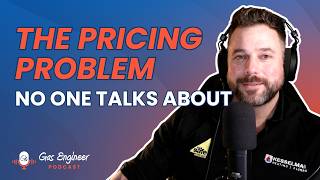
In this episode of the Gas Engineer Podcast, host Tulloch Priest interviews Edward Lovell, a plumbing and heating business owner with a background in construction management and day‑trading. Lovell explains why many gas engineers undercharge, attributing it to a skills gap in finance, sales and marketing when transitioning from employee to business owner, and to a rigid cost‑plus mindset that ignores the value delivered to customers. He contrasts cost‑plus pricing with value‑based pricing, noting that understanding overhead, insurance, van wear, and the perceived worth of outcomes can reveal hidden undercharging. Lovell describes his own operational systems: automated invoice‑chasing based on timed triggers, monthly cash‑flow planning, weekly performance reviews, and daily admin windows, estimating that admin consumes a modest but critical portion of his time. The conversation also touches on broader industry challenges: low heat‑pump installation rates despite qualifications, an aging workforce (average age ~55) limiting recruitment, the difficulty of scaling sole‑trader businesses due to cash‑flow constraints and reactive job mixes, and the need to niche down to improve efficiency. Lovell draws parallels between day‑trading and running a trade business, saying both require discipline, risk awareness, and a different perception of money. Throughout, he emphasizes the importance of mindset shifts, systematic admin, and value‑focused pricing to improve profitability and sustain the sector.
Chapters
You could actually be undercharging not just for the costs and your overhead, but you could be undercharging based on the, on the value you're providing your customer as well.
You do the day trading and then you also do the plumbing. How— those are two quite different worlds.
Vastly different, but the rules are the same, whether it's trading, selling groceries, or plumbing. The benefits and the transition moving into, like, moving back into the business have been quite profound. When you transition from, say, being employed into being self-employed, that your job role changes. You're, you're no longer just the engineer engineer. As the environment changes, you need to understand that there is different roles in the business to do with like finance, sales and marketing, and a big part of that is understanding.
This is the Gas Engineer Podcast. I'm your host, Tullik Priest, and today I'm joined by plumbing and heating company owner Edward Lovell. Welcome to the show, Edward.
Hi, Tullik, and, uh, thank you very much for having me on.
Well, thank you for coming. Um, earlier this year we published our 2025 heating and plumbing report where heating businesses all over the UK told us what's going well, what's not, what's worrying them heading into 2026. Time, pressure, undercharging, and an aging workforce. It paints a clear picture, and Edward is right in the thick of it. So today we're going to be putting the data alongside gas engineers' real experiences. In a sentence or two, why should people care about this conversation?
Uh, I think you should care about this conversation because it may be of some benefit to the future of your business.
Yeah. How was, um, 2025, um, for your business?
The, the business actually started more towards the back end of 2025, around November, um, off the back of, um, a contract coming to an end. I was working in construction, uh, because this isn't my, my first time being a self-employed or business owner when it comes to plumbing and heating.
What happened with your original business, or when you were self-employed, and, and what kind of happened in those interim periods?
So I first went self-employed in my late 20s, and I was self-employed for approximately 10 years. And we were specializing, we actually specialized in more dental work, so dental surgeries, not installing the chairs but fitting out the surgeries. And we ended up working in France as a big hotel we were doing over there, amongst a few other things in London. Anyway, Ida, Unfortunately, I hurt my knee, uh, in the gym, put my knee out. So that was towards the, the back end of the 10 years, and I had to make a decision as to whether or not I continue with the business and try and restructure what direction we were going in, because I was still heavily on the tools. As, as luck should have it, an existing client at that time, um, was looking, uh, for a, a site agent, and they were familiar with my background. We've known each other for quite some time, and he understood my predicament, and he offered me a position. So I ended up spending sort of 7, 8 years approximately in construction management, working through site management through to project management. And that brings us up to present day.
Okay. And then how— and then that kind of led on to going into gas?
Yeah, so I was a gas engineer previously where we did, um, yeah, commercial and domestic gas. Again, we sort of reset my gas qualifications this time around. I was a little bit rusty, I won't lie. Yeah, but it's surprising, surprising what you remember. It really is.
From, from the kind of the research that we did, this is kind of getting back to your business now. Our data kind of shows about 16% of invoices get paid straight away. Do you have a kind of like a system in place for chasing? How is it, or is it one of those things that kind of happened by not chance but having to remember?
So, um, I, I guess that's— there's two ways of looking at that question. There's the original, um, business that I had, which was, uh, there wasn't— we didn't— we weren't really using any software outside of your typical accounting software. So when it came to tracking back then, it was very much done off the top of your head, so to speak. This time around, things are very, very different. A lot of lessons have been learned over the past decade, to be fair. And we have a timed system depending on the invoice and the context of the invoice for chasing. And that's all, currently the majority of it up until a certain stage is automated.
Hi, Producer Alex here wondering if you knew that you aren't subscribed to the channel. More specifically, 93% of you are not subscribed. And we really appreciate you tuning in right now, but you're missing out on even more interesting content. You're already this far into the episode, so why not subscribe to the Gas Engineers Software YouTube channel? Because showing your support genuinely makes a difference. It's free, takes a second to click, and helps us continue to make the content that you want to listen to. Speaking of, let's get back to it.
This is kind of going into pricing a little bit more. A previous guest, Derek Robbins, a training center owner we spoke to, said that he sees engineers changing this, charging the same rates as, you know, 20 years ago. Why do you think this is happening?
So I personally, um, and this is something that's quite, quite close to my heart, I think— I don't think it stems necessarily from one specific issue, um, like to do with charging. I think it's more of a skills deficiency and understanding that when you transition from, say, being employed and you transition to being self-employed, that your job role changes. You're, you're no longer just the engineer. You're at that point in time, you, you're sort of a cog in a machine. As the environment changes, you need to understand that there is different roles in the business to do with like finance, sales and marketing. And a big part of that is understanding your numbers, and you need to understand how those numbers come together. And I think a lot of it is a lack of awareness as to what goes into running a business financially, because it isn't just the fact you've got to pay for a van, it's not just the fact you've got to pay for software, you've got all other things to pay for, and there are other inefficiencies to consider in that equation as well.
Okay, because it's like, from an external kind of point of view, it's— it seems— it appears there's a shortage of gas engineers. And normally if there's a shortage of something in a kind of a general marketplace, the price would generally go up. But it just seems engineers are struggling with, you know, income and then also taking time off. It's just interesting. So I definitely see your point about, you know, knowing your numbers. You need to cover the insurance, the wear and tear on the van, you know, the van's not going to last forever. So all of these things need to be accounted for.
For.
Um, but it's, um, it seems to be like this way for a very long time.
I think perception and belief is, is a, is a big part of it as well. I mean, it's— I, I may have mentioned it previously, is I had some involvement in, in sort of day trading, and the, the time I spent within that environment, you, you see money very differently. The size of the figures involved— same thing with construction as well. The, the the amounts of money involved. So it changes, it changes how you see those sums of money. You become more accustomed to seeing larger sums of money. I think sometimes there's a psychological barrier there when engineers potentially, not all of them for obvious reasons, potentially fall foul and eventually end up undercharging because they think that say charging maybe £350 a day is a lot of money. It's not looked in relationship to A, your costs and your overhead, and it's also not looked in relationship to the actual value you're providing to the customer. If you— I think if, if they could see, and this is one thing that I've picked up, if you can see that it's not so much about you charging the customer a lot of money for what you're doing, it's the value you're providing. And if you can, if you can make that transition and you can understand that this is about you delivering a good service to your client, in, in some circumstances, if you're very good at what you do, you could actually be undercharging, not just for the costs and your overhead, but you could be undercharging based on the, on the value you're providing your customer as well. I think the, um, a perception and belief shift would— yeah, it's quite important.
So you're saying kind of, because there's two ways to do the pricing. One is that you do essentially costs plus a bit, plus a margin. The other option is that you approach it from the customer's point of view, which is the value that they get, and then charging on that one. And you're saying that, um, I'm kind of rephrasing, but, you know, as you transition from like an employee to a business owner, you're very, very good at your job, but you haven't kind of encountered these kind of things before. So you predominantly— people, you're suggesting that people come from that cost plus margin point of view instead of that, you know, the actual value. Is that correct?
Yeah, it's, it's very rigid thinking. It's very rigid thinking because Again, it's again how you see things and what you think is expensive, and then what is expensive to the customer depending on who the customer is. They're two very different things. When you're looking at things purely on a cost, overhead, margin basis, you're looking at things from your perspective. There's nothing wrong with that because it covers your costs and you can make some profit, but there's also a different perspective from, from, from the customer's point of view as to the problems you're solving for them and, and what they're willing to exchange to have that to have that solution provided by your business. And it's really surprising that when you start to adjust how you perceive the offer, what you're doing for your client, how much people are financially willing to exchange for that. And as you gain more experience sort of playing around with that, you start to understand that charging for a day is just not practical. If you're good at what you do, you're doing yourself a massive disservice. You should be thinking about the customer, their problems, and trying to solve as many of those problems as possible and provide as much value as possible. And you'll be really surprised what people are willing to pay for that certainty of outcome.
That's a good point, that certainty. Uh, from our research, around 60% of the, the business handle their all of their own admin. What does your business look like day to day and how much of your time is kind of split between doing things that make money and then all of the admin?
One thing in cycles, so we've got monthly cycles, weekly cycles, and daily. So each month we sit down, organize all the planning for the working materials and cash flow for that month, amongst other things. Then weekly, moving through that, it tends to be more of an analysis of how things are going, and that's generally conducted on a Sunday. During the day, when you've got the different events are unfolding and new information is coming in, um, customers' requirements changing, new jobs come in, obviously that picture starts to change and that has an impact on your time management and the impact on your cash flow as well. So daily there is, um, in the morning and in the evening sort of a period of time when we go through all the inboxes, WhatsApps, capture all the new information, update all the new job— the existing job cards that we've got, then send out all the relevant communication and then if we need to adjust, then we adjust. It's like a, almost like a micromanagement as we're going through. And during the day, around 1 o'clock generally is when I make my sales calls. So if we've got a new lead come in, try and sort of speak to people during the lunch hour, sometimes in the evening.
Yeah, and you would say, how much of your time do you think you would spend on admin, sort of like a percentage?
So I would say as a percentage, I've never sort of sat down and sort of tried to work that out, But realistically, if you were to— each day is capped or bookended, should I say, by an hour of admin before we start, an hour admin when we finish, and probably sort of 20, 30 minutes during a day making different calls and bits and bobs. And then you've got, I would say, maybe half a day a week on the Sunday, just double-checking things are as they should be. Maybe one day out of the month So it's not a huge percentage. It's one of those things that if you don't stay on top of it, it will run away with itself, and then you've got a lot of work to do in one hit. To be fair, there is no benefit to not maintaining it. It's something that you need to stay on top of constantly.
Otherwise, yeah, there's all sorts of challenges— cash flow, etc. And then if something's going off track, you definitely need to catch it early, not just wait for your tax return and suddenly just to discover those. So yeah, yeah. Also from our research, about 4 in 10 engineers are now heat pump qualified, but almost nobody seems to be installing them. Only 3 people in our whole survey did more than 10 last year. Is it kind of on your radar, or does it kind of feel like it's more of a distraction?
I wouldn't say either, to be fair. It's, it's, it's not, not on my radar. It's something that I'm familiar with, But from my perspective, if you look at the numbers, I think it's about 1% of all households in the UK are like on a heat pump. I think it's more to do with supply and demand. I'm not sure that the market's ready for it yet.
You know, the heat pumps from other guests, you know, they aren't as flexible and you need to be a lot more precise. So there is kind of like some upfront risk. From my understanding, the margins are higher, but, you know, as you say, if the demand is not there, it's going to be a challenge. Are you fed up with drowning in a pile of paperwork that comes with running your heating and plumbing business? Gas Engineers Software is an easy-to-use, all-in-one job management system made especially for UK heating and plumbing companies. From handling customer details to building quotes, issuing certificates, and sending invoices, Gas Engineer Software will help you save time, eliminate paperwork, and make running your business easy. Start a free trial by clicking in the link in the bio. A lot of gas businesses are sole traders and they don't seem to grow their business, like add additional tradespeople, you know, as the revenue goes up. Why do you think causes that?
I think there's a, I think there's a multitude of, of factors that, that can cause that. Potentially they don't want to. That's definitely one thing to consider. You know, they don't want the additional stress. I think sometimes the infrastructure of the business, so whether it be the ability to get, get work in, so for yourselves in marketing, whether they got operational inefficiencies or whether they've got issues with getting money in, they've got cash flow issues, like where's the constraint in the business? I think sometimes it's something to do with that that's actually holding them back. From, from growth.
Because it's— it just seems like a very— like, if you look at other industries, you don't have that same breakdown, you know, where there's, you know, like a— for, like, for example, electrical. Like, the average electrical company is, um, you know, has a higher average number of employees than, like, the gas.
Do you think that's more to do with work type? I mean, one thing that I do know from, from experience, and this is This is something that's actually this time around when we've started the business again, like niching down and actually choosing or picking your poison, so to speak. I think sometimes because plumbers' work can be either planned or unplanned, so you've got reactive jobs and such, and sometimes they come from the same customer. I think sometimes it makes it difficult for certain companies to manage their time efficiently. That may be an issue, 'cause that's something that you don't tend to see as much in electrical work. There's not as much reactive work, 'cause you would try to, if you're having a difference in outcome, you would try to sort of look at electrical businesses and plumbing businesses and try to understand why you have those inefficiencies. And off the top of my head, that's really one of the main differences in those businesses. I mean, one thing that, what we're benefiting from at the moment is focusing on predominantly just like 3 types of work and anything else that comes in, we're not turning it away, so to speak, but we're definitely looking at it differently.
I think there's kind of a range of reasons, like it also depends on what the goal of the sole trader is. Is it, do they need like time flexibility? Do they have a young family? Do they have Are they caring for somebody? Do they want to spend more time fishing? Um, you know, whatever the goal is. But I hadn't thought about the, you know, that percentage of reactive work versus, um, you know, like the planned work, because there, there is quite a lot of, you know, while you're here.
Yeah, yeah, definitely. I think, um, yeah, I think that sort of falls into an element of time management as well from a, from plumber's point of view. 'Cause if you sort of collect the numbers on what customers' complaints are when it comes to plumbers specifically, it's communication is a big issue in our industry and time management. So being where you say you're gonna be when you say you're gonna be there, it's a big issue.
But it's just a challenge. Like if you're not exactly sure how long it's gonna take the job, Um, like if you're off troubleshooting, you know, you would know more about this than I do, but you know, it is, it is a challenge. And then the other element is that, um, for a sole trader, it's not efficient to have like a full-time admin person, so they're trying to be the admin while doing on the tools, while driving. You know, there's a kind of a combination of factors in there.
Yeah, that's why you're, um, that's why your systems are important and understanding that there are different roles inside of a business.
Yes, yeah, definitely. The average age of a gas engineer is 55. What do you think it means for the industry?
It means that we're aging out. If your average age is old, it tells you that you've not got young blood coming in, and I think that's been a problem for a long period of time. I mean, I have heard similar figures, not quite as high as 55, but sort of mid-40s, but it, it still represents an issue. I think it's the— not necessarily how trades are viewed, but I think the allure of other industries like podcasting and YouTube and, and such. I think that's, that's had somewhat of an impact on not just young men, but predominantly young men and careers that they're, they're seeking out, because plumbing, electrical is, is hard work. You know, it is hard work.
It is. But it's also like if you look at computer graduates, it's kind of a cautionary tale in some ways because the— kind of like 3 years ago or 4 years ago, there was a lot of big push, we need more computer graduates. And unfortunately for those candidates who signed up, now that they've come, obviously we're in a time of change, you know, on the computer side, there just isn't the jobs for computer graduates at the moment, not like there was. So it's— but plumbing has, you know, that demand has been a lot, uh, you know, it's a lot steadier.
Yeah, and I think again it comes down to the fact that it's, it's not— as far as jobs go, it is difficult, it is demanding, it's, it's not particularly rock and roll by any stretch of the imagination, especially if you're sort of unblocking toilets and such. I think, yeah, it doesn't have the same draw. And don't get me wrong, I thoroughly enjoyed my career so far. And it's one of those decisions I made when I was younger. Well, I say decision, I sort of fell into the industry, but it's one of those happy accidents. I'm still really, I still get a lot of reward from what I do. I thoroughly enjoy my job and I do.
How do you kind of compare it? Because you do the day trading and then you also do the plumbing. How— those are two quite different worlds.
Yeah, they're extremely different worlds. Yeah, it's— I mean, I got into day trading because of COVID when we were— I was working in construction, obviously site shut down for a period of time, and I had a bit of time on my hands and ended up getting involved in day trading. Fast forward 5 years, we sort of got to a stage where it's producing some profit now. It's actually pretty good, to be fair. I'm not going to be I'm not going to be retiring anytime soon. There's not going to be any Lamborghinis on the drive, but it's enjoyable. It does change the way you see how things work. It does change the way you see money as well. It's been one of the most rewarding experiences I've had in a long, long time. And it's the benefits and the transition moving into, like, moving back into the business. Have been quite profound. It's, um, but it's vastly different, vastly different, but the rules are the same. I think that's one thing to, to sort of highlight when it comes to markets and, and what drives markets, whether it's trading, selling groceries, um, at Greengrocers or plumbing. The fundamental rules behind how business and markets work is all the same.
It's kind of interesting because you've got like one quite physical and the other one is a really kind of— I haven't done day trading, but I would imagine it's quite, um, stressful mentally?
It's very stressful. I wouldn't, I wouldn't want to do it full-time, absolutely not. It's way too stressful. It's fun when you're not relying on it.
Okay, yeah, that would definitely up the pressure if you had to.
Yeah, incredibly.
Yeah, well, thank you very much for coming on the show, Edward. It's very nice speaking to you, and we hope to see you again soon.
Lovely, and again, thanks for having me on. Thank you.
More from Tulloch

Your Profit Is More Than Your Salary: Pricing A Trades Business w/ Doug D'Aubrey

Is taking over another gas business a realistic alternative to hiring from scratch?





He Took Over Another Gas Business After 3 Years As A Sole Trader w/ Dan Giles


