A Conversation with Vali Nasr
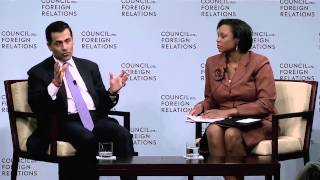
The event opens with Jim Lindsay and Kendra Gaither introducing Dr. Vali Nasr, dean of SAIS, for a keynote at the Council on Foreign Relations’ Conference on Diversity in International Affairs. Nasr addresses a series of policy questions from the moderator and audience, covering the upcoming 2014 Afghan elections, Pakistan’s strategic concerns, the stalled Israel‑Palestine peace process, the role of global capital markets in sanctions (e.g., Russia), the future of the International Criminal Court, the political trajectory of Egypt under General Sisi, and broader themes of youth empowerment, middle‑class development, and the need for a more diverse U.S. foreign‑policy workforce. He repeatedly stresses the importance of credible but pragmatic elections in Afghanistan, the paradoxical interests of Pakistan, the lack of political bandwidth for the U.S. to push a peace deal in the Middle East, and the destabilizing potential of unregulated financial flows. Nasr also offers career advice to aspiring international‑affairs professionals, urging interdisciplinary training, language skills, and an understanding of intersecting issues such as energy, health, and development. Throughout, he highlights the systemic under‑investment in building middle‑class societies as a long‑term strategy to counter extremism and promote stability, while noting the challenges of achieving this in countries like Pakistan, Afghanistan, and Egypt.
Chapters
Good evening, everyone. On behalf of Richard Haass, the president of the Council on Foreign Relations, I want to welcome you here tonight to the Conference on Diversity in International Affairs. I'm Jim Lindsay, senior vice president and director of studies here at the Council on Foreign Relations. We are holding this conference on diversity in international affairs for a simple reason. While America's ethnic and racial makeup has changed dramatically in recent decades, the ethnic and racial makeup of the American foreign policy community hasn't. That's a loss for our country. Talented voices and unique perspectives that could enrich our foreign policy debate are not being heard. That loss is all the greater in the globalizing world in which we live, in which events and people overseas increasingly affect our lives here at home. Our very diversity, the fact that we as a society have ties to virtually every country in the world, can be of a great strength in a complex in a challenging world. Our goal over the next two days with the Diversity in International Affairs Conference is to move ahead the effort to enrich and diversify the American foreign policy community. We hope that you will find the talks and the panels and the sessions tonight and tomorrow to be informational and perhaps even inspiring. We hope that the career sessions will help you sharpen your skills, and see new opportunities in international affairs. Most of all, we hope that the sessions today and tomorrow will enable all of us to make new friends and to broaden our networks. We at CFR are delighted to be joined in this effort by two outstanding organizations, the International Career Advancement Program, ICAP, and the Global Access Pipeline, GAP. GAP. ICAP is a mid-career professional development program that seeks to bring greater diversity to the management and policymaking positions in international public service. I want to thank ICAP's leadership, Charlotte Key, Mary Vargas, and Chandrima Das for joining us here tonight to make this conference a reality. GAP is a consortium of organizations that seeks to create a pipeline from high school through post-collegiate hiring to enhance the quality and diversity of U.S. participation in international affairs. GAP's instrumental co-chairs are Zarina Jarrani and Kimberly McClure, and I'm pleased to say they are also with us here tonight. Finally, CFR owes a special debt of gratitude to Tom Rowe, whose leadership and persistence has been a driving force making both GAP and ICAP the successful organizations they are today. So I would ask Charlotte, Mary, Shondrima, Kim, Zarina, and Tom to please stand, and I'd like you all to clap and applaud them. Take a bow. They have all done very, very hard and very, very good work, and we look forward to working with them in the future and the good work they do. I also want to thank the Rubina Foundation, whose generous support has made the Conference on Diversity and International Affairs possible. Finally, I want to thank two groups here at CFR without whom tonight's event would not have been possible. First, we have our DC meetings team in particular Chris Tuttle, Emily McLeod, and Dexter Denga-Baganese. They did their usual and wonderful job of stewarding the event. I also want to thank DC Events and Operations team, which is led by Rachel Peterson. They worked tirelessly to get the facilities ready for today, and they also made it possible that before and after events you could have something quite tasty and enjoyable to E. So when you see them, thank them as well. Without further ado, I am going to ask Kendra Gaither, who will be introducing tonight's keynote speaker, to enter stage right, and we'll go from there. Again, thank you very much, and I hope everyone enjoys the conference.
Good evening, everyone. I'm pleased to welcome tonight's keynote speaker, Dr. Vali Nasr, who is the Dean of the Paul Nitze School of Advanced and International Studies at the Johns Hopkins University here in Washington, D.C. He is an eminent scholar and author and a government servant as well, who recently served as a special advisor to the President's Special Representative on Afghanistan and Pakistan. I'd like to remind you all that this meeting is on the record. And I'd like to start with Afghanistan, your most recent government hat, with elections being held tomorrow. I think we would benefit from your expertise and your wisdom if you would tell us a little bit about what we should expect for tomorrow and what the outcomes may be from this change in leadership through the election process.
Well, we hope that it will be a credible, legitimate, and peaceful election. Last time when this happened in 2009, there were charges of fraud. There are large parts of the population who were not able to vote because of security issues, and there are security threats again. There are also fear of fraud as well. But the most important thing to watch is actually Afghanistan has changed significantly since then. Now, about 30% of the population at least possesses cell phones. Many young people are going to do vigilante voluntary election monitoring, especially because the international observers have been chased away by the violence. That now 12% of the Afghans have access to the internet. So there has been a change in profile, and it's been very interesting to see how that gets reflected in the elections. So we have a candidate which is favored by the president, sort of a Medvedev for Afghanistan. There is Abdullah Abdullah, who is a very well-known national figure who last time believed that he actually won. And there's a technocrat which is very much favored by the international community, Ashraf Ghani. And it's a race between them. The best-case scenario would be an acceptable first-round winner because that would give a much greater time to prepare for the December deadline of U exit of international forces. But most people think that there will have to be a runoff, which means that we're looking at a September, October possible outcome for the elections. That puts a lot more pressure on the international agenda to wrap up this war and exit Afghanistan in December.
Indeed, that's quite a lot to be looking for. Could we talk a little bit about neighbor Pakistan? President— former President Musharraf was just brought up on charges, and in your work looking at both countries, it was very clear that the key to Afghanistan was also in Pakistan. Can you tell us a little bit about how that— how the stability in the region beyond the elections in Afghanistan and looking at Pakistan, what the regional prognosis might be for United States policy?
Well, Afghanistan is one of those cases, much like now we see in Syria and before that in the Middle East in Lebanon, where it obviously matters to the neighbors a lot more than it matters to us. For us, it's a period of intense engagement. They have to live with Afghanistan or Syria for the rest of their lives. They have vital stakes in that country. So Afghanistan's two key neighbors are Iran and Pakistan. They each have a very different set set of issues there, the Pakistanis have always viewed it as an imperative to control Afghanistan's destiny for two reasons. One is that they're afraid that any independent, strong Afghan government will be an ally of India, their main strategic rival, and it's important to prevent such a government from taking shape. And secondly, that about 40% of Afghans are Pashtuns, and 15% of Pakistanis are Pashtuns. And if you do your math, it means that there are a lot more Pashtuns in Pakistan than in Afghanistan, because 50% of 180 million is a lot bigger than 40% of 30 million. And they are also afraid that the government in Afghanistan that is Pashtun, that it's independent, that it's allied with India, that it would be forced to break up Pakistan. And Pakistan is a country that once before broke up. When it lost its eastern wing in the form of Bangladesh. So that sort of a phobia has caused the Pakistanis to have an intense strategic interest in Afghanistan, which unfortunately got reflected in supporting the Taliban as a very effective force to basically keep Afghanistan from being, you know, what we wanted it to be. I think the biggest problem starting with the Bush administration was the fundamental assumption that Pakistan and the United States were on the same page in Afghanistan. I always believed that everything we wanted for Afghanistan was exactly what made the Pakistanis scared. A strong, democratic, prosperous central government in Afghanistan with its own army of 200,000-300,000 men armed by the United States, capable of lording over its own territory, and that's exactly what would make the Pakistanis very afraid. So I think in some ways the outcome in Afghanistan is not what Pakistan wanted. They're afraid of the extremism, but it's not also what they didn't want. You know, they really had not— were not looking for the outcome that we did. But now it's their responsibility more than it's ours because we're leaving, and I think everybody believes we're leaving, and right or wrong, that means that Now it's for them to manage this issue and figure out how they would deal with India on this, how they will deal with Iran. And Pakistan also, as you mentioned, has its own internal issues. It's a country that's full of paradoxes. We often think of it as a terrorist state, the worst, the most dangerous country in the world, but it's also interestingly one of the most dynamic countries in the world. Pakistan has a middle class of about 30 million people. The best kept secret in corporate America is how much money corporations make in Pakistan. International corporations, you know, do extremely well. It's some of their most profitable units are in Pakistan. It has tremendous potential. But it also has a nasty extremist streak in its society. It has deep ethnic divisions, it has a weak government. And then on the positive side, in the past few years we've seen a democratic government for the first time finish its term in Pakistan. And have actually a peaceful transfer of power. We've had a peaceful transition from a president to another president that happened. We've had a peaceful transfer of both Chief Justice and Chief of the Military. That has happened. These are all very important transition points. And I think the Pakistanis feel very strongly about trying President Musharraf because they believe that the kind of interference in constitution or process that he did ought to be illegal and ought to be treated as treason so that the military will not do this again. I don't think this is an entirely— that holding Musharraf accountable for— although there are many other things he's going to be held accountable including a brutal suppression of a Baluchi uprising in Pakistan. But on this count, you can't have democracy without ultimately imposing the rule of law on the military.
Thank you. Taking advantage of your expertise in the Middle East, I'd like to have you reflect, if I might, on Secretary Kerry's statements today that it might be time to take a reality check on the peace process between Israel and the Palestinians. What is your thinking on the negotiation process and whether or not the situation is ripe for a breakthrough?
Truth be told, I never thought that there was any chance of this happening. I thought, you know, Secretary Kerry did a tremendous effort to push this forward, but this was more the triumph of hope over reality to start with. To begin with, there's a lot of other things on the plate of the administration, and they seem to be more being added every week. You know, when he started, we didn't have Iran, we didn't have Ukraine, it was just Syria. Now, you know, I'm just waiting— now those have been added, and I'm sure before the end of the month or end of the spring, there's going to be something else in Asia that's going to happen that is going to need his time. And the kind of intense diplomacy that the Arab-Israeli issue requires basically is, first of all, is a question of bandwidth. There are many people who are asking, even if there is hope, why are we spending so much time on this when, you know, there are more urgent issues in the region like Syria, like Iran, and also elsewhere now like Ukraine? So that's one issue. Secondly, is that I don't think, you know, the conditions are actually ripe for this because we have an Israeli government that was never really sold on this issue, was never really ready to make the ultimate compromise, that it actually has a more hardline position than even average public opinion in Israel, but Prime Minister Netanyahu is also very, I think, comfortably popular and in control politically. And somehow his own political career and his political power of his party is very much attached to the power of those who are most resistant to exchange of land for peace, which are the settlers and the right. So it's not the right government, it's not the right motivation for that government. And then the Palestinians are too weak to demand anything of Israel. So any deal I think that the Israelis may be willing to sign on to will not be sellable on the Palestinian side. Any deal that is sellable on the Palestinian side, there's no, I believe, logical reason why this current Israeli government would embrace. And then, you know, whenever we've approached the Arab-Israeli issue, we always had Arab partners. So, you know, every discussion of Arab-Israeli issues started in Cairo, Amman, Damascus and Riyadh. You can look back, Jim Baker, you know, Warren Christopher, Madeleine Albright, they all, that's where shuttle diplomacy began. And then of course Jerusalem, but you know, you basically worked on the Arab periphery because you believe these Arab states were critical to giving Israel assurance and a sense of security, and these Arab states were critical in providing the Palestinians with a political cover to make tough decisions, and they would provide hand-holding, they would promise money. Now, two of those Arab partners are not there anymore, really, in an effective way. Egypt has imploded. Syria is, you know, we know where Syria is. Jordan is mired in its own problems and never was even the most serious of these, the most strong of these partners. And we're sort of in a cold war, if not a chilly war, with Saudi Arabia right now. They're in no mood in basically signing on to anything that is supportive. They actually want us not to focus on this. They want us to focus on Iran and focus on Syria. So actually, even when we started this, we didn't have the right regional condition for this. And I think basically, Basically, we gave it a tremendous amount of push. We really couldn't get the Arabs and Israelis even to that right zone, so we're seeing it sort of at the end. They're not seeing much promise in this, and they're beginning to balk at a process. It's unfortunate. I think, you know, this problem is not going to go away, and ultimately is entangled with everything else in the region and it's going to exact a cost at some point.
Well, I hope we can come back to the regional context. You've put a lot of things on the table with Syria, with Iran, with relations with Saudi Arabia, with issues in Russia. But as this is the opening for our conference on diversity and international affairs, I'd like to turn the table and challenge the audience to come back to some of those meaty foreign policy questions in just a moment. But I'd ask, as a dean who presides over one of the preeminent schools in international affairs, What kind of advice would you give to young professionals and students who are currently entering the field? What kind of tools, skills, and training do you recommend to your students and would you recommend that they take advantage of?
Well, the first advice I would give is to apply to SAIS. That goes without saying. But, you know, it's a tremendously interesting and exciting time in international affairs, largely because We're dealing with a world that is changing very rapidly and in new ways. Now, what we often see in terms of news is these kinds of crises we've been talking about, you know, Syria, Ukraine, South China Sea, and these are very important. So whether you're going into public service or private sector, having a handle on global issues is very important. Many of you will seek careers in public service, and that's tremendously important to have a generation that will be able to manage these crises going forward. And for that, you know, you really have to be rooted in an education that provides you with the critical tools, not just economics and international affairs and international law, and conflict management, but much more importantly, it gives you the tools of being able to analyze, understand, and understand strategy. I think whenever even you look at our global leaders, that's what really separates the wheat from the chaff. Those who have depth of knowledge, ability to analyze, understand, and see forward, that is critical. So, you know, you want those qualities in your in your higher education, in education international affairs. But there's also, we're dealing with a much broader world. We're dealing with a world which is about emerging markets, which is about relationships that are no longer hub and spoke. In fact, we already ourselves have in some ways declared that maybe the transatlantic relationship is not as important and we ought to be looking at other areas of the world. But one thing we haven't said is that most of The world doesn't think it's just about us anymore. So you're dealing with a really networked world where the Chinese are dealing directly with Brazil, where Middle East is not looking, even though politically and strategically engaged with us, today China is the biggest trading partner of the Persian Gulf region. The Chinese trade with Persian Gulf is much bigger than the U.S. trade with with the Persian Gulf, that Russia's trade with Europe is far more than, you know, its trade with us. So you're dealing with a world that is much more open than it was a generation ago. That— and that provides tremendous amount of opportunities whether you're in public sector, but particularly if you're in the private sector. I mean, the Renaissance man of international affairs today is somebody who can understand this world. Who can have a perspective that can see the world from the viewpoint of the Chinese and the Brazilians, not our own. And that requires also underground experience, it requires particularly knowledge of languages and cultures, which is very, very important. And then I think some of the most interesting and exciting things in international affairs are happening where things cross over and intersect. And so, you know, we talk about energy, but, you know, it's about energy in Africa or energy in Latin America. And we talk about security, it's security and development and security and energy. Or, you know, people used to talk about conflict resolution as if it was only about, you know, getting two warring parties in a room and finding a way to negotiate peace. But conflict management, conflict resolution is now about also global health. It's about energy. It's about all of these other issues. That's actually sometimes where the most innovative and interesting things are happening. And when you go into the job market, the job market is going to reward those who are able to operate in those intersections much more than those who are— but that requires you to be rooted in the, you know, correct disciplines, but be able to also be conversant beyond just those, those disciplines. So you should look for programs in international affairs that address these issues, that provide you with the right tools. As I said, analytical tools, reasoning tools, understanding of history, of strategy, but also that provide you with knowledge of specific areas of the world and specific issues and that allows you to think about how an intersected world really works. I mean, we often say this as if it's a throwaway concept, that we live in an interconnected, intersected world, but what does it really mean? What kind of an employee, what kind of a young professional does that world need? And that's really the critical issue.
Thank you. I'm going to at this time invite audience members to join in the discussion. We're going to invite you all to ask questions of Dr. Nasr. And in so doing, we're going to ask that you please wait for the microphone to speak. And when you are identified, please stand, state your name and affiliation. And of course, we ask that your questions indeed be questions and that they be brief so that many can participate. Do we have any first questions? We'll start right here. The woman in the middle. And then this gentleman in the glasses will be second. Please stand. The mic's coming to you.
Thank you. OK. Hi.
Good evening, Dr. Nasr. Good evening. I'm Brittany Pruitt. I'm a senior international studies major at Spelman College. And I'm here on invitation from the Public Policy and International Affairs Fellowship. And my question to you was in regards to talking about fraud in the impending elections in Afghanistan. And I have been listening to some soundbites and reading articles about women voters' concerns on basically their husbands taking their voting cards and them not being able to participate in the elections and that being a concern of theirs. I wanted to know if that had been expressed in your work in addressing fraud and transparency in these upcoming elections.
Well, that wasn't an issue in 2009 when we were looking at this, but there are all manners on which you can exercise fraud, which is one is by preventing certain people or regions voting, stuffing ballot boxes in certain places, intimidating a population to vote a certain way. And, you know, there's always the old ways in which you can interfere in a political process. And, you know, in Afghanistan there's obviously ample opportunity to do that. The political system, the electoral system is not organized enough. But, you know, I think the critical issue to keep in mind is, and we learned this in Afghanistan, we raised a lot of human cry about fraud, but in reality there was no, you know, there was, the fraud was not such that the Afghans themselves rejected the results of the 2009 elections. There were no demonstrations in the street rejecting the verdict, and President Karzai was largely accepted by Afghans as having generally won the election. So there was a discrepancy between what we called fraud and what was sort of good enough for Afghans. So I think that's important to keep in mind, that, you know, that in the end, the goal is— I think the goal for Afghanistan in a practical way is not to sort of have squeaky clean elections at a level that actually is not attainable, but really to have a sufficiently legitimate outcome that allows that country to go forward exactly when we are leaving. So I think it's important for the international community not to get ahead of the Afghans themselves on this and not to keep raising issues and actually try to delegitimate an election that might otherwise be acceptable to them. Because, you know, at the end of the day, we're leaving, and if there's not a political process there, either we have to stay, which I don't think is really in the cards, or that you might have actually much worse outcomes than just having a government that, you know, may have a questionable legitimacy but nevertheless has legitimacy in the eyes of the population. Hi, good evening. My name is Haywood Perry. I just recently graduated from the University of Pennsylvania and wrapped up at the White House in the Domestic Policy Council. And my question is in regards to global capital markets. I'm curious, as you had mentioned the private sector, the increasing role that it's playing within foreign policy considerations. Can you speak more about the trajectory you see kind of global capital markets playing, particularly within the context of like decisions with Russia, for example, where when we're— a lot of European nations kind of halted in intervening because of the financial repercussions that they were worried would happen? Thank you. Well, you know, generally, I think the nature of capital markets and the interconnectedness of financial markets across the globe is a very interesting challenge to the global order. I think we haven't ever encountered a situation in which a series of faceless bankers and financiers could make decisions that could literally even bring down the global order for all we know. And we've never encountered a situation that financial markets are actually capable of basically bringing down the global order. And they're generally unregulated and we often think they react to politics, but they could also just as equally cause political turmoil. And going forward, I think this is going to be an interesting dynamic of how does the world really deal with both having open financial markets and yet you don't end up in a situation where the amount of money that can suddenly move could literally create catastrophes politically. Now, in the case of Russia, you know, the The issue is not just sort of how the capital markets react to this. I mean, they're obviously expecting in terms of whether or not there'll be further sanctions imposed on Russia or whether, you know, those sanctions could impact the patterns of investment. But the larger issue is that going forward, you know, Russia is going to continue to generate wealth by selling gas and oil. And, you know, how is that money going to be managed? And I think that to a good extent is going to decide the way in which, you know, the political actions are then reflected in the markets.
Other questions? Got a hand right here and then we'll take this hand right here. Hi, Wida Amir, and I'm with Global Kids. So working with young people and youth, you brought up the issue of youth being, you know, on their cell phones and doing some change work in Afghanistan. Where do you see Afghan youth actually being the face of change currently and looking forward, especially if we are going to look at a political turmoil towards the end of the year? There was some conversation about the youth, you know, really uniting, organizing, and mobilizing. About a year ago, 2 years ago, what's the outlook for them now?
Well, generally we don't know, largely because there's no good polling in Afghanistan and often, you know, much of the perspective is really focused on the large urban centers, particularly Kabul, where you might say the profile of the youth is different. But generally I would say about Africa and the Middle East and even parts of Asia, one has to be very careful when we talk about youth.
Youth.
Literally everybody is youth. I mean, in some ways, I think this came out, I remember in Iran in 2009 where everybody said that, you know, it was the youth industry, it was the youth industry. Well, the thugs who were beating them up were also youth. They were the same age group. And even in Afghanistan you could say the Taliban are youth. I mean, it's not like they're all bearded men fighting against young people. So, you know, we're basically, what we're talking about is, a middle class to an upper middle class youth that, you know, has a certain degree of education. In the Arab world, we understood that they are at least of a level of cultural literacy to be using iPads and iPhones and Twitter and to be able to communicate that way. And so, you know, they can be change agents. We saw that in the Arab world. But in the Arab world, we found out there was also another youth over there. Which, you know, came right after them and had very different values and aspirations. And I think, you know, we have to watch in Afghanistan and see whether the youth that is now— has benefited from the years of Karzai government and American presence, that has been part of the Afghan economy, that grew around international presence there, that has bought into the idea of progress and change and being part of the global economy and has the tools for it, which is it has cell phones, it has internet access, it has literacy enough, and it has the connectivity with the outside world, is really able to organize politically to actually act on this. So I think right now that youth is vesting its hopes in one of two or three candidates and is going to look at these candidates as basically either providing continuity and further change. If those candidates are not able to deliver or they come in and are not able to govern, then, you know, then you have to see where does that youth go. And whether it actually has sufficient amount of staying power. One of the things that, you know, sort of worries me about the Middle East is that that kind of a youth or women who are also similarly associated with that kind of change are tied to a particular economy. So you have to have a certain degree of economic stability and economic activity to support a middle class whose youth and women and professionals then could make political demands. If you have a gradual sort of dismantling of that economy, it's very hard to see where that youth would come from. So if you took Africa, for instance, you know, the Republic of Congo is not producing the same kind of youth, but Nigeria is. Now you have also cell phone-toting, iPad-waving youth demanding accountability and progress and doing innovative things and setting up companies. And that's a feature of a certain middle-class stability that has emerged in southern Nigeria. Now if something happens in Nigeria that would make Nigeria look more like the Republic of Congo, then you're not going to see that activity. In other words, that kind of a youth does not grow in a vacuum. You have to have an economic basis for it. And I think that's where our focus has to be, really, to help sustain economies that then would produce that hopeful strata.
Before we go to the next question, do you feel like we do that in our U.S. policy? I know there's been an increased focus on youth engagement. Are we planning appropriately for how to engage youth economically around the world?
You know, no, and the one reason is— no, I mean largely because actually a lot of our foreign policy in its thinking is still about hard power and it's about security issues. And to be honest with you, the discourse, public discourse, not just administration, in the past decade, two decades, has been about only hard power issues. I mean, I wrote a book about this that, you know, if you want to deal with the problem of extremism in the Middle East, grow the middle class. You know, forget about trying to change people's religion and preaching, you know, these sorts of things to them. Just grow their middle class. And so we haven't done much of that, but also, you know, really doing this globally requires enormous amount of investment from the United States. And, you know, we're not there right now. We're sort of— the American public is pressuring Congress, the government, that we really don't want to spend any money outside. We don't want to— and it's not so much about aid as charity you give to people. But we're not really sort of putting the money that's required investment in societies that would create that middle class. And so, you know, the question is where does that investment come from?
We have a young woman waiting here, and then we'll take this young woman in the front. Thank you. My name is Joanna Port, a recent graduate of Cornell with my master's in public administration. I just wanted to ask your opinion of the ICC. Is it losing ground post the 2008 elections in Kenya and the current pursuance of President Kenyatta into the ICC. Several countries in Africa, especially after the African Union, have entertained a resolution to pull out of ICC. So is it losing ground?
Well, if a number of countries actually end up moving out, yes, I mean, that clearly is a dent into the reputation and a downgrading of ICC. But ultimately, you know, international institutions are not as— are more blunt instruments in the sense that, you know, they can work only slowly and to a certain extent, and they are as good as the member states allow them to be. So I think, you know, one has to put the expectations within, you the right perspective. I don't think ICC will be able to solve Kenya's problems, nor of any other country's problems in the manner that has been expected. But largely, I think it's also convenient for both African states and the international community to sort of abdicate responsibility for their own role in being able to bring a better resolution for the issue in Kenya and sort of to put the blame on the ICC. But if you put too much pressure on it, you know, obviously it will collapse. And then, you know, then next time around you don't even have that instrument to work with.
We have a woman here waiting in the front.
Thank you.
Hi, I'm Jadaea. I'm here representing the International Youth Leadership Institute. And I just want to ask you, because we're talking about Well, I'm here on behalf of the youth organization, and we were just talking about youth empowerment and youth development. And so I was wondering, what do you feel like the youth should know, and what sort of mindset do you feel like the youth should have so that when we become the adults of the world, we don't mess up like our foreparents? So, like, yeah, that's basically the question that I have.
I don't think we should set goals before you that might be unattainable. But I mean, I would say, you know, obviously your generation, the point you're in life is full of hope and aspiration and ambition. And that's wonderful because whatever organization you go into, that's where the dynamism will come from and also the power to innovate and have new thinking will come from. And I think that's every generation produces that. And I think the good thing about many institutions internationally and in the U.S. is that they are open to that change that comes with every generation's perspective. But what it's important not to lose sight is that that kind of dynamism and ambition and hope is not a substitute for solid knowledge. You're not gonna change the world with just aspiration. You know, once, you know, in some cases that might be possible, but in the end, you know, solid education, solid knowledge of the world, you know, investment in languages of areas of the world that you care about, investment in technical basics for whatever field you're in. So if you're really interested in changing climate, You have to know your technical stuff, you have to know your economics, you have to understand your energy. You also have to know culture and political context of all the areas of the world that are involved. So, you know, the one thing that you also have to learn from the older generation is that there's no substitute for hard work and knowledge and pursuit of excellence. And you'll face your own challenges, you get to make your own mistakes. It shouldn't be the mistakes of our generation or generations before us. But I think it's important for you to sort of remain committed to that core, that basic.
Let's see, we have a hand in the back right here on the left. Hello, Sydney Taylor from Innovations in Civic Participation. And we are a youth-serving organization that works to empower youth civic engagement. And I want to go back to the statement you made earlier that the focus should be on, especially in environments like Pakistan, like Afghanistan and Egypt, the focus should be on building up these middle-class youth to empower change. What are the implications for those youth that don't fall into the middle class, that are within the lower economic classes of the country? What is the implication— what are the implications for those youth and what can we do to continue to empower them because they can't be left behind?
No, you're right. I mean, these societies, and this is also true of Africa and parts of Latin America as well, are facing the same dilemmas that, say, we encounter. In other words, you have a driver, you need a driver to build the economy, to generate wealth, to create dynamism, So, you know, if you look in this country and you said, okay, it's in Wall Street and Silicon Valley most clearly, then the next phase becomes is how do you get from the 1% to the 99%? And what sort of mechanisms are required? So, you know, that's investment in infrastructure, investment in education, and then at some point these countries will have to deal with the same issues we deal with, which is taxes. To find a way to basically funnel money in society and they have to come up with the right strategies of doing that. We've seen different sort of experiments around the world, some more successful than others. For instance, China is right now dealing with this issue in an important way about how you distribute wealth in China, how do you recycle wealth. So, you know, this is where I think the challenge is going to be. But, you know, right now where Pakistan or Afghanistan is, is one step before. So everybody's poor, the economy's poor. You really need to create, if you would, a forward movement in the economy in a way that it becomes a self-sustaining generator of wealth. So what distinguishes an average what we used to call developing country, right? And what we today we call emerging markets is that— I mean, emerging markets have created a formula for being able to grow at a certain pace for a certain period of time. And in some cases we've seen that it's been very successful, like a case like South Korea, that they've, you know, genuinely have turned the corner. In some cases, like, that it has stalled or it has actually aggravated the situation. And in some cases, we've seen that, you know, that the countries are really at a loss about how to deal with the critical issues. But ultimately, for countries like Pakistan or Afghanistan or, you know, some African countries, the goal is to become an emerging market. And then you can think about how do you go from being just an emerging market to being a, to say, being able to be a South Korea or to be a Sweden and solve the disparity problem.
We have time for just one last question. It's going to be this young man here in the green tie. But before we take it, I just want to remind all participants that this meeting has been on the record.
Hello, Dean Nasser. Thank you for coming and speaking with us. I'm a second-year student at SAIS currently, and I wanted to ask you about what you see for the future for Egypt. It has been predicted that now former General Sisi will in fact win the election, and I was wondering, do you foresee him approaching his election and incoming into office in a democratic means, or do you think that he will follow in the steps of his forefathers and centralized power and use his role under the military and his experience in the military to further perpetuate the same problems that we currently see in Egypt today? [Speaker:Vali Nasr] Well, you know, the game of politics in a circumstance like Egypt is like a probability tree. You know, you go down a path, you can't come back and go here. So there is no democratic possibility in Egypt, period. That's done. You know, the way in which the coup happened, the control of the military, the manner in which suppressions happened, the sentencing of 540 people to death on a single day, the fact that Sisi will win with an astonishing probably majority, and then what he's going to do afterwards, which is further consolidation of power, these are sort of all down the authoritarian path. And in fact, for a time, I think Egypt will be far more closed and far more authoritarian than Mubarak was. It already is. And, you know, the danger right now is that there's also a certain authoritarian nostalgia in Egypt. So there is a sort of a kind of— the society is divided between those who might be sympathetic to the Muslim Brotherhood and those who are sympathetic to Sisi. And therefore, I think, you know, there's no pressure for democratization. I mean, you know, there's an adoration of General Sisi before even he becomes president. And he's going to have a honeymoon for a period of time. General Musharraf had it too. Now he's on the docket for treason. But, you know, I think the key issue, the key interesting issue is not democracy in Egypt. I think that's the wrong place to focus. The interesting issue is what is he going to do with the dictatorship? So there is a case there. There is a General Pinochet in Chile. You know, it was far more brutal than Egypt. He came in, you know, people were put in stadiums, there were summary executions, there were a lot of disappeared people. It was extremely brutal in Chile. But what saved Chile, it was that he used that period to really fix the economy. So things that a democratic or a semi-open government cannot do, like labor reform, like extracting concessions from teachers, or, you know, all of these things, all this sort of difficult IMF kind of reforms, Chile did. And in fact, they basically borrowed a page from Ronald Reagan and Margaret Thatcher's economic playbook, and they implemented it. So when General Pinochet ultimately left, you know, the economy was on the right track. And the same is true of South Korea. The father of the current president of South Korea was, you know, held accountable for opening fire on leftist students in Gyeongju. But look what happened under his rule in South Korea. It was the beginning of the South Korean economic miracle. That a country whose GDP was the same as Upper Volta is now, you know, is now an advanced industrial country. And then there are cases where you could say, you know, you get the worst of both worlds. So the dictators came in, and that's actually the Arab world pretty much. You had all of the, all of the absence of democracy and all of the hardship, and there was no economic reform either. And in the end, when the dictatorship went, you had these bloated public sectors, poverty, no middle class, you know, all of these things. And then on top of it, you didn't have any democratic institutions. So let's see which General Sisi, which one of these General Sisi will be. Will he really reform Egypt? I generally don't think so because the other side of this is Egypt is a country where the military accounts for 45% of the GDP. 85% of all industry in Egypt is owned by the military. The problem of market economy in Egypt is actually the military. And so, you know, that's an open question is if he's really willing to take He has to take the military on. Politically, he has to take on the Muslim Brotherhood, but when it comes to the economy, he has to take on the military.
I feel like we're ending here on a provocative note, and I hope that you will take that to mean that Dr. Nasr has given us a lot of food for thought today, and I hope you'll join me in thanking him for his time.
Thank you. Thanks very much.
More from Vali
Trump has no easy solution for Iran's chokehold on global markets, says Vali Nasr
Why This War Could Be a “Turning Point” for the Global Order - Vali Nasr | Endgame #261
Iran Is Playing the Long Game to Exhaust the U.S. — So Far It’s Working | Vali Nasr
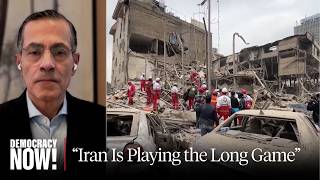
"Iran Is Playing the Long Game": What to Expect from Protracted War in Middle East

Middle East Crossroads: Is Turkey the next target? | Exclusive with Prof. Vali Nasr