Vali Nasr | Iran's Grand Strategy
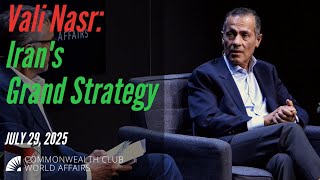
In a Commonwealth Club World Affairs interview, Vali Nasr, author of Iran's Grand Strategy: A Political History, discusses the implications of the recent U.S. airstrikes on Iran's nuclear facilities and the broader strategic context of Iran's 40‑year rivalry with the United States and Israel. Nasr argues that while the attacks signal a shift in the balance of power—making Iran appear weaker—they do not fundamentally alter Tehran’s long‑standing worldview, which is rooted in a nationalist, anti‑imperialist narrative inherited from the 1979 revolution and earlier Shah‑era ambitions for great‑power status. He explains why Iran has pursued a “sacred defense” (mobilizing society around revolutionary ideals) and “forward defense” (using proxies such as Hezbollah, Iraqi militias, and Syrian allies to project power beyond its borders). The conversation covers Iran’s nuclear program origins, the Shah’s civilian nuclear ambitions, the role of the Supreme Leader versus the military‑security apparatus, the Revolutionary Guard’s economic and political dominance, and Iran’s evolving relationship with Russia, including the supply of Shahed drones to the Ukraine war. Nasr also reflects on domestic dynamics: a highly educated, cosmopolitan populace that is increasingly detached from the revolutionary elite, the limited but decisive voting bloc that supports the regime, and the prospects for change after Supreme Leader Ali Khamenei’s death. He concludes with a cautious optimism that both Tehran and Washington have a vested interest in avoiding a full‑scale war, while warning that continued sanctions and mis‑perceptions could push Iran toward a more dangerous path.
Chapters
What does Iran do in terms of repairing relations between state and society, which is quite important? And ultimately, without Hezbollah, with Hamas gone, with loss of Syria, with having no basically ability to counteract or deter Israel from around Israel's own borders, how do they actually manage Israel. I think what we are seeing in Iran is sort of a, is right now a period of great debate and thinking about where do you go from here.
Well, hello and welcome to tonight's Commonwealth Club World Affairs Program. My name is Stephen Saum, and I'm Executive Director of Strategic Communications and Content at St. Mary's College of California. More important, I'll be your moderator this evening. Now it is my pleasure to introduce Vali Nasr, the author of Iran's Grand Strategy: A Political History. Vali Nasr is a leading foreign policy expert and the Majid Khaduri Professor of International Affairs and Middle East Studies at Johns Hopkins University's School of Advanced International Studies. Additionally, he serves as the co-director of the university's SAIS Rethinking Iran Initiative, the leading hub for fostering a comprehensive and nuanced understanding of contemporary Iran and its regional influence within academia and the public sphere. Please join me in welcoming Vali Nasr. Welcome. Welcome back to the club. Thank you so much for joining us here this evening, and congratulations on your new book. Let me start off by asking you something that I think is on many people's minds here, and which you've written about since the book was published. The United States attack on Iran's nuclear sites just over a month ago, following a week-long Israeli bombing campaign, has marked a real turning point for Iran. How so? What does this moment mean?
So, first of all, let me thank the club for inviting me back. It's wonderful being here, and particularly to the new home of the club. And thanks for hosting this. Yes, indeed, this is a major turning point, because the United States now has attacked Iran militarily, directly. It has attacked its nuclear program directly. And because, for the first time at least, the perception, both particularly in the West, but to a good extent in Iran, is that its back is to the wall, that it's weaker than it has been, at least in its ability to deter the United States and particularly deter Israel to retaliate. Retaliate, its position is weaker. But at the same time, a lot of what I discuss in the book has not really fundamentally changed. In other words, the way in which Iran sees the US threat, the way that it sees its rivalry with Israel, the reasons why it has pursued the strategies that it has done to date, those have not changed. And nor, as we can see in the United States, has the US perspective on Iran changed. Other than saying they're weaker, There's essentially no other perspective right now on the table as to how you deal with Iran going forward. So the war is a major turning point because it's a change of balance of power, but in other ways, it really hasn't changed anything decisively.
So if Iran is feeling weaker or seeming weaker, right, it seems like then one way out is to not be weaker anymore, to be stronger, right? So if your nuclear program has been attacked act, it seems, to try and power forward and actually get the bomb. It seems like a—
That clearly is an obvious logical next step. People in Iran are debating it. People outside are debating it. But I would say it's not as easy to do because there's a distance between where Iran is and where enough number of bombs would be for Iran to have credible deterrence. And you could say Iran, from the very beginning, did not pursue its program in a way that would get it to a bomb quickly, which actually does give some credence to the fact that they were never really resolved on whether they wanted a bomb. So if you look at cases like India or Pakistan, when they got the bomb, you really didn't know they have a program. Nobody other than intelligence services knew. They didn't try to create civilian infrastructure. They didn't try to create a sort of an industrial-level enrichment in structure. They went straight for the bomb. And then one day you found out when there was a test It's done. The mushroom cloud told you that they've already crossed the line. Whereas Iran didn't go about it that way. It's been incrementally building the program, which is being inspected as it's being built, even though there are unhappinesses with what it's showing, what it's not showing. But it's been above the ground, at least to that level. So now where it is, even with the damage, for Iran to get from here to a bomb is not easy. Secondly, I would say, If you look at the history of US-Iran relations since the revolution, which I detail in the book, which becomes the foundation for the way Iran sees its strategy, Iran plays the long game. And I don't mean this in the way like you play the long game in the stock market or in that sense. In the sense that what it's learned when it went to war with Iraq, what it's learned in struggling with the US is that it is not out there to knock its adversary down in the first round of the bout. It understands that much like, let's say, the Russia-Ukraine war, that what happens in the first 3 months may not be decisive in terms of where the war would be. If we went back to the first week of the Russia-Ukraine war, everybody thought Kyiv would fall within a few days. There'd be a Russian puppet government in Kyiv. Then for a while, it looked like the Ukrainians were going to break through Russia and, in fact, dictate an overthrow of Putin. I remember all these articles that were being written that we should be thinking about the next Russian regime after Putin. And 3 years, 4 years, we are where we are. And still, it's not clearly decisive how this war ends. I think the Iranians see their struggle with the US and with Israel in that light. So yes, Israel, you know, landed a very heavy punch on Iran and then the US bombed it. But the Iranians are still standing. The regime didn't collapse. The nuclear program was not completely obliterated. They're still in the fight. And in the last days of the war, they launched a barrage of missiles on Israel, which was important in the sense that they are not completely toothless. And so they're still in it. And that is victory for them. Because they are in this struggle against two of the world's best-equipped and best-performing militaries, and they are in a war against two nuclear-powered countries. So their calculation of what constitutes victory and what constitutes defeat, and, you know, how do they survive and how do they realize their goals, is very different. I think, than the way we interpret it.
So how would you begin to explain that? What does victory look like for Iran in terms of the struggle against the US and Israel?
So as I said, the first order of victory for them is to basically not sink. And, you know, they've designed their, even their military, their structure in a way that it cannot be as easily decapitated. And you could take out 20 Revolutionary Guard commanders, the top commander of each of the main forces, and they were still capable of fighting a war and launching their missiles and carrying on. They realize they have strategic advantages, which is they're much larger, they're a much bigger country, and therefore, you know, they can essentially absorb a lot more pressure. They also realize that their struggle against the US is a 40-year struggle. This didn't start last year. So, in their eyes, they have been already in a long war. This is rather just the last sort of battle. But saying all of this, it doesn't mean that what happened is not a significant challenge to them. So they have to think about, even within the framework of this strategy that I mentioned, what are the next steps? Do they talk to the United States? Do they actually respond to President Trump's entreaties of, of, of let's talk? At least there are reports that Iran's foreign minister and President Trump's special envoy Steve Witkoff have been exchanging messages. They haven't come to an agreement to meet for a meeting. But the lines are not completely dead. That, or does Iran actually go for the bomb? What does Iran do in terms of repairing relations between state and society, which is quite important? And ultimately, without Hezbollah, with Hamas gone, with loss of Syria, with having no basically ability to counteract or deter Israel from around Israel's own borders, how do they actually manage Israel? And so I think what we are seeing in Iran is sort of a, is right now a period of great debate and thinking about where do you go from here.
So one of the real strengths of the book is the way that you trace the threads of the past to make sense of the present, right? And to understand the worldviews. On a fundamental level, I think one of the revelations for me was being reminded of the fact that the nuclear program, the civilian nuclear program, that goes back to the time of the Shah, right? This was not something that came after the revolution.
Absolutely. I mean, the Shah was, I mean, in many ways, you could say Henry Kissinger is the father of Iran's nuclear program. He doesn't like that, but he didn't like that. I used to work with him, but that's the reality. He actually, basically, you know, engaged the Shah on this issue. The Shah wanted Iran's nuclear program. The Shah, much like the Islamic Republic, never said he wants a bomb. He's the one who signed on to the Non-Proliferation Treaty. He said that Iran needs nuclear power as a civilian source of energy, that even though it's oil rich, it should sell its oil abroad, but his ambitions for industrializing Iran required nuclear power. But the Shah also had ambitions of Iran being a great power, one of the top 5 industrial powers by year 2000. And he believed that nuclear capability was the, was the entry card into the club of the big boys. It was part of his ambitions for Iran. He never said he wanted a bomb. And then the Islamic Republic essentially has inherited a lot of that as well. A lot of their arguments are similar, which is that, you know, we want this for energy purposes. We need at least minimal enrichment in order to be able to even provide medical isotopes for cancer treatment. So that's one of the reasons they say we won't accept zero enrichment. The Shah had a falling out with the Ford administration because the Shah refused exactly what the Trump administration is peddling now, which is that the fuel cycle would not be inside Iran. That Iran would have to send out of the country its spent fuel and ideally import enriched fuel. And the Shah believed that that actually treated Iran as a second-class citizen. So if the Germans or the Japanese without having a bomb could have enrichment, why couldn't Iran? And also that Iran should be self-sufficient and should not rely on anybody else for its source of energy, which is identical to the arguments that are being made or were being made, in fact, a few months ago when Iran rejected President Trump's dictate that you must give up enrichment. The Iran Supreme Leader said this is a matter of energy independence, this is a matter of national sovereignty, and we cannot rely on any outside country to be a source of vital energy to us. And so you could see that even though that was a pro-American capitalist modernizing monarchy, and this is an anti-American quote-unquote theocratic revolutionary regime, once you sort of put aside these value judgments, the core arguments, you know, reflect a sort of a sense of Iranian nationalism. A country that sees itself as a great power that it has to be given its dues as a great power and it wants self-reliance. And there is a sort of a resonance of nationalism there. Now, of course, the Shah could get away with that argument because he was pro-Western, because there was a certain degree of trust, because just like the United States is willing to think about giving nuclear power to Saudi Arabia now, they were willing to. But of course, the Islamic Republic is its own worst enemy. When it comes to making these kinds of nationalist arguments, because there's zero trust in what it might have in mind for its nuclear program.
So I want to come back to a phrase that you just used, kind of talking about, you know, quote unquote, a theocratic regime, right? Talk about the role of the Supreme Leader and how big a role religion plays versus the secular state and the security state?
I mean, partly I wrote this book and I started research on it a number of years ago and digging into now a lot of archives and memoirs, etc., is available in Iran. And I think one of the key issues that's important for Americans, Europeans, policymakers, academic, general public to know is that you have to understand your adversary. And you're not going to get very far if you create a caricature of them. It may be comfortable to make caricatures, but it's not very helpful in terms of understanding them. And we've become too attached to the idea that these guys are turbaned mullahs. This is all theocracy. This is all religion. And yes, there is religion without a doubt, and the origins of the Islamic Republic was religious. But when it comes to these national security issues, these are hard, nationalistic, calculating generals and statesmen. So when you read their accounts of, you know, whether they should negotiate or not, whether they should invest in missiles or not, why are they in Syria, you know, these are— what they may tell the public is one thing, but their own, in their own discussions, these are sort of secular debates that is quite understandable to the outside, right? Just like if we thought about Russia, we disagree with Putin's strategy, but we understand that these generals or Putin have, are calculating things based on precepts that are quite understandable to us. So, you know, the Islamic Republic has a veneer of religion, and its language uses terminology of religion, religion. It still hearkens to that. But its national ambitions, its strategy vis-à-vis the United States, these are sort of strategic choices and then tactical decisions that it makes that are not, you know, driven because they've read the religious text. This is based on their own, their particular reading of history, reading of what is the threat to Iran, and how to deal with that threat. And I say it very simply. I mean, one of the interesting things is, you know, when the revolution happened, the founder of Iran's revolution, Ayatollah Khomeini, who was kind of like the Marx and Lenin of Iran's revolution, I start by narrating an episode when the secular democratic leader of the opposition went to Paris to see him to forge an alliance against the Shah, the secular democratic leader in his own thinking thought that I will draft a statement that Khomeini will sign as the goals of the revolution. And he said that the future government of Iran will be based on two principles. That it would be democratic and that it would be Islamic. Khomeini read it and then wrote in his own handwriting a third principle that it would be independent. And independence was most important thing to Khomeini. Yes, it was an Islamic revolution, but the utility of the Islamic revolution was that for the first time in several hundred years, it would give Iran genuine independence. So even to this day, the revolutionary leaders of Iran take pride, and I don't say it's historically correct, I'm just saying in their own mind, that they're the first government in several hundred years that have given Iran genuine independence. That under them Iran is an independent country. And they believe the Shah was a puppet of the US. His father was a puppet of the British. The 19th century monarchs were all like weak. And they are the only, the first government in Iran that has given it independence. And then you say, okay, independence, great. Independence from whom? It's independence from the United States. So in their mind, the greatest threat to Iran's independence since 1979, and then obviously in their mind from before 1953 coup in Iran, et cetera, is the US. So they are in a constant struggle. Their whole national strategy has been built around the constant struggle of maintaining Iran's independence from the United States. Now, this obviously, even if it was a selling point early on, you might say the shelf life of this idea has passed. They should get past it. All of those I agree. But this is a concept that doesn't come from reading the holy book. This concept comes from a class of revolutionary leaders in their youth who absorbed a certain 1960s, '70s view of American imperialism, which actually was very popular about 10 miles from here.
Yeah, what do you think about reading and translating maybe Franz Fanon?
Yes, I mean, Iran's Supreme Leader is better understood as a 1960s leftist anti-imperialist revolutionary than as an ayatollah. Yes, he's an ayatollah, but his mindset, his reading of the US is sort of post-Vietnam War, you know, anti-Americanism. A lot of these revolutionaries got their ideas from the New Left 1960s, '70s Europe and the US. A lot of the students who went back either influenced their current leadership or joined the leadership. They came from Berkeley. They came from Columbia. They were part of those movements. And so in a way, yes, Iran is almost like fossil. Its national strategy is fossilized. But it's important to understand that and not try to look for Iran's way of thinking in the holy book. It doesn't tell you anything. The holy book may be used in order to justify this particular anti-imperialist view. But I would say, like, Russia looked to be going in a very different direction. China looked to be going in a very different direction. They are going back to this sort of a similar kind of a viewpoint that they're positioning themselves against the world dominated by the United States. So Russia's view is, you know, the US was coming into my territory and I need to to push them back by eating up Ukraine. And in Iran, in fact, the Supreme Leader believes that Russia and China are moving in Iran's direction. It's not Iran that's moving in their direction. That they tried their hand at globalization, they joined the world order, and somehow they're coming back to where they are. And so this is their sort of a foundational worldview here.
So you mentioned Henry Kissinger earlier. There's a story that you tell about Kissinger in the book as well, kind of him coming and speaking to an Iranian leader asking, you know, basically, when are you going to stop, you know, asserting yourself, being aggressive in the region?
Right. I mean, Kissinger always sort of, whenever he wrote about Iran, he peddled this idea that these guys are just woolly-brained, religious fanatics. And that he wrote famously, when is Iran going to stop being a movement and start being a country? Which basically means that if it's a country, will make national security decision-making based on national interest. And I narrate a story in 2015 when a very senior Iranian statesman was in New York for a UN meeting and he met with Kissinger, and they started talking, and Kissinger raises these issues with them. And Kissinger was very fond of Immanuel Kant. In fact, he always says that, you know, he learned his international affairs from Immanuel Kant rather than from any political scientist. And Kant has a theory of perpetual peace, which is, you know, peace is achieved when the protagonist basically exhaust, get so exhausted with warfare that they decide they're not willing to spend any more resources even for one more inch of territory. And he basically asked the Iranian interlocutor about when is it that Iran is going to get exhausted with this strategy that it's been following and basically seeks perpetual peace. Now what Kissinger didn't know is that his interlocutor had translated more than one book of Immanuel Kant into Persian and knew Kant just as well as Kissinger. So again, he's not a woolly-brained, you know, religious fanatic. He knows German philosophy very well. And he tells Kissinger, we are pursuing a strategy to make you exhausted with the Middle East. When are you going to get exhausted and leave, right? And so if you looked at the 40 years of Iran's strategy of how is Iran trying to ensure its independence from the United States. It's to exhaust the United States to leave the Middle East. And in fact, it believes it has been successful. I mean, this current war is very significant, but the Iranians believe that it is thanks to them in part that— and in fact, the Supreme Leader has even taken credit for it, as I I cite in the book that, you know, there are now 3 presidents in a row that are trying to get out of the Middle East as fast as they can, right? Of course, there is China and there's other things, but in Iraq, Iran contributed greatly to exhausting the United States, right? And ultimately, the mood in America changed towards involvement in the Middle East because of the Iraq war. And so, in their mind, that is the strategy they're following. That is the strategy they're also going to— they have been following with Israel as well. And my estimation is that at some level, they will explore whether that's still possible or not.
So there are a couple of, I think, really useful conceptual frameworks that you offer in the book. You talk about sacred defense and forward defense. Can you unpack those for the audience here to kind of help them understand what those mean?
So, in my conception, and I outline in this book, you know, I mean, Iran is a big country, revolution is a big thing, just like when we study China, Russia, there's not only one angle to explain a whole country. And I don't pretend to do that. What I argue is that Iran's national security, a country that has been at war for 40 years, hot war as well as, you know, cold war with the United States, its entire character has been shaped by war more than ideology, more than revolution, more than domestic politics. Iran is, today, is a state that national security has created. Charles Tilly, the famous sociologist, had a very famous line that states make war and wars make states and states make war. That states are born out of war, in a way. And so the Islamic Republic that we know today is essentially the product of this larger conflict with the US. So the revolution gave birth to the Islamic Republic, but it's been these wars that have created the Islamic Republic. And particularly one war in the early years of the Islamic Republic was most important, and that's the war between Iran and Iraq, which was waged over an 8-year period between 1980 and 1988-89. Now, Now, most Westerners don't think much of this war, but it was one of the greatest wars of the second part of the 20th century. In fact, maybe after World War II, it's perhaps the most ferocious, largest land war of the 20th century. There were largest tank battles since World War II, largest trench warfare since World War I. First open use of chemical weapons, prolific use of chemical weapons by Iraq in the battlefield since World War I. And the two countries in a combined number perhaps lost upwards of 700,000 people over an 8-year period and maybe combined $300 or $400 billion in 1980s dollars. So it was a very significant war.
You also note though that with those use of chemical weapons by Iraq that there was no international condemnation.
No, there were a number of lessons that came out of that war which are, which are very significant. So one is that, you know, the first phase of the war, 1980 to '82, for the first 2 years Iraq attacked Iran and occupied a fair chunk of Iran's oil-rich province. And particularly destroyed and occupied one of its major ports, a port city of 150,000 people. The international community said nothing. The United Nations would not even acknowledge that Iraq had invaded Iran. And the Iranians basically, it took them 2 years to come up with a way to get the Iraqis to leave. And this was not with use of tanks and aircraft because nobody sold them parts. They didn't have the material to do it. They came up with guerrilla warfare, human wave attacks on Iraqi positions. But after 2 years, they expelled Iraq from Iranian territory, which is important because in their mindset, as I said, you know, the first phase of the war does not mean anything, right? For 2 years, they had lost the war until they started winning the war. And then they decided to take the war into Iraq, believing that, you know, unless they toppled Saddam, he would come back at Iran. And then they spent 6 years, fruitless 6 years. They didn't achieve much in a way and lost a lot of people, a lot of war material. And in 1989, they were forced to accept a ceasefire with Iraq having in fact more of the upper hand. But the 8-year war, in it, the Iranians came away with the lesson that they're alone in the world. Nobody's going to support them. They have to stand on their own feet. Europe, Arab countries, the United States, the Soviet Union, they all supported Iraq. That if there is no application of international law to protect Iran, because the use of chemical weapons was never acknowledged or condemned, during the war. And that ultimately, as I said, that they have to figure out how they do it, which is the same situation they may be finding themselves today, that they're alone, but they have been here before. It's not new to them. And they have a sense that like just they triumph then, they can triumph now again. Thirdly, I think they realize, and this is something that's different today, this is the one thing that's different. They realize that the reason they survived the war was their people were with them. And the people were with them because then they were actually revolutionary. So they refer to that period as sacred defense. In other words, they defended the country around the ideas of the Islamic Revolution. That is missing in Iran today. Although the Iranians did not rise up when Israel attacked Iran, but that kind of a relationship between state and society is not present. Now I would very quickly say about the term forward defense. It refers to the idea that given the limitations that Iran has as a country alone, that nobody gives it weapons, And this is a reality about Iran, which goes to the Pahlavi period, goes to earlier period. Iranians are a big country. They're part of the Middle East. They see themselves as above everybody else. They see themselves as a singular country, a great civilization, ancient civilization. But at the same time, they are also alone because they are Persian. They're not Arab or Turkish. And they are Shia Muslims, kind of like say they're Catholics, and the rest of the Middle East is by and large Sunni Muslim, which is more, let's say they're Protestants. So by religious identity and by language, they're not welcome in the region, right? So they are part of the region, but they are not part of the region. And this reality is is significant. Thirdly is that the Iranians view that the Arab-Israeli and American threat to Iran comes from its west, not from its east. Right? So Iran's problems are with the Arab world. And Iran believes that the United States is basically threatening Iran through the Arab world and not through Israel. And these are all to its west. And so Iran does not have air defense systems or tanks or an air force because it cannot have access to those technologies. So it cannot defend itself on its own borders, which is now Israel and the US are forcing it to do. And that Iran would be much better able to protect itself if it protected itself from inside the Arab world. Not by, you know, invading and occupying, but by having proxies. So the value of Hezbollah to Iran, and again, if you put aside value ascriptions, terrorist organizations, etc., the main value of Hezbollah to Iran was that it was a deterrence against Israel's attack on Iran. I mean, the argument would be Israel only attacked Iran in the manner that it did after it defanged Hezbollah. In fact, the Israelis would tell you that the biggest coup here was that once the shadow of Hezbollah's missiles was lifted off Israel, then Israel had no compunction about attacking Iran directly, which means that between 1982, when first Israel went into Lebanon and Hezbollah was created, all the way to 2025, or let's say between 2000 when Israel came out of Lebanon, and 2025, for a quarter century, Iran basically was able to deter Israel or avoid a direct confrontation with Israel using Hezbollah. Then Iran essentially used militias in Iraq to prevent the United States from succeeding in Iraq so that it would not attack Iran. Iranians were convinced that if the US succeeded in Iraq, it would move on to Iran. And so they call this idea of forward defense. Now, I know we here, we call it nefarious Iranian influence in the region. We call it proxies. The Arabs call it meddling in the region. And it has very, very negative effects on the region. And Iran has taken advantage of collapse of state, of chaos. But the logic behind it is not just— this is not sport. It's not let's spend money to just be involved in Lebanon, Syria, Yemen, etc. The strategic logic of it is that we're in a war with the US, with Israel, and with their Arab allies, and we cannot fight this war with air force and tanks and conventional military. We're alone. And the only way in which we can deter the United States or deter Israel or deter the other Arabs or keep the Arabs weak is by supporting these proxies over there. Now, forward defense has collapsed now because with the collapse of Hezbollah and then the loss of Syria, the deterrence against Israel is not there anymore. And in fact, Iran has been eliminated from the Levant altogether. Still in Iraq and Yemen, but that is again the logic of why Iran had these proxies. Why was it so involved in Lebanon? Why did it spend billions of dollars in Lebanon and Syria? Why was it so hell-bent in protecting Assad? These were not ideological. These were basically because these forces, Hezbollah and Syria, had become absolute necessities to Iran's conception of defense. Now, you could say that, you know, Iran should not have pursued a war that required these things. But given that it sees itself at war with the United States and its allies, the strategic logic for forward defense was that this was deterrence and projection of power in a forward manner in the Arab world.
One of the things you also point out, I mean, mentioning Syria, I mean, that it was It was Iran inviting Russia to get involved in Syria that—
The Iranians, when Assad came under threat, the Iranians saw it as extremely dangerous to Iran's national interest. And the reasoning was that they understood that the US and the Arab countries were really interested in Assad falling because it was a blow to Iran. So the Arab countries were not interested in any other dictator falling, not even Muammar Gaddafi. Europeans and Americans were, but the Arab countries were not, you know, sort of chanting for Muammar Gaddafi to fall. They were not supportive of this Arab Spring anywhere other than in Syria, and the reason was for Iran. Israel, of course, also wanted Iran out of Syria. And the US also saw that, you know, if Assad fell, it would be a big blow to Iran. Iran's connection to Hezbollah would be cut. Hezbollah would be isolated. And then, you know, Syria is ruled by a— was ruled under Assad by a minority government, which was very close to Iran. The majority were rising up against Assad, Sunni Muslims. And Iranians calculated that if Assad fell, then their position in Iraq would be— would not be defensible either. And that Syria was vital to protecting both Lebanon and Iraq if Iran was to sustain itself. And it was a very, very difficult position they were in because for a while Assad's military proved completely incapable of fighting, Iran was not in a position to deploy large numbers of troops on the ground. It could provide advisers and commandos, etc. So the Iranians, and particularly you may remember that famous Iranian general whom President Trump killed, General Soleimani, went to Moscow in a meeting, personal meeting with Putin in the Kremlin, persuaded him that Russia would provide air cover in Syria to shore up Assad's position. Now, the Russians came in for reasons of their own, but ultimately the Iranians were able to mobilize the Russians in order to save the Assad regime.
As we were talking backstage, but beforehand, I spent some years living living in Ukraine. And of course, there were Russian tactics used in Syria that have been deployed in the Russian war against Ukraine as well. But then, of course, one of the dynamics that has really dominated the war in recent months has been the Shahed drones, the Iranian-supplied drones, including the single worst night, more than 700 drones mostly hit Lutsk, the city where I had served as a Peace Corps volunteer. Here. How did Iran get involved with supplying drones to Russia this way, and what do they hope to gain from it?
So, you know, Iran developed a close, I would say deep state to deep state relationship with Russia in Syria. And after President Trump came out of the Iran nuclear deal, and then relations with the United States began to plummet. And then, you know, Trump also killed this General Soleimani. I think the Iranians, particularly the hardline Iranians, the Revolutionary Guards, the security forces, the Supreme Leader, came to a gradual conclusion that there was no future engagement with the US and Europe. That they tried their hand, they signed a nuclear deal, they did their part, The US pocketed whatever Iran gave up and then just basically left the deal and doubled down on even more sanctions on Iran than had been the case before Iran signed the deal. In a way, Iran got more sanctions after the deal than it had before the deal. And then there was a hope that when the Democrats would come back, they would go back to the deal, that Trump was an aberration. And in fact, during the campaign, that was the message, the sort of vague message that the Democrats sent. Even in a debate, I think all but one of the Democratic candidates said that they would go back into the nuclear deal, for no other reason that this was a Democratic Party achievement. It was the deal that President Obama had signed. It was not somebody else's deal. Their own deal and that they would go back to it. And they had defended the logic of the deal when Obama was president, so they would support it. But when Biden became president, he decided that Trump's strategy was Iran was perfectly fine and he would just continue it. He didn't want to go back in the deal. He dragged his feet. He let the sanctions that Trump had put would continue, I think the Iranians, then they became really convinced that this was not a Trump problem. This was now US policy, that US, basically the Democrats, President Biden had basically adopted Trump's strategy with Iran. And in fact, it's at that point that they do a few things to basically pressure the US. And one was they would say, at some point that they're going to go to 60% enriched enrichment, which was a hugely concerning step. The other was that the hardliners in Iran began to argue that, look, the West is against us. They will never reward us for not helping Russia, whereas Russia can help us at the UN. We have a strategic partnership with them. And basically, they pushed for Iran supporting the Russians in Russia's moment of need. Almost like they helped us in Syria in our moment of need, we'll help them in Ukraine in our moment of need. And so they supplied Russia with drones and then missiles and then missile and drone technology. Now, this actually goes back to what I was saying about how Iran learn to stand on its own feet. These Shahed drones are pretty cheap. Actually, some versions of it use very rudimentary chips, microchips that you would find in refrigerators, to devastating effect on the battlefield. So because nobody sells them technology, they have basically mastered technology in a way that sometimes is surprising. Even building missiles that can go around Israel's Iron Dome, for instance. And so, it proved very, very useful to Russia during the war. Now, there's now an argument that the Russians have not reciprocated to the same extent. But at that point in time, that was the logic, although it did in some ways backfire because it alienated Europe from Iran. Considerably, and also the Biden administration. Sanctions went up. Europe became much more hostile towards Iran. And then, you know, the Russia-Ukraine war is also not ending. It's not like you've helped Iran help resolve the war decisively for Russia, and Russia now is free to help Iran. Russia is still stuck in Ukraine.
So shifting gears a little bit, getting to some of the audience questions. One of the members of the audience wants to know what policy vis-à-vis the US would look like if the people of Iran actually were able to elect a leadership that truly reflected the popular will. And talk some about the elections in the country, because that's, again, kind of the historical sweep that you discuss there, the attempts toward reform and then the role that elections have had, is really illuminating.
It's true. So first of all, I mean, it's an important but multi-layered question. And I would say in the following way. I mean, first of all, the Iran that we're dealing with realistically right now, the reality is like many other countries around the world, the people of it are not making foreign policy. It's a political class that's making foreign policy. That's no different than Russia, China, you know, Arab countries, you know, that it's a political class that's making decisions. And then, of course, you have to sell your decisions to your public and get their support for your policies. So the idea that the Iranian people will make foreign policy decisions is right now, not in— it's not in the short run. It's not a policy option for the US. You have to deal with the regime, with the government that's in front of you. Secondly, I would say that by and large, the Iranian people want— part of them want basically a normal state. And I would say by normal state, one that is not isolated, that is not at war with the West, that even if they agree with many of the arguments of the leadership about the West having been unfair to Iran or done this or done that, they basically think that you have to figure out a way to basically stop this forever war with America and arrive like China did, like Russia, Soviet Union did, like many other countries did, arrive at a a truce and end Iran's isolation and normalize relations with the US and the outside. So they're fed up with this isolation. And the other part of Iran, which may not have these kinds of political views, nevertheless is suffering economically. And it understands that the suffering has to do with economic sanctions, which is a consequence of Iran's foreign policy. So they also want the government to find a way to resolve this. So I would say that's generally the mood of the people. But at the same time, it is a mistake to sort of think that Iranians are not also fiercely nationalistic, or that automatically if you have a democratic government, it's willing to give up its nuclear program off the bat. It may be willing to negotiate over it, et cetera. But even we saw it during the war, the Iranians didn't jump for joy to support an invading army, just like the Iraqis didn't, right? They didn't. They saw Israel's attack on Iran, by and large, as an attack on Iran, not an attack on the Islamic Republic. And whatever the differences with their own government was, their reaction was nationalistic in that sense. So in a way, yes, the popular mood in Iran has gone past the revolution, right? In other words, the Iranian public is not revolutionary. A lot of them no longer even remember 1979. Many of them don't even remember the Iran-Iraq War. So you have a leadership let's say, which is still the product of the early years of the revolution. But you have a population that is now past that. And I said that population, and it's also just like the example I gave of that statesman who is well-versed in an Immanuel Kant. You have a population in Iran which is 90% plus literate that is extremely integrated into Every aspect of the world, they win, you know, film awards. I mean, just this year, Iranian youth won 6 International Mathematics Olympiad gold medals, 7 Physics International Olympiad gold medals. It's a highly educated population. Even women who are, you know, disadvantaged in the public sector and on on laws, they are disproportionately better represented in university education than men are and are very well represented in stem cell subjects at a level that would be the envy of the United States in terms of women in stem cell. They are highly represented in the private sector, particularly because they're not allowed in the public sector. You have a sort of a very— a society that is completely at odds with its own government. Not in terms of fighting. I mean, just like that the government in no way reflects the dynamism, the sort of openness, the cosmopolitan-ness of Iranian society. So you have to think that this cannot last indefinitely. Right? But I don't think that we Western policy actually helps liberate this energy in Iran. The opposite. The massive sanctions impoverishes the population. The isolation prevents international business, international private sector, international cultural institutions from finding engagement with counterparts in Iran, right? So the country becoming more and more isolated it's very difficult to see how this, how that, you know, reality of Iran's social force can actually play a role if it's not— I mean, we constantly say we should help them, but these are sort of throwaway words. How are you going to help them if you have zero relationships there?
So you talk— you've talked about the Revolutionary Guards as well, and And say, just now talking about a populace that is increasingly not invested in the revolution, you do have entrenched forces though that are very much invested in the way things are and the economy, the dysfunctional economy being the way that it is.
So, you know, generally speaking, still about, it's about 20% of Iran's population. Would vote and is very supportive of the Islamic Republic. And so it's not zero. And you know, you could, for varieties of reasons, it's ideologically close to it, it's very right of center in terms of its attitudes, et cetera. It relies on government largesse, but there is a 20% of the population, if you look at voting patterns, that regularly and consistently shows up to vote and votes in a particular way, right? Now, every society, and it's true of the United States, majority is majority, but sometimes you could have a very determined minority which could be far more important in politics if it's better organized, better capable of projecting force than the majority might be. And that's true of Iran. Now, the revolution regards as a military force I would say that probably the closest example for us is, let's say, the Russian military, FSB, GRU. In other words, these are— this is a sort of a military security force that has been schooled from ground up in particular worldview and particular political precepts, right? So yes, it's anti-American. Yes, it's pro-regime, etc. But end of the day, you know, every military's day job is to protect the country. What matters is how does it assess threat and how does it believe threat has to be addressed. But at the same time, it's a force that is not uniform. I mean, there are those elements within it who believe that, you know, you should you should engage in a nuclear negotiation with the US, if for no other reason, just to de-escalate. Or at least there are some commanders who are opposed to enforcement of hijab on women because they think that's not a fight the Islamic Republic should be busy with. And in fact, they greatly opposed the, the enforcements that caused the uprisings of 2022. In fact, two of those commanders were among those who were killed during Israeli attack on Iran. And then there are those who basically think exactly the opposite, that you need that kind of ideological vigilance and zero tolerance, etc., going forward. Now, the Revolutionary Guard is also greatly involved in the economy. It's like the Egyptian military, the Pakistani military, like the Russian military, like elements of the PLA in China, which is involved in the public sector. And the more the sanctions force Iran's economy underground into the dark area, the more actually the Revolutionary Guards become powerful in management of the economy. So, you know, in a way you could say Iran is already a country that Revolutionary Guards are running. It's not officially a military regime, but for all practical purposes, a country that is at war with a superpower and is now in a hot war in the region, its military force will dominate everything. You know, that's the way things happen when you're in a war. And so Iran is not any exemption to that.
So one of the members of the audience asks, and I think it's especially interesting in in light of what you just said, what might another leader look like after the death of Khamenei? Is there a potential for change? But given the dynamics of the Revolutionary Guards as part of that, would you be hopeful that there could be dramatic change?
I think Iran is primed for change because, as I mentioned, its society now is at a very different place. Than where its government is. And also, in a way, you could also argue that even though Iran is persisting in its strategy, its strategy is now in some ways exhausted. It's lost Hezbollah, it's lost a lot of its regional capabilities. It has to manage a sort of a very tense situation with two nuclear-powered, militarily capable adversaries. And, you know, this is a point at which you might say a country made this decide that I need a drastic shift. I don't think that point will come until the current Supreme Leader in Iran passes from the scene. I mean, it's just too big an imposing dominant figure in Iran's politics, and it is he who is associated with this strategy of resistance that Iran has been following. But when he passes from the scene, I think, you know, now the turning, the turn may not be clean and immediate. I mean, between when Mao died and Deng Xiaoping took over in China, there were about 7, 8 years that you had a model muddling through. Or between Brezhnev and Gorbachev, there were like 3 other octogenarian leaders that the Soviet Union produced before before Gorbachev basically decided to move in a different direction. But I think Iran is exactly in that moment. And I'm not saying that it will necessarily look like that. But, you know, who immediately replaces the Supreme Leader may not be as relevant as the constellation of forces or the people who might ultimately be the more decisive people 2, 3 years down the road. It will matter a great deal whether the transition comes at a time of peace or at a time of war in Iran. Where does Iran find itself? But I think the debate within the system itself, different factions of the political class about the fact that the current situation in Iran is not sustainable and that Iran needs to sort of have a a big rethink in terms of the direction that it's going is now gradually more and more prominent. So, you know, you could say that you do end up with the revolution in Iran transitioning in a way that the Chinese Revolution or the Soviet Revolution did. So there is a Yeltsin or a Deng Xiaoping collapsing that will come from within this system. You could say that things can collapse into a chaotic situation, you know, civil strife, civil war, something more like Syria, Libya, et cetera. Or that you may have also for a period that Iran goes in a much harder, darker direction. I don't think that is actually sustainable in the long term. I just don't think any solution that would, you know, commit Iran to a perpetual larger-level conflict is actually a viable strategy for Iran. So I think that, you know, at some point, we're in the twilight period of the Islamic Republic, but the exact moment for that transition and the pace of that transition is not clear.
So that's really interesting because, of course, you write in the, the book about the lessons that current leaders took from perestroika and glasnost, the very negative lessons. Like, if you start to open things up, look what happens. It will all fall apart.
Right. And in fact, that's why it is so counterproductive for us to impose sanctions, because sanctions is exactly what they wanted. We don't want to open up to you because look what happened to China and look what happened to Russia. They opened up, they opened to globalization, and the revolution was lost. And in the case of the Soviet Union, the entire empire was lost. Russia became something much smaller. And so our sanctions actually prevents the kind of engagement that they wanted. Yes, that's actually true, but But the reality is that, you know, ultimately decision makers, state leaders have to look at what are the options in front of them and do these paths actually go anywhere, right? Let's say if Hezbollah had not fallen, that Syria had not collapsed, and Iran still was where it was, let's say a year and a half, 2 years ago, obviously it would be it wouldn't be under pressure that it needs to rethink things. Now the question is, okay, we have a defense issue against Israel and the US. We cannot easily defend ourselves. We don't have the money. We don't have the resources. So how do you actually defend yourself? Can you actually commit to a total war scenario here? No, I don't think that actually will work. There's no general that cannot make that argument that that's sustainable. And so I think Iran, and also Iran in 1989, could reject the Russia-China model because it was not where Russia and China were at that point in time. It is now where Russia and China were in 1989. And so I think that's much more of a realistic, even if it doesn't I wouldn't say that it's following that path, but I think it may find itself that ultimately the period of the revolution is really over.
So here's one member of the audience who wants to know, how can the US negotiate with Iran when Iran doesn't negotiate honestly or in good faith?
Well, you see, you always— You always negotiate with your adversary. And you obviously, if you really trusted them and liked them, then they would be your friends and you didn't need to negotiate. Although President Trump has turned all of that on its head. But we have most difficult negotiations now with friends. But the reality of it is, you know, the Iranians could be saying the same thing as well. They did go into a deal with the United States. They did sign the deal. Now, if you didn't ask for certain things at the deal and you later on say, I should have had a better deal, that's on you. But they also had the same things. Like, they said, we should have negotiated better. We didn't ask for certain sanctions relief. We didn't even understand how sanctions would get relieved. Even under President Obama, hardly any sanctions were lifted on Iran. And so, but they But they did their part of the deal. According to the International Atomic Energy Association, Iran got 11 clean bills of health from the IAEA that it had done its part of the deal, the deal that it had signed on to. And, and the presence of IAEA in Iran was exactly to verify that Iran was abiding by its deal. And then they'd also Then even currently, they came to a negotiation with President Trump. President Trump said, OK, I give you 60 days. But those are always notional in negotiations, especially because the US wasn't even ready to negotiate until the third time they met. Steve Witkoff didn't have a team. He wasn't ready to talk. It was more like get-to-know-you meeting. And then they were still negotiating when the Israeli attack came. In fact, why so many Iranian generals were killed watching television with their wives at night is because they didn't think they were there at the moment of the war. The talks had not collapsed. So the good faith runs on both sides. So they are worried, like, if we went to talks with the US, are we going to get attacked again in the middle of the talks? And then the question is, Was President Trump all along playing us along? You know, he always intended to attack and he was just going through the motions, lulling us into lowering our defense so that the attack would come? Or that in the middle of the talks, before he was done, he just decided that he was going to greenlight the attack? Or does it mean that he just basically was incapable of saying no to Prime Minister Netanyahu. None of those three scenarios would give Iran any confidence going back to the table, right? And so, you know, there are certain basics about negotiations, like any business negotiations you would do. You would assume that there are certain things that would hold that basically make the process solid to go forward. If the process itself is open to question, then it's not going to be fruitful. I think there is some onus on the United States to actually restore trust in the negotiation process. And then if you get to a deal, then the question becomes, can you trust that it gets implemented, right, that both sides do their part. But I, you can already see the Iranians are saying that the condition to going back to the table is that President Trump would guarantee that there would be no military attacks while the talks are going on. So that to them it's not even about the talks itself, it's about some other activity outside the talks disrupting the talks, that they're not even trusting of the fact that diplomacy means end of the war, that the ceasefire will hold while you're actually talking.
So we're at the point where we have time for just one more question. So I'll ask a simple one. What's one of your deepest fears where Iran is concerned, and what's one thing that gives you hope?
Well, I'm by nature hopeful, so I think, you know, the hope is here that Iranians don't want war with the United States. The United States doesn't want war with Iran or shouldn't want war with Iran. Iran is order of magnitude larger than Iraq in terms of size, complexity, etc. And if we, you know, ended up spending trillions of dollars, fruitless blood and treasure, and got nowhere in Iraq, Iran is order of magnitude to larger. So I think the most important thing right now is that the two countries have a vested interest in not going to war. And for the United States, you either let Iran go nuclear, you go to war, or you have to negotiate. And for Iran, the only way to avoid war is to negotiate. And so that's the hopeful part. And if negotiations are successful and this time it's implemented, that's sort of, that's not the end game. Negotiations with Iran, just like with JCPOA, is not the endpoint with Iran. It has to be treated as, as level one stuff that if you can get one deal that you implement, you live by, that would be basis for the next. The worst-case scenario is war, or which could have unintended consequences. We could start a war with Iran, we don't know how it's ending, and it will not stay within Iran's borders. It will impact UAE, Qatar, Saudi Arabia, world energy, the economies of those countries that now a lot of American businesses, European businesses depend on. And in a region that is already sort of, is in a generally an unstable situation because of varieties of conflicts that going on and we don't know what the end is. And in a world context in which the United States has its hands full in many different places with a lot of unknowns, a major war in the Middle East can prove catastrophic for all parties concerned and for the region itself. And so yes, this has been a conflict that maybe has been brewing for 40 years, but it does not need to erupt in a volcano that then is going to destroy a lot more. That there is still time and room, particularly after the lessons of this recent war, to sort of step back and try to find a way to gradually de-escalate and put this conflict on a different path.
Well, please join me in thanking Vali Nasr. Author of Iran's Grand Strategy: A Political History. We encourage you to pick up a copy of his most recent book here or at your local bookstore. And for information about Commonwealth Club World Affairs membership and upcoming programs, please visit CommonwealthClub.org. I'm Stephen Soum. Thank you and take care.
More from Vali
Trump has no easy solution for Iran's chokehold on global markets, says Vali Nasr
Why This War Could Be a “Turning Point” for the Global Order - Vali Nasr | Endgame #261
Iran Is Playing the Long Game to Exhaust the U.S. — So Far It’s Working | Vali Nasr
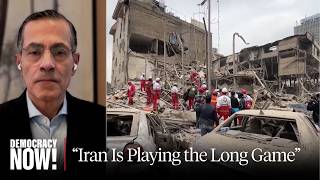
"Iran Is Playing the Long Game": What to Expect from Protracted War in Middle East
Middle East Crossroads: Is Turkey the next target? | Exclusive with Prof. Vali Nasr