Why Iran Isn’t Breaking: Vali Nasr on the Uprising That Isn’t Coming | The Mishal Husain Show
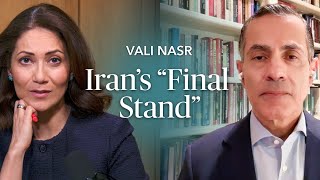
This content was created by Vali Nasr. This content was uploaded by Vali Nasr. This is a YouTube interview (Bloomberg Weekend/The Mishal Husain Show) titled "Why Iran Isn’t Breaking: Vali Nasr on the Uprising That Isn’t Coming" (created 2026-03-13). It features a conversation between host Mishal Husain and political scientist/author Vali Nasr, in which Nasr explains Iran’s strategic endurance in the ongoing conflict, the choice of Mojtaba Khamenei as Supreme Leader, Iran’s regional tactics and nuclear prospects, the impact on the Iranian diaspora, and historical drivers of Iranian policy. The excerpt is an on-the-record expert interview providing analysis and context about Iran’s politics, military strategy, and societal effects of the war.
Chapters
Iran never considered that it should lay down its weapons and just give in, and this has proven extremely costly to them. And now this is the final battle. This is where we've ended up.
Vali Nasr, political scientist and expert on Iran.
And we've won. In the first hour, it was over. If the president was looking for a quick political uprising in Iran, it's not happening, and it won't happen until the dust of this war settles.
The dust of this war settles. How long do you think that is going to take?
I think longer than President Trump is hoping for.
This is an endurance run. You're going to get battered, but you just got to stay up on your feet and keep going.
From Bloomberg Weekend, this is The Mishal Hussein Show. The question of when the Iran war will come to an end is one that so many people are grappling with and worrying about right now, and it's at the heart of the conversation you're about to hear. How can Iran still be firing missiles missiles and drones despite the force the United States and Israel are using against it. What does the new Supreme Leader think he can achieve? That's what made me think of Vali Nasr, a professor and author who I knew could take us into the mindset of Iran's key players. He's someone who's devoted his life to the study of this complex country and region and its relationship with the United States. He once advised the Obama administration. And Iran's story of the last 50 years has changed his own life too. When the 1979 revolution created the Islamic Republic, he and his family were forced into exile, and he's lived in the US ever since. In this, you'll hear Vali Nasr explain how Iran is playing a long game, seeing this as a final stand against American might. And he talks about how the Iranian diaspora is being torn apart by this war, as well as how inside Iran it's leading people to rally around the flag. Vali, welcome. Thank you for being part of this, for having this conversation at this very intense time. Can we begin with what the president has been saying just before the two of us speak, suggesting that the war will end soon. What do you think?
I think that is what he wants. I mean, he, from the very beginning, he was hoping that this would be a very quick war, that he would have a major win, kill the Supreme Leader, bomb some strategic sites in Iran along with Israel, and that there would be a new leadership in Iran. And he would be the president who brought Iran in from the cold, so to say, changed the trajectory of Iran's development. And now this war has gone out of his control. It's far longer, far messier, and is actually exacting a cost from the United States, both in terms of damage to its bases, to its military in the region, but also to energy markets and the global economy as a whole. So I think he's signaling that he wants to end it, but I don't think Iran is ready to quit. I think they've put their teeth into the United States right now, and they're not ready to let go. They've already suffered a lot. And I think they're prepared to suffer more, but they want to come out of this war with changing the US's calculation. They don't want to go back to the status quo before.
But how much are they really prepared to suffer? Is that endlessly? Because the, the price that they're already paying— more than 1,000 people killed, the fuel depots set on fire, the oil supplies affected by that— how large is the price that they're willing to pay?
It is a large price, but I think they had calculated this from before, that of course going up against two superior militaries with enormous amount of air power, that Iran was going to suffer. But I think their calculation is that this is not a munitions count. This is not about who has bigger bomb. This is about who has a higher threshold of pain. And they think United States and Israel can dash a lot faster, but they're not really long-distance runners. And so I think they're prepared to absorb this for far longer, And every indication, including the choice of a new leader in Iran, the fact that the population is getting angry at the US and Israel and is rallying around the defense of the country, all of it tell them that they can last longer. So this comes down to the end of who has more patience and who has a higher threshold of pain.
But Iran's calculation of doing all of that, to what end? To going back to the status quo? Before this war?
No, I think their thinking is that this had to be the last war. Either they go down or that the United States and Israel will abandon the idea that they could go into Iran and have a war every 6 months or at will. This idea of mowing the lawn, that the United States and Israel, and particularly the United States, has to pay high enough a cost to lose its appetite for war with Iran. And also, I think they want, as part of a settlement, that the sanctions would be lifted, that the maximum pressure would be lifted on Iran. There would be some kind of maybe even a ceasefire and withdrawal of Israel from Lebanon. But also, they are saying very openly that they want the United States to abandon its bases in the region. And they're following a very clever strategy here of convincing the Arab or the Gulf states that the United States bases are not really there to protect them. They're not protecting them. They're there to wage war against Iran and invite war on the Gulf. And I think they're hoping that when this war ends, that it will problematize the US presence in the region. And so this kind of a cordon that has been around Iran for a very long time will break down. Now, these might be maximalist goals. I'm not saying they're going to achieve it, but this is exactly what is driving them.
And is this particularly what has driven Mojtaba Khamenei, the son of the now killed Ayatollah, and the new Supreme Leader?
Yes, he's very closely associated with this view. First of all, what Israel and the United States have done is to eliminate the first generation of the revolution, by and large, from the leadership, particularly in the Revolutionary Guards and now the Supreme Leader. So there's a whole new generation of younger Revolutionary Guard commanders have come to the fore who have a very different view of national security. These are not people who earned their stripes in the Iran-Iraq War, in a big land war. These are people who fought against the US and ISIS in Syria and in Iraq. They have a very different view of national security, and Mojtaba is very closely associated with them. In fact, Mojtaba was very intimately involved in the whole process of shaping the Revolutionary Guards over the past 25 years, of who got promoted, who rose in the ranks, So he's very tight with them. And also, I would add, Michel, that Mojtaba, among all the other candidates, has two qualities that really matter now. One is that because he's been sitting next to his father for the past three decades, he, as well as the fact that he's a veteran of the Revolutionary Guards himself and a cleric, he's the most ready candidate to step in the job day one and doesn't need 2, 3 years to learn the job and to get settled in. And secondly, the manner in which his father his wife, his son, his sister were killed, particularly in the religious aura of Iran, even in the nationalist aura of Iran, gives him a particular charisma. In other words, he's earned this office not because he's a grand ayatollah or a great scholar, because of his suffering. I mean, he replicates Shia saints or mythical Iranian heroes. So he's the only candidate out of the ones that was nominated that actually has the greatest charisma, if you would. In terms of stepping into this role.
But doesn't the choice also challenge how many outsiders think of the theocracy? Because father-to-son succession is not supposed to be a thing in the Islamic Republic. And as you say, he doesn't have the religious credentials. He hasn't spent all those decades in Islamic learning and becoming an ayatollah.
Well, neither had his father. I mean, this office is metamorphosing over time since Khomeini took it over. So Khomeini also was not a grand ayatollah in the traditional sense of being really learned with a huge following. It's the office that made him, and he was referred to as Supreme Leader more often, which is a very secular title. And his son, similarly. You're correct that even Khamenei himself was of two minds as to whether it was a wise idea to have a dynastic succession. But at the same time, this succession is coming in the middle of a time when the country is actually fighting for its survival. It's not just a regime. That's very true. But when President Trump talks about arming the Kurds or that Iran's borders may not be the same at the end of this war, he's threatening Iran itself. And therefore, I think that ultimately the council of experts resolved on the leader they thought that was the best for this moment.
And as I said, Mojtaba brings certain qualities, that he can do the job, that he has the charisma and the backing of the Revolutionary Guard, the people who are charged to do this war.
So has the effect of this war been to transform Iran in the opposite way to what the US intended? Because I'm conscious that you were writing before this of a regime under so much pressure because of sanctions, because of the cost of living. We saw the protests at the start of this year and the way that they were put down. And yet now you're painting a picture not only of the determination of the regime to carry on, but people turning against the United States and Israel.
Very much so. I mean, we saw in January that there were enormous protests in Iran against the regime. And there is still huge amount of anger and dislike of the regime. Nobody wants to live under theocracy or economic isolation. But that simple black and white choice for Iranians, us against the regime, has been complicated with the fact that the country's under attack in a massive way. Iranians are fighting for their survival. I mean, if the city of Tehran is under acid rain because of the bombing of oil depots, People might die. People are dying.
Their lives are being destroyed. And so there's a whole new, if you would, political line opening up in Iran. Are you for war or are you against war, as opposed to are you for the regime or are you against the regime? And then are you for protecting Iran or are you willing to risk the destruction of Iran? And this is complicating the picture very much so. And increasingly what we are seeing, that even anti-regime Iranians are showing up in these rallies to basically saying at this particular moment is not the time to have our internal fights over politics, but to actually support the country. And so if the president was looking for a quick political uprising in Iran, it's not happening and it won't happen. It will not happen until the dust of this war settles. So for now, the Iranian public is not a factor in this war. And this was something that both Israel and the United States had been counting on. That the war would pave the way for a popular uprising.
The dust of this war settles. How long do you think that is going to take?
I think longer than President Trump is hoping for.
He thinks that he can just turn the switch off. And it's not that simple because unless he's willing to offer Iranians something big and he's willing to negotiate over some fundamental terms that I mentioned to you, I don't think the Iranians are ready right now. I think they are rebuffing overtures from the US right now, that it's not like last time. And then it really depends, Michel, on how this war ends. I think the future of the Islamic Republic will depend whether they come out of this war damaged, but with their head held high, that they withstood these two massive militaries and came out intact and forced certain compromises on them. Or whether they get actually collapsed or get battered and then have to accept a ceasefire.
And do you think that as this progresses, it could involve terrorism, that that could be a dimension that Iran chooses to employ?
It might. I don't want to say definitively not, but I think they already have their strategy. They don't need to do something that actually may turn off public opinion. I mean, I was in India recently, and it's very clear that outside the United States and the West, they're enjoying a huge amount of support for standing up to Donald Trump, for standing tall. And also they are actually inflicting pain on the United States. I think $120 a barrel oil and the shutdown of the economies of the Gulf hurting varieties of other businesses than just energy is much more effective for them than actually acts of terrorism, which will only play into the hands of the US to demonize them.
And I imagine playing into that are some of the searing images of the last 2 weeks, the schoolgirls, who, it appears, were killed by Tomahawk missiles, which are used by the United States. Donald Trump saying that Iranian naval ships have been sunk rather than captured because it's fun. Also, the destruction of heritage, the bombing of a city like Isfahan.
Yes, those things actually will turn the Iranian, particularly the damage to the heritage, will turn the Iranian public hugely against the United States and Israel. I think it convinces the population that the US and Israel are not liberators and they actually are out to destroy Iran. It's not about the regime, it's about Iran. But this is not going to be the war that President Trump had planned. And so the Iranians are exploring within this story about ways that they can get leverage and they can actually come out in a way that gives them advantage. And I would add, Nischan, there's a lesson that they learned in June, which is important to them, and they do repeat it all the time in their media, et cetera, that in June, it was not they who asked for a ceasefire. In their opinion, it was Israel that asked the United States for a ceasefire. So Israel bombarded Iran in 12 days, but towards the 12th day, it was getting exhausted. It was running out of interceptors. And so Iranians came to this conclusion that to fight the United States and Israel, you cannot match them in terms of firepower. This is an endurance run. You're going to get battered, but you just got to stay up on your feet and keep going.
Vali, can we go further back in time to get your, your take and for you to help us understand Iran's psyche, because your book, Iran's Grand Strategy: A Political History, goes back in time before the revolution. But I was particularly struck by how you describe the impact of the war in the 1980s with Iraq, where Iran really stood alone. The outside world was really on Saddam Hussein's side, and the lesson it learned at that point— is that the key moment where that determination that Iran has to stand on its own feet comes from.
Yes, exactly. I mean, that was a harrowing war. Probably upwards of half a million Iranians died. It took 8 years. It depleted national resources. It was the educational moment for a whole generation of revolutionary leaders, including Ayatollah Khamenei, who was Iran's president during the war, a whole generation of Revolutionary Guard commanders. And in that war, Iran ultimately was able to liberate its territory and then continue to wage war against Iraq, basically by relying on its own resources, learning how to fight when nobody would sell it tanks, artillery, air force, and everybody was supporting Saddam. And they learned that international organizations won't support Iran because it's a revolutionary government. Nobody would sell it anything. It increasingly was under sanctions. So the Islamic Republic for 47 years has grown up, if you would, trying to figure out how to do it on its own and that it's alone and it has to protect itself by its own resources. I mean, we see this in the fact that they're able to produce these missiles and drones. They're not buying them. This is a do-it-yourself country, which is a consequence of its isolation.
Yes, isolated in that way, but also willing and able to sow destruction elsewhere, whether it's the drones that have been used by Russia against Ukraine or, of course, Hezbollah in Iran and the Houthis.
Absolutely. I mean, in their own thinking, and I underscore that, I know how it looks to their adversaries, friends, etc., around the region, but in their own thinking, there is a strategy to this. This is not wanton destruction or some kind of a war on the world in the name of religion. Iran has been isolated by the United States, put in a box The United States has made alliances with its neighbors. It has built large military bases all around Iran, and then is economically has been sanctioning Iran and tightening the cord around it for the past 47 years. So to them, they cannot fight this in a conventional way. Nobody will help them. So essentially, it's an idea of a global sort of guerrilla strategy against the US, that, you know, you build militias in Lebanon, in Iraq, in Syria, in order to defend yourself farther away from your borders, that you need Russia's help for varieties of reasons. And the price for that is to help Russia at its moment of need because you need a Russian veto when the United States wants to put you under sanctions at the UN, or that you try to needle the Arab countries in order to raise the cost of supporting the US strategy against Iran. Now, it has often backfired on them. It won them the enmity of the Arab world, and the strategy of defending themselves in Lebanon and Syria collapsed. But Iran never considered that it should lay down its weapons and just give in and arrive at peace with Israel and the US. It has been determined to fight. And that's probably the folly or the consequence of the strategy Ayatollah Khomeini and Khomeini pursued. This idea that United States is a threat to Iran. The United States wants to take our sovereignty. We have to keep the US out of Iran and in fact, kick it out of the Middle East. And this has proven extremely costly to them. And now this is the final battle. This is where we've ended up.
The final battle, as in it is existential then for the Iranian regime, you think, one way or another?
Yes. In fact, they call this the final battle. In other words, either we go down or that cordon gets broken. They very well understand that this 47 years of resistance to the United States is no longer sustainable in the way that it was waged. Iran is dying economically. It's continuously attacked by Israel and the United States now on its own soil since the collapse of Hezbollah in Syria. And so this is the final stand that either they go down, either resistance collapses or resistance manages to change the rules of the game. And that's what they're betting on.
So if you were designing a US policy towards Iran right now, and I know you, you worked on US policy, right? You're an adviser to the State Department. You worked in the State Department in President Obama's time, which did result in a policy of engagement towards Iran in that there were nuclear negotiations. So that's a form of engagement. If that path had been continued, if Donald Trump hadn't ripped up the Iran deal, would it have resulted in a better present, or is your description of the regime too entrenched for that?
You know, I think it could have ended up in a better place. First off, even revolutionary governments evolve. So, And it's not only that Trump came out of the deal, but what followed his coming out. In other words, putting maximum pressure sanctions on Iran and trying to squeeze Iran more. That maximum pressure itself transformed Iran. It hardened it, it radicalized it, it made it much more determined that the US cannot be trusted and is out to destroy Iran. The more hardline, hard-headed leadership rose to the helm in Iran. So that was one direct consequence. Secondly, let's look at the other side. Say that the deal had continued. Many of those who were negotiating that deal, like President Rouhani or Foreign Minister Zarif, were of an opinion that success of that deal was the building block of gradual change inside Iran and gradual change in relations with the US. And I think President Rouhani's office had an estimation that if the deal had lasted for 10 years, the size of Iran's middle class would've grown by 35%. And that was really the constituency for change in Iran. Whereas when Trump came out and imposed maximum pressure, actually 20% of Iran's middle class within the first 2 years fell under the poverty belt. And so, you know, a poorer society under economic pressure becomes more authoritarian and becomes more radical. So yes, I would say the JCPOA was a leap of faith, but it is a tragedy when we look back at that. At one point, it was a tragedy that it was not given the opportunity to prove itself.
Do you think Iran will now be determined to create a nuclear bomb if it possibly can?
Yes, I think the door is open. First of all, the former Supreme Leader Ali Khamenei had issued a fatwa saying that nuclear weapons are forbidden under Islam. Now, the West may dismiss this as irrelevant, but to a Shia ayatollah and to his followers, a fatwa is quite a very strong statement. The Shias don't follow dead ayatollahs. That fatwa is now no longer valid. It's no longer standing. So it would be up to Mojtaba and clerics in Qom to decide whether they will renew that fatwa or not. But national security imperatives now suggest that Iran will go towards nuclear weapons. First of all, they made a determination that their strategy over 20 years of trying to have an open nuclear program that could be monitored by IAEA, trying to prove to the world that they don't want a bomb, was a mistake, that they should have followed India-Pakistan model. They should have never discussed the program. They should have gone for a bomb rather than a program. And so everything the West did actually made them convinced that trying to negotiate with the world for a civilian nuclear program had been a mistake. It only invited sanctions and war. So where they go from here, I think, is that either they would give up the program altogether, which I don't think is likely, or that the program would essentially become much more of a military program and a secret program.
That's a very stark prospect. I mean, supposedly that's exactly what countries like the United States and its allies have been trying to prevent for decades?
Well, if you, it's very easy to sort of think of Iran as an awful rogue state in the West, and then to say, well, this policy is specific to Iran. But every US policy has an audience out there.
You know, there's a lot of countries now have looked at this and said that if they want to go down that path, they should do it quickly and secretly. And that the United States and Europe will play with you, will put sanctions on you, will deal with you, sign a deal, move out of the deal. And in the end, you end up where Iran is. And so maybe many countries would be dissuaded from even thinking about nuclear issue. But we're also in a world where President Trump is encouraging everybody around the world to develop a weapon of mass destruction to protect themselves from a Venezuela-Iran scenario. I mean, I recently read eminent Pakistani scholar said that how grateful he is for the first time in his life that his country actually made the choice to build nuclear weapons. And so that's a very huge statement. So there's a lot of other countries that are afraid of this kind of American foreign policy of changing leadership on countries, bullying countries, and they will decide that they need nuclear weapons. And so I think Iran has been a very, very bad example for the rest of the world.
Vali, can we go a little bit further back in the 20th century than we've already talked about? Because I learned so much from your book about, for example, Iran's experience in the Second World War and then in the Cold War, and what someone like Khomeini, the founder of the Islamic Republic, learned from those experiences. Take us through what happened.
I mean, the leadership of the Islamic Republic, but also the Iranian people, are keenly aware of Iran's history.
Is continuously evoked. And it's a history in which Iran has barely survived to the 20th century, that it has had aggressive neighbors, Russia and the Ottoman Empire, who've taken territory from it. It's been abused by the British and the French and colonialism. And then in the 20th century, in both World Wars, the country went through famine because of Western policies. It was occupied, it was nearly divided, lost territory. And the older generation of the Islamic Republic was reared in that environment. I mean, between 1946, end of World War II, and 1953, Iran experienced massive amount of foreign intervention. I mean, first in 1946, the Soviet Union occupied northern Iran and wanted to break it off. And it was America and Britain intervened, that didn't happen. But you had a generation, the monarchy, et cetera, who basically were shaped by that experience. And then barely 7 years later, Britain and the United States intervened in Iran to remove a prime minister who wanted to nationalize Iran's oil company.
This was the CIA and MI6 in 1953 against Prime Minister Mossadegh.
In 1953. And so for Khomeini, for Khamenei, they believed that the Islamic Republic was created in order to change that history. No more foreign intervention. No more bullying by superpowers. I mean, they say this, and Iran's former foreign minister a few months ago on an interview with Foreign Policy magazine said the Islamic Republic is the first government in Iran in over 200 years to give Iran genuine sovereignty and protect its borders. Because that sort of history has been internalized by the revolutionary leaders as 200 years of Iranian, Iran basically being under the thumb of outsiders. Including the Shah's period. And I don't agree with that analysis, but that's the history that is in their minds. So history is very important here in that sense.
What do you think of the Shah's son, Reza Pahlavi, and his desire to be seen as a future leader in Iran and the support that he seems to have got from some people, at least before this war, the fact that his name was being chanted on the streets?
Well, I think he did have a huge moment before this war, and we'll see whether It continues for the reason that, you know, historically there have been two important institutions of power in Iran since at least the 1500s. It's the monarchy and the clergy. So when the monarchy was in power and it abused power, it was the clergy who stood up for the people. And when the clergy are in power and they abuse power, it's the monarchy that essentially people see as the alternate institution. And Iranian monarchy has always stood for the grandeur and power of Iran historically. And also, I have to say that under the pressure and the abuse of power that has happened in Iran under the Islamic Republic, there is enormous amount of nostalgia among Iranians for the Shah and his father, that those were better periods. Despite authoritarians, Iranians had better lives. It was an open country. And the Shah's son is a beneficiary of these deep feelings in Iran. So he symbolizes the desire for a return to the good old days, a sort of a future cast in the image of a golden past for many Iranians. I think the problem right now is that, first of all, he never invested in building a ground game in Iran, an actual organization and movement. So yes, he has enthusiastic supporters that could ebb and flow, but enthusiasm of the popularity is not the same thing as having a political program. But in addition, he's allied very, very closely with both Israel and the United States. And this runs against the grain of Iranian nationalism. But we shall see. I mean, you know, it all, as I said, depends on how this war ends. But unless he has a ground game in Iran and unless he actually stands and represents Iran's desire for safety and security at this point, I think it will be very difficult for him to play a significant role.
All this history that you're describing, the last few decades, it's changed your life, hasn't it? Your family's life. You were 18 when you had to leave Iran yourself. Can you describe that period, what it was like to leave the country?
It was very difficult. I mean, we didn't refer to it as refugees then. We called it exiles. But my family left Iran very, very abruptly in 1979 for fear of our safety and all our property, everything in Iran was taken by the revolutionary government. And I ended up going to school and university in the West. I think the disruption was traumatic. It was traumatic for all Iranians that have experienced it since. It is extremely difficult to lose your country, right? And to do so involuntarily. You know, there's a difference between migration and refugee or exile status. But, you know, the bonds with where you were born, where your identity comes from, from the history that you know, from people that you know are there. And so the pain that Iran faces at various times is a pain that you continue to acutely face, even though it's been 47 years since I lived in Iran.
And I know you did manage to visit once. I'm curious to know more about your father because I know of him by reputation. He's a renowned scholar of Islam. He's written many, many books which are read by Muslims and others alike over decades. Why was it not possible for your family to stay in Iran? Because I would have thought with that kind of academic pedigree and his knowledge of Islam that that would be appreciated by the clerics and by Khomeini.
Well, first of all, he worked in the Shah's government. He was chancellor of a university, and towards the end, he was head of the Queen's Special Bureau. So That government affiliation made him a target, if you would, for the eradication that they were implementing towards the Shah's officials. But secondly, not all Islams are the same. So my father stood for a mystical, a different interpretation of Islam that was not the creed of the revolutionaries. I mean, over the years, his books have been translated into Persian and have a huge following in Iran. But the following is mostly among those Iranians who have a deep have a cultural and spiritual relationship with Islam or want to have it, but don't wanna subscribe to the political Islam of the Islamic Republic. And Islamic Republic, like all revolutionary governments, is very intolerant of those he sees as a political and ideological deviation or rivalry. So when you sort of get closer than just basically it's all Islam, there are many different shades. And so his particular, his writings, his approach, was not welcome particularly. And at the beginning, for the reason that I mentioned, but even later when his books have become very popular in Iran, it has created different kinds of sensitivities about a sort of Islam that is not supportive of the official political Islam of the state.
How is he in the face of all of this? What are your conversations like at the moment?
I think for his generation, this is even more painful than mine.
Because, you know, they lived a far longer time period in Iran and they saw much more of its history. And now they are living to see the destruction of the country. And some of them also remember World War II. For instance, my father was a child. And so they can very easily sort of empathize with that moment. I think for all Iranians generally, I mean, there are a segment of Iranians abroad who are celebrating this war. But I would put them aside. But for majority of Iranians, I think this is an incredibly painful moment, regardless of what they think about the Islamic Republic. The relationship of Iranians to Iran is a cultural, patriotic, nationalistic relationship. It goes above and beyond any one government. And I think for a lot of them, they feel it is not the Islamic Republic that's suffering, it's Iran that is suffering. And so emotionally for them, it's very difficult. They also are living in the countries that have a very different perspective on this war. And so that adds to the problem. I remember when I first came to the US, it was during the hostage crisis. As a 17, 18-year-old, it was extremely difficult being Iranian. And then we all lived in the post-9/11 period, which was incredibly difficult being a Muslim in that environment. And now once again, it is this similar kind of a situation that America's at war with Iran. And for a lot of Iranian Americans, this is again, is as difficult a moment as being a Muslim American was after 9/11.
How do you handle all of that yourself? Because your job, as you are doing with us right now, as you do when you write, is to make sense of this complex and difficult period, to interpret it. But as you look at the videos and you see messages on Telegram and elsewhere, do you find yourself shaken?
Yes, often. I mean, deep down, I think this animosity between US and Iran and the policies of both sides has not been good for either country.
And I don't think this war will serve the United States either. So the way I think about this is in terms of what is good for the Middle East, what's good for the United States, and what's good for Iran. But, you know, we all have to cope. As I said, maybe having gone through the experience of the hostage crisis when I was much younger, having gone through the experience of post-9/11 period, I think we are all more prepared for this moment. But there's also deep fractures within the Iranian American community itself. And that's, in a way, is even more painful to watch and to experience at this moment, that also the community abroad is eating itself as a consequence of these events.
The divisions? Because some people, you mean, are cheering the Americans and the Israelis on.
Yes, exactly. They are. And this is creating a great deal of friction. It's become now very much common to talk about how friendships are broken, how people don't talk to each other, how members of the family don't talk to each other. And it's very simple. It used to be, are you, you know, for the regime or not? And that was a much easier answer. But now that is, do you support the war or you do not support the war. At what price should Iran pay for the Islamic Republic to go? I mean, there are those abroad who say that they're willing even for Iran to be divided, to lose territory, a war at any cost for the regime to go. And this makes for very difficult conversations within the community. And now it is not just that Iranian Americans or like Muslim Americans have to have difficult conversations with American Americans who are Christians or Jews. It is the most difficult conversations we're having now is actually with our own kindred.
And do you think that there will be a change to borders at the end of it? Like, if you look at the Iraqi border and the fact that there are Iranian Kurdish groups which could cross that border and which have had relationships with the US, or if you think about the border with Pakistan and the Baloch people on both sides of that border?
It's possible. I mean, if the state collapses in Iran and if this war truly creates a situation where Iranian security Security forces cannot control a country the size of Western Europe, and you have neighbors along with United States and Israel supporting separatist groups, it's possible that one may end up there. But I can tell you, Michel, that right now the talk of it, the prospect of it, is actually unifying the Iranian people at the center in defense of the country. So when President Trump said, "I'm not sure the borders of Iran would be the same at the end of the war," I can tell you in Iran, this felt like a 2-ton rock. It created huge amount of anxiety and rallying, if you would, to the flag. But again, it shows the degree of anxiety that Iranians are feeling and facing. It's not about the collapse of the Islamic Republic, which maybe many of them would welcome in some ways, but they are really, really worried that the price that the country itself might pay. And I think that may create even a sort of unexpected outcomes within Iran and in terms of how it wages this war, how the people react to it.
Vali, to close, I want to go to the words with which you begin your latest book published last year, where you wish that Iran finds its rightful place in the world. Can you paint a picture of that? What is your vision for Iran's rightful place in the world?
I mean, I would like to see a country that is prosperous, that is open, that its people are happy, and that is at peace with its neighbors and with itself.
And Iran for 47 years now has been at war, has been at war with the United States, with Iraq. It's been in economic war and now in hot war. And its population is exhausted. And its population has a deep sense that Iran is capable of much more than this, that it should be a great power on the world stage. And I wish for that to come true. And I wish for all Iranian Americans to be able to not have a distant relationship with Iran, but this, this large community, very talented people who love their country, to actually to be able to coexist with it in an organic way. And same with the people inside Iran, to be exposed to the world in a way that they currently are not.
Vali Nasr, thank you so much for sparing us some time.
Thank you.
More from Vali
Trump has no easy solution for Iran's chokehold on global markets, says Vali Nasr
Why This War Could Be a “Turning Point” for the Global Order - Vali Nasr | Endgame #261
Iran Is Playing the Long Game to Exhaust the U.S. — So Far It’s Working | Vali Nasr
"Iran Is Playing the Long Game": What to Expect from Protracted War in Middle East
Middle East Crossroads: Is Turkey the next target? | Exclusive with Prof. Vali Nasr