Above the Stack Ep 11: AI Is Coming for the Old MSP Model. Build the Next One First.
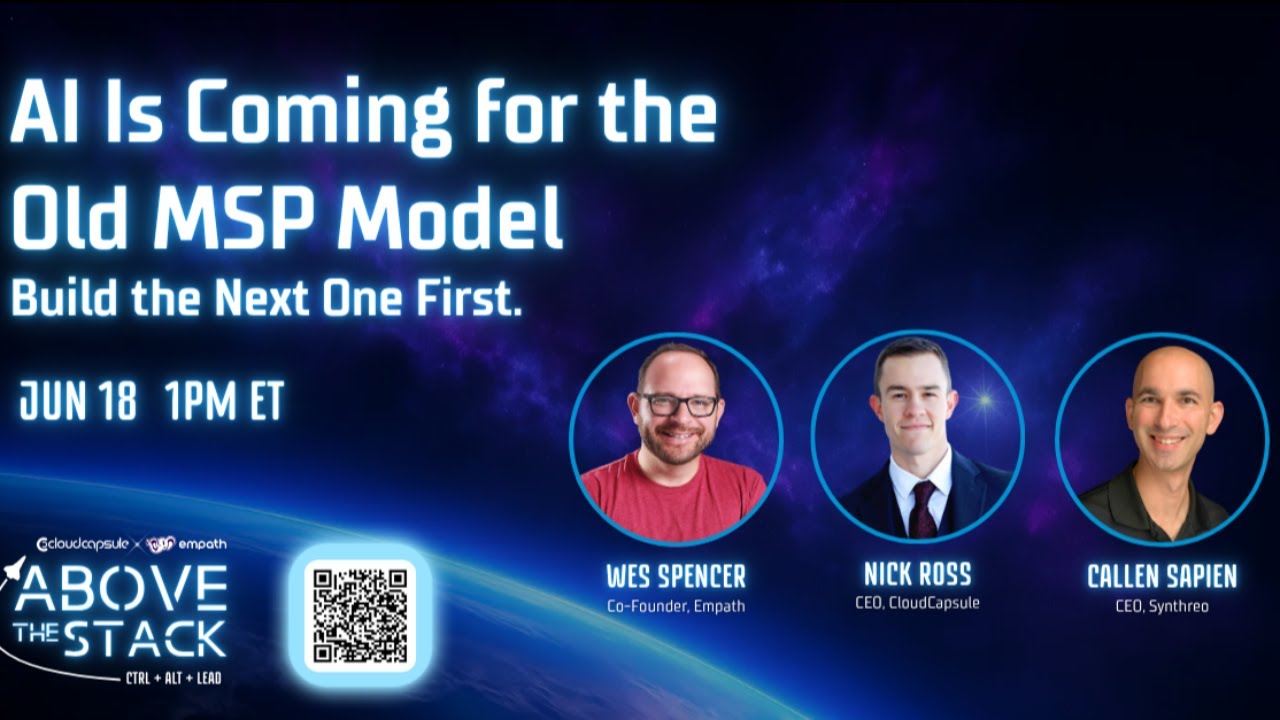
Calen Sapien argues MSPs must abandon low-margin delivery and rebuild around high-margin consulting and AI advisory work. AI won't kill MSPs, but it will kill the old model. The panel covers help-desk automation, new monetization paths like AI-as-a-service, and how to shift client conversations from technical specs to business outcomes.
Chapters
communications arrays are aligned.
Nobody cares about your stack, bro. Well, well, well. Hope y'all are doing awesome today. Nick Ross, how are you, my friend?
Doing great, doing great. Another week almost, almost getting to an end here already, but, uh, been good. It's been fun.
Right. Yeah, it has been really good. I actually did a thing, Nick. I took a vacation and it was great. Yeah, we went up to Glacier in Yellowstone and it was absolutely phenomenal. Had a great time. It's good to kind of disconnect. Best thing about those kind of places are you are— there's no cell signal. So like you're kind of doing your thing with, you know, you're forced to check out.
Yeah, I went to Moab a few weeks ago, did the same thing. Zero cell service and I can actually sleep. I found that I have to take, take the RV out to get that done for a full night's sleep. But it is a good reset and it brings you back a lot more recharged. So I bet you feel the same.
Uh, yeah, 100%. Yeah. And then you're itching, ready to go, and you feel the, the, uh, the guilt of like being away for so long. But man, it's great. Uh, man, a bunch of people checking in. Uh, Billy Turner, what's up, my friend? Good to see you on. You got the one and only Dr. Keith Nelson. What's up? I hope you are doing fantastic as well. Yes, this is being recorded. Andy Lahren, what's going on? And I'm not gonna— well, I will spoil our guest in here in just a second. But this is gonna be a lot of fun. For those of you that are joining for the first time, welcome to Above the Stack. This is a really awesome series that Nick Ross from Cloud Capsule and myself, Wes Spencer, are doing. And Nick, I've been checking the numbers across all the platforms. We're averaging 3,000 views an episode, which is, I think puts it in the tier of like some of the highest watched MSP content that's out there, which is just phenomenal. Like I'm just blown away by it. And I don't know about you, but the content's been a ton of fun. And we've been going down this AI journey and really excited to have our guest on today to talk more on the same. It's going to be great.
Yeah, yeah, it's exciting to see just kind of the resonation, obviously just going beyond the tool set, but now obviously with the AI focus as well too, just a lot of people wanting to collaborate there, and there's definitely a lot of guidance needed just given everything's changing every day. So excited to dive in as well today.
Yeah, as are we. And we've got up there, there, the QR code for— we're big fans of giving free stuff away, so we've got a free worksheet that, um, you guys are welcome to go grab. We try to do that every single episode, So make sure you check that out. We'll actually talk about it more in just a minute. But what we're gonna be talking about today is AI is coming for the old MSP business model. And Nick, I don't know about you, but I've heard a lot about this. I've heard, you know, there's just from the major tier 1 AI providers like Dario, you know, saying things like, hey, look, you know, the end of days are coming for MSPs and, you know, or I'm sorry, not for MSPs, but for like the job world. Then they pull back, you know, those statements say, well, maybe it's actually not here to take our jobs. And then you have probably more nuanced and balanced approaches like, uh, Jensen Huang from NVIDIA that says like, "AI is not coming to take your job. The people that are using AI are coming to take your job." And I think that's filtered down into the MSP space. And there's been just a lot of discussion around this of like, what does this mean for all of us? What, where is this thing going? And that's why I think this is going to be a really fun discussion today to get into just what the, what we're talking about, this new business model that's coming in front of us. And what's changing in the wind. So really excited, Nick, to be talking about that. And let's see, I can't get my slide to go forward. But I guess while I'm fighting with the AI bots, let's go ahead and bring our guest on. If you guys don't know, we are super excited to have the one and only Calen Sapien join us on the call today. Calen, what's going on, my friend? And you are muted, I just noticed.
No, I'm not. How you guys doing?
Fantastic.
Nice. Thanks for having me. Really excited. The other episodes have been phenomenal. So excited to be able to come on and have a good conversation and hopefully contribute something.
Man, there's no question that you're going to be pivotal in that, I think. And for those of you that don't know Callan, let me go ahead. I did finally figure out my slides here. Callan, I'd love for you— I'm going to pop your bio up here. I'd love for you to just tell us more who the heck you are and what you're doing these days.
Yeah, thanks. So obviously my name's there, Calen Sapian. I've been in this channel for about 17 years. I can count 21 if I go back to helping some roadside computer shops turn into MSPs, but I think it really probably counts when I joined ConnectWise. It was really early on. ConnectWise lasted about 8 years there, helped us through the acquisition. You're welcome or I'm sorry, depending on your experiences. And then for the last 5 to 7 years, really been focused on DevSecOps, security, automation, data. And then the last 4 years, it's been all in machine learning and AI. So for me, you know, we realized you made a statement that, you know, AI is coming for us. I actually, people would probably put me in the doomer category. I think that there is a lot of good and there's a lot that we can. And the reason we built Synthrio. Which is what we're doing today, which is an AI platform, a set of services for MSPs to deliver AI as a service to their customers and to their clients, as well as use it internally, was because my concern is that we're in an existential moment, that if we don't embrace it, it's going to move on without us because things like helpdesk are just commonplace. You go to any event now and you see 8, 10, 12 vendors figuring out 85%, 65%, 95% of all help desk tickets, right? And yeah, people laugh at it. Oh, it's not great here. It's not great there. But it's getting better. It's getting much better. So that's what we're working on and we're really excited for it. My favorite thing is when I see my partners making money off of what we're doing and that's what we care about.
Yeah, I absolutely love that. And this is going to be a good conversation today. Nick, I'm going to have you kind of get us onto the playing field if you would. Oh, and by the way, we do have this, our AI Business Transformation Information Conversation Worksheet. We've got a ton of really good commentary out of that. So if anyone wants to see that, go download that. Absolutely use it in your conversations and let Nick and I know if it's been helpful. Let Nick and I know if you've made changes and made it better. Love to hear from you. That QR code will always be up there at the top right of the screen. So you'll be able to get to that anytime. But Nick, I'm gonna have you kind of get us kicked off into this whole conversation— oops, I didn't mean to click it. There we go. And kind of get us onto the playing field here today on what we're going to be talking with Nick about, and it looks like I am still fighting with my slides. I guess it wants to keep opening that link, which is strange. Let's try. There we go. So AI is coming for the old, the old MSP business model. Nick, um, let me just ask you first of all, does that resonate with you? Is that something that you feel like is true, or is this just a whole bunch of hyperbole?
No, I don't think so. I mean, you mentioned the macro element, right, of, you know, these broader enterprise companies and, you know, some of the biggest players in our space kind of bringing that down. We're feeling it there, but I think more so from the MSP level, we're feeling it just because our customers are coming to us, right, all the time about, you know, what, what should I be doing here? Or I've started this AI project and I don't know where to go from it. Or they're just not talking to you and doing it today, right? Um, and at a micro layer with that, it's as basic as using a frontier model. And when I say frontier model, I mean something like a Claude or a GPT or a Copilot in that sense, and doing it without any governance in mind, you know, right? Most people can go in and sign up with a Gmail account that's personal start uploading corporate docs and start interacting with it. And they're not trying to be malicious in nature, but it is— or, you know, just, just get around the IT barrier, if you will. But it's happening today. And the downsides, obviously, we think of security and governance first, but secondary to that, that's more of what they're trying to do is really reach this new productivity layer. And that's where I think, you know, a lot of us can step in and help with that. But a lot of the conversations and the hype and the FOMO, if you call it that, and the sense of like feeling always behind both from a learning curve and from your business model perspective, is thinking about, you know, how much clients are diving in there today where we really haven't seen that type of technology adoption in the past as well too.
Yeah, Callan, I'm curious to hear, I mean, like you said, and yes, I count the old days when you're helping people become MSP. Absolutely, that counts. We're going to add to the years. You've been in the space as long as anybody. Tell me, what would you describe as that old business model and what are some of the key elements that you think are on the cusp or already have changed underfoot?
You know, it's funny, I actually think that the old business model is what we need to embrace. You know, the title sounds like doom and I said I'm a doomer, but, you know, you said it too. The AI isn't coming to replace MSPs. It's coming to replace a specific type of MSP. And it's the type of MSP that, you know, I tend to get in trouble for being spicy sometimes. I know, Wes Spencer, you enjoy my spiciness, but I said this at PAX 8 last week. It's coming for the MSPs that have leaned into the product-led delivery, right? We, we as vendors have not always done the best job in helping MSPs continue to establish a services offering. I think if we lean back into where we were when we were putting in Novell Systems, when we were changing over infrastructure, when we were still managing Exchange servers before it moved, we need to take control of the infrastructure again. And that's what AI is at the end of the day. Like we say AI and it's, is it personal productivity? Is it agents? Is it machine learning off of your data? I think the MSPs need to lean back into the things that gave us 80, 200, 150% margins. And I think that's really where we need to go. We need to stop letting the vendors dictate what the value of something is and stop slinging product and embracing the VAR side and start moving back towards that consulting motion, like match things back up.
And I think that's a great point too. Oh, go ahead, Wes.
No, no, you're up.
Yeah, I was just saying I was going to piggyback off that. I think, you know, it's really coming back to like, do you actually understand what your customer's pain point is? Right. And I think that with AI is a huge component because they're looking to dabble there. They're seeing their competitors, quote unquote, use that and feeling that competitive pressure. They're trying to, you know, get plugged in themselves and see where they can get operational efficiency. But there hasn't been, you know, monumental success, especially not in SMB, right, that most of us serve out there. And I think that's a big deal to talk about, you know, your point on repositioning yourself as a service provider and that trusted advisor. But that also means you deeply understand, you know, how you can help that business, right? Versus just saying like, well, let me put my security stack in place and it's ThreatLocker and SentinelOne and, you know, you name list these, these vendors, which are all great. You know, at the end of the day, like, I'm not knocking the vendor, but I think it just comes back to how you're presenting yourself to that point, too.
Yeah, and it's— there's so much to say about, Callan, what you talked about, like the vendors themselves. We are all 3 vendors. We want you to buy our ish. And so what do we say continuously? You should buy— if I'm not picking on any of us 3, but like, as vendors, we're responsible. We put bread on our table when you go buy our ish. And so we want to tell you things that include you having to buy our software. There's nothing wrong with that. But I think it's up to you as the implementer and the actual owner of the trust relationship with the client to think about what do they really need? Am I just slinging something at them that they're, that I'm told I need to sell them, or I'm actually making their business more efficient, more secure, more capable, more scalable, removing barriers and outcomes, making them more future-proof? Like these are the things that really matter. And Kaunil, I love that you kind of led with that because I think our clients are much smarter than we give them credit for. And if we see ourselves primarily as a slinger of licenses, I think that is a huge component of the model that will not continue. I think it'll always be a component of what we do, but it'll be such a small sliver that I think those are the things that's going to erode away in favor of where we're going with a consulting-first nature.
Yeah, it's our jobs as MSPs are not to consolidate billing and licensing into one place around the technology. It's to make sure that value is being derived. I actually think that the self-adoption of AI, the shadow component over the last 3.5 years that AI has been commonplace in the marketplace, is a tremendous opportunity to lean in to the, the Be Our Guest methodologies, to the business process side of things. Because what we see every day are people that have their Prometheus moment. They get into Claude, they rewrite monday.com, and then they hit the wall, they hit the Claude wall and they go, okay, now I need infrastructure. Oh, I need other people in the company to use this. And they go to the MSP, it's like, hey, are you going to host this for me? It's like, no, it's going to cost you more than Monday. But now that gives such a tremendous opportunity to say, here's where I can provide the value as a service, right? And it's incredible when we can do that because they've already engaged with AI. So now we get to go and say, okay, here's how you get value out of it.
Yeah, yeah, that's exactly right. And if you've missed what we've been talking about, Nick and I have already gone through this conversation with a number of others. For those of you that are joining for the first time, welcome to Above the Stack. Nick, some of the things we talked about here is the reality is this conversation is already underway and your clients are already using AI tools every single day. The data shows that you just may not be in the loop. Is that correct, Nick?
Yeah, 100%. I'm working with a lot of MSPs today that are, you know, just using tooling native in Microsoft because that's our, you know, our focus area, but there's things that you just see over the network where most of the organization's using cloud, you know, and we— and to my earlier point, you know, like there's the security and governance aspect of that, that's kind of scary and kind of your gut reaction as an MSP, like, oh wow, you know, there's a lot of data exposure potentially there. But the flip side is like, how could you, how could you enable them, right, to use cloud and come in there? And to Callan's point earlier, instead of like being on the back end of that conversation where they've spun up some other, you know, third-party app or they've gone down that route because they're now capable with natural language to do so. How can you get ahead of that conversation and say, hey, here's the first stage of what we're going to get into, and I don't care what business or AI tool that you use, like I'm just going to help you govern it. I'm going to give you some guidance around that. And that enables them to carry it forward without feeling like you're restricting them from access, right? Because they'll always find a way to then use the next tool, right? There's, there's only so much you can do in that way. And it's easier than ever now to expose your corporate data to a model like Claude's free program or the personal plans where it's training the underlying model, right? In that sense as well too. So there's a lot of great business cases to do that. But on the opposite end, from the productivity realm, I always feel like if you actually enable the organization to get on a frontier model like that and get them organized, we'll actually have exponential productivity benefits too. And you can guide them through that journey as well. So there's, there's benefits on both sides. You're not just restricting it from a security and governance perspective, but the productivity realm is big too. And last point I'll make is just from a small business perspective, there's a ton of statistics just around like the lack of adoption, obviously right now. But there's a lot of consideration when it comes to, number one, their skills and confidence in using it. Right. And so there's, there's a need there from, from that. Perspective. There's a knowing where to start because it's, you know, new tool every day, new model every day, getting retracted by the government, coming back into the play, right? Whatever it might be. And so there's just a prime opportunity to kind of step in there and be that leader for them at this point in time too.
Completely agree.
Yeah, that's well said. So, Callan, I want to come to you on this because you made this comment to me a while ago and I thought it was insightful. I think you're correct, is that I think for years not painting with the broadest of brushes, but a fairly broad one, that a lot of MSPs, as AI was starting to come out, you know, and clients were curious about it and saying, what is this? I'm reading about it and I'm hearing these huge valuations and the market's literally moving based upon, you know, GPUs and data centers and, you know, the politics are sky high. What should we be doing about this? And a lot of MSPs, Callan, were just kind of like, don't worry about it. It's too early to tell. Don't touch it. Don't do anything. And I don't think that actually changed anything for the client. I think they just said, okay, well, my MSP SP doesn't want to be part of the conversation, I'm going to move on. What are your thoughts on this?
I think we still see it a lot. And I think that one of the broad issues is we're tinkerers and we're experts as an industry. And AI is so new that we— it's not that new anymore, right? November 2022. It's been a while. But we we looked at it in an avoidant state as an industry because there wasn't a lot of infrastructure shifting things. Until recently, agents cost entirely too much. You couldn't access them securely or deliver real meaningful business infrastructure outcomes. And most of the gains were personal productivity gains. MCPs changed that, direct integrations. Cloud Cowork was a major change for that. And I think, and Claude Code was a major change for that. And so what I think happened was, is MSPs thought that they were gonna have the time to learn it and master it. They got into it, realized that the first year or so it was people making images and cat memes, and it wasn't actually bringing a lot of value. So they didn't, so they put it on the shelf and dealt with the 3,000 other tickets and the constant cyber attacks and everything else that their clients were unwilling to pay for. And it just shot right by them. Them. And so now we're starting to see massive disruption as it went from, I would say, especially from September of last year until now, the models have reached almost to where they're peak from an LLM perspective. They can actually work through. They still don't do good at judgment calls. They still don't do great at, I would say, creativity, but they are actually able to take tasks off people's lights. They are able to deliver something that's meaningful and consistent and usable. And because you're selling to consumers as an MSP, they've been screwing around with it. I always have to monitor myself, but, you know, messing around with it for 3.5 years. And so now we need to start messing around with it and we need to get into it and we don't have a lot of time to do so because people are getting help outside of it. And the help they're getting is not that helpful, to be honest with you. I talk to AI consultants all the time and they are jumping in. They tell you to deploy Copilot, deploy Claude, charge you $40,000, $60,000. I talked to a CPA the other day that has spun off an AI consultancy and they're actually going into MSP now. They've paid an outsourced help desk to take away MSP business and get margin on there. And they're selling $30,000, $60,000, $40,000 engagements to revolutionize your business that are one-time fees and then taking that other piece on. And you're seeing the ability for people to spin these things up very quickly.
You really are.
But there's a lot going on.
There is. And I think for a minute, let's take in Nick. I know of nobody better than you to have this conversation. I think If we take— there's some history lessons from the past that I think we can look at to both learn from, glean from, defend against, and even leverage in some ways. And one of those was this huge cloud transition, right? I mean, we all remember the, you know, the mid-2000s era when, you know, we were building server closets left and right in every single customer's premise, and we thought VPN was like the coolest thing ever because then we could reconnect all of these things. And but, but really cloud changed all of that. Nick, what are some things that you have seen from this cloud transition that we can learn from what Callan's talking about of this evolution that's in front of us.
Yeah, I think the funny thing is like we still have laggards, right, from the standpoint of not everybody— like most MSPs that run, you know, have a bunch of hybrid clients still, right, where we're like still trying to transition into the cloud fully. And, you know, the, the CapEx, OpEx expense model has not always, you know, been the best benefit for that company, or they've got so much legacy line of business applications or different types of infrastructure that it really wasn't feasible to go in and do that. And so I think with this motion, I think we're going to see a lot less of that, that laggard type of effect just because it's being driven down at such a fast pace and at such a macro level as well too. Not only from a like a social pressure perspective, but just how it's getting infused in every product that we use now as well. Started off as that like magic wand, like our, our product is AI powered. And now it's turning into— the people still say that, still overinflated for sure, in my opinion. Um, but there's actual— to Callan's point, there's a lot of tangible business outcomes that can be driven. Um, and even at a very micro layer of a personal use case, right, like helping you draft your emails, just saving you hours per day in the normal things you do from an admin work perspective is low-hanging fruit. And we sometimes overlook that for those bigger projects, right, that people want to go in and do like rewriteMonday.com, to Callan's point earlier as well too. It's like you can go do that, but do you want to become a software company, right? Internally is a bigger macro question, and that requires somebody to be, you know, like the— to your point too on cloud, somebody to be that strategic advisor to say, well, this is how your infrastructure looks today and this is how it could look in the future, and this is the bridge that we're going to take to get there. And have that strategic oversight that's looking at the macro lens versus thinking about well, I can create a much better monday.com, right? And, and getting all caught up in that— I, I'm a proponent of that too now with like the build-buy-partner conversation has turned into we can build things a lot faster now, um, and, and a lot easier in some cases. But you don't realize like how much tech debt and other things, and from a maintenance perspective, are incorporated into that. And so there's a lot there that you have to factor in. But on the, on the model as well too, it's it's a big learning curve, you know, just on the sense of like, how are you reselling it, right? The popular news this past week was Microsoft released Copilot Cowork into GA, right? And its costing model is quite expensive, if you say that, for SMB. And it's a metered plan, which isn't going to really work right now for the space. And so, you know, with, with cloud, it also moved us into that OpEx model, which is a different pricing equation. So there's still linear elements of the pillars that you have to go in and talk to with your customer on that note. But knowing that this is going to be driven faster than your traditional items there, but the business is going to want to adapt faster because there's more incentive for them to do so, I believe, at this stage versus there was for moving to cloud.
There is study after study that's saying that AI doesn't have a measurable ROI. And I think it's because almost every study is focusing on personal productivity gains. It's not focusing on the infrastructure like you're talking about. And I think we measured it wrong a lot in the cloud shift as well, as we gave up Exchange servers in exchange for 365 margins, which started out really good, but then have dwindled. And as you mentioned, metering doesn't leave a lot of room for the service provider, right? The push is to to squeeze that out. When you look at what the hyperscalers gained from 2014, 2016 in the shift to the cloud versus what SMB and the managed service providers that serve their infrastructure gained, there's some pretty credible arguments that say we lost, right? We got security revenue, which kind of hid the losses, But we lost the actual infrastructure movement because we were afraid because, and I think it's actually creating a lot of the fear and the uncertainty that people have now because they don't want a $200,000 token bill like they got with the cloud bill when they moved that first client over. But I think the service providers that take the risk are going to have a part in the new infrastructure kind conversation, right? We went up by a few billion dollars. Amazing. Our market shifted from a several hundred million dollar market to about a $7 billion market over the course of a decade. The difference though is AWS, IBM, Accenture, the, the cloud service providers, Microsoft, they went into the trillions, right? And it's— I think that, I think we have an opportunity to do that for SMB again. So I think you're right, Nick, we just have to be smart about it and, and make sure there is an ROI conversation. We're not measuring personal productivity gains, we're measuring infrastructure gains.
Yeah, there, there's so much to say about this, and let's go a little doomy for just a minute. Please don't overreact to what we're about to talk about, um, because I don't think all is lost, but I'm just kind of prefacing a little bit of what we want to talk about as this kind of conversation evolves is I want you all to think about the help desk for a minute, right? Think about If we've seen these transitions of where, for example, the cloud has continued to make the older model of how MSPs work less relevant because margins continue to thin, and what we've done is a shift. What have we done? We've done a bunch of things in cybersecurity as a capability and governance as a service. We saw over the past 5 to 7 years automation as a service come in. Some MSPs were really great at that, many maybe not so much. And the argument could even be made that a lot of the automation as a service was actually for the MSP themselves, less for the client, meaning a reduction in their margins, not necessarily like selling automation or business transformation as a service. So now let's, let's talk about the helpdesk for a minute. And again, I'm just gonna get doomy for a minute, because I think it's a threat that we need to be aware of that is not going to end the game for us. We just need to be aware of how we make some pivots. Think about the helpdesk for a minute. I go through any conference hall that y'all do, and you see a sea of new vendors that are doing helpdesk automation. But what is that going to do if we're effective with it? What it's going to do is it's going to reduce the costs for us to be effective in so much of the minute work that comes in through help desk operations. I'm not, I do not believe that it's going to cause too many layoffs at an MSP, but what it is going to do is two things. It's gonna let the MSP continue to do more with the current staff that they have, and it's also going to help them increase their margins and efficiency. And I know everyone talks about how do we become the $300, $400 a seat MSP that's coming. Let me just ask the question, right? Let me just ask the question. What happens when a very large, well-enabled MSP comes in automation-first using agentic AI and what they're doing, and they say, actually, we can do this thing at $75 a seat. And all of a sudden, they disrupt the market. And so I want you, I want us just to talk about this for a minute, Calen. Can we just have an open conversation of like, this is part of the reality that may come with what we're seeing? And of course, there's some escape hatches we'll talk about in a minute. But what are your thoughts about this?
Yeah, Arlen, uh, Arlen Sorensen, right, uh, the HTG and Evolve founder. Actually, we talk about this, this issue almost every week, uh, because— and he brought it up in the Evolve peer groups last week, and he brought— and, and I think, uh, Gary Pica brought it up as well, right? The guys that have been pushing you to charge more, take more on, are actually in the opposite. They know that whether it's Titan, whether it's, you know, Lyra, whether it's one of companies is going to go predatory, right? And it's going to be 50, 75 a seat because they know how much margin and how much value you can provide by being that AI-enabled service partner and helping be the guide on the AI side of the world, right? The way that I see it is we've been security service providers for the last decade and before, but really dedicated cybersecurity for the last decade because the bad guys figured and they figured out RMM. We have been the infrastructure providers, though, you know, my previous statement, MSP didn't shrink when the cloud showed up, but the infrastructure dollar moved and 4 companies got all of it. And then 30,000 MSPs had to, you know, have the services dollars. We've been the help desk people, like you said, and that's how we've justified our value within an organization. With that going away from that piece, we've gotta figure out other ways and it's gonna get predatory, I think, and it's gonna be the opposite. I think Chris Weiser's out there, right? He used to be, if you're not charging $300 a seat, you're a failure as a company, right? And now he doesn't talk about MSP services at all. He's built this whole AI consultancy model thing. The people that were successful at $300 a seat are moving into the AI side. That's what they're doing.
Doing.
They're taking that, they're dropping that piece, and they're going that way. So I absolutely think it's going to get predatory. I think the people that have been charging more money puts them in a position where they have positive EBITDA and they can invest in the people and the services to deliver AI faster. But I think everybody has to do it. And I do think it's going to— I think there'll be more money concentrated in a way of the people that are willing to embrace that. That's kind of where I'm seeing it. I know, Nick, You kind of got ahead of it on the 365 side with Cloud Capsule and this piece. What are your thinking there?
Yeah, I would agree. I think that your monetization vehicles are kind of shifting, right? Like that's one monetization vehicle where you can undercut the market and you still have a high margin service just given there's so much automation baked in that you can do. And then there's certainly the generational shift as well too with moving to cloud. But also moving into, you know, a workforce that is a lot more tech savvy, um, in that sense, which reduces some of that. I'm not saying that's an absolute, but it's definitely a shift that we're seeing at a, at a macro scale as well too. But the monetization vehicle in the sense of the high margin services that are also very much like really sought after is going to be that advisory realm, right, of, of taking a client through the, the strategic journey of AI and being able to do all aspects of that for them, which is, you know, obviously the strategy implementation tooling is part of that, obviously, but more so like the business outcomes, right? To your point earlier, like what are you actually driving? Because a lot of it today that I see is noise, right? Like there's people online all the time that say like, I built a whole marketing team, you know, it's only costing me $1,200, but it's costing me $500,000 in infrastructure costs and to stand it up and all this stuff. And so there's, there's a lot of that that makes your eyes roll. And that's why business owners even get distracted. Be attracted from or have a negative connotation because they'll see stuff like that and think like, this is dumb, right? Versus like, how could this help my business? And this is where we have to come in and do that. So I— all I have to say is I think there's, there's going to be multiple monetization tracks for businesses, but certainly where you can come in and automate, you know, some of the commodity-level services like help desk, it's gonna, it's gonna be a no-brainer for most people to do that.
Yeah, and this is why, like Keith Nelson, I saw him in the chat joking about like, why cut your rates to $400 a seat? And I love that comment because I know Keith well and I know Vystim is, is MSP, and I know that he actually sells, he's been selling his per seat price, I guess when you calculate it all in, far higher than what the normal is. And so we look at something like this and I'm just going to ask the question to the audience, where do you, where is your, how, what is the value the client perceives from the services you provide. Because if it purely is, in fact, let's just show the next slide, because I think this is really valuable here. If it's purely just, oh, the tools I provide and bring to the table, congratulations, you're the very, in a sense, the bottom of the value funnel, but sort of the top of like easiest to go and fill. That's not considered very valuable to a client, right? Oh, maybe it's, oh, it's the tickets. We're really fast at answering tickets for them. And so anytime a ticket comes in, we're really great at handling it. Great! Well, again, if those are the two value propositions that you're primarily offering to your client, the outcome that you're going to get from them is, is not high enough for them to say a competitor comes along and says, "Well, then how about I do that for a third of the cost because we're so much more capable?" That is where the threat lies. But as we start to go deeper into this value funnel, we get into being able to be efficient with projects, helping the client build their own standards, their own processes, their own SOPs, their own capabilities in what they're doing, as we help them roadmap to success, not just with IT roadmaps, but in all things of where they're going as a business, as a consultant, getting into those outcomes, and ultimately becoming the stupid two words that everyone says that nobody defines, being a trusted advisor. This is where the value comes from. And this is where we have the ability to go and charge prices that it doesn't matter what someone can come in and undercut and say, "I can do this for $45," because you can say, "Shut up, nerd. No, you can't." The value that my partner is giving is far more than the licenses they sell and far more than the automations that they deploy. And so, Callan, again, back to you. Are you seeing MSPs do this? Are you seeing that this is the future? And if so, I'd love to get your thoughts and commentary on this.
I am. And we're seeing— what's crazy is we're seeing deals in other industries, they would feel small. But actually, I don't even think they would feel that small because I did a quick stint in DOD and the enterprise world of things. And we're seeing deals that are $120,000, maybe $2,000 a month in IT services and a commitment of $8,000 or $10,000 or $12,000 in the consulting side, governance AI deployments and those outcomes when you get into the trusted advisor speech. For me, right, not to— I know we're not talking about our products, but our product is a platform that competes with Copilot, with Claude, with N8n, with this, and it's multi-tenanted and all those things. I am as much a services company as I am a technology company. And, and I talked to MSPs, I'll say we don't have that, that, that I don't know how to get that knowledge. It's like, it doesn't matter. That's why we're here. Eventually you'll get that knowledge. And that's why we went that way. But I think that we over-rotated on chasing recurring revenue to our detriment. And we forgot that project work, service time, and that is why they're working with us. That's what a trusted advisor does. They come in. The most profitable companies in the world right now, and for the last 40 years, have worked on project work, but we got sold and as a SaaS provider, my valuations were directly tied to my recurring revenue streams because they were predictable. I've got a lot of thoughts that maybe on a different episode, we could talk about that and the control that VCs and private equity do by taking you away from a cash situation. But that said, I think that's what we need to embrace. And if you look at who's embracing it, at, it is the most valuable companies in the world right now. Palantir started the forward-deployed engineer movement. Without the murder, Palantir is a tremendous company. Uh, we look at OpenAI and, uh, Anthropic. They've committed almost $6 billion to hiring services people to deliver the outcomes. They have 90% of their code being written by itself, but they're still needing to deploy people. Our people need those people too. Like, our, our, the, the SMBs are missing this expertise. They're going in there and they're building their, their, their piece and they hit the wall. And that's actually, for me, the most, uh, awesome prospect of an end customer through the MSP for us is someone who already has Claude, someone who already has a HATs-like solution, someone who already has OpenAI. Copilot is actually the worst One, because Copilot, as much as we all make fun of it, is delivering the best business outcomes outside of me because it's injected in there. It's infrastructure. The Copilot piece, I don't know how it's going to scale from a cost perspective, but we really do need to focus on delivering the services as the trusted executor. It's not just advisor, it's the executor as well. I think that's the piece that we sometimes miss. That project and the advisor has to go hand in hand because they don't have the hands or the know-how to do it.
Yeah, yeah, yeah. I think on, on that piece too, you know, we see a lot of— I talk to a lot of guys that have started AI agencies now and are, you know, trying to do that, automations and things like that. And they often come to me and say, hey, we've had this problem of, you know, our— we've got a lot of discovery, we've got a lot of people that are interested. Top of lead, top of the funnel is great in the sense of, you know, people wanting to talk to us, but then nobody wants to pay the money. Money, you know, to go and actually do the projects, things like that. And I think the core issue there is that you really haven't really uncovered a pain point for the customer that you can, you can sink your teeth into and actually execute against to show them like this is a clear business outcome. And I think you can be creating, you know, workflows and automations and, you know, business outcomes that are product agnostic, you know, in the sense of like, hey, this could work for most businesses and I could tailor it to you as we go in and do to it, but it requires in most all cases like a sense of discovery that you necessarily haven't done before in the past. But it's such rich business information that you can then go in and take to expand into so many different areas of their business as well too. I still do some on the side just to keep myself in practitioner mode, right? And keep myself in line with, uh, you know, what MSPs are working with right now. And I think in most cases I've learned more about the business in a couple weeks than I I think, you know, a lot of MSPs do, and, and just like working with them for over a year or more because they're just doing their help desk, they're just doing the basics in that sense versus getting into the weeds of how the operation actually works, right? And I think that's a big difference that most of us are going to have to build competency around. And it's as easy as just starting with open-ended questions, right? It's not like you have to have a prescriptive model for that. Um, and we've talked about that in previous episodes too, Wes, but just start having the conversation, right, is a good first step.
Yeah, so to— right, to— oh, go ahead, Kellen.
Just one brief thing is, and the reason I say that though the people that are already using Claude are a great one is because exactly what Nick said, they bring to you with an incredible amount of excitement the proof and the pain that they started to solve, but they can't do it on their own, so they're begging for help. It sounds like they're saying they already solved it, it. But what they're really bringing to you is, look at what I did, tell me it's good, but tell me how to make it work throughout my whole business. And they are so willing to pay for that because they know they have a pain, they can see an ROI. You don't even have to sell it. You just have to tell them how much it's going to cost and how long it's going to take.
Yeah, that's right. And so that's why I've left this slide up for so long. I want all of you listening today or on the recording to pause here and go bring this to your team and literally ask them, I want you to show me in the QBR when we start having conversations less about AI and much more about these. We say business outcomes. These are literally some of those outcomes that they want. They want you to come and bring them AI. They have been doing that since the day they went to ChatGPT.com and, and SSO'd into Google. What they want is you to come in and do things like help us work faster. Help us improve our margins. Help us reduce our error mistakes and our error-prone capabilities that cause rework and cause lost business. Help us find ways to have a better, smoother service delivery that results in happier customers. Help us make more accurate, timely decisions in the time of need with data that drives it correctly without us having to have a lag time. Help us reduce our risk and help us kill manual effort that we know is swallowing us whole. And even if I can't see it, These are the things, if I'm sitting in the MSP CEO seat today, this is what I'm asking my VCOs. Show me in your conversations where these outcomes are being discussed. You don't have to have all the answers, but what I do expect from you is to come back to us so we can start to develop a plan next time you go meet with a customer to go handle these outcomes. Now, AI will absolutely be a huge part of this, but again, if we just lead with where are you using your AI? You should dump that AI and use mine. AI is a super big risk. Stop using it that way and use it my way. You're going to get resistance every single time. You wonder why I can't get activity from my customers. This is why we're missing what they actually care about.
Well, I think to that point too, Wes Spencer, it's like most of the engagements that I've done or talked to MSPs about, when you open up the conversation in this area, the funny thing is like most of the time you'll find a broken business process that you can just fix. And not necessarily even have to incorporate AI. So it's kind of like shooting a bazooka at an ant. If you're talking about throwing an AI model into it, it's more like—
it sounds fun, by the way.
Yeah, yeah, good target, right? Um, but you know, I think the big thing with that is like, you can actually— it's a net benefit, right, to them. If you come in and say like, oh, we've discovered that like all this data over here is messy, it could just be put into this bucket, and if you guys just did this, you could probably speed up your time by 10 hours or save 10 hours a month or doing that, right? And that's, that's simple, but it also helps you understand where there's other pockets of opportunity when you have that conversation. So I think it's, it's a big call-out, you know, to just have discussion, right? And to start unpacking what that means and record it, right, in your own, in your own ecosystem as well. Agreed.
So, Kellen, I want you to talk about this a little bit, really what those outcomes should map towards, not just those needs. Like if we go back a slide, you know, the things we talked about, but to move forward here is it should connect to some of these actual capabilities. It isn't, to your point, doesn't always have to come back to money. It's nice when it does, but it can come back to a lot of other outcomes as well.
I completely agree. Okay, cool.
I didn't know if you had commentary there, so—
No, no, no, sorry. My internet went for a second, so I caught the last half of that. One thing I will say, there was that top top one was time. And we, we talk a lot about how you can't buy time, you can't do that, but AI does give you capacity. Like, more than anything else, it increases your capacity and your ability to deliver. And so it kind of does buy time, and that, that is what we're trading it for, whether that's FTE time, whether that's process time, whether that's more done in the same amount of time. It buys you that capacity. So that's a nice trade when it comes down to it.
Yeah, yeah, no question. You know, this is when Gus starts to come in, right? After, after we've had these conversations, then it comes down into, OK, now we've earned the right to help the clients do it correctly, right? And I think the conversation is pretty simple, and I'm curious what you both think. It's as simple as like, look, if I'm speeding down a mountain road, I want to put guardrails up, not speed bumps. If I put speed bumps up, it's going to cause and force you to slow down with interruption into the driving experience every single time. What I really want to do is put a sign I've got the guardrails up. So if you decide to careen at 60 and you're not quite paying attention, I'm going to save your life. There may be a little bit of damage along the way, but I'm still going to let the car— cars move at the speed they need to move, right? And this is sort of where the governance conversation comes in, right? If we lead with this, they're going to say, "Shut up, nerd, go away." If we come in with this after we've mapped out things correctly, they're going to say, "Yeah, of course we want to do this in a healthy way." So anything that stands out to you, to you all here, Yeah, I mean, I think the big thing, you know, is that it really ignites the security conversation when you're talking about what's in it for them from a productivity lens or the business outcome lens of, hey, we're going to come in and do these things to solve your pain.
And by the way, we're going to have to do these 3 security pieces, you know, that'll make, make this whole thing, uh, hum and be secure in the same fashion. It's often like reducing and/or eliminating all the traditional friction that MSPs have had around just pulling teeth with customers, right? Like trying to get them to do MFA, trying to get them to do, you know, endpoint protection on the device and have certain restrictions for applications, things like that. I've done some, you know, like the last one I did that was, uh, kind of in a similar vein was I worked with a credit union and they take in a bunch of loans. And so we built a nice AI workflow to take in the loans, evaluate them, and have some decision tree logic that was automated and driven by AI. And, you know, that was all the business outcome is going to save them 20 hours a week to do that. So there was clear ROI for and when doing the investigation found a bunch of stale guest user access, found the data siloed in different repositories that wasn't secure, protected by any controls, and a couple of other items, right, that traditionally in the past that would have been a hard thing to go like, you need to clean this stuff up. But I just said, hey, you know, these are the other things that we need to do. And they signed off on it. It was like a minute conversation, right, in that sense. So it's, it's eye-opening in that way, you know, just to be able to position in that way and be able to take your customer through that. That, knowing that you're handling both sides, right? But you don't have to talk about the dry and boring side, right, which is to them the security and governance side, as much. But still, you know, have that confidence to do that. I think Keith put up a good point here in the chat too, like in the sense of marketing yourself as a trusted advisor probably isn't the best. We've talked about this in the past of like niching down and being very specific with how you're catering to this. But I think we're using that as a blanket term. But you do want to, you know, try to specialize in what you're, you're doing in that degree. And also thinking about like, that's like people putting, we have the best customer service, right, on their websites. Like, well, you might actually, but everybody says that. So, you know, how do you differentiate yourself in this market as well too?
From a governance and a security piece, that's actually an area that we sell off of, but it is hard to sell against hyperscalers. I was always go to the cloud because is I don't think that your personal data center is more secure than the entire infrastructure of Amazon or Microsoft, how it's configured and whether or not you're going to do that. But the only thing that's more secure about your personal server or your VLAN is the fact that I can unplug it and it goes away, right? But I can do all those same things. Similarly, cloud is secure, right? There are breaches that happen and they're more likely to happen because they're better targets. But they, but they for the most part are like, I don't ever sell our product on it's more secure than, than going direct. That's, I think it's a losing battle and it doesn't actually sell on it. But education, having someone there, I have submitted 9 responsible disclosures to Anthropic. Almost every single one of them has led to a breach and they have not, they have not responded to me. I know others in the red teaming have, have done that as well. They don't listen to their customers because they don't have to. That's the difference between the hyperscaler and the data center or the server that's controlled. That's the value that the MSP provides. And so education and governance, for example, most people don't know what the word sycophancy is, but people experience it every day when the AI tells them that their idea to YOLO the payroll into, you know, the next big thing is important or the right thing to do. Most people don't— I was actually at a webinar with a partner just yesterday and one of their end customers, because it was to the end, the MSP's end clients, asked the question. It was the first time I've ever been asked it, but it's a phenomenal question, was my customers, so the end client's customers are coming to them as experts in an arena, sometimes with wrong information that ChatGPT has given them. And so being able to have it, have the MSP understand how to explain to the end customer how to combat what they're dealing with with AI, because they're dealing with it too. It's not just us getting questions from the end customers, it's them. So there's a deeper level of education. It's not just clicking through and no before or something else anymore. It's doing what Empath is and actually educating completely so that you can educate your client completely so they can answer the questions around AI because they're getting it too. This was a lawn care company that the person had come to and they had these fake stats around potash that ChatGPT had just made up, just made up. And it's like, how do I combat this? I don't want to call my customer an idiot. It's like, well, here's the way, but we have to be able to explain explain that to them. So the governance goes far beyond just securing your data anymore. Now it's bringing them up to your level.
Yeah, well said. Well said. We are running out of time here today, which is not a bad thing. That's how you know we've had great conversation. A few more things as we kind of start to wrap up. One is the client conversation. We're going to mostly skip over this today other than the worksheet that we have will talk you through a number of those components, just how to have conversations with clients. It starts with open-ended questions. It starts with these kinds of things. Where's workflow? Where do you feel like knowledge is being trapped? So on and so forth, right? And so go grab that guide. It's going to give you a ton of really helpful conversations that you can start to have with your clients in your day-to-day. And also remember, we talked about this all the time, and this is kind of the, even the theme of Above the Stack, please do not lead with your stack. Your clients don't care about your stack. Like, as much as we want to brag about it and talk about how exciting it is, they just don't care. So stop with those things and start opening up with the challenges that lead into the pain points that the client has. I think a lot of times we're afraid to have those conversations because we're afraid we don't have the answers to them right away, and that is OK. The client is not expecting you to be a wizard that has all the answers right away. You can come back with a little bit more as you start to think about it. So, Callan, I want to come to you on this one is, when we start some of these first projects, it can be a little boring sometimes. It doesn't have to be the most incredibly built-out, game-changing thing that just revolutionizes the company forever. It can actually start small, and that's an okay thing. Can you talk about this just a little bit?
Yeah, we have 3 rules when we're recommending projects. The first is it should be boring and it should be well-defined, right? The first one should actually have a human doing it in a way that's measurable. That when we take the human out of the loop, we can see what's going to happen because, to your guardrail analogy, we want to make sure that it's something that already has guardrails. It's well-defined. You've got to be happy with the boring. That's actually— I've seen so many vendors and MSPs always want to be flashy. Look at Datadog. One of the larger companies in the world is completely boring, but you know what? They're highly profitable. Splunk is another one. One, right? It's like, be with the boring. The second is, if you try to boil the pot before the ocean, right? It's okay, we could go try and boil the ocean. Our data centers for AI are going to do that, so we might as well be boiling the ocean with them. But boil the pot before you boil the ocean, boil the kettle before you boil the ocean. And then make sure that it is something though that someone in a position of influence is related to. What we see is that it's often the finance teams, right? Right now. They embraced macros in Excel, they embraced RPA. RPA was built for finance people. Focus in those areas and you're going to get that quick win you can build off of, and there is plenty to build off of once you get it right.
It's well said. Well, Nick, this has been a really, really great conversation. I don't know about you, but I've really appreciated this. And, um, Callan, I think this is talking directly into what this looks like. Nick, I wonder if you might just chat with us a little bit of what you think the future MSP looks like. I know we have maybe 30 seconds left before we talk about our next guest for next month, but do you see these as sort of the future of where our MSP space is going?
Absolutely. Yeah, I think, you know, advisory first, consultancy first is going to be, you know, how you're showcasing the most value like we've kind of unpacked today on the call. And then some of those ancillary services that you're still doing, right? Like you're creating this bridge with your existing practice It's not like that's going to go away, right? Those services that you're providing, but, you know, they're going to be in less of a visible focus. Right. And we already have problems with that with our customers today on showcasing them ticket reports. Right. And then glazing over, not, not really caring much about that anymore versus how it's shifting their business and the business focus. So I think a big, big piece of it is going to revolve around how the conversations are going with that customer and then thinking about, you know, the business business outcomes. Again, like trying to lead with that as much as you can. And the more that you can do that across your customers, the more that you can package that up and, you know, reuse it, right? And that, that would be the goal too, to be able to scale while still bringing that tailored edge to those services, is where we understand their business but can do repeat business outcomes just, you know, with different tool sets that they use or, you know, different business processes that might, might involve as well. So, uh, definite shifts, and, and I think there's, you know, time to go do that, right? Don't feel like you have to change overnight. There's scaling that your team needs to go through as well, you know, that, that's going to evolve over time. And a lot of it's new for everybody, right? So I think we're all in that bucket of, of learning together and, and having peers to do it with us.
Yep, that's exactly right. And so I think one of the big takeaways for today is that, you know, you do not need to become the next AI center. What you need to become is somebody that can guide clients and, and really manage that trust relationship when AI comes into the business. I think that's the big, to me, the big takeaway. So a couple of things, we've left this QR open forever, but if you're interested, grab this, it's completely free. There's no gating of any kind other than just popping your email in. We'd love to give you a copy of this Business Transformation Conversation. You can incorporate it into your QRs, you should, I mean, your QBRs. You should absolutely be having these types of open-ended questions. I think you'll be shocked at where some of this comes from. Callan, I know you're not here to talk about, um, Cintherio as, as a whole, but who the heck are y'all and what do you do for MSPs?
Yeah, so what we do is, uh, we take the model of do it for you, done with you, or do it yourself. We are your AI as a service provider, and, and what I mean by that is everybody wants to get better using AI, people don't have a clear path to, to do it. And we help you do that. Our goal is to help MSPs establish a new line of business that gets them between 50% and 200% margins. And we've got a platform to— that handles almost every single aspect of AI consumption from a business-centric standpoint, from chat to agents to regular RPA workflows to governance and security and applying that. And then we've got a services team that works with you every step of the way. We'll get on the call with you from initial discovery all the way through building and managing and maintaining the agent. And from our perspective, we help you get set up very, very quickly. That's what we do. Amazing.
That's awesome. So yeah, definitely check out what Callan and team are doing over at Cintrio. Absolutely love it. You can book a session there if you guys would like to. And I hope you do. I hope you have a conversation. Callan's a great company, and they're doing great things. Also, I am really excited about this, Nick. This is the very first time that we have brought on an actual MSP onto the show, which we should be doing a lot of. This is gonna be a ton of fun. If you don't know Dustin Bolander from Clear Guidance Partners out in, in Texas, in Austin, he's actually been doing what we've— everything we've talked about today, literally Dustin is doing. I sent this outline of this, and then also the one we do with John Harden to him. He's like, "This is absolutely amazing. It was exactly what we're doing." So we're going to bring him on and He's going to share what he's learned and what he's been doing. So really excited about this one. It's July 22 at 1 PM Eastern. So make sure you, you book your calendars there. Make sure you're queued up for a replay on it, because it's really going to be stellar. Nick, why don't you take us out today? This has been a super fun discussion, and love to have you kind of take us out as I leave up all 3 of us, if we can ever reach out to help in any way. But Nick, the floor is yours to take us out.
Yeah, appreciate everybody joining. Great conversation. Definitely check out those worksheets. I mean, I I think think no matter what, you know, just again getting the conversation started, it's really good to help. Um, appreciate you being on too with us, Callan. We haven't met in the past, so it's great to like officially get to talk to you and, and have, have this floor as well too. But, um, yeah, I, uh, I appreciate everybody diving in with the questions and everything like that and staying engaged, and we'll see you guys on the next one.
Thank y'all, take care, see everyone.
See you guys, see ya.
Yeah.










