Above the Stack Ep 12: The MSP Actually Selling AI Strategy
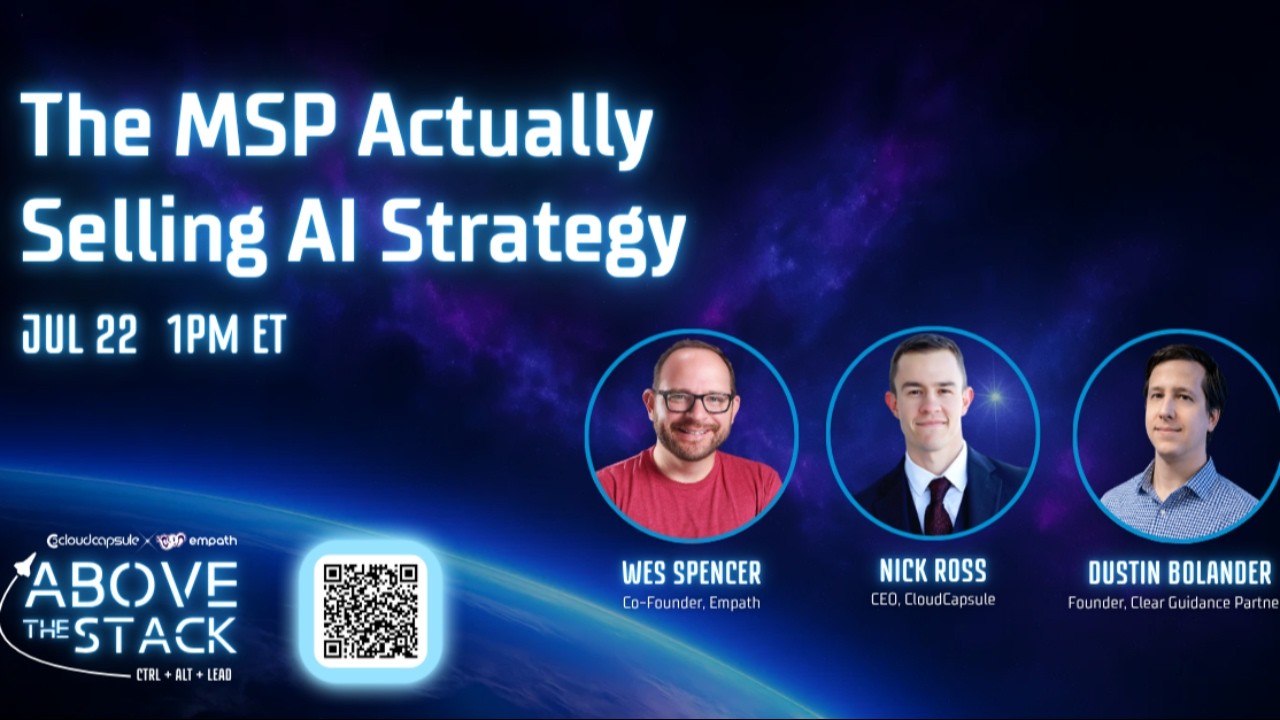
Dustin from ClearGrounds explains how MSPs sell AI to law firms, from discovery through implementation. He shares a quick win: a Copilot workflow that reorganized a client's SharePoint. The hosts emphasize building internal AI culture through weekly lunches and hands-on experimentation with cloud licenses.
Chapters
Communications arrays are aligned.
Nobody cares about your stack, bro. It's the truth. Your clients don't care. Your tools, they're not really all that important. I'll tell you what is important. Security maturity, leadership, strategy, and outcomes that drive to a difference.
We're stepping above the noise, the checklist, the buzzwords. This is where MSPs stop guessing and start leading because frameworks like CIS, they're no longer optional.
Welcome to Above the Stack, where business meets technical and security becomes your differentiator. It's time. To go from operating in the weeds to owning the airspace.
Control all lead.
Signing off. We will see you there. Nick Ross, what's going on, my friend?
How are you?
Doing great, Wes. How about you, man?
Uh, good as always. Good as always. This is one of those shows I'm really excited to be introducing our guest here in a minute. I almost don't even want a banner. I'm so excited just to get into the discussion. But this is one that has been needed to happen for a long time, and, um, man, I'm so excited. We're going to be really talking through an interview with an MSP who's actually operationalizing AI today, and couldn't be a better moment on the show for us to start doing something like that. What do you think?
Yeah, absolutely. I mean, I think a lot of us haven't gotten started yet in that area, but, you know, the guest we have on today is actively doing projects with customers, getting in front of them, having the conversations, getting paid for it in a lot of these cases as well too. So really excited to unpack that as well too. I'm excited just to learn as well, you know, on everything he's been doing.
Heck yes. Yes, I am too. So what we're going to be talking about today is just actually what does selling look like? And I know that sounds like slimy. I know that sounds like snake oily, but it's not. Like we're going to actually talk about effective, what this looks like to engage a customer, to help them with, we call it, we say business outcomes, but what do those business outcomes actually look like? Like this is going to be hands-on practical, man. So many people checking in today. Enrique, what's up, my brother? Good to see you on. Hello to you too. The one and only Princess Lim, who does tons of stuff behind the scenes for us. She is really the one that makes this stuff happen. What's up? And then, ah, Brett Chidham checking in too. Brett, what's up, my friend? It's been way too long since we've chatted. I hope you are doing well. Good to have you on. So without any further ado, let me just say this. You've got Nick and Wes here. I am the co-founder of Empath. Nick is the co-founder of Cloud Capsule. We're not here to talk about either of those because we are above the stack on the show. But if we can ever help you in any way, by all means reach out. Let's go ahead and bring our guest on. Dustin, I'm going to bring you in here. You want to say hello and who the heck you are?
How's it going? I'm excited today to talk about what email security tools and RMM that I use. Uh, there's a lot of stuff on here. I have extreme shiny object syndrome. So yeah, started off— this is actually my second MSP that I've owned. Sold the first one back in 2017. And started this one. I've made a habit out of running into things that everyone else is running away from. So founded CGP and said, we're just gonna do lawyers. Nobody wants to do lawyers. There actually are a lot of good lawyer clients out there. There's a lot more bad ones. So I get why the industry has its reputation, but it's like, there's really successful dentistry MSPs, stuff like that. I think any niche you can get into, but yeah, we decided to do law and we're over 90% lawyers. A little over 2,000 seats. We do have a really high seat price. We start at about $250 and go up from there for kind of the all-you-can-eat managed IT package and have some other, you know, really interesting stuff. And then it says finance on there. There's a whole other interesting part we're exploring that way. But, um, yeah, so, uh, got into insurance after that. And I got a new idea brewing too, I'll have to tell you about, Wes. We're, uh, I'm having lunch with somebody next week on business number 4, so I love it.
All the businesses all the time. I absolutely love it. One day we'll tell the story of when I first met you in real life all those years ago and we boondoggled the bartender into a free shot of Pappy Van Winkle 18-year. That is a story for another time.
And then he didn't sell it to us. It was awesome.
Yes.
Yes. Also, BELTACS. Tell us what's going on with BELTACS real quick. Yeah.
As an MSP owner, I got sick of filling out insurance forms and talking to agents that don't understand what we actually do as MSPs. So we have, we, us and TechCrug are the two companies with our own policies for MSPs. I focused really on small MSPs, $5 million and under. It's policy through Lloyd's of London. We also do cyber and a bunch of other interesting stuff. But it was kind of that Kelvin talks about spite-driven development, right? Is I am a spite-driven business starting, I guess, where it's like, man, nobody's doing a good job at this. It's annoying me. I'm gonna go get licensed to do it myself. So, um, we are a little about 18 months in as a standalone company and got a couple hundred MSPs. It's, uh, it's fun. I'm a big nerd when it comes to other people like, oh, I want to write code, I want to buy code, I want to do this. I'm like, I want a glass of wine and a 40-page contract to read. That's my idea of a good time. So insurance, cyber insurance specifically, is kind of a really good business for me. You are a—
I don't know what to say other than you are a masochist, my friend.
I need years of therapy. That's what my wife said is whenever I retire, we're going straight into therapy. Yep.
I, I, yeah, I think that's a great idea for you, 100%. So just so y'all know, you can scan the QR now, but we'll have it up multiple times through the show. Dustin has been incredibly awesome in giving us the slides he uses for a lot of his client conversations. So if y'all don't know, if this is your first time on here on Above the Stack, we always have giveaways. We're big fans of like giving you something tangible and usable. And so Dustin, I just wanna say thank you just outta the gate before we even get into the content. Thanks for being willing to share. A lot of MSPs I don't think would do this. They'd like view this as their protective moat, but you've just been so giving and open because I think you just know this is how the industry works. Yes.
The other piece too is like this is all moving so quickly that we've been really doing it heavily for about a year now is all. I'll say it openly. It's like I was kind of an AI skeptic at first. My good friend, business partner on one of the other companies, Ashley Cooper, we still fight all the time. I think AI has actually made support worse in a lot of cases. I have story after story of our payroll provider. Just the other day, I was dealing with Southwest Airlines. I couldn't log into my account. It kept resetting the password and the thing was like, oh, I'm going to send you a password reset. Let me talk to somebody. Let me talk to somebody. And no. But so big AI skeptic, I still am in certain ways. About a year ago we started doing this. It's moving so fast that roughly every 4 months, uh, what we do has changed. So a year ago, this Cloud 101 deck, we were charging for this, which is just wild to say. At this point though, it's like, it's— it goes out with our sales stuff, all of our existing clients that even if they're not using AI, uh, or consulting, they get it, that kind of thing. Um, so yeah, like, I'm happy to share with the community, but it's one of those things like, it's going so quickly. What you're doing today is not going to be viable I'll talk some right now, or today rather, on— we call it Claude in a box. Um, it's $5,000 to $10,000 project right now. I don't think we're going to be able to charge anything for it 6 months from now. Just as—
and why is that?
Uh, everybody's AI proficiency is getting better. Um, that if you go back before, it's like, oh, I'm talking to GPT. Um, and now you're starting to get, you know, the 70-year-old CFO at a law firm actually kind of understands the concept of tokens. Versus, you know, again, 6 months ago, the guy would be like, like, I take my grandkids to the arcade. Actually had somebody say that to me once. They're like, what do I need tokens like an arcade? Um, so just as the AI literacy gets better, just that, that, uh, bar kind of is getting raised, that baseline of the majority of people. There's still some need, but, um, most of— I'm going to speak with law firms a lot today. Most law firms now have 1 or 2 people that have at least just like a baseline savviness of AI. They are using ChatGPT personally a bunch, you know, that kind of thing, where 6 months ago you probably couldn't walk down the hallway in a law firm and say, hey Wes, tell, tell me how to use Claude better, um, that sort of thing. And that's becoming more and more. So just as that base literacy familiarity increases, um, we're all gonna have to change our strategy. What the clients actually need is going to continue to change and evolve.
Yeah, I, I, I agree with you. Um, and, and I think that we should even start with this a little bit, is your client base is not like fly-by-night, you know, any chunks living down in your title. Um, but, but you actually deal with law firms, you deal with venture capital. Um, I would say pretty sophisticated clients that actually view risk, you know, in a different way than I think, you know, a small, you know, CPA firm might, right? So we should even mention, like, even your client base. So, because I think it'd be easy for people to be like, yeah, but Dustin's just talking to, like, I don't know, just, you know, little small clients, blah, blah, blah. You're actually dealing with, like, legit law firms.
We have, uh, one of the big kind of selling points for us is that we build the, um, compliance And where people say, you know, okay, compliance, not talking necessarily the traditional GRC. Interesting piece, so if you want to get into working with law firms, the biggest mistake that people, MSPs, that I see them make is, we'll help you meet all the Bar Association regulations. Dude, all that stuff from a cybersecurity technology standpoint is most part is guidance. It is not regulation. So that is one of those of learn to speak the industry's jargon you're going after. If you go in and say that, the majority of attorneys right away are gonna be like, Wes doesn't know what the hell he's talking about. Like, that's not a thing. Um, what it does mean is we're doing a lot of stuff of filling out, uh, quarterly compliance, um, reports from Fortune 10, like big companies that are in every town. Our clients are serving them and they all have their own frameworks. It's the, it's the worst. But, um, that's a big part of what we're doing. So yeah, from a sophisticated sophistication standpoint One of our smallest clients, it's like 4 attorneys, uh, they have 3 Fortune 10 clients. So it is a huge— you know, they're paying like, I think, $1,100 a seat because of the amount of work that goes into it. So the clients are sophisticated, but it's their clients are really what drive all this stuff.
Yeah, man, uh, I love that. So Nick, I want to turn it over to you. What questions do you have, um, to get us kind of on the playing field, Dustin?
Yeah, I mean, certainly there's a lot to unpack with you today, Dustin, but I'd love to maybe start at how you guys think about, you know, that packaging layer. Like, obviously we've got this resource that you mentioned is evolving, and, you know, love to hear maybe some specifics around, you know, examples of those client engagements, things like that, of how you guys are actually like holistically thinking about it going into those and what you've seen success with there too.
Yeah, so I'll start off with what hasn't worked because that's colored a lot of what we're doing. Um, is most SMBs, again, law firms, uh, financial firms, are going in being like, Nick, we need to use AI. They don't really know. So probably the biggest failures that we've had is like, we're diving in, we're going to do some deep this, that, and the other, and then it's kind of halfway through the project we realized the client didn't know what the hell they wanted. They're not wanting to go this direction, it's too complex, it's too expensive, this kind of thing. So where we've really zeroed in, I mentioned earlier we have sort of the Claude in a box. The legal industry is heavily standardized on Claude. I think we've done— we actually started a year ago doing a ton of ChatGPT. We had our GPT in a box projects. I believe we've only done in the last 6 months one GPT project. Everything else has been Claude at the client's request. We kind of push them that way also. There's a lot of interesting legal connectors on there. But what started off originally, you know, we would kind of do open-ended this, that, and the other. Then it turned into, let's just get you in there working, right? The goal on this is it's going to be a 4-week project. At the end of it, all of your people are going to know how to use CLOD at a base level to do their jobs, right? Just kind of base legal work, being able to work through documents, drafting, things like that. And then now it's actually gotten more into— we're not spending as much time in CLOD because there's a lot of specific softwares available in the legal industry. So like timekeeping, right, is lawyers— it's— they live and die by the billable hour. Cloud is not a good timekeeping software, but there's a lot of cool AI stuff. Ajax is one of our favorites. So whenever we're going in, we're doing discovery projects now. I'm actually jumping on a plane at 5 AM tomorrow, flying out to a client just because of scheduling. I was like, all right, I guess I'm up. But we're going to go through and it's a discovery project of looking at each phase of the business. So from, you know, again, break it down. How does your client's business run? Law firm, first thing that happens, somebody reaches out, then we go to intake, then we work the case, blah, blah, blah. Um, but we're going to run through on each of those what are you doing now, what's working, what's not, and then looking at it to be like, ooh, timekeeping is an easy one. Um, you have to understand your client's business, how it runs. So again, going back to one of my biggest phrases that I hate in our industry is sitting down and be, Nick, tell me how you make money. You just exposed yourself as you're not the trusted advisor. You're going into your client being like, tell me how to service you. I don't know. Right? Um, so that's one of the reasons I love doing verticals. Like, going into the law firm is we say, how do you bill? Are you an hourly firm, or are you alternative fee or contingency? Those are the three models. And so if they're like, oh, we're, uh, hourly, well, using AI in the day-to-day work product is literally taking money off their plate in most cases. So we go and we first kind of look at everything else. Where can we save you time on administration? Um, how can we capture more of your time more efficiently? That sort of thing, right? And then at the end, we'll get to the drafting. So it's really looking at it. I know everybody says like, look at the business first, look at the business first. Um, it is really hard to do that as a generalist. My first MSP, we did vets, uh, we had Texas's biggest chicken wing joint, stuff like that. It's like, I don't know anything about restaurants. I couldn't go in there and give those guys honest advice, that sort of thing, on it. Um, so I think you do have to niche down to come in and do this kind of work properly. And really deliver value. Um, you either have to niche down into an industry, um, or one other specific thing was a good friend of mine— I think you guys might know him, uh, Jim Berry down in Florida. Yeah, he's great. They know the point of sale, all the inventory systems. So if you're a business that carries inventory, he knows that part of it inside and out, right? So there's different specializations, but I think right now everybody's gotten past the guy that can come in and consult for 2 hours and then hits a wall on AI. You have to know how to really dig into the business and find the opportunities. So a kind of long— sorry, Nick, I just went, um, down the rabbit hole. But back to your original question, like, what we're doing, it's a lot of it has evolved into the discovery side of it to figure out, like, almost here's your big wins, here's your medium wins, and then this stuff, you know, you're an hourly law firm, we're not going to spend a lot of time and money on drafting unless you tell us to because that's taking food off your table.
Yeah, well, I think it's a great point. I mean, we've talked about it in previous episodes too, like a lot of people starting at what we call, or I think John Harden termed it like a nuclear project, right? In the sense of like, hey, let's go do this thing. We've got a shiny object syndrome of like rewriting our CRM tool or writing our own CRM tool or, you know, fixing data pipeline enrichment in that sense. And it's such a hard thing to get ROI on, obviously, number one. But to your point earlier, the technology shifting, we're gonna have tech debt that we have to understand is gonna be there with whatever we build. We're not software developers probably by trade internally, so we don't have people that can maintain certain things that we put into practice. And what we've seen too, I've seen the same in the sense of like, hey, if you're going to start anywhere, a lot of the personal productivity and getting the whole org to start using a, you know, a corporate-wide approved AI channel, it could be these frontier models like Claude or GPT is usually where a lot of the volume sits. But also just, you know, when we think about The tools you mentioned too, just like, well, what can make, you know, your job easier, but also is your quick wins. And I think having that matrix, if you will, or to your point on discovery, um, ton of discovery needs to be done no matter what in most cases. But I love the point on niching down so that it's a little bit more focused area, right? Or you could maybe ideally as an MSP turn that into a repeatable process for the same industry type.
Yeah.
Do you feel like that's what you guys—
100%. Yeah, because then you can get into fix fee. You know what it really takes to go in and do it. We had previously, we had a, we still do, I guess technically we have a software selection project that we really kind of boxed up for law firms so we can go and look at their document management, their accounting systems, that kind of thing. So that was pretty easy to transition into AI and a lot of that is built. We have all these templates. The client I'm flying out to the next 2 days, I'm going to be doing interviews with lawyers for, you know, 6 hours straight Thursday and Friday. So around that, it's very repeatable. Um, and I'll tell you guys on that is, you know, we're charging, uh, $4,000 a day on it. And we're not— if you go and you look at our MSP, you know, our people and all that stuff, there's not— don't get me wrong, I love our people, but it's not like some special— we're not stealing people from like, you know, Deloitte or anything like that, or like Ernst Young or Bain. Um, we're a bunch of MSP dudes and ladies, so there's nothing special sauce on the staff side.
What do those interviews look like? Like, what are you asking?
Um, so it's going to be around, okay, Wes, you know, tell me, what's your practice area? Like, what do you, you know, what's your current caseload look like? Um, so maybe they're like, oh, insurance defense, I have like 20 cases right now, um, going on, blah blah blah. So, okay, what tools do you use? And so at that point they're like, okay, I mean, it's lawyers, so they're usually going to say I have maybe a document management system pulled up Okay, wait a minute, that's key because now there's like 3 different document management systems. Ooh, we're looking at Claude, this one integrates with Claude, right? So you're looking at, and Nick, you kind of hit it earlier, right? It's, I don't think most MSPs should be doing software development, or if you are, go all in on that. But integration work is huge. It's relatively easy, relatively speaking, compared to software development. So what we're looking for is opportunities to integrate opportunities to use software better or directly replace it, where they're like, oh, I'm using this one, where it's like, oh, switch to this, it's about the same price, but it adds these 6 features. Or there's my favorite story, we had a firm was like, we need AI, and we walked in and their use case was, you know, hey Wes, tell me what you do every day. And this poor lady was like, I spend 3 or 4 hours every day, I go to, you know, this client, there's 1,000 shareholders, and I have to go through and prepare these letters for them and I have to mail them out or email them all out. AI could do this. Like, yeah, okay, that's pretty cool. Like, so she pulls up an Excel sheet as for every client, they have an Excel sheet. And so right away the lady, she's now retired, she's my old business partner named Eden. We kind of look at each other and then Eden types me and she goes, it's frickin mail merge, dude. So on that, we showed the lady like literally on the call, we show her mail merge and she's like, you just got me back 2 hours a day. Yeah, um, because you're just going, you know, show me what you're doing. And then at that point it's like, all right, how can we plug in these? Again, very big on off-the-shelf, um, that sort of thing. But, um, another good use case is if you're working in family law, it's very common you get a new client and it's like, all right, uh, you know, Nick's getting divorced, we got to get all of his financials, his wife's financials, that kind of stuff. Um, and people just send them over one at a time, right? Hey dude, I told you I need these 20 things. Oh, here's this bank statement. Like, Nick, I need the credit card statement, blah blah blah. So at the end of it, um, some poor paralegal or legal assistant has to sit there and organize it. That's a really good use case for cloud co-work. Yeah, so just looking at stuff like that, those are some of the examples of what we've done. Um, I can nerd out on this specific to legal. Uh, billing is another one where we see a ton of success, but it's like understanding what they do on a day-to-day basis and all right, now where can we plug in automation AI?
And I hope people listening are understanding what you're saying, which is— I, I'm not— and this even gets into this question that Sydney had. Let me read it and then I'll make a statement. I'm really curious what you think about it. So Sydney writes in and saying, does Dustin specialize more in finding and creating time-saving automations or more in bringing AI in and having it being governed and managed correctly, or both? And the reason I love that question is because it kind of gets what you're talking about. I think right now there's too much of like MSPs are confused on how to sell AI. And what they've always thought about when they hear about selling anything is walking in and saying, here's this tool that I bought from a vendor and I have this big commitment that I have to meet, so therefore you now have to go and have this thing. And it just— that does not work at all. That might work with a firewall. That does not work with AI where they just say, shut up, go away, I don't want to buy your tool, I don't want to buy your ish. What I really want is, you know, what you've just mentioned, all these things that literally where they come back and say, you just saved me 2 hours a day, you you came in and transformed or scaled up a business process I, I was already doing or made it better. And that's really, I think, what they want. And it is a divergence, I think, of where most MSPs are comfortable with today, which is hence why we're having this conversation.
Yeah, no, it's definitely, um, this is way more, uh, so just for reference, right, going back to my first MSP, uh, 2011. So I've been doing this for a while. I'm older than I look. Um, But it's— this is the biggest shift to more of a consulting mindset that I've seen since I've been in the industry. I think a lot of MSPs are going to struggle if you are going in to sell AI. There's a couple guys that I know, they're using like the industry off-the-shelf solutions and they're like, oh yeah, like I sell 2 of these a year. One guy was like, after 18 months I have, uh, $3,500 MRR off of it. Um, not bad, but it's like that's never going to scale substantially because though you're looking at trying to check a box like you would with a firewall, right? Um, and really a consulting approach.
And to your point of how fast this industry moves, you're never going to compete with a Frontier model. And you're never— like, the amount of, like, what's, what's constantly being upgraded and what they're constantly able to do and the native integrations they have into, like, all the tools we use already is just— I mean, it's, it's non-stop. That's just not where you want to be able to put your flag down as the value proposition for the client. It should be a consulting nature.
Yeah, I think from a scaling perspective too, it's probably where the biggest gap is because to Dustin's point and what I've seen as well too, just in the general sense, if you think about you come into an organization and you get personal productivity up and lifted into a governed channel, right? And that's not saying that you're putting hyper strict restrictions on everything. It's just saying like If people were using cloud personal accounts before, they're using a corporate account now, right? As simple as that, if you wanted to make it, you know, like that, that clean cut. But the same is true of like finding broken processes and departments, finding individual users that spend all this admin work. And it's in a lot of our competency as MSPs being a little bit more technical to know how to stitch that together or to use the basics of AI to understand like, hey, this is a workflow that we could do. Or uncovering things, right, that it's just like, oh, this is maybe a broken process, right, that you could fix. And having consultancy and not telling me to say, this is actually what I would do first, right? And then they'll trust you more in that sense of, well, here's the next thing that we need to do, or what other departments could we start to look at to optimize this, or how can we get more interdepartmental collaboration going, um, for, or, you know, change workflows, things like that as well. So I think there's so much opportunity there, and that kind of should, should alleviate, in my opinion, some of the fear of, um, you know, this, the syndrome of, you know, not thinking you're, you're an AI expert, right? Or having procrastination around that because there's all this change going on. It really starts at the basics and then starting to put those wrappers. Are you guys getting into the security and governance side? I'm curious on that side.
I know, uh, it's, uh, one of the nice things on the law firm side of it is like almost all the AI work is around, uh, you're not seeing a ton in the, like, executive versus staff level. Most of it's around the work product, which 99% of the firm already has access to. So there's really, um, this has been kind of a nice thing, there's not as many governance issues as you'll see in most other industries because it's the majority of, uh, so our ideal client is law firm, um, 100 people and under, where we're working directly with the partners or the COO. We don't work with IT department— we don't work for the IT department, rather, that kind of thing. Almost all those firms are— everybody at the firm has access to every, you know, client's data kind of thing. So we're doing some stuff around what they can use, you know, what they can and can't use, the training. There's a little bit of an ethical obligations thing, but that's again one of those weird parts with the bar associations. You guys, your eyes will roll, you don't want to go down that rabbit hole today. But the governance piece is a very light touch. So we're starting with that, but it's not— I've seen some— I'm not saying that the governance isn't useful. I'm seeing some of these people doing like the Purview configurations for bigger companies. Like, yeah, absolutely, there's a lot. But just the nature of the legal industry is, I would say from that standpoint internally, you know, the guardrails, the ethical walls and all that stuff is 10% at most versus anything else. So it's really the biggest piece is around like what tools you mentioned earlier, personal cloud account, Nick. That's one of the biggest things is making sure that they're only using the firm-provided tools or that if it's publicly accessible information, you know, at that point it's a little bit easier, right? It's a court filing that's public record. It's in PACER. Then at that point it's like, yeah, you can use a lot more stuff, but feeding in client confidentiality. There's a really cool product we got introduced to called Super Wisdom., and they do— every time you close out, it runs on Amazon. It has access to all the major models, but every time you close out, it completely wipes its memory. It's like one of the ZDR, uh, zero data retentions. So we have some firms are like, I want to use AI, but there's zero way we can have— and it's like, this is kind of your only option versus you're a 10-person firm, you're not going to do local models. So yeah, from the governance piece, but I guess the way I'd put it is normally governance is like 2 meetings tops, and then at that point it's kind of done. It's pretty light touch in the legal industry just because of how the firms operate internally and the heavy ethical obligations that already exist.
Yeah. Yeah. You mentioned that's a good kind of maybe segue to a different idea or topic that I was curious about that you guys are seeing. But you mentioned, you know, hey, there's this nonstarter we might have around, you know, in this case it's the data retention or, you know, us putting sensitive data in there. That's, that's more governance, obviously specific and security specific. But on a broader sense, What are like, what are some of the common objections I guess you guys get in trying to implement more AI with your customers or, you know, pushback that you're seeing internally?
So there's a couple different pieces right now. For better or for worse, it gets everybody talking, but it also scares the heck out of them. There's been a bunch of court decisions around it. You guys both earlier were kind of saying is I look at AI as another tool, right? It's an enhanced automation, that kind of thing. It shouldn't be its own. It is a business tool for making workflows better, just like, you know, automation tool, right? You have like a Rooster or a P or something. AI could be the next level of that. Um, from the confidentiality, um, the government security side of it is it goes back to the people, right? So they freak out about this court filing. Oh my gosh, the court said, you know, they, uh, they sanctioned this attorney for using AI. It's like, that could have been an intern that gave him something really stupid and it would have had the same result. Unfortunately though, that they keep, you know, every week something else is in the news. Um, there's actually a court website— or not a court website, there's a website that lists all the court sanctions. Last I looked, it's up to like 600 public sanctions of attorneys in the United States alone for doing stupid stuff with AI. So that's where the security part comes in more, is it's kind of the same, almost like the, you know, don't click links or One of the biggest issues that you'll run into in the legal space is the firm that's like, Nick, we're not gonna— you're a good paralegal, but we're not going to give you Adobe Acrobat. That person goes in and starts using those free online PDF tools. Like, no dude, stop, that's bad. Same kind of thing with AI. Well, I'm gonna go plug it into, um, you know, I'm going to sign up with ChatGPT on my Gmail and go plug it in. So it's the security, um, with what we deal with, the security issues are kind of the same you would with people with like rogue IT, shadow IT, right? It's not AI specific. It is, but if that makes sense, is our approach to it is the same as shadow IT. We don't want them using a bunch of third-party tools the firm doesn't have control over, hasn't authorized, that kind of thing. So still fighting that same fight, right?
And so much of it comes down to like earning the right to get to that position with the client, right? Like ultimately they own the risk, not you. Like, yeah, you're the MSP, and if your MSA doesn't say that you should really go back and reconsider that. So if they own the risk, they make the decisions. If we lead with— I, I know sometimes you can get past this with like a bank, maybe some law firms where like you can lead with security, but more often than not, you have to earn the right to that. Like, you, you have to be able to say things like, hey, as we're scaling up this very valuable thing for you, isn't it important that we do it in a secure way? Isn't it important that we do it in a way that constrains the data because you don't want X, Y, and Z to happen? And then they say, because I've already been sold on the value of what getting, then yeah, let's do it the right way. It goes all the way back to the old days of like, no one buys a car without airbags anymore and a backup camera anymore, right? Like we say, if we're going to invest in the car, we're going to pay a little extra to have some of those features because we got to do it right. And so, I think you nailed it on that. And I think that's sometimes where we miss it. And you'll see some of these security vendors that are out there like, "Lead with the security discussion." And they're just like, "Shut up, nerd. I'm just so tired of you coming in telling me I have to do all these things without seeing the value of what you're offering and what we get out of that as well." And I think that's that's where you'll find success.
Yeah, we've gotten too much as an industry, I think, of like getting to no too quickly instead of trying to get to yes. So I'll give an example. Kyle Christensen, Wes Spencer's business partner, did an awesome post on LinkedIn the other day. Um, there's an MSP insurance broker that's telling MSPs you can't be doing AI. It's like, that's the stupidest thing I've ever heard. Like, what? What?
Why?
Um, instead of like, okay, well, here's the policy you need to protect your MSP instead, You got to have that same approach with your clients. It's like the, you know, oh, we're going to block this. The right answer to that is, well, your people want to use this, they're going to find another way. Why don't you enable them instead of just coming in and saying no? I understand there's certain things you have to say, you know, I want to disable, you know, MFA. Well, no, that's not, um, what was that? Do you guys remember that site that was like Say No to Duo where it would register the phone number and it automatically accept every Duo prompt?
No, but that's awful.
And hilarious, back like 2018, um, somebody made a service you could pay a dollar a month so you'd register your Duo device and it would just automatically accept every prompt.
Oh, that's hilarious.
Yeah, so let's not go that far, but, uh, on the AI side of, you know, as an MSP, uh, with your clients, is figure out a way to get to yes.
Yes, exactly.
They'll say yes, 100%. But yeah, to your point, Wes, it's like, yeah, you got to— you are not there to be the mean adult parent Or you can be, there's a business model, but I think with the way the industry is going, you know, we're, again, we've talked today about consulting. Nobody hires consultants to tell them, almost nobody hires consultants to tell them no. We did have a project a couple years ago, we did, we're at the end of it. The COO was like, thank you guys for, I've been telling them the same thing. They're like, oh my gosh, I'm sorry you paid us. He was like, no, they just need a highly paid consultant to tell them no. Yep.
So it happens sometimes, but it's exactly how this happens.
Yes.
So one of the things I want to do, like, I know we're not going to go like in-depth into like every slide you've got here that we— the QR code will get folks if they want access to them. But like, one thing I did want to talk about a little bit is just let you pause on a few different slides that you felt like are effective. Like when you're walking into a client conversation and you are having to have this education on what you mentioned, like they're getting better and better at this, right? But like, help us understand when you start some of these discussions, what are you trying to get across from them? Are you trying to make them AI experts? Are you just trying to get them to get their feet wet enough? And like, what, what kinds of things are important for you to teach them as you're going down this journey of like client education when you're doing these, these, these presentations?
So the biggest piece on these is to get it to where whenever you get in there, you're not scared, right? So our typical person is going to be, you know, a Gen X lawyer, The industry tends to, you know, skew very heavily towards women in the legal industry. So just giving you kind of prototype in your head, right, is it's a woman probably in her 40s, maybe early 50s, that is billing out at $400 to $800 per hour. So it's like, I need you to make my life easier, right? Every, every hour you cost me, Wes Spencer Spencer, is, you know, that's $800 that would have been in my pocket. So it's okay, how do we get them to where they're getting in there, they're comfortable, they're not scared going, "Oh my gosh, what is this? Do I need to worry about it?" This is, again, I like to think about the whole cybersecurity poverty line thing where it's like you got to be this tall to ride. We want to get that with AI, just base familiarity where they can look at a tool and just like, "Oh, okay, this makes sense, this is safe." General concepts. Good example right here, the connectors. First thing everybody asks, "Hey, we're going to connect it to 365. Oh my gosh, can it send emails? Can it get into other people's stuff? Blah, blah, blah." Hey, look, it's read-only and it's just your stuff. Super essential. Jump to the next slide, we'll hit a couple more. This is another good one. Well, I'm confident. I'm a lawyer, so I'm overconfident. First thing I'm going to do is point Cowork to the 3 terabyte cases drive. No, don't do that. Oh my God, that's going to be bad. Not saying they can't long-term, but that's where the general advice that we've been giving them is starting off with Co-Work, make a local folder, move your stuff in and out. Well, I don't think that's a good idea. Well, you know what, you're going to hit one wrong command and it's going to completely sort the case files, uh, you know, folders and everything. So screw up in your own little sandbox until you get the hang of it. So again, we're trying to, you know, we don't want to make their life harder. We want to say yes. This is where I think a lot of MSPs are going to make the mistake and go, no Co-Work. It's dangerous. It is. It's super dangerous and people are going to do stupid stuff with it. But we give them the sandbox to play and we just figured out a way to get them to yes.
Yep, that makes sense. Uh, talk to us a little bit more about where you're seeing this 365 connector and that conversation.
Yeah, um, not a lot of firms are using SharePoint. Um, they tend to be either on a full document management system. I, I would guess maybe the type of firms, uh, MSP would be working with in this capacity, maybe 5% will be using SharePoint in any serious manner. So this is almost entirely— there's two things firms care about, right, is email and phones. That's always the, like, everything else can burn down, who cares. So the biggest piece is the, uh, email piece. Oh cool, I can use this to search my email. Like, all right, that's awesome. Teams less so, but the big emphasis here is email. They can use it to search for stuff, they can pull information together, stuff like that. So this is always our base cloud deployment package is Claude training plus the 365 connector. Like, and that's why, right? Hey Wes, this can help you with— again, going back to knowing the industry, knowing the people you're working with— hey, this can search your email, it can help draft stuff, it can help pull together kind of report summaries, stuff like that. That is magic to a lawyer's ears because otherwise they're sitting there trying to search Outlook, cussing at it, it sits there and spins, that kind of stuff. Let Claude do it. Yep, makes sense.
What else we got here? We can, we can cruise through some of these or park a little bit more where you want.
Just again, one of those orientation things. We don't really spend a ton of time on that. Let's keep jumping through. So yeah, I don't want to go down that too much. This is again just kind of, hey guys, here's, here's how it works, right? Whenever I see skills or I type slash and it pulled up this stuff, like, what is a skill? Why does it matter? That sort of thing. And this will get you— you have those couple of power users within the firm. They're going to start building their own skills. So not only does that help the firm internally, but then at that point, that generates more work for you as the MSP. Hey guys, we want to build this out. Um, you know, Andy has this really cool thing that he did. Check this out. Like, what do we do with this? Okay, we need to— you're burning all your tokens searching email, so we need to, you know, build some rules into that skill. Uh, and then we want to deploy it firm-wide, blah blah blah. Like, okay, cool. Like, we have one full-time guy that like his full-time job is just writing skills. Like, that's the extent of it. It's, it's not rocket science, but understanding how this stuff works, it is to the lawyers. And being able to, whenever they're just like, man, I built a daily task that summarizes this, but it just, you know, pukes out halfway through, it's like, okay, we just need to optimize it, Wes, that's not a problem. And then at that point you can go, okay, cool, should we roll this out to everybody at the firm? Then we're going to train them how to use it, that kind of thing.
So let's just pause on that for a second because I think that's so valuable. And Nick, I want your comments on this too, but like We don't have to— I think one of the things that people get stuck on— how we both have these Turvis mugs, it's so funny. We both get— we get stuck on this, like, what is the thing I offer? What is the thing I do? What is the thing I bring to them? And I think you just nailed a lot of that is discover what they're already doing, right? Like employees will always find quicker, more maybe half-baked, but a quicker way to do something. They want to work more efficiently. They want to get more done than they've ever been able to do before.
Right.
And so I love that. And then your job is to come in as the hero to say, I can actually help scale that up or fix where you're blocked on that, or even a better way to do it, or a more secure way to do it. So as we scale it, we don't, you know, send all case data out to everyone everywhere. I absolutely love that. And I think that should hopefully put you as an MSP kind of like, okay, that makes me feel better. I just need to be better at discovery and then know that I can come in and kind of bring this thing to completion.
Yeah.
And so, yeah, I'm sorry, back off that too. Oh, sorry. Yeah, I would say I'd pick it back off from, from the Skills perspective. I think you brought a good point of like it can create upsell work, right, within the organization. You can templatize these skills and reuse them for your common productivity workflows that any, you know, knowledge worker would, would consume, but also industry-specific lawyers, other, you know, fintech, everything else like that. Departmental role-based workflows I've seen work really well with Skills as well too. And there's multiple benefits that you can express, you know, that doesn't make it a hard decision. Obviously, you know, making it easier for them to be productive, getting more consistency in their responses, but also a great point on token use, right? Like, you'll actually talk cheaper, right, in a sense, or collaborate cheaper, not to mention the productivity benefit that could be cross-departmental. So I think that's a huge point with these that really you should highlight with what you can go in and do by just enabling the basics, right, of a lot of these tools.
Yeah, and that the discovery piece is really, you know, I mentioned earlier, it's like $4,000 a day for discovery. I know there's gonna be a ton of people I'm surprised we haven't seen in the chat yet. That won't work in my market. I guarantee you it will. My first MSP, we used to charge vets through the nose for work. Once you kind of get the hang of it and all that stuff, but you don't have to start off doing that, right? Go in, you know, you're getting ready to do this. A lot of it I think is going to be owner-led for MSPs, you know, your average MSP being, you know, 10 to 20 people kind of thing. Go in, spend an afternoon with a client, somebody that's like high-tech that knows the business inside and out, play with it. Like, just ramp your way up to being confident enough to go in and say, I am worth $4,000 a day to do this discovery work with you. You need to buy a discovery, um, you know, package from us. Um, if you just go in cold to try to do that, I don't think most MSPs can do that. It's, it's intimidating, right? That's— you're asking for a lot of money and they're not going to have direct results at the end. John Harder and I always talk about this where it's like you got to have the game plan, the ramp, right? How do you do that? But, um, go in and learn to do the discovery part. It's one of those you're, you're going to learn by doing. Um, hopefully this stuff helps people, but you still got to go and do it. It's, it's, it takes practice. But go in, spend a couple hours with one client, now go to another. And this sounds weird, uh, hopefully Dean's not listening, he'll kill me for this— underprice it. Get it in there to get one sold, get some money on the table. That's going to build confidence. Now you got a reference client. Like, just kind of stair-step it, stair-step it, right? And then get to where you're doing this pretty consistently. You have it templated, it's wildly profitable, client gets huge results at the end, that kind of thing.
And congratulations.
I think, I think— oh, sorry.
Well, just super quickly, in 5 seconds, congratulations, y'all. Dustin just explained what I think the vast majority of the shift of becoming an MSP really is into the future. So just want to say that.
Yeah.
Well, I think it's, I think it's huge in the sense of, you know, how, you know, he's talking about just going in there and doing it, but also like you're iterating, right? You're getting the reps in and that's really the big piece right now because it's all a learning curve for all of us, right? Like it's always changing, we're always having to adapt. You know, what you did today is going to help you in the future. It's going to be different, um, in that sense. But I think another big piece there that I, I think it's a good call out is you should charge for discovery, right? I see a lot of MSPs doing this for free right now, and what it creates is no skin in the game for the customer, and they're hyped up about AI, and so they'll happily take your time and then not actually do anything with that. So it's really important that you do charge for it and they understand the worth of that with these higher prices as well too, because it can create business transformation. And I guarantee you could do— I As an MSP, you should be able to guarantee that, I believe, just based off your existing skill set. And you have to complement that with the consulting skill set that we've talked about. But if you get their skin in the game, then they'll actually be somebody that can, or is serious about moving forward, right? In that sense versus like, oh, we could do that, but that seems like a lot of money right now, right? Or whatever the excuse is in that situation. And I think sales lever-wise, you could also say like, if you move forward with a project with us, we can comp some of that pricing into your existing or your first engagement, right? So just, there's different ways to do that. Um, what have you heard, Dustin? I guess I would be curious to, like, sales objection-wise, like pricing, you know, maybe, but like what other potential sales objections?
So, um, I want to jump back to something you said real quick, the client getting skin in the game. Like, that's a huge, um, your, uh, close rate on future work. So like one of the, uh, sales funnels that we use on the general managed IT side is security audits. We charge for those. And so my thing I always say is I'm like, oh, somebody's giving it away for free, then that's exactly what it's going to be worth. So our sales director has— I'm the kind of guy, Wes Spencer will tell you this, where it's like if you start talking to me, I'll talk for 3 hours, I'll tell you how to do everything, all the industry secrets, that sort of thing. So our sales director is like, Dustin, you can't talk for more than 30 minutes, you're billable after that. Um, your close rate, future business, this, that, and the other, because like Nick said, skin in the game, that they pay for that discovery, they are emotionally, financially invested, they really want to do it. You get rid of all those lookie-loos. So, um, going back to sales objections, um, the biggest one we're seeing right now is we're just going to throw people in there and let them figure it out, which honestly is kind of working half the time. Um, to some degree, I'm not saying it's working great. I'm not saying they don't come back later, but for that, like, we're going to get started, it works half the time. So my thing to that is like, okay, Nick, you know what? That's actually probably going to work. Right? Be realistic about it. Don't sell on fear. Don't— because if you tell them like, no, that'll never work, you need our GRC package, blah blah blah, 2 months later, whenever they're mostly working, they're gonna say, man, that guy was so full of shit, like, we're not calling them back. So look, Nick, that'll get you halfway there, right? You're gonna have— this Wes guy is brilliant, um, I'm confident he can figure it out, but he also has 100 other things to do. Um, you know, it's— we have a very structured, proven process. We've deployed a bunch of other firms. That I'll guarantee it to the point where at the end of it, you know, we'll refund you if you guys aren't happy with the outcome. But it's like, this is a proven process that has been developed across a bunch of different law firms already. We give you the full clear roadmap. We walk your hand through, you know, Billy, your paralegal over there who can barely turn on his computer most days. That's our problem, to teach him to use AI. You don't have to pull one of your lawyers, you know, over to deal with that. So that's the big part. That's probably the number one that we see. Is, you know, we can just figure it out. And so it's just like, look, we're the professionals. You can figure it out, but we can help you do it faster and better. One of the other ones is it's all changing so fast, why would we put all this work in? I did one on Monday at a client's executive committee. And so my thing was like, we're honest to God, Nick, we're all probably gonna be on Copilot in 18 months. Microsoft cannot be stopped. But what we're doing with this is 80% of what we implement with Cloud, we're going to be able to move that over. We're going to have everything filled out, diagrammed, all your— it's not an AI thing, it's a workflow. We could be doing all this on paper with human beings. We're going to automate it with AI to make it faster, more streamlined, that kind of thing. So it's like this is completely reusable whenever you move to Copilot or if you move to LexisNexis or Westlaw, that kind of stuff.
Yeah.
That's awesome.
If you follow that train of thought too, the other thing on that objection is like, now is the time to build the muscle memory because we've even seen this in Empath, right? Like we formed up around 2022 and really started the company in 2023 after the advent of AI came native. But even in those days, it was really just chatbot, right? So you weren't really doing much more than that. So you look at— you fast forward to like even just operationally how we, how we do everything today. AI is integrated into nearly everything we do to very deep levels. And one of the things we've learned through that journey is it requires an open mind and a rethinking of everything. And it's not necessarily the processes, like the same inputs and outputs occur. It's the speed and capabilities, the where we introduce the automation, where we have AI drive so much of it for us, to steal from Ashley Cooper, this idea of like human-led, right? And that I think is where companies should see the value on the investment of even if things are going to change, the tech stack that you use changes, And what— how quickly the frontier models are introducing more and more capability. Great. But like, now is the time to get better at this and to rethink how does our business of the future run. And if you're not going to do that today, just think about how many more miles behind you're going to be in 2 years when it does finally settle at a place you're like, oh, but now I'm comfortable. Now you're so far behind that that's a scary position to be in as a business owner.
Yeah, I'll give you a specific example of like personally where I've seen a huge impact is So I'm doing a CyberFox as their summit next week. I'm going to be doing the keynote, talk about insurance as Belltechs. A year ago, my workflow was, and we built this out, was my poor marketing guy, we would get on, we would record it, transcript was reasonably accurate, but I would sit there and I'd talk to him. Be like, all right, Trey, blah, blah, blah, blah, blah, and then I want a slide for this, I want a slide for that. Poor guy spends a day, sends me back a PowerPoint deck. My workflow now is I do a one-person Teams meeting, I paste the transcript into Cloud Design where the marketing guy built out all the assets and all that stuff. And dude, I just like, I spent 30 minutes over the weekend and I got, uh, Joe, the guy who runs the Cyberfox events, was like, this is a wonderful PowerPoint. I was like, cool. That was, it was like all of 45 minutes of work for me. Um, I got a couple tweaks I got to make, but now Trey, the marketing guy, gets to do more productive stuff because nobody wants to sit there doing PowerPoint. But that's still a human— back to the point, it's human-led. It was a workflow thing, right? And then we just put— we kind of put AI in the loop instead of a human for some of the tasks.
Yeah, I think that there's always a net benefit, right? And I think we— in a lot of cases, I see business underestimate the cost of maintenance, right? Or the cost of change, right, that we need to factor in. We need to educate on so that's not like a blindside to them, or they don't feel like, hey, we've got to rewrite this thing. You didn't tell us about this. Those types of things. I do think, you know, kind of rewinding a little bit, like your, your answer to the first sales objection that you had there also really highlighted a huge, like, grand slam offer you guys have clearly created too. Like, the way that you express that is saying that, hey, you know, we're overcoming your objections by also talking about your pain points, right? You're gonna— we're gonna take off things off your plate that you don't want to do, guaranteed. You know, you don't want to sit there and help these guys, you know, learn these tools. You don't have the time for that. It's not going to be time well spent. We're going to go in and do these 6 things to get you guys enabled and it's going to be this type of ROI for you. So I think that's also a huge piece to highlight in this sense of what kind of offer are you giving to them and what kind of offer are you describing? Because there's so much benefit in what you can underlying go in and do, but also while peeling back all their pain points along the way. Sounds like you guys have either really thought that through or obviously gone through a lot of iterations of—
Gone through a lot of iterations. A lot of people— we're kind of on our, uh, fifth compilation of the team, I think, off the top of my head, getting it zeroed in. Um, something else you said too makes me think— one of the pieces that I've come to have an opposite view on is, and this is projects in general, but I think even more specifically with AI work for an MSP. Originally my thing was like, whenever we were 10 people, was like, oh, I can go in, I'm so smart, I can figure out whatever. These projects are open-ended. I think it's actually better to start with packaging before you do anything more open-ended, that you're gonna be more familiar with the traps. Like going back to what you said earlier, right, Nick? Repetition wins. You know, it's like getting good at sportsball, do it 10,000 times before you start doing kind of more freestyle stuff. I don't think that your early forays should be an open-ended client, fully client dictated. Like pick a, we're gonna get really good in this little box. Here's our, we're going to be Cloud 101, right? We're in this industry, we're going to get these 10 connectors set up. We understand how they work, we understand skills. Ronald mentioned about the legal agent from Microsoft versus Cloud for Legal. Cloud for Legal is just a skills pack. Like there's some really good stuff in there, go in, play with that stuff, learn it. And again, just be like, this is our box we operate in, here's our package. Get good at that before you start expanding, offering everything to everyone, that sort of thing, or even just doing the more open-ended, borderline DevOps software development projects.
Yeah, John, John Harden brought this up on our call, I think, or just in a side conversation I had with him or something like that. But it was the question of would you rather get one client 90% AI enabled or would you rather get all of your clients 10% AI enabled with the same amount of time? And it's really like you should try to do the latter because you're going to get more at-bats, you're going to get more feedback, you're going to learn how you can package that. To a repeatable process, you know, as best you can. Yep. In that sense versus like, I've spent all this time with one client, I've been very unique with them because of this workflow, or I try to do one of those nuclear projects of going in and really spending 6 months before they even get ROI. Yeah. Or CROI in that sense. I think it's a great point too of just like time management and strategy behind it as well too.
Yeah. One of the questions was average timeframe for the discovery phase. We try to wrap up in 30 days.. And so this is another thing John and I have talked about. I bet you guys have too, Nick, is like the, you gotta get quick wins. Nobody wants to sit there. If you are going into an SMB, hey guys, we're gonna do this awesome AI project, you know, 6 months from now it's gonna transform your business. Everything's gonna have changed. It's an SMB, you're not moving fast enough. You know, there's a bunch of reasons. Go in and get, we have one client right now, we're billing I think about $15,000 a month on AI work. But the thing to the team is, They have to have deliverables every single week. Monday evenings is our go-live deployments, and so we broke it up into weekly sprints where it's just like, we're going to deliver tangible, not blah blah blah, we optimize this backend, you know, harness kind of thing, that shut up nerd, um, but it's the, you know, tangible results. What can the lawyer see that's different and working better this week? And so just that little wins, little wins, little wins. 'Cause otherwise it's the, um, my favorite story, there's a competitor, um, and I had, uh, we're probably about to pick up a client from them because the guy goes in the first 50 attorneys that are all billing, you know, $800 and he goes in and he is like, well, to, uh, to use AI you have to understand it. And he spent an hour-long presentation giving them the history of AI. It's like, dude, attorneys don't care. That's not, nobody came out of that being able to do their job better as a lawyer. Nobody— you just didn't make anybody's lives easier. Maybe it was interesting, but, um, you got to hit those wins. So yeah, to make your point of, you know, get everybody 20% improvement, that's gonna— they're gonna be happy.
Well, that— I mean, it's a perfect segue into like what you have here in some of your, your deck. And, and I just— and this stuff is so good. So like, I, I love this, like helping them even understand when do I use things like a research mode, right? And what are the differences between them, right? Or another example here is like, hey, treat this like a new hire, right? So thinking through like actually how to talk to it and get what I need out of it. So just open this and convert it. Tell me more about what we're trying to do, what the outcome should be and how we should think about, you know, presenting the data correctly for what audience and purpose. Like, I love these examples to where a client's like, oh yeah, that actually is very— I've never tried it that way. I didn't think about it that way. And to your point, these are like, these are the 10% incremental improvements to steal from John Harden that open up the— now that I know this, I can do these. I can do these things with it. Now I can do these things with it, you know, opens up the opportunity for the project labor, all of those other things on top.
Yeah. Um, so jump back one slide real quick. I'll give you a real-world example, was, um, this one right here. So I walked in that client I mentioned earlier, it's like $15,000 a month. Uh, they were very unhappy on the managed services side. Um, I went out there to kind of, you know, get chewed out, that kind of stuff. Um, and I was working with their CFO and she was complaining about they had some situation come up with, um It was like an HR regulation had changed and she's like, oh my gosh, I'm doing— so I showed her and I was like, hey, check out this deep research. We built a quick prompt to go in and basically give me all the primary sources for the regulation updates and then advice, you know, clean it up, give me, uh, cite your sources and all that. And the next morning whenever I go back into their office, I was her best friend. Like, we were about to get fired probably, um, but at that point it was like I just solved a major problem for her. It was literally like, I think I had seen— they were on GPT, and I think somebody had showed me the power of deep research like 3 weeks before that. But that was an immediate thing of like instant win for AI. Tiny little thing, but, um, she was sitting there and she's like, oh my gosh, I have these 3 other things I need to figure out. I'm going to use this to get started. Easy win. And it's something stupid simple, man.
I, I love that. Um, I absolutely love that. I guess we're running low on time, so I'm gonna let the audience know if you have another question, we I think we've answered all the ones that have come in. Pop it in now, Dustin would be happy to answer for you. Um, so get that question in. You know, Dustin, one thing I would ask you is if you were starting this from scratch today, like if you had never done any of this and you're actually the flip, you know, side, you're listening in on someone else teaching, knowing what you know, where— what would you, what would you do to get started? Like what's like the number one most important get started step for people listening today?
Um, so, but the thing I joked about earlier is get your people in there, start playing with it. Um, roll out— again, if you can't catch on today, I'm a Claude fanboy— do Copilot, do ChatGPT, whatever. Pick your, uh, you know, pick your favorite product, but get in there, tell them to start using it day to day. And then get them— I alluded to this earlier— is one of the recommendations we make to every firm is you're on Teams or Slack, or the firm I'm about to go to, they don't use any chat stuff. So I said, great, then do a weekly AI lunch. And people are talking, bouncing ideas off of each other, because you're going to have every time— I mean, shoot, Wes Spencer and I will talk and it's like, oh man, I saw this, oh, that's a really good idea. Um, it will organically come up. You're an MSP, you got a bunch of smart tech nerds working there. Um, you know, we love fiddling with stuff, we love playing with new technology. It'll organically start to sort itself out and somebody go, oh man, you know, client so-and-so could use this, or like, I ran into this problem the other day. One of our account managers sold a Copilot. We don't do Copilot typically, but he sold a Copilot project because a client was having a SharePoint issue. He talked to a buddy at another MSP who's blah, blah, blah, and it was, the client was blown away. It was something really small around like reorganizing and alerting, but it was just simple Copilot workflow and just game changer 'cause the client had been complaining about it. I love—
yeah, I love, I love that. And I love the, the MSPs have taken the approach kind of like Google, right, where they let you allocate a certain amount of your time to your own R&D and project, right? So it's, it's that concept, but you create a culture behind it and at your MSP and you create competitions, even like friendly competitions internally. You're just driving innovation and letting people pitch things and, you know, having fun with it at the end of the day. Honestly, I think you've hired that persona, right, that's going to geek out and enjoy doing those things. So why not enable some of the time, you know, for that? You're going to save a lot of time, you're going to win new business, you're going to make clients happier. I think it's guaranteed. So it's a great point.
Speaking to the other owners, don't be cheap. Give them the $20 a month cloud license. It's not going to kill you. If that is a legitimate financial concern, you got bigger problems as an MSP.
Speaking of big concerns, the one and only Bob Miller needs to know. Or you can grow your hair out more, buddy.
It is, uh, ChannelCon '80s theme next week. I've been getting ready for 6 months. It's good.
You're gonna rock it.
You're gonna rock it.
Well, suddenly an hour has passed by. Um, Dustin, people want to get in touch with you. What's the way they can do that?
Uh, LinkedIn works great, or you can email, uh, Dustin at, uh, beltex.com is my insurance email. Or there we go, ClearGrounds emails on there. Even better, use that one. But yeah, I always, I always love talking to people. Hit me up on LinkedIn, shoot me an email. Happy to answer questions.
Fantastic. Dustin, thank you for joining us today. I knew the hour would fly by. I knew we'd need more time, but what a great discussion. I hope people have really learned a bunch of things so far that have been valuable to us. Thanks for joining on Above the Stack. Just so everyone knows, we do have our next episode is going to be the one and only Dave Powell, a very good friend of mine as well. We're going to be talking about the buyer psychology of AI. So we're going to like flip. And go into like how does the, the buyer today think about what AI is and what it's doing. This is going to be really great, August 18th. This one's gonna be at noon, a little bit of a different time frame, so we're accommodating David's busy schedule. So thank you all for joining, and once again, Dustin, you are the man. Thank you so much for just how much you've done for the industry, and I cannot thank you enough, brother. It's been fantastic.
Yeah, thanks for having me, guys.
All right, thanks everyone. We will see y'all later.










