Episode 14: #MSP Talent Factory: Strategies to Turn Your Zeros into Heroes
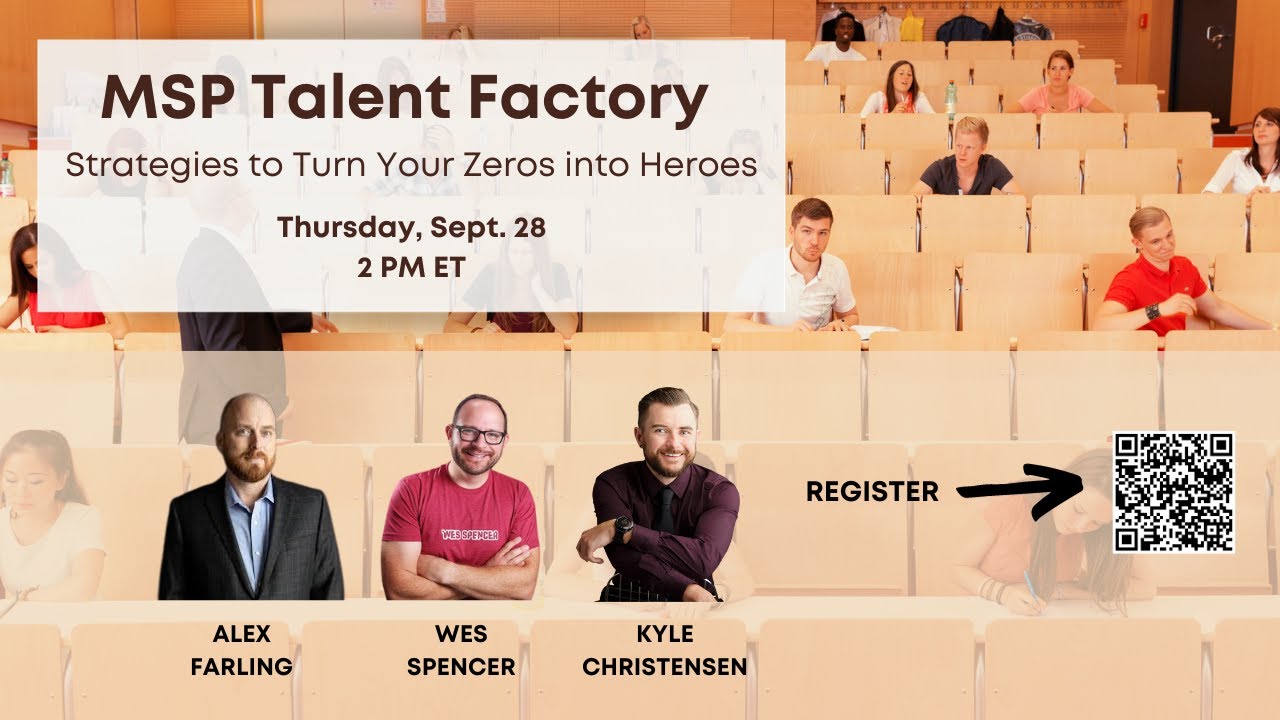
In this episode of the MSP Talent Factory podcast, hosts Kyle, Wes Spencer, and Alex Farling discuss the challenges and strategies for building a high‑performing managed service provider (MSP) workforce. They introduce the "talent factory" metaphor, comparing MSPs to college football teams that must develop players quickly before they outgrow the organization. The conversation covers the distinction between training and education, the hidden costs of recruitment and turnover, the importance of career pathing, KPI design, and motivation theories such as self‑determination theory. They debate compensation models, variable pay, and benefits, emphasizing the need for tailored employee development and recognition. The hosts also announce Empath as a sponsor, highlight vendor education initiatives (ConnectWise University, Pax8 Academy), and unveil a new community‑driven conference called RejectionCon for talks rejected elsewhere. Throughout, they share personal anecdotes, industry observations, and actionable advice for MSP owners to create scalable, empathetic, and profitable talent pipelines.
Chapters
Alright boys, we had a little issue with the, uh, counter, but let's just get this going. What's up?
What's going on? How are you guys?
Alex, you gotta— oh, Alex, you're muted. Oh, everyone take a drink.
Classic. I don't even know which screen to look at. I'm gonna have to drink Coke, that's a problem.
But, oh, you need a little extra caffeine. And there's something weird about your tag now— co-founder of Empath.
Yeah, yeah, so we did a thing. Did a thing, right Wes?
We did a thing.
And today we have my good friend, my colleague, and now my co-founder, Wes Spencer.
Aw shucks, Alex. But no, for reals, we were, I mean, Alex and I have dreamed, there's a team of people that I would love to one day work with and you were always at the top of that list. And I don't think people realize what a fortuitous sense of events it takes for something like that to happen, right? I'll just, no excuses, I'll say one, Connor Swalm from FINN, I'd love to work with that guy one day. But the stars don't align. He's too busy with Finn, as he should be, right? But you and I just had this awesome opportunity to do this together. We shared the same visions, shared the same idea set, and, uh, man, I'm pumped.
Yeah, I know, it's really cool. It's, it's really awesome. And I'll throw one out there too. John Harden is one of those human beings that, my God, I would love to work with that human being. He's so sharp. Every time I talk to him, I get smarter. And he's tucked in over there at Auvik just having the time of his life, and I can't steal him away. So, you know, there are, there are those things, and it takes a, a certain amount of the stars aligning for something like this to happen. So Yeah, Kyle, that it did. Um, yeah, you know, why can't you work with us, dude?
Hands up, you want Kyle to work with us.
Too busy. I mean, there is empathy and jealousy and all those gross emotions wrapped into the fun you guys are having, but I've done a lot of podcasts with Kyle.
I don't know, he's tough.
Yeah, you don't— ask my old business partners, you don't want to work with me. But I, you know, there is an entrepreneurial lesson in that to where just because the business you're working with right now doesn't mean you can't network with people for tomorrow. I know when I was at Best Buy, I never thought that I would go from an enterprise world down to a small business world, but I kept making friends, right? I kept introducing myself. I'd go to these trade shows and this tool called LabTech was at this enterprise trade show. And next thing I know, I meet an MSP owner that I just kept shooting the shit with because I'm trying to buy, you know, a million endpoints and he's trying to buy 10. Um, and then the next thing you know, he says, hey, I'm starting an MSP. You wanna start it with me? So the, I think there's a huge lesson in even what you guys are saying, right? Of, um, always kind of just relationships. There's a value to it. There's an entrepreneurial freedom when you have relationships that today don't do nothing. Tomorrow could be your 9-figure exit. So to both of you, I hope, uh, the best for you. And obviously this, this podcast ain't going nowhere because, uh, some things are changing, Alex, right?
Yeah, yeah, we're having fun with it. And, uh, there, there's some, there's some really good news going on with the podcast. Um, I think we get into that in a few, but, uh, I think we even have a slide to talk about it. But yeah, really good things going on with the podcast. Um, life is, life is freaking awesome. Like, you just, you You ever have that week where just everything's firing on all cylinders and everything's good? Um, that is what the last couple weeks have felt like for me.
So I'm glad to hear it.
So, uh, let's get this going though, because we gotta— we got an amazing topic. And I think where it came out of is at the very end of our last episode with Peter Kajawa. He, he used an analogy, and I haven't forgotten it since he used it. And Wes if you weren't on it, but essentially he, he talked about MSPs being more like a college football team than a professional football team. It was a beautiful metaphor for this because when you have a college football team and you're a coach, you, you go into your players and drafting your players knowing that you only have them for 4 years and you have to maximize that time you have with them in 4 years. To not only get them to the pros, right? You are a catalyst for making them go from good to great, but also you gotta use them for your own ambition to get your team in that good to great type of context. And eventually when they go professional, right, that's their career. They're gonna spend many, many years with some teams if they're good. But in, and Alex, I think you, you and I kind of talked after it, it, it's, I don't think there's a better metaphor out there.
No, there's not. And I had never heard that one before. That was a really great way to say it. The MSP space, that is just a real challenge. I was ecstatic at one point when I looked around and realized my average tenure was 8 years. And that was unheard of in the space at the time. Client or employee retention is hard. You know, we are in an industry where the economics of it just make us recruit inexpensive folks that grow quickly. And outgrow us. And that's just— that it is. It's no different than college football.
Well, I was going to say, for more like college football, I was hoping it's because we— because MSBs have weird traditions like, you know, teepeeing their own trees when they close a deal and, you know, all kinds of other weird things like ringing cowbells and catching downtown bars on fire when they win the championship.
We had a gong. We didn't have a cowbell. But, you know, you got to do what you got to do.
But right, if you think about it though too, from a, a true empathetic— to use your guys' company's whole mantra— there is a point to where as an MSP, as a small business, your employees are going to outgrow you. And a lot of us do the desperate ex-boyfriend or desperate ex-girlfriend move of, you can't leave me, you gotta work for me forever at a pay that I can't afford.
I thought it was just if we don't talk about it, maybe it won't happen.
Or it's that, right? It's, let's, let's not talk about that you've outgrown us, but shouldn't there be a humility and a pa— and a, uh, an internal passion to say, I took somebody from making $40,000 a year at a tier 1 all the way to $100,000 working for an enterprise or for a bigger MSP or whatever the, wherever they go in their career. Doesn't that have its own value?
Well, and Kyle, that's, that's not just the plight, but also the reward of what we do, you know, like, and I don't think it's also just unique to MSPs. I think it's anyone in the SMB space. I remember at my bank, I've shared this story before with others, but I had, I remember hiring my very first dedicated security analyst and oh my goodness, was he good. And he actually came from a very small MSP that wasn't doing well. And I interviewed him like, this person is incredible. His knowledge is unbelievable. He just has no security experience, stuck him in the role and he flourished. And I remember one day, He literally left. He's like, hey, he comes in on Monday. He's like, hey, can I be gone from tomorrow to Thursday? I'm like, well, sure, Austin, no problem if you need to. He's like, yeah, I just need a few days vacation. I know it's an interview. Who leaves the last minute notice from Tuesday to Thursday? But he was so new into like the professional world, he didn't know that I knew. So he gets back on Friday. I'm like, hey man, how'd it go? He go, how'd what go? I'm like, how'd the interview go? He goes, how'd you know? Did someone say it? I'm like, Austin, bro, who leaves on Tuesday to Thursday? Come on, man. Who was it with? And he's like, well, I don't know if I should tell you. I'm like, just tell me, man. He goes, it was New York Stock Exchange. I flew out to Atlanta where their, their like their IT headquarters is. And I said, Austin, if you don't take that job, if they offer it to you, I will fire you. And sure enough, he took the job because I mean, how can you not, right? Like I'm proud of knowing that I had somebody while it hurt for us to lose him, to know that he went on to do something ridiculously awesome. Right? And I think there's a reward to that too.
It's, you know, as much as we like to rag on our channel, one of the things that I truly did like about— and, you know, I'm gonna get flamed for saying this— I, I loved hearing when ConnectWise was going around after acquisition saying how many millionaires they made, right? Because they had this level to where we helped get them there, right? There's a passion for bringing my employees from, you know, a, a level of life and prosperity. That's, that should be the game. And you as an owner or as a manager, your clients are your employees. So if I want my clients to flourish, I should want my employees to flourish. Like, you have a responsibility to them. And while we could probably harp on this, we could get way too— I think we have so much stuff built for this conversation, I want to jump right into it.
Oh, so let's go talk about the gaping hole we're going to create. Once we, uh, once we allow all these folks to flourish, right?
And for some reason— oh man, we, we, you know, doing these things live, for some reason now it's, it's just the first slide's blank.
If you go to the next slide, I think you're good.
If you click on it, there's an automation there or an animation there or something.
Yeah, it's, it's— hold on.
Uh, is there an IT guy in the room?
Can we get some PowerPoint training in some empath?
Anyone want to 3-seat license for 3 dummies.
The MSP Talent Factory. And I think we owe credit to somebody, Alex, for this, this, uh, vernacular.
I was walking out of an event in Chicago, or in, uh, in DC last year, and I ran into my good friend Sean Walsh over at Encore Strategic, and we were just talking about this problem. And he was building a recruiting company at the time. And, you know, they do some recruiting for MSPs. They help you land and hire people and kind of an interesting concept. And what he said to me was MSPs need to become a talent factory. And those words just stuck with me. I've been hearing them over and over forever. He said, you know, we're always going to be the ones that hire somebody from Starbucks. And Wes likes to say we hire the kid from, from the AT&T store. You know, that is just the reality of the mechanics of how MSP works. And yeah, at some point you're going to go out and hire a tier 3 guy and you're going to pay a ton of money for him. But that's not every hire you make. That's not even the average hire you make. The average hire you make is the, the guy who can make you a ton of margin, um, billing it up at a high rate and charging you a low rate. So by the way, we've got to get those people up to speed.
By the way, Alex, just to let those— I don't know who all's in on this, you probably have vendors in here too, and that's fine, but I'm just going to tell you, if you're looking at the news that's happening right now, everyone's doing this, and I don't think it's a bad thing. ConnectWise just announced their big university play.
Connect—
uh, Pax8 has their academy. You've seen a lot of these like very large vendors that are all in on education. They're all in on recognizing if we can make talent better across the entire MSP-verse, we can close deals faster, we can grow revenue. And if the MSPs grow in their capabilities, so do the vendors. So the vendors have a vested interest in this. Yes, it's a selfish vested interest, but it's one that's symbiotic with MSPs. So read between the lines and you're seeing, I'm just telling you, education is going to be the focus of 2024. It just, I'm seeing all the tea leaves in the wind here. When we did that interview with CJ over at CRN, she's like, but aren't you doing the same thing everyone else is doing? I'm like, yes. And I'm pumped about that because it shows that there's a huge need here for all of this. And I think it's big. And I, you know, I'm an educator at heart, right? So seeing other people go down this journey too just makes me happy because it is key.
Well, and I think I talk to a lot of MSP owners about this to where there's an ignorance sometimes we have to what our true business model is as a service company. When you are a service organization, you are not a consulting company. They are two different types of companies. A service organization, the only way you make money is economy of scale. Your, your revenue goes up and your costs go down. And I know sometimes that's hard to hear because we know what repercussions that's going to have as we scale, right? That means I need more people that make less money. That's just a nature of how our economic model works. If you don't like that, right, then there's a consulting model where you eat what you kill. You sell your time, you work your time. And everyone gets a portion of that revenue share. But for us on this call as MSPs, we have to be able to have tier 1 helpdesk work higher volumes of tickets so I can control my margins to pay my employees fairly across the board and get a price that my clients actually want to pay. Right. We can't always charge $250 a user a month. That'll never scale. I was talking with Sean Torres last week and we joked that if you could get like $7,500 per user per month as an MSP, you would never have to do M&A. If you figure out that sauce through education, literally, you just land and expand. You drop in a new market and you steal all the other MSP clients that are out there from other MSPs. You don't need to acquire them, right? That's, that's, that's kind of where this economic model happens.
And are you sure that you don't want to come work for us at Empath?
You know, if you play your cards right, Um, the bridge truck will work.
Okay, deal. That was awesome. I mean, it's so true. I love, I love that.
Um, now you guys know who we are. I, I think at this point I kind of laugh. I know, Alex, you tell me we got to do this because there's new people on this call, but I think it's just one person who doesn't know who you are, Kyle, so you got to tell them who— yeah, right. Um, where do we even start with this? Let's start with Wes though, because— and where do I get this Wes Spencer t-shirt is what I really want to know.
My— well, here's the truth of that. My wife says, I will allow you to have a shirt with your name on it once for your bio image, and if you ever put it on again, she's like, we're not talking. I was like, yes ma'am. So I think it was promptly thrown into the trash, and I saw her digging out of trash and putting it into the bonfire out back. So, you know, it's gone, it's gone, you'll never see it again.
So if you're in the chat and you want a Wes Spencer t-shirt, please leave a comment because I will have a box of them at IT Nation.
No, you won't.
My wife will kill me. She will think that I did it. So yeah, that's not ever going to happen again. Yeah.
So that's exactly what we're going to tell her.
I know you would. Starting to rethink all of my empath bringing you on board, Kai or Alex. You too, Kyle. Offer rescinded. Yeah, that's awesome. So anyway, I'm a cybersecurity guy, have been my whole career, and I'm doing a bunch. I love Cyberfox. I'm very involved with them as they're vice president of security strategy and sort of a strategist and advisor for them. Um, same with Fifth Wall. And, um, but really my full focus is Empath and really pumped about, um, helping MSPs in their journey of growth and everything we're going to talk about today. So that's, that's me.
That's you. And then this guy that I'm halfway begrudgingly jealous at for being on Empath— who are you, Mr. Farling?
Uh, you know, some guy that likes to build and sell businesses, I guess. Um, you know, sold an MSP in 2020, sold us— sold a Lifecycle Insights, whatever that thing is, in, uh, in 2023. And now I'm over here with Wes, uh, working on the education front. So living life.
Yeah, Mr. Multiple Exit. Um, for me, guys, I, I'm a turnaround guy over the last 20 years. I'm the one that they bring in. Uh, I started a consulting business with a co-founder of mine back in 2018 after doing some MSP flipping that we were able to get about 5, 6 Techs, uh, where we actually helped over 2,000+ MSPs over 4 years through either PSA coaching, uh, consulting. I did a lot of EOS and scaling up type business coaching, business planning, FP&A, uh, and started to really develop a process and a feel to how do I make MSPs grow and scale fast where the employees are happy and the clients are getting really good support. Uh, so it's through this obsession that Alex and I met each other because he had a tool that my clients had to have in order to give a great client experience and not throw a bunch of time at it. Um, and it's— it was just all harmonious because of this rising tide type mentality. Um, and for those of you that don't, right, I have a YouTube channel where, right, I kind of riff and start to talk way too damn much. Um, whoa, what's this slide, Alex?
Oh crap, you know, there's some news. This cool thing about when you build a podcast or a show And you get people to show up for it every single time. Vendors start asking if they can give you money. And until now, we've actually turned away a few, but we've actually now taken on a sponsor for the show. So going forward, you will see some Empath sponsorships talked about on the show here. But, you know, to no weird circumstance or anything, I was able to strong-arm Wes Spencer into being the show's first real sponsor. Mostly because we're here to teach, we're here to educate. And the podcast kind of has the same purpose, which has really kind of been my life's focus anyway, teaching MSPs how to QBR at Lifecycle Insights, teaching MSPs at Empath, teaching MSPs here. Like, it's just a passion. So since all the things kind of aligned, as Wes said earlier, it made sense for us to bring Empath on as a sponsor.
Well, and selfishly, Kyle needed a write-off, so if I figured if I sold a sponsorship that we were getting a lot more money for, for $3.50, like Wes just mentioned, you know, it would, right, $3.50 would give me some tax breaks. So thank you, Wes, very much. My CPA's very happy. She's, she's, she's like, hey, finally you have something you can write off. Um, so that, that, you know, $20,000 loss per month that we could have sold Alex, uh, I tried.
Yeah, deal of the century.
Now, on a serious note, guys, I've been very reluctant, and you guys can ask Alex, on bringing a sponsor onto the show. And a lot of these costs, you know, we brought on video editors, bringing sponsors on the show, that's, that's the way that needs to be said. We were both unemployed, and when we started this, and we want to thank everyone genuinely, right? Like, we were bringing on video editors and graphic people and buying all these tools for this production quality And it came out of just genuinely wanting to do what we're doing. Like we just said, hey, let's hop on a call. Let's help MSPs because, right, our time is limited. And we've had plenty of people that wanted to be sponsors, but guests, and we didn't want that grossness of we don't want to be just a show to push product. And I don't ever want to be a show to push product just to be very blatant to everybody. That's not my mission as helping MSP scale and grow and make a ton of money. That includes the employees. So the whole idea of Empath, when Alex went and he said, hey, it would be kind of neat if Empath was the sponsor. It was hard for me to say, 'cause there wasn't really a tool, there wasn't an endpoint. It was all about education. And at the same time, it's the three of us still talking and conversing about the same shit we were already doing. So all of those grossnesses that I was feeling about, about bringing on a sponsor, I didn't have that grossness anymore.
Oh, congratulations, you're not gross. A little bit gross.
I mean, all right, well, let's jump in.
We got real stuff to talk about today. Let's, let's jump into the reason that folks are here, because, um, you know, and, and Wes, this— a lot of this comes out of, uh, the research and education that you did when you were starting Empath: The Talking Points. Say, why don't you kind of Clue us in on the problem and the education you've been digging into there.
Yeah, I've been, I've been pretty much knee-deep in this, uh, world of, um, education versus training. There's a huge difference between the two. Been looking at how some of the bigger Fortune 500s are investing in this. Did you know we've spent billions of dollars? We spend billions of dollars a year in this world of like corporate training. And I have to wonder, does it actually have any return on investment? And the answer to that is not really. But there's a big difference between what I found in research, the difference between training and education. And so I've looked at a lot of studies, I've looked at a lot of data, and we're going to share a synopsis of a lot of it today. I think it's going to be very, very impactful to you because I think as MSPs, we can short-circuit this because we can be much more nimble, because we can be much more effective with it, and because the dollar spent for us is $20,000-$50,000 spent for enterprise. It's really the truth. So we can be so much more effective with this. So I'm very pumped to kind of get into a lot of this data, and I want to know from you all in the audience, you know, agree, disagree with the data that's being shown, because I think there's some implications here.
It's, and it's almost cart before the horse. I mean, you know, Daniel just put in the chat, checking off someone's KPIs without data. And for those of you that have seen my Expectation Flywheel that, that I debuted on the Service Manager Show episode, we, we have these KPIs and data points, but we never take time to mentor or have a strategy of what we want our employees to do in the first place. It's like we go right to our employees need this level of billability, but then we never go here, let me teach you what billability is. Let me teach you how that helps the economics of the organization. It's like you're prescribing the result before having the reason.
Well, the transparency of that too, of, of this is how, how your, your job, your actions impact the company is huge, right? If you only understand this, how they're Yeah, go ahead.
Oh, sorry. We keep talking over each other. Just going to say quickly, here's a practical example of this when it comes to like education with MSPs. An MSP owner will reach out to me often because even on my newsletter, I've been talking a whole bunch about this. I've been pulling out this in more depth. And I had an MSP, an awesome one, reach out and say, Wes, I love what you're saying. I fully agree. But I have a problem. My problem is I'm making, I'm making education a priority in my MSP, but my folks just aren't doing it. They're not taking time for it. They're not diving into it like I want them to. And so I replied back and I said, well, I think you have a problem here in that you set a KPI, you want them to go learn, but you've not given the measurement. You've not had the accountability back to them to free them up to do it. Like, what are you doing to make it possible for them to go learn? Because they're saying back to you they're too busy. Well, we got a problem here. We have a chicken and an egg problem here because you're not giving them the capacity to go and get through all that, to get through education. In other words, You gotta make it part of their job. You can't just say, here's a KPI to go learn. What am I doing to free you up to let you go do that?
Oh my God. 100,000%. Because you could even go one step further of you don't even budget in your pricing to your clients the capacity that an employee now can go train without having to be 100% billable or utilized. And that because my only way of doing math when I build my product and packaging is to take my employee's raw cost and add markup to it. Well, they're not billing 100% of the time, so you can't do the math that way.
Well, and the maturity comes in understanding that as the MSP business owner, yes, you went and learned your craft on your own time. Maybe you went to college, but a lot of us didn't.
Your mom went to college.
Evenings and weekends and, you know, time in your mom's basement figuring out how to, how to, how to, how technology works, right? How to deploy it, how to configure it because it was a passion. Your employees don't owe it to you to go home and play in the basement on their home lab and figure out how technology works. That's just not how this works. So we've really got to find a way to make sure that we invest back into our employees. And that kind of leads to this particular slide here where we talk about turnover is expensive, right? What does it cost you guys to lose an employee? Does anybody here really know how long it takes you to get the new guy up to speed? What that costs you, how long it takes before he's profitable afterwards?
I know my MSP was a month and a half of fully burdened rate.
It was longer than that at mine, I can tell you that. It was closer to 3.
Mm-hmm. And, and that's the conversation, right? Like, is there's a discrepancy because how you onboard your employee into training, into being productive, is also equations into the economics of your business to buy them that freedom to either learn to be productive, like, when do we expect them to ramp up? Or is it just kind of this pissing into the wind thing and— or throw them to the sharks thing, right? Like, oh, eventually they're going to hit their targets. Or it's on the other side of the spectrum of, okay, here you go, here's your login to ConnectWise. Okay, thanks, see you later. And then we fire them for it because they're not hitting targets.
So imagine that ever happening at an MSP.
And, and I think, remember, let's reverse this all the way back to the beginning of the conversation when We were sort of joking that, you know, small business, MSPs included, hire people from the AT&T store. Like, where I got that quote from is an actual MSP, a very good friend of mine from an awesome MSP in Kentucky that's very, very effective, very efficient, multimillion-dollar MSP. They know what they're about. And he said to me, Wes, he goes, one thing that people don't realize, especially when it comes to cybersecurity in particular, but really in almost anything MSP, we don't hire from Huntress, we don't hire from CrowdStrike, we don't hire from Cisco. We hire from AT&T store. And he said, I literally mean that. My, my newest hire, she's incredible. She's got the world's greatest personality, can-do attitude. She loves technology. But I found her when she was selling me a new iPhone and I loved everything about it. I'm like, hey, you looking for a new job? She's like, actually, yeah, let's go talk tomorrow. And he hired her on the spot. And he said, but she's starting from ground zero. She doesn't know what an EDR is. She doesn't know what the MSP, the letters stand for and all of that. Right. And so we have a gap here. And that's really the case. And so if you think about the time investment to get that person into operational efficiency and then they walk out the door, so much more damaging because of the amount of time you've got to re-spend and reinvest in somebody new. And what a crapshoot to know if they're even going to be any good.
And if you wanted to put economics in it, there's a recruitment debt at that point you're building. Like we all talked about technical debt, but what about the education or recruitment debt that I've built? Because And I see this in sales all the time, honestly, where I'm gonna go hire 10 reps and I'm gonna let 2 of them, uh, succeed and I'm gonna get rid of the other 8. I can't show you how many times that they go and do that process and then all 10 of them don't work because they think they're all going to sink or swim. And then I ask simple questions. Sean Torres and I actually were joking about this the other day of I forgot to show them how to use the CRM to even find the phone numbers.
Yeah, and how many of us think about sales as a position that we need to train people into? It's a skill just like anything else, but we think that we hired some guy who has some sales experience and he'll go work his black magic and bring us some new customers. But this goes for every role in the business, whether it's your bank, whether it's your bookkeeper, whether it's your, you know, dispatcher, sales manager, service manager. Doesn't matter. They all need to understand how your tools work, how your organization works. There is a level of training and onboarding to get them from new guy to competent with our tools, no matter how much education they come with. Never mind if it's the guy from the AT&T store.
Well, and even we overlook things. I've seen this before where an MSP goes, oh, I'm hiring this guy from another MSP because he already knows ConnectWise. I don't need to train him. And I can tell you right now, think about how configurable ConnectWise is. I was just going to say, after having built a PSA consulting firm that's flipped about 2,000 of those things, they're snowflakes. And not only just the snowflakes of the system itself, but how you have your teams use it as a tool, right? You're giving them something where they— it was like my dad when he handed me a plasma cutter when I was 6 years old and said, be careful, don't cut your finger off. I'm surprised I have all my digits on my left hand. Like, honestly, the odds of this happening are against me. I should have been, you know, four-fingered Jack right now. Um, yeah, right. Um, so it's— we, we almost make them shoot themselves in the foot. And so it's all expensive, and we don't think about ROI, we don't think about the time the employee becomes 100% efficient. All of those things come into place too. We're losing money letting talent walk in the door not able to do their job. And it's— you don't ever get away from that debt.
Ever.
Yeah. Yep.
Uh, and I love the old analogy, right? What happens if I invest in them and they leave versus what happens if I don't and they stay? And I think that kind of sets up the next slide, right? Um, because there is actual— there's an actual LinkedIn statistic that 94% of employees say they would stay longer with their current provider or their current employer, uh, if that employer had invested in their career. And I think there's a couple interesting parts to this. One of those is not just investing in the human and leveling them up and helping them with training, but the other is also career pathing that person and sitting down with them and having a conversation about what do you want to be when you grow up? Kyle, what do you want to be when you grow up? And what does it look like to get you from here to there? And what has to happen in the company for that to be realistic? Because if you want to be the CEO, then I have to retire.
Um, so real quick, what I want to be when I grow up is an empath employee, but that's— we'll have that conversation later.
All of those positions are full, I'm sorry.
So real quick, Andy Strauss just asked something great, and I want Wes Spencer this one, and I don't know if you can see it in the chat. I'm putting you on the hot one. Do you find more of an employee makes, the less they actually desire to do? And there's a lot of stuff in there, but at the end of it, it feels the means nothing if there's no desire for an employee to self-improve we're seeing more of this post-COVID?
I was, I was really hoping you'd answer this question, so I'll take a stab at it and you can just correct me because I know I'm wrong on this. Okay. Um, so there's right or wrong here, probably, because what I'm going to say is probably wrong. You know, Andy, when you ask that question, it makes me think about the same thing. Like, um, I, I do wonder if, like, what's the— where, where does the— is it organically they just make more because they came in at a higher level, more senior role, or is it somebody that's promoted up and now they've made more money they've made progressively? Because I doubt it's the latter. A lot of times where you see people come in and you just see a lot of laziness is where it comes in for, for people that we hired in brand new. We thought were going to be excellent in the role. They're coming in because they have a senior background or have been a VP of whatever before, and they just come in with some entitlement. They don't have the hunger, they don't have the desire. Whereas you see somebody that's really promoted through the ranks, they promoted ideally because they've been killer at what they do, because they've been passionate about who they stand for and what they're building. They know they have a career pathway that takes them somewhere that's going to get them to they want to go. And those are the people I do want to reward and make sure that they continue to stay invested, because I know how much it would cost me by keeping them at the same level and they walk out the door, right? So I'm curious to know from you, Andy, if you're seeing that just from like sort of new hires that have come in, that come in at a higher level, because I'm wondering if that's a little bit more where it's coming from. Kyle, what do you think? There we go.
So jokes aside, So there's some interesting research. There's something in psychology called self-determination theory, and I've really been obsessed with this for this exact reason, Andy, is where does the ownership, like the extreme ownership, to use the Jocko Williams, the Wilson term, term, right? Where is the ability that turns somebody from a, just a basic performer to an overperformer? What causes that? Is there a psychological, uh, element that's, that's increased there? And what I found was a study from Google and MIT where they were using SMART goals in their agile process. And one of the ideas of SMART goals is that the goal needs to be attainable, meaning I have to be able to hit it. And when they started to implement SMART goals, they noticed employee satisfaction and churn actually went up— or, and satisfaction went down and churn went up with their employees. And they were like, wait a minute. We make your goals attainable, like basically easy to hit, and you're not satisfied. What's going on here? And when they dove into this, this, um, the self-determination theory, what they found was that the human psyche truly only tries harder when there is a challenge, when there is something putting resistance on me. If you hold me back, I want to push forward. It's that old exercise to where if I put no force and I push, then I get— I, I move, right? However, if I put a little bit of feedback, now there's a bond, there's a relationship that holds me there. And what happens in, especially in MSPs, we create these KPIs and say you need to be 80% billable, but then we keep giving you easy tickets to be 80% billable. We never make it harder. You get complacent. Now what you were afraid to do, because we're gonna, we think naturally we are just going to piss off an employee. But what if you were to increase that, make it 85%, move the target on them? Now I need to try a little bit harder, right? I need to grow a little bit. I need to push myself a little bit. That is where they start to now, while in the moment, right, they're a little frustrated because, man, I really, man, I thought I just got over this. You're now, you're now encouraging them to be better, finding, be more unique, right? Use that idea that out of necessity comes, is the mother of invention. If I now have the necessity to be 5% more efficient, I gotta be more creative to get there, which is going to drive me there. And if you're doing that and at the end of the day, in my opinion, they're still not holding their weight, Andy, let me know your address and I'll send this to you because there's a point where then this may just not be the job for them.
Alex, I have a question for you on this from a sales perspective. I wholeheartedly agree. And Kyle, I'm somebody that needs to be pushed. If I'm not being pushed, I fall into complacency. I have a very lazy-based nature. And if I don't have a goal and I don't have a deadline— yeah, I mean, yes, that is me. And so it's why I'm so driven, because I know the alternative is a dark place I don't want to go to. That's just transparent. It's me. But here's my question, Kyle. Sorry, Alex, is I was talking to somebody that's very good in sales and they have a quota they carry and they've hit that. Not only have they quit, they hit that quota, they've hit that quota 3 years in a row. In all 3 years, they've actually blown it out. They are the highest revenue generating salesperson in their MSP. And I was talking the other day and they're complaining they're ready to move. And the reason they said they're moving is they said, so my MSP keeps raising the bar for me. They keep taking my revenue higher, but I'm not being rewarded anymore. So all they're doing is punishing me and now they're pushing me out the door and I'm going to walk out of this MSP having been their highest revenue generator because they're just pushing me to do more without me getting any extra reward. All they're doing is they're punishing me. I should be rewarded for this more. They should just leave me alone and let me continue making all the revenue that they wanted me to make instead of making it harder and harder and harder for me. Is the gap because they're also not rewarding him more? Like, what do you think on that?
I think so. I think one of the— and Kyle will have his own opinions on this, being a guy who is big on KPIs. But, um, I have no problem raising a salesman's quota, uh, raising their— my expectation of them, but their salary better go up with it, right? If I'm, if I'm saying this is your minimum and this is what you have to get just to, to have your base, we need to— if we're going to raise that, we should also be raising your compensation. Salespeople aren't any different than regular employees. If you're giving everybody else 3% every year, give your salesperson a pay raise every year, um, raise their base every year. And when you raise their, their quota raise their commission. Um, I think Connor Swam dealt with this over at FIN better than anybody I know, and Connor talks about this openly, so I think I can. Um, he doesn't cap commission for his salespeople, so it doesn't matter. It doesn't matter. And, and if you, if you know, hey, if he sells this much, I make this much, as long as the math problem's done right, I don't need to penalize him by raising his quota, raising his minimums. If he's hitting what, where I think the bar ought to be, and I'm paying him for everything over and above. There is a win-win scenario.
We always—
this leadership team is creating a win-lose scenario.
Well, and I think there's— I think there's something else here, though, where if we were to take a look at that MSP, Wes, that you were speaking with and this quote right here, I think on the next slide, right, people don't quit jobs, they quit bosses. It applies to the situation because if we were to go look at all the other sales reps at that MSP, how many of them are not hitting quota? Is he the overperformer that like the tier 3 engineer at some MSPs where we just always assign them tickets because they always get it to work, but we never hold the tier 2 guy that keeps escalating it and doesn't really try harder accountable, right? If we were to hold that guy accountable and try to get him to move up or out and actually be a manager and have those tough conversations, would I need to always rely on that rockstar sales rep? Would I always need to? To write? Like, is there something else there? Is there— or is the company not reinvesting to bring in a second sales rep?
Well, and if the company is— you basically lead yourself right into this slide, right? This human would have stayed, would have been the overperformer forever. They would have continued to knock it out of the park for this MSP. And instead, a boss is doing something stupid and the employee's on the way out the door. And this goes into, you know, providing training, providing growth opportunity, providing all these things for your employees, but really it's just about being a good place to work, right? If we create a great environment, employees don't look for somewhere else to go. Um, I know at my MSP I had employees who turned down better opportunities with the state of Delaware, who used to come poach all of my employees. Um, they just knew that we were kind of a talent factory, and I had employees turn them down when the benefits were better, the pay was better. It was just a crappy place to work, and they didn't want to go to a crappy place to work.
Yep, it's a combination of things, right, when we talk about retention. Because just like our clients, there's good churn and bad churn, and it's recognizing that some insecurities we have when it comes to accountability and education and training, right, there's got to be a level to where— not that it's accountable, but it nurtures everyone to the same destination that their business is going to. And that, right, that quid pro quo— I like where I work, so I'm going to stay there. I don't know, like, I don't know where I'm going with this thought. It kind of fell out of my head a little bit.
I'm going somewhere with a thought. Um, it's one that's going to get me in some legal trouble, uh, but I'm just going to say it anyway. Um, so this isn't reflective of any experience I've had, but come March, maybe I can change that statement. How about that? There was a company that I'm aware of that the folks that worked there certainly made far less than they could have made, especially in development. However, if you were to ask them, are you guys thinking about leaving? They'd say, heck no, we're not leaving for 3 reasons. Reason 1, we have equity, and that equity is worth more than the money I'm making. The money just pays my bills, but the equity is really exciting because I'm working for a means to an end. I'm part of a team, and us getting to the finish line means I get a check at the end of the day. Or the end of that journey, I'm really excited about that too, was I'm having fun at work. Like, I work, I can do fun things and we do fun things. And third is like, I have meaningful, rewarding experiences in what I do. And those that I work for, I love them because we're tied into the same mission and they're eating the same tacos I'm eating. They're not rich either. We're all going down this journey together. We're building towards a means to an end. Well, that company had to get— it happened to get acquired. When it got acquired, I kid you not, within 60 days, every single developer walked out the door. And what was shocking to the acquirer was, well, why did they leave? We kept their salaries the same. And that person said to them, hello, how did you think that wouldn't happen when you didn't give them significant raises? Because their means to an end, their equity transacted. They got what they needed out of it and they weren't properly incentivized to make what they want. Now, we— I know we just said the slide before that they would stay if they, you know, they had a workforce development, all that kind of stuff. When you're that far off and you lack all the other things, that's on the ownership to not actually look at them and say, as a good boss, I need to step into their shoes and think about what they need to be able to survive. No wonder they went from $150,000 to $250,000, go and work for a cool blockchain startup or something like that. And that's literally what happens in those kind of situations. So I think what's predicated to the business owner is like what makes you a good business owner is actually stepping in the shoes of the employee and say, am I doing the right things for them? Am I putting the right things in place to keep them incentivized and keep them excited? If it's not equity, then what is it that keeps them excited about it? We owe it to them to be able to keep them. If we don't do that, they go 3 slides back, how expensive it is to replace them.
I think we struck a chord with Wes Spencer.
Yeah. Now the lawyers are coming, but it wasn't any of my direct experience.
Well, let's move forward because the recorded version is going to be chopped up a little bit and shorter than normal.
It's all right. Yo, lifestyle.
There'll just be a lot of bleeps over Wes, that's all. It'll be the first time anybody ever thought Wes Spencer's a bad word.
Yeah. Oh, so what's this Gallup poll, Alex?
Yeah, now we're stepping into a Gallup poll where we're saying that, uh, about 56%, uh, of employees are less likely to look for new opportunities when they're recognized at their current job, which I think is important. But only 19% of employees feel like their organization has a strong culture. And this goes to exactly what Michelle was talking about in the chat, which is that employees need to feel like they're part of something, right? If we're good at recognizing them, we used CrewWho at my MSP. It's a great little tool for the attaboys and the pats on the back. But we also did career pathing and planning, and we celebrated when everybody had a win. Like, if you create a culture of celebration and recognition around people people's successes. Somebody goes out and gets a cert, throw a pizza party. Like, just do something that says, hey, we did a good job. Um, this is going to bring— this is going to bring a little bit of pride to that employee and a lot of loyalty from that employee. And that's just been my experience. But interested to hear what the rest of you guys think about it.
I, I always— I understand it at its core and the insecurity, but I always see this, I'm afraid of variable pay, I hate the term variable pay. I see so many people opposed to anyone that's not sales having a variable pay model. And then I see really high-performing employees also upset that they don't have an opportunity to make more money. So there's almost this cultural paradigm in the operations and finance world where we need to, to challenge the zeitgeist and say, hey, variable pay isn't a bad option if the base is fair and the— and it's a win-win scenario, right? If I have engineers that I expect them to bill 500 hours every single month and they bill 600 hours, then I know as a business I should have made more profitability. Therefore, why couldn't I give them a little share in the pie? And why would they not want that either? Because I know the ones that stay till 5:30 and make sure that the boards are clean before they leave, those are the ones I want to take care of. And isn't that just a super awesome objective way to do that? And it's, it's, it's funny on how often I see people so opposed to that. Kyle, I can't do variable pay, all my employees will leave us. Well, how many of your employees are taking advantage of you then? A lot of tough love in this conversation about development.
And how many of your employees aren't performing at their best? Because if they were, you'd be able to pay them the top tier of that variable pay all day, every day. So there's a good conversation to be had there. It's been hoisted on salespeople for a long time. Just be careful with variable pay with your salespeople because also we hear people go, well, can't I just pay the sales guy 100% commission? No, he has to be able to eat and keep his home. God forbid he has a bad sales month. I don't care how good he is and I don't care how good he convinced you he is. You can't just pay sales and you can't just pay anyone., you know, commission or performance-based.
Well, I might disagree with you a little bit on when it comes to sales guys. I like to pay them just, just under what keeps them eating, just so that they stay hungry to make the deals, outperform ramen noodles just a little bit. Yeah, right. I'll give you enough to eat ramen noodles every night. If you want to eat steak, you gotta earn that steak, right?
So 60% of employees say that the second most important factor next to salary is benefits. Now, I don't know how many of you guys struggle with benefits as an MSP. I did. Holy crap, they're expensive. They're hard to get right. How many of you have had the experience where you went out and bought, got good benefits for your team and then they don't even use them? Right? This happens all the time. We did an IRA for our employees, right? Where they can do, we can do a company match contributions, the whole works. And I will tell you, less than half of the company actually signed up.
Then, you know, mine was the exact same way, Alex. How many people didn't want to contribute to 401? And I think this goes back to the beginning of this conversation of how many of your employees know what a 401 is? Are we educating?
Well, and not even that, not even that. Like, the same way everybody wants to be recognized differently, different people see value in different benefits., right? The single mom may see more, more value in, or the single parent may see more value in an extra day off for exceptional performance, where the, the stable family person who is tucking money away for a rainy day might see more value in that IRA or that 401. So I think it's important to talk to your team and understand what they see value in because, you know, it's not always about the benefit. It's not always about the fact that you give benefits, Sometimes it's about how and what benefits you give, because different people value completely different things. I remember when I was, um, in, in my very younger years, I filled vending machines, and I watched our, um, our union trade away really, really good health insurance for a 50-cent-an-hour pay raise, and I was annoyed as hell. Some of the drivers on those trucks were super happy to have their 50 cents an hour, and it was just an eye-opener to me that we don't all see value in the same things. Some of us just want a really nice red Swingline stapler.
And I think though, bringing this into kind of how sales approaches like target market, right, or ideal client profile, we all talked about that in a cybersecurity context. What is your ideal employee profile? And are we asking the question of what benefits does our ideal employee profile want? Right. If I'm hiring, like if I'm— when I'm back at Geek Squad days, right, we're all under 21. Every single employee. I'm sitting there going, what is most important to me right now is beer money, right? It's the maximizing the amount of beer that I have in my fridge and also trying to find 21-year-olds to buy it for me. But I digress, right? There's a level there where, are they asking us, hey, what would you like, right? Especially in this decentralized world where most of your employees might be remote. When I see, oh, we have, uh, um, carpooling type benefits, and we're trying to, you know, we're going to give you a car allowance. And I'm sitting here going, I haven't driven to work in the last 2 years, why do I even care? Because some HR person at a PEO said that's our standard package.
Yep.
Wow, I love this image.
Has anybody ever felt stuck at work? The, uh, there are a lot of studies out there that say that employees just don't feel that pathway, right? That, uh, leadership has not invested in their ability to grow as a person. And I think as important as it is to, um, to maybe in the interview process talk to somebody about what motivates them, how do they like to receive recognition, how do they— what do they consider to be benefits, flair. The, you know, it's important also to understand that good employees, the ones who are going to stick with you for a while and want to grow, need to know what growing looks like to them. You know, you might have somebody in a Tier 1 engineer role who wants to be a manager. They want to be a service desk manager. They want to be a pod leader or whatever. You might also have some folks that are in a role and want to get way outside of that, right? I had took a guy from Tier 2 engineer to salesperson. And he absolutely loved it. Technically, he was an account manager, but he did some sales too. And so, and he was absolutely way more happy there. The consistency of the help desk was not his thing. It didn't suit him well. So we built him a career path and we helped him. I hired a sales trainer and we coached him on sales and account management functions and literally grew him out of that role in a period of about 18 months. It takes time. It takes an open role. There has to be a spot for that person to go. But I think it's super important for everyone in your organization to know what tomorrow brings and what the future brings and where they're going and what they want to do.
You know, you know that movie Incredibles, the very first one, when Mr. Incredible is stuck in the insurance company and, you know, he had this like huge, you know, his whole job as a superhero is saving the world. And then, you know, the superheroes get in trouble because that one guy. And so, you know, they ban superheroes and stuff. They have to go into this, like, you know, this terrible career. And he's like this insurance guy. You see him, he's like just sleeping on the phone and you're watching that. And I think we've all had those jobs before where we're like, we literally cringe because in our human DNA, I truly believe we are built to do great things. We are destined to go build and create and do something huge and impact the world in whatever that way is that we are built to do. And then you get stuck in a job like that, right? I think it's why it's so visceral in that movie. I almost hate watching that scene because I just can't stand it. I can't see— I can't stand seeing what that must be like. And then eventually, of course, he gets out of it, gets back to his roots of being a superhero. That's what career pathways are all about, is getting them out of the insurance job, so to speak, and into being who they're created to be. And I think if you do that, if you have a career pathway that can track and know what that employee, what we want them to be like because they've told us and we know their skill set and we give them a pathway to get there, man, that creates It's so much excitement. I also think it gives them the ability to say, you know, I don't like what I'm doing right now in this one step, but because this step is just part of many steps to get to where I want to be, I'm passionate about it even though I don't love it because I want to get to over here and I'm happy to do this to get to over there. I think it's so important.
So you recently did a whole thing about repetition on YouTube, Wes Spencer. I think everyone should go check it out. It's a great video, but I think there's also a, there's a, there's an overcorrection to that. Which is when does repetition become monotony? When does it become complacency? When does it become, oh my God, I've literally sitting here stamping forms like 8 hours a day. And if there's one— Yes, exactly right. When is there a point where we need to have responsibilities to ourselves to say, I have become complacent, I need change, right? We want so badly to be upset at our employers But I, I almost want that tough pill to swallow, which is, yeah, and what are you doing about your own career to get out of that monotony, right? Sometimes it doesn't have to be salary, right?
Yeah, well, there's different humans for that. There are people who enjoy knowing what tomorrow, what the day is going to bring, and doing the same thing over and over, and, you know, balancing the books and doing the steady eddy kind of thing. Um, I'm the human being that the third time I do it, I'm bored as hell with it, and I don't ever want to do it again. Um, you know, and, and so you have to know who your employee is again to know what they're going to value and where, where that monotony is going to make them crazy or where it's going to give them that, uh, that little bit of comfort that they can wrap, wrap themselves up in and come to work happy every day.
Well, I think I know that the three of us here, because we've all done the startup thing, there's fun in startupness. And the reason I think I love being a turnaround guy is because I got to go into pandemonium hell Everything, nothing is working, there's just a thousand things to do. I jump in, you clean it up, you figure it out, you get processes. But the second it turns into turning crops over and watering the farm and harvesting crops and doing it again, I'm bored as fuck. Like, I'm just—
I enjoy being a sales guy, right? I mean, that's why, that's why I enjoyed sales so much. You get a new dumpster fire every 24 4 hours, right? And you get to sit across the table from somebody else and go, no, it's not the worst network I've ever seen. I promise we can fix it.
Um, but going into leadership and mentorship though, you need to ask your employees these questions. You need to ask them, dude, you're not performing. Are you just bored? Are you just over it? I know it's a tough conversation because the answer might be it's time to go start looking for a job, kind of like Wes Spencer, your guy that was going over to the, to the NASDAQ. Right? There's a point where we may need to suggest to them, hey, let's make this fun, let's make this exciting, let me write you a letter of recommendation, let me help you find that next thing. And you want that because then you have opportunity to go find their replacement, bring them in, have them work side by side, and help the next guy move out the door, right? This is getting into that talent factory idea to where we can't— we're not going to keep them forever, guys. We're not.
And how often is it when that person heads out the door that the rest of the team goes Oh, thank God he's gone. He was making me crazy.
Kyle's like, that's the other side of the fence, right?
That person who's not having fun, who's not engaged, who's not enjoying what they're doing, that is a drag on your culture across the company, not just on that one human.
It becomes, it goes from being bored to having this like anguish to your employer because you haven't had anyone challenge you to say, Is it us? Is it because your job's not changing? Because we're just— your role is a job that doesn't change. It's tier 1, it's tier 2. You're just going to be working tickets because it's an assembly line. Or, right, is it— is it something else? Um, employee retention is predicted upon employee job satisfaction. How many of you guys in the chat do employee satisfaction surveys? I'm curious. Do we use that as a KPI? We got some people, Dana and, uh, Daniel. Do we actually make changes while we're waiting for the yeses and the nos?
Kyle, what, what kind of questions should we be asking? Like, not just are you happy in your work, do you like this company? What else should we ask?
Are you gonna quit? I just realized, by the way, we're starting to run out of time, and I don't, I don't want to get away from this, but employee satisfaction, it's still a lagging indicator, right? It doesn't replace true management of an employee, true mentorship. I think sometimes we go right to management and we skip mentorship, we skip training, we skip education. We go right to the, I'm gonna swing the hammer on you. But right, I think it's those opportunities, those open-ended questions. Did you have enough time? Like, how many hours this week did you spend You know, taking a course. How many hours this month did you spend, uh, like, what are you looking to grow into? What's exciting you right now? Like, Google has that 80/20 rule, right, where 20% of their month should be dictated on something you just want to do, a passion project, right? Like, are you giving employees that? Let them speak out. Did they say, hey boss, I don't like how our automate is set up, and you go, well, it's set up fine? Or are we having this kind of this, this ego competition? Or are we saying, cool, do you want to work on it? Do you want to champion that? Do you want to be the person to make change from this?
That's good. You know, there's an interesting, interesting correlation here. It's much easier to save somebody's data if you realize the hard drive is failing when the smart indicator goes off, but before it starts clicking, right? It's much easier to save an employee when you realize that there's a problem, but you get to it before they're unsatisfied. I just think it's important that we have these conversations before things are all in the tank.
And, and Andy asked, you know, at scale, who mentors? Everyone does. I mean, it doesn't have to be a leadership role, right? If I'm a Tier 3 and there's a Tier 2 guy, right, are we setting up mechanisms to where, hey, come shadow me for an hour this week and see me knock out this PowerShell script and how I write it? Right? Like, there is a system to where everybody learns from everybody. I, I don't think that ever goes away.
And, and at size, you know, you get to a point where the leadership can't mentor everyone. No one can have more than 7 direct reports and be functional, right? At 7 direct reports, you— beyond that, you will spend every bit of your time just dealing with the issue of managing all the people, and you won't have any of your own work to do. So there's this thing where not only do you have to mentor them on their career and what's going on, but at some level you have to teach middle managers how to do that with the people that work for them. And what better way to do it than to be able to say, hey, remember all the things we did with you while you were just a tier 2 engineer? Well, when you— when we promote you up to a management role or middle management role, we're going to expect you to do these things back with the rest of the team.
And on that note, those rejected ones, I feel like this was written directed at me here, Wes. What's this rejected con?
Hey, look, we asked you and you think you rejected us. Maybe we're the rejected ones, Kyle. I'm just saying. So yeah, if you haven't seen it, I dropped the news on this today, although CJ in the CRN article last week did hint at it. You know, I know what it's like to be rejected. I think we all do. It's not a fun— it's not a fun experience, right? And one thing that Empath is about is we're about giving a platform to folks. We're about creating a decentralized place where some of the best creators out there can go and produce and educate and help us all in our journey. And so we decided in a lot of conversations with MSPs that there's a whole lot of talks that got rejected that shouldn't have at big conferences, whether that was, you know, Black Hat, whether it was, uh, some, you know, small conference or anything in between. So we've created literally a conference called RejectionCon that is for the rejected ones. It's really cool. So check this out, rejection.com. Look at our sad little robot there. Isn't he so sad? I showed it to my wife and she's like, oh, I'm so Sad. I'm like, yes, I got what I was going for. I had AI create it for me, was Midjourney. Uh, but what this is all about is, um, we're— we are letting those that have had a rejected talk— and that's the criteria, it has to be a talk that's never been given before and has been rejected by a conference— you can submit it in, and we're gonna let the community vote for the best talks across, uh, all kinds of areas: finance, operations, revenue, technology, cybersecurity, all these different topics and areas that you're going to be able to submit for. And we're pumped about really giving a platform to the voiceless here. And the coolest thing is 100% of your attendance fees, like the conference pass, goes to charity. It goes to the Rural Tech Fund. It's a 501. I'm really good friends with the person that runs it. It's fully vetted. What they're doing, they're all about is giving funds into school systems that don't have the resources for STEM, for science, technology, education, math, all that stuff, engineering, math. It's all about that. So what's cool is we get to do good, we get to learn, we get to do some awesome stuff. So I would love for you to take a look at that rejection rejectedcon.com. There's a waitlist if you want to be first to know on all the things that are happening. It's right there. And if you have a talk that's been rejected, well, pretty soon we're gonna have a little form where you can even submit your rejected talk. So really, really, really excited about it.
So the question comes up, Steve has asked us, what happens if they get rejected again?
There's no rejected talks from RejectedCon. We've already thought through that, Steve. So we have a mechanism. There's going to be a limit, there's going to be a cap to how many people can submit. So if you don't get in, you have to submit next year. But we have a plan in mind for that. There are no rejected talks at RejectionCon. That is not a thing. We thought about that in depth.
Right on. Well guys, as always, I appreciate it. I know we went a couple minutes over, guys. I appreciate those that stayed on with us. We're going to go ahead and cap it here. Um, we're probably gonna have to do a part 2 on this. There was like 5 slides we didn't get through, so I'm sure we can go ahead and revisit those. Uh, we are going to be sending out the announcements for the next session, it's gonna— we're gonna tailor it a little bit more towards finance. We're gonna talk about our clients' budgets and our budgets as MSPs, probably in the next couple sessions. And, uh, we'll have to come back at some point, Wes, uh, to keep on this education train.
We'd love to.
And thank you for your tree fitty.
Anytime, my friend. Thanks everyone.
All right, thanks.
Yeah, everyone else, take care.










